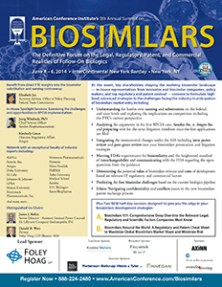
• BrochureInforma Life Sciences will be holding its 23rd Annual EU Pharmaceutical Law Forum on May 14-15, 2014 in Brussels, Belgium.  The conference will offer presentations on the following topics:

    • Feedback from the EU Commission on competition law (keynote presentation) — to be presented by a representative from DG Competition, European Commission;
    • Reverse payment patent settlements;
    • Examining parallel trade: Imports and exports;
    • Relationship between pharmaceutical companies and wholesales/distributors: Assessing the competition law aspects;
    • Review of high profile national cases/decisions in competition law;
    • Unified Patent Court: Feedback from the European Commission (keynote presentation) — to be presented by François Arbault, Head of Unit, European Commission;
    • Interface between competition law, IP and the regulatory frameworks;
    • Understanding European patent and SPC litigation: Changes ahead (evening seminar discussion and dinner);
    • Implementation of the EU regulatory framework for medicinal products for human use (keynote presentation) — to be presented by Olga Solomon, Deputy Head of Unit D5 – Medicinal Products – Authorisations, European Medicines Agency, DG Health and Consumers, European Commission;
    • Transparency of pre-clinical and clinical trial data and other regulatory data;
    • Review of the clinical trials regulation;
    • Evaluating data exclusivity/Regulatory Data Protection (RDP) in the pharmaceutical industry;
    • Interaction with healthcare professionals – challenges and changes;
    • New trends in pricing and reimbursement and revisions to the EU Transparency Directive: Main focus on France, Germany, Spain, Italy and the UK;
    • Practical experience of the new pharmacovigilance legislation;
    • Feedback from the EU Commission on the EU regulatory framework for medical devices (keynote presentation) — to be presented by Despina Spanou, Director for Consumer Affairs, European Commission;
    • Examining the use of medical devices;
    • Overcoming challenges surrounding personalised medicines and IVDs;
    • Reviewing combination and borderline products;
    • Biosimilars and the regulatory frameworks; and
    • Examining pharmaceutical advertising, social media and health apps (evening seminar discussion and dinner).

    A complete brochure for this conference, including an agenda, detailed descriptions of conference sessions, list of speakers, and registration form can be obtained here.

    Informa Life SciencesThe registration fee for the conference is £1632.29 (1 Day Pass — conference and evening seminar for day 1 or 2), £2055.79 (2 Day Pass — conference only), £2660.79 (2 Day Pass — conference and one evening seminar), or £3023.79 (Full Pass — conference and evening seminar for days 1 and 2.  Those registering by April 11, 2014 will receive a £100 discount.  Those interested in registering for the conference can do so here, by e-mailing registrations@informa-ls.com, by calling +44(0) 20 7017 7481, or by faxing a registration form to +44(0) 20 7017 7823.

    Patent Docs is a media partner of the EU Pharmaceutical Law Forum.

  • PLI #1Practising Law Institute (PLI) will be holding its Fundamentals of Patent Prosecution 2014: A Boot Camp for Claim Drafting & Amendment Writing seminar on May 13-15, 2014 in Chicago, IL, on June 11-13, 2014 in New York, NY, and on July 9-11, 2014 in San Francisco, CA.  The three-day program, which is directed to patent prosecuting and litigating attorneys and patent agents with or without a Patent Office registration number or little patent experience, will focus on teaching the basics of claim drafting, patent application preparation and prosecution, as well as a review of recent developments in the law.  A litigator's perspective is also presented to show how drafting and prosecution can influence the development, and often the outcome, of subsequent patent litigation.  The seminar will feature lectures in the morning followed by small clinic sessions in the afternoon, with day 1 focusing on invention disclosures and patent preparation, day 2 on prosecution and issuance, and day 3 on litigation and opinion drafting.  Lectures will explain:

    • How to decide what elements of the invention should be included in the patent;
    • How to prosecute an application to result in allowance of an enforceable patent;
    • How to interview an Examiner;
    • How to use reissues, reexaminations, and other post-issuance proceedings;
    • How to anticipate patent litigation issues during the patent prosecution process; and
    • How to approach patent opinion drafting.

    PLI faculty will offer presentations on the following topics:

    • Taking Invention Disclosures;
    • Overview of Claim Drafting and Preparation of Patent Application;
    • Claim Drafting;
    • Review of Model Claims;
    • Patent Prosecution;
    • Conducting the Examiner Interview;
    • Review of Model Amendment; and
    • Litigation Issues.

    A program schedule and list of speakers for each of the locations can be found herePatent Docs authors Kevin Noonan (Chicago co-chair) and Donald Zuhn will be presenting on day 1 at the Chicago seminar.

    The registration fee for the conference is $1,895.  Those interested in registering for the conference can do so at the PLI website.

  • George Washington University Law SchoolThe George Washington University Law School (with Mayer Brown and Pillsbury) will be holding its annual GW Law Symposium on Intellectual Property on May 6, 2014 at The George Washington University Law School, 2000 H Street NW, Washington, DC.  The Symposium will offer presentations on the following topics:

    • Keynote Address — Nathan Kelley, Deputy General Counsel for Intellectual Property Law and Solicitor, United States Patent & Trademark Office

    • Beginning of A New Era: Post Issuance PTO Proceedings

    • Tips and Trends for Litigating Patent Cases in the Federal Courts

    • ITC: Recent Developments and Current Trends

    • Defensive Strategies: Patent Litigation

    Additional information about the Symposium, including a program, list of speakers, and directions can be found at the Symposium's website.  A cocktail reception will take place following the Symposium.

    The registration fee for the Symposium is $25 (Student Registration) or $75 (General Registration).  Those interested in registering for the Symposium can do so here.

  • Technology Transfer Tactics will be offering a webinar entitled "The Supreme Court’s Medtronic Ruling: Practical Guidance for Protecting University IP" on April 24, 2014 from 1:00 – 2:00 pm (Eastern).  Brian D. Gildea, Executive Director, IP & Licensing, Boston University Technology Development, and Charles R. Macedo of Amster, Rothstein and Ebenstein, LLP will dissect the Supreme Court's decision in Medtronic, Inc. v. Mirowski Family Ventures, LLC while giving practical guidance on how to manage and fortify patent portfolios in light of the decision.  The webinar will:

    • Review the Medtronic v Mirowski Family Ventures case specifics;
    • Address the three notions the Supreme Court's decision was based upon;
    • Provide expert tips on drafting and negotiating future patent licenses in light of Medtronic;
    • Address how to respond to declaratory judgment petitions — and what will meet "burden of proof";
    • Provide practical guidance for prepare burden of proof evidence; and
    • Provide best practices for dealing with licensees who file for declaratory judgment.

    The registration fee for the webinar is $197.  Those interested in registering for the webinar, can do so here.

    Technology Transfer Tactics

  • Strafford #1Strafford will be offering a webinar/teleconference entitled "Advanced AIA Issues for Patent Claim Construction: Best Practices Absent Clear Court Guidance" on April 23, 2014 from 1:00 to 2:30 pm (EDT).  Thomas L. Irving of Finnegan Henderson Farabow Garrett & Dunner, Colin G. Sandercock of Perkins Coie, and Lauren L. Stevens of the Global Patent Group provide guidance to patent counsel regarding the impact of the Leahy-Smith America Invents Act (AIA) on claim construction and offer best practices for addressing claim construction issues in light of the AIA.  The webinar will review the following questions:

    • What are the changes resulting from the AIA and the implications for claim construction?
    • What is the impact of claim construction on choice of law?
    • What are the benefits of new claims in a continuation application regarding choice of law in view of transitional applications?
    • Can the choice of law change when a district court judge construes the claim in such a way that the EFD changes?

    The registration fee for the webinar is $297 ($362 for registration and CLE processing).  Those interested in registering for the webinar, can do so here.

  • By Andrew Williams

    Senate SealThe Senate Committee on the Judiciary was set to consider the Patent Transparency and Improvements Act of 2013 (S. 1720) earlier today during an Executive Business Meeting.  Instead, the Committee again tabled the bill, this time until next Tuesday (April 8, 2014).  In his statement on the issue, Chairman Leahy suggested that it was Senator Hatch's "bonding" provision that was the sticking point necessitating the delay.  However, it was clear that the Committee had been receiving feedback from stakeholders, which may have been slowing the process.  For example, Sen. Leahy's statement included the observation:

    Even casual observers may have noticed that the Senate does not operate like the House of Representatives.  Not only do Senators like to talk.  Senators listen to those who oppose their ideas.  There has been a lot of talk about the need for patent reform.  And over the past several weeks, I actually think there has been a lot of listening.  We have heard concerns about unintended consequences; for instance, this having an impact outside of the context of patent law.  We have heard concerns about pending Supreme Court cases, like the case they heard this week about the patentability of software patents.  We have heard concerns from businesses on Main Street and the tech community that reforms must be meaningful to address the problems they face.

    Nevertheless, he did sound optimistic that the few remaining issues could be nailed down in the next day or so.  Sen. Grassley echoed those sentiments, indicating that staff discussions have been productive and that they are moving in the right direction.

    The key words used by many of the Senators that provided a statement were "optimism" and "unintended consequences."  It was heartening to hear supporters on both sides of the issue express concern over the potential impact that the proposed provisions might have on the legitimate assertion of patents.  For example, Sen. Lee, co-sponsor of the above-referenced bill, indicated that he was addressing concerns from both sides regarding the consumer stay and demand letter provisions, so to "appropriately and narrowly target patent troll behavior."  He stressed that he was seeking to take into account the legitimate concerns of patent holders and trying to minimize any unintended consequences.  Sen. Lee's stated goal was to have a patent system that serves its Constitutional purpose, by encouraging, not hindering, innovation.  Of course, the unintended consequences of the proposed legislation that we are most concerned about is just that, a hindering of innovation.

    Sen. Schumer also expressed optimism that the Committee could reach an agreement.  As he did the other day in his event with the Internet Association, Sen. Schumer compared patent trolls to hookworms (or tapeworms), because "they do nothing, they attach themselves to the insides of the body, and eat the food that other people have worked to cultivate and digest."  Sen. Franken was not fond of this analogy (maybe it was too close to lunch), and Sen. Leahy quipped that they would hold the biology mark-up right after this.  But to his credit, Sen. Schumer did identify one of the most serious unintended consequences of the fee-shifting provision — even with the prospect that fees might be recouped, younger companies will not be able to survive the potential five plus years of litigation to get them.  He reiterated his desire to expand CBM patent review, but acknowledged that it was unlikely to be accepted.  Finally, he welcomed the delay if it would ensure a better bill, because a good bill is better than passing ineffective legislation.

    It was not until Sens. Durbin and Feinstein provided their statements that a sense of the opposition to the legislation was truly felt.  Sen. Durbin began by pointing out that the extent of the "patent troll" problem may have been exaggerated.  He quoted from the GAO report that determined that only 19% of the patent infringement suits were brought by non-practicing entities.  The overwhelming majority, therefore, were brought by non-"trolls."  He criticized the House of Representatives for hurriedly passing the Innovation Act, expressing concern that they did not engage in thoughtful deliberation.  He explained that many of the House members were probably not aware that "universities, manufacturers, biotech companies, venture capital groups and independent inventors had serious concerns about this House bill."  Sen. Durbin continued by stating the concerns have not gone away, and then read from the letter delivered by the Innovation Alliance and others, which we reported on yesterday.  He was shocked by the diversity of organizations that signed that letter, and was surprised by its content.  Instead of the policy concerns he was expecting, the letter addressed a fundamental question — that some of the measures go far beyond what is necessary to address the threat of abusive litigation, and instead "would do serious damage to the patent system."  He concluded by pointing out that because this legislation will be more controversial than anticipated, Congress needs to make sure to protect the legitimate patent holders.

    Sen. Feinstein also described a letter that she received, this one from medical device manufactures.  She expressed gratitude that this letter listed all of the concerns with the various bills clearly and distinctly.  She pointed out that letters that only cite generalities were not very useful.  In making this comment, could she have been responding to Sen. Schumer's comments on messaging from the other day, in which he urged people to ignore the details and instead just focus on the fact that "trolls" are sucking the vitality of America (see "Stopping Bad Patents — Senator Schumer Takes on the 'Patent Trolls'")?

    A copy of the webcast of the committee meeting can be found here.  As always, we will continue to monitor and report on the progress of this bill.

  •         By Sherri Oslick

    Gavel About Court Report:  Each week we will report briefly on recently filed biotech and pharma cases.

    Bristol-Myers Squibb Company v. Apotex Inc. et al.
    1:14-cv-00351; filed March 19, 2014 in the District Court of Delaware

    • Plaintiff:  Bristol-Myers Squibb Co.
    • Defendants:  Apotex Inc.; Apotex Corp.

    Infringement of U.S. Patent No. 5,206,244 ("Hydroxymethyl (Methylenecyclopentyl) Purines and Pyrimidines," issued April 27, 1993) following a Paragraph IV certification as part of Apotex's filing of an ANDA to manufacture a generic version of BMS's Baraclude® (entecavir, used to treat chronic hepatitis B virus infectrion).  View the complaint here.

    Sanofi et al. v. Alkem Laboratories, Ltd. et al.
    1:14-cv-01957; filed March 19, 2014 in the Northern District of Illinois

    • Plaintiffs:  Sanofi; Sanofi-Aventis U.S. LLC
    • Defendants:  Alkem Laboratories, Ltd.; Ascend Laboratories, LLC

    Sanofi et al. v. Sun Pharma Global FZE et al.
    1:14-cv-01844; filed March 14, 2014 in the Northern District of Illinois

    • Plaintiffs:  Sanofi; Sanofi-Aventis U.S. LLC
    • Defendants:  Sun Pharma Global FZE; Sun Pharmaceutical Industries Ltd.; Caraco Pharmaceutical Laboratories, Ltd.

    The complaints in these cases are substantially identical.  Infringement of U.S. Patent Nos. 7,323,493 ("Solid Pharmaceutical Composition Containing Benzofuran Derivatives," issued January 29, 2008), 8,318,800 ("Solid Pharmaceutical Compositions Containing Benzofuran Derivatives," issued November 27, 2012), 8,410,167 ("Use of Dronedarone for the Preparation of a Medicament for Use in the Prevention of Cardiovascular Hospitalization or of Mortality," issued April 2, 2013), and 8,602,215 ("Methods for Reducing the Risk of an Adverse Dronedarone/Beta-Blockers Interaction in a Patient Suffering from Atrial Fibrillation," issued December 10, 2013) following a Paragraph IV certification as part of Sun's filing of an ANDA to manufacture a generic version of Sanofi's Multaq® (dronedarone, used to reduce the risk of hospitalization for atrial fibrillation in patients in sinus rhythm with a history of paroxysmal or persistent atrial fibrillation).  View the Sun complaint here.


    Pfizer Inc. et al. v. Torrent Pharmaceuticals Limited et al.
    3:14-cv-01704; filed March 17, 2014 in the District Court of New Jersey

    • Plaintiffs:  Pfizer Inc.; Pfizer Ltd.; Pfizer Ireland Pharmaceuticals
    • Defendants:  Torrent Pharmaceuticals Ltd.; Torrent Pharma Inc.

    Pfizer Inc. et al. v. Torrent Pharmaceuticals Limited et al.
    1:14-cv-01831; filed March 17, 2014 in the Southern District of New York

    • Plaintiffs:  Pfizer Inc.; Pfizer Ltd.; Pfizer Ireland Pharmaceuticals
    • Defendants:  Torrent Pharmaceuticals Ltd.; Torrent Pharma Inc.

    The complaints in these cases are substantially identical.  Infringement of U.S. Patent No. 6,469,012 ("Pyrazolopyrimidinones for the Treatment of Impotence," issued October 22, 2002) following a Paragraph IV certification as part of Torrent's filing of an ANDA to manufacture a generic version of Pfizer's Viagra® (sildenafil citrate, used to treat erectile dysfunction).  View the New Jersey complaint here.

    Cephalon, Inc. v. Emcure Pharmaceuticals Ltd. et al.
    3:14-cv-01705; filed March 17, 2014 in the District Court of New Jersey

    • Plaintiff:  Cephalon, Inc.
    • Defendants:  Emcure Pharmaceuticals Ltd.; Emcure Pharmaceuticals USA, Inc.

    Infringement of U.S. Patent No. 8,445,524 ("Solid Forms of Bendamustine Hydrochloride," issued May 21, 2013) following a Paragraph IV certification as part of Emcure's filing of an ANDA to manufacture a generic version of Cephalon's Treanda® (bendamustine hydrochloride, used to treat chronic lymphocytic leukemia and non-Hodgkin's lymphoma).  View the complaint here.

    Otsuka Pharmaceutical Co., Ltd. v. Amneal Pharmaceuticals, LLC et al.
    3:14-cv-01688; filed March 14, 2014 in the District Court of New Jersey

    • Plaintiff:  Otsuka Pharmaceutical Co., Ltd.
    • Defendants:  Amneal Pharmaceuticals, LLC; Amneal Pharmaceuticals of New York, LLC; Amneal Pharmaceuticals Co. India Private Ltd.

    Infringement of U.S. Patent No. 7,053,092 ("5-HT1A Receptor Subtype Agonist," issued May 30, 2006) following a Paragraph IV certification as part of Amneal's filing of an ANDA to manufacture a generic version of Otsuka's Abilify® (aripiprazole, used to treat bipolar disorder and schizophrenia).  View the complaint here.

    Astellas US LLC et al. v. Emcure Pharmaceuticals USA, Inc. et al.
    2:14-cv-01665; filed March 14, 2014 in the District Court of New Jersey

    • Plaintiffs:  Astellas US LLC; Astellas Pharma US, Inc.; Item Development AB
    • Defendants:  Emcure Pharmaceuticals USA, Inc.; Emcure Pharmaceuticals, Ltd.

    Infringement of U.S. Patent No. 5,731,296 ("Selective Vasodilation by Continuous Adenosine Infusion," issued March 24, 1998), licensed to Astellas, following a Paragraph IV certification as part of Emcure's filing of an ANDA to manufacture a generic version of Astellas' Adenoscan® product (adenosine injection, used as a diagnostic for myocardial reperfusion injury).  View the complaint here.

  • By Andrew Williams

    Innovation AllianceOn the day before the Senate Judiciary Committee is scheduled to take up S. 1720 (The Patent Transparency and Improvements Act), the Innovation Alliance delivered a letter to Chairman Leahy and Ranking Member Grassley concerning the committee's legislative efforts.  The Alliance was joined on the letter by a host of additional entities and organization, "representing thousands of innovative companies, universities, and organizations and millions of workers in the United States."  These included individual companies, such as 3M, Caterpillar, and Novartis, as well as organizations, such as the Association of University Technology Managers ("AUTM"), the Biotechnology Industry Organization ("BIO"), and the Pharmaceutical Research and Manufacturers of America ("PhRMA").  The letter begins by acknowledging the hard work the Committee has undertaken in crafting a "bill to target abusive practices in patent litigation."  However, it quickly points out that some of the measures are not narrowly tailored to address the perceived problem, "and, in fact, would do serious damage to the patent system."  In essence, the letter explains, every patent holder is treated as though they are a "troll" by many of the pending provisions.  "This approach clearly favors a business model that does not rely on patents and tilts the balance in favor of patent infringers, thereby discouraging investment in innovation."  Specifically, the letter calls out the current provisions on discovery, customer stay, fee shifting, pleadings, and enforcement by the FTC.  The letter concludes by suggesting that if an appropriate balance is not met, the undersigned "will oppose the legislation."

    The letter comes a day after Senator Charles Schumer of New York "Hung Out" with the Internet Association.  As we pointed out yesterday, when asked how to get the anti-troll message across, Sen. Schumer stressed that it is not necessary to worry about the details.  However, it is the details that the Innovation Alliance thinks are crucial.  Much like the Internet Association's site "Stop Bad Patents," the Innovation Alliance hosts the "Save the Inventor" website, which also encourages visitors to contact their Senators.  But instead of speaking in generalities with unsupported statistics, the "Save the Inventor" site provides facts, including the sources for any numbers or statistics cited.  In fact, several of these sources are from U.S. governmental organizations, such as the Government Accountability Office and the Department of Commerce.  The Innovation Alliance states that patent reform must be targeted and balanced for an innovation ecosystem that drives the American economy to thrive.  And while acknowledging that there is a litigation abuse problem, the Alliance believes that the key to solving it is improving patent quality, which includes vigorous pre-grant review.

    Today's letter is not the Innovation Alliance's only recent communication with Congress.  On March 13, they released a statement supporting Senator Feinstein for introducing the "Patent Fee Integrity Act," aimed at preventing fee-diversion from the Patent Office.  In addition, on March 4, 2014, the Alliance sent a letter to Senate Committee on Commerce, Science, & Transportation in response to S. 2049 (The Transparency in Assertion of Patents Act).  As we reported at the time, this bill would provide the FTC with enforcement power to curb the sending of demand letters.  The Alliance's letter complained that the bill is not targeted at the abusive behavior, but rather applies to all patent enforcement, even though "the vast majority [of patent holders] are engaging in perfectly reasonable and appropriate economic activity."  The letter also pointed out the First Amendment concerns of that particular bill.

    We will continue to monitor the progress of S. 1720.  As Sen. Schumer suggested yesterday, it is unlikely that the committee will vote on the bill tomorrow.  Nevertheless, every indication is that something will happen soon.  When it does, we will report on any significant advances.

  • By Andrew Williams

    Schumer, CharlesIn what turned out not to be an April Fools' Day joke, Senator Charles Schumer (at right) of New York participated earlier today in a Google+ Hangout sponsored by the Internet Association.  According to their website, this organization represents the interests of several leading Internet companies, and is "dedicated to advancing public policy solutions to strengthen and protect Internet freedom, foster innovation and economic growth and empower users."  This is the same association that maintains the "Stop Bad Patents" website, which requests visitors to contact Congress about the so-called "patent troll" problem.  The event was described as both a discussion of the importance of Internet technologies to the economy, and how the "patent trolls" are threatening businesses.

    Even though it should come as no surprise where Sen. Schumer stands on the issue, he took a fairly strong stand during the discussion, literally comparing non-practicing entities to blood-sucking leaches:

    [T]hese people who create no wealth, no ideas, no value, are sort of like leaches on the system and they are just sucking out the vitality of companies large and small that are the future of America.  So, I would urge people — you don't have to get into the details — but just ask your legislator, your congressman and your senator in particular, particularly if you're in a state where it's somebody on the judiciary committee which is considering this, to get real patent reform done that stops the trolls early on and as they litigate.  And then you don't have to get into the details.  We want as strong a bill as possible, because these trolls are just, as I said, they're like hookworms, they're like leaches on the system.

    (see "Stop Bad Patents with Senator Schumer," beginning at 22:17).  Sen. Schumer's quote was in response to a question about messaging, and specifically how to respond to "the people who defend the status quo," who "simply say that you don't want to reward inventors or that you are stealing inventions."  The problem with this exchange is that the question already presumed that rewarding inventors or the theft of intellectual property are not legitimate concerns.  Sen. Schumer's suggestion that the details are unimportant does a disservice to any meaningful discourse on the topic.  While no one is denying that there is a litigation abuse problem, unless the details are sufficiently explored, any resulting reforms are bound to have unintended consequences.

    Sen. Schumer did reveal a few facts of interest during this event.  First, even though the Judiciary Committee is set to take up the bill again this Thursday, April 3, he commented that he was hopeful that "we can mark-up a bill as early as next week."  Therefore, even though they may be close to a compromise (as the Senators involved have recently hinted), it appears unlikely now that it will pass out of committee this week.  When pressed about whether Congress could get something done in this election year, Sen. Schumer pointed to April and May as the crucial months.  He did reveal some of his plans regarding amendments to the bill.  One unique proposal involves requiring "early arbitration before all the litigation," to determine upfront if you have a legitimate claim.  Of course, if such an arbitration goes beyond what is already available via a 12(b)(6) motion (which it is presumed that it would need to), then it would appear to be little more than a mini-trial before the litigation.  This would seem to increase the cost of litigation, not decrease it.  Also, such a provision would at least create a speed bump, if not a road block, to the legitimate assertion of patents, especially by smaller companies that may need the particular intellectual property protection for their very existence.  In other areas, Sen. Schumer highlighted the concerns of the small companies, especially with regard to the current fee-shifting proposals.  He made the perceptive observation that fee-shifting will not benefit small companies that cannot wait until the end of protracted litigation to recoup attorney fees.  It is unfortunate that the plight of the patent-asserting small companies do not appear to have been given equal consideration.  Finally, and not surprisingly, Sen. Schumer suggested that he would try to expand the CBM review procedure to all business method patents.

    This Google+ Hangout, which was moderated by Jeff Roberts, law and policy reporter at Gigaom, did provide unique perspectives of the "patent-troll" problem from several of the participants that claimed to have experienced these abusive practices first hand.  First, Brad Burnham of Union Square Ventures discussed the "patent troll" problem from a venture capitalist perspective.  Mr. Burnham made the observation that it is generally the smaller companies that are the first targets, because they generally do not have the resources to fight back and therefore it is easier to extract a quick settlement.  With that said, Mr. Burnham was not sure that the proposed legislation would change his company's investment strategy, because according to him, the abuses are so pervasive that there would be no way to determine how any particular company would benefited from the reform.  In the same room with Mr. Burnham was Brian Chase, providing the perspective of a single company, Foursquare.  He echoed the concern that it can cost hundreds of thousands of dollars before you even get to a claim construction determination.  But, he added, there is an additional cost to small companies because of the time expended by critical individuals tied up with depositions and other discovery.  Leigh Freund, Vice President & Chief Counsel, Global Public Policy at AOL Inc., provided the perspective of a large media company.  Even though AOL might be a larger company, Ms. Freund pointed out that it has the same financial concerns as a start-up company.  She made the observation that AOL is active in acquiring smaller companies, the sort of companies that are impacted very seriously by these "trolls."  She believes that the money spent defending against so-called "trolls" would be better spent investing in technology (which, of course, would presumably be protected by intellectual property).  Finally, Jordan Breslow, General Counsel of Etsy, shared the experience of that small start-up defending against "trolls" almost from its inception.  He pointed out that these so-called "trolls" with questionable patents target companies that have money in their coffers, because it is economically rational to settle quickly instead expending the money to fight and win.  He expressed the opinion that the proposed legislation would have a significant impact on him and Etsy, because he would have a counter-threat against unfounded assertions, any pleading burdens would be higher, and he would ultimately have the capacity to recover fees.

    As indicated, the Senate Judiciary Committee is scheduled to take up consideration of S.1720 (The Patent Transparency and Improvements Act) on April 3, 2014.  We will continue to monitor the progress of this bill, and report on any significant advances.

  • By Kevin E. Noonan

    Cook-Deegan, Robert #2In an article in The Cancer Letter entitled "Robert Cook-Deegan's Viewers' Guide To the Super Bowl of Gene Patent Cases," Professor Robert Cook-Deegan (at right) of the Institute for Genome Sciences & Policy and Sanford School of Public Policy, Duke University provides his colleagues in the medical arts with an update on the progress of the Myriad case, specifically the several pending district court actions, now consolidated before Judge Robert Shelby in the District of Utah.  Continuing the pervasive presence of kitsch in everything Myriad (recall Judge Moore's disdain for Acting Solicitor General Katyal's "magic microscope on these grounds), Dr. Cook-Deegan analogizes patent litigation to a "blood sport," complete with analogies between hemorrhage and spilled ink/lost profits.  Dr. Cook-Deegan's focus is on Judge Shelby's recent denial of Myriad's preliminary injunction motion, as well as providing broad hints to the court and defendants regarding other legal avenues for attacking Myriad's patents.  Dr. Cook-Deegan is not a thoughtless partisan in this debate (indeed, he provided an insightful basis for invalidating Myriad's probe-and-primer claims based on traditional patent law concerns with novelty; see "Caught in a Time Warp: The (In)validity of BRCA1 Oligonucleotide Claims"), but he has certainly taken a side.

    The article starts with Judge Shelby's 106-page ruling; as with most articles on the Judge's decision its length is apparently a relevant supernumerary for the correctness of the Court's conclusion (brevity being the soul of wit but clearly not a hallmark of judicial acumen).  Dr. Cook-Deegan correctly points out that the Court understood that Myriad might in fact suffer irreparable harm to its BRCA gene testing franchise but that this likelihood was trumped by the Court's determination that Myriad was unlikely to prevail on its patent infringement claims.  Dr. Cook-Deegan characterizes the Court's assessment as being that "the claims to DNA molecules — mainly to DNA primers used to amplify the DNA in its tests — are in trouble; and the claims to methods are in very deep trouble."  He cites the Myriad franchise in BRCA gene testing as having generated $2.8 billion in revenues since 1996, and asserts that Myriad's "monopoly" on testing (it always a tell for a writer's opinion on patents to describe them as a monopoly) ended in June 2013 with the Supreme Court's decision in AMP v. Myriad Genetics.

    Dr. Cook-Deegan (much like Judge Shelby in his opinion, one of the reasons it is 106 pages long) then follows with a synopsis of the Supreme Court's decision in the Myriad case, recognizing that Justice Thomas's opinion, while more straightforward than most of the Court's pronouncements on patent law did not produce "a map locating [the] Rubicon" between patent ineligible and patent eligible forms of DNA.  (This characterization is somewhat unfair to the Court's opinion; it seems clear that the Court decided that merely being synthetic in nature was not enough, but that the DNA sequence itself could not occur in nature.)  The article sets forth what has transpired since the Supreme Court's decision, specifically Myriad's activity in suing anyone offering a BRCA gene test and there being several potential or actual Myriad targets filing declaratory judgment actions against Myriad for invalidity based on the Supreme Court's decision.  This list includes Ambry Genetics, Gene-by-Gene, Ltd. (this defendant has since settled with Myriad); Quest Diagnostics; GeneDx; InVitae; Counsyl Genetics; and LabCorp.

    Dr. Cook-Deegan notes that these lawsuits generally involve Myriad's assertion of several of the hundreds of claims remaining after the ACLU's suit against 7 claims of 15 patents.  The article questions why Myriad would sue in view of its track record before the Federal Circuit (as to some of its method claims) and the Supreme Court, and of course mentions Myriad's profits as a motive (recall that patents are intended to garner money damages upon infringement), and that the $10 million that Myriad purportedly "set aside" for patent litigation represents "one week's profits" from a purported $520 million in revenues (not profits) Myriad made "in its most recent fiscal year."  In fairness to Myriad, Dr. Cook-Deegan also acknowledges that the company thinks it will win, particularly because these lawsuits are more traditional patent infringement actions and very different from the "court of public opinion" that the ACLU manipulated so expertly in the AMP case.  But he also correctly notes that Judge Shelby's ruling on Myriad's preliminary injunction motion has changed the odds against Myriad, returning to the sports theme by drawing an analogy with the Denver Broncos recent unsuccessful experience in the Meadowlands relating to meeting a strong offense with a strong defense.  This section of the article ends by noting that up until now the issue has been one of patent eligibility, and there may be other grounds for attacking Myriad's claims that may be raised in the pending lawsuits.

    At this point the article veers more closely to advocacy, with Dr. Cook-Deegan making a case for invalidating Myriad's claims to the BRCA2 gene (and any that depend, logically or legally, on Myriad's claim to having invented the isolated form of this gene) based in Section 102(g) of the (1952) Patent Act.  This section can be used to invalidate a claim if the claimed invention was made prior to the patentee's making of the invention by a first inventor who did not "abandon, suppress or conceal" the invention.  This argument involves factual issues from the time during which several laboratories, including those of Mark Skolnick (Myriad's inventor) and Mary-Claire King in Seattle, were trying to identify human genes that were involved with an increased propensity for breast and ovarian cancer.  Dr. Cook-Deegan, citing Kevin Davies's book Breakthrough, concedes that the Skolnick lab "won" the race to isolate the BRCA1 gene.  The situation is different for BRCA2, according to Dr. Cook-Deegan, and he lays out in detail the "case" for third party invention of BRCA2.

    According to this article, a British group, led by Michael Stratton, first provided linkage analysis data showing the gene now know as BRCA2 resided on human chromosome 13 in 1994.  As it turned out, Myriad filed its BRCA2 patent application three days before Dr. Stratton announced his team's discovery of BRCA2 in the scientific journal Nature.  In a sentence no doubt intended to illustrate the frenzied nature of the scientific race for BRCA2 (but that also seems to imply Myriad-associated shenanigans), Dr. Cook-Deegan asserts that "[t]he scientific scuttlebutt has long been that Myriad scientists learned of the pending publication and filed just in time.  But was it really in time?"  This quasi-allegation is followed by a timeline of events as follows:

    The Stratton group, working with Andrew Futreal of Duke, filed a UK patent application on BRCA2 on November 23, 1995 (UK patent 2,307,477 was published on May 28, 1997).  The Stratton team submitted their BRCA2 paper on December 5.  Stratton's UK patent application was thus filed almost a month before Myriad's US application for BRCA2, and the Myriad/Utah team did not publish on BRCA2 until March 1996, three months after Stratton's team.  The Stratton team also got a US patent (6,045,997).  That patent was allowed to lapse when the first maintenance fee was due, but the US patent and patents in 18 other jurisdictions do establish a presumption of priority from Stratton's UK patent.

    The plot spun in the article thickens, Dr. Cook-Deegan stating (correctly) that the U.S. Patent and Trademark Office is precluded from granting patents on the same invention (stated in the article slightly differently, that the Office is "not supposed to grant overlapping claims").  He also notes that the Office did not declare an interference proceeding, the way that priority disputes between separate inventors were resolved under the previous "first to invent" patent regime (that changed with the enactment of the Leahy-Smith America Invents Act).  He then states tantalizingly that "[t]he current litigation could finally bring to light the documents that would establish who knew what when, both who made the discovery and who deserves any patent rights on which mutations and the wild type sequence of BRCA1 and BRCA2."  The reader will be excused if she gets the impression that Dr. Cook-Deegan fervently wishes this eventuality to come to pass (and who he thinks will turn out to be the first inventor).

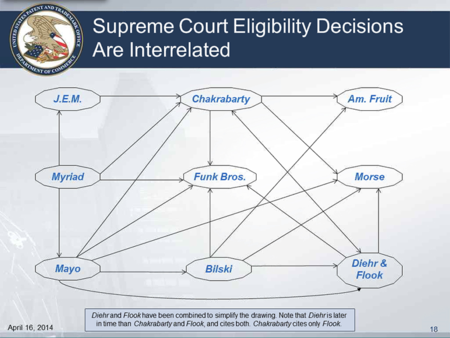
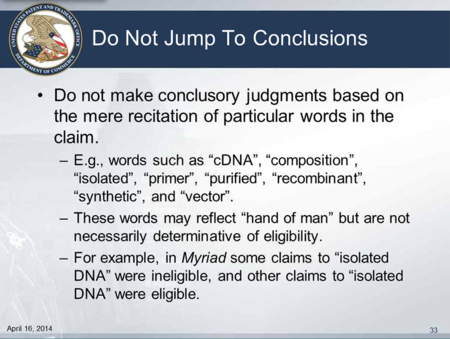
    The article then turns to the question of whether Myriad's primer (and probe) claims satisfy the requirements of 35 U.S.C. § 101.  Much of this section of the article unfortunately relates to the recently issued Guidelines from the U.S. Patent and Trademark Office regarding patent eligibility in view of the Supreme Court's Mayo v. Prometheus and Myriad decisions.  While it is true that Judge Shelby's decision was made in consideration of these Guidelines, they do not have the force of law and represent merely how the Office (for now) is interpreting the Supreme Court's decisions.  They are certainly relevant to how claims in pending applications are being examined; they are of dubious relevance to the legal question of where the Court drew the line with regard to the patent eligibility of DNA primers and probes.

    The article then discusses whether Myriad's primer and probe claims satisfy the written description and enablement requirements of Section 112.  The grounds for this challenge are that Myriad uses primers that flank BRCA gene exons and thus fall outside the scope of the claims reciting primers and probes that are fragments of BRCA cDNA (in view of the fact that these primers and probes are not expressly described in the BRCA gene patent specifications).  This argument seems to conflate whether these primers fall within the scope of Myriad's claims (and thus that construing the claims to so include these sequences may render them invalid for lack of descriptive support) and whether the practice of BRCA gene diagnostic testing by others using these non-exonic primers and probes would infringe Myriad's primer claims insofar as they are properly cabined within the confines of exonic sequences.  But Dr. Cook-Deegan is correct when he states that the validity vel non of these claims may depend on how they are ultimately construed by the District Court.

    The article also focuses on claim 6 of U.S. Patent No. 5,747,282 which is not directed to DNA amplification methods and that would doubtless "capture" genomic DNA molecules clearly invalidated by the Supreme Court in Myriad.  These are also the types of molecules Dr. Cook-Deegan and colleagues showed to be invalid under 35 U.S.C. § 102, and the article briefly reviews the scientific basis for this conclusion.

    Dr. Cook-Deegan further attempts to implicate the government's rights in the BRCA genes (stemming from National Institute of Health support for the basic genetic research underlying discovery of the BRCA genes).  It is worth noting that the "march-in rights" he cites as part of the Bayh-Dole Act have been available for the entirety of the time Myriad has held and threatened to assert its BRCA gene patents, and that the government has never used these march-in rights under any circumstances (although, famously, the government threatened to do so regarding the availability of the antibiotic Cipro in the wake of the anthrax scare after the terrorist attacks on September 11, 2001).  And it is further worth noting that the government has not acted even in the face of calls by Senators to do so after Myriad filed its lawsuits against BRCA genetic diagnostic test providers in the wake of the Supreme Court's decision invalidating some (but not all) of its claims.  Here, Dr. Cook-Deegan invokes not only Bayh-Dole but the Stevenson-Wydler Act (relating to rights in inventions made in government laboratories), as well as assorted misfeasances by Myriad having to do with reporting and other requirements with regard to whether the government can and should act.  And in this regard Dr. Cook-Deegan cites the knowledge (and possible testimony) of Dr. Andrew Futreal, who the article describes as:

    [A] pivotal figure in understanding the discovery process in court proceedings.  He was a coauthor and co-inventor on the Myriad/Utah team that first characterized BRCA1 when he was at NIEHS, and then coauthor and coinventor on the Stratton papers and patents that first reported BRCA2.  . . .  He is thus the only person who was coauthor and coinventor for the first papers and patents for both BRCA1 and BRCA2.

    In view of these assertions, it is surprising that the article doesn't supply defendants' counsel with Dr. Futreal's address.

    Finally, Dr. Cook-Deegan points his readers (and defendants' counsel) to Myriad's litigation against OncorMed in 1997 over U.S. Patent No. 5,654,155, one of the patents Myriad is now asserting but that it attempted to invalidate in the prior litigation.  Dr. Cook-Deegan presents no information about any relevant evidence from this earlier litigation, but speculates that "[t]he 1997 litigation may have left a paper trail that the discovery process will unearth" because "[c]laims in the OncorMed patents were likely to be revoked or considerably weakened in 1997, and they are no more likely to be robust and enforceable now."

    Finally, after noting more putative evidence of Myriad's bad behavior (here, with regard to "hoarding" its BRCA gene mutation database as a trade secret, complete with reference to "tart words" from Judge Shelby in dicta from his preliminary injunction decision), Dr. Cook-Deegan confesses that:

    The historian in me wants this to go to court so we can learn what happened two decades ago.  Litigation is very costly, however, and the trial and appeals process is protracted, saps management attention, and poses recurrent decisions about whether and how to proceed further.  Moreover, litigation is a very expensive and not entirely reliable way to document historical events.  No one predicted a safety on the first play from scrimmage in the Super Bowl; any number of outcomes can still emerge from the litigation over BRCA1 and BRCA2.  The business models that emerge, however, are likely to entail more competition than Myriad's unitary genetic testing service that prevailed 1996-2013.

    Perhaps.