
By Kevin E. Noonan –

In a nonprecedential opinion, the Federal Circuit reviewed summary judgment granted to accused infringer Abiomed that claims asserted by Maquet Cardiovascular LLC were not infringed, in Abiomed Inc. v. Marquet Cardiovascular LLC.
The case arose over claims to intravascular blood pump systems and methods for using them to provide heart support. U.S. Patent Nos. 7,022,100; 8,888,728; 9,327,068; 9,545,468; 9,561,314; and 9,597,437 were asserted; by the time the case came to trial, only claims 16 and 17 of the ‘100 patent were at issue. Claim 1 of the ‘468 patent was also set forth in the opinion to further illustrate relevant claim terms construed by the District Court, wherein said construction was reversed at trial and upheld on appeal:
1. An intravascular blood pump system, comprising:
an intravascular blood pump adapted to be guided to a predetermined location within the circulatory system of a patient by a guide wire and configured to provide leftheart support, the intravascular blood pump comprising a rotor having a rotor hub tapering in the distal direction, at least one blade extending radially outward from the rotor hub,
a catheter coupled to a proximal end of the intravascular blood pump, a purge lumen extending through the catheter and operatively arranged to deliver purge fluid towards the intravascular blood pump;
a cannula coupled to a distal end of the intravascular blood pump, one or more first ports and one or more second ports establishing fluid communication between a lumen of therefrom and located distal to the at least one first port, the cannula is configured such that when the intravascular blood pump is positioned in the patient to provide leftheart support the distal end of the cannula and the at least one second port are positioned inside the patient’s heart and the proximal end of the cannula and the at least one first port are positioned in the patient’s aorta, the intravascular blood pump is configured to draw blood from the patient’s heart into the at least one second port through the cannula lumen and out the at least one first port to provide leftheart support while the cannula is positioned across an aortic valve of the patient;
an elongate lumen associated with the cannula and sized to slidably receive the guide wire and dimensioned such that the guide wire passes slidably and coaxially through the elongate lumen, the elongate lumen is sized smaller cross sectionally than the cannula lumen, both the elongate lumen and the cannula lumen not extending through the rotor hub, the intravascular blood pump system configured for the guide wire to extend proximally away from the intravascular blood pump, the guide wire not passing through the rotor hub or the catheter, and the guide wire extending out of the intravascular blood pump system in a distal direction through the elongate lumen;
a pressure sensing element configured to sense pressure proximate the intravascular blood pump;
a housing connected to a proximal end of the catheter; and first and second conduits each connected to the housing, at least one of the first conduit and second conduit in fluid communication with the purge lumen.
16. An intravascular blood pump system comprising:
an intravascular blood pump having a cannula coupled thereto,
a guide mechanism adapted to guide said intravascular blood pump and cannula to a predetermined location within the circulatory system of a patient, and
a blood pressure detection mechanism to detect the pressure of the blood proximate
at least one of the intravascular blood pump and cannula.
17. The intravascular blood pump system of claim 16 and further, wherein said blood pressure detection mechanism comprises at least one of fluid filled column disposed within at least a portion of said cannula, a piezoelectric element coupled to at least one of the intravascular blood pump and cannula, and a strain gauge coupled to at least one of the intravascular blood pump and cannula.
(Wherein italicized text identifies the elements of the patent claims in dispute.)
Abiomed initially filed a declaratory judgment action that its intravascular blood pump systems did not infringe any of the claims of the asserted patents and that those claims were invalid; Maquet filed a counterclaim asserting infringement and demanding money damages.
The opinion recognizes that the asserted claims disclosed three “broad aspect[s] of the present invention,” each defined by a specific type of “guide mechanism:” (1) “an ‘over-the-wire’ type guide mechanism;” (2) “a ‘side-rigger’ or ‘rapid exchange’ type guide mechanism;” and (3) “a ‘guide catheter’ type guide mechanism.” These embodiments were recited in claims with three claim limitations at issue: (1) “an elongate lumen associated with the cannula;” (2) “purge fluid;” and (3) “guide mechanism,” with the “guide mechanism” claim being recited in the asserted claims of the ‘100 patent.
The District Court issued a claim construction order wherein the limitation “an elongate lumen associated with the cannula” in the ‘468, ‘314, and ‘437 patents was construed to mean “a permanent elongate lumen formed along the side of the cannula.” The term “purge fluid” in the ‘728, ‘068, ‘468, ‘314, and ‘437 patents was construed to require that “the purge fluid does not go through the rotor bearings and into the bloodstream.” Finally, the District Court construed the limitation “guide mechanism” in the ‘100 patent to be in means-plus-function format. Maquet limited the asserted claims to claims 16 and 17 of the ‘100 patent as set forth above as a result of the District Court’s claim construction.
The District Court held on summary judgment that Abiomed’s accused infringing intravascular blood pump systems did not infringe asserted claims 16 and 17. This appeal followed.
The Federal Circuit affirmed-in-part, vacated-in-part, and remanded, rejecting the four arguments asserted by Maquet. The first of these was that the District Court erred in construing the phrase “elongated lumen associated with the cannula” to be limited to those elongated lumens that are “formed alongside of the cannula.” Maquet did not argue that there was error in the District Court’s determination that nothing in the plain language of the claims, the specification, or the prosecution history supported restricting the term to lumens found alongside the cannula. Rather, the District Court’s relied upon statements made by Maquet in inter partes proceedings, which Maquet argued was error. The Federal Circuit panel agreed, citing Phillips v. AWH Corp., 415 F.3d 1303, 1313–14 (Fed. Cir. 2005) (en banc), for the canons of construction that claims are construed under their plain and ordinary meaning to the skilled artisan, the specification and the prosecution history. There are two exceptions recognized by the Court: the first is when a patentee acts as their own lexicographer and provides express definitions; and the second is when a patentee disclaims the full scope of a claim in the specification or during prosecution. The panel assessed each of the three Philips bases of claim construction and found no support for the District Court’s construction of this phrase in the claims. For example, while there are species embodiments of this construction in the specification these are “exemplary only” and don’t limit the scope as construed by the District Court.
The inter partes review source of the District Court’s claim construction of this term was based on Marquet’s statements distinguishing its claims from a reference to Jegaden in those proceedings. The District Court’s error, in the panel’s view, was interpreting these statements as constituting prosecution disclaimer. Such an interpretation is not forbidden under Aylus Networks, Inc. v. Apple Inc., 856 F.3d 1353, 1360 (Fed. Cir. 2017), but in order for prosecution disclaimer to be properly invoked under these circumstances those statements must satisfy both of two requirements, specifically that the disclaimer be clear and unmistakable under Omega Eng’g, Inc. v. Raytek Corp., 334 F.3d 1314, 1326 (Fed. Cir. 2003). The Federal Circuit did not consider Maquet’s statements to have been “words or expressions of manifest exclusion or restriction” under Unwired Planet, LLC v. Apple Inc., 829 F.3d 1353, 1358 (Fed. Cir. 2016) (quoting Teleflex, Inc. v. Ficosa N. Am. Corp., 299 F.3d 1313, 1327 (Fed. Cir. 2002)), and were “far too slender . . . reed[s] to support the judicial narrowing of a clear claim term,” citing N. Telecom Ltd. v. Samsung Elecs. Co., 215 F.3d 1281, 1294 (Fed. Cir. 2000). Thus, the panel held the District Court’s construction of this term was error.
Maquet’s second argument was that the District Court erroneously imported a negative limitation into the term “purge fluid,” specifically that the fluid “does not go through the rotor bearings and into the bloodstream.” The panel rejected Abiomed’s support for this construction based on distinctions made to overcome the prior art (International Publication No. WO 99/02204) and disparagement thereof, and held that the District Court erred. As in its analysis of the cannula term, the opinion parsed the Philips factors and found wanting the District Court’s construction using this assessment. In fact, the panel found evidence from the specification that permitted the purge fluid to pass though the components of the claimed intravascular blood pump system and into the bloodstream. The District Court, while recognizing these deficiencies nevertheless found that Maquet had “unmistakably disparaged” configurations permitting the purge fluid to enter the bloodstream, again arising from statements made during an IPR. Once again, the panel held that the statements did not “amount to an instance ‘[w]here an applicant argues that a claim possesses a feature that the prior art does not possess in order to overcome a prior art rejection,’” citing Seachange Int’l, Inc. v. C-COR, Inc., 413 F.3d 1361, 1372–73 (Fed. Cir. 2005), and also Andersen Corp. v. Fiber Composites, LLC, 474 F.3d 1361, 1374 (Fed. Cir. 2007). Under these circumstances, where in addition it was unclear on the record whether the argument was made to distinguish the prior art, the panel held the District Court erred in finding “clear and unmistakable” disclaimer and vacated this determination, remanding to the District Court “for proceedings consistent with [the] opinion.”
Third, Maquet argued that the District Court erred in construing the term “guide mechanism” as being a means-plus-function term. On this construction the panel agreed with Abiomed that the District Court had not erred. The Federal Circuit recognized that the term did not contain the canonical “means for” terminology but also that under Williamson v. Citrix Online, LLC, 792 F.3d 1339, 1346 (Fed. Cir. 2015), that language was not mandatory. Under Williamson, the presence or absence of this phraseology raised a rebuttable presumption for or against (respectively) a finding that 35 U.S.C. § 112 ¶ 6 was to be applied in construing the claim. In this case, the panel held the District Court had not erred because the claim did not recite sufficiently definite structure and the skilled worker would not have understood the claimed element (the guide mechanism) to possess “a sufficiently definite meaning as the name for a structure” under Williamson. In the Court’s assessment, “mechanism” is nothing other than a “nonce” word and “guide” is a merely a “functional modifier,” citing Media Rts. Techs., Inc. v. Cap. One Fin. Corp., 800 F.3d 1366, 1373 (Fed. Cir. 2015). The remaining claim language does not remedy these deficiencies according to the opinion as the claim only recited functional terms. Nor did the Court find any “clear and unambiguous” definition for the term in the specification.
Having decided that the District Court had not erred in considering “guide mechanism” to be in means-plus-function format, the opinion determined that the specification was lacking in the required “sufficient structure” that “corresponds to the claimed function.” The District Court held that the structural disclosures in the specification amounted to:
(a) a guide wire passing slideably through a central lumen extending through a drive cable assembly, blood pump, and cannula; (b) a guide wire passing slideably through a lumen extending through a guide carriage integrally formed along at least a portion of the cannula sidewall; or (c) a conduit assembly, including guide catheter, a rotor shroud, and a cannula, which is capable of docking to a separate pump assembly.
Maquet objected to this description by arguing that the District Court failed to include in this litany “(1) a ‘rapid exchange’ guide mechanism and (2) a guide mechanism that ‘includes a guide carriage 124.’” The Federal Circuit rejected these objections because Maquet supported its argument with extrinsic evidence which the panel found insufficient under Vitronics Corp. v. Conceptronic, Inc., 90 F.3d 1576, 1584 (Fed. Cir. 1996).
Finally, Maquet argued that granting summary judgment in Abiomed’s favor was error because there remained genuine issues of material fact even if the Federal Circuit held that the District Court had properly construed the term “guide mechanism.” Once again, here the Federal Circuit agreed with Abiomed, reciting the rubric that “[t]o literally infringe a means-plus-function limitation, ‘the accused structure must either be the same as the disclosed structure or be a section 112, paragraph 6 “equivalent,” i.e., (1) perform the identical function and (2) be otherwise insubstantially different with respect to structure,’” citing Kemco Sales, Inc. v. Control Papers Co., 208 F.3d 1352, 1364 (Fed. Cir. 2000). The District Court had properly considered summary judgment by viewing the evidence in light most favorable to non-movant Maquet and accepting Maquet’s specific factual contentions. The basis for this reasoning was illustrated by drawings showing the arrangement of the disputed elements in the claimed device:
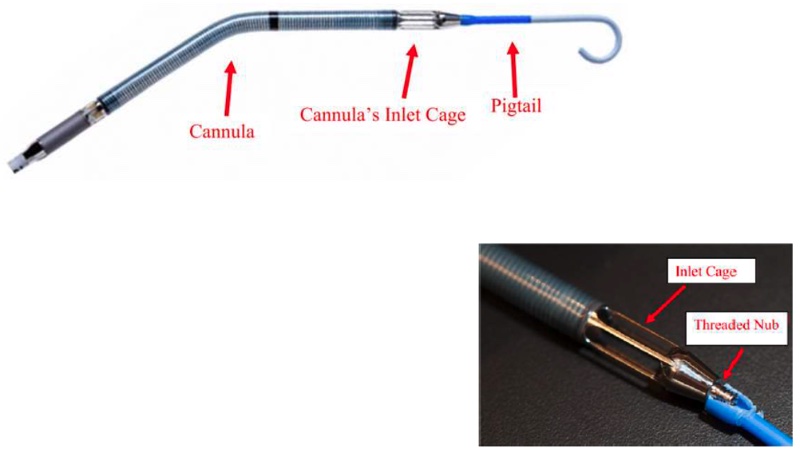
and stating “[s]pecifically, the parties dispute whether the structure of the Impella products meets structure (b) of the district court’s claim construction. Maquet contends that ‘a jury could reasonably find that the Impella’s pigtail guide carriage is “integrally formed along at least a portion of the cannula sidewall.’” However, as the District Court determined, “the pigtail is not attached to any portion of the cannula sidewalls. Rather, it is attached to the threaded nub, which is attached to a flat surface, which is attached to the inlet cage at the distal end of the cannula[:]”
Because “[t]he cannula sidewalls lie entirely below (proximal) to that plane; the pigtail and threaded nub lie entirely above (distal) to it, . . . there is never any point in the structure where the pigtail or nub are ‘along’ even a ‘portion’ of the cannula sidewall.”
The opinion thus asserts that accordingly “the district court did not reversibly err in determining that the Impella pigtail is not ‘formed along at least a portion of the cannula sidewall.’”
Finally, in this regard, the opinion rejects Maquet’s assertion of expert testimony based on its characterization of that testimony as being “conclusory” and “insufficient to defeat summary judgment,” citing Traxcell Techs., LLC v. Sprint Commc’ns Co., 15 F.4th 1121, 1129 (Fed. Cir. 2021).
In sum, the Federal Circuit affirmed-in-part, vacated-in-part, and remanded to the District Court.
Abiomed Inc. v. Marquet Cardiovascular LLC (Fed. Cir. 2026)
Nonprecedential disposition
Panel: Circuit Judges Hughes, Cunningham, and Stark
Opinion by Circuit Judge Cunningham


Leave a Reply