• By Donald Zuhn

    Earlier this month, Genetic Engineering & Biotechnology News released its list of the top 25 best-selling drugs worldwide for 2013.  GEN's list, which the journal released on March 3 (see "The Top 25 Best-Selling Drugs of 2013"), was based on sales or revenue reported by biopharma companies in press announcements, annual reports, investor materials, and conference calls during 2013.  For each drug on its list, GEN has provided 2012 and 2013 sales, percent change from 2012 to 2013, and Q4 2013 sales and percent change for both 2012 and 2013.  2013 sales for the top 25 drugs range from $3.005 billion to $10.659 billion.  GEN's top 25 rankings are shown below, with the additional designation of small molecule or biologic for each drug that made GEN's list.

    Genetic Engineering & Biotechnology News Top 25 Best-Selling Drugs of 2013

    GEN Top 25
    Genetic Engineering & Biotechnology News, "The Top 25 Best-Selling Drugs of 2013," March 3, 2014.

    Earlier this week, FiercePharma released its own list of best-selling drugs for 2013 — albeit a top 10 list (see "The 10 best-selling drugs of 2013").  To create its list, FiercePharma obtained sales figures from EvaluatePharma.  2013 sales for the top 10 drugs on FiercePharma's list range from $5.501 billion to $11.02 billion. FiercePharma's top 10 rankings are shown below.

    FiercePharma Top 10 Best-Selling Drugs of 2013

    Fierce Top 10
    FiercePharma, "The 10 best-selling drugs of 2013," March 25, 2014.

    For additional information regarding this topic, please see:

    • "GEN Compiles List of Top Selling Drugs for 2012," March 12, 2013

  • Barr does not infringe, Alcon's patents not invalid

    By Kevin E. Noonan

    AlconIn ANDA litigation between branded drug maker Alcon Research and generic drugmaker Barr Laboratories, the Federal Circuit affirmed a District Court finding of non-infringement and reversed a finding of invalidity for failure to satisfy either the enablement or written description requirements of 35 U.S.C. §112(a).

    The case involved BARR's filing of an ANDA (as the second filer) for a generic version of "Alcon's glaucoma and ocular hypertension drug Travatan Z®, which contains travoprost [a type PGF2α prostaglandin analog], the synthetic prostaglandin fluprostenol isopropyl ester."  The claims at issue were directed to methods for producing chemically stabilized prostaglandin formulations, as claimed in U.S. Patent No. 5,631,287 (the "'287 patent") and U.S. Patent No. 6,011,062 (the "'062 patent"); claims 1 and 12 of the '287 patent are representative:

    1.  A method of enhancing the chemical stability of an aqueous composition comprising a therapeutically-effective amount of a prostaglandin, wherein the method comprises adding a chemically-stabilizing amount of a polyethoxylated castor oil [("PECO")] to the composition.

    12.  The method of claim 1 wherein the composition is a topically administrable ophthalmic composition.

    Barr PharmaceuticalsThere are a number of curiosities regarding Alcon's patents and how they were asserted in this case.  For example, the '287 patent and the '062 patent, which were the subject of this litigation are not listed in the Orange Book, and Barr stipulated to infringement of claims from two Orange Book listed patents (U.S. Patent Nos. 6,503,497 and 6,849,253) and that those claims were not invalid.  Two other Alcon patents (U.S. Patent Nos. 5,510,383 (the "'383 patent") and 5,889,052 (the "'052 patent") were not asserted and the District Court denied Barr's post-judgment motion to enter judgment as a matter of law ("JMOL") of non-infringement as to these patents (which procedural ruling the Federal Circuit affirmed under Third Circuit law).

    The District Court based its non-infringement determination on its finding that Alcon did not test Barr's product and thus did not show that Barr added a "chemically stabilizing amount of PECO" to its generic formulations.  The District Court also found that Barr had shown by clear and convincing evidence that Alcon's claims were overbroad, supported by a too-limited disclosure and that the art of stabilizing prostaglandin formulations was unpredictable, and thus that the '287 and '062 specifications did not satisfy either the enablement or written description requirements.

    The Federal Circuit affirmed-in-part (as to non-infringement) and reversed-in-part (as to invalidity), in an opinion by Judge Lourie joined by Judges Newman and Bryson.  With regard to non-infringement, the Federal Circuit agreed with the District Court, stating that in an ANDA case, infringement is predicated on a comparison of the claims to "'the product that is likely to be sold following ANDA approval,'" citing Abbott Labs. v. Tor- Pharm, Inc., 300 F.3d 1367, 1373 (Fed. Cir. 2002).  The District Court determined, and the Federal Circuit agreed, that the results of Alcon's own stability of its branded product could not be extrapolated to Barr's proposed generic product because "the composition of the generic product proposed in Barr's ANDA is significantly different from the compositions tested in Alcon's study," specifically having a significantly lower pH, slightly less travoprost, and a different mixture of buffering agents.  Alcon itself admitted that these differences could "have a substantial impact on the chemical stability of a prostaglandin in an ophthalmic formulation" and thus the Federal Circuit held that there was substantial evidence supporting the District Court's finding of non-infringement.

    Regarding invalidity, the Federal Circuit, citing In re Wands, held that Barr failed to make a "threshold showing" that any experimentation (much less undue experimentation) was necessary.  Specifically:

    The claimed methods comprise only a single step — adding a chemically-stabilizing amount of PECO to the prostaglandin composition — that Barr's own expert testified was "routine."  The claims as a whole merely require that the addition of PECO to the composition provide some increase in chemical stability, but do not require a particular level of stability or a particular magnitude of increase.  Moreover, the patents disclose exemplary compositions within the scope of the claims, detail how those example compositions are prepared from commercially-available ingredients, and provide step-by-step procedures for adding PECO to a prostaglandin composition in a way that embodies the claimed invention.  The patents also identify the various prostaglandins and PECOs that can be used and a range of suitable concentrations for both components, including narrow preferred embodiments.

    [citations to the record omitted]

    The Federal Circuit rejected what it termed "conclusory statements" by Barr with respect to a putatively large number of variables in the formulation that could affect stability; while "[a]djusting variables may be relevant to optimizing the stability of a given prostaglandin composition, . . .  Barr proffered no evidence that any experimentation, let alone undue experimentation, with those variables would be necessary in order to practice the claimed invention" (emphasis in opinion).  This left the District Court's enablement without any foundation according to the Federal Circuit.

    In a section of the Court's opinion that reads broadly its precedent regarding what is needed to satisfy the enablement requirement, the Court further noted that actual reduction to practice, working examples in the specification, knowledge by the inventor that the invention actually works, nor any guarantee of operability must be provided, making "irrelevant" the lack of any data "proving" that adding PECOs to a prostaglandin formulation enhances its chemical stability.  What Barr needed to show, and did not according to the panel, was that at least some of the claimed embodiments were in fact inoperable and that the ordinarily skilled worker would need to resort to undue experimentation to practice the invention.  The deficiencies in Barr's showing resulted in a lack of clear and convincing evidence and the Federal Circuit thus reversed.

    Turning to the written description question, the panel found that the '287 patent "details the claimed invention and provides a step-by-step description of how a person of ordinary skill in the art may use it," specifically that "the use of . . . polyethoxylated castor oils in [pharmaceutical] compositions," especially those "topically applied to the eye," "enhances the chemical stability of prostaglandins."  (The disclosure of the '062 patent was substantially similar.)  The specification discloses "exemplary formulations" that recite "every ingredient," "data generated by the inventor [] showing the effect of PECO and prostaglandin concentration on stability," "various classes of prostaglandins" that could be used with the disclosed formulations (including "thirty-two specifically preferred examples of those prostaglandins"), varying types of PECOs and their concentrations, and the "various formulation parameters, including osmolality and pH, that may be selected when practicing  the invention," according to the Court.  This was enough to demonstrate that the inventors had possession of the claimed invention:

    In summary, the '287 and '062 patent disclosures demonstrate that the inventors possessed the claimed invention:  they conceived of and described their invention at the time the respective original patent applications were filed, including the idea that adding PECO would enhance the chemical stability of prostaglandins across a range of various formulation parameters as cited by the district court.  . . .  That is all that the written description requirement demands.

    Alcon Research Ltd. v. Barr Laboratories Inc. (Fed. Cir. 2014)
    Panel: Circuit Judges Newman, Lourie, and Bryson
    Opinion by Circuit Judge Lourie

  • By Andrew Williams

    USPTO SealEarlier this month, on March 6, 2014, the Patent Trial and Appeal Board ("Board") issued three related inter partes review opinions, marking the first set of opinions related to either the Biotech or Pharmaceutical industry.  The cases were IPR2012-00006IPR2012-00007, and IPR2013-00011, and the parties were Illumina, Inc. (Petitioner) and The Trustees of Columbia University in the City of New York ("Columbia") (Patent Owner).  The technology at issue related to nucleotide analogues for use in sequencing by synthesis, a technique of sequencing by which every added nucleotide is determined using a label, such as a fluorescently detectable label.  As should not be surprising at this point, the Board cancelled all of the reviewed claims as either being anticipated or rendered obvious by the prior art.  The Board also either denied Columbia's motion to amend the claims, or dismissed them as moot.  The claim amendments were found to either be of the same scope as those that were the subject of the review, or were separately unpatentable.  Here also, there was no surprise, as the Board has yet to grant a motion to amend claims.  Finally, the Board dismissed motions from both parties to exclude evidence as being moot.

    The Technology

    The technology at issue in this IPR generally related to sequencing by synthesis.  Simply put, this technology involves incorporating a labeled nucleotide analogue into a primer strand using DNA polymerase, in a manner comparable to that used when a DNA strand is synthesized.  Normally, when a DNA strand is synthesized, the 5' position of the sugar in a new incoming nucleotide is linked to the 3'-OH group of the sugar of a preexisting nucleotide in the strand under synthesis.  The difference in this sequencing technique, though, is that the newly incorporated nucleotide analogues have cleavable chemical groups capping the 3'-OH to prevent the incorporation of any successive nucleotides before the identity of the nucleotide analogue is determined.  In essence, the strand is terminated with the addition of the new nucleotide.  This nucleotide is identified with a detectable label attached to the nucleotide, such as a fluorescent tag.  Each base (A, C, G, or T) has a unique label, thereby allowing its identification.  In order to sequence an entire region of DNA, the 3'-OH cap is cleaved and the process repeated step-wise until the entire sequence is deduced.

    Columbia UniversityColumbia scientists did not invent sequencing by synthesis, and indeed, the method was fairly well established when the applications in question were filed.  Instead, Columbia asserted that the novelty of the three reviewed patents was the particular nucleotide analogues utilized.  Specifically, the analogues have the detectable label attached to the base (as opposed to the 3'-OH group), they have a cleavable chemical group capping the 3'-OH group, and at least some of the claims require the use of a deaza-substituted base, such as 7-deazapurine (a deazabase is one in which a natural nitrogen atom in the base ring is substituted with a carbon atom).

    Representative claims of the patents-at-issue include:  Patent No. 7,713,698, claims 1 and 11:

    1.  A method of determining the identity of a nucleotide analogue incorporated into a nucleic acid primer extension strand, comprising:
        a)  contacting a nucleic acid template attached to a solid surface with a nucleic acid primer which hybridizes to the template;
        b)  simultaneously contacting the product of step a) with a polymerase and four nucleotide analogues which are either (i) aA, aC, aG, and aT, or (ii) aA, aC, aG, and aU, so as to incorporate one of the nucleotide analogues onto the nucleic acid primer and form a nucleic acid primer extension strand, wherein each nucleotide analogue within (i) or (ii) comprises a base labeled with a unique label and contains a removable chemical moiety capping the 3'-OH group of the sugar of the nucleotide analogue, and wherein at least one of the four nucleotide analogues within (i) or (ii) is deaza-substituted; and
        c)  detecting the unique label of the incorporated nucleotide analogue, so as to thereby determine the identity of the nucleotide analogue incorporated into the nucleic acid primer extension strand

    11.  A plurality of nucleic acid templates immobilized on a solid surface, wherein a nucleic acid primer is hybridized to such nucleic acid templates each such nucleic acid primer comprising a labeled incorporated nucleotide analogue, at least one of which is deaza-substituted, wherein each labeled nucleotide analogue comprises a base labeled with a unique label and contains a removable chemical moiety capping the 3'-OH group of the sugar of the nucleotide analogue.

    Patent No. 7,790,869, claims 12 and 15:

    12.  A nucleotide having a base that is attached to a detectable label through a cleavable linker, wherein the nucleotide has a deoxyribose comprising a cleavable chemical group capping the 3' OH group, wherein the cleavable linker is cleaved by a means selected from the group consisting of one or more of a physical means, a chemical means, a physical chemical means, heat, and light, and wherein the cleavable chemical group capping the 3' OH group is cleaved by a means selected from the group consisting of one or more of a physical means, a chemical means, a physical chemical means, heat, and light.

    15.  The nucleotide of claim 12, wherein the base is a deazapurine.

    And Patent No. 8,088,575, claims 1 and 6:

    1.  A method of determining the identity of a nucleotide analogue incorporated into a nucleic acid primer extension strand, comprising: a) contacting a nucleic acid template attached to a solid surface with a nucleic acid primer which hybridizes to the template; b) simultaneously contacting the product of step a) with a polymerase and four nucleotide analogues which are either (i) aA, aC, aG, and aT, or (ii) aA, aC, aG, and aU, so as to incorporate one of the nucleotide analogues onto the nucleic acid primer and form a nucleic acid primer extension strand, wherein each nucleotide analogue within (i) or (ii) comprises a base labeled with a unique label and contains a small removable chemical moiety capping the 3'-OH group of the sugar of the nucleotide analogue, wherein said small cleavable chemical group does not interfere with the recognition of the nucleotide analogue by polymerase as a substrate; and c) detecting the unique label of the incorporated nucleotide analogue, so as to thereby determine the identity of the nucleotide analogue incorporated into the nucleic acid primer extension strand

    6.  The method of claim 1, wherein said base of at least one of said nucleotide analogues is a deazapurine.

    The Cited Art

    The following references were cited in one or more the final written decisions of these three IPRs.  Even though each review had its individual nuances pertinent to the particular patent involved, we will address the various rejections below as a group.

    Tsien

    WO 91/06678 ("Tsien") purportedly described the DNS sequencing by synthesis method, and therefore was a starting point for many of the rejections of the relevant claims.  Tsien disclosed unique labels attached to a base, and a removable 3'-OH chemical moiety (capping group).  For the claims requiring no more than these limitations, the Board found Tsien to be an anticipatory reference.  Columbia argued that this was impermissible, because there was no express statement in Tsien to use a cleavable linker to attach the fluorescent label to the base.  However, the Board found that one of ordinary skill would have envisaged such a configuration based on a reading of the Tsien disclosure.  The Board explained that "specific examples are not necessary to establish anticipation when there is a small genus disclosed and each member can be at once envisaged."  IPR2012-00007 Final Written Decision, pg. 10.

    Tsien and Prober I

    Even though Tsien disclosed unique labels and a removable 3'-OH capping group, it lacked an explicit disclosure of a deaza-substituted base.  However, it did explicitly reference the Prober I reference.  Prober I (James M. Prober et al.,  A System for Rapid DNA Sequencing with Fluorescent Chain-Terminating Dideoxynucleotides, 238 Science 336-41 (1987) disclosed a nucleotide comprising a deazapurine base to which a label has been attached.  The Board found it significant that Tsien referenced Prober I, and did not otherwise "disparage[] these alternative nucleotide analogues."  Moreover, Columbia was unable to identify why one of ordinary skill in the art would conclude that the deazapurine base was unsuitable for the sequencing by synthesis method.  In other words, the Board made it the patent holder's burden to provide evidence against the obviousness of the claims when the primary reference itself specifically mentions the combined reference, even if the combination is not specifically called out.

    Stemple

    U.S. Patent No. 7,270,951 ("Stemple") purportedly describes DNA sequencing by synthesis.  Specifically, it described "chain terminating nucleotides that include a blocking group at the 3'-OH of the ribose . . . and a fluorescent label attached to the nucleotide base."  The Board found that at least one claim as anticipated by Stemple, which Columbia did not contest.  Instead, Columbia attempted to cancel that claim, a request which was ultimately denied.

    Stemple and Anazawa

    Even though Stemple described sequencing by synthesis, it did not disclose a deazabase.  Anazawa (WO 98/33939) was an application published Japanese that taught a deazapurine base coupled to a detectable label.  Stemple did reference Anazawa as describing a particular base to which a fluorochrome-photolabile linker conjugate can attach.  However, the Board also found that even absent this disclosure, it would have been obvious for one of skill in the art to use Anazawa's deazapurine labeled nucleotide

    Dower

    U.S. Patent No. 5,547,839 ("Dower") purportedly describes methods for sequencing DNA.  The Board found that Dower was anticipatory of the claims not requiring the deazapurine base.  With regard to those other claims, Illumina had contended that Prober I was incorporated by reference.  It had pointed out that Dower describes Prober I as teaching deazapurine bases, even though such teaching only had an irreversible 3'-OH blocking group.  However, the Board disagreed, because it did not believe that Dower had any teaching of using Prober I to modify Dower's nucleotides with a reversible 3'-OH capping group.  "Illumina has not pointed to anything convincing in Dower that teaches replacing Dower's dideoxy terminated nucleotide with a removable 3'-OH cap or vice-versa."  IPR2013-00011 Final Written Decision, pg. 16.  Therefore, Dower combined with Prober I was not found to render obvious the claims that recited deazapurine bases.

    Secondary Considerations

    As the Board explained, secondary considerations must always be considered as part of the evidence, not just when the decision maker has doubts after reviewing the art.  These considerations can often be the most probative and cogent evidence, and helps the court avert the hindsight trap.  In this case, Columbia alleged that its inventions were not obvious because they provided "unexpectedly improved properties," commercial success for Illumina in its sequencing by synthesis products, evidence of attempted licensing, and praise and skepticism.  As for the first two factors, Columbia alleged that its inventions had unexpected properties over pyrosequencing, and that Illumina experienced commercial success practicing the inventions in comparision to pyrosequencing.  The Board rejected these arguments, because pyrosequencing was not the closest art – "[t]o establish unexpected results, the claimed subject matter must be compared with the closest prior art."  IPR2012-00006 Final Written Decision, pg. 33.  The Board pointed out that Tsien was the closest art, and therefore must be the one that is used for comparison.  As such, these secondary considerations were not sufficiently demonstrated by Columbia.  The Board also considered the fact that Illumina had attempted to license Columbia's technology, because licensing can be evidence that a licensor recognizes the merits of the invention.  Nevertheless, even though Illumina did inquire about licensing, there was no evidence it did so because it believed that the patents had independent merit.  Instead, the invention that had merit was that disclosed in Tsien.  The Board found that it was possible Illumina was simply trying to license these patents because they potentially covered its own product, and there was insufficient evidence to establish that this was not the case.  Finally, the Board considered the praise and skepticism surrounding the inventions, but found this information to be of insufficient weight and relevance to be persuasive.

    In total, the Board cancelled all reviewed claims of these three patents that were the subject of these three IPRs.  It will be interesting to observe whether the trend toward cancellation of all claims continues when other biotech or pharmaceutical-related patents are reviewed.  We will continue to monitor these cases and provide periodic updates.

  •         By Sherri Oslick

    Gavel About Court Report:  Each week we will report briefly on recently filed biotech and pharma cases.

    Cephalon Inc. v. Sun Pharma Global FZE et al.
    1:14-cv-00333; filed March 14, 2014 in the District Court of Delaware

    • Plaintiff:  Cephalon Inc.
    • Defendants:  Sun Pharma Global FZE; Sun Pharmaceutical Industries Ltd.; Sun Pharmaceutical Industries Inc.

    Cephalon Inc. v. Dr. Reddy's Laboratories Ltd. et al.
    1:14-cv-00334; filed March 14, 2014 in the District Court of Delaware

    • Plaintiff:  Cephalon Inc.
    • Defendants:  Dr. Reddy's Laboratories Ltd.; Dr. Reddy's Laboratories Inc.

    The complaints in these cases are substantially identical.  Infringement of U.S. Patent No. 8,609,863 ("Bendamustine Pharmaceutical Compositions," issued December 17, 2013) following a Paragraph IV certification as part of defendants' filing of an ANDA to manufacture a generic version of Cephalon's Treanda® (bendamustine hydrochloride, used to treat chronic lymphocytic leukemia and non-Hodgkin's lymphoma).  View the Sun complaint here.

    Cephalon Inc. v. Emcure Pharmaceuticals Ltd. et al.
    1:14-cv-00335; filed March 14, 2014 in the District Court of Delaware

    • Plaintiff:  Cephalon Inc.
    • Defendants:  Emcure Pharmaceuticals Ltd.; Emcure Pharmaceuticals USA Inc.

    Infringement of U.S. Patent No. 8,445,524 ("Solid Forms of Bendamustine Hydrochloride," issued May 21, 2013) following a Paragraph IV certification as part of defendants' filing of an ANDA to manufacture a generic version of Cephalon's Treanda® (bendamustine hydrochloride, used to treat chronic lymphocytic leukemia and non-Hodgkin's lymphoma).  View the complaint here.

    Eli Lilly and Company et al. v. Accord Healthcare, Inc. USA et al.
    2:14-cv-01643; filed March 13, 2014 in the District Court of New Jersey

    • Plaintiffs:  Eli Lilly and Company; Daiichi Sankyo Co., Ltd.; Daiichi Sankyo, Inc.; Ube Industries, Ltd.
    • Defendants:  Accord Healthcare, Inc. USA; Accord Healthcare, Inc.; Intas Pharmaceuticals Ltd.; Amneal Pharmaceuticals LLC; Amneal Pharmaceuticals of New York, LLC; Amneal Pharmaceuticals Co. India Pvt. Ltd.; Aurobindo Pharma Ltd.; Aurobindo Pharma USA Inc.; Dr. Reddy's Laboratories, Ltd.; Dr. Reddy's Laboratories, Inc.; Glenmark Generics Inc., USA; Glenmark Generics Ltd.; Glenmark Pharmaceuticals Ltd.; Hetero USA Inc.; Hetero Labs Ltd.; Hetero Labs Ltd. Unit V; Hetero Drugs Ltd.; Mylan Pharmaceuticals Inc.; Mylan Inc.; Mylan Laboratories Ltd.; Par Pharmaceutical Companies, Inc.; Par Pharmaceutical, Inc.; Sun Pharma Global FZE; Caraco Pharmaceutical Laboratories, Ltd.; Sun Pharma Global Inc.; Sun Pharmaceutical Industries, Ltd.; Teva Pharmaceuticals USA, Inc.; Teva Pharmaceutical Industries, Ltd.; Watson Laboratories, Inc.; Actavis PLC; Actavis, Inc.; Actavis Pharma, Inc.; Zydus Pharmaceuticals USA, Inc.; Cadila Healthcare Ltd.

    Infringement of certain of U.S. Patent Nos. 5,288,726 ("Tetrahydrothieno-pyridine Derivatives, Furo and Pyrrolo Analogs Thereof and Their Preparation and Uses for Inhibiting Blood Platelet Aggregation," issued February 22, 1994), 8,404,703 ("Medicinal Compositions Containing Aspirin," issued March 26, 2013) and 8,569,325 ("Method of Treatment with Coadministration of Aspirin and Prasugrel," issued October 29, 2013) following a Paragraph IV certification as part of defendants' filing of an ANDA to manufacture a generic version of Lilly's Effient® (prasugrel hydrochloride, to be used in combination with aspirin for the reduction of thrombotic cardiovascular events in certain patients with acute coronary syndrome (ACS) who are to be managed with percutaneous coronary intervention).  View the complaint here.

    Regeneron Pharmaceuticals, Inc. v. Ablexis LLC
    7:14-cv-01651; filed March 11, 2014 in the Southern District of New York

    Regeneron Pharmaceuticals, Inc. v. Merus B.V.
    7:14-cv-01650; filed March 11, 2014 in the Southern District of New York

    The complaints in these cases are substantially identical.  Infringement of U.S. Patent No. 8,502,018 ("Methods of Modifying Eukaryotic Cells," issued August 6, 2013) based on defendants' creation of a genetically modified mouse comprising human unrearranged variable region gene segments inserted at an endogenous mouse immunoglobulin locus).  View the Ablexis complaint here.

  • CalendarMarch 24-26, 2014 – Medical Device Patents*** (American Conference Institute) – Chicago, IL

    March 25, 2014 – 24th Annual Conference on USPTO Law and Practice (PTO Day) (Intellectual Property Owners Association and U.S. Patent and Trademark Office) – Washington, DC

    March 25, 2014 – "Big Data Litigation in an Era of Big Data Privacy Concerns: Recent Developments in International Data Privacy Law and Their Impact on U.S. Litigation" (McDonnell Boehnen Hulbert & Berghoff LLP) – 10:00 am to 11:15 am (CT)

    March 26, 2014 – "Trade Secret vs. Patent Protection After AIA: Making the Choice — Understanding AIA's Impact on Trade Secrets, Evaluating the Protection Options, Weighing the Benefits and Risks" (Strafford) – 1:00 to 2:30 pm (EDT)

    March 26-27, 2014 – Biotech Patenting*** (C5) – Munich, Germany

    March 27, 2014 – "Prosecuting Pre-AIA Patent Applications And Responding to Post-Grant Petitions" (IIT Chicago-Kent College of Law and Intellectual Property Law Association of Chicago) – Chicago, IL

    March 31 to April 2, 2014 - Life Sciences Collaborative Agreements and Acquisitions*** (American Conference Institute) - New York, NY

    April 23, 2014 – European biotech patent law update (D Young & Co) – 4:00 am, 7:00 am, and 12:00 pm (ET)

    April 23-25, 2014 – 2014 Spring Intellectual Property Counsels Committee (IPCC) Conference (Biotechnology Industry Organization) – Palm Springs, CA

    April 28-29, 2014 – Paragraph IV Disputes*** (American Conference Institute) – New York, NY

    August 13-15, 2014 – Advanced Patent Law Seminars (Chisum Patent Academy) - Seattle, WA

    August 18-20, 2014 – Advanced Patent Law Seminars (Chisum Patent Academy) - Seattle, WA

    ***Patent Docs is a media partner of this conference or CLE

  • IPLACThe IIT Chicago-Kent College of Law and Intellectual Property Law Association of Chicago (IPLAC) will be offering a program on "Prosecuting Pre-AIA Patent Applications And Responding to Post-Grant Petitions" on March 27, 2014 from 3:00 to 5:00 pm (Central) at IIT Chicago-Kent College of Law in Chicago, IL.  The program will provide practical tips and strategies for filing and prosecuting patent applications with pre-AIA priority, and when one should maintain pre-AIA priority or switch to post-AIA priority.  The program will also address how the attorney of record in a patent application, who will be served with petitions for post-grant USPTO trial proceedings needs to act to be sure the patent owner takes the correct steps to protect the patent rights being challenged in these trial proceedings.  The registration fee for the program is $30 for IPLAC members, $25 for students, and $40 for non-members.  Those interested in registering for event can do so here.

  • By Kevin E. Noonan

    MyriadOn March 13, Myriad Genetics filed a Notice of (interlocutory) Appeal with the Federal Circuit.  Myriad is seeking to have the Court review and reverse the District Court's denial of the company's preliminary jnjunction motion against Ambry Genetics in its on-going (and now consolidated) lawsuit on several claims from Myriad's BRCA gene testing patents.  It is unlikely that the District Court will stay discovery and other pretrial aspects of the pending lawsuits, and Ambry can continue to provide genetic diagnostic tests including the BRCA1 and BRCA2 mutation tests while the appeal is pending (as can the other defendants: Quest Labs, Labcorp, Counsyl, GeneDx and Invitae).

    Federal Circuit Seal
    It is possible that this is Myriad's last gasp in these litigations; in view of the rationale the District Court used to find that Ambry had provided sufficient evidence to raise a serious question of whether Myriad's asserted claims recite patent eligible subject matter, affirmance by the Federal Circuit should be expected to be followed rapidly by summary judgment motions using the District Court's own reasoning to find Myriad's claims invalid.

    For additional information regarding this topic, please see:

    • "Panel on Multidistrict Litigation Consolidates Myriad Cases in Utah District Court," March 19, 2014
    • "Utah Judge Denies Myriad's Preliminary Injunction Motion," March 11, 2014
    • "Gene-by-Gene Cries Uncle, Settles with Myriad Genetics," February 7, 2014
    • " Invitae Files Motion to Dismiss for Lack of Personal Jurisdiction in Myriad Genetics v. Invitae Corp.," December 11, 2013
    • " Myriad Genetics Sues LabCorp over BRCA Gene Testing," December 4, 2013
    • " Myriad Genetics Sues Invitae over BRCA Gene Testing and Invitae Sues Right Back," November 27, 2013
    • "Where Do We Stand?" October 31, 2013
    • "Defendants' Oppose Myriad's Motions to Dismiss Antitrust Counterclaims," October 28, 2013
    • "Myriad Genetics Files Amended Complaint Relating to Colon Cancer Genetic Diagnostic Testing," October 23, 2013
    • "Myriad Genetics Sues Quest for Patent Infringement," October 22, 2013
    • "Myriad Sues GeneDx on BRCA and Other Genetic Diagnostic Patents," October 21, 2013
    • "Diagnostics Giant Quest Files Declaratory Judgment Action against Myriad Genetics," October 13, 2013
    • "Bay Area Genetic Diagnostics Company Files Declaratory Judgment Action against Myriad Genetics," October 10, 2013
    • "Preliminary Injunction in Myriad v. Ambry and Gene-by Gene: Myriad Replies," October 9, 2013
    • "Defendants' Response to Myriad's Preliminary Injunction Motions," September 19, 2013
    • "Myriad Moves to Dismiss Ambry's Antitrust Counterclaims on Noerr-Pennington Doctrine," August 28, 2013
    • "Amici Submit Brief in Support of Ambry Genetics and Gene by Gene," August 27, 2013
    • "Ambry Responds to Myriad Lawsuit," August 7, 2013
    • "Why Does Myriad Think It Can Win BRCA Gene Lawsuits?" July 30, 2013
    • "Myriad Genetics Files Infringement Suit Against Gene by Gene for Genetic Diagnostic Testing of BRCA Genes," July 10, 2013
    • "Myriad Genetics Files Suit Against Ambry Genetics for Genetic Diagnostic Testing of BRCA Genes," July 9, 2013

  • By Kevin E. Noonan

    MyriadThe old adage "Be careful what you wish for" comes to mind regarding Myriad Genetics' motion to the Judicial Panel on Multidistrict Litigation under 28 U.S.C. § 1407, that cases relating to the company's BRCA gene patents be consolidated in the District of Utah.  By year-end 2013, the litigation scorecard stood at six patent infringement lawsuits pending in the District of Utah, against Ambry Genetics, Gene-by-Gene, Quest, GeneDx, Invitae, and LabCorp, and three declaratory judgment actions by Quest, Invitae, and Counsyl, pending in various California district courts.  Last month, the MDL Panel granted Myriad's motion, joining five of these cases under the caption In Re: BRCA1- and BRCA2-Based Hereditary Cancer Test Patent Litigation.  These cases include the ones pending against Ambry Genetics (C.A. No. 2:13-00640); GeneDx (C.A. No. 2:13-00954); and Quest Diagnostics (C.A. No. 2:13-00967), already pending in the District of Utah, and the declaratory judgment litigations by Quest (C.A. No. 8:13-01587, in the Central District of California) and Counsyl (C.A. No. 5:13-04391, in the Northern District of California).  (The Panel decision notes that another infringement lawsuit, originally filed by Myriad in Utah, against Gene-by-Gene Ltd. had settled.)  The Panel also noted other cases, such as the ones involving Invitae Corp. and Labcorp., could be consolidated as "potential tag-along actions."

    The Judicial panel rejected Respondents arguments that the factual differences between the different companies' genetic testing, the differences in claims Myriad has asserted against each, the lack of extensive discovery on defendants' invalidity contentions in view of the Supreme Court's decision in Association for Molecular Pathology v. Myriad Genetics, Inc., 133 S. Ct. 2107 (2013) (which defendants argued "ha[d] already addressed the validity of certain claims of the BRCA patents") and "alternatives" made consolidation of the cases unnecessary.  The panel opined that the Supreme Court's AMP decision, which held that "genes and the information they encode are not patent eligible under [35 U.S.C.] § 101 simply because they have been isolated from the surrounding genetic material," primarily addressed claims of the BRCA patents that are not asserted in the motion.  Accordingly, the Panel recognized that "[d]etermining whether the claims (and the patents) not at issue in AMP are likewise invalid as pertaining to non-patentable subject-matter may require a substantial amount of pretrial motion practice and parsing of the language of the patents."  The resulting complexity of these tasks favored consolidation as a way to conserve judicial resources (as well as the parties' resources, which may have been of lesser concerns to defendants).  Among the advantages perceived by the Judicial Panel was that "as only a single judge will have to become familiar with the patented technology."

    Moreover, the Panel opined that, although there were some differences in different defendant's products and in the patents and claims Myriad had asserted against the various defendants (and differences in the claims challenged by the declaratory judgment plaintiffs), "the core factual and legal inquiries in each action will be similar, if not identical," so that consolidation would again conserve judicial resources by "allow[ing] a single judge to preside over the discovery relating to these patents and to consistently rule on challenges to the validity thereof."

    Whatever ruefulness Myriad may now be experiencing will be due to the choice of Judge Robert J. Shelby to hear the consolidated cases.  Judge Shelby was the logical choice, seeing as he was already presiding over the Utah cases and had "invested considerable time and effort to familiarize himself with the complex technology and the complicated patent issues at the heart of this litigation," including "a technology 'tutorial.'"  The Panel also considered that Judge Shelby also had presided over the preliminary injunction hearing in the Ambry case, where he heard fact and expert testimony and attorney argument on issues "likely to be common to all the actions."

    This is the rub, of course, in view of Judge Shelby's 106-page opinion denying Myriad's preliminary injunction motion.  The Judge had heard testimony and argument and seems to have come to the preliminary conclusion that Myriad's asserted claims are invalid under the Supreme Court's Myriad opinion as well as from its Mayo v. Prometheus Labs. opinion.  While Myriad will have its "day in court" to persuade the Judge otherwise, what the company has gained in economy it may have lost in being before a judge who believes their patents are invalid (and could be further persuaded that all or some of the defendants' genetic testing does not infringe any of the asserted claims).

    The District Court has set a preliminary hearing with the parties for Friday, April 25, 2014.  This date is within the time period for Myriad to appeal the District Court's denial of its preliminary injunction motion, but it is unlikely that the Court will grant a stay on those grounds (which directly involve only one of the parties to the consolidated action).  Unless, of course, Myriad quits its Quixotic quest for vindication, moves to dismiss the pending actions and decides to rely on its market leadership, efficiency, reliability, reputation in the ob/gyn and genetic diagnostic communities and, of course, its proprietary database of BRCA gene mutations instead of its patents of now-questionable validity.

  • By Kevin E. Noonan

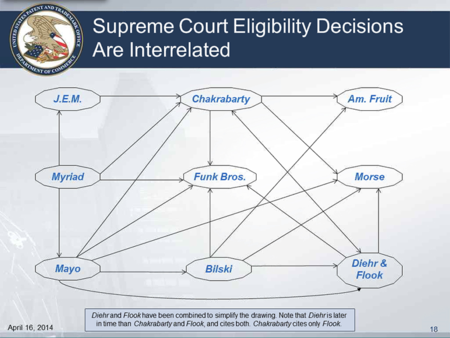
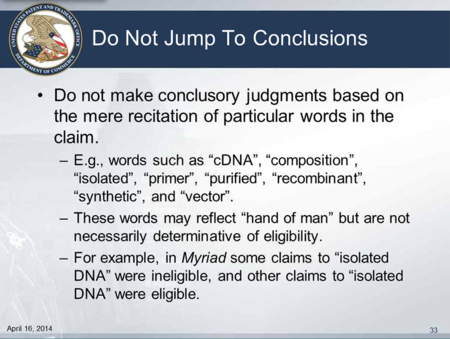
    USPTO SealThe U.S. Patent and Trademark Office recently issued (without public notice or opportunity to comment) its interpretation of the standards for subject matter eligibility in view of the Supreme Court's recent decisions in Mayo v. Prometheus and AMP v. Myriad.  The framework of the Office's issued Guidelines has been discussed previously (see "USPTO Issues Guidance for Analyzing Subject Matter Eligibility of Claims Reciting Laws of Nature/Natural Principles, Natural Phenomena or Natural Products").  Stripped of the Guidelines' flow charts, factors, and factual inquiries, the Guidelines in large part mandate the following exclusion from patent eligibility:

    [C]hemicals derived from natural sources (e.g., antibiotics, fats, oils, petroleum derivatives, resins, toxins, etc.); foods (e.g., fruits, grains, meats and vegetables); metals and metallic compounds that exist in nature; minerals; natural materials (e.g., rocks, sands, soils); nucleic acids; organisms (e.g., bacteria, plants and multicellular animals); proteins and peptides; and other substances found in or derived from nature . . . regardless of whether particular words (e.g., "isolated", "recombinant", or "synthetic") are recited in the claim.

    The response from the patenting and biotech communities has been appropriately Apocalyptic; however, when considering the impact of these Guidelines there are a few considerations that should be kept in mind.

    The first is that these Guidelines have no force of law; they are merely administrative tools for how the Office will administer the law under its (mis)understanding of the Supreme Court's rubrics.  Such Guidelines have been issued before — involving how the Office would apply the law relating the utility and written description (in 2001), for example.  While the Federal Circuit has occasionally referenced such Guidelines (see, for example, the first, vacated decision in Enzo v. GenProbe), courts have consistently recognized that they are not bound by the Office's understanding of how to apply the law.  Thus, bemoaning the loss of thousands of granted patents is at best premature; until this interpretation of subject matter eligibility gets judicial imprimatur these Guidelines have no effect on existing patents.

    It is also important to recognize that the Office made a categorical, per se distinction between the types of inventions enumerated above and other types of inventions.  The last time the Office made such a distinction was when it decided that patents would not be granted on "living things" in the Bergy and Chakrabarty cases.  The CCPA (and Judge Rich) made short work of this distinction (for many reasons the Judge's opinion in the In re Bergy case is delightful reading), and the Supreme Court also found that whether something is alive is not a categorical distinction supporting patent ineligibility.  The Supreme Court has spent over a decade reversing the Federal Circuit's bright line, per se rules on everything from the standards for granting an injunction to those for non-obviousness, and the window dressing of flow charts and the other parts of the Office's analytical framework does not disguise the per se nature of the Office's Guidelines for determining patent ineligibility.  While it is possible the Supreme Court (or certain members thereof) might welcome this PTO action, if this is what the Court wanted to mandate it would have done so.

    It is also important to understand how far the Office's Guidelines have gone beyond what the Supreme Court actually ruled in the recent spate of patent eligibility cases.  The Court has tried to be parsimonious in these decisions (even in the Mayo case, although it is more difficult to recognize the Court's restraint in view of Justice Breyer's tendency to include copious dicta).  But in Bilski v. Kappos, Bowman v. Monsanto, and even Myriad, the Court has been direct in limiting the scope of its decisions to the cases at hand, and to caution against over-interpreting its holdings.  By crafting the absolute, categorical prohibitions contained in the Guidelines, the Office has seriously overreacted to these decisions in ways both unnecessary and inconsistent with the Supreme Court's more measured approach.

    This inconsistency is evident by a cursory perusal of the Office's prior practices and behavior, specifically with regard to isolated species in the chemical and biochemical arts.  In the Bergy case itself, Judge Rich noted that no one, including the Office, disputed the patent eligibility of lincomycin, the antibiotic produced by the bacterial species (Streptomyces vellosus) whose patent eligibility was at issue.  Mere inspection of Patent Office records will reveal numerous patents on isolated enzymes, chemicals, and other "products of nature" whose distinction was that they had been isolated from nature by the hand of man into a form not found in nature and thus that were patent eligible.  And the cases to the contrary — of vanadium, lithium and other minerals, for example — were the exceptions perhaps because of their more fundamental nature as elements as opposed to complex molecules having beneficial utilities.  It is nothing more than pedantic absolutism to ignore these distinctions just because antibiotics and other important molecules come from "nature"; as Chief Judge Rader has noted, all we have is nature and the Office's Guidelines ignore these well-established distinctions.

    It is perhaps not a surprise that the Office issued these Guidelines, in view of the hostility to patents evinced almost weekly by the Obama administration.  Whether the result of undue influence from companies themselves hostile to patenting due to the impact patents can have on their industries, or from academics having their own reasons for taking an anti-patent stance, or simply because administration officials believe that patents make drugs and other products more expensive, it has consistently been the case that in its public statements and policy initiatives the Executive Branch has acted in ways not supportive of patenting and frequently seemingly naïve about the issues and the effects of the positions that have been taken (recall the "magic microscope," for example).  Former Director Kappos seemed to be a buffer between the Office and the rest of the administration in this regard, consistent with his broad experience.  His absence (and the consequences of not naming a permanent Director since Mr. Kappos left) is evident in the substance of these Guidelines.

    The Guidelines also remind us of the foolishness of the idea that courts should give greater deference to Patent Office determinations, or worse, that the Office should be given substantive rulemaking authority.  The Guidelines illustrate a policy heavily influenced by politics, and politics change from administration to administration.  This is the case even without direct influence on the Office by higher ups in the Executive; there is no evidence that the infamous "claims and continuation" rule changes under Director Dudas were part of a patent-unfriendly effort by the Bush administration rather than the Office's response to criticism from agencies like the Federal Trade Commission, bodies like the National Academies of Science, and (again) academic critics making specious arguments about an applicant's ability to "wear down" an examiner to grant a patent improperly.  But such politicking does not benefit innovation or promote progress.

    That the Guidelines do not implement the Supreme Court's decisions in a reasonable and workable way to promote American innovation can be appreciated readily by noting that none of the inventions in the following list are now patent eligible:

    • Isolated chemical compound from crude oil useful as a lubricant
    • Isolated chemical compound from a plant useful as a drug
    • Isolated antibiotic produced by bacteria
    • Isolated protein from an animal useful to cure/ameliorate human disease
    • Isolated cucumber gene that extends freshness
    • Isolated human gene (erythropoietin)

    (unless, of course, either of the two genes are claimed as cDNA, or as part of a recombinant expression construct, for example).

    These Guidelines will work their mischief until they are appealed to the Federal Circuit, or until the Supreme Court has the opportunity to clarify its thinking on subject matter eligibility.  Perhaps the extent of this mischief will convince those companies and professional organizations that have sat on the sidelines to get involved in informing Members of Congress, their friends in the administration, and the popular press about the outcome we can expect if these broad prohibitions stand against patenting subject matter that has been responsible for most progress in the life sciences over the past century (and that have fueled one of the drivers of the American economy since the 1980's).  If life, health, better nutrition, and independence from conventional sources of fossil fuels aren't enough to be convincing, then maybe stressing the effects on jobs and the economy will be.

  •         By Sherri Oslick

    Gavel About Court Report:  Each week we will report briefly on recently filed biotech and pharma cases.

    Eli Lilly and Company et al. v. Accord Healthcare Inc., USA et al.
    1:14-cv-00389; filed March 12, 2014 in the Southern District of Indiana

    • Plaintiffs:  Eli Lilly and Company; Daiichi Sankyo Co., Ltd.; Daiichi Sankyo Co., Ltd.; Ube Industries, Ltd.
    • Defendants:  Accord Healthcare Inc., USA; Accord Healthcare, Inc.; Intas Pharmaceuticals Ltd.; Amneal Pharmaceuticals LLC; Amneal Pharmaceuticals of New York, LLC; Amneal Pharmaceuticals Co. India Pvt. Ltd.; Aurobindo Pharma Limited; Aurobindo Pharma USA Inc.; Dr. Reddy's Laboratories, Ltd.; Dr. Reddy's Laboratories, Inc.; Glenmark Generics Inc., USA; Glenmark Generics Ltd.; Glenmark Pharmaceuticals Ltd.; Hetero USA Inc.; Hetero Labs Limited; Hetero Labs Limited Unit V; Hetero Drugs Ltd.; Mylan Pharmaceuticals Inc.; Mylan Inc.; Mylan Laboratories Limited; Par Pharmaceutical Companies, Inc.; Par Pharmaceutical, Inc.; Sun Pharma Global FZE; Caraco Pharmaceutical Laboratories, Ltd.; Sun Pharma Global, Inc.; Sun Pharmaceutical Industries Ltd.; Teva Pharmaceuticals USA, Inc.; Teva Pharmaceutical Industries Ltd.; Watson Laboratories, Inc.; Actavis PLC; Zydus Pharmaceuticals USA, Inc.; Cadila Healthcare Ltd.; Actavis Inc.; Actavis Pharma, Inc.

    Infringement of certain of U.S. Patent Nos. 5,288,726 ("Tetrahydrothienopyridine Derivatives, Furo and Pyrrolo Analogs Thereof and Their Preparation and Uses for Inhibiting Blood Platelet Aggregation," issued February 22, 1994), 8,404,703 ("Medicinal Compositions Containing Aspirin," issued March 26, 2013) and 8,569,325 ("Method of Treatment with Coadministration of Aspirin and Prasugrel," issued October 29, 2013) following a Paragraph IV certification as part of defendants' filing of an ANDA to manufacture a generic version of Lilly's Effient® (prasugrel hydrochloride, to be used in combination with aspirin for the reduction of thrombotic cardiovascular events in certain patients with acute coronary syndrome (ACS) who are to be managed with percutaneous coronary intervention).  View the complaint here.


    Medac Pharma, Inc. et al. v. Antares Pharma, Inc. et al.
    1:14-cv-01498; filed March 7, 2014 in the District Court of New Jersey

    • Plaintiffs:  Medac Pharma, Inc.; Medac Gesellschaft fur klinische Spezialpraparate GmbH
    • Defendants:  Antares Pharma, Inc.; Leo Pharma A/S; Leo Pharma Inc.

    Infringement of U.S. Patent No. 8,664,231 ("Concentrated Methotrexate Solutions," issued March 4, 2014) based on defendants' manufacture, sale, and offer for sale of its OTREXUP product ((methotrexate) injection, used in the management of patients with severe, active rheumatoid arthritis and polyarticular juvenile idiopathic arthritis, who are intolerant of or had an inadequate response to first-line therapy and in the symptomatic control of severe, recalcitrant, disabling psoriasis in adults who are not adequately responsive to other forms of therapy).  View the complaint here.

    Sanofi et al. v. Alkem Laboratories Ltd. et al.
    1:14-cv-00292; filed March 6, 2014 in the District Court of Delaware

    • Plaintiffs:  Sanofi; Sanofi-Aventis US LLC
    • Defendants:  Alkem Laboratories Ltd.; Ascend Laboratories LLC

    Sanofi et al. v. Sun Pharma Global FZE et al.
    1:14-cv-00294; filed March 6, 2014 in the District Court of Delaware

    • Plaintiffs:  Sanofi; Sanofi-Aventis US LLC
    • Defendants:  Sun Pharma Global FZE; Sun Pharmaceutical Industries Ltd.; Caraco Pharmaceutical Laboratories Ltd.

    The complaints in these cases are substantially identical.  Infringement of U.S. Patent Nos. 7,323,493 ("Solid Pharmaceutical Composition Containing Benzofuran Derivatives," issued January 29, 2008), 8,318,800 ("Solid Pharmaceutical Compositions Containing Benzofuran Derivatives," issued November 27, 2012), 8,410,167 ("Use of Dronedarone for the Preparation of a Medicament for Use in the Prevention of Cardiovascular Hospitalization or of Mortality," issued April 2, 2013), and 8,602,215 ("Methods for Reducing the Risk of an Adverse Dronedarone/Beta-Blockers Interaction in a Patient Suffering from Atrial Fibrillation," issued December 10, 2013) following a Paragraph IV certification as part of defendants' filing of an ANDA to manufacture a generic version of Sanofi's Multaq® (dronedarone, used to reduce the risk of hospitalization for atrial fibrillation in patients in sinus rhythm with a history of paroxysmal or persistent atrial fibrillation).  View the Alkem complaint here.

    Sanofi et al. v. First Time US Generics LLC
    1:14-cv-00293; filed March 6, 2014 in the District Court of Delaware

    • Plaintiffs:  Sanofi; Sanofi-Aventis US LLC
    • Defendant:  First Time US Generics LLC

    Infringement of U.S. Patent Nos. 8,318,800 ("Solid Pharmaceutical Compositions Containing Benzofuran Derivatives," issued November 27, 2012), 8,410,167 ("Use of Dronedarone for the Preparation of a Medicament for Use in the Prevention of Cardiovascular Hospitalization or of Mortality," issued April 2, 2013), and 8,602,215 ("Methods for Reducing the Risk of an Adverse Dronedarone/Beta-Blockers Interaction in a Patient Suffering from Atrial Fibrillation," issued December 10, 2013) following a Paragraph IV certification as part of defendants' filing of an ANDA to manufacture a generic version of Sanofi's Multaq® (dronedarone, used to reduce the risk of hospitalization for atrial fibrillation in patients in sinus rhythm with a history of paroxysmal or persistent atrial fibrillation).  View the complaint here.

    Janssen Products, L.P. et al. v. Lupin Ltd. et al.
    2:14-cv-01370; filed March 4, 2014 in the District Court of New Jersey

    • Plaintiffs:  Janssen Products, L.P.; Janssen R&D Ireland
    • Defendants:  Lupin Ltd.; Lupin Pharmaceuticals Inc.

    Infringement of U.S. Patent No. 8,518,987 ("Pseudopolymorphic Forms of a HIV Protease Inhibitor," issued August 27, 2013) following a Paragraph IV certification as part of Lupin's filing of an ANDA to manufacture a generic version of Janssen's Prezista® (darunavir, used to treat human immunodeficiency virus (HIV-1) infection).  View the complaint here.