• By Donald Zuhn —

    Washington - Capitol #3Last month, Sen. Richard Blumenthal (D-CT) and Rep. Joaquin Castro (D-TX) introduced legislation in the Senate and House, respectively, that would extend the term of certain patents claiming a method of using a biological product.  The companion bills, entitled the "Independent Innovator and Repurposing Act" (S. 2150 and H.R. 4287), profess "[t]o advance the public health by encouraging independent innovators to pursue drug repurposing research and develop new treatments and cures by providing appropriate intellectual property protections for those innovations, and for other purposes."

    The legislation would extend by five years the term of a patent claiming a method of using a biological product provided that the patent has not already been extended under 35 U.S.C. § 156.  To secure an extension, the patentee must apply for the extension before the patent expires and establish, inter alia, that the patent was issued to an "independent innovator," the owner of record is the independent innovator or a qualified small business in which the independent innovator has an ownership interest, and a commercial marketing application under 42 U.S.C. § 262(a) for a method of use claimed in the patent has been filed.

    The legislation defines a biological product by reference to 42 U.S.C. § 262(a)(i)(1) as meaning "a virus, therapeutic serum, toxin, antitoxin, vaccine, blood, blood component or derivative, allergenic product, protein (except any chemically synthesized polypeptide), or analogous product, or arsphenamine or derivative of arsphenamine (or any other trivalent organic arsenic compound), applicable to the prevention, treatment, or cure of a disease or condition of human beings."  According to the companion bills, an "independent innovator" is any person or entity that obtains a method of use patent for a biological product and is not, at the time of invention or patent filing, affiliated with the holder of an approved commercial marketing application under 42 U.S.C. § 262(a) for the biological product.

  • By Kevin E. Noonan —

    Endo PharmaceuticalsThe Federal Circuit's decision in the consolidated appeals of Endo Pharmaceuticals Inc. v. Actavis, Inc. and Endo Pharmaceuticals Inc. v. Roxane Laboratories, Inc. amply demonstrates the concept that you should be careful what you bargain for, wherein the Court held that a prior ANDA settlement agreement provides neither express or implied licenses to newly issued patents.  As a consequence, the Court reversed the District Court's denial of a preliminary injunction against the generic defendants and remanded for continuation of the current (ANDA) litigation.

    The case involved Endo's Opana® ER (extended release) tablet for the opioid painkiller oxymorphone.  Prior ANDA litigation between Endo and the generic defendants settled with an agreement between the parties independently, the relevant provisions of the Roxane Agreement that define "Licensed Patents" as:

    (a) any [U.S.] patents that are both (i) now owned by Endo . . . and (ii) issued as of the Effective Date of this Agreement, including the Opana® ER Patents,
    (b) any [U.S.] patent applications that claim priority to the Opana® ER Patents, including any continuation, continuation-in-part and divisional patent applications that claim priority to Opana® ER Patents, and
    (c) any patents resulting from the reissue or reexamination of patents or patent application of pa- tents or patent applications comprised within clauses (a) and (b) . . .  [emphasis in opinion]

    where the Agreement defines "Opana® ER patents" to be U.S. Patent Nos. 5,662,933, 5,958,456, and 7,276,250.  The Agreement also contained a "covenant not to sue" with regard to the Licensed Patents, and a "No Implied Rights" provision stating that Endo did not grant any other license or right "whether by implication, estoppel or otherwise, other than as expressly granted herein."  (The Federal Circuit opinion characterizes the Actavis Agreement as being "similar" but that it grants the license, covenant not to sue, and contains the No Implied Right section with regard to an additional patent not at issue in the appeal.)

    ActavisThe patents now at issue between the parties granted after settlement of the earlier litigation (U.S. Patent Nos. 8,309,122 and 8,329,216) or were acquired by Endo (U.S. Patent No. 7,851,482); the latter patent is only at issue between Endo and Actavis.  The District Court denied Endo's motion for preliminary injunction, the Court stating that "this is a highly unfair and unjust situation if . . . infringement of the new patents would stop the marketing and permitting process that was going on by Actavis and Roxane."  The District Court stated in its decision that "as a matter of law . . . Endo is estopped from claiming that the activity of Actavis and Roxane, which has gone on for a substantial period of time, is now suddenly barred because of these new patents."

    Roxane LaboratoriesThe Federal Circuit reversed, in an opinion by Judge Moore joined in full by Judge Newman and in part by Judge Dyk, who also dissented in part.  With regard to the generic defendant Roxane's contention that they had an express license under the Agreement for the asserted patents, Judge Moore was blunt, stating that this argument is "meritless."  This argument is based on the relationship between the patents-in-suit and licensed patents, wherein the '122 and '216 patents claim priority to a provisional patent application that was the priority document for one of the Licensed Patents (specifically, U.S. Patent No. 7,276,250).  Roxane contended that the language of the license, wherein the licensed patents "included continuation, continuation-in-part, and divisional applications that claim priority to the Opana® ER Patents" indicated that the provision was not limited to those species but would include inter alia patents such as the '122 and '216 patents by virtue of their common priority document with the expressly licensed patents.  Judge Moore based her analysis on the definition of "continuation, continuation-in-part, and divisional applications," stating (in a footnote) that "[t]he '122 and '216 patents do not have the same disclosure as the '250 patent, nor do they claim priority to the application that issued as the '250 patent.  To be continuations of the '250 patent, the '122 and '216 patents would have to, on their face, expressly indicate that they are continuations of the application that issued as the '250 patent [and] unequivocally, they do not."  Nor, according to the opinion, do the '122 and '216 patents cross-reference or otherwise expressly claim priority to any of the Licensed Patents.  Judge Moore was also not persuaded that the word "including" in the license "somehow broadens what it means to 'claim priority to' another patent," stating that "[t]here is no reading of this language that extends coverage to patents that merely have a provisional application in common with the licensed patents."  The opinion illustrates this with a graphic showing the relationships between the various patents:

    FigureAs for the '492 patent, the opinion characterizes this patent as being "completely unrelated to any of the previously licensed patents, and is likewise not covered by the agreement."

    Turning to the generic defendants' implied license argument, the Court was equally unpersuaded (at least regarding Roxane's allegations).  The opinion specifically distinguishes the situation before it in this case with the Court's prior decision in TransCore, LP v. Electronic Transaction Consultants Corp., 563 F.3d 1271, 1279 (Fed. Cir. 2009), where the patentee was legally estopped from bringing a second infringement action even though the earlier settlement agreement stated that it "shall not apply to any other patents."  The opinion states that no one, not even a patentee, has an "absolute right" to "make, use and sell" a product.  Thus, no license agreement from a patentee can confer (or transfer) a right the patentee does not have.  The concept of estoppel, according to the Court, is "a narrow category of conduct encompassing scenarios where a patentee has licensed or assigned a right, received consideration, and then sought to derogate from the right granted" (emphasis in opinion).  One distinction the opinion notes with the TransCore case is that there, the patentee was "asserting a patent whose claim scope fully encompassed that of the claims of one of the licensed patents" and that "the asserted patent claims were broader than the licensed claims."  According to the opinion, the narrowness of this exception was consistently adhered to by the Court in later applications of the doctrine, for example, General Protecht Group, Inc. v. Leviton Manufacturing Co., Inc., 651 F.3d 1355, 1361 (Fed. Cir. 2011) (where the asserted patents had "[t]he same inventive subject matter [as that] disclosed in the licensed patents" and "[t]he same products were accused), and Intel Corp. v. Negotiated Data Solutions, Inc., 703 F.3d 1360, 1366 (Fed. Cir. 2012), both cases involving continuation applications claiming priority to a licensed patent.  The opinion expressly refuses to "expand the implied license doctrine," stating "You get what you bargain for."  Endo has not granted a license to "an idea" but rather to "specific patents and patent applications."  Citing Spindelfabrik Suessen- Schurr, Stahlecker & Grill GmbH v. Schubert & Salzer Maschinefabrik Aktiengesellschaft, 829 F.2d 1075, 1081 (Fed. Cir. 1987), the opinion concludes that ""patent license agreements can be written to convey different scopes of promises not to sue, e.g., a promise not to sue under a specific patent or, more broadly, a promise not to sue under any patent the licensor now has or may acquire in the future."  "Having agreed to licenses that do not cover the patents at issue in these appeals, Appellees will not now be heard to complain."

    Judge Dyk dissented only with regard to whether Actavis had an implied license under its Agreement to the '122 and '216 patents.  In this regard Judge Dyk cites the factual distinction between the generic parties that Endo had obtained the '122 and '216 patent applications while negotiating with Actavis and did not disclose their existence for Actavis (but did disclose them to Roxane), as well as differences in the language in the two Agreements that have (to him) significance with regard to the scope of the licenses.  Under his appreciation of the facts, the relationship between the priority document for the '250 patent and the '122 and '216 patents is enough to create an implied license under the Activis Agreement in view of the Court's TransCore and General Protecht Group precedents, and he would affirm the District Court as to this defendant and these patents.

    Endo Pharmaceuticals Inc. v. Actavis, Inc. & Endo Pharmaceuticals Inc. v. Roxane Laboratories, Inc. (Fed. Cir. 2014)
    Panel: Circuit Judges Newman, Dyk, and Moore
    Opinion by Circuit Judge Moore; dissenting-in-part opinion by Circuit Judge Dyk

  • By Kevin E. Noonan —

    Senju PharmaceuticalApplying the doctrine of claim preclusion (previously termed res judicata), a fractured majority of the Federal Circuit held that prior ANDA litigation to final judgment precluded reassertion of amended claims in the same patents against the same products after reexamination that narrowed the scope of the claims to avoid an obviousness determination.

    The case involved patentee Senju Pharmaceutical's (joined by Kyorin Pharmaceutical Co. and Allergan, Inc.) suit against Apotex in response to a Paragraph IV certification against Senju's patented ocular antimicrobial agent containing the drug Gatifloxacin as claimed in U.S. Patent No. 6,333,045.  The patent claimed an ophthalmic formulation of the drug containing disodium edetate (EDTA) that improved delivery of the drug across the cornea of the eye.

    Apotex #1In the first round of litigation, the District Court found that Apotex's formulation infringed but that the asserted claims were invalid for obviousness.  Post-trial motions took more than a year to resolve, and more that 18 months elapsed from the Court's original determination and entry of final judgment.  During that time, the patentee submitted a request for ex parte reexamination which resulted in cancellation of all but one of the claims asserted against Apotex and a reexamination certificate in which the claims contained additional limitations that overcame the grounds of obviousness found by the District Court (and was issued by the U.S. Patent and Trademark office prior to entry of final judgment).

    Senju and co-plaintiffs filed the lawsuit that is the subject of this appeal within a month of the PTO issuing the reexamination certificate and almost a month before entry of final judgment in the initial action.  The District Court granted Apotex's motion to dismiss under Fed. R. Civ. Pro. 12(b)(6) for failure to state a justiciable claim, on the grounds that Senju's claim was barred under res judicata.

    The Federal Circuit affirmed, in an opinion by Judge Plager joined by Judge Newman, with Judge O'Malley dissenting.  The majority set out the black letter law, that "under the doctrine of res judicata, a judgment 'on the merits' in a prior suit involving the same parties or their privies bars a second suit based on the same cause of action," citing the Supreme Court's decision in Lawlor v. Nat'l Screen Serv. Corp., 349 U.S. 322, 326 (1955).  Their review being plenary on this issue, the Court applied Third Circuit law in assessing whether Senju's cause of action was barred under these circumstances.  In the Third Circuit, the majority asserted, there were three requirements for issue preclusion:  "(1) a final judgment on the merits in a prior suit involving[ ] (2) the same parties or their [privies]; and (3) a subsequent suit based on the same cause of action," citing CoreStates Bank, N.A. v. Huls Am., Inc., 176 F.3d 187, 194 (3d Cir. 1999).

    Here, the first two prongs of the test were clearly met, and the issue devolved to deciding whether the instant lawsuit was based on the same "cause of action."  Under Federal Circuit law (which the majority applies to determining the features of a cause of action sounding in patent law), the Court looks at the "transaction facts from which [the cause of action] arises" and "the extent of the factual overlap" between a prior and pending case.  With regard to the extent of the overlap, the majority cited as factors the "product or process" at issue in the two cases (emphasis in opinion).  Claim preclusion may apply where the products or processes at issue are "essentially the same," citing Acumed LLC v. Stryker Corp., 525 F.3d 1319, 1323 (Fed. Cir. 2008).  Another consideration is whether the same patent or patents are asserted, because "[o]rdinarily, '[e]ach patent asserted raises an independent and distinct cause of action,"' according to Kearns v. Gen. Motors Corp., 94 F.3d 1553, 1555 (Fed. Cir. 1996).  Stated another way, "[c]laim preclusion will generally apply when a patentee seeks to assert the same patent against the same party and the same subject matter."

    Applying these precepts to the case before them, the majority held that issue preclusion applied and the District Court was correct in dismissing the second lawsuit against Apotex.  First, the panel majority noted that the products against which the patents were asserted were the same (as set forth in Apotex's ANDA).  The "more difficult question" for the majority was whether the patent resulting from the reexamination certificate (or, as the majority clarifies, the patent rights asserted) were the same in the two causes of action.  It was undisputed that the asserted claims were different (they were narrower and contained express limitations directed to the presence of EDTA in the formulation, and the pH).  Controlling precedent, according to the panel majority (and Senju) is Aspex Eyewear, Inc. v. Marchon Eyewear, Inc., 672 F.3d 1335, 1340-42 (Fed. Cir. 2012).  Apotex applied the same precedent and argued that it supported the opposite conclusion, i.e., Senju's second lawsuit was precluded by adverse judgment in the first lawsuit.  The majority found Apotex's argument to be the more persuasive one, based in part on the legal reality that the reexamined claims could have the same or more narrow scope as compared to the original claims, and that these claims "cannot create a new cause of action that did not exist before."  In distinguishing Senju's argument, the opinion states:

    Senju's theory is based on the patent claims that are found in the original patent and the cause of action thereunder; the cause of action in the second suit is based on the new or amended patent claims now in the patent as a result of the re-examination.  According to Senju, in order to determine whether a cause of action for infringement is the same in both suits, the differences between the patent claims must be examined to determine whether there are substantial differences, in which case the causes of action are different.

    The panel majority agrees with Apotex that the proper focus is on "whether the same patented invention" is asserted in the second action, and that whether the patent claims are the same or substantially the same in the two actions is a secondary consideration.  The majority relied upon four "separate issues" raised in the Aspex Eyewear case:

    First was the issue in this case:  whether a new cause of action arose as a result of the reexamination that had occurred; second was whether the same product was at issue in both cases (it was not an ANDA case); third was the effect of a settlement agreement between the parties; and fourth were certain claim construction issues the court undertook to address.

    Of these, the majority found only the first relevant to the question they were deciding.  As to this issue, the majority found express parallels, wherein patentee Aspex made the same arguments now made by Senju that the Aspex court rejected on the grounds that the claims emerging from reexamination are not (indeed, cannot be) broader than the claims asserted in the first action, and thus could not "create a new legal right against infringement" lacking in the first action.

    Here, the majority stated that the reexamined patent cannot confer new rights on the patentee because "a so-called 'reexamined patent; is the original patent; it has just been examined another time . . ." and "[r]eexamination does not involve the filing of a new patent application nor the issuance of a new patent."  As a result of the statutory constraints (including 35 U.S.C. §§ 132(a) and 305) on claims in reexamination, the panel majority concluded that:

    [A] reexamined patent claim cannot contain within its scope any product or process which would not have infringed the original claims.  Put another way, because the patent right is a right to exclude whose outer boundary is defined by the scope of the patent's claims, as explained in Aspex, reexamination does not provide larger claim scope to a patentee than the patentee had under the original patent claims.

    The majority (perhaps) tipped its hand on the equitable underpinnings of its decision in its penultimate paragraphs:

    At its core, what Senju seeks is a do-over.  Having lost its suit, Senju seeks to use reexamination to obtain a second bite at the apple, to assert its patent against the same party, Apotex, and the same product, the Gatifloxacin ophthalmic solution described in ANDA No. 79-084.  But that is exactly what claim preclusion was designed to prevent.

    Judge O'Malley, writing in dissent, provided the more compelling argument to the contrary.  According to her opinion, "[t]he dispositive issue in this case is whether Senju's reexamined claims granted new patent rights that Senju could not have asserted in its first lawsuit against Apotex."  For her they do; she distinguishes the difference between claims of broader scope (which are precluded under the reexamination statute) and claims of broader rights than in the original patent (emphasis in dissenting opinion).  The reason this is important is that the original claims, being invalid for obviousness, conferred no rights, whereas the reexamined claims do confer rights because they are non-obvious.  Quoting Lawlor, Judge O'Malley noted that "a prior judgment 'cannot be given the effect of extinguishing claims which did not even then exist and which could not possibly have been sued upon in the previous case.'"  The majority's requirement "would fault Senju for failing to raise claims that did not exist" at the time of the earlier adjudication (and that would "requir[e] patentees to assert rights they have, or may later acquire, in a single lawsuit)" (emphasis in opinion).  Because the District Court did not compare the claims asserted in the earlier litigation with the reexamined claims to determine whether Senju had obtained such new patent rights, Judge O'Malley would have the case remanded so that the District Court could make that determination.

    Judge O'Malley noted that the majority's analytical framework can be properly employed when the question is infringement, because of the constraints against expanding claim scope set forth in the statute:  "[i]n other words, when infringement is the only consideration, reexamined claims cannot expand a patentee's rights beyond those granted by the original claims."  But "[t]he majority [] does not consider how issues of validity affect the preclusion analysis" according to Judge O'Malley.  Judge O'Malley distinguishes the Aspex Eyewear decision on the grounds that in the first of those actions the accused article was found not to infringe, and thus reexamined claims could not result in a contrary result.  Here, on the other hand, the issue is claim validity, where "[t]he reexamined claims that issued were presumptively valid and, unlike the invalid original claims, may have provided Senju with actionable patent rights (i.e., a new cause of action)."  The Aspex decision is consistent with Judge O'Malley's argument, according to the dissent because in that case the court stated that "[i]f a claim did not exist at the time of the earlier action, it could not have been asserted in that action and is not barred by res judicata."  And regarding the majority's concern with Senju obtaining "a second bite at the apple," Judge O'Malley states:

    Reexamination routinely provides defendants with a second opportunity to invalidate a patent's claims.  Even after a defendant fails to invalidate a patent in district court, it can nonetheless strip the plaintiff of any right to relief if it succeeds in invalidating the plaintiff's claims in reexamination before final judgment is entered in the first case.  See, e.g., Fresenius USA, Inc. v. Baxter Int'l, Inc., 721 F.3d 1330 (Fed. Cir. 2013).


    Senju Pharmaceutical Co. v. Apotex Inc.
    (Fed. Cir. 2014)
    Panel:  Circuit Judges Newman, Plager, and O'Malley
    Opinion by Circuit Judge Plager; disenting opinion by Circuit Judge O'Malley

  • By Michael Borella —

    Supreme Court Building #1On Monday, March 31, the Supreme Court heard oral arguments in the closely-watched Alice Corp. v. CLS Bank Int'l case.  The question presented was "[w]hether claims to computer-implemented inventions — including claims to systems and machines, processes, and items of manufacture — are directed to patent-eligible subject matter within the meaning of 35 U.S.C. § 101 as interpreted by this Court?"  Thus, the viability of many so-called software and business method patents are once again potentially up for review.

    This case was likely destined for the Supreme Court once the Federal Circuit released its six-opinion en banc decision last May, demonstrating a severe intra-circuit split.  Judge Lourie's concurrence read Justice Breyer's 2012 Mayo v. Prometheus opinion in view of former Justice Stevens' 1978 Parker v. Flook decision, the latter a case that some thought had been in part overturned by 1980's Diamond v. Diehr and 2010's Bilski v. Kappos.  In Mayo, however, Justice Breyer resurrected the "inventive concept" analysis of Flook, and its propensity to blur the lines between the inquiries of patent-eligible subject matter, anticipation, and obviousness.

    Alice CorporationArguing for Alice was Carter Phillips, for CLS Bank was Mark Perry, and for the U.S. government, as amicus, was Donald Verrilli.

    As Mr. Phillips began, the Justices honed in on one of Alice's major obstacles — the similarity between the claims under review and those in Bilski that were found to be invalid just four years ago.  Justices Ginsburg and Breyer, in particular, made analogies between Alice's claims for an intermediate settlement system to mental and pencil-and-paper accounting techniques.  While Mr. Phillips attempted to draw the conversation closer to the language of the claims, the Justices indicated their concern that Alice was essentially taking a well-known accounting technique and merely implementing it on a computer.

    Justice Kennedy seemed troubled over whether a computer was actually required to implement the claimed methods (Alice's method claims do not explicitly require a computer, but the parties stipulated that the methods were computer-implemented in district court proceedings).  On the other hand, Justice Scalia wondered why implementing the claimed method on a computer was not enough for Alice to overcome the § 101 bar.  He asked whether "the cotton gin not an invention because it just means you're doing through a machine what people used to do by hand?"  Justice Scalia also stated, however, that the issue seemed to be the novelty of the program, not whether a computer was used.

    Justice Ginsburg brought up the question that has been in many of our minds since Mayo, of whether that case held that novelty overlapped with patent-eligibility.  Naturally, Mr. Phillips argued that Diehr limited the extent to which novelty was part of the § 101 analysis.  However, none of the parties or Justice Breyer directly addressed this issue again.

    Justice Breyer, nonetheless, seemed to acknowledge that the rule he set forth in Mayo had not been as easy to apply as he would have liked.  He stated to Mr. Phillips, "you realize I couldn't figure out much in Prometheus to go beyond what I thought was an obvious case, leaving it up to you and your colleagues to figure out how to go further."  Later, to Mr. Perry, Justice Breyer characterized Mayo and Bilski as "sketch[ing] an outer shell of the content, hoping that the experts, you and the other lawyers and the . . . circuit court, could fill in a little better than we had done the content of that shell."

    CLSJustices Breyer and Sotomayor pushed Mr. Perry to help them fill in this shell.  Justice Breyer sought "the right words or [an] example" of how to tie a software or business method to a computer.  Justice Sotomayor wondered how Mr. Perry would write Alice's claims to make the invention patent-eligible.  Instead of directly answering these questions, Mr. Perry gave the general examples of data compression and data encryption as software technologies that are likely to be patent-eligible because they address "a business problem, a social problem, or a technological problem."

    Chief Justice Roberts brought up the issue of claims that are broad enough to be done without a computer, but require calculations of such complexity that it would take a prohibitively long time to perform the invention by hand.  In Mr. Perry's view, such claims are not at issue in this case, and if they were, the claims would need to explicitly recite a computer performing the calculations.  But Justice Breyer was concerned that such an approach would lead to the computer being added to the claims as a way of saying "apply it" to an otherwise abstract idea.

    Justice Kagan also requested that Mr. Perry help the Court formulate a test for "how sufficiently does [a patent] have to describe [how a computer will implement an idea]."  Mr. Perry indicated that claiming a desired outcome is insufficient, but then he fell back on Justice Breyer's Mayo procedure as providing a means for separating the § 101 wheat from chaff.  In doing so, he advocated against barring all software patents — instead indicating that some should be valid, some should not, and that the Court has traditionally looked at these matters in a robust and nuanced fashion rather than as a black and white issue.

    Justice Ginsburg asked Mr. Perry why the Federal Circuit split so badly on this case if Bilski and Mayo were clear.  Mr. Perry indicated that the Mayo test is sufficient, but that the Federal Circuit has failed to apply it properly.

    Mr. Verrilli, arguing on behalf of the United States, also took the position that some software patents are eligible, such as those that are "used to improve another technology."  He also stated that the Court need not address the patentability of software in general to resolve this case.  However, Mr. Verrilli also believed that the abstract idea exception to § 101 was "the only tool left to deal with . . . a significant problem, the proliferation of patents of business methods."

    He went on to contend that novelty and non-obviousness analyses would not be able to "deal with the problem effectively."  His example to support this notion, however, was more than a little strained, as he claimed that a § 103 analysis would be "totally divorced from the question of technology at that point."

    There are two main take-home points from these proceedings.  First, none of the parties, including CLS Bank, think that the Justices need decide the ultimate question of whether software is patentable.  All parties seem to agree that some software is patentable, some is not, and that the dispute is where to draw the line.

    Second, the Court is searching for a test to apply when determining whether claims that incorporate an abstract idea meet the § 101 requirements.  At least five Justices asked for guidance in this regard, but none of the parties were able to answer the question without falling back on Mayo or a similar high-level analysis.  This goes to demonstrate the complexity of the issue, and may be a signal that the Court decides this case narrowly.

  • CalendarApril 16, 2014 – "Patent Subject Matter Eligibility: Navigating the New "Myriad" Guidelines — Analyzing Subject Matter and Avoiding Rejection Under the USPTO's Detailed Framework" (Strafford) – 1:00 to 2:30 pm (EDT)

    April 22, 2014 – China Pharmaceutical Regulatory Law Boot Camp (American Conference Institute) – New York, NY

    April 23, 2014 – European biotech patent law update (D Young & Co) – 4:00 am, 7:00 am, and 12:00 pm (ET)

    April 23, 2014 – "Advanced AIA Issues for Patent Claim Construction: Best Practices Absent Clear Court Guidance" (Strafford) – 1:00 to 2:30 pm (EDT)

    April 23-25, 2014 – 2014 Spring Intellectual Property Counsels Committee (IPCC) Conference (Biotechnology Industry Organization) – Palm Springs, CA

    April 24, 2014 – "The Supreme Court’s Medtronic Ruling: Practical Guidance for Protecting University IP" (Technology Transfer Tactics) – 1:00 – 2:00 pm (Eastern)

    April 28-29, 2014 – Paragraph IV Disputes*** (American Conference Institute) – New York, NY

    May 6, 2014  – GW Law Symposium on Intellectual Property (George Washington University Law School, Mayer Brown, and Pillsbury) – George Washington University Law School

    May 13-15, 2014 – Fundamentals of Patent Prosecution 2014: A Boot Camp for Claim Drafting & Amendment Writing (Practising Law Institute) – Chicago, IL

    May 14-15, 2014 – EU Pharmaceutical Law Forum*** (Informa Life Sciences) – Brussels, Belgium

    June 11-13, 2014 – Fundamentals of Patent Prosecution 2014: A Boot Camp for Claim Drafting & Amendment Writing (Practising Law Institute) – New York, NY

    July 9-11, 2014 – Fundamentals of Patent Prosecution 2014: A Boot Camp for Claim Drafting & Amendment Writing (Practising Law Institute) – San Francisco, CA

    August 13-15, 2014 – Advanced Patent Law Seminars (Chisum Patent Academy) - Seattle, WA

    August 18-20, 2014 – Advanced Patent Law Seminars (Chisum Patent Academy) - Seattle, WA

    ***Patent Docs is a media partner of this conference or CLE

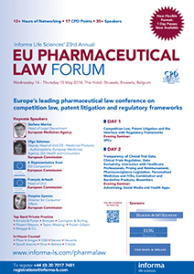
  • BrochureInforma Life Sciences will be holding its 23rd Annual EU Pharmaceutical Law Forum on May 14-15, 2014 in Brussels, Belgium.  The conference will offer presentations on the following topics:

    • Feedback from the EU Commission on competition law (keynote presentation) — to be presented by a representative from DG Competition, European Commission;
    • Reverse payment patent settlements;
    • Examining parallel trade: Imports and exports;
    • Relationship between pharmaceutical companies and wholesales/distributors: Assessing the competition law aspects;
    • Review of high profile national cases/decisions in competition law;
    • Unified Patent Court: Feedback from the European Commission (keynote presentation) — to be presented by François Arbault, Head of Unit, European Commission;
    • Interface between competition law, IP and the regulatory frameworks;
    • Understanding European patent and SPC litigation: Changes ahead (evening seminar discussion and dinner);
    • Implementation of the EU regulatory framework for medicinal products for human use (keynote presentation) — to be presented by Olga Solomon, Deputy Head of Unit D5 – Medicinal Products – Authorisations, European Medicines Agency, DG Health and Consumers, European Commission;
    • Transparency of pre-clinical and clinical trial data and other regulatory data;
    • Review of the clinical trials regulation;
    • Evaluating data exclusivity/Regulatory Data Protection (RDP) in the pharmaceutical industry;
    • Interaction with healthcare professionals – challenges and changes;
    • New trends in pricing and reimbursement and revisions to the EU Transparency Directive: Main focus on France, Germany, Spain, Italy and the UK;
    • Practical experience of the new pharmacovigilance legislation;
    • Feedback from the EU Commission on the EU regulatory framework for medical devices (keynote presentation) — to be presented by Despina Spanou, Director for Consumer Affairs, European Commission;
    • Examining the use of medical devices;
    • Overcoming challenges surrounding personalised medicines and IVDs;
    • Reviewing combination and borderline products;
    • Biosimilars and the regulatory frameworks; and
    • Examining pharmaceutical advertising, social media and health apps (evening seminar discussion and dinner).

    A complete brochure for this conference, including an agenda, detailed descriptions of conference sessions, list of speakers, and registration form can be obtained here.

    Informa Life SciencesThe registration fee for the conference is £1632.29 (1 Day Pass — conference and evening seminar for day 1 or 2), £2055.79 (2 Day Pass — conference only), £2660.79 (2 Day Pass — conference and one evening seminar), or £3023.79 (Full Pass — conference and evening seminar for days 1 and 2.  Those registering by April 11, 2014 will receive a £100 discount.  Those interested in registering for the conference can do so here, by e-mailing registrations@informa-ls.com, by calling +44(0) 20 7017 7481, or by faxing a registration form to +44(0) 20 7017 7823.

    Patent Docs is a media partner of the EU Pharmaceutical Law Forum.

  • PLI #1Practising Law Institute (PLI) will be holding its Fundamentals of Patent Prosecution 2014: A Boot Camp for Claim Drafting & Amendment Writing seminar on May 13-15, 2014 in Chicago, IL, on June 11-13, 2014 in New York, NY, and on July 9-11, 2014 in San Francisco, CA.  The three-day program, which is directed to patent prosecuting and litigating attorneys and patent agents with or without a Patent Office registration number or little patent experience, will focus on teaching the basics of claim drafting, patent application preparation and prosecution, as well as a review of recent developments in the law.  A litigator's perspective is also presented to show how drafting and prosecution can influence the development, and often the outcome, of subsequent patent litigation.  The seminar will feature lectures in the morning followed by small clinic sessions in the afternoon, with day 1 focusing on invention disclosures and patent preparation, day 2 on prosecution and issuance, and day 3 on litigation and opinion drafting.  Lectures will explain:

    • How to decide what elements of the invention should be included in the patent;
    • How to prosecute an application to result in allowance of an enforceable patent;
    • How to interview an Examiner;
    • How to use reissues, reexaminations, and other post-issuance proceedings;
    • How to anticipate patent litigation issues during the patent prosecution process; and
    • How to approach patent opinion drafting.

    PLI faculty will offer presentations on the following topics:

    • Taking Invention Disclosures;
    • Overview of Claim Drafting and Preparation of Patent Application;
    • Claim Drafting;
    • Review of Model Claims;
    • Patent Prosecution;
    • Conducting the Examiner Interview;
    • Review of Model Amendment; and
    • Litigation Issues.

    A program schedule and list of speakers for each of the locations can be found here.  Patent Docs authors Kevin Noonan (Chicago co-chair) and Donald Zuhn will be presenting on day 1 at the Chicago seminar.

    The registration fee for the conference is $1,895.  Those interested in registering for the conference can do so at the PLI website.

  • George Washington University Law SchoolThe George Washington University Law School (with Mayer Brown and Pillsbury) will be holding its annual GW Law Symposium on Intellectual Property on May 6, 2014 at The George Washington University Law School, 2000 H Street NW, Washington, DC.  The Symposium will offer presentations on the following topics:

    • Keynote Address — Nathan Kelley, Deputy General Counsel for Intellectual Property Law and Solicitor, United States Patent & Trademark Office

    • Beginning of A New Era: Post Issuance PTO Proceedings

    • Tips and Trends for Litigating Patent Cases in the Federal Courts

    • ITC: Recent Developments and Current Trends

    • Defensive Strategies: Patent Litigation

    Additional information about the Symposium, including a program, list of speakers, and directions can be found at the Symposium's website.  A cocktail reception will take place following the Symposium.

    The registration fee for the Symposium is $25 (Student Registration) or $75 (General Registration).  Those interested in registering for the Symposium can do so here.

  • Technology Transfer Tactics will be offering a webinar entitled "The Supreme Court’s Medtronic Ruling: Practical Guidance for Protecting University IP" on April 24, 2014 from 1:00 – 2:00 pm (Eastern).  Brian D. Gildea, Executive Director, IP & Licensing, Boston University Technology Development, and Charles R. Macedo of Amster, Rothstein and Ebenstein, LLP will dissect the Supreme Court's decision in Medtronic, Inc. v. Mirowski Family Ventures, LLC while giving practical guidance on how to manage and fortify patent portfolios in light of the decision.  The webinar will:

    • Review the Medtronic v Mirowski Family Ventures case specifics;
    • Address the three notions the Supreme Court's decision was based upon;
    • Provide expert tips on drafting and negotiating future patent licenses in light of Medtronic;
    • Address how to respond to declaratory judgment petitions — and what will meet "burden of proof";
    • Provide practical guidance for prepare burden of proof evidence; and
    • Provide best practices for dealing with licensees who file for declaratory judgment.

    The registration fee for the webinar is $197.  Those interested in registering for the webinar, can do so here.

    Technology Transfer Tactics

  • Strafford #1Strafford will be offering a webinar/teleconference entitled "Advanced AIA Issues for Patent Claim Construction: Best Practices Absent Clear Court Guidance" on April 23, 2014 from 1:00 to 2:30 pm (EDT).  Thomas L. Irving of Finnegan Henderson Farabow Garrett & Dunner, Colin G. Sandercock of Perkins Coie, and Lauren L. Stevens of the Global Patent Group provide guidance to patent counsel regarding the impact of the Leahy-Smith America Invents Act (AIA) on claim construction and offer best practices for addressing claim construction issues in light of the AIA.  The webinar will review the following questions:

    • What are the changes resulting from the AIA and the implications for claim construction?
    • What is the impact of claim construction on choice of law?
    • What are the benefits of new claims in a continuation application regarding choice of law in view of transitional applications?
    • Can the choice of law change when a district court judge construes the claim in such a way that the EFD changes?

    The registration fee for the webinar is $297 ($362 for registration and CLE processing).  Those interested in registering for the webinar, can do so here.