
By Kevin E. Noonan –

In a nonprecedential decision, the Federal Circuit recently affirmed a district court’s finding that innovator drugmaker Otsuka Pharmaceutical failed to show generic competitor Lupin infringed (or would infringe, if it marketed an FDA-approved generic version of Otsuka’s JYNARQUE® drug), the claims of U.S. Patent No. 8,501,730 and that Lupin had shown that Otsuka’s method of making the active pharmaceutical agent, highly pure tolvaptan, was obvious in Otsuka Pharmaceutical Co. v. Lupin Ltd.
In ANDA litigation, Otsuka asserted claims of U.S. Patent Nos. 8,501,730 and 8,273,735:
U.S. Patent No. 8,501,730:
1. A highly pure 7-chloro-5-hydroxy-1-[2-methyl-4-(2-methylbenzoylamino)benzoyl]-2,3,4,5-tetrahydro-1H-1-benzazepine having a purity of more than 99.5%, or a salt thereof, which is produced by the process which comprises reducing a benzazepine compound of the formula (1):
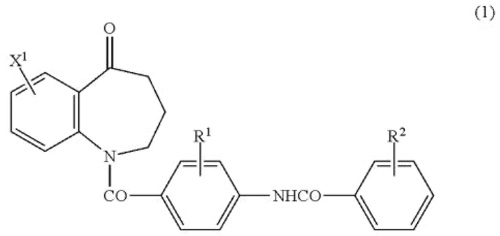
wherein X1 is a halogen atom, R1 and R2 are independently a lower alkyl group, or a salt thereof in the presence of a hydrogenating agent selected from the group consisting of lithium aluminum hydride, sodium borohydride, zinc borohydride, and diborane in an amount of 0.25 to 1 mole per 1 mole of the compound (1).
U.S. Patent No. 8,273,735:
6. A process for producing a 2,3,4,5-tetrahydro-1H-1-benzazepine compound of the formula(10):
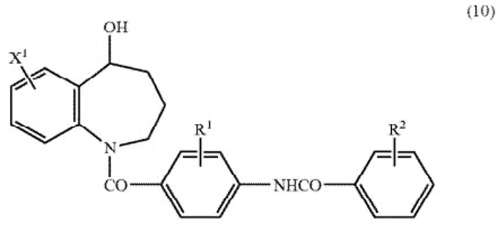
wherein X1 is a halogen atom, R1 and R2 are independently a lower alkyl group, or a salt thereof, which comprises reducing a benzazepine compound of the formula (1):
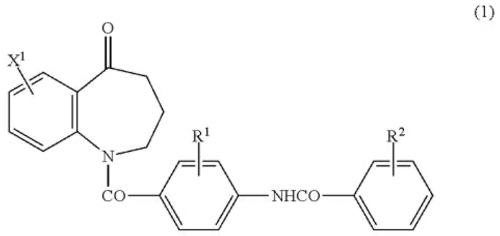
wherein R1, R2 and X1 are as defined above, or a salt thereof in the presence of a hydrogenating agent selected from the group consisting of lithium aluminum hydride, sodium borohydride, zinc borohydride, and diborane in an amount of 0.25 to 1 mole per 1 mole of the compound (1).
7. The process according to claim 6, wherein the hydrogenating agent is sodium borohydride which is used in an amount of 0.25 to 1 mole per 1 mole of the compound (1).
(wherein dependent claims 7, 8, and 10 were asserted).
Otsuka’s drug product and method for producing it had the benefit of reducing the percentage (to be less than 0.05%) of an impurity (termed “the dechlorinated impurity” in the opinion) for the tolvaptan used to treat Autosomal Dominant Polycystic Kidney Disease (ADPKD). The District Court found that Lupin’s Drug Master File differed from Otsuka’s method because “where Otsuka’s claimed process generally uses 1 molar equivalent or less of hydrogenating agent such as sodium borohydride per 1 mole of precursor compound, Lupin’s process uses at least 1.2 molar equivalents of sodium borohydride per 1 mole of precursor” (emphasis in opinion).
In other differences in its commercial process, Lupin tested the progress of the synthesis reaction at 15 and 75 minutes after initiation to determine whether no more than 0.05% of the original amount of the precursor compound remained. If that was the case, the reaction was quenched by the addition of hydrochloric acid and water, whereas if 0.05% of the original amount of the precursor compound or more remained additional reducing agent was added. On the basis of these differences, the District Court held Lupin’s DMF method does not infringe Otsuka’s claimed (and approved) method.
Regarding invalidity, the District Court found that the asserted claims of the ‘735 patent were obvious over the cited prior art while the asserted claims of the ‘730 patent were not.
The Federal Circuit affirmed, in an opinion by Circuit Judge Hughes, joined by Circuit Judge Cunningham and the Honorable Allison D. Burroughs, District Judge, U.S. District Court for the District of Massachusetts, sitting by designation.
In its assessment of the District Court’s infringement determination, the panel reviewed the District Court’s conclusion for clear error regarding fact findings and its legal conclusions de novo, citing United Therapeutics Corp. v. Liquidia Techs., Inc., 74 F.4th 1360, 1367 (Fed. Cir. 2023), and Merck Sharp & Dohme Corp. v. Amneal Pharms. LLC, 881 F.3d 1376, 1384 (Fed. Cir. 2018). Otsuka argued that the District Court’s reasoning was disjointed with regard to the claim term “amount,” wherein the District Court adopted a “practical completion” for construction and a “different and contradictory” construction (“absolute completion”) in applying the terms to Lupin’s DMF. Otsuka contended that “the reaction is practically complete before 1 molar equivalent of hydrogenating agent is added to the reaction mixture.” The District Court had construed the term “amount” to mean “the amount [of hydrogenating agent] while the reaction is taking place.” The panel also considered the differing definitions asserted by the parties during post-trial briefing, where Otsuka argued that the amount of hydrogenating agent recited in the claims was “the amount of hydrogenating agent added before the reduction reaction reaches ‘practical completion’ or is ‘complete in a practical sense,’” and Lupin’s position was that “so long as unreacted ketone precursor and sodium borohydride are present, the reaction will continue to proceed.” Otsuka’s argument prevailed with the District Court, on the grounds that Lupin’s position was directed to “the ‘theoretical possibility’ of ‘absolute completion’ of the reaction.”
On the basis of this construction, the District Court found that Otsuka’s infringement contentions failed for two reasons. First, Otsuka’s evidence did not establish that the reduction reaction was “practically complete” by the time the amount of unreduced precursor fell to 0.05% of the original amount in the reaction mixture when Lupin’s recipe ended the reaction by initiating the quenching step. Second, should Lupin’s reaction reach that amount Otsuka failed to show the other limitations of the claims were satisfied, that “no more than 1 molar equivalent of sodium borohydride or less has been added by that point.” The panel, in affirming these determinations, rejected Otsuka’s evidence to the contrary, which consisted of the results of two experiments performed by Lupin during the development of their synthetic process, and testimony from its own expert that “the reduction reaction will be complete long before the addition of 1 molar equivalent of sodium borohydride.” The basis for the Court’s rejection of these arguments was that, for Otsuka’s first contention the data from the two experiments contained “anomalies” that could be accounted for by “some unspecified ‘margin of error’ or a lack of ‘appropriate quality control.’” These anomalies were enough for the panel to agree with the District Court that reliance on these experiments by Otsuka’s expert was faulty because the data itself was “flawed.”
Otsuka’s second argument, based on its expert’s testimony, “that the reduction reaction will be complete long before the addition of 1 molar equivalent of sodium borohydride” was also unpersuasive to the Federal Circuit. Because some of these conclusions relied on the flawed experiments from Otsuka’s first arguments the panel agreed with the District Court that that Lupin’s expert’s testimony was more reliable and consistent with the evidence than Otsuka’s evidence.
Another Otsuka argument that did not convince the panel was that the District Court had erred with regard to Lupin’s expert witness testimony and purported deficiencies thereof. Specifically, Otsuka argued that Lupin’s expert was not properly qualified as an expert for failing to satisfy the standard of having “ordinary skill in the art,” based on lack of experience incorporated into the definition adopted by the District Court (having a relevant doctorate degree and ‘at least two years of experience in the synthesis, research, and development of medicinal compounds’”). The opinion notes that Otsuka had made these same arguments during post-trial briefing but the District Court refused to “entertain the merits” for failure to object and thus preserve challenge to admissibility of Lupin’s expert’s testimony on this basis. The panel found that the District Court properly determined that Otsuka had forfeited this objection under the law of the Third Circuit under Harbor Bus. Compliance Corp. v. Firstbase.io, Inc., 152 F.4th 516, 527 (3d Cir. 2025); United States v. Rivas, 493 F.3d 131, 136 (3d Cir. 2007). In addition, the panel cited Otsuka’s failure to file a Daubert motion under these circumstances, Daubert v. Merrell Dow Pharmaceuticals (1993). On these bases, the Federal Circuit affirmed the District Court’s conclusion that Otsuka had failed to establish infringement.
Regarding the District Court’s invalidity holding, the opinion sets forth the bases on the District Court record for that determination. These include a reference to Kondo et al.* that teaches small-scale synthesis of tolvaptan, which the District Court found would provide motivation for the skilled artisan “to specifically select the reduction step for modification” based on testimony from Lupin’s expert. Having so chosen, that artisan would have been motivated to “reduce the amount of sodium borohydride used in Kondo’s reduction step” and to achieve the claimed invention either “in light of his or her background knowledge or in light of two other [unidentified herein] pieces of prior art.” The District Court also found that these motivated alterations in prior art synthetic methods would have been pursued by the skilled artisan with a reasonable expectation of success.
The Federal Circuit, in affirming these conclusions by the District Court, rejected Otsuka’s arguments based on Lupin’s expert witness’s deficiencies in his focus on the Kondo reference and its reduction step as an indication of hindsight bias, as well as dismissing secondary considerations including “unexpectedly high tolvaptan purity and yield” over the Kondo prior art. The panel found that Lupin’s expert in his testimony considered other prior art but found Kondo to be “a particularly promising reference.” Also significant for the panel was that a non-prior art reference referred to the Kondo reference to be “a standard method for synthesizing tolvaptan.” The Federal Circuit concurred, despite acknowledging that there were “major obstacles” in developing the method. The Federal Circuit further found no clear error in the District Court’s assessment of the motivation to combine the prior art. This conclusion appears to be due in part to both parties’ experts having identified “many of the steps of Kondo” to have been “considered for modification,” including the reduction step. This conclusion was bolstered by Lupin’s “significant” expert testimony as to why the skilled worker would have done so, including “cost savings, improvement of the reaction’s safety profile, post-processing simplification, and knowledge that the hydrogenating agent was already being used in molar excess.”
As for the secondary considerations aspect of the District Court’s obviousness determination, the panel noted that Otsuka’s expert testimony was not based on Kondo’s methods but on modifications that used double the amount of reducing agent (emphasis in opinion). The opinion also asserts that the purported evidence of “unexpectedly high [product] yield” was inaccurate (comparing 30% to the 82-93% yield using the claimed process). In any event, the Federal Circuit dismissed secondary considerations errors by the District Court (should they exist) as being harmless, on the basis (“[a]fter all”) that “weak secondary considerations generally do not overcome a strong prima facie case of obviousness,” citing Genentech, Inc. v. Sandoz Inc., 55 F.4th 1368, 1378 (Fed. Cir. 2022).
* Kazumi Kondo et al., 7-Chloro-5-hydroxy-1-[2-methyl-4-(2 methylbenzoyl amino)benzoyl]-2,3,4,5-tetrahydro-1H-1-benzazepine (OPC-41061): A Potent, Orally Active Nonpeptide Arginine Vasopressin V2 Receptor Antagonist, 7 Bioorganic & Med. Chemistry 1743, 1743–54 (1999).
Otsuka Pharmaceutical Co. v. Lupin Ltd. (Fed. Cir. 2026)
Nonprecedential disposition
Panel: Circuit Judges Hughes and Cunningham and District Judge Burroughs
Opinion by Circuit Judge Hughes


Leave a Reply