
By Kevin E. Noonan –
Arbutus Biopharma and Genevant Sciences, having prevailed in district court litigation against Moderna involving infringement of U.S. Patent Nos. 8,058,069, 8,492,359, 8,822,668, 9,364,435, 9,504,651, and 11,141,378 regarding lipid nanoparticle (LNP) technology specifically comprising a particular cationic lipid:
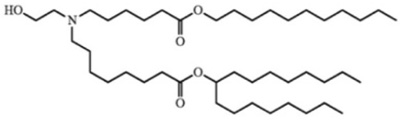
used in making vaccines against SARS-CoV-19 virus (COVID-19), filed its responsive brief in Moderna’s appeal to the Federal Circuit. At issue was the District Court’s determination on summary judgment that 28 U.S.C. § 1498(a) did not absolve Moderna of infringement liability, which if Moderna was to convince the Court to reverse would compel Arbutus/Genevant to bring the matter to the Court of Federal Claims as to the magnitude of payment by the government to which they were entitled. The statute reads:
Whenever an invention described in and covered by a patent of the United States is used or manufactured by or for the United States without license of the owner . . . the owner’s remedy shall be by action against the United States in the United States Court of Federal Claims for the recovery of his reasonable and entire compensation for such use and manufacture.
The amount at issue is not insignificant, the parties having settled (provided that Moderna does not prevail in its appeal) on a $1.3 billion payment.
In its responsive brief, Arbutus based its argument on statutory construction and precedent regarding how Section 1498 has been construed in particular instances. These arguments are in direct contrast to those in Moderna’s opening brief, which is based on the Executive branch being in best position to determine what is needed to meet emergencies, which is what the statute has always been intended to do (according to Moderna).
Arbutus argues that Section 1498 was crafted to permit the Federal government to obtain patented articles needed by the government during wartime, in what is termed the “direct benefits” test, as well as providing a limited abrogation of sovereign immunity for accepting liability for patent infringement. This argument relies on statutory language that infringement is by “a contractor” done (1) “for the Government” and (2) with the government’s “authorization or consent” (the parties have not disputed that the agreement involving COVID-19 vaccines satisfies the authorization or consent requirement).
Accordingly, Arbutus’s argument is focused on the “for the Government” language of the statute. Moderna’s actions were predominantly for the public, the brief maintains, there having been only a small fraction (~6,000,000 out of 500,000,000 vaccine doses provided by Moderna) used by the government directly (“designed and developed by a private party, shipped to private warehouses, and distributed to private companies and states to administer to private citizens,” as characterized in the brief). The government entered into a contract (termed “C-100”) for Moderna to make the vaccine having express language, wherein the government purchased vaccines to “facilitat[e] the goal of making” vaccine doses “available to the American population,” that were “used by the general public or by nongovernmental entities for purposes other than Governmental purposes”; and that “manufacturing of vaccine doses” was done for two groups—”the United States Government (USG) and the US population.”
Arbutus argues that Section 1498 does not apply to this public use; the “for the government” provisions of the statute mean that the benefit must be for the government directly and emphasizes that Moderna made the product (almost all of it, 98.8%) exclusively for the public. In addition, Arbutus contends that the government had essentially no involvement with the vaccines outside authorizing their procurement, for example that the government did no testing nor take physical possession nor make decisions as to who received the vaccine doses. This situation was a consequence of the express terms of the C-100 contract, i.e., for the benefit of both the government and the public.
Arbutus argues that Moderna’s interpretation “reads out” of the statute this direct benefit requirement, and (with the government) relied solely on satisfaction of the “authorize and consent” prong and disregarded the (separate) “for the government” prong. This, not the District Court’s decision, is error, according to the brief, because both prongs must be satisfied, inter alia because indirect infringement (which would be the case here) is subject to sovereign immunity which was not waived, citing Zoltek Corp. v. United States, 672 F.3d 1309, 1320 (Fed. Cir. 2012) (en banc)), as well as Broome v. Hardie-Tynes Mfg., 92 F.2d 886, 888 (5th Cir. 1937) (“for the government” prong must be satisfied); Hughes Aircraft Co. v. United States, 534 F.2d 889, 895, 897-98 (Ct. Cl. 1976) (per the contract, did the government directly benefit from the infringement); Sevenson Env’t Servs. v. Shaw Env’t, Inc., 477 F.3d 1361 (Fed. Cir. 2007) (“where infringing activity has been performed by a government contractor pursuant to a government contract and for the benefit of the government”); and IRIS Corp. v. Japan Airlines Corp., 769 F.3d 1359, 1362 (Fed. Cir. 2014) (satisfying the “authorization and consent” requirement not enough). The brief also cites instances where the “for” the government prong failed, including Windsurfing International, Inc. v. Ostermann, 534 F. Supp. 581, 588 (S.D.N.Y. 1982) (involving equipment for the Olympics); Larson v. United States, 26 Cl. Ct. 365 (1992) (involving Medicare payments); Riles v. Amerada Hess Corp., 999 F. Supp. 938, 940 (S.D. Tex. 1998) (related to oil drilling); and Carrier Corp. v. United States, 534 F.2d 244, 247 (Ct. Cl. 1976) (regarding garbage collection). Finally, with regard to precedent-citing, the brief sets forth decisions related to the “direct benefit test” that must be satisfied, including Advanced Software Design Corp. v. Fed. Rsrv. Bank, 583 F.3d 1371 (Fed. Cir. 2009) (Federal Reserve Bank); IRIS Corp (passport scanning); Riles (oil drilling); Yassin v. United States, 76 F. Supp. 509, 511 (Ct. Cl. 1948) (D-Day bridges); Kaplan v. United States, 153 F. Supp. 787, 789 (Ct. Cl. 1957) (sleeping bags).
Like the District Court, the brief uses a dictionary definition to construe the word “for” specifically, “For, A New Dictionary on Historical Principles 409 (1908),” citing FastShip, LLC v. United States, 892 F.3d 1298, 1303 (Fed. Cir. 2018), and provides a long explication of the proper use of the term in the statute.
The distinction Arbutus makes using these citations is between a contractor who makes a vaccine for the government versus a contractor employed by the government to make vaccines “full stop.” Arbutus relies for the factual grounds for this argument on Moderna’s own admissions that doses were provided for “the US population”; that their efforts were directed towards “developing a vaccine that’s intended to be administered to the general public, . . . beyond the internal use by the US Government only”; that its “vaccines [were] for the American people” and “for purposes other than Governmental purposes.” Arbutus also cites the facts regarding to whom the doses went and that the government never took formal title to the vaccines, calling any such title “ethereal.” To the extent there may be any ambiguity Arbutus argues that the burden is on Moderna regarding any such ambiguity to be cited against the government, relying on FAA v. Cooper, 566 U.S. 284, 290-91 (2012). The brief also relies on the District Court being in agreement with Arbutus on the need for both of these prongs to be satisfied, and that Moderna’s infringing activity (vaccines) for the benefit of the public was outside the scope of Section 1498, because the government did not directly benefit and thus being outside the scope of Section 1498 the private patent rights of Arbutus and Genevant were violated.
Arbutus further argues that a ruling in favor of Moderna would “collapse” the Section 1498 statutory structure as well as raise separation of powers issues should the court decide Moderna can benefit from Section 1498 under these circumstances. Congress in enacting the statutory language has limited the extent to which infringement on behalf of the government can be excused and the Executive Branch cannot expand it unilaterally, calling any such decision to confer “unfettered Executive discretion to intrude on private patent rights.” Moreover, the statute is itself a waiver of sovereign immunity and “executive officers lack the power to waive the federal government’s sovereign immunity” unilaterally, citing United States v. Horn, 29 F.3d 754, 762 (1st Cir. 1994), and Pacrim Pizza Co. v. Pirie, 304 F.3d 1291, 1294 (Fed. Cir. 2002), whereas Congress has that authority, citing Admiral Fin. Corp. v. United States, 51 Fed. Cl. 366, 368-69 (2002), and asserting that “[h]ad Congress thought it necessary to extinguish third-party patent liability in addressing the pandemic, it could have done so. It did not.”
Arbutus also argues that Moderna’s position is an “unprecedented expansion of the Executive’s power to expropriate constitutionally protected patent rights,” being made by bureaucrats as “a choice that courts (including this one) are powerless to review or “second guess,” according to the Department of Justice’s amicus brief (and contrary to Loper Bright’s overturning Chevron deference as well).
The brief also addresses Moderna’s warning regarding the effects of overruling the District Court on private parties using injunctions to prevent the government from acting in emergencies, noting that “[w]ithout expanding §1498 (which Arbutus argues would be the result of the Federl Circuit ruling in Moderna’s favor), courts ‘refuse” to “enjoin activities [where it] would injure the public health,’” citing Cordis Corp. v. Bos. Sci. Corp., 99F. App’x 928, 935 (Fed. Cir. 2004), and Bianco v. Globus Med., Inc., 2014 WL 1049067, at *11 (E.D. Tex. Mar. 17, 2014) (collecting cases), and that “[c]ourts [have already] refused injunctions related to COVID-19 for that reason,” citing Intrivo Diagnostics, Inc. v. Access Bio, Inc., 2022 WL 204618, at *2 (C.D. Cal. Jan. 24, 2022).
The brief also briefly considers argument from amici supporting Moderna, and states that “Moderna’s amici argue that the pandemic’s exigency justifies reading §1498 broadly. . . . But the pandemic did not transform ultra vires actions into permissible conduct,” citing Ala. Ass’n of Realtors v. HHS, 594 U.S. 758, 766 (2021) (per curiam) (“It is indisputable that the public has a strong interest in combating the spread of [COVID-19] . . . [b]ut our system does not permit agencies to act unlawfully even in pursuit of desirable ends.”).
On the other hand, Arbutus’s argument has resonated with several of the amici filing briefs in support of affirmance (to be discussed in other posts), motivated by the concern that expanding the scope of Section 1498 would, along with (improper) expansion of “march-in” rights provisions of the Bayh-Dole Act, severely impinge on private patent rights based on circumstances not reaching the emergency status of the COVID pandemic but serving seemingly compelling political ends.


Leave a Reply