
By Kevin E. Noonan –
One of the beneficial characteristics of the response to the COVID-19 pandemic were pledges from companies involved in developing vaccines (such as Moderna, Pfizer, BioNTech, and others) not to enforce patents on relevant technology during the duration. That restraint has long-since vanished (as has the global pandemic effects of the virus) and there have been several lawsuits, in the U.S. and abroad, relating to various components of the vaccine.
One of these lawsuits saw Arbutus Biopharma and Genevant Sciences suing Moderna over lipid nanoparticle (LNP) LNP technology specifically comprising a particular cationic lipid claimed in U.S. Patent Nos. 8,058,069, 8,492,359, 8,822,668, 9,364,435, 9,504,651, and 11,141,378:
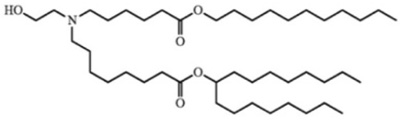
Arbutus and Genevant Sciences recently settled their lawsuit with Moderna; relevant features of this settlement include an immediate (July 2026) payment by Moderna to plaintiffs of $950 million with an additional $1.3 billion payment being subject to a determination on appeal to the Federal Circuit regarding Moderna’s claim that these sums should be paid by the Federal Government because their COVID-19 vaccine, Spikemax®, was produced under the provisions of 28 U.S.C. § 1498(a).
The question of who should pay was decided on summary judgement by the District Court (answer: Moderna) subject to appeal to the Federal Circuit regarding whether 28 U.S.C. § 1498(a) controlled, in which case the matter would be decided by the Court of Federal Claims as to the magnitude of payment by the government to which Arbutus was entitled. The statute reads:
Whenever an invention described in and covered by a patent of the United States is used or manufactured by or for the United States without license of the owner . . . the owner’s remedy shall be by action against the United States in the United States Court of Federal Claims for the recovery of his reasonable and entire compensation for such use and manufacture.
And the issue for the District Court, Moderna, and Plaintiffs Arbutus Biopharma and Genevant Sciences is the meaning of the term “used or manufactured by or for the United States” as it relates to use of vaccines against COVID-19 by the government itself or as administered to the public (the parties did not dispute that the other statutory requirement, that Moderna acted with the government’s “authorization and consent,” was satisfied).
Moderna’s brief sets out the policy considerations it argues should be persuasive for the Federal Circuit to reverse the District Court’s determinations that Section 1498 is not the proper basis for summary judgment:
A novel coronavirus, SARS-CoV-2, was first detected in Wuhan, China, in December 2019. Appx3237. “COVID-19” quickly spread across the globe. . . . By January, it reached America’s shores. Id. And ordinary life came to a halt.
COVID-19 posed a uniquely destabilizing threat. It spread easily through respiratory means. And humans had yet to develop “herd immunity,” which typically slows viral spread, to the novel virus. This meant that, on average, each person infected with COVID-19 transmitted it to multiple others, causing the virus to rapidly and uncontrollably multiply, before people even showed symptoms. This was a “‘perfect storm’ for rapid epidemic transmission with widespread infection.” Severe outbreaks overwhelmed the Nation’s hospitals. Early responses proved both ineffective and temporary. Frontline workers risked their lives just to man their posts. Without an effective vaccine, health authorities attempted to slow transmission through isolation measures, which imposed enormous economic and societal costs. Work stopped. Human contact was cut off. Loved ones were still dying—many alone.
In March 2020, President Trump declared a national emergency and announced “sweeping” government action “to control the spread of the virus in the United States.” This included entry restrictions and travel-related quarantines. It also entailed “policies to accelerate the acquisition of personal protective equipment and streamline bringing new diagnostic capabilities to laboratories.” The President explained that the “spread of COVID-19 within our Nation’s communities threatens to strain our Nation’s healthcare systems.” He warned hospitals to “be prepared to surge capacity” and confirmed that further measures were “needed to successfully contain and combat the virus in the United States.”
With this as a predicate, Moderna argued in its opening brief on appeal that the government agreed/promised to bear the risk of patent infringement liability under Section 1498 to reimburse Arbutus or any other patent holder for infringement damages. This portion of the brief contained the colorful analogy that under the District Court’s decision “a government-procured vaccine used to lift the Nation from a pandemic is less eligible for protection than staples sitting in an IRS supply closet.” Moderna argued that both prongs of the 1498 statute are satisfied in this case, i.e., “[t]he Government hired Moderna to develop a novel vaccine as a government product at the Government’s direction. The Government owned and controlled each batch produced. And it explicitly authorized Moderna to use ‘any’ patented invention in performing the ‘C-100’ Contract at issue.” Moderna’s opening brief further argued that Section 1498 – in its statutory text, legislative history, and history of how the statute has been used and courts passed judgment on the applications thereof – did not in this instance prevent the government from assuming such liability, specifically because the government itself took title to every dose (raising issues of fact on this point between what Moderna asserts and what Arbutus contends – to be discussed in a future post on Arbutus’s responsive brief). Moderna also challenged Arbutus’s arguments regarding the absence of direct infringement as precluding the government being liable for indirect infringement, stating that “there was no way for the Government to buy and deploy the vaccine without Moderna indirectly infringing: no manufacturing, no distribution, no administration.” The brief also makes the rational argument that Section 1498 permits the government to shield its contractor Moderna from “using injunctions or threats of massive damages to stop contractors from supplying the Government at all.” Affirmance of the District Court’s decision in this case, Moderna argues, would prevent the government from using private industry to “protect the Nation from the next pandemic, war, or other national emergency.”
Moderna took the opportunity to rebut Arbutus’s telling of the tale (that Moderna had control over an overwhelming amount of the 500 million vaccine doses it produced), stating that Moderna worked “hand-in-glove” with the government to deliver the vaccine against COVID-19, and emphasizing the degree of cooperation between Moderna and the government (rather than casting Moderna as an independent actor), making factual statements including:
“By late summer 2020, the Government was ready to start making Moderna’s mRNA vaccine.” – “The Contract called the vaccines ‘OWS products’” – “This was a government operation through-and-through” – “Contract provisions ensured ongoing government control over nearly every aspect of production, including timelines, security, management, maintenance, storage, delivery, packaging, and insurance” – “[G]overnment representatives were guaranteed access to Moderna’s facilities for compliance checks and audits” – “As DOD stressed from the outset, ‘[t]he federal government will own these vaccine doses’” – “Moderna delivered. The Government accepted—and took title to—half-a billion C-100 vaccine doses and deployed those doses to lift the Nation out of the COVID-19 pandemic. The Government’s partnership with Moderna and other private-sector innovators proved indispensable to that accomplishment” – “the Government [had] ‘full visibility, control, and ability to shift assets and use data to optimize vaccine uptake,’ which furthered the Government’s objective ‘to achieve maximum uptake of the vaccine across all population groups.’”
Moreover, Moderna’s brief asserts that:
• “The Government oversaw the distribution process.”
• “It signed agreements with each state and territory governing use of government doses, including that they be administered ‘according to the label.’”
• “Each dose was tracked in a government batch tracker”
• “The Government entered into a centralized distributor contract with McKesson to deliver the vaccine to locations throughout the country.”
• “McKesson executed the Government’s instructions to deliver “a specific amount of vaccine to a designated location.”
Moderna further argues that precedent supports its position that “government authorized patent use to fulfill a government procurement contract is manufacture or use ‘for the United States’ . . . [t]hat does not turn on what the Government does with its purchase,” citing Yassin v. United States, 76 F. Supp. 509, 515 (Ct. Cl. 1948), “[e]ven if the Government sends the goods abroad,” citing Kaplan v. United States, 153 F. Supp. 787, 789-90 (Ct. Cl. 1957). Moderna maintains in its argument that this and other precedent had interpreted the phrase “for the government” as meaning “on behalf of the government” (a position that the District Court rejected). In its assertions that the District Court erred in this determination, Moderna argues that the facts support the interpretation of the phrase “for the government” to mean “intended for the government” because the government “bought, paid for, and owned every vial it accepted,” and this is the standard applied pre-1498 during World War I wherein qualifying inventions were “used . . . by” (and only by) the Government. Moderna further argues that “for the government” is not a limit on what the government can procure but is just meant to ensure that it is the government that is doing the procuring and meant to permit the government to procure “whatever it wished regardless of possible patent infringement,” citing TVI Energy Corp. v. Blane, 806 F.2d 1057, 1060 (Fed. Cir. 1986).
According to Moderna, the cases relied upon by the District Court – Sheridan v. United States, 120 Fed. Cl. 127 (2015), and Larson v. United States, 26 Cl. Ct. 365 (1992) – stand for the principle that “private parties cannot spring liability on the Government by claiming that it incidentally benefited from private conduct.” Moderna characterizes as “absurd” the District Court’s limitation for the word “benefit” to be “only from doses physically injected into federal employees,” arguing that the true benefits obtained under Section 1498 were “deploying vaccines to thwart a pandemic, reopen the economy, and reduce nationwide dependence on the Government’s own spending.”
Further regarding the decision by the District Court and its reasoning, Moderna reminds the Court that in its statutory exegesis explicated the word “for” by choosing one of 31 different dictionary definitions (that Moderna disputes), and argues that contrary to the District Court’s conclusion “[t]he Government was the ‘intended recipient’ of all vaccine stock that Moderna produced pursuant to the C-100 Contract. The Government ordered, accepted, paid for, and owned every vial” (emphasis in brief). Moderna argued further that the District Court erred by turning an “intended recipient” requirement into an “end-user” requirement, so the Section 1498 safe harbor applies only if the vaccines produced by Moderna were used solely by the government (which use can arise long after the product was made for the government, Moderna argues), citing Sheridan v. United States, 629 F. App’x 948, 951 (Fed. Cir. 2015) (§ 1498 only covers infringement by those “acting on behalf of the United States”)
Moderna further argues that the District Court erred in its interpretation of the “for the government” requirement on Section 1498 “not merely because it benefited the public, but because the Government hired Moderna to do it.”
Regarding the issue of indirect infringement, Moderna cites Decca Ltd. v. United States, 640 F.2d 1157(Ct. Cl. 1980) (“section 1498 shields governmental contractors from being held liable for contributory infringement”), and Astronet Technologies Inc. v. BAE Systems, Inc., 802 F.3d 1271 (Fed. Cir. 2015) (“§1498 protects contractors from claims of indirect infringement predicated on direct infringement falling within the statute”), and argues that § 1498 protects use “by” and use “for” the United States so that indirect infringement (by the government eliciting direct infringement by a contractor) is protected by § 1498.
Turning to the consequences to be feared from the District Court’s decision Moderna asserts that:
The district court’s reasoning revives the very harms that Congress adopted §1498 to prevent. It lets Plaintiffs pursue exactly the same liability against Moderna—especially as Plaintiffs contend any use of the vaccine results in indirect infringement. Plaintiffs could even have sought an injunction to prevent Moderna from manufacturing or distributing the vaccine, halting the Government’s nationwide vaccination operation.
and that:
Congress did not allow government contractors’ statutory protection to be dodged so easily.
Turning to statutory interpretation as a matter of law, Moderna takes the position that the circumstances here clearly satisfy the requirements of Section 1498 for both authorization and consent and actions for the government (stressing the former):
Where, as here, the Government directly contracts for the manufacture of a product, that manufacture is on the Government’s behalf—and therefore “for the Government.” Based on regulation 48 C.F.R. §27.201-1(a) (describing §1498 as setting forth “the exclusive remedy for patent . . . infringement by or on behalf of the Government” (emphasis added)) – supported by government’s “Statement of Interest” filed pursuant to 28 U.S.C. § 517.
The Government desperately needed a vaccine to respond to a once-in-a-century pandemic that had brought American life—and the national economy—to a halt. The Government could not have made that vaccine itself, especially at the scale or speed required. So the Government hired Moderna to do that work for it. In a period of immense uncertainty, Moderna agreed to make an innovative vaccine in enormous quantities at record speed. The Government directed, oversaw, controlled, and approved Moderna’s work.
And:
[N]ot only were the doses manufactured for the Government, they were then used by and for the Government.
Moderna provides the hypothetical that if the government had made the vaccine itself then Section 1498 would certainly apply, and asks the Court why should Section 1498 not apply when “the Government hires a contractor to perform that same work through a procurement contract.”
The Moderna brief also provides a history of Section 1498 and its further statutory modifications, e.g., to extend the government’s protection against infringement to government contractors in response to William Cramp & Sons Ship & Engine Bldg. Co. v. Int’l Curtis Marine Turbine Co., 246 U.S. 28, 42 (1918). Moderna argues that the change in the statute occasioned by this decision was consistent with its position that by manufacturing COVID-19 vaccines any infringement was protected by Section 1498 as amended, citing Richmond Screw Anchor Co. v. United States, 275 U.S. 331, 342 (1928), for the proper scope of this change (which protection was further expanded to subcontractors during World War II).
Precedential citations supporting Moderna’s positions cited in the brief include Sevenson Env’t Servs. v. Shaw Env’t, Inc., 477 F.3d 1361 (Fed. Cir. 2007) (“A prime contractor that provides the goods or services required by a procurement contract with the Government is acting “for” the Government”), and Crater Corp. v. Lucent Techs., Inc., 255 F.3d 1361, 1368 (Fed. Cir. 2001) (regarding subcontractors); Yassin v. United States, 76 F. Supp. 509, 515 (Ct. Cl. 1948); Broome v. Hardie-Tynes Mfg. Co., 92 F.2d 886, 887-88 (5th Cir. 1937) (local dam works); and In re Mahurkar, 831 F. Supp. 1354, 1393 (N.D. Ill. 1993) (regarding supply of IV catheters).
Moderna’s brief distinguishes Sheridan and Larson as relied upon by the District Court because in Sheridan there was no government contract (“The Government never ordered any pipes or authorized their use” [and] “It did not control their distribution” [and] “It had no demonstrated ‘interest’ in or connection to them, much less a role directing their production as part of a government operation.”) And Larsen “involved only government reimbursement for private medical care—[there was] no government procurement and no authorization or consent to use patents.” In both cases the holdings were simply that “[p]rivate parties cannot foist §1498 liability on the Government for conduct the Government never sought, required, or bargained for” according to Moderna. The distinction Moderna makes here is that Moderna’s infringement was the consequence of the “intended effect of government conduct.” Moreover, Moderna contends that “[i]f the contractor was providing what the Government ‘sought or required’ in its contract (as Moderna was when making the vaccine), that is sufficient to show the contractor was acting ‘for the Government,’” citing Sevenson and Pieczenik v. United States, 2023 WL 5031507, at *2 (Fed. Cir. Aug. 8, 2023). This is the basis for Moderna to argue that “[w]here that is the case, the §1498 inquiry ‘reduce[s] to the very simple question’ whether the Government gave authorization or consent” under Sevenson.
Turning to the government benefit, Moderna recites a litany of public health and economic benefits as well as foreign policy advantages, which include those even if limited to benefits for the government per se, and argues that the Astronet and Decca decisions bring indirect infringement under the protective umbrella of Section 1498.
And with regard to the indirect infringement question, the brief cites Leading Tech. Composites, Inc. v. MV2, LLC, 2020 WL 13891409, at *13 (D. Md. Nov. 20, 2020) (“§1498 immunity also extends to claims of indirect infringement”); and Morpho Detection, Inc. v. Smiths Detection Inc., 2013 WL 5701522, at *4-5 (E.D. Va. Oct. 17, 2013) (recognizing §1498’s “clear directive” that the “sole remedy” for use under the statute extends to an indirect-infringement claim) to illustrate how courts have addressed this issue in the context of Section 1498 liability.
Moderna’s brief concludes with its assessment of appropriate public policy arguments regarding consequences of affirmance and urges the Federal Circuit to reverse the District Court’s summary judgment decision against Moderna deserving protection under the provisions of Section 1498.


Leave a comment