• Calendar

    March 6, 2012 – Biotechnology/Chemical/Pharmaceutical (BCP) Customer Partnership Meeting (U.S. Patent and Trademark Office) – 9:30 am – 4:00 pm (ET)

    March 14-15, 2012 – Biotech Patenting (C5) – Munich, Germany

    March 20-21, 2012 – FDA Boot Camp*** (American Conference Institute) – New York, NY

    March 26-27, 2012 – PTO Procedures under the America Invents Act*** (American Conference Institute) – New York, NY

    March 27, 2012 – The Biosimilar Drug Approval Pathway: Draft FDA Guidance and Beyond (McDonnell Boehnen Hulbert & Berghoff LLP) – 10:00 am to 11:15 am (CT)

    March 27, 2012 – US Patent Reform Forum 2012 (Managing Intellectual Property) – Washington, DC

    March 28-30, 2012 – 27th Annual Intellectual Property Law Conference (American Bar Association (ABA) Section of Intellectual Property Law) – Arlington, VA

    April 17, 2012 – 28th Annual Joint Patent Practice Seminar (Connecticut, New Jersey, New York, and Philadelphia Intellectual Property Law Associations) – New York, NY

    April 18, 2012 – European Biotech Patent Law Update (D Young & Co.) – 7:00 am and 12:00 pm (EDT)

    April 24-25, 2012 – Paragraph IV Disputes*** (American Conference Institute) – New York, NY

    ***Patent Docs is a media partner of this conference or CLE

  • MBHB Logo 2

    McDonnell Boehnen Hulbert & Berghoff LLP will be offering a live webinar on the "The Biosimilar Drug Approval Pathway: Draft FDA Guidance and Beyond" on March 27, 2012 from 10:00 am to 11:15 am (CT).  Patent Docs authors and MBHB attorneys Dr. Kevin Noonan and Dr. James DeGiulio will provide a detailed analysis of the three biosimilar guidance documents published by the U.S. Food and Drug Administration on February 9, 2012, including:

    • What the guidance materials say and what they don't;
    • Early impressions and reactions to the biosimilar guidance documents;
    • Lessons from the guidance and practical applications;
    • Effect of the guidance on the 351(k) abbreviated pathway;
    • Biosimilar proposal status update; and
    • Impact of the BPCIA and biosimilar guidance on other aspects of patent law.

    The presenters will also discuss the possibility that the combination of these non-specific guidances and the complex litigation provisions of the law may provide incentives for biologic drug innovators to rely more heavily on the market exclusivity provisions of the Act than on patents, and the implications of this eventuality.

    While there is no fee to participate, attendees must register in advance.  Those wishing to register can do so here.  CLE credit is pending for the states of California, Georgia, Illinois, North Carolina, New Jersey, New York and Virginia.

  • Brochure

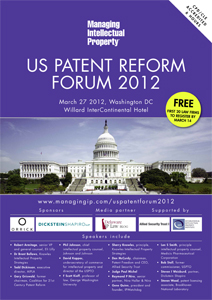
    Managing Intellectual Property will be holding the US Patent Reform Forum 2012 on March 27, 2012 in Washington, DC.  The conference will offer presentations on:

    • Roundtable: AIA rulemaking overview;
    • An industry perspective: We lobbied the cause; the act was passed — where did we land?
    • Key considerations: The joinder provision; ITC proceedings and the new rules on false marking;
    • In focus: Post grant review and litigation strategies under AIA;
    • First-to-file system: Implications of a significant change in the law; and
    • AIA and NPEs: Impact or more of the same?

    In addition, keynote addresses will be given by Robert Armitage, senior vice president and general counsel for Eli Lilly and Company; U.S. Patent and Trademark Office Director David Kappos; and former USPTO Commissioner of Patents Bob Stoll.

    A complete brochure for this conference, including a programme, detailed descriptions of forum sessions, list of speakers, and registration form can be obtained here.

    The registration fee for the conference is $1,295 (private practice rate).  There is no fee for in-house counsel, academics, and attendees from research institutes.  Those interested in registering for the conference can do so by calling 1-212-224-3570, by faxing a registration form to +44 20 7779 8279, or by e-mailing hotline@euromoenyplc.com.

  • D Young & Co

    D Young & Co. will be offering its next European biotech patent law update on April 18, 2012.  The 45-minute webinar will be offered at two times:  7:00 am (EDT) and 12:00 pm (EDT).  Robert Dempster and Simon O'Brien will provide an essential update and live Q&A on European biotechnology case law.

    While there is no fee to participate, attendees must register in advance.  Those wishing to register can do so here.

  • By Donald Zuhn —

    USPTO Seal

    Last month, the U.S. Patent and Trademark Office, exercising the new fee setting authority conferred upon the Office by § 10 of the Leahy-Smith America Invents Act, submitted a table of patent fee changes to the Patent Public Advisory Committee (PPAC).  The proposed fee changes were submitted to the PPAC in advance of two public hearings that were held on February 15 and February 23.

    AIA § 10 allows the Director to set or adjust any fee established, authorized, or charged under Title 35 (but "only to recover the aggregate estimated costs to the Office for processing, activities, services, and materials relating to patents").  Pursuant to that section, the Director must submit proposed fee changes to the PPAC not less than 45 days before publishing the proposed fees in the Federal Register, after which the PPAC shall have 30 days to deliberate, consider, and comment on the proposal as well as hold a public hearing on the proposal.  (The proposed fee changes were submitted to the PPAC on February 7, so the Committee has at least until March 8 to consider the changes and the Director must wait until March 23 before publishing a notice regarding the changes.)  The Director shall then consider and analyze PPAC's comments, advice, or recommendations before setting or adjusting the fee.  AIA § 10 also requires that the Director provide the public with a 45-day period in which to comment on any fee change, and specifies that fee changes shall not become effective until 45 days after the final rule regarding such change is published in the Federal Register (in order to give Congress an opportunity to enact a law disapproving of the fee change).

    Along with the table of proposed changes, the Office has also made the following materials available on its AIA implementation webpage:

    • A 4-page letter from Director Kappos to PPAC regarding the proposed changes;
    • A 34-slide executive summary of the proposed changes that was submitted to PPAC;
    • An 85-slide collection of detailed appendices regarding the proposed changes that was submitted to PPAC;
    • An attachment providing aggregate revenue calculations that was submitted to PPAC; and
    • A 5-page memorandum from USPTO General Counsel Bernard J. Knight, Jr. regarding patent fee setting.

    A listing of the twenty highest patent fees* under the Office's proposal is shown below:

    Proposed Fees

    As measured in dollars, the twenty patent fees* that would increase the most under the Office's proposal are as follows:

    $ Increase

    Finally, as measured by percentage, the twenty patent fees* that would increase the most under the Office's proposal are as follows:

    % Increase

    The Office's rationale for each of its proposed changes can be found by cross-referencing the table of patent fee changes with the detailed appendices.

    *Patent fees for design, plant, and reissue applications were excluded.

  • EPO

    By Charlotte Teall —

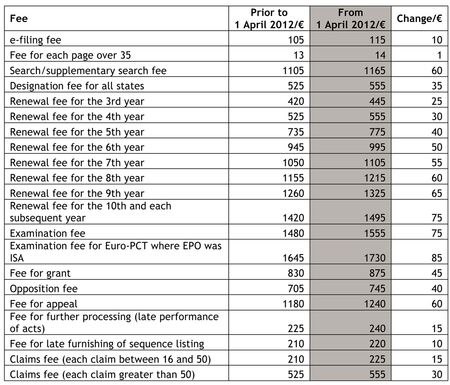
    The European Patent Office ("EPO") recently announced that most of its fees will increase by between 5 and 10 per cent from 1 April 2012.

    The changes in fees

    A comparison of the old and new fees is given below (this shows the changes in the most common fees paid to the EPO; there are fee increases for other fees which are less commonly paid).

    EPO fee changes 2012

    Practical implications

    If you know that you want to enter the European regional phase of a PCT application, you should do so before 1 April 2012, to save around 5% on the official fees due.

    For example, a typical PCT application might have 35 pages and 15 claims, with the USPTO as the International Searching Authority (ISA).  If that PCT application enters the European regional phase on or after 1 April 2012, the total official fees will be €3215.  If it enters the European regional phase before 1 April 2012, the total official fees will be €3020 (saving slightly more than 5% in the official fees).

    Exactly the same principle applies to filing a new European patent application directly at the EPO.  It particularly applies to new divisional applications, where the savings on accumulated renewal fees can be considerable.

    Therefore, if possible, you should file new European patent applications (particularly divisionals), and enter the European regional phase of PCT applications, before 1 April 2012.

    The EPO has elected not to introduce a new payment structure.  The changes in fees will not change day-to-day practice, save for the need to pay higher official fees.  Therefore, our previous practical advice, for example concerning minimising the number of claims, still applies.

    The other major practice change the EPO has proposed from 1 April 2012 concerns the new grant procedure reported here.

    This article was reprinted with permission from Forresters.

  • By Kevin E. Noonan —

    Monsanto

    On Friday, Judge Naomi Reice Buchwald presiding in the Southern District of New York granted Monsanto's motion to dismiss a case brought by the Public Patent Foundation (PubPat) on behalf of "farmers and seed businesses, both organic and non-organic, as well as related membership organizations."  Organic Seed Growers and Trade Assn. et al. v. Monsanto Co.  This puts to an end (for now) PubPat's latest effort to influence U.S. patent policy through the courts (the other instance being, most (in)famously, Association for Molecular Pathology v. U.S. Patent and Trademark Office ("the Myriad case"), although here PubPat was not aided by the American Civil Liberties Union).  The complaint named almost seventy plaintiffs, and the patents at issue were U.S. Patent Nos. 5,322,938 (expired 6/21/2011), 5,532,605 (expired 7/28/2008), 5,362,865 (expired 11/8/2011), 5,378,619 (expired 1/3/2012), 5,424,412 (will expire 6/13/2012), 5,463,175 (will expire 10/31/2012), 5,530,196, 5,554,798, 5,593,874, 5,641,876, 5,659,122, 5,717,084, 5,728,925, 5,750,871, 5,859,347, 6,025,545, 6,040,497, 6,051,753, 6,083,878, 6,753,463, and 6,825,400, and U.S. Reissue Patent Nos. RE38825 and RE39247.

    Monsanto asked the Court to dismiss the action for failure to allege a "case or controversy" under the Declaratory Judgments Act as required under Article III of the Constitution.  The District Court began its opinion granting this motion by noting that a court's jurisdiction cannot exceed this Article III requirement under the Declaratory Judgment Act, citing Prasco, LLC v. Medicis Pharm. Corp., 537 F.3d 1329, 1335 (Fed. Cir. 2008).  The Supreme Court's test for determining whether a sufficient case or controversy has been plead requires a plaintiff to establish that "the facts alleged, under all the circumstances, show that there is a substantial controversy, between parties having adverse legal interests, of sufficient immediacy and reality to warrant the issuance of a declaratory judgment," citing (without apparent irony) Association for Molecular Pathology v. U.S. Patent & Trademark Office ("AMP"), 653 F.3d 1329, 1342-43 (Fed. Cir. 2011) (quoting MedImmune, Inc. v. Genentech, Inc., 549 U.S. 118, 127 (2007)).  The Court noted that this test has been "refined" by the Federal Circuit to require "an injury in fact traceable to the patentee," which only exists if plaintiffs have alleged "both (1) an affirmative act by the patentee related to the enforcement of his patent rights, and (2) meaningful preparation to conduct potentially infringing activity."  Id. at 1343 (citing SanDisk Corp. v. STMicroelectronics, Inc., 480 F.3d 1372, 1380-81 (Fed. Cir. 2007).

    The opinion notes (in footnote 5) that:

    [P]laintiffs attempt to circumvent this test first by arguing that MedImmune confers per se standing on any plaintiff who has purchased a license to a patent.  (Pls.' Mem. 18.)  The argument evinces a lack of understanding of MedImmune's holding, which was that purchasing a patent license does not preclude jurisdiction where the purchase has been coerced.  See 549 U.S. at 129-31.  Plaintiffs, relying on their misreading of MedImmune, next endeavor to extend the argument and contend that standing should be conferred on all parties who are able to purchase a license, whether or not they have done so.  (Pls.' Mem. 19.)  Accepting this suggestion would functionally eliminate the case or controversy requirement and should thus be rejected out of hand.

    District Court for the Southern District of New York

    The Court explained that the first prong of the Federal Circuit's test ensures that the parties have "adverse legal interests," which is established "where a patentee asserts rights under a patent based on certain identified ongoing or planned activity of another party, and where that party contends that it has the right to engage in the accused activity without license."  SanDisk, 480 F.3d at 1381.  (The Court recognized that "it is possible that the first prong of the test may be satisfied upon some lesser showing.")  In any case, there must be "an underlying legal cause of action that the declaratory defendant could have brought or threatened to bring, if not for the fact that the declaratory plaintiff had preempted it," because otherwise "any adverse economic interest that the declaratory plaintiff may have against the declaratory defendant is not a legally cognizable interest sufficient to confer declaratory judgment jurisdiction," citing Creative Compounds, LLC v. Starmark Labs., 651 F.3d 1303, 1316 (Fed. Cir. 2011).  The "mere existence of a potentially adverse patent does not cause an injury [or] create an imminent risk of an injury; absent action by the patentee, a potential [infringer] is legally free to market its product in the face of an adversely-held patent," citing Prasco, 537 F.3d at 1338.

    As to the second prong, the Federal Circuit's test requires that the declaratory judgment plaintiff has taken "significant, concrete steps to conduct infringing activity"; otherwise, "the dispute is neither 'immediate' nor 'real' and the requirements for justiciability have not been met," citing Cat Tech LLC v. TubeMaster, Inc., 528 F.3d 871, 880 (Fed. Cir. 2008).  The Court notes that "the greater the length of time before potentially infringing activity is expected to occur" is "significant" and impacts the immediacy of the cause of action.

    Here, the Court held that plaintiffs failed to assert a "case or controversy" that supported Article III jurisdiction.  The facts supporting the Court's conclusion were that there was no evidence that Monsanto "ever demanded royalty payments from plaintiffs, identified any of plaintiffs' conduct as potentially infringing, or even initiated any contact with plaintiffs whatsoever."  Plaintiffs only support for there being a "case or controversy," according to the Court, was "(1) defendants' pattern of enforcing their patent rights against non-plaintiff farmers through litigation or threats of litigation; (2) plaintiffs' assertion of the 'implicit threat' in defendants' statement that it is not their policy to enforce their patent rights against farmers whose crops inadvertently acquire trace amounts of patented seeds or traits; and (3) defendants' refusal to provide plaintiffs with a blanket covenant not to sue."

    These reasons were not sufficient in the Court's opinion.  The first reason, that Monsanto has a pattern of enforcing its patent rights through litigation or threat of litigation, was rejected by the Court because it did not include evidence that Monsanto had exercised its patent rights against the plaintiffs.  While conceding that suits against third parties could support declaratory judgment jurisdiction, the Court noted that these circumstances required that suits against such third parties must be "sufficiently similar" to one that a patentee "may bring" against the plaintiffs (put another way, against "similarly situated parties").  The reason, according to the opinion, is that "a fear of future harm that is only subjective is not an injury or threat of injury caused by the defendant that can be the basis of an Article III case or controversy," citing Prasco, 537 F.3d at 1338.  This is evaluated objectively, wherein "it is the reality of the threat of injury that is relevant to the standing inquiry, not the plaintiff's subjective apprehensions."  Id. at 1338-39 and Hewlett-Packard Co. v. Acceleron LLC, 587 F.3d 1358, 1363 (Fed. Cir. 2009).  Specifically, the Court determined that the 144 patent infringement suits filed by Monsanto between 1997 and 2010 were not excessive, comparing the frequency of thirteen lawsuits a year with the "approximately two million" farms in America.  In addition, these suits were not against "similarly situated plaintiffs" in the Court's view, since the declaratory judgment plaintiffs here averred that they had no interest in having their seed "contaminated by transgenic seed"; the defendants in Monsanto's other actions were farmers who infringed Monsanto's patents by replanting seeds or breaching their contractual obligations.  There was "no evidence that defendants have commenced litigation against anyone standing in similar stead to plaintiffs and thus the evidence did not support the 'affirmative acts' prong of the Federal Circuit's test for declaratory judgment jurisdiction" according to the opinion.  And any allegations by plaintiffs that Monsanto had threatened "similarly situated" farmers who wished to avoid inadvertent use of Monsanto's patented seed were, according to the Court, "equally lame" because "not one single plaintiff claims to have been so threatened."

    PUBPAT

    The Court also rejected plaintiffs' argument that Monsanto's actions contained an "implicit" threat of litigation.  This allegation stemmed from Monsanto's statements.  In response to a post-filing letter from PubPat demanding a covenant not to sue in order to dismiss the lawsuit, and similar statements on Monsanto's website.  The "purportedly threatening languages reads (in its entirety)":

    It has never been, nor will it be[,] Monsanto policy to exercise its patent rights where trace amounts of our patented seeds or traits are present in [a] farmer's fields as a result of inadvertent means.

    The Court found plaintiffs' characterization of this language as threatening to be "objectively unreasonable."  This determination is based on plaintiffs' avowed intention to not "use or sell transgenic seeds," and that plaintiffs' intention was "specifically communicated" to Monsanto.  If these intentions were true, "the presence of patented traits in plaintiffs' seeds could only be inadvertent," according to the Court, and the possibility that plaintiffs could somehow "find themselves unknowingly utilizing it in significant quantities strains credulity."  The Court finds the "plain meaning" of Monsanto's statement to be clear, and that the Court would not adopt plaintiffs' "deliberate misreading" thereof.  Further:

    Indeed, plaintiffs' letter to defendants seems to have been nothing more than an attempt to create a controversy where none exists.  This effort to convert a statement that defendants have no intention of bringing suit into grounds for maintaining a case, if accepted, would disincentivize patentees from ever attempting to provide comfort to those whom they do not intend to sue, behavior which should be countenanced and encouraged.  In contrast, plaintiffs' argument is baseless and their tactics not to be tolerated.

    Remarkably, the Court noted that these statements were made after filing the initial complaint, in view of the fact that it is impermissible for the Court to consider such conduct in evaluating whether declaratory judgment jurisdiction exists.  The policy reason for this rule is that it would "invite a declaratory judgment plaintiff in a patent case to file suit at the earliest moment it conceives of any potential benefit to doing so" in an attempt to "draw an infringement suit in response (thereby retroactively establishing jurisdiction over their first-filed declaratory judgment suit)," said the Court, citing Innovative Therapies, Inc. v. Kinetic Concepts, Inc., 599 F.3d 1377, 1384 (Fed. Cir. 2010).  This is exactly what plaintiffs are attempting here, according to the opinion, which is "a further reason to discount their argument."

    Finally, the Court deigned not to credit any effect of Monsanto's refusal to execute a covenant not to sue in plaintiffs' favor.  Calling it a request for a "blanket waiver," the Court found it "unsurprising" that Monsanto declined plaintiffs' invitation to enter into such an agreement.  Plaintiffs' argument was "groundless and their tactics unacceptable," the Court held.  Monsanto's refusal to enter into the covenant was but one factor to be considered under Federal Circuit precedent and here "does not meaningfully add to plaintiffs' case."  According to the opinion, "plaintiffs' letter was clearly intended to be used as a prop in this litigation, and the failure to sign a covenant not to sue borders on the wholly irrelevant."

    The Court also found no evidence of the required "preparatory conduct" needed under the second prong of the Federal Circuit test.  In this case, plaintiffs contended that there was no requirement for them to take affirmative action to infringe, since "defendants' patented seeds will spread with no action on plaintiffs' part and are self-replicating."  Regardless of the accuracy of these allegations, the Court said that the "potential infringement " must be "a matter of immediate concern," and that plaintiffs' allegations fail in this regard.  The opinion notes that not only have plaintiffs not alleged that any of them have "actually grown or sold contaminated seed," they have maintained their intention to "specifically avoid any such use."  They do, however, allege that they "could . . . be accused of patent infringement" due to contamination of their seed with Monsanto's seed.  The Court characterized this allegation as the sort of "intangible worry, unanchored in time" that the Federal Circuit has found "insufficient to support an 'actual or imminent' injury for standing without any specification of when the some day will be," citing AMP, 653 F.3d at 1346.  Addressing plaintiffs' allegation that they are suffering injury because some of them have stopped planting certain crops due to fear of a lawsuit, the Court called this an injury of their own making that did not support declaratory judgment jurisdiction.

    Finally, considering all the circumstances, the Court granted Monsanto's motion to dismiss, calling plaintiffs' allegations "diaphanous" and the complaint "a transparent effort to create a controversy where none exists."

  • By Donald Zuhn —

    Pioneer Hi-Bred

    Today, the Federal Circuit affirmed a decision by the Board of Patent Appeals and Interferences holding that in an interference between Pioneer Hi-Bred International's U.S. Patent No. 6,258,999 and Monsanto Technology's U.S. Application No. 11/151,700, Monsanto was not time-barred under 35 U.S.C. § 135(b)(1) and Monsanto's '700 application claims were entitled to seniority.

    Pioneer's '999 patent, which issued on July 10, 2001, claims the benefit of U.S. Application No. 07/205,155, which was filed on June 10, 1988.  Claim 1 of the '999 patent recites:

    1.  A fertile transgenic Zea mays plant comprised of stably incorporated foreign DNA, wherein said foreign DNA consists of DNA that is not from a corn plant and that is not comprised of a T-DNA border.

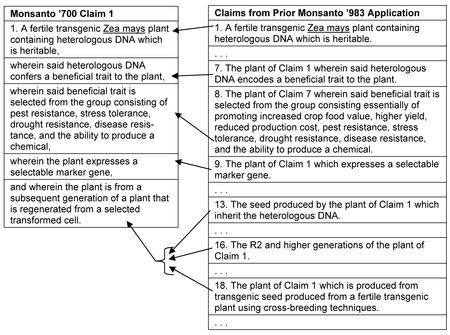
    Monsanto's '700 application, which was filed June 13, 2005, claims the benefit of U.S. Application No. 07/467,983, which was filed on January 22, 1990.  Claim 1 of the '700 application recites:

    1.  A fertile transgenic Zea mays plant containing heterologous DNA which is heritable, wherein said heterologous DNA confers a beneficial trait to the plant, wherein said beneficial trait is selected from the group consisting of pest resistance, stress tolerance, drought resistance, disease resistance, and the ability to produce a chemical, wherein the plant expresses a selectable marker gene, and wherein the plant is from a subsequent generation of a plant that is re-generated from a selected transformed cell.

    Following the Board's declaration of an interference between all of the claims in Pioneer's '999 patent and twelve claims in Monsanto's '700 application, Pioneer moved for judgment, arguing that the claims of the '700 application were time-barred under § 135(b)(1).  That section states that:

    A claim which is the same as, or for the same or substantially the same subject matter as, a claim of an issued patent may not be made in any application unless such a claim is made prior to one year from the date on which the patent was granted.

    Because the claims of the '700 application were not presented to the USPTO prior to July 10, 2002 (i.e., one year from the date on which the '999 patent issued) — the critical date — Pioneer contended that it was entitled to a determination of priority.  The Board, however, denied Pioneer's motion, holding that the interfering claims in Monsanto's '700 application related back to claims in the '983 application, which were presented before the critical date.

    Monsanto

    Monsanto also filed a motion, seeking to deny Pioneer the benefit of the '155 application, arguing that the '155 application did not contain sufficient disclosure supporting the claims involved in the interference.  The Board granted Monsanto's motion, making Monsanto the senior party, and Pioneer stipulated to judgment in favor of Monsanto.  Pioneer then appealed the Board's decision to the Federal Circuit.

    On appeal, Pioneer argued that the Board erred in relying on multiple pre-critical date claims to support Monsanto's later claim.  While the Board recognized that no single claim in the '983 application contained all of the limitations of claim 1 in Monsanto's '700 application, the Board determined that multiple claims from a pre-critical application, operating together, could serve as the basis for showing that a later claim was actually made before the one-year bar of § 135(b)(1).  In particular, the Board held that when claims 1, 7-9, 12, 16, and 18 of the pre-critical '983 application were taken together (as shown in the comparison below), they were "sufficiently congruent" with the claims presented in Monsanto's '700 application to overcome the § 135(b)(1) time bar.

    Claim Chart

    Pioneer also argued that the claims of the '983 application recite inventions that are so different that the Board erred in holding these claims to be "sufficiently congruent."  In particular, Pioneer contended that the Board erred in determining that claim 9 and claims 7 and 8 of the '983 application were directed to the same invention.  Finding no error in the Board's determination, the Federal Circuit concluded that "the pre-critical date claims here demonstrate intent to claim an invention reflecting both the limitations of claims 7 and 8 and of claim 9."  The Court agreed with the Board that "nothing in claim 9 indicates a choice away from the limitations of claim 7 or claim 8."

    Pioneer also found fault with the Board's analysis as to claims 13, 16, and 18 of the '983 application, arguing that these claims did not support the limitation of claim 1 of Monsanto's '700 application that "the plant is from a subsequent generation of a plant that is regenerated from a selected transformed cell."  As the Court noted, this language limits the claim to all generations of the subject plant beyond the initial progenitor (i.e., R1 and higher generations).  Once again agreeing with the Board, the Court noted that:

    Claim 16 specifically reaches the "R2 and higher generations."  And while there is no claim expressly reciting an "R1" generation, Monsanto '983 claim 13 addresses the seed necessary to give rise to that generation and claim 18 limits the plant of Monsanto '983 claim 1 so that it is itself an "R1" plant.

    Pioneer closed by arguing that the Board erred in denying Pioneer the benefit of the '155 application.  The basis of the Board's decision was the lack of disclosure of an enabled embodiment satisfying the requirement in claim 1 of Pioneer's '999 patent that the "foreign DNA . . . is not comprised of a T-DNA border."  The Court found no error in the Board's conclusion that Monsanto met its burden of showing that Pioneer's '155 application could not serve as a constructive reduction to practice of the '999 patent claim (i.e., it did not disclose any enabled embodiment of the later claim), and that Pioneer failed to overcome this showing.  The Court stated that:

    Reviewing the Pioneer '155 application, we agree with the Board that it includes no express discussion of T-DNA borders at all.  In its briefs and argument on appeal Pioneer presented no serious contention that the foreign DNA described in that application would inherently not comprise a T-DNA border, which is the only other way the required embodiment could be found.

    The Court therefore affirmed the Board's decision that Monsanto's '700 application claims were entitled to seniority.

    Pioneer Hi-Bred International, Inc. v. Monsanto Technology LLC (Fed. Cir. 2012)
    Panel: Circuit Judges Prost, Clevenger, and Reyna
    Opinion by Circuit Judge Clevenger

  • By James DeGiulio — 

    FDA

    Earlier this month, the U.S. Food and Drug Administration recently published its long-awaited guidance documents on Biosimilars/Biosimilarity (see "FDA Publishes Draft Guidelines for Biosimilar Product Development" and "More on FDA Draft Guidelines for "Follow-on" Biologic Drug Approval Pathway").  Some of the first public statements made by the FDA regarding these newly-published biosimilar guidance documents were made in a February 15 presentation by Dr. Rachel E. Sherman, Associate Director for Medical Policy at the Center for Drug Evaluation and Research.  Dr. Sherman moved through the guidance documents quickly, without exploring any particular issues in detail, but there were several notable messages in her presentation that expand beyond the text of the statute and the guidance documents.

    Sherman, Rachel

    Dr. Sherman (at left) opened by noting that the presentation represented the first opportunity for the FDA to interact with the audience targeted by the guidance documents.  The FDA has continually emphasized the guidances' wide target audience, comprising consumers (patients), patient advocacy groups, health care providers, as well as those in the pharmaceutical industry.  The FDA's effort to draft the guidelines so as to be understandable to the average consumer may partially explain the minimal specific requirements throughout the guidance documents.  The presentation continued with an overview of the Biologics Price Competition and Innovation Act (BPCIA) and its effects on the approval of biologics under the current statutory framework (PHSA and FFDCA).  The BPCIA will consolidate the approval of all biologics, as the FDA strongly disapproves the current two-option framework, allowing certain biologics to be approved under either the PHSA or the FFDCA.  The transition to a single approval pathway under the BPCIA is expected to be completed by 2020.

    The FDA next responded to the criticism that the abbreviated approval pathway does not promote innovation.  The FDA considers the biosimilarity approval pathway to be innovative because each analytical study required of biosimilar applicants will advance the field of knowledge regarding the molecule of interest.  For example, a biosimilar applicant may have to characterize the function of particular amino acids in binding domains of its biosimilar product, thus providing date to others in the field as to the homology requirements of its biologic.  The FDA would then make a determination of biosimilarity, and consider whether the FDA would require additional testing/studies to support a finding of biosimilarity.  This determination is presented using an entertaining analogy.  Dr. Sherman's presentation contains a line drawing of an elephant (below), where each line represents an analytical or clinical study performed by the biosimilar applicant (Wel J. "Least squares fitting of an elephant." Chemtech Feb. 128-29 (1975)).  The FDA will have to compare the reference product (figure A) with the biosimilar products (figures B-E) to determine what level of detail is required for a determination of biosimilarity (whether the drawing is an elephant or not).  The biosimilar applicant will attempt to draw the minimum amount of lines such that the FDA can make a finding that the biological product is biosimilar to the reference product (elephant).  The FDA will not permit any "tracing" of the lines in the drawing, as these attributes of the biosimilar are already known.  The FDA considers repetition of any animal or human studies to be unethical, therefore they must be avoided.  Each test or study must add something to the whole body of evidence.  This elephant analogy is also used to define "fingerprint" studies, which may tell the biosimilar applicant at an early stage that its product will not qualify for approval under 351(k) (e.g., if early lines in the drawing show a beak or fins).

    Elephant Drawings

    Animal analogies aside, Dr. Sherman reiterated the importance of meeting with the FDA "early and often" during biosimilar development.  By issuing the guidance documents, the FDA only intended to address the highest priority uncertainty in the biosimilarity standards.  Only the minimum amount of information was included to provide biosimilar applicants with some level of expectation regarding the minimum studies required prior to contacting the FDA.  The FDA expects the minimum characterization outlined in the guidance documents to be performed up front, and then the expectation is that the biosimilar applicant will contact the FDA armed with this subset of data.  The FDA has every intention of, essentially, making up the standards as it goes, and is strongly encouraging anyone who is considering entering the biosimilar space to set up an FDA meeting as soon as possible to discuss.

    Perhaps most interesting was the FDA's status report on the current status of received biosimilar proposals.  According to Dr. Sherman, the FDA has currently received 35 pre-IND meeting requests for proposed biosimilar products, corresponding to eleven reference products.  Of course, the applicants and the corresponding reference products were not disclosed.  However, for comparison, the EU has approved fourteen biosimilar products, which correspond to three reference products:  Filgrastim (Amgen's Neupogen), Epoetin (Amgen's Epogen), and Somatropin (Genentech's Nutropin).  From this status report, it appears that many of the biosimilar applicants and sponsors are already aggressively meeting with the FDA regarding the future of their particular biological products.  Other proposals have gone even farther, for there have been 21 pre-IND sponsor meetings held as of February 15, and the FDA has received nine IND applications thus far.

    Dr. Sherman commented briefly on interchangeability, confirming that the FDA had not come to any type of conclusions on the standards for interchangeability.  In contrast to the "biosimilarity" standard, the FDA will not be able to rely on the EU guidelines as a model for determining interchangeability, for the EU does not have a comparable provision in its biosimilar regulatory pathway.  The FDA will have to start from scratch in generating this standard, which is unlikely to be clarified anytime soon.  The presentation did note that, under the FDA's step-by-step analysis, the agency would have to first make a finding of biosimilarity before any requests for interchangeability would be accepted.  So the clock on a FDA interchangeability guidance won't start ticking until after the first biologic is approved as a biosimilar.  Unsurprisingly, Dr. Sherman stated that the FDA will "invariably" require at least one human clinical study to show interchangeability once biosimilarity is established.

    Finally, Dr. Sherman indicated that the FDA intends to publish future guidance documents on several issues directed to biosimilars (beyond interchangeability):  Package inserts; Product Naming and Pharmacovigilance; and an Orange Book-like publication listing which products are biosimilar and/or interchangeable for a particular reference product.

    For those that are interested in viewing the full webinar, a link to the webinar can be found on the FDA's Biosimilars webpage.

  • By Kevin E. Noonan —

    Rush, Bobby

    On February 9th, Congressman Bobby Rush (former "defense minister" of the Black Panther Party and representative for the Illinois 1st Congressional District; at right) joined Congressman Henry Waxman (below) in introducing the latest legislative measure directed at preventing reverse payment settlements of lawsuits under 35 U.S.C. § 271(e)(2) between branded innovator pharmaceutical companies and their generic competitors.  The bill, named the "Protecting Consumer Access to Generic Drugs Act of 2012" (H.R. 3995), was introduced "[t]o prohibit brand name drug companies from compensating generic drug companies to delay the entry of a generic drug into the market, and for other purposes."  The two Congressmen were also joined by Reps. Chris Van Hollen (D-MD), Frank Pallone (D-NJ), G.K. Butterfield (D-NC), and fellow Illinois Rep. Jan Schakowsky.

    Waxman, Henry

    The bill would prohibit "any person" to be a party to an agreement "resolving or settling a patent infringement lawsuit" in which an ANDA filer "receives anything of value" and the ANDA filer agrees "not to research, develop, market, or sell, for any period of time, the drug" that is the subject of the ANDA and the patent infringement lawsuit.  The bill excepts settlements where the only "value" received by the ANDA filer is the ability to market the drug before expiration of the patents in the infringement lawsuit or before expiration of "any other statutory exclusivity that would prevent the marketing of such drug," presumably including exclusivities under the Federal Food, Drug and Cosmetic Act (FFD&CA), or waiver of damages accrued by ("at-risk") sales of a drug before the lawsuit is settled.  (This section 2 of the bill is blithely entitled "Unfair and Deceptive Acts and Practices related to New Drug Applications.")

    Rep. Rush describes the intent of these provisions on his home page.  "Currently," he explains, "these arrangements have generally been held to be legal but they hurt consumers and increase the cost that taxpayers pay to fund Medicare and Medicaid."  These settlements "cost[] consumers billions of dollars" (noting that the Congressional Budget Office estimates that the cost "could be" "roughly 3 billion dollars over ten years" to taxpayers, raising the (unanswered) question of why that estimate is so carefully qualified.  The Congressman also believes that:

    We should be concerned about what patients and the federal government are not getting out of these anticompetitive arrangements.  Consumers and patients, a good many of whom are elderly and on fixed incomes are not getting access to more affordable generic drugs to help treat their conditions.  And, the government is not getting the benefit of lower drug prices and related cost savings for Medicare and Medicaid that would help significantly in reducing our federal deficit.

    His intention is clearly stated:  "My bill would outlaw these settlement abuses and work to reverse the heavy tolls that they take on consumers' wallets and the Federal treasury from having to pay more money over a longer period of time for brand name drugs and authorized generics."

    While certainly heart-felt, these sentiments fly in the face of careful economic analyses by several Federal Courts of Appeal that (in individual cases) lawful reverse payments actually reduce costs for consumers (in the long run) and avoid wasteful investment by innovator companies in litigation rather than innovation (see "Reverse Payments in Generic Drug Settlements" – Part I, Part II, Part III).  Indeed, the only governmental agency more committed than some Congressmen to the need to eliminate the "scourge" of reverse payment settlements is the Federal Trade Commission, which posits that reverse payments only occur when the underlying patents are invalid or unenforceable (thus cynically refusing to consider that sound economics rather than nefarious lawyering is the basis for innovator companies to enter into reverse payment settlements).

    Federal Trade Commission (FTC) Seal

    It is thus a mixed blessing that H.R. 3995 specifies (Sec. 3) that violation of its provision fall within the FTC's purview rather than under the Sherman Act as an agreement in restraint of trade.  This portion of the bill states that such an agreement will considered "an unfair and deceptive act or practice and an unfair method of competition in or affecting interstate commerce" under Section 5 of the Federal Trade Commission Act (15 U.S.C. § 45).  The FTC is given rulemaking authority to implement these enforcement provisions, and the power to exempt agreements on a case-by-case basis that it finds "to be in furtherance of market competition and for the benefit of consumers," regardless of how unlikely the Commission’s current stance on these agreements makes that eventuality.  The bill also provides that an ANDA filer found to be in violation of the reverse payment provisions shall forfeit the 180-day exclusivity period provided by the FFDCA (Sec. 4), and in Sec. 5 that all agreements shall be filed with the Department of Justice and the FTC including "any other agreements the parties enter into within 30 days of entering into an agreement [settling an ANDA suit as currently provided by 21 U.S.C. 3155] (i.e., the Medicare Prescription Drug, Improvement, and Modernization Act of 2003 (MMA)."  This certification must be made by the CEO or other officer "responsible for negotiating any agreement" required to be filed under the MMA under penalty of perjury.  The bill specifically spells out that this certification specify that it "(1) represent[s] the complete, final, and exclusive agreement between the parties; (2) include[s] any ancillary agreements that are contingent upon, provide a contingent condition for, or are otherwise related to, the referenced agreement; and (3) include[s] written descriptions of any oral agreements, representations, commitments, or promises between the parties that are responsive to subsection (a) or (b) of such section 1112 and have not been reduced to writing'".

    The bill stands a chance of passage if only because it seems to promise reduction in drug prices and in the cost of drugs to the Federal government.  As with much of what is happening in the country these days, it is long on short-term gain and short on long-term consequences, and contrary to the overwhelming experience of these agreements when scrutinized by courts in the context of antitrust litigation.  While restricting enforcement to the FTC may prevent every state attorney general or aggrieved citizen from filing a lawsuit based on the Sherman Act (and avoid except for the perjury provisions the threat of criminal sanction), the bill represents another piece of political drama that may actually have much more negative consequences economically than the benefits it purports to pursue.  Perhaps the improbability of its passage in view of the current political climate is a blessing.  But it should not be too much to ask that our representatives actually consider all the consequences before they attempt to impose limits on the flexibility of innovator and generic companies to iron out their differences and provide both new drugs and generic copies of old drugs within the prevailing regulatory regime.