Written description jurisprudence has been one of the areas of statutory explication of Section 112(a) (along with enablement) primarily under the purview of the Federal Circuit (until the Supreme Court’s Amgen v. Sanofi decision on enablement; the Court has yet to take a written description case in the Federal Circuit era). An advantage of this focus has been a rubric clear in enunciation if not always in application as to what factual considerations are relevant (see below). This situation is illustrated by the Federal Circuit in its recent decision in Exelixis, Inc. v. MSN Laboratories Private Ltd.
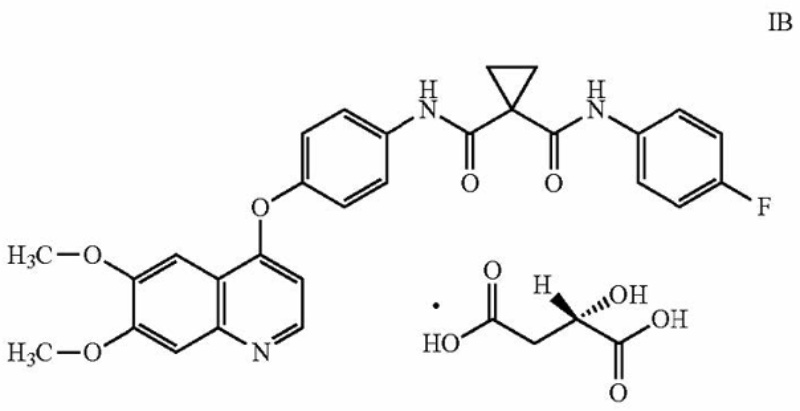
The case arose over the Exelixis drug Cabometyx®, (cabozantinib (L)-malate as its active pharmaceutical ingredient), having indications for treatment of kidney, liver, and differentiated thyroid cancer. The opinion set forth some of the history of the development of this API, which were specific for two (purportedly unique) crystalline forms, themselves protected by U.S. Patent Nos. 8,877,776 and 9,809,549 (not at issue in this litigation).
This ANDA litigation involved infringement of U.S. Patent Nos. 11,091,439 (claiming crystalline (L)-malate salts); 11,091,440 (claiming pharmaceutical formulations thereof); 11,098,015 (claiming methods for treating cancer); and 11,298,349 (claiming synthetic methods). Claims 1, 3, and 4 of the ‘439 patent were set out in the opinion as being illustrative:
1. N-(4-{[6,7-bis(methyloxy)quinolin-4-yl]oxy}pheny l)- N’-(4-fluorophenyl) cyclopropane-1,1-dicarboxamide, malate salt, wherein said salt is crystalline.
3. The N-(4-{[6,7-bis(methyloxy)quinolin-4-yl]oxy}phenyl)-N’-(4-fluorophenyl) cyclopropane-1,1-dicarboxamide, malate salt according to claim 1, wherein said salt is the (L)-malate salt or (D)-malate salt.
4. The N-(4-{[6,7-bis(methyloxy)quinolin-4-yl]oxy}phenyl)-N’-(4-fluorophenyl) cyclopropane-1,1-dicarboxamide, malate salt according to claim 3, wherein said salt is the (L)-malate salt.
In addition, Exelixis asserted U.S. Patent No. 11,298,349 that claims synthetic methods that are “substantially free” of a genotoxic impurity, these methods being illustrated by claim 3:
3. A pharmaceutical composition for oral administration comprising Compound IB;
one or more fillers; one or more disintegrants; one or more glidants; and one or more lubricants, wherein the pharmaceutical composition is a tablet or capsule pharmaceutical composition; and
wherein the pharmaceutical composition is essentially free of 6,7-dimethoxy-quinoline-4-ol.
(where the italicized limitations are relevant to the Court’s decisions and the specification defined “substantially free” as an amount of 200 ppm or less).
MSN’s product was an S enantiomer of cabozantinib (L)-malate, which was subject to its own patent. MSN conceded infringement for the asserted ‘439, 440, and ‘015 patent claims but not the ‘349 patent, and asserted invalidity for failure to satisfy the written description requirement for each of Exelixis’s asserted patents. The District Court held that MSN had not satisfied the requirement of establishing invalidity by clear and convincing evidence under the written description requirement of 35 U.S.C. § 112(a).
The District Court applied the (now) traditional alternative bases for fulfilling the standard of disclosing either “(1) a representative number of species falling within the scope of the genus, or (2) structural features common to the members of the genus so that one of skill in the art can visualize or recognize the members of the genus” under Ariad Pharms., Inc. v. Eli Lilly & Co., 598 F.3d 1336, 1350 (Fed. Cir. 2010). The Court held that Exelixis had provided structural features common to the members of the genus, citing as an example GlaxoSmithKline LLC v. Banner Pharmacaps, Inc., 744 F.3d 725 (Fed. Cir. 2014). In addition, the District Court discerned that the specification further disclosed “the chemical formula and structure of crystalline cabozantinib (L)-malate” and could identify the claimed crystalline forms (as opposed to amorphous cabozantinib), as well as methods for making the inventive crystalline compounds.
Regarding the ‘349 patent, the Court held that the asserted prior art, International Application Publication No. WO 2010/083414 did not inherently disclose the claimed methods nor that the batches of the drug having the claimed lack of impurity were produced thereby.
The District Court thus held that MSN’s product infringed claims of the ‘439, 440, and ‘015 patents but not the ‘349 patent, and that none of the asserted claims were invalid. This appeal followed.
The Federal Circuit affirmed, in an opinion by Judge Stoll, joined by Chief Judge Moore and District Court Judge K. Michael Moore, sitting by designation from the District of Florida. After expounding on settled law for establishing disclosure of an adequate written description (which MSN does not dispute), the brief set forth the crux of MSN’s argument that the District Court had erred:
[T]he district court legally erred by crediting allegedly cursory parts of the specification that fail to disclose structural features distinguishing the genus of crystalline cabozantinib (L)-malate salt such that a skilled artisan could visualize its members,
to which the Federal Circuit responded: “We are not persuaded.”
As to why this is the case, the opinion relies on the disclosure in the specification of “the chemical name and formula of cabozantinib (L)-malate salt, as well as that the structure of the salt is crystalline,” and that “[t]he claims are no broader than the written description, as the claims require cabozantinib (L)-malate salt with a crystalline structure” (as well as disclosing processes to make the claimed invention, while noting that this disclosure is “not dispositive”). The Court noted that MSN’s argument was directed at the sufficiency of this disclosure, to which the panel responded by noting the “multiple of the [Ariad] factors” disclosed in the asserted patents’ specification(s), which support was evidence of a lack of clear error by the District Court (supported by the similarities to the GSK decision). Also supporting the Federal Circuit’s findings regarding lack of clear error was the absence of any claims or elements thereof having to do with potentially diverse properties of any species in the claimed genus other than the expressly disclosed N-1 and N-2 species, according to the opinion. The opinion also sets forth the distinctions in this case and in AbbVie Deutschland GmbH & Co., KG v. Janssen Biotech, Inc., 759 F.3dv1285 (Fed. Cir. 2014), wherein in the latter case there were differences in the structural similarities between the disclosed species and the scope of the claimed antibodies and wherein “the fact finder heard specific evidence that the patents only described one type of structurally similar antibodies in an entire genus.” In addition, there were far fewer crystalline forms (a total of 14) encompassed by the asserted claims in this case than there were of antibodies in AbbVie. Accordingly the panel stated that under these circumstances there was no need to consider the “representative number of species” branch of the test for written description adequacy enunciated in Ariad. Finally, the Federal Circuit rejected MSN’s allegations that the District Court had applied a lower degree of analytical rigor when assessing the adequacy of disclosure with regard to written description for structurally defined claims than the case law has applied for claim scope defined by function, stating that “the district court was merely recognizing, as we have also recognized, that when there is functional claiming, supplying adequate written description can be more challenging,” again citing Ariad.
The opinion notes that MSN also asserted other written description precedent, including ICU Medical, Inc. v. Alaris Medical Systems, Inc., 558 F.3d 1368 (Fed. Cir. 2009), Tronzo v. Biomet, Inc., 156 F.3d 1154 (Fed. Cir. 1998), and Eli Lilly & Co. v. Teva Pharmaceuticals USA, Inc., 619 F.3d 1329 (Fed. Cir. 2010), distinguishing the facts in those cases from the facts considered by the District Court here.
The opinion concludes by affirming MSN’s position that Exelixis’s allegation of infringement of claims of the ‘349 patent has been mooted by the District Court’s decision that those claims were not invalid (finding no “inherent obviousness” as asserted by MSN). Moreover, the panel rejected Exelixis’s argument that “our holding on the inherency issue could potentially have collateral consequences in another case between Exelixis, MSN, and other defendants,” saying that “[t]hese purported collateral consequences are too speculative and hypothetical to confer standing,” citing Best Medical International, Inc. v. Elekta Inc., 46 F.4th 1346 (Fed. Cir. 2022). Accordingly, the panel vacated the District Court’s judgment as to this claim, citing United States v. Munsingwear, Inc., 340 U.S. 36, 39–40 (1950), and U.S. Bancorp Mortg. Co. v. Bonner Mall P’ship, 513 U.S. 18, 24 (1994), on the grounds that doing so “avoids [any] unfairness” by “‘clear[ing] the path for future relitigation’ by eliminating a judgment the loser was stopped from opposing on direct review,” citing Arizonans for Off. Eng. v. Arizona, 520 U.S. 43, 71–72 (1997).


 Patent Docs
Leave a comment