• Life Sciences Top 50 (plus 3)

    By Donald Zuhn —

    IPO #2On Wednesday, the Intellectual Property Owners Association (IPO) released its 29th annual list of the top 300 organizations receiving U.S. patents.  Patent Docs Readers may recall that the U.S. Patent and Trademark Office stopped releasing its annual list of top patent recipients in 2006 in order to "discourag[e] any perception that we believe more is better."

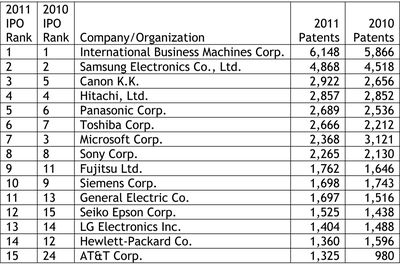
    The IPO compiled its list by counting the number of utility patents granted during 2011 that listed an organization or a subsidiary as the owner on the printed patent.  The IPO noted that if an assignment to an organization or its subsidiary was recorded after the patent was printed, the patent was not counted, and further, that patents which were granted to two or more organizations jointly were attributed to the organization listed first on the patent.  The IPO also noted that 244,430 patents were issued in 2011, which was an increase from the 233,127 patents that issued in 2010.  The top fifteen companies on the IPO Top 300 are listed below (click on table to expand):

    IPO Top 15
    Falling out of the Top 15 in 2011 was Intel Corp., which dropped to 17th.

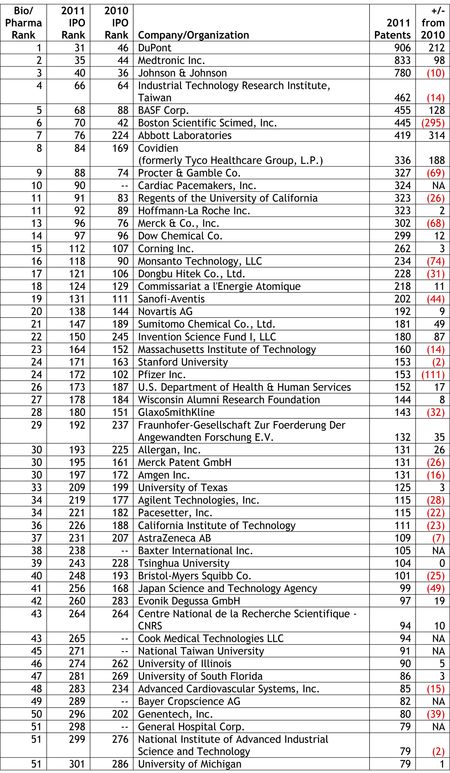
    As in past years, Patent Docs used the IPO's list of top patent holders to compile a list of the top life sciences companies and organizations receiving U.S. patents in 2011.  In the past six years, the number of life sciences companies and organizations making the list has gone from 51 in 2006 to 47 in 2007, 43 in 2008, 47 in 2009, 56 in 2010, and 53 last year.  Each organization's IPO top 300 ranking for 2011 is indicated in the "2011 IPO Rank" column; the IPO top 300 ranking for 2010 (if available) is indicated in the "2010 IPO Rank" column; and the change in number of patents from 2010 is indicated in "+/- from 2010."  The Life Sciences Top 50 (plus 3) is listed below (click on table to expand):

    Biotech Top 53
    Life sciences companies and organizations that failed to make the IPO top 300 in 2011 after making it in 2010 included Boehringer Ingelheim International GmbH (#260 on the IPO top 300 for 2010), Becton, Dickinson and Co. (263), Columbia University (272), Vertex Pharmaceuticals, Inc. (274), University of Pennsylvania (289), Unilever Patent Group (296), Ajinomoto Co., Inc. (297), Cornell Research Foundation Inc. (298), and University of Washington (301).  Cardiac Pacemakers, Inc. returned to the Top 300 after a one year hiatus.

    Please note that some of the companies and organizations listed above may be involved in work outside the life sciences sector, and therefore, a portion of the patents granted to these companies and organizations may be directed to other than life sciences-related inventions.  In addition, our list is a little inclusive in that we included medical device companies.

    For additional information regarding this topic, please see:

    • "IPO Releases List of Top 300 Patent Holders for 2010," June 30, 2011
    • "IPO Releases List of Top 300 Patent Holders for 2009," May 26, 2010
    • "IPO Releases List of Top 300 Patent Holders for 2008," May 14, 2009
    • "IPO Releases List of Top 300 Patent Holders," May 22, 2008
    • "IPO Posts List of Top 300 Patent Holders," April 20, 2007

  • By Kevin E. Noonan —

    CoverHans Sauer, Associate General Counsel for Intellectual Property for the Biotechnology Industry Organization (BIO), frequently asks (when discussing patent-eligibility of genes):  "What about cucumber genes?  Should they be patented?"  If Hans wishes to remain au courant, however, he will need to update this question by asking "What about tomato genes?" after the disclosure, in this week's Nature, that the entire genomic DNA sequence of the tomato (Solanum lycopersicum) has been deciphered (The Tomato Genome Consortium, "The tomato genome sequence provides insights into fleshy fruit evolution," Nature 485: 635–41 (31 May 2012)).

    As with other species genome project results, the reported sequence reveals interesting relationships between tomatoes and closely-related species (like the potato, Solanum tuberosum), including "wild" species (Solanum pimpinellifolium) related to the domestic tomato, as well as identifying sequence characteristics resulting from evolutionary events in the tomato pedigree.
    Heinz-ketchupThe researchers used an inbred cultivar, "Heinz 1706," having a "predictive" genome size of 900Mb on 12 tomato chromosomes.  The tomato genomic sequence was compared with the "wild" tomato sequence as well as other domesticated species of Solanum (particularly potato).  The sequence differences between the domesticated and wild tomato amounted to 0.6% nucleotide divergence in 5.4 million single nucleotide polymorphisms (SNPs) scattered throughout the genome.

    Between tomato and potato, on the other hand, 8.7% sequence divergence was found, including nine large and several smaller inversions (which can facilitate sequence and species divergence by interfering with meiotic pairing), with intergenic and heterochromatic (repeat-rich) sequences showing (not unexpectedly) > 30% sequence divergence.

    Evolutionarily, the tomato sequence showed evidence of two consecutive genome triplications (a phenomenon common among plants but unknown for animal species), one recent between tomato and potato (~7.3 Myr ago), and one ancient (at about the rosid (tomato) – asterid (grape) divergence, ~71 +/- 19.4 Myr ago).  These events are believed to have provided the genetic plasticity to develop genes controlling fruit characteristics, such as color and "fleshiness."  These include transcription factors and enzymes involved in ethylene biosynthesis (used for ripening), red light photoreceptors (PHYB1/PHYB2), and lycopene synthesis (PST1/PSY2).  Interestingly, the researchers reported that "[s]everal cytochrome P450 subfamilies associated with toxic alkaloid biosynthesis show contraction or complete loss in tomato and the extant genes show negligible expression in ripe fruits," a genetic adaptation to be expected for plants that have adopted a seed-dispersal mechanism requiring that the fruit be eaten by animals and the seeds passed in their spoor.  Differential expression of genes for cell wall architecture was also observed and believed to be involved in this aspect of the tomato life cycle.

    On the other hand, the observed patterns comparing tomato genes with grape orthologs (22.5% of grape genes have an orthologous region in tomato, 39.9% have two and 21.6% have three) suggested that triplication was followed by "widespread gene loss" (see Figure 2 of publication).  Synteny maps between tomato chromosomes and chromosomes from potato, eggplant (aubergine), pepper, and tobacco were prepared and showed high levels of synteny, not unexpected in view of these species' interrelatedness.

    Turning to the overall chromosome structure, the tomato showed pericentric heterochromatin and distal euchromatin, with miRNA and chloroplast insertions "more evenly distributed" throughout euchromatin.  There was evidence of fewer high-copy LTR-containing retrotransposons in the tomato genome than in Sorghum or Arabidopsis genomes, with "older" average insertion age (2.8M v. 0.8M years ago); the tomato genome is "unusual among angiosperms by being largely comprise of low copy number DNA."  In view of these differences with Arabidopsis, it was paradoxical that "[c]hromosomal organization of  genes, transcripts, repeats and small RNAs (sRNAs) is very similar" between the tomato and Aribodopsis genomes.
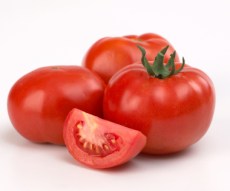
    TomatoesSequence comparisions and open reading frame analyses found from 34,727 to 35,004 protein-coding genes in the tomato genome.  Of these, 18,320 were orthologs to potato genes; comparisons of synonymous vs. non-synonymous nucleotide substitution patterns between potato and tomato with similar comparisons between sorghum and maize (11.9Myr divergence) suggested stronger "diversifying" selection in the tomato/potato pair.  Comparison of the tomato genome with the "wild" S. pimpinellifolium species genes showed 7,378 identical genes and 11,753 genes with only synonymous nucleotide sequence changes; of the rest (12,629 genes), there were not only non-synomynous changes but also gain/loss of stop codons, with implications for gross changes in functionality.  In some instances, "several" chromosomal segments (particularly from cherry tomatoes) were more similar to the S. pimpinellifolium species than to the Heinz 1076 cultivar sequence.

    The tomato genome shares with the soybean and potato genomes the location of small, regulatory RNAs to "gene-rich" chromosomal regions and particularly promoters.  96 conserved miRNA species were identified in tomato compared with 120 such species in potato, grouped into 34 families (10 "highly conserved" in plants and the others "less conserved" that are more abundant in potato than tomato; some of these potato-specific miRNAs specifically target Toll interleukin receptor, nucleotide-binding site and leucine-rich repeat genes.  Protein-coding genes from tomato, potato, Arabidopsis, rice, and grape were "clustered" into 23,208 gene groups (having at least 2 members), of which "8,615 are common to all five genomes, 1,727 are confined to eudicots (tomato, potato, grape and Arabidopsis), and 727 are confined to plants with fleshy fruits (tomato, potato and grape)."

    The report concludes with these lessons from the genome that reflect the natural history of the tomato:

    The genome sequences of tomato and S. pimpinellifolium also provide a basis for understanding the bottlenecks that have narrowed tomato genetic diversity: the domestication of S. pimpinellifolium in the Americas, the export of a small number of genotypes to Europe in the 16th century, and the intensive breeding that followed.  Charles Rick pioneered the use of trait introgression from wild tomato relatives to increase genetic diversity of cultivated tomatoes.  Introgression lines exist for seven wild tomato species, including S. pimpinellifolium, in the background of cultivated tomato.  The genome sequences presented here and the availability of millions of SNPs will allow breeders to revisit this rich trait reservoir and identify domestication genes, providing biological knowledge and empowering biodiversity-based breeding.

    The genomic data generated by the whole project is available on-line, in GenBank under accession number AEKE00000000.  The individual chromosome sequences as numbers CM001064–CM001075, and the data on expressed sequences are available in the "Sequence Read Archive" under accession number SRA049915, GSE33507, SRA050797 and SRA048144.

    The Tomato Genome Consortium was responsible for the report, and reflects a vast amount of work by hundreds of researchers around the world.  Named as corresponding authors are:

    Shusei Sato, Satoshi Tabata, Lukas A. Mueller, Sanwen Huang, Yongchen Du, Chuanyou Li, Zhukuan Cheng, Jianru Zuo, Bin Han, Ying Wang, Hongqing Ling, Yongbiao Xue, Doreen Ware, W. Richard McCombie, Zachary B. Lippman, Stephen M. Stack, Steven D. Tanksley, Yves Van de Peer, Klaus Mayer, Gerard J. Bishop, Sarah Butcher, Nagendra Kumar Singh, Thomas Schiex, Mondher Bouzayen, Antonio Granell, Fernando Carrari, Gianluca De Bellis, Giovanni Giuliano, Glenn Bryan, Michiel J. T. van Eijk, Hiroyuki Fukuoka, Debasis Chattopadhyay, Roeland C. H. J. van Ham, Doil Choi, Jane Rogers, Zhangjun Fei, James J. Giovannoni, Rod Wing, Heiko Schoof, Blake C. Meyers, Jitendra P. Khurana, Akhilesh K. Tyagi, Tamas Dalmay, Andrew H. Paterson, Xiyin Wang, Luigi Frusciante, Graham B. Seymour, Bruce A. Roe, Giorgio Valle, Hans H. de Jong and René M. Klein Lankhorst

    Note: the complete list can be found in the Supplementary Information (Supplementary Information).

    The Tomato Genome Consortium includes scientists from The Kazusa DNA Research Institute, Japan; 454 Life Sciences Co. (Roche), USA; Amplicon Express Inc., USA; Beijing Vegetable Research Center, China; National Center for Gene Research, Chinese Academy of Sciences, Shanghai, China; BGI-Shenzhen, China; BMR-Genomics SrL, Italy; Boyce Thompson Institute for Plant Research, Cornell University, USA; Centre for Biosystems Genomics, The Netherlands; Centro Nacional de Analisis Genomico, Barcelona, Spain; China Agricultural University, Beijing, China; Institute of Vegetables and Flowers Chinese Academy of Agricultural Sciences, Beijing, China; Institute of Genetics and Developmental Biology, Chinese Academy of Sciences, Beijing, China; Wuhan Botanical Garden, Chinese Academy of Sciences, Beijing, China; Cold Spring Harbor Laboratory, USA; Colorado State University, USA; National Taiwan University, Taipei; Department of Plant Biology, Cornell University, USA;  Centre for Genomic Regulation, University Pompeu Fabra, Barcelona, Spain; Department of Plant Biotechnology and Bioinformatics, Ghent University, Belgium; Faculty of Agriculture, The Hebrew University of Jerusalem, Israel; Institute of Industrial Crops, Heilongjiang Academy of Agricultural Sciences, China; Institute for Bioinformatics and Systems Biology (MIPS), Helmholtz Center for Health and Environment, Germany; College of Horticulture, Henan Agricultural University, China; Department of Life Sciences, Imperial College London, UK; NRC on Plant Biotechnology, Indian Agricultural Research Institute, India; INRA, Génétique et amélioration des fruits et légumes, France; INRA, Biologie du Fruit et Pathologie, France; Unité de Biométrie et d'Intelligence Artificielle, INRA, France; INRA-CNRGV, France; Plateforme bioinformatique Genotoul, Biométrie et Intelligence Artificielle, INRA, France; Institut National Polytechnique de Toulouse – ENSAT, Université de Toulouse, France; Instituto de Biología Molecular y Celular de Plantas (CSIC-UPV), Spain; Instituto de Hortofruticultura Subtropical y Mediterránea "La Mayora", Universidad de Malaga – Consejo Superior de Investigaciones Cientificas (IHSM-UMA-CSIC), Spain; Instituto de Biotecnología, Argentina; Institute for Biomedical Technologies, National Research Council of Italy; Institute of Plant Genetics, Research Division Portici, National Research Council of Italy; ENEA, Casaccia Research Center, Italy; Scuola Superiore Sant'Anna, Italy; ENEA, Trisaia Research Center, Italy; James Hutton Institute, UK; Barcelona Supercomputing Center, Spain; Institute of Research in Biomedicine, Barcelona, Spain; ICREA, Barcelona, Spain; Keygene N.V., Wageningen, The Netherlands; Plant Systems Engineering Research Center, Korea Research Institute of Bioscience and Biotechnology, Republic of Korea; Life Technologies, USA; Life Technologies, France; Max Planck Institute for Plant Breeding Research, Germany; School of Agriculture, Meiji University, Japan; Department of Plant Science and Plant Pathology, Montana State University, USA; NARO Institute of Vegetable and Tea Science, Japan; National Institute of Plant Genome Research, India; Plant Research International, Business Unit Bioscience, Wageningen, The Netherlands; Institute of Plant Genetic Engineering, Qingdao Agricultural University, China; Roche Applied Science, Germany; Seoul National University, Department of Plant Science and Plant Genomics and Breeding Institute, Republic of Korea; Seoul National University, Department of Agricultural Biotechnology, Republic of Korea; Seoul National University, Crop Functional Genomics Center, Republic of Korea; High-Tech Research Center, Shandong Academy of Agricultural Sciences, China; Institute of Vegetables, Shandong Academy of Agricultural Sciences, China; School of Life Sciences, Sichuan University, China; Sistemas Genomicos, Spain; College of Horticulture, South China Agricultural University, China; Syngenta Biotechnology, Inc., USA; Norwich Research Park, UK; Department of Botany, The Natural History Museum, UK; United States Department of Agriculture – Agricultural Research Service, Robert W. Holley Center, USA; Instituto de Hortofruticultura Subtropical y Mediterranea, Departamento de Biologia Molecular y Bioquimica, Spain; Centre de Regulacio Genomica, Universitat Pompeu Fabra, Spain; Arizona Genomics Institute, USA.; Crop Bioinformatics, Institute of Crop Science and Resource Conservation, University of Bonn, Germany;  Department of Plant and Soil Sciences, and Delaware Biotechnology Institute, University of Delaware, USA; Interdisciplinary Centre for Plant Genomics and Department of Plant Molecular Biology, University of Delhi South Campus, India.; University of East Anglia, UK; Department of Biology and the UF Genetics Institute, USA; Plant Genome Mapping Laboratory, University of Georgia, USA; Center for Genomics and Computational Biology, School of Life Sciences, and School of Sciences, Hebei United University, China; J. Craig Venter Institute, USA; University of Naples "Federico II" Department of Soil, Plant, Environmental and Animal Production Sciences, Italy; Division of Plant and Crop Sciences, University of Nottingham, UK; Department of Chemistry and Biochemistry, University of Oklahoma, USA; CRIBI, University of Padua, Italy; Department of Microbiology, Immunology and Biochemistry, University of Tennessee Health Science Center, USA.; Department of Agriculture and Environmental Sciences, University of Udine, Italy; Wageningen University, Laboratory of Genetics, Wageningen, The Netherlands; Wageningen University, Laboratory of Plant Breeding, Wageningen, The Netherlands; Wellcome Trust Sanger Institute Hinxton, UK; Ylichron SrL, Casaccia Research Center, Italy; and Plant Engineering Research Institute, Sejong University, Republic of Korea.


  • BIO and the Prometheus Supreme Court Case

    By Andrew Williams —

    BIO International ConventionThe 2012 BIO International Convention in Boston is less than two weeks away.  If you are planning on attending, you probably already know that the amount of information and opportunities available at BIO can be daunting.  Therefore, over the next two weeks, Patent Docs will be highlighting a few sessions or other opportunities, in thematic fashion, to help you navigate your way through the convention.  For example, today we present opportunities for those attendees who have been thinking about how Prometheus is going to affect their research or practice (and we are not talking about Ridley Scott's highly anticipated new movie — opening this Friday at a theater near you).  Of course, Patent Docs authors and contributors will be present at BIO as part of the MBHB contingent, and Patent Docs readers are encouraged to stop by the MBHB booth to discuss Prometheus (or whatever other topic is of interest to you) (#1335 – Hall A).

    Last year, just prior to the 2011 BIO International Convention in Washington D.C., the Supreme Court granted certiorari in the Mayo Collaborative Services v. Prometheus Laboratories Inc. case.  As Patent Docs readers are well aware, the claims at issue in that case involved optimizing drug dosage in the treatment of autoimmune diseases by determining the level of a metabolite in a patient.  In the intervening year, the Supreme Court reversed the Federal Circuit's determination that the diagnostic claims were patent eligible, and instead held that they were unpatentable laws of nature, with any additional steps found in the claims to involve "well-understood, routine, conventional activit[ies] previously engaged in by researchers in the field."  And, even though the opinion warned that patent eligibility should not depend on the "draftsman's art," there has already been plenty of discussion of how far-reaching Prometheus will be, and what a patent practitioner can do to ensure that any new or current claims will not suffer the same fate.  BIO looks like it will be no exception to this trend.  And, even though we are confident that there will be plenty of discussion throughout the convention, we are highlighting three break-out sessions that promise to address this case, and the issues it presents.

    First, the Personalized Medicine and Diagnostics Track will present "IP Challenges for Personalized Medicine & Diagnostics," on Monday, June 18 at 2:00 to 3:30 pm.  The session promises to look at how the ability to obtain patents to personalized medicine will be affected by the recent court cases of Myriad, Classen, and Prometheus, as well as the emotionally charged public perception of such patents.  The panel will explore the tension between such public perceptions and the demonstrable benefits to patients of such "companion diagnostics" patents by highlighting the intersection of personalized medicine & intellectual property protection.  Of course, just how companies can deliver on the promise of personalized medicine in this environment remains a question.  This panel includes the Associate General Counsel of BIO, Hans Sauer; as well as Annabelle Bennett, Federal Court of Australia Judge; and Thomas Triolo, Senior Counsel at Merck & Co., Inc.  The session will be moderated by Jennifer Gordon of Baker Botts L.L.P.

    Not to be outdone, the Biotech Patenting and Tech Transfer Track will be presenting "IP issues Affecting Biomarker-Based Diagnostics and Personalized Medicine" on Wednesday, June 20, at 3:00-3:30 pm.  This session includes a panel of international attorneys that will discuss the impact of recent court cases, legislation, and scientific issues on patent procurement and protection in the field of biomarkers and personalized medicine.  The panel promises to focus on inventions relating to the use of genetic and non-genetic human variation to predict susceptibility to disease and/or identify patients that will benefit from personalized treatments.  In addition to the impact of the America Invents Act and court decisions such as Myriad and Prometheus, the panel will discuss scientific issues are impacting patent procurement (such as what types of data are or can be required), and cross-border and joint infringement considerations that impact the ability to enforce such patents.  The panel includes:  Thorlakur Jonsson, Director of Intellectual Property of deCODE genetics ehf; Simon O'Brien, Chartered Patent Attorney with D. Young & Co.; John Tessensohn, Board Member of Shusaku Yamamoto Patent Attorneys; and David Gass of Marshall, Gerstein & Borun, LLP.  This session will be moderated by Jan Skouv, Director IPR of Exiqon A/S.

    Last, but certainly not least, the Biotech Patenting and Tech Transfer Track is also presenting "Recent Developments in Patentability: Prometheus, Myriad, Classen, and the Patentability of Diagnostic Claims," on Tuesday, June 19, at 8:30-9:45 am.  This session promises to provide insights on these major court cases and the decision-making behind them.  The panel of patent-law experts and practitioners will provide insights into cutting edge legal issues regarding diagnostic methods, will consider an insider's view of decision-making at the Supreme Court and Federal Circuit, and will identify the consequences of these cases for biotech companies.  The panel includes: Kevin Marks, Vice President and General Counsel of Roche Molecular Diagnostics; John Whealan, Associate Dean for Intellectual Property at The George Washington University Law School; Neal Katyal of Hogan Lovells; and Seth Waxman of WilmerHale.  This session will be moderated by Mark Fleming of WilmerHale.

  • By Donald Zuhn —

    USPTO SealLast week, the U.S. Patent and Trademark Office announced proposed amendments to the rules of practice to implement the micro entity provision of § 10 of the Leahy-Smith America Invents Act.  Pursuant to that section of the AIA, the fees for filing, searching, examining, issuing, appealing, and maintaining patent applications and patents shall be reduced by 75% for any micro entity as defined in new 35 U.S.C. § 123.  New § 123 defines micro entities as follows:

    § 123. Micro entity defined
        (a) IN GENERAL.-For purposes of this title, the term 'micro entity' means an applicant who makes a certification that the applicant-
            (1) qualifies as a small entity, as defined in regulations issued by the Director;
            (2) has not been named as an inventor on more than 4 previously filed patent applications, other than applications filed in another country, provisional applications under section 111(b), or international applications filed under the treaty defined in section 351(a) for which the basic national fee under section 41(a) was not paid;
            (3) did not, in the calendar year preceding the calendar year in which the applicable fee is being paid, have a gross income, as defined in section 61(a) of the Internal Revenue Code of 1986, exceeding 3 times the median household income for that preceding calendar year, as most recently reported by the Bureau of the Census; and
            (4) has not assigned, granted, or conveyed, and is not under an obligation by contract or law to assign, grant, or convey, a license or other ownership interest in the application concerned to an entity that, in the calendar year preceding the calendar year in which the applicable fee is being paid, had a gross income, as defined in section 61(a) of the Internal Revenue Code of 1986, exceeding 3 times the median household income for that preceding calendar year, as most recently reported by the Bureau of the Census.

    The Office has published the proposed changes to the rules implementing micro entity status in a Federal Register notice (77 Fed. Reg. 31806).  The proposed changes specify procedures for claiming micro entity status, paying fees as a micro entity, notifying the Office regarding the loss of micro entity status, and correcting payments erroneously made using the reduced micro entity rate.

    Among the rules changes being proposed is a new provision setting out the requirements to qualify as a micro entity (which tracks § 123 above) and procedures relating to micro entity status that track 37 C.F.R. § 1.27 (which provides a definition of small entities and procedures for establishing status as a small entity to permit payment of small entity fees; specifies when a determination of entitlement to small entity status and notification of loss of entitlement to small entity status are required; describes fraud on the Office as it pertains to claiming small entity status).  To claim micro entity status, applicants will have to make a certification of entitlement to that status (preferably using a form the Office is currently developing).  Applicants will only have to claim micro entity status once during the prosecution of an application, but will be permitted to pay the reduced micro entity fee amount only if the applicant is entitled to micro entity status on the date a fee is paid.  Because 35 U.S.C. § 123 requires a certification of micro entity status, the proposed rules regarding micro entity status will not permit applicants to establish micro entity status by merely paying the micro entity fee (as applicants may do to establish small entity status) or secure a refund by subsequently establishing micro entity status (as permitted for small entities).

    While noting that "[t]he micro entity provisions of 35 U.S.C. 123 are currently in effect," the Office acknowledges in the notice that "no patent fee is currently eligible for the seventy-five percent micro entity reduction as no patent fee has yet been set or adjusted under section 10 of the Leahy-Smith America Invents Act."  The Office indicated that fees for micro entities would be forthcoming in a separate rulemaking.  The notice contains a discussion of the specific rules changes and the full text of new § 1.29 (Micro entity status), which would be added to 37 C.F.R. Part I.

    Comments regarding the proposed changes can be sent by e-mail to micro_entity@uspto.gov; by regular mail to:  Mail Stop Comments — Patents, Commissioner for Patents, P.O. Box 1450, Alexandria, VA 22313–1450, marked to the attention of James Engel, Senior Legal Advisor, Office of Patent Legal Administration, Office of the Deputy Commissioner for Patent Examination Policy; or via the Federal eRulemaking Portal.  Comments must be submitted by July 30, 2012.

  • By Sherri Oslick —

    Gavel In an effort to catch up with recently filed biotech and pharma cases, Patent Docs presents this additional installment of Court Report. 

    Exelixis, Inc. v. Honorable David J. Kappos
    1:12-cv-00574; filed May 29, 2012 in the Eastern District of Virginia

    Review and correction of the patent term adjustment calculation made by the U.S. Patent and Trademark Office for U.S. Patent No. 8,067,436 ("c-Met Modulators and Methods of Use," issued November 29, 2011).  View the complaint here.


    Shire Development, LLC et al. v. Mylan Pharmaceuticals, Inc. et al.

    8:12-cv-01190; filed May 25, 2012 in the Middle District of Florida

    • Plaintiffs:  Shire Development, LLC; Shire Pharmaceutical Development, Inc.; Cosmo Technologies Ltd.; Giuliani International Ltd.
    • Defendants:  Mylan Pharmaceuticals, Inc.; Mylan, Inc.

    Infringement of U.S. Patent No. 6,773,720 ("Mesalazine Controlled Release Oral Pharmaceutical Compositions," issued August 10, 2004) following a Paragraph IV certification as part of Mylan's filing of an ANDA to manufacture a generic version of Shire's Lialda® (mesalamine, used to induce remission in patients with active, mild to moderate ulcerative colitis).  View the complaint here.


    Pfizer Inc. et al. v. Sandoz Inc.

    1:12-cv-00654; filed May 24, 2012 in the District Court of Delaware

    • Plaintiffs:  Pfizer Inc.; Wyeth LLC; Wyeth Pharmaceuticals Inc.
    • Defendant:  Sandoz Inc.

    Infringement of U.S. Patent No. 8,026,276 ("Parenteral CCI-779 Formulations Containing Cosolvents, an Antioxidant, and a Surfactant," issued September 27, 2011) following a Paragraph IV certification as part of Sandoz's filing of an ANDA to manufacture a generic version of Pfizer's Torisel® (temsirolimus injection, used to treat advanced renal cell carcinoma).  View the complaint here.

  • By Sherri Oslick —

    Gavel About Court Report:  Each week we will report briefly on recently filed biotech and pharma cases.

    Astellas US LLC et al. v. Hospira Inc.
    1:12-cv-00652; filed May 23, 2012 in the District Court of Delaware

    • Plaintiffs:  Astellas US LLC; Astellas Pharma US, Inc.; Item Development AB
    • Defendant:  Hospira Inc.

    Infringement of U.S. Patent No. 5,731,296 ("Selective Vasodilation by Continuous Adenosine Infusion," issued March 24, 1998), licensed to Astellas, following a Paragraph IV certification as part of Hospria's filing of an ANDA to manufacture a generic version of Astellas' Adenoscan® product (adenosine injection, used as a diagnostic for myocardial reperfusion injury).  View the complaint here.


    Auxilium Pharmaceuticals, Inc. et al. v. Watson Laboratories, Inc. (NV) et al.

    2:12-cv-03084; filed May 23, 2012 in the District Court of New Jersey

    •  Plaintiffs: Auxilium Pharmaceuticals, Inc.; FCB I LLC
    •  Defendants: Watson Laboratories, Inc. (NV); Watson Pharmaceuticals, Inc.; Watson Pharma, Inc.

    Infringement of U.S. Patent Nos. 7,320,968 ("Pharmaceutical Composition," issued January 22, 2008), 7,608,605 (same title, issued October 27, 2009), 7,608,606 (same title, issued October 27, 2009), 7,608,607 (same title, issued October 27, 2009), 7,608,608 (same title, issued October 27, 2009), 7,608,609 (same title, issued October 27, 2009), 7,608,610 (same title, issued October 27, 2009), 7,935,690 (same title, issued May 3, 2011), 8,063,029 (same title, issued November 22, 2011), and 8,178,518 (same title, issued May 15, 2012) following a Paragraph IV certification as part of Watson's filing of an ANDA to manufacture a generic version of Auxilium's Testim® (transdermal testosterone gel, used to treat hypogonadism in men).  View the complaint here.


    Janssen Pharmaceuticals, Inc. v. Haupt Pharma, Inc. et al.

    2:12-cv-03034; filed May 22, 2012 in the District Court of New Jersey

    • Plaintiff:  Janssen Pharmaceuticals, Inc.
    • Defendants:  Haupt Pharma, Inc.; Ranbaxy Laboratories Ltd.; Ranbaxy Inc.

    Infringement of U.S. Patent No. 6,214,815 ("Triphasic Oral Contraceptive," issued April 10, 2001) following a Paragraph IV certification as part of Sun's filing of an ANDA to manufacture a generic version of Janssen's Ortho Tri-Cyclen® Lo (norgestimate and ethinyl estradiol, used for oral contraception).  View the complaint here.


    Panagene, Inc. et al. v. Bio-Synthesis, Inc.

    2:12-cv-00301; filed May 17, 2012 in the Eastern District of Texas

    • Plaintiffs:  Panagene, Inc.; Dorte Buchardt; Michael Egholm; Peter E Nielsen; Rolf H Berg
    • Defendant:  Bio-Synthesis, Inc.

    Infringement of U.S. Patent Nos. 6,395,474 ("Peptide Nucleic Acids," issued May 28, 2002) and 7,378,485 ("Peptide Nucleic Acids with Polyamide-Containing Backbones," filed May 27, 2008) based on Bio-Synthesis' manufacture, use, and sale of peptide nucleic acids.  View the complaint here.

  • Calendar

    June 5, 2012 – Orange Book Use Codes: Impact of Caraco v. Novo Nordisk (Strafford) – 1:00 – 2:30 pm (EDT)

    June 6, 2012 – Biotechnology/chemical/ pharmaceutical (BCP) customer partnership meeting (U.S. Patent and Trademark Office) – 9:00 am – 4:30 pm (ET)

    June 8-12, 2012 – 2012 MidYear Meeting (Association of American Law Schools) – Berkeley, CA

    June 13-15, 2012 – Fundamentals of Patent Prosecution 2012: A Boot Camp for Claim Drafting & Amendment Writing (Practising Law Institute) – New York, NY

    June 14, 2012 – The Elimination and Creation of Defenses in the Wake of AIA (Technology Transfer Tactics) – 1:00 – 2:00 pm (Eastern)

    June 18-21, 2012 – BIO International Convention (Biotechnology Industry Organization) – Boston, MA

    June 20-21, 2012 – International Forum on Pharma Patent Lifecycles*** (C5) – London, England

    July 23-24, 2012 – Patent Cooperation Treaty Seminar (American Intellectual Property Law Association) – Alexandria, VA

    June 24-26, 2012 – IP Business Congress (Intellectual Asset Management (IAM) magazine) – Cascais, Portugal

    June 25-26, 2012 – Hatch-Waxman Boot Camp*** (American Conference Institute) – San Diego, CA

    July 11-13, 2012 – Fundamentals of Patent Prosecution 2012: A Boot Camp for Claim Drafting & Amendment Writing (Practising Law Institute) – San Francisco, CA

    July 17-19, 2012 – Product and Pipeline Enhancement for Generics*** (marcus evans) – Washington, DC

    July 30-31, 2012 – Freedom to Operate*** (American Conference Institute) – Philadelphia, PA

    July 30 to August 1, 2012 – Intensive Patent Law Seminar (Chisum Patent Academy) – Seattle, WA

    ***Patent Docs is a media partner of this conference or CLE

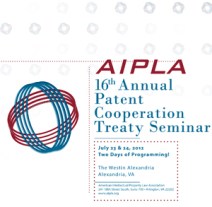
  • BorchureThe American Intellectual Property Law Association (AIPLA) will be holding its 16th Annual Patent Cooperation Treaty Seminar on July 23-24, 2012 in Alexandria, VA.  The seminar will offer sessions on the following topics:

    • Overview of the PCT System; Introduction to and Benefits of the PCT; Why You Might Use PCT Even if You Do Not Intend to Do Any Foreign Filings
    • Choosing the Receiving Office; Pros and Cons of Using RO/US and RO/IB; Follow-On Filings at the IB
    • ePCT
    • Best Practices for Completing the Request Form
    • America Invents Act Implications for the PCT
    • Signature Requirements; Agents and Common Representatives; Withdrawals; Recording Changes and Provisional Protection; Power of Attorney Best Practices
    • PCT Patent Prosecution Highway (PPH) Basics; PPH Prosecution Highway Programs and Practice Tips
    • International Search and Preliminary Examination; Supplementary International Search; Selecting a Searching Authority
    • Amending the International Application and Filing Informal Comments; Comments on Prosecuting Your International Application: Article 19, Informal Comments, Article 34
    • Strategies for PCT Filing
    • Alternative IP Rights: (Utility Models and Innovation Patents)
    • Entering the US National Stage
    • Entering the EPO Regional Phase; London Protocol; Divisionals; Potential Unified European Patent
    • Entering the National Phase in China
    • Strategies for National Filing
    • Paris Convention; US Provisional Applications – Risks and Possible Benefits
    • Drafting an International Application as a Global Application –US View; EP View; China View
    • Incorporation by Reference; Restoration of the Priority Right; Reinstatement of Rights
    • Fixing Mistakes and Best Practices – International Phase and US National Stage
    • Priority Document Exchange (PDX) and WIPO Digital Access Service (DAS); Using DAS

    A program for the seminar can be obtained here, and an online agenda for the seminar can be viewed here.

    The registration fee for the conference is $295 (AIPLA Student/Government Member), $445 (Non-Member/Government Employee), $645 (AIPLA Member), or $945 (Non-Member).  Those interested in registering for the conference can do so here.

  • By Kevin E. Noonan —

    House of Representatives SealLess than a week after the Senate passed its version of a bill amending the user fee provisions of the Food, Drug and Cosmetic Act (FDCA) for funding FDA review of innovator and generic drugs, medical device and biosimilars (S. 3187; Food and Drug Administration Safety and Innovation Act), the House passed its own version of the bill (H.R. 5651; Food and Drug Administration Reform Act of 2012).  The bill was passed by a vote of 387-5 (with 39 abstentions); the naysayers include Reps. Ron Paul (R-TX-14), Tom McClintock (R-CA-4), Justin Amash (R-MI-3), Raul Labrador (R-ID-1), and Maurice Hinchey (D-NY-22).  Like the Senate bill, the House version reauthorizes prescription drug (PDUFA; Title I) and medical device (MDUFA; Title II) user fees, as well as establishing new user fees for generic drugs (GDUFA; Title III) and biosimilars (BsUFA; Title IV).

    FDAThe bill is not yet ready for President Obama's signature, however; there are several differences between the Senate and House bills that have been conveniently compared in tabular form by the Congressional Research Service.  There are no significant differences between the bills regarding the biosimilars provisions discussed in an earlier post regarding the Senate bill provisions (see "Senate Passes User Fee Bill").  Notable differences include no counterpart to Senator Coburn's amendment to the Senate bill (Section 723) requiring the Secretary to contract with a "private, independent" consulting firm to assess agency performance of its premarket review of drug applications.  The House bill contains provisions not found in the Senate bill, for example that extend the time for agency approval after an ANDA is filed from 30 months to 45 months.

    It is estimated that the bill could be ready for the President's signature by mid-summer.

  • By Kevin E. Noonan —

    MyriadOne of the interesting and unresolved issues in the Association for Molecular Pathology v. U.S. Patent and Trademark Office case ("Myriad") involves whether the Federal Circuit, or any U.S. court, has jurisdiction to hear the case.  This issue is based on the Federal Circuit's determination, in its now-vacated decision in the case, that only one plaintiff, Dr. Harry Ostrer, had standing to bring the lawsuit, coupled with Myriad's contention that the basis for jurisdiction was abolished when Dr. Ostrer changed his academic affiliation.  This issue was brought to the Court's attention two days before it handed down its now-vacated decision, and was not sufficient to induce the Federal Circuit to rehear the case either before the original panel or en banc.  After remand from the Supreme Court's decision granting certiorari and vacating the Federal Circuit's opinion for reconsideration in view of the Court's Mayo Collaborative Services v. Prometheus Labortories, Inc. decision, the Federal Circuit did not include this issue in the questions to be addressed by the parties or interested amici.

    Today, Myriad filed a paper, entitled "Appellants' Suggestion of Mootness or in the Alternative Motion to Remand," that squarely brings the issue before the Federal Circuit.  After walking the Court through the procedural history of the case, Myriad's brief sets out the legal basis for its challenge.  The primary case is MedImmune, Inc. v. Genentech, Inc., wherein the Supreme Court held that for declaratory judgment jurisdiction, "the factual allegations 'must show that there is a substantial controversy, between parties have adverse legal interests, of sufficient immediacy and reality to warrant the issuance of a declaratory judgment,'" 549 U.S. 118, 127 (2007), citing Md. Cas. Co. v. P. Coal & Oil Co., 312 U.S. 270. 273 (1941).  Myriad cites Federal Circuit precedent following this decision, including SanDisk Corp. v. STMicroelecs. Inc., 480 F.3d 1372, 1380 (Fed. Cir. 2007) (requiring that "a patentee asserts rights under a patent based on certain identified ongoing or planned activity of another party"); 3M Corp. v. Avery Dennison Corp., 673 F.3d 1372, 1377 (Fed. Cir. 2012) ("[T]o establish an injury in fact traceable to the patentee a declaratory judgment plantiff must allege an affirmative act by the patentee relating to the enforcement of his patent rights"); and Prasco, LLC v. Medicis Pharm. Corp., 537 F.3d 1329, 1338 (Fed. Cir. 2008) (wherein standing is assessed by determing "whether there is '(1) an injury-in-fact, i.e. a harm that is 'concrete' or actual and imminent, not 'conjectural' or 'hypothetical,' (2) that is 'fairly traceable' to the defendant's conduct and (3) is redressible by a favorable decision").  In this case, Myriad reminds the Court that it required that declaratory judgment jurisdiction depended upon "affirmative acts" that were "directed at specific Plaintiffs."

    The brief also cites Supreme Court and Federal Circuit precedent to the effect that the requirement for standing "apply at every stage of the case."  These include Lewis v. Cont'l. Bank Corp, 494 U.S. 72, 477-78 (1990) ("[I]t is not enough that a dispute was very much alive when the suit was filed, or when review was obtained by the Court of Appeals."); Dow Jones & Co. v. Ablaise Ltd., 606 F.3d 1338, 1345 (Fed. Cir. 2010) ("plaintiff bears the burden of proving the existence of [] a controversy throughout the litigation"); and Benitec Australia Ltd. v. Nucleonics, Inc., 495 F.3d 1340, 1344 (Fed. Cir. 2007) ("the burden is on the party claiming declaratory judgment jurisdiction to establish that such jurisdiction existed at the time the claim for declaratory relief was filed and that it has continued since").

    Moreover, Myriad argues that the Court must dismiss the claim as moot if "a sufficiently real and immediate controversy does not remain throughout the pendency of the appeal," citing Nasatka v. Delta Sci. Corp., 58 F.3d 1578, 1580 (Fed. Cir. 1995), and in addition, that the district court decision should be mooted where the appeal is mooted "by the unilaterial act of the party that prevailed before the district court," citing U.S. Bancorp Mortgage Co. v. Bonner Mall P'ship, 513 U.S. 18, 23 (1994), and Tafas v. Kappos, 586 F.3d 1369 (Fed. Cir. 2009) (en banc).

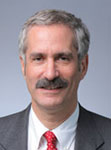
    Ostrer, HarryUnder the present circumstances, Myriad asserts, this case is moot; those circumstances, of course, referring to the changed circumstances of the sole plaintiff, Dr. Harry Ostrer (at left), found in the Federal Circuit's now-vacated decision to have had standing to bring the suit (see "Association for Molecular Pathology v. United States Patent and Trademark Office (Fed. Cir. 2011)").  As Myriad alleged in a letter filed with the Court two days before that now-vacated decision was handed down, Dr. Ostrer left New York University Medical Center to take a position at Albert Einstein College of Medicine and Montefiore Hospital (see "Myriad Writes to Federal Circuit on Standing Issue").  As Myriad points out, the Federal Circuit's determination that Dr. Ostrer had standing was based on the "affirmative act" by Myriad of offering a license to NYU in 1998 (with the implied threat of patent infringement litigation should NYU refuse the license and continue to offer BRCA genetic testing).  Myriad argues that the controversy upon which the Court based its jurisdictional decision was not personal to Dr. Ostrer but "derived from his position at NYU, and the facilities and past practices there."  Evidence in support of this assertion proffered in Myriad's brief is that the 1998 letter was sent to Dr. Ostrer not personally but "in his professional capacity as Director of NYU's Molecular Genetics Laboratory" (an assertion supported by a declaration of Richard Marsh, Vice President at Myriad responsible for implementing its licensing practices).  The brief cites portions of that letter indicating that Myriad was offering a license to NYU, not to Dr. Ostrer.  And the brief cites the language of the now-vacated Federal Circuit opinion that the controversy was "sufficiently real and immediate" because "the relevant circumstances remain[ed] unchanged" from when Myriad had "affirmatively acted" in 1998 by offering the license to NYU.

    Now, of course, Myriad contends that the relevant circumstances "have changed" (emphasis in original) because Dr. Ostrer has left NYU.  The brief emphasizes that Dr. Ostrer changed these circumstances "voluntarily" and "unilaterally" "chang[ing] all the relevant facts and circumstances that led [the Federal Circuit] to conclude that he alone had a justiciable controversy with Myriad."  In addition, Myriad argues that it has no dispute with Dr. Ostrer's current employer, Montefiore, and states that it "has no knowledge of any past or present activities at Montefiore that could possibly give rise to a patent controversy," again relying on Mr. Marsh's declaration.  This argument was reiterated by Myriad with regard to the absence of any evidence that Dr. Ostrer had ever been offered a personal license, i.e., one that could have traveled with him from NYU to Montefiore.  The absence of such evidence makes sense, according to Myriad, because "Dr. Ostrer did not own the clinical diagnostic laboratory; NYU did.  Dr. Ostrer did not employ the individuals who operate the clinical diagnostic laboratory; NYU did.  Dr. Oster did not hold the required licenses or permits to conduct clinical diagnostic testing; NYU did."  Because Myriad's alleged affirmative act that supported jurisdiction was directed at NYU and not Dr. Ostrer, his change of position to Montefiore thus removes the controversy, Myriad argues.  Citing City of Los Angeles v. Lyons, 461 U.S. 95, 107 n.8 (1983), Myriad states that "[i]it is the reality of the threat of . . . injury that is relevant to the standing inquiry, not the plaintiff's subjective apprehensions."  Thus, Myriad argues, the absence of any affirmative act directed towards Montefiore renders irrelevant any continued apprehensions Dr. Ostrer alleges (in a declaration submitted after this issue was raised by Myriad).  Dr. Ostrer's "readiness" to perform BRCA testing is thus not enough to support jurisdiction, according to the brief, because there is no controversy between Myriad and Montefiore and no evidence that Montefiore has ever acted "in any way [that would] interfere with Myriad's rights under the patents at issue in this litigation."

    Importantly to the jurisdictional issue, Myriad contends that there are no other plaintiffs that could step into Dr. Ostrer's shoes: seventeen of the other plaintiffs were found to never have had any communications from Myriad, and the remaining two doctors (Drs. Ganguly and Kazazian) "alleged no intent 'to actually and immediately engage in allegedly infringing BRCA-related activities'" and thus could not allege any "sufficiently real and immediate controversy."  Indeed, Myriad asserts that Dr. Ostrer "now finds himself identically situated to the seventeen plaintiffs with which Myriad has had no contact whatsoever, and who thus had no standing to seek a declaratory judgment against Myriad," citing the Federal Circuit's now-vacated opinion.  The affirmative acts sufficient to support declaratory judgment jurisdiction are required to be "directed at specific Plaintiffs" Myriad contends, citing SanDisk and Prasco, and acts directed towards NYU are not directed towards Montefiore.  "In the absence of a licensing inquiry from Myriad, Montefiore's Dr. Ostrer, like hundreds of other doctors in hundreds of other laboratories around the United States, all with the equipment, capability, and desire to perform genetic sequencing, lacks any real controversy with Myriad requiring an immediate resolution," Myriad argues, and any forbearance on Dr. Ostrer's part in performing BRCA testing is "a unilaterally self-imposed harm" that cannot sustain standing.

    Interestingly, the brief also cites the Court's recent (May 21st) grant of certiorari (in light of an opinion from the Solicitor General urging that certiorari be granted) in a case much like this one, where the ACLU recruited "an assortment of organizational and [other] plaintiffs" who alleged "only self-imposed injury and not any action directed at them by the defendant."  Amnesty Int'l. USA v. Clapper, 638 F.3d 118 (2d. Cir 2011), cert granted, Clapper v. Amnesty Int'l. USA, 566 U.S. __ (May 21, 2012) (No. 11-1025).  Myriad (in yet another footnote) cited the Clapper case in that "self-inflicted harm does not satisfy the basic requirements for standing" because, inter alia, even if it amounted to an Article III recognized injury it "would not fairly be traceable to defendant's challenged conduct."  In this regard, Myriad asserts that "multiple other laboratories are conducting BRCA clinical diagnostic testing today without a license from Myriad, directing the Court's attention to the Genetic Testing Registry.

    Myriad's brief also seeks vacatur of the District Court's decision, based on Dr. Ostrer's "unilateral action" in destroying the basis for declaratory judgment jurisdiction, citing U.S. Bancorp ("vacatur must be granted where mootness results from the unilateral action of the party who prevailed in the lower court") and Tafas.

    In a footnote, Myriad raises the underlying point:  that the Federal Circuit does not have the "authority to reconsider its merits rulings in light of Mayo v. Prometheus, citing Bender v. Williamsport Area Sch. Dist., 475 U.S. 534, 541 (1986), for the proposition that "'every federal appellate court has a special obligation to' ensure that it has jurisdiction before proceeding to the merits of the case."

    In the alternative, Myriad argues that, "[a]t the very least," the Federal Circuit should remand the case to the District Court to hear the jurisdictional arguments and give the parties the opportunity to "adjudicate the jurisdictional effect of Dr. Ostrer's departure from NYU and his new position at Montefiore."  This argument is based on Myriad's lack of opportunity to "test these and other averments in Dr. Ostrer's new declaration," specifically averments that testing (at Montefiore) would take place "immediately" upon a judgment against Myriad.  Myriad cited the requirements for licensure, either under CLIA or New York State regulations, as well as the absence of evidence that Montefiore intends to permit Dr. Ostrer to perform such testing.  In this regard the brief cites Dr. Ostrer's declaration testimony that "he will be Director of 'Genetic and Genomic Diagnostics at Montefiore Medical Center'" against the reality that "[a]lmost a year later, a review of the websites for Montefiore fails to show any evidence that such a diagnostic entity exists."  Myriad's brief also points out that Montefiore indeed has a molecular diagnostic laboratory, "directed by Dr. Qiuliu Pan, that performs genetic testing."  But there is no evidence that Dr. Ostrer "is involved in or plans to direct any BRCA clinical genetic testing" at Montefiore or that Montefiore will permit him to do so.

    Myriad also takes this opportunity to remind the Federal Circuit of an argument made in its reply brief and noted at oral argument, that there are (many) other claims in its patents that were not challenged by the ACLU and PubPat.  These claims are "also directed to BRCA clinical diagnostic testing" and "a declaratory judgment on the limited number of claims challenged by plaintiffs" would not be sufficient to provide a sufficient remedy to redress the alleged harms to the plaintiffs.  This (redressibility) is also "a required element to sustain declaratory-judgment jurisdiction" and its determination "has now become necessary due to Dr. Ostrer's new positions at Montefiore and" in "determining what BRCA clinical diagnostic testing he would there be allowed to undertake" according to Myriad's brief.

    The brief closes with a "Statement of Consent or Opposition," stating that "Counsel for appellees has declined to consent, and indicated that a response will be filed."  Opening briefs and briefs by any amici remain due on June 15th.

    For additional information regarding this and other related topics, please see:

    • "Federal Circuit Sets Schedule for AMP v. USPTO," April 30, 2012
    • "Mayo Collaborative Services v. Prometheus Laboratories — What the Court's Decision Means," March 22, 2012
    • "Mayo Collaborative Services v. Prometheus Laboratories — What the Supreme Court Said," March 21, 2012
    • "Early Reaction to Supreme Court Decision in Mayo v. Prometheus," March 20, 2012
    • "Mayo Collaborative Services v. Prometheus Laboratories, Inc. (2012)," March 20, 2012
    • "Plaintiffs File Petition for Certiorari in AMP v. USPTO," December 8, 2011
    • "Federal Circuit Denies Petition for Rehearing in AMP v. USPTO," September 18, 2011
    • "Federal Circuit Denies Plaintiff(s)' Petition for Rehearing in AMP v. USPTO," September 14, 2011
    • "Defendants File Petition for Rehearing in AMP v. USPTO," August 30, 2011
    • "Plaintiff(s) File Petition for Rehearing in AMP v. USPTO," August 29, 2011
    • "Is Claim Construction the Key to Patent-eligibility of Isolated DNA?" August 23, 2011
    • "AMP v. USPTO: Judge Bryson's Opinion," August 3, 2011
    • "AMP v. USPTO: Judge Moore's Concurring Opinion," August 2, 2011
    • "Association for Molecular Pathology v. United States Patent and Trademark Office (Fed. Cir. 2011)," August 1, 2011
    • "Standing in AMP v. USPTO: The Plot Thickens," July 29, 2011
    • "Federal Circuit Issues Decision in AMP v. USPTO," July 29, 2011
    • "Myriad Writes to Federal Circuit on Standing Issue," July 28, 2011
    • "Deciphering the Patent-Eligibility Message in Prometheus, Myriad and Classen," March 20, 2011