• By Kevin E. Noonan —

    Much has been written about the biosimilar approval pathway contained in the Biologics Price Competition and Innovation Act of 2009 (BPCIA).  While the substantive provisions are still being worked out, one mundane and practical detail is how the government will pay for erecting and maintaining the regulatory edifice mandated under the biosimilars law.  As with much of what the FDA does, this will be done by user fees, and determining the extent of these fees is currently being hashed out in Congress.

    Senate SealOn Friday, the Senate considered several amendments and passed its version of the user fee provisions, S. 3187.  Relevant to the BPCIA is TITLE IV: User Fees for Biosimilar Drugs, which contains several provisions related to various aspects of the nascent biosimilars regime.  These include specifically Section 402, which sets forth amendments to the Food, Drug and Cosmetics Act as follows:

    • For the "initial biosimilar biological product development fee," a fee that can be charged for an "initial meeting" with the FDA (744H(a)(1)(A)(ii)), or a "clinical protocol for an IND 'protocol' (under FCDA 505(i))" (744H(a)(1)(A)(iii));

    • An "annual biosimilar biological product development fee" for maintaining the application (744H(a)(1)(B)); and

    • Provisions for discontinuing payment (744H(a)(1)(C)) and reactivating payments (744H(a)(1)(D)) depending on status of application (withdrawn or resubmitted).

    The bill also authorizes the FDA to refuse to meet with or receive IND from any applicant that has not timely paid the required fee (744H(a)(1)(E)), and provides for no refunds (744H(a)(1)(F)(i)), waivers, exemptions or reductions (744H(a)(1)(F)(ii)).

    FDAFurther and different fees are assessed for filing the biosimilars application itself from which can be deducted the "cumulative amount" of any of the initial meeting, IND protocol or reinstatement fees previously paid.  744H(a)(2)(A)(i).  There is a 50% discount of the application fee "for which clinical data (other than comparative bioavailability studies) with respect to safety or effectiveness are not required."  744H(a)(2)(A)(ii)).  However, the same 50% fee will be charged for a supplement that submits clinical data for safety or effectiveness is required (having the same exemption for bioavailability studies).  744H(a)(2)(A)(iii).

    Once approved, the successful biosimilar applicant will be assessed a "biosimilar biological product establishment fee" (744H(a)(3)(A)) for each "establishment" that manufactures an approved biologic drug; the fee is annual (744H(a)(3)(B)).  The successful applicant is also assessed a "biosimilar biologic product fee" (744H(a)(4)(A)).

    After setting forth what fees are to be charged, the bill sets forth the extent of the fees (744H(b)(1)(A)): generally the same as the fees for conventional drug products, but the initial meeting and product development fees are 10% of the fees charged under section 736(c)(4) for applications per Section 736(a)(1)(A)(i).

    However, the total amount of fees charged for a fiscal year under this section may not exceed the total amount for such fiscal year of the costs of resources allocated for the process for the review of biosimilar biological product applications, pursuant to Section 744H(b)(2), indicating that Congress does not wish biosilimar applicants to become a "cash cow" for the agency.  In addition, there is a waiver of the fee for the first biosimilar application filed by a "small business" (Section 744H(c)(1)), where a "small business" is defined as:

    [A]n entity that has fewer than 500 employees, including employees of affiliates, and does not have a drug product that has been approved under a human drug application (as defined in section 735) or a biosimilar biological product application (as defined in section 744G(4)) and introduced or delivered for introduction into interstate commerce.

    The bill also includes an amendment introduced by Senator Tom Coburn, M.D. of Oklahoma.  The amendment, No. 2131 entitled "Independent Assessment Of The Drug And Biologic Application Review Process," reads:

    SEC. 723. INDEPENDENT ASSESSMENT.
        (a) IN GENERAL.—The Secretary shall contract with a private, independent consulting firm capable of performing the technical analysis, management assessment, and program evaluation tasks required to conduct a comprehensive assessment of the process for the review of drug applications under subsections (b) and (j) of section 505 of the Federal Food, Drug, and Cosmetic Act (21 U.S.C. 355(b), (j)) and subsections (a) and (k) of section 351 of the Public Health Service Act (42 U.S.C. 262(a), (k)). The assessment shall address the premarket review process of drugs by the Food and Drug Administration, using an assessment framework that draws from appropriate quality system standards, including management responsibility, documents controls and records management, and corrective and preventive action.
        (b) PARTICIPATION.—Representatives of the Food and Drug Administration and manufacturers of drugs subject to user fees under part 2 of subchapter C of chapter VII of the Federal Food, Drug, and Cosmetic Act (21 U.S.C. 379g et seq.) shall participate in a comprehensive assessment of the process for the review of drug applications under section 505 of the Federal Food, Drug, and Cosmetic Act and section 351 of the Public Health Service Act. The assessment shall be conducted in phases.

    The bill further provides that the first contract under this provision of the law be awarded "not later than March 31, 2013" and the agency must publish a "written assessment" "no later than February 1, 2016.  (Section 723(c)).  The findings of each such independent assessment must be published ("not later than six months after the contract is a awarded") and the "[f]inal comprehensive findings and recommendations" published "not later than 1 year after the contract is awarded.
"  (Section 723(d)(1)).  The content of these assessments is also specified in the bill (Section 723(e)):

    (1) Identification of process improvements and best practices for conducting predictable, efficient, and consistent premarket reviews that meet regulatory review standards.
    (2) Analysis of elements of the review process that consume or save time to facilitate a more efficient process," that includes—
        (A) consideration of root causes for inefficiencies that may affect review performance and total time to decision;
        (B) recommended actions to correct any failures to meet user fee program goals; and
        (C) consideration of the impact of combination products on the review process.
    (3) Assessment of methods and controls of the Food and Drug Administration for collecting and reporting information on premarket review process resource use and performance.
    (4) Assessment of effectiveness of the reviewer training program of the Food and Drug Administration.
    (5) Recommendations for ongoing periodic assessments and any additional, more detailed or focused assessments.

    The Secretary is mandated to "analyze" these recommendations and "incorporate" the recommendations into its practices "as appropriate."  (Section 723(f)).  The bill also directs the agency to include "the results of the assessment in a Good Review Management Practices guidance document, which shall include initial and ongoing training of Food and Drug Administration staff, and periodic audits of compliance with the guidance."

    In his comments when introducing the bill, Senator Coburn stated that the amendment "came out of study of the [General Accounting Office's] findings" on the FDA's performance.  He cited the GAO's study as finding "an irregular pattern of performance review at the FDA" and said that this amendment was intended as a "management tool" to "evaluate individual employees."  "Timeliness" appears to be the impetus for the amendment, as well as better ways to assess timeliness.  "The idea is not to push drugs out that shouldn't be approved," the Senator reassured his colleagues.  But consistent with the goals of providing user fees in the first place, the Senator urged that the amendment be included in the bill because it was consistent with those aims, stating that fears that the amendment's provisions would result in a regime where unsafe drugs were approved was not realistic because the GAO's recommendations contained provisions relating to "inappropriate pressure" that could be brought to bear by users on the agency.  He praised (backhandedly) the agency and the way it performs its duties, saying they "do an awfully good job" but that "they are just awfully slow at it."

    The amendments sunset on October 1, 2017 and are effective at the later of October 1, 2012 or on the date of enactment of the amendments into law.

    The House version of the bill, H.R.5651, is reportedly ready for a floor vote in the near future.

  • By Sherri Oslick —

    Gavel About Court Report:  Each week we will report briefly on recently filed biotech and pharma cases.

    Cumberland Pharmaceuticals Inc. v. InnoPharma Inc.
    1:12-cv-00618; filed May 17, 2012 in the District Court of Delaware

    Cumberland Pharmaceuticals Inc. v. Paddock Laboratories LLC et al.
    1:12-cv-00619; filed May 17, 2012 in the District Court of Delaware

    • Plaintiff:  Cumberland Pharmaceuticals Inc.
    • Defendants:  Paddock Laboratories LLC; Perrigo Co.

    Cumberland Pharmaceuticals Inc. v. Mylan Institutional LLC et al.
    1:12-cv-03846; filed May 17, 2012 in the Northern District of Illinois

    • Plaintiff:  Cumberland Pharmaceuticals Inc.
    • Defendants:  Mylan Institutional LLC; Mylan Inc.

    The complaints in these cases are substantially identical.  Infringement of U.S. Patent No. 8,148,356 ("Acetylcysteine Composition and Uses Therefor," issued April 3, 2012) following a Paragraph IV certification as part of defendants' filing of an ANDA to manufacture a generic version of Cumberland's Acetadote® (N-acetylcysteine  injection, used to prevent or lessen hepatic injury after ingestion of a potentially hepatotoxic quantity of acetaminophen).  View the InnoPharma complaint here.


    Allergan, Inc. v. Hi-Tech Pharmacal Co., Inc.

    1:12-cv-00492; filed May 16, 2012 in the Middle District of North Carolina

    Infringement of U.S. Patent No. 8,101,161 ("Method of Enhanced Hair Growth," issued  January 24, 2012) following a Paragraph IV certification as part of Hi-Tech's filing of an ANDA to manufacture a generic version of Allergan's Latisse® (bimatoprost topical solution/drops, 0.03%, used to treat inadequate or not enough eye lashes).  View the complaint here.


    Warner Chilcott Co., LLC v. Watson Laboratories, Inc. et al.

    3:12-cv-02928; filed May 16, 2012 in the District Court of New Jersey

    • Plaintiff:  Warner Chilcott Co., LLC
    • Defendants:  Watson Laboratories, Inc.; Watson Pharma, Inc.; Watson Pharmaceuticals, Inc.

    Infringement of U.S. Patent Nos. 5,552,394 ("Low Dose Oral Contraceptives with Less Breakthrough Bleeding and Sustained Efficacy," issued September 3, 1996) and 7,704,984 ("Extended Estrogen Dosing Contraceptive Regimen" issued April 27, 2010) following a Paragraph IV certification as part of Watson's filing of an ANDA to manufacture a generic version of Warner Chilcott's Lo Loestrin® Fe (norethindrone acetate and ethinyl estradiol tablets, and ethinyl estradiol and ferrous fumarate tablets, used for oral contraception).  View the complaint here.


    Novartis Pharmaceuticals Corp. v. Lupin Ltd. et al.

    1:12-cv-00595; filed May 14, 2012 in the District Court of Delaware

    • Plaintiff:  Novartis Pharmaceuticals Corp.
    • Defendants:  Lupin Ltd.; Lupin Pharmaceuticals Inc.

    Novartis Pharmaceuticals Corporation v. Torrent Pharmaceuticals Ltd. et al.
    1:12-cv-00596; filed May 14, 2012 in the District Court of Delaware

    • Plaintiff:  Novartis Pharmaceuticals Corp.
    • Defendants:  Torrent Pharmaceuticals Ltd.; Torrent Pharma Inc.

    The complaints in these cases are substantially identical.  Infringement of U.S. Patent Nos. 6,294,197 ("Solid Oral Dosage Forms of Valsartan," issued September 25, 2001) and 8,101,599 ("Pharmaceutical Composition Containing Anti-Hypertensive Agents," issued January 24, 2012) following a Paragraph IV certification as part of defendants' filing of an ANDA to manufacture a generic version of Novartis's Exforge HCT® (amlodipine, valsartan, and hydrochlorothiazide, used to treat hypertension).  View the Lupin complaint here.


    Helsinn Healthcare S.A. et al. v. Dr. Reddy's Laboratories, Ltd. et al.

    3:12-cv-02867; filed May 11, 2012 in the District Court of New Jersey

    • Plaintiffs:  Helsinn Healthcare S.A.; Roche Palo Alto LLC
    • Defendants:  Dr. Reddy's Laboratories, Ltd.; Dr. Reddy's Laboratories, Inc.

    Infringement of U.S. Patent No. 7,947,724 ("Liquid Pharmaceutical Formulations of Palonosetron," issued May 24, 2011) following a Paragraph IV certification as part of Dr. Reddy's filing of an NDA (under  § 505(b)(2) of the Food, Drug and Cosmetic Act) to manufacture a generic version of Helsinn's Aloxi® (palonosetron hydrochloride intravenous solution, used for the prevention of acute and delayed nausea and vomiting associated with initial and repeat courses  of moderately emetogenic chemotherapy, and acute nausea and vomiting associated with initial and repeat courses of highly emetogenic chemotherapy).  View the complaint here.

  • Calendar

    June 1, 2012 – Understanding the America Invents Act: A Sweeping Change of U.S. Patent Prosecution Practice (American Bar Association (ABA) Section of Intellectual Property Law, Young Lawyers Division, and Center for Continuing Legal Education) – 1:00 – 2:30 pm (EDT)

    June 5, 2012 – Orange Book Use Codes: Impact of Caraco v. Novo Nordisk (Strafford) – 1:00 – 2:30 pm (EDT)

    June 6, 2012 – Biotechnology/chemical/ pharmaceutical (BCP) customer partnership meeting (U.S. Patent and Trademark Office) – 9:00 am – 4:30 pm (ET)

    June 8-12, 2012 – 2012 MidYear Meeting (Association of American Law Schools) – Berkeley, CA

    June 13-15, 2012 – Fundamentals of Patent Prosecution 2012: A Boot Camp for Claim Drafting & Amendment Writing (Practising Law Institute) – New York, NY

    June 14, 2012 – The Elimination and Creation of Defenses in the Wake of AIA (Technology Transfer Tactics) – 1:00 – 2:00 pm (Eastern)

    June 18-21, 2012 – BIO International Convention (Biotechnology Industry Organization) – Boston, MA

    June 20-21, 2012 – International Forum on Pharma Patent Lifecycles*** (C5) – London, England

    June 24-26, 2012 – IP Business Congress (Intellectual Asset Management (IAM) magazine) – Cascais, Portugal

    June 25-26, 2012 – Hatch-Waxman Boot Camp*** (American Conference Institute) – San Diego, CA

    July 11-13, 2012 – Fundamentals of Patent Prosecution 2012: A Boot Camp for Claim Drafting & Amendment Writing (Practising Law Institute) – San Francisco, CA

    July 17-19, 2012 – Product and Pipeline Enhancement for Generics*** (marcus evans) – Washington, DC

    July 30-31, 2012 – Freedom to Operate*** (American Conference Institute) – Philadelphia, PA

    July 30 to August 1, 2012 – Intensive Patent Law Seminar (Chisum Patent Academy) – Seattle, WA

    ***Patent Docs is a media partner of this conference or CLE

  • Technology Transfer Tactics will be offering a webinar entitled "The Elimination and Creation of Defenses in the Wake of AIA" on June 14, 2012 from 1:00 – 2:00 pm (Eastern).  U.S. and European patent attorney Robert Lelkes of Steffin Lelkes Azod, LLP will cover those portions of the Leahy-Smith America Invents Act that impact the elimination and creation of certain defenses and provide practical strategies for protecting patents.  The webinar will cover the following topics:

    • Enhance university income from patents via preservation of the university exception to the prior use defense;
    • Preserve ownership of inventions via the new derivation proceedings;
    • Protection of the patentability of claims in foreign countries; and
    • Timing and claim content considerations to eliminate or create applicability of first-to-file, the new grace period definition, and the new post grant proceedings.

    The registration fee for the webinar is $197.  Those interested in registering for the webinar, can do so here.

    Technology Transfer Tactics

  • Independence HallAmerican Conference Institute (ACI) will be holding its 6th National Tactical and Practical Guide to Freedom to Operate on July 30-31, 2012 in Philadelphia, PA.  The conference will allow attendees to:

    • Preserve privilege and confidentiality in freedom to operate opinions;
    • License your way out of trouble;
    • Analyze smart freedom to operate game plans post-America Invents Act;
    • Evaluate the effects of the recent Mayo v. Prometheus decision and determine its impact on protecting diagnostic methods;
    • Utilize new procedures like post-grant review to challenge troubling patents;
    • Create a "living" freedom to operate strategy conducted in tandem with the R&D process;
    • Tailor search strategies to the requirements of different products to maximize search effectiveness;
    • Overcome international freedom to operate search challenges; and
    • Examine the broadening obviousness standard and its effects on freedom to operate analysis.

    BrochureIn particular, ACI's faculty will offer presentations on the following topics:

    • Strengthen the value of your future IP: Reinventing FTO procedures in light of the game-changing provisions in the America Invents Act;
    • Case law update: Predicting the patentability of diagnostic patents post-Mayo v. Prometheus;
    • Maximizing FTO effectiveness by tailoring search strategies to different products' requirements;
    • Confronting and overcoming challenges in international FTO searches to ensure global rights for commercializing products;
    • Drafting informative FTO opinions: Perspectives from in-house and outside counsel;
    • Combating troubling FTO results by conducting thorough claim construction analysis;
    • Demystifying the current obviousness standard and its implications for FTO;
    • Taking action to address potential roadblocks with effective FTO analysis;
    • Clearing the underbrush: Utilizing new procedures to challenge troubling patents;
    • Satisfying the stringent FTO requirements demanded in due diligence for M&A; and
    • Privilege and confidentiality in FTO opinions: When are they preserved and when are they waived?

    In addition, a post-conference workshop entitled "The Master Class on Creating and Implementing an Iterative 'Living' FTO Strategy: Utilizing FTO to Inform Product Development and Minimize IP Risks" will be offered from 3:00 to 6:00 pm on July 31, 2012, and a second post-conference workshop entitled "The Complete Guide to Maintaining Market Exclusivity for Diagnostic Methods Post-Prometheus" will be offered from 9:00 am to 12:00 pm on August 1, 2012.

    The agenda for the Freedom to Operate conference can be found here.  A complete brochure for this conference, including an agenda, detailed descriptions of conference sessions, list of speakers, and registration form can be obtained here.

    ACI - American Conference InstituteThe registration fee for the conference is $2,295 (conference alone), $2,895 (conference and one workshop), or $3,495 (conference and both workshops).  Those registering by June 28, 2012 will receive a $200 discount.  Patent Docs readers who reference the discount code "PD 200" will receive $200 off the current price tier when registering.  Those interested in registering for the conference can do so here, by calling 1-888-224-2480, or by faxing a registration form to 1-877-927-1563.

    Patent Docs is a media partner of ACI's Freedom to Operate conference.

    Photograph of Independence Hall (above) by Rdsmith4, from the  Wikipedia Commons under the Creative Commons license.

  • USPTO Building FacadeThe U.S. Patent and Trademark Office has announced a revised agenda for the next biotechnology/ chemical/pharmaceutical (BCP) customer partnership meeting to be held on June 6, 2012.  New to the agenda is an afternoon session on the Recommendation for the Disclosure of Sequence Listings using XML (Proposed ST.26).  The time slots for a number of sessions have also been changed.  The revised agenda is as follows:

    Morning Session

    • Opening Remarks (9:00 – 9:15 am ET):  George Elliott, Wanda Walker, and Dan Sullivan (Acting), Directors, Technology Center 1600

    • AIA Update (9:15 – 10:15 am):  Janet Gongola, Patent Reform Coordinator

    • Break (10:15 – 10:30 am)

    • Cooperative Patent Classification Overview (10:30 – 11:15 am):  Bruce Kisliuk, Deputy Commissioner for Patent Administration

    • Claim Interpretation (11:15 am – 12:00 pm):  Jeffrey Lundgren, SPE, Art Unit 1629

    • Lunch (12:00 – 1:15 pm)

    Afternoon Session

    • Mayo v. Prometheus (1:15 – 2:45 pm):  Roberte Makowski, Connolly Bove Lodge & Hutz, LLP,
    and Hans Sauer, Associate General Counsel for BIO

    • Break (2:45 – 3:00 pm)

    • Recommendation for the Disclosure of Sequence Listings using XML (Proposed ST.26) (3:00 – 3:30 pm):  Susan Wolski, PCT Legal

    • Range Limitations in Claims (3:30 – 4:15 pm):  Jean Witz, QAS, TC1600

    • Closing Remarks/Discussion (4:15 – 4:30 pm):  George Elliott, Wanda Walker, and Dan Sullivan (Acting), Directors, Technology Center 1600

    The meeting can be attended in person at the USPTO's Madison Auditorium, 600 Dulany Street, Alexandria, VA, or viewed online here (click "Join Now").  Individuals wishing to join the teleconference only should call +1-408-600-3600 (U.S./Canada, toil number), and use the access code: 991 681 937.  Those wishing to attend the meeting should contact Cecilia Tsang by phone at 571-272-0562, by fax at 571-273-0562, or by e-mail at Cecilia.Tsang@uspto.gov by June 4, 2012 to confirm their attendance.  Additional information regarding the BCP customer partnership meeting can be found here.

  • By Kevin E. Noonan —

    Bioeconomy BlueprintIn April, the White House released a policy paper what was styled the "National Bioeconomy Blueprint."  Its presumptions are based on the idea that the portion of the economy "fueled by research and innovation in the biological sciences" is a "large and rapidly growing segment of the world economy that provides substantial public benefit."  This has caused innovation in the biological sciences to become a priority of the Obama Administration, promising not only economic development but to "live longer, healthier lives, reduce our dependence on oil, address key environmental challenges, transform manufacturing processes, and increase the productivity and scope of the agricultural sector while growing new jobs and industries."  Successes of the bioeconomy touted by the Blueprint include $76 billion in revenues from genetically engineered crops and $100 billion in revenues from "industrial biotechnology" (including "fuels, materials, chemicals, and industrial enzymes derived from genetically modified systems").  The Blueprint identifies genetic engineering technology, DNA sequence analysis and "automated high-throughput manipulations of biomolecules" as "foundational technologies," while identifying "synthetic biology," proteomics and bio-informatics as "emerging technologies."

    The result of the "bioeconomy" becoming an Administration "priority" is a directive (Executive Memorandum (M-10-30)) to all Federal agencies to "support research to establish the foundations for a 21st century bioeconomy," an effort that the Blueprint says has made "significant early progress."  While these efforts also "raise important ethical and security issues that are also top priorities for the Administration," discussions of these concerns are expressly deemed to be outside the scope of the Blueprint itself.

    The first chapter of the Blueprint sets out the broad goals, citing the National Research Council's 2009 report, A New Biology for the 21st Century, for a recognition of the importance of biological research for addressing societal needs for foods, fuel, and medicines (echoing BIO's motto of "Healing, Fueling and Feeding the World").  The Blueprint enunciates "key elements" of the recommended national effort, including:

    • a full spectrum of basic and applied R&D activities performed by academic, government, and private sectors
    • public-private partnerships
    • a supportive commercialization system for bioinventions
    • innovative regulatory policies that reflect government awareness of needs for and impediments to progress
    • a skilled and creative workforce
    • public support for technological advances
    • flexibility to accommodate the evolving needs, discoveries, and challenges

    The second chapter enumerates several examples of efforts to achieve the goals.

    The Blueprint sets forth "five strategic objectives" for achieving the promised bioeconomy:

    1. Support R&D investments that will provide the foundation for the future U.S. bioeconomy.

    This objective includes "[c]oordinated, integrated R&D efforts will help strategically shape the national bioeconomy R&D agenda"; "[e]xpand[ing] and [d]eveloping essential bioeconomy technologies"; "[i]ntegrat[ing] approaches across fields"; and "[i]mplement[ing] Improved Funding Mechanisms."  In this effort, "the President has called for agencies to identify strategic R&D investments, as well as increase the use of flexible funding mechanisms to improve program efficiency and provide the best opportunity to enhance economic growth."  The rationale is that "[a] robust biological/biomedical R&D enterprise, backed by government, foundations, and for profit investments, is necessary to produce the new knowledge, ideas, and foundational technologies required to develop products and services that support businesses and industries and help create jobs."

    Much of what is cited in the Blueprint are efforts like the NIH Center for Regenerative Medicine, to accelerate the development and testing of new clinical protocols using iPS-cell-based treatments, and the use of FDA data on drug products clinical data ("[t]he FDA currently houses one of the largest known repositories of clinical data, including safety, efficacy, and performance information, and an increasing amount of post-market safety surveillance data").  While technology-based, such efforts do raise their own questions, such as whether translational activities are the best use of NIH resources and the extent to which clinical and other data submitted in support of regulatory approval can be expropriated by the government for its own, alternative uses without raising constitutional concerns.  The Blueprint also cites several biofuels efforts by Advanced Research Projects Agency-Energy, Department of Agriculture (USDA) and Department of Energy's (DOE) Biomass Program, USDA-DOE Plant Feedstock Genomics for Bioenergy Program, National Science Foundation's (NSF) Engineering Directorate Sustainable Energy Pathways (SEP) effort, as well as government programs supporting biomanufacturing.

    2. Facilitate the transition of bioinventions from research lab to market, including an increased focus on translational and regulatory sciences.

    This objective includes "[a] dedicated commitment to translational efforts will accelerate movement of bioinventions out of laboratories and into markets, specifically: [a]ccelerat[ing] progress to market; enhance[ing] entrepreneurship at eniversities; and utilize[ing] federal procurement authority."  The Blueprint identifies programs intended to help start-ups negotiate the "valley of death" of investment, including the Startup America initiative, specifically naming "five areas highlighted for action: unlocking access to capital; connecting mentors with entrepreneurs; reducing regulatory barrier; tax relief; and other economic incentives for small businesses"; the National Institute of Standards and Technology (NIST) Hollings Manufacturing Extension Partnership (MEP); the National Innovation Marketplace; BioInnovation Initiative; Executive Order 13514, Federal Leadership in Environmental, Energy, and Economic Performance; reauthorization of the Small Business Innovation Research (SBIR) and Small Business Technology Transfer (STTR) programs; translational biomedicine efforts such as the National Center for Advancing Translational Sciences (NCATS), established in December 2011, and cooperative programs between FDA and NIH.  In addition, the Blueprint advocates enhanced entrepreneurial activities in universities and improved technology transfer, which includes exclusive licensing of NIH-developed innovation, "to companies developing drugs, vaccines, or therapeutics from NIH-patented or patent-pending technologies."  But the Bleuprint also contains statements like "[t]he America Invents Act provides entrepreneurs the tools they need to obtain patents more quickly and to defend them against litigation challenges, both at lower costs" which reduces a reader's confidence that the Administration has accurately assessed the important components of bio-innovation.

    3. Develop and reform regulations to reduce barriers, increase the speed and predictability of regulatory processes, and reduce costs while protecting human and environmental health.

    This objective includes "[i]mproved regulatory processes [that] will help rapidly and safely achieve the promise of the future bioeconomy, specifically: improve[ing] regulatory processes and regulations; and collaborat[ing] with stakeholders."

    This initiative is actually directed to "reducing regulatory barriers":  specifically, regulations that "have become inadequate or unnecessarily restrictive because technology and its associated products and services, as well as our national interests, have evolved and regulations may not have kept pace."  The Blueprint also cites Executive Orders, Improving Regulation and Regulatory Review and Regulation and Independent Regulatory Agencies and revisions to FDA regulations that "increase transparency, consistency, and predictability of the regulatory processes and help drive medical product innovation forward."  Specific regulatory changes are directed to medical devices and regulation for "emerging technologies."

    4. Update training programs and align academic institution incentives with student training for national workforce needs.

    This objective includes the directive that "Federal agencies should take steps to ensure that the future bioeconomy has a sustainable and appropriately-trained workforce," specifically enumerating "employer-educator partnerships" and "reengineer[ing] training programs."  A large portion of this objective is directed towards an emphasis on minority-serving institutions (including community colleges).

    5. Identify and support opportunities for the development of public-private partnerships and precompetitive collaborations — where competitors pool resources, knowledge, and expertise to learn from successes and failures.

    This objective includes the directive that "Federal agencies should provide incentives for public-private partnerships and precompetitive collaborations to benefit the bioeconomy broadly, specifically directed to "catalyz[ing] public-private partnerships."  "Models" for collaboration are listed as:

    • Open-source initiatives
    • Industry consortia for process innovation
    • Discovery-enabling consortia
    • Public–private consortia for 
knowledge creation
    • Prizes
    • Innovation incubators
    • Industry complementors
    • Virtual pharmaceutical companies

    Citing "Overview of Precompetitive Collaboration for Institute of Medicine Workshop."

    This portion of the Blueprint sets out public-private partnerships for "rescuing" or repurposing" abandoned pharmaceutical compounds and smarter drug design.

    The next portion of the Blueprint sets forth purported "successes" of the Administration's efforts to stimulate the bioeconomy, which include:

    • "Broad Spectrum Anti-Viral: Researchers at the Massachusetts Institute of Technology's Lincoln Laboratory reported in 2011 creation of a broad-spectrum antiviral technology that selectively kills any virus-infected cell but does not harm uninfected cells." ("Broad-Spectrum Antiviral Therapeutics")

    • "Diesel from CO2: Through photosynthesis, plants, algae, and some bacteria use the energy of sunlight to convert CO2 into a variety of organic compounds needed for growth and survival A Massachusetts-based company re-engineered photosynthetic organisms to synthesize, from sunlight and CO2, molecules that form the chemical basis of diesel fuel."

    • "Designing Biological Systems for Next- Generation Biomanufacturing: Synthetic biology is enabling scientists to rapidly design organisms that can be used in the production of renewable chemicals, biofuels, renewable specialty and fine chemicals, food ingredients, and health-care products. Bioacrylic acid heralds the advent of synthetic-biology-enabled manufacturing: acrylic acid ingredients are used to make adhesives stronger, paints more durable, and diapers more absorbent, and today petroleum-based acrylic is an $8 billion global market" ("Current Uses of Synthetic Biology")

    • "Allergen-Free Peanuts: Researchers at a number of institutions in the United States have made inroads towards eliminating or inactivating allergenic proteins in peanuts. If successful, these approaches could lead to significant health benefits for Americans and economic opportunities for the peanut industry."

    • "Biodegradable Plastics from Biomass: A major commercial "polylactic acid" bioplastic is already made today from cellulose However, the ability to replace petroleum-based plastics with this bioproduct is constrained by the limited availability of the specific cellulosic source material. To address this limitation, USDA scientists discovered a bacterium that can ferment a broader range of cellulosic biomass materials into polylactic acid, enabling commercial production on a much larger scale. With an estimated $375 billion market for chemical, plastic, and rubber products based on petroleum, this represents a substantial bioeconomy opportunity." ("Sustainable Polymers")

    • "Biosensor Pollution Monitoring: Biosensors are devices composed of a biological sensing component linked
to a signaling component, working together to reveal the presence of an element, molecule, or organism of interest. In 2011, a team at the Virginia Institute of Marine Science reported creation of a portable biosensor that could detect marine pollutants, including oil, much faster and more cheaply than current technologies. If deployed near oil facilities, such sensors could provide early warning of spills and leaks and track dispersal patterns in real time." ("Near real-time, on-site, quantitative analysis of PAHs in the aqueous environment using an antibody-based biosensor")

    More naïve (or perhaps idealist) portions of the Blueprint posit "trends" in the bioeconomy such as "sharing:"

    Non-traditional research collaborations that feature the
sharing of information, resources, and capabilities are
transforming the bioeconomy.  Precompetitive collabora
tions — where "competitors" partner and pool resources — are growing as partners seek new ways to leverage constrained resources and surmount shared problems.  Partnerships for innovation are increasingly observed as a response to changing economic and technological conditions.

    In agriculture, as the public and private sectors seek increased information for the bioeconomy on potential crop characteristics, there is increased sharing, both domestically and internationally, of genetic information.  The sharing of genetic information enhances U.S. agricultural competitiveness for food, energy, chemical production in plants, and other biobased-product crop species.

    In the health sector, precompetitive collaborations are having significant impacts in clinical-trial design and biomarker discovery, among other areas.  Combined industrial R&D has contributed to transformative progress despite major challenges such as increased management costs due to "outside" collaborations and the need to develop effective communication networks across companies.

    Similarly idealistic (or perhaps fantastical) portions of the Bleuprint include the idea for "using the power of prizes to drive innovation," specifically with regard to enactment of the "America COMPETES Reauthorization Act[,] granting all Federal agencies broad authority to conduct prize competitions as called for by the President" in December 2011 ("Implementation of Federal Prize Authority: Progress Report").

    The Blueprint contains some important information, such as the "30-year decline in new molecular entities per dollar spent on R&D":

    FIG1Figure 1. 30-year decline in new molecular entities per dollar spent on R&D There has been a 30-year decline in pharmaceutical industry productivity, as measured by new molecular entities per dollar spent
on R&D, normalized to 5-year rolling average of 1970 
to 1975 While R&D costs have increased 50-fold during this time period, the output of investigational new drug candidates and new drug application products has stayed flat.  Figure Source: IOM (Institute of Medicine) 2010 Extending the spectrum of precompetitive collaboration in oncology research: Workshop summary Washington, DC: The National Academies Press.

    The Blueprint interprets this data, by asserting that "[o]ne issue that government and industry must address is that increased investment in research has not resulted in a concomitant increase in approved drugs.  Figure 1 shows that the number of FDA-approved new molecular entities has not kept pace with the pharmaceutical sector's spending over time have cited internal drug pipeline productivity declines, delays in application review caused by both industry and regulators, and a decreasing number of tractable medical challenges as reasons for this decline in productivity.  Advances in translational and regulatory sciences, improvements in the transfer of technology from the public to the private sector, regulatory process improvements, Federal workforce enhancements, and innovative public-private partnerships have potential to help overcome these challenges."

    On the other hand, the Blueprint identifies certain sectors of the bioeconomy that are rapidly advancing, such as genomic sequencing as illustrated in the following Figure:
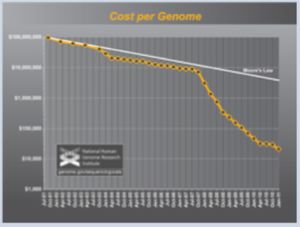
    FIG2
    Figure 2. "Cost per Genome" — the cost of sequencing a human-sized genome
    Data from 2001 through October 2007 represent the costs of generating DNA sequence using first generation sequencing technology.  Beginning in January 2008, the data represent the costs of generating DNA sequence using 'second-generation' (or 'next-generation') sequencing platforms.  The change in instruments represents the rapid evolution of DNA sequencing technologies that has occurred in recent years. www genome gov/sequencingcosts.

    The Blueprint asserts that "[w]hile the sequencing of the first human genome took 13 years and cost $2.7 billion, researchers can now sequence a human genome for a fraction of that cost (~$7,700) and within two weeks' time" and considers the implications of these rapid increases in speed and decreases in cost for "whole-genome" human genomic sequencing.

    The Blueprint concludes:

    The Administration has made great strides in harnessing biological research innovations to address national challenges in health, energy, food, environment, and manufacturing via the commercial economy.  But there is much more to be done.  The Administration plans to explore additional creative ideas for promoting U. S. leadership in the bioeconomy, such as innovative financing for translational research, increasing the impact of the SBIR program, and improving the ability of faculty and students to move from "idea to IPO," and will continue to accept public input by email at bioeconomy@ostp gov.

    By strategically shaping future R&D investments, improving commercialization of bioinventions, updating workforce training programs for new bioeconomy careers, reforming regulatory processes, and building new bioeconomy public-private partnerships, the Administration will help stimulate the growth of a high-wage, high-skill sector while improving the lives of all Americans.

    Politics aside, publication of the Blueprint indicates that the Obama Administration recognizes the importance of the bioeconomy to the nation's economy as a whole.  Provided that the government is receptive to the input and information from all stakeholders (and not just government policy wonks, academics or think tank, armchair entrepreneurs, the Blueprint may actually provide a roadmap for progress.

  • By Donald Zuhn —

    USPTO Releases Certain AIA Implementation Dates

    Gongola, JanetThe U.S. Patent and Trademark Office recently updated its Leahy-Smith America Invents Act Implementation micro-site to announce several AIA implementation dates.  On the micro-site, USPTO Patent Reform Coordinator Janet Gongola (at right) indicated that the Office will submit its genetic testing study to Congress (pursuant to § 27 of the AIA) on June 15; will issue a Federal Register notice making the Patent Ombudsman Program permanent in June or July; will issue three notices of proposed rulemaking on First-Inventor-to-File, Fee Setting, and Micro-entity provisions and one guidance document on the First-Inventor-to-File provisio in June or July; will open the Detroit satellite office on July 13; will issue final rules for the Inventor's Oath/Declaration, Supplemental Examination, Preissuance Submissions, Citation of Patent Owner Statements, Post Grant Review, Inter Partes Review, and Covered Business Method Review provisions, the Technological Invention Definition, the Umbrella Administrative Trial Rules, and a trial practice guide for the administrative trials by August 16.  Ms. Gongola also indicated that the Office was planning a roundtable discussion on its First-Inventor-to-File proposal in the late summer, and a second series of cross-country roadshows in the early fall to teach stakeholders about the final rules.


    USPTO Posts Comments on AIA Implementation

    USPTO SealThe U.S. Patent and Trademark Office has posted comments it has received in response to the Office's several notices on AIA implementation.  The comments have been divided by subject as follows:

    • Inter Partes Review
    • Post-Grant Review
    • Transitional Program for Covered Business Method Patent Review
    • Definition of Technological Invention
    • Derivation Proceedings
    • Umbrella Administrative Trial Rules and Practice Guide
    • Genetic Diagnostic Testing
    • Statute of Limitations Provisions for Office Disciplinary Proceedings
    • Patent Public Advisory Committee Public Hearings on the Proposed Patent Fee Schedule
    • Satellite Offices for the Nationwide Workforce
    • Supplemental Examination and Revision of the Nationwide Workforce
    • Inventor's Oath or Declaration
    • Preissuance Submissions by Third Parties
    • Post Patent Provisions
    • Leahy-Smith America Invents Act Implementation

    The comments page on the AIA microsite also outlines the process by which the public can submit comments to the final rules to be published by the Office by August 16.


    Rospatent Given Authority to Act as ISA/IPEA for PCT Applications Filed with RO/US

    RospatentLast month, the U.S. Patent and Trademark Office and Federal Service on Intellectual Property, Patents & Trademarks of Russia (Rospatent) concluded an agreement that permits Rospatent to act as an International Searching Authority (ISA) and International Preliminary Examining Authority (IPEA) under the Patent Cooperation Treaty (PCT) for international applications filed with the USPTO as a Receiving Office (RO/US) provided that the applications are filed in English and Rospatent has been selected as the ISA and IPEA.  The agreement became effective January 10, 2012.

    In announcing the agreement, the USPTO noted that it would collect a search fee of $415 for Rospatent acting as an ISA (with the fee increasing to $453 effective June 1, 2012), and then transmit the fee to Rospatent.  The Office also noted that all correspondence between Rospatent and the USPTO will be in English.

    With the addition of Rospatent, applicants can now choose among five offices to act as ISA or IPEA:  the USPTO, European Patent Office (EPO), Korean Intellectual Property Office (KIPO), IP Australia, and Rospatent.  Currently, the search fees for electing one of these offices are:  $2,426 (EPO), $2,080 (USPTO), $2,041 (IP Australia), $1,101 (KIPO), and $415 (Rospatent).  Applicants should keep in mind that the National Stage search fee will depend on whether the international search report (ISR) was prepared by another office ($490) or by the USPTO ($120).


    Java Update Not Supported By EFS-Web and Private PAIR

    EFS-WebEarlier this month, the U.S. Patent and Trademark Office issued an e-mail alert notifying EFS-Web and Private PAIR users that neither system would support the Java 7 update 4 (7u4) released by Oracle Corp. on May 2.  The Office has recommended that users not install this update until the Office resolves issues with that update and the EFS-Web and Private PAIR.

  • By Sherri Oslick —

    Gavel In an effort to catch up with recently filed biotech and pharma cases, Patent Docs presents this additional installment of Court Report. 

    Janssen Products, L.P. et al. v. Lupin Ltd. et al.
    2:12-cv-02840; filed May 10, 2012 in the District Court of New Jersey

    • Plaintiffs:  Janssen Products, L.P.; Janssen R&D Ireland; G.D. Searle, LLC
    • Defendants:  Lupin Ltd.; Lupin Pharmaceuticals Inc.

    Infringement of U.S. Patent No. RE42,889 ("α- and β-Amino Acid Hydroxyethylamino Sulfonamides Useful as Retroviral Protease Inhibitors," issued November 1, 2011) following a Paragraph IV certification as part of Lupin's filing of an ANDA to manufacture a generic version of Janssen's Prezista® (darunavir, used to treat human immunodeficiency virus (HIV-1) infection).  View the complaint here.


    Depomed, Inc. v. Zydus Pharmaceuticals (USA), Inc. et al.

    3:12-cv-02813; filed May 9, 2012 in the District Court of New Jersey

    • Plaintiff:  Depomed, Inc.
    • Defendants:  Zydus Pharmaceuticals (USA), Inc.; Cadila Healthcare Ltd.

    Infringement of U.S. Patent Nos. 6,340,475 ("Extending the Duration of Drug Release Within the Stomach During the Fed Mode," issued January 22, 2002), 6,488,962 ("Tablet Shapes To Enhance Gastric Retention of Swellable Controlled-Release Oral Dosage Forms," issued December 3, 2002), 6,635,280 ("Extending the Duration of Drug Release Within the Stomach During the Fed Mode," issued October 21, 2003), 6,723,340 ("Optimal Polymer Mixtures for Gastric Retentive Tablets," issued April 20, 2004), 7,438,927 ("Methods of Treatment Using a Gastric Retained Gabapentin Dosage," issued October 21, 2008) and 7,731,989 ("Gastric Retained Gabapentin Dosage Form," issued June 8, 2010) following a Paragraph IV certification as part of Zydus' filing of an ANDA to manufacture a generic version of Depomed's Gralise® (gabapentin, used for the management of postherpetic neuralgia).  View the complaint here.


    Shire Development LLC et al. v. Watson Pharmaceuticals, Inc. et al.

    0:12-cv-60862; filed May 8, 2012 in the Southern District of Florida

    • Plaintiffs:  Shire Development LLC; Shire Pharmaceutical Development Inc.; Cosmo Technologies Ltd.; Giuliani International Ltd.
    • Defendants:  Watson Pharmaceuticals, Inc.; Watson Laboratories, Inc. – Florida

    Infringement of U.S. Patent No. 6,773,720 ("Mesalazine Controlled Release Oral Pharmaceutical Compositions," issued August 10, 2004) following a Paragraph IV certification as part of Watson's filing of an ANDA to manufacture a generic version of Shire's Lialda® (mesalamine, used to induce remission in patients with active, mild to moderate ulcerative colitis).  View the complaint here.


    Valeant International (Barbados) SRL v. Sandoz Inc.

    1:12-cv-00536; filed April 30, 2012 in the District Court of Delaware

    Infringement of U.S. Patent Nos. 7,241,805 ("Modified Release Formulations of a Bupropion Salt," issued July 10, 2007), 7,569,610 (same title, issued August 4, 2009), 7,572,935 (same title, issued August 11, 2009), 7,585,897 (same title, issued September 8, 2009), 7,645,802 ("Bupropion Hydrobromide and Therapeutic Applications," issued January 12, 2010), 7,649,019 ("Modified Release Formulations of a Bupropion Salt," issued January 19, 2010), 7,662,407 (same title, issued February 16, 2010), 7,671,094 ("Bupropion Hydrobromide and Therapeutic Applications," issued March 2, 2010), and 7,553,992 ("Modified Release Formulations of a Bupropion Salt," issued June 30, 2009) following a Paragraph IV certification as part of Sandoz's filing of an ANDA to manufacture a generic version of Valeant's Aplenzin ER (bupropion, used to treat depression).  View the complaint here.


    Monsanto Co. et al. v. Alexander et al.

    4:12-cv-00751; filed April 27, 2012 in the Eastern District of Missouri

    • Plaintiffs:  Monsanto Co.; Monsanto Technology LLC
    • Defendants:  Myron Alexander; John Sullivan; Jamon Andreasen

    Infringement of U.S. Patent Nos. 5,352,605 ("Chimeric Genes for Transforming Plant Cells Using Viral Promoters," issued October 4, 1994) and RE39,247 ("Glyphosate-tolerant 5-enolpyruvylshikimate-3-phosphate Synthases," issued August 22, 2006) based on defendants' use of soybean seed produced from earlier planted Roundup Ready® soybean seed.  View the complaint here.

  • By Donald Zuhn —

    USPTO SealAs part of its efforts to implement the Leahy-Smith America Invents Act, the U.S. Patent and Trademark Office issued a Federal Register notice (77 Fed. Reg. 3748) earlier this year indicating that the Office had begun to collect information on independent second opinion genetic diagnostic testing where patents and exclusive licenses exist that cover primary genetic diagnostic tests (see "USPTO News Briefs," January 26, 2012).  This collection of information was needed in order for the Office to fulfill its obligations under § 27 of the AIA to prepare a report on genetic diagnostic testing for submission to the Committee of the Judiciary for both the Senate and House.

    In the first phase of the Office's information gathering process on genetic diagnostic testing, the Office held two public hearings on the matter.  Readers may recall that Patent Docs author Kevin Noonan testified at the first of these hearings in February (see "Patent Docs Author Testifies at Genetic Diagnostic Testing Hearing"; "USPTO Holds First Hearing on 'Second Opinion' Genetic Testing").  In the second phase of this process, the Office asked members of the public to submit written comments on several topics presented in AIA § 27 or any of the additional issues presented in the Office's Federal Register notice.

    To provide the public with access to comments that were submitted in response to the Office's request, a webpage on genetic diagnostic testing has been established as part of the Office's AIA implementation site.  The Office has divided the thirty submissions into those from:

    • Intellectual property organizations — includes comments from the American Bar Association (ABA) Section of Science and Technology Law and Section of Intellectual Property Law, American Intellectual Property Law Association (AIPLA), Association of University Technology Managers (AUTM), Intellectual Property Owners Association (IPO), and Pharmaceutical Research and Manufacturers of America (PhRMA).

    • Academic and Research Institutions — includes comments from Duke Institute for Genome Sciences and Policy.

    • Companies — surprisingly includes comments from organizations such as the American Civil Liberties Union (ACLU), American Medical Association (AMA), and Myriad plaintiffs American Society for Clinical Pathology (ASCP), Breast Cancer Action, and College of American Pathologists (CAP), along with those from companies such as Myriad Genetics and Prometheus Laboratories; other commenters include Bio-Reference Laboratories, Cancer Legal Resource Center, Genspace, Knowledge Ecology International, National Society of Genetic Counselors, and joint comments from Roche Molecular Systems and Abbott Laboratories.

    • Individuals — divided into "practitioners" and "others," with the latter including Dr. Wendy Chung, a plaintiff in the Myriad case, and Dr. Luigi Palombi, who spearheaded a campaign against the BRCA gene patents in Australia, which resulted in an Australian Senate Inquiry into gene patents, and six other commenters (James Evans, Sharonmoyee Goswami, Lori Pressman, Pamela Scudder, Rochelle Shoretz, and Brenda Simon), and the former including comments from three practitioners (Christine Gritzmacher, Siu Lo, and Suzannah Sundby).

    IPO #2It would be difficult to adequately cover the full range of comments submitted in response to the Office's notice in a single post, so Patent Docs plans to examine a number of the submissions in subsequent posts.  Today, we look at the comments submitted by the IPO.  In its submission, the IPO focuses on the issues raised in Questions 8 and 9 of the Office's notice, which are as follows:

    (8) What effect would providing more widespread access to independent second opinion genetic diagnostic tests have on existing owners and license holders of patents that cover genetic diagnostic tests?  How should policy makers consider the relationship of patents, which may cover purified genetic substances, to proprietary data derived from conducting tests, each of which may be useful in both improving high quality and wide access to testing but may also provide important competitive advantages that can drive investments in research and development?

    (9) What effects, if any, do patents and exclusive licenses have on genetic diagnostic testing?
        (a) What effects, if any, do patents and exclusive licenses on genetic diagnostic tests have upon the development of new testing procedures?
        (b) What effects, if any, do patents and exclusive licenses on genetic diagnostic tests have upon how new testing procedures are performed?
        (c) What effects, if any, do patents and exclusive licenses on genetic diagnostic tests have upon the interpretation of testing results?
        (d) What effects, if any, do patents and exclusive licenses on genetic diagnostic tests have upon the further improvement of testing procedures?

    With respect to Question 8, the IPO contends that "compelling patent owners to grant licenses for the purpose of permitting third parties to provide second opinion genetic diagnostic tests would have a detrimental effect on the U.S. patent system," by "undermin[ing] the incentive created by the patent system to create new tests, as well as to design around existing patents to provide tests that are comparable to existing tests."  In response to Question 9, the IPO states that "exclusive licenses do not materially reduce the availability of second opinion genetic diagnostic tests, as these tests are usually available from the patent owner or another licensed provider."

    The IPO notes that the phrase "confirming genetic diagnostic testing activity" in the AIA encompasses a "very narrow category" of activity, namely providing an individual with independent confirmation of results obtained from another test provider’s prior performance of a test on the individual.  According to the IPO, this is not the type of second opinion that most patients seek.  The IPO suggests instead that "most patients who are seeking second opinions are asking for second medical opinions, not for second diagnostic tests performed by a different testing facility," adding that "[t]he existence of patents and exclusive licenses does not impair in any way patients’ access to second medical opinions" (emphasis added).

    In addition, the IPO points out that "while labs [that conduct genetic diagnostic testing and utilize genetic diagnostic products] can be affected by the enforcement of patents, it is diagnostic companies that are most directly affected."  The IPO explains that "[i]f a diagnostic company is excluded from offering a genetic diagnostic test, in most cases, hospitals and reference labs can obtain the desired test from another genetic diagnostic company that is not excluded (either the patentee or the licensee)."

    The IPO also notes that "[i]t is rare that a single type of test for a single gene provides independent diagnostic capability," adding that "due to evolving case law in the area of biotechnology, patents for these types of diagnostics are increasingly difficult to obtain and are even more difficult to obtain with a broad claim scope."  However, when confronted with these rare situations, the IPO contends that a diagnostic company has many options:  "It can look for alternative markers (which is typically done), license a number of patents needed to make the complete diagnostic, or choose to license and sell a diagnostic that comprises part of the diagnostic solution sought."  In addition to encouraging diagnostic companies to design around a patented test, "[f]orcing those who have not invented to license provides an economic incentive to invent in the first place and rewards the inventor for doing so."  The IPO argues that if such patents are unavailable or required to be licensed on a compulsory basis, "there will be little incentive for diagnostic companies to conduct or sponsor research in these areas."

    The IPO concludes its comments by declaring that it would be "a mistake to weaken the patent system in the area of genetic diagnostic testing."