• LSI - Law Seminars International - redLaw Seminars International (LSI) will be offering a one-hour telebriefing on the "Post-Grant Proceedings after the AIA" on June 19, 2012 from 3:00 – 4:00 pm (Eastern).  Wab P. Kadaba of Kilpatrick Townsend & Stockton LLP will moderate a panel including Wilson White, Associate Litigation Counsel of Google Inc., who will provide an in-house perspective and Mitchell G. Stockwell of Kilpatrick Townsend & Stockton LLP and Cyrus A Morton of Robins, Kaplan, Miller & Ciresi L.L.P., who will provide the private litigator's perspective.  The panel will discuss the practical implications of implementation of inter partes review and post-grant review to post-grant proceedings in the wake of the AIA, offering participants practical and strategic insights about how best to prepare for the post-AIA landscape.  Among the topics to be covered are:

    • Practical impacts of new Patent Office procedures, including post-grant and inter partes review;
    • Strategic and tactical considerations for challenging third party patents;
    • The impact of the estoppel provisions on later challenges to the same patent;
    • Potential effects on patent litigation and patent trials; and
    • Potential pitfalls and how to avoid them.

    A Q&A will follow the presentation and last for up to 30 minutes.

    The registration fee is $125 per caller and $50 each additional person on the same line who desires continuing education credit.  Those interested in registering for the telebriefing, can do so here.

  •     By Kevin E. Noonan —

    Australia Coat of ArmsLast year, the Australian Senate rejected a call for banning patents on human genes in Australia.  This result came after almost a decade of debate, resulting in several Reports (including the 2011 ACIP Report on Patentable Subject Matter, the Senate Gene Patents Report, issued November 24, 2010, and the 2004 Australian Law Reform Commission's Report on Genes and Ingenuity: Gene Patenting and Human Health (ALRC 99 Report) (see "News from Abroad: The Gene Patents Debate in Australia — An Update").  On November 23, 2011, the Australian government released a combined report (that can be accessed here).  And the Australian Senate determined that the Australian Patent Act of 1990 should not be amended to exclude human genes as patent-eligible subject matter, pursuant to a 124-page report that recommended against passage of the Patent Amendment (Human Genes and Biological Materials) Bill 2010, which was introduced by Senators Helen Coonan, Bill Heffernan, Rachel Siewert, and Nick Xenophon (see "Australian Senate Committee Issues Recommendation on Gene Patenting Bill").

    Undaunted, another Member of Parliament (Melissa Parke, the Labor representative from Fremantle, Western Australia), is reported (by Intellectual Asset Management, "Gene patent opponents take the fight back to Parliament") to be ready to introduce a bill to amend Section 18(2) of the Patents Act, as follows:

    18(2)  The following are not patentable inventions:
            (a)  human being, and the biological processes for their generation;
            (b)  genetic materials that exist in nature, or are the same as or not markedly different from those existing in nature whether such materials are in situ, isolated or purified;
            (c)  any method that involve the mere comparison of genetic materials or genetic sequences in the provision of a diagnosis for a human being.
    18(2)(A)  A reference in subsection (2) to genetic materials includes, but is not limited to, DNA or RNA whether in whole or part or in fragments, however made.

    While wrongheaded, this proposal has a few advantages over judicial solutions that may arise in the U.S., for example.  First, it is expressly limited to genetic material, and so avoids the risk of determining that "products of nature" are somehow patent ineligible.  While this bill shares the infirmity with Congressman Becerra's thrice-rejected (or maybe more correctly, ignored) bill to ban "gene patenting" in that it encompasses more than human DNA (thus threatening cucumber or tomato gene patents as well as human ones), it does avoid the risk of finding the antibiotics, anticancer drugs, improved lubricants or silicon formulations, or antibodies (the most common form of biologic drug) would become unpatentable.  It also permits any such ban to be considered by Australia's elected representatives, rather than judges without any particular expertise in technology (some of whom are comfortable overturning the opinions of judges that do have such "special expertise").

    But unlike earlier proposals (including last year's), this bill would also ban "applications" of genetic technology, albeit only those that "mere[ly] compar[e]" genetic sequences.  Such claims have already been held unpatentable in the U.S. under the Bilski and AMP v. USPTO precedent.  It is unclear whether claims further reciting other affirmative steps in identifying a sequence would fall within the scope of the proposed ban.  Also precluded from patent protection would be synthetic DNA including oligonucleotide fragments (while blessedly being devoid of a reference to a "magic microscope" as justification for the ban).  It is unclear whether cDNA would be considered "markedly different" under the bill, although this would depend on whether the chemical or informational properties of DNA are considered.

    The prospect of the bill being introduced is another testament to the persistence of the anti-gene patenting proponents on the issue, reminiscent of other motivated political factions.  Whether this bill gains sufficient traction to have a chance of passage, or whether political fatigue or indifference prevent its passage will be closely monitored, here and anywhere the issue is seriously considered.

  • BIO and the America Invents Act

    By Andrew Williams —

    BIO International ConventionThe 2012 BIO International Convention begins in Boston next week.  Patent Docs has been highlighting a few sessions, in thematic fashion, to help you navigate your way through the convention.  Today, in this final installment, we review a few opportunities for those interested in learning how the Leahy-Smith America Invents Act will impact U.S. patent practice, with the use of patent systems from other countries to serve as a guide.  Please note, however, that even though we have highlighted several sessions from a spectrum of disciplinary tracks over the past week, we have only begun to scratch the surface of opportunities available at the BIO convention.  Of course, if you want to share your favorite session with us, or let us know how the America Invents Act is going to affect you or your company (or for that matter, any other topic that is on your mind), the Patent Docs authors and contributors will be present at BIO as part of the MBHB contingent, and you are encouraged to stop by the MBHB booth to meet us (#1335 – Hall A).  We will be posting a schedule shortly to let you know when your favorite Patent Docs author or contributor will be at the booth.

    As Patent Docs readers know, one of the biggest stories from the past year for U.S. patent practice was the passage of the Leahy-Smith America Invents Act ("the AIA").  Of course, Patent Docs has been covering the AIA for years, and is continuing to follow the U.S. Patent Office's implementation of various provisions of the new law.  There has been no shortage of opportunities to learn about and discuss the AIA, but the BIO International Convention provides some unique opportunities that are not necessarily found elsewhere.  Specifically, the U.S. can look to how patent systems throughout the world have been dealing with provisions that are analogous to sections of the AIA.  Because of the strong international presence at the conference, U.S. patent practitioners can learn from their international colleagues.  And, hopefully, it will also give the non-U.S. patent practitioners a chance to learn about how the new U.S. law will affect them and their companies or clients.

    As a perfect example, the Biotech Patenting and Tech Transfer Track will be presenting "Patenting under the America Invents Act in Comparison with European Patent Practice" on Wednesday, June 20, between 10:00-11:30 am.  This session will include speakers from the European Patent Office and the U.S. Patent and Trademark Office, as well as patent practitioners from these two jurisdictions, who will be able to provide insight on the America Invents Act and how it compares to European practice.  The session promises to review the changes in patentability in the U.S., such as the first-to-file system, the grace period, prior art, and post grant review, and assess patentability in Europe, including its first-to-file system, prior art, and opposition practice.  These two systems will be compared and contrasted for perspectives on global strategies.  For example, the differences in the grace periods related to the two first-to-file systems will be examined, including how they might impact prosecution strategies.  The speakers of this session include Wenfang Chen, Patent Counsel for Danisco U.S. Inc./Dupont; Sally Mannion, Head, Pharma & Nutrition Team at Avidity IP; Enrique Molina Galán, Director, European Patent Office; and Mary Till, Legal Advisor with the U.S. Patent and Trademark Office.  This session will be moderated by Thomas Kowalski, Shareholder at Vedder Price.

    Another example of a session that will look to other jurisdictions, this time for a specific topic, is "The New World: Post-Grant Review in the United States — What Can We Learn from Experiences in Europe, Japan, India and Australia," which is being presented on Monday, June 18, between 2:00-3:30 pm.  The AIA made significant changes to the U.S. post-grant review system, allowing parties the opportunity to challenge the validity of patents on prior art and disclosure grounds within nine months of grant.  There will be a newly titled "Patent Trial and Appeal Board" that will hear these challenges, and the Federal Circuit will only be able to review decisions under the substantial evidence standard.  The speakers for this session are a panel of international experts who will be able to explain their countries' histories with post-grant review, including the growing pains they experienced developing their respective systems.  They promise to assess the pros and cons of post-grant review and coordinated global approaches to the subject.  The session includes Pravin Anand, Managing Partner at Anand and Anand; Katrina Howard, Member, Selborne Chambers; Hans-Rainer Jaenichen, Partner at Vossius & Partner; and Shusaku Yamamoto, Founder of Shusaku Yamamoto Patent Attorneys.  The session will be moderated by James F. Haley, Partner at Ropes & Gray LLP.

    The final session that we are highlighting will explore the consequences, whether intentional or unintentional, of one of the provisions of the AIA — the Prior User Rights.  This session is entitled "Prior User Rights and Trade Secrets: A New IP Option Replacing Patents to Secure Freedom-To-Operate for Internally Used Innovations in Biotechnology," and will be presented on Tuesday, June 19, and 2:00-3:30 pm.  This section of the AIA allows a company to maintain a new technology as a trade secret, while providing a defense against future infringement of a later patent.  As such, the Prior User Rights could change the patent landscape for externally marketed products and internally used technologies used to produce them.  This session promises to assess the merits and risks of the choice between patents and prior user rights to secure freedom-to-operate for these internally used technologies.  It will also explore how a prior user paradigm might best benefit you or your clients company.  The speakers for this session include Brian Barrett, Associate General Patent Counsel for Eli Lilly & Company; Mary Ann Dillahunty, Vice President, Intellectual Property for Oncolytics Biotech, Inc.; Jason Duncan, Associate General Counsel of EMD Serono, Inc.; and Andrew Torrance, Visiting Professor at MIT Sloan School of Management.  The moderators will be Thomas Kelley, Consulting Patent Counsel of Monsanto Company and R. Mark Halligan, Partner at Nixon Peabody LLP.

  • By Kevin E. Noonan —

    MyriadThe Federal Circuit today denied Defendant Myriad Genetics' motion, styled as "Appellant's Suggestion of Mootness, or, in the Alternative, Motion to Remand," seeking to reopen the question of whether Dr. Harry Ostrer continues to have standing to bring the lawsuit (see "Myriad Files Motion 'Suggesting' Mootness or Seeking Remand in AMP v. USPTO").  As will be recalled, the Federal Circuit held that only Dr. Ostrer among all the named plaintiffs had standing, because he asserted he was “ready, willing and able” to practice the claimed BRCA genetic diagnostic methods should the Court affirm the District Court's decision invalidating the claims at issue.  Myriad contended that Dr. Ostrer's change in academic affiliation stripped him of the ability to perform genetic diagnostic tests for the BRCA mutations, and thus that the Court should either dismiss the case or remand for a determination by the District Court on Dr. Ostrer's status.

    Of course, even that eventuality might have proven unavailing for having the case dismissed, since plaintiffs had also asserted unconstitutionality claims (under the First and Fourteenth Amendments) based on the USPTO granting patents that interfered with a woman's ability to obtain information about her genetic health.  A motion to dismiss by the PTO was denied on the grounds that the women had no other recourse to a remedy other than the lawsuit.  The District Court avoided addressing that issue, however, and dismissed the USPTO from the case when making its decision, under the principle that constitutional questions should be avoided if the matter can be resolved by applying the appropriate statute (or, as here, deciding that the government action was contrary to the statute).

    Opening party briefs and briefs by any amici remain due on June 15th.

  • BIO and Biosimilar Regulations throughout the World

    By Andrew Williams —

    BIO International ConventionThe 2012 BIO International Convention in Boston begins next week.  If you are planning on attending, Patent Docs is highlighting a few sessions, in thematic fashion, to help navigate your way through the Convention.  Last week, we highlighted three sessions on how the Supreme Court's Prometheus case is impacting the BIO community.  Today, we present opportunities for those interested in learning more about how the biotech industry is adjusting to the new biosimilar framework in various jurisdictions.  Of course, Patent Docs authors and contributors will be present at BIO as part of the MBHB contingent, and Patent Docs readers are encouraged to stop by the MBHB booth (#1335 – Hall A) to discuss the FDA's draft guidance documents on the new biosimilar approval pathway (or whatever other topic is of interest to you).

    On March 23, 2010, President Obama signed into law the Patient Protection and Affordable Care Act ("the Act"), which amended the Public Health Service Act to create an abbreviated approval pathway for biological products that are either biosimilar to or interchangeable with an already approved biological product.  While the fate of the Act has yet to be determined by the Supreme Court, the U.S. is almost certain to begin seeing biosimilar drugs approved in the near future.  In fact, in February of this year, the FDA issued three guidance documents that provided its thinking on key scientific and regulatory factors that will be involved in submitting applications for biosimilar products to the agency (see "FDA Publishes Draft Guidelines for Biosimilar Product Development").  However, the U.S. is not the first jurisdiction to consider a biosimilar pathway, and in fact Europe has already approved several biosimilar drugs via an abbreviated registration process.  Of course, the subject of biosimilars is of great interest to the biotech community, and this year provides several opportunities for BIO attendees to attend sessions on the development of biosimilars regulatory schemes both here and outside the U.S.

    Europe has led the way in creating a biosimilar approval pathway, and was the first to approve biosimilar drugs.  Some of the key factors driving this process were patent expirations, cost containment measures, ageing populations, and supporting legislations.  On Monday, June 18, between 10:00-11:30 am, the Health Policy and Reimbursement Track will present "Access to and Uptake of Biosimilars: The European Experience."  This session promises to focus on market opportunities for both innovator companies and the generic industry in Europe.  It will evaluate the challenges for the policy makers and payers in terms of pricing and reimbursement of biosimilars, as well as the challenges of providing patients, healthcare professionals and payers with adequate information.  The panel for the session consists of Thomas Bols, Vice President Health Policy & Market Access, EuropaBIO; Paul Greenland, Biosimilars and Proprietary Marketing Director, EGA; and Steffen Thirstrup, Chief Medical Officer of the Danish Medicines Agency (DKMA).  The session will be moderated by Thomas Heynisch, Deputy Head of Unit Healthcare, Biotechnology, of the European Commission, DG Enterprise and Industry.

    Of course, Europe isn't the only area outside of the U.S. that has been establishing a biosimilar regulatory framework.  Countries in Latin America have been actively making plans to become global leaders in biotechnology.  Argentina published a dedicated biosimilar regulation in late 2010 and 2011, and Brazil developed new biologics regulations in the same timeframe, with product-specific guidelines for biosimilars.  In addition, Mexico recently updated the Regulation of Health Supplies (RIS) in terms of biological medicine.  To discuss these advances, the Global Innovations and Markets Track will present "Biologics and Biosimilars in Latin America: Are New Regulations and Guidelines in Brazil, Mexico, and Argentina a New Model for Drug Regulation?" on Wednesday, June 20 from 8:30-9:45 am.  The panel promises to discuss the regulatory framework in Brazil and Mexico, because, in 2012, Brazil is finalizing its guidelines for biosimilar monoclonal antibodies, and Mexico is implementing it new biologics regulation.  It is an objective of this session to distinguish the framework in these two countries from other emerging markets, and how the respective governments were able to achieve this change in regulatory framework.  It is also an objective to learn from company executives working within these regulatory frameworks what matters most when deciding to enter and/or invest in a country.  Currently, the session presenters are Dirceu Barbano, Director Chairman of ANVISA, National Health Surveillance Agency, and Laura Hamill, Vice President, Latin America for Amgen.

    As a final example of a learning opportunity about biosimilars, the Achieving Regulatory Approval and Compliance Track is presenting "Interchangeable Biosimilars: Distinguishing between Aspiration and Achievement" on Thursday, June 21 from 8:30-9:45 am.  The U.S. may not be the first jurisdiction to create a biosimilar regularity pathway, or approve biosimilar drugs, but they are the only one to require an evaluation of interchangeability.  In fact, Canada has explicitly rejected the notion of interchangeability.  This session promises to summarize the state of the science of biotechnology, specifically with regard to a determination of interchangeability as defined by the U.S. law.  Also, the panelists will discuss the challenges of implementing such a system, and how it will affect manufacturers, health care providers, patients and payers.  Finally, they will look at the key public policy considerations involved.  The panel will include Joseph Miletich, Senior Vice President, Research and Development for Amgen; Gregory Schimizzi, Co-founder of Carolina Arthritis, Coalition of State Rheumatology Organizations; Jan Wyatt, Patient Advocate for the Arthritis Foundation; and Richard Kingham, Partner at Covington & Burling LLP.  The session will be moderated by Ramsey Baghdadi, Senior Editor of The RPM Report.

  • By Donald Zuhn —

    IPO #2Last week, we reported on the release of the Intellectual Property Owners Association's (IPO) list of the Top 300 organizations receiving U.S. patents in 2011 (see "IPO Releases List of Top 300 Patent Holders for 2011").  As in past years, Patent Docs used the IPO's list of top patent holders to compile a list of the top 53 life sciences companies and organizations receiving U.S. patents in 2011.  Our analysis was not quite an exact science, as we noted that a number of companies and organizations appearing on the Life Sciences Top 53 are likely to be involved in work outside the life sciences sector, and therefore, that a portion of the patents granted to these companies and organizations are likely to be directed to other than life sciences-related inventions.

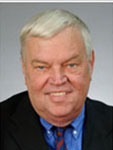
    Wegner, HaroldIn a series of e-mail newsletters distributed last week, Hal Wegner (at left) reported on the IPO's Top 300 list, noting that the IPO's list was dominated by the electronics/software/manufacturing sectors, which grabbed the top ten spots on the list, and that the top ten bio/pharma companies averaged 288 patents, or "less than one-sixth that of the patent industry leaders."  In comparing his own analysis with our Life Sciences Top 53, Mr. Wegner noted that our list was compiled using a broader definition of life sciences and his list resulted from a narrower focus on pharmaceuticals.  In a follow-up e-mail, Mr. Wegner observed that "[t]he Top Ten pharma companies of the world average $35 billion in patent-secured sales, the most profitable use of the patent system amongst all industries."

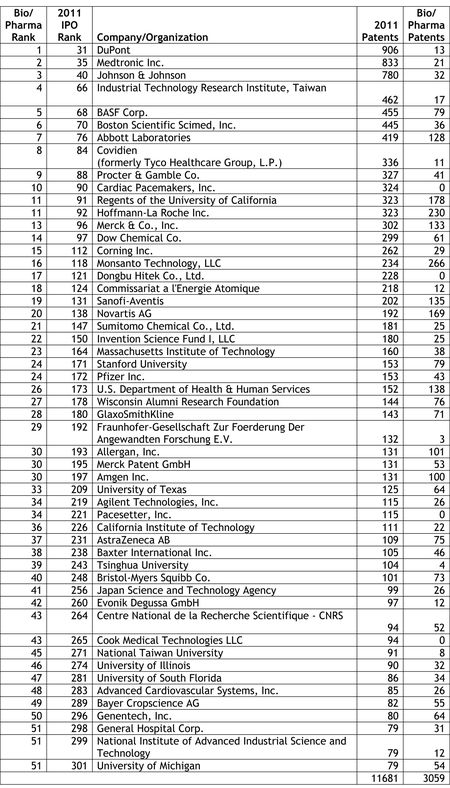
    To get a more accurate picture of the top companies involved in bio/pharma patenting, we searched the U.S. Patent and Trademark Full-Text and Image Database for the number bio/pharma patents that were issued last year to each of the companies and organizations on our Life Sciences Top 53.  The number of bio/pharma patents was determined by searching for patents designated as belonging to at least on of the following classes:  424 (Drug, Bio-Affecting and Body Treating Compositions), 435 (Chemistry: Molecular Biology and Microbiology), 436 (Chemistry: Analytical and Immunological Testing), 504 (Plant Protecting and Regulating Compositions), 506 (Combinatorial Chemistry Technology: Method, Library, Apparatus), and/or 514 (Drug, Bio-Affecting and Body Treating Compositions) that issued in the specified year.  A search of the USPTO patent database for 2011 patents designated as belonging to one of the above classes indicates that of the 244,430 utility patents that were issued last year, 14,973 (6.1%) were directed to bio/pharma-related inventions.

    After performing the above search for each of the companies and organizations on our Life Sciences Top 53, we obtained the following results (with bio/pharma patents — i.e., those designating at least one of the above classes — listed in the "Bio/Pharma Patents" column; click on table to enlarge):

    Table 1
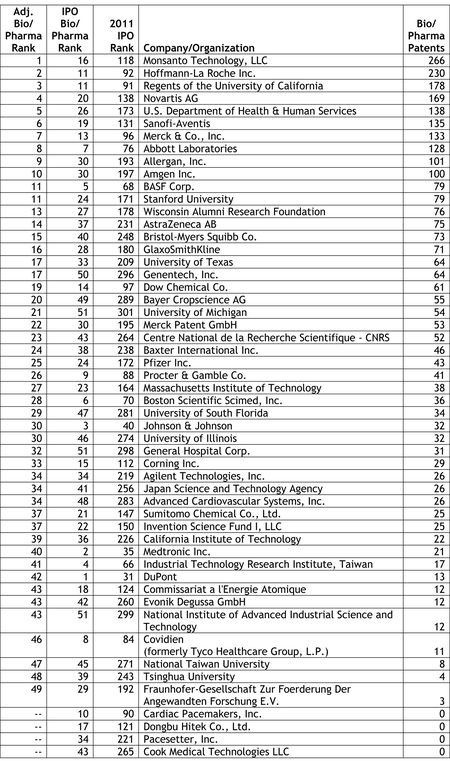
    As indicated above, the Life Sciences Top 53 secured a total of 11,681 patents, of which 3,059 (26.2%) were bio/pharma patents.  Re-sorting the Life Sciences Top 53 by bio/pharma patents produced the following list (click on table to enlarge):

    Table 2
    While each of the Top 10 bio/pharma companies and organizations from our LIfe Sciences Top 53 secured at least 100 bio/pharma patents in 2011, the 1,578 patents granted to the Bio/Pharma Top 10 constituted just over one-fourth of the number of patents issued to IBM in 2011 (IBM took the top spot on the IPO Top 300 list with 6,148 patents).

    While our search produced a list that may be more indicative of the top bio/pharma patentees (at least among the top 300 patentees), it was probably limited in some respects.  For example, to the extent that bio/pharma patents were designated in some other class, such patents would have been omitted from our count.  In addition, to the extent that a subsidiary of a given company contributed to that company's patent count and the subsidiary had a distinct name, such patents would have been omitted from our count (the IPO notes that for its Top 300 list, patents in the name of a majority-owned company were included with patents of the parent organization if the organization asked the IPO to include subsidiaries).  Moreover, if the assignee was not indicated on the face of the patent, that patent would have been omitted from our count.  That being said, the IPO notes that for its Top 300 list, patents that were granted to two or more organizations jointly were attributed to the organization listed first on the patent document.  In generating our list, such patents would have been included in both organizations' counts (this difference may explain why Monsanto was named as an assignee on 266 bio/pharma patents, but appears to have been granted only 234 patents on the IPO's list).

  • By Kevin E. Noonan —

    MyriadOn May 30th, Myriad Genetics filed a motion in the remand of Association for Molecular Pathology v. U.S. Patent and Trademark Office case ("Myriad") to the Federal Circuit, styled "Appellant's Suggestion of Mootness, or, in the alternative, Motion to Remand," to address the fundamental question of whether the Federal Circuit, or any U.S. court, has jurisdiction to hear the case.  This issue is based on the Federal Circuit's determination, in its now-vacated decision, that only one plaintiff, Dr. Harry Ostrer, had standing to bring the lawsuit, coupled with Myriad's contention that the basis for jurisdiction was abolished when Dr. Ostrer changed his academic affiliation.  This issue was brought to the Court's attention two days before it handed down its now-vacated decision, and was not sufficient to induce the Federal Circuit to rehear the case either before the original panel or en banc.  After remand from the Supreme Court's decision granting certiorari and vacating the Federal Circuit's opinion for reconsideration in view of the Court's Mayo v. Prometheus decision, the Federal Circuit did not include this issue in the questions to be addressed by the parties or interested amici.

    ACLUPlaintiffs have responded in a brief that contains three arguments.  The first is that Dr. Ostrer was sued personally, so that his change in employment status is not relevant to the standing issue.  This argument is factual in nature, alleging that Dr. Ostrer remains capable of performing BRCA genetic testing in his new position at Albert Einstein College of Medicine/Montefiore Hospital but has not done so due to Myriad's threat of patent infringement liability.  The brief challenges Myriad's contention that the threat of infringement liability was directed to Dr. Ostrer's prior employer, New York University (NYU), because Myriad's "threatening" letter was directed towards Dr. Ostrer personally and NYU was not named as a plaintiff in the lawsuit.  (While it is true that the letter was addressed to Dr. Ostrer, the brief notes that Myriad in fact sued the employer of two other putative plaintiffs, Drs. Ganguly and Kazazian, and it should be remembered that the ACLU and PubPat, the sponsors of the litigation were responsible for what parties were named, not Myriad.)  The brief contends that finding his change of employment to have stripped Dr. Ostrer of standing could be contrary to the Court's original finding that he had standing as an individual; this argument does not address Myriad's position that regardless of his subjective intent of being "ready" and "willing" to infringe he would only be "able" to do so if Montefiore Hospital permits him to be.  In this regard, the brief states that Myriad's citation to the Montefiore Hospital website as evidence that Dr. Ostrer's is not unable to provide BRCA genetic testing services is "outdated" and provides an updated citation (Laboratory Services, Montefiore Medical Center).  Finally, the brief resists the suggestion that the Court remand to the District Court for a factual determination of the standing issue, stating that such action would be appropriate only if Myriad were to make an adequate proffer regarding a change in Dr. Ostrer's ability to infringe, which (of course) the brief contends Myriad has not done.

    PUBPATPlaintiffs' second argument is that, even under the standard enunciated by the Federal Circuit in its now-vacated decision, other plaintiffs, including Ms. Reich and Ms. Matloff also have standing, being themselves "personally" threatened with suit.  Ms. Reich is an NYU employee, and Ms. Matloff works at Yale.  The brief argues that, insofar as the Court's earlier decision is read as holding that standing is predicated on the ability to perform BCRA testing, then Ms. Reich's continued employment at NYU confers standing upon her.  This argument does not address whether Ms. Reich has the professional capacity to perform BRCA testing in a milieu other than a lab (Dr Ostrer's) where the testing can be performed, a concern that echoes Myriad's argument (unrebutted in Plaintiffs' brief) that Dr Ostrer no longer has standing because Montefiore does not have regulatory approval (from New York State, for example) to perform the tests.  As for Ms. Matloff, Myriad's "threat" was conveyed not by a formal letter (as were the "threats" to Dr. Ostrer at NYU and Drs. Ganguly and Kazazian at Penn) but in a telephone call initiated by Ms. Matloff; it can reasonably be assumed that the call was for the express intent to garner the "threat" and create standing, a tactic that can only kindly be said should not be encouraged.

    The final (and most lengthy) argument advanced by Plaintiffs is that the Federal Circuit erred with regard to the other named plaintiffs, who according to the brief also have standing.  The brief specifically addresses this argument to one organizational plaintiff, the American College of Medical Genetics and Genomics (formerly, the American College of Medical Genetics), reiterating its position that standing should lie because "gene patenting is germane to ACMG's purpose."  These plaintiffs have organizational standing, according to the brief, under Warth v. Seldin, 422 U.S. 490, 511 (1975).  As for the other plaintiffs, the brief takes the opportunity to renew its attack on the standing standards imposed by the Federal Circuit, which Plaintiffs contend are "more stringent" than the "reasonable apprehension of suit" test abrogated (in a footnote) in the Supreme Court's MedImmune, Inc. v. Genentech, Inc. decision.  549 U.S. 118, 127 (2007).  The brief characterizes what it fashions the "personally threatened" test as being a "bright line rule" that the Supreme Court "instruct[ed] [in MedImmune] are inappropriate when analyzing a plaintiff's standing in a declaratory judgment action."  The brief supports this assertion by citing a portion of the earlier, now-vacated Federal Circuit decision, where the Court found that "every other similarly situated researcher and institution" ceased BRCA testing as the result of Myriad's patent enforcement actions, that there was no evidence that any other researcher or institution had successfully challenged Myriad's assertion of its patent rights, nor was there evidence that Myriad's intention to assert those rights had changed.  This pattern should be enough to make Myriad's actions sufficiently "proximate" to raise standing, according to Plaintiffs.  The brief also cites several cases where the Supreme Court and other appellate courts (including the Federal Circuit) have found standing without direct action against individual plaintiffs, including Doe v. Bolton, 410 U.S. 179, 188 (1973); Virginia v. Am. Booksellers Ass'n, Inc., 484 U.S. 383, 393 (1988); Vt. Right to Life Comm., Inc. v. Sorrell, 221 F.3d 376, 382 (2d Cir. 2000); and Biotech. Indus. Org. v. District of Columbia, 496 F.3d 1362, 1370 (Fed. Cir. 2007).  However, these were all cases involving government action in enforcing a statute.  The brief recognizes this, but calls it a "difference without a distinction" (seemingly contrary to similar distinctions made by Justice Scalia in the MedImmune opinion and garbling in the process Learned Hand's famous aphorism).  According to the brief, "[t]he elements required for Article III standing do not differ based on the public or private nature of the potential enforcer.  A party can show a substantial controversy based on impending injury resulting from an invalid law or patent.  A requirement that the law or patent be enforced against a party before they can seek judicial alleviation of that injury is contrary to the law."  The brief provides no legal basis for equating a statute with a patent or government with private action.

    Opening party briefs and briefs by any amici remain due on June 15th.

  • By Sherri Oslick —

    Gavel About Court Report:  Each week we will report briefly on recently filed biotech and pharma cases.

    Fidopharm Inc. v. Merial Ltd.
    1:12-cv-00714; filed June 5, 2012 in the District Court of Delaware

    Declaratory judgment of non-infringement and invalidity of U.S. Patent No. 6,096,329 ("Insecticidal Combination to Control Mammal Fleas, in Particular Fleas on Cats and Dogs," issued August 1, 2000), licensed to Merial in the animal health field, based on plaintiffs' manufacture and impending sale of its newly formulated PetArmor® Plus flea-and-tick products for cats and dogs.  View the complaint here.


    Merial Ltd. et al. v. VELCERA Inc. et al.

    3:12-cv-00075; filed June 5, 2012 in the Middle District of Georgia

    • Plaintiffs:  Merial Ltd.; Merial SAS
    • Defendants:  Velcera Inc.; Fidopharm Inc.

    Infringement of U.S. Patent No. 6,096,329 ("Insecticidal Combination to Control Mammal Fleas, in Particular Fleas on Cats and Dogs," issued August 1, 2000), licensed to Merial in the animal health field, based on defendants' manufacture and impending sale of its newly formulated PetArmor® Plus flea-and-tick products for cats and dogs.  View the complaint here.


    Medicis Pharmaceutical Corp. v. Zydus Pharmaceuticals USA, Inc. et al.

    3:12-cv-03368; filed June 5, 2012 in the District Court of New Jersey

    • Plaintiff:  Medicis Pharmaceutical Corp.
    • Defendants:  Zydus Pharmaceuticals USA Inc.; Cadila Healthcare Ltd.

    Medicis Pharmaceutical Corp. v. Zydus Pharmaceuticals USA Inc. et al.
    1:12-cv-00707; filed June 4, 2012 in the District Court of Delaware

    • Plaintiff:  Medicis Pharmaceutical Corp.
    • Defendants:  Zydus Pharmaceuticals USA Inc.; Cadila Healthcare Ltd.

    The complaints in these cases are substantially identical.  Infringement of U.S. Patent Nos. 5,908,838 ("Method for the Treatment of Acne," issued June 1, 1999) and 7,790,705 ("Minocycline Oral Dosage Forms for the Treatment of Acne," issued September 7, 2010) following a Paragraph IV certification as part of Zydus' filing of an ANDA to manufacture a generic version of Medics' Solodyn® (minocycline hydrochloride extended release tablets, used to treat acne).  View the Delaware complaint here.


    Abbott Laboratories et al. v. Kremers Urban Pharmaceuticals Inc.

    1:12-cv-00703; filed June 1, 2012 in the District Court of Delaware

    • Plaintiffs:  Abbott Laboratories; Abbott Respiratory LLC
    • Defendant:  Kremers Urban Pharmaceuticals Inc.

    Infringement of U.S. Patent Nos. 6,080,428 ("Nicotinic Acid Compositions for Treating Hyperlipidemia and Related Methods Therefor," issued June 27, 2000) and 6,469,035 ("Methods of Pretreating Hyperlipidemic Individuals with a Flush Inhibiting Agent Prior to the Start of Single Daily Dose Nicotinic Acid Therapy to Reduce Flushing Provoked by Nicotinic Acid," issued October 22, 2002) following a Paragraph IV certification as part of Kremers' filing of an ANDA to manufacture a generic version of Abbott's Niaspan® (niacin extended-release tablets, used to treat hypercholesterolemia).  View the complaint here.


    Merck Sharp & Dohme Corp. v. Accord Healthcare, Inc. USA et al.

    3:12-cv-03324; filed June 1, 2012 in the District Court of New Jersey

    • Plaintiff:  Merck Sharp & Dohme Corp.
    • Defendants:  Accord Healthcare, Inc. USA; Accord Healthcare, Inc.; Intas Pharmaceuticals Ltd.

    Merck Sharp & Dohme Corp. v. Sandoz Inc.
    3:12-cv-03289; filed May 31, 2012 in the District Court of New Jersey

    • Plaintiff:  Merck Sharp & Dohme Corp.
    • Defendant:  Sandoz Inc.

    The complaints in these cases are substantially identical.  Infringement of U.S. Patent Nos. 5,691,336 ("Morpholine Compounds Are Prodrugs Useful As Tachykinin Receptor Antagonists," issued November 25, 1997) and 5,716,942 ("Treatment of Migraine With Morpholine Tachykinin Receptor Antagonists," issued February 10, 1998) following a Paragraph IV certification as part of Sandoz's filing of an ANDA to manufacture a generic version of Merck's Emend® (fosaprepitant dimeglumine for injection, used in the prevention of acute and delayed nausea and vomiting associated with initial and repeat courses of highly emetogenic cancer chemotherapy including high-dose cisplatin, and to prevent nausea and vomiting associated with initial and repeat courses of moderately emetogenic cancer chemotherapy).  View the Sandoz complaint here.


    Human Genome Sciences, Inc. v. Kappos

    1:12-cv-00607; filed June 1, 2012 in the Eastern District of Virginia

    Review and correction of the patent term adjustment calculation made by the U.S. Patent and Trademark Office for U.S. Patent No. 8,071,092 ("Methods of Inhibiting B Lymphocytes Using Antibodies to Neutrokine-alpha," issued December 6, 2011).  View the complaint here.

  • Calendar

    June 13-15, 2012 – Fundamentals of Patent Prosecution 2012: A Boot Camp for Claim Drafting & Amendment Writing (Practising Law Institute) – New York, NY

    June 14, 2012 – The Elimination and Creation of Defenses in the Wake of AIA (Technology Transfer Tactics) – 1:00 – 2:00 pm (Eastern)

    June 18-21, 2012 – BIO International Convention (Biotechnology Industry Organization) – Boston, MA

    June 20-21, 2012 – International Forum on Pharma Patent Lifecycles*** (C5) – London, England

    July 23-24, 2012 – Patent Cooperation Treaty Seminar (American Intellectual Property Law Association) – Alexandria, VA

    June 24-26, 2012 – IP Business Congress (Intellectual Asset Management (IAM) magazine) – Cascais, Portugal

    June 25-26, 2012 – Hatch-Waxman Boot Camp*** (American Conference Institute) – San Diego, CA

    July 11-13, 2012 – Fundamentals of Patent Prosecution 2012: A Boot Camp for Claim Drafting & Amendment Writing (Practising Law Institute) – San Francisco, CA

    July 12, 2012 – Inducement to Infringe in Hatch-Waxman Litigation:  Lessons from Bayer Schering v. Lupin and AstraZeneca v. Apotex for Pharma Patents (Strafford) – 1:00 – 2:30 pm (EDT)

    July 17-19, 2012 – Product and Pipeline Enhancement for Generics*** (marcus evans) – Washington, DC

    July 30-31, 2012 – Freedom to Operate*** (American Conference Institute) – Philadelphia, PA

    July 30 to August 1, 2012 – Intensive Patent Law Seminar (Chisum Patent Academy) – Seattle, WA

    ***Patent Docs is a media partner of this conference or CLE

  • Strafford #1Strafford will be offering a webinar/teleconference entitled "Inducement to Infringe in Hatch-Waxman Litigation:  Lessons from Bayer Schering v. Lupin and AstraZeneca v. Apotex for Pharma Patents" on July 12, 2012 from 1:00 – 2:30 pm (EDT).  Thomas L. Irving and David P. Frazier, Ph.D. of Finnegan Henderson Farabow Garrett & Dunner will provide guidance on claim and label language; to proactively coordinate patent, regulatory and clinical personnel; and to maintain consistency between claims and likely or actual label language throughout patent prosecution and label negotiation with the FDA.  The webinar will review the following questions:

    • What can be learned from the AstraZeneca v. Apotex and the Bayer Schering v. Lupin decisions?
    • What are the best approaches to maintain consistency between claims and likely or actual label language?
    • What steps can be taken to maintain the coordination of patent, regulatory and clinical personnel throughout the patent prosecution and label negotiation with FDA?

    An interactive Q&A session will follow the presentation.

    The registration fee for the webinar is $297 ($362 for registration and CLE processing).  Those registering by June 22, 2012 will receive a $50 discount.  Those interested in registering for the webinar, can do so here.