• By Kevin E. Noonan —

    Federal Circuit SealIn a case otherwise of little interest to the biotech/pharma community, the Federal Circuit last month increased the burden on proving patentability created by prior art references for patent applicants and patentees.  This was accomplished by defining a presumption of enablement not only for prior patents and published patent applications but also for all prior printed publications, regardless of source of provenance.

    The case involved an appeal from a U.S. Patent and Trademark Office rejection (in five ex parte reexaminations merged for consideration by the Office) of claims in U.S. Patent No. 5,734,961 directed to "to a method and apparatus for transmitting information recorded on digital disks from a central server to subscribers via a high data rate telecommunications network."  For completeness, independent method claim 1 is set forth as follows:

    1.  Method of receiving information from one of a plurality of information systems via a high data rate telecommunication network in response to a request from one of plural subscriber stations, said method comprising the steps of:
        initiating a two-way transmission from subscriber computer means of said one of said plural subscriber stations to one of said in formation systems via said telecommunication network,
        outputting on output means of said one of said plural subscriber stations data related to plural information stored at one of said information systems,
        selecting at said one of said plural subscriber stations at least one of said information by means of input means of said one of said plural subscriber stations and transmit- ting a signal identifying said at least one selected information from said subscriber computer means to a selected information system via said telecommunication network,
        receiving at said one of said plural subscriber stations from said selected information system digital signals via said telecom- munication network, expanding by expansion means said transmitted signals, converting said expanded digital signals into analog signals and delivering said analog signals to transducer means.

    This claim and others (including some that added a "controller" limitation) were rejected over four prior art references:

    • Arif Ghafoor et al., A Distributed Multimedia Database System, Dep't of Elec. & Comp. Eng'g, Syracuse Univer sity (1988 IEEE).

    • Stavros Christodoulakis & Theodora Velissaropoulos, Issues in the Design of a Distributed Testbed for Multimedia Information Systmems (MINOS), Journal of Mgmt. Inf. Sys., Vol. 4, No. 2 (1987).

    • H.K. Huang et al., Picture Archiving and Communications Systems (PACS) for Radiological Images: State of the Art, CRC Critical Reviews in Diagnostic Imaging, Vol. 28, Issue 4 (1988).

    • Barrett, U.S. Patent 4,918,588 (granted April 17, 1990).

    In an opinion by Judge Lourie, joined by Chief Judge Rader and Judge Bryson, the Federal Circuit affirmed the PTO determination that the claims were either anticipated or obvious.  In arriving at this conclusion, the Court addressed Antor's argument that the Board erred when it considered the prior art printed publications to be presumptively enabled.  The Court set out the following reasoning for its disagreement with this argument.

    The opinion cites Amgen Inc. v. Hoechst Marion Roussel, Inc., 314 F.3d 1313, 1354 (Fed. Cir. 2003), for the proposition that "both claimed and unclaimed materials disclosed in a patent are presumptively enabling," noting that during prosecution "the examiner is entitled to reject application claims as anticipated by a prior art patent without conducting an inquiry into whether or not that patent is enabled or whether or not it is the claimed material (as opposed to the unclaimed disclosures) in that patent that are at issue," citing In re Sasse, 629 F.2d 675, 681, 207 USPQ 107, 111 (C.C.P.A. 1980).  This is not determinative, however, because the applicant can then rebut the presumption by submitting evidence that the reference is not enabled.

    The panel recognizes, however, that the Amgen case "did not decide whether a prior art printed publication, as distinguished from a patent, is presumptively enabling during patent prosecution," although in so going the Amgen Court did suggest that such a presumption was likely, saying that "[w]e note that by logical extension, our reasoning here might also apply to prior art printed publications as well, but as Sugimoto is a patent we need not and do not so decide today."

    Accordingly, the opinion makes express that "logical extension":  "the issue regarding non-patent publications [being] squarely before the court [], we now hold that a prior art printed publication cited by an examiner is presumptively enabling barring any showing to the contrary by a patent applicant or patentee."  In coming to this conclusion, the panel rejected Antor's argument that printed publications should be treated differently than patents because of the statutory presumption of validity that attaches to a patent.  35 U.S.C. § 282.  The basis here was the same basis the panel used in Amgen:  § 282 is not the source of the presumption; rather, the panel here notes that the precedent cited in the Amgen case applied the logic that "it is procedurally convenient to place the burden on an applicant who is in a better position to show, by experiment or argument, why the disclosure in question is not enabling or operative" and thus that prior art patents can be presumed enabling for both claimed and unclaimed subject matter.  Finally, closing the logical loop this panel explained that the undisclosed subject matter in a patent is not examined at all and thus in no different a posture than what is contained in a non-patent prior art publication.  (The same could also be said, but it was not mentioned in the opinion, for prior art published applications.)

    The consequence of this decision, according to the panel, changes nothing for patentees or applicants, because in any case the examiner "is governed by 35 U.S.C. § 132, which requires notification to an applicant of the reasons for a rejection with 'such information and references as may be useful in judging of the propriety of continuing the prosecution of his application.'"  Provided that an examiner has included in an Office Action "the theory of the rejection, the prior art basis for the rejection, and where each limitation of the rejected claims is shown in the prior art reference" she has met her burden under the statute.  As a practical matter, the Court is aware that the examiner, having "no access to experts or laboratories, is not in a position to test each piece of prior art for enablement in citing it, and requiring him to do so would be onerous, if not impossible."  Thus:

    Consistent with the statutory framework and our precedent, we therefore hold that, during patent prosecution, an examiner is entitled to reject claims as anticipated by a prior art publication or patent without conducting an inquiry into whether or not that prior art reference is enabling.  As long as an examiner makes a proper prima facie case of anticipation by giving adequate notice under § 132, the burden shifts to the applicant to submit rebuttal evidence of nonenablement.

    This decision has important implications for practitioners attempting to provide patent protection for biotechnology-based inventions.  A great deal of biotechnology research and inventions have derived from university inventors, and even for those inventions that do not their inventiveness is assessed in view of prior art produced by university researchers.  It is a feature of some of this art that portions therein are reserved for what can most kindly be called discussions of possible future implications and applications of a scientific result (unkindly, these can be nothing less than unsupported flights of fancy).  However, the presence of such language in scientific references such as journal articles not expressly provides a much more robust source of prior art, insofar as anything said in a prior art printed publication now falls expressly within the presumption that it is enabled.  While in many cases this will not pose an insurmountable challenge, it can be expected at the very least to increase the difficulties and cost of obtaining patents, and to open up a host of new prior art for use in invalidity defenses (the panel here noted that in Amgen "that presumption applies in the district court as well as the PTO, placing the burden on the patentee to show that unclaimed disclosures in a prior art patent are not enabling").  And while the heightened burden of "clear and convincing" evidence may serve to ameliorate this change in the district courts, the situation is very different during patent prosecution or reexamination, due to the "substantial evidence" standard of review used by the Federal Circuit for factual determinations by the Office.  In re Gartside, 203 F.3d 1305, 1316 (Fed. Cir. 2000).  These consequences are even more significant in view of the expanded potential for post-grant review occasioned by enactment of the Leahy-Smith America Invents Act.

    One hypothetical example may suffice.  (NOTE to the literal minded:  what follows is generally not patentable or patent eligible; it is just an example in extremis to make the point).  As noted previously, perhaps the most beautiful sentence in scientific literature is this one:

    It has not escaped our notice that the specific pairing we have postulated immediately suggests a possible copying mechanism for the genetic material.

    James Watson & Francis Crick, "Molecular Structure of Nucleic Acids; A Structure for Deoxyribose Nucleic Acid," Nature 171: 737-38 (April 25, 1953).  Now let's assume that patent protection was being sought for any of the practical applications of specific basepair hybridization (solution reassociation, various "blotting" techniques, even recombinant DNA production requiring proper hybridization of DNA fragments asymetrically cut with different restriction enzymes) and ask, what would the effect of this sentence be on such claims, keeping in mind that when Watson and Crick wrote this sentence they had no experimental evidence (of their own) and that the accuracy of their insight on the structure of DNA would take years to conclusively establish.

    In re Antor Media Corp. (Fed. Cir. 2012)
    Panel: Chief Judge Rader and Circuit Judges Lourie and Bryson
    Opinion by Circuit Judge Lourie

  • By Sherri Oslick —

    Gavel About Court Report:  Each week we will report briefly on recently filed biotech and pharma cases.

    Bayer Intellectual Property GmbH et al. v. Warner Chilcott Company LLC et al.
    1:12-cv-01032; filed August 13, 2012 in the District Court of Delaware

    • Plaintiffs:  Bayer Intellectual Property GmbH; Bayer Pharma AG
    • Defendants:  Warner Chilcott Co. LLC; Warner Chilcott (US) LLC; Warner Chilcott PLC

    Infringement of U.S. Patent No. 5,980,940 ("Pharmaceutical Combination Preparation for Hormonal Contraception," issued November 9, 1999) based on Warner Chilcott's manufacture and sale of its Lo Loestrin product (norethindrone acetate and ethinyl estradiol tablets, used for oral contraception).  View the complaint here.


    Luitpold Pharmaceuticals, Inc. v. Amneal Pharmaceuticals, LLC et al.

    3:12-cv-05064; filed August 10, 2012 in the District Court of New Jersey

    • Plaintiff:  Luitpold Pharmaceuticals, Inc.
    • Defendants:  Amneal Pharmaceuticals, LLC; Amneal Holdings, LLC; Amneal Pharmaceuticals Holding Co., LLC; Amneal Pharmaceuticals of New York, LLC.; Amneal Pharmaceuticals Co. India Private Ltd.; Recordati Ireland Ltd.

    Infringement of U.S. Patent No. 6,333,044 ("Therapeutic compositions for intranasal administration which include KETOROLAC®," issued December 25, 2001) following a Paragraph IV certification as part of Amneal's filing of an ANDA to manufacture a generic version of Luitpold's Sprix® (ketorolac tromethamine nasal spray, used for the management of moderate to moderately severe pain that requires analgesia at the opioid level).  View the complaint here.


    Janssen Pharmaceuticals, Inc. v. Glenmark Generics Ltd. et al.

    2:12-cv-05009; filed August 9, 2012 in the District Court of New Jersey

    • Plaintiff:  Janssen Pharmaceuticals, Inc.
    • Defendants:  Glenmark Generics Ltd.; Glenmark Generics Inc., USA

    Infringement of U.S. Patent No. 6,214,815 ("Triphasic Oral Contraceptive," issued April 10, 2001) following a Paragraph IV certification as part of Glenmark's filing of an ANDA to manufacture a generic version of Janssen's Ortho Tri-Cyclen® Lo (norgestimate and ethinyl estradiol, used for oral contraception).  View the complaint here.


    Ariad Pharmaceuticals, Inc. v. Kappos

    1:12-cv-00886; filed August 9, 2012 in the Eastern District of Virginia

    Review and correction of the patent term adjustment calculation made by the U.S. Patent and Trademark Office for U.S. Patent No. 8,114,174 ("Substituted Acetylenic Imidazo[1,2-B] Pyridazine Compounds as Kinase Inhibitors," issued February 14, 2012).  View the complaint here.

  • Calendar

    August 21, 2012 – Mayo v. Prometheus: The Supreme Court's New Methodology for Analyzing Patent Eligibility (American Bar Association) – 1:00 – 2:30 pm (EDT)

    August 22, 2012 – The Final USPTO AIA Rules: What You Need to Know (American Intellectual Property Law Association) – 12:30 – 2:00 pm (Eastern)

    August 24, 2012 – The America Invents Act: The Boundaries of Prior Art (American Bar Association) – 1:00 – 2:30 pm (EDT)

    August 27, 2012 – AIA Post-Grant Implementation Begins – Is Your Business Strategy Aligned? (Foley & Lardner) – 3:00 pm (Eastern)

    August 30, 2012 – The Written Description Requirement: Are Antibodies Chemicals, Proteins, or Exceptions? (American Bar Association) – 1:00 – 2:30 pm (Eastern)

    September 6, 2012 – A Review of the Impact of Recent Supreme Court and Federal Circuit Decisions on Patent Strategy (McDonnell Boehnen Hulbert & Berghoff LLP) – 10:00 – 11:15 am (CT)

    September 9-11, 2012 – IPO Annual Meeting (Intellectual Property Owners Association) – San Antonio, TX

    September 10-12, 2012 – Business of Biosimilars & Generic Drugs (Institute for International Research) – Boston, MA

    September 19, 2012 – New Post Grant Proceeding Rules: Adjusting to the New Reality (Technology Transfer Tactics) – 1:00 – 2:15 pm (Eastern)

    September 20-21, 2012 – FDA Boot Camp*** (American Conference Institute) – Boston, MA

    September 24-25, 2012 – Biosimilars and Biobetters*** (SMi) – London, UK

    September 25-26, 2012 – EU Pharma Regulatory Law*** (C5) – Brussels, Belgium

    September 28, 2012 – Focus on Biologics and Biosimilars (Catalyzing Collaboration Between Industry and Academia in the Life Sciences) – Hospira, Inc., Lake Forest, IL

    October 10-11, 2012 – Maximizing Pharmaceutical Patent Lifecycles*** (ACI) – New York, NY

    October 10-11, 2012 – Biotech & Pharmaceutical Patenting*** (C5) – London, UK

    October 22-23, 2012 – Tech Transfer Summit North America*** (Tech Transfer Summit Ltd.) – John Hopkins University, Montgomery County, MD

    October 24-25, 2012 – FDA Boot Camp Devices Edition*** (American Conference Institute) – Chicago, IL

    ***Patent Docs is a media partner of this conference or CLE

  • ABA JournalThe ABA Journal has begun work on its 6th annual list of the 100 best legal blogs (or blawgs) and has announced that it is seeking the advice of its readers, via the ABAJournal.com website, on which blawgs and practice areas to include on this year's Blawg 100.  Readers interested in nominating a particular blog or practice area should use the blawg 100 amici form provided on the ABA Journal website.  Additional information about the Blawg 100 can also be found on the blawg 100 amici form.  The form requires that anyone making a nomination provide a name, employer or law school, city, and e-mail address.  The ABA Journal requires this information in order to discourage:

    • Blawggers who nominate their own blawgs or nominate blawgs to which they have previously contributed posts.
    • Wives and husbands who nominate their spouses' blawgs.
    • Employees of law firms who nominate blawgs written by their co-workers.
    • Public relations professionals in the employ of lawyers or law firms who nominate their clients' blawgs.
    • Pairs of blawggers who have clearly entered into a gentlemen's agreement to nominate each other.

    The ABA Journal, however, welcomes comments from readers who do not fall into the above categories.

    Nominations must be submitted no later than Friday, September 7.

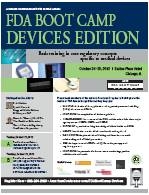
  • Chicago #5American Conference Institute (ACI) will be holding its FDA Boot Camp Devices Edition conference on October 24-25, 2012 in Chicago, IL.  ACI faculty will help attendees:

    • Master the basics of the application and approval processes, including 510(k) clearance and PMAs;
    • Navigate the complexities of device regulations;
    • Comprehend the structure of the FDA and the roles of the three major agency centers:  CDER, CBER, and CDRH;
    • Develop a practical working knowledge of clinical trials and IDEs;
    • Learn how devices are classified, monitored, and regulated;
    • Recognize the pivotal role of labeling and learn how to avoid misbranding and off label promotion;
    • See the importance of cGMPs and QSRs to the post-approval regulatory process; and
    • Navigate the protocols of adverse events monitoring, product withdrawals, and recalls.

    BrochureIn particular, ACI's faculty will offer presentations on the following topics:

    • The basics: Understanding and working with the FDA — jurisdiction, functions, organization, and operations;
    • Overview of device regulation;
    • Understanding clinical trials and the investigational device exemption (IDE);
    • Comprehending the 510(k) clearance process;
    • Navigating the premarket approval process (PMA);
    • Complying with general post-market controls;
    • Understanding FDA enforcement tools, policies, practices, and trends;
    • Labeling and promotion;
    • Medical device reporting;
    • Guidance for navigating recalls and withdrawals; and
    • Quality system regulation.

    A pre-conference primer on the "Fundamentals of FDA Device Regulatory Law," will be offered on October 23, 2012 from 1:00 – 4:00 pm.  The workshop will provide a basic overview of FDA regulations and will prepare attendees for the in-depth discussions that will take place throughout the conference.

    A post-conference master class on "Unique Regulatory Schemes for Specialized Devices: In Vitro Diagnostics and Software Classified as Devices" will be offered from 2:00 – 5:15 pm on October 25, 2012.  The master class will provide attendees with enhanced information specific to in vitro diagnostics and software that is classified as a medical device and will help attendees thoroughly comprehend the complexities and nuances of these areas of regulatory law.

    An agenda for the conference can be found here, and more information regarding the pre-conference primer and master class can be found here.  A complete brochure for this conference, including an agenda, detailed descriptions of conference sessions, list of speakers, and registration form can be obtained here.

    ACI - American Conference InstituteThe registration fee is $2,295 (conference alone), $2,895 (conference and pre-conference primer or master class), or $3,495 (conference, pre-conference primer, and master class).  Those registering by August 24, 2012 will receive a $300 discount and those registering by September 21, 2012 will receive a $200 discount.  Patent Docs readers who reference the discount code "PD 200" will receive $200 off the current price tier when registering.  Those interested in registering for the conference can do so here, by calling 1-888-224-2480, by faxing a registration form to 1-877-927-1563, or by e-mailing CustomerService@AmericanConference.com.

    Patent Docs is a media partner of ACI's FDA Boot Camp Devices Edition conference.

  • AIPLAThe American Intellectual Property Law Association (AIPLA) will be offering a webinar entitled "The Final USPTO AIA Rules: What You Need to Know" on August 22, 2012 from 12:30 – 2:00 pm (Eastern).  Sally Medley, Administrative Patent Judge with the USPTO Board of Patent Trials and Appeals, and Janet Gongola, Patent Reform Coordinator for the U.S. Patent and Trademark Office, will present an overview of the provisions and the final rules and respond to audience questions.  Topics to be discussed will include:  inventor's oath and declaration, supplemental examination, post-grant review, inter partes review, post-grant review of covered business method patents, implementing estoppels provisions for filers of ex parte reexaminations begun after final decisions in post grant or inter partes review, and statute of limitations.

    The registration fee for the program is $145 (AIPLA member rate) or $175 (non-member rate).  Those interested in registering for the program, can do so here.

  • Technology Transfer Tactics will be offering a webinar entitled "New Post Grant Proceeding Rules: Adjusting to the New Reality" on September 19, 2012 from 1:00 – 2:15 pm (Eastern).  Randi Isaacs, In-House Patent Counsel for Emory University's Office of Technology Transfer, and Charles R. Macedo of Amster, Rothstein and Ebenstein, LLP will dissect the new rules implementing post-grant proceedings under the Leahy-Smith America Invents Act and educate attendees on how to best adjust to these changes, while understanding how the changes will specifically affect university procedures and patent protection strategies.

    The registration fee for the webinar is $197.  Those interested in registering for the webinar, can do so here.

    Technology Transfer Tactics

  • HospiraAs part of an ongoing forum to bring researchers from universities and companies together to exchange ideas, discuss challenges, and explore potential collaborations to promote commercialization, Catalyzing Collaboration Between Industry and Academia in the Life Sciences will be offering a forum entitled "Focus on Biologics and Biosimilars" on September 28, 2012 from 8:00 am to 5:15 pm (Central) at Hospira, Inc. in Lake Forest, IL.  The forum will provide a unique combination of presentations, roundtable discussions, and networking, emphasizing how industry and academia can work together to create advances in biologics and biosimilars.  An agenda for the forum can be found here.

    The registration fee for the forum is $25.  Those interested in registering for the forum, can do so here until September 26.  Pre-registration is mandatory, as there will be no on-site registration.

  • By Kevin E. Noonan —

    MyriadAs we reported earlier today, the Federal Circuit, in a decision that substantially reiterates its prior opinion, determined in Association for Molecular Pathology v. U.S. Patent and Trademark Office that, the Supreme Court's decision in Mayo v. Prometheus notwithstanding, claims to isolated human DNA satisfy the requirements of 35 U.S.C. 101.

    At the outset, it must be noted that each of Judge Lourie's majority opinion, Judge Moore's concurring opinion and Judge Bryson's opinion concurring in part and dissenting in part substantially tracks their earlier opinions, as discussed previously (summaries of the earlier opinions can be found here (Judge Lourie), here (Judge Moore), and here (Judge Bryson)).  Accordingly, here the focus will be, as it must, on how the individual members of the panel addressed the Supreme Court's remand instruction to reconsider their opinion(s) in view of the Court's decision in Mayo v. Prometheus.

    For Judge Lourie (and to some extent, Judge Moore), the answer to the question posed by the intervening Mayo decision is simple:  that decision did not change the standards for assessing the patent eligibility for compositions of matter and manufactures as enunciated by the Court in Funk Bros. Seed Co. v. Kalo Inoculant Co. and Diamond v. Chakrabarty.

    Judge Lourie's majority opinion is frank in this assessment, stating that "Mayo does not control the question of patent-eligibility of [] claims to compositions of matter, [that are] expressly authorized as suitable patent-eligible subject matter in § 101."  For the majority, the claimed isolated DNA molecules are "not found in nature" and are "man-made, a product of human ingenuity."  Like all compositions of matter, the claimed molecules are "prepared from products of nature" but that is not enough to render them patent-ineligible per se, according to the opinion:

    All new chemical or biological molecules, whether made by synthesis or decomposition, are made from natural materials.  For example, virtually every medicine utilized by today's medical practitioners, and every manufactured plastic product, is either synthesized from natural materials (most often petroleum fractions) or derived from natural plant materials.  But, as such, they are different from natural materials, even if they are ultimately derived from them.  The same is true of isolated DNA molecules.

    The "primary framework" for assessing patent-eligibility of composition of matter claims remain "the Supreme Court's decisions in Chakrabarty and Funk Brothers" and "[w]hile Mayo and earlier decisions concerning method claim patentability provide valuable insights and illuminate broad, foundational principles" they do not alter the primacy of these earlier decisions, and in applying these decisions the majority opinion follows its earlier assessment of the patent-eligibility of the claimed DNA molecules.

    Judge Lourie's opinion also sets out further grounds for overturning the District Court's decision rendering these claims invalid for being non-statutory subject matter.  These include that the District Court "created a categorical rule excluding isolated genes from patent eligibility," something that the opinion considers contrary to the Supreme Court's mandate that such categorical rules not be imposed in deciding subject matter eligibility.  The opinion cites Bilski v. Kappos (business methods) and Chakrabarty (living organisms) as cases where the Court has affirmatively rejected such per se rules of patent ineligibility.  Isolated DNA "is not and should not be considered a special case for purposes of patent eligibility under existing law" says Judge Lourie, expressly rejecting the District Court's distinction that "DNA represents the physical embodiment of biological information, distinct in its essential characteristics from any other chemical found in nature."

    The opinion also notes that the question as embodied in that portion of the District Court's opinion and as argued by plaintiffs (that it may have an "unusual status as a chemical entity that conveys genetic information") does not permit courts to usurp the prerogative of Congress to address such policy questions, quoting Chief Justice Roberts in Nat'l Fed'n of Indep. Bus. v. Sebelius, 132 S. Ct. 2566, slip op. at 6 (2012) ("[W]e possess neither the expertise nor the prerogative to make policy judgments.  Those decisions are entrusted to our Nation's elected leaders, who can be thrown out of office if the people disagree with them.").  It is up to Congress to address this issue according to the opinion, which notes that Congress has in fact "enacted a comprehensive patent reform act during the pendency of this case."

    Turning to the question of preemption (more properly, "undue" preemption) that concerned the Supreme Court in Mayo, which focused on its concern that permitting patents on particular subject matter would prevent use of that subject matter by others, the majority responds that "the answer to that concern is that permitting patents on isolated genes does not preempt a law of nature [because a] composition of matter is not a law of nature."  The opinion also notes that "a limited preemption" is an inherent property of the patent right.  The public benefit in granting that limited right to preempt is that "[w]hen the patent expires, the public is entitled to practice the invention of the patent."  In this regard, Judge Lourie notes that "[t]he seven patents being challenged here all expire by December 18, 2015" and that "[a]ny preemption thus is limited, very limited in the case of the present patents."

    The majority opinion also rejects the contention, by plaintiffs and certain amici (most notably the government) that "remand of this case for reconsideration in light of Mayo might suggest [] that the composition claims are mere reflections of a law of nature."  Simply put, the opinion states that "they are not, any more than any product of man reflects and is consistent with a law of nature.  Everything and everyone comes from nature, following its laws.  But the compositions here are not natural products.  They are the products of man, albeit following, as all materials do, laws of nature."

    Turning to the method claims, the Court unanimously held that these claims are not patent-eligible under the Supreme Court's Mayo decision (just as they had previously ruled that the claims were not patent-eligible under the Bilski "machine or transformation" test).  In doing so, the panel voiced its opinion that the Court's Mayo decision "made clear that such diagnostic methods in that case essentially claim natural laws that are not eligible for patent."  The panel did not apply the Mayo reasoning here, however, because in its view "those method claims cannot stand" under their earlier, arguably more permissive standard for patent eligibility in view of the Mayo decision.

    Finally, turning to Claim 20 the panel decided unanimously that this claim is patent eligible because it recites a transformed host cell that is not naturally-occurring, analogous to the bacteria claimed by Chakrabarty.  This claim satisfies the Supreme Court's edict from Mayo that "to transform an unpatentable law of nature into a patent-eligible application of such a law, one must do more than simply state the law of nature while adding the words 'apply it'" because it utilizes this man-made cell.  And important to the panel's unanimous decision is that "the claim does not cover all cells, all compounds, or all methods of determining the therapeutic effect of a compound" but "[r]ather [] is tied to specific host cells transformed with specific genes and grown in the presence or absence of a specific type of therapeutic" (emphasis in opinion).

    The panel also unanimously reaffirmed its earlier decision that Dr. Harry Ostrer, alone among the plaintiffs had standing to bring a declaratory judgment action and thus that the District Court properly denied Myriad's motion to dismiss.

    And in perhaps an indication that the panel believed these questions to be more frivolous than the seriousness of the questions presented would suggest, it awarded costs to Myriad.

    In her concurring opinion, Judge Moore also asserts that "the Prometheus decision does not control the outcome in this case" but concedes that "it is nonetheless instructive regarding the scope of the law of nature exception" and she rejects Myriad's contention that "Prometheus is constrained to method [claims]," calling it "untenable."  Regardless, she agrees with Judge Lourie that "Prometheus did not, however, overturn Funk Brothers or Chakrabarty," which she characterizes as "cases clearly more analogous to the one before us."  And using this jurisprudential "framework" she arrives at the same conclusion as Judge Lourie, that the claimed isolated DNA molecules are patent eligible if they represent "a composition of matter with 'markedly different characteristics' from that found in nature with the potential for significant utility."  With regard to utility, Judge Moore recognizes that "[t]he ability to use isolated DNA molecules as the basis for diagnostic genetic testing is clearly an 'enlargement of the range of . . . utility' as compared to nature," citing Funk Bros.  Regarding the oligonucleotide claims, she distinguished the Supreme Court's rubrics from Mayo on the grounds that "the claims to short isolated strands of DNA are not directed to the relationship between the mutation and cancer, but rather to a new tool that can be used to determine if that relationship exists."

    As she did in her previous concurring opinion, Judge Moore states that, "[i]f deciding this case on a blank canvas" she "might conclude that an isolated DNA sequence that includes most or all of a gene is not patentable subject matter," noting that "[t]he scope of the law of nature/manifestation of nature exception was certainly enlarged in Prometheus."  However, as she opined previously she recognized here that this case is not decided on such a blank canvas, in view of the "expansive scope of patentable subject matter" authorized by Congress "for centuries."  She also once again cites the "decades" of U.S. Patent and Trademark Office practice in granting patents on isolated DNA molecules and the "thousands of patents with claims to isolated DNA, and some unknown (but certainly large) number of patents to purified natural products or fragments thereof."  Turning to an important and unaddressed concern underlying the "product of nature" argument espoused by plaintiffs and certain amici (once again, particularly the government), Judge Moore writes:

    [P]urifying or isolating natural products has historically been exactly the kind of discovery protected by the patent statutes.  There is a century-long history of affirming patent protection for isolated and purified biological products ranging from hormones to vitamins to proteins to antibiotics.  These inventions must have seemed miraculous at the time, providing previously unknown therapeutic options to treat sickness.  The fact that these molecules might have existed in nature did not foreclose patent protection in view of the extraordinary benefits accessible to man after isolation.

    In view of this history, for Judge Moore "[w]e cannot, after decades of patents and judicial precedent, now call human DNA fruit from the poisonous tree, and punish those inquisitive enough to investigate, isolate, and patent it" regardless of whether there are "moral, ethical, or theological components" to the policy question of whether DNA molecules should be patented.  Now as previously, Judge Moore believes that the patent eligibility of isolated DNA molecules "is a debate for Congress to resolve" and she once again is unwilling to "strip an entire industry of the property rights it has invested in, earned, and owned for decades unchallenged under the facts of this case."

    As is the case with his judicial brethren, Judge Bryson substantially repeats his earlier opinion concurring in part and dissenting in part, parting company with the majority as to the patent eligibility of isolated genomic DNA molecules and oligonucleotides.  Unlike the majority, Judge Bryson finds the Supreme Court's Mayo decision to be "instructive" although he also voices the opinion that the Mayo decision "does not decide this case."  In analogy to the Court's requirement that there be something "inventive" added to the law of nature so that the claims add "enough" to be more than a mere statement of a natural law, Judge Bryson enunciates a requirement that "a patent involving a product of nature should have an inventive concept that involves more than merely incidental changes to the naturally occurring product."  Here, the question for Judge Bryson is whether claims to a composition of matter "that is nearly identical to a product of nature" is "enough" for the applicant to have made an "inventive contribution" to the product of nature.  On these grounds, Judge Bryson comes to the same conclusion as he has previously, joining the majority as to the cDNA claims but disagreeing that isolated genomic DNA or oligonucleotides are sufficiently "inventive" to be eligible for patenting.  And as he has previously indicated, Judge Bryson is apparently convinced that because "[t]he informational content of the nucleotide sequences is the critical aspect of these molecules" the identity of the informational content of the claimed molecules and the molecules as they exist in nature is enough for Judge Bryson to conclude that these claims are not patent eligible.

    In many ways, this decision reestablishes the status quo ante, and invites the Supreme Court to revisit its watershed decision on the expansive scope of patent eligibility, the Chakrabarty decision.  Keeping in mind that Chakrabarty was decided by a vote of 5-4, this prospect, particularly in view of the (easily) perceived concerns and prejudices of the present Court, is disquieting.  Perhaps that is why the introductory portion of the majority opinion took pains to announce what the case was "not" about:

    Before reviewing the applicability of the Supreme Court's Mayo holding to the claims of the Myriad patents, however, it is important to state what this appeal is not about.  It is not about whether individuals suspected of having an increased risk of developing breast cancer are entitled to a second opinion.  Nor is it about whether the University of Utah, the owner of the instant patents, or Myriad, the exclusive licensee, has acted improperly in its licensing or enforcement policies with respect to the patents.  The question is also not whether is it desirable for one company to hold a patent or license covering a test that may save people's lives, or for other companies to be excluded from the market encompassed by such a patent — that is the basic right provided by a patent, i.e., to exclude others from practicing the patented subject matter.  It is also not whether the claims at issue are novel or nonobvious or too broad.  Those questions are not before us.  It is solely whether the claims to isolated BRCA DNA, to methods for comparing DNA sequences, and to a process for screening potential cancer therapeutics meet the threshold test for patent-eligible subject matter under 35 U.S.C. § 101 in light of various Supreme Court holdings, particularly including Mayo.  The issue is patent eligibility, not patentability.

    * * *

    Accordingly, we once again conclude that claims 1, 2, 5, 6, and 7 of the '282 patent; claims 1, 6, and 7 of the '492 patent; and claim 1 of the '473 patent directed to isolated DNA molecules recite patent-eligible subject matter under § 101.  Mayo does not change that result.  In so doing, we reiterate that the issue before us is patent eligibility, not patentability, about which we express no opinion.

    Perhaps the Supreme Court will take these sentiments into consideration if (realistically, when) it finally hears this case.

    Association for Molecular Pathology v. United States Patent and Trademark Office (Fed. Cir. 2012)
    Panel: Circuit Judges Lourie, Bryson, and Moore
    Opinion by Circuit Judge Lourie; concurring in part opinion by Circuit Judge Moore; concurring in part and dissenting in part opinion by Circuit Judge Bryson

  • Federal Circuit SealIn a decision that substantially reiterates its prior opinion, the Federal Circuit decided today in Association for Molecular Pathology v. U.S. Patent and Trademark Office (the Myriad case) that, the Supreme Court's decision in Mayo Collaborative Services v. Prometheus Laboratories, Inc. notwithstanding, claims to isolated human DNA satisfy the requirements of 35 U.S.C. 101:

    On the threshold issue of jurisdiction, we affirm the district court's decision to exercise declaratory judgment jurisdiction because we conclude that at least one plaintiff, Dr. Harry Ostrer, has standing to challenge the validity of Myriad's patents.  On the merits, we reverse the district court's decision that Myriad's composition claims to "isolated" DNA molecules cover patent-ineligible products of nature under § 101 because each of the claimed molecules represents a nonnaturally occurring composition of matter.  We also reverse the district court's decision that Myriad's method claim to screening potential cancer therapeutics via changes in cell growth rates of transformed cells is directed to a patent-ineligible scientific principle.  We affirm the court's decision, however, that Myriad's method claims directed to "comparing" or "analyzing" DNA sequences are patent ineligible; such claims include no transformative steps and cover only patent-ineligible abstract, mental steps.

    Further analysis will be provided in subsequent posts.  The opinion of the Court can be found here.