• By Canadian Patent Utility Coalition* —

    CPUCWhile the United States and Canada share a border, common values and a strong commitment to international trade and security issues, many are surprised to learn that protection of intellectual property (IP) is a source of significant friction in our relationship.  Indeed, in its 2014 annual "Special 301" report released last week on IP practices overseas, the Office of the United States Trade Representative (USTR) again placed Canada on its "Watch List" for inadequate IP protection and enforcement.  In making this determination, USTR highlighted in particular that Canada's application of heightened patent utility requirements is "leading to uncertainty for patent holders and applicants and undermining incentives for investment in the pharmaceutical sector".  In comments filed with USTR leading up to the issuance of its 301 report, a number of organizations — including the U.S. Chamber of Commerce's Global IP Center (GIPC), Intellectual Property Owners Association (IPO), and the Canadian Patent Utility Coalition (CPUC) — detailed the negative impact of Canada's heightened and improper patent utility standard on U.S. jobs, innovation and competitiveness.  USTR's Special 301 process shines a spotlight on the degree to which the Canadian utility standard is contrary to internationally accepted norms and its own trade obligations.

    The Issue

    It is common for patents involving innovative medicines to be litigated.  Competitors often argue that a patent should not have been granted because the invention was obvious or was not really new.  However, it is extremely rare for patents to be challenged for lack of usefulness or utility.  This is because patents are typically challenged by those who wish to revoke the patent and market the product themselves.  If an invention is not useful, it makes little business sense to bear the costs of challenging the patent.  Conversely, if the product is actually in production and being used by customers, it should be difficult to demonstrate that the invention is not useful and never should have been patented.

    Canadian FlagUnfortunately, a pattern has developed in Canada whereby patents for innovative medicines are being challenged on the grounds that the inventions are not useful.  Ironically, these challenges have come from companies seeking to have the patents revoked so that they can copy and market these medicines themselves.  As a result, Canada has revoked valuable patents for nearly 20 useful medicines over the past nine years because the patents fail to satisfy Canada's unique patent standards.  As noted by USTR, under this standard, courts are invalidating patents held by U.S. pharmaceutical companies on the basis of inutility, "even though such products have been in the market and benefiting patients for years".

    Background: International and U.S. Patent Standards

    Robust intellectual property protections are vital to the biopharmaceutical sector; adequate and effective patent protection, in particular, is what drives innovators to undertake enormous risks by investing in the research, development, and delivery of innovative new therapeutics to patients globally.  The WTO Agreement on Trade-Related Aspects of Intellectual Property Rights (TRIPS) and North American Free Trade Agreement (NAFTA) require patents to be granted for inventions relating to all fields of technology that are new, result from an inventive step, and are "capable of industrial application."  "Capable of industrial application" is synonymous with "useful" and is often referred to as the "utility" standard.  Thus, TRIPS and NAFTA require signatories to provide patent protection to useful inventions that meet the other requirements for patentability.

    The utility standard is by no means intended to be a burdensome requirement.  It is designed simply to ensure that patents are not granted for inoperable, fanciful, or purely aesthetic inventions.  For example, in applying the patent utility test, the United States Patent and Trademark Office and U.S. courts require simply that an invention's claimed utility be specific and practical.  The patent utility test applied in the U.S. is very similar to the tests applied in the European Union and Japan, among most other industrialized nations.  When a patent is challenged for a lack of utility under Section 101 of the Patent Act, U.S. courts focus on actual utility and will consider evidence developed and submitted after the filing of the patent application in evaluating an invention's utility.  Specific utility can be shown where a pharmaceutical or biotechnology patent discloses a specific disease against which the claimed compounds are useful.

    Importantly, U.S. courts have made it abundantly clear that the human testing necessary for U.S. Food and Drug Administration (FDA) approval is not a prerequisite for finding usefulness for a therapeutic under the patent laws.  The FDA's focus on human testing to demonstrate the safety and efficacy of a therapeutic before it is sold on the market is distinct from the Patent Act's patentability requirements.  At the same time, USPTO and the U.S. courts accept evidence of FDA approval of human clinical trials as creating a strong presumption that the utility standard has been met.  The U.S. approach is consistent with the practices of most if not all other WTO members.  Canada's approach is the exception, and is inconsistent with international standards.

    Canada's Patent Utility Standard: An Insolvable Riddle for Patentees

    Canada's utility test has three elements which taken together present a riddle that is impossible to solve.

    • First, the court or CIPO subjectively construes the "promise of the patent" from the patent specification, sometimes going beyond a mere statement of use and also beyond that which is specifically claimed in the patent application.  There is no similar concept under U.S. law or practice.  For example, "promises" have been construed as treatment of disease over the long term for conditions deemed chronic.  There is no way to know in advance how the "promise" might be construed by the Court or Canada's Intellectual Property Office (CIPO).

    • Second, the court or CIPO, using a heightened evidentiary standard of proof, determines whether utility is demonstrated by reference to the promise of the patent.  As in the first test, there is no way a patentee can know in advance whether enough proof has been provided.  For example, even completed human clinical trials have been found inadequate to demonstrate utility in Canada where the courts have questioned the size or duration of the trials.  This stands in sharp contrast to U.S. practice, as noted above, where data from human clinical trials (even those trials conducted after filing of the patent application) create a presumption of usefulness.

    • Third, if utility is not demonstrated, the court or CIPO determines whether, at the time of the filing, there was a "sound prediction of utility."  In Canada, evidence of utility generated after the filing date is not considered and only evidence contained within the application may be used as proof of utility.  This last prong creates heightened disclosure requirements inconsistent with U.S. practice, which does not require evidence of utility to be found within the specification as of the filing date.

    The Consequences of Canada's Application of its Outlier Patent Utility Standard

    Since the "promise" of the patent is construed by the court years after the filing date, the promise doctrine leads to great uncertainty among innovators as it is now unclear how much information is required at the time of filing to meet these new, onerous requirements.  Moreover, this judicially-created utility doctrine applies a shifting standard that places applicants and patentees in an untenable "Catch-22" predicament:  To be patentable, useful inventions must also be novel and inventive over all prior art available at the patent filing date.  If an applicant aims to meet Canada's enhanced test for proof of utility, which may include carrying out long-term clinical trials prior to filing a patent application, the applicant would have to delay patent filings in Canada and other countries such as the United States.  Such delays would increase the risk of patent refusal and patent invalidity in numerous countries on the basis of prior art published during the long-term clinical trials.

    Canada's approach to utility is also inconsistent with the patent laws of similarly-situated economies and impedes ongoing efforts to achieve patent harmonization internationally.  The Canadian approach is strikingly out of step with the first-to-file rule of the America Invents Act, which encourages early filing.  It also compromises the ability of innovators to file patents in Canada using an international application under the Patent Cooperation Treaty (PCT), which has less onerous disclosure obligations.  Moreover, the results in Canadian cases contradict those in the United States and Europe:  pharmaceutical patents found to lack utility by Canadian courts have been upheld as having utility in U.S. and European proceedings, if utility is challenged at all.

    Moreover, Canada's promise doctrine, in practice, has discriminated against a particular area of technology — the biopharmaceutical sector.  Since 2005, all patent revocations based on utility in Canada have involved pharmaceutical patents.[1]  Given the disproportionate impact of the promise doctrine on the biopharmaceutical sector, Canada is failing to meet its international obligation to apply patent standards in a non-discriminatory manner across different technologies.  The graphic below illustrates the disproportionate impact on drug patents.

    Image
    Conclusion

    The heightened test applied by Canada is substantially different from the test required under TRIPS and NAFTA.  Parties to these trade agreements cannot redefine core terms like "useful" and "capable of industrial application" without fundamentally changing the essence of the agreements.  Canada's substantial redefinition of "usefulness" has severely undermined patent protection for innovators.

    * The Canadian Patent Utility Coalition (CPUC) represents 19 innovative companies who are extremely concerned about Canada's heightened and improper patent utility standards which are causing significant economic harm and uncertainty to innovative companies.  To learn more about CPUC and its views, please refer to the group's Special 301 Written Submission (footnote 1 of the submission provides a list of the member companies).


    [1] In only one case outside the pharmaceutical sector have any challenged claims been found to lack utility; a distinct claim under the same patent was upheld as useful, such that the patent remained valid.  See Bell Helicopter Textron Canada Limitée v. Eurocopter, 2013 FCA 219.

  •         By Sherri Oslick

    Gavel About Court Report:  Each week we will report briefly on recently filed biotech and pharma cases.

    Cephalon Inc. v. Uman Pharma Inc.
    1:14-cv-00568; filed April 30, 2014 in the District Court of Delaware

    Infringement of U.S. Patent Nos. 8,445,524 ("Solid Forms of Bendamustine Hydrochloride," issued May 21, 2013) and 8,436,190 ("Bendamustine Pharmaceutical Compositions," issued May 7, 2013) following a Paragraph IV certification as part of Uman's filing of an ANDA to manufacture a generic version of Cephalon's Treanda® (bendamustine hydrochloride, used to treat chronic lymphocytic leukemia and non-Hodgkin's lymphoma).  View the complaint here.

    Celgene Corp. et al. v. Fresenius Kabi USA LLC
    1:14-cv-00571; filed April 30, 2014 in the District Court of Delaware

    • Plaintiffs:  Celgene Corp.; Astellas Pharma Inc.
    • Defendant:  Fresenius Kabi USA LLC

    Infringement of U.S. Patent Nos. 7,608,280 ("Method of Producing FR901228," issued October 27, 2009) and 7,611,724 (same title, issued November 3, 2009) following a Paragraph IV certification as part of Fesenius' filing of an ANDA to manufacture a generic version of Celgene's Istodax® (romidepsin for injection, used to treatment of peripheral and cutaneous T-cell lymphoma).  View the complaint here.

    Amarin Pharma, Inc. et al. v. Dr. Reddy's Laboratories, Inc. et al.
    3:14-cv-02760; filed April 30, 2014 in the District Court of New Jersey

    • Plaintiffs:  Amarin Pharma, Inc.; Amarin Pharmaceuticals Ireland Ltd.
    • Defendants:  Dr. Reddy's Laboratories, Inc.; Dr. Reddy's Laboratories, Ltd.

    Amarin Pharma, Inc. et al. v. Roxane Laboratories, Inc.
    1:14-cv-00901; filed April 25, 2014 in the Northern District of Ohio

    • Plaintiffs:  Amarin Pharma, Inc.; Amarin Pharmaceuticals Ireland Ltd.
    • Defendant:  Roxane Laboratories, Inc.

    The complaints in these cases are substantially identical.  Infringement of U.S. Patent Nos. 8,293,728 ("Methods of Treating Hypertriglyceridemia," issued October 23, 2012), 8,318,715 (same title, issued November 27, 2012), 8,357,677 (same title, issued January 22, 2013), 8,367,652 (same title, issued February 5, 2013), 8,377,920 (same title, issued February 19, 2013), 8,399,446 (same title, issued March 19, 2013), 8,415,335 (same title, issued April 9, 2013), 8,426,399 (same title, issued April 23, 2013), 8,431,560 (same title, issued April 30, 2013), 8,440,650 (same title, issued May 14, 2013), 8,501,225 ("Stable Pharmaceutical Composition and Methods of Using Same," issued August 6, 2013), 8,518,929 ("Methods of Treating Hypertriglyceridemia," issued August 27, 2013), 8,524,698 (same title, issued September 3, 2013), 8,546,372 (same title, issued October 1, 2013), 8,551,521 ("Stable Pharmaceutical Composition and Methods of Using Same," issued October 8, 2013), and 8,617,594 (same title, issued December 31, 2013) following a Paragraph IV certification as part of defendants' filing of an ANDA to manufacture a generic version of Amarin's Vascepa® (icosapent ethyl, used as an adjunct to diet to reduce triglyceride levels in adult patients with severe hypertriglyceridemia).  View the Dr. Reddy's complaint here.

    Otsuka Pharmaceutical Co., Ltd. v. Amneal Pharmaceuticals, LLC et al.
    3:14-cv-02700; filed April 28, 2014 in the District Court of New Jersey

    • Plaintiff:  Otsuka Pharmaceutical Co., Ltd.
    • Defendants:  Amneal Pharmaceuticals, LLC; Amneal Pharmaceuticals of New York, LLC; Amneal Pharmaceuticals Co. India Private Ltd.

    Infringement of U.S. Patent No. 8,642,600 ("Method of Treating Autism," issued February 4, 2014) following a Paragraph IV certification as part of Amneal's filing of an ANDA to manufacture a generic version of Otsuka's Abilify® (aripiprazole, used to treat bipolar disorder, schizophrenia, and austistic disorder, and as an adjunctive treatment of major depressive disorder).  View the complaint here.

    Medicines Company v. Exela Pharma Sciences, LLC et al.
    5:14-cv-00058; filed April 25, 2014 in the Western District of North Carolina

    • Plaintiff:  Medicines Company
    • Defendants:  Exela Pharma Sciences, LLC; Exela Pharmsci, Inc.; Exela Holdings, Inc.

    Infringement of U.S. Patent Nos. 7,582,727 ("Pharmaceutical Formulations of Bivalirudin and Process of Making the Same," issued September 1, 2009) and 7,598,343 (same title, issued October 6, 2009) following a Paragraph IV certification as part of Exela's filing of an ANDA to manufacture a generic version of The Medicines Company's Angiomax® (bivalirudin, used as an anticoagulant in patients with unstable angina undergoing percutaneous translurninal coronary angioplasty).  View the complaint here.


    Dow Pharmaceutical Sciences, Inc. et al. v. Actavis, Inc. et al.
    2:14-cv-02661; filed April 25, 2014 in the District Court of New Jersey

    • Plaintiffs:  Dow Pharmaceutical Sciences, Inc.; Valeant Pharmaceuticals North America LLC
    • Defendants:  Actavis, Inc.; Watson Laboratories, Inc.; Andrx Corp.; Watson Pharma, Inc.

    Infringement of U.S. Patent No. 8,663,699 ("Topical Pharmaceutical Formulations Containing a Low Concentration of Benzoyl Peroxide in Suspension in Water and a Water-Miscible Organic Solvent," issued March 4, 2014) following a Paragraph IV certification as part of Actavis' filing of an ANDA to manufacture a generic version of Dow's Acanya® (clindamycin phosphate and benzoyl peroxide gel, 1.2%/2.5%, used to treat acne).  View the complaint here.


    AbbVie Inc. et al. v. Hetero USA Inc. et al.
    1:14-cv-00543; filed April 24, 2014 in the District Court of Delaware

    • Plaintiffs:  AbbVie Inc.; Abbvie Deutschland GmbH & Co. KG
    • Defendants:  Hetero USA Inc.; Hetero Labs Ltd.; Hetero Labs Ltd.; Hetero USA Inc.

    Infringement of U.S. Patent Nos. 8,470,347 ("Self-Emulsifying Active Substance Formulation and Use of This Formulation," issued June 25, 2013) and 8,399,015 ("Solid Pharmaceutical Dosage Form," issued March 19, 2013) following a Paragraph IV certification as part of Hetero's  amendment of its ANDA to manufacture a generic version of AbbVie's Norvir® (ritonavir, used to treat human immunodeficiency virus (HIV) infection).  View the complaint here.

  • CalendarMay 6, 2014  – GW Law Symposium on Intellectual Property (George Washington University Law School, Mayer Brown, and Pillsbury) – George Washington University Law School

    May 13-15, 2014 – Fundamentals of Patent Prosecution 2014: A Boot Camp for Claim Drafting & Amendment Writing (Practising Law Institute) – Chicago, IL

    May 14-15, 2014 – EU Pharmaceutical Law Forum*** (Informa Life Sciences) – Brussels, Belgium

    May 15, 2014 – "Patent Subject Matter Eligibility: Navigating the New 'Myriad' Guidelines — Analyzing Subject Matter and Avoiding Rejection Under the USPTO's Detailed Framework" (Strafford) – 1:00 to 2:30 pm (EDT)

    May 22, 2014 – "Patent Infringement: Structuring Opinions of Counsel: Leveraging Opinion Letters to Reduce the Risks of Liability and Enhanced Damages" (Strafford) – 1:00 to 2:30 pm (EDT)

    June 4, 2014 – "Patent Due Diligence Post-AIA: Avoiding Dangers of Inadequate Investigation — Evaluating Validity of Key Patents, Identifying Enforceability Issues, Addressing New Considerations Under the AIA" (Strafford) – 1:00 to 2:30 pm (EDT)

    June 4-6, 2014 – Biosimilars*** (American Conference Institute) – New York, NY

    June 9-10, 2014 – Hatch-Waxman Boot Camp*** (American Conference Institute) – Chicago, IL

    June 10, 2014 – "'Standing Out' — The Supreme Court's Redefined Standard for Fee Shifting in Patent Litigation, and How It Might Impact 'Patent Troll' Litigation" (McDonnell Boehnen Hulbert & Berghoff LLP) – 10:00 am to 11:15 am (CT)

    June 11-13, 2014 – Fundamentals of Patent Prosecution 2014: A Boot Camp for Claim Drafting & Amendment Writing (Practising Law Institute) – New York, NY

    July 9-11, 2014 – Fundamentals of Patent Prosecution 2014: A Boot Camp for Claim Drafting & Amendment Writing (Practising Law Institute) – San Francisco, CA

    August 13-15, 2014 – Advanced Patent Law Seminars (Chisum Patent Academy) - Seattle, WA

    August 18-20, 2014 – Advanced Patent Law Seminars (Chisum Patent Academy) - Seattle, WA

    ***Patent Docs is a media partner of this conference or CLE

  • MBHB Logo 2McDonnell Boehnen Hulbert & Berghoff LLP will be offering a live webinar entitled "'Standing Out' — The Supreme Court's Redefined Standard for Fee Shifting in Patent Litigation, and How It Might Impact 'Patent Troll' Litigation" on June 10, 2014 from 10:00 am to 11:15 am (CT).  Patent Docs contributor and MBHB attorney Dr. Andrew W. Williams and MBHB attorney Erin R. Woelker will cover the potential implications of the Octane Fitness, LLC v. ICON Health & Fitness, Inc. and Highmark Inc. v. Allcare Health Mgmt. Sys., Inc. decisions on fee-shifting in patent litigation, especially in cases involving these "patent trolls."  The webinar will address the following topics:

    • An overview of the fee shifting statute § 285 and how it has been applied in federal court;
    • A review of the Octane and Highmark cases and an analysis of the new standard for obtaining attorney fees;
    • A discussion of how the broadened "exceptional case" test may be applied by courts going forward, including a review of the fee-shifting provision under the Copyright Act; and
    • A discussion of the implications of these decisions on "patent troll" litigations, and the impact they might have on the legislation aimed at curbing abusive litigation currently pending in Congress.

    While there is no fee to participate, attendees must register in advance.  Those wishing to register can do so here.  CLE credit is pending for the states of California, Illinois, New Jersey, New York, North Carolina, and Virginia.

  • Chicago #2American Conference Institute (ACI) will be holding the next session of its Hatch-Waxman Boot Camp conference on June 9-10, 2014 in Chicago, IL.  ACI faculty will help attendees:

    • Understand the interplay of between the PTO and FDA in the patenting of drugs and biologics;
    • Learn about the essentials of the FDA approval process and its link to biopharmaceutical patents;
    • Develop an in-depth and practical knowledge of Hatch-Waxman protocols;
    • Navigate the intricacies of patent term adjustment and patent term extension; and
    • Comprehend how the BPCIA biosimilars pathway for large molecules will compare to the Hatch-Waxman schematic for small molecule.

    BrochureIn particular, ACI's faculty will offer presentations on the following topics:

    • Key agencies overview:  Understanding the jurisdiction and interplay of the FDA and PTO in the patenting of drugs and biologics;
    • Exploring the link between the FDA approval process and the patenting of drugs and biologics;
    • IP overview for drugs and biologics:  Hatch-Waxman, BPCIA, trade dress, and more;
    • ANDA litigation 101: Paragraph IV disputes primer;
    • Orange Book listings, de–listings, and related challenges;
    • Bioequivalence and the "same active ingredient" vis-a-vis patentability;
    • An in-depth look at 180-day exclusivity;
    • Comprehending the intricacies of non-patent/regulatory exclusivity;
    • Assessing patent protections afforded under the safe harbor; and
    • Examining pharmaceutical patent extensions:  Patent Term Adjustment and Patent Term Restoration.

    A post-conference interactive biosimilars strategy session, entitled "Biosimilars 101:  Interpreting the Law, Appreciating the Science, Anticipating Regulations and Preparing for Litigation," will be offered from 9:00 am to 12:00 pm on June 11, 2014.

    The agenda for the Hatch-Waxman Boot Camp conference can be found here.  A complete brochure for this conference, including an agenda, detailed descriptions of conference sessions, list of speakers, and registration form can be obtained here.

    ACI - American Conference InstituteThe registration fee for the conference is $2,295 (conference alone) or $2,895 (conference and workshop).  Those registering by May 9, 2014 will receive a $300 discount.  Those interested in registering for the conference can do so here, by calling 1-888-224-2480, or by faxing a registration form to 1-877-927-1563.

    Patent Docs is a media partner of ACI's Hatch-Waxman Boot Camp conference.

  • Strafford #1Strafford will be offering a webinar/teleconference entitled "Patent Due Diligence Post-AIA: Avoiding Dangers of Inadequate Investigation — Evaluating Validity of Key Patents, Identifying Enforceability Issues, Addressing New Considerations Under the AIA" on June 4, 2014 from 1:00 to 2:30 pm (EDT).  Thomas L. Irving of Finnegan Henderson Farabow Garrett & Dunner; Donna M. Meuth, Associate General Counsel for Eisai; and Lauren L. Stevens of Global Patent Group will provide guidance to patent counsel regarding the impact of the America Invents Act (AIA) on patent due diligence, and offer best practices for conducting due diligence in light of the AIA.  The webinar will review the following questions:
    • How do the AIA and recent court decisions affect the due diligence process?
    • Is an application correctly filed in the name of the applicant or should it be filed in the name of the inventors because it is under the old 120/119(e)?
    • What changes should patent counsel make in the due diligence process as a result of the AIA?

    The registration fee for the webinar is $297 ($362 for registration and CLE processing).  Those registering by May 9, 2014 will receive a $50 discount.  Those interested in registering for the webinar, can do so here.

  • BioCentury This WeekRep. Anna Eshoo (D-CA) will appear on BioCentury This Week on Sunday, May 4 to address "The Congressional Battle for Biotech."  BioCentury This Week television host Steve Usdin will interview Rep. Eshoo about her life sciences agenda, in which Rep. Eshoo:

    • Makes the case for increasing funding for federal health R&D;
    • Suggests that Congress create a "safe harbor" for companies that provide compassionate access to experimental drugs;
    • Says the FDA needs to do more to make the biosimilars pathway work; and
    • Calls for Congress to write "rules of the road" for personalized medicine.

    The interview can be viewed on WUSA from 8:30 to 9:00 EST or online at www.biocenturytv.com beginning at 9:00 am EST.

  • By Kevin E. Noonan

    Knowles, SherryLast week, Sherry Knowles, former chief patent counsel for GlaxoSmithKline and now principal at Knowles Intellectual Property Strategies, LLC submitted to Managing Intellectual Property magazine a detailed critique of the U.S. Patent and Trademark Office's Guidelines for examination under Section 101 of the Patent Act in view of the Supreme Court's opinions in Mayo v. Prometheus and AMP v. Myriad Genetics.  Her detailed (and critical) assessment of the Guidelines was prompted by a spirited defense of those Guidelines by Drew Hirschfield published by MIP in its March 4th issue, which in turn was occasioned by Ms. Knowles' assertion on March 26th at a MIP-sponsored panel session where, among other things, she characterized the Guidelines as "horrifying to the pharmaceutical and biotech industry."

    Ms. Knowles raises the issue recognized by many in the patent community upon first inspection of the Guidelines:  rather than merely attempting to administer the Court's decisions by limiting them to their facts (a particularly appropriate approach in view of the fact-specific bases for the Court's decisions in each case), she asserts that "these Guidelines appear to expand the Supreme Court analyses, apply the expanded analysis to products and methods that have not yet been litigated, and in doing so arguably de facto expand the law, which currently stands only in the form of judicial exceptions to patentability."  These are not prospective or potential problems; Ms. Knowles rightly notes that this expansion of the "natural products" judicial exception is forming the grounds for rejecting U.S. patent applications now, and that the expected consequence (delay in obtaining patent protection and uncertainty about the validity and scope of such protection) could easily "chill[] any ability to attract venture capital and strip[] the value of numerous emerging life science companies."

    She also raises the specter of the U.S. being out of step with the rest of the world, noting that many U.S. trade partners and competitors on the world stage (including the countries of Europe, China, Australia, Japan and Russia) grant patent protection for products now outside U.S. patent protection (according to the Guidelines) and that this reality threatens the U.S.'s position as a global biotechnology leader.  Insofar as developing countries look to the U.S. to lead, these Guidelines encourage the sort of "anti-innovation" sentiments the U.S. has long opposed (for example, those preventing pharmaceutical patenting that were part of the impetus for the GATT treaty).

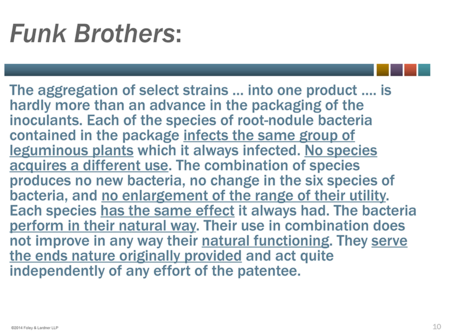
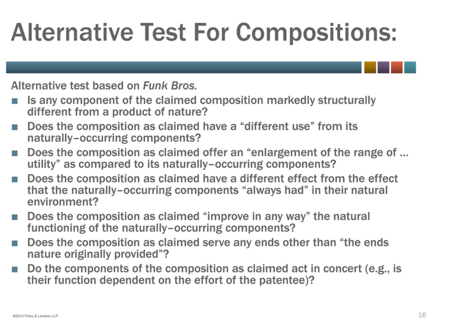
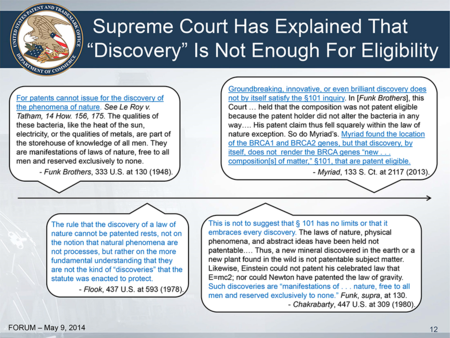
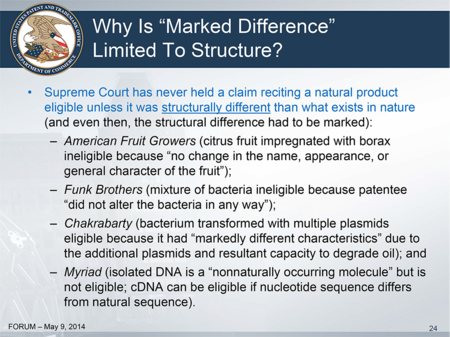
    Ms. Knowles asks a simple but fundamental question:  How did we get here?  In her analysis, which reviews the Constitutional approach to patent protection as implemented by U.S. patent law and in particular, the 1952 Act, places at least some of the blame for the current circumstance on Congress, which "has only issued one sentence on what constitutes patentable subject matter in the United States."  As a consequence, the "great void" created by this lack of attention has been filled by the Supreme Court, which is "immune from the political process" and lacks the resources needed to appreciate the effects on U.S. innovation its economy of its policy decisions.  This institutional lack of competence is illustrated by the Court's decision in Funk Bros. Seed Co. Vs. Kalo Inoculant Co. (333 U.S. 127; 68 S.Ct 440 (1948), which forms the basis for the PTO's interpretation of the Court's recent cases.  (Indeed, in a panel discussion at the Spring BIO IPCC meeting last week in Palm Springs, the Office's reliance on Funk Bros. was readily acknowledged by its representative on the panel.)  Ms. Knowles notes that the "fatal flaw" in Kalo's patent claim (Claim 4 of U.S. Patent No. 2,200,532) was that it attempted to encompass all combinations of Rhizobium species that could permit growth in each other's presence, a case of "an aspiration which defined the material not by what it is but by what it does."  This problem is one governed not by Section 101 of the Patent Act but rather Section 112, first paragraph (now Section 112(a)), for failure to provide an adequate written description of the invention.  Rather than rely on this principle (which, while as recited was part of the revisions to the patent laws enacted four years after Funk Bros., but which was already enshrined in prevailing law), the Court relied on its "gut-feel that if one simply tells the public to find a bacteria that works, and use a prior art method to do so, that alone is not patentable."  The result was "immeasurable damage []caused by using 101 as the rationale and with expansive, unnecessary and not politically tested verbiage that any mixture of natural materials is not patentable."  (As close readers of the opinion have long recognized, Ms. Knowles references Justice Frankfurter's concurring opinion which is much more informative than Justice Douglas's principle opinion on the Court's concern and intended scope of its opinion.)  And she puts paid to the misunderstanding of the case (that persists even today on the Court and particularly in the PTO) by citing Judge Giles S. Rich (author of the 1952 Patent Act) on this issue:

    The real vice or inadequacy of the judge-made requirement for "invention" was in the truism Mr. Federico [one of the drafters of the 103 statute] restated, "the so-called standard of invention is an unmeasurable quantity having different meanings for different persons."  It left every judge practically scott-free to decide this often controlling factor according to his personal philosophy of what inventions should be patented, whether or not he had any competence to do so or any knowledge of the patent system as an operative socioeconomic force.  This was too great a freedom because it involved national policy which should be declared by Congress, not by individual judges or even groups of judges on multiple-judge courts.

    Per Judge Rich, the test for "invention," as that term was inexactly used for many years by the Court, is embodied in Section 103 and adoption of that section of the patent law evinces Congress's judgment on how best to put into effect the Constitutional purpose of the patent grant.

    Fast forward to the present day, and Ms. Knowles assays the current Court's statements in its Mayo and Myriad decisions showing that these principles and appreciation of Congressional intent have been forgotten if ever appreciated at all.  She notes that the Court has expressly stated that "mere discovery" does not satisfy the legal standard for invention, which requires the Court to ignore the words of the statute that "Whosoever invents or discovers any new and useful process, machine, manufacture or composition of matter, or any new and useful improvement thereof, may obtain a patent therefor," and asks "[d]oes the Supreme Court have the right to pencil out two very important words of a statute?  Can the Supreme Court decide to honor only part of a statute and judicially except the rest?"  This is not interpreting the law, Ms. Knowles contends; it is changing it (and about that she is completely correct).

    The next section of her piece is perhaps the most salient to the policy question raised by the Court and improvidently addressed by the Guidelines.  Relying on a 2012 report from the National Institutes of Health, Natural Product Branch, she recites the statistics relating to the number of FDA approvals (a total of 1,355) for new drugs falling into the following categories:

    Drug type/source                                Number

    Biological (B)                                            203

    Natural product (N)                                    55

    Natural product (botanical) (NB)               149

    Derived from a natural product (ND)          298

    Totally synthetic (S)                                  393

    Total synthesis/natural product (S*)           176

    Vaccine (S)                                                 81

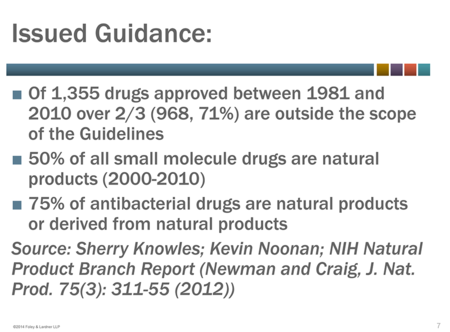
    These statistics illustrate the consequences of the Court's and the Office's policymaking; of the 1,355 drugs approved between 1981 and 2010:

    • 968 (71%) are outside the scope of the Guidelines

    • 636 (47%) are B, N, NB, and V

    • 50% of all small molecule drugs are natural products (2000-2010)

    • About 75% of antibacterial drugs are natural products or derived from natural products

    • Almost 80% of small molecule anticancer drugs were natural products or derivatives

    The Report also has specific information on particular drugs among these different catagories.

    Ms. Knowles does not state the obvious:  these statistics are chilling.  It is of particular note that during the 1982-2010 timeframe only 15% of approved drugs were biologics; every study has shown that the percentage of drugs that are biologics has been growing and will be the predominant type of drug developed in the 2011-2030 time period.  And these drugs are the among the ones that the PTO would preclude from patenting, based on its over-interpretation of the Court's decisions in Mayo and Myriad.

    In closing, Ms. Knowles does not shy away from the implications of her analysis, that what we have here is a breakdown of the separation of powers that is the basis of our Federal government.  The Supreme Court is legislating rather than interpreting the law, and Congress seems unable to identify the portions of the patent law that are actually important for innovation, producing the legislative void the Court has taken upon itself to fill.  She notes that the Guidelines cite the "judicial exceptions to patent[-eligibility]" eighty-two times, without citing the relevant language of the Patent Act at all.  The short term answer may be as simple as having the Office listen to the patenting community and the outrage the Guidelines have created, but that may be a false hope:  the Office was tone-deaf enough to promulgate these Guidelines without notice and comment (which, even if not necessary would have alerted the relevant parties to provide whatever counter-arguments they are now raising after the fact).  And she is even more hopeful in calling for us all to "encourage our Congressional representatives to open the political process to update the patent statutes, and in doing so, provide the necessary clarity and leadership on patentability in this complex technology space and override the Supreme Court's 'judicial exceptions to patentability.'"  The solution may be as simple as the Office rescinding these Guidelines, publishing them for notice and comment, and then working with its relevant stakeholders to find a workable compromise.  No matter how this is resolved, we owe it to ourselves if not the public to try to educate our leaders on these important issues.

  • By Donald Zuhn

    NVCAEarlier this month, the National Venture Capital Association (NVCA), a trade association representing the U.S. venture capital industry, released the results of its MoneyTree Report on venture funding for the first quarter of 2014.  The report, which is prepared by the NVCA and PriceWaterhouseCoopers LLP using data from Thomson Reuters, indicates that venture capitalists invested $9.469 billion in 951 deals in the first quarter, which constituted a 12% increase in dollars and a 14% decrease in deals as compared with the fourth quarter of 2013, when $8.441 billion was invested in 1,112 deals (see chart below, which shows total venture funding from the first quarter of 2011 through the first quarter of 2014; data from MoneyTree Reports; click on chart to expand).  The nearly $9.5 billion invested in the first quarter was the highest quarterly total since the second quarter of 2001. 

    Funding Total
    PricewaterhouseCoopers (PWC)Venture funding in the biotechnology sector dropped from $1.375 billion in the fourth quarter of 2013 to $1.062 billion in the first quarter of 2014 (see chart below, which shows venture funding for the biotech (blue), medical devices (red), and software (green) sectors since the first quarter of 2011; data from MoneyTree Reports; click on chart to expand).  In addition to suffering a 23% drop in dollars, the biotech sector also dropped 21% in deals in the first quarter of 2014.  However, funding in the biotech sector was up from the first quarter of 2013, when $871 million was invested.

    Funding By Industry
    While the biotech sector secured enough funding to place second among the seventeen sectors tracked by the NVCA, the biotech sector received only 25% of the $4.008 billion in funding that was poured into the software sector in the first quarter — the first time since the fourth quarter of 2000 that the software sector broke the $4 billion mark.  The software sector has now captured the top spot for eighteen straight quarters, with the biotech sector finishing second in all but two of those quarters (the industrial/energy sector knocked the biotech sector to third in the second quarter of 2010 and first quarter of 2011), and the software sector has received more than $2 billion in funding for eight consecutive quarters.

    Medical device and equipment investment increased by 28% with respect to dollars and dropped by 37% in deals in the first quarter, with $588 million being invested in 61 deals.  Overall, nine of the seventeen sectors tracked by the NVCA saw decreases in dollars invested in the first quarter.

    For additional information regarding this and other related topics, please see:

    • "Biotech Venture Funding Rebounded in 2013 After Strong Fourth Quarter," January 26, 2014
    • "Biotech Venture Funding Sees Second Quarter Rebound," July 22, 2013
    • "Biotech Venture Funding Down 33% in First Quarter," April 30, 2013
    • "Annual Venture Funding Drops for First Time in Three Years," February 4, 2013
    • "Biotech Venture Funding Up 64% in Third Quarter," October 29, 2012
    • "Venture Funding in Life Sciences Sector Drops 9% in Second Quarter," July 22, 2012
    • "Biotech Venture Funding Drops 43% in First Quarter," May 3, 2012
    • "Venture Funding Increased 22% in 2011," February 2, 2012
    • "Life Sciences Venture Funding Drops in Third Quarter," October 27, 2011
    • "Life Sciences Venture Funding up 37% in Second Quarter," August 1, 2011
    • "VentureSource Reports 35% Increase in 1Q Venture Funding," April 26, 2011
    • "NVCA Reports Modest Gains in First Quarter Venture Funding," April 19, 2011

    • "NVCA Reports 31% Drop in Venture Funding for Third Quarter," October 17, 2010

    • "NVCA Reports 34% Increase in Venture Funding for Second Quarter," July 22, 2010

    • "NVCA Report Shows First Quarter Drop in Venture Funding," April 20, 2010

    • "Biotech/Pharma Financing Improving, R&D Spending Up," August 31, 2009
    • "NVCA Study Shows Increase in Third Quarter Venture Funding," October 23, 2009

    • "First Quarter Venture Capital Funding at 12-Year Low," April 23, 2009

    • "NVCA Study Shows Decline in 2008 Investment; BIO Study Predicts Biotech Rebound in 2009," February 16, 2009

  • By Andrew Williams

    Supreme Court Building #2As we reported earlier today, the Supreme Court issued opinions in the Octane Fitness, LLC v. ICON Health & Fitness, Inc. (Supreme Court docket number 12-1184) and Highmark Inc. v. Allcare Health Mgmt. Sys., Inc. (Supreme Court docket number 12-1163) cases.  The statute at issue in these cases was 35 U.S.C. § 285, which provides that a "court in exceptional cases may award reasonable attorney fees to the prevailing party."  The Federal Circuit had previously established that exceptional cases were either based on litigation-related misconduct or if the litigation was both (1) brought in subjective bad faith and (2) objectively baseless."  See Brooks Furniture Mfg. v. Dutailier, Inc., 393 F.3d 1378 (Fed. Cir. 2005).  The Supreme Court found this test to be "overly rigid."  First, the litigation-related misconduct identified by the Federal Circuit, such as willful infringement, fraud, or inequitable conduct, and conduct that violates Fed. R. Civ. P. 11, are all otherwise, independently sanctionable.  The Court did not think this was an appropriate benchmark.  Instead, the opinion clarified that even if a party's unreasonable conduct is not necessarily independently sanctionable, it can still give rise to a finding of an "exceptional" case.  Moreover, the Court believed that either subjective bad faith or an objectively baseless suit could be sufficient to find a case "exceptional," without requiring both.  Finally, the test established by the Federal Circuit in Brooks Furniture rendered § 285 superfluous.  This is because of the "long recognized [] common-law exception to the general 'American Rule' against fee-shifting."  In other words, district courts already had an inherent power to shift fees in the cases that would satisfy the Brooks Furniture test.

    It was not overly surprising that the Supreme Court discarded the Federal Circuit standard from 2005.  Indeed, as the opinion noted in one of the only footnotes unanimously agreed to by the Court, even Chief Judge Rader recently criticized the Brooks Furniture case, complaining that the court "'should have remained true to its original reading of §285.'"  Octane, slip op. at 4-5, FN 4 (citing Kilopass Tech. Inc. v. Sidense Corp. No. 2013-1193, 2013 WL 6800885, at *14 (Fed. Cir. Dec. 26, 2013) (Rader, C.J., concurring)).  What wasn't clear was what the new standard for an "exceptional" case would be.  In fact, during oral arguments, several choices were bandied about, ranging from "frivolousness," to "objectively baseless," to "gross injustice," to "objectively reasonable," to "just let the District Court decide."  Justice Scalia even had problems with the term meritless, noting that "every time you win [a] summary judgment motion, that's a determination that the claim is without merit."  Instead, the Court resorted to dictionary definitions of the word "exceptional" to arrive at the new standard — "an 'exceptional' case is simply one that stands out from others with respect to the substantive strength of a party's litigating position (considering both the governing law and the facts of the case) or the unreasonable manner in which the case was litigated."  Octane, slip op. at 7-8.  But what does it mean to "stand out"?  Does this mean that there is some normative aspect to the test?  After all, this case has garnered a lot of attention because of the implications for so-called "patent-troll" litigation tactics.  In fact, if the statistics of some of the anti-troll organizations are to be believed, "troll" litigations make up the majority of court filings.  If this is so, do these cases truly stand out?  Even the much smaller number of suits brought by patent assertion entities, 19%, identified by the GAO hardly makes these cases the antithesis of "run-of-the mill" litigation anymore.

    Nevertheless, the new standard provides two types of situations that might make a case "stand out."  First, the court can look to the "substantial strength" of a party's position, either legally or factually.  This begs the question whether the assertion of a (presumed valid) issued patent can ever result in an exceptional case finding.  Obviously, a patent holder could overreach by asserting its patent against an accused infringer whose activities objectively do not fall within the claim scope.  But if the infringement count would satisfy Rule 11, would the assertion of a questionable, but still valid patent, ever "stand out?"  Moreover, if the accused infringer does not file invalidity counterclaims, would they still be subject to this prong of the standard.  In other words, if they had an objectively weak position in denying allegations in an Answer or asserting affirmative defenses, could a defendant be subject to fee shifting for refusing to settle?  Finally, is there a temporal character to this prong?  For example, is this standard to be considered only at the pleading stage, or can an adverse ruling turn a party's position "substantially weak," such that the suit (or defense) should not be maintained?

    This brings up the second situation — when cases are litigated in an unreasonable manner.  Presumably such nefarious actions can turn even the strongest cases "exceptional."  But where will the line be drawn?  If a party's attorney is overzealously advocating for his or her client, when do such actions cross the line?  Certainly seeking discovery is essential to establish one's case, but reports of discovery abuse are rampant.  Or would engaging in extensive motion practice potentially subject a party to fee-shifting?  Would refusing to settle be considered litigating in an unreasonable manner?  And, again, such actions (no matter how reprehensible) must "stand-out" before making the case exceptional.

    This leaves a lot of question for the trial courts to sort out when asked for an award of fees by the prevailing party.  Looking at the Octane case itself might be instructive, as that case was vacated and remanded for further proceeding consistent with the opinion.  In its briefing to the Court, Octane appeared to tap into the public sentiment regarding "trolls" by devoting an entire section of its brief to the public policies related to curbing abusive patent litigation.  Nevertheless, even Octane admitted that "[t]his case does not involve a classic 'troll,' but does involve a larger competitor asserting a non-practiced patent against a smaller competitor in a troll-like manner."  Even though ICON asserted a patent against Octane (which is presumed valid) which ICON did not practice, ICON was otherwise an operating company.  Nevertheless, there would appear to be nothing in the articulated standard that would inherently subject a non-practicing entity to fee shifting.  There were some questionable internal correspondence in this case, such as ICON's Vice President of Global Sales, who stated in an e-mail that ICON was "'[n]ot only coming out with a great product to go after [Octane], but throwing a lawsuit on top of that,' and that I[CON] was asserting a defunct patent because it was 'just looking for royalties.'"  The Supreme Court, however, noted that the District Court found these to be stray comments by employees with no real connection to the suit.  ICON did receive an unfavorable claim construction ruling, apparently destroying its literal infringement argument.  But instead of conceding, ICON pursued a doctrine of equivalents theory (which it presumably had a right to do).  As the Federal Circuit reported the record, the only thing that potentially could have made this case "stand out" was that the big company was going after a smaller competitor.  But a patent holder should have the right to assert its intellectual property rights, regardless of the size of the accused infringer.  It will be interesting to see the outcome of this case, and the other cases that will apply the new standard, to just see how it gets applied.

    One final aspect of the opinion that is worth noting is that the Supreme Court altered the evidentiary burden related to fee-shifting to patent holders.  The Federal Circuit had articulated that because patents are presumed valid, an alleged infringer would be required to establish an exceptional case by clear and convincing evidence.  However, the Supreme Court disagreed, finding that § 285 imposed no evidentiary burden, much less a heightened one.  This should alleviate the perceived inequities experienced by accused infringers, who appeared to have a harder time successfully requesting attorney fees than their patent-holding counterparts.

    Octane Fitness, LLC v. ICON Health & Fitness, Inc. (2014)
    Opinion by Justice Stotomayor

    Highmark Inc. v. Allcare Health Mgmt. Sys., Inc. (2014)
    Opinion by Justice Sotomayor