• By Kevin E. Noonan

    Everybody knows that the dice are loaded
    Everybody rolls with their fingers crossed
    Everybody knows the war is over
    Everybody knows the good guys lost
    Everybody knows the fight was fixed
    The poor stay poor, the rich get rich
    That's how it goes
    Everybody knows

    Everybody knows that the boat is leaking
    Everybody knows that the captain lied
    Everybody got this broken feeling
    Like their father or their dog just died
    Everybody talking to their pockets
    Everybody wants a box of chocolates
    And a long-stem rose
    Everybody knows

    "Everybody Knows," Leonard Cohen
    U.S. Trade RepresentativeAnd everybody knows that suspending patent rights is necessary to provide sufficient vaccine to stem the global pandemic caused by the SARS-CoV-2 virus known as COVID-19.  It is always a sign of intellectual weakness and pack animal thinking to believe something is true because "everybody knows"; recently American pathologists reaped the consequences of their "everybody knows" campaign against "gene patenting" in AMP v. Myriad Genetics (see "Schadenfreude Is Not Always An Unpleasant Feeling"), although evidence of this eventuality was available earlier (see "The ACLU, Working for the Man").  Sadly, the true roots of the issues arising over global vaccination have been known for almost a year (see "Latest COVID Conundrum: Accessibility of Vaccines (When They Are Available)"), and the wrong-headedness of proposals for a "patent waiver" have also been recognized (see "Suspending IP Protection: A Bad Idea (That Won't Achieve Its Desired Goals)").  And yet, of course, the Biden Administration, speaking though the U.S. Trade Representative Katherine Tai, issued a press release yesterday supporting the waiver (see "Biden Administration Supports Waiver of IP Protection for COVID-19 Vaccines").

    There is no silver lining and no Pollyanna or Professor Pangloss available to contend that this is good policy, but it may be informative to consider the possible outcomes that could arise depending on how any such waiver or suspension is effectuated.

    To the extent that the suspension or waiver of rights is limited to patents, the effects could amount to no more than virtue signaling, a political exercise meant to illustrate differences between the prior administration and this one, or to placate voices like Senator Bernie Sanders who maintain that pharmaceutical companies are rapacious predators who place profits over people (with a fervor and rhetoric the prior administration and its supporters reserved for liberals and the well-educated).

    But as annoying as this might be, there is a greater danger in other forms of implementation.  The terms of the press release do not say that there should be a waiver of patent protection (which was the original impetus and justification for the waiver as proposed by India and South Africa last October when it was proposed; see "Communication IP/C/W/669, "WAIVER FROM CERTAIN PROVISIONS OF THE TRIPS AGREEMENT FOR THE PREVENTION, CONTAINMENT AND TREATMENT OF COVID-19, 2 October 2020").  The plain language of the press release, and the focus of the waiver that has evolved, is to include all intellectual property.  This would include trade secrets, and that raises a serious issue.  As explicated by Derek Lowe in his article "Myths of Vaccine Manufacturing," the rate-limiting step for COVID vaccine production (at least for the mRNA-based vaccines) involves proprietary machines and methods for making the vaccine that are, more than likely, not covered by patents and never will be.  The technological circumstances surrounding vaccine production involve trade secrets regarding formulation of vaccines that are what can be the bottleneck in the process.  But trade secrets are the type of property the rights to which cannot be suspended; disclosure destroys the secret and thus the property.  It is unlikely that companies will voluntarily give up their valuable trade secrets, and while there might perhaps be some stomach for forcing them to in some jurisdictions, it is unlikely that the U.S. will be one of them.

    But this "moveable feast" of policy rationales illustrates the political fact that the aim and goal of this and other proposals by India, South Africa, and other countries is to escape the TRIPS requirement for recognizing and enforcing IP protections, imposed as part of the requirements for WTO membership.  When these facts are considered, the call by these governments (and others) should be understood for what it is:  an attempt to use the pandemic to achieve a goal of status quo ante (prior to the establishment of the GATT/TRIPS/WTO global trade and patent regime), which was imposed upon these and other countries a generation ago.  The COVID pandemic provides the humanitarian reason for a solution that isn't a solution but that resonates with uninformed (albeit generally well-meaning) politicians, humanitarians, and religious and non-governmental organizations.

    It is undeniable that there are significant issues regarding availability of drugs in low- and middle-income countries that need to be addressed.  But there are ways to achieve the lofty goals that are at the root of calls for an IP waiver.  This includes cooperation between pharmaceutical companies, as Merck as done with Johnson & Johnson, that can increase the number of doses of the vaccine necessary for global vaccination.  Groups like Gavi, the WHO, and the Coalition for Epidemic Preparedness Innovations (CEPI), can be involved in a concerted effort obtain vaccine supplies for the rest of the world.  Western governments with "excess" vaccine reserves can use the auspices of these groups to send doses to low- and middle-income countries and economies (LMICS) and even some "wealthier" countries having the economic capacity to defray some or all of the costs.  Indeed, the Biden Administration announced it would make available "excess" vaccine doses to countries in need (amounting to 60 million doses).

    The motivations for such efforts need not rely exclusively on altruism, either; as has become evident recently the virus has the capacity to mutate in ways that variants of unknown resistance to current vaccines can arise.  Vaccines, particularly the mRNA-base vaccines, may not be effective against these variants (see "Do mRNA-based COVID Vaccines Have an Achilles Heel?").  Thus, it is in everyone's interest to extend vaccination globally (regardless of how daunting that challenge may be) to reduce the probability of such variants arising.

    The efforts being applied globally to develop vaccines, treatments, and better tests and technology in response to COVID-19 have been impressive.  We can hope that, ultimately, these efforts will prove to be successful.  Intellectual property protection has an important role to play in these efforts.  Past experience and recent developments suggest that protecting IP for vaccines, therapies, and technologies to fight COVID-19 will have a positive impact, and advance the cause of eradicating, or at least treating, and preventing this disease.  Support for the proposed IP waiver is a foolish and tragic mistake.

  • By Donald Zuhn

    Yesterday, United States Trade Representative Katherine Tai announced "the Biden-Harris Administration's support for waiving intellectual property protections for COVID-19 vaccines" (see "Biden Administration Supports Waiver of IP Protection for COVID-19 Vaccines").  The waiver was proposed last fall by India and South Africa, which asked the Council for Trade-Related Aspects of Intellectual Property Rights (TRIPS) of the World Trade Organization (WTO) to recommend "a waiver from the implementation, application and enforcement of Sections 1, 4, 5, and 7 of Part II of the TRIPS Agreement in relation to prevention, containment or treatment of COVID-19" to the General Council of the WTO.  In March, the Biotechnology Innovation Organization (BIO), a group of fifteen industry and trade organizations (including BIO), and a group of intellectual property organizations (including the IPO), sent letters to the Biden Administration, members of Congress, and officials at the Patent and Copyright Offices asking the recipients to oppose the waiver proposal.

    Biotechnology Innovation OrganizationIn response to Ambassador Kai's statement on Wednesday, BIO and IPO released their own statements.  BIO's statement, which was issued by BIO's president and CEO, Dr. Michelle McMurry-Heath, noted that the organization was "extremely disappointed that the Administration has chosen to support waiving critical protections for American ingenuity and to delay the equitable delivery of needed COVID vaccines to people around the globe."  Dr. McMurry-Heath explained that:

    Handing needy countries a recipe book without the ingredients, safeguards, and sizable workforce needed will not help people waiting for the vaccine.  Handing them the blueprint to construct a kitchen that — in optimal conditions — can take a year to build will not help us stop the emergence of dangerous new COVID variants.  The better alternative would have been to follow through on the President's pledge just last week to make the United States the world's "arsenal of vaccines".  This policy leads in the opposite direction.

    BIO pointed to the COVID Global Strategy for Harnessing Access Reaching Everyone (SHARE) Program as a better alternative to "ensure sufficient global supply of vaccines, ensure safe and expeditious global access to vaccines and therapeutics, and bolster ongoing efforts to strengthen and support healthcare systems in low-and middle-income countries in addressing COVID."  BIO also contended that the Administration's "decision will disadvantage patients by undermining existing incentives to develop vaccines and therapeutics for future pandemics."  BIO concluded by stating that:

    The United States has unfortunately chosen to set a dangerous precedent with these actions.  But how we negotiate with the WTO moving forward will be critical in mitigating this myopic decision and its effects on patients around the world.

    IPO #1IPO Executive Director Jessica Landacre stated that the organization was "extremely disappointed by the U.S. government's statement yesterday that it will support 'waiving intellectual property protections for COVID-19 vaccines.'"  She noted that the IPO "supports equitable, widespread, and successful distribution of vaccines to meet the challenges of COVID-19, but waiving IP rights would not further this goal," adding that "should a waiver of IP rights be implemented, it would have an immediate chilling effect on the research and collaborations that are needed to continue to combat COVID-19 and that will be needed to tackle any future crisis."  The IPO believes that the Administration's decision "sets a dangerous precedent," and contends that the "misinformed approach" will "not solve the problem it seeks to address."

    ImagesThe Biden Administration's decision to support a waiver of IP protections for COVID-19 vaccines, and the response to that decision, raises the question of how the ongoing humanitarian crisis in India can be most quickly addressed.  In a May 1 article in MIT Technology Review, Krishna Udayakumar and Andrea Taylor of the Duke Global Health Innovation Center write that "immediate and aggressive measures are needed to stabilize the situation and buy time for vaccine production to ramp up" (see "What India Needs to Get Through Its Covid Crisis").  They note that the crisis "will require coordinated global action."  In particular, India requires medical oxygen, medications, hospital beds, ventilators, personal protective equipment, COVID testing supplies, and more health workers "to augment India's own, who are currently working under immense pressure."  While the authors note that the first aid shipments from the UK and the U.S. arrived on April 27 and 30, respectively, they indicate that "[e]ven this global aid response will not avert a historic tragedy."  The authors conclude the article by stating that:

    The heartbreaking tragedy in India will unfortunately continue for many weeks.  But by mobilizing global resources more quickly, adopting public health measures that will keep the virus in check, and ramping up vaccine manufacturing, India and the global community can at least offer some hope of better days ahead.

    For additional information regarding this topic, please see:

    • "Biden Administration Supports Waiver of IP Protection for COVID-19 Vaccines," May 5, 2021
    • "Suspending IP Protection: A Bad Idea (That Won't Achieve Its Desired Goals)," April 26, 2021
    • "Sen. Tillis Asks Biden Administration to Oppose WTO Waiver Proposal," April 21, 2021
    • "IP Organizations Support Continued Opposition to Waiver Proposal," April 5, 2021
    • "Industry Coalition Supports Continued Efforts to Oppose Waiver Proposal," March 29, 2021
    • "BIO and PhRMA Urge Biden Administration to Oppose Proposed WTO TRIPS Waiver," March 11, 2021
    • "IPO Sends Letter on IP Law and Policy to President-Elect and Vice President-Elect," January 4, 2021

  • By Donald Zuhn

    U.S. Trade RepresentativeIn a statement issued earlier today, United States Trade Representative Katherine Tai announced "the Biden-Harris Administration's support for waiving intellectual property protections for COVID-19 vaccines."

    As we reported earlier this year, India and South Africa proposed last fall that the Council for Trade-Related Aspects of Intellectual Property Rights (TRIPS) of the World Trade Organization (WTO) recommend "a waiver from the implementation, application and enforcement of Sections 1, 4, 5, and 7 of Part II of the TRIPS Agreement in relation to prevention, containment or treatment of COVID-19" to the General Council of the WTO.  The two countries also recommended that "[t]he waiver should continue until widespread vaccination is in place globally."

    In March and April, the Biotechnology Innovation Organization (BIO), Pharmaceutical Research and Manufacturers of America (PhRMA), a group of fifteen industry and trade organizations (including BIO and PhRMA), four intellectual property organizations, and Sen. Thom Tillis (R-NC), the Ranking Member of the Subcommittee on Intellectual Property, sent separate letters to the Biden Administration, members of Congress, and officials at the Patent and Copyright Offices, asking the recipients to oppose the waiver proposal.

    Ambassador Kai's statement regarding the waiver proposal was concise:

    This is a global health crisis, and the extraordinary circumstances of the COVID-19 pandemic call for extraordinary measures.  The Administration believes strongly in intellectual property protections, but in service of ending this pandemic, supports the waiver of those protections for COVID-19 vaccines.  We will actively participate in text-based negotiations at the World Trade Organization (WTO) needed to make that happen.  Those negotiations will take time given the consensus-based nature of the institution and the complexity of the issues involved.

    The Administration's aim is to get as many safe and effective vaccines to as many people as fast as possible.  As our vaccine supply for the American people is secured, the Administration will continue to ramp up its efforts — working with the private sector and all possible partners — to expand vaccine manufacturing and distribution.  It will also work to increase the raw materials needed to produce those vaccines.

    Several media outlets reported on the Ambassador's statement this afternoon before it became publicly available on the Office of the United States Trade Representative website.  The New York Times reported that the WTO had held further discussions about waiving intellectual property protections earlier in the day, and that more discussions were expected in the coming weeks, as India and South Africa were preparing a revised waiver proposal (see "The Biden administration says it will support lifting patent protections to help produce more vaccines globally").  CNN reported that prior to the Ambassador's statement, "[t]here had been divisions within the administration over whether to ease some patent restrictions on vaccines, according to people familiar with the matter" (see "US supports vaccine patent waiver proposal at World Trade Organization").

    Responding to the Ambassador's announcement, the U.S. Chamber of Commerce released the following statement from Executive Vice President and Chief Policy Officer Neil Bradley:

    The administration has gotten this issue wrong; undermining intellectual property rights for complex, hard to manufacture vaccines will not accelerate global production, instead it will take us off track in the ongoing and successful efforts to license and scale global production of vaccines that individuals can be confident are safe and effective.  Make no mistake, this move will undermine the global fight against COVID and it will diminish our ability to prepare for and respond to the next pandemic.  We urge the administration to reverse course and work with the business community to deliver on the President's recent promise to make America the 'arsenal of vaccines.'

    For additional information regarding this topic, please see:

    • "Suspending IP Protection: A Bad Idea (That Won't Achieve Its Desired Goals)," April 26, 2021
    • "Sen. Tillis Asks Biden Administration to Oppose WTO Waiver Proposal," April 21, 2021
    • "IP Organizations Support Continued Opposition to Waiver Proposal," April 5, 2021
    • "Industry Coalition Supports Continued Efforts to Oppose Waiver Proposal," March 29, 2021
    • "BIO and PhRMA Urge Biden Administration to Oppose Proposed WTO TRIPS Waiver," March 11, 2021
    • "IPO Sends Letter on IP Law and Policy to President-Elect and Vice President-Elect," January 4, 2021

  • By Kevin E. Noonan and Michael Borella

    Supreme Court Building #1Today, the Supreme Court requested the views of the Solicitor General in its consideration of American Axle's certiorari petition, which asks the Court to reverse the Federal Circuit's decision in American Axle & Mfg. v. Neapco Holdings LLC.  That decision is noteworthy on several grounds.  It is an application of the Federal Circuit's fractured jurisprudence on subject matter eligibility under 35 U.S.C. § 101 to a traditionally patent-eligible subject matter — a method of producing shaft assemblies in a driveline system for trucks having reduced vibration during use.  The case was the occasion for the full Court to illustrate the deep divisions among the Judges, with half of them voting to rehear the case en banc and the other half refusing to do so.  Moreover, the decision not to grant rehearing en banc was accompanied by several opinions from various combinations of the Judges concurring or dissenting from the decision.  And those opinions (as well as Judge Moore's dissent from the panel opinion) contained sharp rhetoric regarding not only the panel decision but the pattern and scope of the Court's attempts to consistently and coherently explicate the broad principles enunciated by the Supreme Court in Mayo Collaborative Services v. Prometheus Laboratories and Alice Corp. v. CLS Bank International (which, to be fair, may itself have been a Herculean task).

    It is foolhardy to speculate on why the Court asked these views, except noting that a sufficient number of the Justices felt it would be beneficial to their deliberations (regarding whether to grant certiorari) to hear what the Government has to say, in view of the Executive's role in granting patents.  However, it is evidence that there are several consequences of this decision that should be borne in mind.

    The most immediate consequence is that it gives the Biden administration a chance to provide the Court (and the rest of us) with insights into how the administration views patent law in general and eligibility in particular.  This is an aspect that may very well be clearer depending on the administration's choice for U.S. Patent and Trademark Office Director, and how that individual responds to questions during confirmation hearing on these topics.

    The time it takes to receive the SG's views (which can be a few to several months) will delay the Court's decision whether to grant certiorari until the October Term.  This may result in the certiorari decision (and if granted the Court's decision on the merits) being decided by a differently constituted Court, should for example Justice Breyer decide (as has been suggested) to retire.  A Justice Breyer retirement could be significant on this issue because he wrote the Mayo opinion (and before that a dissenting opinion on dismissal of certiorari in LabCorp v. Metabolite) and thus bears some responsibility for shaping the precedent the Federal Circuit (and district courts as well as the Office) have had such difficulty in consistently applying.

    With regard to the certiorari decision itself, regardless of how the SG comes down on the question, if the Court does not grant it could indicate a continued unwillingness to address patent eligibility.  If the Court does hear arguments on the merits, of course, at a minimum the Justices could provide clarity regarding the "super-enablement" requirement that at least one Federal Circuit judge believes the panel majority has injected into the eligibility question, and more broadly the Court could provide more clarity on the eligibility issue in reassessing (or at least restating more clearly) the metes and bounds of what is patent-eligible subject matter.

    On the other hand, it is possible (although hopefully unlikely) that the Court could further muddy the issue, making eligibility even less predictable, more confusing, and less clear.  While in the short term this would be unfortunate, it may raise the possibility that Congress would be able to enact meaningful reform of Section 101 — something that certain legislators have been threatening for the last two years.

    As has been the case for the past decade, a period during which the Court has denied certiorari on this issue more than fifty times, all we can do it wait.

  • Federal Circuit Bar Association_2The Federal Circuit Bar Association (FCBA) will be offering a remote program entitled "UK and Continental Challenges: Innovation and IP" on May 4, 2021 from 1:00 pm to 2:00 pm (ET).  Penny Gilbert of Powell Gilbert will moderate a panel consisting of Clemens Heusch of Nokia Corporation; Ludwig von Reiche of IP21nnovate; Muriel Morel-Pecheux of Sanofi; Rt Hon. Sir Robin Jacob, Sir Hugh Laddie Chair of Intellectual Property Law, University College London; and Klaus Haft of Hoyng Rokh Monegier.

    There is no registration fee for FCBA and EPLAW members and the registration for non-members is $75.  Additional information regarding the program can be found here.

  • IPO #2The Intellectual Property Owners Association (IPO) will offer a one-hour webinar entitled "Compulsory Licensing and Other Government Actions: To Use or Not To Use?" on May 5, 2021 from 2:00 pm to 3:00 pm (ET).  Colene Blank of 3M Innovative Properties Co., Thomas A. Brown of Dell Technologies, and Sharon Reiche of Pfizer will explore the extent to which governments should assume patent licensing powers to make crucial medical related supplies available, and discuss the voluntary IP licensing initiatives taken by companies in the pharmaceutical, medical device, and IT industries in meeting the challenges of the current pandemic.

    The registration fee for the webinar is $150 for non-members or free for IPO members (government and academic rates are available upon request).  Those interested in registering for the webinar can do so here.

  • IPLACThe Intellectual Property Law Association of Chicago (IPLAC) Corporate Committee will be presenting panel discussion entitled "Patent Focus: Section 101" on May 6, 2021 from 11:00 am to 12:00 pm (CT).  A. Christal Sheppard, Professor, University of Nebraska College of Law, and Distinguished Fellow, NGCT – Nebraska Governance and Technology Center will moderate a panel consisting of Andrei Iancu of Irell & Manella; Rob Sterne of Sterne, Kessler, Goldstein & Fox; Gwilym Roberts of Kilburn & Strode LLP.

    The panel discussion is free for IPLAC members.  Those interested in registering for event can do so here.

  • Federal Circuit Bar Association_2The Federal Circuit Bar Association (FCBA) will be offering a remote program entitled "The Patent Office Perspective" on May 6, 2021 from 1:00 pm to 2:00 pm (ET).  Patrick C. Keane of Buchanan Ingersoll & Rooney PC will moderate a panel consisting of Charles Eloshway, Senior Patent Counsel, Office of Policy and International Affairs (OPIA), United States Patent and Trademark Office; Konstantinos Georgaras, Chief Executive Officer (Interim) of the Canadian Intellectual Property Office; Thomas Krause, Deputy General Counsel for Intellectual Property Law and Solicitor, United States Patent and Trademark Office.

    There is no registration fee for FCBA and EPLAW members and the registration for non-members is $75.  Additional information regarding the program can be found here.

  • By Kevin E. Noonan

    Earlier this month, Eric Sagonowsky reviewed the top ten drugs in the U.S. (in terms of sales) losing patent exclusivity in an article published by Fierce Pharma.

    These drugs are Lucentis (Genentech/Roche), Bystolic (AbbVie/Allergan), Vascepa (Amarin), Nothera (Lundbeck), Narcan (Emergent Biosolutions), Brovana (Sunovion), Sutent (Pfizer), Saphris (AbbVie/Allergan), Amitiza (Mallinckrodt), and Feraheme (Amag Pharma).  The nature of these losses and consequences thereof can be seen from the article, synopsized here.

    Lucentis (ranibizumab), Roche's drug for macular degeneration, is a humanized mouse monoclonal antibody fragment specific for vascular endothelial growth factor A.  It is related to Roche's Avastin (bevacizumab) product, having been modified for injection into the vitreous humor of the eye for the treatment of wet age-related forms of the disease (AMD).

    Bystolic (nebivolol), AbbVie/Allergan's drug for high blood pressure, is a small molecule beta blocker having the formula:

    Picture1
    The last patent on this drug product expired on December 17, 2021; under the terms of settlement agreements with several generic competitors, versions of the drug can come on the market (if FDA approved) on September 17, 2021.  However, antitrust litigation by direct purchasers may complicate this scenario.

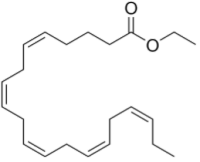
    Vascepa (ethyl eicosapentaenoic acid), Amarin's drug for hypertriglyceridemia and cardiovascular disease, is a purified omega-3 fatty acid eicosapentaenoic acid having the formula:

    Picture2

    The drug is involved in litigation, Amarin having lost its ANDA litigation action against Hikma Pharmaceuticals (see "Amarin Pharma, Inc. v. Hikma Pharmaceuticals USA Inc. (Fed. Cir. 2020)"), although Amarin brought another lawsuit against Hikma in November 2020.

    Nothera (droxidopa), Lundbeck's drug for neurogenic orthostatic hypotension, is a synthetic amino acid analogue that is converted in vivo to norepinephrine and has the formula:

    Picture3

    Several generic challengers are in the offing, including Camber Pharma (which launched its generic in February 2021), Hikma (March 2, 2021), and Zydus Cadila (FDA approval May 2020).

    Narcan (naloxone) is Emergent Biosolutions's drug known for treating opioid overdose and has the formula:

    Picture4

    This drug has been in ANDA litigation with Teva, which received FDA approval in 2019 and invalidated Emergent's Orange Book-listed patents in the district court; that decision is on appeal to the Federal Circuit.  Emergent reached a settlement agreement with Perrigo that licenses the company to bring its generic Narcan to market in 2033 or earlier should Emergent be unable to obtain reversal of the district court's decision invalidating its patents.

    Brovana (arformoterol) is Sunovion's drug for treating chronic obstructive pulmonary disease (COPD).  It is a long-acting β2 adrenoceptor agonist having the formula:

    Picture5

    All Sunovion's patents protecting this drug will expire in 2021, and several generic companies have received tentative FDA approval.

    Sutent (sunitinib), is marketed by Pfizer for the treatment of cancer including gastrointestinal stromal tumors, advanced renal cell carcinoma, and pancreatic neuroendocrine tumors.  It has the formula:

    Picture6

    All the drug's patents expire in 2021, and generic competitors include Glenmark and Mylan (which lost an ANDA litigation over its proposed generic version of the drug in 2010).

    Saphris (asenapine) is AbbVie/Allergan's drug for treating schizophrenia and bipolar disorder.  It has the formula:

    Picture7

    Breckenridge, Alembic, and Sigmapharm launched generic versions of the drug in December 2020.

    Amitiza (lubiprostone) is Mallinckrodt's drug for treating constipation and irritable bowel syndrome.  It has the formula:

    Picture8

    Mallinckrodt recently filed for Chapter 11 bankruptcy.

    Feraheme (ferumoxytol) is an intravenously administered, carbohydrate-coated, superparamagnetic iron oxide (Fe3O4) nanoparticle inorganic product for treating anemia marketed by Amag Pharmaceuticals.  Under the terms of a patent infringement litigation settlement, Sandoz is authorized to launch its generic version in July 2021 (having received FDA approval in January 2021).  Other provisions of this settlement provide for Sandoz to pay royalties to Amag until June 30, 2023 (when the last patent expires) and for Amag to market an authorized generic in July 2022.

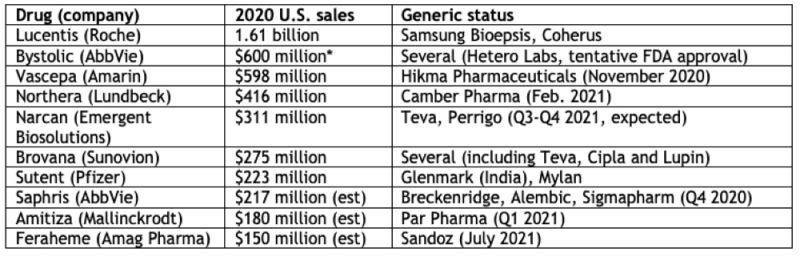
    The economic consequences for these companies can be assessed by their U.S. sales, although as Mr. Saganosky reports, not all of them will be facing generic or biosimilar competition right away (for various reasons including court battles and regulatory approval delays).

    Table* 2019 U.S. sales data

    Mr. Sagonowsky notes that his report is based on information "from numerous sources, including lists of potential generic launches from OptumRxGoodRxGreyB, and Corporate Pharmacy Services, plus company filings, conference calls with analysts, FDA records and more."

  • By Kevin E. Noonan

    SARS-CoV-2Demagogy is never pretty.  When coupled with a species-threatening pandemic, the propensity for the pundit class is to be susceptible to solutions that sound reasonable only to the uninformed.  To make matters worse, some of those "solutions" are proposed by actors creative in using the crisis to advocate positions that benefit their constituencies under the cover of (and preying on) the humanitarian impulses of global elites comfortable in both their privilege and ignorance.  This is particularly dangerous where positions promoted under the cover of beneficence mask long-felt and deep-seated resentments over encouraging, perhaps heavy-handedly, a global trade regime mandating recognition of intellectual property rights in countries adverse to them and that have been successful in chipping away at them for the past 20 years.

    Thus we have calls, specifically by South Africa* and India**, for governments to suspend patent rights during the pandemic, ostensibly for vaccine-related IP but in fact having a much broader scope.  Most in industrialized countries who understand the impact (essentially none) of patents on vaccine production and availability are easily dismissed as speaking from a vested interest (bringing to mind the biblical exhortation against the mote in one's neighbor's eye and the mean in one's own) (see "Sen. Tillis Asks Biden Administration to Oppose WTO Waiver Proposal"; "IP Organizations Support Continued Opposition to Waiver Proposal; Industry Coalition Supports Continued Efforts to Oppose Waiver Proposal"; "BIO and PhRMA Urge Biden Administration to Oppose Proposed WTO TRIPS Waiver"; and "IPO Sends Letter on IP Law and Policy to President-Elect and Vice President-Elect").  But should governments succumb to the siren call of purported humanitarianism to the detriment of a global innovation system that (ironically) provided the innovation ecosystem that produced no fewer than half-dozen effective vaccines against COVID-19 in less than a year, in the face of a threat that even its proponents characterize as "an impediment or the risk of an impediment" to vaccine development, it seems prudent to critically assess whether technology is available for which patents could have the putative preclusive effect procurement and distribution of effective vaccines.

    Such an assessment is provided by Derek Lowe in an article published in February entitled "Myths of Vaccine Manufacturing" in Science Translational Medicine.  He identified the following "steps" of the vaccine-making process (and remember, these steps occur only after the vaccine is developed, tested, and receives regulatory approval):

    Step One: Produce the appropriate stretch of DNA, containing the sequence that you need to have transcribed into mRNA.  This is generally done in bacterial culture.

    Step Two: Produce that mRNA from your DNA template using enzymes in a bioreactor.

    Step Three: Produce the lipids that you need for the formulation.  Some of these are pretty common (such as cholesterol), but the key ones are very much not (more on this below).

    Step Four: Take your mRNA and your lipids and combine these into lipid nanoparticles (LNPs).  I have just breezed past the single biggest technological hurdle in the whole process, and below you will learn why it's such a beast.

    Step Five: Combine the LNPs with the other components of the formulation (phosphate buffers, saline, sucrose and such) and fill those into vials.

    Step Six: Get those vials into trays, into packages, into boxes, into crates, and out the door into trucks and airplanes.

    The last step has been the subject of other analyses (see, e.g., "Latest COVID Conundrum: Accessibility of Vaccines (When They Are Available)") showing that logistics, having nothing to do with patent protection, is fraught with its own limitations, mostly political and financial.

    Evaluating the potential for widespread vaccine production (which is the purported global societal benefit of suspending patent protection), Dr. Lowe moves stepwise (but focuses on Step 4 as the bottleneck step).  For Step 1, he references "Exploring the Supply Chain of the Pfizer/BioNTech and Moderna COVID-19 Vaccines", a blog post by Jonas Neubart.  This post details that "DNA plasmid production on an industrial scale is pretty well worked out" and thus is not a bottleneck in producing mRNA-based vaccines.

    Step 2, transcription, is also not an impediment, albeit not as widely practiced as Step 1 ("RNA production is certainly closer to being rate-limiting than Step One, but it's nothing compared to the real bottlenecks that are coming").

    Nor, according to the post is Step 3 regarding the lipids used to produce the nanoparticle carrier for viral (SPIKE protein) mRNA.  "These are surely not trivial to make on scale, but they're still small molecules with relatively straightforward structures," he says, and "[i]f you had to, you could surely get some other manufacturers up to speed on the process."

    And similarly Steps 5 and 6 are not an issue, because "[e]veryone in this part of the manufacturing business has known for months that a Big Vaccine Push has been coming, and has been cranking up vial manufacturing, bringing all available production lines up to speed, and signing deals all over the place with everyone who has any kind of advanced vaccine effort."

    So far Dr. Lowe sets out conventional pharmaceutical manufacturing technology that is well-established enough that patents and technology are not an impediment.  But as he quotes Neubart as saying, "Welcome to the bottleneck!" in Step 4.  Why?  Because this step involves "[t]urning a mixture of mRNA and a set of lipids into a well-defined mix of solid nanoparticles with consistent mRNA encapsulation."  These methods are done in-house by Moderna and (less certainly) by Pfizer in Kalamazoo and BioNTech in Germany.  Microfluidics are suspected to be the technology used, and these require control of a number of process parameters that, unlike patents, are not disclosed to the public.  And as Dr. Lowe posits, these processes likely require "bespoke" machines made just for this purpose, which are not readily available.

    Dr. Lowe's article was directed to (and frankly prompted by) assertions that there are "dozens" of pharmaceutical companies ready to produce these vaccines, and that this is not the case.  The evidence evinced by Dr. Lowe is relevant to the question of whether patents create an impediment to COVID vaccine production.  It is apparent that, even if there might be circumstances under which intellectual property negatively affects vaccine availability, suspending patent protection is not an effective answer because the rate-limiting step for COVID vaccine production (at least for the mRNA-based vaccines) involves proprietary machines and methods for making the vaccine that are, more than likely, not covered by patents and never will be.

    And that raises the specter of an even more dangerous attack on intellectual property.  Because the technological circumstances set out by Lowe and Neubert involve trade secrets regarding formulation of vaccines are what can be the bottleneck in the process.  But trade secrets are the type of property the rights to which cannot be suspended; disclosure destroys the secret and thus the property.  In the U.S., government seizure of trade secrets might be compensated as a taking (although how effective such compensation would be is in serious question).  But is the U.S. government prepared to compensate not only its own trade secret misappropriation but global dispersion of the "secrets," and just how willing can we expect countries such as India and South Africa (the prime proponents of patent suspension) to provide any compensation whatsoever?  When these facts are considered, the call by these governments (and others) should be understood for what it is:  an attempt to use the pandemic to achieve a goal of status quo ante (prior to the establishment of the GATT/TRIPS/WTO global trade and patent regime), which was imposed upon these and other countries a generation ago.  The COVID pandemic provides the humanitarian excuse for a solution that isn't a solution but that resonates with uninformed (albeit generally well-meaning) politicians, humanitarians, and religious and non-governmental organizations.

    Which is not to say that there are no issues regarding availability of drugs in low- and middle-income countries that need to be addressed (see "The Law of Unintended Consequences Arises in Applying TRIPS to Patented Drug Protection in Developing Countries"; "A Modest Proposal Regarding Drug Pricing in Developing Countries"; "Trying to Find a Solution to the Global Drug Pricing Crisis").  But there are ways to achieve the lofty goals that are at the root of this message.  As Merck as done with Johnson & Johnson, partnering between pharmaceutical companies can increase the number of doses of the vaccine necessary for global vaccination.  Groups like Gavi ("a Geneva-based funder of vaccines for low-income countries"), the WHO, and the Coalition for Epidemic Preparedness Innovations (CEPI), "a fund based in Oslo that was created to finance and coordinate vaccines for outbreaks" can be involved in an concerted effort to obtain vaccine supplies for the rest of the world.  Western governments with "excess" vaccine reserves can use the auspices of these groups to send doses to low- and middle-income countries and economies (LMICS) and even some "wealthier" countries having the economic capacity to defray some or all of the costs.  Indeed, today the Biden Administration announced it would make available "excess" vaccine doses to countries in need.

    And the motivations for such efforts need not rely exclusively on altruism; as has become evident recently the virus has the capacity to mutate in ways that variants of unknown resistance to current vaccines can arise.  Vaccines, particularly the mRNA-base vaccines, may not be effective against these variants (see "Do mRNA-based COVID Vaccines Have an Achilles Heel?") and thus it is in everyone's interest to extend vaccination globally (regardless of how daunting that challenge may be) to reduce the probability of such variants arising.

    SARS-CoV-2 and the COVID pandemic is the greatest global health threat caused by a virus since the influenza pandemic of 1918 (see "The Great Influenza: The Story of the Deadliest Pandemic in History") and, before that, enumerable smallpox outbreaks (see "The Fever of 1721: The Epidemic That Revolutionized Medicine and American Politics").  But the current outcry calls for governments and the rest of us to heed Kipling's admonition regarding the aspiration to "keep your head when all about you/Are losing theirs and blaming it on you."  Let's hope they can do so.

    * Ironically (or perhaps a basis for their position on the patent suppression suggestion), in South Africa "the existing patent system . . . plays a key role in stifling – rather than stimulating – innovation"; see "Do mRNA-based COVID Vaccines Have an Achilles Heel?"

    ** Pathetically, the Indian government has "come[] under fire for forcing states and private buyers to pay more for scarce vaccine even while France and Germany are preparing to send aid (in the form of vaccine doses), according to the Financial Times of London (see "US and Europe to send aid to fight India’s coronavirus surge" (subscription required)).