• By Kevin E. Noonan

    University of California-BerkleyLast week, Junior Party The University of California/Berkeley, the University of Vienna, and Emmanuelle Charpentier (collectively, "CVC") filed its reply to Senior Party The Broad Institute, Harvard University, and the Massachusetts Institute of Technology (collectively, "Broad") motion in opposition (see "Broad Files Motion in Opposition to CVC Priority Motion") to CVC's motion for priority in Interference No. 106,115.

    The Reply is (relatively) direct and to the point (motivated no doubt as much by the page limit in Reply briefs as to the rhetorical force of a short, pithy, to-the-point argument).  (Although to be fair the brief begins with a reminder that the CVC inventors "revolutionized the field of genome editing, giving the world a new system capable of cleaving and editing genes in eukaryotic cells," mixing the irrebuttable with the precise question the Board is asked with answering.)  The critical component of this achievement (no matter who did it) is the development of the combination of the tracr RNA and crRNA into a single guide RNA (sgRNA).  Asserting their multiple instances of earlier conception, CVC contends that these conceptions predated any conception by the Broad's inventors, accompanied by CVC's diligence in achieving reduction to practice.

    The brief also counters Broad's long-running narrative, extending from the earlier interference between these parties (No. 106,048), that those skilled in the art would not have thought performing CRISPR in eukaryotic cells would be a routine extension of CVC's undoubted successes in performing prokaryotic CRISPR.  The brief asserts "new" testimony from its own witnesses (Barrangou and Sontheimer) as well as testimony adduced from Broad's collaborator Dr. Marraffini to the contrary.  The brief attempts to turn the Broad's inventors' achievements against Broad, as being actual corroboration of their assertions, by referencing Dr. Marraffini's testimony suggesting derivation of the sgRNA concept from a scientific talk by one of the CVC inventors, and then contending that the straightforward reduction to practice of this concept by Broad's inventors is actually evidence that doing so was straightforward and routine.

    The brief sets out three reasons why CVC should prevail on the priority question:

    • First, CVC argues earlier conception, coupled with "reasonable diligence" in actual reduction to practice.  And this "definite and permanent idea never changed," according to CVC, evidenced by its use in all later actual reduction-to-practice events.

    • Second, CVC had conceived of a "preformed" CRISPR-Cas9 complex that they showed (on August 9, 2012) could achieve CRISPR-mediated genetic changes in eukaryotic cells by microinjection.  This method for achieving CRISPR in eukaryotic cells occasions none of the technical impediments Broad has asserted against eukaryotic CRISPR, and neither the Count nor the claims-in-interference are limited to specific methods of introducing CRISPR-Cas9 into eukaryotic cells.  In addition, CVC argues with regard to this reason that Broad has not provided any evidence that CVC's diligence was deficient (other than attacking the completeness of CVC's conception based on purported failure of actual reduction to practice attempts).

    • Third, CVC finally gives full-throated voice to their allegation that the Broad inventors derived eukaryotic CRISPR from CVC's scientists.  The allegation is based on the testimony CVC adduced from Dr. Marraffini in his deposition, to the effect that Dr. Marraffini disclosed to the Broad inventors CVC's sgRNA embodiment after learning of it from review of a confidential manuscript and attending a scientific presentation.  This evidence is supported, according to CVC, by evidence from a graduate student working under Dr. Zhang that Broad's experiments relating to eukaryotic CRISPR had "all failed" prior to Dr. Marraffini's disclosure.

    With regard to the first of these reasons, CVC reiterates the evidence it has proffered for conception as early as March 1, 2012.  (While a necessary part of their argument, the facts of CVC's conception(s) are not in dispute; rather, Broad has argued that the history of CVC's attempts to reduce the invention to practice, which is their view was protracted due to the non-routine nature of these experiments, should be held to mean that CVC's conception was not complete until actual reduction to practice, which occurred after Broad's June 26, 2012 conception date.)  CVC's brief in this regard focuses on elements of its conception with respect to various features of the CRISPR-Cas9 system (the presence of a nuclear localization sequence, NLS, for example), as well as the formation of a CRISPR-Cas9 RNP in vitro capable of being introduced into eukaryotic cells by microinjection.  Moreover, CVC argues that the embodiment it relies upon for priority is the same embodiment disclosed in Example 2 of its P3 application (USSN 61/757,640, filed January 28, 2013; see "PTAB Decides Parties' Motions in CRISPR Interference"), for which the Board had recognized its sufficiency as for at least constructive reduction to practice of eukaryotic CRISPR:

    Table 1
    And regarding Broad's assertions that their inventors had "adapted" CRISPR for eukaryotic applications, CVC argues this embodiment had overcome any such impediments:

    Table 2
    Because the Board rendered this decision with regard to their motion for priority benefit, CVC argues, constructive reduction to practice of this embodiment prior to Broad's earliest asserted conception date mandates the Board to grant its motion of priority of claims corresponding to the Count.

    CVC also addressed Broad's various arguments regarding purported deficiencies in its conception, again with reference to this specific embodiment of eukaryotic CRISPR (and characterizing Broad's argument as "fabricat[ing] an illusion of doubt in the inventors' minds by cataloging snippets from 12 various CVC documents").  According to CVC, all Broad's "evidence" of CVC's deficiencies "simply reflect that the inventors understood and considered these routine implementation issues during the process and, at all stages, had a plan to address them," supported by inventor testimony.

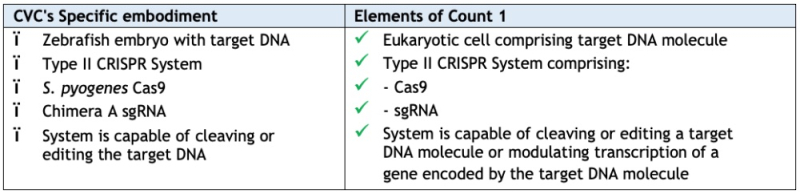
    With regard to CVC's second reason it is entitled to priority judgment, the brief argues complete conception consistent with the elements of Count 1:

    Table 3
    This evidence establishes that CVC's conception was "definite and permanent" according to the brief, again relying on assertions by the Board regarding Example 2 of CVC's P3 priority application.  The brief asserts for the significance of this embodiment as actual reduction to practice regarding Broad's arguments that CVC's conception was deficient:

    There is no need for codon optimization, RNA or protein expression, concomitant folding, and co-localization of RNA and protein, because the complex is already formed before injection.  The use of pre-formed complexes also minimizes RNA and protein degradation, because the complex is protected from cellular factors, as it is in bacterial host cells [Testimony of Dr. Moens, CVC expert witness, italics in brief].

    In addition, CVC's brief sets forth its evidence that "[m]ultiple lab groups used CVC's system with only ordinary skill and routine techniques," as well as testimony from several references regarding expectations of those skilled in the art, as further evidence of complete conception (as well as reiterating its argument that Broad's efficient reduction to practice is actually evidence supporting CVC's complete conception).  Specifically CVC argues:

    The PTAB may not ignore the copious objective evidence showing that CVC and the rest of the field understood the alleged "problem" and knew how to solve it.  . . .  That neither CVC nor others encountered "perplexing intricate difficulties arising every step of the way" or "unduly extensive research or experimentation" when applying CVC's sgRNA CRISPR-Cas9 system in eukaryotic cells confirms the completeness of CVC's 22 conception [citations omitted].

    And the existence of some failures in attempts to practice eukaryotic CRISPR is "irrelevant," according to CVC, because "[t]he law does not require a 100% success rate for attempts at reduction to practice" and "[i]n fact, the law of conception does not require any success rate for reductions to practice."

    CVC also argues that, with regard to its priority motion granted by the Board regarding it P3 priority application, Broad had not argued a lack of diligence in "August, October, and November 2012, and through CVC's constructive reduction to practice in January 2013," but rather had focused these arguments on March and April 2012.  These dates are "outside the critical period" (i.e., between Broad's conception after CVC's asserted March 1, 2012 date of conception, through CVC's actual or constructive reduction to practice) and thus are unchallenged by Broad according to the brief.

    CVC then turns to its legal argument that Broad was attempting to "rewrite conception law" to require a reasonable expectation of success; CVC argues it does not, citing Burroughs Wellcome Co. v. Barr 13 Labs., Inc., 40 F.3d 1223 (Fed. Cir. 1994), and Dana-Farber Cancer Inst., Inc. v. Ono Pharm. Co., 964 F.3d 16 1365, 1372 (Fed. Cir. 2020).  CVC also argues that Broad has mischaracterized Hitzeman v. Rutter, 243 F.3d 1345 (Fed. Cir. 2001), "as requiring both the inventors and a POSA to have a reasonable expectation of success for the inventors to have had a complete conception"; according to CVC, inventors are persons of extraordinary creativity and that the standard is whether here is complete conception in the mind of the inventor rather than a person having ordinary skill in the art.  In any event, CVC argues, its inventors having conceived of and actually reduced to practice the sgRNA CRISPR system "as a pre-formed RNP complex outside of a cell and had a way of delivering the complex into a eukaryotic cell via microinjection" settles the argument.  And if there is any dispute whether CVC's inventors expected CRISPR to be operable in eukaryotic cells, the brief cites contemporaneous statements from both Dr. Doudna and Dr. Charpentier asserting that they did.  The brief also counters Broad's arguments that persons of ordinary skill in the art doubted utility of CRISPR in eukaryotic cells by testimony from witnesses "Raible, Sontheimer, Barrangou, and Marraffini."  Finally, the brief asserts that the purported difficulties of eukaryotic CRISPR did not exist because those impediments would arise (if they did) for protein-mediated methods, whereas CRISPR was fundamentally an RNA-mediated protocol.

    Finally regarding CVC's second basis for the Board to render a decision in its favor on priority, the brief notes its several corroborated instances of actual reduction to practice:  in zebrafish on August 9, 2012 and mammalian cells in October and November 2012.

    As to the third reason for prevailing, derivation, CVC reiterates its evidence and argument that Broad's inventors derived eukaryotic CRISPR from CVC's inventors, specifically with regard to sgRNA embodiments.  The basis for this argument is the testimony by Dr. Marraffini in his deposition regarding his role as a confidential reviewer of a draft paper that eventually published as the Jinek reference; that Dr. Marraffini attended a scientific conference during which CVC's inventor disclosed this embodiment for use in eukaryotic CRISPR; that Dr. Marraffini appreciated its significance; and that he transmitted this information to the Broad inventors.  An important aspect of these allegations is that, according to CVC, Broad's inventor was unaware of the functional significance of the tracr RNA component of the CRISPR-Cas9 complex until Dr. Marraffini informed him of the sgRNA-containing embodiments.  This evidence compels the Board to grant judgment to CVC in this interference according to the brief.

    In conclusion, CVC asserts:

    The law rewards inventors, such has CVC, not those who merely derive and then reduce to practice using ordinary skill.  The CVC inventors, not Zhang, invented the subject matter of Count 1.  Whether applying priority of invention law or derivation law, the PTAB should recognize what the scientific community recognized in awarding the Nobel Prize to Charpentier and Doudna: it was their teamwork that made the tremendous scientific leap forward to allow the world to reap the benefits of a single-guide RNA CRISPR-Cas9 system for genome editing in eukaryotes.  The extensive corroborated evidence of record shows this to be the case, and the PTAB should award priority to CVC.

  • By Kevin E. Noonan

    Federal Circuit SealIn one of the more daring (and somewhat risky) strategies by an appellant challenging an adverse decision in a covered-business method (CBM) review proceeding, New Vision Gaming asserted a purported conflict of interest by Administrative Patent Judges (APJs) in making institution decisions.  According to the Appellant's argument, the pay, bonus, and supervisory structure of the Patent Trial and Appeal Board raised at least the appearance that APJs could be improperly motivated in their own self-interest to institute CBMs and other post-grant review proceedings (see "Appellant Raises Due Process Issues in New Vision Gaming and Development v. SG Gaming").

    New Vision's arguments were unavailing, however, as the Federal Circuit avoided the issue entirely, ruling last week that the Board's decision be vacated and the case remanded for hearing before a constitutionally properly appointed panel.  The basis for this decision is that New Vision had not waived its challenge under Arthrex, Inc. v. Smith & Nephew, now under review by the Supreme Court.  The Federal Circuit's opinion was written by Judge Moore joined by Judge Taranto and in part by Judge Newman, who also dissented-in-part.  It is Judge Newman's dissent that is noteworthy, because Judge Newman believed that the question of whether a contract/license between the parties, designating the District of Nevada as the forum for any dispute, should have precluded the PTAB from asserting jurisdiction (and as a threshold issue might have precluded remand if the PTAB had improperly done so).  The PTAB, intervenor in this appeal, maintained that the jurisdiction issue was not provided for under the America Invents Act (§ 18) and that the Federal Circuit's jurisdiction is restricted under 35 U.S.C. § 324(e).  Petitioner before the PTAB, SG Gaming, argued that the jurisdictional issue was not appealable as an institution decision under Thryv, Inc. v. Click-To-Call Technologies, LP, 140 S. Ct. 1367 (2020).  Judge Newman countered with her own Supreme Court precedent, that "precedent requires respecting an agreed selection of forum," M/S Bremen v. Zapata Off-Shore Co., 407 U.S. 1 (1972).  The Judge also raised Federal Circuit precedent, that "§ 324(e) does not bar review of Board decisions 'separate . . . to the in[stitu]tion decision,'" citing Facebook, Inc. v. Windy City Innovations, LLC, 973 F.3d 1321, 1332 (Fed. Cir. 2020), and that while appeals cannot be taken from the Board's determination of whether a substantial new question of patentability has been raised, Belkin Int'l, Inc. v. Kappos, 696 F.3d 1379 (Fed. Cir. 2012), the Board's conduct of the review (which presumably includes whether there should have been any reviewing conduct at all) is reviewable, citing St. Jude Med., Cardiology Div., Inc. v. Volcano Corp., 749 F.3d 1373 (Fed. Cir. 2014).

    New Vision Gaming & Development, Inc. v. SG Gaming, Inc. (Fed. Cir. 2021)
    Panel: Circuit Judges Newman, Moore, and Taranto
    Opinion by Circuit Judge Moore; opinion concurring in part and dissenting in part by Circuit Judge Newman

  • By Kevin E. Noonan

    Plus ça change, plus c'est la même chose – Jean-Baptiste Alphonse Karr, 1862

    U.S. Trade RepresentativeOr maybe not.  On April 30th, Ambassador Katherine Tai, U.S. Trade Representative (USTR), issued the 2021 Special 301 Report.  In a press release, the USTR stated that "[i]ntellectual property rights incentivize our creators, manufacturers, and innovators to invent new products and technologies."  The press release notes that the review period underlying the Report took place during the COVID-19 pandemic, "the largest global health crisis in more than a century."  Consistent with recent decisions (including support for the proposed WTO IP waiver; see "Biden Administration Supports Waiver of IP Protection for COVID-19 Vaccines"), Ambassador Tai's press release asserts that:

    The top priority of the United States is saving lives and ending the pandemic in the United States and around the world.  As affirmed in the Doha Declaration on the TRIPS Agreement and Public Health, the United States, while recognizing the role of intellectual property (IP) protection in the development of new medicines, respects a trading partner's right to protect public health and, in particular, to promote access to medicines for all.

    The press release also highlights recent successes (IP rights protections and amended laws in China) and setbacks (citing "the European Union's aggressive promotion of its exclusionary geographical indications policies"), as well as providing a preview of the results set forth in the Report.

    According to the Executive Summary of the Report, "[a] priority of this Administration is to craft trade policy in service of America's workers, including those in innovation-driven export industries."  In sharp contrast with Reports issued during the prior administration, here the Summary asserts exhortation that:

    The Report informs the public and our trading partners and seeks to be a positive catalyst for change.  In addition, given the importance of innovation and IP in developing the advances necessary for fighting the ongoing COVID-19 crisis, this Administration is committed to trade policies that seek to save lives in this pandemic and ensure preparedness for the next one.  USTR looks forward to working closely with the governments of the trading partners that are identified in this year's Report to address both emerging and continuing concerns, and to build on the positive results that many of these governments have achieved.

    The Report is promulgated pursuant to Section 182 of the Trade Act of 1974, as amended by the Omnibus Trade and Competitiveness Act of 1988 and the Uruguay Round Agreements Act (enacted in 1994).  The Trade Representative is required under the Act to "identify those countries that deny adequate and effective protection for IPR or deny fair and equitable market access for persons that rely on intellectual property protection."  The Trade Representative has implemented these provisions by creating a "Priority Watch List" and "Watch List."  Placing a country on the Priority Watch List or Watch List is used to indicate that the country exhibits "particular problems . . . with respect to IPR protection, enforcement, or market access for persons relying on intellectual property."  These watch lists are reserved for countries having "the most onerous or egregious acts, policies, or practices and whose acts, policies, or practices have the greatest adverse impact (actual or potential) on the relevant U.S. products."

    The Report also notes the USTR's continued efforts to enhance public engagement.  These efforts were limited to written submissions due to the COVID pandemic and the responses posted online (www.regulations.gov, docket number USTR-2020-0041).  The Report notes that the USTR received submissions from 50 non-government stakeholders and 22 foreign governments.

    The USTR reviewed "more than 100" of this country's trading partners and identified nine countries on a "Priority Watch List" (decreased by one from last year) and another 23 countries on the "Watch List" (the same number as last year), all relating to deficiencies in intellectual property protection in these countries.  The Priority Watch List in the 2020 Report includes Argentina, Chile, China, India, Indonesia, Russia, Saudi Arabia, Ukraine, and Venezuela (Algeria being removed from the list this year).  Countries on this list "present the most significant concerns this year regarding insufficient IP protection or enforcement or actions that otherwise limited market access for persons relying on intellectual property protection."  On the Watch List this year are Algeria, Barbados, Bolivia, Brazil, Canada, Colombia, Dominican Republic, Ecuador, Egypt, Guatemala, Kuwait, Lebanon, Mexico, Pakistan, Paraguay, Peru, Romania, Thailand, Trinidad & Tobago, Turkey, Turkmenistan, Uzbekistan, and Vietnam (the United Arab Emirates being removed from the list this year and Algeria shifting from the Priority Watch List to the Watch List).

    The Report contains two Sections (on "Developments in Intellectual Property Rights Protection and Enforcement" and "Country Reports") and two Annexes on particular issues (the statutory bases of the Report, and government technical assistance and capacity building efforts).

    The Report cites (and emphasizes) significant progress in several U.S. trading partners, including:

    • The United Arab Emirates, which was removed from the Watch List as a consequence of "resolving concerns with IP protection of pharmaceutical products by issuing Decree 321 that, among other things, provides protection against unfair commercial use, as well as unauthorized disclosure, of test or other data generated to obtain marketing approval" as well as addressing "long-standing IP enforcement concerns" in Dubai involving the movement of counterfeit goods;

    • Algeria, which moved from the Priority Watch List to the Watch List as a result of "steps the government has taken to engage and cooperate with stakeholders, improve enforcement efforts, and reduce IP-related market access barriers";

    • Brazil, while still being placed on the Watch List showed improvement in IP protection for cooperating with the U.S. DOJ as well as Homeland Security and their UK counterparts in "seiz[ing] the domain names of multiple commercial websites engaged in the illegal reproduction and distribution of copyrighted works";

    • Taiwan, for amending its trade secret law that resulted in imposition of a $3.4 million fine and 5-6 year prison sentence for stealing trade secrets related to semiconductor technology;

    • Peru, for enforcing actions against entities involved in pirating music and film from local websites showing U.S. stakeholder-owned copyrighted works;

    • Ukraine, which "continued to take positive steps in 2020 toward a transparent, fair, and predictable system for the collective management of royalties."

    Also noted in this section of the Report were member states participating in the 1991 Act of the International Union for the Protection of New Varieties of Plants Convention, with Saint Vincent and the Grenadines acceding to the treaty in 2020, and the WIPO Internet Treaties (the World Intellectual Property Organization (WIPO) Performances and Phonograms Treaty and the WIPO Copyright Treaty), with Afghanistan, Comoros, San Marino, and Vanuatu acceding to these treaties in 2020.

    Another Section of the Report involves "illustrative best practices" by U.S. trading partners.  These include "cooperation and coordination among national government agencies involved in IP issues is an example of effective IP enforcement," citing Thailand, India, Saudi Arabia, Brail, and Indonesia for these efforts; "specialized IP enforcement units," including those in Brazil, Malaysia, and India; "IP awareness and educational campaigns" in Spain, India, Thailand, and Vietnam; and "active participation of government officials in technical assistance and capacity building" in Singapore, Romania, Taiwan, Algeria, India, and Cambodia.  Micro-, small- and medium-sized enterprises (MSMEs) were particularly noted as "contribut[ing] widely to innovation, trade, growth, investment, and competition" and thus the Report applauds efforts in Hing Kong, the UK, Canada, and Mexico to support these businesses.

    Cooperation rather than confrontation is a running theme in this report, where the USTR sets forth its plan for improving trade relations and protection of U.S. stakeholders IP, including efforts to:

    • Engage with U.S. stakeholders, the U.S. Congress, and other interested parties to ensure that the U.S. Government's position is informed by the full range of views on the pertinent issues;

    • Conduct extensive discussions with individual trading partners regarding their respective IP regimes;

    • Encourage trading partners to engage fully, and with the greatest degree of transparency, with the full range of stakeholders on IP matters;

    • Develop an action plan with benchmarks for each country that has been on the Priority Watch List for at least one year to encourage progress on high-priority IP concerns; and

    • Identify, where possible, appropriate ways in which the U.S. Government can be of assistance.

    And to reinforce the tone, the USTR states the US "will conduct these discussions in a manner that both advances the policy goals of the United States and respects the importance of meaningful policy dialogue with U.S. trading partners."

    Multilateral and bilateral initiatives are discussed.  Perhaps significantly the primary multilateral initiative called out in the Report is the WTO, with regard to which the Report states that "[i]n the past year, the United States co-sponsored discussions in the TRIPS Council on the positive and mutually reinforcing relationship between the protection of IP, innovation, and business development."  Bilateral agreements mentioned in the Report include various Trade and Investment Framework Agreements (TIFAs) between the U.S. and several ("more than 50") trading partners, discussing specifically such arrangements with Pakistan, Argentina, Nepal, Central Asia countries, and Fiji.  The United States-Mexico-Canada Agreement, updating and revising NAFTA, is one such trilateral agreement which the Report states "secur[ed] strong improvements in the protection and enforcement of IP."  The UK's exit from the European Union is recited as providing "new opportunities for the United States to expand and deepen our existing relationship with the UK," which include strengthening IP protection and continuing efforts begun in the last administration to "review . . . the status and objectives of the United States-UK Free Trade Agreement (FTA) to inform our next steps with the UK."  Agreements with the EU was also not neglected, as were negotiations started in July 2020 to negotiate a trade agreement with Kenya.

    Turning to specific issues of concern, trademark counterfeiting is said to harm "consumers, legitimate producers and governments."  The problem is one with global scale, "and involved the production, transshipment, and sale of a vast array of fake goods . . . including semiconductors and other electronics, chemicals, medicines, automotive and aircraft parts, food and beverages, household consumer products, personal care products, apparel and footwear, toys, and sporting goods."  Many of these goods rise in China, whereas India is called out as a source of counterfeit medicines and Turkey for counterfeit apparel and foodstuffs.  Such goods are transshipped according to the Report through hubs in Hong Kong, Turkey and the UAE and sold in markets in Brazil, Nigeria, and Paraguay.

    Counterfeit pharmaceuticals are of particular concern, having "important consequences for consumer health and safety [that are] exacerbated by the rapid growth of illegitimate online sales . . . [and] contributes to the proliferation of substandard, unsafe medicines that do not conform to established quality standards."  Most of these goods confiscated by the U.S. were transshipped through China, Hong Kong, India, Canada, and the Dominican Republic and arose from China, India, the Philippines, Vietnam, Indonesia, and Pakistan (according to a report by OECD/EUIPO).  Counterfeit oncology drugs are produced by Bangladesh and Myanmar according to industry sources and "significant quantities of[counterfeit]  COVID-19 testing kits, personal protective equipment (PPE) such as N-95 and equivalent masks, and sanitizers, detergents, and disinfectants" were sourced from China and Vietnam.  These problems are exacerbated by use of legitimate delivery services and online pharmacy sites, particularly those involved in consumer-to-consumer sales, according to the Report.  The remedy again is cooperation, cajolery, and consultation:

    The United States continues to urge trading partners to undertake more effective criminal and border enforcement against the manufacture, import, export, transit, and distribution of counterfeit goods.  The United States engages with its trading partners through bilateral consultations, trade agreements, and international organizations to help ensure that penalties, such as significant monetary fines and meaningful sentences of imprisonment, are available and applied to deter counterfeiting.  In addition, trading partners should ensure that competent authorities seize and destroy counterfeit goods, as well as the materials and implements used for their production, thereby removing them from the channels of commerce.  Permitting counterfeit goods and enabling materials to re-enter the channels of commerce after an enforcement action waste resources and compromise the global enforcement effort.

    The Report does not ignore enforcement, but identifies countries (Columbia, Indonesia, and Turkey) and practices that fall short of adequate efforts.

    Online and broadcast piracy are also discussed, the Report noting that while "[t]he increased availability of broadband Internet connections around the world, combined with increasingly accessible and sophisticated mobile technology, has been a boon to the U.S. economy and trade," "technological developments have also made the Internet an extremely efficient vehicle for disseminating pirated content, thus competing unfairly with legitimate e-commerce and distribution services that copyright holders and online platforms use to deliver licensed content."  Sources of counterfeit optical disks mentioned in the Report include China, India, Mexico, and Pakistan, with Argentina, Canada, Chile, China, Colombia, the Dominican Republic, India, Mexico, the Netherlands, Romania, Russia, Switzerland, Thailand, Ukraine, and Vietnam being identified as "hav[ing] high levels of online piracy and lack effective enforcement" estimated as costing the U.S. economy "at least $29.2 billion and as much as $71 billion in lost revenue each year."  A particular form of copyright piracy (particularly of music), termed "streamripping," is practiced (or ineffectively prevented) in Canada, Mexico, the Netherlands, Sweden, and Switzerland.  Technology including illicit Internet Protocol Television (IPTV) services that "unlawfully retransmit telecommunications signals and channels containing copyrighted content through dedicated web portals and third-party applications that run on ISDs or legitimate devices" was used at high levels in Argentina, Brazil, Chile, China, Guatemala, Hong Kong, Indonesia, Iraq, Mexico, Saudi Arabia, Singapore, Switzerland, Taiwan, Thailand, Ukraine, and Vietnam.  China, according to the Report, with Iraq being identified as being a source of satellite receivers having "preloaded" pirate IPTV applications.  Also noted were the use of camcorders to produce expropriated contend, in Russia, India, and China, with impediments to counteracting such illicit activities found in Argentina, Brazil, Ecuador, India, Peru, and Russia (which don't effectively criminalize such activities).  The significance of the problem was synopsized in the Report as follows:

    In addition to the distribution of copies of newly released movies resulting from unauthorized camcording, other examples of online piracy that damage legitimate trade are found in virtually every country listed in the Report and include: the unauthorized retransmission of live sports programming online; the unauthorized cloning of cloud-based entertainment software, through reverse engineering or hacking, onto servers that allow users to play pirated content online, including pirated online games; and online distribution of software and devices that allow for the circumvention of TPMs, including game copiers and mod chips that allow users to play pirated games on physical consoles.  Piracy facilitated by online services presents unique enforcement challenges for right holders in countries where copyright laws have not been able to adapt or keep pace with these innovations in piracy.

    Difficulties in trade secret protection has its own subsection of the Report.  The problems of adequately protecting trade secrets have arisen "in a wide variety of industry sectors, including Information Communications Technology (ICT), services, pharmaceuticals and medical devices, environmental technologies, and other manufacturing sectors, rely on the ability to protect and enforce their trade secrets and rights in proprietary information" and include theft of "business plans, internal market analyses, manufacturing methods, customer lists, and recipes" that "are often among a company's core business assets," according to the Report.  The Report states that trade secret protection (or lack of it) is a particular problem in Russia, China, and India.  Certain U.S. trade partners have made successful efforts in 2020 (including the EU and Taiwan, as well as aspects of the trade deal struck between the U.S. and China last year; see "U.S. and China Approve Trade Agreement: Part 1"), the Report calls for action by international organizations such as the OECD and APEC.

    Another subsection of the Report involved "forced" technology transfer, indigenous innovation, and preferences for indigenous IP.  These include the following activities, many of which involved governmental action:

    • Requiring the transfer of technology as a condition for obtaining investment and regulatory approvals or otherwise securing access to a market or as a condition for allowing a company to continue to do business in the market;

    • Directing state-owned enterprises in innovative sectors to seek non-commercial terms from their foreign business partners, including with respect to the acquisition and use or licensing of IP;

    • Providing national firms with an unfair competitive advantage by failing to effectively enforce, or discouraging the enforcement of, U.S.-owned IP, including patents, trademarks, trade secrets, and copyright;

    • Failing to take meaningful measures to prevent or to deter cyber intrusions and other unauthorized activities;

    • Requiring use of, or providing preferences to, products or services that contain locally developed or owned IP, including with respect to government procurement;

    • Manipulating the standards development process to create unfair advantages for national firms, including with respect to participation by foreign firms and the terms on which IP is licensed; and

    • Requiring the submission of unnecessary or excessive confidential business information for regulatory approval purposes and failing to protect such information appropriately.

    China and Indonesia are recognized for such practices.

    As in other years, geographical indications (i.e., country or region of origin limitations primarily for wine and foodstuffs) are discussed, specifically in the EU.  This is particularly troubling for trademarks, the Report stating that "[t]he EU GI agenda remains highly concerning, because it significantly undermines the scope of trademarks held by U.S. producers and imposes barriers on market access for U.S.-made goods that rely on the use of common names, such as parmesan or feta."  These practices are particularly troublesome for MSMEs, according to the Report, because their trademarks are "among the most effective ways for producers and companies . . . to create value, to promote their goods and services, and to protect their brands."  Also a specific concern for the U.S. is that these GI practices produce a trade barrier to U.S. goods in the EU, particularly when GI protection is given to "common names" for a product (Havarti and danbo cheese being given as examples).  The effects of these practices are exacerbated by the "significant deficit in food and agricultural trade" between the US and the EU (with Europe exporting $1 billion in cheese to the U.S. versus $5.5 million of U.S. cheese being imported by the EU).  While having little luck dissuading the EU from continuing and expanding its GI practices, the Report cites several bilateral agreements (with Argentina, Australia, Brazil, Canada, Chile, China, Ecuador, Indonesia, Japan, Kenya, Korea, Mexico, Morocco, New Zealand, Paraguay, the Philippines, Singapore, Tunisia, Ukraine, Uruguay, Vietnam, and others) that have a number of provisions aimed at curtailing some of the deleterious effects of GI protection.

    With regard to pharmaceuticals and medical devices and market access for U.S. products, the Report contends that "[t]he COVID-19 pandemic has highlighted the importance of pharmaceutical, medical device, and other health-related innovation, as well as a lack of widespread, equitable distribution of these innovations," including the need for fighting the current as well as future pandemics.  The Report cites tariffs and other taxes levied by countries including Brazil, India, and Pakistan, as well as "unreasonable regulatory approval delays and non-transparent reimbursement policies" that "discourage the development and marketing of new drugs and other medical products."  The Report recites successful efforts in Canada, Mexico, Chine, the UAE, Korea, Japan, and Indonesia to address issues of transparency and fairness in this sector.  On the other hand, the Report also notes that stakeholders have "expressed concerns" about practices in Australia, Canada, China, Japan, Korea, New Zealand, and Turkey, "on issues related to pharmaceutical innovation and market access."

    Trademark issues are noted in the Report for China, India, Malaysia, the Philippines, Panama, Russia, Iraq South Africa, Kuwait, Oman, and the UAE with regard to "bad faith" trademark applications, slow opposition and cancellation proceedings, and delays in processing trademark applications.  Mandatory recordation requirements that impose "unnecessary administrative and financial burdens on trademark owners and create difficulty in the enforcement and maintenance of trademark rights" are asserted for Brazil, Ecuador, Egypt, and Spain.  Specific examples of trademark issues, including "unauthorized domain name registration and trademark uses in some country code top-level domain names," and copyright royalty collection issues have arisen in India and the UAE.

    Software concerns included in the Report involve government use of unlicensed software (costing $46 billion globally in 2018 according to The Software Alliance).  This issue is particularly noted in Argentina, China, Guatemala, Indonesia, Pakistan, Paraguay, Romania, Thailand, Turkey, Turkmenistan, Ukraine, Uzbekistan, and Vietnam but the Report states that "[t]he United States continues to work with other governments to address government use of unlicensed software, particularly in countries that are modernizing their software systems or where there are infringement concerns."

    As in prior years, the Report sets forth subsections on IP and the environment (stating that "[s]trong IP protection and enforcement are essential to promoting investment in innovation in the environmental sector" which "not only promotes economic growth and supports jobs, but also is critical to responding to environmental challenges) and IP and health.  This latter discussion is focused (perhaps inevitably) on the COVID pandemic.  Here, the "top priority" is "saving lives and ending the pandemic in the United States and around the world" (rather than protecting IP as it is throughout the other sections of the Report).  With a nod to the international consequences of the prior administration, the Report states that "[a]s part of rebuilding U.S. alliances, the United States is exploring every avenue to coordinate with the global community and is evaluating the efficacy of proposals in multilateral fora, including the WTO, by their true potential to save lives, end this pandemic, and respond to the next one."

    This section also includes an extensive discussion of the provisions of the TRIPS agreement, the Doha Declaration, and Article 31 TRIPS regarding compulsory licenses.  The USTR through this Report states that the U.S. "strongly supports the WTO General Council Decision on the Implementation of Paragraph 6 of the Doha Declaration on the TRIPS Agreement and Public Health" (which permits member states to issue compulsory licenses to export pharmaceuticals to countries who cannot produce these drugs themselves).  Also included in the Report is a section devoted to implementation of the TRIPS Agreement with regard to the requirement for "certain minimum standards of IP protection and enforcement."

    Finally, the Report notes that the U.S. "continues to monitor the resolution of concerns and disputes announced in previous Reports" and "will use all available means to resolve concerns, including bilateral dialogue and enforcement tools such as those provided under U.S. law, the WTO, and other dispute settlement procedures, as appropriate."

    Section II of the Report is a detailed, country-by-country discussion for each country on the Priority Watch List and the Watch List, relating to the activities (or lack thereof) of each country that results in placement of that country on these lists.

    As it has for the past several years (and across otherwise very different Administrations), the U.S. Trade Representative Special 301 Report provides insights into both the concerns of U.S. IP rights holders and the Administration's intentions to work with other countries to increase protection for IP rights of U.S. IP rights holders.  While enunciating U.S. interests and policies consistent with earlier Reports, this Report is notable for the lack of specific and detailed discussions of individual countries' deficiencies with regard to respecting IP rights, particularly U.S. stakeholders' IP rights.  It lacks some of the more broad-brush accusations or assertions against our trade partners, and uses more conciliatory language espousing cooperation rather than confrontation.  And it is very different in tone from earlier Reports wherein the complaints, and even the language enunciating these complaints, has remained dispiritingly the same, suggesting that despite pronouncements of small victories efforts to reduce unfair trade practices globally have fallen far short.  Consistent with other actions, real and symbolic, made by the Biden Administration, the USTR through this Report seems to be offering something of an olive branch to our trade partners.  The stick hasn't been particularly effective in promoting IP-respecting behavior in the past; perhaps the carrot(s) contained in this Report will have more success.

    For additional information regarding this and other related topics, please see:

    • "U.S. Trade Representative Releases 2020 Special 301 Report," May 10, 2020
    • "U.S. Trade Representative Releases 2019 Special 301 Report," April 29, 2019
    • "U.S. Trade Representative Releases 2018 Special 301 Report," April 29, 2018
    • "U.S. Trade Representative Issues 2017 Special 301 Report," May 4, 2017
    • "U.S. Trade Representative Issues 2016 Special 301 Report," May 19, 2016
    • "U.S. Trade Representative Issues 2015 Special 301 Report," April 30, 2015
    • "U.S. Trade Representative Issues 2014 Special 301 Report," May 19, 2014
    • "U.S. Trade Representative Issues 2013 Special 301 Report," May 30, 2013
    • "U.S. Trade Representative Issues 2012 Special 301 Report," May 1, 2012
    • "U.S. Trade Representative Releases Special 301 Report on Global IPR," May 4, 2011
    • "U.S. Trade Representative Releases Special 301 Report on Global IPR," May 19, 2010
    • "New Administration, Same Result: U.S. Trade Representative's Section 301 Report," May 6, 2009
    • "Congressmen Criticize U.S. Trade Representative over Special 301 Report," July 1, 2008
    • "U.S. Continues Efforts to Protect Patent Rights Abroad," April 29, 2008

  • CalendarMay 25, 2021 – "A Year in Review: PTAB Practice Updates, the Impact of COVID, and Lessons Learned Along the Way" (Intellectual Property Law Association of Chicago AIA Trials Committee) – 10:00 to 11:00 am (CT)

    May 25, 2021 – "Immunology and the Patentability and Enforcement of Immunotherapies" (IPWatchdog and Morningside IP) – 12:00 pm (ET)

    May 25, 2021 – "Inventor Diversity: How to Obtain and Leverage Inventor Gender Diversity Metrics" (Intellectual Property Owners Association) – 2:00 pm to 3:00 pm (ET)

  • IPLACThe Intellectual Property Law Association of Chicago (IPLAC) AIA Trials Committee will be presenting a fireside chat entitled "A Year in Review: PTAB Practice Updates, the Impact of COVID, and Lessons Learned Along the Way" on May 25, 2021 from 10:00 to 11:00 am (CT).  Vice Chief Administrative Patent Judge Michael Tierney of the U.S. Patent and Trademark Office's Patent Trial and Appeal Board and George "Trey" Lyons, III of McDonnell Boehnen Hulbert & Berghoff LLP will look at changes to, and the impact of the COVID-19 pandemic on, AIA Trial Proceedings, including: discretionary denials, motion to amend pilot program, § 101, and appealability, as well as lessons learned from the pandemic that will influence PTAB practice moving forward.

    The panel discussion is free for IPLAC members.  Those interested in registering for event can do so here.

  • IPWatchdogIPWatchdog and Morningside IP and will be offering a webinar entitled "Immunology and the Patentability and Enforcement of Immunotherapies" on May 25, 2021 at 12:00 pm (ET).  Carla Mouta-Bellum of Arrigo, Lee, Guttman & Mouta-Bellum, LLP; Rachel Elsby of Akin Gump Strauss Hauer & Feld, LLP; and Gene Quinn of IPWatchdog, Inc. will discuss ongoing research and development, patenting activities and pitfalls, as well as patent enforcement and infringement in cancer immunotherapy.

    There is no registration fee for this webinar.  However, those interested in registering for the webinar, should do so here.

  • IPO #2The Intellectual Property Owners Association (IPO) will offer a one-hour webinar entitled "Inventor Diversity: How to Obtain and Leverage Inventor Gender Diversity Metrics" on May 25, 2021 from 2:00 pm to 3:00 pm (ET).  David Andrews of Aon IP Solutions, Justin Cook of Nielsen, and Suzanne Harrison of Percipience LLC will walk through the practical steps of how to generate data indicating the extent of gender diversity amongst an entity's inventor community, and also discuss the opportunities to leverage this data to drive organizational change by reporting metrics on a regular cadence while iterating on an entity's internal efforts to improve inventor gender diversity.

    The registration fee for the webinar is $150 for non-members or free for IPO members (government and academic rates are available upon request).  Those interested in registering for the webinar can do so here.

  • By Kevin E. Noonan

    Federal Circuit SealThe Federal Circuit continues its recent run of decisions extending the reach of the enablement requirement of 35 U.S.C. 112(a) to invalidate patents in Pacific Biosciences of California, Inc. v. Oxford Nanopore Technologies, Inc. (albeit in this case, affirming denial of motion for JMOL in the face of a jury verdict of non-enablement).

    The matter arose when Pacific Biosciences asserted U.S. Patent Nos. 9,546,400 and 9,772,323 directed to methods for sequencing nucleic acid (DNA) using nanopore technology.  As explained in the opinion, the DNA being sequenced passes through the nanopores causing a change in electrical current specific for each nucleotide base (which is then recognized by the machine).  Pacific Biosciences asserted Claim 1 of the '400 patent:

    1.  A method for sequencing a nucleic acid template comprising:
        a) providing a substrate comprising a nanopore in contact with a solution, the solution comprising a template nucleic acid above the nanopore;
        b) providing a voltage across the nanopore;
        c) measuring a property which has a value that varies for N monomeric units of the template nucleic acid in the pore, wherein the measuring is performed as a function of time, while the template nucleic acid is translocating through the nanopore, wherein N is three or greater; and
        d) determining the sequence of the template nucleic acid using the measured property from step (c) by performing a process including comparing the measured property from step (c) to calibration information produced by measuring such property for 4 to the N sequence combinations.

    A jury found that Oxford infringed the asserted claims but that the claims were invalid for failure to satisfy the enablement requirement, based in part on conflicting testimony from each party's experts.  The District Court denied Pacific Biosciences' pos-trial motion for judgment as a matter of law (JMOL), leading to this appeal.

    The Federal Circuit affirmed, in an opinion by Judge Taranto, joined by Judges Lourie and Stoll.  According to the opinion, "[w]hat matters is the scope of the asserted claims," which in relevant part extended to determining the sequence of a template nucleic acid without any limitation regarding the "character" of the nucleic acid, including differentiating between "particular types of DNA" (what the Court understood any of this to mean is unclear).  The opinion discusses the relevance of the "N nucleotides" limitation in the claims, which was one basis for Oxford's expert's testimony that the claims were not enabled.  The opinion also notes testimony from more than one witness that nanopore sequencing technology was not performed in the art until 2011 (after the 2009 priority dates of the patents at issue) and not based on the disclosures of those patents.  The opinion notes also that Pacific Biosciences' specification was constructive and that there was no "real-world reduction to practice" achieved at the time of filing.  (There was also evidence presented to the jury that Pacific Biosciences had intended to "'tangle . . . up' and 'fool' competitors with its patents" which the opinion understood might have pointed the jury away from deciding that Pacific Biosciences had an enabled method.)  The remainder of the panel's opinion on enablement was focused on whether the District Court properly denied Pacific Biosciences' motion for JMOL and whether the jury could reasonably have arrived at its verdict in view of the conflicting testimony of the witnesses.  The panel stated that in its opinion "there was ample evidence to support a finding that, before the 2009 priority date of the '400 and '323 patents, relevant artisans did not know how to perform nanopore sequencing for more than a narrow range of the full scope of nucleic acids covered by the asserted claims," citing Idenix Pharms. LLC v. Gilead Sciences Inc., 941 F.3d 1149 (Fed. Cir. 2019), Enzo Biochem, Inc. v. Calgene, Inc., 188 F.3d 1362 (Fed. Cir. 1999), and Union Carbide Chems. & Plastics Tech. Corp. v. Shell Oil Co., 308 F.3d 1167 (Fed. Cir. 2002), in support.

    But as Paul Harvey used to say, here's the rest of the story (which has nothing to do with patent law and as such is discussed herein subservient to the patent law aspects of the decision).  The trial was held beginning on March 9, 2020, and Pacific Biosciences was concerned that Oxford not be able to intimate to the jury that finding its patents infringed and not invalid would hamper efforts to combat COVID-19 (specifically based on Pacific Biosciences' status as a non-practicing entity or its patent being a "paper patent").  To this end, Pacific Biosciences sought and received a motion in limine that Oxford not be able to make or hint any such conclusion to the jury.  Both parties mentioned the pandemic in their opening statements, but Pacific Biosciences objected to how Oxford made its mention of the issue (and obtained a curative instruction from the Court the next day).  The judge also admonished both parties not to "'turn this really into a trial about an ongoing global health crisis that has to be on the minds of the jury,' which would be 'unfair' and 'improper' and would 'inflam[e] the jury' and 'would create a real risk of a verdict' not based on the evidence."  Pacific Biosciences raised similar objections to Oxford's closing argument.  In addition to its motion for JMOL, Pacific Biosciences moved under Rule 59 for a new trial, based on undue prejudice caused by Oxford's violation of the motion in limine; the District Court denied this motion because Pacific Biosciences did not provide evidence that Oxford had violated the in limine motion after its statements in its opening argument or that the jury had been inflamed by those statements.

    The Federal Circuit also affirmed the District Court's denial of the motion for a new trial.  One solid basis for this decision is that the panel opined that the District Court's views of the matter should be given "considerable weight" in view of that court's being in a better position to observe the demeanor of the jury, party counsel, and witnesses, citing Draper v. Airco, Inc., 580 F.2d 91, 97 (3d Cir. 1978) (the Federal Circuit applying Third Circuit law to this question).  Another basis in the opinion was that Pacific Biosciences did not object when presented with advance notice that Oxford intended to make the purportedly inflammatory statements.  Further, the opinion notes that the District Court gave just the curative instruction Pacific Biosciences requested the day after the purported violation occurred, and required each party inform each other of any further instances of argument or testimony related to COVID-19 before eliciting testimony or making arguments to the jury.  Accordingly, the opinion asserts that "[g]iven all the circumstances, we do not see a basis for disturbing the district court's assessment that there was an insufficient likelihood that the improper opening remarks had an adverse impact on the ultimate verdict to justify a new trial in this case."

    Pacific Biosciences of California, Inc. v. Oxford Nanopore Technologies, Inc. (Fed. Cir. 2021)
    Panel: Circuit Judges Lourie, Taranto, and Stoll
    Opinion by Circuit Judge Taranto

  • By Kevin E. Noonan

    Federal Circuit SealLast month, the Federal Circuit affirmed an exclusion order imposed by the International Trade Commission against Bio-Rad for importing infringing microfluidic systems and components used for gene sequencing or related analyses, in Bio-Rad Laboratories, Inc. v. Int'l. Trade Comm.

    The ITC's decision followed a complaint by 10X Genomics, an intervenor in this appeal, for infringement of U.S. Patent Nos. 9,689,024, 9,695,468, and 9,856,530.  An ITC Administrative Law Judge found importation of the accused articles infringed claims in each of the asserted patents, that Bio-Rad had not established that the patents were invalid, and that 10X Genomics practiced the claims (and thus satisfied the "domestic industry" requirement of the Tariff Act of 1930, 19 U.S.C. § 1337(a)(2)).  Also, the ALJ rejected Bio-Rad's affirmative defense that it was a co-owner of these patents under terms of a prior employment contract with certain of the inventors.

    The following claims are representative for each of the asserted patents:

    Claim 1 of the '024 patent:

    1.  A method for sample preparation, comprising:
        a) providing a droplet comprising a porous gel bead and a target nucleic acid analyte, wherein said porous gel bead comprises at least 1,000,000 oligonucleotide molecules comprising barcode sequences, wherein said oligonucleotide molecules are releasably attached to said porous gel bead, wherein said barcode sequences are the same sequence for said oligonucleotide molecules;
        b) applying a stimulus to said porous gel bead to release said oligonucleotide molecules from said porous gel bead into said droplet, wherein upon release from said porous gel bead, a given oligonucleotide molecule from said oligonucleotide molecules attaches to said target nucleic acid analyte; and
        c) subjecting said given oligonucleotide molecule attached to said target nucleic acid analyte to nucleic acid amplification to yield a barcoded target nucleic acid analyte.

    Claim 1 of the '468 patent:

    1.  A method for droplet generation, comprising:
        (a) providing at least 1,000,000 oligonucleotide molecules comprising barcode sequences, wherein said barcode sequences are the same sequence for said at least 1,000,000 oligonucleotide molecules, wherein said at least 1,000,000 oligonucleotide molecules are releasably attached to a bead, wherein said bead is porous;
        (b) combining said at least 1,000,000 oligonucleotide molecules and a sample comprising a nucleic acid analyte each in an aqueous phase at a first junction of two or more channels of a microfluidic device to form an aqueous mixture comprising said at least 1,000,000 oligonucleotide molecules attached to said bead and said sample; and
        (c) generating a droplet comprising said at least 1,000,000[ ]oligonucleotide molecules attached to said bead and said sample comprising said nucleic acid analyte by contacting said aqueous mixture with an immiscible continuous phase at a second junction of two or more channels of said microfluidic device.

    Claim 1 of the '530 patent:

    1.  A method for nucleic acid preparation or analysis, comprising:
        (a) providing:
            (i) at least 1,000 gel beads;
            (ii) releasably attached to each of said at least 1,000 gel beads, at least 1,000 barcode molecules comprising identical barcode sequences that are distinct from barcode sequences of at least 1,000 barcode molecules releasably attached to any other gel bead of said at least 1,000 gel beads; and
            (iii) a plurality of cells each comprising a plurality of polynucleotide molecules;
        (b) generating a plurality of droplets, wherein at least 1,000 droplets of said plurality of droplets each comprise:
            (i) a single gel bead from said at least 1,000 gel beads; and
            (ii) a single cell from said plurality of cells; and
        (c) in each of said at least 1,000 droplets, using said plurality of polynucleotide molecules from said single cell and barcode molecules of said at least 1,000 barcode molecules from said single gel bead to generate a plurality of barcoded polynucleotide molecules,
        wherein said barcode molecules become detached from said gel bead.

    The factual history as set forth in the Federal Circuit's opinion is as follows.  Two of the named inventors of the asserted patents previously worked for a company (QuantaLife, Inc.) that was thereafter acquired by Bio-Rad.  These inventors had agreed in their employment contracts with QuantaLife to promptly disclose and assign to the company "the full details of any and all ideas, processes, recipes, trademarks and service marks, works, inventions, discoveries, marketing and business ideas, and improvements or enhancements to any of the foregoing ("IP")" that they "conceive[d], develop[ed] or create[d] alone or with the aid of others during the term of Employee's employment with the Company," and assign any such IP to the company (emphasis added).  These inventors signed similar agreements with Bio-Rad after the acquisition.

    These inventors then left Bio-Rad in April 2012 and formed 10X Genomics in July 2012, where they developed the technology claimed in the asserted patents.  As set forth in the opinion, the 10X Genomics technology had a "gel bead in emulsion" (GEM) architecture that differed from the more conventional "capsule-in-capsule and capsule-in-droplets architecture."  The relevant features of this technology as claimed included that it "involves 'partitioning nucleic acids, DNA or RNA, in droplets together with gel beads that are used to deliver the barcodes into the droplet,' where the 'barcodes are released from the gel beads using a stimulus.'"  According to the opinion, there was no evidence that the inventors conceived of their technology prior to January 2013.

    The basis for 10X Genomics' complaint was that Bio-Rad's products practiced the invention claimed in each asserted patent.  With regard to the '024 patent, the ALJ determined that Bio-Rad's accused methods practiced the step of "applying a stimulus to said porous gel bead to release said oligonucleotide molecules from said porous gel bead" (emphasis in opinion).  Bio-Rad unsuccessfully contended that the stimulus in its method acted on the oligonucleotides themselves rather than the gel bead, but the ALJ held (and the Commission affirmed) that the oligonucleotides were part of the gel bead and thus Bio-Rad's method satisfied this limitation.  For the '468 patent, Bio-Rad argued a distinction over the claim requirement of  "combining said at least 1,000,000 oligonucleotide molecules and a sample comprising a nucleic acid analyte . . . at a first junction of two or more channels of a microfluidic device to form an aqueous mixture."  Bio-Rad argued that the sample and oligonucleotide combination did not form an aqueous mixture at the first junction of the apparatus but were separate until droplets formed thereafter.  The ALJ disagreed based on testimony from 10X Genomics' expert, and the Commission agreed.  Concerning the '530 patent, Bio-Rad argued that its method did not fulfill the ALJ's construction of the claim that the second step (generating at least 1,000 droplets) was complete prior to the third step ("generating a plurality of barcoded polynucleotide molecules").  Bio-Rad supported this argument by the contention that the enzymes that provide the stimulus in its product "begin to form barcoded molecules immediately upon droplet formation" rather than after at least 1,000 droplets are formed.  The ALJ rejected this argument because the evidence showed that in practice the enzyme did not act sufficiently quickly to have "finish[ed] cleaving all barcoded molecules from the gel bead within the droplets before 1,000 droplets are formed."

    The ALJ also rejected Bio-Rad's assertions that the 10X Genomics' product did not practice the invention claimed in the '530 patent any more than its own product did, a decision affirmed by the Commission on a slightly different basis, as well as rejecting Bio-Rad's argument that the claims of the '530 patent were indefinite.

    Turning to Bio-Rad's affirmative defense that it was a co-owner of the asserted patents, the ALJ rejected the argument because there was no evidence that the invention(s) claimed in these patents had been conceived prior to January 2013 (after the inventors had left Bio-Rad's employ) and "'[n]o provision of any of the applicable contracts governs future inventions' merely because the future inventions 'are based on or developed from work done during employment.'"  In agreeing, the Commission also stated that the "ideas" identified by Bio-Rad purportedly worked on by the inventors during their employment terms were too "generic" to support co-ownership because the lacked the specifics required by the claims (and in particular that their work at Bio-Rad involved "droplet-in-droplet" not "gel-bead" architecture).  Also supporting the Commission's decision was their determination that many of the ideas asserted by Bio-Rad were to be found in Bio-Rad's prior art U.S. Patent No. 9,347,059 that named one of the inventors (showing, according to the Commission, that Bio-Rad had received the "benefit of its bargain" from the employment contract).

    The Commission having affirmed the ALJ's decision, this appeal followed.

    The Federal Circuit affirmed, in a decision by Judge Taranto joined by Judges Chen and Stoll.  The Federal Circuit held that substantial evidence supported the Commission's decision that Bio-Rad's accused imported articles infringed the asserted claims of the '024 patent.  The opinion notes that the plain meaning of the claim language recites that the oligonucleotides are releasably attached to the porous gel bead, and release is caused by applying a stimulus; Bio-Rad's system satisfies those requirements according to the Court.  The panel rejected Bio-Rad's arguments to the contrary, based on the distinction between the oligonucleotides and the porous gel bead being distinct entities, and differences in how its stimulus differs from what is exemplarily disclosed in the '024 specification.

    The Court also rejected Bio-Rad's distinctions between what is claimed in the '468 patent and its accused imported articles based on the details of mixing the nucleic-acid-sample solution and reagent solution.  The opinion states that the evidence Bio-Rad relied upon to make a spatial distinction between where these solutions are mixed and where droplets are formed was "hazy" and that without record evidence supporting Bio-Rad's argument the Court "cannot say that the Commission lacked substantial evidence to find that Bio-Rad infringed the '468 patent."

    The opinion also set forth and rejected the arguments Bio-Rad raised against the Commission's determination that its accused imported articles infringed the asserted claims of the '530 patent.  As a threshold matter the opinion states that:

    Bio-Rad's argument must fail unless the Commission erred, as a matter of claim construction, in determining that the claim permits some barcode detachment (from the gel of the bead) to occur before 1,000 droplets are formed—as long as the claim-required number of detachments occur after 1,000 droplets have formed.

    But Bio-Rad made no objection or argument regarding the Commission's claim construction, and the panel found none.  The claim recites that the second step of claim 1 of the '530 patent be completed before the third step.  But the panel opinion states that "[c]ritically, that conclusion does not mean, and the claim language does not require, that there be no barcode detachment before 1,000 droplets are generated" (which was the basis for Bio-Rad's argument).  The opinion states that the Commission's determination was supported by substantial evidence that "barcode molecules are not released from the gel beads instantaneously and that, instead, the barcoding process merely begins to occur upon droplet formation, with enough barcode detachment still occurring after 1,000 droplets are formed to meet the claim requirement" and, if that was the case, the Commission was correct in finding that "[t]he fact that barcoding of other polynucleotides also happened before 1,000 droplets were generated is irrelevant."

    Bio-Rad turned this argument on its head in contending that 10X Genomics' product did not practice the invention claimed in the asserted claims of the '530 patent and thus did not satisfy the domestic industry requirement in the statute for relief from the ITC under Section 1337(a)(2).  But because "[t]he test for satisfying the 'technical prong' of the [domestic] industry requirement is essentially [the] same as that for infringement, i.e., a comparison of domestic products to the asserted claims," Alloc, Inc. v. Int'l Trade Comm'n, 342 F.3d 1361, 1375 (Fed. Cir. 2003), the Federal Circuit also rejected this challenge to the Commission's determination.  According to the opinion, Bio-Rad failed to show the Commission's determination was not supported by substantial evidence, being based on documentary evidence and expert testimony.

    Bio-Rad also asserted (and the Federal Circuit rejected) that the claims of the '530 patent are indefinite, which the panel reviewed de novo in the absence of any challenge to the Commission's material findings.  The opinion affirmed the Commission's determination that Bio-Rad had forfeited this defense by raising it for the first time during the Commission's consideration of the ALJ's determination (Bio-Rad did not contest this decision until its Reply brief below).  But in addition, the panel rejected the basis for Bio-Rad's indefiniteness contention, that the Commission had to clarify the ALJ's initial claim construction.  The opinion notes that "[m]odifications are proper and sometimes necessary steps as disputes sharpen during litigation," citing Pfizer, Inc. v. Teva Pharms. USA, Inc., 429 F.3d 1364, 1377 (Fed. Cir. 2005), and that in this case all that occurred before the Commission was "[m]ere amplification of an initial construction to resolve a material dispute about claim meaning," which "provides an even weaker potential basis for a suggestion of indefiniteness."

    Finally, the Court turned to Bio-Rad's argument that it is a co-owner of the asserted patents based on an employment contract with some of the inventors.  As the Court understood Bio-Rad's contentions:

    First, Bio-Rad asserts, if [inventors] Drs. Hindson and Saxonov, when working at Bio-Rad (or its predecessor QuantaLife), had ideas that contributed to the post-employment inventions at issue, and if those contributions would make them co-inventors (regardless of post-employment contributions to the inventions), then the assignment provisions required assignment of their co-ownership interest to Bio-Rad.  Second, Bio-Rad asserts, Drs. Hindson and Saxonov did in fact have such co-inventorship-qualifying ideas while employed at Bio-Rad (specifically, while working for QuantaLife).

    The Court assessed these assertions under California law as matters of contract interpretation; under that law interpretation of a contract is a matter of law subject to de novo review according to the opinion.  The opinion comes directly to the point:  "Bio-Rad has furnished no persuasive basis for disturbing the Commission's conclusion that the assignment provisions do not apply to a signatory's ideas developed during the employment (with Bio-Rad or QuantaLife) solely because the ideas ended up contributing to a post-employment patentable invention in a way that supports co-inventorship of that eventual invention."  Specifically, the panel appreciated that the employment contracts by their terms were limited to intellectual property that arose in the course of employment at the time the inventors were employed by Bio-Rad's predecessor-in-interest, QuantaLife (i.e., "before the termination of employment").  Under these circumstances, the Court noted that "Bio-Rad does not argue, much less demonstrate, that a person's work, just because it might one day turn out to contribute significantly to a later patentable invention and make the person a co-inventor, is itself protectible intellectual property before the patentable invention is made."  For a patent, "the pertinent intellectual property does not exist until at least conception of that invention" the opinion states, citing, inter alia, Burroughs Wellcome Co. v. Barr Labs., Inc., 40 F.3d 1223, 1227–28 (Fed. Cir. 1994).  None of the precedent Bio-Rad advanced in support of its co-ownership argument was to the contrary (and remarkably did not support its argument in the Court's opinion), in particular Bd. of Trustees of the Leland Stanford Junior Univ. v. Roche Molecular Sys., Inc., 583 F.3d 832, 837 (Fed. Cir. 2009).  Finally, the panel understood California law to "recognize[] significant policy constraints on employer agreements that restrain former employees in the practice of their profession, including agreements that require assignment of rights in post-employment inventions" insofar as "[s]uch an agreement might deter a former employee from pursuing future work related to the subject matter and might deter a future employer from hiring that individual to work in the area."  And the panel did not find any reversible error by the Commission in deciding, on the merits, that nothing the inventors had done during the course of their employment had sufficient specificity to support Bio-Rad's claims of an ownership interest in any of the asserted patents.

    Bio-Rad Laboratories, Inc. v. Int'l. Trade Comm. (Fed. Cir. 2021)
    Panel: Circuit Judges Taranto, Chen, and Stoll
    Opinion by Circuit Judge Taranto

  • By Donald Zuhn

    House of Representatives SealEarlier this month, United States Trade Representative Katherine Tai announced "the Biden-Harris Administration's support for waiving intellectual property protections for COVID-19 vaccines."  One day prior to Ambassador Tai's announcement, a group of Republican legislators sent a letter to the Ambassador urging the Biden Administration to continue the United States' opposition to the request by India, South Africa, and other nations to waive certain portions of the Agreement on Trade-Related Aspects of Intellectual Property Rights (TRIPS) for all members of the World Trade Organization (WTO).  The group asserted that "[t]he requested waiver is extraordinarily broad and unnecessary to accomplish the goal of giving as many people as possible access to vaccines and treatments for COVID-19, including in developing countries," and argued that "the waiver would undermine the very innovation that has led to the record-breaking rapid development of COVID-19 vaccines already saving lives around the world, and it would not meaningfully improve vaccine availability."  Instead, the legislators suggested that the focus should be "overcoming the real obstacles faced by developing countries in accessing vaccines and treatments, which does not require waiving intellectual property (IP) rights."

    The group of Republican legislators who signed the letter, all of whom are members of the Subcommittee on Courts, Intellectual Property, and the Internet of the House Committee on the Judiciary, included Ranking Members Jim Jordan (R-OH) and Darrell Issa (R-CA), and Steve Chabot (R-OH), Louie Gohmert (R-TX), Matt Gaetz (R-FL), Mike Johnson (R-LA), Tom Tiffany (R-WI), Thomas Massie (R-KY), Dan Bishop (R-NC), Michelle Fischbach (R-MN), Scott Fitzgerald (R-WI), and Cliff Bentz (R-OR).  The group's letter presented four arguments against the proposed waiver.  First, the legislators argued that IP rights are not the bottleneck for worldwide access to COVID-19 vaccines and treatments.  Second, the group contended that worldwide access to COVID-19 treatments can be expanded without weakening IP rights.  Third, they asserted that the proposed waiver is excessively broad.  And finally, the group argues that the requested waiver would harm American innovation, technological leadership, and economic competitiveness.

    With respect to their first argument, the legislators note that the sponsors of the proposed waiver have presented no convincing evidence to support their assertion that IP rights are a significant bottleneck to the widespread availability of COVID-19 vaccines and treatments.  Instead, they suggest that factors other than IP, such as the lack of cold storage, transportation and infrastructure problems, and shortages in basic supplies like syringes, have had a far greater effect on the availability of COVID-19 vaccines and treatments, particularly in developing countries.  The group also notes that the manufacturing of COVID-19 vaccines and therapeutics is complex and requires exacting standards to ensure patient safety, stating that:

    Canceling IP rights would not improve the quality control of any manufacturing facilities.  In fact, allowing potentially any manufacturer to ignore IP rights and produce complex COVID-19 drugs on their own could instead increase the risk that defective and potentially unsafe medicines are produced, harming the patients who receive them, damaging public confidence, and ultimately undermining global vaccination efforts.

    Turning to their second argument, the legislators point out that the United States has, along with its allies, pledged billions of dollars and other resources to support the World Health Organization's COVAX program and the Access to COVID-19 Tools (ACT) Accelerator initiative, which the group states are "providing real solutions for countries that need access to COVID-19 vaccines and treatments without dismantling IP protections, even temporarily."  They also present evidence that COVID-19-related IP rights have been successfully licensed, highlighting licenses secured by the Serum Institute of India to the Astrazeneca and Novavax vaccines, by South Africa's Aspen Pharmacare to the Johnson & Johnson vaccine, and by nine generic pharmaceutical manufacturers to Gilead's therapeutic drug remdesivir.  In addition, the legislators point out that "TRIPS already allows countries to impose compulsory licenses to access vital IP rights, and no country has availed itself of that capability to date for COVID-19 vaccines or treatments."

    Regarding their third argument, the legislators argue that the proposed waiver is "excessively broad and far exceeds any reasonable measure to address the COVID-19 pandemic," noting that the waiver is not limited to patents on vaccines or treatments for COVID-19.  The group also states that it is "unclear how a waiver of TRIPS obligations would provide more access to trade secrets and proprietary technologies, which are confidential by definition and typically closely guarded."

    Finally, with respect to their fourth argument, the legislators contend that "[e]ven if IP protections on the broad array of technology covered by the waiver are bypassed only temporarily, the damage could not be undone for key trade secrets and proprietary know-how if countries force the disclosure of such sensitive information."  The group argues that "the proposed waiver represents a danger to American technological leadership and economic competitiveness without any significant benefit to global public health" (emphasis in letter).  Highlighting the "ground-breaking mRNA vaccine technology that could revolutionize future vaccine development," the group argues that the waiver's sponsors "are seeking not only the COVID-19 vaccines produced using that technology but also that technology itself, which they could then use for other purposes."  And the Republican legislators assert that "[a]t a time when the Biden Administration is proposing trillions of debt-funded spending, the United States must not give away advanced technology developed with billions of Americans' tax dollars to other countries, including adversaries like China and Russia."

    The legislators conclude their letter by stating that "[w]hile considerable work can still be done to improve access to COVID-19 medicines and other innovations, that work can be done without the drastic step of suspending IP rights, and significant progress has already been made to address the real obstacles hampering the global COVID-19 response," urging Ambassador Tai and the Biden Administration to maintain U.S. opposition to the waiver, and expressing their willingness to work with the Administration on solutions to the actual problems causing shortages and supply issues with COVID-19 vaccines and treatments.

    For additional information regarding this topic, please see:

    • "Population of Patents at Risk from Proposed WTO Patent Waiver," May 12, 2021
    • "Sen. Daines Urges Biden Administration to Withdraw Support for COVID-19 IP Waiver," May 12, 2021
    • "Pfizer CEO Pens Open Letter on COVID-19 Vaccine IP Waiver," May 10, 2021
    • "If the Devil of the WTO IP Waiver Is in the Details, What Are the Details?" May 9, 2021
    • "The Road to Hell Is Paved with What Everybody Knows," May 6, 2021
    • "BIO & IPO Issue Statements on Biden Administration's Support for Proposed WTO Waiver," May 6, 2021
    • "Biden Administration Supports Waiver of IP Protection for COVID-19 Vaccines," May 5, 2021
    • "Suspending IP Protection: A Bad Idea (That Won't Achieve Its Desired Goals)," April 26, 2021
    • "Sen. Tillis Asks Biden Administration to Oppose WTO Waiver Proposal," April 21, 2021
    • "IP Organizations Support Continued Opposition to Waiver Proposal," April 5, 2021
    • "Industry Coalition Supports Continued Efforts to Oppose Waiver Proposal," March 29, 2021
    • "BIO and PhRMA Urge Biden Administration to Oppose Proposed WTO TRIPS Waiver," March 11, 2021
    • "IPO Sends Letter on IP Law and Policy to President-Elect and Vice President-Elect," January 4, 2021