• By Kevin E. Noonan —

    Federal Circuit SealThe Federal Circuit, and the Court of Customs and Patent Appeals before it, generally reviewed decisions by the Patent and Trademark Office under the same standard applied to district court decisions, whether the factual basis for the decision was "clearly erroneous" (questions of law were, and are, decided de novo), acting as a check on the administrative agency's interpretations of its precedent and Congress's statutory mandates.  That changed when the Supreme Court decided, in Dickinson v. Zurko (1999), pursuant to the provisions of the Administrative Procedures Act (5 U.S.C. §§ 551 et seq.) and specifically 5 U.S.C. § 706, that factual determinations should be upheld if supported by substantial evidence.  This change in standard of review became even more important after enactment of the post-grant review procedures in the Leahy-Smith America Invents Act, and in particular the inter partes review (IPR) provisions (35 U.S.C. §§ 311 et seq.) with regard to obviousness determinations under 35 U.S.C. § 103.  This is because while obviousness is a legal determination, it is based on factual determinations that have been much more likely to pass muster under substantial evidence review and has led the Federal Circuit generally to affirm decisions by the Patent Trial and Appeal Board (PTAB) on that basis.  Not so in Chemours Company FC, LLC v. Daikin Industries, Ltd., decided last week, which showed perhaps the limits of deference the Court is willing to entertain in reviewing PTAB obviousness determinations.

    The case arose over Daikin's challenge of two Chemour patents, U.S. Patent Nos. 7,122,609 and 8,076,431.  The technology was directed to extrusion coating of communications cables involving pulling said cables through melted polymers for form insulation.  Chemour's patents disclosed "a polymer with unique properties such that it can be formed at high extrusion speeds while still producing a high-quality coating on the communication cables" and specifically performing extrusion at 30±3g/10 min characterized as "a high melt flow rate."  The opinion recites Claim 1 of the '609 patent as being representative:

    1.  A partially-crystalline copolymer comprising tetrafluoroethylene, hexafluoropropylene in an amount corresponding to a hexafluoropropylene index (HFPl) of from about 2.8 to 5.3, said copolymer being polymerized and isolated in the absence of added alkali metal salt, having a melt flow rate of within the range of about 30±3 g/10 min, and having no more than about 50 unstable endgroups/106 carbon atoms.

    The Board found all claims in both patents to be obvious over the disclosure of U.S. Patent No 6,541,588.  The basis for the determination was that the '588 patent teaches that cables can be insulated at speeds similar to the range recited in the '609 patent claims (in one example being 24 g/10 min, which is close to the lower limit of Chemour's range, 27 g/10 min).  Significantly, the '588 patent also teaches that it is important to maintain "a very narrow molecular weight distribution" in the polymer (which in a footnote the Court explains means "[a] polymer with a narrower molecular weight distribution has more polymer chains that are of similar lengths, while a broad molecular weight distribution fluorinated ethylene propylene ("FEP") has more variation in polymer chain lengths").  The Board found that "a skilled artisan would have been motivated to increase the melt flow rate of [the '588 patent]'s preferred embodiment to within the claimed range in order to coat wires faster."  Notwithstanding the narrow range teaching regarding polymer molecular weight in the '588 patent, the Board further found that "it is not clear on this fully developed record why the skilled artisan would have been motivated to maintain such a narrow molecular weight distribution when seeking to achieve even higher coating speeds" and that the '588 patent specification "lacked specificity" regarding the metes and bounds of "narrow" and "broad" molecular weight ranges.  This was enough for the Board to opine that "this purported discovery would not have prevented the skilled artisan, at the time of the invention of the '609 patent, from considering other techniques—such as broadening the polymer's molecular weight distribution—to achieve higher coating speeds . . . ."  Based on these factual determinations, the PTAB held the claims in the '609 and '431 patents were obvious, and Chemour appealed.

    The Federal Circuit reversed, in an opinion by Judge Reyna joined by Judge Newman; Judge Dyk concurred with majority that the Board's decision was erroneous but not with reversal of the judgment.  The majority's opinion was based on its conclusion that while it was permissible for the Board "to inform itself of the state of the art at the time of the invention," "the Board appears to have ignored the express disclosure in [the '588 patent] that teaches away from the claimed invention and relied on teachings from other references that were not concerned with the particular problems  [the '588 patent]  sought to solve.  In other words, the Board did not adequately grapple with why a skilled artisan would find it obvious to increase [the '588 patent]'s melt flow rate to the claimed range while retaining its critical "very narrow molecular-weight distribution."  Regarding the motivation to increase the melt flow rate to be within the range recited in the '609 and '431 patents, the opinion states the Board did not support with substantial evidence "why a POSA would be motivated to increase [the '588 patent]'s melt flow rate to the claimed range, when doing so would necessarily involve altering the inventive concept of a narrow molecular weight distribution polymer."  The majority perceived that the '588 patent taught away from broadening the molecular weight range to achieve the higher melt flow rates.  The '588 patent itself recited "numerous examples of processing techniques that are typically used to increase melt flow rate, which [the '588 patent] cautions should not be used due to the risk of obtaining a broader molecular weight distribution" (emphasis in opinion).  The majority agreed with Chemour that "the Board needed competent proof showing a skilled artisan would have been motivated to, and reasonably expected to be able to, increase the melt flow rate of [the '588 patent]'s polymer to the claimed range when all known methods for doing so would go against [the '588 patent]'s invention by broadening molecular weight distribution" which in the majority's view it did not.

    The majority also opined on the Board's erroneous application of the objective indicia of non-obviousness; Judge Dyk joined his brethren in this portion of the opinion.  The issue involved the commercial success flavor of objective non-obviousness, where the panel held the Board erred for finding an insufficient nexus between said success and the patents at issue.  Chemour's argument on appeal on this issue was twofold: first, that the PTAB found no nexus on a limitation-by-limitation basis, and that the Board required Chemour to show market share data to establish commercial success.  The panel agreed with Chemour's first argument, stating that "the separate disclosure of individual limitations, where the invention is a unique combination of three interdependent properties, does not negate a nexus" because "[c]oncluding otherwise would mean that nexus could never exist where the claimed invention is a unique combination of known elements from the prior art," citing WBIP, LLC v. Kohler Co., 829 F.3d 1317, 1332 (Fed. Cir. 2016).  With regard to Chemour's market data argument, the panel agreed that a showing of "significant sales in the relevant market" of a product "disclosed and claimed in the patent" provides a presumption "that the commercial success is due to the patented invention," citing J.T. Eaton & Co. v. Atl. Paste & Glue Co., 106 F.3d 1563, 1571 (Fed. Cir. 1997).  Market share data, "though potentially useful," is not required to satisfy the standard of commercial success according to the Court.

    Finally, the panel assessed Chemour's argument that the PTAB erred in its finding that the patents-at-issue were so-called "blocking patents" that would have prevented competitors from entering the relevant market (and thus provide an alternative explanation for the purported commercial success; (see "Acorda Therapeutics, Inc. v. Roxane Laboratories, Inc. (Fed. Cir. 2018)").  The panel held that the Board erred in its determination, stating without analysis or explanation that the challenged patent, which covers the claimed invention at issue, cannot act as a blocking patent.

    As a side note, the panel declined to consider Chemour's argument that the Board's decision was in violation of the Appointments Clause, after the Supreme Court's decision in U.S. v. Arthrex.

    The basis for Judge Dyk's partial dissent was his disagreement with his colleagues that the '588 patent "taught away" from the claimed invention.  Specifically, the Judge thought the polymer disclosed in the '588 patent was "nearly identical" to the polymer recited in the patents-at-issue.  The only difference in Judge Dyk's apprehension of the claimed invention with the '588 patent is the extrusion rate, which is similar between the challenged claims and the reference.  In his view, the '588 patent disclosed that even though "a narrow molecular weight distribution performs better" it also acknowledged "the feasibility of using a broad molecular weight distribution to create polymers for high speed extrusion coating of wires."  This, in the Judge's opinion, was not a teaching away and "[t]he majority's approach impermissibly expands the teaching away doctrine such that it encompasses a reference's mere preference for a particular alternative."  Judge Dyk also believes that the distinction between narrow and broad molecular weight ranges was insufficiently disclosed in the '588 patent to support the majority's opinion.  Accordingly, Judge Dyk would remand for a determination of obviousness in view of the proper consideration of the secondary indicia as set forth in the majority opinion.

    Chemours Company FC, LLC v. Daikin Industries, Ltd. (Fed. Cir. 2021)
    Panel: Circuit Judges Newman, Dyk, and Reyna
    Opinion by Circuit Judge Reyna; opinion concurring in part and dissenting in part by Circuit Judge Dyk

  • By Kevin E. Noonan —

    USPTO SealRecently, the Patent Trial and Appeal Board denied two requests by Junior Party University of California/Berkeley, the University of Vienna, and Emmanuelle Charpentier (hereinafter, "CVC") in Interference No. 106,115.

    In the first, CVC asked a conference call to discuss its renewed request for leave to file a motion against Senior Party The Broad Institute, Massachusetts Institute of Technology, and Harvard University (hereinafter, "Broad") that alleged inequitable conduct.  This is a motion for which leave had been requested in this interference (see "CRISPR Interference Parties Propose Motions") as well as in prior Interference No. 105,048 (see "CRISPR Interference Motions Set").  In that earlier interference, the matter was mooted by the Board's determination that there was no interference-in-fact between the parties (see "PTAB Decides CRISPR Interference — No interference-in-fact" and PTAB Decides CRISPR Interference in Favor of Broad Institute — Their Reasoning).  In this interference, the Board had deferred consideration of CVC's request until after the priority phase (see "PTAB Redeclares CRISPR Interference and Grants Leave for Some (But Not All) of Parties' Proposed Motions").  Nevertheless, CVC contended in its request that the Board should grant leave at this time because "the issues it would argue overlap with issues raised in the priority phase and that there are new justifications for a requested motion."

    The Board concluded that there was no need for a conference call "at this time," maintaining its decision that consideration of CVC's motion, if appropriate, should be deferred until after conclusion of the priority phase and that CVC's request was premature, relying on the discretionary nature of its authorization of motions in an interference, citing 37 C.F.R. § 41.121 (a)(1), as is any other basis for patentability under 35 U.S.C. § 135(a).  The priority issues having been briefed by the parties and with Final Hearing on priority looming, the Board rejected CVC's request for a conference call to consider inequitable conduct.

    In its other motion, CVC requested that the Board add Broad U.S. Patent Application No. 15/349,603 to this interference, on the grounds that the application contained claims corresponding to the Count of this interference and the Examiner had issued a Notice of Allowance.

    The Board rejected this request because "[b]riefing in the current interference is complete, with authorized motions, oppositions, and replies in the second, priority, phase of the interference having been filed . . . [Accordingly, a]uthorization of a new motion at this time would be disruptive and could impede our goal of securing the just, speedy, and inexpensive resolution of the proceeding," citing 37 C.F.R. § 41.1.  The Board included a reminder (or perhaps an admonishment) that "[t]he parties have a duty to disclose to the Office all information known to be material to patentability, which may include information about and disclosures in this interference" under Rule 56, to the extent the Examiner granted these claims in any way improvidently or without understanding the status of this interference; a brief review of the file wrapper on PAIR indicated that the Examiner had been made aware of the Board's substantive decisions in this interference by way of Information Disclosure Statements submitted by the applicant.

  • By Michael Borella —

    Federal Circuit SealSensormatic asserted U.S. Patents 7,730,534, 7,936,370, 7,954,129, 8,208,019, and 8,610,772 against Wyze in the District of Delaware, alleging infringement.  Wyze moved the District Court to dismiss under Rule 12(c), on the grounds that the claims are directed to ineligible subject matter.  The motion was granted.  Sensormatic appealed.

    In Alice v. CLS Bank, the Supreme Court set forth a two-part test to determine whether claims are directed to patent-eligible subject matter under 35 U.S.C. § 101.  One must first decide whether the claim at hand involves a judicially-excluded law of nature, a natural phenomenon, or an abstract idea.  If so, then one must further decide whether any element or combination of elements in the claim is sufficient to ensure that the claim amounts to significantly more than the judicial exclusion.  But elements or combinations of elements that are well-understood, routine, and conventional will not lift the claim over the § 101 hurdle.  While this inquiry is generally carried out as a matter of law, factual issues can come into play when determining whether something is well-understood, routine, and conventional.

    Last year, the Federal Circuit provided a major clue as to how to think about patent eligibility in practice.  In Dropbox Inc. v. Synchronoss Techs. Inc. the Court wrote that "an inventive concept exists when a claim recites a specific, discrete implementation of the abstract idea where the particular arrangement of elements is a technical improvement over the prior art."  This suggests that in order for a claim that is otherwise directed to an abstract idea to be successful under § 101, it should have three qualities:  specificity, a technical solution that it provides, and some degree of novelty.  More particularly, there should be a nexus between these three factors — specificity, technical character, and novelty should appear in the same claim element or at least be explicitly linked in some fashion in the recitation of the claim.

    Claim 14 of the '129 patent was deemed representative:

    A surveillance system for wireless communication between components comprising:
        a base system including at least two wireless input capture devices (ICDs), the ICDs having at least one sensor and at least one input component for detecting and recording inputs, a processor, a memory, a transmitter/receiver, all constructed and configured in electronic connection;
        wherein the ICDs are operable for direct wireless cross-communication with each other without requiring interaction with a remote server computer for operation; and
        wherein the ICDs are operable for direct wireless communication with a remote viewing device operable by an authorized user.

    Here we have one of those cases where the Court's main concern appears to be a lack of specificity in the claims, which the Court describes as "abstractness".  As claims go, this one is mostly outcome-oriented, in that it recites what the inventors want the invention to do rather than how it achieves this goal.  In past cases, this factor alone has been used to establish that a claim can be abstract regardless of whether it recites physical components.

    Applying the Alice test, the District Court "court concluded that the claims are directed to the abstract ideas of wireless communication and remote surveillance, and determined that none of the claim limitations take the claims beyond those abstract ideas."  Further, the District Court opined, "the claims do not recite an inventive concept sufficient to transform them into patent-eligible subject matter because they merely describe implementing abstract ideas using well-known, generic computer components and functionalities."  Thus, the claims were found ineligible.

    The Federal Circuit agreed.  But first it attempted to shed a little bit of light on the scope of the legal concept of "abstractness".  The Court stated:

    As patent eligibility case law has developed, the Supreme Court has had opportunities to declare that claims to a machine are de facto eligible.  In fact, the statute pro-vides that "[w]hoever invents or discovered any new and useful . . . machine . . . may obtain a patent therefore," subject to other patentability requirements set forth in Title 35 of the United States Code.  But the law has not developed that way.  Instead, the Court has noted that the machine-or-transformation test is a "useful and important clue" for determining patent eligibility, but that not all claims drafted as machine or system claims are patent-eligible.  In Alice, the Court confirmed that recitation of a tangible system, "(in § 101 terms, a 'machine')," does not end the eligibility inquiry.  What matters, according to the Court, is the reality behind the machine or system language, whether or not it simply clothes abstract concepts.  The district court correctly followed that precedent in determining that the patents asserted here claim ineligible subject matter.

    In other words, an invention that is a concrete and tangible machine, and claimed as such, can be found to be "abstract" if the claimed subject matter is otherwise abstract.  While this makes sense to a point, it ultimately requires that the finder of fact (or of law — patent eligibility is a strange amalgam of both) decide whether certain claim elements can be ignored for purposes of the § 101 inquiry.  Putting a power this subjective in the hands of even a federal judge, much less an examiner or a PTAB judge, can be problematic.

    Indeed, the Court's statement quoted above may be in response to the recent case of Yu v. Apple, a controversial split decision that found a digital camera with a particular hardware arrangement performing particular functions to be ineligible.  While the Court may have made this statement for explanatory reasons, it is likely to be taken as a warning shot.  Whatever the Court is trying to say, patentees are likely to hear, "All Your Devices Belong to Us!"  This is a reminder that the term "abstract" is not meant to be taken literally, and any statutory category of claims can be abstract (even if you can drop it on your foot).

    In any event, Sensormatic argued before the Federal Circuit that:

    [T]he claims are directed to three non-abstract improvements in surveil-lance technology: (1) a configuration of ICDs (surveillance sensors) that communicate with each other, which improves wireless range and removes the need for a central server; (2) dual encoding of input data, which improves use of bandwidth and device compatibility; and (3) prioritization of ICD input data through distributed detection of trigger events, which improves storage and retention of significant input data.

    Wyze pointed out that the dual encoding and trigger events were not actually claimed, and in the alternative were abstract as well.

    The Court largely agreed with Wyze, noting that "the broad concept of communicating information wirelessly, without more, is an abstract idea."  The Court further wrote:

    First, although Sensormatic argues that its claims are directed to a specific configuration of ICDs, Sensormatic fails to identify any particular non-abstract configuration.  Second, dual encoding is itself abstract.  The concept of encoding or decoding image data is abstract, even if for the purpose of transmitting files to devices with less memory or bandwidth or by transcoding data into multiple formats.  Third, prioritization of ICD input data through detection of trigger events is an aspect of the abstract idea of remote surveillance as well as drawn to the abstract idea of classifying and organizing images.  Accordingly, we conclude that the claims are directed to an abstract idea at Alice step one.

    Moving on to part two of Alice, Sensormatic asserted that the claimed invention would "distribute functions previously carried out at a server computer to a cluster of interconnected ICDs, thereby eliminating the need for software and extending the system's range."  Wyze countered, and the Court agreed, that "Sensormatic fails to explain how any combination of elements provides an inventive concept," either in its briefs or at oral argument.  Since "[p]roviding generic devices that communicate with each other . . . is a conventional application of an abstract idea, the Court found that the claim also failed under part two, and therefore is ineligible.

    Sensormatic Electronics, LLC v. Wyze Labs, Inc. (Fed. Cir. 2021)
    Panel: Circuit Judges Newman, Lourie, and Dyk
    Opinion by Circuit Judge Lourie

  • Pfizer and BioNTech Agree to Vaccine Technology Transfer with South Africa's Biovac Institute

    By Kevin E. Noonan —

    Pfizer 1As reported by Reuters* on Wednesday (see "South African firm to help make Pfizer/BioNTech COVID vaccine"), Pfizer and BioNTech, manufacturers and developers of an mRNA-based vaccine against SARS-CoV-2, have agreed to help the South African drug maker Biovac Institute produce about 100 million doses per year of its vaccine, specifically to be targeted to African nations.

    BioNTechAs described by the Reuters article, Biovac Institute is "a joint venture between the South African government and private sector partners"; it has an advantage as being the first company in Africa to use mRNA technology to make the vaccine.  The scope of the cooperative agreement is limited to "fill and finish" aspects of the vaccine, leaving Pfizer and BioNTech to produce the mRNA components of the vaccine in Europe (for a more detailed description of the vaccine making process, see Lowe, D. "Myths of Vaccine Manufacturing," Science Translational Medicine, February 2021).  Production is slated to begin "towards the second half of 2022" according to Biovac CEO Morena Makhoana, with the aspirational 100 million doses per year being achieved in "early" 2023.  The value of the agreement is 200 million South African rand ($13.6 million) according to South Africa President Cyril Ramaphosa, who as Reuters reported called the agreement "a breakthrough in efforts to overcome vaccine inequity."

    Perhaps also relevant is the World Health Organization's establishment of a consortium (including Biovac) to be a "tech transfer hub" aimed at "giv[ing] poor and middle-income countries the knowledge and licences to produce COVID-19 vaccines.

    This is not the first South African company to make such a deal; Aspen has a similar agreement with Johnson & Johnson for its more conventional adenovirus-based COVID-19 vaccine.  This is also not the first vaccine-related partnering agreement between Pfizer and Biovac, who in 2015 agreed to collaborate on Pfizer's pneumonia vaccine Prevnar; distribution of the vaccine has been delayed in South Africa due to regulatory approval requirements.

    The WTO proposal (see Communication IP/C/W/669, "Waiver from certain provisions of the TRIPS agreement for the prevention, containment and treatment of COVID-19, 2 October 2020) has been vigorously promoted by many countries (most of which lack the production capacity to make the vaccine) and opposed predominantly by European countries, as illustrated by this map:

    2021-07-25 Maphttps://www.msf.org/countries-obstructing-covid-19-patent-waiver-must-allow-negotiations

    The progress of approval of the waiver is uncertain (see "If the Devil of the WTO IP Waiver Is in the Details, What Are the Details?") and the wisdom even more so (see "Suspending IP Protection: A Bad Idea (That Won't Achieve Its Desired Goals").  In addition to the EU, most companies involved in producing vaccines and other pharmaceuticals have opposed the waiver (see "Pfizer CEO Pens Open Letter on COVID-19 Vaccine IP Waiver") as have IP and industry groups (see "IP Organizations Support Continued Opposition to Waiver Proposal; Industry Coalition Supports Continued Efforts to Oppose Waiver Proposal"; "BIO and PhRMA Urge Biden Administration to Oppose Proposed WTO TRIPS Waiver"; "Industry Coalition Supports Continued Efforts to Oppose Waiver Proposal"; and "IPO Sends Letter on IP Law and Policy to President-Elect and Vice President-Elect") and politicians and policymakers (see "Sen. Tillis Asks Biden Administration to Oppose WTO Waiver Proposal"; "GOP Legislators Write in Opposition to Proposed TRIPS Waiver"; "Sen. Daines Urges Biden Administration to Withdraw Support for COVID-19 IP Waiver"; Andrei Iancu, former U.S. Patent and Trademark Office Director, quoted in StatNews; Reto Hilty, Director at the Max Planck Institute for Innovation and Competition, https://www.mpg.de/16579491/patent-protection-vaccines-covid-10-reto-hilty).

    The negative consequences of the inequities between the developed world and everyone else on both global public health and the intellectual property regime are not now just being appreciated (see, e.g., "A Modest Proposal Regarding Drug Pricing in Developing Countries"; "The Law of Unintended Consequences Arises in Applying TRIPS to Patented Drug Protection in Developing Countries"; "Africa (Still) Depending on the Kindness of Strangers in Anti-AIDS Drug Pricing"; and "Worldwide Drug Pricing Regime in Chaos") but like many issues the COVID-19 pandemic has raised the temperature on the debate.  Perhaps the latest developments were the goal of the countries promoting the IP waiver at the WTO all along.  Also possible is that continued resistance from European countries to the waiver has convinced waiver proponents to use the leverage they have due to the pandemic to move the needle in the direction of technology transfer as far as they can (or at least create a precedent for it for vaccines).  Long term this development is likely to be more positive than merely having low- and middle-income countries rely on vaccine donations as the Biden Administration and others have pledged (such donations are put in context by the Kaiser Family Foundation in Michaud et al., "Putting U.S. Global COVID-19 Vaccine Donations in Context," May 25, 2021).  But whether this will be enough to reduce pressure on the industrialized world to reduce or eliminate the IP requirements on less economically developed countries created by the GATT/TRIPS/WTO regime remains to be seen.

    *Reporting by Michael Erman, Wendell Roelf, and Alexander Winning; editing by Richard Pullin and Mark Potter

  • CalendarJuly 27-28, 2021 – Practitioners' Think Tank on ITC Litigation and Enforcement conference (American Conference Institute)

    July 28, 2021 – Trade Secrets: An Ounce of Prevention is Worth a Pound of Cure (Biotechnology Innovation Organization IP Counsels Committee) – 1:00 pm (EDT)

    July 28-29, 2021 – Women Leaders in Life Sciences Law conference (American Conference Institute)

    September 29-30, 2021 – FDA Boot Camp (American Conference Institute)

  • BIOThe Biotechnology Innovation Organization IP Counsels Committee will be offering the next installment in its webinar series on July 28, 2021 at 1:00 pm (EDT).  In the webinar, entitled "Trade Secrets: An Ounce of Prevention is Worth a Pound of Cure," Christopher P. Borello of Venable LLP will moderate a panel consisting of Tashica Amirgholizadeh of Gilead Sciences, Inc.; Danielle A. Lawrence of Venable LLP; and Brendan O’Malley of Abeona Therapeutics.  The panel will provide information on preventative measures to protect trade secrets and to minimize allegations of trade secret misappropriation, including identifying and managing trade secrets; employee agreements, policies, training and separation procedures; disclosure of trade secrets to others; and managing third-party trade secrets.

    The webinar is complimentary for BIO members and $99 for non-members.  Those interested in registering for the program, can do so here.

  • By Kevin E. Noonan —

    Nautilus pompiliusCephalopods are fascinating creatures, and their primary living representative — the octopus — has recently been the subject of the Academy Award winning documentary "My Octopus Teacher."  They are clearly intelligent (as set forth in Peter Godfrey-Smith's Other Minds: The Octopus, the Sea, and the Deep Origins of Consciousness), but it is an intelligence so different from human intelligence that it was an inspiration for the alien first-contact film, Arrival.

    Outside the coleoid group, the only living relative are animals of the genus Nautilus, the sole surviving externally shelled cephalopod since the Paleozoic (541 to 252 million years ago).  That shell is itself iconic, as both objet d'art and a living illustration of the Fibonacci series in the ratios of the whorls from which the shell is made.

    Recently, an international group of researchers (predominantly working in China)* published a paper entitled "The genome of Nautilus pompilius illuminates eye evolution and biomineralization," in the July edition of Nature Ecology & Evolution, elucidating the Nautilus genome.  (The octopus genome has been determined previously; see "Octopus Genome Sequenced".)  In stark contrast with the octopus genome, the Nautilus genome is parsimonious, the authors characterizing it as "compact, minimalist" with few genes and "slow evolutionary rates in both non-coding and coding regions."  Genetic innovations in Nautilus involve gene loss, with expansion and contraction independently of certain gene families resulting in the "pinhole" eye which functions without either cornea or lens.  These distinctions with their coleoid cephalopod cousins provide the possibility that genomic comparisons could provide insights into how evolution shaped both cephaloid types, according to the authors.

    These researchers report that the Nautilus genome comprises 731 megabasepairs, which is the smallest of the cephalopods, being 2.5-7 fold smaller than their extant coleoid relatives.  One feature the authors called "strikingly different" in Nautilus DNA is found in transposable elements (TE), known to be "the driving force in shaping genomic architecture and evolution."  TEs comprise 31% of the genome, with retrotransposons, including LINE (long interspersed nuclear element) SINE (short interspersed nuclear element), and LTR (long terminal repeats) elements constituting only a minor portion (6.5%); in contrast, these elements are "a prominent presence" in the coleoid cephalopod genome.  Moreover, further analysis indicated that an ancient DNA transposon "burst" occurred once in the Nautilus lineage and that there has been no further expansion of TEs in the Nautilus genome (coleoid cephalopods have had more evolutionarily recent instances of such bursts).  Nautilus shares this characteristic with other mollusks, which the authors say suggest slow evolutionary rates in non-coding regions of the Nautilus genome.

    Genetic analyses identified 17,710 protein-coding sequences in the Nautilus genome, which is only 53-61% of the number of putative gene sequences found in octopus and squid genomes.  On the gene family level this is reflected by "a huge contraction of orthologous gene families" in the Nautilus genome (204 gene families contracted versus only 9 gene families that have expanded).  The authors note that 18 domains of centromere protein B were specifically expanded in Nautilus compared with other cephalopods; this protein is thought to "play[] crucial roles in host genome integrity and replication fidelity through the repression of retrotransposons and centromere formation in yeast or humans" consistent with the frequencies of TE sequences found in the Nautilus genome.

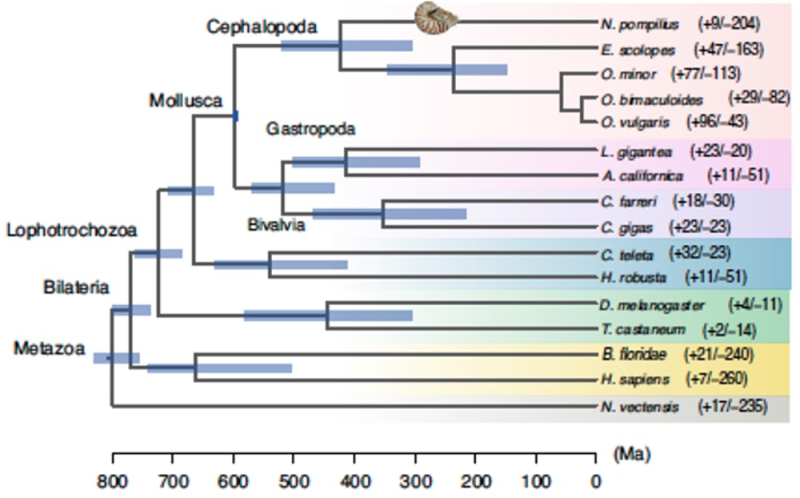
    On a more global level, comparisons of the Nautilus genome to related (and not-so-related) species was used to assess phylogenetic relationships, using 423 single-copy orthologues from 16 animal genomes as shown in the figure:

    Image 1
    Divergence from the coleoid cephalopods was estimated by these studies to have occurred around the Silurian-Devonian boundary at about 423 million years ago (Ma), consistent with other estimates from geological evidence and "molecular clock" inferences.  On a finer scale, these researchers report that N. pompilius populations expanded about 23 Ma ("at the turn of the Miocene") in a "stepwise manner," which expansion then stopped as a result of climate changes (glaciation) at the Mid-Pleistocene Transition (around 1 Ma), and finally fell precipitously around 0.4 Ma during another intense glaciation period termed the Mid-Brunhes Event.  These authors conclude that this pattern indicates N. pompilius to be sensitive to "extreme environmental fluctuations" (although it is not evident that they are particularly more sensitive than other aquatic species).  Paradoxically octopus species and certain bony fishes thrived during this period according to the paper, suggesting "ecological competition" (i.e.,"nature red in tooth and claw") had much to do with the population record of N. pompilius during these times.

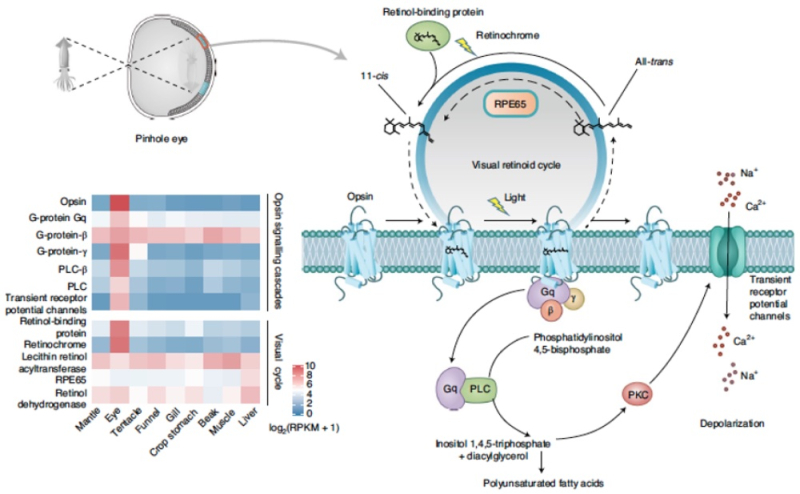
    Turning to the pinhole eye, these researchers report the presence of "nearly all" of the genes encoding the core regulatory complex of transcription factors thought to govern lens formation in coleoid cephalopods (PAX6, SIX3/6 and SOX2, among others) in Nautilus, consistent with lens development in the early Cambrian era (541-485 Ma).  In Nautilus, an important regulatory gene for lens production (in vertebrates as well as coleoid cephalopods), Nrl/Maf, is missing and genes encoding lens-specific crystallin genes are "contracted" compared to other mollusks like octopus that have lens-equipped eyes.  Other specific crystallin genes found expanded in coleoids are missing in the Nautilus genome.  Nautilus is known for behaviors (such as coming towards the surface to feed under lower light conditions) indicating visual perception, and were found by these researchers to possess one photoreceptive r-opsin gene and one retinochrome gene, which these authors assert represents "the minimal opsin gene number among known metazoans" (albeit conceding that N. pompilius is almost certainly colorblind).  The authors note that light intensity is a more critical faculty for animals like N. pompilius that migrate vertically between depths at sea, and that such sensitivity depends on the 11-cis retinal chromophore which isomerizes in response to light.  The N. pompilius genome contains a retinochrome encoding such an isomerase, and in addition these researchers identified an ortholog of a gene family (ten genes) named retinal pigment epithelium-specific protein 65 kDa present in vertebrates that is also found in the Nautilus genome.  These genes contain a conserved iron binding site, an "active cavity" site, and a "hydrophobic tunnel" consistent with catalytic activity.  The significance of these finding is explained by the authors as:

    From a perspective of evolutionary adaptation, the appearance of the pinhole eye is one adaptive breakthrough essential to the nautilus lifestyle of vertical depth migrations, allowing the organism to acquire spatial vision and rapidly cope with hydrostatic pressure within the eye through opening the pupil to seawater.  Overall, multiple genomic innovations including gene losses, independent contraction and expansion of specific gene families and presence of associated regulatory networks seem to work in unison to drive the evolution of the pinhole eye in nautilus.

    The paper provides a schematic diagram of the Nautilus pinhole eye to put these genetic analyses in context:

    Image 2
    Turning to the other characteristic morphological feature of Nautilus, its shell, the authors note that it is made up of aragonite (an orthorhombic crystal of calcium carbonate, CaCO3) and shell matrix proteins (SMP) used as a substrate.  The authors report finding genes encoding a total of 78 SMPs with expression pattern concentrated in the shell mantle (72%).  Genetic comparisons revealed that 21 Nautilus SMPs shared sequence similarity with analogous genes from bivalves and gastropods and found several conserved domains in these protein across mollusk species, including "laminin, chitin-binding and carbonic anhydrase domains."  The authors posit these regions as part of a "core biomineralization toolkit" conserved across external shell-expressing mollusks.  On the other hand, 52 of the 78 SMPs encoded in the Nautilus genome were either new or Nautilus-specific, and these researchers speculate that most of the unique SMPs evolved independently in different mollusk species including Nautilus.  Indeed, there is one important SMP, Nautilin-63, that these researchers found showed low sequence similarity even within the Nautilus genus.  And the top ten SMPs enriched in the Nautilus mantle contain an evolutionarily novel poly(Gly or Gly-Ala) repetitive motif; also detected encoded in these proteins were several repetitive low-complexity domains (RLCDs), in common with other shelled mollusks, that the inventors suggest "could be a unifying principle for molluscan biomineralization, especially for nacre formation."

    Finally, the paper discusses the Nautilus immune system, which contains a "highly complex yet comprehensive innate immune components" enabling Toll-like receptor and tumor necrosis factor receptor signaling that regulates "apoptosis, inflammation and immune defences."  Also detected were genes encoding IL17R, H-lectin, and IL1, which the authors assert "supports the assumption that nautilus has preserved a more complete repertoire of immune molecules than other cephalopods."  An assessment of gene numbers for immune system-specific genes showed expansion of C-type lectin genes (81) compared to coleoid species (wherein 12-33 genes are encoded) and some of these genes have been independently duplicated.  Also found to be specifically expanded are interferon-inducible GTPases, genes also known to be implicated in immune function.  These genetic features of the immune system-involved genes in Nautilus (and comparisons with coleoid species) is illustrated in this figure:

    Image 3
    The authors conclude with this synopsis of their findings:

    Genomic evidence reveals that nautilus has undergone lineage-specific innovations in both body plan and behaviour since the Cambrian and retained these extraordinary features after a long evolutionary history.  In particular, vertical depth migration in Nautilus and other chambered cephalopods is one of several critical and common strategies needed to avoid predators and budget energy; these may have helped the survival of these species ever since.  The emergence of the pinhole eye is a great innovation for switching from directional to spatial vision and rapidly change hydrostatic pressure, making vertical depth migration possible.

    Our findings highlight that co-evolutionary loss of core regulatory transcription factors may have driven the evolution of the pinhole eye.  Moreover, our proteomic and transcriptomic data suggest that an ancient "core biomineralization toolkit" and new RLCDs coordinately directed the construction of the chamber shell, which has evolved into the buoyancy apparatus needed to adapt to a critical life mode.  Taken together, the draft genome of N. pompilius together with multiomics provide a valuable insight into not only the adaptive innovations of the ancestor of cephalopods but also the dynamic evolution of coleoids.

    * Key Laboratory of Tropical Marine Bio-resources and Ecology and Guangdong Provincial Key Laboratory of Applied Marine Biology, South China Sea Institute of Oceanology, Chinese Academy of Sciences, Guangzhou; Innovation Academy of South China Sea Ecology and Environmental Engineering, Chinese Academy of Sciences, Guangzhou; Southern Marine Science and Engineering Guangdong Laboratory, Guangzhou; MOE Key Laboratory for Membraneless Organelles and Cellular Dynamics, Hefei National Laboratory for Physical Sciences at the Microscale, CAS Key Laboratory of Brain Function and Disease, School of Life Sciences, Division of Life Sciences and Medicine, University of Science and Technology of China, Hefei; Zhejiang Key Laboratory of Aquatic Germplasm Resources, College of Biological and Environmental Sciences, Zhejiang Wanli University, Ningbo; Biomarker Technologies Corporation, Beijing; State Key Laboratory of Biocontrol, College of Life Sciences, Sun Yat-sen University, Guangzhou; Department of Neuroscience and Developmental Biology, University of Vienna.

  • ACIAmerican Conference Institute (ACI) will be holding its 37th Annual FDA Boot Camp conference on September 29-30, 2021 as a VIRTUAL conference.

    The conference will provide attendees with presentations on these topics:

    • The organization, jurisdiction, functions, and operations of FDA
    • The essentials of the approval process for drugs and biologics
    • The role of the Hatch-Waxman Act in the patenting of drugs and biologics
    • Clinical trials for drugs and biologics
    • Labeling in the drug and biologics approval process
    • cGMPs and other manufacturing concerns relative to products liability
    • Proactive adverse events monitoring and signal detection
    • Recalls, product withdrawals, and FDA oversight authority

    The conference presentations will be grouped into the Pre-Approval and Approval Process; Patents and Related IP Protections and Mechanisms; Hatch-Waxman and BPCIA Fundamentals: Understanding Follow-On Products and the Rules for Generic Entry; Drugs and Biologics Labeling: Appreciating the Importance of the Final Step of the Approval Process; cGMPs: Discovering the Unique Role of Current Good Manufacturing Practices ("cGMPs") in the Post Approval Process; Advertising, Promotions, And Related First Amendment Concerns; Preparing for the Worse: Adverse Events Monitoring, Pharmacovigilance, Risk Management, and Recalls; and Understanding the Scope of FDA Enforcement Authority and Actions.

    Co-Chairs Christopher Mikson of DLA Piper LLP and Chad Landmon of Axihn, Veltrop & Harkrider LLP will speak on "Understanding the Relevance of New FDA Initiatives and Policies and How They May Redefine the Life Sciences Industry in the Aftermath of COVID-19."

    In addition, two pre-conference workshops will be offered on September 28, 2021.  The first, entitled "FDA Law 101: A Guide to Agency Structure, Jurisdiction, Regulation, and Applicable Laws," will be offered from 9:00 am to 12:00 am, and the second, entitled "Medical Devices, Combination Products, and Companion Diagnostics Boot Camp: A Review of FDA Guidelines and Regulations," will be offered from 1:30 pm to 4:30 pm.  There will also be a post-conference workshop held from 2:30 pm to 5:30 pm on September 30th entitled "Hatch-Waxman and BPCIA in the Trenches: Exclusivity and Bioequivalency Working Group."

    A complete brochure for this conference, including an agenda, detailed descriptions of conference sessions, list of speakers, and registration form can be obtained here.

    The registration fee for the conference is $1,595 for registration by July 30, 2021, $1,695 for registration by August 27, 2021, and $1,795 for registration thereafter.  The workshops are $600 apiece.  ACI is offering an All Access Pass for the conference and all three workshops for $2,095 for registration by July 30, 2021, $2,195 for registration by August 27, 2021, and $2,295 for registration thereafter.  Patent Docs readers are entitled to a 10% discount off of the registration fee using discount code D10-806-806GX06.  Those interested in registering for the conference can do so here, by e-mailing CustomerService@AmericanConference.com, or by calling 1-888-224-2480.

    Patent Docs is a media partner of ACI's 37th Annual FDA Boot Camp.

  • By Donald Zuhn —

    CoverEarlier this month, the National Academy of Inventors (NAI) and the Intellectual Property Owners Association (IPO) published their annual list of the top 100 worldwide universities that received the most U.S. utility patents during the 2020 calendar year.  The NAI is a member organization comprising U.S. and international universities, and governmental and non-profit research institutions, with over 4,000 individual inventor members and Fellows spanning more than 250 institutions.  The organization was founded in 2010 to recognize and encourage inventors with patents issued from the U.S. Patent and Trademark Office, enhance the visibility of academic technology and innovation, encourage the disclosure of intellectual property, educate and mentor innovative students, and translate the inventions of its members to benefit society.  The joint effort by the NAI and IPO is based on data obtained from the U.S. Patent and Trademark Office.  For their report, the NAI and IPO defined a university as an institution that grants undergraduate-level degrees, and when a patent is assigned to one or more entities, credit was given to the first named entity.  The report indicates that the number of patents granted to a particular university does not necessarily indicate the value of a university's technology, the effectiveness of its research, or whether its patents will be successfully licensed and/or brought to market.  The top 25 universities on the NAI/IPO listing are as follows (click on table to expand):

    Top 25 Universities - 2020
    The complete list of 100 universities can be found here.

    For additional information regarding this and other related topics, please see:

    • "IPO & Harrity Analytics Release List of Top 300 Patent Holders for 2020," February 18, 2021
    • "NAI & IPO Release List of Top 100 Universities Receiving Patents in 2019," June 3, 2020
    • "IPO & Harrity Analytics Release List of Top 300 Patent Holders for 2019," May 25, 2020
    • "IPO Releases List of Top 300 Patent Holders for 2018," August 7, 2019
    • "IPO Releases List of Top 300 Patent Holders for 2017," July 4, 2018
    • "Top 100 Universities Worldwide Granted U.S. Patents in 2016," June 15, 2017
    • "IPO Releases List of Top 300 Patent Holders for 2016," June 14, 2017
    • "NAI & IPO Release List of Top 100 Universities Receiving Patents in 2014," July 5, 2015
    • "IPO Releases List of Top 300 Patent Holders for 2014," July 1, 2015
    • "IPO Names Top 100 Patenting Universities," July 24, 2014
    • "IPO Releases List of Top 300 Patent Holders for 2013," July 7, 2014
    • "NAI & IPO Release List of Top 100 Universities Receiving Patents in 2012," January 7, 2014
    • "Brookings Paper Calls for Technology Transfer Model Based on University Start-ups," December 12, 2013
    • "IPO Releases List of Top 300 Patent Holders for 2012," June 24, 2013
    • "Another Look at IPO Top 300 and Life Sciences Top 53," June 11, 2012
    • "IPO Releases List of Top 300 Patent Holders for 2011," June 7, 2012
    • "IPO Releases List of Top 300 Patent Holders for 2010," June 30, 2011
    • "IPO Releases List of Top 300 Patent Holders for 2009," May 26, 2010
    • "IPO Releases List of Top 300 Patent Holders for 2008," May 14, 2009
    • "IPO Releases List of Top 300 Patent Holders," May 22, 2008
    • "IPO Posts List of Top 300 Patent Holders," April 20, 2007

  • By Kevin E. Noonan —

    Great DaneThe domestic dog (Canis lupus familiaris) has been the subject of many genetic studies, particularly since the dawning of the age of Whole Genome Sequencing in the late 20th Century.  These studies have elucidated some interesting facts about "man's best friend," some of which have been discussed here (see "The Genetic Basis of Coat Variation in Dogs"; "Leg Length Variation in Dogs and its Relevance to Human Mutations"; "From Toy Poodle to Rottweiler: Why Is Fido So Small (or Large)?";  "Selection for Facial Features in Domestic Dogs: The Evolution of Cuteness") and comparators to related species (see "Red Fox Genome Sheds Light on Domesticated Dogs (and Maybe Humans)").

    But as with other organisms, a great deal of the genetic sequence set forth early in the 21st Century was incomplete due to technical limitations. Chief amongst these was difficulty in obtaining reliable sequence information on sequences repeated in many places in the genome, which interfered with reliable assembly of sequenced portions (termed "contigs") into longer (ideally, chromosomal-length) linear sequence assemblies (termed "scaffolds).  Improvements in sequencing technology now permit better sequence determinations for high GC and highly repetitive regions.

    The existence of a prior reference genome (produced from a female boxer named Tasha), combined with these new sequencing tools, was used by an international team of researchers* in a paper published in March of this year in the Proceedings of the National Academy of Sciences (USA) entitled "Long-read assembly of a Great Dane genome highlights the contribution of GC-rich sequence and mobile elements to canine genomes."  These scientists reported elucidation of the genomic sequence from a female Great Dane named Zoey, wherein they were able to identify and eliminate (in large part) incorporation of false contigs due to repetitive ends and fragment ends that map to multimer genomic locations.  Using alignment with the reference dog genome revealed gaps between contigs as earlier reported in dog genomic DNA.  They report finding 373 additional sequence regions spanning contigs having N50 of 30kb and a total length of 10.5 Mbp.  The resulting aligned scaffolds were assigned to dog chromosomes to constitute a genomic sequence for the dog genomic complement of 78 chromosomes.

    From this sequence the researchers were able to identify 22,182 protein-coding gene models; full-length matches with the reference canine genome were found for only 84.9% (18,834) of all protein-coding gene models, and almost full-length alignments were found for 93% (20,670) of the models; in addition they identified 49 protein-coding genes not present in the earlier canine reference genome.  Also annotated were 7,049 long noncoding RNAs that included 84 with no or only partial alignment to the reference canine genome.  From this comparison they further were able to appreciate that the assembly from the Great Dane genome spanned the majority of sequence gaps not having been sequenced in the reference dog genome.  Mapping of these gaps showed that 2,151 gaps (16.8% of gaps) overlapped the transcription start site of a predicted protein-coding gene and were found to be extremely GC rich (67.3%).  Further, a subset of the resolved gaps, having a median 80.95% GC content, were found to be preferentially localized (i.e., at a frequency greater than random chance) at transcription start sites and recombination hotspots.  About 12% (1,457 of 12,304 on the autosomes) of gap segments were found to be located within 1 kbp of a hotspot (the expected percentage of such location was closer to 3%).  These hotspot-adjacent segments were extremely GC rich; 5,553 such identified segments had a GC content greater than that what would be expected from random sequence permutations.  The total extent of these extreme GC segments spanned 4.03 Mbp in the Great Dane sequence assembly, were found to have "a median length of 531 bp, a median GC content of 80.95%, and are located much closer to transcription start sites (median distance of 290 bp) and recombination hotspots (median distance of 68.7 kbp) than expected by chance."

    Analysis of the Great Dane genome assembly with the reference canine genome identified 16,834 deletions (median size: 207 bp) and 15,621 insertions (median size: 204 bp) in Great Dane DNA.  Genetic assessment of these sequences revealed predominantly the presence of two forms of "retrotransposon insertion/deletion polymorphisms" which included dimorphic canine short interspersed elements (SINECs) (16,221 copies) and dimorphic long interspersed element-1 sequences (LINE-1_Cfs) (1,121 copies).  The 3' flanking sequence for the LINE-_Cfs elements suggested "multiple retrotransposition-competent LINE-1_Cfs segregate among dog populations."

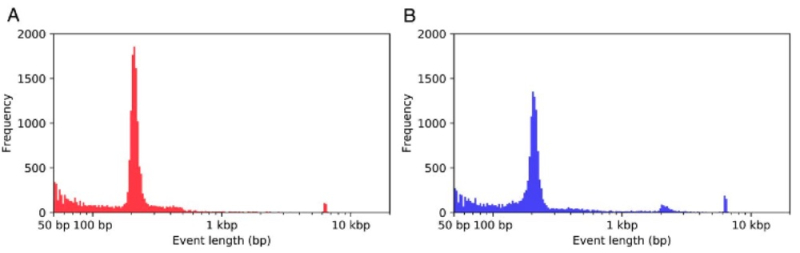
    The researchers further reported a length distribution of the detected variants having "a striking bimodal pattern, with clear peaks at ∼200 bp and ∼6 kbp, consistent with the size of SINEC and LINE-1 sequences," as shown in this Figure:

    Image 1
    The location of these sequences was associated with insertions and deletions, the researchers reporting that inspection of the sequences in the 150-250-bp range (dimorphic SINEC elements) were found at 7,298 deletion and 6,071 insertion sites, and that "LINE-1 sequences accounted for 339 deletions and 581 insertions longer than 1 kbp." When combined with data from the reference canine genome there were at least 16,221 dimorphic SINEC and 1,121 dimorphic LINE-1 sequences identified.  "Hallmarks of retrotransposition" were identified at these sites, wherein the SINEC and LINE-1 sequences were flanked by "target site duplications having a 15 bp median size with the elements ending in poly(A) tracts having median lengths of 9 bp to 12 bp."

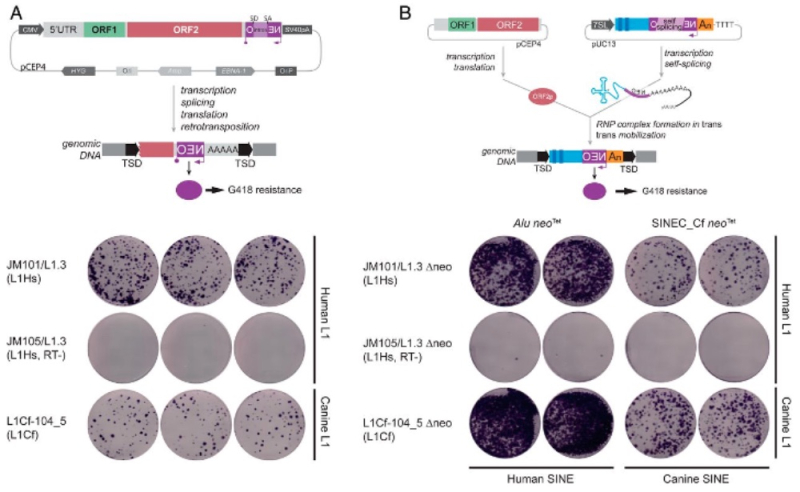
    To test whether these sequences were capable of retrotransposition, a particular sequence was cloned that had intact open reading frames encoding the ORF1p and ORF2p predicted proteins and lacked mutations expected to disrupt protein function.  This element was introduced into human cells in vitro and shown to be capable of retrotransposition, as illustrated in this Figure:

    Image 2
    This element also capable of mobilizing both the canine SINEC elements and analogous human Alu elements.  The researchers speculated that this result was consistent with ongoing retrotransposon activity as a driver of canine genetic variation.

    The researchers set forth a synopsis of their results as follows.  They had identified 49 predicted protein-coding genes from the Great Dane assembly that were not found in the canine genome, as well as 2,151 protein-coding gene models having a transcription start position located in a gap in the reference genome sequence.  The existence of high GC-content sequences in canine promoter regions distinguishes the preferential location of recombination events in dogs, which lack a functional PRDM9 gene known to mediate recombination in other mammals; see Paigen & Petkov, 2018, "PRDM9 and its role in genetic recombination," Trends Genet. 34, 291–300, and Auton et al., 2013, "Genetic recombination is targeted towards gene promoter regions in dogs," PLoS Genet. 9, e1003984.  The researchers assert that "[t]he presence of extremely GC-rich segments likely reflects a key aspect of canine genome biology" as a consequence of these findings.  Further, a comparison of the number of single nucleotide variants (i.e., differences) found in Zoey and Tasha (3.57 million) was lower than found in similar comparison between humans (4.1-5.0 million).  In contrast, the levels of LINE-1 and SINEC dimorphism between these two dog genomes was "disproportionately large," there being "an ∼17-fold increase in SINE differences (16,221/915) and an eightfold increase in LINE differences (1,121/128) compared to the numbers found among humans" (indeed, the researchers report that "more dimorphic SINEs were found between these two breed dogs than have been found in studies of thousands of humans").  They note that these results are consistent with prior studies, including Wang & Kirkness, 2005, "Short interspersed elements (SINEs) are a major source of canine genomic diversity," Genome Res. 15, 1798–808.

    The authors conclude by saying:

    [O]ur study suggests that retrotransposition is an ongoing process that continues to affect the canine genome.  We provide proof-of-principle evidence that dog genomes contain LINE-1 and SINEC elements that are capable of retrotransposition in a cultured cell assay.  We also identified two LINE-1 lineages with the same 3′ transduced sequence associated with multiple elements, suggesting the presence of multiple canine LINE-1s that are capable of spawning new insertions.  Additionally, analysis of 3′ transduction patterns suggests the presence of additional active LINE-1s in canines that have yet to be characterized.  Thus, a full understanding of canine evolution and phenotypic differences requires consideration of these important drivers of genome diversity.

    * From  the Department of Biological Sciences, Bowling Green State University; the Department of Human Genetics, Department of Computational Medicine and Bioinformatics, and the Department of Internal Medicine, University of Michigan; the Université Côte d'Azur, CNRS, INSERM, Institut de Recherche sur le Cancer et le Vieillissement de Nice, Nice; the Université de Rennes 1, CNRS, Institut de Génétique et Développement de Rennes−UMR 6290, Rennes; and the Department of Biomedical Sciences, Cornell University, Ithaca, NY 14850.