• By Kevin E. Noonan —

    Federal Circuit SealMost judicial outcomes, particularly on appeal, are broadly based on varying combinations of process and outcome.  The law is replete with process-based decisions (standing, jurisdiction, waiver, to name a few) and of course even more frequently perhaps coming to the "correct" outcome is a major decisive factor in a court's opinions.  Rarely are these two features of judicial consideration juxtaposed in opposition (albeit not so rarely that the aphorism that "hard cases make bad law" is not appreciated in practice) but such a case is illustrated in the Federal Circuit's latest (and second) decision in GlaxoSmithKline LLC v. Teva Pharmaceuticals USA.

    The matter arose in litigation over GSK's Coreg® product (carvedilol) for treatment of hypertension (the initial approved indication; U.S. Patent No. 4,503,067), congestive heart failure (CHF) (the subject of U.S. Patent No. 5,760,069), and left ventricular dysfunction following myocardial infarction (LVD-MI).  The '069 patent recites a method of treating CHF with a combination of carvedilol and "one or more of an angiotensin-converting enzyme ("ACE") inhibitor, a diuretic, and digoxin."

    Teva's ANDA was filed with a Paragraph III certification over the '067 patent and a Paragraph IV certification over the '069 patent.  The FDA tentatively approved Teva's generic product for "treatment of hypertension and heart failure" which Teva launched on expiration of the '067 patent.  Teva's label indicated that the product was approved treatment of LVD-MI and hypertension and announced that FDA had given its product an "AB rating" (which the opinion explained "allow[s] users to determine quickly whether the Agency has evaluated a particular approved product as therapeutically equivalent to other pharmaceutically equivalent products").  Thereafter, FDA required Teva to amend its label to be identical to the GSK label for Coreg®, which introduced treatment of heart failure into the approved treatments recited in Teva's label.

    GSK filed for reissue of the '069 patent which was duly granted by the U.S. Patent and Trademark Office as Reissue Patent No. RE40,000; claim 1 is representative of the invention as claimed in the '000 reissue patent:

    1.  A method of decreasing mortality caused by congestive heart failure in a patient in need thereof which comprises administering a therapeutically acceptable amount of carvedilol in conjunction with one or more other therapeutic agents, said agents being selected from the group consisting of an angiotensin converting enzyme inhibitor (ACE), a diuretic, and digoxin,
        wherein the administering comprises administering to said patient daily maintenance dosages for a maintenance period to decrease a risk of mortality caused by congestive heart failure, and said maintenance period is greater than six months.

    (Where the italicized portion of the claim represents the modifications introduced in prosecution of the reissue application.)

    GSK filed suit against Teva for inducement of infringement based on the Teva label, based on direct infringement by physicians prescribing the drug for the label indications.  Teva argued that it had "carved out" the indication for CHF pursuant to 21 U.S.C. § 355(j)(2)(A)(viii), resulting in a "skinny label" with regard to this indication.  Thereafter, FDA compelled Teva to amend its label to include that indication.  In addition, Teva argued that it could be liable for inducement only if GSK could show that Teva had "directly communicated with the direct infringers and 'caused' them to directly infringe the method in the '000 patent."  In a jury instruction the court informed the jury that circumstantial evidence could be used to satisfy this burden.

    The jury found that Teva induced infringement of the '000 reissue patent both before and after the label amendment (albeit infringing several claims after but not before that change).  The District Court granted Teva's motion for judgment as a matter of law (JMOL) on the basis that GSK had not "caused" physicians to prescribe their product for the infringing uses.  Because proof of such causation was required, according to the District Court, its absence precluded the jury from basing its decision on substantial evidence.  The Court relied on the "many sources of information available to prescribing physicians" other than Teva's label (including paradoxically GSK's label and promotion of its Coreg® product) in finding this evidentiary deficiency.  Also, the Court based its decision on physician testimony that their prescribing behavior relied on "guidelines and research, as well as their own experience" and not Teva's label.  "In sum," the Court said, "substantial evidence [did] not support the jury's finding on causation, and therefore [did] not support its verdict that Teva is liable for induced infringement, during both the skinny and full label periods."  This appeal followed.

    The Federal Circuit reversed, in an opinion by Judge Newman joined by Judge Moore; Chief Judge Prost provided a lengthy, comprehensive dissent.  The panel majority relied on the Supreme Court's decision in Global-Tech Appliances, Inc. v. SEB S.A., 563 U.S. 754 (2011), that copying is evidence of inducement, and also found compelling evidence from Teva's website regarding its product's AB rating with GSK's Coreg® product and other promotional content, as well as testimony from GSK's witnesses regarding physician reliance on information from generic drug makers.

    The panel majority opined that the District Court erred in applying the correct legal standard, stating that "precedent makes clear that when the provider of an identical product knows of and markets the same product for intended direct infringing activity, the criteria of induced infringement are met."  Considering this precedent, the majority held that "[t]here was ample record evidence of promotional materials, press releases, product catalogs, the FDA labels, and testimony of witnesses from both sides, to support the jury verdict of inducement to infringe the designated claims for the period of the '000 reissue patent."

    Chief Judge Prost dissented based, as the majority noted, on her objections to the quanta of evidence adduced and policy consequences should the majority's position be sustained.  In the Chief's view, the majority's decision undermines the policy goals, embodied in the provisions of the law regarding skinny labels, for balance between the incentives patents provide for pharmaceutical innovation and the public's need for access to that innovation once the patent term has expired.  In the Chief's view, the majority's decision undermined these policy goals by finding Teva induced infringement by marketing its generic drug produce for unpatented uses (emphasis in dissent) using its skinny label.  The dissent not only disagreed with the majority's decision, but apprehended it to "nullify[y] Congress's statutory provision for skinny labels—creating liability for inducement where there should be none," contrary to Congressional intent and "slowing, rather than speeding, the introduction of low-cost generics."

    The original majority opinion occasioned an outpouring of outrage from industry groups (particularly generic ones) who latched onto the then-Chief Judge's rhetoric in her dissent to the effect that the opinion eviscerated the congressional sanctioning of skinny labels.  The Court granted panel rehearing in February that resulted in the current opinion.

    In which the outcome has not changed (although the explication of the process aspects of the majority, per curiam opinion are perhaps more explicit).  After reciting the procedural posture of this decision (as a panel rehearing), the majority address amici's concerns (amply represented in eleven amicus briefs, including a brief by one of the architects of the generic's law former Representative Henry Waxman).  The opinion recites with approval the behavioral distinctions underpinning the majority's decision based on the law with regard to skinny labels:

    Generics could be held liable for actively inducing infringement if they marketed a drug with a label describing a patented therapeutic use or if they took active steps to encourage doctors or patients to use the drug in an infringing manner.  But generics could not be held liable for merely marketing and selling under a 'skinny' label omitting all patented indications, or for merely noting (without mentioning any infringing uses) that FDA had rated a product as therapeutically equivalent to a brand-name drug [emphasis in original].

    Stating that the panel (or at least the majority) agreed to rehear arguments "to make clear how the facts of this case place it clearly outside the boundaries of the concerns expressed by amici, the opinion states succinctly that the basis for their decision that the jury correctly found Teva liable for inducing infringement was "by marketing a drug with a label encouraging a patented therapeutic use (emphasis in opinion).  The opinion also states more precisely the procedural basis for their opinion:  "[t]his is a case in which substantial evidence supports a jury finding that the patented use was on the generic label at all relevant times and that, therefore, Teva failed to carve out all patented indications" and that this decision is a "narrow, case-specific review of substantial evidence does not upset the careful balance struck by the Hatch-Waxman Act regarding section viii carve-outs."  The remainder of the majority opinion sets forth (extensively) the evidentiary basis for their opinion that there was sufficient evidence (including expert testimony and marketing efforts occurring both before and after FDA-mandated changes to Teva's label) to satisfy the substantiality standard and that the District Court erred in granting Teva JMOL to the contrary (inter alia including specific errors in treating factual questions as legal ones that the majority state were "not this court or the district court, to resolve").

    (The majority also affirmed the jury's damages calculations, which apparently played a much less significant part of the controversy surrounding this appeal, albeit likely being at least as important to the parties.  Adding insult to injury the majority awarded costs to GSK.)

    Former Chief Judge Prost remained unconvinced, in large part because this outcome (in her view) undermines the congressionally sanctioned skinny label regime (if only by rendering it much more case- and fact-specific than she perceives Congress intended).  The outcome-based philosophy of the dissent is presaged in its first sentence, where Judge Prost reminds the reader that "GSK's patent on carvediol expired in 2007" followed by the statement that "Because the FDA cannot authorize a generic version of a drug that would infringe a patent, this one remaining patented use could have prevented a less-expensive, generic carvedilol from coming to market altogether—even though the drug itself and other uses of it were unpatented."  The skinny label regime was Congress's solution to the "problem" it "saw coming" in Judge Prost's view.  The majority's decision thwarts this intent, in Judge Prost's view, based on evidence of inducement that was "thin to nonexistent."  The District Court had properly exercised its supervisory role in remedying a situation where a jury comes to the wrong conclusion, based on Judge Prost's evaluation of the evidence before it.  The Judge sets forth her motivation for writing (once again) in dissent (and that the majority's attempt to provide a comforting standard falls short in her opinion):

    I write in this case because far from being a disagreement among reasonable minds about the individual facts, this case signals that our law on this issue has gone awry.  I am particularly concerned with three aspects of the majority's analysis.  First, even setting aside the majority's willingness to glean intentional encouragement from a label specifically designed to avoid encouragement, the majority further weakens the intentional-encouragement prong of inducement by effectively eliminating the demarcation between describing an infringing use and encouraging that use in a label.  Second, the majority defies basic tort law by eviscerating the causation prong of inducement.  The upshot of these two moves is that a plaintiff now has to show very little for a jury to speculate as to the rest.  Third, the majority creates confusion for generics, leaving them in the dark about what might expose them to liability.  These missteps throw a wrench into Congress's design for enabling quick public access to generic versions of unpatented drugs with unpatented uses.

    The contrasting opinions by the majority and the dissent raise the issue (outside the policy one) of the extent to which a reviewing court (whether the district court or the Federal Circuit) can make judgments on the substantiality of the evidence upon which a jury bases its verdict.  The substantial evidence standard is intentionally deferential ("more than a scintilla"), based on the prudent principle that a jury has had the opportunity to hear evidence from witnesses and gauge the weight their testimony is given, based on considerations (demeanor, for example) unavailable to a court on appeal.  JMOL includes additional considerations (including the district court's opportunity for observing this same inferential evidence).  Here, the majority applied Third Circuit law on the standard for reviewing JMOL decisions, which according to the opinion was that JMOL should be granted "sparingly" and "only if, viewing the evidence in the light most favorable to the nonmovant and giving it the advantage of every fair and reasonable inference, there is insufficient evidence from which a jury reasonably could find liability" citing Marra v. Phila. Hous. Auth., 497 F.3d 286, 300 (3d Cir. 2007).  The majority, both based on the standard of review as well as the conventional deference given to jury verdicts, felt bound by these procedural considerations to reinstate against Teva the jury verdict of induced infringement liability.  Judge Prost, viewing the matter on outcome (for policy) grounds once again disagreed.  The only aspect that has changed (to the extent it has) is a perhaps comforting (and more informative) recitation of the standard the Federal Circuit will apply to induced infringement in the context of skinny labels; by itself this may be (and of course has to be) enough.

    GlaxoSmithKline LLC v. Teva Pharmaceuticals USA (Fed. Cir. 2021)
    Panel: Chief Judge Moore and Circuit Judges Newman and Prost
    Per curiam

  • By Kevin E. Noonan —

    Broad InstituteOn May 28th, Junior Party the Broad Institute, Harvard University, and MIT (collectively, "Broad") filed its Substantive Preliminary Motion No. 3 in CRISPR Interference No. 106,126 (where ToolGen is the Senior Party).  This motion, pursuant to 37 C.F.R. §§ 41.121(a)(1)(iii) and 41.208(a)(1) requests that the Board de-designate Broad claims in these five categories as not corresponding to either Count 1 or proposed Count 2 (A-E) or Count 1 (F):

    • Category A: use of vectors for RNA expression;
    • Category B: Staphylococcus aureus Cas9 protein ("SaCas9");
    • Category C: Cas9 chimeric CRISPR enzyme;
    • Category D: Cas9 with two or more nuclear localization signals ("NLSs");
    • Category E: Cas9 fused to specified protein domains; and
    • Category F: Claims not limited to single-molecule RNA.

    The brief asserts that, should the Board grant this motion and deny Broad Substantive Motion No. 1 (see "Broad Files Substantive Preliminary Motion No. 1 in CRISPR Interference") these of the Broad claims would correspond to Count 1:

    claim 18 of U.S. Patent No. 8,697,359, claims 26-30 of U.S. Patent No. 8,795,965, claims 2 and 5 of U.S. Patent No. 8,906,616,and claim 16 and 27 of U.S. Patent No. 9,840,713 [exhibit references omitted]

    while should the Board grant both this motion and Broad's Motion No. 1, these of Broad's claims would remain in the interference as corresponding to Proposed Count 2:

    claims 15-20 of the '359 patent, claims 26-29 of U.S. Patent No. 8,771,945, claims 26-30 of the '965 patent, claims 24-30 of U.S. Patent No. 8,889,356, all claims of the '616 patent, claims 21-28 of U.S. Patent No. 8,945,839, and claims 15-17, 20-24, 26-28, 31-35, and 38-39 of the '713 patent, as well as allowable claims 1, 40, and 41 of Application 15/160,710 and allowable claims 74, 94, and 95 of Application 15/430,260 should the Board also grant Broad's Contingent Substantive Motion No. 2 [see "Broad Files Contingent Preliminary Motion No. 2 in CRISPR Interference"; exhibit references omitted]

    (the exercise nicely illustrating the strategic considerations involved in Preliminary Motion interference practice).

    These five categories comprise claims drawn to "patentably distinct" inventions from the inventions within the scope of either Count 1 or Count 2.  Broad argues that these distinctions are neither disclosed nor obvious in view of the Counts as they would be understood by those having ordinary skill in the art.  Moreover, and consistent with Broad's arguments in this interference and in Interference No. 106,115 Broad contends that dual-molecule and single molecule guide RNA embodiments of CRISPR are also patentably distinct and claim not limited to single-molecule embodiments should be de-designated as not corresponding to Count 1.  And as Broad argued with regard to Substantive Motion No. 1 in this interference, ToolGen's disclosure and claims are not to the contrary.

    The brief then sets forth its arguments why claims from each of these categories do not correspond to the Count:

    • Category A (use of vectors for RNA expression): neither of the Counts recite limitations regarding use of a vector for delivering RNA species to eukaryotic cells (for example, microinjection is an alternative).  In the absence thereof Broad argues there is no anticipation, and there is also any reasoned basis for choosing a vector (and, consistent with Broad's arguments against CVC's reduction to practice, no reasonable basis for success in introducing these specie using a vector into eukaryotic cells) and thus these embodiments would not have been obvious.  Broad relies on expert testimony adduced in the '115 Interference (and Interference No. 106,048 before that), as well as ToolGen's evidence in this interference, to argue that practicing CRISPR in eukaryotic cells would face terrible obstacle and would not have been routine, obvious, or subject to reasonable expectations of success.  Stating that "[t]he prior art does not teach or suggest the use of, or providing reasons to select from that list, a vector for delivery of the RNA," Broad argues that "[w]here, as here, the prior art provides a number of choices, without any reason to make a particular selection, the selection is not obvious," citing Ortho-McNeil Pharm., Inc. v. Mylan Labs., Inc., 520 F. 3d 1358, 1364 (Fed. Cir. 2008).  Broad also asserts unexpected results and commercial success in support of the non-obviousness of using a vector to express RNA species in eukaryotic embodiments of CRISPR.

    • Category B (Staphylococcus aureus Cas9 protein): Broad argues that neither Count contains a limitation for using Cas9 from aureus (and thus does not anticipate) and that there is no basis either for choosing this species of Cas9 nor would it have been obvious to do so.  Citing the "more than 600 bacterial Cas9 analogues" known in the art, Broad asserts that "[w]here, as here, the prior art choices are vast, the prior art must provide some reason to make the selection in order to find obviousness," citing Ortho-McNeil Pharm., Inc. v. Mylan Labs., Inc., 520 F.3d 1358, at 1364 (Fed. Cir. 2008)."  In arguing that S. aureus Cas9 CRISPR embodiments would not have been obvious.  There is no significant sequence similarity between S. aureus Cas9 and Staphylococcus pyogenes Cas9 known in the art, and the smaller size of the S. aureus Cas9 ortholog was not recognized as being preferred at the time the parties conceived of eukaryotic CRISPR embodiments.  As with Category A, Broad argues unexpected results and commercial success for S. pyogenes Cas9 embodiments in support of its non-obviousness contentions.

    • Category C (Cas9 chimeric CRISPR enzyme): citing embodiments claimed in Broad's U.S. Patent No. 8,889,418, Broad argues that there is no disclosure in the art relating to Cas9 enzymes chimeric in comprising fragments from two different Cas9 proteins.  Broad cites disclosure from the '418 patent regarding the benefits of chimeric Cas9 unknown in the prior art and not recited in the Counts in support of these contentions.

    • Category D (Cas9 with two or more NLS): NLS-comprising Cas9 species are not recited in either Count and hence claims reciting these alternatives are not anticipated by the Counts.  With regard to obviousness, Broad argues that there was no teaching nor suggestion regarding Cas9 proteins modified with any NLS, much less to of them.  In addition to arguing no reasonable expectation of success (based on purported folding and other protein changes grafting NLS-encoding amino acid sequence onto Cas9) Broad argues that its inventors showed unexpectedly improved in vivo eukaryotic CRISPR results using Cas9 enzymes having more than one NLS.

    • Category E (Cas9 fused to specified protein domains): Broad makes similar arguments as it does for Categories C and D with regard to this category, for much of the same reasons.

    • Category F (Claims not limited to single-molecule RNA): while limiting this category to claims corresponding to Count 1 (and not Count 2), Broad provides in brief arguments made in the '115 Interference and with regard to its Substantive Motion No. 1 in this interference.  The brief specifically explicates Broad's arguments for involved claims in its '713, '418, '308, and '616 patents, including claim differentiation arguments with regard to construction of the term "guide RNA," which the Board limited to sgRNA species in the '115 Interference (a decision Broad continues to dispute).

    Finally, Broad takes its opportunity to again argue that its involved claims encompassing both dual-molecule and single-molecule RNA species should not correspond to Count 1, for reasons set forth in its Substantive Motion No. 1 in this interference and in the'115 Interference.

  •     By Michael Borella and Ashley Hatzenbihler[1]—

    Introduction

    Diamond v. Diehr, decided by the Supreme Court in 1981, seemed to establish a bedrock principle of statutory construction for patent law.  The Court stated that "[t]he 'novelty' of any element or steps in a process, or even of the process itself, is of no relevance in determining whether the subject matter of a claim falls within the 35 U.S.C. § 101 categories of possibly patentable subject matter."  That proclamation appeared to slam the door shut on any consideration of novelty, or by extension non-obviousness, as part of the subject matter eligibility calculus.  Indeed, this tenet held for over 30 years.

    Then, in 2012, Justice Breyer wrote in Mayo v. Prometheus, "[w]e recognize that, in evaluating the significance of additional steps, the § 101 patent-eligibility inquiry and, say, the § 102 novelty inquiry might sometimes overlap."  This statement, if made in isolation, might have been considered misguided dicta in an opinion that otherwise relied on the reasoning of Diehr.  Yet Mayo went further, as Justice Breyer analyzed the claim language in question:

    [T]he claims inform a relevant audience about certain laws of nature; any additional steps consist of well-understood, routine, conventional activity already engaged in by the scientific community; and those steps, when viewed as a whole, add nothing significant beyond the sum of their parts taken separately.  For these reasons we believe that the steps are not sufficient to transform unpatentable natural correlations into patentable applications of those regularities.

    As a consequence of concluding that this claim was ineligible under § 101, the Court implicitly approved integrating a form of prior art consideration into the eligibly analysis.  A claim element that is "well-understood, routine, conventional" is by definition in the prior art.  In fact, such an element is indisputably and clearly in the prior art.[2]

    In 2014, the Court spoke again on § 101, with Alice v. CLS Bank.  Alice did not explicitly overrule Diehr — and in fact went to lengths trying to justify how its holding was consistent with the principles of Diehr.  But the justices left the rest of us scratching our collective heads, because Mayo and Alice sure do seem to contradict Diehr in rather impactful ways, including whether and how to consider prior art when evaluating eligibility.

    To that point, since 2018, the Federal Circuit's Berkheimer v. HP decision has stood for the notion that whether additional elements are well-understood, routine, or conventional can be determined as a factual inquiry if such an answer is not apparent.  This further ties together patent-eligibility with obviousness, both being decided as a matter of law with underlying issues of fact.

    But Berkheimer is just one example.  Indeed, comparisons between claimed inventions and prior art are found in a vast number of post-Alice Federal Circuit § 101 decisions including Koninklijke KPN N.V. v. Gemalto M2M GmbH, The Chamberlain Group, Inc. v. Techtronic Industries Co., Enfish v. Microsoft, McRO, Inc. v. Bandai Namco Games America Inc., Cellspin Soft, Inc. v. Fitbit, Inc., Data Engine Technologies LLC v. Google LLC, Core Wireless Licensing S.A.R.L. v. LG Electronics, Inc., and Internet Patents Corp. v. Active Network, Inc., just to name a few.

    It is now indisputable that prior art is part of the § 101 test.  But the contours of the prior art analysis within a patent-eligibility inquiry remain surprisingly difficult to nail down.  The Federal Circuit has never specifically clarified how prior art influences the § 101 inquiry, giving the test an amoeba-like property that changes subtly from opinion to opinion.  With so much at stake — for patent applicants, patent holders, accused infringers, and potential licensees — at least a modicum of lucidity would be desirable.

    Our goal is to explore this space through the words of the Federal Circuit that appear in numerous decisions over the last seven years.  We do so by aligning our investigation with the two prongs of the Alice test,[3] as an assertion of eligibility can be supported by distinguishing a claimed invention over the prior art in either prong.[4]  In doing so, we hope to provide a degree of illumination on this otherwise murky area of patent law.

    Prior Art Under Prong One

    A common definition of the prong one analysis in Federal Circuit jurisprudence is that it requires one to "look at the focus of the claimed advance over the prior art to determine if the claim's character as a whole is directed to excluded subject matter."  While this exact text is from Chamberlain, variations of it appear in approximately 20 decisions since 2016.  The earliest seems to be from Genetic Techs. Limited v. Merial, where Judge Dyk interpreted Mayo as considering that "the focus of the claimed advance over the prior art was allegedly newly discovered information about human biology."

    But how does one determine such a "focus"?  In Yu v. Apple, for example, it is based on "the language of the asserted claims themselves, considered in light of the specification."  Chamberlain and a number of other cases also refer to the specification as a way of shining light on the "true focus" of a claim.  Mortgage Application Techs. v. Meridianlink also considered the prosecution history in this process.

    With this in mind, it appears that there should be some form of advance over the prior art in the claims themselves or as explained by the specification in order to meet the hurdle of prong one.  But are there any constraints on the advance such that certain types of advances are less likely to be directed to judicial exceptions (and therefore more likely to render claims eligible) than others?  It turns out that there are.

    The advance should be claimed specifically.  In Dropbox v. Synchross Techs., the claimed advance was "nothing but a functional abstraction" and the specification did not "define this abstraction as a technological solution."  In Chamberlain, the specification described the difference between the claimed invention and the prior art as "the broad concept of communicating information wirelessly," which also lacked specificity.  This implies that the claimed advance should involve how something is done, and go beyond just stating what is being done.  On the other hand, the claimed focus in Enfish was a "specific type of data structure" for which the specification describes its virtues over the prior art.  These claims were found to be non-abstract.

    The advance should also truly be . . . an advance.  In Solutran v. Elavon, the specification established that all of the claimed steps were conventional despite also describing these steps as capturing the advance over the prior art.  As a result, the claims were found to be directed to an abstract idea.  Similarly, the focus of the claimed advance was found abstract in Intellectual Ventures v. Erie Indemnity Co. because it was drawn to computerizing "longstanding conduct that existed well before the advent of computers and the Internet."  In contrast, the claims of McRO recited a computerized process that had not been previously performed by humans, and were therefore non-abstract.

    Certain types of advances are also given little or no weight under prong one.  In Trading Techs. Int'l v. IBG, the advance was that the claimed invention provided "information to traders in a way that helps them process information more quickly, not on improving computers or technology."  Such an advance, while potentially quite innovative, is often viewed as non-technical and therefore abstract.  Indeed, many claims to financial transactions are determined to be abstract regardless of whether they represent an improvement over the prior art.

    Based on these observations, the focus of the claimed advance over the prior art should be presented in a specific manner that defines how the advance is achieved rather than in an outcome-oriented fashion.  But such a purported advance can be discounted if there is evidence that it is not truly an improvement over the prior art, or if it is non-technical in nature.

    Additionally, in Cardionet v. InfoBionic, the Federal Circuit described at length that the prior art inquiry under § 101 need not include a search for references that read on the claim language.  Instead, "[i]n determining whether [the claims] are directed to an abstract idea, a court may well consult the plain claim language, written description, and prosecution history and, from these sources, conclude that the claims are directed to automating a longstanding or fundamental practice."  Nonetheless, it is not "impermissible for courts to look outside the intrinsic evidence as part of their Alice step one inquiry."

    Put another way, the § 101 prior art determination under prong one can be made based on the four corners of the patent document and its file history rather than the search and comparison one would undertake when applying §§ 102 and 103.  But such a search and comparison is not prohibited.

    Prior Art Under Prong Two

    Prong two of Alice was characterized by the Supreme Court as "examin[ing] the elements of the claim to determine whether it contains an inventive concept sufficient to transform the claimed abstract idea into a patent-eligible application."  As noted above, these additional elements must be more than just well-understood, routine, conventional activities or features previously known in the industry.  For instance, the Court held in Alice that generic computer components alone do not rise to the level of an inventive concept.

    In view of the holding in Berkheimer, prong two can have a procedural impact that is typically absent from prong one.  In Aatrix Software v. Green Shades Software, the Federal Circuit fleshed out Berkheimer by stating that patent eligibility under § 101 can be determined on the pleadings, but "[t]his is true only when there are no factual allegations that, taken as true, prevent resolving the eligibility question as a matter of law."  On the other hand, "[i]f there are claim construction disputes . . . either the court must proceed by adopting the non-moving party's constructions . . . or the court must resolve the disputes to whatever extent is needed to conduct the § 101 analysis, which may well be less than a full, formal claim construction."  As a consequence, plaintiffs now front-load their complaints with factual allegations relating to the claimed advances over the prior art if they believe that their asserted patents are vulnerable to an Alice challenge.

    Substantively, Dropbox provides the clearest statement setting forth the character of the prior art analysis under prong two.  In that case, the Federal Circuit states "an inventive concept exists when a claim recites a specific discrete implementation of an abstract idea where the particular arrangement of elements is a technical improvement over the prior art."  Right there, we have the same three factors that dominate the prong one analysis — specificity, technical character, and improvement over the prior art.  Nonetheless, in the world of patent-eligibility, nothing is that simple.  Dropbox get us most of the way home, but not all of the way.

    The nuances are subtle.  To provide an inventive concept, the additional elements themselves must not be directed to judicial exceptions.  This was the case in Recognicorp, LLC v. Nintendo Co., where additional elements directed to image encoding procedures were deemed to be merely mathematical in nature, and thus also abstract.  Put succinctly in Synopsys, Inc. v. Mentor Graphics Corp., "a claim for a new abstract idea is still an abstract idea."  The Federal Circuit was more forceful on this point in SAP America, Inc. v. InvestPic, LLC, stating that, for an invention directed to mathematical techniques in finance, "patent law does not protect such claims, without more, no matter how groundbreaking the advance."[5]

    Further, Mayo established that adding extra-solution activities to a claim does not provide an inventive concept.  Such activities involve those that are both pre-solution and post-solution, including simple gathering of data, high-level data processing, and generic displaying of data.  This was made clear in Electric Power Group, LLC v. Alstom S.A., when the Federal Circuit stated "selecting information, by content or source, for collection, analysis, and display does nothing significant to differentiate a process from ordinary mental processes, whose implicit exclusion from § 101 undergirds the information-based category of abstract ideas."  This falls under the specificity factor — a non-specific or outcome-oriented element has little or no impact on patent-eligibility even if it is arguably not in the prior art.

    Also, limiting the claims to a particular technological environment or solution space does not provide an inventive concept.  As an example, the claims in Electric Power Group were limited to power-grid monitoring, but this alone was not enough.  Putting this in the context of prior art, if it is known to carry out the claimed invention in one environment, doing so in another environment without more is not sufficient.

    Notably, prong two also requires consideration of whether an inventive concept lies in the additional elements as an ordered combination.  Alice gave this aspect of the analysis short shrift, merely stating that "[c]onsidered as an ordered combination, the computer components of petitioner's method add nothing that is not already present when the steps are considered separately."  This conclusory language has apparently given the Federal Circuit and District Courts the understanding that they can also proceed in a conclusory fashion with prong two.  A large number of opinions effectively ignore or are dismissive of ordered combinations of additional elements, particularly when the Court finds the patentees' allegations of inventive concepts therein to be lacking.

    Having said that, the Federal Circuit has added some color to the inquiry, stating in Chamberlain that:

    The appropriate question is not whether the entire claim as a whole was well-understood, routine and conventional to a skilled artisan (i.e., whether it lacks novelty), but rather, there are two distinct questions: (1) whether each of the elements in the claimed product (apart from the natural laws themselves) involve well-understood, routine, conventional activity previously engaged in by researchers in the field, and (2) whether all of the steps as an ordered combination add nothing to the laws of nature that is not already present when the steps are considered separately.

    An example of the ordered combination saving the day for a patentee is in BASCOM Global Internet Services, Inc. v. AT&T Mobility LLC.  There, the additional elements, taken individually, provided only generic computer, network, and Internet components, none of which rose to the level of an inventive concept on its own.  However, the Court found that the ordered combination of these elements afforded a technical solution that provided the benefits of two different prior art arrangements that were previously available only individually.  Thus, this beneficial ordered combination was an inventive concept.  Amdocs (Israel) Limited v. Openet Telecom, Inc. drove this point home with the Court stating "[w]hile some individual limitations arguably may be generic, others are unconventional and the ordered combination of these limitations yields an inventive concept sufficient to confer eligibility."  In short, the improvement over the prior art can be found in a combination of elements.

    Finally, Recognicorp also held that "[t]o save a patent at step two, an inventive concept must be evident in the claims."  However, this does not imply that one cannot look to the specification to obtain an understanding of improvements over the prior art — Berkheimer clearly supports such an undertaking.  Instead, the improvements as alleged in the specification or elsewhere must be recited — at least in some fashion — by the claims.

    To summarize, an inventive concept can be found in the claim language of one or more additional elements and/or the combination thereof.  The inventive concept should be a specific, technical advance over the prior art that is not an extra-solution activity or a field of use limitation.

    Conclusion

    So where do these observations get us?  Last year we provided empirical evidence that the eligibility of claimed inventions is highly correlated with the claims' specificity, technical nature, and novelty.  We further argued that this evidence suggests more than just a correlational relationship — that these three factors play a causational role in determining patent eligibility.  But in that study we did not attempt to break down how the three factors influence each of the two prongs of Alice.

    After digging into the precise character of the relationship between eligibility and prior art, we find that specificity, technical nature, and prior art can be considered in both prong one and prong two of Alice.  While our initial focus was on how prior art considerations can sway the § 101 inquiry, specificity and technical nature are part of this equation and cannot be ignored.  To truly understand the link between a § 101 outcome and prior art, one at least needs to keep these other factors in mind.

    Consequently, one could argue that the two prongs of the Alice test have been, in practice, unceremoniously yet effectively collapsed into a single prong.  Indeed, such anecdotal arguments have been made in the past, and the investigation herein supports such a notion.  Further, in accordance with our previous study, the three factors remain significant influencers of the eligibility outcome.

    [1] Ashley Hatzenbihler is a student at Loyola University Chicago School of Law where she is focusing her studies on Intellectual Property.  Ashley is an associate editor of the Loyola University Chicago International Law Review and was a staff member of the Loyola University Chicago Law Review (vol. 52).  Currently, she is a Summer Associate at McDonnell Boehnen Hulbert & Berghoff.  Prior to law school, Ashley received her Bachelors in Mechanical Engineering with a minor in Mathematics from Marquette University.  Ashley also completed her Masters of Science in Mechanical Engineering from Marquette University, with her research focusing on the optimal conditions for auto-ignition testing of diesel fuels and surrogates.

    [2] In contrast, an element lacking novelty or non-obviousness is not automatically well-understood, routine, or conventional.  For example, a practice that is disclosed in only in an obscure journal article that is known to just few experts in the relevant field is not well-understood, routine, or conventional, whereas a practice that is carried out daily in multiple laboratories would fall into this category.  See Berkheimer v. HP ("Whether something is well-understood, routine, and conventional to a skilled artisan at the time of the patent is a factual determination and goes beyond what was simply known in the prior art.").

    [3] Prong one determines whether the claim is directed to a judicial exception (such as an abstract idea, law of nature or natural phenomenon).  If this is the case, prong two determines whether the claim recites significantly more than just the exception.

    [4] Berkheimer addressed prior art under prong two, but many other cases do so under prong one.

    [5] As a result, a claim can be found to be unpatentably abstract because the recited invention is too close to prior art, but just because a claim includes some features not in the prior art does not automatically render it non-abstract. 

  • By Kevin E. Noonan —

    Broad InstituteOn May 28th, Junior Party the Broad Institute, Harvard University and MIT (collectively, "Broad") filed its Contingent Preliminary Motion No. 2 in CRISPR Interference No. 106,126 (where ToolGen is the Senior Party), pursuant to 37 C.F.R. §§ 41.121(a)(1)(i) and 41.208(a)(2) and Standing Order ("SO") 203.2.  This motion is contingent on the Board's grant of Broad's Substantive Preliminary Motion No. 1.  In that motion, Broad asked the Board to substitute (in part) a new Count No. 2 in place of Count 1 in the '126 Interference as instituted (see "Broad Files Substantive Preliminary Motion No. 1 in CRISPR Interference").

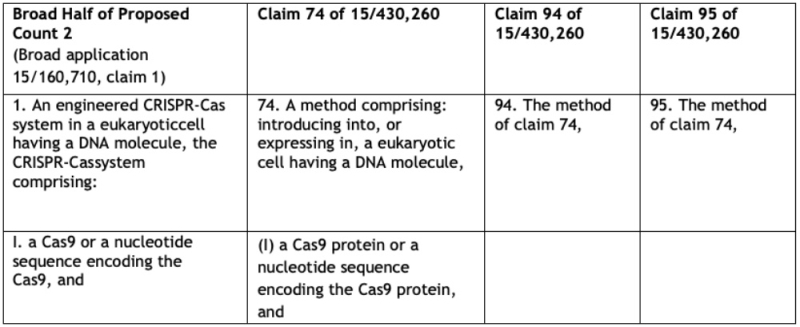
    In this motion, Broad asks the Board to add their U.S. Application Nos. 15/160,710 (having allowable claims 1, 40, and 41) and 15/430,260 (allowable claims 74, 94, and 95) to the Interference and designate the allowable claims as corresponding to Proposed Count 2.  Consistent with their arguments in Motion No. 1, Broad contends that these claims recite "generic" limitations with regard to the RNA components of CRISPR, i.e., both dual-molecule and single-molecule guide RNA.  In the alternative (i.e., should the Board deny Broad's Substantive Preliminary Motion No. 1), Broad in this motion asks the Board to designate claim 1 of the '710 application and claim 95 of the '260 application as corresponding to current Count 1.

    Broad takes its opportunity in this motion to continue to argue that the current Count 1 is unfair because it is limited to single-guise RNA (sgRNA) species of CRISPR and in doing so deprives Broad of their best proofs (which purportedly prevent Broad from evidence of dual-molecule CRISPR embodiments that would permit the Party to prevail, at least with regard to such "generic" patent claims).  Broad repeats many arguments set forth in Motion No. 1 related to this unfairness and the risk Broad is subject to should ToolGen prevail on claims to sgRNA embodiments (including being estopped under MPEP § 2308.03 from pursuing dual-molecule CRISPR embodiments).

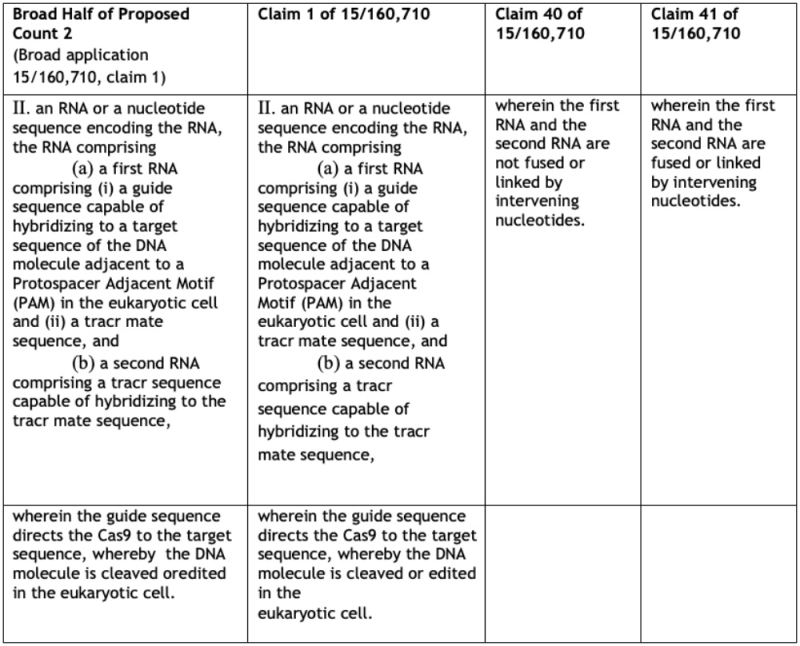
    After setting forth the legal arguments, Broad's brief sets out charts illustrating correspondence between claims of the '710 patent and Proposed Count No. 2:

    Claim Chart Showing Correspondence Of Claims 1, 40, and 41 of the '710 Application

    Table 1Table 2
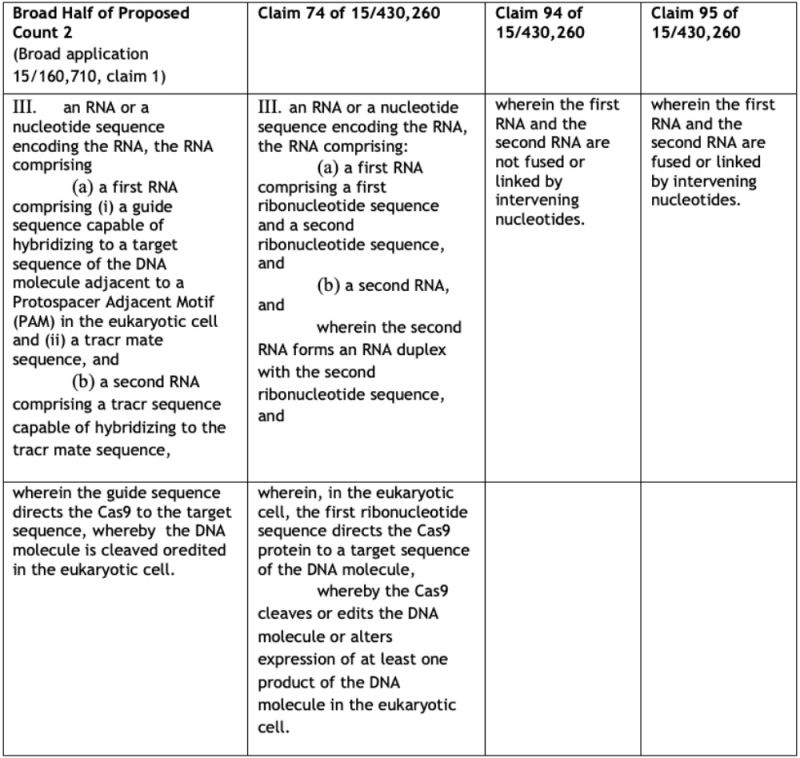
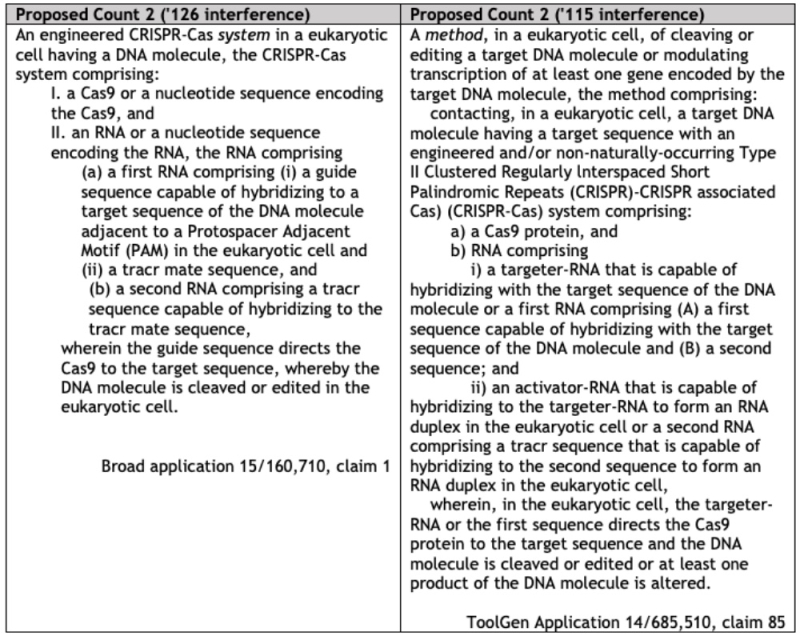
    and similar correspondence with claims of the '260 application:

    Claim Chart Showing Correspondence Of Claims 74, 94, and 95 of the '260 Application

    Table 3Table 4
    The brief sets forth in support thereof arguments that substituting this Count would substitute Count 2, reiterating and synopsizing arguments Broad set forth in its Substantive Preliminary Motion No. 1.

  • CalendarAugust 11, 2021 – "How to Avoid Common IP Pitfalls in Energy Industry Joint Ventures and Collaborations" (Intellectual Property Owners Association) – 2:00 pm to 3:00 pm (ET)

    September 24-25, 2021 – Elevate Your Prosecution 2021 conference – Salt Lake City

    September 29-30, 2021 – FDA Boot Camp (American Conference Institute)

  • IPO #2The Intellectual Property Owners Association (IPO) will offer a one-hour webinar entitled "How to Avoid Common IP Pitfalls in Energy Industry Joint Ventures and Collaborations" on August 11, 2021 from 2:00 pm to 3:00 pm (ET).  Charles Collins-Chase of Finnegan, Henderson, Farabow, Garrett & Dunner, LLP; Pamela McCollough of Shell Oil Companyl and KaRan Reed of BP America, Inc. will discuss practical tips for avoiding common energy sector IP pitfalls, including:

    • What due diligence should you perform before teaming up with another company (or even an industry competitor)?
    • What is the best way to define the scope of your rights and document your company's IP contributions to the JV or collaboration?
    • Special considerations for protecting trade secrets, know-how, and data;
    • Ownership considerations for any jointly owned IP created during the course of the collaboration; and
    • Thinking ahead to the conclusion of the collaboration.

    The registration fee for the webinar is $150 for non-members or free for IPO members (government and academic rates are available upon request).  Those interested in registering for the webinar can do so here.

  • The Elevate Your Prosecution 2021 conference on patent prosecution will be held in the Murano room of the Grand America in Salt Lake City from Friday, September 24 to Saturday, September 25.

    Expected and pending are 14 hours of Utah CLE.  The roster of speakers includes Dennis Crouch, John Duffy, David Hricik, and John White.  The full agenda follows below, and more details can be found here.

    Participants can register here for the in-person event (about 40 spaces remaining), the speakers dinner Friday night (about 8 spaces remaining), or the webcast.

    The agenda:

    Friday, September 24, 2021:

    1.1    Michael Spector and Julie Burke (Petition.ai LLC): Deep Dive into Strategies for Successful Petitions at the USPTO
    1.2.   Dan Tucker (Finnegan, Henderson, Farabow, Garrett & Dunner, LLP): Realities of Succeeding in PTAB Trials 1
    1.3.   Mike Bohn (VLP Law Group LLP): Surviving, Pivoting, and Thriving in the Changing Global IP Marketplace
    1.4.   Dan Tanner (Tanner IP PLLC): The Ethics of Educating Clients about Patent Vulnerabilities – a Litigator's Perspective
    1.5.   James Long (Li & Cai IP Group, PTAB.US: A Memory Palace Approach to PTAB Case Citations and Holding Statistics
    1.6.   Andrew Godsey (Global Technology Transfer Group) and Clarke Nelson (InFact Experts LLC): Comprehensive Overview of Modern Patent Valuation
    1.7.   Margaret Polson (Polson Intellectual Property Law PC): Overview of Design Patents for Software-Related Inventions
    1.8.   Travis Banta (former USPTO) and Kip Werking (FisherBroyles, LLP): Using Persuasion and the USPTO Count System for Successful Examiner Interviews – an Examiner's Perspective

    Saturday, September 25, 2021:

    2.1.    Scott McKeown (Ropes & Gray LLP): Realities of Succeeding in PTAB Trials 2: Prosecuting for the PTAB
    2.2.    David Hricik (Mercer Law School): Academic Perspective on Patent Valuation 1: Recent Legal and Technological Changes Reducing Patent Value
    2.3.    John Duffy (University of Virginia School of Law): Academic Perspective on Patent Valuation 2: Historical Overview of File Wrappers for Famous Patents
    2.4.    Adam Mossoff (George Mason University Antonin Scalia Law School): Academic Perspective on Patent Valuation 3: Implications of the New Paradigm of Patents as Public Rights in the Administrative State
    2.5     Ron Katznelson (President at Bi-Level Technologies): Pecuniary Interests of PTAB Judges – Empirical Analysis Relating Bonus Awards to Decisions in AIA Trials
    2.6.    Robert Greenspoon (Flachsbart & Greenspoon, LLC): Past and Future Constitutional Challenges in Patent Law
    2.7.    John White (CEO & Managing Director at PCT Learning Center): Overview of the Benefits Today of Relying More Heavily on the PCT
    2.8.    Dennis Crouch (University of Missouri School of Law): To Be Determined

  • By Kevin E. Noonan —

    FDALast week the U.S. Food and Drug Administration approved an interchangeable biosimilar to insulin glargine, an approval notable because it is the first approved interchangeable biosimilar product.  The product is Semglee (insulin glargine-yfgn), produced by Mylan Pharmaceuticals, Inc., and under this approval, it is interchangeable with Lantus (insulin glargine) made by Sanofi.

    The approval was based on the provisions of the Biological Price Competition and Innovation Act of 2009 (BPCIA), enacted with the Affordable Care Act (commonly known as "Obamacare") codified at 42 U.S.C. § 262 et seq.  Subsection (k) relates to the standards for biosimilarity; the FDA (and the statute itself) distinguish between biosimilarity and interchangeability inter alia by applying a heightened standard for interchangeability.  Specifically, the statute requires that an interchangeable product is biosimilar and can be expected to produce the same clinical result as the reference product in any given patient; and that for a biological product that is administered more than once to an individual, the risk in terms of safety or diminished efficacy of alternating or switching between use of the biological product and the reference product is not greater than the risk of using the reference product without such alternation or switch.  42 U.S.C. §§ 262(I)(3) and 262(k)(4).

    Insulins are in a unique class of biologic drugs that, for historical reasons, were approved under the Food, Drug, and Cosmetics Act (codified at 21 U.S.C. § 301 et seq.).  The BPCIA provided a sunset date of March 23, 2020 for such approvals; the FDA finalized rulemaking on this change on February 20, 2020.  Under the revised rule, any protein having a defined amino acid sequence of 40 amino acids or longer falls within the statutory definition of the term "protein" and hence is considered to be a "biological product" as defined by the BPCIA (42 U.S.C. § 262(I)).

    Semglee (insulin glargine-yfgn) was approved for treatment of Type 1 diabetes (i.e., the juvenile form) diabetes as well as Type 2 diabetes (i.e., the adult-onset form).  The FDA announcement prophesied that "[a]pproval of these insulin products can provide patients with additional safe, high-quality and potentially cost-effective options for treating diabetes."  Acting FDA Commissioner Janet Woodcock, M.D. stated that this approval has "the potential to greatly reduce healthcare costs" (a sentiment that, if true, would be a boon to the sometimes overheated debate over drug prices having insulin as a poster child; see, e.g., "Insulin's Out-Of-Pocket Cost Burden To Diabetic Patients Continues To Rise Despite Reduced Net Costs To PBMs").  This is clearly significant to the over 34 million individuals in the U.S. diagnosed with diabetes.  The Acting Commissioner also hailed FDA's "longstanding commitment to support a competitive marketplace for biological products and ultimately empowers patients by helping to increase access to safe, effective and high-quality medications at potentially lower cost."

    As set forth in the FDA's announcement, Semglee (insulin glargine-yfgn) was approved for dispensing in 10 mL vials and 3 mL pens for administration twice daily.

    It is not surprising, perhaps, that insulin, a biologically derived drug known since the 1930's would, in its modern embodiments, be the first molecule to satisfy FDA guidance on the standards for interchangeability (see "FDA Issues Final Guidance Regarding Biosimilar Interchangeability").  While there has been some concern with the perceived slow pace of biosimilar uptake by physicians and patients (see "FDA Issues Plan for Further Facilitating Biosimilar Development"), one of the benefits of interchangeability is that physicians' input (and approval) is not needed and can be implemented at the pharmacy level.  While this pathway for FDA approval is less advantageous than with small molecule drugs (which are typically administered by the patient herself as a pill, as opposed to biologic drugs which are infused by a physician or other healthcare provider), the FDA's exultations regarding Semglee's approval are well-taken as an indication not only that the FDA is willing (under the appropriate circumstances) to approve an interchangeable biological product but also as a teaching opportunity for other biosimilar drug makers on how to successfully navigate the FDA's pathway to interchangeability (desirable in addition for the exclusivity provisions only available to interchangeable biosimilar drugs).  Whether a dam-burst of interchangeable biosimilar drug products will now arise of course remains to be seen.

  • Electronic Gaming Patents Found Invalid under § 101

    By Joseph Herndon —

    District Court for the Southern District of TexasIn the U.S. District Court for the Southern District of Texas (Houston Division), Plaintiff Epic Tech, LLC (a seller of so-called "sweepstakes games") sued Defendants Fusion Skill, Inc. and Texas Wiz, LLC for infringement of U.S. Patent Nos. 9,589,423 and 8,545,315 with the distribution of gaming systems similar to Epic Tech's sweepstakes games.

    The two patents at issue are related to the play of sweepstakes games.  The first patent (the '423 patent) is directed to a method of conducting a sweepstakes game in which a computer-based system operating the game immediately determines and credits a player's account with any prize earned before showing the user the results of the game.  According to Epic Tech, this method is beneficial because it "further reinforces to regulators that the prizes are predetermined and that there is no chance or skill involved in the simulated game."

    This is important because gambling is illegal in many states, but various methods of evading this prohibition now exist, including converting a gambling-machine-like game into a lottery-like game.  In this method, the result of the game is not determined by random.  Instead, the system is loaded with a finite number of results—i.e., some number of winning tickets and a larger number of losing tickets—from which a ticket is randomly selected upon initiation of the game.  In other words, whereas in a traditional gambling machine game it would be mathematically possible for a player to lose—or win—one trillion times in a row, the precise number of winners and losers over the long run is predetermined in a lottery-based slot machine.  Further distinguishing these sweepstakes games from gambling-like games is the payment method.  Whereas a traditional gambling machine game is played by inserting a payment directly into the machine, a sweepstakes game might be initiated with a token that is given away for free along with an ostensibly unrelated purpose.  Because such a game does not technically require consideration on the part of the player, it can be defined as something other than gambling.

    The second patent (the '315 patent) describes a method for conducting computer-based sweepstakes bonus games, or "game-in-games" in the patent's lexicology.  The '315 patent claims a method whereby the playing of a game-in-game is triggered automatically, without player interference, upon the selection of a winning ticket for the initial game.

    The Defendants argued that each patent is invalid because it claims an abstract idea as proscribed by 35 U.S.C. § 101.

    1.  The '423 patent

    The '423 patent is directed to a method of dispensing prizes in an electronic sweepstakes game.  Its purported innovation is for the computer server on which the game is played to credit a player's account with the prize corresponding to the selected sweepstakes entry prior to displaying the results.  This innovation apparently makes the game more appealing to regulators.

    Claim 1 of the '423 patent is set forth here:

    1.  A method of providing a sweepstakes prize, the method comprising:
        a.  facilitating, by one or more processors, selection of a first plurality of sweepstakes tickets from a second finite plurality of sweepstakes tickets in response to a request from a user;
        b.  prior to a visual display of the results of the first plurality of tickets to a user account, determining, by the one or more processors, a prize associated with each of the first plurality of sweepstakes tickets and a total value for the prizes associated with the first plurality of sweepstakes tickets;
        c.  prior to a visual display of the results of the first plurality of tickets to a user account, crediting to an account for the user, by the one or more processors, the total prize value associated with the first plurality of sweepstakes tickets; and
        d.  providing to the user a visual display of the results of the first plurality of sweepstakes tickets.

    The Court followed the two-step Alice test, asking first whether the patent is "directed to a patent-ineligible concept," such as an "abstract idea," and second whether, "if so, the particular elements of the claim, considered both individually and as an ordered combination, do not add enough to transform the nature of the claim into a patent-eligible application."

    The Court stated that the '423 patent "flunks" Alice step one because it is directed to an abstract idea.  When computer-related patents are at issue, the critical distinction is whether the focus of the claims is on the specific asserted improvement in computer capabilities or, instead, on a process that qualifies as an abstract idea for which computers are invoked merely as a tool.

    Here, the '423 patent claim merely deploys computers as a tool to implement a novel method of executing a sweepstakes game—specifically, in Epic Tech's own words, a new "method for awarding a sweepstakes prize developed by the patentee."  The '423 patent does not describe, and Epic Tech does not claim, any innovation in computer software; instead, the patent merely sets out a new method for using computers to award sweepstakes prizes.  Thus, the Court found the focus of the claims is not on such an improvement in computers as tools, but on certain independently abstract ideas that use computers as tools.

    Because the '423 patent was found to be directed to an abstract idea, the Court proceeded to step two of the Alice test.

    The Court viewed step two as deciding whether this case is closer to DDR Holdings or Electric Power.  In DDR Holdings, the court held valid a patent that described a novel method for Internet advertising because its claims specified how interactions with the Internet are manipulated to yield a desired result—a result that overrides the routine and conventional sequence of events ordinarily triggered by the click of a hyperlink.  DDR Holdings, LLC v. Hotels.com, LP, 773 F.3d 1245 (Fed. Cir. 2014).

    In Electric Power, the patent claimed a method of gathering and displaying information for electric power grid operators, but lacked details for how to accomplish those functions.  The claims alternatively were directed to the solution itself.  Electric Power Group, LLC v. Alstom, S.A., 830 F.3d 1350 (Fed. Cir. 2016).

    The Court here found the '423 patent to be more like that in Electric Power.  The '423 patent was found to offer no "arguably inventive" method; rather, it simply instructs a computer to send information to another computer at an earlier step than it otherwise would in the normal course of a sweepstakes game.  The claims were found to lack meaningful details that would save them from § 101 destruction.

    2.  The '315 patent

    The '315 patent describes a method for operating sweepstakes bonus games, or "game-in-games."  The '315 patent describes its invention as "a method of playing a game-within-a-game" and "a method . . . providing a plurality of gaming terminals within a network."  Specifically, the '315 patent claims two networked computer terminals that simultaneously play a first game and, if the player wins the first game, trigger the playing of a second game.  Notably, the '315 patent does not claim any specific software or hardware necessary to implement this system.

    Claim 1 of the '315 patent is set forth here:

    1.  A computer-implemented method, comprising:
        a.  providing a plurality of gaming terminals linked together via a network, the plurality of gaming terminals comprising at least a first gaming terminal;
        b.  receiving a first request from a first player to play a first sweepstakes game on the first gaming terminal, wherein the first request qualifies the first player to be eligible to win an award associated with the first sweepstakes game;
        c.  in response to receiving the first request:
            i.  receiving a participation credit to play the first sweepstakes game;
            ii.  presenting an option to the first player to participate in a first sweepstakes game-in-game on the first gaming terminal so that the first player can play the first sweepstakes game and concurrently be eligible to win one or more prizes from the first sweepstakes game-in-game, wherein an outcome of the first sweepstakes game-in-game is independent of the outcome of the first sweepstakes game;
            iii.  receiving a second request; and
            iv.  in response to receiving the second request within a predetermined time limit, granting the first player eligibility to win one or more prizes from the first sweepstakes game-in-game;
        d.  triggering a play of the first sweepstakes game-in-game; and
        e.  notifying the first player of their eligibility to win one or more prizes from the play of the first sweepstakes game-in-game,
        wherein once the second sweepstakes game-in-game is triggered to play, the second sweepstakes game-in-game automatically plays on a server without input from the first gaming terminal.

    Again, the Court found that the '315 patent "flunks" Alice step one.  Like the '423 patent, the '315 patent expressly describes itself as directed to methods, but does not claim any novel usage or configuration of computer hardware or software.

    Next, under Alice step two, the Court found that the '315 patent cannot survive.  Here, the '315 patent merely describes a set of steps that could be performed by any computer—or a fast-moving store clerk—without adding any novel or inventive step.

    The '315 patent claims a method of operating two games simultaneously in which the second game is triggered by certain conditions in the first game.  If the '315 patent described some technologically innovative mechanism by which the second game is triggered, it might well be inventive.  But, it does not.  Rather, it simply claims the idea of putting two computers next to each other and having the second computer initiate a game if the first computer produces a winning result.  That idea is abstract and thus unpatentable.

    Epic Tech contended that the '315 patent's processes cannot be performed solely by humans because the patent claims a system that "independently control[s]" the game-in-game and "takes no input from the individual human players playing on the gaming terminals."

    But the Court found that a human is perfectly capable of independently running a basic game of luck without taking input from a human player—in fact, that is what a casino's croupiers do every day.  In any event, the question is not whether the patent claims a process that cannot be performed by a human, but whether the patent claims a non-ordinary process.

    Thus, Defendants' Motion for Partial Summary Judgment on Invalidity was granted as to both patents.

    Epic Tech, LLC v. Fusion Skill, Inc. (S.D. Tex. 2021)
    Memorandum and Order by U.S. District Judge Ellison

  • By Kevin E. Noonan —

    On May 28th, Junior Party the Broad Institute, Harvard University, and MIT (collectively, "Broad") filed its Substantive Preliminary Motion No. 1 in CRISPR Interference No. 106,126 (where ToolGen is the Senior Party).  While this Motion shares many similarities to a similar motion filed in Broad's interference against the University of California, Berkeley, the University of Vienna, and Emmanuelle Charpentier; Junior Party and collectively, "CVC"), there are significant differences in the proposed Count 2 in this interference and the proposed Count 2 proposed in the '115 Interference (wherein the Board denied Broad's motion in that interference).

    Broad filed this motion pursuant to 37 C.F.R. §§ 41.121(a)(1)(iii) and 41.208(a)(1).  The two proposed Counts 2 are set forth as follows:

    Table

    Broad's argument, as it was unsuccessfully in the '115 interference, is that it would be unfair to preclude them from establishing conception of the "genus" of eukaryotic CRISPR claims by limiting the Count to sgRNA species (which here as in the '115 interference would be subject to CVC's arguments of prior conception), an argument the motion asserts is "consistent with Broad's proofs in [the '115 interference]" (see "CRISPR Motions Day at the PTAB: Broad Files Its Substantive Motion No. 2").

    Broad further argues in the unfairness vein that losing this interference would invalidate its generic claims and could raise interference estoppel against the Party for claims reciting dual-molecule embodiments pursuant to MPEP § 2308.03.

    As known from Broad's priority position in the '115 interference, they have asserted conception (at least) of dual-molecule embodiments prior to CVC's disclosure of single-molecule CRISPR configurations (which are the subject of CVC's claims that Broad had the benefit of communication from Dr. Marraffini and thus Broad should not be credited with conception thereof; see "CVC Files Reply to Broad's Opposition to CVC's Priority Motion").  Broad further argues that:

    In this regard, it does not matter if Broad has only one involved claim directed to generic RNA systems or many such claims.  With even one of Broad's generic RNA claims involved in a priority contest based on the species of Count 1, an adverse ruling could wholesale deprive Broad of the ability to claim the generic RNA system as its invention, including future claims that Broad might prosecute.

    Unlike in the '115 Interference, Broad here asserts that opponent (and Senior Party) ToolGen has itself pursued claims generic to the configuration of the RNA species.  Accordingly, Broad contends that "because both parties have laid claim to the eukaryotic invention regardless of whether dual-molecule RNA or single-molecule RNA is used, adopting a generic RNA count, Proposed Count 2, is the most just resolution, and the one that will properly reflect the full scope of the interfering subject matter."

    In addition, Broad asks the Board to give them priority benefit to U.S. provisional application No. 61/736,527, filed December 12, 2012, reminding the Board that it conferred priority benefit to this application in the '115 interference which was limited to Count 1.  Finally, the motion asks the Board to designate the following claims as corresponding to Count 2 should the Board grant Broad's Substantive Motion No. 1:

    [C]laims 15-20 of the '359 patent[,] claims 26-29 of the '945 patent, claims 26-30 of the '965 patent, claims 24-30 of the '356 patent, all claims 1-30 of the '616 patent, claims 21-28 of the '839 patent, and claims 15-17, 20-24, 26-28, 31-35, and 38-39 of the '713 patent, and, upon the grant of Broad Contingent Motion 2, claims 1, 40, and 41 of the '710 application and claims 74, 94, and 95 of the '260 application [reference to exhibits excluded].

    In addition, Broad asks the Board to designate all ToolGen claims as corresponding to Count 2 on the basis that the '126 Interference as declare designated these claims to correspond to "narrower" Count 1.

    As Broad had done as Senior Party in the '115 Interference, here they argue that the two different embodiments of the CRISPR invention, citing ToolGen's U.S. Patent Application Publication No. 2015/0344912 for that proposition.  Broad asserts that the two embodiments are "highly analogous" in eukaryotic cells, disregarding its rhetoric regarding how difficult eukaryotic CRISPR was to achieve (and the efficiencies introduced using sgRNA embodiments), citing experts (including CVC experts) in support of this proposition.  The brief sets forth a timeline of its dual-molecule eukaryotic CRISPR experiments, using the following diagram to illustrate conception on April 5, 2011:

    Image 1
    Broad asserts continued efforts for dual-molecule CRISPR in eukaryotic cells in August, 2011 (and reduction to practice in October-November 2011) and submission of an NIH grant on January 12, 2012 containing the following diagram of "an entire mammalian CRISPR expression system":

    Image 2
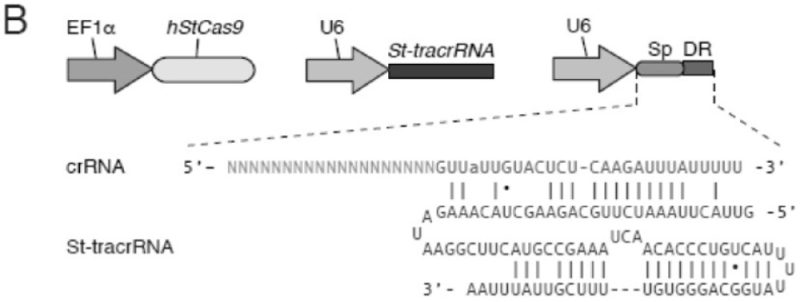
    It was only after these efforts involving "already engineered and tested dual-molecule RNA CRISPR-Cas9 systems in eukaryotic cells" that Broad asserts Inventor Zhang "conceived of and by July 20, 2012 actually reduced to practice a single-molecule RNA system using a GAAA linker."  The dual-molecule embodiments were first disclosed in a manuscript submitted on October 5, 2012 that published as the Le Cong et al. 2013 paper (Science 2013 Feb 15; 339:819-23), citing this passage:

    To reconstitute the noncoding RNA components of the S. pyogenes type II CRISPR/Cas system, we expressed an 89-nucleotide (nt) tracrRNA (fig. S2) under the RNA polymerase III U6 promoter (Fig. 1B).  Similarly, we used the U6 promoter to drive the expression of a pre-crRNA array comprising a single guide spacer flanked by DRs (Fig. 1B).

    Broad contends that similar disclosure can be found in the Zhang B1 application, to which Broad asserts it is entitled with regard to this priority chain:

    Image 3
    illustrated in a portion of Figure 11B in that application:

    Image 4
    Despite these arguments, Broad concedes that the Board came to the conclusion that "guide" RNA in the context of the '115 Interference was limited to sgRNA species, a conclusion Broad continues in that interference and this to dispute according to Broad's brief (see "PTAB Decides Parties' Motions in CRISPR Interference").

    Broad then sets forth certain claims in its involved patents and applications that encompass dual-molecule CRISPR embodiments (e.g., claim 15 of US Patent No. 9,840,713; the brief notes that claim 16 dependent in claim 15 in the '713 patent is limited to sgRNA species), and claims 1 and 2-24 of Broad's U.S. Patent No. 8,889,418, as well as Broad's involved U.S. Application Nos. 15/670,710 and 15/430,260 (which are the subject of Broad's Substantive Preliminary Motion No. 2, which will be the subject of a later post).  The brief makes similar arguments with regard to the involved claims of U.S. Patent Nos. 8,697,359.

    Broad exemplifies ToolGen's pursued claims "generic" to the RNA components of eukaryotic CRISPR, stating that the specification of ToolGen's involved '710 application recited the term "guide RNA" without restriction to sgRNA, and that "neither the involved ToolGen '510 application, nor any of the applications to which it claims priority, demonstrates or even suggests that single-molecule RNA is an improvement over dual-molecule RNA."

    In explication of their argument, Broad expressly asserts it has been unfairly precluded from relying on some of the evidence set forth in this brief regarding conception and reduction to practice of dual-molecule CRISPR embodiments in the '115 Interference and asks the Board to avoid this consequence in this interference.  ToolGen would not be prejudiced (except, of course, to the extent that granting Broad's motion would establish an earlier conception date followed by diligent reduction to practice of eukaryotic CRISPR by Broad) Broad contends because ToolGen has itself pursued dual-molecule CRISPR embodiments.