•     By Donald Zuhn

    Businessweeklogo_jpg
    An article at BusinessWeek.com ("Biotech IPO’s Iffy Prognosis") attributes a recent drop in initial public offerings (IPO’s) for small biotech companies to the reluctance of investors to forgo big paydays as small biotechs use much of the cash raised from such offerings on drug development.  However, while the biotech IPO environment has become more cautious, the environment for biotech acquisitions has blossomed.  According to author Alex Halperin, the reason for this reversal of fortune is simple:  larger pharmaceutical companies have been more than willing to assume the risk associated with drug development and approval, and view the acquisition of newer biotech companies as an effective way to "outscource" their research.

    Logo_1
    In comparing two upcoming biotech IPO’s for OncoGeneX and Rosetta Genomics with Merck’s recent acquisitions of GlycoFi and Sirna Therapeutics and GlaxoSmithKline’s purchase of Domantis, Halperin finds little in the IPO offerings to get enthused about.  Sirnalogo
    Of course, the author’s perception is likely colored by his characterization of OncoGeneX and Rosetta Genomics as "money-losing companies without an established product."  Ultimately, Halperin views acquisition as the more compelling alternative for small biotechs in the current business climate.

  •     By Mark Chael

    Gentel
    GenTel BioSciences of Madison, Wisconsin recently announced that it had raised $1.5 million USD in angel financing for development and commercialization of protein chips and assays, plus $500,000 USD to be used to complete a new partnership with a large pharmaceutical company.  However, other than the fact that the deal has been signed, president and CEO Alex Vodenlich did not provide further details regarding the deal or the identity of GenTel’s new partner.  Gentel had originally planned on raising only $1.5 million USD in the latest round of financing, however the partnership opportunity apparently required additional cash resources.

    GenTel, also known as GenTel BioSurfaces or GenTel Corporation, is listed as the assignee on U.S. Patent No. 6,878,523 and three published U.S. patent applications, all of which disclose molecular interaction assays on solid surfaces, and in particular, transcription factor and signaling molecule interaction assays.

    According to Gentel, the company currently offers "the most dependable protein microarray products for multiplex immunoassays."  Its proprietary PATH® ultra-thin nitrocellulose film surface chemistry "delivers the highest sensitivity for antibody microarray applications."  Additional information on Gentel, including its line of products and services, can be found here.

  •     By Sherri Oslick

    Gavel A note to our readers:  Patent Docs apologizes to our
    readers for the recent Court Report hiatus.  This Court Reporter was deeply immersed in very intensive preliminary
    injunction proceedings and has just now been able to come up for air.  We will catch our readers up in the next few
    postings.  Patent Docs thanks our readers
    for their patience.

    Digene Corp. v. Third Wave Technologies, Inc.
    3:07-cv-00022; filed January 11, 2007 in the Western District of Wisconsin

    Infringement of U.S. Patent No. 5,643,715 ("Human Papillomavirus Type 52 DNA Sequences and Methods for Employing the Same," issued July 1, 1997) based on defendants' sale of its Invader® HPV A9 Oligo Mix.  View the complaint here, and a more in depth report here.


    Pfizer Inc. et. al. v. IVAX Pharmaceuticals, Inc.

    2:07-cv-00174; filed January 11, 2007 in the District Court of New Jersey

    Infringement of U.S. Patent No. 5,382,600 ("3,3-Diphenylpropylamines and Pharmaceutical Compositions Thereof, issued January 17, 1995) following a paragraph IV certification as part of IVAX's filing of an ANDA to manufacture a generic version of Pfizer's Detrol® (tolterodine tartrate, used to treat overactive bladder).  View the complaint here.


    Teva Pharmacuetical Industries Ltd. et. al. v. Torrent Pharmaceuticals Ltd. et. al.

    1:07-cv-00024; filed January 12, 2007 in the District Court of Delaware

    Teva Pharmaceutical Industries Ltd. et. al. v Hetero Drugs Ltd.
    1:07-cv-00122; filed January 12, 2007 in the District Court of Maryland

    Teva Pharmacuetical Industries Ltd. et. al. v. Cipla Ltd. et. al.

    2:07-cv-00240; filed January 12, 2007 in the District Court of New Jersey

    Teva Pharmacuetical Industries Ltd. et. al. v. Hetero Drugs Ltd.
    2:07-cv-00241; filed January 12, 2007 in the District Court of New Jersey

    Teva Pharmaceutical Industries Ltd. et al v. Cipla Ltd. et al.
    1:07-cv-00316; filed January 12, 2007 in the Southern District of New York

    Teva Pharmacuetical Industries Ltd. et. al. v. Matrix Laboratories Ltd. et. al.
    2 :07-cv-00581; filed February 2, 2007 in the District Court of New Jersey

    The complaints in these cases are substantially identical.  Declaratory judgment of infringement of U.S. Patent Nos. 6,600,073 ("Methods for Preparation of Sertraline Hydrochloride Polymorphs," issued July 29, 2003), 6,500,987 ("Sertraline Hydrochloride Polymorphs," issued December 31, 2002), 6,495,721 ("Sertraline Hydrochloride Form II and Methods for the Preparation Thereof," issued December 17, 2002), and 6,897,340 ("Processes for Preparation of Polymorphic Form II of Sertraline Hydrochloride," issued May 24, 2005), all directed to methods of manufacturing crystalline forms of sertraline hydrochloride (the API in Zoloft®, used to treat depression), based on the defendants' filing of a DMF (drug master file) with the FDA.  View the Torrent complaint here.  (The Torrent case was voluntarily dismissed by Teva without prejudice on February 15.)


    Teva Pharmaceuticals Industries Ltd. et. al. v. Lupin Limited et. al.

    1:07-cv-00121; filed January 12, 2007 in the District Court of Maryland

    Teva Pharmacuetical Industries Ltd. et. al. v. Zydus-Cadila Healthcare et. al.
    2:07-cv-00242; filed January 12, 2007 in the District Court of New Jersey

    Teva Pharmacuetical Industries Ltd. et. al. v. Sandoz Inc.
    2:07-cv-00243; filed January 12, 2007 in the District Court of New Jersey

    Teva Pharmacuetical Industries Ltd. et. al. v. Andrx Corp.
    2:07-cv-00244; filed January 12, 2007 in the District Court of New Jersey

    Teva Pharmacuetical Industries Ltd. et. al. v. Genpharm Inc.
    2:07-cv-00245; filed January 12, 2007 in the District Court of New Jersey

    Teva Pharmacuetical Industries Ltd. et. al. v. InvaGen Pharmaceuticals Inc. et. al.
    2:07-cv-00246; filed January 12, 2007 in the District Court of New Jersey

    Teva Pharmacuetical Industries Ltd. et. al. v. Lupin Limited et. al.
    2:07-cv-00247; filed January 12, 2007 in the District Court of New Jersey

    Teva Pharmacuetical Industries Ltd. et. al. v. Apotex Inc. et. al.
    2:07-cv-00248; filed January 12, 2007 in the District Court of New Jersey

    Teva Pharmaceutical Industries Ltd. et al v. InvaGen Pharmaceuticals Inc. et. al.
    1:07-cv-00315; filed January 12, 2007 in the Southern District of New York

    The complaints in these cases are substantially identical.  Declaratory judgment of validity and infringement of U.S. Patent Nos. 6,600,073 ("Methods for Preparation of Sertraline Hydrochloride Polymorphs," issued July 29, 2003), 6,500,987 ("Sertraline Hydrochloride Polymorphs," issued December 31, 2002), 6,495,721 ("Sertraline Hydrochloride Form II and Methods for the Preparation Thereof," issued December 17, 2002), and 6,897,340 ("Processes for Preparation of Polymorphic Form II of Sertraline Hydrochloride," issued May 24, 2005), all directed to methods of manufacturing crystalline forms of sertraline hydrochloride (the API in Pfizer's Zoloft®, used to treat depression) based on defendants' anticipated sale of generic Zoloft® following final FDA approval of defendants' ANDA (at the end of Teva's exclusivity period).  View the Lupin complaint here.  (The Zydus and Genpharm cases were voluntarily dismissed by Teva without prejudice on February 22.)

  •     By Kevin E. Noonan

    Images_1
    DNA has a unique status among biological molecules, being both a chemical and information comprising the nucleotide sequence that encodes the amino acid sequence of a gene’s cognate protein.  In a recent article in Science, Michael Gottesman and his colleagues at the National Institutes of Health have demonstrated that even this straightforward understanding of information flow involved in gene expression may be more complicated than it has appeared.  These results have implications not only for understanding the underlying biology but in protecting genes with patents.

    Watson1
    The genetic code is degenerate, meaning that the number of possible triplet codons (64) is greater than the number of amino acids (20) corresponding to these codons.  This fundamental concept in molecular biology was first postulated by Francis Crick and verified by Marshall Nirenberg and others in the ’50’s and ’60’s.  The physical embodiment of the degeneracy of the code is transfer RNA (tRNA), small RNA molecules having a triplet codon at one "end" of the molecule and a position at the other end to which the corresponding amino acid is linked; the specificity resides in the "charging" enzymes that match tRNA to its proper amino acid.  Most amino acids are encoded by more than one triplet and have more than one tRNA charged with that amino acid.  Leucine has the most (with 6) and methionine and tryptophan are the exceptions that have only one cognate tRNA.

    It is known that not all tRNAs for a particular amino acid are produced in the same abundance, either in cells of a particular species or between species.  Thus, early genetic engineering efforts for some proteins involved changing codon choice for DNA from one species (human) for expression in other species (bacteria and yeast).  The underlying assumption, however, is that there was no difference between these codons other than tRNA abundance, and that an amino acid sequence could be encoded by any one of a number of nucleotide sequences representing "synonyms" of the native sequence.

    Gottesman’s work changes all that.  His team looked at the gene encoding human MDR1, a plasma membrane, ATP-dependent transporter that recognizes and transports from the cell many structurally-different chemical compounds.  This protein, termed P-gp, is responsible for protecting colon, kidney, and other cells from environmental toxins; forms a part of the blood-brain barrier; and makes certain cancer cells resistant to chemotherapeutic drugs.  Gottesman expressed two different embodiments of the MDR1 gene, where a certain portion of the amino acid sequences of each were encoded by a synonymous stretch of nucleotides.  In this portion of the gene, the encoded amino acid sequence was the same but the codons used in the two embodiments were different:  one of them used rare triplet codons and the other did not.  His results were startling:  not only were the proteins produced at different rates (which could be expected if the rare codon-containing species was translated more slowly), but the phenotype of the two proteins differed as well.  For example, the rare codon-encoding embodiment showed different sensitivity to certain inhibitors.  In addition, the different forms showed different susceptibility to proteolytic enzymes and different binding characteristics with conformation-specific antibodies.  Gottesman interpreted these results to mean that differences in translation speed or efficiency could change the way the protein was folded as it was produced at the ribosome, and the differences in protein folding caused (or at least contributed to) the observed phenotypic differences.

    It is unknown how common it is to have these kinds of phenotypic differences result from triplet codon synonyms.  P-pg differs from many other proteins in significant ways.  For example, it is relatively nonspecific in substrate recognition, being able to transport many structurally-different compounds across the cell’s plasma membrane against a concentration gradient.  Other researchers have found changes in substrate specificity associated with mutations in the amino acid sequence (see Choi et al., 1988, Cell 53:519-29 and Safa et al., 1990, Proc. Natl. Acad. Sci. U.S.A. 87:7225-29).  The protein is also internally-duplicated, and other members of the MDR gene family are involved in dramatically different phenotypes despite having very similar primary amino acid sequences (see Van der Bliek et al., 1987, EMBO J. 6:3325-31 and Smith et al., 1994, FEBS Lett. 354:263-66).

    Gottesman’s findings have implications for how patent protection is obtained for genes.  Heretofore, it has been common to recite a gene claim in the form of "an isolated nucleic acid encoding a protein having an amino acid sequence identified by SEQ ID NO: X."  This claim is typically supported by one cloned or otherwise identified sequence, and encompasses all nucleotide sequences encoding the amino acid sequence.  Said another way, the claim encompasses all nucleotide sequence synonyms of the encoded amino acid sequence.  When these synonymous sequences were believed to be equivalent (i.e., to encode the same protein with the same phenotypic characteristics), there was no reason not to consider elucidation of the nucleotide sequence and translation into the predicted amino acid sequence as encompassing all these synonymous sequences.  If the effect of synonymous sequences detected by Gottesman is widespread, however, it may be more appropriate to permit patenting of claims to specific synonymous sequences, provided that they are associated with a phenotype that differs in some way from the phenotype of the protein encoded by the patented sequence.  This would be the equivalent of patenting a chemical species encompassed within a prior art genus, where the species has unexpected or unappreciated properties that distinguish it from the properties of the generic compounds.  These results also illustrate one other example of how the human genome has evolved to maximize genetic variability and helps explain the general observation from the Human Genome Project, that there are many fewer human genes than were expected to be found.

  • Calendar February 27-28, 2007 – Patent Portfolio Management (American Conference Institute) – New York, NY

    March 21-22, 2007 – Complex IP & Technology Transactions Conference (Law Seminars International) – Chicago, IL

    March 25-29, 2007 – American Chemical Society National Meeting – Chicago, IL

    April 16-18, 2007 – Biotechnology: Patent Prosecution, Licensing, Litigation &
    Hatch-Waxman
    (Patent Resources Group) – Orlando, FL

    April 27, 2007 – Patent Claim Construction Workshop (Law Seminars International) – Atlanta, GA

    May 6-9, 2007 – BIO International Convention – Boston, MA

  •     By Kevin E. Noonan

    Nei_logo
    Earlier this week, the National Eye Institutes (NEI) of the National Institutes of Health announced that it would conduct a study comparing the effectiveness of two Genentech drugs, Lucentis® and Avastin®, for the treatment of age-related macular degeneration (AMD).  This was not good news for Genentech, because although treating AMD with Avastin® is an off-label use (Avastin® is approved for treating colon and certain lung cancers), the cost of the treatment is between 1% and 3% of the cost of Lucentis® treatment ($20-60 per dose versus $2,000/dose).

    Lucentis
    Lucentis® has been a great success for Genentech despite its cost, because it is one of only two FDA approved drugs for treating neovascular or "wet" AMD, a condition that if untreated leads inexorably to blindness.  The drug has been so successful that it has the lion’s share of the market over Macugen (sold by EyeTech).  The drug has not been without controversy, however, since it is not a cure for AMD but merely stablizes the wet form, and in many patients prevents the condition from worsening.  This means that the drug must be administered like insulin or other maintenance drugs.  At a cost of $2,000/dose and a once-a-month dosing schedule, the cost to treat the half-million "wet" AMD patients in the U.S. is greater than $10 billion per year.  According to Dr. Edward Chaum, Plough Foundation Professor of Ophthalmology, University of Tennessee, this is more than the entire Medicare budget for all of ophthalmology (cataracts, diabetes, glaucoma, and everything else) combined.

    Avastina
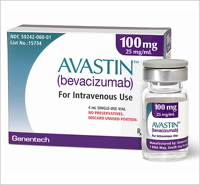
    Avastin® is so much cheaper because it is priced at $600/vial for intravenous use, but is injected into the eye at such small doses (0.1cc) that each vial can deliver 30 doses ($20/dose), says Dr. Chaum.  Genentech has opposed the off-label use of Avastin®, and cautioned ophthalmologists that there is a greater risk of stroke using Avastin.  However, the increased stroke risk was seen at the therapeutic dose for cancer patients, which is 400-fold higher than the dose used to treat AMD.  Recently, Genentech also reported that certain doses of Lucentis used for AMD are also associated with an increased risk of stroke.

    Not surprisingly, Genentech’s behavior has angered the Retina ophthalmology community, which has generally ignored Genentech’s warnings and has been widely using Avastin® for AMD.  The results of the NEI study will not be available for about a year, but the situation should be clarified sooner than that, in view of anecdotal evidence from such off-label use and the expected disclosure of preliminary results.

    Echaum
    Dr. Chaum and others believe that the results of the head-to-head clinical trial will likely validate use of Avastin® as being at least equivalent to Lucentis®.  If confirmed, Genentech will be forced to choose between removing Avastin® from the marketplace (which is unlikely, since it is a $2 billion/ year drug for cancer indications), or acquiescing to providing the drug in the lower dose amounts that are now provided only by compounding pharmacies.

    The hard reality is that AMD is a progressive disease whose best treatment is prevention.  It is an indication of the dire consequences of AMD (blindness in old age) that patients and their physicians endure the therapeutic regimen (direct injection into the eye every 4-6 weeks) for drugs that at best only slow disease progression.  Genentech lost an opportunity with Avastin® and Lucentis® to solidify ties with a large and growing patient population and their doctors.  Perhaps their cooperation, if forthcoming, in the face of the expected equivalence results for these two drugs, and the resulting greater affordability for the majority of patients, can repair the damage.

  •     By Kevin E. Noonan

    Genentechlogoblue200_2_1
    The news keeps getting worse for Genentech.  On the heels of the announcement that the National Institutes of Health would fund a study comparing the efficacy of Lucentis® and Avastin® (see "Retinal Specialist on the Avastin®/Lucentis® Controversy"), Genentech disclosed the results of an Avastin® study done by its parent company, Roche Holdings Ltd. of Switzerland.  In this study, Avastin® treatment was shown to be just as effective in lung cancer patients using half the recommended dose as it is with the full dose.  Treating with half the recommended dose would drop the cost, and hence Genentech’s revenues, from $8,800/month to $4,400/month, threatening a franchise worth about $3 million yearly (a number expected to grow as the U.S. population continues to age).

    Avastin
    The only silver lining is that the Roche study did not present evidence on the effects of the lower dose on long-term survival.  Although patients treated in the study with the lower dose showed not difference in mortality, the length of the study was insufficient to establish no difference over a longer timeframe.  Thus, low dosing comprises a risk for cancer patients, which may inhibit the 75% of oncologists who have not switched to the lower dose from doing so.  In any event, this study continues to threaten Genentech’s newfound dominance as the market leader in U.S. biotechnology companies.

  •     By Kevin E. Noonan

    Nih_300_1
    The U.S. National Institutes of Health (NIH) announced
    Wednesday that it had assembled a database of the entire genomic complement of
    2,000 human and avian influenza strains that are publicly available from the
    National Institute of Allergy and Infectious Diseases (NIAID).  The information in this database represents
    flu samples collected worldwide.

    Logo_niaid_1
    The database is the result of the Influenza Genome
    Sequencing project, started at NIH in 2004.  NIAID funded a variety of influenza sequencing efforts by university and
    private entities, including The Institute for Genomic Research (TIGR);
    Wadsworth Center of the New York State Department of Health in Albany, NY; the
    Centers for Disease Control and Prevention in Atlanta; St. Jude Children’s
    Research Hospital in Memphis, TN; the World Organization for Animal Health /
    Food and Agriculture Organization of the United Nations (OIE/FAO) Reference
    Laboratory for Newcastle Disease and Avian Influenza in Padova, Italy; The Ohio
    State University in Columbus, OH; Children’s Hospital Boston; Baylor College of
    Medicine in Houston; and Canterbury Health Laboratories in Christchurch, New
    Zealand.

    The work is not completed:  sequencing capacities have grown to more than
    200 viral genomes per month and is ongoing.  The sequence information is being posted on the GenBank database as it is
    acquired.

    This continued effort is relevant to developing vaccines for influenza, which is
    characterized by high mutation and recombination rates.  This information is particularly useful for developing vaccines to
    so-called "seasonal" influenza, which kills between 250,000 and
    500,000 people worldwide each year.  The
    information also helps determine the appropriate vaccines for the population of
    influenza virus extant each season and in different parts of the world.  The database will be even more important
    if a pandemic strain arises, such as the Asian "bird flu" of recent
    years, since pandemics can cause much more widespread mortality – an estimated
    40-60 million people died in the 1918 pandemic.

  •     By Donald Zuhn

    Genentechlogoblue200_2_2
    Genentech, Inc. announced on Wednesday that the USPTO has issued a final Office Action in its
    reexamination of U.S. Patent No. 6,331,415, rejecting the claims of what is generally referred to as the Cabilly patent. In its press release, Genentech stated its
    intention to respond to the final Office Action and, if necessary, appeal the
    decision through "all appropriate means of review within the Patent Office
    and the courts."

    Medimmune_2
    The ‘415 patent was the subject of a recent Supreme Court
    decision, in which the Court found that patent licensee Medimmune could
    challenge the validity of the patent while continuing to pay patent royalties
    under the license, and that such a suit fulfilled the "cases or
    controversies" requirement of Article III of the Constitution (see
    "Medimmune, Inc. v. Genentech, Inc. (2007)").

    Genentech noted that despite the USPTO’s determination,
    the ‘415 patent will remain "valid and enforceable" throughout the
    appeals process, which Genentech estimated would take at least one or two years.

  •      By Kevin Noonan

    It isn’t often that you hear someone defend so-called "patent trolls."  With the exception of publications directed towards the patent bar, most mainstream media are content to parrot the idea that anyone (other than a large manufacturing company) who asserts its patents in court is merely a "troll" trying to achieve the technological equivalent of a mugging.

    Wall_street_journal
    Which is why an OpEd piece in none other than the February 21, 2007 issue of The Wall Street Journal is a refreshing bit of common sense.  Written by Laura Peters, general counsel of Immersion Corp., the piece is directed towards Congressional attempts to "reform" the patent system.  As readers of this space will appreciate, some of the proposed cures are worse than the purported disease, and Ms. Peters goes after two of them.

    The first is the idea – made current by Federal Circuit Judge Kimberley Moore when Judge Moore was an academic – that patent continuation applications are somehow an improper attempt to "game" the patent system and obtain undeserved patents.  Despite being supported by questionable statistics (which run contrary to many a practitioner’s experience with the Patent Office bureaucracy), this idea motivated proposed rules changes last year that would have limited continuation application filings.  The intellectual property community responded so negatively that the proposed rules are (thankfully) no longer imminent (see "Patent Applicants Beware: The Rules Are Changing (Again)" Part 1 and Part 2).

    Ms. Peters points out the practical reasons why such proposals are wrongheaded.  These include the fact that continuation applications are important, particularly to small companies with emerging technologies.  She cites the costs of preparing many (rather than one) patent applications to cover all aspects of a new technology, and the practical reality that some aspects of the technology are underappreciated at the time the first patent application is filed but before the technology is fully developed.  She points out that the consequence of restricting continuation practice would be to give a boon to the copyists, who could use the disclosed but unclaimed subject matter without fear of patent infringement liability, greatly reducing the technology’s value.

    Ms. Peters is also a skeptic about the U.S. adopting a European-style "opposition proceeding," seeing this as a way for large companies (with greater resources) to harass small companies without the attendant risk of infringement liability.  She identifies the real beneficiaries of the "cheaper, faster" alternatives to litigation:  large companies who do not need these advantages, and the losers:  small companies who face the increased cost of defending against opponents.  According to Ms. Peters, even without such opposition proceedings, small companies are forced to fight on two fronts, as accused infringers can use existing re-examination proceedings in concert with patent infringement litigation.

    The real problem with all these proposals is that they increase the cost of patenting, and the extra burden falls most heavily on those companies least able to afford them:  small, innovative start-ups.  These are the companies that need to use their funds to invest in bringing their products to market.  Without them, Ms. Peters notes, innovation will be the purview only of large companies with big budgets.

    And we will be the losers.  Taking as her examples Steve Jobs, Don Hewlett, and Andre Pavel, she reminds us that there is a reason (at least in America) that so many of our cutting-edge, groundbreaking technologies come from basement workshops and garages:  large companies lack the flexibility to pursue innovation with the same vigor as smaller ones.  It is these smaller companies that have transformed this country from the tired, aging rust-belt has-been of the 1980’s to the economic lion it was at the turn of the century.  And the U.S. patent system and ability to protect all this innovation with patents made this turnaround possible.  We should be wary of misguided attempts to fix apocryphal problems, or the next time we might not be so lucky.