•     By Kevin E. Noonan

    The recent first Office Action in the re-examination of the Thomson stem cell patents before the U.S. Patent and Trademark Office (see "WARF Stem Cell Patent Claims Rejected in Re-examination") has predictably resulted in press releases and commentary regarding these patents.  However, while the Patent Office has initially rejected the claims for the three patents-in-reexamination, the issue is far from resolved, and the rejections per se do not establish that the patents are invalid.

    Since the reexaminations were requested, however, the issue has been less over the validity of the patents than it has been over avoiding royalty payments by commercial interests, particularly those hoping to benefit from the windfall expected from California’s support for stem cell research (see "Stem Cells a Go! in California").  Rest assured, California expects to make a profit from its investment, and the Thomson patents are in the way.

    Thus, we have the PR campaign that these are "bad" patents, and that it is the patents, rather than the Bush administration’s ban on Federal support, that is "driving" stem cell research abroad.  There is, of course, no mention that the patent-holder, the Wisconsin Alumni Research Foundation (WARF) licenses its stem cell patents to scientific researchers for substantially less than it licenses these patents to commercial interests, or that in return for the license, WARF provides support and training in working with cells well-recognized as being difficult to grow.

    Newsbongso
    One of the latest salvos in this PR war comes from the San Diego Union Tribune, in an article about Singapore researcher Ariff Bongso.  It is cast as an apocryphal story of the pure scientific researcher out merely for the glory of discovery, untainted by thoughts of profiting by patenting his invention.  No doubt, Dr. Bongso has admirably pursued his research in Singapore (where the government has spent a great deal of money on its own stem cell industry).  However, the facts don’t support the conclusion that Dr. Thomson either does not deserve his patents or that he should not have obtained them.  Indeed, the article merely establishes once again that the understanding of the scientific and legal issues contained in the popular press is severely wanting, and that the public is in fact less informed, or more misinformed, for their efforts.

    The crux of the matter is, fortunately, set forth in the article itself.  Speaking about his work, Dr. Bongso explains that he created in vitro fertilized embryos in the laboratory and determined how to extend the time the embryos could grow outside the womb before implantation.  At that time, he was able to extract embryonic stem cells from the inner cell mass and have them survive in culture for a short time.  However, by his own admission, Dr. Bongso was unable to get the cells to grow for enough time or to sufficient numbers to be useful.  That was Thomson’s patentable contribution.

    Loring__2
    Quoted extensively in the article is Dr. Jeanne Loring, a scientist whose expert declaration, opining on both the science of embryonic stem cells and the law of obviousness, was rejected by the U.S. patent examiner in the Thomson patent reexamination.  Although pointed in its rhetoric about the "public injury" occasioned by the Thomson patents, the examiner condemned this declaration and refused to consider it, since it was improper to submit such a declaration in a re-examination.  In the Union Tribune article, Dr. Loring opines that the Thomson work was "an advance, not an invention," providing no legal or logical reasons for the distinction.
    200201889631_2
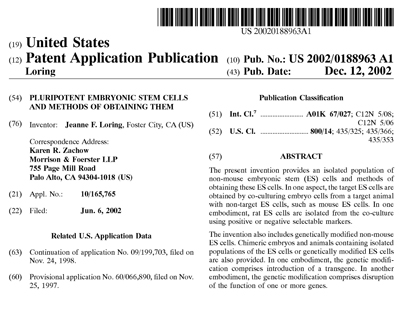
    While it is certainly Dr. Loring’s opinion these days that stem cell patents (or at least Dr. Thomson’s stem cell patents) are a bad thing, it has not always been so.  In 2002, Dr. Loring submitted her own U.S. patent application on stem cells, published as U.S. Publication No. 2002/0188963.  In this application, Dr. Loring claimed "an isolated population of non-mouse embryonic stem cells," a claim much broader than any of Dr. Thomson’s claims (that are limited not only to primate and human stem cells, but recite particular properties those cells must possess).  Indeed, Dr. Loring’s claims are so broad that they undoubtedly encompassed the cells produced by Dr. Bongso.  If Dr. Thomson’s claims occasion "public injury," imagine the result should Dr. Loring’s claims have ever issued.  In what must be viewed as a fortunate outcome for the public good (in view of the current rhetoric about stem cells), the U.S. Patent and Trademark Office refused to issue Dr. Loring a patent on her "invention."

    A decision as to whether Dr. Thomson’s patents are properly granted, valid, and enforceable is expected from the Patent Office later this year (subject to court appeal).  Until then, it does the public no service for the press to publish politically-motivated fairy tales.

    For additional Patent Docs coverage concerning stem cells, please see:

  •     By Donald Zuhn

    Osprey_logo_2
    Osprey Pharmaceuticals Ltd. announced today that it had been granted U.S. Patent Nos. 7,157,418; 7,166,702; and 7,192,736.  The claims of the ‘418 patent are directed to methods for treating secondary tissue damage and other inflammatory conditions and disorders using a chemokine-cell toxin conjugate, the claims of the ‘702 patent are directed to chemokine-cell toxin conjugates (e.g., fusion proteins), and the claims of the ‘736 patent are directed to nucleic acid molecules encoding chemokine-cell toxin conjugates.  The ‘418, ‘702, and ‘736 patents, which issued on January 2, January 23, and March 23, respectively, are the first U.S. patents to be awarded to the Saint Laurent, Quebec-based biotech company.

    According to the statement released by Osprey Pharmaceuticals, the ‘418, ‘702, and ‘736 patents "protect the use of conjugated chemokines to selectively and systematically eliminate overactive leukocytes implicated in most chronic diseases, the core technology behind Osprey’s Leukocyte Population Modulator (LPM) platform."  Osprey co-founder Dr. John McDonald noted that "[t]he timing of the patent issuance comes at an important stage of the company’s development, as we move our first LPM for the treatment of chronic kidney disease into the clinic later this year."

    Osprey’s LPMs are chemokine-toxin fusion proteins that kill cells expressing chemokine receptors, most of which are leukocytes.  The foundation of Osprey’s therapeutic strategy is that more than 100 common diseases and traumas – such as nephritis, multiple sclerosis, arthritis, asthma, and some cancers – are due to a generalized failure in the chemokine regulated controls that maintain the balance of leukocyte numbers and activity at the core of the immune system.  Thus, Osprey postulates that because leukocytes effectively are the fuel that keeps a disease going, killing them off with an LPM removes that fuel.

    The ‘418 patent issued from U.S. Application No. 09/360,242 and claims the benefit of International Application PCT/CA99/00659, filed July 21, 1999, and U.S. Provisional Application No. 60/155,186, filed July 22, 1998.  Representative independent claims 1, 9, and 29 of the ‘418 patent recite:

    1.  A method for inhibiting proliferation or migration of activated immune effector cells, comprising administering a conjugate to an animal, whereby proliferation or migration of the immune effector cells is inhibited, wherein:
        the conjugate comprises a targeted agent or a portion thereof and a chemokine receptor targeting agent or a portion thereof sufficient to bind to a chemokine receptor on immune effector cells and facilitate internalization of the conjugate;
        the chemokine receptor targeting agent is a chemokine, an antibody that specifically binds to a chemokine receptor or a fragment of the chemokine or antibody, wherein the chemokine, antibody or fragment thereof binds to the receptor and internalizes the targeted agent in a cell;
        the targeted agent or portion thereof, when internalized in a cell, alters metabolism or gene expression in the cell, regulates or alters protein synthesis in the cell, inhibits proliferation of the cell or kills the cell; and
        the conjugate binds to a chemokine receptor resulting in internalization of the targeted agent in cells bearing the receptor.

    9.  A method for inhibiting the proliferation, migration or activity of secondary tissue damage-promoting inflammatory cells, comprising administering to a subject in need thereof an effective amount of a therapeutic agent that inhibits the proliferation, migration or physiological activity of secondary tissue damage-promoting inflammatory cells, wherein the therapeutic agent is a conjugate that comprises a chemokine receptor targeting agent and a targeted agent or portion thereof selected so that conjugate binds to a chemokine receptor and internalizes the targeted agent, which inhibits the proliferation, migration or physiological activity of the secondary tissue damage-promoting cells.

    29.  A method of targeted delivery of an agent into cells that express chemokine receptors, comprising associating the agent with a chemokine receptor targeting agent, whereby:
    the chemokine receptor targeting agent binds to a chemokine receptor expressed on the cells; and
        the agent is internalized by the cells, wherein the cells are immune effector cells.

    The ‘702 patent issued from U.S. Application No. 09/453,851, which is a divisional of the application from which the ‘418 patent issued.  Representative independent claim 1 of the ‘702 patent recites:

    1.  A conjugate, comprising a targeted agent and a chemokine receptor targeting agent, or a portion thereof, wherein the conjugate binds to a chemokine receptor present on activated leukocytes resulting in internalization of the targeted agent in cells bearing the receptor.

    The ‘736 patent issued from U.S. Application No. 09/792,793, which is a divisional of the application from which the ‘702 patent issued.  Representative independent claim 1 of the ‘736 patent recites:

    1.  A nucleic acid molecule, comprising a sequence of nucleotides encoding a conjugate that comprises a toxin and a chemokine receptor targeting agent, or a portion thereof sufficient for binding to a chemokine receptor and internalization of the chemokine receptor targeting agent, wherein:
        the conjugate binds to a chemokine receptor resulting in internalization of the toxin in cells bearing the receptor; and
        the receptor occurs on activated immune cells.

  •     By Sherri Oslick

    Gavel About
    Court Report:  Each week we will report briefly on recently filed
    biotech and pharma cases, and a few interesting cases will be selected
    for periodic monitoring.

    Teva Pharmaceutical Industries Ltd. et. al. v. Cobalt Pharmaceuticals, Inc. et. al.
    2:07-cv-01690; filed April 10, 2007 in the District Court of New Jersey

    Infringement of U.S. Patent Nos. 6,600,073 ("Methods for Preparation of Sertraline Hydrochloride Polymorphs," issued July 29, 2003), 6,500,987 ("Sertraline Hydrochloride Polymorphs," issued December 31, 2002), 6,495,721 ("Sertraline Hydrochloride Form II and Methods for the Preparation Thereof," issued December 17, 2002), and 6,897,340 ("Processes for Preparation of Polymorphic Form II of Sertraline Hydrochloride," issued May 24, 2005), all directed to methods of manufacturing crystalline forms of sertraline hydrochloride (the API in Pfizer's Zoloft®, used to treat depression) based on defendant's manufacture and sale of generic Zoloft®.  View the complaint here.


    Monsanto Co. et. al. v. Bening et. al.

    3:07-cv-00261; filed April 9, 2007 in the Southern District of Illinois

    Infringement of U.S. Patent Nos. 5,352,605 ("Chimeric Genes for Transforming Plant Cells Using Viral Promoters," issued October 4, 1994) and RE39,247 ("Glyphosate-tolerant 5-enolpyruvylshikimate-3-phosphate Synthases," issued August 22, 2006) based on defendants' use of soybean seed produced from earlier planted Roundup Ready® soybean seed.  View the complaint here.


    AstraZeneca Pharmaceuticals LP et. al. v. Sandoz Inc.

    3:07-cv-01632; filed April 6, 2007 in the District Court of New Jersey

    Infringement of U.S. Patent No. 4,879,288 ("Novel Dibenzothiazepine Antipsychotic," issued November 7, 1989) following a paragraph IV certification as part of Sandoz's filing of an ANDA to manufacture a generic version of AstraZeneca's Seroquel® (quetiapine fumarate, used to treat schizophrenia and bipolar disorder).  View the complaint here.


    Merck Sharp & Dohme Pharmaceuticals Srl v. Teva Pharmaceuticals USA, Inc. et. al.

    3:07-cv-01596; filed April 3, 2007 in the District Court of New Jersey

    Infringement of U.S. Patent No. 5,565,473 ("Unsaturated Hydroxyalkylquinoline Acids as Leukotriene Antagonists," issued October 15, 1996) following Teva's filing of an ANDA to manufacture a generic version of Merck's Singulair® (montelukast sodium, used to treat asthma and allergic rhinitis).  View the complaint here.


    LBS Technologies, Inc. v. Incyte Corp.

    2:07-cv-01297; filed March 30, 2007 in the Eastern District of Pennsylvania

    Infringement of U.S. Patent Nos. 5,021,335 ("In Situ Transcription in Cells and Tissues," issued June 4, 1991), 5,168,038 (same title, issued December 1, 1992), 5,545,522 ("Process for Amplifying a Target Polynucleotide Sequence Using a Single Primer-Promoter Complex," issued August 13, 1996), 5,716,785 ("Processes for Genetic Manipulations Using Promoters," issued February 10, 1998), 5,891,636 (same title, issued April 6, 1999), 5,958,688 ("Characterization of mRNA patterns in neurites and single cells for medical diagnosis and therapeutics," issued September 28, 1999), and 6,291,170 ("Multi-Genes Expression Profile," issued September 18, 2001).  View the complaint here.

  • Calendar April 16-18, 2007 – Biotechnology: Patent Prosecution, Licensing, Litigation &
    Hatch-Waxman
    (Patent Resources Group) – Orlando, FL

    April 19-20, 2007 – "Litigation and Enforcement in the Biotech and Pharmaceutical Industry" (GTCbio) – San Francisco, CA

    April 27, 2007 – Patent Claim Construction Workshop (Law Seminars International) – Atlanta, GA

    May 6-9, 2007 – BIO International Convention – Boston, MA

    June 26-28, 2007 – Euro-Biotech Forum 2007 – Paris, France

  •     By Donald Zuhn

    Dow
    On Thursday, Dow Chemical Co. announced that two senior executives had been fired for "engag[ing] in business activity that was highly inappropriate and a clear violation of Dow’s Code of Business Conduct."  In particular, Dow determined that the two executives had been "involved in unauthorized discussions with third parties about the potential acquisition of the Company."

    The terminations appear to be related to the report earlier this week that a consortium of Middle Eastern investors and American buyout firms was preparing a $50 billion leveraged buyout of Dow Chemical Co. (see "Dow Denies That It Is Buyout Target").

    The New York Times speculated today that the terminated executives’ "rogue" negotiations may ultimately "have whetted investors’ and suitors’ appetite for a Dow takeover," and that "while [the fired executives’] talks appear to have been bungled, Dow could still make an attractive takeover target for Middle East investors or private equity firms."  In addition, the Times report indicated that the rogue negotiations may not have been so rogue.  In particular, one of the terminated executives denied Dow’s accusations and suggested that he was being made a scapegoat.

  • Joblogo_2
        By Jason Derry —

    Array BioPharma has
    announced
    that AstraZeneca has dosed a patient with its MEK
    inhibitor, ARRY-704, in a Phase I clinical trial. By dosing the first patient, Array BioPharma
    is now entitled to a $2 million milestone payment from AstraZeneca. ARRY-704 is an orally active MEK-inhibitor
    with tumor suppressive activity.  Earlier
    this week, Array BioPharma announced
    that it has filed an Investigational New Drug (IND) application for ARRY-797, a p38
    inhibitor, and plans to initiate Phase 1 clinical trials in cancer patients.

    Contentpagelogo240x101

  •     By Donald Zuhn

    Allergan_logo
    On Thursday, Allergan, Inc. announced that the U.S. Court of Appeals for the Federal Circuit has affirmed judgment in favor of Allergan and Roche Palo Alto, LLC in a patent infringement suit against Apotex, Inc., Apotex Corp., and Novex Pharma ("Apotex").  As a result of this decision, Apotex will not be able to obtain FDA approval to market a generic version of Allergan’s ACULAR® (ketorolac tromethamine ophthalmic solution) product.  ACULAR® is approved for use in treating ocular itching due to seasonal allergic conjunctivitis and post-operative inflammation in patients following cataract surgery.

    Last year, Apotex appealed a District Court ruling that its proposed generic product infringed Roche Palo Alto’s U.S. Patent No. 5,110,493 (which Roche licenses to Allergan), and that the ‘493 patent was a valid and enforceable.  The District Court also determined that the effective date of approval of Apotex’ Abbreviated New Drug Application (ANDA) would have to wait until after the ‘493 patent expired on May 5, 2009.

    Apotex_2

  •     By Donald Zuhn

    On Tuesday, Abbott announced that it had reached an agreement with World Health Organization (WHO) Margaret_chan_2
    Director General Margaret Chan to reduce the price of its Kaletra/Aluvia (lopinavir/ritonavir) AIDS drugs in the developing world.  In particular, Abbott will be offering the drugs to about forty low and low-middle income countries (as defined using World Bank criteria) at a price of $1,000 per patient per year – or about 55% less than the average current price at which Abbott sells the drugs in these countries (and less than the price of any generic version of the drugs).

    According to Abbott’s statement, the price reduction will serve to "further increase A_major_3
    access and address the debate around pricing of HIV medicines . . . while preserving the system that enables the discovery of new medicines."  Abbott added that "[t]he patents of scientists and inventors must exist so that there are incentives for sustained research and development," without which "the miracle drugs the world enjoys today, including HIV medicines, would not exist."

    Abbott’s decision to reduce the price of its AIDS drugs in the developing world constitutes a reversal of its earlier decision to withdraw its products from Thailand in response to that country’s issuance of compulsory licenses for Kaletra (see "No New Abbott Medicines for Thailand"), which in turn resulted from Abbott’s failure to reach an agreement with the Thailand government on a reduced price for Kaletra.  With respect to its dispute with Thailand, Abbott stated that it "appreciates and fully respects the suggestion of Director General Chan that more work needs to be done with the government of Thailand to achieve a positive outcome, " but noted that "Kaletra capsules remain available in Thailand and will be eligible for the new price."

    A Reuters report indicates that despite Abbott’s announcement, the company’s dispute with Thailand continues, and as a result, Abbott will not be offering Aluvia (a newer form of Kaletra) in Thailand.  According to the Reuters report, AIDS activists have widely criticized this decision since Aluvia is a heat-stable form of Kaletra that eliminates the need for costly cold storage in resource-poor countries.

    For additional information concerning the issue of compulsory licensing in Thailand, please see:

  •     By Kevin E. Noonan

    Uspto_seal
    As has been reported elsewhere (see Patently O: "Rumors Continuations & Claims"), the U.S. Patent and Trademark Office appears to be ready to issue "final rules" on changing continuation application practice, said PTO’s Commissioner of Patents John Doll today at a meeting of the District of Columbia Bar Association.

    According to Commissioner Doll, the Patent Office has delivered the "final rules" to the Congressional Office of Management and Budget (OMB), which will take a minimum of 90 days to review the proposed rule changes.  Thereafter, the rules will be published in the Federal Register.

    The extent of the good news associated with this announcement is the concession by Commissioner Doll that the unprecedentedly large (and unprecedently negative) public commentary submitted in response to the rules as initially proposed has had an effect.  Commissioner Doll hinted that the final rules have been modified, explicitly in response to some of the comments.  Among the modifications alluded to in his comments were changes in the proposed "representative claim" proposal as well as increased limits on the numbers of independent and total claims.  Also purportedly changed is the rule that all divisional applications be filed at the same time to retain the initial priority date, and the limits on the number of continuing applications that will be permitted.

    Readers of this space will recall some of the more draconian portions of the proposed rules (see below).  These include limiting continuations to one per application, and depriving applicants subject to claim restriction (based on claiming more than one invention in a single application) of the right to pursue the restricted claims after the original application grants.  The number of claims the Office was willing to examine was limited to ten "representative" claims chosen by the applicant, including all independent claims.  Claims restricted from an application by Patent Office determination that they were independently-patentable inventions would be required to be filed during the pendency of the restricted application in order to retain the priority right.  And the Office proposed requiring applicants to identify and characterize prior art with particularity regarding individual claim limitations, without any concomitant changes in Rule 56 to shield patent counsel from later accusations of inequitable conduct.

    Commissioner Doll is scheduled to address the American Bar Association’s Intellectual Property Section meeting in Washington over the next three days (April 12-14, Arlington VA).  It will be interesting to see whether Commissioner Doll is more forthcoming in his remarks during this meeting.  Continued strict secrecy is likely to be a harbinger that the "modified" rules are not much better than the original rules deemed by many to be extremely unsatisfactory.  If so, litigation over the competency of the Patent Office to make such sweeping incursions on applicants’ statutory rights is possible.

    For additional information regarding this topic, see:

  •     By Donald Zuhn

    Logo
    On Tuesday, GTC Biotherapeutics, Inc. announced that it had been granted a non-exclusive worldwide license from stART Licensing, Inc. to use stART’s nuclear transfer patents and patent applications to produce therapeutic proteins in the milk of transgenic animals.

    Atyrn
    GTC Biotherapeutics, Inc.
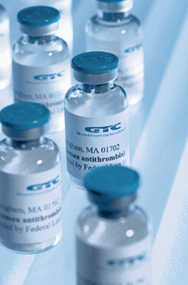
    commercializes therapeutic proteins through transgenic animal technology.  GTC’s ATryn®, a recombinant form of human antithrombin, was the first transgenically produced protein to be approved anywhere in the world (the European Commission has approved ATryn® for the treatment of deep vein thrombosis).  ATryn® is produced in the milk of transgenic goats that have been developed by micro-injection.

    100
    stART Licensing, Inc. is a joint venture between Geron Corp. and Exeter Life Sciences, Inc.  stART manages and licenses a portfolio of patent rights related to animal reproductive technologies, including the patents and patent applications involved in the licensing agreement.  The licensed nuclear transfer technology was originally developed by the Roslin Institute for the cloning of Dolly the sheep.

    Financial terms of the agreement include a $200,000 payment to stART and a split of 278,370 shares of GTC’s common stock between stART and Exeter.  In addition, GTC will pay royalties to stART on any products that GTC develops with the licensed technology.  The agreement will remain in force through the expiration of the last of stART’s nuclear transfer patents, which GTC expects to expire in 2016.  While the patents and patent applications involved in the agreement have not yet been disclosed, the licensed technology may include U.S. Patent Nos. 6,525,243; 6,252,133; and 6,147,276; and a number of U.S. patent applications.

    Biz5_clip_image001
    According to GTC’s statement, the licensed technology will be utilized, as an alternative to micro-injection, to develop transgenic animals that incorporate a transgene into their genome for the expression of therapeutic proteins in the transgenic animal’s milk.  GTC also noted that by using nuclear transfer technology, it will be able to speed up the development of large-scale transgenic production capacity.

    GTC Chairman and CEO Dr. Geoffrey Cox stated that GTC’s "intellectual property portfolio provides patent protection for both the practice of our technology and the commercialization of our products," noting that GTC had received a U.S. patent in 2006 "for the production of therapeutic proteins in the milk of any transgenic mammal."  According to Dr. Cox, the licensed stART technology would help "support[] our strategic focus on the development and commercialization of recombinant plasma proteins and monoclonal antibodies."