•     By Kevin E. Noonan

    Cover_nature
    After a thorough review by a peer-review panel of the scientific data presented in a report published in its pages five years ago, the journal Nature announced on June 14, 2007 that, although representation of the data in one figure was flawed, the underlying conclusions were scientifically valid.  These conclusions were accompanied this week by a Corrigendum (or correction) published in the journal by the reports’ authors, identifying and acknowledging the mistakes but reasserting their conclusion that multipotent adult progenitor cells, or MAPCs, could be found in mouse bone marrow (see Jiang et al., "Pluripotency of mesenchymal stem cells derived from adult marrow").

    Stem_160
    The report comes as a sort of vindication for Dr. Catherine Verfaillie, the principal investigator in the study who is now at the Catholic University of Leuven in Belgium.  Dr. Verfaille has maintained all along that the basic conclusions of the work are sound, but has also acknowledged that there were flaws in how the paper was published (see "Limitations on The Usefulness of Adult Stem Cells").

    Specifically, the paper identifies as unreliable one figure (Figure 1b), a fluorescence-activated cell sorting (FACS) plot.  This data was unreliable, according to the Corrigendum, because the intensity of staining was 10-fold lower than expected, and the proper controls were not included.  However, the authors provide a corrected Figure, and affirmatively state that they have been able to reproduce the work and obtain a reliable result.

    200706208_d03063307v
    These events may breathe additional life into efforts to develop pluripotent human stem cells from adult tissues.  One important reason that human embryonic stem cells have remained a primary focus of stem cell research even in the face of governmental efforts to suppress (or at least limit) their use for religious and "moral" reasons, is that stem cells from the inner cell mass of the blastocyst have been the only truly pluripotent cells known.  The Verfaille work, if truly reproducible, provides another, less controversial avenue for developing human pluripotent stem cells.  This line of investigation has the additional advantages that MAPCs could be derived from a patient’s own tissues, and thus avoid potential immunological complications to using human stem cells therapeutically.  Since the Bush administration is steadfast (or just plain stubborn) in its opposition to human embryonic stem cells (having used two of its only three vetoes against bills that would expand the scope of human ES cell lines approved for federally-funded research), any chance that stem cell science will advance in the U.S. is dependent on finding other sources.  These include alternative funding sources, such as the California initiative (see "Stem Cells a Go! in California") and other states and private foundations.  They once again include alternative stem cell sources, such as Dr. Verfaille’s MAPCs.  Perhaps these developments will blunt the negative effects that federal funding restrictions have had on the progress of stem cell science in this country.  Such an outcome would be beneficial both to science and the economy, and may help to reverse the "stem cell brain drain" the Bush Administration’s policies have had over the past seven years.

    For additional information on this and related topics, please see:

  •     By Sherri Oslick

    Gavel
    About
    Court Report:  Each week we will report briefly on recently filed
    biotech and pharma cases, and a few interesting cases will be selected
    for periodic monitoring.


    Teva Pharmaceutical Industries Ltd. et. al. v. Zentiva, S.A.

    1:07-cv-21593; filed June 21, 2007 in the Southern District of Florida

    Declaratory judgment of infringement of U.S. Patent Nos. 6,699,997 ("Carvedilol," issued March 2, 2004), 6,710,184 ("Crystalline Solids of Carvedilol and Processes for Their Preparation," issued March 23, 2004), 7,056,942 ("Carvedilol," issued June 6, 2006), and 7,126,008 (same title, issued October 24, 2006) based on Zentiva's filing of a DMF (drug master file) with the FDA for the manufacture of carvedilol (the active ingredient in GSK's Coreg®, used to treat congestive heart failure).  View the complaint here.


    Sanofi-Aventis U.S. LLC et. al. v. Dabur Oncology PLC et. al.

    3:07-cv-02854; filed June 19, 2007 in the District Court of New Jersey

    Sanofi-Aventis U.S. LLC et. al. v. Teva Parenteral Medicines, Inc. et. al.
    1:07-cv-03428; filed June 18, 2007 in the District Court of New Jersey

    The complaints in these two cases substantially identical.  Infringement of U.S. Patent Nos. 5,338,874 ("Cis oxalato (trans 1-1,2-cyclohexanediamine) PT(II) Having Optically High Purity," issued August 16, 1994) and 5,716,988 ("Pharmaceutically Stable Preparation of Oxaliplatinum," issued February 10, 1998) following a paragraph IV certification as part of Sandoz's filing of an NDA (under § 505(b)(2) of the Food, Drug and Cosmetic Act) and Dabur's filing of an ANDA to manufacture a generic version of plaintiffs' Eloxatin® (oxaliplatin for injection, used to treat colorectal cancer).  View the Dabur complaint here, and the Teva complaint here.


    Johnson Matthey Inc. v. Noven Pharmaceuticals, Inc.

    2:07-cv-00260; filed June 19, 2007 in the Eastern District of Texas

    Infringement of U.S. Patent No. 6,096,760 ("Solid α-Phenyl-2-Piperidine Acetate Free Base, Its Preparation and Use in Medicine," issued August 1, 2000) based on Noven's manufacture and sale of methyl α-phenyl-2-piperidine acetate free base and/or pharmaceutical formulations containing methyl α-phenyl-2-piperidine acetate free base.  View the complaint here.


    Abbott Laboratories v. Impax Laboratories Inc.

    1:07-cv-00388; filed June 18, 2007 in the District Court of Delaware

    Infringement of U.S. Patent Nos. 6,713,086 ("Controlled Release Formulation of Divalproex Sodium," issued March 30, 2004) and 6,528,090 (same title, issued March 4, 2003) following a paragraph IV certification as part of Impax's filing of an ANDA to manufacture a generic version of Abbott's Depakote® ER (divalproex sodium, used to treat manic episodes associated with bipolar disorder, epilepsy, and migraine headaches).  View the complaint here.


    Tiber Laboratories, LLC v. Hawthorn Pharmaceuticals, Inc.

    2:07-cv-00069; filed June 18, 2007 in the Northern District of Georgia

    Infringement of U.S. Patent No. 6,979,689 ("Compositions and Methods for Treating Upper Respiratory Congestion," issued December 27, 2005) based on Hawthorn's sale of DYTAN-HC (used to treat cough, congestion and discomfort associated with the common cold, sinusitis and acute upper respiratory tract infections).  View the complaint here.


    febit biotech GmbH v. Codon Devices Inc.

    1:07-cv-00385; filed June 15, 2007 in the District Court of Delaware

    Infringement of U.S. Patent No. 6,586,211 ("Method for Producing Polymers," issued July 1, 2003) based on Codon Devices' manufacture and use of, and sale of molecular biology devices incorporating, its BioFAB® gene synthesis platform.  View the complaint here.

  •     By Mark Chael

    Uspto_seal
    As Patent Docs has previously reported (here and here), the USPTO recently held a customer partnership meeting for the biotech, chemical, and pharmaceutical art groups.  Of the many interesting and informative presentations and discussions from the meeting, those of us that prosecute patent applications directed to oligonucleotide, protein, and antibody inventions should find Mr. Bruce Campell’s discussion of restriction practice for product and process inventions in TC1600 particularly helpful.  Mr. Campell is a SPE in Art Group 1648.  A revised copy of Mr. Campell’s presentation is available here.

    In addition to a fine introduction to restriction practice generally, Mr. Campell presented ten examples of restriction practice specific to the biotech, chemical, and pharma arts, especially nucleotide, protein, and antibody inventions.

    By way of introduction, Mr. Campell mentioned that, restriction is not an option when the inventions as claimed are not independent or distinct or where "the claims define the same essential characteristics of a single disclosed embodiment of an invention."

    For process inventions, one should compare the preambles, the active steps, and the specification.  If the claimed preambles are different, but the active steps are the same, restriction would be improper as long as the specification indicated that the objectives of the methods recited in the preambles could all be accomplished using the same active step.  On the other hand, restriction may be proper in claims with different preambles and identical active steps, if the objectives recited in the preambles were specific to different types of materials and resulted in different outcomes.

    There are two criteria for a restriction requirement: 1) the claimed inventions must be independent and distinct, and 2) there would be a "serious burden" on the examiner if restriction were not required.  A "serious burden" results where the "search and examination for one of the claimed inventions is not required for another of the claimed inventions."  Prima facie serious burden results if one or more of the following reasons apply:  separate classifications and/or status in the art, different fields of search, prior art for one invention not likely applicable to the other invention, and different non-prior art issues under § 101 and § 112.  A "serious burden" may also be shown based on different fields and types of searching required, for example, different class/subclass classifications (which are apparently infrequently used by examiners) as well as different electronic resources and search queries.  Mr. Campell mentioned that the identification of different electronic resources and search queries as supporting a "serious burden" on examiners would be finding its way into the latest revision of the MPEP due out some time soon.

    Regarding the independence of biotech product and process inventions, Mr. Campell presented a particularly helpful slide during his presentation that correlated DNA, protein, and antibody product claims with related claims drawn to methods of making/using the DNA, protein, and antibody.  Regarding the distinctness of product and process inventions, one should look to whether they are obvious variants, whether they are materially different, and/or whether they are mutually exclusive.  A number of biotech-specific examples were presented that attempted to highlight the nuances in these concepts of distinctness as applied to restriction practice.

    Lastly, in addition to touching on the subject of rejoinder, Mr. Campell presented a practical tip regarding the distinction between products and processes of screening or detecting.  A screening or detection method claim seeks to produce information, e.g., information about an unknown product that has a certain effect or information about whether a known candidate product does or does not have a certain activity.  Such methods typically do not lead to the production or isolation of the product and such methods typically do not require the presence of the product at all.  Thus, method claims that are drawn to screening for or detecting a particular product are usually not methods of making or using a particular product with the activity in question.

    During the course of the presentation, it was suggested that if applicants and practitioners desire to traverse a given restriction requirement for a group of related nucleic acids or proteins, they should provide an alignment of the sequences using any of the available programs/algorithms to support their argument that the sequences are in fact related and there would be no "serious burden" on the examiner to search and examine the related group of sequences, rather than restricting the claims to the individual sequences that make up the group.

    Sequence_listing

    A recording of Mr. Campell’s presentation can be downloaded here.  To play .wrf files, you will need to install the WebEx Player available here.

    Note to Readers:  This is the second in a series of articles regarding
    selected presentations from the June 13, 2007 quarterly
    biotechnology/chemical/pharmaceuticals customer partnership meeting.  The first article in the series is entitled "Biotechnology Art Group Discusses Enablement of Antibody Claims."

  • Calendar
    June 26-28, 2007 – Euro-Biotech Forum 2007 – Paris, France

    June 28, 2007 – "Patent Licensing Post MedImmune: Proceed with Caution: Best Practices for Adapting to Sweeping Change in Licensing" (Strafford CLE Teleconferences)

    July 12-14, 2007 – Intellectual Property Law Summer Institute (Institute of Continuing Legal Education) – Mackinac Island, Michigan

    July 16-17, 2007 – Pharma and Biotech Collaborative Agreements Conference (American Conference Institute) – San Francisco, CA***

    ***Patent Docs is a media sponsor of this conference or CLE.

  •     By Mark Chael

    Nasdaq_logo_2
    The Nasdaq Stock Market, Inc. recently announced that as part of its semi-annual re-ranking of the NASDAQ Biotechnology Index® (NBI), thirteen securities have been added to the index, while four have been dropped.  All of the securities on the NBI are classified as biotech or pharma according to the Industry Classification Benchmark (ICB).

    Sirna_nasdaq_2
    In addition to the proper ICB classification, the NBI securities must also meet other criteria, including market value, average daily share volume, listing on the NASDAQ Global Market or NASDAQ Global Select Market, and "seasoning as a public company."  The last criteria allows the decision-makers at The Nasdaq Stock Market, Inc. a good deal of latitude in choosing companies for inclusion or exclusion.

    The companies recently added to the NBI are:

    While the companies recently removed from the NBI are:

  •     By Kevin E. Noonan

    Federal District Court Judge Patti Saris handed down her decision in a major class action suit against several pharmaceutical companies, and the pharmaceutical companies cannot be happy with the result.  In re Pharmaceutical Industry Average Wholesale Price Litigation, MDL No. 1456, Civil Action No. 01-12257-PBS (D. Mass. 2007).

    Astrazeneca_large
    At issue were payments made by third-party payors that reimburse patients for Medicare co-payments (Class 2 plaintiffs), and all "end-payors," which included patients who make co-payments under private medical insurance (Class 3 plaintiffs).  The defendants included AstraZeneca (for the drug Zoladex for prostate cancer), Bristol-Myers Squibb (for five drugs including taxol for breast cancer), and Schering-Plough’s Warrick subsidiary (for the respiratory drug albuterol sulfate).  Johnson & Johnson was found not to be liable for pricing of its Remicade® drug for Crohn’s disease.

    Bristolmyers_squibb_1
    Judge Saris ruled that liability attached due to these companies’ activities relating to the method of determining drug pricing known as "average wholesale pricing (AWP), a practice dating from the 1960’s, and covered both physician-administered and self-administered drugs.  It was also used as a benchmark for Medicare drug pricing used by the Federal government until 2003.  Rather than set drug prices itself, the government left it to the drug industry to set the AWPs.  And although the relevant government agencies had the authority to conduct audits and surveys to interrogate how accurately the AWPs reflected actual drug pricing, Judge Saris found that the agencies had never done so.

    Scheringplough
    Under the AWP method, Judge Saris found that the liable drug companies inflated the price of their drugs to create a "middle" of profitability between the actual price paid by physicians and pharmacies and the AWP.  The Court recognized that a markup of 20-25%, which had been an industry standard, was justifiable to defray administrative and other costs.  In contrast, for the drugs at issue in this litigation, the Court found that the markups ranged from 85.9% to 1131.7%.  These elevated markups occurred more often for drugs facing generic competition, because it conferred countervailing market advantages for these drugs and gave physicians the capacity to benefit financially by their choice of which drug to administer (especially since the terms of the contractual relationships between pharmaceutical companies and doctors were kept confidential).  This was much less of a problem with self-administered drugs, where patient benefits managers played a greater (and cost-cutting) role.

    Jj_logo_red_on_wht_1200_1
    Fortunately for the defendants found liable, damages prior to December, 1997 were banned by the statute of limitations, and further limited by changes in the law enacted by Congress in 2003.  Even so, the Court found AstraZeneca liable to the Class 3 plaintiffs in the amount of $4,451,429.  Bristol-Myers Squibb was found liable in the amount of $183,454 to the Class 3 plaintiffs.  Schering-Plough’s Warrick subsidiary was not found liable to the Class 3 plaintiffs.  However, the Court was unable to determine damages to the Class 2 plaintiffs on the trial record, and requested additional information from all three defendants.  A further bench trial is also a possibility for the Court to be able to make the damages determination as to the Class 2 plaintiffs.  The defendants have indicated they are considering appealing the decision.

    For additional information regarding this decision, please see:

  •     By Kevin E. Noonan

    Largecover
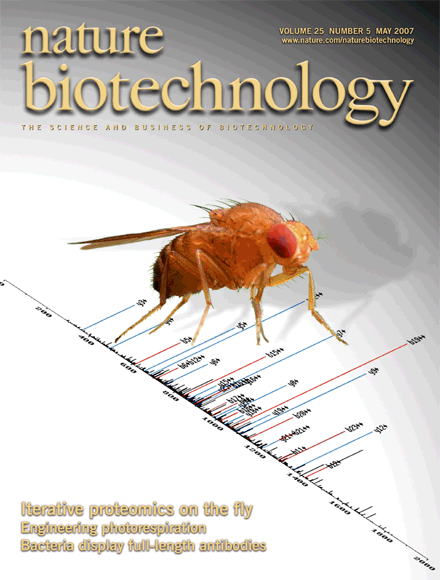
    U.S. patent practitioners have long felt that obtaining patent protection in Japan was more difficult than in other countries, particularly for biotechnology inventions.  An article in Nature Biotechnology last month (Aida et al., "Shortened life spans of biotech pioneer patents in Japan: a lesson from the DNA chip") provides solid evidence that this is the case, and illustrates the disadvantages under which biotechnology patents operate in Japan – which are even more pronounced the more fundamental and "pioneering" the claimed invention.

    Ogtlogorgb72dpi_transparent
    The authors, from the Intellectual Property Division of the Tokyo Medical and Dental University used as illustrative examples two patents directed to DNA array technology:  one to Oxford Gene Technology (OGT) and the other to Affymetrix.  The subject matter of the OGT patent was directed to methods for identifying a polynucleotide sequence using a microarray, while the Affymetrix patent was directed towards methods for Affymetrix_color_logo_jpg_small_2
    preparing the arrays.  The authors, and the Japanese Patent Office (JPO), treated this subject matter as "pioneering," which in this context appears to have caused heightened scrutiny during examination.

    Jplogo
    The study compared the term and the time and course of the prosecution histories of corresponding patents granted in Japan, Europe, and the U.S. for each of these technologies.  The results were striking:  the Japanese patents had a shorter term (4 years, five months for the Affymetrix patent, 6 years for the OGT patent) in Japan, compared with 12 years for Affymetrix’s patent and 15 years for the OGT patent in Europe.  This metric was not as informative for the U.S. patents, which were filed prior to the change in U.S. patent term from 17 years from grant to 20 years from earliest filing date.

    Uspto_seal
    The time in prosecution was another measure, used across all three patent offices (U.S., Europe, and Japan).  Here, the OGT patents were in prosecution for almost ten years in Japan, and the Affymetrix patents were prosecuted for 14 years before the JPO.  These results were not the result of inactivity:  the OGT application was rejected during the course of prosecution over five separate Office Actions, and the Affymetrix applicants responded to six separate Actions.  In contrast, the OGT patent was in prosecution for a little less than 5 years (three Actions) in Europe and about 4 years (three Actions) in the U.S., and the Affymetrix application prosecuted for 5 years (two Actions) in Europe and 3 years (two Actions) in the U.S.

    Epoepc_2
    Turning to the substance of the examination, for the OGT patent the Japanese Patent Office was concerned with whether the claims would encompass prior art methods for membrane-based nucleic acid transfer and hybridization ("Southern" blotting).  OGT was compelled to limit the claims to an "impermeable support" wherein the oligonucleotides were "covalently linked" in order to overcome these grounds of rejection.  However, the patent was opposed by Canon (Tokyo) after grant, and the JPO required the applicant to further limit the claims to recite a minimum of at least 72 oligonucleotide probes on the array.  The broadest claim issued to OGT was this one:

    A method of analyzing a polynucleotide sequence, by the use of an impermeable support to the surface of which is attached an array of a plurality of oligonucleotides of specific lengths, each oligonucleotide of the array being covalently bound to the surface of the support at given intervals, said method comprising labeling the polynucleotide sequence or a fragment thereof, applying the labeled polynucleotide sequence or a fragment thereof under hybridization conditions to the array, and observing the location of the label on the surface associated with particular members of the set of oligonucleotides.

    Of these limitations, only those directed to "covalently bonded" oligonucleotides were required in the other patent offices (the U.S.).

    The course of the Affymetrix patent prosecution was even more protracted.  In contrast to OGT’s patent, the issue raised by the JPO was lack of enablement.  The Affymetrix specification was directed explicitly to oligopeptide arrays and did not contain examples directed to oligonucleotides, although the claims encompassed oligonucleotide arrays.  The JPO steadfastly maintained its rejection on these grounds, and it was only after Affymetrix was able to show that oligonucleotides could be used in the methods set forth for oligopeptides that the Office allowed claims to issue.  Even then, the JPO required that the claims were limited to using visible or ultraviolet light as an energy source for polymerization.  The broadest claim issued to Affymetrix is this one:

    A method for simultaneously manufacturing various oligopeptides or oligonucleotides at known positions on the surface of a single substrate comprising the steps of:

    (1) (a) exposing a plurality of selected regions on the surface of the substrate to light or ultraviolet light having a wavelength of at least 280 nm to remove protective groups; and
    (b) exposing the regions to selected monomers having protective groups removable by irradiation with light or ultraviolet light of at least 280 nm, the selected monomers being bound to the regions at sites from which the protective groups have been removed; and

    (2) repeating step (1) using a plurality of selected regions and the selected monomers, wherein the selected regions in each repeated step are identical to, partially overlap with, or are different from the regions selected in step (1), a monomer selected in each repeated step is identical to or different from the monomer used in the preceding step, the region and the monomer employed in each repeated step are selected so as to bind to the support at sites from which the protective groups on the surface of the support or those of monomers used in step (1) have been removed, various types of oligopeptides or oligonucleotides comprising two or more monomers are synthesized on the substrate through the repeated steps, and the monomers are amino acids or nucleotides.

    This delay in obtaining patent protection in Japan for these patents was also found for other "pioneering" biotechnology patents.  The authors compared the time of prosecution for Japanese, European, and U.S. patents for recombinant protein production (14 years in Japan, 3 years in Europe, and 5 years in the U.S.), antisense assays (10 years in Japan, 8 years in Europe, and 2 years in the U.S.), polymerase chain reaction (8 years in Japan, 6 years in Europe, and about 1 year in the U.S.), and transgenic animal methods (8 years in Japan, 7 years in Europe, and 4 years in the U.S.).  The term of these patents was concomitantly shorter in Japan than in either Europe or the U.S.

    The results of these analyses confirm that it is folly to delay filing a request for examination upon filing in Japan, since not making this request will only increase prosecution times due to purely administrative delays in prosecution.  Also, these authors showed that designating a patent as being "pioneering" was found to increase the time in prosecution, even when compared with applications on related technology not considered (by the JPO) to be pioneering.  Thus, it would be prudent to avoid, either in the specification or in argument, language that would indicate that the technology is "revolutionary" or "groundbreaking" or the like, since that may trigger categorization of the patent as "pioneering" and thus retard the course of prosecution.  This dependence of prosecution times (and successfulness) on how applications are classified is not unique to Japan:  in the early 1990s, it was a common practice to use the title or the wording of the first claim to attempt to direct an application to the chemical art units, rather than the biotechnology art units, in the U.S. Patent and Trademark Office.  The practice tended to increase the likelihood of avoiding the protracted prosecution times associated with examination by biotech patent examiners.  This study by Japanese patent practitioners convincingly demonstrates that related tactics may be advantageous in Japan for efficiently obtaining biotechnology patent protection.

  •     By Kevin E. Noonan

    The U.S. faces a potential crisis over the failure of the Food and Drug Administration (FDA) to properly oversee quality assurance for drugs produced by foreign generic drug companies.  The risks of the current situation, detailed in an earlier post (see "The Effect of Foreign Generics on The U.S. Drug Supply – Part I"), will only become greater as the foreign generic drug industry expands in countries like China and India and the number of generic drugs (and perhaps even branded drugs) made as either finished drug products or active pharmaceutical ingredient continues to increase.  The potential for a genuine catastrophe is high.

    What such a catastrophe might look like has been foreshadowed not once, but several times with regard not to active pharmaceutical ingredients but rather ancillary compounds used for preparing drug formulations.  As detailed in a June 17, 2007 article by Walt Bogdanich in The New York Times, there have already been several instances of the preservative glycerin, used in the preparation of liquid drug products like cough medicines and fever remedies for children, being contaminated with diethylene glycol, a toxic component of antifreeze.

    Although "certified" as being pharmaceutical grade, the glycerin used to prepare antifever medicine for children in Haiti in 1995-96 caused the deaths of at least 88 children.  One of the difficulties in dealing with the crisis was that it took time to identify the glycerin as the source of the problem, and during that delay more children became ill and died.  The contaminated glycerin was ultimately traced to a Chinese government-run chemical company, Sinochem International Chemical Company, but in following the trail back to this Chinese company, FDA investigators found political and commercial interests aligned to thwart identification of those responsible and, as it turns out, prevent the catastrophe from recurring ten years later.

    According to Mr. Bogdanich’s article, FDA investigators were motivated to get involved because even in the 1990’s the U.S. was importing pharmaceutical-grade glycerin and other compounds used in drug-making.  The investigators found that the immediate source of the glycerin was a German broker, but the records were unclear, and indeed that broker had contracted with other brokers to distribute what turned out to be additional barrels of adulterated glycerin.  The obfuscation of the commercial records was not merely sloppy record-keeping, however.  According to the FDA, the European traders were merely conforming to the practice of "neutralization," which prevented the end (or even intermediate) purchaser from being able to deal directly with the source and thus "eliminate the middle man."  Neutralization was a commercial practice these "middlemen" used to protect their business interests, but it had as a deadly consequence destruction of the identity of the adulterated glycerin source.

    This problem was exacerbated in China, where Sinochem was the source but not the producer of the adulterated glycerin.  And Sinochem was completely uncooperative, although the FDA merely asked for a list of glycerin producers.  The company initially refused to identify the glycerin source for the same reason the European traders did:  to prevent foreign purchasers from bypassing Sinochem (and thus the Chinese government) and deal directly with the producers; this practice was banned under the centrally-planned Chinese Communist government.  Sinochem continued to refuse to cooperate even when the public health-related reasons for the inquiry were revealed.  Indeed, when questioned later, Sinochem officials maintained that the glycerin they sold was safe, and suggested any contamination occurred as the glycerin passed through the European supply chain.

    Ultimately, after much delay, Sinochem identified the producer as the Tianhong Fine Chemicals Factory, located in northeastern China in the city of Dalian.  Amazingly, however, Sinochem refused to provide an address for the company, but gave the FDA investigators only a telephone number.  This led to a dead end, since the company official (when the investigators were finally able to contact him) denied there was any contamination in his plant.  But since he also refused to give the investigators the factory’s address, this line of inquiry came to an end.  (Years later, when an FDA investigator did visit the Dalian plant, the factory was no longer making glycerin, and all records of glycerin production were gone.)

    Following the Haitian incident, and the FDA’s frustrations in its investigation, a number of groups including the World Health Organization and the American Medical Association recommended changes in how these chemicals are regulated worldwide, including certificates of analysis clearly showing the drug source.  However, none of these recommendations have been implemented, and eleven children were dying in India of diethylene glycol poisoning even as the AMA’s recommendations were being promulgated in its Journal.  A similar incident of diethylene glycol contamination of purportedly "pharmaceutical grade" glycerin occurred last September in Panama, killing at least 40 children according to an FDA report released last month.

    And these are not isolated incidents:  over the past twenty years there have been at least five other occurrences of mass poisonings, in places like Bangladesh, Nigeria, Argentina, and India.

    Despite these incidents, the absence of an international body with the authority to cross borders in pursuit of the purveyors of adulterated chemicals, and having the power to address the problem at the source and punish those responsible, precludes any global solution to the problem.  Any smug assurance in America that "it can’t happen here" should have been shattered by recent reports that low-cost toothpaste in several East coast discount stores was found to be contaminated with diethylene glycol, sourced from China and made subject to a recall of tens of thousands of toothpaste tubes.  This instance was especially troubling since the contaminated toothpaste was found in branded products that were purportedly counterfeit, having been traced to South American companies where the branded company has no manufacturing facilities.  It seems that not only can’t the FDA prevent such adulterated chemicals from contaminating products in America, but our customs officials can’t distinguish actual from counterfeit products.  These inabilities, due in part from lack of funding in view of the current Administration’s funding priorities, condemn the American people, at present, to far less protection in their foodstuffs, drugs, and cosmetic products than they have been accustomed to, and to which they are entitled.

  •     By Donald Zuhn

    Epoepc
    On Monday, the European Patent Office (EPO) announced that patent filings rose by 5% in 2006, jumping from 197,400 in 2005 to 207,300 in 2006.  While the proportion of filings originating from the 32 EPO member states fell from 49.6% to 48.5%, the number of filings originating from the U.S. rose slightly from 16.6% to 16.8%.

    The EPO also announced that patent grants went up 17.9% in 2006, rising from 53,255 in 2005 to 62,780 in 2006.  U.S. applicants collected 14,834 European patents in 2006.

    Of the top 100 filers in 2006, Bayer topped the list of biotech and pharma companies, finishing 14th overall with 604 filed applications.  With respect to subject matter, 2006 filings in the area of medical technology were up 6.8%, filings related to organic chemistry and macromolecular compounds were up 10.6%, and biotechnology filings were down 5.3%.

    For more information concerning this topic, please see the EPO's Annual Report for 2006.

  •     By Donald Zuhn

    Sanofiaventis_large
    Sanofi-Aventis and Bristol-Myers Squibb announced today (June 19, 2007) that the U.S. District Court for the Southern District of New York has issued a ruling in their favor in an infringement action against Apotex.  Sanofi and BMS filed the action in March of 2002, contending that Apotex’ filing of an ANDA for clopidogrel bisulfate tablets infringed Sanofi’s U.S. Patent No. 4,847,265, which is directed to clopidogrel bisulfate.  The ‘265 patent is exclusively licensed to Bristol-Myers Squibb Sanofi Pharmaceuticals Holding Partnership, which sells clopidogrel bisulfate tablets under the trademark Plavix®.

    Logo_bristol_myers_web_2
    In an 82-page opinion, District Court Judge Stein found that Apotex had "concededly infringed" Sanofi’s ‘265 patent and had failed to prove by clear and convincing evidence that the ‘265 patent is invalid or unenforceable.  Judge Stein enjoined Apotex from engaging in any activity that infringes the ‘265 patent, which expires on November 17, 2011, and announced that the amount of damages would be determined in future proceedings.

    For more information regarding this decision, please see: