 The authors and contributors of Patent Docs wish their readers and families a Happy Thanksgiving. Publication of Patent Docs will resume on November 28th.

Patent Law Weblog
recent posts
about
-
-
By Kevin E. Noonan —
On October 1st, Senior Party ToolGen Inc. filed its Motion to Exclude certain evidence presented by Junior Party the Broad Institute, Harvard University, and MIT (collectively, "Broad") in Interference No. 106,126. Broad filed its Opposition to ToolGen's motion on October 8th, and ToolGen filed its Reply on October 15th.
 ToolGen's bases for excluding evidence including Broad's purported "best proofs" on priority were that they have not been authenticated and are thus inadmissible under FRE 901. Specifically, ToolGen raised these objections against Broad Exhibits 2526, 2530, 2533, 2535, 2536, 2563, 2565, 2566, 2581, 2582, and 2599. Some of these objections involve the date of the exhibit (e.g., Exh. 2526) which is dated after the relevant time period concerning conception and reduction to practice of the claimed invention (i.e., CRISPR achieved in eukaryotic cells). Others relate to lack of "dates, labels, or other identifying marks" (e.g., Exh. 2530, which purports to be "an image of an electrophoresis gel that Broad alleges shows a dual-molecule RNA configuration that was 'used to target, cleave, and edit an endogenous "NTF3" genomic target in eukaryotic cells in October–November 2011'"). ToolGen raised objections on similar grounds against Exhs. 2535, 2536, and 2563, which ToolGen asserted "are unannotated images completely devoid of identifying features" that "could be generic images from anywhere; none contain labels, captions, or descriptions that would allow a person of ordinary skill in the art ('POSA') to understand the alleged experiment, let alone assess whether the exhibit is what Broad claims it to be" (which are "successful single and dual-molecule systems"). Finally, ToolGen asserted that none of these exhibits were authenticated by Broad's expert witness, Dr. Seeger who "[did] not profess to have any knowledge of the aforementioned exhibits."
ToolGen's second basis for its Motion to Exclude is related to Exhibit Nos. 2708, 2710, 2716, 2734, 2751, 2770, 2771, 2772, 2773, 2775, 2777, 2780, 2781, 2782, 2784, 2829, 2830, 2842, and 2845, introduced in support of Broad's Substantive Motion No. 1, and also Exhibit Nos. 2704, 2705, and 2793 introduced in support of Broad's Substantive Preliminary Motion No. 3, and was that they were hearsay and inadmissible under FRE 801 and 802. These Exhibits all contain out-of-court statements offered for the truth of the matter asserted, specifically "to prove that Broad's experiments allegedly showed successful reduction to practice of Broad's Proposed Count 2."
ToolGen's third ground for its Motion to Exclude is related to Exhibits published after December 12, 2012, as being irrelevant under FRE 401 and 403 for not providing information about the state of the art at the time the application was filed. In particular, Exh. 2217, relied upon by Broad expert Dr. Seeger and allegedly pertaining to the definition of guide RNA, was relied upon in opining on obviousness and thus should be excluded ToolGen maintained. ToolGen raised similar objections against Exhibits 2201, 2226, 2231, 2232, 2654, and 2683 (for the relationship as independent inventions between SaCas9 and chimeric Cas-9) and Exhibits 2226, 2231, 2232, 2454, 2683, and 2653.
ToolGen further objected to "certain testimony of Broad's expert Dr. Seeger (i.e., Ex. 2454, ¶¶166–168, 233–243, 255–57) under FRE 702 and 703" as being irrelevant under FRE 403 and improper under FRE 702 and 703. The latter objection was based on ToolGen's assertions that the evidence is based on "inadmissible exhibits of the type upon which an expert would not ordinarily [or reasonably] rely." ToolGen made a similar objection to the declaration of Broad's expert, Dr. Seeger (Exh. 2454) as it has on other exhibits, that it (and they) relies on evidence dated after the relevant time period (the dates of the priority applications in the interference). This disjuncture in time period makes the expert's analysis run afoul of FRE 702 and 703 to the extent that the expert opined on the understanding of one skilled in the art using evidence from post-filing exhibits ToolGen asserts, citing as an example Eisai Co. Ltd. v. Dr. Reddy's Labs., Ltd., 533 F.3d 1353, 1359 (Fed. Cir. 2008). These same principles apply here, ToolGen contended, with regard to the expert's assessment of the disclosure of Broad's P1 priority application (61/736,527, filed December 12, 2012) and the meaning to be ascribed to the term "guide RNA," during which the expert relied on Exh. 2217 which post-dates this filing date. ToolGen cited additional instances of this improper reliance, and asked that the Board exclude the expert's testimony tainted thereby.
ToolGen also criticized Dr. Seeger for relying on "unauthenticated and hearsay[-containing]" exhibits, specifically Exh. 2526 regarding Broad Inventor Zhang's completion of a tracrRNA vector which is "devoid of any identifying features" and is "unsponsored by any witness with personal knowledge."
Finally, ToolGen asserted as hearsay several e-mails (Exh. 2704, 2705, 2708, 2750, and 2793) relied upon by Dr. Seeger in his declaration (Exh. 2454). Because "[e]ach of the . . . emails consists of out-of-court statements offered for the supposed truth of the matter asserted—[that] Broad's experiments allegedly showing successful reduction to practice of dual-molecule CRISPR-Cas9 in a eukaryotic system and that certain claims are separately patentable inventions," ToolGen contended that these e-mails are hearsay and Dr. Seeger's reliance on them should be excluded under FRE 801 and 802.
 In its Opposition Broad argued generally that the evidence ToolGen objected to regarding FRE 901 was merely a proffer ("a demonstration of what Broad later intends to prove at the priority phase should the Count be changed") and should not be excluded (because a tribunal can consider such evidence within its sound discretion). Broad asserted that:
ToolGen's motion is based on a misunderstanding of what it means to make a proffer in connection with a motion to change the count. The PTAB is clear that—consistent with traditional procedure—a proffer in connection with a motion to change the count need not be based on admissible evidence, as it is not an attempt to introduce testimony or documents. Rather, a proffer is a demonstration of what a party intends to show at a later point, and thus, it may include unauthenticated or hearsay evidence. To hold otherwise would require a party making a proffer of its best proofs essentially to put forth its priority case, including subjecting authenticating and testifying witnesses to cross-examination before the priority phase. This is not consistent with the law or PTAB practice: "[i]n general submission of a document together with a representation by counsel of what the document shows is a sufficient proffer," citing Byrn v. Aronhime, Patent Interference 105,384 (McK), Paper 64, at 11:24-26 (P.T.A.B. Sept. 20, 2006).
Failing that, Broad argued substantively that ToolGen has not met its burden to show inadmissibility under FRE 901(b)(4) because the test for authentication is that indicia thereof ("appearance, contents, substance, internal patterns, or other distinctive characteristics") should be considered as a whole. And with regard to ToolGen's hearsay arguments Broad countered by contending that ToolGen was wrong because the challenged documents are "not offered for the truth of the matters asserted, but rather as proof of what they say."
Regarding ToolGen's relevancy contentions, Broad argued that "Federal Circuit precedent is clear that post-filing information, such as testing that shows unexpected results or evidence of commercial success, can be relevant" (which is certainly true but is much less clear that Broad addressed the application of the rule advanced by ToolGen), citing Knoll Pharm. Co., Inc. v. Teva Pharm. USA, Inc., 367 F.3d 1381, 1385 (Fed. Cir. 2004), and Sanofi-Aventis Deutschland GmbH v. Glenmark Pharm. Inc., USA, 748 F.3d 1354, 1360 (Fed. Cir. 2014), as examples (but perhaps because circumstances like commercial success by their very nature must be evidence "after the fact" of conception and reduction to practice of the invention).
Finally, Broad argued that the declaration of its expert, Dr Seeger, is admissible and faults ToolGen for failing to depose him. Broad also argued that the predicate for ToolGen's objection to Dr. Seeger's declaration, the admissibility of evidence he relied upon based on ToolGen's relevancy and hearsay objections, dooms its arguments that Dr. Seeger's declaration is not admissible. Even if this is not the case, Broad reminds the panel that "it is well established that an expert can rely on inadmissible or hearsay evidence if it is the type of material on which experts would reasonably rely," citing FRE 703.
The remainder of Broad's Opposition is a point-by-point refutation, by page and line number according to interference rules, of ToolGen's allegations and assertions in its Motion.
 In its Reply, ToolGen responds to Broad's allegations that it misunderstands the nature of a proffer by arguing that, regardless of the standard for the Board to consider evidence in a proffer a proponent of the proffer "must show sufficiency of its proffer in its substantive Motion 1, not here" (i.e., not in its Opposition to ToolGen's motion to exclude) and "Broad may not offer evidence into the record under the guise of a proffer, thereby bypassing the evidentiary rules." ToolGen notes that Broad's expert, Dr. Seeger, had not cited nor described ten of the objected-to citations.
ToolGen also maintains that Broad "misunderstands" how its hearsay evidence is used and is thus is properly deemed to be inadmissible when, as here, it is being introduced as evidence. ToolGen notes that "[b]elying its position, Broad offers the content of challenged hearsay exhibits as material facts in Broad Motion 1," which suggests that this evidence is being used to establish its truth (and not as "proof of what they say"), citing examples of this type of use ("stating as a fact that Zhang 'engineered and tested dual-molecule RNA CRISPR systems in eukaryotic cells'").
With regard to Dr. Seeger's declaration, ToolGen maintains that what is improper, and properly the subject of its Motion to Exclude, is the use of post-filing exhibits to support his averments. This is because this evidence "provide[s] no insight into how a skilled artisan would understand claim terms at the relevant filing date (emphasis in brief), providing examples and citing Brookhill-Wilk, LLC. v. Intuitive Surgical, Inc., 334 F.3d 1294, 1299 (Fed. Cir. 2003).
And finally, ToolGen characterizes Dr. Seeger's declaration as being a "mere conduit for hearsay" and inadmissible for that reason. ToolGen admits that FRE 703 permits an expert to rely on the hearsay comprising Exhibits 2704, 2705, 2708, 2750, and 2793, but ToolGen maintains "FRE 703 does not permit an expert or party to evade hearsay rules by simply incorporating inadmissible out-of-court statements into the record via the expert's testimony," citing Wi-Lan Inc., v. Sharp Electronics Corp., 992 F.3d 1366, 1375 (Fed. Cir. 2021). ToolGen asserts that "Dr. Seeger does exactly this" by summarizing the contents of various exhibits comprising such hearsay.
The Board will render its decision prior to Final Hearing in this Interference. Broad has not filed a motion to exclude evidence in this interference.
-
By Donald Zuhn —
USPTO Delays Fee for Failure to File Applications in DOCX Format
 In a notice published in the Federal Register earlier today (86 Fed. Reg. 66192), the U.S. Patent and Trademark Office announced that it was delaying the effective date for assessment of the fee for filing patent applications that are not in the DOCX format. The new fee, which was announced by the Office on August 3, 2020, was set to take effect on January 1, 2022, but will now become effective on January 1, 2023. The fee is set forth in 37 C.F.R. § 1.16(u), which requires an additional charge of $400 for large entities, $200 for small entities, and $100 for micro entities, for any application filed under 35 U.S.C. § 111 for an original patent (except for design, plant, or provisional applications), where the specification, claims, and/or abstract does not conform to the USPTO requirements for submission in DOCX format.
The Office notes that two pilot programs have been conducted for filing applications in DOCX format: the eMod Text Pilot Program, which was conducted between August 2016 and September 2017, and the Patent Center Text Pilot Program, which was conducted from June 2018 to April 2020. Although all applicants have been able to file applications in DOCX format in Patent Center since April 2020, the Office's notice indicates that the delay in assessing the new fee will enable the Office to provide enhanced testing of its information technology systems as more users file in DOCX and give applicants more time to adjust to filing patent applications in DOCX format. Despite delaying the effective date of the new fee, the Office strongly encourages applicants to begin filing patent applications in DOCX format or file test submissions through the Patent Center training mode before the new effective date. Additional information regarding the filing of application documents in DOCX format can be found here.
USPTO Provides Reminder Regarding Proper Presentation of Prophetic and Working Examples
In a notice published in the Federal Register earlier this year (86 Fed. Reg. 35074), the U.S. Patent and Trademark Office reminded applicants that "patent applications must properly present examples in a manner that clearly distinguishes between prophetic examples that describe predicted experimental results and working examples that report actual experimental results." The Office notes that "[t]he distinction must be clear to satisfy the written description and enablement requirements and comply with the applicant's duty of disclosure."
The Office's notice points out that prophetic examples are typically used in a patent application to describe reasonably expected future or anticipated results, and working examples correspond to work performed or experiments conducted that yielded actual results. The notice also indicates that prophetic examples should not be described using the past tense, cautioning that improper use of past tense could raise an inequitable conduct issue:
[P]rophetic examples should not be described using the past tense. Hoffmann-La Roche, Inc. v. Promega Corp., 323 F.3d. 1354, 1367 (Fed. Cir. 2003) (improperly identifying a prophetic example in the past tense validly raises an inequitable conduct issue based on the intent of the inventors in drafting the example in the past tense, when the example, in fact, is prophetic). Knowingly asserting in a patent application that a certain result "was run" or an experiment "was conducted" when, in fact, the experiment was not conducted or the result was not obtained is fraud.
Instead of using past tense, the Office notes that prophetic examples may be written in future or present tense. The Office also suggests that "[i]t is a best practice to label examples as prophetic or otherwise separate them from working examples to avoid ambiguities."
USPTO Establishes Email Address for PCT Inquiries
In a Notice issued earlier this month, the U.S. Patent and Trademark Office announced that it was establishing an email address (PCTHelp@uspto.gov) for stakeholders to submit inquiries regarding the Patent Cooperation Treaty (PCT), including procedures applicable to international applications filed under the PCT and U.S. national stage applications submitted under 35 U.S.C. § 371. The Office notes that the new address, which will be available beginning on January 1, 2022, is intended to improve the overall customer service experience for those needing information regarding the PCT and international and national stage applications in the USPTO. The Office also notes that the email address is not intended for case-specific or time-sensitive inquiries, which should continue to be directed by telephone to the existing PCT Help Desk. According to the Notice, the new email address will permit those faced with substantial time differences to submit queries outside of USPTO business hours and should help improve response times for the PCT Help Desk by taking some inquiries out of the Help Desk's queue. The PCT Help Desk, which was established in 1993, has received an average of 23,000 calls annually over the last three fiscal years.
USPTO Increases Annual Limit on Accepted Track One Requests
In a notice published in the Federal Register in September (86 Fed. Reg. 52988), the U.S. Patent and Trademark Office announced that it was increasing the limit of the number of prioritized examination (Track One) requests that may be accepted in a fiscal year to 15,000. The notice points out that the number of accepted requests that was originally specified in the America Invents Act was 10,000, which was increased in 2019 to 12,000 accepted requests. The notice also indicates that quality metrics used by the Office continue to reveal no loss in examination quality for applications given prioritized examination, and further, that the number of applications accepted for prioritized examination continues to constitute a small fraction of the total number of patent examinations completed in a fiscal year (approximately 640,000 applications and requests for continued examination).
USPTO Updates Requirements for Examination for Registration to Practice in Patent Cases
In a notice published in the Federal Register in September (86 Fed. Reg. 52652), the U.S. Patent and Trademark Office announced the implementation of updates to the General Requirements Bulletin for Admission to the Examination for Registration to Practice in Patent Cases Before the United States Patent and Trademark Office ("GRB"). The notice indicates that there are three categories of technical and scientific qualifications that permit applicants to sit for the registration examination: Category A for specified bachelor's degrees, Category B for other bachelor's degrees with technical and scientific training, and Category C for practical engineering or scientific experience. The updates include the addition of certain Category B degrees to the list of Category A degrees, the acceptance of advanced degrees (i.e., master's and doctor of philosophy degrees) under Category A, and the acceptance of a combination of core sciences with a lab component under Category B. Additional information regarding the specific changes can be found in the Office's notice.
-
By Kevin E. Noonan —
In its turn, on September 17th, Senior Party ToolGen Inc. filed its Motion to Exclude certain evidence presented by Junior Party the University of California/Berkeley, the University of Vienna, and Emmanuelle Charpentier (collectively, "CVC") in Interference No. 106,127. CVC filed its Opposition to ToolGen's motion on October 8th, and ToolGen filed its Reply on October 15th.
 ToolGen's motion objected to the following ten exhibits (or portions of them):
1. Paragraphs 38-66, Bailey declaration Ex. 2015 (under FRE 702(b) and (d))
2. Paragraphs 28-39 and 40-86 Ex. 2477 (FRE 702(b) and (d))
3. Sontheimer declaration Ex. 2019 (FRE 602, 701(c), 702)(lay opinion)
4. Barrangou declaration Ex. 2021 (FRE 602, 701(c), 702)(lay opinion)
5. Doudna declaration Ex. 2023 (FRE 602, 701(c), 702)(lay opinion)
6. Sternberg declaration Ex. 2221 (FRE 602, 701(c), 702)(lay opinion)
7. Carroll declaration Ex. 2348 (FRE 602, 701(c), 702)(lay opinion)
8. Doyon declaration Ex. 2013 (relevance, improper expert testimony)
9. Zamore declaration Ex. 2017 (relevance, improper expert testimony)
10. Marrafini Interference No. 106,115 deposition testimony Ex. 2455 (hearsay)ToolGen's objections under Fed. R. Evid. 702 sounded in the sufficiency of the facts and data underlying the testimony (Fed. R. Evid. 702(b)) and whether the expert had "reliably applied the principles and methods to the facts of the case" (Fed. R. Evid. 702(d)). The remainder of the objections were directed to the various expert declarations submitted by CVC, and Dr. Marrafini's deposition transcript from the '115 Interference between CVC and Broad.
With regard to Exhibits 2015 and 2477 (Declarations of Scott Bailey, Ph.D.), ToolGen argued that Dr. Bailey's testimony that ToolGen is not entitled to priority to its P1 (US 61/717,324 application, filed October 23, 2012), P3 (US 61/837,481 application, filed June 20, 2013) and PCT applications (PCT/KR2013/009488, filed October 23, 2013) contradicts his testimony regarding CVC's alternative of Count 1 with regard to whether "a codon-optimized Cas9 nucleic acid and a nuclear localization signal ("NLS") is required to provide an adequate written description of ToolGen's claims." ToolGen asserted that Dr. Bailey testified as he did in Exhibits 2015 and 2477 "upon instructions provided by CVC's lawyers that contradict the facts." These allegations were based on statements in Dr. Bailey's testimony that he was "asked by counsel to assume that in the context of Embodiment 3-1, ToolGen's P3 must describe an embodiment of an NLS-tagged, codon-optimized Cas9 mRNA for expression in mouse cells[.]" This contravenes Fed. R. Evid. 702(b), ToolGen argued, because "an expert must base his opinions on reliable facts and data" rather than by "blindly accepting CVC's lawyer-provided assumptions"; this is enough for the testimony to be stricken according to ToolGen, citing Tyger Constr. Co. v. Pensacola Constr. Co., 29 F.3d 137, 144 (4th Cir. 1994), and Paz v. Brush 20 Engineered Materials, Inc., 555 F.3d 383, 389 (5th Cir. 2009). And, ToolGen argued, Dr. Bailey did not consider CVC's alternative Count.
The challenged declarations of Dr. Sontheimer, Dr. Barrangou, Dr. Doudna, Dr. Sternberg, and Dr. Carroll all suffer from the same defect, ToolGen argued: they constitute improper lay, rather than expert, opinion testimony. They are nothing more than "CVC's post-hoc attempt to correct the declarants' contemporaneous doubts about CRISPR-Cas9 in eukaryotes, which CVC witnesses consistently expressed in the summer and fall of 2012," ToolGen asserts. They are lay witness testimonies rather than expert testimony because "CVC made no showing qualifying them as expert witnesses, and the witnesses themselves testified that they were not submitting expert declarations and that they had offered no opinions at all about the sufficiency of disclosure in CVC P1 or P2" (emphasis in brief). While the exact details of the declarations vary somewhat, the gist of ToolGen's objections were the same: the testimony by these witnesses as lay witnesses and not experts was impermissible because as such it "cannot be based on scientific, technical, or other specialized knowledge under FRE 701(c)." The testimony from Drs. Sontheimer, Barrangou, and Doudna that ToolGen objected to had in common that the witnesses "opine[d] on the state of the CRISPR field and the content, contribution to the field, and reception by conference attendees (and indeed those not in attendance, too) of a presentation by Dr. Chylinski and Dr. Jinek at the June 21, 2012 Annual CRISPR Research Meeting." ToolGen objected specifically to Dr. Doudna's testimony, which allegedly in part "could be straight from Dr. Doyon or Dr. Zamore's expert declaration." Dr. Sternberg testified that "once the components of a system are identified in vitro, independent of a particular cellular environment, it is reasonable to expect the system to work in a range of cellular environments, assuming routine adjustments," and Dr. Carroll said under oath that he "understood at the time of this [Sept. 2012] article that well-known molecular biology techniques could be used to apply the CRISPR-Cas9 system described in Jinek et al. in a eukaryotic cell" (which, ToolGen notes, is "the exact conclusion CVC and ToolGen's experts have extensively opined for and against in this matter").
Regarding Drs. Doyon's and Zamore's actual expert testimony, ToolGen's objection to the former was that the witness "based his opinion on post-filing exhibits," contrary to the rubric that satisfaction of both written description and enablement are judged by the understanding of the skilled artisan at the time the invention was made, citing In re Wright, 999 F.2d 1557, 1562-63, n.8 (Fed. Cir. 1993), and Application of Gunn, 537 F.2d 1123, 1128 (C.C.P.A. 1976). The brief enumerated hundreds of such instances in support of this objection. Another objection to Dr. Doyon's testimony was that it relied on declarations by other witnesses that are "irrelevant or improper lay testimony." Another basis for ToolGen's objection was Dr. Doyon's reliance on private e-mails that are hearsay because they are "out-of-court statements offered for the supposed truth of the matter asserted," specifically "whether the CVC experiments showed successful reduction to practice of CRISPR-Cas9 in a eukaryotic system or whether CVC P1 described and enabled an embodiment of Count 1." ToolGen also asked the Board to exclude Dr. Doyon's reliance on Dr. Jinek's laboratory notebook (which has not been corroborated by a non-inventor witness) and Dr. Doyon did not testify that he had independent personal knowledge. Finally, ToolGen objected to Dr. Doyon's reliance on evidence he did not review.
ToolGen asserted reliance on post-produced material in support of its motion to exclude testimony from Dr. Zamore, on the same grounds for its objections to Dr Doyon's testimony.
Finally, ToolGen argued that Dr. Marrafini's testimony should be excluded as hearsay falling within no recognized exception.
 CVC's opposition to ToolGen's motion to exclude focused on those objections that CVC contended boiled down to an opinion based on assumptions of legal requirements (inter alia, for enablement and written description), which CVC argued expert witnesses are permitted to make, citing Huawei Techs. Co. Ltd. v. Verizon Comms. Inc., 2:20-cv-00030-JRG at *8 (E.D. Tex. Jul 2, 2021). Moreover, the contention that an expert's "assumptions are unfounded go to the weight, not the admissibility, of the testimony" CVC argued, citing Amorgianos v. Nat'l R.R. Passenger Corp., 303 F.3d 256, 266 (2d Cir. 2002) (quoting Daubert v. Merrill Dow Pharms. Inc., 509 U.S. 579, 593-94 (1993)." CVC thus "admitted" that its expert witness based his opinion on "CVC's legal argument that ToolGen, in defending its accorded benefit, is estopped from relying on an embodiment in its P1 lacking a codon-optimized Cas9 nucleic acid or an NLS-tagged and codon optimized Cas9," taking the opportunity to reiterate CVC's position that "ToolGen argued to the Patent Office that codon-optimization and nuclear-localization sequences were critical to patentability of ToolGen's interfering claims, one of which is ToolGen's half of Count" in justification for its position.
Turning to ToolGen's arguments regarding exclusion of all or part of the declarations of Drs. Sontheimer, Dr. Barrangou, Dr. Doudna, Dr. Sternberg, and Dr. Carroll as being expert testimony submitted in the guise of lay testimony, CVC argued that "these witnesses are all scientists providing their personal recollections of historical events and understandings that they personally held during the relevant timeframe based on their first-hand knowledge of those events," which is admissible under Fed. R. Evid. 702 as well as Fed. R. Evid. 602 (personal knowledge). CVC illustrates the propriety and admissibility of this testimony by citing Sitrick v. Dreamworks, LLC, 516 F.3d 993 (Fed. Cir. 2008), Supernus Pharm., Inc. v. Twi Pharm., Inc., No. 15-369 (RMB/JS), 2017 WL 4182809, at *20 n.12 (D.N.J. Sept. 21, 2017), and Braun Corp. v. Maxon Lift Corp., 282 F. Supp.2d 931, 934 (N.D. Ind. 2003), aff'd., 97 F. App'x 335 (Fed. Cir. 2004). In CVC's view, declarations based on personal knowledge are not expert opinions, citing Freedom Wireless, Inc. v. Boston Commc'ns Grp., Inc., 369 F.Supp.2d 155, 157 (D. Mass. 2005). This is particularly the case, CVC argued (understandably in view of the importance of the testimony to its case) regarding the declarants' reaction to "Drs. Chylinski and Jinek's seminal June 2012 presentation at the CRISPR conference" (where CVC's scientists presented single molecule guide RNA-dependent CRISPR for the first time), which CVC characterizes as "recollection regarding historical events that [the witness] personally observed." CVC made similar arguments regarding testimony of Drs. Sternberg and Carroll. And ToolGen's objections to Dr. Doudna's testimony received special attention in CVC's Opposition, the brief stating that, as "an inventor of CVC's CRISPR-Cas9 system" her testimony was based on "her specialized knowledge and experience" and {inventors may –- and often do — testify about their understanding of how their invention works, as well as when an invention was conceived and reduced to practice without being treated as experts," citing Voice Techs. Grp., Inc. v. VMC Sys., Inc., 164 F.3d 605, 615 (Fed. Cir. 1999).
CVC also addressed ToolGen's challenges of Dr. Doyon's and Dr. Zamore's testimony, on three grounds. First, with regard to the bases of the objection CVC asserted that "ToolGen merely provides a naked string cite of exhibits purportedly published after the relevant filing date, with no substantive analysis of what these exhibits are, what they disclose, or the purpose for which Dr. Doyon cites them," which is proper, citing Plant Genetic Sys., N.V. v. DeKalb Genetics Corp., 315 F.3d 1335, 1344 (Fed. Cir. 2003), and Thomas & Betts Corp. v. Litton Sys. Inc., 720 F.2d 1572, 1581 (Fed. Cir. 1983). Second, regardless of the validity of ToolGen's objections to the testimony of CVC's "fact" witnesses as set forth above, CVC argued that Dr. Doyon's "opinions are based on his own analysis of the extensive record evidence in this case" and they don't "automatically become unreliable just because he also read and considered consistent, supportive factual testimony set out in five declarations." CVC similarly addressed ToolGen's objections to certain e-mails Dr. Doyon reviewed as well as to Dr. Jinek's laboratory notebook. Third and finally, CVC challenged ToolGen's narrative that Dr. Doyon did not review material he later relied upon. Rather, CVC argued that Dr. Doyon merely testified that he could not recollect whether he did or he didn't.
For ToolGen's arguments regarding admissibility of Dr. Zamore's testimony, CVC reiterates its arguments that "there is nothing per se inadmissible about articles that were published after the relevant filing date. Such articles can still be probative of what a skilled person would have understood at the time of filing" CVC contended, citing Plant Genetic, 315 F.3d at 1344.
Finally, turning to Dr. Marrafini's testimony, CVC argued that deposition testimony is admissible under "various hearsay exceptions" (Fed. R. Evid. 804(b)(1),(3); Fed. R. Civ. P. 32(a)(8)) and ToolGen had had the opportunity to cross-examine him on this testimony and waived it, citing Fed. R. Evid. 801(d), 803(b)(and making the further point that to the extent that Dr. Marrafini is indeed not available this provides further support for the Board's consideration of this testimony, under Fed. R. Evid. 804(b)(1); Cf. Fed. R. Civ. P. 32(a)(4)).
 ToolGen's Reply addresses CVC's argument that expert witnesses are permitted to rely on assumptions by asserting that they are not permitted to rely on incorrect or unsupported legal assumptions or ones that are contrary to facts the witness admits, citing Paz v. Brush Engineered Materials, Inc., 555 F.3d 383, 389 (5th Cir. 2009). ToolGen challenges CVC's arguments regarding Drs. Sontheimer, Dr. Barrangou, Dr. Doudna, Dr. Sternberg, and Dr. Carroll testimony as being far more that their personal recollections, stating that each of them are "rife with scientific, technical and other specialized knowledge offered to argue that a POSA would view Jinek 2012 or the Chylinski-Jinek presentation as describing or enabling CRISPR-Cas9 in eukaryotic cells." And just because Dr. Doudna is an inventor ToolGen states that does not exempt her from the provisions of Fed. R. Evid. 701.
As for Drs. Doyon's and Zamore's testimony, ToolGen asserts that Dr. Doyon specifically and affirmatively testified that he did not review sequencing data ("the critical, distinguishing piece of Jinek 2013") upon which his testimony was based. ToolGen cites as an example contrary to CVC's broad assertion that experts are permitted to consider and rely on post-filing evidence, an instance where, "to support his argument that a POSA in January 2013 would have known Cas9 would not have been active below 20°C, Dr. Doyon cites only 2017 and 2019 publications." And ToolGen continues to cite the impropriety of Dr. Doyon relying on hearsay e-mails and an unauthenticated lab notebook at arriving at his opinions. ToolGen merely states that these same arguments apply with regard to Dr. Zamore's testimony.
As to Dr. Marrafini's deposition ToolGen argues that it had attempted (unsuccessfully) to depose Dr. Marrafini in Interference No. 106,126 against Broad but was denied the opportunity.
The Board will render its decision prior to Final Hearing in this Interference.
-
 December 2, 2021 – "The Intersection of Intellectual Property and International Arbitration: Quantum and Valuation (Part 1)" (Lexology, iam, GAR, and Charles Rivers Associates) – 8:00 am to 9:30 am (CST)
December 3, 2021 – "PTAB Review: Effects of Arthrex and Potential Future Reforms" (Federal Circuit Bar Association PTAB/TTAB Committee) – 12:00 pm to 1:00 pm (ET)
-
 Lexology, iam, GAR, and Charles Rivers Associates (CRA) will hosting a webinar entitled "The Intersection of Intellectual Property and International Arbitration: Quantum and Valuation (Part 1)" on December 2, 2021 from 8:00 am to 9:30 am (CST). In the first in a series addressing substantive Intellectual Property in International Arbitration issues, this webinar will address how and when Intellectual Property Rights (IPRs) become a focal point in investor-state and commercial proceedings; provide an overview of IP value drivers, IPR valuation and damages methods, and significant differences in valuation standards and damages measures by jurisdiction; and, briefly identify current developments and hot topics, such as geopolitics or FRAND/SEP, which may impact IP in IA quantum claims. Heidi Whitfield of Charles River Associates will moderate a panel consisting of Gaela Gehring Flores of Allen & Overy, and Christopher Gerardi, Daniel McGavock, Brian Daniel, James Donohue, Cynthia Catlett, and Peter Rankin of Charles River Associates.
Those interested in registering for the webinar can do so here.
-
 The Federal Circuit Bar Association (FCBA) PTAB/TTAB Committee will be offering a remote program entitled "PTAB Review: Effects of Arthrex and Potential Future Reforms" on December 3, 2021 from 12:00 pm to 1:00 pm (ET). Robert Bauer of Bauer Law Offices will moderate a panel consisting of Lora Green of Wilson Sonsini Goodrich & Rosati (former Administrative Patent Judge, U.S. Patent and Trademark Office); James Toupin, Adjunct Professor, American University, Washington College of Law (former General Counsel, U.S. Patent and Trademark Office); John Wheelan, Associate Dean for Intellectual Property Law, George Washington University Law School (former Deputy General Counsel for IP Law and Solicitor, U.S. Patent and Trademark Office); and Molly Silfen, Counsel Detailee, United States Senate (on detail from Office of the Solicitor, U.S. Patent and Trademark Office). The webinar will address recent and prospective developments in PTAB proceedings, including practice alter the recent Supreme Court decision in Arthrex, and focus on new legislative developments and other reform proposals relating to the management and administration of PTAB proceedings.
The webinar is complimentary for FCBA and students, $50 for government/academic/retired non-members, and $175 for private practitioner non-members. Those interested in registering for the program, can do so here.
-
By Kevin E. Noonan —
 On September 17th, Junior Party the University of California/Berkeley, the University of Vienna, and Emmanuelle Charpentier (collectively, "CVC") filed its Motion to Exclude certain evidence presented by Senior Party ToolGen Inc. in Interference No. 106,126. ToolGen filed its Opposition to CVC's motion on October 8th, and CVC filed its Reply on October 15th.
CVC objected to but two ToolGen exhibits, as set forth in this Table:
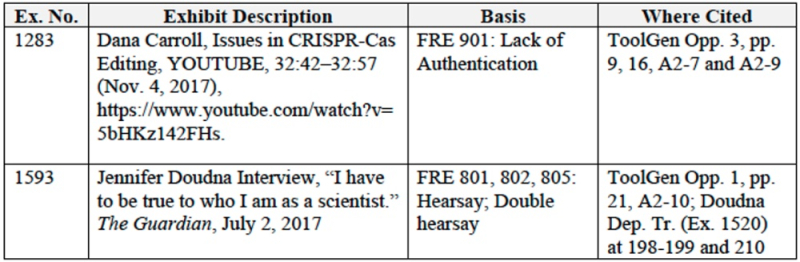
In its brief, CVC noted that it had preserved its objections under 37 C.F.R. § 41.155(b)(1) by timely filing 7 days after ToolGen served these exhibits. On the merits, CVC supported its objection to Ex. 1283 being that the YouTube video of Dr. Dana Carroll was "juxtaposed with untitled graphics and drawings in a different window." ToolGen, CVC asserted, failed to authenticate the video, i.e., provided no substantiating testimony through a witness subject to cross-examination. Nor, according to CVC, did ToolGen provide any "evidence regarding who posted this video and when, whether it was edited, and whether it accurately portrays Dr. Carroll's opinions or understandings, especially with respect to the purposes for which ToolGen cites it." And nor, argued CVC, did ToolGen provide any "explanation as to who extracted the video from the internet and provides no metadata to establish its origins" and ToolGen did not question Dr. Carroll about the video during his deposition.CVC's basis for its objection to Ex. 1593 was that ToolGen provided the interview "for the truth of the matter asserted," i.e., "CVC inventors' timing, difficulty, challenges, and knowledge relating to their invention of CRISPR-Cas9 in eukaryotes." This constitutes "double hearsay" according to CVC and should be inadmissible because "it is a third-party's out of court statement recounting a party's out of court statement." Moreover, CVC argued that "[t]he cited publication is an edited excerpt of a longer interview, as evidenced by bracketed text within Dr. Doudna's responses and other expository remarks." These revisions were not made to "present a historical account of facts for the purposes of resolving intellectual property rights" CVC asserts but rather "were formulated to 'capture the interest' of the intended audience." That these are the inventor's out-of-court statements does not rescue them from a hearsay objection according to CVC, citing Horta v. Sullivan, 4 F.3d 2, 8 (1st Cir. 1993) and New England Mut. Life Ins. Co. v. Anderson, 888 F.2d 646, 650 (10th Cir. 1989). Neither does their status as "hearsay within hearsay" make them admissible under the party admission against interest under Fed. R. Evid. 805 according to CVC because "[o]ut-of-court statements that have been curated by a third-party for other purposes are not admissible to prove the sequences of events, the motivations, intentions, and expectations of the inventors," citing SO ¶ 152.2.1.
In its Opposition filed October 8th, ToolGen began its argument my reminding the Board that these are CVC's fact witnesses who are contradicting current positions taken in the interference. As for the YouTube video (Ex. 1283), ToolGen asserts that CVC objected to only 15 seconds of a 53-minute video, but that in these 15 seconds "Dr. Carroll admits that ToolGen inventor Dr. Jin-Soo Kim discovered what was not obvious to skilled artisans at the time—that adding two guanines to the 5' end of guide RNA improves its specificity." With regard to CVC's authenticity arguments, ToolGen noted that "the video shows that it was posted by the Innovative Genomics Institute, a company founded by CVC's own Dr. Doudna" (stating later in the Opposition that "CVC is thus challenging the authenticity of a video of its own witness, posted by its inventor's organization"). ToolGen argued further that there were "multiple indicia of authenticity supporting that the video reliably depicts Dr. Carroll and his views." ToolGen contends that under FRE 901(b)(4), "the appearance, contents, and distinctive characteristics of the video support a finding that the video is what ToolGen claims it is: a lecture by Dr. Dana Carroll," citing Zen Design Grp., Ltd. v. Scholastic, Inc., No. 16-12936, 2019 WL 2996190, at *2 (E.D. Mich. July 9, 2019). According to ToolGen, "[t]he Innovative Genomics Institute, Dr. Doudna, and Dr. Carroll also have had years to remove this video from YouTube if there were any inaccuracies depicted. They have not done so." ToolGen draws the conclusion that:
CVC moves to exclude this evidence only because the video clip directly contradicts CVC's litigation position with respect to obviousness. Given the totality of the circumstances, the video is authentic and accurately depicts Dr. Carroll admitting that ToolGen was the first to discover that two guanines on the 5' end of the guide RNA improves specificity.
Regarding the Doudna interview, ToolGen argued that even CVC's own exhibits contained articles where Dr. Doudna expresses the same sentiments regarding adapting CRISPR to eukaryotic cells, citing "Ex. 2279 ("We weren't sure if CRISPR/Cas9 would work in eukaryotes[.]"); Ex. 2032 ("Doudna experienced 'many frustrations' getting CRISPR to work in human cells."); Ex. 2033 ("[I]t was not known whether [a CRISPR-Cas9] system would function in eukaryotic cells.")." These are "multiple indicia of trustworthiness" ToolGen contended; moreover, ToolGen argued that "Dr. Doudna's contemporaneous thoughts are far more probative than Dr. Doudna's testimony prepared for (sic) litigation." ToolGen contended that Dr. Doudna's own statements were not hearsay under FRE 801(d)(2) because she is a party opponent, citing Nuance Communs., Inc. v. Abbyy Software House, 626 F.3d 1222, 1230 n.1 (Fed. Cir. 2010). ToolGen also asserted that this interview satisfied FRE 807 as "the residual exception to hearsay" which provides the evidence is not excluded if:
(1) the statement is supported by sufficient guarantees of trustworthiness—after considering the totality of circumstances under which it was made and evidence, if any, corroborating the statement; and (2) it is more probative on the point for which it is offered than any other evidence that the proponent can obtain through reasonable efforts.
(all of which factual predicates are satisfied here, ToolGen argued). ToolGen asserted three bases for establishing the interview's trustworthiness: Dr. Doudna herself confirmed the article was written after she was interviewed; the sentiments contained in the interview were ones she had voiced in several other instances; and Dr. Doudna has never corrected or retracted she made in the interview, even in her deposition when given an opportunity to do so.
ToolGen also asserted that this evidence should not be excluded because it is "highly probative of Dr. Doudna's contemporaneous thoughts regarding the doubts she had that CRISPR-Cas9 could be adapted for use in eukaryotic cells," citing United States v. U.S. Gypsum Co., 333 U.S. 364, 395–96 (1948), and the Board's own preference for contemporaneous statements on this very issue in Interference No. 105,048 and in the Decisions on Motions in Interference No. 106,115.
In its October 15th reply, CVC directed its counterargument to ToolGen's "belated" attempt (in its view) to authenticate Dr. Carroll's YouTube video with reference to ToolGen Exhibit Nos. 1614 (the Innovative Genomics Institute website, Innovative Genomics Institute) and 1615 (Opening Screen of Ex. 1283 (Dana Carroll, Issues in CRISPR-Cas Editing, YOUTUBE, 32:42–32:57 (Nov. 4, 2017)). The time to authenticate was August 5, 2021 (in response to CVC's timely objection) and the Board should not permit ToolGen to supplement its evidence with these attempts to corroborate, CVC argued. CVC also rebutted ToolGen's argument that only 15 seconds of the Carroll lecture were to be excluded, saying that CVC had move to exclude the video "in its entirety" (emphasis in brief). Rather, ToolGen submits a video "excerpt" unauthenticated as to "who excerpted it, and whether it still accurately portrays the original subject matter in its excerpted form" (emphasis in brief).
As to the Doudna interview, CVC argued in its Reply that ToolGen's distinction in its Opposition that CVC's Motion did not cite "patent cases" is irrelevant because the rules regarding hearsay do not depend on the subject matter ("Hearsay is hearsay"). And as for ToolGen's invocation of FRE 807, CVC argued that:
Courts have specifically found that mainstream media interviews edited for publication to a lay audience lack the traditional indicia of reliability that Rule 807 requires, because quotes in such publications are cherry-picked to give a sense of drama and "capture the interest of . . . readers, who might otherwise have little interest," rather than to present an accurate or fulsome account of events.
citing New England Mut. Life Ins. Co. v. Anderson, 888 F.2d 646, 650 (10th Cir. 1989), and Ohio v. Roberts, 448 U.S. 56, 65 (1980); Horta v. Sullivan, 4 F.3d 2, 8 (1st Cir. 1993). Moreover, CVC's quotations from Dr. Doudna direct the Board's attention to the number of times that Dr. Doudna did not validate the statements attributed to her, saying frequently "I don't know that to be true" or variants thereof. Finally, to the extent that ToolGen relied on statements from other sources similar to the ones the interview had Dr. Doudna making CVC argues that those sources may be equally unreliable and cited Gehin v. Wisconsin Group Ins. Bd., 692 N.W.2d 572, ¶ 92 (Wis. 2005), for the principle that "bootstrap[ping] uncorroborated hearsay with uncorroborated hearsay would eviscerate the requirement that there be corroboration of hearsay in order for the hearsay evidence to form the basis of an agency's finding of fact").
The Board will render its decision prior to Final Hearing in this Interference.
-
By Kevin E. Noonan —
 Joint inventorship has been called "one of the muddiest concepts in the muddy metaphysics of patent law" because the "exact parameters of what constitutes joint inventorship are quite difficult to define." Mueller Brass Co. v. Reading Indus., 352 F. Supp. 1357, 1372 (E.D. Pa. 1972), aff'd, 487 F.3d 1395 (3d Cir. 1983). The consequences of an improper (or improvident) determination of inventorship (and the sometime difficulties that can arise when a change of inventorship is delayed until a patent is being asserted at trial) is illustrated in the Federal Circuit's recent non-precedential decision in Horizon Medicines LLC v. Alkem Laboratories Ltd.
The matter arose in ANDA litigation over Horizon's DUEXIS® product, an NSAID formulation used for administration to rheumatoid arthritis and osteoarthritis patients. According to the opinion, the prior art recognized that chronic use of NSAIDs at dosages useful for pain relief and inflammation (such as ibuprofen, a "non-selective" NSAID) produced stomach ulcers. (In a footnote the opinion sets forth a distinction between non-selective NSAIDs, which inhibit both known forms of cyclooxygenase (COX), and "selective" NSAIDs, which only recognize the COX species that are not present in the mucus lining of the stomach and thus are not associated with stomach ulcers.) However, selective NSAIDs were found to be disadvantageous due to cardiovascular complications associated with their use. Horizon's claimed non-selective NSAID formulations avoided the ulcer-producing effects of non-selective NSAID administration by co-formulation with famotidine. In ANDA litigation Horizon asserted U.S. Patent Nos. 8,067,033 and 8,067,451; claim 1 of each patent was set forth in the opinion as being representative:
'033 patent:
1. A pharmaceutical composition comprising
a first portion that comprises 800 mg ibuprofen and a second portion that comprises 26.6 mg famotidine,
wherein the surface area of direct physical contact between ibuprofen and famotidine does not exceed 130 mm2,
wherein no more than about 1% sulfamide is present when the composition is stored at 40°C and 75% relative humidity for a period of one month,
wherein the composition is formulated so that release of both the ibuprofen and the famotidine occurs rapidly at about the same time,
wherein none of the composition, the famotidine, and the ibuprofen is enterically coated or formulated for sustained or delayed release, and
wherein the composition is for use according to a TID (three times per day) administration schedule for reducing the risk of developing ibuprofen-induced ulcers in a human patient requiring ibuprofen for an ibuprofen-responsive condition.'451 patent:
1. An oral dosage in tablet form comprising
a first portion that comprises 800 mg ibuprofen and a second portion that comprises 26.6 mg famotidine,
wherein a barrier layer comprising hydroxyl propyl methyl cellulose 2910, polyoxyethylene glycol 400, polysorbate 80, and titanium dioxide surrounds the second portion completely separating it from the first portion . . .Relevant to the District Court's determinations, use of the combination of a non-selective NSAID and famotidine was known in the art to reduce stomach ulceration upon prolonged use. The opinion explains that this advantageous combination was also known to degrade due to chemical incompatibility between these two compounds. The claimed formulations achieved their greater stability by minimizing the surface area of direct physical contact between the incompatible ingredients; as set forth in the opinion the product contained "a famotidine core, an ibuprofen shell, and an Opadry® White barrier layer in between."
The District Court found the asserted claims (claims 1, 8, 11, and 14) of the '033 patent to be invalid for obviousness and the asserted claims (claims 1–3 and 8–10) of the '451 patent not to be infringed. Horizon appealed.
The Federal Circuit affirmed the District Court's invalidity and non-infringement determinations in an opinion by Judge Dyk joined by Judges O'Malley and Hughes. The District Court's obviousness determination was based on U.S. Patent Application Pub. No. 2007/0043096 A1, which Horizon argued was not properly prior art and thus the District Court had committed legal error in considering it to be so. Because the patents-in-suit and the cited prior art patent application were filed prior to enactment of the Leahy-Smith America Invents Act, the District Court and Federal Circuit applied the novelty provisions of the 1952 Patent Act in finding the '096 application to be prior art. The '033 patent names Inventor Tidmarsh while the '096 application names Tidmarsh and a second inventor, Golombik. (In a footnote the Federal Circuit explains there were additional inventors named in each but that their status did not need to be resolved because resolution of the Tidmarsh/Golombik inventorship status was outcome determinative.) At trial Horizon moved under 35 U.S.C. § 256 to add Golombik as an inventor on the '033 patent, a motion the district court denied. Horizon's argument on appeal was that if Tidmarsh and Golombik had invented formulations comprising 800 mg ibuprofen and 26.6 mg famotidine (as set forth in the '096 application) then both inventors perforce were also inventors of the invention described and claimed in the '033 patent (which recites formulations comprising 800 mg ibuprofen and 26.6 mg famotidine). The Federal Circuit rejected this argument. The opinion notes that generally "the inventors named in an issued patent are presumed to be correct" and this presumption can be overcome only in the face of clear and convincing evidence, citing Caterpillar Inc. v. Sturman Indus., Inc., 387 F.3d 1358, 1377 (Fed. Cir. 2004). Mere inventor testimony is not enough to overcome this presumption, according to the Court, and "some form of corroboration must be shown"; see EmeraChem Holdings, LLC v. Volkswagen Grp. of Am., Inc., 859 F.3d 1341, 1346 (Fed. Cir. 2017) (similar considerations provide the rationale for like requirements in interferences; see, Medichem, S.A. v. Rolabo, S.L., 437 F.3d 1157, 1171 (Fed. Cir. 2006)). Moreover, the opinion states that "[o]ur cases are clear that inventing something in an earlier patent or patent application does not automatically make one an inventor of patents that incorporate the earlier invention," citing Eli Lilly and Co. v. Aradigm Corp., 376 F.3d 1352, 1358, 1362 (Fed. Cir. 2004). The Court was unpersuaded by Horizon's reliance on Pannu v. Iolab Corp., 155 F.3d 1344 (Fed. Cir. 1998), to the effect that Tidmarsh and Golombik were engaged in a "collaborative enterprise," on the grounds that unlike in Pannu "[t]he only support for Golombik's contribution to the '033 patent is testimony by Tidmarsh and Golombik." The Federal Circuit found no clear error by the District Court based on the totality of the evidence, including putative inventor testimony (which the District Court had characterized as "non-specific," "convenient, uncorroborated, and not very credible").
The Federal Circuit also rejected Horizon's non-obviousness arguments taking the '096 application as proper prior art. These arguments were grounded on whether the skilled worker would have had a reasonable expectation of success in achieving formulations having the stability of the claimed formulations. This expectation arose, according to the District Court as affirmed by the Federal Circuit, from another prior art reference that disclosed using the same "tablet-in-tablet" formulation claimed in the '033 patent to achieve increased stability for combinations of drugs "similar to ibuprofen and famotidine" (as supported by expert witness testimony). The Federal Circuit found no clear error in these District Court determinations either.
And the Federal Circuit dismissed consideration of Horizon's arguments regarding non-infringement of the '033 patent as moot in view of their affirmance of the invalidity of the '033 patent's asserted claims.
Regarding the '451 patent, Horizon argued that the District Court erred in construing the term "comprising" as recited in the claim with regard to the barrier layer limitation to mean "consisting essentially of." The Federal Circuit rejected this argument, first, because the panel held that Horizon had not established harmful error in its briefing, and second, "the prosecution history of the '451 patent supports the district court's construction." Specifically, the opinion points to "multiple exchanges with the Examiner" where Horizon made amendments to overcome rejections over the prior art that purportedly "focus[ed] on an embodiment of the invention that uses Opadry® White (YS-1-7003) as a barrier layer." In view of this history the panel found no clear error in the District Court's construction nor the factual basis for its finding of non-infringement.
Horizon Medicines LLC v. Alkem Laboratories Ltd. (Fed. Cir. 2021)
Nonprecedential disposition
Panel: Circuit Judges Dyk, O'Malley, and Hughes
Opinion by Circuit Judge Dyk -
By Kevin E. Noonan —
 The Federal Circuit continued its stringent (if misguided) application of the scope of subject matter eligibility by invalidating claims asserted in CardioNet, LLC v. InfoBionic, Inc.
The case arose over InfoBionic's alleged infringement of CardioNet's U.S. Patent No. 7,099,715; claims 1, 11, and 20 are illustrative:
1. A machine-implemented method comprising:
identifying heart beats in a sensed cardiac signal;
activating a frequency domain T wave filter, used in said identifying heart beats, in response to a message from a monitoring station generated at least in part based upon discovery of a predetermined characteristic in the sensed cardiac signal; and
outputting information corresponding to the identified heart beats to a communications channel of a distributed cardiac activity monitoring system.11. A distributed cardiac activity monitoring system comprising:
a monitoring apparatus including a communications interface, a real-time QRS detector, a frequency domain T wave filter, and a selector that activates the T wave filter with respect to the real-time QRS detector in response to a message, wherein the activated frequency domain T wave filter preprocesses a cardiac signal provided to the realtime QRS detector; and
a monitoring station that communicatively couples with the monitoring apparatus via the communications interface and transmits the message to the monitoring apparatus to activate the frequency do-main T wave filter based at least in part upon a predetermined criteria.20. A cardiac monitoring apparatus comprising:
a communications interface;
a real-time heart beat detector;
a frequency domain T wave filter; and
a selector that activates the frequency domain T wave filter with respect to the real-time heart beat detector in response to a message, wherein the activated frequency domain T wave filter preprocesses a cardiac signal provided to the real-time heart beat detector.The District Court granted summary judgment of non-infringement but held the claims not to be invalid under 35 U.S.C. § 101 for failure to recite eligible subject matter. Both parties appealed.
The Federal Circuit vacated the District Court's non-infringement judgment and remanded for entry of judgment that the '715 patent claims were invalid on subject matter eligibility grounds, in an opinion by Judge Lourie, joined by Judges Dyk and O'Malley. The Court applied the Supreme Court's Mayo/Alice test (as it has grown under the Federal Circuit; see Alice Corp. v. CLS Bank Int'l, 573 U.S. 208, 217 (2014), and Mayo Collaborative Servs. v. Prometheus Labs., Inc., 566 U.S. 66, 70–73 (2012)) in reaching its invalidity conclusion. The opinion sets forth the District Court's reasoning that, while in Step 1 of the Mayo/Alice test claim 20 is "directed to" an abstract idea ("filtering raw cardiogram data to optimize its output"), under Step 2 the claim recites "an inventive concept sufficient to transform the abstract idea into patent-eligible subject matter." The basis for this conclusion is that the claim is "tied to a machine" and thus satisfies the "machine or transformation" test under Bilski v. Kappos. The Court agrees with regard to Step 1 reciting an abstract idea, which the Court characterizes as "the abstract idea of filtering patient heartbeat signals to increase accuracy." This, "at bottom" according to the Court "requires only basic mathematical calculations, such as 'de-compos[ing] a T wave into its constituent frequencies and multipl[ying] them by a filter frequency response.'" In this analysis the Court goes beyond what is claimed (an apparatus) and focuses on how the apparatus achieves its aims (thus avoiding the question of whether this is how the mathematical formula is applied (which was sufficient under Diamond v. Diehr to render a method claim patent-eligible), reminiscent of the Court's troubling type of reasoning in American Axle & Mfg. v. Neapco Holdings LLC. The opinion, applying precedent across disciplines denigrates the inventiveness of the improvement in the art by cherry-picking Justice Thomas's statement in Ass'n for Molecular Pathology v. Myriad Genetics, Inc., 569 U.S. 576, 591 (2013), that "such calculations, even if '[g]roundbreaking,' are still directed to an abstract idea."
The opinion illustrates how the Court has gone astray in addressing CardioNet's additional arguments. For example, to the argument that the apparatus uses the mathematical formula to achieve an improvement in an ECG that does not mistake T waves for R waves the opinion asserts "[t]o qualify as 'a patent-eligible improvement,' the invention must be directed to a specific improvement in the computer's functionality, not simply to use of the computer 'as a tool' to implement an abstract idea." Of course, what is a computer except a tool; if the computer was just used to produce mathematical solutions the Court's rationale may have made some sense. But the Court's reasoning ignores that the mathematical formula is used to produce an improved ECG, which certainly seems like a desirable, inventive, patent-eligible technical achievement (not to mention a benefit for patients whose physicians can rely on more accurate ECGs).
The Court is on firmer ground (albeit one more properly sounding in indefiniteness rather than ineligibility) when it critiques the claim for not reciting when and how the T wave filter is activated (which apparently is the result of determination by an operator, e.g., in claim 1: "activating a frequency domain T wave filter, used in said identifying heart beats, in response to a message from a monitoring station generated at least in part based upon discovery of a predetermined characteristic in the sensed cardiac signal").
The true colors of the determination of ineligibility are revealed in the opinion's discussion distinguishing claims here from the claims held patent eligible in CardioNet, LLC v. InfoBionic, Inc., 955 F.3d 1358 (Fed. Cir. 2020). The distinction, sounding in novelty rather than ineligibility, is that "[i]n that case . . . there was no intrinsic evidence that the claimed technique had ever been used" whereas here "InfoBionic points to evidence that the use of a filter to perform mathematical functions was not a new activity."
Turning to Alice Step 2, the Court dismissed CardioNet's argument that the T wave filter was "innovative" (i.e., a frank novelty argument) based on disclosure in the '715 specification seemingly to the contrary (but nonetheless engrafting the eligibility argument into another species of novelty arguments without the need for a proper novelty analysis). The speciousness of the Court's rationale is illustrated by the conclusion that "'[a] claim for a new abstract idea,' here, a mathematical calculation, 'is still an abstract idea'" citing Synopsys, Inc. v. Mentor Graphics Corp., 839 F.3d 1138, 1151 (Fed. Cir. 2016) (not a case involving similar subject matter). Once again patentee's arguments were thwarted by statements in their own specification, wherein "the specification explains that the other claimed components are conventional" (such statements being fatal under the Court's analysis that eschews considering claims as a whole, in contravention to Diamond v Diehr). And while the Supreme Court validated the machine or transformation test (while insisting it was not the exclusive test), by now the Federal Circuit appears content to ignore that precedent as well, in favor of their determinations that "not all 'transformations or machine implementations infuse an otherwise ineligible claim with an "inventive concept,"'" citing Solutran, Inc. v. Elavon, Inc., 931 F.3d 1161, 1169 (Fed. Cir. 2019) (citing DDR Holdings, LLC v. Hotels.com, L.P., 773 F.3d 1245, 1256 (Fed. Cir. 2014) and relying on the Supreme Court's holding that the test is not dispositive. The opinion further states that:
Here, although claim 20 is technically tied to a machine (a cardiac apparatus) its ultimate focus is to "preprocess[] a cardiac signal" using a "T wave filter," which, as explained above, is an abstract idea.
Under standards like "ultimate focus" and "inventive concept," claims to almost anything are capable of being invalidated on subject matter eligibility grounds (and indeed are being invalidated; see Yu v. Apple).
There was a time, when the expectations of the Federal Circuit were higher with regard to the Court's mandate from Congress concerning patent law and the Court's purported expertise, that a decision like this one would have produced confusion, chagrin, or outrage with how the Court applied dubious Supreme Court decisions on subject matter eligibility in invalidating the asserted claims. Nowadays, after almost a decade (the lost decade?) of the Court's fractured subject matter eligibility jurisprudence that has spread like a stain to encompass almost every class of subject matter possible, the only emotions that arise are sadness; perhaps with the passage of time this will evolve into Elvis Costello's aphorism "I used to be disgusted/Now I try to stay amused." But not yet.
CardioNet, LLC v. InfoBionic, Inc. (Fed. Cir. 2021)
Nonprecedential disposition
Panel: Circuit Judges Lourie, Dyk, and O'Malley
Opinion by Circuit Judge Lourie
 Patent Docs