• J A KempJ A Kemp will be offering a webinar entitled "User Interfaces — What Can You Patent?" on January 25, 2022 from 4:00 pm to 5:00 pm (GMT).  Dominic Forsthye and Callum Docherty of J A Kemp will look at the EPO's approach to excluded matter as applied to user interfaces, using examples from case law to try to make sense of what can and cannot be patented at the EPO, and will discuss practical tips for drafting and prosecuting UI applications at the EPO to increase chances of success.  The webinar will address the following topics:

    • The EPO's approach to excluded subject-matter
    • Examples from case law to highlight how the EPO approaches user interfaces
    • Technical effect, and arguments that can be employed to highlight technical effect
    • A brief review of the UK approach to user interfaces
    • Practical drafting tips for user interface inventions

    There is no registration fee for this webinar.  However, those interested in registering for the webinar, should do so here.

  • By Kevin E. Noonan

    Federal Circuit SealWhile the Federal Circuit has patent law as its principal focus, as a U.S. Circuit Court of Appeals, questions come before the Court on more mundane, procedural matters (which, sometimes being dispositive, does not reduce their importance to the parties and occasionally the rest of us).  One such case was decided on December 16th in Alpek Polyester, S.A. v. Polymetrix AG (complicated, as should be evident from the caption, by involving non-US. parties and having putatively infringing activities arising both here and abroad).

    The case arose over Polymetrix's asserted infringement of U.S. Patent Nos. 7,790,840, 7,868,125, and 7,192,545 owned by Alpek (a Mexican company) and exclusively licensed to co-Plaintiff DAK Americas LLC (a U.S. company), the patent claim being directed to methods for producing polyethylene terephthalate (PET) resins; because the matters on appeal were exclusively procedural there was no need in the opinion (or here) to delve into the scope of the claims any further.  Defendant Polymetrix is a Swiss company in the business of supplying equipment and engineering services for constructing plants for making PET resin (while not making the resin itself, i.e., it provides the means but not the product and thus did not itself practice the claimed methods).

    The activity that prompted the lawsuit was Polymetrix contracting with a Polish company, Indorama Ventures Poland sp. z o.o. ("IVP") wherein Polymetrix equipped a manufacturing plant located in Wloclawek, Poland to run the patented process.  When the work was completed Polymetrix entered into a "commissioning" period during which the plant was tested (using the patented process to product PET resin); during this time Polymetrix retained ownership of the equipment and IVP withheld payment until the installation passed appropriate tests.

    Jurisdiction arose in the U.S. when IVP sent to affiliates in the U.S. (Auriga Polymers and AlphaPet Inc.) samples of PET resin made in the Wloclawek plant using Polymetrix equipment to perform the patented process.  There were three instances of this importation, including one wherein an AlphaPet employee brought the sample into the country personally.  Alpek sued following these activities, alleging that Polymetrix induced infringement under 35 U.S.C. § 271(b) (the predicate literal infringement lying under the provisions of § 271(g)).  While the opinion references "a complicated and protracted international discovery process" that ensued, only three incidents were worthy of the Court's consideration.  The first involved failure of Defendant Polymetrix to disclose under Federal Rule of Civil Procedure 26 the identity of IVP's director, Mr. Saini (the relevance of this failure being Polymetrix's reliance on a declaration in support of a summary judgment motion at issue in this appeal).  Second was disputed testimony in a deposition (of a Rule 30(b)(6) witness representing Auriga) that Polymetrix owned the plant in Wloclawek, Poland, supporting Alpek's motion to amend its complaint to include an allegation of direct infringement under § 271(g).  The third and final discovery dispute involved an assertion of privilege by Polymetrix over an opinion of counsel concerning Alpek's infringement allegations, which Alpek alleged had been waived by disclosure to a potential corporate suitor.

    Polymetrix filed a summary judgment motion that it did not infringe, which the District Court granted.  The District Court rejected Alpek's arguments that there were disputed issues of material fact, denied Alpek's motion to strike the Saini testimony due to failure to satisfy Rule 26 when Polymetrix did not identify him as someone with knowledge about the company and its activities, and held that the misstatement at deposition was inadmissible under Federal Rule of Evidence 602 because the witness lacked personal knowledge regarding importation of PET resin made in the Polish plant using the patented process.  The District Court also denied Alpek's motion to amend the complaint as being untimely.  This appeal followed.

    The Federal Circuit affirmed, in an opinion by Judge Lourie joined by Judges O'Malley and Stoll.  The opinion addresses the four arguments raised by Alpek on appeal:

    • First, Alpek argues that the court abused its discretion by disregarding [the Rule 30(b)(6) witness's] admission that the July 17, 2014 sample was brought into the United States 'for Polymetrix' [arguing that the statement was admissible because the witness's testimony under Rule 30(b)(6) does not require personal knowledge to be admissible].

    • Second, Alpek argues that the court erred by finding that Polymetrix did not ratify IVP's importation by using test results from the United States [by receiving and relying on test results it knew were produced by Auriga and AlphaPet in the U.S.]

    • Third, Alpek argues that the court erred in failing to recognize fact disputes that stem from Polymetrix's ownership of the equipment under a Swedish law interpretation of the contract[ and]

    • [F]ourth, Alpek argues that the court erred by declining to strike the Saini declaration upon which Polymetrix heavily relied to support its summary judgment motion [based on Federal Rule of Civil Procedure 37].

    Polymetrix's counterargument was based on the causation prong of § 271(b), i.e., that its activities did not cause IVP to import into the U.S. PET resin samples for testing.  Regarding Alpek's first argument, Polymetrix contended that the witness misspoke due to misunderstanding the question (which the witness clarified at the time during subsequent testimony during the deposition).  The Federal Circuit, applying Eighth Circuit law appropriate for reviewing the District Court's decision here, noted that in the Eighth Circuit evidence to be considered on summary judgment must be "admissible evidence," citing Crews v. Monarch Fire Prot. Dist., 771 F.3d 1085, 1092 (8th Cir. 2014) (emphasis in original) (citing Nooner v. Norris, 594 F.3d 592, 603 (8th Cir. 2010).  Under the applicable abuse of discretion standard, the Federal Circuit found no abuse (noting that the witness did not testify at trial and "would not [have been] admissible at trial under Federal Rule of Evidence 801(d)(2)" nor Federal Rule of Civil Procedure 32(a)(3) relating to the testimony of an adverse party.  The opinion also distinguished seemingly contrary precedent in General Mills Operations, LLC v. Five Star Custom Foods, Ltd., 703 F.3d 1104, 1110 (8th Cir. 2013), because the disputed testimony was not by an adverse party's witness.  Finally, the Federal Circuit did not find Alpek's argument persuasive insofar as it relied on two words ("for Polymetrix") "excerpted from one question in one deposition in the larger context of a protracted discovery process that lasted years" and was asserted by Alpek for an inducement argument that was "contrary to the overwhelming majority of the evidence which demonstrates that Polymetrix had no knowledge or concern about where, when, or how IVP conducted performance tests."  In the panel's view the evidence showed the witness simply misspoke.  The Court found no genuine issue of material fact here that would justify the "delay and expense" of a trial.

    Regarding Alpek's second argument, the Federal Circuit did not see any genuine issue of material fact on the evidence, which the Court considered to be supported only with "a conclusory assertion by [Alpek's] expert."  According to the opinion, the "overwhelming majority of the evidence" supported a finding that AlphaPet was not the source of the data relied upon by Polymetrix with regard to the performance of the Polish plant (including agreement with the District Court that Alpek blundered when it asserted that this data "match[ed] up almost exactly," the opinion stating that "If the AlphaPet test results were really the source of the data for Polymetrix's report, we can discern no reason why the two sets of data would not match up exactly" (emphases in opinion).

    As for Alpek's third argument, the Federal Circuit agreed with the District Court that the details of Swedish contract law, asserted to support Alpek's contention that under that law Polymetrix was responsible for the activities in the Polish plant, were "inapposite."  "As a matter of American law," according to the opinion, 'the mere fact that Polymetrix owned the plant equipment is wholly insufficient for Alpek to meet its burden of proving that Polymetrix took active steps to induce IVP to infringe," citing MGM Studios Inc. v. Grokster, Ltd., 545 U.S. 913, 935–36 (2005), in support for this principle.

    Finally, the Court rejected Alpek's fourth argument, based in part on the breadth of the District Court's discretion on discovery matters and enforcement of the Civil Procedure rules.  The Federal Circuit saw none of the surprise or prejudice the Rule was intended to prevent, in view of the "more than 1,000 documents produced during discovery" bearing the witness's name.

    Having dispensed with the summary judgment portion of the appeal, the panel turned to the District Court's denial of Alpek's motion to amend its complaint.  Here the Court found no justification for Alpek's failure to file its motion by the deadline date the District Court had established, and the panel rejected Alpek's allegations that witness testimony adduced during a deposition that occurred after the deadline alerted it to the factual bases for the amended complaint, i.e., that Polymetrix was a literal infringer under § 271(g).  And Alpek's arguments, according to the opinion, "consist[ed] of mere disagreement with the magistrate judge's view of the facts."  Under these circumstances the Federal Circuit affirmed denial of Alpek's motion to amend.

    The final issue considered by the Court was Alpek's motion to compel production of attorney opinion based on waiver due to disclosure to Polymetrix's corporate suitor.  The Court agreed with Polymetrix that the panel need not address the issue because it "has no bearing on the district court's summary judgment ruling."  The opinion notes that Alpek had the burden of showing that Polymetrix caused IVP's infringement of the patents-in-suit, while the opinion even if offered into evidence would only address Polymetrix' intent to induce infringement, citing Omega Patents, LLC v. CalAmp Corp., 920 F.3d 1337, 1352–53 (Fed. Cir. 2019).  Because the District Court's basis for granting summary judgment was Alpek's failure to establish Polymetrix's causation of IVP's asserted infringement, "the issue of intent did not factor into the district court's grant of summary judgment" according to the Court (emphasis in opinion).  This issue, in view of the Court's affirmance of the District Court's grant of summary judgment, was thus moot according to the panel.

    Alpek Polyester, S.A. v. Polymetrix AG (Fed. Cir. 2021)
    Nonprecedential disposition
    Panel: Circuit Judges Lourie, O'Malley, and Stoll
    Opinion by Circuit Judge Lourie

  • By Kevin E. Noonan

    USPTO SealFollowing a telephone conference held on August 16th (a transcript of which can be found here) between the Board and representatives of Junior Party the University of California/Berkeley, the University of Vienna, and Emmanuelle Charpentier (collectively, "CVC") and Senior Party Sigma-Aldrich, the Board issued its Order on September 20th authorizing motions and setting times under 37 C.F.R. §§ 104(c) and 121.

    As it had in its Order setting motions and times in related Interference No. 106,133 between Sigma-Aldrich and Junior Party the Broad Institute, Harvard University, and MIT, the Order begins with the Board's rejection of any of these motions being "threshold" motions (as the parties had argued), stating that "[p]atentability over the prior art is not now, and never has been, a 'threshold issue.'"  Further, the Board stated that "a holding during the course of interference that a party's claims are unpatentable over prior art does not necessarily deprive that party of standing on the central issue of an interference—priority," citing  37 C.F.R. § 41.201, noting that a party in an interference having claims deemed unpatentable "may still have a basis to show the opponent is not entitled to a patent because the opponent was not the first to invent the interfering subject matter."  This raises the possibility that the outcome of an interference may be that neither party is entitled to a patent on claims falling within the scope of the Interference Count.

    Regarding Junior Part CVC's Motions List, the Board DEFERRED CVC'S Substantive Preliminary Motion No. 1, which CVC characterized as a "threshold" motion, that sought to have a finding of no interference-in-fact based on CVC's allegations that  Sigma-Aldrich's application-in-interference was properly governed under the "first inventor to file" provisions of the Leahy-Smith America Invents Act; the basis for this allegation was that Sigma-Aldrich's application-in-interference "contains or contains at any time" (emphasis in brief) subject matter not entitled to priority to an application filed prior to enactment of the AIA.  The Board considered this not as a motion for no interference-in-fact, as CVC maintained, but rather as a motion for unpatentability and thus agreed to consider granting the motion and hearing CVC's arguments during the priority phase of the interference.

    The Board GRANTED CVC leave to file Substantive Preliminary Motion No. 2 under 37 C.F.R. §§ 41.121(a)(1)(ii) and 41.208(a)(3) for benefit of priority to U.S. Provisional Application Nos. 61/652,086, filed May 25, 2012 ("P1"), or 61/716,256, filed October 19, 2012 ("P2").  The Board designated this as CVC SUBSTANTIVE MOTION 1 and also granted CVC's request to extend the page limit for CVC's Motion and Sigma-Aldrich's Opposition to 45 pages.

    The Board GRANTED CVC leave to file Substantive Preliminary Motion No. 3 seeking to have the Board deny Sigma-Aldrich benefit of priority to its earliest provisional application, No. 61/734,256, filed December 6, 2012.  The Board designated this as CVC SUBSTANTIVE MOTION 2.

    The Board GRANTED CVC leave to file Substantive Preliminary Motion No. 4 seeking the Board to change the Count, including the alternative portion of the Count to recite Sigma-Aldrich's involved claim 33 instead of 31 as declared.  The Board designated this as CVC SUBSTANTIVE MOTION 3.

    The Bared DEFERRED CVC's proposed Preliminary Motions 5-7 which sought to file motions under 37 C.F.R. § 41.121(a)(1) for unpatentability of Sigma-Aldrich's claims in this interference.  The Board noted that it would consider authorizing these motions during the priority phase.

    The Board GRANTED CVC leave to file proposed Contingent Miscellaneous Motion No. 8 under 37 C.F.R. § 41.121(a)(3), asking the Board to add claims of U.S. Patent Nos. 10,731,181 and 10,745,716, designating this motion as CVC MOTION 4.  The Board DENIED (without prejudice).  The Board DENIED CVC leave to file Contingent Miscellaneous Motion No. 9 under 37 C.F.R. § 41.121(a)(3), asking the Board to add claims in Sigma-Aldrich's U.S. Patent Application Nos. 15/188,927; 15/188,931; 16/943,767; and 17/208,477 to this Interference because these claims had not yet been allowed.

    Finally, CVC's request to file a motion under 37 C.F.R. § 41.208(a)(4) seeking judgment based on priority was DEFERRED until the priority phase.

    Turning to Sigma-Aldrich's Motions list, the Board GRANTED Sigma-Aldrich leave to file its proposed Preliminary Motion No. 1 under 37 C.F.R. § 41.121(a)(1)(i) to change the Count to Count 2:

    Proposed Count 2 (reciting in the alternative claim 31 of Sigma-Aldrich's Application No. 15/456,204 as in the Count as declared):

    156.  A method of cleaving or editing a target DNA molecule or modulating transcription of at least one gene encoded thereon, the method comprising:
    contacting a target DNA molecule having a target sequence with an engineered and/or non-naturally-occurring Type II Clustered Regularly Interspaced Short Palindromic Repeats (CRISPR)—CRISPR associated (Cas) (CRISPR-Cas) system comprising:
        a) a single molecule DNA-targeting RNA comprising
            i) a targeter-RNA that hybridizes with the target sequence, and
            ii) an activator-RNA that hybridizes with the targeter-RNA to form a double-stranded RNA duplex of a protein-binding segment,
    wherein the targeter-RNA and the activator-RNA are covalently linked to one another with intervening nucleotides; and
        b) a Cas9 protein,
    wherein the single molecule DNA-targeting RNA forms a complex with the Cas9 protein, thereby targeting the Cas9 protein to the target DNA molecule
    whereby said target DNA molecule is cleaved or edited or transcription of at least one gene encoded by the target DNA molecule is modulated, and
    wherein said contacting occurs in a eukaryotic cell.

    157.  The method of Claim 156, wherein, prior to the contacting step, the method comprises:
    introducing into the eukaryotic cell containing the target DNA molecule:
        1) the single molecule DNA-targeting RNA, or a DNA molecule comprising a nucleotide sequence that (i) encodes the single molecule DNA targeting RNA and (ii) is operably linked to a regulatory element operable in said eukaryotic cell; and
        2) the Cas9 protein, an RNA molecule comprising a nucleotide sequence encoding the Cas9 protein, or a DNA molecule comprising a nucleotide  sequence that (i) encodes the Cas9 protein and (ii) is operably linked to a regulatory element operable in said eukaryotic cell.

    164.  The method of Claim 157, wherein the method comprises creation of a double strand break in the target DNA molecule which is repaired by a homology-directed repair mechanism which incorporates a sequence of a donor polynucleotide into the target DNA molecule, thereby editing the target DNA molecule.

    (CVC Application No. 15/947,680)

    The Board designated this as SIGMA MOTION 1.

    The Board DENIED Sigma-Aldrich leave to file its proposed Contingent Motion No. 2 to deny CVC benefit of Application Nos. 61/757,640, filed Jan. 28, 2013 ("CVC P3"), or 61/765,576, filed Feb. 15, 2013 ("CVC P4"), under 37 C.F.R. § 41.121(a)(1), as "moot ab initio," on the grounds that:

    [A] motion to change a count must show why the movant should be accorded any benefit for the proposed count and may overcome the presumption that the opponent is entitled to its earliest accorded benefit date by showing in the motion why the opponent should not be accorded benefit of an earlier application with respect to the proposed count. (See Standing Order 8 ¶ 208.2.)

    And thus any arguments in this proposed motion should be presented in SIGMA MOTION 1.

    The Board DEFERRED until the priority phase Sigma-Aldrich's proposed Substantive Preliminary Motion No. 3 that CVC's claims were unpatentable.

    The Board DISMISSED (as moot) Sigma-Aldrich's request for a Protective Order, instead the Board issuing an ORDER that Sigma-Aldrich could submit a protective order to keep its Priority Statement under seal until the priority phase of the interference, suggesting Sigma-Aldrich use the protective order filed in Interference 106,115 "as reference."

    Sigma-Aldrich's request to file a motion under 37 C.F.R. § 41.208(a)(4) seeking judgment based on priority was DEFERRED until the priority phase.

    In addition to these Motion requests, Sigma-Aldrich requested that the requirement under 37 C.F.R. § 41.121(d) that the parties file separate statements of material fact be waived; the Board DENIED this request.  The Board GRANTED the parties' request that the deadlines for filing and service be extended to 8:00 pm for filing and 11:00 pm, respectively, for all papers filed and served in the interference.  The Board WAIVED the requirement for sequential exhibit numbers and ORDERED that exhibits could be filed within two business days of the due date for any paper in which they were cited.  The Board also granted Sigma-Aldrich's request that it correct certain typographical errors in the caption.

    The Board set out the following briefing schedule, subject to agreement by the parties to change the schedule for TIME PERIODS 1-6.

    TIME PERIOD 1 ………………………………………………….29 October 2021
    File motions
    File (but serve one business day later) priority statements
    TIME PERIOD 2 ………………………………………………..10 December 2021
    File responsive motions to motions filed in TIME PERIOD 1
    TIME PERIOD 3 …………………………………………………..21 January 2022
    File oppositions to all motions
    TIME PERIOD 4 ………………………………………………………4 March 2022
    File all replies
    TIME PERIOD 5 ………………………………………………………15 April 2022
    File request for oral argument
    File motions to exclude.
    File observations
    TIME PERIOD 6 …………………………………………………………6 May 2022
    File oppositions to motions to exclude
    File response to observations
    TIME PERIOD 7 ………………………………………………………..20 May 2022
    File replies to oppositions to motions to exclude
    DEFAULT ORAL ARGUMENT DATE ………………………………………………TBD

  • By Donald Zuhn –-

    Federal Circuit SealEarlier today, the Federal Circuit affirmed the final determination by the U.S. Patent and Trademark Office Patent Trial and Appeal Board finding claims 1, 2, and 4-14 of U.S. Patent No. 8,409,862 unpatentable as either anticipated or obvious.

    The '862 patent is directed to using mass spectrometry to detect low levels of testosterone in female humans.  The '862 patent explains that while testosterone levels are much lower in females as compared to males, testosterone can be purified prior to mass spectrometry, which can improve the limit of detection.  Claims 8 and 9, which were relevant to the appeal, require the detection of testosterone at concentrations of less than 5 ng/dL or less than 1 ng/dL in the sample, respectively.

    Laboratory Corporation of America Holdings had petitioned for inter partes review of the claims found by the Board to be unpatentable, arguing that claims 8 and 9 would have been obvious in view of Clarke, an abstract found on a CD from the 49th annual conference of the American Society for Mass Spectrometry (ASMS) held in May 2001, or as obvious in view of Clarke in combination with another reference (Draisci).  The opinion notes that "Clarke details a method for detecting low levels of testosterone and describes a method similar to the '862 patent—wherein testosterone is purified before mass spectrometry."  The opinion also notes that Clarke discloses the detection of testosterone down to 50 pg/mL, which is equivalent to 5 ng/dL.

    On appeal, Quest argued that the Board erred with respect to two of its findings:  first, that Clarke was valid prior art as a printed publication, and second, that claims 8 and 9 would have been obvious in light of Clarke or Clarke in combination with Draisci.  Regarding the first determination, the Board noted that the ASMS sent the CD containing Clarke (and approximately 1,600 other abstracts) to thousands of ASMS members, and that the CD was available in the University of Wisconsin-Madison library before the priority date of the '862 patent.  The Board also noted that the CD permitted users to search abstracts using certain keywords.  Regarding the second determination, the Board concluded that it would have been obvious to reach detection limits below 5 ng/dL and 1 ng/dL based on the teachings of Clarke or Clarke with Draisci, finding that a skilled artisan would have been motivated to achieve a lower level of detection and would have reached these levels by optimizing several experimental parameters (in particular, by increasing the volume of the sample and modernizing the equipment).

    With regard to Clarke, Quest argued that this reference was not a printed publication because it was not publicly accessible.  In particular, Quest pointed out that Clarke was on a CD with approximately 1,600 other abstracts and that the CD provided minimal indexing, which made Clarke "an obscure, inaccessible reference."  The Federal Circuit, however, disagreed, stating that "although Clarke was surrounded by hundreds of other abstracts, the ASMS distributed the CD to the specific people most motivated to search the CD and find Clarke" (emphasis in opinion).  The Federal Circuit also noted that the CD allowed for some keyword searching using several mass spectrometry-related keywords, even if the keyword "testosterone" could not be searched.  The Federal Circuit therefore concluded that substantial evidence supported the Board's finding that Clarke was publicly available and thus prior art.

    With regard to the Board's finding of obviousness with respect to claims 8 and 9, Quest argued that there was no motivation to modify Clarke to increase sensitivity, that there was no reasonable expectation of success in doing so, and that there was a documented failure of others.  The Federal Circuit first found that substantial evidence supported the Board's conclusion that there was a motivation to improve the sensitivity of methods measuring testosterone.  Quest had specifically argued that 5 ng/dL and 1 ng/dL of testosterone are below the clinically relevant range of testosterone, but the Court was unpersuaded that this would have discouraged the development of more sensitive methods.  The Court next found that substantial evidence supported the Board's finding that a skilled artisan would have had a reasonable expectation of success of achieving a lower level of detection, noting that the Board had recognized a number of parameters, including increasing the sample volume, that a skilled artisan could have modified to reach 5 ng/dL or 1 ng/dL detection.  Finally, the Court was unpersuaded by Quest's argument that Kushnir et al., 52(1) CLIN. CHEM. 120–28 (2006), demonstrated a failure of others to reach detection levels of 5 ng/dL or 1 ng/dL without derivatizing testosterone.  "Given the deferential standard of review, as well as the differences in Kushnir's detection method relative to the claims at issue," the Board "decline[d] to say that the Board erred in determining that Kushnir fails to establish nonobviousness."  The Federal Circuit therefore found that substantial evidence supported the facts underlying the Board's conclusion that claims 8 and 9 would have been obvious in view of Clarke.

    Finding that substantial evidence supported both of the Board's findings that were challenged by Quest, the Federal Circuit affirmed the Board's finding that claims 1, 2, and 4–14 of the '862 patent were unpatentable as either obvious or anticipated.

    Quest Diagnostics Investments LLC v. Hirshfeld (Fed. Cir. 2021)
    Nonprecedential disposition
    Panel: Chief Judge Moore and Circuit Judges Clevenger and Chen
    Opinion by Circuit Judge Chen

  • By Kevin E. Noonan

    USPTO SealFollowing a telephone conference held on August 16th (a transcript of which can be found here) between the Board and representatives of Junior Party the Broad Institute, Harvard University, and MIT (collectively, Broad) and Senior Party Sigma-Aldrich, the Board issued its Order on September 20th authorizing motions and setting times under 37 C.F.R. §§ 104(c) and 121.

    The Order begins with the Board's rejection of any of these motions being "threshold" motions (as the parties had argued), stating that "[p]atentability over the prior art is not now, and never has been, a 'threshold issue.'"  Further, the Board stated that "a holding during the course of interference that a party's claims are unpatentable over prior art does not necessarily deprive that party of standing on the central issue of an interference—priority," citing  37 C.F.R. § 41.201, noting that a party in an interference having claims deemed unpatentable "may still have a basis to show the opponent is not entitled to a patent because the opponent was not the first to invent the interfering subject matter."  This raises the possibility that the outcome of an interference may be that neither party is entitled to a patent on claims falling within the scope of the Interference Count.

    Turning to Junior Party Broad's motions, Broad requested in its proposed Substantive Preliminary Motion No. 1 to change the Count under 37 C.F.R. §§ 41.121(a)(1)(i) and 41.208(a)(2).*  The justification here as in earlier interferences (Nos. 106,115 and 106,126) was to provide "a count broad enough to cover Broad's best proofs, which are directed to CRISPR-Cas9 systems using dual-molecule RNA but not including a donor polynucleotide sequence."  Broad argued in the alternative a proposed Substitute Count 2:

    A CRISPR-Cas9 system, for use in a eukaryotic cell, comprising:
        a) a Cas9 or a nucleic acid encoding the Cas9 and
        b) an RNA or a nucleic acid encoding the RNA, wherein the RNA is a dual RNA comprising a CRISPR RNA (crRNA) and a trans activating crRNA (tracrRNA) or wherein the RNA is a chimeric RNA comprising a crRNA fused to a tracrRNA,
    wherein the crRNA directs the Cas9 to a target sequence in a eukaryotic cell, whereby a site-specific, double-strand break is introduced, or the target sequence is edited.

    or, as in this interference as declared, claim 31 of U.S. Application No. 15/456,204.

    Alternative proposed Substitute Count 3 recited:

    A method comprising: introducing into, or expressing in, a eukaryotic cell having a DNA molecule,
        (I)    a Cas9 protein or one or more nucleotide sequences encoding the Cas9 protein;
        (II)   an RNA or one or more nucleotide sequences encoding the RNA, the RNA comprising: (a) a first RNA comprising a first ribonucleotide sequence and a second ribonucleotide sequence, and (b) a second RNA; and
        (III) a template polynucleotide;
        wherein the second RNA forms an RNA duplex with the second ribonucleotide sequence, and wherein, in the eukaryotic cell, the first ribonucleotide sequence directs the Cas9 protein to a target sequence of the DNA molecule, whereby the Cas9 cleaves both strands of the DNA molecule and the cleavage is repaired by integration of the template polynucleotide into the DNA molecule in the eukaryotic cell.

    or, as in this interference as declared, claim 31 of U.S. Application No. 15/456,204; the Board notes that the first alternative portion of proposed Substitute Count 3 corresponds to Broad Application No. 16/177,403 claim 52 which has not been deemed allowable in ex parte examination.

    The Board understood these proposed Substitute Counts to be directed to common subject matter directed to CRISPR-mediated DNA cleavage in eukaryotic cells and that Broad may argue that certain of its claims designated as corresponding to Count 1 in the Declaration of Interference do not correspond to Count 3.  The Board GRANTED Broad's request to be filed as BROAD MOTION 1 directed at substituting proposed Substitute Count 3 for the Count in the interference as declared.

    Broad's proposed Contingent Motion No. 1 requested leave to file a motion under 37 C.F.R. §§ 41.121(a)(1)(i) and 41.208(a)(2) to add claims in Broad applications not designated as corresponding to the Count as declared.  These include claims 1, 40, and 41 of Application No. 15/160,710; claims 74, 94, and 95 of U.S. Application No. 15/430,260; and claims 52-56 of U.S Application No. 16/177,403 (although these claims have not been deemed allowable by the Office).  The Board GRANTED Broad's request to be filed as BROAD MOTION 2.

    The Broad's proposed Contingent Motion No. 2 requested leave to file a motion under 37 C.F.R. §§ 41.121(a)(1)(iii) and 41.208(a)(2), designating various claims as not corresponding to Substitute Count 3 on a variety of grounds.  The Board GRANTED Broad's request to be filed as BROAD MOTION 3.

    The Board DENIED Broad's proposed Motion No. 4 seeking judgment of unpatentability under 37 C.F.R. §§ 41.121(a)(1)(iii) on the basis that Sigma-Aldrich's involved application (Application No. 15/456,204) is not entitled to priority benefit to its first provisional application, U.S. Application No. 61/734,256, for failing to provide an adequate written description and for failing to provide a constructive reduction to practice of the claimed subject matter.  The basis for the Board's denial was that "the motion will not further the inquiry into priority of invention of the count."  The Board DEFERRED consideration of whether to authorize a motion regarding unpatentability of Sigma-Aldrich's claims-in-interference until the priority phase.

    Instead of considering Broad's final proposed Preliminary Motion under 37 C.F.R. § 41.121(a)(3), the Board entered an ORDER requiring both parties to provide notice of any allowed claims to the Board and the examiners of its application and DENIED this request as moot.

    Finally, Broad's request to file a motion under 37 C.F.R. § 41.208(a)(4) seeking judgment based on priority was DEFERRED until the priority phase.

    For Sigma-Aldrich's motions requests, the Board DENIED request for Motion No. 1 seeking to terminate the interference without entering judgment based on Broad lacking standing.  In its Motions List, Sigma-Aldrich argued that Broad's patents and applications having claims corresponding to the Count were not entitled to proceed because they were subject to the first-inventor-to-file provisions of the Leahy-Smith America Invents Act.  Unfortunately for Sigma-Aldrich, its counsel argued during the teleconference that Broad's claims could be subject to both the preclusions under the AIA of showing an invention date earlier than its filing date and be subject to the provisions of pre-AIA 35 U.S.C. § 102(g).  The Board confessed that the basis of this argument was unclear, and that Sigma-Aldrich had not articulated a persuasive argument for why the interference was improvidently declared.

    Sigma-Aldrich's second proposed Substantive Motion was to challenge Broad's entitlement to be accorded benefit of its provisional applications for failure to provide a constructive reduction to practice of an embodiment falling within the scope of Count 1.  The Board GRANTED this request and designated this SIGMA MOTION 1.

    Sigma-Aldrich's third proposed Substantive Motion was to have the Board designate Broad's application No. 15/330,876 as not corresponding to the Count.  The Board GRANTED this request and designated this SIGMA MOTION 2.

    Sigma-Aldrich's fourth proposed Motion was for a protective order (analogous to protective orders imposed in other interferences involving CVC and Broad and these patents and applications; see "CRISPR Housekeeping" and "ToolGen Files Proposed Protective Orders in CRISPR Interferences").  The Board issued an ORDER that Sigma-Aldrich could submit a protective order to keep its Priority Statement under seal until the priority phase of the interference, suggesting Sigma-Aldrich use the protective order filed in Interference 106,115 "as reference."  The motion request was thus DENIED as moot.

    Sigma-Aldrich's request to file a motion under 37 C.F.R. § 41.208(a)(4) seeking judgment based on priority was DEFERRED until the priority phase.

    In addition to these Motion requests, Sigma-Aldrich requested that the requirement under 37 C.F.R. § 41.121(d) that the parties file separate statements of material fact be waived; the Board DENIED this request.  The Board GRANTED the parties' request that the deadlines for filing and service be extended to 8 o'clock pm for filing and 11 o'clock pm, respectively, for all papers filed and served in the interference.  The Board WAIVED the requirement for sequential exhibit numbers and ORDERED that exhibits could be filed within two business days of the due date for any paper in which they were cited.

    The Board set out the following briefing schedule, subject to agreement by the parties to change the schedule for TIME PERIODS 1-6.

    TIME PERIOD 1 ………………………………………………….29 October 2021
    File motions
    File (but serve one business day later) priority statements
    TIME PERIOD 2 ………………………………………………..10 December 2021
    File responsive motions to motions filed in TIME PERIOD 1
    TIME PERIOD 3 …………………………………………………..21 January 2022
    File oppositions to all motions
    TIME PERIOD 4 ………………………………………………………4 March 2022
    File all replies
    TIME PERIOD 5 ………………………………………………………15 April 2022
    File request for oral argument
    File motions to exclude
    File observations
    TIME PERIOD 6 …………………………………………………………6 May 2022
    File oppositions to motions to exclude
    File response to observations
    TIME PERIOD 7 ………………………………………………………..20 May 2022
    File replies to oppositions to motions to exclude
    DEFAULT ORAL ARGUMENT DATE ………………………………………………TBD

  • Holiday StarsThe authors and contributors of Patent Docs wish their readers and families a Happy Holidays!  It is also our hope that all of our readers, along with their families and friends, stay safe during the holiday.  Publication of Patent Docs will resume on December 26th.

  • By Kevin E. Noonan

    Federal Circuit SealThere are some cases where the Federal Circuit makes its decision based on the eternal verities of patent law (insofar as there are any eternal verities in patent law).  One such decision arose earlier this month when the Federal Circuit affirmed a determination of non-obviousness by the Patent Trial and Appeal Board in an inter partes review proceeding, that opinion captioned Teva Pharmaceuticals USA, Inc. v. Corcept Therapeutics, Inc.

    The case arose incident to ANDA litigation between the parties involving Corcept's Korlym product comprising the active pharmaceutical ingredient mifepristone for treating Cushing's Syndrome.  The drug had been recognized since the 1980's as an antiprogestin compound, but its relevant effect in vivo turned out to be as a glucocorticoid reception antagonist, which suggested its use against Cushing's (which was known to be caused by excessive levels of cortisol).  Corcept obtained FDA approval for the drug contingent on its performance of a post-marketing study under the provisions of 21 U.S.C. § 355(o)(3), one of which was to conduct "[a] drug-drug interaction clinical trial to determine a quantitative estimate of the change in exposure of mifepristone following co-administration of ketoconazole (a strong CYP3A4 inhibitor)."  The agency provided a description of the basis for this study, which included information such as ignorance in the art regarding the "degree of change" in exposure to mifepristone in the presence of drugs like ketoconazole and the potential safety risk that could arise.  Important to the issues before the Court was Korlym's approved label, which recommended a starting dose of 300 mg/day that could be increased in increments to 1200 mg/day, and a caveat that administration of the drug should be limited to 300 ng/day in the presence of strong CYP3A inhibitors.

    Corcept performed the required study and obtained patent protection on the resulting treatment method, U.S. Patent No. 10,195,214; claim 1 is representative:

    A method of treating Cushing's syndrome in a patient who is taking an original once-daily dose of 1200 mg or 900 mg per day of mifepristone, comprising the steps of:
        reducing the original once-daily dose to an adjusted once-daily dose of 600 mg mifepristone,
        administering the adjusted once-daily dose of 600 mg mifepristone and a strong CYP3A inhibitor to the patient,
        wherein said strong CYP3A inhibitor is selected from the group consisting of ketoconazole, itraconazole, nefazodone, ritonavir, nelfmavir, indinavir, boceprevir, clarithromycin, conivaptan, lopinavir, posaconazole, saquinavir, telaprevir, cobicistat, troleandomycin, tipranivir, paritaprevir, and voriconazole.

    The basis for Teva's IPR challenge was that this claim was obvious over Korlym's label in combination with the FDA study memorandum (which the opinion refers to as "Lee"), further and optionally in combination with FDA guidance documents on drug-drug interactions.

    The Board found that Teva had not satisfied its burden of showing obviousness by a preponderance of the evidence, specifically a showing that "a skilled artisan would have had a reasonable expectation of success for safe co-administration of more than 300 mg of mifepristone with a strong CYP3A inhibitor."  The Board's decision also specifically discredited Teva's expert's declaration and testimony to the contrary.  This appeal followed.

    The Federal Circuit affirmed, in a decision by Chief Judge Moore joined by Judges Newman and Reyna.  The opinion sets forth the bases for Teva's appeal as first, that the Board required "precise predictability" from the prior art in achieving the claimed invention (instead of a reasonable expectation of success) and second, that the issue involved "range" precedents that the Board did not apply (for recent examples, see Biogen Int'l GmbH v. Mylan Pharmaceuticals Inc. (Fed. Cir. 2021), and Indivior UK Ltd. v. Dr. Reddy's Laboratories S.A. (Fed. Cir. 2021)).  As can be her wont, the Chief Judge summarized the panel's opinion in the simple phrase "[w]e do not agree" with either of these arguments.

    With regard to the "reasonable expectation of success" argument, the opinion notes that the existence of the expectation is a question of fact requiring substantial evidence (although noting that the ultimate obviousness determination is a question of law subject to de novo review).  The issue, according to the Federal Circuit, was whether the skilled artisan would have had a reasonable expectation of success in achieving the invention as claimed with regard to the specific mifepristone dose (600 mg/day) in combination with a strong CYP3A inhibitor.  What the skilled worker would have lacked, according to the panel, was such a reasonable expectation that administering more than 300 mg/day in the presence of a strong CYP3A inhibitor would be safe.  Indeed, the Board went so far as to say the skilled worker would have had "no expectation" of such success in view of the cited art (keeping in mind the statements in Lee regarding the safety of the combination of mifepristone and a strong CYP3A inhibitor being unknown).  The Federal Circuit found these circumstances to be dispositive on this issue, citing Honeywell Int'l Inc. v. Mexichem Amanco Holding S.A. DE C.V., 865 F.3d 1348, 1356 (Fed. Cir. 2017), for the principle that where there is no expectation of success there can be no reasonable expectation of success.  The opinion specifically addressed Teva's expert's testimony, regarding what the Court considered contradictory statements prior to IPR institution ("it was reasonably likely that 600 mg [per day of mifepristone] would be well tolerated and therapeutically effective") and afterwards (wherein the expert stated "unequivocally" that "a skilled artisan 'would have no expectation as to whether the co-administration of 600 mg of mifepristone with ketoconazole would be safe'").

    Next considering Teva's range argument, the panel set forth its basis for rejecting the argument, that "Teva had failed to prove the general working conditions disclosed in the prior art encompass the claimed invention."  This is based on the Court's precedent that "where the general conditions of a claim are disclosed in the prior art, it is not inventive to discover the optimum or workable ranges by routine experimentation," citing E.I. DuPont de Nemours & Co. v. Synvina C.V., 904 F.3d 996, 1006 (Fed. Cir. 2018).  The "general working conditions" under consideration in the Court's range cases involved instances where "prior art ranges and claimed ranges either overlap or are close enough such that one skilled in the art would have expected them to have the same properties," citing, inter alia, Valeant Pharms. Int'l, Inc. v. Mylan Pharms. Inc., 955 F.3d 25, 32 (Fed. Cir. 2020).  Instead of a range the Board found, the prior art here recited a particular dose (300 mg/day), a conclusion the Federal Circuit held was supported by substantial evidence including the Korlym label and certain industry publications not specifically referenced in the opinion that voiced consistent limitations on mifepristone doses in the presence of strong CYP3A inhibitors.  Relying on the Board's findings on reasonable expectation of success the panel rejected Teva's argument that prior art monotherapy (i.e., mifepristone doses in the absence of strong CYP3A inhibitors) supported their obviousness argument on the basis that the skilled worker would have had no expectation of success regarding combination therapy based on these monotherapies.

    As for those eternal verities, the ones applied by the Federal Circuit here were the requirement for a showing that the skilled worker would have had a reasonable expectation of success in achieving the claimed invention in view of the asserted prior art, and that decisions of the Board on questions of fact supported by substantial evidence are difficult if not almost impossible for the Federal Circuit to overturn (see, for example, Qiagen North America Holdings Inc. v. Handylab, Inc. (Fed. Cir. 2021); Teva Pharmaceuticals Int'l GmbH v. Eli Lilly & Co., Eli Lilly & Co. v. Teva Pharmaceuticals Int'l GmbH, and Teva Pharmaceuticals Int'l GmbH v. Eli Lilly & Co. (Fed. Cir. 2021); Trustees of Columbia University v. Illumina, Inc. (Fed. Cir. 2021); and In re Fulton (Fed. Cir. 2021), but see, Chemours Company FC, LLC v. Daikin Industries, Ltd. (Fed. Cir. 2021)).  In this way the Court's decision was unremarkable except as an example of these fundamental principles.

    Teva Pharmaceuticals USA, Inc. v. Corcept Therapeutics, Inc. (Fed. Cir. 2021)
    Panel:  Chief Judge Moore and Circuit Judges Newman and Reyna
    Opinion by Chief Judge Moore

  • By Kevin E. Noonan

    Federal Circuit SealThe issue of standing can be outcome-determinative:  without it, no matter how worthy a party's position or arguments, a court will not consider them without standing.  The vagaries of standing and its importance were illustrated this fall in the Federal Circuit's opinion in University of South Florida Research Foundation, Inc. v. Fujifilm Medical Systems U.S.A., Inc.*

    The action arose over a dispute involving an invention described in the opinion as "Workstation-User Interface for Digital Mammography."  This invention was initially disclosed by faculty at the University of South Florida who assigned their rights to the University.  A later assignment of what is presumably a "new and improved" version of the invention was assigned by these inventors five years later, leading to filing an application resulting in U.S. Patent No. 6,630,937, entitled "Workstation Interface for Use in Digital Mammography and Associated Methods."

    The details of the relationship between the University and University of South Florida Research Foundation (USFRF) are obscured by redactions, but under a nunc pro tunc license agreement (putatively) relating to the '937 patent between these Florida entities, the USFRF filed suit against Fujifilm for infringement.  USFRF asserted a chain of interest in the patent in the complaint running from the inventors to USF to USFRF:

    The inventors of the '937 patent assigned their rights to the University of South Florida in Tampa, Florida.  The University of South Florida in turn assigned their rights to the '937 patent to the Plaintiff in this lawsuit, namely the University of South Florida Research Foundation, Inc. ("USFRF").  USFRF is currently the owner of the entire right, title and interest in United States Patent No. 6,630,937.

    Nevertheless, Fujifilm moved for summary judgment that USFRF lacked standing to sue, arguing that the license agreement did not transfer "all substantial rights" to the Foundation for it to bring suit by itself.  The defect, which USF attempted to "correct" if permitted to file a Second Amended Complaint, was that rather than assigning all right, title, and interest to the Foundation, the University had just granted an exclusive license.  The District Court dismissed the action (without prejudice) under Federal Rule Civil Procedure 12(h)(3) for "lack of both statutory and constitutional standing"; as explained in a footnote, "statutory standing" referred to 35 U.S.C. § 281, which the Federal Circuit characterized as "simply a statutory requirement" rather than a separate form of standing.  The defects in the license relied upon by the District Court included a lack of "an exclusive granting of the right to defend the patent to USFRF," the lack of any language regarding "the transference of the right to sue," and the lack of any provisions that "limit[ed] USF's ability to bring suit for alleged infringement."  Importantly, the District Court also considered the license's "grantback" provisions that permitted the University to practice the invention for "internal research, clinical, and education purposes" as standing-precluding provisions.  The District Court's constitutional (Article III) standing decision was based on USFRF's refusal to disclose the invention disclosure referred to in the license, which the Court held was a "necessary document"; another consideration was a question of whether the right to sue had been transferred prior to filing the complaint.  USFRF appealed.

    The Federal Circuit vacated the District Court's decision dismissing the action on standing grounds and remanded, in an opinion by Judge Stoll, joined by Chief Judge Moore and Judge Reyna.  The issue, framed by the Court's recitation of a litany of its precedent, is whether "an exclusive license is tantamount to an assignment," which depends on "the intention of the parties [to the license agreement] and . . . the substance of what was granted," citing Alfred E. Mann Found. for Sci. Rsch. v. Cochlear Corp., 604 F.3d 1354, 1358–59 (Fed. Cir. 2010), quoting Mentor H/S, Inc. v. Med. Device All., Inc., 240 F.3d 1016, 1017 (Fed. Cir. 2001).  The panel noted that while there had been decisions where the rights that needed to be transferred to establish standing to sue had been discussed, the Court had never "established a complete list of the rights that must be examined to determine whether a patentee has transferred away sufficient rights to render another party the owner of a patent."  Instead the Court had adopted a "totality of the agreement" approach, wherein "[a]mong the factors that we consider, the exclusive right to make, use, and sell, as well as the nature and scope of the patentee's retained right to sue accused infringers are the most important considerations in determining whether a license agreement transfers sufficient rights to render the licensee the owner of the patent," citing Diamond Coating Techs., LLC v. Hyundai Motor Am., 823 F.3d 615, 619 (Fed. Cir. 2016) (quoting Alfred E. Mann).

    Applying this precedent, the panel compared the rights transferred here with rights transfers deemed sufficient to satisfy the standing requirements.  In Alfred E. Mann, for example, the licensor's retention of the right to sue for infringement was "the most important factor in determining whether an exclusive license transfers sufficient rights to render the licensee the owner of the patent."  "[A] broad right to decide whether to bring suit and to control litigation is thoroughly inconsistent with an assignment of the patents-in-suit to [a licensee]" according to that opinion, thereby setting out a well-defined basis for finding lack of standing.  Similar considerations applied in AsymmetRx, Inc. v. Biocare Med., LLC, 582 F.3d 1314, 1321 (Fed. Cir. 2009), where the patentee retained "substantial interests in the patents-in-suit," including the right to sue for infringement.  Finally, in Diamond Coating, limitations on the licensee (including prohibition against licensing the patent without licensor's permission, a  grantback license that included a right to sell patented products and control over decisions regarding enforcement) precluded the licensee from having standing to sue on its own behalf.

    Here, the panel opined, the District Court was not incorrect in finding that USFRF was not a patentee as defined in § 281 and could not sue without joining USF.  The Court's decision was grounded in the first instance on an absence in the license of transfer from USF to USFRF of the right to sue on the patent.  As synthesized by the Federal Circuit, "[t]he agreement's silence on the right to sue accused infringers does not show an intent to transfer that right.  Rather, it shows that USF retained the important right to enforce the patent against accused infringer," and the panel decision was thus consistent with their Alfred E. Mann, AsymmetRx, and Diamond Coating precedent.  Additional features of the license (including redacted provisions on reservation of undisclosed rights and a weighting of infringement suit recovery amounts) supported this conclusion.  And the panel rejected USFRF's attempt to rely on their decision in Speedplay, Inc. v. Bebop, Inc., 211 F.3d 1245 (Fed. Cir. 2000), regarding a transferred royalty-free right to sublicense.

    Turning to Article III standing, the Court applied Second Circuit law relating to USFRF's failure to disclose the invention disclosure and failure to provide evidence of when the license agreement was signed.  On this issue the Federal Circuit held that the District Court erred in deciding that production of the invention disclosure was the only way USFRF could satisfy the requirement that the license covered the '937 patent, because doing so would involve waiver of attorney-client privilege and work-product protections.  The Court found sufficient disclosure in the license of the equivalence of the invention disclosure and the '937 patent to establish that the license extended to that patent.  According to the opinion, "[t]he correlation of the patent application serial number listed on the assignment and the face of the patent should have been sufficient in this case to prove that the license agreement covered the '937 patent."

    Also, the Federal Circuit held that the District Court erred in finding lack of Article III standing due to the undated nunc pro tunc license that failed to show when it was signed.  According to the panel, "[e]ven if the license agreement was signed after the filing of the complaint, USFRF would have held at least one exclusionary right in the patent under [a Revenue Allocation Agreement previously entered into by the parties]."  Constitutional standing arises when a party holds at least one such exclusionary right under the Court's precedents, including WiAV Sols. LLC v. Motorola, Inc., 631 F.3d 1257, 1265 (Fed. Cir. 2010);  Morrow v. Microsoft, 499 F.3d 1332, 1340–41 (Fed. Cir. 2007); and Intell. Prop. Dev., Inc. v. TCI Cablevision of Cal., Inc., 248 F.3d 1333, 1347 (Fed. Cir. 2001), according to the opinion.

    Whether USFRF can cure the deficiencies in statutory standing under § 281 will be the issue the District Court will be asked to decide on remand, because as explained in the opinion "the district court's dismissal was predicated on [USFRF's lack of] constitutional standing" and thus did not consider USFRF's attempt to cure in its Second Amended Complaint.  But both USF and USFRF believed the Foundation had standing to sue, and the District Court's decision on statutory requirements for standing and the Federal Circuit's opinion illustrate how wrong parties can be in arranging their agreements to be consistent with the rubrics discussed in this opinion.

    University of South Florida Research Foundation, Inc. v. Fujifilm Medical Systems U.S.A., Inc. (Fed. Cir. 2021)
    Panel: Chief Judge Moore and Circuit Judges Reyna and Stoll
    Opinion by Circuit Judge Stoll

    * The opinion was handed down under seal on October 22nd and then reissued on November 23rd in partially redacted form.

  • By Kevin E. Noonan

    The parties in Interference No. 106,132, namely Senior Party Sigma-Aldrich and Junior Party the University of California/Berkeley, the University of Vienna, and Emmanuelle Charpentier (collectively, "CVC"), filed their respective lists of proposed preliminary motions four days prior to their August 3rd teleconference with the Board to present their arguments for the Board to grant leave to file any of them.

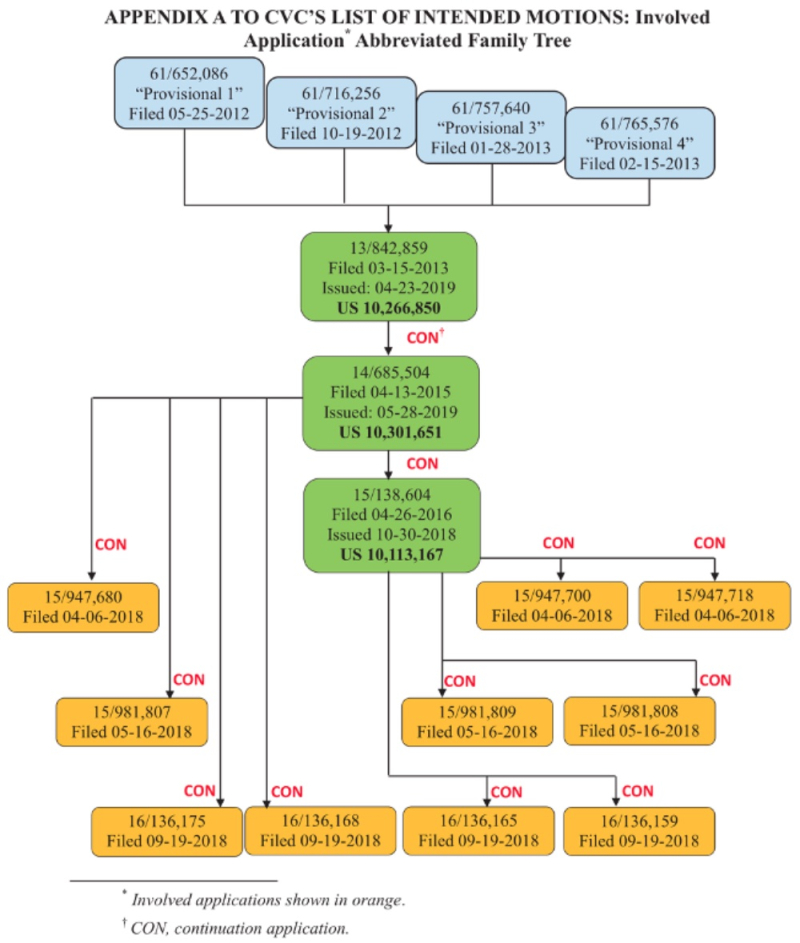
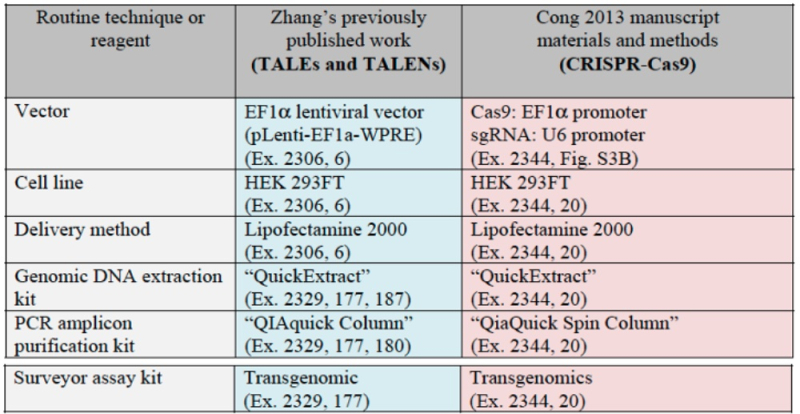
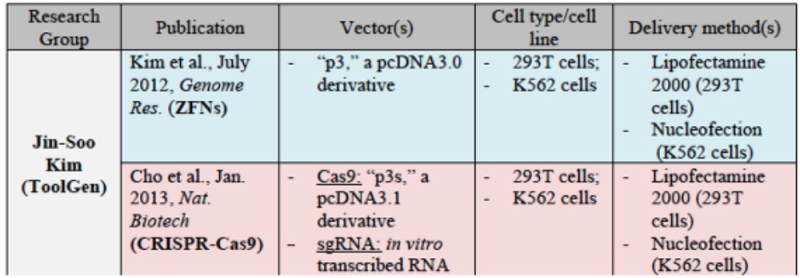
    Junior Party CVC proposed ten preliminary motions.  CVC Substantive Preliminary Motion No. 1, which CVC characterized as a "threshold" motion, sought to have a finding of no interference-in-fact because CVC alleged Sigma-Aldrich's application-in-interference was properly governed under the "first inventor to file" provisions of the Leahy-Smith America Invents Act because that patent "contains or contains at any time" (emphasis in brief) subject matter not entitled to priority to an application filed prior to enactment of the AIA.  As Sigma-Aldrich did in its analogous request for preliminary motion against Broad (see "Sigma-Aldrich and Broad Propose Preliminary Motions in Recent CRISPR Interference No. 106,133"), CVC provides an Appendix outlining the bases in Sigma-Aldrich's application-in-interference No. 15/456,204:

    Image
    CVC also provides as an example in the text amendment of a claim during prosecution of a parent application (No. 15/188,911) that the Office determined was sufficient for the amended claim not to be entitled to the first-to-invent provisions of the 1952 Patent Act.  This determination regarding the '911 application, from which the '204 application claimed priority, was enough for the Board to conclude, according to CVC, that the '204 application was not entitled to participate in this interference.  In addition to asking the Board for leave to file its Motion, CVC asks that this motion be authorized, briefed, and decided before any other motions are briefed or considered, so as not to burden the parties in filing unnecessary motions.

    CVC's Substantive Preliminary Motion No. 2 under 37 C.F.R. §§ 41.121(a)(1)(ii) and 41.208(a)(3) asks leave to file a motion for benefit of priority to U.S. provisional application Nos. 61/652,086, filed May 25, 2012 ("P1"); 61/716,256, filed October 19, 2012 ("P2"), earlier-filed applications from which CVC has sought priority benefit in Interference Nos. 106,115 (where the Board denied the motion) and 106,127 (where the Board has not yet ruled).  CVC asks for a longer page limit for its motion, "[d]ue to the complexity of the issues and extensive evidentiary record implicated by this Motion."  CVC also argued that the Board's adverse decision on this motion in the '115 does not raise an estoppel because that decision is not yet final (having not been ripe for appeal) and because the Count in the '115 Interference and the Count in this interference are not identical.

    CVC's Substantive Preliminary Motion No. 3 seeks to have the Board deny Sigma-Aldrich benefit of priority to its earliest provisional application, No. 61/734,256 filed December 6, 2012 (the Board having given Sigma-Aldrich the priority benefit to this application in the Declaration.

    CVC's Substantive Preliminary Motion No. 4 asks the Board to change the Count, "to better—and more uniformly—reflect the common invention being adjudicated in multiple pending interferences involving the claims of multiple parties directed to sgRNA CRISPR-Cas9."  CVC notes in particular that Sigma-Aldrich's "half" of the Count does not contain the limitation in claim 33 of the '204 application "wherein the guide RNA is a single molecule," while CVC's half of the Count is expressly limited to eukaryotic CRISPR species encompassing single molecule RNA species.  CVC relies on 37 C.F.R. § 41.1(b) for "considerations of efficiency, uniformity, and clarity [to] justify narrowing Sigma's half of the Count."

    CVC then proposes three separate Substantive Preliminary Motions under 37 C.F.R. § 41.121(a)(1) for unpatentability of Sigma-Aldrich's claims in this interference.  CVC's Substantive Preliminary Motion No. 5 asks the Board 37 C.F.R. § 41.121(a)(1) to find the claims of the '204 application to be unpatentable under AIA 35 U.S.C. § 103 for obviousness over U.S. Application Publication No. 2015/0322457, alone or in combination with several prior art references "disclosing gene editing using donor integration-based strategies"; CVC relies on its Substantive Preliminary Motion No. 1 that the '204 application is not entitled to the benefits of the first to invent provisions of the 1952 Patent Act in support of this motion.  In addition, CVC argues a variety of public and PTAB policy goals purportedly furthered by the Board granting this motion.

    CVC's Substantive Preliminary Motion No. 6 asks the Board 37 C.F.R. § 41.121(a)(1) to find the claims of the '204 application to be unpatentable under AIA 35 U.S.C. § 102 or § 103 for anticipation or obviousness over U.S. Application Publication No. 2014/0068797, alone or in combination with several prior art references in view of Sigma-Aldrich's purported inability to swear behind these references based on CVC's arguments in its Substantive Preliminary Motion No. 1.  CVC particularly notes that the basis for the Office finding the claims in the '204 application patentable over cited prior art was that the claims were amended to recite CRISPR embodiments having the feature of integrating donor DNA into target DNA.  This feature is found, CVC argues, in its '797 Publication as well as its P1 and P2 provisional applications, none of which were considered during ex parte prosecution.  CVC also argues that any adverse decision in the '115 Interference does not estop their making this argument in this interference, inter alia, because that earlier decision is not final.

    CVC's Substantive Preliminary Motion No. 7 asks the Board 37 C.F.R. § 41.121(a)(1) to find the claims of the '204 application to be unpatentable under AIA 35 U.S.C. § 102 or § 103 for anticipation or obviousness over under a combination of prior art references including "Jinek 2013, Mali 2013, Hwang 2013, Cong 2013, and/or Cho 2013."  In addition to asserting invalidity, CVC asserts that Sigma-Aldrich cannot "swear behind" these references due to its status as not being entitled to the first to invent provisions of the 1952 Patent Act.

    CVC asks the Board's leave to file two miscellaneous motions.  The first, CVC's Contingent Miscellaneous Motion No. 8 under 37 C.F.R. § 41.121(a)(3), asks the Board to include to add claims of U.S. Patent Nos. 10,731,181 and 10,745,716, contingent on the Board either denying it authorization to CVC for filing its Preliminary Motion No. 1 or denying the motion on its merits.

    CVC's Contingent Miscellaneous Motion No. 9 under 37 C.F.R. § 41.121(a)(3) asks the Board to add claims in Sigma-Aldrich's U.S. Patent Application Nos. 15/188,927; 15/188,931; 16/943,767; and 17/208,477 to this Interference.  Like CVC Motion No. 8, this motion is contingent on the Board either denying it authorization to CVC for filing its Preliminary Motion No. 1 or denying the motion on its merits.

    Finally, CVC's Substantive Preliminary Motion No. 10 was a motion under 37 C.F.R. § 41.208(a)(4) seeking judgment based on priority.

    Sigma-Aldrich filed its request under 37 C.F.R. § 41.121(a)(1)(i) to change the Count to one of five different alternatives.  Sigma-Aldrich justifies this request by asserting that "[t]he current Count 1, as set forth in the Declaration, encompasses two patentably distinct inventions: (1) CRISPR-Cas9 in a eukaryotic cell to cleave a target DNA; and (2) CRISPR-Cas9 in a eukaryotic cell to cleave a target DNA and subsequently to integrate a donor DNA sequence into the target DNA."  But the step of "subsequently to integrate a donor DNA sequence into the target DNA" is not obvious over merely CRISPR-mediate cleavage of target DNA and thus this aspect is patentably distinct.  Citing 37 C.F.R. § 41.201 for the principle that a single interference Count "should not encompass two patentably distinct inventions," Sigma-Aldrich argued that CVC's part of the Count is limited to CRISPR-mediated target DNA cleavage alone while its own portion of the Count is limited to CRISPR-mediated integration of donor DNA into the target site.  The inequity raised by this Count structure is that it would enable CVC to submit proofs of its invention (limited to DNA cleavage) to prevail on separately patentable subject matter encompassing donor DNA integration.

    Sigma-Aldrich's Proposed Counts 2-5 are as follows:

    Proposed Count 2 (all proposed Counts recite claim 31 of Sigma-Aldrich's Application No. 15/456,204 as in the Count as declared):

    156.  A method of cleaving or editing a target DNA molecule or modulating transcription of at least one gene encoded thereon, the method comprising:
    contacting a target DNA molecule having a target sequence with an engineered and/or non-naturally-occurring Type II Clustered Regularly Interspaced Short Palindromic Repeats (CRISPR)—CRISPR associated (Cas) (CRISPR-Cas) system comprising:
        a) a single molecule DNA-targeting RNA comprising
            i) a targeter-RNA that hybridizes with the target sequence, and
            ii) an activator-RNA that hybridizes with the targeter-RNA to form a double-stranded RNA duplex of a protein-binding segment,
    wherein the targeter-RNA and the activator-RNA are covalently linked to one another with intervening nucleotides; and
        b) a Cas9 protein,
    wherein the single molecule DNA-targeting RNA forms a complex with the Cas9 protein, thereby targeting the Cas9 protein to the target DNA molecule
    whereby said target DNA molecule is cleaved or edited or transcription of at least one gene encoded by the target DNA molecule is modulated, and
    wherein said contacting occurs in a eukaryotic cell.

    157.  The method of Claim 156, wherein, prior to the contacting step, the method comprises:
    introducing into the eukaryotic cell containing the target DNA molecule:
        1) the single molecule DNA-targeting RNA, or a DNA molecule comprising a nucleotide sequence that (i) encodes the single molecule DNA targeting RNA and (ii) is operably linked to a regulatory element operable in said eukaryotic cell; and
        2) the Cas9 protein, an RNA molecule comprising a nucleotide sequence encoding the Cas9 protein, or a DNA molecule comprising a nucleotide  sequence that (i) encodes the Cas9 protein and (ii) is operably linked to a regulatory element operable in said eukaryotic cell.

    164.  The method of Claim 157, wherein the method comprises creation of a double strand break in the target DNA molecule which is repaired by a homology-directed repair mechanism which incorporates a sequence of a donor polynucleotide into the target DNA molecule, thereby editing the target DNA molecule.

    (CVC Application No. 15/947,680)

    Sigma-Aldrich notes that an advantage of this Proposed Count 2 is that it reconciles the subject matter categories of the two alternatives in the Count (both are directed to methods) instead of Count 1 as declared (directed to CVC's composition and Sigma-Aldrich's method).

    Sigma-Aldrich's Proposed Count 3 is the same as Proposed Count 2 but Claim 164 would depend directly on claim 156 instead of including the limitations of intervening claim 157 of CVC's '680 application).

    Sigma-Aldrich's Proposed Count 4 recites CVC's claim 169 (dependent on claim 156) in the alternative to Sigma-Aldrich's claim 31 of the '204 application:

    169.  The eukaryotic cell of Claim 156, wherein the system comprises a donor polynucleotide and the system is capable of editing the target DNA molecule by inserting a sequence of the donor polynucleotide into a cleaved strand of the target DNA molecule.

    Sigma-Aldrich's Proposed Count 5 recites in alternative composition of matter claims; this proposal constitutes CVC's claim 169 of its Application No. 15/981,807 and Sigma-Aldrich's claim 64 of the '204 application:

    64.  A eukaryotic cell comprising a chromosomal sequence and a Clustered Regularly Interspersed Short Palindromic Repeats (CRISPR)/CRISPR associated (Cas) (CRISPR-Cas) type II system comprising
        (i) a CRISPR-Cas type II protein linked to only one nuclear localization signal (NLS) or a nucleic acid encoding the CRISPR-Cas type II protein linked to only one NLS, wherein the CRISPR-Cas type II protein is a Cas9 protein, and the nucleic acid encoding the CRISPR-Cas type II protein is codon optimized for expression in the eukaryotic cell;
        (ii) a guide RNA or DNA encoding the guide RNA, wherein the guide RNA comprises a first region that is complementary to a target site in the chromosomal sequence, which target site in the chromosomal sequence is immediately followed by a protospacer adjacent motif (PAM), and a second region that interacts with the CRISPR-Cas type II protein, and wherein the guide RNA comprises a crRNA and a tracrRNA; and
        (iii) a donor polynucleotide comprising a donor sequence and upstream and downstream sequences;
    wherein the guide RNA is capable of guiding the CRISPR-Cas type II protein to the target site in the chromosomal sequence, the CRISPR-Cas type II protein is capable of introducing a double-stranded break at the target site, and the system is capable of repairing the double-stranded break by a DNA homology-directed repair (HDR) process leading to integration or exchange of the donor sequence into the chromosomal sequence.

    Sigma-Aldrich requested leave to file its Contingent Motion No. 2 to deny CVC benefit of Application 61/757,640 (filed Jan. 28, 2013) ("CVC P3") or 61/765,576 (filed Feb. 15, 2013) ("CVC P4") under 37 C.F.R. § 41.121(a)(1), should the Board grant any of alternative Proposed Counts 2, 3, 4, or 5, on the grounds that these applications do not provide a constructive reduction to practice of an invention recited by any of these alternative Counts, i.e., "use of a CRISPR-Cas9 composition or method in a eukaryotic cell to successfully cleave a target DNA and thereafter to integrate a donor DNA sequence into that cleaved target DNA."

    Sigma-Aldrich also sought leave to file its Substantive Preliminary Motion No. 3 for a Board determination that CVC's involved claims are unpatentable under §§ 102(a)/(e) and/or 103 in view of the Chen reference, WO 2014/087489290 A1 (published June 12, 2014), which claimed priority to Application 61/734,256 (filed Dec. 6, 2012) ("Sigma P1").

    Sigma-Aldrich also seeks a Protective Order such as the one entered in other CRISPR interferences, and finally filed a motion under 37 C.F.R. § 41.208(a)(4) seeking judgment based on priority.

    In addition, Sigma-Aldrich adds the Board to address some "miscellaneous administrative issues" such as deadlines for filing and service in this interference and asks the Board to waive the requirement for a separate Statement of Material Fact or not have these pages be included in the page limit, as well as a few typographical errors in the caption.

    Future posts will discuss the parties arguments at the August 3rd teleconference and the Board's determinations regarding which Preliminary Motions the parties will be permitted to file.

  • By Kevin E. Noonan

    The parties in Interference No. 106,133, namely Senior Party Sigma-Aldrich and Junior Party the Broad Institute, Harvard University, and MIT (collectively, "Broad"), filed their respective lists of proposed preliminary motions four days prior to their August 3rd teleconference with the Board to present their arguments for the Board to grant leave to file any of them.

    Broad InstituteJunior Party Broad proposed Substantive Preliminary Motion No. 1, to change the Count under 37 C.F.R. §§ 41.121(a)(1)(i) and 41.208(a)(2).*  The justification here as in earlier interferences (Nos. 106,115 and 106,126) is to provide "a count broad enough to cover Broad's best proofs, which are directed to CRISPR-Cas9 systems using dual-molecule RNA but not including a donor polynucleotide sequence."  Proposed substitute Count 2 is:

    A CRISPR-Cas9 system, for use in a eukaryotic cell, comprising:
        a) a Cas9 or a nucleic acid encoding the Cas9 and
        b) an RNA or a nucleic acid encoding the RNA, wherein the RNA is a dual RNA comprising a CRISPR RNA (crRNA) and a trans activating crRNA (tracrRNA) or wherein the RNA is a chimeric RNA comprising a crRNA fused to a tracrRNA,
    wherein the crRNA directs the Cas9 to a target sequence in a eukaryotic cell, whereby a site-specific, double-strand break is introduced, or the target sequence is edited.

    Once again, Broad's argument involves the purported "fairness" that this Count provides compared with the Count as declared, which Broad asserts "does not appropriately capture the common subject matter," i.e., "use of CRISPR-Cas9 systems in eukaryotic cells."  Broad's "best proofs," they argue, "include dual-molecule RNA systems without a donor polynucleotide" (this latter feature recited in Sigma-Aldrich's alternative to Count 1).  In addition, Broad argues that Sigma-Aldrich's invention is likewise not limited to single-molecule RNA embodiments of CRISPR (for clarity, these embodiments comprise a fusion of the crRNA species, specific for the target, and tracrRNA which interacts with Cas9 in forming the CRISPR complex).  Moreover, Broad cites portions of Sigma-Aldrich's prosecution history to support its motion, reminding the Board that Sigma-Aldrich asserted to the Examiner that the party "reserves the right to file patentably distinct CRISPR cleavage-only claims at a later date in one or more continuing applications."  According to Broad, Sigma-Aldrich sought to provoke an interference directed to "methods of integrating a donor polynucleotide sequence into the chromosomal sequence of a eukaryotic cell," and understandably reminds the Board that the only CRISPR interference that has reached a conclusion, No. 106,048 (which Broad "won" by having the Board find no interference-in-fact), had a scope that encompassed both single molecule and dual molecule RNA CRISPR embodiments.  And the "best proofs" Broad refers to are its achievement (disputed by Junior Party CVC in Interference No. 106,115) of dual molecule CRISPR embodiments in eukaryotic cells in 2011.

    Broad also proposes an alternative Count 3 under 37 C.F.R. §§ 41.121(a)(1)(i) and 41.208(a)(2), intended to limit the scope of the interference to the extent that would support a motion by Broad to declare most of its claims to not correspond to the substituted Count.  Proposed Count 3 recites in the alternative claim 52 of Broad involved application 16/177,403:

    A method comprising: introducing into, or expressing in, a eukaryotic cell having a DNA molecule,
        (I)    a Cas9 protein or one or more nucleotide sequences encoding the Cas9 protein;
        (II)   an RNA or one or more nucleotide sequences encoding the RNA, the RNA comprising: (a) a first RNA comprising a first ribonucleotide sequence and a second ribonucleotide sequence, and (b) a second RNA; and
        (III) a template polynucleotide;
    wherein the second RNA forms an RNA duplex with the second ribonucleotide sequence, and wherein, in the eukaryotic cell, the first ribonucleotide sequence directs the Cas9 protein to a target sequence of the DNA molecule, whereby the Cas9 cleaves both strands of the DNA molecule and the cleavage is repaired by integration of the template polynucleotide into the DNA molecule in the eukaryotic cell.

    Or, as in this interference as declared, claim 31 of U.S. Application No 15/456,204.  Broad justifies this Proposed Count 3 by asserting that:

    Sigma limited its claims to only those requiring use of a donor polynucleotide, arguing that this specific limitation rendered its claims non-obvious over Jinek 2012 and Kim P1.  Having so limited its claims to only those requiring a donor polynucleotide in order to secure allowance, Sigma should not now be permitted to attempt to claim for itself broader subject matter ([i.e.,]use of CRISPR-Cas9 in eukaryotic cells more generally without a template, the subject matter of Broad's half of Count 1).

    Broad helpfully recites the claims in Broad's involved application and patents that would remain in the interference should the Board substitute Proposed Count 3 in this interference:  "U. S. Patent No. 8,871,445, claim 13; U.S. Patent No. 8,932,814, claims 2, and 14-15; U.S. Patent No. 8,889,356, claims 2 and 14; U.S. Patent No. 9,840,713, claim 14; and application 14/704,551, claims 14-15" (as well as claims 52-56 of U.S. Application No. 16/177,403 should the Board grant a series of contingent motions, vide infra).

    Again, pursuant to 37 C.F.R. §§ 41.121(a)(1)(i) and 41.208(a)(2), Broad proposes a series of Contingent Preliminary Motions dependent upon the Board granting its Substantive Motion No. 1 for either of the Proposed Substitute Counts.  Under circumstances where the Board grants Broad's Motion No. 1 to substitute Proposed Count 2, Broad asks the Board to grant leave to add to the interference claims 1 and 40-41 of Application No. 15/160,710; and claims 74 and 94-95 of U.S. Application No. 15/430,260.  Under circumstances where the Board grants Broad's Motion No. 1 to substitute Proposed Count 3, Broad asks the Board to grant leave to add to the interference claims 52-56 of U.S Application No. 16/177,403.

    In a second Contingent Preliminary Motion Broad asks the Board for leave to designate claims as not corresponding to the substituted Count under 37 C.F.R. §§ 41.121(a)(1)(iii) and 41.208(a)(2), based on such claims reciting a Staphylococcus aureus Cas9 species not disclosed in Sigma-Aldrich's application, including all involved claims of Broad U.S. Patent Nos. 8,865,406 and 8,895,308, as well as claims 1, 16-21, and 30-40 of U.S. Application No. 15/330,876.  Under the same Rules, Broad asks the Board to de-designate all involved claims of its U.S. Patent No. 8,889,418 based on limitations in those claims that the Cas9 comprising the claimed CRISPR complex is chimeric, i.e., comprised of first and second protein fragments from different Cas9 proteins.  Also contained in this proposed Contingent Preliminary Motion is Broad's request that the Board de-designate all involved claims of its U.S. Patent Nos 8,871,445 and 8,932,814, as well as claim 7 of U.S. Patent No. 8,993,233 and claims 9-11 of U.S. Application No. 14/704,551 and claim 34 of U.S. Application No. 15/330,876.  The basis for this request is that these claims recite Cas9 species with improved nuclear localization by incorporation of more than one nuclear localization signal.  Broad further asks the Board for leave to file a Contingent Preliminary Motion to de-designate all involved claims of U.S. Patent Nos. 8,993,233 and 8,999,641 and claims 18-19, 25, 29-30 and 36 of U.S. Patent No. 9,840,713 and claim 21 of U.S. Application No. 15/330,876 on the basis that these claims do not recite Cas9 species fused to "specified protein domains or [that] includes one or more heterologous domains or includes a functional domain."  Finally, Broad asks the Board for leave to file a Contingent Preliminary Motion to de-designate all involved claims of U.S. Patent Nos 8,865,406; 8,889,356; 8,889,418; 8,932,814; 8,945,839; 8,993,233; and 8,999,641, as well as claims 1-3, 5-20, 12-17, and 19-20 of U.S. Patent No. 8,697,359; claims 1-4 and 6-19 of U.S. Patent No. 8,771,945; claims 1-12 and 14-30 of U.S. Patent No. 8,871,445; claims 1-9, 11-14, 16-25, and 27-28 of U.S. Patent No. 8,895,308; claims 1, 3-4 and 6-30 of U.S. Patent No. 8,906,616; claims 1-7, 10-13, 15, 17-26, and 28-41 of U.S. Patent No. 9,840,713, and claims 2, 4-13, and 16-18 of U.S. Application No. 14/704,551.  As Broad summed up, if the Board granted these motions:

    [C]laims 4, 11, and 18 of U.S. Patent No. 8,697,359; claim 5 of U.S. Patent No. 8,771,945; claims 1-20 (all involved claims) of U.S. Patent No. 8,795,965; claim 13 of U.S. Patent No. 8,871,445; claims 10, 15 and 26 of U.S. Patent No. 8,895,308; claims 2 and 5 of U.S. Patent No. 8,906,616; claims 8-9, 14, 16, and 27 of U.S. Patent No. 9,840,713, claims 14 and 15 of application 14/704,551 and claims 1, 16-21, and 30-40 (all involved claims) of application 15/330,876 would remain designated as corresponding to Count 1 (although some of those claims are subject to other grounds for being designated as not corresponding to the Count) as those are the only involved claims that require chimeric RNA where the RNA components are fused or covalently linked through intervening nucleotides in the CRISPR-Cas9 complex and/or inclusion of a donor polynucleotide for HDR after DSB [i.e., these would be the only Broad claims involved in this Interference].

    Broad also asked the Board for leave to file two additional substantive motions.  Broad Substantive Preliminary Motion No. 2 seeks judgment of unpatentability under 37 C.F.R. §§ 41.121(a)(1)(iii) on the basis that Sigma-Aldrich's involved application (Application No. 15/456,204) is not entitled to priority benefit to its first provisional application, U.S. Application No. 61/734,256, for failing to provide an adequate written description and for failing to provide a constructive reduction to practice of the claimed subject matter.  In addition, Broad argues that without such benefit prior art including Broad's Cong et al. paper (Science 339: 819-23, January 3, 2013), Mali et al., Science 339: 823-26, January 3, 2013, and U.S. Publication No. 2014/0342457, claiming priority to U.S. Application No. 61/738,355, filed December 17, 2012, are invalidating prior are under § 102 and/or § 103.

    Broad's final proposed Substantive Preliminary Motion No. 3 is brought under 37 C.F.R. § 41.121(a)(3) and asks the Board to enter an Order requiring Sigma-Aldrich to keep Broad and the Board abreast of any issuance or notice of allowance for any related, pending applications.

    And of course, Broad filed a motion under 37 C.F.R. § 41.208(a)(4) seeking judgment based on priority.

    Sigma-AldrichFor its part, Sigma-Aldrich filed its list of three proposed Substantive Preliminary Motions.  In proposed Substantive Preliminary Motion No. 1, under 37 C.F.R. § 41.121(a)(1), Sigma-Aldrich asks the Board to deny Broad standing in this interference, based on failing to satisfy the requirements under the Leahy-Smith America Invents Act to fall under prior "first to invent" regime under the 1952 Patent Act.  Sigma-Aldrich asks the Board to consider this a threshold motion under 37 C.F.R. § 41.201.  Sigma-Aldrich contends that "[e]ach of Broad's involved patents and applications is subject to the first inventor-to-file ("FITF") law, regulations, rules, and procedures, as enacted and promulgated as a consequence of the AIA" because "each of Broad's involved patents and applications contains claims to subject matter that (a) contains (or at one time contained) a claim to a claimed invention having an effective filing date after March 16, 2013; and/or (b) claims (or at one time claimed) the benefit of an earlier filing date based upon an earlier application that contained such a claim," citing M.P.E.P. § 2159.02.  (CVC asked the Board for leave to file a similar Preliminary Motion in Interference No. 106,048).  Rather than burdening the text of the motion, Sigma-Aldrich provides its detailed support for this Motion in an appendix, providing in its argument a list of five claim limitations it contends were not supported by pre-AIA disclosures.  Sigma-Aldrich contends that "while an applicant is permitted to rely upon the filing date of an earlier-filed patent application, an applicant is not permitted to submit evidence of earlier invention, e.g., evidence of earlier conception and reduction to practice" under the AIA, and thus Broad lacks standing to submit any evidence of invention earlier than its first priority date, December 12, 2012, for U.S. Application No. 61/736,527 (also known as "Broad P1" in this and related CRISPR interferences).

    Sigma-Aldrich's Substantive Preliminary Motion No. 2 under 37 C.F.R. § 41.121(a)(1) asks the Board to deny Broad benefit of priority to seven provisional applications in addition to P1 filed between December 12, 2012 and March 15, 2013 (P2: Application No. 61/748,427, filed Jan. 2, 2013; P3: Application No. 61/758,468, filed January 30, 2013; P4: Application No. 61/768,595, filed February 25, 2013; P5: Application No. 61/769,046, filed February 25, 2013; P6: Application No. 61/791,409, filed March 15, 2013; and P7: Application No. 61/802,174, filed March 15, 2013).  (Sigma-Aldrich notes in a footnote that these provisional applications were all filed before the effective date of the AIA, and that while Broad has 14 other related provisional applications, the complexities of their interrelatedness preclude considering the deficiencies in their disclosures in this single Motion.)  The basis for this Motion is that in these applications Broad did not demonstrate a constructive reduction to practice of an invention according to the Count, wherein is recited "a method of using CRISPR-Cas9 in a eukaryotic cell to successfully cleave a target DNA and thereafter to successfully either integrate a donor DNA sequence into that cleaved target DNA, or alter the expression of the gene product of that cleaved target DNA."

    Sigma-Aldrich's Substantive Preliminary Motion No. 3 under 37 C.F.R. § 41.121(a)(3) seeks to remove Broad's allowed Application No. 15/330,876 from the interference, because "[a]ll of the claims in the '876 application are directed solely to, inter alia, a composition of CRISPR-Cas9 in a eukaryotic cell to simply cleave a target DNA molecule" and "[n]one of the claims in the '876 application recite further that the composition subsequently integrates a donor DNA sequence into the target DNA molecule, nor do they recite further that the composition alters the expression of the gene product of the cleaved target DNA molecule."  Accordingly, because "none of Broad's claims in the '876 application is substantially the same as (i.e., patentably indistinct from) Sigma's claims in the present interference . . . none of the claims in the '876 application interferes with any of the claims of Sigma's involved Application 15/456,204."

    Sigma-Aldrich also seeks a Protective Order such as the one entered in other CRISPR interferences, and finally filed a motion under 37 C.F.R. § 41.208(a)(4) seeking judgment based on priority.

    In addition, Sigma-Aldrich asks the Board to address some "miscellaneous administrative issues" such as deadlines for filing and service in this interference and asks the Board to waive the requirement for a separate Statement of Material Fact or not have these pages be included in the page limit.

    Future posts will discuss the parties arguments at the August 3rd teleconference and the Board's determinations regarding which Preliminary Motions the parties will be permitted to file.

    * Readers familiar with the other CRISPR interference will recognize this motion.