One of the characteristics of the response to the COVID-19 pandemic were the pledges from companies involved in developing vaccines (such as Moderna, Pfizer, BioNTech, and others) not to enforce patents on relevant technology during the duration. That restraint has long-since vanished (as has the global pandemic effects of the virus) and there have been several lawsuits, in the U.S. and abroad, relating to various components of the vaccine (see, e.g., Alnylam Pharmaceuticals v. Pfizer and Alnylam Pharmaceuticals Inc v. Moderna Inc.) These have included the lipids comprising the nanoparticles and use of variant nucleotides (such as pseudouridine analogs); most of these lawsuits have settled or come to resolution (see, e.g., Arbutus Biopharma Corp. v. ModernaTx, Inc. and Moderna Sues Pfizer and BioNTech over mRNA Vaccine Technology).
The latest skirmish involves Bayer Cropscience and affiliates Monsanto and Monsanto Technology against three defendants in separately filed lawsuits: Moderna, Inc., Moderna US, Inc., and ModernaTx Inc. D. Del., No. 26-cv-12 with regard to the Spikevax® protein component of the vaccine; Pfizer Inc., BioNTech SE, BioNTech Mfg. GmbH, and BioNTech US Inc. D. Del., No. 26-cv-13 directed to the Comirnaty® protein; and Johnson & Johnson, Janssen Pharmaceutica NV, Janssen Pharmaceuticals Inc., Janssen Biotech Inc, and Janssen Vacines & Prevention N.V. D.N.J., No. 3:26-cv-71 involving Jcvoden, which unlike the other two Spike protein mRNA vaccines comprises an adenovirus-encoded Spike protein-encoding construct.* The complaints in each case (see below) are similar and assert similar allegations, differing only in the profit amount alleged to have been garnered by the parties.
The asserted patent, U.S. Patent No. 7,741,118, had originally been directed to improving yield of pest resistance-related genes in recombinant crops, but significantly not limited to these outcomes. The claimed technology purportedly eliminated “problem” coding sequences in mRNA of interest that “improved mRNA stability and the amount or quality of protein produced.” Such problem sequences include A/T rich areas of the transcript, such as (specifically) ATTTA and generally “regions with over five consecutive A and/or T nucleotides.” In the accused vaccines, the modifications acted to reduce destabilization of Spike-encoding mRNA in vivo (thought to be due to self-complementarity), thus improving translational efficiency. The claimed methods involved substituting these problem sequences with amino acid-encoding sequences; in each case, the complaint recites specific claims alleged to be infringed by defendants, asserted to have resulted in each defendant having been able “to quickly and effectively design and synthesize [Spike-encoding] mRNA” that “was enabled in part by its use of Plaintiffs’ patented method for removing the Problem Sequences identified in the ‘118 Patent by substituting sense codons.” The alleged infringed claims shared for each Defendant “at least Claims 59 [and] 60” of the ‘118 Patent:
59. A method of making a structural gene that encodes a protein, the method comprising: (a) starting with a coding sequence that encodes a protein and that contains polyadenylation signal sequences listed in Table II; (b) reducing the number of said polyadenylation signal sequences in the coding sequence by substituting sense codons for codons in the coding sequence; and (c) making a structural gene that comprises a coding sequence that includes the codons substituted according to step (b) and is characterized by the reduced number of Table II polyadenylation signal sequences, and that encodes the protein.
60. The method of claim 59, wherein the starting coding sequence of step (a) contains ATTTA sequences, and wherein step (b) further comprises reducing the number of said ATTTA sequences in the coding sequence by substituting sense codons for codons in the coding sequence.
Each complaint also asserted the profits each defendant had made from its infringement:
In 2024, Pfizer reported $5.3 billion in global Comirnaty revenue, including $2 billion in the US; BioNTech reported €701 million ($819.3 million) in global sales. Moderna in 2024 reported $3.1 billion in global Spikevax sales, including $1.7 billion in the US. J&J reported $198 million that year from global Jcovden sales.
These complaints were filed recently and progress of the lawsuits will be monitored going forward.
* It is noted that the Emergency Use Authorizations for the Jcovden vaccine was revoked in the U.S. and the EU in 2023 and the vaccine is no longer being administered.
Dickens’s Bleak House has long stood as an exemplar for the perils of interminable litigation where no one benefits (except, perhaps, the lawyers; seeJarndyce v. Jarndyce). In a case already somewhat notorious for its subject matter, Allen v. Cooper (2020), on remand back from the Supreme Court upholding North Carolina’s sovereign immunity against suit for copyright infringement, the journey recently ended at the Fourth Circuit.
To provide the reader with a recap, the case arose over Petitioner Allen’s suit against North Carolina’s unauthorized use of copyrighted materials relating to the discovery and salvage of the pirate Blackbeard’s “flagship” Revengeoff the coastal waters of that state and, hence, being deemed State property [note: readers wishing to skip the recap can scroll down to the paragraph beginning with ***). Petitioner relied on the provisions of the Copyright Remedy Clarification Act of 1990 (CRCA), codified at 17 U.S.C. § 511:
[A] State “shall not be immune, under the Eleventh Amendment [or] any other doctrine of sovereign immunity, from suit in Federal court” for copyright infringement. 17 U.S.C. §511(a). [I]n such a suit a State will be liable, and subject to remedies, “in the same manner and to the same extent as” a private party. §511(b).
North Carolina asserted sovereign immunity under the Eleventh Amendment:
The Judicial Power of the United States shall not be construed to extend to any suit in law or equity, commenced or prosecuted against one of the United States by Citizens of another State, or by Citizens or Subjects of any Foreign State.
The District Court found for plaintiff, based on the express provisions of the CRCA, and on Section 5 of the Fourteenth Amendment, in view of the “the States’ ‘pattern’ of ‘abus[ive]’ copyright infringement.” The Fourth Circuit reversed, based on the Supreme Court’s decision in Florida Prepaid Postsecondary Ed. Expense Bd.v. College Savings Bank, 527 U.S. 627 (1999), holding unconstitutional the Patent Remedy Act, enacted by Congress on the same day and having substantially the same provisions.
On certiorari, the Supreme Court affirmed the Fourth Circuit’s judgment, in a decision by Justice Kagan and joined by the Court with the exception of two portions of the opinion in which Justice Thomas did not join; in addition, Justice Breyer wrote a concurring opinion joined by Justice Ginsberg. The opinion noted that the express language of the Eleventh Amendment is not unequivocal but that sovereign immunity stands for the “presupposition of our constitutional structure which it confirms,” citing Blatchfordv. Native Village of Noatak, 501 U.S. 775, 779 (1991). This presumption is, first, that “each State is a sovereign entity in our federal system,” citing Seminole Tribe of Fla.v. Florida, 517 U.S. 44, 54 (1996). Second, “[i]t is inherent in the nature of sovereignty not to be amenable to [a] suit” absent consent, cited in Seminole Tribe and relying on The Federalist No. 81, p. 487 (A. Hamilton). Finally, that “fundamental aspect of sovereignty constrains federal ‘judicial authority’” according to the Court, citing Blatchford.
The opinion acknowledges that this immunity is not absolute and the Court has recognized exceptions, in instances where Congress enacts a statute having “unequivocal statutory language” that abrogates a State’s sovereign immunity (citing Dellmuthv. Muth, 491 U.S. 223, 228 (1989)) and there is some constitutional provision that excuses Congress’s encroachment on sovereign state prerogatives (citing Kimelv. Florida Bd. of Regents, 528 U.S. 62, 78 (2000)). In this case, the first prong of the test was indisputably met. As for the second prong, Petitioner relied on Congress’s Article I power to grant copyrights, and the Fourteenth Amendment’s grant to Congress of the power to enforce the Amendment’s due process provisions.
The Court rejected these arguments, the opinion stating that “[t]he slate on which we write today is anything but clean.” The Article I power to grant copyrights (and patents) “impose[s] a corresponding duty (i.e., not to infringe) on States no less than private parties,” according to the Court, citing Goldstein v. California, 412 U.S. 546, 560 (1973). Petitioner argued that abrogation of North Carolina’s sovereign immunity was the best, if not only, way to protect Petitioner’s copyright. But the opinion asserts:
The problem for Allen is that this Court has already rejected his theory, in Florida Prepaid. While that case involved Congress’s failed attempt to abrogate State sovereign immunity for patent infringement, the constitutional basis for copyright protection arises in in the same provision of Article I as patent protection (Section 8, clause 8) and thus that decision mandates the Court’s opinion here.
The Court noted that the justifications for stripping States of sovereign immunity in Florida Prepaid for patents were the same as asserted here: “to ensure ‘uniform, surefire protection’ of intellectual property.” While acknowledging that this was a “proper Article I concern,” the opinion reiterates the holding of Florida Prepaid that it isn’t enough to satisfy the second prong, that there is a constitutional provision supporting this exercise of federal power, based on the Court’s decision in Seminole Tribe v. Florida. The rubric from the case is that Congress does not have the power, under Article I, to “circumvent” the limitations sovereign immunity places on federal jurisdiction. As stated in the opinion, “the power to ‘secur[e]’ an intellectual property owner’s ‘exclusive Right’ under Article I stops when it runs into sovereign immunity.”
The Court also rejected Petitioner’s argument that Central Va. Community Collegev. Katz provided “an exit ramp” from the Florida Prepaid precedent. 546 U.S. 356, 359 (2006). Katz involved the Bankruptcy Clause, which the Court decided enabled Congress to compel states to participate in bankruptcy proceedings. But the opinion noted that the Court had expressly exempted bankruptcy proceedings from Seminole Tribe’s general rule. The Court refused in this case to extend “bankruptcy exceptionalism” to the Copyright Clause. Bankruptcy proceedings were “in rem” according to the Court, and accordingly “it does not implicate States’ sovereignty to nearly the same degree as other kinds of jurisdiction,” citing Katz. In addition, the Court in Katz found that bankruptcy proceedings and the Bankruptcy Clause had a “unique history” that produced in the Court “a felt need to curb the States’ authority.” This need stemmed from the “wildly divergent schemes” different States had at the founding of the Republic for discharging debt in bankruptcy and that the States at that time had a history of not respecting discharge orders from other states. As is its wont, the Court reverted to the origins and purposes (the Framers’ intentions) of the Bankruptcy Clause for justification for its distinction. And the Court in Katz had found that by ratifying the Constitution, the States had agreed to yield their sovereign immunity (in view of the language of the Bankruptcy Clause itself); because a State can always waive its immunity any apparent inconsistency was thus resolved.
Florida Prepaid, and stare decisis, were enough in the Court’s view to determine the outcome, because finding abrogation of North Carolina’s sovereign immunity would be directly contrary to affirming Florida’s sovereign immunity in the Court’s earlier precedent. The only way to abrogate sovereign immunity in this case would have been to overrule the Court’s recognition of Florida’s sovereign immunity. Calling stare decisis a “foundation stone of the rule of law” (and citing Michiganv. Bay Mills Indian Community, 572 U.S. 782, 798 (2014), a case on Indian tribe immunity for the principle), the opinion stated that there must be a “special justification” for doing so (as well as a belief that the earlier case had been wrongly decided), which the Court did not find.
Regarding Section 5 of the Fourteenth Amendment, the Court recognized that the Amendment “fundamentally altered the balance of state and federal power,” citing Seminole Tribe, and that the Court had held that (under the right circumstances) this Amendment gives Congress the power to abrogate State sovereign immunity, citing Fitzpatrickv. Bitzer, 427 U.S. 445, 456 (1976). But the Court recognized that this power is limited: for example, it must be tailored to “remedy or prevent” State conduct that violates the Amendment’s due process guaranties, citing City of Boernev. Flores, 521 U.S. 507, 519 (1997). The Court has fashioned a “means-ends test” in this regard, wherein “Congress can permit suits against States for actual violations of the rights guaranteed in Section 1” of the Amendment. The Court requires a “congruence and proportionality between the injury to be prevented or remedied and the means adopted to that end.” But the limits on this grant of power are what the amendment actually bars, which are violations of due process. In this case, the question the Court apprehended was “[w]hen does the Fourteenth Amendment care about copyright infringement?” – finding the answer to be “sometimes,” particularly when States deprive a citizen of property without due process of law. But “sometimes” does not mean “always,” according to the opinion, excluding for example instances of negligence, citing Danielsv. Williams, 474 U.S. 327, 328 (1986). Copyright infringement must be intentional, or at least reckless, for the due process protections of the Fourteenth Amendment to come to bear, and only where the State does not offer a remedy for the infringement, citing Hudsonv. Palmer, 468 U.S. 517, 533 (1984).
In resolving the question before it regarding the Fourteenth Amendment, the Court once again turned to its decision in Florida Prepaid, as defining unconstitutional infringement to be “intentional conduct for which there is no adequate state remedy.” In that case, “the statute’s abrogation of immunity [in the Patent Remedy Act], the equivalent of the CRCA’s—was out of all proportion to what it found [in the legislative history].” This was because, inter alia, “Congress did not identify a pattern of unconstitutional patent infringement” (indeed, the Court characterized the evidence as “thin,” amounting to only two examples in the context of most States complying with the Patent Statute). In addition, that evidence was that States’ infringement was “innocent or at worst negligent” rather than reckless or intentional. The Court noted that the Patent Remedy Act was disproportionate to the harm that provoked it, stating “it exposed all States to the hilt” of liability for patent infringement. It was not carefully and narrowly directed to correcting a problem but instead provided “a uniform remedy for patent infringement.” It did not “enforce” Section 1 (due process) of the Fourteenth Amendment and thus was not “appropriate” for enforcing the Amendment under Section 5.
In view of the “identical scope” of the statute at issue before the Court, the opinion sets forth the rhetorical question “[c]ould . . . this case come out differently” (answering “no”) unless there was stronger evidence of intentional or reckless (i.e., unconstitutional) infringement. In this case, there was a greater quantum of evidence supporting State infringement of copyrights (including a 155-page report from the Register of Copyrights) than in earlier patent cases. But the Court held that even this wasn’t enough. The Court found the evidence “scarcely more impressive” (“only a dozen possible examples of state infringement” and “seven court cases brought against States” as well as “five [uncorroborated] anecdotes taken from public comments”) than the evidence for States’ patent infringement in Florida Prepaid. And only two of these examples raised any due process issues. Under this analysis, the Court found that this statute failed the “congruence and proportionality” test and the outcome could not differ from the Court’s earlier decision in Florida Prepaid.
The opinion concluded with the Court suggesting that Congress could pass a statute abrogating State sovereign immunity regarding copyright infringement under the right circumstances, noting that Congress passed both the Patent Remedy Act and the CRCA prior to the Court’s decision in Seminole Tribe. The opinion suggests that “Congress will know the rules” regarding “the importance of linking the scope of its abrogation to the redress or prevention of unconstitutional injuries—and of creating a legislative record to back up that connection” should Congress decide to pursue another statute to abrogate State sovereign immunity. Such a “tailored statute” could “effectively stop States from behaving as copyright pirates” and, as a consequence, “bring digital Blackbeards to justice.”
***After the Supreme Court’s decision, the North Carolina District Court granted Allen’s motion to reopen the lawsuit on the basis of “as-applied” or “case-by-case” abrogation of state sovereign immunity under United States v. Georgia, 546 U.S. 151 (2006) (termed “the 2021 Ruling” in the Fourth Circuit’s opinion). The State of North Carolina defendants moved to dismiss on sovereign immunity grounds, and the District Court denied this motion on one of the claims in the complaint and authorized discovery (termed “the 2024 Ruling” in the opinion). The Fourth Circuit reversed the 2021 Ruling permitting Allen to proceed, vacated the 2024 Ruling as a consequence, and remanded with directions to dismiss.
In the opinion, the Court recognized that the North Carolina legislature had enacted a statute seeming to legitimize the State’s use of Allen’s copyrighted video and other material:
All photographs, video recordings, or other documentary materials of a derelict vessel or shipwreck or its contents, relics, artifacts, or historic materials in the custody of any agency of North Carolina government or its subdivisions shall be a public record pursuant to G.S. 132-1. There shall be no limitation on the use of or no requirement to alter any such photograph, video recordings, or other documentary material, and any such provision in any agreement, permit, or license shall be void and unenforceable as a matter of public policy. N.C. Gen. Stat. § 121-25(b) (2015).
The Court also noted that Allen’s 2016 complaint was brought (1) for a declaratory judgment that § 121-25(b) was preempted by the federal copyright statute; (2) for damages and injunctive relief; and (3) under 42 U.S.C. § 1983 alleging that § 121-25(b) constituted a taking under the Fifth Amendment and violated Allen’s due process rights under the Fourteenth Amendment. In addition, the opinion recognizes Allen’s inclusion as a defendant a non-government entity, the Friends of Queen Anne’s Revenge (the “Friends of QAR”) for infringement.
Allen’s attempt to re-start the litigation was based on Rule 60(b)(6) of the Federal Rules of Civil Procedure for reconsideration of the District Court’s decision to dismiss his Fifth Amendment takings cause of action and to get the District Court’s leave to amend his complaint on these grounds (specifically based on the Supreme Court’s decision in U.S. v. Georgia). In its 2021 Ruling, the District Court recognized that Allen’s motion was improper under Rule 60(b) but considered it under Rule 54(b); the District Court also found Allen’s motion to be timely (82 days) in view of the time spent appealing to the Fourth Circuit and the Supreme Court (more than three years).
The District Court granted Allen’s motion under its 2021 Ruling based on its determination that an intervening case, Knick v. Township of Scott, Pennsylvania, 588 U.S. 180 (2019), had implicitly overruled the Fourth Circuit precedent that the District Court had relied on in its 2017 Ruling. The District Court further held in its 2021 Ruling that Allen’s Fifth Amendment takings claim could be properly renewed under Rule 54(b) and that neither the District Court, the Fourth Circuit, nor the Supreme Court had ever assessed Allen’s grounds for abrogation of North Carolina’s sovereign immunity under the Supreme Court’s Georgia precedent.
The case therefore proceeded with Allen filing his second amended complaint, which the North Carolina defendant challenged (and the District Court held) “[went] far beyond the [District] Court’s instructions” in its 2021 Ruling. The District Court, in its 2024 Ruling, dismissed all grounds in the Second Amended complaint except Allen’s copyright infringement claims and “whether the North Carolina defendants’ copyright infringement activities constituted a denial of Fourteenth Amendment procedural due process” under the “case-by-case” abrogation theory from Georgia. The North Carolina defendants then pursued this appeal.
The opinion setting forth the bases for the Court’s decision to reverse the District Court’s 2021 Ruling first assessed the Court’s jurisdiction, then North Carolina’s argument that the District Court’s 2021 Ruling was “fatally flawed,” and third whether the Court should address the North Carolina defendants’ challenge to the District Court’s 2024 Ruling (finding jurisdiction thereof under the collateral order doctrine that properly involved a consideration of the 2021 Ruling under “pendent appellate jurisdiction” citing Rux v. Republic of Sudan, 461 F.3d 461, 475 (4th Cir. 2006)).
Regarding the first issue, whether the District Court erred in permitting Allen to refile his complaint under Rule 60(b)(6) and then applying the principles of Rule 54(b), the Court asserted the standard of its review to be abuse of discretion by the District Court, Carlson v. Bos. Sci. Corp., 856 F.3d 320, 325 (4th Cir. 2017) (regarding Rule 54(b) review), and Aikens v. Ingram, 652 F.3d 496, 501 (4th Cir. 2011) (en banc) (regarding Rule 60(b) review). Using this standard, the Court held the District Court’s 2021 Ruling was error, because “Rule 60(b) was the only conceivable — yet nevertheless inadequate — means to reopen this litigation.” This is because (the Court explains) Rule 54(b) applies to interlocutory, pre-judgment orders:
[A]ny order or other decision, however designated, that adjudicates fewer than all the claims or the rights and liabilities of fewer than all the parties does not end the action as to any of the claims or parties and may be revised at anytime before the entry of a judgment adjudicating all the claims and all the parties’ rights and liabilities. Fed. R. Civ. P. 54(b) (emphasis added).
And Rule 60(b) by its terms is directed to “Grounds for Relief from a Final Judgment, Order, or Proceeding.” Fed. R. Civ. P. 60(b) (emphasis added). The District Court erred in ignoring the appellate procedural history in failing to recognize that its 2017 Ruling was not an interlocutory order (which would have properly fallen within the ambit of Rule 54(b)) according to the opinion. This is because the Supreme Court’s decision had affirmed the Circuit’s Court’s mandate ending the case against all but the QAR defendant and Allen had dismissed the action against that defendant voluntarily. This made the judgment final and outside the scope of Rule 54(b), the opinion citing Waetzig v. Halliburton Energy Servs., Inc., 604 U.S. 305, 312 (2025), in this regard, inter alia because voluntary stipulation of dismissal does not require a court order to become effective under Fed. R. Civ. P. 41(a)(1)(A)(ii).
Under these circumstances, the Court held that the District Court had abused its discretion by applying Rule 54(b) instead of Rule 60(b)(6) (which the opinion characterizes as the “catchall provision”). And applying that Rule requires “extraordinary circumstances” not present here according to the opinion, the Court citing Wells Fargo Bank, N.Z. v. AMH Roman Two NC, LLC, 859 F.3d 295, 299 (4th Cir. 2017) (citation modified), and Ackermann v. United States, 340 U.S. 193, 199-202 (1950). Such motion should be, and has been, denied when the asserted reason for the motion could have been addressed in an appeal, the opinion citing Dowell v. State Farm Fire & Cas. Auto. Ins. Co., 993 F.2d 46, 48 (4th Cir. 1993). Because Allen’s basis for reconsideration did not fall into the other reasons provided by the Rule he was compelled to satisfy the extraordinary circumstances provision. And because “no such circumstances existed here, . . . the district court’s ruling is thus an erroneous abuse of discretion,” according to the Court.
Turning to the District Court’s reasoning for permitting Allen to submit his amended complaint for reconsideration, i.e., because the court:
[N]ever expressly closed the door to a valid claim of case-by-case abrogation under Georgia [and b]ecause this Court, the Fourth Circuit, and the Supreme Court all passed on the Georgia issue, it is appropriate to consider this claim for case-by-case abrogation following the Supreme Court’s decision rejecting the CRCA as a valid prophylactic statute,
the opinion characterizes this reasoning as being “fatally flawed for multiple reasons.” The first of these is that the Georgia decision was handed down by the Supreme Court in 2006, “10 years before Allen had even filed his 2016 Complaint.” Moreover (“critically”), Allen had neglected to raise Georgia before the District Court, the Fourth Circuit, or the Supreme Court in any of the earlier proceedings. Nor did either Allen nor the District Court explain why that failure met (or “could ever meet”) the “extraordinary circumstances” test needed to properly apply Rule 60(b)(6) according to the Court. Permitting Allen to “haul[] the North Carolina defendants back into court” would subject the North Carolina defendants to the type of “manifest” prejudice precluded for invoking Rule 60(b)(6). The opinion cites reasons set forth in the District Court’s 2021 Ruling to have “perplexingly collapsed Allen’s Rule 60(b)(6) and Rule 15(a) burdens,” contrary to recent Supreme Court and Fourth Circuit rulings, including BLOM Bank SAL v. Honickman, 605 U.S. 204, 213 (2025), and Daulatzai v. Maryland, 97 F.4th 166, 178 (4th Cir. 2024). The Court saw Allen’s efforts as nothing more than a “do-over” that was unfair to the North Carolina defendants and inefficient for the judicial system.
Having reversed the District Court’s 2021 Ruling, the Court then vacated the 2024 Ruling because no “live dispute” properly existed, citing Norfolk Southern Railway Co. v. City of Alexandria, 608 F.3d 150 (4th Cir. 2010), and Holloway v. City of Va. Beach, 42 F.4th 266, 275 (4th Cir. 2022), and because any resolution by the Court of the underlying issue – Eleventh Amendment sovereign immunity – would be an advisory opinion “on moot constitutional issues.” Accordingly, the Court remanded to the District Court with instructions to dismiss the case against the North Carolina defendants with prejudice.
We previously reported that the China National Intellectual Property Administration (CNIPA) had begun requiring that Applicants submit an inventor ID number for every inventor along with each inventor’s nationality for Chinese patent applications filed on or after January 1, 2026 (see “CNIPA Implements Inventor ID Requirement“). Pursuant to the change in CNIPA’s inventor information requirements, the inventor ID number can be submitted at the time of filing or within two months from the date of a CNIPA notification requesting the inventor ID number. For Chinese inventors, the ID number is the inventor’s National ID number (i.e., an 18-digit Citizen Identity Number issued by the Chinese government), and for non-Chinese inventors, a passport number or any other government-issued valid identifying number, such as a driver’s license number, will be accepted by CNIPA.
Since our previous report, however, we have received advice from two other Chinese law firms that has muddied the waters with respect to the new inventor information requirements. According to the Zhong Lun law firm, pursuant to the “latest guidelines and actual practices,” ID numbers must be submitted for Chinese inventors for applications (including Chinese national phase entry of a PCT application) filed on or after January 1, 2026, but only nationalities need to be submitted for non-Chinese inventors. Thus, passport numbers or driver’s license numbers are not required for non-Chinese inventors.
The Chinese patent and trademark firm, China Patent Agent (U.K.) Ltd. (“CPA”), distributed an email alert regarding the requirements for inventor information under the new Patent Examination Guidelines which took effect on January 1, 2026. CPA noted that it had discussed the new requirements with CNIPA directors and had “learned that the guidelines for foreign inventors’ ID information will be applied [by CNIPA] with a degree of flexibility.” In particular, CPA noted that:
[I]f the national ID number or passport ID number of a foreign inventor is not readily available at the time of Chinese filing, applicants may leave the ID field blank during initial submission. If CNIPA identifies this as an issue, it may issue a notification to correct, at which point a response with a statement of opinion can be filed to address the matter [emphasis in original].
CPA also noted that:
The requirement for the less-sensitive nationality information is kept unchanged for both foreign inventors and Chinese nationals. That is, it is still required to specify the nationality of all inventors at the time of submission of a new application. It also remains the case that the 18-digit Chinese ID number of all Chinese inventors must be submitted together with the application filing [emphasis in original].
While CPA reported that it “successfully submitted several new applications without providing ID information of foreign inventors,” it pointed out that its email alert reflected the firm’s “current understanding [of the requirement] based on direct consultation [with CNIPA personnel],” and did not constitute “an official announcement from CNIPA.”
So, with respect to CNIPA’s new inventor information requirements, CNIPA is either requiring Applicants to submit inventor ID numbers for non-Chinese inventors, is not requiring Applicants to submit inventor ID numbers for non-Chinese inventors, or is applying the new requirement “with a degree of flexibility.”
Patent Docs will continue to monitor and report on the new requirement as more information becomes available. Patent Docs also wishes to thank its readers for alerting us to the “alternative views” on the new inventor ID requirement.
On January 16, 2026, the Federal Circuit rendered an opinion in Gamevice, Inc. v. Nintendo Co. regarding the dispute surrounding U.S. Patent No. 9,808,713 (the ‘713 patent) and U.S. Patent No. 10,391,393 (the ‘393 patent) (both patents being owned by Gamevice, Inc. (“Gamevice”)). A third patent, U.S. Patent No. 9,855,498 (the ‘498 patent) (collectively, the “Asserted Patents”), was also asserted by Gamevice before the District Court. However, the ‘498 patent was previously invalidated during the course of litigation, and that invalidation was not on appeal. A proper discussion of the opinion, and of valuable takeaways therefrom, requires a review of the procedural history surrounding the litigation.
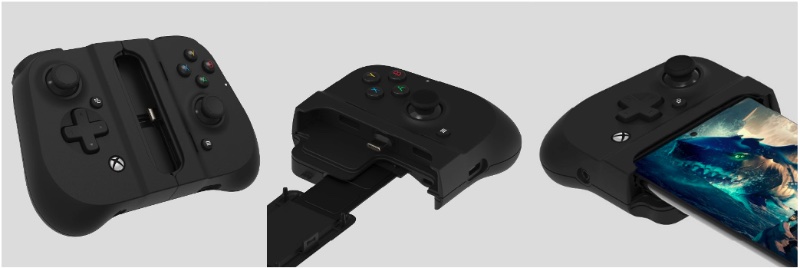
Gamevice, formerly known as Wikipad, Inc., is a tablet and smartphone accessory manufacturer known for its gaming-focused peripherals that afford the comfort of a familiar video game controller grip to mobile devices. The design of the peripherals allows for attachment to mobile devices, with adjustable width to fit devices with a variety of screen sizes. For reference, an example of the “GAMEVICE FLEX” (Gamevice’s most recent model) is shown below (the image at left is the peripheral in its closed state, the center image is one paddle of the peripheral in an open state, and the image at right is one paddle of the peripheral connected to an example mobile device):[1]
Procedural History
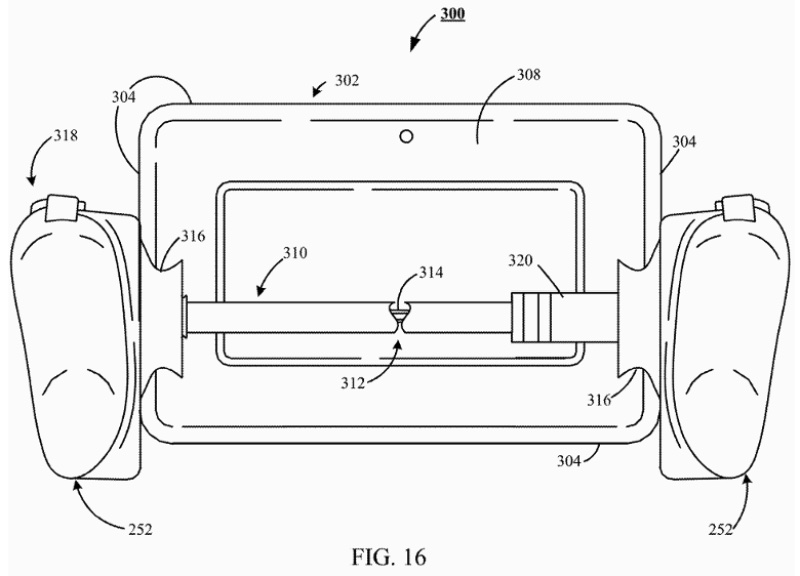
The ‘713 and ‘393 patents are part of a branching patent family and share the same title, “Game Controller with Structural Bridge.” The ‘713 patent issued on November 7, 2017, and the ‘393 patent issued on August 27, 2019. Both patents share substantially the same disclosure, including figures depicting an earlier model of the Gamevice peripherals. For example, Figure 16 of the ‘393 patent is shown below:
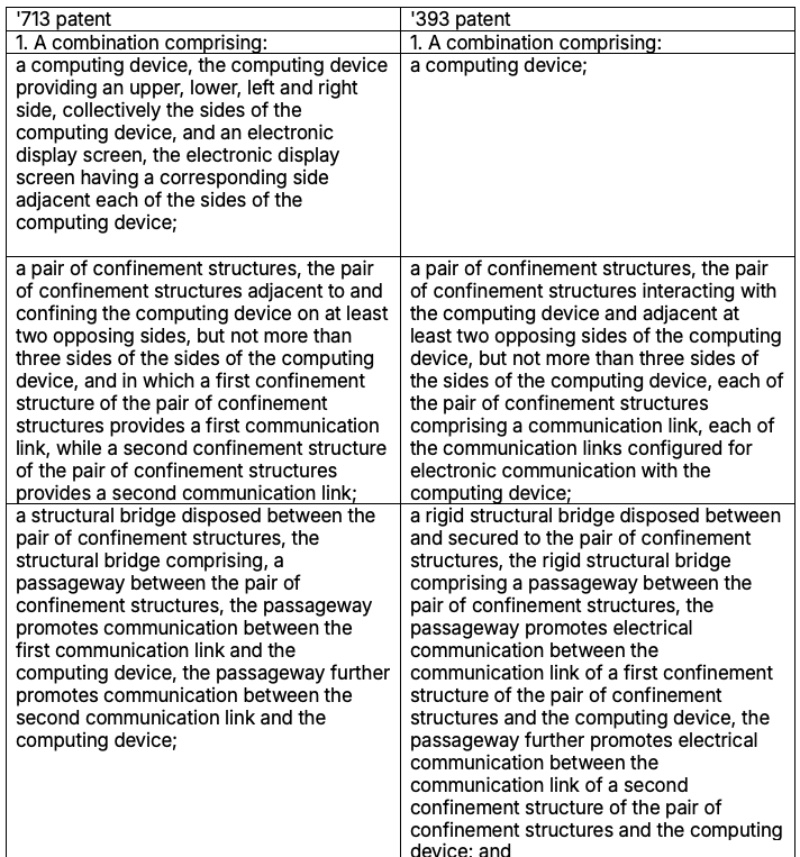
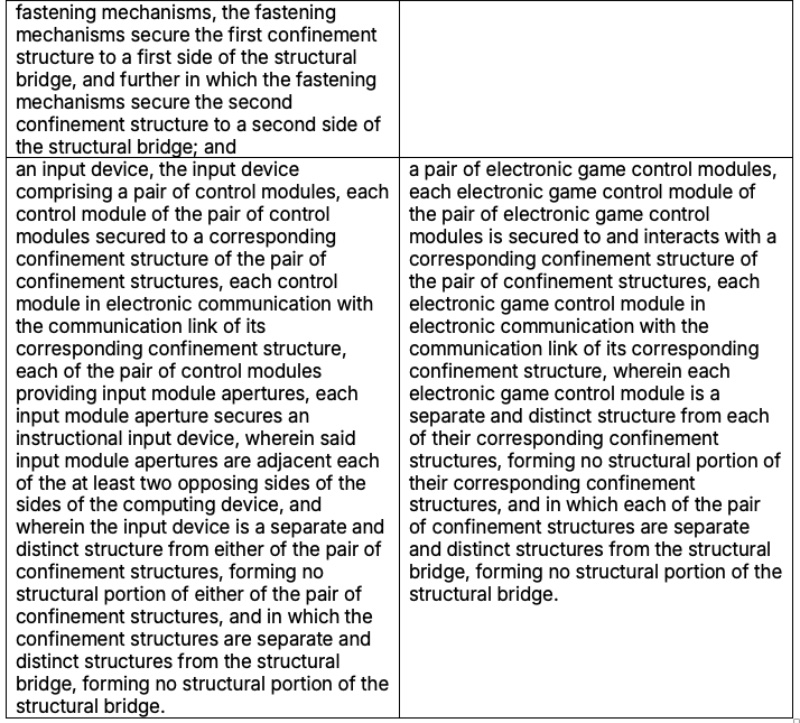
The independent claims of both patents are both drawn toward the device and its confinement structures (the part of the peripheral that secures the mobile device), the bridge connecting said confinement structures, and the input units (the game controllers). The claims specify that the confinement structures, the bridge, and the input units are all separable components that do not make up a “structural portion” of any of the other components. Thus, for example, the input units do not make up a “structural portion” of the confinement structures to which the input units are secured. Independent claim 1 of the ‘713 patent and independent claim 1 of the ‘393 patent are reproduced below, for reference:
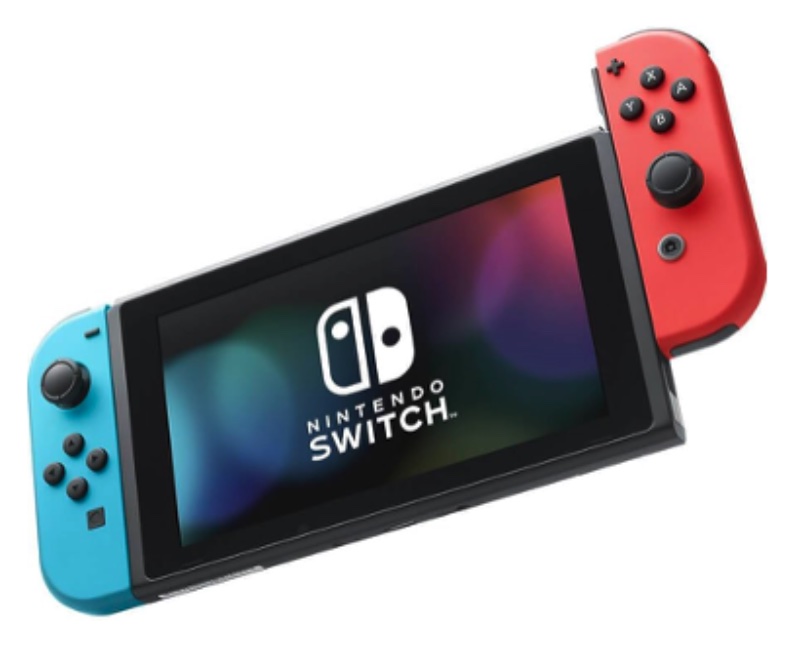
On March 29, 2018, plaintiff Gamevice filed suit in the Northern District of California against Nintendo and Nintendo of America (“Nintendo”) (a video game industry cornerstone, known for its storied history and wildly popular Intellectual Properties (IP) including Mario, Zelda, and Pokémon). The complaint alleged the infringement of the ‘713 and ‘498 patents, based on Nintendo’s then most recent video game console, the Nintendo Switch:
Simultaneous with the District Court filing, Gamevice also filed a complaint with the U.S. International Trade Commission (“ITC”) under 19 U.S.C. § 1337, which asserted similar patent infringement claims by Nintendo.
In Nintendo’s response to the District Court complaint, Nintendo motioned for a stay in proceedings pending the resolution of the ITC proceedings (which is mandatory under 28 U.S.C. § 1659 for claims involved in proceedings before the ITC under § 1337). All issues before the ITC (and appealed to the Federal Circuit based on the ITC results) were resolved by November 18, 2021, ultimately ending in a finding for Nintendo of non-infringement of all patents.
On March 1, 2022, following the resolution of the ITC case, Gamevice filed a motion to amend the complaint in District Court to incorporate claims of infringement of the ‘393 patent. The ‘393 patent was also litigated at the ITC to similar results, but the ITC proceeding did not begin until after the stay in proceedings for the District Court litigation had been granted, and thus the ‘393 patent could not have been added to the complaint prior to March 1, 2022.
As the District Court case resumed, Nintendo sought Rule 11 sanctions against Gamevice for “frivolous[ly]” trying to relitigate matters settled in the ITC.[2] Sanctions were not granted, though, as ITC decisions are not preclusive, and can be pursued in the district court, so long as Gamevice had a reasonable belief that the outcome might be different.
The Back-and-Forth Outcomes during District Court Litigation
The District Court litigation can be broken into three outcomes spread over the course of 2023. First, a motion for summary judgment filed by Nintendo was granted in part and denied in part on March 14, 2023. Second, Gamevice filed, and succeeded on, a motion for reconsideration on June 14, 2023. Third, a final motion for summary judgment, in favor of Nintendo, was granted on October 31, 2023. This final motion became the subject of appeal to the Federal Circuit, as discussed in detail below.
The First Summary Judgment Motion
The first summary judgment motion in District Court concluded that all claims of the Asserted Patents, except for claim 16 of the ‘713 patent, were invalid as anticipated by the Nintendo switch. The motion turned on whether or not the Nintendo Switch, first sold in the United States on March 3, 2017, actually constituted prior art to the ‘713, ‘393, and ‘498 patents. Gamevice argued that, while the patents were filed after the date of first sale of the Nintendo Switch, they were entitled to priority based on U.S. Patent No. 9,126,119 (the ‘119 patent), which was filed on February 2, 2015, and “provided written description support for the asserted claims.” Because the patent family of which the ‘713, ‘393, and ‘498 patents are a part contained multiple continuations-in-part, including continuations-in-part of the ‘119 patent, this issue was up for debate.
Whether the later patents were entitled to priority turned on rules of interpretation about whether or not a species disclosed in an earlier patent can support later claims (e.g., in a continuation application) of a genus. According to the District Court, this depends on “what the disclosure reasonably conveys to a person skilled in the art.” See Bilstad v. Wakalopulos, 386 F.3d 1116, 1124-25 (Fed. Cir. 2004). In a case applying this standard, Tronzo v. Biomet, the Federal Circuit found that because the specification disclosed only a specific range of shapes for the device claimed, it did not support later claims to a more general range of shapes.[3]
In this case, the term at issue was “computing device,” which was construed in a prior Markman order to mean “electronic equipment controlled by a CPU.” The ‘119 patent only provided support, in its claims and figures, for computing devices that had both a back and an attached screen (e.g., tablets, smart phones, etc.). Thus, according to the District Court, the broader aspects of the claims in the Asserted Patents were not entitled to the priority date of the ‘119 patent. While some dependent claims of the Asserted Patents did include the narrowed features relating to the species described in the ‘119 patent, the District Court nevertheless found that none of the claims were entitled to the ‘119 patent’s priority date (the only exception being independent claim 16 of the ‘713 patent, which mirrored independent claim 1, except that it excludes the reference to a computing device).
The Motion for Reconsideration
The grant of a motion for reconsideration is a rare event because, as noted by the District Court, it is “an extraordinary remedy, to be used sparingly in the interests of finality and conservation of judicial resources.” However, the astute reader may have noticed in the previous section that the District Court committed clear error that necessitated reconsideration.
As mentioned in the prior section, several dependent claims in the ‘713 and the ‘393 patents recite further limitations that narrow the term “computing device” in the independent claims to cover only computing devices with a back and a screen, which is what the District Court deemed to be supported by the ‘119 specification that predates the first sales of the Nintendo Switch. The District Court, though, held (improperly) that these claims were not entitled to the ‘119 priority date. However, as pointed out by Gamevice in its motion for reconsideration, this is an incorrect application of federal law. The Federal Circuit has long held that, “a finding of invalidity of an independent claim does not determine the validity of claims that depend from it.” Scanner Techs. Corp. v. ICOS Vision Sys. Corp. N.V., 528 F.3d 1365, 1383 (Fed. Cir. 2008).
The District Court conceded that it did not apply the correct standard and, upon reconsideration, found that claims 3, 4, 6, and 7 of the ‘713 patent and claim 6 of the ‘393 patent were entitled to the ‘119 priority date. Nintendo did attempt to challenge the interpretation of claims here, and how they should be understood in view of the term “computing device,” but the District Court found such arguments “unpersuasive and insincere.”[4]
The Second Motion for Summary Judgment
The Second Motion for Summary Judgment featured an interesting procedural question about how a court should treat a prior determination that an asserted claim is anticipated by the allegedly infringing product followed by a later determination that the asserted claim actually predates the allegedly infringing product. Should that prior determination be binding (i.e., should the original determination of anticipation be outcome determinative of infringement)?
On the original motion for summary judgment, the District Court held that the Asserted Patents were all anticipated by the Nintendo Switch. As a result, Gamevice argued, given that several of the claims that were initially deemed anticipated now had been determined to pre-date the Switch, that the Court must, either as a matter of Judicial Estoppel or the law of the case doctrine, hold that those claims are infringed by the Nintendo Switch. The argument by Gamevice hinged, in part, on the fact that Nintendo’s prior motion of summary judgment “pled infringement for the purposes of its summary judgment motion of invalidity.” The Court found the arguments presented by Gamevice unpersuasive. One reason for this is that the Court found that the cases relied upon by Gamevice did not clearly support Gamevice’s contentions. For example, in the District Court’s view, many of the cases provided by Gamevice involved courts treating the pleas during summary judgment stages as a sort of limited stipulation to expedite the courts analysis in order to focus on an invalidity defense (rather than a strict admission). The second reason is that the District Court, in effect, found that if Nintendo were bound by “conceding infringement” when pleading in the alternative (invalidity), it would make such pleadings overly burdensome on defendants (and, in our view, would chill the use of such expeditious pleadings going forward).
The rest of the District Court’s opinion on the second motion for summary judgment focused on whether there was a “genuine issue of material fact” as to whether the Switch infringed any of the remaining claims that were salvaged in the motion for reconsideration. This determination depended upon Gamevice’s ability to prove that the Nintendo Switch featured each limitation of the claims, namely the references to a “passageway,” “confinement structures,” and the “apertures” that “secure.” The District Court determined that, contrary to Gamevice’s contentions, there was no way to show that the Nintendo Switch control modules feature “confinement structures” or “apertures” that perform a “secur[ing]” function. On this basis, the District Court found that there was no genuine issue of material fact. Thus, since Gamevice could not show infringement without both of these limitations being proven to exist in the Nintendo Switch, Nintendo’s motion for summary judgement was granted and Nintendo prevailed at the District Court.
The Appeal
Gamevice appealed the decision by the District Court to the Federal Circuit, and the decision on the resulting appeal was reached on January 16, 2026. The decision primarily focused on whether or not the District Court erred in how it interpreted, and applied said interpretations, of “confinement structures” and “apertures” that “secure.” The appeal opinion focuses primarily on the latter interpretation, only mentioning the “confinement structures” in passing.
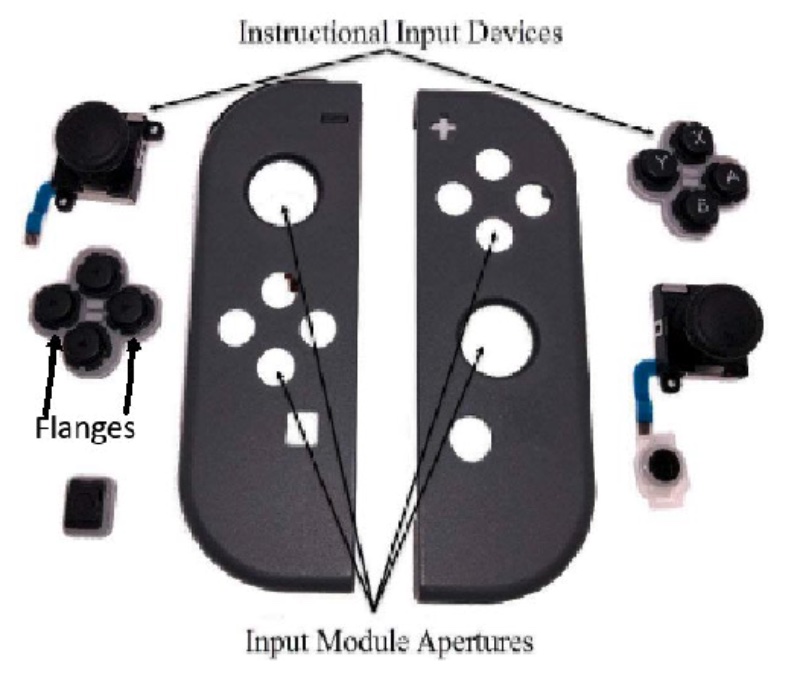
Gamevice’s arguments turned on what is required of an “aperture” that “secures” a button or a joystick in a control unit, and whether or not the “additional parts” of a Nintendo Switch controller (shown below) include such requirements.
Gamevice primarily argued to the Federal Circuit that: (1) the District Court’s determination that apertures (the “holes”) cannot, themselves, secure anything is in direct contradiction with Gamevice’s specification, and (2) the District Court improperly construed the term “secure” by not allowing for the use of additional components (such as flanges on buttons) to assist the “aperture” in the securing (e.g., as long as the hole was not so large that a button with a wider flange would slip out, then the button was being “secured” by the “aperture,” according to Gamevice).
The Federal Circuit did not agree with Gamevice’s contentions. First, the Federal Circuit determined that the District Court’s opinion, when read properly, identified that the Nintendo Switch’s alleged “apertures” did not secure anything (as the parties agreed that the buttons are held in by the flange at the bottom). Second, and crucially, the Federal Circuit also determined that Gamevice failed to previously request an interpretation of “secure” that allowed for something other than the hole itself[5] to be considered part of the “aperture” that “secures” and/or to identify any support in the specification that would allow for such an interpretation. Further issues are pointed out, such as Gamevice’s expert admitting that the Switch holes “merely ‘allow the buttons and joysticks to pass through and move within.’” Lastly, the Federal Circuit also pointed out that the Joysticks are secured to the housing by screws, which is yet further beyond the “aperture” doing the “secur[ing].” In our opinion, even if the Federal Circuit’s construction of an “aperture” that “secures” was broadened (in-line with Gamevice’s argument), the screws securing the Joysticks may have, by themselves, been enough for the Federal Circuit to reach the same conclusion (at least with respect to the Switch Joysticks).
Given the above analysis, the Federal Circuit affirmed the decision of the District Court. During oral argument, Nintendo was asked whether the appeal should focus solely on the “noninfringement issue,” as the alternative “invalidity” holding of the District Court was potentially inconsistent with the District Court’s noninfringement holding. Nintendo agreed (presumably in order to speed up the appeals process).
Takeaways
Some key takeaways for those regularly involved in patent practice:
(1) ITC decisions do not create estoppel so long as the losing party genuinely believes there may be a different result. The ITC does not have the same estoppel considerations as the PTAB, and, while the proceedings may move quickly, they may not necessarily help a victorious party in a District Court or PTAB proceeding.
(2) A prior finding of invalidity by anticipation does not support a finding of infringement, if the invalidity by anticipation was the result of a summary judgment pleading that conceded infringement. Parties who want to avoid diluting an argument or motion by having to argue non-infringement and then, in the alternative, invalidity may be able to focus on the invalidity issue and, for sake of argument, admit infringement without potentially risking being estopped from raising the non-infringement issue again later. The relevant cases include Evans Cooling Systems, Inc. v. General Motors Corp.,125 F.3d 1448 (Fed. Cir. 1997), and Gammino v. Southwestern Bell Tel., L.P., 512 F. Supp. 2d 626 (N.D. Tex. 2007).
(3) The specification and drawings are crucial for claim construction. A lot of what limited Gamevice both in the district court and on appeal came down to what was supported by the specification. It is not as though Gamevice tried to read a term like “computing system” to mean a system that did not exist at the time that Gamevice filed its application. In fact, the argument for what is covered by the term “computing system” was not, per se, incorrect. However, the examples provided in the specification, both in words and in images, painted a very particular picture of what was covered, which ultimately limited the number of claims and, thereby, the avenues of attack that could be brought against Nintendo. Between the limitations on an “aperture” that “secures” and on “computing device,” Gamevice couldn’t find a path forward.
This case illustrates the importance of having a wide variety of embodiments being covered by the specification.
Conclusion
A cursory review of the claims, specification, and figures in the Gamevice patents does paint a picture of what appears to be a reasonable shot at a showing of infringement. However, this litigation goes to show, no matter how strong a case looks on its face, it will ultimately be won on many little details.
[2]Gamevice, Inc. v. Nintendo Co., Order Denying Motions for Rule 11 Sanctions, 18-cv-01942-RS.
[3] In Tronzo, the case related to the cup shape for a Hip socket. In the earlier patent, the specification and language focused on “conical cups” while the later claimed only referred to “cups.” The Federal Circuit held that the genus was limited to conical cups.
[4]Gamevice, Inc. v. Nintendo, Co., 677 F.3d 1069, 1075 (N. D. Cal. 2023).
[5] Gamevice was pushing for the idea that the parts of the “housing unit” of the controller, that surround the hole, are part of the aperture that secures the button. The Federal Circuit did not agree, as the claim language and the specification was very specific about the hole, and only the hole, doing the securing.
The Hatch-Waxman Act has always represented a delicate balance between the interests of innovator and generic drugmakers: innovators seek to maintain exclusivity as broadly and long as possible, generics seek to come to market as soon as possible and leverage previous marketing by the innovators as much as possible. The strategies between the two involve a continual thrust and parry – most relevant here, generics can adopt so-called “skinny labels” by “carving out” patented uses of drugs, and innovators have then focused on the generic drugmakers’ marketing of those skinny-labeled drugs as “generic versions” of the branded drug (with a wink and a nod) and argued that the marketing pulls back in what the skinny label carves out. In Amarin Pharma, Inc. v. Hikma Pharmaceuticals USA Inc.,[1] the Federal Circuit decided that those types of allegations could potentially support a claim for inducement of infringement; the Supreme Court has now granted certiorari to decide the question for itself.[2]
The basis for the dispute begins with the language of the Hatch-Waxman Act. Concerned with the possibility that innovator drug companies could extend patent exclusivity by obtaining a series of patents on different uses of a drug, Congress codified the possibility of a generic drug being approved for less than all of the indications identified in the label of the reference-listed drug.[3] By carving out the patented uses of the listed drug and leaving only the unpatented uses (whether patent protection was never obtained or had expired for those uses), the generic drug can come to market with a “skinny label.” Congress intended that result, preventing innovator drug companies from making the label a game of whack-a-mole that would keep generic companies from bringing drugs to market for the treatment of conditions that are subject to no patent protection.
However, generic drug companies’ interaction with the public is not limited to the label alone. If it were, there would be no question that the generic companies do not actively induce infringement of the patented methods by marketing a skinny labeled drug. On the other hand, if the generic companies were to market the same drug for the patented treatment method, they would not only be potentially subject to punishment by the FDA (because marketing a drug for a use not on the approved label would generally be considered to be “adulteration”), they would also be actively inducing infringement of the patent. But the question arises when their conduct and public pronouncements fall somewhere in between: where is the line between fair marketing practices and inducing infringement?
This dispute arises out of Amarin’s Vascepa® (icosapent ethyl) drug, a omega-3 fatty acid purified from fish oil. In 2012, Amarin obtained FDA approval for use of Vascepa® for the treatment of severe hypertriglyceridemia (referred to as “SH” – triglyceride levels of over 500 mg/dL, more than three times the “normal” level), an indication for which it had obtained patent protection. Four years later, Hikma filed an ANDA seeking approval to market its generic version of the drug based on the original Vascepa® label with a “Paragraph IV”[4] certification that the patents covering the method of treating SH were invalid. Amarin sued Hikma; while that litigation was pending, Amarin obtained approval and patents on another indication relating to reducing cardiovascular (“CV”) disease risk.
Instead of changing its draft label to include the new CV indication, Hikma left its label essentially the same as the original SH-only label.[5] It prevailed in the litigation, proving the patents covering the method of treating SH were invalid as obvious, and launched its generic drug with the (now) skinny label limited to the SH indication. In launching its product, however, Hikma issued press releases that called its drug a “generic equivalent” of Vascepa®, touted the market size for Vascepa® – which was predominantly based on the CV indication – and referred on its website to the drug’s use as a treatment for “hypertriglyceridemia,” which was broader than the approved SH indication. Nowhere in Hikma’s promotional materials, however, did it say that the generic drug was approved for the CV indication.
Amarin sued Hikma again (this time post-launch), arguing that the press releases and website language was intended to, and did, actively induce doctors to prescribe Hikma’s generic drug for the patented treatment within the CV indication. Hikma moved to dismiss, arguing that Amarin failed to state a claim because nothing Hikma did in obtaining approval and marketing the skinny labeled generic drug would constitute active inducement of infringement. The U.S. District Court for the District of Delaware agreed, finding that the skinny label was itself not even arguably infringing and that Hikma’s marketing statements were – at best – evidence of intent to get doctors to prescribe the drug in an infringing manner, but uncombined with any instruction to use the drug to treat CV. As the District Court phrased it, Hikma’s conduct could not be considered anything more than describing the infringing use and “does not rise to the level of encouraging, recommending, or promoting taking Hikma’s generic for the reduction of CV risk.” Accordingly, the District Court granted Hikma’s motion to dismiss.
Amarin appealed the dismissal, and the Federal Circuit ultimately decided that Amarin’s allegations could potentially support a finding of active inducement to infringe and reversed. The Federal Circuit may have been motivated in part by the unusual posture of the case:[6] this was not an ANDA case based solely on the product label, or even a case based primarily on the indication in the product label – there really was no solid grounds for making such an argument. Instead, it was the public statements by Hikma in combination with (or even perhaps, despite) the product label that gave rise to Amarin’s claim. Because there was also very little dispute that the allegations of underlying direct infringement by doctors and Hikma’s intent to have doctors infringe were sufficient, the decision turned on the question of whether Hikma’s alleged statements and marketing actions could plausibly be considered “actively” inducing doctors in service of that intent.
The Federal Circuit found that the allegations of Amarin’s complaint provided enough plausibility to support a claim for active inducement of infringement. First, other portions of the label (which Hikma was not empowered to alter when filing an ANDA) reported data on both SH and CV populations. Second, Hikma altered the original SH-only label by removing the CV Limitation on Use and adding warnings of potential cardiovascular side effects from the newer label; those warnings would be relevant only if the drug were prescribed for the CV indication. Even so, the Federal Circuit found those portions of the product label alone would not support a claim for active inducement of infringement – merely not discouraging infringement is not the same as actively inducing it. Rather, it was only when the product label was viewed in combination with Hikma’s public statements that the package could be read as potentially providing the basis for a claim of active inducement of infringement. The panel believed it could not resolve the questions of fact underlying the interpretation of the public statements and their relation to the product label on a motion to dismiss. Thus, while it recognized that Amarin’s claim might fail on a motion for summary judgment, it reversed the District Court’s decision and remanded for further proceedings.
Hikma petitioned for certiorari, noting that some commentators viewed the case as a fundamental shift in the ground between branded drugs and generics versions thereof and a potentially chilling message to generic companies. It argued that the Federal Circuit’s decision was not only wrong on the application of the pleading standards, but also that its approach conflicted with the Ninth Circuit’s interpretation of the pleading requirements for active inducement of infringement (as applied in the copyright context) and that it completely undermined the Hatch-Waxman Act’s skinny labeling option. It argued that the decision would severely harm the generic drug market, raising drug prices and creating great uncertainty as to when generic drugs could launch. Amarin opposed the petition, arguing that the case was tied tightly to very specific facts, that the Federal Circuit correctly applied the pleading standards (and in a manner that did not conflict with any other circuit’s application of the law), and that Hikma’s claims of harm to the market were overblown. As Amarin put it:
Petitioners act like they were hit with a judgment, but this case is just beginning. Infringement and any defenses to it are not yet decided, nor are any remedies. What petitioners really want is a safe-harbor from having to litigate at all—a sort of qualified immunity for generic pharmaceuticals that has no basis in statute or case law.
In its reply, Hikma pointed out that it was not the only one who foresaw the sky falling due to the decision here; in the certiorari process in an earlier, similar case,[7] the then-Solicitor General had asserted that even “the potential for inducement liability in these circumstances may significantly deter use of the section viii pathway even if such liability is rarely imposed.” The Supreme Court then solicited the current Solicitor General’s views on the case, and he placed his thumb squarely on the scale against the Federal Circuit and for review (and reversal) by the Supreme Court. As he argued:
The decision below subverts Congress’s balance between competing interests by subjecting Hikma to a substantial threat of infringement liability for statements that either (a) are integral to the section viii pathway or (b) have no meaningful likelihood of increasing the prevalence of infringing off-label uses. The contents of Hikma’s “skinny label” are largely dictated by the Hatch-Waxman Amendments, and Hikma’s description of its drug as the “generic equivalent” of Vascepa is central to the Hatch-Waxman scheme. And while the Federal Circuit identified a handful of other statements to investors that accurately described the generic drug and its brand-name counterpart, the complaint in this case did not describe any plausible sequence of events by which those statements could have led a healthcare professional to engage in direct infringement.
The Supreme Court then granted certiorari review.
Given the facts and posture of the Hikma case, it is likely that the Supreme Court will reverse the Federal Circuit’s decision. But in doing so, it is unlikely that it will pronounce the lower court decision “merely wrong” – such cases are rarely considered by the Court – but more likely will involve establishment of a clearer boundary between what is fair to include in a skinny label and marketing information and what might give rise to an infringement claim. That makes this situation especially rare, as it is usually the case that the Federal Circuit creates bright-line tests and the Supreme Court strikes them down in favor of a “totality of the circumstances” approach. But here, where generic drug companies are tied to the language of the product label and the ubiquitous description of a “generic equivalent” of a reference label drug, it seems more important that the Court remove the chill that could be placed on the generic drug market by a vague pleading standard. As a result, it is likely to find that a skinny label that does not mention a patented use will be judged to fall within a safe harbor from liability.
[3] 21 U.S.C. § 355(j)(2)(A)(viii) provides that a generic drug company can submit an Abbreviated Drug Application and “if with respect to the listed drug referred to in clause (i) information was filed under subsection (b) or (c) for a method of use patent which does not claim a use for which the applicant is seeking approval under this subsection, [the ANDA can include] a statement that the method of use patent does not claim such a use.”
[5] One difference proved important to the Federal Circuit: the original Vascepa® label excluded the CV indication in the form of a CV Limitation on Use. Hikma’s label did not include the CV Limitation on Use. Hikma’s label also included warnings of potential cardiovascular side effects which were not included in the original Vascepa® label.
[6] The appellate panel itself was a bit unusual, as it included U.S. District Court Judge Alan Albright of the Western District of Texas, sitting by designation. Judge Albright is one of the most prolific patent judges, and one of the ones most sought by patentees.
[7]Glaxo-SmithKline LLC v. Teva Pharms. USA, Inc., 7 F.4th 1320 (Fed. Cir. 2021).
Today, the Court granted Hikma’s certiorari petition, which recited the following Questions Presented:
1. When a generic drug label fully carves out a patented use, are allegations that the generic drugmaker calls its product a “generic version” and cites public information about the branded drug (e.g., sales) enough to plead induced infringement of the patented use?
2. Does a complaint state a claim for induced infringement of a patented method if it does not allege any instruction or other statement by the defendant that encourages, or even mentions, the patented use?
This case follows patterns found before in instances where the Court has granted cert: the Federal Circuit has rendered decisions with competing stances taken by members of the Court and the decision has “real world” implications on important societal matters (i.e., it isn’t just a patent dispute between the parties but will influence important policy outcomes; here, regarding the availability of generic drugs).
The Court’s Order does not specify which flavor of these Questions they have deigned to consider, and how Hikma crafts the questions it actually argues will be seen in coming months. However, the universal sentiment on both sides of the aisle are that drugs cost too much, and to the extent this sentiment resonated with the Justices (and whether such resonance with common sentiment is, as in other instances, a factor in their decision to hear the case) will also become evident in time. In this way, this certiorari decision is reminiscent of the Court’s grant in Association of Molecular Pathology v. Myriad without the predictably fraught outcomes arising therefrom. After all, what could be bad about lower drug costs (other than reducing the availability of innovator drugs to be copied by generic drugmakers)? We shall see.
The China National Intellectual Property Administration (CNIPA) has instituted a change in its inventor information requirements. For Chinese patent applications filed on or after January 1, 2026, Applicants must submit an inventor ID number for every inventor along with each inventor’s nationality. The nationality of each Inventor mustbe submitted at the time an application is filed. For inventors holding dual nationality, the Applicant must choose one nationality for submission to CNIPA.
The inventor ID number can be submitted at the time of filing or within two months from the date of a CNIPA notification requesting the inventor ID number. For Chinese inventors, the ID number is their National ID number (i.e., an 18-digit Citizen Identity Number issued by the Chinese government). For non-Chinese inventors, a passport number or any other government-issued valid identifying number, such as a driver’s license number, is acceptable.
Patent Docs thanks Chinese intellectual property firm AFD China for alerting us to the new inventor ID requirement.
The preclusive scope of 35 U.S.C. § 314(d) regarding decisions on instituting post grant review proceedings (specifically, inter partes review or IPR) has been decided several times by the Supreme Court since enactment of the Leahy-Smith America Invents Act in 2013 to be very preclusive (seeCuozzo Speed Technologies, LLC v. Lee, 579 U. S. 261 (2016); Thryv, Inc. v. Click-to-Call Techs., LP, 590 U.S. 45 (2020)). Indeed, the only exception to the statutory mandate that institution cannot be subject to judicial review are in circumstances where there may be “appeals that implicate constitutional questions.” Nevertheless the temptation to seek judicial review (and reversal) of institution decisions by the Patent Trial and Appeal Board (PTAB) has persisted (albeit unsuccessfully) as shown in the Federal Circuit’s decision last month in Ethanol Boosting Systems, LLC v. Ford Motor Co.
This case arose in inter partes review proceedings of certain claims in three related patents owned by Ethanol Boosting Systems (EBS): U.S. Patent Nos. 10,619,580; 10,791,760; and 9,708,965, all held to be invalid for obviousness by the PTAB. Claim 1 of the ‘581 patent is cited in the opinion as representative:
1. A fuel management system for a spark ignition engine, comprising: a first fueling system that uses direct injection; a second fueling system that uses port fuel injection; and a three-way catalyst configured to reduce emissions from the spark ignition engine, wherein the fuel management system is configured to provide fueling in a first torque range, the first torque range being a first range of torque values at which both the first fueling system and the second fueling system are operable throughout the first range of torque values, wherein the fuel management system is further configured such that a fraction of fueling provided by the first fueling system is higher at a highest value of torque in the first torque range than in a lowest value of torque in the first torque range, wherein the fuel management system is further configured to provide fueling in a second torque range, the second torque range being a second range of torque values at which the second fueling system is operable throughout the second range of torque values and the first fueling system is not operable throughout the second range of torque values, wherein the fuel management system is further configured such that when the system provides fueling at a torque value that exceeds the second range of torque values, the spark ignition engine is operated in the first torque range, and wherein the spark ignition engine is configured to operate at a stoichiometric air/fuel ratio in at least part of the first torque range and in at least part of the second torque range.
As noted in the opinion, the case between the parties has been before the Court before, wherein a claim construction decision by a district court was vacated (and the details including the timing of those proceedings are relevant to the decision here; seeEthanol Boosting Sys., LLC v. Ford Motor Co., No. 21-1949, 2022 WL 2798395 (Fed. Cir. July 18, 2022) (nonprecedential)). In that case, at issue were claim limitations for embodiments comprising direct fuel injection mechanisms, specifically the words “fuel” in the phrase “directly inject[ed] fuel” and “fueling system that uses direct injection”; these terms were generically called “DI Fuel terms” in the opinion. Before the District Court, EBS asserted construction of these terms under the “plain and ordinary” meaning rubric, whereas Ford argued that the term encompassed fuel that was different from what was used in an alternative, port injection system and contained an antiknock agent other than gasoline itself. When Ford filed its petitions for instituting the IPRs, it argued that the DI Fuel terms be construed under the plain and ordinary meaning; the Board stayed its institution decision while awaiting the District Court’s claim construction.
The District Court handed down its claim construction decision before the PTAB instituted these IPRs, construing the DI Fuel terms (as Ford argued) to mean “(1) different fuel for direct injection and port injection and (2) an anti-knock agent other than gasoline.” Pursuant to the parties’ stipulation, the District Court entered judgment of non-infringement based on this construction. Several months later the PTAB denied institution of the IPRs, holding that the DI Fuel terms required different fuel than was used in the port injector as claimed. This construction defeated Ford’s prior art-based invalidity arguments in its petitions. This construction apparently did not take into account the District Court’s construction nor the EBS appeal to the Federal Circuit, because shortly after the Court vacated the District Court’s construction, the PTAB granted Ford’s petitions to institute based on that decision’s claim construction.
In the earlier opinion, the Federal Circuit had vacated the distinction drawn by the District Court between the fuel used in the direct injection and the port injection embodiments of the claimed fuel management system, finding no basis for requiring such differences. Moreover, the Court considered the disclosure in the specification of fuel comprising 100% ethanol to be excluded from claims construed to require differing fuels in the two alternative embodiments. The opinion notes that EBS only appealed the first portion of the District Court’s construction, i.e., that there was different fuel used for direct injection and port injection, thereby leaving unchallenged the second portion, that gasoline cannot provide the antiknock component of directly injected fuel. Accordingly, the Federal Circuit did not consider in that opinion this second portion of the District Court’s claim construction.
Having instituted the IPRs, the PTAB construed the DI Fuel terms according to their plain and ordinary meaning and rejected EBS’s argument that gasoline cannot be the [sole] antiknock agent because the Court’s earlier construction was “controlling law,” on the grounds that the Court had not considered the second portion of the definition of the DI Fuel term. Having come to these claim construction determinations, the PTAB recognized there was a motivation to combine the asserted prior art references and that the combinations disclosed the claim limitations in dispute. On those grounds the Board issued a Final Written Opinion invalidating all challenged claims as being obvious, and this appeal followed.
The Federal Circuit affirmed in an opinion by Judge Chen joined by Judges Clevenger and Hughes. The first of three arguments made to the Court by EBS was that the Board had exceeded its authority (acted ultra vires) by staying its institution decision while awaiting the District Court’s claim construction. The panel considered this argument as a request for the Court to effectively “de-institute” the IPRs, and that this request was in direct conflict with 35 U.S.C. § 314(d), which precludes courts from reviewing IPR institution determinations. The opinion supports this interpretation and its consequences by citing Thryv, Inc v. Click-To-Call Techs., LP, 590 U.S. 45, 52–53 (2020); IGT v. Zynga Inc., 144 F.4th 1357, 1365 (Fed. Cir. 2025); and ESIP Series 2, LLC v. Puzhen Life USA, LLC, 958 F.3d 1378, 1386 (Fed. Cir. 2020). EBS crafted its challenge less specifically against institution, directing that challenge to the question of whether the Board was entitled to stay its institution decision (i.e., thereby not directly targeting the institution per se). The opinion rejects this characterization of there having been a stay, which is not how the Court has previously considered the time taken by an agency to issue a reconsideration decision, citing CyWee Grp. Ltd. v. Google LLC, 59 F.4th 1263, 1267 (Fed. Cir. 2023). At least one basis for this position is that there is no law or regulation cited by EBS nor known to the Court that requires a definite amount of time for a reconsideration request to be deliberated. Even though EBS’s argument was focused on the propriety of the “stay,” the panel considered the argument to be a challenge of the propriety of the PTAB’s institution decision, barred under § 314(d). And the Court found such grounds for challenge to have been distinguished and rejected by prior precedent, including Thryv, IGT, and ESIP Series 2. The Court also rejected the “special dispatch” requirements enunciated in Ethicon, Inc. v. Quigg, 849 F.2d 1422 (Fed. Cir. 1988), based on procedural (that case involved reexamination proceedings) and factual (the IPR in this case had not been instituted) differences. The Court recognized that the Supreme Court has only held “narrow exceptions” to the statutory bar under § 314(d), including “‘appeals that implicate constitutional questions, that depend on other less closely related statutes, or . . . present other questions of interpretation that reach, in terms of scope and impact, well beyond’ § 314,” citing Cuozzo Speed Techs. v. Com. for Intell. Prop., 579 U.S. 261, 275 (2016). EBS analogized the Board’s delaying its institution decision to “shenanigans” identified as being outside the reach of the § 314 preclusion, which the panel rejected under Cuozzo in view of their earlier decision in SIPCO, LLC v. Emerson Electric Co. (which concerned the Board exceeding its authority to institute a Covered Business Method (CBM) review on a purportedly non-CBM patent (980 F.3d 865, 869 (Fed. Cir. 2020)). This decision was directly applicable to EBS’s argument here, according to the opinion because in that case as here the argument was that the Board exceeded its statutory authority, which the Court held was not outside the § 314 preclusion. In addition, the Court found that the Board had “sound reasons” for delaying its institution decision because the Court’s earlier decision “would address the very claim term that the Board hinged its initial denial of institution upon.”
(In this context, the recent proclamations by incoming U.S. PTO Director John Squires may take on more significance (see “New Director Overturns PTAB Procedural Precedents: Parts I and II“). Under the recently promulgated interpretation of the statute, Congress has conferred decisions regarding IPR institution exclusively to the Director. While Directors can delegate (and have delegated) institution decisions to the PTAB and three- or five-judge panels thereof, such delegation is discretionary with the Director. In view of Cuozzo, Thryv, and this decision, current practice will now give the Director unfettered authority to render such decisions, with consequences that may (and likely will) have IPR institution occur at the whim of the policy (and political) whims of particular Directors. Under current jurisprudence, only modification of the statute by Congress can prevent such an outcome; the likelihood thereof will undoubtedly depend on how prudently Directors exercise such plenary powers.)
EBS’s second grounds for appeal were directed at the Board’s claim construction regarding the “fuel” term. In those arguments EBS maintained that the Board was compelled to adopt the portion of the unchallenged portion of the District Court’s construction (regarding the antiknock properties of the DI fuel), that the Board did not perform its own “substantive analysis” of its construction, and additional arguments directly on the merits. Regarding the unchallenged and previously unconsidered (by the Federal Circuit) second portion of the DI fuel term, EBS relied on the Court’s mandate and waiver doctrines to argue that the Board was limited by the Court’s earlier decision as “controlling law.” However, the panel rejected this argument on the basis that these doctrines did not apply “across different litigations and proceedings” and in particular “for a non-appealed district court construction” (emphasis in opinion), citing Musacchio v. United States, 577 U.S. 237, 244–45 (2016), Hyatt v. Stewart, 148 F.4th 1376, 1382 (Fed. Cir. 2025), and TecSec, Inc. v. Int’l Bus. Machs. Corp., 731 F.3d 1336, 1344 (Fed. Cir. 2013), as relating (“closely related,” according to the opinion) to the “law of the case” doctrine. The opinion did not deign to address EBS’s judicial estoppel argument which it had “briefly allude[d to]” and for failure to identify any unfair advantage to Ford as well as having been forfeited thereby.
With regard to EBS’s argument that the Board failed to “engage in any meaningful claim construction analysis” or “fail[ed] to adequately explain why it substantively reached a different outcome than the non-appealed portion of the district court’s construction,” thereby violating the provisions of 37 C.F.R. § 42.100, the panel identified these arguments to involve “unraised issues” which the opinion asserts the Court did not typically find fault in instances where the Board did not consider them, for example under Apple Inc. v. Gesture Tech. Partners, LLC, 127 F.4th 364, 370 n.2 (Fed. Cir. 2025). The Court found no evidence that EBS had asked the Board to construe the DI fuel terms (and strongly stated that in the panel’s view EBS had asked the Board to “expressly forego any construction of its own” in favor of the non-appealed portion of the construction by the district court (emphasis in opinion), which it had characterized as “controlling law” (see above). (Indeed, neither party had made a claim construction request to the Board, according to the opinion). The Board thus did not abuse its discretion according to the panel.
Turning to the substance of claim construction of the term “DI fuel,” the Court first held that EBS had forfeited the issue by its already-noted failure to request that the Board construe the claims. Further, “on the merits,” the opinion states that there is no evidence on the record that the DI fuel term disavows the use of gasoline as an antiknock agent, citing examples of embodiments where gasoline can be so used when other antiknock agents, such as ethanol, have been exhausted. The opinion also rejects any arguments that such embodiments have been disclaimed, and cites instances in the earlier appeal where EBS “explained” that the specification disclosed embodiments where gasoline was an acceptable antiknock agent.
Regarding the Board’s obviousness determinations, the opinion identifies two prior art combinations that are relevant to the appeal: 1. U.S. Patent No. 6,505,603 (Schray) and Japanese Patent Application Publication No. JP2003013785 (Miura); or
2. German Patent Application No. DE19853799, Japanese Patent Application Publication No. JPH10252512 and Bosch Auto. Handbook (3d ed.).
According to the assessment presented in the opinion, in the references cited in Ford’s first obviousness challenge the ‘603 patent discloses “an internal combustion engine to reduce engine knocking” comprising “directly injecting the fuel twice during each cycle, with the first occurring in the induction phase and the second occurring in the compression phase.” The ‘785 Japanese patent application discloses suppressing engine knocking using a port injector. In Ford’s second challenge for obviousness, German patent application ‘799 teaches a “method for creating fuel mixtures in an internal combustion engine” and “drawing a greater percentage of the fuel from the direct injector at greater loads.” The ‘512 Japanese patent application teaches “an engine that contains both a port injector as well as a direct injector” and a “fuel map” wherein is disclosed “which of those two injectors operate (as a function of torque).” The Bosch reference is a “general-purpose automotive handbook.”
The panel rejected EBS’s contention that the Board erred in its motivation-to-combine determination regarding the first combination, homogeneity and heterogeneity of fuel/air mixing, the Court maintaining that Ford’s arguments did not rely on any such distinctions. The Board had agreed with Ford’s actual arguments according to the opinion, that “a skilled artisan would swap Schray’s first injector with Miura’s port injector because Miura’s port injector would ‘provide the engine of Schray with additional benefits related to mixing and stable combustion at low loads.’” Moreover the panel did not consider EBS to have challenged that argument in this appeal. Additionally, the panel appreciated the Board’s rationale regarding motivation to combine that these two references provided different approaches to solving the engine knocking problem and that a skilled worker would be motivated to combine them. Accordingly, the panel held that there was substantial evidence supporting the Board’s determination that there was sufficient motivation to combine in reaching its obviousness determination.
The Court also rejected EBS’s challenges to particular claim limitations in ground 1 of the IPR, which asserted the first combination of references, on the grounds that the Board had “strayed from” the unpatentability theories asserted in Ford’s petitions regarding the “three way catalyst” limitation. The panel disagreed with EBS on the grounds that the Board would properly consider the “proposed combination” of the references (emphasis in opinion) in reaching the obviousness determination that was the basis for ground 1 in its petition.
The panel also rejected EBS’s arguments regarding Ford’s second ground, under the second combination of references, because “[u]nder the circumstances here, where the Board also provided a full explanation for why it rejected EBS’s multiple counter-arguments, the Board’s reasoning is readily discernible, and therefore, it satisfied its obligation to adequately explain its motivation finding.”
Finally, the Court rejected EBS’s arguments regarding the Board’s rejection of rebuttal arguments they had made, because “on this record, the Board found that Ford satisfied its burden” to assert adequate invalidity grounds for obviousness.
The D.C. Circuit Court today denied Judge Pauline Newman’s request for rehearing en banc of the panel decision handed down by the Court on August 22, 2025 (see “Judge Newman’s Challenge Fails at D.C. Circuit“). That decision affirmed the D.C. District Court’s dismissal of Judge Newman’s complaint against the Judicial Council over the Federal Circuit’s continuing suspension under the Judicial Conduct and Disability Act of 1980. The Judge’s en banc petition was aimed at McBryde v. Committee to Review Circuit Council Conduct & Disability Orders of the Judicial Conference of the United States, 264 F.3d 52 (D.C. Cir. 2001), wherein the panel held that “Congress precluded our jurisdiction over statutory and as-applied constitutional challenges to judicial council orders.” It was provoked in no small measure by what the Judge (and others) considered the panel’s “implicit invitation” for the en banc Court to overrule or at least cabin McBryde, being literally littered with quotes, citations, and dicta from the D.C. Circuit’s opinion suggesting this course of action.
Despite these circumstances, the D.C. Circuit Court rejected the petition in a per curiam opinion (see below) with no further explanation.
The Judge’s forthright challenge to what her briefing has characterized as the constitutional questions regarding separation of powers for removing Article III judges raised by the actions of the Judicial Council suggests a likelihood of a certiorari petition in the New Year.
In an email Patent Alert that was distributed this afternoon, the U.S. Patent and Trademark Office announced that it has issued the one millionth electronic patent grant (eGrant), which the Office stated “mark[ed] a major milestone in the agency’s modernization of the patent grant process.” The Office highlighted the benefits of eGrants, which include:
• Faster protection: Inventors receive enforceable patent rights sooner, providing greater certainty to invest, grow, and compete. • Operational efficiency: The transition to eGrants streamlined publication times, getting groundbreaking technologies to the marketplace sooner. • A modern USPTO: The eGrant reinforces the USPTO’s role as a forward-thinking, digital-first IP office committed to secure, high-quality digital services. • Benefit to applicants and practitioners: The eGrant program also provides applicants with enhanced security, simplified digital records management, and global compatibility across IP systems. These improvements allow inventors and attorneys to access, share, and act on granted patents immediately, supporting faster enforcement, licensing, and commercialization.