• District Court Decision Impacts PTA Determinations

    By Donald Zuhn

    District Cort for the District of Columbia Seal
    On September 30th, the District Court for the District of
    Columbia granted summary judgment in favor of Wyeth, determining that the U.S.
    Patent and Trademark Office had misconstrued 35 U.S.C. § 154(b)(2)(A), and as a
    result, had denied Wyeth a portion of patent term to which it was entitled
    under U.S. Patent Law (see Memorandum Opinion and Order).  The case,
    which was decided by Judge James Robertson, should be of interest to patent
    practitioners, patentees, and assignees for at least two reasons.  First, Judge Robertson's decision
    impacts the manner in which Patent Term Adjustment (PTA) is calculated, and
    thus, potentially affects the patent terms of numerous patents.  Second, Judge Robertson's opinion
    includes an interesting analysis of the type of deference the USPTO is owed for
    its interpretations of provisions of Title 35.

    At issue in Wyeth was the interplay between two of the
    patent term guarantee provisions of § 154(b)(1).  According to the Court, these provisions provide "a
    one-day extension of patent term for every day that issuance of a patent is
    delayed by a failure of the PTO to comply with various enumerated statutory
    deadlines:  fourteen months for a
    first office action; four months to respond to a reply; four months to issue a
    patent after the fee is paid; and the like" (see § 154(b)(1)(A)) and
    "a one-day term extension . . . for every day greater than three years
    after the filing date that it takes for the patent to issue, regardless of
    whether the delay is the fault of the PTO" (see § 154(b)(1)(B)).  The Court labeled the periods of delay
    encompassed by § 154(b)(1)(A) as "A delays" or "A periods,"
    and the "[t]he period that begins after the three-year window has closed .
    . . as the 'B delay' or the 'B period.'"  The above delays are subject to the limitations of §
    154(b)(2)(A), which states that:

    To the extent that periods of delay attributable to
    grounds specified in paragraph (1) overlap, the period of any adjustment
    granted under this subsection shall not exceed the actual number of days the
    issuance of the patent was delayed.

    The Court described the above provision as being
    "manifestly intended to prevent double-counting of periods of delay,"
    explaining that "[p]roper interpretation of this proscription against
    windfall extensions requires an assessment of what it means for 'periods of
    delay' to 'overlap.'"  In a
    Federal register Notice entitled "Explanation of 37 CFR 1.703(f) and of
    the United States Patent and Trademark Office Interpretation of 35 U.S.C.
    154(b)(2)(A)" (69 Fed. Reg. 34238), the Office
    states that:

    If an application is entitled to an adjustment under 35
    U.S.C. 154(b)(1)(B), the entire period during which the application was pending
    before the Office (except for periods excluded under 35 U.S.C.
    154(b)(1)(B)(i)-(iii)), and not just the period beginning three years after the
    actual filing date of the application, is the period of delay under 35 U.S.C.
    154(b)(1)(B) in determining whether periods of delay overlap under 35 U.S.C.
    154(b)(2)(A).

    USPTO Seal
    Summarizing the USPTO's take on § 154(b)(2)(A), the Court
    states that "the PTO's view is that any administrative delay under §
    154(b)(1)(A) overlaps any 3-year maximum pendency delay under §
    154(b)(1)(B):  the applicant gets
    credit for 'A delay' or for 'B delay,' whichever is larger, but never A +
    B."  Wyeth, however, argued
    that the "A period" and "B period" overlap only if they
    occur on the same calendar day or days. 
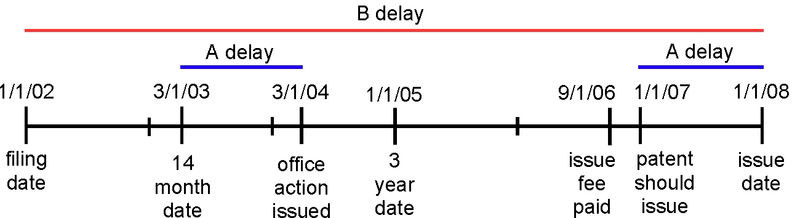
    The parties' different perspectives on an exemplary PTA calculation
    can be represented schematically as follows (using the example presented in
    Judge Robertson's opinion):
    USPTO

    The USPTO's view (shown above):  the patentee is entitled to three years of PTA.

    Wyeth

    Wyeth's view (shown above):  the patentee is entitled to four years of PTA.

    Wyeth
    The Court determined that Wyeth's construction of §
    154(b)(2)(B) was correct, stating that "[t]he only way that [A and B]
    periods of time can 'overlap' is if they occur on the same day."  Thus, in the example shown above,
    Wyeth's calculation is the correct one. 
    According to the Court, "[t]he problem with the PTO's construction
    is that it considers the application delayed under § 154(b)(1)(B) during the
    period before it has been delayed" (original emphasis).

    Judge Robertson acknowledged the reasonableness of the
    Office's argument that "'A delays' during the first three years of an
    applications' pendency inevitably lead to 'B delays' in later years," and
    thus "if plaintiffs' construction is adopted, one cause of delay will be
    counted twice:  once because the
    PTO has failed to meet and administrative deadline, and again because that
    failure has pushed back the entire processing of the application into the 'B
    period.'"  However, the Court
    concluded that while the Patent Office's efforts to prevent "windfall
    extensions" may be reasonable, and were maybe even consistent with Congress'
    intent, the Office's interpretation "must square with Congress's
    words.  If the outcome commanded by
    that text is an unintended result, the problem is for Congress to remedy, not
    the agency."

    In view of the pending appeal in Tafas v. Dudas (see "PTO Files Reply Brief in Tafas v. Dudas Appeal"), the
    opinion in Wyeth is also intriguing for what it says about the deference owed
    the Patent Office for its interpretations of provisions of Title 35.  The Court first determined that the
    Office's interpretation was not entitled to deference under Chevron U.S.A., Inc. v. Natural Resources Defense Council, Inc.,
    467 U.S. 837 (1984).  Citing Merck
    & Co. v. Kessler
    , 80 F.3d 1543 (Fed. Cir. 1996), the Court noted that
    "the Federal Circuit has held that the PTO is not afforded Chevron
    deference because it does not have the authority to issue substantive rules,
    only procedural regulations regarding the conduct of proceedings before the
    agency."  Moreover, the Court
    found that under 35 U.S.C. § 154(b)(3)(A), "the authority of the PTO is
    limited to prescribing 'regulations establishing procedures for the application
    for and determination of patent term adjustments under this subsection'"
    (emphasis added by District Court). 
    Comparing the rulemaking authority set forth by this provision with the
    rulemaking authority set forth in § 154(b)(2)(C)(iii), the Court concluded that
    it was "clear that the PTO's authority to interpret the overlap provision
    is quite limited," and therefore, that "Chevron deference does not
    apply to the interpretation at issue here."  The Court further explained, however, that even if the
    Office was entitled to Chevron deference with respect to its interpretation of
    § 154(b)(2)(B), such deference "would not save the PTO's interpretation .
    . . because it cannot be reconciled with the plain text of the statute"
    (as discussed above).

    While the Wyeth decision impacts the manner in which
    patent practitioners, patentees, and assignees will calculate PTA for patents
    that will soon be issuing, Wyeth also impacts the proper PTA for patents that
    have already issued — up to a point. 
    That "point" is specified in 37 C.F.R. § 1.705(d), which
    states that:

    If the patent indicates or should have indicated a
    revised patent term adjustment, request for reconsideration of the patent term
    adjustment indicated in the patent must be filed within two months of the date
    the patent issued
    and must comply with the requirements of paragraphs (b)(1)
    and (b)(2) of this section.  Any
    request for reconsideration under this section that raises issues that were
    raised, or could have been raised, in an application for patent term adjustment
    under paragraph (b) of this section shall be dismissed as untimely as to those
    issues.

    (Emphasis added.) 
    Thus, if a patent is entitled to more PTA under Wyeth, but that patent
    issued on or before August 12, 2008 (the selection of a cut-off date is based
    on the fact that patents issue on Tuesdays), § 1.705(d) would preclude a
    patentee from requesting reconsideration of the PTA determination (unless, of
    course, the patentee was willing to follow Wyeth's lead and file suit, or
    alternatively, the USPTO decided to suspend the provisions of § 1.705(d)).  As a point of reference, a simple search
    of the USPTO Patent Full-text and Image Database identified 15,266 patents issuing between August 16, 2008 and October 16, 2008 (from applications filed
    between May 29, 2000 and October 16, 2005) that might be entitled to more
    PTA.  A second search of the patent
    database identified 3,738 patents issued between July 30, 2008 (two months
    prior to the Wyeth decision) and August 15, 2008 (from applications filed
    between May 29, 2000 and October 16, 2005) in which requests for
    reconsideration would be precluded under § 1.705(d).  And of course, one would expect that an even
    greater number of patents issued prior to July 30, 2008 would be entitled
    to greater PTA periods under Wyeth.  In view
    of the latter two categories, the patent community will anxiously await the
    Patent Office's response to Wyeth.

    We wish to thank the Patent Docs reader (who has asked
    not to be named) for bringing this case to our attention.

  •     By Donald Zuhn

    USPTO Seal
    The U.S. Patent and Trademark Office and USPTO Director Jon Dudas filed their reply brief today in the Tafas v. Dudas appeal (a copy of the brief can be obtained here).  We previously reported on the filing of opening appeal briefs by the PTO, GSK, and Dr. Tafas.

    The Patent Office begins by arguing that the Final Rules (sometimes referred to as the continuation and claims rules) fall within the Office's rulemaking authority.  On this issue, the PTO asserts that "[i]t is the settled law in this Circuit that USPTO’s interpretation of the Patent Act, made in the exercise of its rulemaking authority under Section 2(b)(2), is entitled to Chevron deference."  The Patent Office also argues that "[a]ll of the rules at issue here come squarely within the terms" of the grant of rulemaking authority in 35 U.S.C. § 2(b)(2)(A), which gives the USPTO the authority to promulgate regulations "govern[ing] the conduct of proceedings in the Office."  In particular, the Office states that:

    Rules 78 and 114 establish the number of continuation applications and RCEs an applicant can file before any showing is required.  Those Rules regulate the timing and availability of procedural mechanisms.  They do not regulate the substantive criteria that apply in Office proceedings, and do not address whether an invention is patentable.  The same is true for Final Rules 75 and 265, which require an applicant to file an ESD if his application contains more than five independent or twenty-five total claims.  Those Rules do not impose any limit on how many claims can be presented; they merely require an ESD if the applicant exceeds the prescribed numbers.  Nor do those Rules address or alter the substantive conditions of patentability.

    In a footnote, the Patent Office contends that the Final Rules also fall within the Office’s § 2(b)(2)(C) authority to issue rules to facilitate and expedite the processing of patent applications, "because they address [in part] the crippling backlog of unexamined applications," and the Office's § 2(b)(2)(D) authority to govern the conduct of agents, attorneys, or other persons representing applicants "because Rules 78 and 114 are directed, in part, to stemming the misuse and abuse of the prior rules allowing an unlimited number of filings." 

    The Patent Office next argues that the Final Rules are consistent with the Patent Act.  With respect to Rule 78 (which would limit applicants to two continuations absent the "requisite showing"), the Office again turns to In re Bogese, 303 F.3d 1362 (Fed. Cir. 2002), a prosecution laches case, for support.  In comparing Bogese to the instant case, the Office notes that:

    [W]hile prosecution history laches imposes the penalty of final rejection, Rule 78 does not result in the rejection of any filings:  the first two continuation applications are accepted as of right, and even if a third or subsequent continuation application does not make the showing required by Rule 78, it is still accepted, albeit without the earlier priority date.

    Not surprisingly, the PTO's brief glosses over the fact that a "continuation" application lacking the benefit of an earlier priority date would be virtually worthless (i.e., if an applicant could have filed a standalone application, the applicant would have filed a standalone application).  In addition, while the PTO's brief is replete with reminders that the Final Rules create no per se limit on the number of continuations (or RCEs) that an applicant can file, it downplays the height of the "requisite showing" hurdle.

    With respect to Rules 75 (5/25 claims rule) and 265 (requiring an Examination Support Document (ESD) when exceeding 5 independent or 25 total claims), the Patent Office contends that "Rule 75 does not limit the number of claims at all, and the ESD requirement for claims exceeding the requisite number is a reasonable imposition."  While the Office acknowledges "[t]hat applicants may be reluctant because of the doctrines of inequitable conduct and prosecution history estoppel to provide information absent a rejection," it states that "[s]uch court-made doctrines cannot affect USPTO’s express authority [under 35 U.S.C. § 132] to issue requirements rather than rejections."

    As to whether the Final Rules are impermissibly retroactive, the Patent Office argues that:

    [T]he Final Rules are precisely the kind of procedural regulations that do not implicate retroactivity concerns, because they do not change the criteria used by an examiner to evaluate whether an application meets the statutory requirements for patentability, but address only how an applicant must present his application to the Office and what information he must provide.

    GlaxoSmithKline - GSK
    The Patent Office closes its brief by addressing GSK's argument that the Final Rules impair an applicant's trade secret rights.  According to the Office, "GSK has extinguished its own trade secret rights by failing to ask the USPTO to maintain an application in confidence," noting that "[i]f the applicant asks the USPTO to maintain its application in confidence, then it need never disclose trade secrets."  Such is all fine and well, except for the fact that an applicant wishing to keep its application in confidence must make a non-publication request and agree to forgo securing corresponding foreign patents.

    For additional information regarding the appeal, please see:

    • "Dr. Tafas Files Brief in New Rules Appeal," September 30, 2008
    • "GSK Files Brief in Tafas v. Dudas Appeal," September 25, 2008
    • "Tafas v. Dudas Update," September 2, 2008
    • "Public Interest Groups Back USPTO in Tafas v. Dudas Appeal," August 5, 2008
    • "USPTO Files Opening Brief in Tafas v. Dudas Appeal," July 22, 2008
    • "Save the Date — Initial Scheduling of the Tafas/GSK v. Dudas Appeal," May 21, 2008
    • "USPTO to Appeal Tafas/GSK v. Dudas," May 7, 2008

  • By Kevin E. Noonan

    The Federal Circuit today issued its decision in the
    Ciprofloxacin antitrust litigation, in an opinion that addressed the extent to
    which a patent-holding innovator drug company can enter into an agreement with
    a generic competitor that keeps the generic drug off the market.

    Cipro
    Bayer holds U.S. Patent No. 4,670,444 claiming
    generically certain antibiotic drugs, and specifically ciprofloxacin
    hydrochloride that Bayer sells as Cipro®.  Barr filed an Abbreviated New Drug Application (ANDA) containing a
    Paragraph IV certification that the '444 patent was invalid and
    unenforceable.  During the course
    of the ensuing litigation, the other named defendants became involved through
    agreements with Barr.  Before trial,
    Bayer and Barr settled the litigation, with the various parties entering into
    several agreements.  These
    agreements provided that none of the defendants would challenge the validity or
    enforceability of the '444 patent, and that Barr would convert its Paragraph IV
    certification to a Paragraph III and not market its generic Cipro® until the '444
    patent expired.

    The most significant provision of these agreements
    provided that Bayer would sell Cipro® to Barr for resale or make quarterly
    payments ("reverse payments") until December 31, 2003.  In return, Barr agreed not to sell a
    generic version of Cipro® until at least six months before the '444 patent
    expired.  In a footnote, the Court
    noted that Bayer had paid Barr a total of $398 million under this agreement.

    Bayer
    After entering into these settlement agreements, Bayer
    filed for re-exam, and although some claims were amended or cancelled, the
    claim to the Cipro® drug product was not changed.  Thereafter, four other generic drug companies (Schein,
    Mylan, Carlsbad, and Ranbaxy) filed ANDAs on the re-examined '444 patent.  Bayer prevailed over Schein and Mylan
    on summary judgment, and won a bench trial against Carlsbad.  (Ranbaxy's suit was dismissed when it
    withdrew its Paragraph IV certification.)  Inequitable conduct was not raised
    in any of these actions.

    The underlying District Court litigation was a
    consolidation of several antitrust actions by patient advocacy groups and both
    direct and indirect Cipro® purchasers.  In this suit, the plaintiffs raised four counts under Federal antitrust
    law, as well as a fifth count under state antitrust and consumer protection
    laws; these state law claims were based on the allegation that the '444 patent
    was obtained through fraud on the Patent Office and the actions were sham
    litigations.  The District Court
    granted summary judgment for Bayer on the antitrust counts, and dismissed the
    state law claims as being barred by preemption.  This decision was based on the District Court's
    determination that all of the misconduct alleged involved misconduct before the
    PTO (as opposed to misconduct in the marketplace, for example).

    Federal Circuit Seal
    The Federal Circuit affirmed, in an opinion by Judge
    Prost joined by Judge Schall and Judge Ward of the Eastern District of Texas,
    sitting by designation.  The plaintiffs
    made the following allegations of error by the District Court that were
    addressed in Judge Prost's opinion:

    (1) that the Agreements were per se unlawful, or were
    unlawful under a properly-applied rule of reason analysis;
    (2) that the Agreements did not fall within the
    "exclusionary zone" of the '444 patent;
    (3) that the district court did not consider the law of
    the regional circuits and government agencies in evaluating the Agreements;
    (4) that the district court did not appreciate the
    (negative) effects of the Agreements on other generic manufacturers; and
    (5) that the district court did not consider evidence
    showing that the Agreements preserved Barr's claim to the 180-day exclusivity
    period.

    The CAFC began its analysis by reminding the plaintiffs that
    the Supreme Court had interpreted the Sherman Act's prohibition on restraint of
    trade to include only unreasonable restraints, and that this was the proper
    context for assessing whether the Agreements were per se illegal or illegal
    under a rule of reason.  In order
    for these Agreements to be per se illegal under the Sherman Act, they would
    need to have a "predictable and pernicious anticompetitive effect,
    and . . . limited potential for procompetitive benefit."  The Federal Circuit said the District Court
    had "no basis" for finding such a predictably anticompetitive effect,
    and thus properly applied a rule of reason approach.  Using Second Circuit law, the CAFC set out a three-step
    process for applying the rule of reason:

    First, the plaintiff bears the initial burden of showing
    that the challenged action has had an actual adverse effect on competition as a
    whole in the relevant market.  Then, if the plaintiff succeeds, the burden
    shifts to the defendant to establish the pro-competitive redeeming virtues of
    the action.  Should the defendant carry this burden, the plaintiff must then
    show that the same pro-competitive effect could be achieved through an
    alternative means that is less restrictive of competition.

    The District Court, applying these rubrics, found that the relevant market was
    ciprofloxacin and that Bayer had market power in that market.  However, the District Court also found
    that there was "no evidence that the Agreements created a bottleneck on
    challenges to the '444 patent or otherwise restrained competition outside the
    'exclusionary zone' of the patent."  Under these circumstances the District Court found, and the Federal
    Circuit affirmed, that the plaintiffs had not established the first prong of
    the test, that there was an anticompetitive effect of the Agreements.

    The opinion addressed the plaintiffs' further contention
    that the Agreements represented an abuse of the patent right, by using the
    patents to insulate Bayer from competition and avoid the risk of having the
    '444 patent invalidated.  "[A]
    patent by its very nature is anticompetitive," according to Judge Prost's
    opinion, constituting "'an exception to the general rule against
    monopolies and to the right of access to a free and open market.'"  The District Court
    properly recognized "this underlying tension between the antitrust laws
    and the patent laws," according to the Federal Circuit, and further recognized that
    "any adverse anti-competitive effects within the scope of the '444 patent
    could not be addressed by antitrust law," citing Supreme Court and several
    regional circuit court of appeals opinions for this proposition.

    Judge Prost's opinion also cited the "long-standing
    policy" in favor of settlements, including in patent litigation, and that
    preventing a competitor from entering the market, and using a patent to do so,
    was within the patentee's right to exclude.  Nor were the provisions in the agreement that Barr and the
    other generic company defendants would not challenge the validity or
    enforceability of the '444 patent sufficient to raise antitrust liability,
    according to the Federal Circuit.  These are common provisions in patent litigation settlement agreements,
    and the record showed that four other generic companies filed ANDA's with
    Paragraph IV certifications, illustrating that the Agreements did not prevent
    the validity or enforceability of the '444 patent from being challenged.

    The opinion then turned to the allegation that the District Court should have considered the legal standards used by the various
    regional circuit courts of appeal and by government agencies such as the
    Federal Trade Commission in assessing antitrust liability for such exclusionary
    agreements under Hatch-Waxman.  Most significantly, the CAFC distinguished the Agreements and the
    conduct of the parties in this case with those in the In re Cardiezem CD Antitrust
    Litigation
    .  These distinctions
    included that the Agreement in the Cardiezem case involved restrictions on
    sales of non-infringing versions of the generic drug, and an agreement whereby
    the generic manufacturer did not relinquish its 180-day exclusivity period,
    thus creating a real impediment and delay in the ability of other generic
    manufacturers from entering the marketplace.  These provisions created anticompetitive effects outside the
    exclusion zone of the patent in that case, which were not features of the
    Agreements at issue here.  Moreover, the opinion voiced its agreement with the Second Circuit (In
    re Tamoxifen
    ) and Eleventh Circuit (In re Schering-Plough) that a court need
    not consider the validity of a patent underlying an ANDA settlement agreement
    unless there is evidence of inequitable conduct or sham litigation.  The CAFC agreed with Judge Posner (in Asahi Glass Co. v. Pentech Pharms., Inc., 289 F. Supp. 2d 986 (N.D. Ill. 2003)) that
    "if 'there is nothing suspicious about the circumstances of a patent
    settlement, then to prevent a cloud from being cast over the settlement process
    a third party should not be permitted to haul the parties to the settlement
    over the hot coals of antitrust litigation.'"

    The Federal Circuit also rejected the plaintiffs' contention that
    antitrust liability arose under the Agreements because they had the effect of
    delaying challenges by other generic drug manufacturers, in view of the
    evidence that there was no "bottleneck" that inhibited other generic
    manufacturers from filing ANDAs in the face of these Agreements.  The Court also rejected the contention
    that the Agreements were unlawful because Barr retained its claim to the
    180-day exclusivity period.  The Court
    noted that these Agreements were in effect prior to amendments to the
    Hatch-Waxman Act that removed the requirement that a first ANDA filer must
    "successfully defend" the patent infringement suit brought by the
    patent holder under the Hatch-Waxman regime.  Accordingly, Barr did not retain the right to the 180-day
    exclusivity period because it settled rather than prevailed in its lawsuit with
    Bayer, something the Court noted Barr acknowledged in the consent judgment that
    concluded its ANDA litigation with Bayer as part of the settlement agreement.

    The Federal Circuit also affirmed dismissal of Count V of
    plaintiffs' complaint, based on state antitrust law, under the doctrine of
    federal preemption.  The Court
    agreed with the District Court that any misconduct alleged by plaintiffs in
    support of this claim was misconduct that occurred before the Patent Office,
    and that the issue was one of patent law which fell exclusively under federal
    law.

    This case illustrates once again the "tension,"
    even in a legal scheme as comprehensive as Hatch-Waxman, between the
    exclusivity arising under patent law and its counter prohibitions on restraint
    of free competition under antitrust law.  The Federal Circuit's decision here clarifies the types of behavior that
    fall within the protections of patent law and those that do not and thus raise
    antitrust liability.

    In re Ciprofloxacin Hydrochloride Antitrust Litigation (Fed. Cir. 2008)
    Panel: Circuit Judges Schall and Prost and District Court Judge Ward
    Opinion by Circuit Judge Prost

  • By Donald Zuhn

    On Wednesday Senator Barack Obama and Senator John McCain will be participating in their third, and final, presidential debate.  While the third debate will address the economy and domestic policy issues, there is a strong likelihood, particularly in view of the current financial crisis, that U.S. patent policy will draw little attention from either candidate.  The lack of such a discussion at tomorrow's debate does not, however, mean that the candidates' positions on the U.S. patent system have yet to be articulated.

    McCain, John
    Both candidates, for example, provide some information about their patent platforms on their websites.  Senator McCain has pledged to push for greater resources for the U.S. Patent and Trademark Office, so that the Office can "hire and train quality examiners . . . to ensure timely, predictable and effective patent review."  The Senator states that the increased workload at the Patent Office "threatens to undermine the quality of our patent examinations."  Senator McCain also believes that because "[t]he lack of an affordable, reliable means to ensure that the Government only grants valid patents has led to overly broad, frivolous lawsuits designed to force innovative companies into big settlements," alternative approaches to expensive patent litigation are needed for resolving patent challenges.

    Obama, Barack #1
    Senator Obama, meanwhile, believes that the patent system must be updated in order "to promote . . . innovation and investment while ensuring that intellectual property owners are fairly treated."  The Senator states that "[a] system that produces timely, high-quality patents is essential for global competitiveness in the 21st century."  Like Senator McCain, Senator Obama wants to give the Patent Office the resources it needs to improve patent quality, and has further pledged to open up the patent process to citizen review in order to "reduce the uncertainty and wasteful litigation that is currently a significant drag on innovation."  While Senator Obama received some attention last November concerning the concept of "gold-plated" patents (see "Mitt Romney on Patents"), neither the Senator's website nor his 83-page "Blueprint for Change" (available at his website) make any mention of such patents.

    Fortunately, the portion of the electorate that may be interested in the Senators' views on U.S. patent policy need not rely solely on the nominal information being presented on the candidates' websites.  Instead, patent practitioners, assignees, and inventors are encouraged to watch the panel discussion, sponsored by the Colorado Bar Association, that took place in Denver on August 28th.  The discussion, entitled "Intellectual Property Policy and the Presidential Election: A Discussion on its Future by Leading Policy Advisors to the Candidates," brought together two representatives from each of the candidates' campaigns to address patent, copyright, and antitrust issues.

    Sprigman, Chris
    Representing Senator McCain's campaign were Edward Reines, a partner at Weil, Gotshal & Manges LLP and member of Senator McCain's Justice Advisory Committee, and Ray Gifford, a partner at Kamlet Shepherd & Reichert, LLP.  Representing Senator Obama's campaign were Professor Arti Rai, from the Duke University School of Law (and a former classmate of Senator Obama's at Harvard Law School), and Associate Professor Christopher Sprigman (at right), from the University of Virginia School of Law.  The panel discussion was moderated by Jonathan Alter, a columnist and senior editor for Newsweek magazine.

    Rai, Arti
    With respect to patent policy, the panel discussion covered Federal Circuit appointments, patent eligible subject matter, the Patent Office's application backlog, patent reform, and PTO rulemaking.  On the topic of CAFC appointments, Prof. Rai (at left), who has been "tasked to coordinate some of the thinking on IP" for the Obama campaign, informed the audience that the Senator would take a serious interest in Federal Circuit appointees — something she claimed past Presidents had not done.  Mr. Reines said Senator McCain would do likewise, and agreed with Prof. Rai that the appointment of a district court judge to the CAFC would make sense.

    Reines, Edward
    While none of the panelists would speculate on outcome of In re Bilski, Mr. Reines (at right) distinguished the candidates' positions on patentable subject matter by noting that Professor Lawrence Lessig, an Obama advisor, had argued that the burden is on each industry "to prove that patenting makes sense" for that industry.  Prof. Rai, however, argued that both she and Professor Mark Lemley, another Obama advisor, had advised against subject matter limitations, and indicated that this difference in opinion demonstrated the diversity of opinions on Obama's technology team.

    When the discussion turned to the Patent Office's application backlog, Mr. Reines took the opportunity to attack Senator Obama's gold-plated patent strategy.  Mr. Reines asked the audience to go to Senator Obama's website for more information on what he called the Obama campaign's "only real concrete proposal" for improving the U.S. patent system (as mentioned above, Senator Obama's website no longer mentions the gold-plated patent plan).  Mr. Reines argued that such a system would provide those with deep pockets and "silver spoons" with patents having "some super-heightened presumption of validity," while leaving independent inventors and small businesses with "regular, garden variety patents with no presumption of validity, or essentially no presumption of validity."  Mr. Reines contended that gold-plated patents are "an example of a professorial class that sounds good as a speech, and sounds good as an academic concept, but in terms of the actual execution, is more trouble than it's worth."  According to Mr. Reines, the way to address the application backlog was to reform the Patent Office, not create a tiered patent system.

    In response, Prof. Rai explained that the gold-plated patent plan (which she noted was first set forth in a paper by Prof. Lemley) had nothing to do with fee structure, but rather, focused on the rigorousness of the examination.  She added that "if you want really secure patent rights, you presumably want a rigorous examination."  Mr. Reines, however, was skeptical that the USPTO, which is already facing an enormous application backlog, would be able to offer independent inventors and other small entities bulletproof patents (as Prof. Rai alternatively referred to them) without a significant increase in fees.

    Gifford, Ray
    Mr. Alter opened the discussion on patent reform by observing that Senator Leahy had been an early supporter of Senator Obama, and since Senator Leahy was "in there early," he would have "a direct line" to Obama if he is elected President.  Mr. Reines noted that Senator McCain strongly supported reforming the patent system in a "sensible, balanced" manner.  Mr. Gifford (at left) went a step further, arguing that a vote for Obama was a vote against patent reform.  He explained that "there are two major constituencies in the Democratic Party that have completely opposite views on IP reform generally . . . the law professoriate . . . who as a general matter have never met an intellectual property right they didn't want to weaken [and] the constituencies of Hollywood and Silicon Valley that rely on copyrights or patents to do business."  Mr. Gifford contended that these two factions within the Obama campaign would "fight to a stand-off."

    Prof. Rai responded to Mr. Gifford's characterization by pointing out that "nobody listens to law professors for the most part," and then clarified that by "nobody," she meant "Congress."  She added that the biggest opponent to patent reform is the biopharmaceutical industry, noting that the Democratic Party and this industry "have not historically been very close."  Prof. Rai also observed that Senator Kyl's "much weakened" patent reform bill had been heavily influenced by the biopharma industry (she did not note that Senator Kyl is a member of the McCain Justice Advisory Committee).

    Turning to PTO rulemaking, Mr. Alter asked the panelists whether Tafas/GSK v. Dudas had been correctly decided.  Prof. Rai, who had argued that Judge Cacheris got it wrong as an administrative law matter in a Patently-O post (see "The GSK Case: An Administrative Perspective"), responded: "That's a very complicated question.  That's an administrative law question, not a patent question."  She thought the bigger question was whether the enjoined rules would have actually helped the Patent Office address the application backlog, and suggested that they would not have helped.  Mr. Reines declined to offer his views on the case, stating that "if an authority on administrative law thinks the case is complicated, then I'm not going to predict the outcome on the fly."

    During the question and answer portion of the discussion, the panelists were asked what reforms needed to be made at the PTO.  Prof. Rai provided four suggestions:  putting "very competent people with backgrounds in patent law at the helm," permanently ending fee diversion, giving the PTO the authority to set its own fees, and increasing examiner pay.  Mr. Gifford agreed that the Patent Office needed more and better resources, but argued that the PTO administration did not necessarily have to be stocked with "patent people."  He asserted that "there is value to having someone who is a generalist who understands broader trends of government, and that doesn't make the patent world this arcane cul-de-sac where only patent lawyers can fear to tread."  Mr. Alter concluded the discussion by predicting that at least two of the panelists would play a large role in vetting the next USPTO Director.

    For additional information regarding this and other related topics, please see:
    • "Follow-on Biologics in the News: Presidential Candidates Support Follow-on Biologics Regulatory Pathway," September 23, 2008
    • "Mitt Romney on Patents: A Reason for Thanksgiving," November 21, 2007

  •     By Kevin E. Noonan

    District_court_for_the_district_of_
    On October 2, 2008, Judge William Young of the District Court of the District of Massachusetts issued his 150-page opinion in Amgen Inc. v. F. Hoffmann-La Roche Ltd. , Amgen’s patent infringement suit over Roche’s Mircera® drug product (see "Victory for Amgen in District Court Decision – Part I").  On October 23, 2007, Amgen received a jury verdict that Amgen’s patents-in-suit (U.S. Patent Nos. 5,547,933; 5,441,868; 5,618,698; 5,955,422; and 5,756,349) were not invalid and Mircera® infringed the claims of the ‘933, ‘868 and ‘698 patents (see "Amgen Survives Another EPO Challenge").  Thereafter, Judge Young entered a preliminary injunction to prevent Roche from putting Mircera® on the market while the Court prepared its opinion.  On Friday, the Federal Circuit affirmed the preliminary injunction without an opinion, under Federal Circuit Rule 36 (see "Amgen v. Hoffmann-LaRoche: Back to the District Court").

    Federal_circuit_seal
    The Federal Circuit considered none of Judge Young’s findings of fact and conclusions of law, maintaining that none of these issues were before the CAFC since Judge Young was precluded from entering a final judgment until after the Federal Circuit made its decision and returned jurisdiction to the District Court.  These decisions by the District Court included:  1) affirming the jury’s infringement decision by denying Roche’s motion for judgment as a matter of law (JMOL); 2) reaffirming its pretrial decision to grant summary judgment regarding infringement of claim 1 of the ‘422 patent; 3) "explaining" its reasoning for ruling, also pretrial, that the claims of Amgen’s patents-in-suit are not invalid for obviousness-type double patenting (despite the intervening Federal Circuit decision in Pfizer, Inc. v. Teva Pharmaceuticals USA, Inc.); 4) denying Roche’s motion for JMOL that claim 1 of the ‘422 patent and claims 3, 7, and 9 of the ‘933 patent are not invalid for indefiniteness for reciting the term "human erythropoietin"; and 5) granting Amgen a permanent injunction.  Previous Patent Docs posts have discussed the obviousness-type double patenting (Part I) and permanent injunction (Part II) aspects of the District Court’s decision.  Here, we discuss some of the remaining grounds for the Court’s deciding this case in Amgen’s favor.

    Roche_2
    The Court denied Roche’s motions for judgment as a matter of law (JMOL) that Amgen’s claims were invalid.  Although the Court noted that Roche’s motion raised issued of invalidity on the grounds of anticipation, obviousness, indefiniteness, and non-enablement, the Court addressed two of these arguments:  first, that the claims of the ‘422 patent were anticipated by the Goldwasser study, and second that the term "human erythropoietin" is indefinite.

    Amgen
    Regarding the anticipation argument, this was ground well-traveled and familiar to the Court.  Hoechst Marion Roussel (HMR) used the same prior art study of Goldwasser to support the same anticipation argument in Amgen Inc. v. Hoechst Marion Roussel, Inc., and the court there, as the Court here, found claim 1 of the ‘422 patent not to be anticipated when the Goldwasser study was applied as a § 102 reference.  In this case, the Court gave effect to the limitation "purified from mammalian cells grown in culture" to distinguish over the Goldwasser EPO preparations that were made from urine, as a matter of law based on the Court’s claim construction.  The Court construed claim 1 of the ‘422 patent as reciting 5 elements:

    A [1] pharmaceutical composition comprising a [2] therapeutically effective amount of [3] human erythropoietin and a [4] pharmaceutically acceptable diluent, adjuvant or carrier, wherein said erythropoietin is [5] purified from mammalian cells grown in culture.

    The Court said that Roche tried to improperly shift the invalidity burden to Amgen, by arguing that Amgen was required to show that the "source" limitation "imparts novel structure to an otherwise non-novel product."  As for the propriety of finding that the process/source limitation was a substantive limitation, the Court found that it was a well-established way of distinguishing claimed subject matter over the prior art.  This conclusion was based, in part, on Dr. Lin’s testimony that "’the only way [to] characterize [his claimed] product is by the way they were making [it]’."  This claim construction was affirmed by the Federal Circuit in Amgen Inc. v. Hoechst Marion Roussel, Inc. (although in that case the issue was whether the term could be construed to mean that the EPO product was purified from the culture media as opposed to being purified from the cells themselves).  The Court also noted that there were "observed distinctions" between "recombinant EPO [rEPO] and the urinary EPO [uEPO] employed by Goldwasser."  These included what the Court termed "critical distinctions" in glycosylation and specific activity in vivo, which "may . . . reflect recombinant EPO’s resistance to degradation in the human body," which the Court cited as reasons for imbuing the source limitation as a real limitation on the EPO product claim

    "It is also significant that the source is what enables mass production and commercial viability," according to the Court.  In the Court’s view, the simple fact is that the prior art Goldwasser method would require a drug manufacturer to "scour the world" for aplastic anemia patients whose urine could be processed to produce purified uEPO, "transforming the company into a glorified urine collection agency."  The "genius," in part, of rEPO is that it frees drug manufacturers from this dependency on urine as a source of EPO, according to the opinion.

    Procedurally, the Court also disagreed with whether the issue was a question of fact for the jury, casting the question not as whether Amgen’s claim 1 of the ‘422 patent was anticipated but on the question of claim construction.  The Court said that Roche’s arguments were contrary to Markman v. Westview Instruments, Inc., wherein the meaning of claims is a question of law solely within the province of the court.  According to the District Court, having construed the "purified from mammalian cells grown in culture" limitation as discussed above, no jury could decide that the Goldwasser reference anticipated, since Goldwasser taught uEPO, and the Court cited In re Luck for the principle that process limitations in a product claim "must be given the same consideration as traditional product characteristics."

    The Court also based its decision on its conclusion that imposing on Amgen the burden argued by Roche would contravene the statutory presumption of validity.  The Court distinguished Roche’s authority to the contrary, In re Moeller, 117 F.2d 565 (CCPA 1941), by pointing out that the Moeller case was an appeal from a decision of the PTO Board of Appeals, where the presumption of validity does not apply.  The Court was also unpersuaded by Roche’s argument that the distinctions between rEPO and uEPO were undefined, and that it was possible that an rEPO preparation could be identical to the uEPO preparation of Goldwasser, saying that any such speculation failed to satisfy Roche’s burden of establishing invalidity by clear and convincing evidence.

    Finally, the Court noted that its construction, that the source is a substantive limit on the product in the claim, has been twice appealed to the Federal Circuit and twice affirmed:

    As to the ‘422 patent, the limitation "purified from mammalian cells grown in culture" in claim 1 clearly limits the source of the EPO used in the claimed "pharmaceutical composition."  The limitation only speaks to the source of the EPO and does not limit the process by which the EPO is expressed.  Rather, the claim is broadly drawn to a "pharmaceutical composition" having certain elements, one of those being EPO "purified from mammalian cells in culture."  This reading is in line with the district court’s construction.

    Turning to Roche’s allegations that the claims of the ‘422 patent (claim 1) and ‘933 patent (claims 3, 7, and 9) were indefinite for reciting "human erythropoietin," the Court said that the "touchstone" of the indefiniteness inquiry is whether the skilled worker would understand what was being claimed.  This question, according to the Court, was addressed by competing expert testimony (Dr. Lodish for Amgen and Dr. Flavell for Roche).  However, the Court said that its role was not to re-weigh the evidence but to determine whether the evidence provided "a sufficient basis for a reasonable jury to conclude Roche failed to prove indefiniteness by clear and convincing evidence."  The Court found that it did, saying that the claims are sufficiently definite even if the specification is unclear on whether it is 165-166 amino acids.  Part of the basis for the Court’s decision is that "in fields of new and evolving knowledge . . . claims can be no more precise than the knowledge of the field permits" (citing PharmaStem Therapeutics Inc v. Viacell, Inc., 491 F.3d 1342, 1373 (Fed. Cir. 2007)).  Roche argued that the disclosure in the specification of undefined "mutants, analogs and allelic variants" as falling within the scope of the term "human erythropoietin" was enough to render the term indefinite, and the Court disagreed.  The Court also opined that Roche’s "focus on the number of amino acids" (165 or 166) was "misplaced," since the Court’s construction of the phrase did not require that the amino acid sequence have a precisely-defined length.

    Mircera
    Finally, the Court denied Roche’s motion for JMOL on the question of infringement, based on evidence that Roche’s Mircera® drug product contained erythropoietin that fell within the scope of Amgen’s claims.  In doing so, the Court rejected Roche’s theory that Mircera® should be considered as a "single molecule" (i.e., peg-EPO), but rather characterized it as rEPO modified by conjugation with polyethylene glycol.  In the Court’s view, "[p]egylation merely attaches a sugar, via a single carbon bond, to a recombinant glycoprotein with the patented amino acid sequence; it does not alter the patented properties of EPO."  This alteration was not sufficient for the Court to overturn the jury verdict of infringement.  In support of its decision, the Court cited testimony, internal Roche documents, and Roche’s representations to the FDA to the effect that peglylating rEPO did not change its "amino acid sequence, glycosylation or carbohydrate content," i.e., that Mircera® retained rEPO’s biological properties.

    For additional information regarding this topic, please see:

    • "Amgen v. Hoffmann-LaRoche: Back to the District Court," October 10, 2008
    • "Victory for Amgen in District Court Decision – Part III," October 9, 2008
    • "Victory for Amgen in District Court Decision – Part II," October 8, 2008
    • "Victory for Amgen in District Court Decision – Part I," October 6, 2008
    • "BIO Submits Amicus Brief in Amgen v. Hoffman-LaRoche," July 7, 2008
    • "Glasses Half-full or Half-empty: Hoffman-LaRoche’s Different Interpretation of Pfizer v. Teva," April 15, 2008
    • "Hoffmann-LaRoche Can’t Wait, Files Notice of Appeal to the Federal Circuit," April 11, 2008
    • "Will the Federal Circuit’s Pfizer v. Teva Decision Spell the End of Amgen’s Patent Rights to Recombinant Human Erythropoietin?" March 31, 2008
    • "Court Still Cannot Decide on Amgen’s Permanent Injunction," March 26, 2008
    • "Amgen Inc. v. International Trade Commission (Fed. Cir. 2008)," March 20, 2008
    • "Roche Agrees to Court’s Conditions for Modifying Preliminary Injunction," March 20, 2008
    • "Roche’s Mircera® Remains Off the Market (For Now)," March 2, 2008
    • "Amgen Survives Another EPO Challenge," October 28, 2007

  •     By Donald Zuhn

    Sumobrain
    Patents Online, LLC, the company behind FreePatentsOnline, today announced the release of a companion online service, SumoBrain.  The service, which was launched this summer, offers an alternative to patent search pay services by providing free cross-collection searching, portfolios, saved search capabilities, alerts, bulk PDF download capabilities, and collaboration tools.  According to the company’s release, SumoBrain was initially conceived as a subscription service, but Patents Online decided to make the service completely free.  Patents Online CEO Erik Reeves noted that the FreePatentsOnline database, from which SumoBrain will draw its search results, currently includes 8,812,656 patents.  SumoBrain permits full-text searching of U.S. patents (1976-present), published U.S. applications (2001-present), European patents and published European applications (1991-present), PCT publications (1978-present), and English abstracts of Japanese patent applications (1996-present).  PDFs can be obtained for U.S. patents (1790-present), published U.S. applications (2001-present), European patents and published European applications (1978-present), and PCT publications (1978-present).

  • Due to some problems associated with the renewal of our alternate domain names, the Patent Docs weblog can no longer be reached via the patentdocs.net or patentdocs.us web addresses.  We recommend that you replace bookmarks to either of the above addresses with the following address:

    http://www.patentdocs.typepad.com/

  •     By Sherri Oslick

    Gavel_2
    About
    Court Report:  Each week we will report briefly on recently filed
    biotech and pharma cases, and a few interesting cases will be selected
    for periodic monitoring.


    Invitrogen Corp. v. Oxford Biomedical Research, Inc. et al.

    3:08-cv-00599; filed October 8, 2008 in the Western District of Wisconsin

    Declaratory judgment of invalidity, non-infringement, and unenforceability (due to lapse) of U.S. Patent No. 5,886,157 ("Expression and Purification of Human Cytochrome P450," issued March 23, 1999) based on a disagreement regarding the scope of a Licensing and Supply Agreement among the parties centering on methods of making recombinant human cytochrome P450.  View the complaint here.


    Otsuka Pharmaceutical Co. v. Apotex Corp. et al.
    3:08-cv-04958; filed October 6, 2008 in the District Court of New Jersey

    Infringement of U.S. Patent No. 5,006,528 ("Carbostyril Derivatives," issued April 9, 1991) following a Paragraph IV certification as part of Apotex's filing of an ANDA to manufacture a generic version of Otsuka's Abilify® (aripiprazole, used to treat bipolar disorder and schizophrenia).  View the complaint here.


    Teva Pharmaceutical Industries Ltd. v. Astrazeneca Pharmaceuticals LP et al.

    2:08-cv-04786; filed October 6, 2008 in the Eastern District of Pennsylvania

    Infringement of U.S. Patent No. RE39,502 ("Stable Pharmaceutical Compositions Containing 7-Substituted-3,5-Dihydroxyheptanoic Acids or 7-Substituted-3,5-Dihydroxyheptenoic Acids," issued March 6, 2007) based on AstraZeneca's manufacture and sale of its Crestor® (rosuvastatin calcium, used to treat high cholesterol).  View the complaint here.

  • CalendarOctober 15, 2008 – Developments in Pharmaceutical and Biotech Patent Law (Practising Law Institute) – San Francisco, CA

    October 15-16, 2008 – Pharmaceutical Congress on Paragraph IV Disputes*** (Center for Business Intelligence) – Philadelphia, PA

    October 15-16, 2008 – Advanced Courses (Patent Resources Group) – Santa Ana Pueblo, NM

    October 15-17, 2008 – Maximizing Pharmaceutical Patent Lifecycles*** (American Conference Institute) – New York, NY

    October 23-24, 2008 – Patent Litigation 2008 (Practising Law Institute) – Chicago, IL

    October 28-29, 2008 – Pharma/Biotech IP Due Diligence*** (C5) – Amsterdam, Netherlands

    November 10-11, 2008 – Patent Litigation 2008 (Practising Law Institute) – Atlanta, GA

    November 11-13, 2008 – 4th Biosimilars conference (Visiongain) – Philadelphia, PA

    November 12-14, 2008 – Structuring, Negotiating and Managing Pharma/Biotech Collaborative Agreements (American Conference Institute) – New York, NY

    November 17-18, 2008 – Pharmaceutical and Biotech Patent Opinion Writing*** (American Conference Institute) – Boston, MA

    November 17-18, 2008 – Patent Litigation 2008 (Practising Law Institute) – New York, NY

    November 19-20, 2008 – Paragraph IV on Trial*** (American Conference Institute) – New York, NY

    December 8-9, 2008 – Pharmaceutical and Biotech Patent Opinion Writing*** (American Conference Institute) – Atlanta, GA

    January 12-13, 2009 – Pharmaceutical and Biotech Patent Opinion Writing*** (American Conference Institute) – San Diego, CA

    January 28-29, 2009 – 6th National Conference on Pharma/Biotech IP Due Diligence (American Conference Institute) – New York, NY

    ***Patent Docs is a media partner of this conference or CLE

  •     By Kevin E. Noonan

    Federal_circuit_seal
    The Federal Circuit today issued an Order, pursuant to Federal Circuit Rule 36, affirming the District Court’s grant of a preliminary injunction in Amgen Inc. v. F. Hoffmann-La Roche Ltd., Amgen’s patent infringement suit over Roche’s Mircera® drug product.  The District Court granted the preliminary injunction on February 28, 2008, after a jury verdict that Amgen’s patents-in-suit (U.S. Patent Nos. 5,547,933; 5,441,868; 5,618,698; 5,955,422; and 5,756,349) were not invalid and Mircera® infringed the claims of the ‘933, ‘868, and ‘698 patents (see "Amgen Survives Another EPO Challenge").  Massachusetts District Court Judge William Young entered the injunction to prevent Roche from putting Mircera® on the market while the Court prepared its opinion.  The Court issued that opinion, 150 pages in length, last Thursday (see "Victory for Amgen in District Court Decision" – Part I, Part II), which presented procedural and other problems for the parties and the Federal Circuit during oral argument just this Wednesday (Part III).

    By ruling as it did, without an opinion, the Federal Circuit did the only thing both parties agreed would help move the case to resolution:  get the case back within Judge Young’s jurisdiction so he can enter a final judgment.  Lacking a final judgment precluded the Federal Circuit panel hearing oral argument on Wednesday from considering the merits of any of the parties’ contentions, a circumstance all agreed was "unusual."

    Amgen
    Upon questioning from the panel at oral argument on Wednesday, Amgen’s counsel Rusty Day suggested that Amgen might file post-judgment motions, and indicated that Amgen expected to file a notice of appeal on some issues.  Roche filed its notice of appeal last Friday; that notice will not become effective until Judge Young enters his opinion as a final judgment.  The parties and the panel expected entry of judgment to happen rapidly; as Judge Plager asked, "don’t you think Judge Young is waiting by his telephone [for their opinion]?"

    Roche
    It is unlikely that the Federal Circuit will hold oral arguments on the merits much before next summer, even if Roche moves to expedite the briefing schedule as their counsel, Leora Ben-Ami, told the panel Roche intended to do.  This just delays even further Mircera®’s entry into the marketplace, to Roche’s detriment.  They may have to be satisfied for the foreseeable future by selling Mircera® in Europe, a circumstance mentioned by Judge Young in his opinion:

    European companies such as Roche can profit from building upon American discoveries by producing and selling infringing products in Europe and throughout the rest of the world.  Nevertheless, the fact that Roche "built up its manufacturing facility in [Europe] and prepared to market its product was simply a risk it took with eyes open to the" possibility that it would not be permitted to market MIRCERA in the United States.