• Office_of_management_budget_omb
    On Wednesday, we published a request from Dr. Richard Belzer to patent practitioners and patent applicants to submit comments regarding the Ex parte Appeal Rule to the Office and Management and Budget (OMB) (see "Unhappy with the Ex parte Appeal Rule? Read This Now — Updated").  Because the U.S. Patent and Trademark Office has not made its submission to the OMB requesting clearance for the Ex parte Appeal Rule under the Paperwork Reduction Act (PRA) easily available on its website, we were asked to publish a follow-up report providing links to the PTO’s submission at the OMB website (as well as a few other potentially useful links).  According to Dr. Belzer, the single most important document is the PTO’s Supporting Statement, a copy of which can be obtained here.  Additional information regarding the PTO’s submission can also be found here.

    Uspto_seal_no_background_2
    Information regarding the Ex parte Appeal rule can be found at the following locations:
    • "Rules of Practice Before the Board of Patent Appeals and Interferences in Ex Parte Appeals," 72 Fed. Reg. 41472 (July 30, 2007).
    • "Rules of Practice Before the Board of Patent Appeals and Interferences in Ex Parte Appeals," 73 Fed. Reg. 32938 (June 10, 2008).
    Comments on July 2007 Rules of Practice Before the Board of Patent Appeals and Interferences in Ex Parte Appeals.
    • USPTO Paperwork Reduction Act page.

    The relevant regulations under the PRA can be obtained here.

  •     By Christopher P. Singer

    Uspto_seal
    We have learned from one of our foreign associates that the Korean Intellectual Property Office (KIPO) announced that it will launch an online priority document exchange (PDX) service with the U.S. Patent and Trademark Office (USPTO) beginning on October 14, 2008.  The KIPO has a similar PDX program in effect with the Japanese Patent Office (JPO) as well as with the European Patent Office (EPO).

    Kipo_2
    Under the program, a patent application or a utility model application that is filed with the KIPO on or after October 14, 2008 that claims priority from a patent application filed with the USPTO can avoid having to supply a hardcopy of the priority document to the KIPO upon meeting either of the following conditions:

    (1)  If the priority application (i.e., the US application) has already been published in the U.S.; or

    (2)  If, in case of a non-published application, the "Authorization to Permit Electronic Access to Application(s)" (Form PTO/SB/39) of the U.S. application has already been submitted to the USPTO.

    As the KIPO requires submission of the priority document within 16 months from the earliest priority date, either of the above conditions needs to be satisfied before the 16 month time limit.  At the present time, the KIPO and the USPTO are still discussing whether to apply the PDX program to applications which have been filed with the KIPO before October 14, 2008.

    For additional information on related topics, please see:

    • "USPTO and KIPO Sign Memorandum on Cooperative Patent Examination," September 24, 2008

  •     By Christopher P. Singer

    Uspto_seal_2
    In a Notice published in the Federal Register on October 9, 2008, the U.S. Patent and Trademark Office announced the names of persons that have been appointed to the Performance Review Board.  Among the twelve familiar names constituting the Board, Margaret J. A. Peterlin (Under Secretary of Commerce for Intellectual Property and USPTO Deputy Director) will serve as the Chairperson, and Stephen S. Smith (USPTO Chief Administrative Officer) will serve as the Vice Chairperson.  The remaining ten members include John J. Doll (USPTO Commissioner for Patents), Lynne G. Beresford (USPTO Commissioner for Trademarks), Wendy R. Garber (USPTO Chief Information Officer), James A. Toupin (USPTO General Counsel), Lois E. Boland (USPTO Director of Office of Intellectual Property Policy and Enforcement), Barry K. Hudson (USPTO Chief Financial Officer), Jefferson D. Taylor (USPTO Director of Office of Governmental Affairs), Deborah S. Cohn (USPTO Deputy Commissioner for Trademark Operations), Margaret A. Focarino (USPTO Deputy Commissioner for Patent Operations), and Kenneth Berman (International Broadcasting Bureau Director of Information Technology).  The Notice did not include any term limits for the Board members.

  •     By Kevin E. Noonan

    District_court_for_the_district_of_
    As Patent Docs has reported (see Part I and Part II), last week District Court Judge William G. Young (D. Mass) issued a 150-page decision on post-trial motions and a permanent injunction, and provided his rationale for a number of pretrial summary judgment motion decisions, in Amgen Inc. v. Hoffmann-LaRoche, Amgen’s patent infringement suit over Roche’s Mircera® drug product.  The District Court was precluded from entering final judgment in the case, however, because Roche had appealed a preliminary injunction entered by the Court on February 28, 2008, a decision that kept Roche from putting Mircera® on the market while the Court prepared its opinion.  Instead, the Court ordered the case "administratively closed" until the Federal Circuit renders its decision on the appeal.

    Federal_circuit_seal
    Oral arguments on that appeal occurred yesterday, and the consequences of Judge Young’s eleventh hour decision-making were fully appreciated by both the parties and the CAFC (audio of oral arguments on this appeal can be found here).  The panel, consisting of Judge Rader, presiding, joined by Judges Gajarsa and Plager, began the proceedings by admonishing counsel that the only issue before the Court was the preliminary injunction; Judge Young’s opinion was not in the record and was not at issue in this appeal.

    Roche
    The Court asked Roche’s attorney, Leora Ben-Ami, what Roche wanted them to do, and she responded by saying the Court should consolidate the appeal of the preliminary injunction with Roche’s appeal of Judge Young’s decision(s) below.  The Court aggressively challenged the idea of consolidating — there was "nothing to consolidate."  Ms. Ben-Ami responded that in Roche’s view, the District Court had come to a final judgment, but the panel told her "[w]e do not have a paper that says ‘Judgment?’"  They said they don’t have it, and (facetiously) asked her to forward it to the bench.  The panel said they have an opinion, but not a judgment, and the rules require a judgment.

    Ms. Ben-Ami conceded that it was "an unusual circumstance," and while the Court agreed, and agreed that they could take judicial notice of the existence of the opinion (but not taking judicial notice of its contents), they could not take judicial notice "of a judgment that doesn’t exist."

    Ms. Ben-Ami also asked the Court to find on the merits that Amgen’s patents were invalid for obviousness-type double patenting, which produced (amongst a gale of laughter from the bench) the admonition that the Court needed a record and they did not have it.  Ms. Ben-Ami persisted that they did have a sufficient record to decide substantive issues.  In this case, she asserted, unlike the typical preliminary injunction case, the Court had a complete trial record.  Yes, the Court agreed, but they did not have the judge’s findings of fact and conclusions of law.  How were they to proceed without that, the Court asked her?  Ms. Ben-Ami responded that Roche had been very careful to only ask the Court to decide questions of law, for which they need give no deference to Judge Young’s decision below, and so didn’t need anything more from Judge Young.

    The panel persisted, asking her how they could address these issues on the procedural posture of the case.  She said they could vacate the preliminary injunction and require the District Court to enter judgment and move the case back up to the Federal Circuit.  This suggestion was also not well-received by the panel, who asked her what basis would they have to vacate the injunction?  When Ms. Ben-Ami responded with the "likelihood of success" prong of the standard, the Court countered that they have a trial verdict that Judge Young agreed with, giving them no basis for vacating the injunction on that ground.

    In response to a (seemingly sincere) question of whether Roche was merely being frugal in asking the Court to get to the merits here, Ms. Ben-Ami asserted that this wasn’t a case about "ball-bearings or widgets," but was a case where the proceedings were keeping a drug from patients who needed it.  She reminded the Court that the FDA had approved Mircera® as a new drug with a different label than Amgen’s EPO products, and that Mircera® was approved and being sold in Europe.  When she brought up Judge Young’s evidentiary rulings that prevented the jury from being told about FDA’s determination that Mircera® is a "new chemical entity" and that it was being sold in Europe, the panel reminded her that the jury wasn’t being asked to decide that question:  the issue before the jury was "something called patent infringement . . . it’s a little different."

    The Court returned to the question of what they could do to expedite the case towards resolution.  Ms. Ben-Ami repeated the idea that they vacate the preliminary injunction, based on the likelihood of success.  Faced with the panel’s resistance to this suggestion, Ms. Ben-Ami argued that the questions Roche asked the Court to decide — whether continuation applications fell within the ambit of 35 U.S.C. § 121, how should the statute be construed, and the issue of claim construction — were all questions of law.  She told the panel that they had the views of the trial judge from the Markman hearing and jury instructions.  Ms. Ben-Ami also contended, in answer to a question from the panel, that Roche would agree to an expedited briefing schedule should the panel give her the relief Roche sought by vacating the injunction.

    Amgen
    The Court next heard from Amgen, represented by Rusty Day.  He told the panel he had an answer to the question of what they should do.  The answer was either to affirm the preliminary injunction, or dismiss the appeal and remand so Judge Young could enter judgment.  Either resolution would get the case to final judgment and ready for a merits panel to address the substantive issues, he said.  Consolidation would not achieve that result, Mr. Day asserted, reminding the panel that consolidation disregards Amgen’s right to appeal.  (To which the panel responded that there was nothing to consolidate.)  Mr. Day suggested that entry of a permanent injunction would moot the appeal, but the panel disagreed — on the record before them there was no basis for mooting the appeal.  The panel also said they would be "hard-pressed" to find grounds to dismiss.

    The Court then asked Mr. Day, what would be the implications if they affirmed (without deciding the substantive issues)?  What would Amgen argue was the precedential effect of an affirmance?  Mr. Day responded that the District Court had entered the preliminary injunction as a way to preserve the status quo, preventing Roche from launching Mircera®, while Judge Young was writing his opinion.  Under these circumstances, Mr. Day said, the only question the panel needed to answer was whether it was an abuse of discretion for Judge Young to enter the preliminary injunction under these circumstances.

    The panel asked Mr. Day whether he was ready to agree to an expedited briefing schedule, and while he didn’t refuse, he did remind the Court that Roche had filed its notice of appeal with 26 issues to be appealed, and whether briefing could be expedited would depend on what was being appealed.  He did respond to the panel that the Federal Circuit could expect that Amgen would file a notice of appeal once the District Court entered final judgment.  And he reminded the panel that, although Roche had filed its notice of appeal either last Friday or Monday and it was a valid notice, it did not take effect until the District Court entered final judgment, so merely filing the notice did not "move the case forward."

    In her rebuttal time, Ms. Ben-Ami again argued the equities, that Roche had been precluded from putting its FDA-approved drug on the market, and that any procedural scenario the Court was considering would result in further delay.  The panel posed a hypothetical, wherein the Court did reach the merits, and found some issues in favor of Roche and some in favor of Amgen.  They would have to remand, asking whether that wouldn’t also result in delay, since the District Court would then have another trial and have to write another opinion, even without an injunction, that would return the case to the Federal Circuit in a year or so?  What have we achieved, asked the panel?  Ms. Ben-Ami argued a result expediting resolution of the case could occur from the Court deciding dispositive issues now, but the panel resisted the idea of  "piecemealing" the record to reach a decision on the issues.  The panel said they understood the importance of these issues, that they "don’t want people dying," but that they cannot see a way to shorten the time it will take to reach a resolution on the procedural posture of the case.  Ms. Ben-Ami’s final argument to the Court was that they could order Judge Young to enter final judgment immediately, which raised another chuckle; the panel asked, don’t you think Judge Young is waiting by his telephone for their opinion?  Ms. Ben-Ami’s final request, that the Court also order Judge Young to expedite his decision on any post-judgment motions Amgen might file, met with little sympathy:  "They [Amgen] have their rights," said the Court, and "you have yours."

    The Court’s decision should be available in the next few months.

    For additional information regarding this topic, please see:

    • "Victory for Amgen in District Court Decision – Part II," October 8, 2008
    • "Victory for Amgen in District Court Decision – Part I," October 6, 2008
    • "BIO Submits Amicus Brief in Amgen v. Hoffman-LaRoche," July 7, 2008
    • "Glasses Half-full or Half-empty: Hoffman-LaRoche’s Different Interpretation of Pfizer v. Teva," April 15, 2008
    • "Hoffmann-LaRoche Can’t Wait, Files Notice of Appeal to the Federal Circuit," April 11, 2008
    • "Will the Federal Circuit’s Pfizer v. Teva Decision Spell the End of Amgen’s Patent Rights to Recombinant Human Erythropoietin?" March 31, 2008
    • "Court Still Cannot Decide on Amgen’s Permanent Injunction," March 26, 2008
    • "Amgen Inc. v. International Trade Commission (Fed. Cir. 2008)," March 20, 2008
    • "Roche Agrees to Court’s Conditions for Modifying Preliminary Injunction," March 20, 2008
    • "Roche’s Mircera® Remains Off the Market (For Now)," March 2, 2008
    • "Amgen Survives Another EPO Challenge," October 28, 2007

  •     By Richard Belzer

    Uspto_seal_3
    The U.S. Patent and Trademark Office (PTO) today published a notice in the Federal Register inviting public comments on paperwork burdens associated with the changes in the procedural requirements for ex parte appeals (73 Fed. Reg. 32937-32977, June 10, 2008).  This notice arises under the Paperwork Reduction Act (44 U.S.C. § 3501 et seq., and implementing regulations at 5 C.F.R. Part 1320).  The Paperwork Reduction Act (PRA) is a very important law that is almost completely unfamiliar to most patent practitioners.  Its purpose is to protect the public from abusive governmental demands for information.  Compliance with the requirements of the PRA is determined by the Office of Management and Budget (OMB), a neutral arbiter outside the PTO whose statutory responsibility is to ensure that federal agencies treat the public fairly.  It is OMB, not the PTO, that will be reviewing comments submitted during this notice-and-comment period.  Without OMB’s approval, the Patent Office will have no legal authority to compel patent applicants to comply with the Ex Parte Appeal Rule (or, for that matter, the formatting requirements of the current 2004 appeal rules, for which the PTO never sought OMB approval).

    Office_of_management_budget_omb
    In view of the patent community’s recent experiences with proposed rules promulgated by the PTO, and the suspicion that the Office has not always made a good faith effort to comply with rulemaking procedures, it is important for the portion of the public most informed about patent matters — patent practitioners and their clients — to avail themselves of this opportunity to let OMB know your views on the impact the Ex Parte Appeal Rule can be expected to have.

    (We note that the PTO published this notice on Wednesday, October 8, 2008.  This is the last day on which the Notice could have been published to still allow OMB 60 days to review the rule before the effective date of December 10, 2008.  However, by email today, the PTO conceded that its submission to OMB is not yet ready to be distributed for comment.  Because the PTO cannot give the public a full 30-day comment period, the PTO would appear to be in default of its obligations under the law.  This late notice, and lack of preparation, is consistent with earlier PTO actions with regard to their obligations under the PRA.  For example, the initial Paperwork Notice was published on June 9, 2008, a year later than required, and today’s Notice does not fit within any available rule.)

    WHAT YOU NEED TO DO

    1.  Obtain the documentation from the PTO.

    The first thing to do is send an email request to the PTO asking for a copy of the relevant documents:

    To:  Susan.Fawcett@uspto.gov
    Subject Line:  0651–00xx Board of Patent Appeals and Interferences (BPAI) Actions copy request
    Message Body:  Please send by reply email a copy of this ICR and the Supporting Statement.

    Belzer_richard
    It would be useful if you include a bcc to me (rbbelzer at post.harvard.edu) so that I can count how many requests are sent to the PTO as a result of this alert.

    You should receive at least two documents.  The first document is the "ICR," or "Information Collection Request."  An ICR is a formal request by an agency to OMB for OMB’s approval under the Paperwork Reduction Act, without which the agency has no authority to compel the public to supply any more information than is required by the bare text of the statute.  The text of the ICR will contain summary information.

    The second document is the "Supporting Statement."  By law, the Supporting Statement must include objectively supported estimates of burden, and these estimates must be transparent and easy for you to reproduce to see how they were derived.  This document will have the estimates that the PTO provided to OMB, and is where we expect members of the patent community might offer useful comments on any underreporting in the PTO’s burden estimates and analytical flaws in developing those estimates.

    For reference, the definition of paperwork "burden" is an expansive one, and is defined expressly in the regulations (5 C.F.R. § 1320.3(b)(1); see Appendix below).  Anything and everything covered by this definition should be included.  For example, the final Appeal Rule permits examiners to withhold explanations and some evidence during regular prosecution and inject them for the first time in an Examiner’s Answer.  This increases the burdens that arise during ordinary prosecution, raising significant burdens on the public to anticipate what an examiner might do in the future.  This burden is cognizable under the PRA and attributable to the Appeal Rule, even though it temporally occurs during regular prosecution rather than during the appeal process.  The time required to cut a brief to meet the very tight page limit is also cognizable, as is any procedural scuffling required during Rule 116 practice to address any such late-asserted evidence or explanations.

    Importantly, estimates based on the "professional judgment," "belief," or "opinion" of Patent Office personnel, or estimates with no disclosed basis, do not qualify as "objectively supported."

    2.  Submit a public comment to OMB.

    For the next 30 days, OMB will be accepting public comment on the paperwork and recordkeeping burdens associated with the Appeal Rule.  By law, OMB has 60 days to either approve or disapprove the ICR.  Approval of an ICR by OMB gives the agency authority to collect information from the public.  That deadline will run out very close to December 10, 2008, the effective date of the Ex parte Appeal Rule.  For that reason, it is imperative that public comments be submitted as early as possible.  Do not wait until Day 29 to decide to do this.

    It is essential that OMB hear from you.  The more thoughtful, reasoned, and documented public comments OMB receives, the better.  Usually, OMB does not receive any public comments at all, and in these cases OMB is compelled by necessity to assume that what the agency provided is valid and reliable.  Your job is to make sure OMB gets higher quality information.

    Public comments on the ICR should be sent as soon as possible, and must be sent by November 7, 2008, via email to:

    Nicholas A. Fraser
    Desk Officer for USPTO
    Office of Information and Regulatory Affairs
    Office of Management and Budget
    Nicholas_A._Fraser@omb.eop.gov

    3.  What to include in your public comment.

    Public comments to OMB should address the following issues:

    1.  Has the PTO provided an objectively-supported estimate of the number of hours it will take to comply with the Appeal Rule?  Historically, the Patent Office has severely underestimated the number of hours, and has failed to provide any analytical transparency into the sources or methods employed.  Often, the PTO’s burden estimates consist of mere "judgment" or "belief."  Flawed statistical methods, or "informal surveys" with no disclosure of data or method, are not "objectively supported."  You should not "cut" non-billable overhead hours, or assume any fixed-price cap on hours.  The estimate should be as correct as possible, reflecting all time expended.

    2.  Has the PTO provided an objectively-supported estimate of the opportunity cost of each of these hours?  Historically, the Patent Office has significantly understated the hourly cost of attorney time, and assumed that tasks normally performed by attorneys can be performed by lower-cost paralegals and administrative staff instead.

    3.  Has the PTO provided an objectively-supported estimate of the number of applications expected to be appealed?  There is considerable controversy about how many appeals should be expected.  For purposes of public comment on this ICR, the Continuations Rule, currently enjoined by the District Court in Tafas v. Dudas but now under appeal, should be assumed to apply.  Do not assume that Tafas will be upheld.  You are entitled to take the PTO at its word, that issues formerly resolved through continuations must now be resolved through appeal, and that every continuation limited by the Continuations rule will mature into an appeal.  Likewise, because the PTO asserted that the non-paperwork regulatory burden (e.g., loss of patent value, scope, or term) is zero, you are to assume that applicants will pursue every available procedural option required to avoid sacrificing any patent value, regardless of cost-effectiveness.  The PTO laid the ground-rule assumptions by asserting that the economic impacts were "not significant" and therefore essentially zero; you are permitted to follow those assumptions wherever they lead and to assume that all available paperwork options will be explored in order to avoid any loss of patent value.

    4.  Did PTO contact you for assistance or information to help them estimate the burden associated with the Ex parte Appeal Rule?  By law and regulation, the PTO is required to consult with those who would bear the burden of complying with information collection requirements.  They do not have to consult with all of you, but they do have to consult with some of you.  Statements from the organizations that logically should have been consulted (e.g., AIPLA, ABA-IP, IPO, NAPP) stating that they were not consulted would be especially helpful.

    5.  Which elements of the Ex Parte Appeal Rule require you to submit information that the PTO already has in its possession, albeit in another form?  It is against the law for OMB to approve the collection of duplicative information.  Thus, most contents of the appendix required by current and proposed 37 C.F.R. § 41.37(t) are simply illegal.  Are there any other provisions that you believe are duplicative?

    6.  Was the PTO’s Notice and Comment period conducted fairly?  If you filed a Notice and Comment letter in response to the Notice of Proposed Rulemaking or the June Request for Comment, and the PTO failed to fairly respond to your comment (e.g., by misparaphrasing the comment or omitting a salient issue), the PTO violated Paperwork regulations and Executive Orders also administered by OMB.  OMB’s ability to evaluate the PTO’s submission will be enhanced if you bring these types of PTO error to OMB’s attention.

    It is important that OMB receives a rich set of highly informative public comments, preferably from as wide a variety of entities (organizations, firms, large, small, from a variety of technological areas) as possible.  Comments may be more effective to OMB if they are informative without being tendentious.  To this end, I am open to one or a series of conference calls to provide assistance.  To indicate interest in participating, please contact me by email (rbbelzer at post.harvard.edu) or by phone at 703-780-1850.

    APPENDIX:  DEFINITION OF "BURDEN"

    5 C.F.R. 1320.3(b)(1):

    Burden means the total time, effort, or financial resources expended by persons to generate, maintain, retain, or disclose or provide information to or for a Federal agency, including:

    (i) Reviewing instructions;

    (ii) Developing, acquiring, installing, and utilizing technology and systems for the purpose of collecting, validating, and verifying information;

    (iii) Developing, acquiring, installing, and utilizing technology and systems for the purpose of processing and maintaining information;

    (iv) Developing, acquiring, installing, and utilizing technology and systems for the purpose of disclosing and providing information;

    (v) Adjusting the existing ways to comply with any previously applicable instructions and requirements;

    (vi) Training personnel to be able to respond to a collection of information;

    (vii) Searching data sources;

    (viii) Completing and reviewing the collection of information; and

    (ix) Transmitting, or otherwise disclosing the information.

    _________________________________________________________

    For additional information regarding this topic, please see:

    • "Patent Office Posts Comments on New Appeals Rules," September 11, 2008
    • "More on USPTO Rulemaking Practices,"July 21, 2008
    • "USPTO Rulemaking Practices Being Called into Question (Again)," July 20, 2008
    • "New Appeals Rules Published," June 10, 2008
    • "Patent Office to Publish New Appeals Rules on Tuesday," June 9, 2008

  •     By Kevin E. Noonan

    District_court_for_the_district_o_2
    On October 2nd, District Court Judge William G. Young (D. Mass) issued a decision on post-trial motions and a permanent injunction in Amgen Inc. v. Hoffmann-LaRoche, Amgen’s patent infringement suit over Roche’s Mircera® drug product.  In a 150-page opinion, Judge Young handed Amgen nothing less than a complete victory.

    Amgen_2
    Amgen procured a jury judgment on October 23, 2007 that Mircera® infringed several Amgen patents, including U.S. Patent Nos. 5,547,933; 5,441,868; and 5,618,698.  In addition, the jury found these and two other patents (U.S. Patent Nos. 5,955,422 and 5,756,349) not to be invalid (see "Amgen Survives Another EPO Challenge").  The District Court entered a preliminary injunction on February 28, 2008, which prevented Roche from launching Mircera® (the FDA approved Mircera® in November 2007).  In entering the preliminary injunction, Judge Young assessed whether Amgen was entitled to an injunction using the four-factor test set forth by the Supreme Court in eBay Inc. v. MercExchange, L.L.C.  Judge Young found that Amgen satisfied all the eBay requirements except the public interest prong.  The District Court expressly did not enter any findings on the fourth prong, but left open the possibility that the injunction could be modified under four conditions.  Roche agreed to the Court’s conditions (see "Roche Agrees to Court’s Conditions for Modifying Preliminary Injunction"), but Amgen did not, and the Court appointed a special master to consider the question of how dosing and pricing of Amgen’s and Roche’s products should be compared (see "Court Still Cannot Decide on Amgen’s Permanent Injunction").  Roche responded by filing its notice of appeal to the Federal Circuit on April 11, 2008 (see "Hoffmann-LaRoche Can’t Wait, Files Notice of Appeal to the Federal Circuit"); that appeal was scheduled to be argued today (October 8).

    In last Thursday’s ruling, the District Court ruled in Amgen’s favor on all issues.  An earlier post discussed the Court’s reasoning on its decision that the claims are not invalid under the judicially-created doctrine of obviousness-type double patenting (ODP) (see "Victory for Amgen in District Court Decision – Part I").  This post will discuss the Court’s reasons for granting a permanent injunction to Amgen (subject to Roche’s appeal of the preliminary injunction, or a consolidated appeal that Roche may file in response to this decision).  The remaining grounds for the Court’s decision will be addressed in future posts.

    The Court first reiterated its earlier opinion that Amgen fulfilled the first three of the four equitable considerations enunciated by the Supreme Court in eBay:  Amgen’s asserted claims were infringed and not invalid; Amgen’s injury would not be adequately compensated merely with money damages; and the balance of the hardships weighed in favor of granting the injunction.  The District Court opined that while eBay has made it easier to deny an injunction to a non-practicing entity (aka a "patent troll"), in the Court’s view eBay "changed little where a prevailing plaintiff seeks an injunction to keep an infringing competitor out of the market."  (The Court stated that, with but two exceptions, district courts have granted permanent injunctions in 26 cases where infringement was found between direct competitors.)  The Court also opined that the Supreme Court "does not appear to have intended eBay to be pathbreaking precedent," calling the decision  a "barebones majority opinion" that did "little more than remind court[s] that they must exercise discretion in accordance with the framework Congress approved" (i.e., that a court "may" enter an injunction "in accordance with the principles of equity," see 35 U.S.C. § 283).

    Mircera
    The District Court then discussed the factors it considered in determining whether the public interest would favor granting Amgen a permanent injunction.  Judge Young conceded that, initially, he was inclined to decide in Roche’s favor, on the grounds that introducing Mircera® would increase competition in the pharmaceutical market place and reduce prices accordingly.  The Court was not willing to rest on this initial assumption, however, but held "extensive evidentiary hearings" on the effects of permitting Roche to introduce Mircera®, as well as appointing both a special master and a technical advisor to help the Court understand the economics of the pharmaceutical industry.  The result was that "[t]he Court’s initial impression [did] . . . not withstand a reflective and detailed analysis."

    In coming to its decision, the Court identified three factors it balanced in considering the public interest:  patient health, Medicare savings, and "the public’s interest in a robust patent system."  With regard to patient health, the Court found no compelling evidence that the more limited dosing Roche asserted for its Mircera® produce would greatly increase benefits to patients.  The Court’s conclusion was based to some extent on how erythropoiesis stimulating agents (ESAs) like Mircera® are administered:  kidney dialysis patents, for example, receive dialysis three times a week, so more frequent administration of an ESA has no effect on the patient (albeit perhaps incurring additional ancillary administrative costs).  The Court also credited expert testimony that more frequent dosing may have beneficial effects in titrating the effect of the drug, leading to more stable and consistent red blood cell levels.  The Court also considered the benefits of reducing the "vulnerability" to patients from manufacturing problems stemming from a sole source of approved ESAs, as well as "expanding the armamentarium" available to physicians to treat anemia.

    On the other hand, the Court considered testimony that the longer dosing intervals achieved with Mircera® were associated with greater variability in blood hemoglobin levels, and with some evidence from clinical trials that there was a greater mortality rate for patients treated with pegylated erythropoietin.  The Court appreciated that the parties’ experts would disagree on the relative patient benefits of their respective products.  The Court took a slightly longer view of the question, however, in terms of the risks associated with introducing a new product into a treatment regimen:

    [O]ne set of facts is clear and warrants particularly strong consideration.  Although clinical studies in support of a Biologics License Application at the United States Food and Drug Administration or at the European Medicinal Evaluation Agency frequently involve several thousand patients, it often takes many years before the medical community learns how new therapies are to be used safely and effectively, for what patients and at what doses, and conditions under which their use is not advised.  As physician/patient experience accumulates and scientific evidence evolves, the benefit/risk calculation underlying treatment often shifts as well.

    The Court noted that even for Amgen’s erythropoietin products (Aranesp® and Epogen®) the FDA was continuing to evaluate risks and changing labeling requirements and treatment guidelines (see "FDA Makes Changes in Erythropoietin Labeling"), despite their longevity as approved drugs (Epogen® was launched in 1989 and Aranesp® in 2001).

    The Court concluded that:

    Given that both the FDA and the European Medicines Agency have approved MIRCERA as safe and effective for the treatment of anemia in patients with chronic renal failure, it seems likely that some patients might well benefit from MIRCERA being on the market as an additional element in the physicians’ armamentarium due to clinical, convenience, and quality-of-life concerns.  Nevertheless, with major changes in recommended treatment modalities still occurring many years after the initial product launch for currently available ESAs, it is also plausible that, were MIRCERA allowed to be marketed in the United States, information and consensus on its risk/benefit profile relative to those of EPOGEN, Procrit, and Aranesp would also evolve and change, perhaps substantially.  . . .  Hence, it is difficult if not impossible to predict with any reasonable level of confidence what the net clinical, convenience, and quality-of-life benefits of Mircera will be relative to those of the existing ESAs.

    Roche_2
    Turning to the second consideration, Medicare savings, the Court set forth a detailed "primer" on drug pricing under Medicare.  This factor was an important consideration for the Court because "government purchasers comprised approximately 80% of EPOGEN sales," with 75 of that 80% being incurred under the Medicare Part B program.  The Court acknowledged the assistance of "Ernest Berndt, an applied economics professor at the Massachusetts Institute of Technology Sloan School of Business," a court-appointed special master and technical advisor on these matters.  (A detailed explication of this analysis would overly burden this post and risk introducing inaccuracies into the Court’s careful analysis; thus, only a brief synopsis of the Court’s conclusions is provided here.)  Simply put, under the complex scheme for calculating reimbursements to drug providers and physicians, the Court found that introducing a new drug into an established market was likely to have the paradoxical effect of causing drug prices to increase.  In this case, such increases could arise from Roche charging at least as great a price for Mircera® as Amgen charges for Aranesp® or Epogen®.  The Court was clear to acknowledge that this outcome was the result of Medicare’s method for calculating reimbursement rates, which provided an incentive to keep ESA prices high.  The Court also noted that Amgen’s expert testified that there were at least three differences between "textbook" or "plain vanilla" competition and competition between drug providers caused by Medicare reimbursement policies:  first, that under Medicare it is the physician rather than the patient that makes drug choice decisions; second, that end-users (i.e., patients) pay only a small fraction of the drug costs, thereby reducing patient incentive for cheaper drugs; and third, "perhaps most important," "providers are drawn to the drugs that offer the largest difference between the amount the provider is reimbursed  . . . under Medicare . . . and that the provider actually paid for the drug," a difference the Court said is called "cost recovery" in the industry.

    The result of this economic analysis convinced the Court that Roche was "likely to enter the market at a price higher than that of Amgen’s products and to maintain high prices over time."  This conclusion was supported by testimony from Roche witnesses that cost recovery was "a major factor" in developing Roche’s pricing strategy for Mircera®.  The Court also recognized that Roche’s pricing behavior would be dependent, in part, on Amgen’s reaction to Mircera® entering the market.  And on top of these uncertainties, the Court also recognized that Congress and administrative agencies could alter the Medicare drug reimbursement calculation at any time and in unpredictable ways.  On balance, the Court concluded that Mircera® market entry was unlikely to reduce Medicare costs for ESA products, saying that "[i]t is simply impossible to predict with certainty the effect that MIRCERA’s entry would have on prices and, accordingly, on Medicare expenditures."

    Finally, the Court opined that "[p]ermitting Roche to enter the [ESA] market would undermine the incentives for innovation" provided by patenting.  The Court relied on testimony from Amgen’s CEO on the importance of patents in protecting pharmaceutical innovation, citing statistics on the cost of bringing a successful drug to market, and more importantly, the costs associated with the very many more failures incurred for every successful drug product.

    The Court synopsized these considerations, and its ultimate determination, as follows:

    If the Court allowed Roche to introduce MIRCERA into the market, perhaps a few patients would benefit, and maybe Medicare would save a few dollars.  These arguments, however, could be made for almost any infringing drug.  Were courts to refuse injunctions on the basis of such speculation, then pharmaceutical patents would be worth far less than they are today because they would no longer include a right to exclude infringers from the market.  The diminishing returns would disincentivize research and development for pathbreaking drugs by lowering the expected value of discovery.  By contrast, granting injunctions encourages companies to devote their energies toward developing drugs that
    will satisfy unmet medical needs.

    As for the equities, as to Roche:

    At bottom, Roche attached a sugar to a patented protein.  As the jury concluded, this was not innovation.  Of course, Roche’s efforts to modify Amgen’s patented product will not go entirely unrewarded.  As it stands, European companies such as Roche can profit from building upon American discoveries by producing and selling infringing products in Europe and throughout the rest of the world.  Nevertheless, the fact that Roche "built up its manufacturing facility in [Europe] and prepared to market its product was simply a risk it took with eyes open to the" possibility that it would not be permitted to market MIRCERA in the United States.

    And as to Amgen:

    The Court has relinquished any notion that the long-suffering or terminally ill among our number may rely upon "the benevolence of" pharmaceutical companies.  Companies like Amgen invest in risky research and development to discover drugs like EPO because such drugs are worth tens of billions of dollars, period.  If America is to continue to be an engine of medical innovation it will be because we protect the right of inventors to exploit the limited monopoly granted in the Patent Clause.

    Accordingly:

    [T]he Court cannot conclude with any certainty that MIRCERA will save lives or money.  Failure to enter a permanent injunction, however, would risk undermining the incentives for innovation that have produced, and hopefully will continue to produce, medical advances that extend and enhance the value of life.  The Court therefore concludes that the public interest will not be disserved by a permanent injunction.

    Injunction granted.

    For additional information regarding this topic, please see:

    • "Victory for Amgen in District Court Decision – Part I," October 6, 2008
    • "BIO Submits Amicus Brief in Amgen v. Hoffman-LaRoche," July 7, 2008
    • "Glasses Half-full or Half-empty: Hoffman-LaRoche’s Different Interpretation of Pfizer v. Teva," April 15, 2008
    • "Hoffmann-LaRoche Can’t Wait, Files Notice of Appeal to the Federal Circuit," April 11, 2008
    • "Will the Federal Circuit’s Pfizer v. Teva Decision Spell the End of Amgen’s Patent Rights to Recombinant Human Erythropoietin?" March 31, 2008
    • "Court Still Cannot Decide on Amgen’s Permanent Injunction," March 26, 2008
    • "Amgen Inc. v. International Trade Commission (Fed. Cir. 2008)," March 20, 2008
    • "Roche Agrees to Court’s Conditions for Modifying Preliminary Injunction," March 20, 2008
    • "Roche’s Mircera® Remains Off the Market (For Now)," March 2, 2008
    • "Amgen Survives Another EPO Challenge," October 28, 2007

  •     By Donald Zuhn

    Last Friday, the Federal Circuit affirmed the determination by the District Court for the District of Delaware that U.S. Patent No. 5,236,940 does not qualify as an enabling prior art reference, and therefore, does not anticipate claims 1-5 of U.S. Patent No. 5,527,814.

    Aventis_pharmaceuticals
    The ‘814 patent, which is owned by Defendant-Appellee Aventis Pharmaceuticals Inc., relates to the use of riluzole to treat amyotrophic lateral sclerosis (ALS), otherwise known as Lou Gehrig’s disease.  Aventis markets riluzole under the trade name RILUTEK.

    Impax_laboratories
    Seeking approval to market a generic version of riluzole, Plaintiff-Appellant Impax Laboratories, Inc. filed an Abbreviated New Drug Application (ANDA) with the FDA.  One year later, Impax filed suit for a declaratory judgment that it did not infringe, induce infringement of, or contribute to the infringement of the ‘814 patent, and further, that the ‘814 patent was invalid as anticipated and unenforceable.

    Rilutek
    After a bench trial, the District Court determined that Impax failed to show that the ‘814 patent was unenforceable or that claims 1-5 of the ‘814 patent were anticipated by the ‘940 patent.  Impax appealed that determination to the Federal Circuit, which affirmed-in-part, vacated-in-part, and remanded to the District Court (see Patent Docs report on Impax II).  On remand, the District Court found that because the ‘940 patent disclosed a formula encompassing hundreds or thousands of compounds for the treatment of several diseases, excessive experimentation would have been required to use riluzole to treat ALS (in view of the teachings of the ‘940 patent).  In addition, the District Court determined that nothing in the ‘940 patent directed the skilled artisan to the use of riluzole for treating ALS, rejecting Impax’s argument that "the mere mention of riluzole is sufficient to put one skilled in the art in the possession of the claimed invention."

    Federal_circuit_seal_2
    In the second appeal, the Federal Circuit affirmed the District Court’s finding of non-enablement, stating that "each component of the claimed invention — identifying riluzole as a treatment for ALS and devising dosage parameters — would require undue experimentation based on the teachings of the ‘940 patent."  Because the District Court did not err in finding the ‘940 patent to be non-enabling, the Federal Circuit also found that the District Court had correctly determined that the ‘940 patent did not anticipate claims 1-5 of the ‘814 patent.

    Impax Laboratories, Inc. v. Aventis Pharmaceuticals Inc. (Fed. Cir. 2008)
    Panel: Circuit Judges Rader and Schall and District Judge Zobel
    Opinion by Circuit Judge Rader

    Additional Disclaimer:  MBHB represented Aventis in the above appeal.  To the extent that this case summary contains any opinions, the opinions would be of Dr. Zuhn and not Aventis or MBHB.

  •     By Kevin E. Noonan

    District_court_for_the_district_o_3
    On October 2nd, District Court Judge William G. Young (D. Mass) issued a decision on post-trial motions and a permanent injunction in Amgen Inc. v. Hoffmann-LaRoche, Amgen’s patent infringement suit over Roche’s Mircera®  drug product.  In a 150-page opinion, Judge Young handed Amgen nothing less than a complete victory.

    Amgen_3
    Amgen procured a jury judgment on October 23, 2007 that Mircera® infringed several Amgen patents.  That verdict found Roche’s Mircera® infringed claims 3, 7, and 8 of Amgen’s U.S. Patent No. 5,547,933 (claim 12 was found not to be literally infringed but infringed under the Doctrine of Equivalents); claims 1 and 2 of U.S. Patent No. 5,441,868; and claims 6 through 9 of U.S. Patent No. 5,618,698.  Two other patents asserted in the litigation were found not invalid:  U.S. Patent Nos. 5,955,422 (claim 1) and 5,756,349 (claim 7); and the jury did not reach a determination with respect to infringement and validity for U.S. Patent No. 5,621,080.  Amgen’s infringed claims were directed to recombinant methods and recombinant EPO protein, and Roche’s Mircera® drug product is a form of recombinant EPO that has been covalently linked to polyethylene glycol.  In addition, the jury found that Roche had not sustained its burden of establishing that any of Amgen’s asserted claims were invalid (see "Amgen Survives Another EPO Challenge ").

    Mircera_2
    The District Court then entered a preliminary injunction on February 28, 2008 foreclosing Roche from launching Mircera®; Roche had been granted approval by the U.S. Food and Drug Administration to market Mircera® almost a year ago (in November 2007).  In entering the preliminary injunction, Judge Young assessed whether Amgen was entitled to an injunction using the four-factor test set forth by the Supreme Court in eBay Inc. v. MercExchange, L.L.C.  Judge Young expressly found that Amgen satisfied three of the four requirements (Amgen’s asserted claims were infringed and not invalid; Amgen’s injury would not be adequately compensated merely with money damages; and the balance of the hardships weighed in favor of granting the injunction).  However, the Court at that time did not decide in Amgen’s favor as to the fourth prong, the public interest, particularly in view of Roche’s representations of the advantages of its Mircera® product over Amgen’s version of EPO (including inter alia less frequent dosing; see "Long-Acting Drug for Dialysis Anemia Equivalent to Weekly Agent").

    Roche_3
    The Court left open the possibility that the injunction could be modified under the following four conditions:  that Roche would pay Amgen a royalty of 22.5% (Amgen having already rejected an offer for a 20% royalty from Roche; see "Amgen Rejects Roche’s Micera [sic] License Payment Offer"); that Roche would introduce Mircera® to the Medicare patient population at a cost no more than the average sales price of Amgen’s EPO products (sold under the names Epogen® and Aranesp®); that Roche would have to provide clinical evidence to permit the District Court to determine a "dosage conversion factor" between Mircera® and Epogen®; and that Roche would pay for an independent agency to monitor sales and determine royalty payments owed to Amgen.  In addition, Roche would agree to supply Mircera® to any patient needing it, at or below the authorized price.  Although Roche ultimately agreed to these conditions (see "Roche Agrees to Court’s Conditions for Modifying Preliminary Injunction"), Amgen did not, and the Court appointed a special master to consider the question of how dosing and pricing of Amgen’s and Roche’s products should be compared (see "Court Still Cannot Decide on Amgen’s Permanent Injunction").  Roche responded by filing its notice of appeal to the Federal Circuit on April 11, 2008 (see "Hoffmann-LaRoche Can’t Wait, Files Notice of Appeal to the Federal Circuit"); that appeal is scheduled to be argued on October 8th.

    In last Thursday’s ruling, the Court ruled in Amgen’s favor on all issues, including:  1) affirming the jury’s infringement decision by denying Roche’s motion for judgment as a matter of law (JMOL); 2) reaffirming its pretrial decision to grant summary judgment regarding infringement of claim 1 of the ‘422 patent; 3) "explaining" its reasoning for ruling, also pretrial, that the claims of Amgen’s patents-in-suit are not invalid for obviousness-type double patenting (despite the intervening Federal Circuit decision in Pfizer, Inc. v. Teva Pharmaceuticals USA, Inc.); 4) denying Roche’s motion for JMOL that claim 1 of the ‘422 patent and claims 3, 7, and 9 of the ‘933 patent are not invalid for indefiniteness for reciting the term "human erythropoietin"; and 5) granting Amgen a permanent injunction barring "Roche, its agents, servants, employees, counsel, and all persons and entities acting in concert therewith" from infringing the claims of the patents-in-suit for the remaining life of those patents.

    This post will discuss the Court’s reasoning on its decision that the claims are not invalid under the judicially-created doctrine of obviousness-type double patenting (ODP).  The remaining grounds for the Court’s decision will be addressed in future posts.

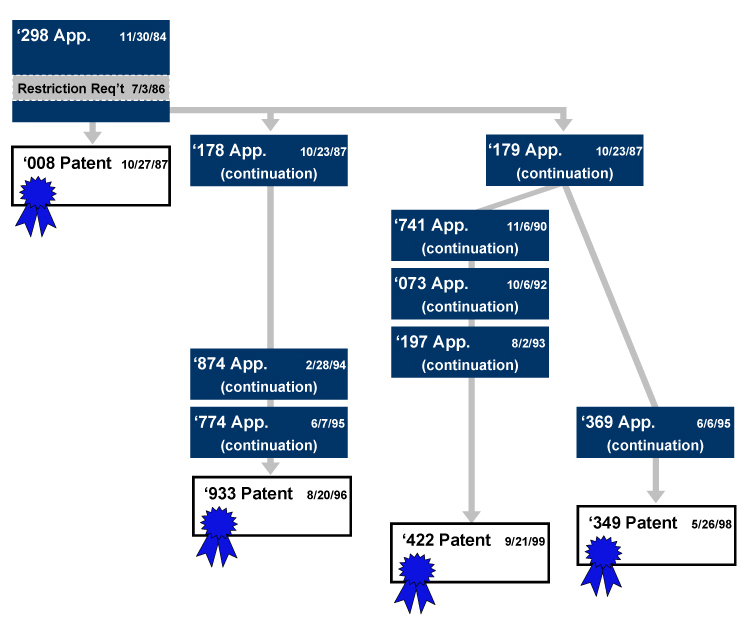
    The relationships between Amgen’s various patents-in-suit, and the earlier-filed ‘008 patent, are set forth in the following diagram:
    Patent_family_amgen_revised

    Roche argued that the claims of the patents-in-suit were invalid for obviousness-type double patenting (ODP) over claim 10 of U.S. Patent No. 4,667,016:

    10.  A process for the efficient recovery of recombinant erythropoietin from a mammalian cell culture supernatant fluid, said process comprising the following steps in sequence:
        (1)  subjecting the fluid to ion exchange chromatographic separation at about pH 7.0, thereby to selectively bind erythropoietin in said sample to a DEAE agarose cationic resin;
        (2)  stabilizing materials bound to said resin against degradation by acid activated proteases through treatment with urea;
        (3)  selectively eluting bound materials having a pKa greater than that of erythropoietin by treatment with aqueous acid at a pH of about 4.3.
        (4)  selectively eluting erythropoietin by treatment with an aqueous salt at a pH of about 7.0;
        (5)  subjecting erythropoietin -containing eluent fractions to reverse phase liquid chromatographic separation involving an immobilized C.sub.4 resin, thereby to selectively bind erythropoietin in said fluid to said resin;
        (6)  selectively eluting bound erythropoietin from said resin with an aqueous ethanol solution of about 60 percent at a pH of about 7.0; and,
        (7)  isolating erythropoietin -containing fractions of the eluent.

    The Court denied Roche’s summary judgment motion based on claim 10 of the ‘016 patent pretrial, and granted (in part) Amgen’s cross-motion for summary judgment that the claims of its patents-in-suit were not invalid for ODP over both the ‘016 patent and U.S. Patent No. 4,703,008.

    In its October 2nd decision, the Court explained that it had made its determination by application of the "two-way" test for ODP.  Under the Court’s understanding of Federal Circuit precedent, this was a case of a patent on a "follow-on" invention granting before a patent on an earlier-filed application to an "original" invention.  Moreover, the order in which the patents were granted was "a function of a restriction requirement imposed by the PTO," and the claims of the patents in suit were "consonant" with this restriction requirement.  Thus, according to the Court, "the claims of the ‘933, ‘422, and ‘349 patents are immune from ODP" over the ‘016 or ‘008 patents pursuant to 35 U.S.C. § 121.

    The Court set forth its legal analysis:  "[i]n most cases, courts employ a ‘one-way’ test where the court compared the claims according to the order in which the patents issued."  There are exceptions to this rule under Federal Circuit precedent, according to the Court, citing In re Berg, 140 F.3d 1428 (Fed. Cir. 1998).  These circumstances are the result of "the reality that the Patent Office is perennially underfunded and slow."  Accordingly, occasionally patents will issue such that "a patent covering a subsequently conceived follow-on invention" will issue "before the patent covering the underlying invention."  Using the two-way test prevents the inequity that would arise from applying the one-way test under circumstances where the internal workings of the Patent Office invert the order in which patents are granted on such "underlying" and "follow-on" inventions.

    Which test is to be used is, according to the Court, a matter of law, depending on a two-prong test:  first, that an applicant could not have filed the claims in the same (i.e., the earlier-filed) application; and second, that the applicant did not cause a delay in prosecution of the earlier-filed application.

    The Court found that any delay in the grant of the earlier-filed application was caused by the Patent Office.  The application resulting in the ‘008 patent (USSN 06/675,298; see diagram) was filed November 20, 1984, while the application resulting in the ‘016 patent (USSN 06/747,119) was filed on June 20, 1985.  Claim 10 is clearly directed to a specific 7-part process for purifying erythropoietin.  The Court characterized as "undisputed" that the ‘016 patent inventors did not conceive of their process until after Amgen filed the ‘298 application.  Under these circumstances, the Court found the first prong of the test was satisfied, that the applicants could not have filed claim 10 of the ‘016 patent in the earlier-filed ‘298 application because it had not been invented yet.

    As to the second prong, the PTO imposed a restriction requirement on the claims of the ‘298 application as follows:

    I.  Claims 1-13, 16, 39-41, 47-54 and 59, drawn to polypeptide, classified in Class 260, subclass 112.
    II.  Claims 14, 15, 17-36, 58 and 61-72, drawn to DNA, classified in Class 536, subclass 27.
    III.  Claims 37-38, drawn to plasmid, classified in Class 435, subclass 240.
    IV.  Claims 42-46, drawn to cells, classified in Class 435, subclass 240.
    V.  Claims 55-57, drawn to pharmaceutical composition, classified in Class 435, subclass 177.
    VI.  Claim 60, drawn to assay, classified in Class 435, subclass 6.

    Amgen elected to pursue claims in Group II in the ‘298 application, and the granted claims of the ‘008 patent were confined to claims from that Group.  Amgen also filed two divisional applications, USSN 07/113,178 (having claims from Groups I and VI) and USSN 07/113,179 (having claims from Group I) (see diagram).  The Court defined the co-pendency period of the applications resulting in the ‘008 and ‘016 patents narrowly (between the time the application resulting in the ‘016 patent was filed on June 20, 1985 and when it granted on May 19, 1987), and found that during that period Amgen did nothing to delay prosecution of the ‘298 patent application.  "[I]t was the PTO, not Amgen, that caused the later-filed ‘016 patent to issue before Dr. Lin’s ‘298 application" in the Court’s estimation.

    The Court expressly rejected Roche’s contention that recitation of the term "recombinant erythropoietin from a mammalian cell culture supernatant fluid" in claim 10 of the ‘016 patent was sufficient to satisfy ODP requirements.  The decision characterized as "fatally flawed" the assumption (attributed to Roche by the Court) that the disclosure found in the ‘016 patent specification was relevant to the question of whether the claims of the patents-in-suit were patentably-distinct over claim 10 of the ‘016 patent.  According to the Court, the Federal Circuit had "made clear that ‘[d]ouble patenting is altogether a matter of what is claimed," citing General Foods Corp. v. Studiengesellschaft Kohle mbH, 972 F.2d 1272, 1277 (Fed. Cir. 1992).  The Court expressly distinguished the Federal Circuit decision, relied upon by Roche, in Geneva Pharmaceuticals, Inc. v. GlaxoSmithKline PLC, 349 F.3d 1373 (Fed. Cir. 2003).  Roche argued that this case stood for the proposition that a court can rely on disclosure in the parent specification as well as the parent’s granted claims in determining whether claims in a later-granted patent are invalid for ODP.  According to Judge Young, the reason that the Federal Circuit considered the specification in Geneva was a part of construing the claims to understand their metes and bounds.  Reliance on the specification is not only unnecessary but improper where, as here, that scope and meaning are evident from the express language of the claims of the patents-in-suit and claim 10 of the ‘016 patent, and thus the Court found that Geneva did not support Roche’s position.

    The Court also noted that Roche had the burden of establishing ODP by clear and convincing evidence, a burden made more difficult in this case because the Patent Office had twice rejected that argument in finding that the claims of the patents-in-suit were not invalid under ODP over the claims of the ‘016 patent.

    Finally, the Court turned to the question of whether the claims of Amgen’s patents-in-suit were entitled to the safe harbor of 35 U.S.C. § 121.  In addition to "the express requirements" of § 121 (i.e., the plain meaning of the statute), the Court interpreted Federal Circuit precedent to require "consonance":  "the applicant must maintain the line of demarcation between the independent and distinct inventions that prompted the restriction requirement," citing Pfizer Inc. v. Teva Pharms. USA, Inc., 518 F.3d 1358, 1359 (Fed. Cir. 2008).  Consonance thus required the Court to determine whether the patents-in-suit were the product of applications filed in response to a PTO-imposed restriction requirement, and whether the claims in those patents "remained faithful" to the claim groupings that made up the restriction.  In answer to the first question, the Court found that the ‘178 and ‘179 applications (that resulted ultimately in the ‘933, ‘422, and ‘349 patents-in-suit; see diagram) were filed in response to the restriction requirement imposed on the ‘298 application.  The Court also found that these claims "remained faithful" to the groupings that made up the restriction.  In coming to this conclusion, the Court was persuaded by the fact that none of the claims prosecuted in the ‘178 or ‘179 applications, or granted in the ‘933, ‘422, or ‘349 patents-in-suit, were members of restriction Group II that had been elected in response to the restriction requirement in the ‘298 application and comprised the claims granted in the ‘008 patent.

    In reaching this decision, the Court rejected Roche’s argument that Amgen had "broken consonance" by including claims from Groups I and V in the ‘178 application, and similarly rejected Roche’s argument that Amgen’s combining claims from Groups V and VII had the same effect during prosecution of the ‘422 patent.  The Court held that these arguments were "without legal foundation" because Roche cited no case supporting the proposition that Amgen was required to file a separate divisional for each restriction group to maintain consonance with the original restriction requirement.  The Court cited Symbol Technologies, Inc. v. Opticon, Inc., 935 F.2d 1569, 1579 (Fed. Cir. 1991) for the rule that "new or amended claims in a divisional application are entitled to the benefit of [section] 121 if the claims do not cross the line of demarcation drawn around the invention elected in the restriction requirement."  In addition, the Court rejected Roche’s contention that reciting erythropoietin as a "non-naturally occurring glycoprotein" in the claims of the ‘933 patent implicated the DNA claims of restriction Group II (based in the premise that such "non-naturally occurring erythropoietin required recombinant DNA for its production).  While agreeing that the Examiner’s written description of the restriction groupings was consistent with Roche’s argument, the Court drew the "relevant line of demarcation" between the claims as "the grouping restriction actually imposed by the examiner (rather than her characterization thereof), citing Texas Instruments Inc. v. ITC, 988 F.2d 1165, 1179 (Fed. Cir. 1993) (which interpretation did not support Roche’s argument).

    This portion of the opinion was directed towards the Court’s grant of partial summary judgment to Amgen prior to trial.  However, this did not decide the issue, since Roche was able to convince the Court that there were fact issues remaining to be determined relating to two additional theories (that the Court termed "number 3 and number 4") and that the Court decided in this opinion.  These issues were tried to the Court and not to the jury, since the Court held that ODP was related to the metes and bounds of how claims were construed and thus solely within its province.

    Roche theory number 3 relates to the claims of the ‘868 and ‘698 patents that are clearly outside the scope of the § 121 safe harbor.  The asserted claims of the ‘868 and ‘698 patents are process claims, and the task for the Court was to determine whether they are patentably distinct from the claims of the ‘008 patent.  Simply put, Roche’s argument was that claim 1 of the ‘868 patent:

    1.  A process for the production of glycosylated erythropoietin polypeptide having the in vivo biological property of causing bone marrow cells to increase production of reticulocytes and red blood cells comprising the steps of:
        (a) growing, under suitable nutrient conditions, mammalian host cells transformed or transfected with an isolated DNA sequence encoding human erythropoietin; and
        (b) isolating said glycosylated erythropoietin polypeptide therefrom.

    " . . . simply tells one skilled in the art to ‘take the cells that were claimed in the ‘008 patent and grow them, let[ting] them do what they normally do.’"  The Court disagreed, adopting Amgen’s argument that the cells claimed in the ‘008 patent were not required to "actually express any EPO polypeptide" (a rationale that would seem to call into question satisfaction by such a claim of the utility requirement of 35 U.S.C. § 101).  The Court opined that "simply having the starting material" (the cells claimed in the ‘008 patent) was not equivalent to "having an actual process that successfully" produces useful quantities of erythropoietin.  This clarity of this reasoning improves when the Court puts it in proper context, that Roche did not carry its burden of establishing by clear and convincing evidence that the claims of the ‘868 and ‘008 patents are not patentably distinct and thus invalid for ODP.

    The Court came to the same conclusion for claims 6-9 of the ‘698 patent:

    6.  A process for the production of a glycosylated erythropoietin polypeptide having the in vivo biological property of causing bone marrow cells to increase production of reticulocytes and red blood cells comprising the steps of:
        (a) growing, under suitable nutrient conditions, vertebrate cells comprising amplified erythropoietin amino acid sequence of [figure] 6, and
        (b) isolating said glycosylated erythropoietin polypeptide expressed by said cells.

    7.  The process of claim 6 wherein said vertebrate cells further comprise amplified marker gene DNA.

    8.  The process of claim 7 wherein said amplified marker gene DNA is Dihydrofolate reductase (DHFR) gene DNA.

    9.  The process according to claims 2, 4, and 6 wherein said cells are mammalian cells.

    For these claims, limitations relating to the presence of amplified EPO-encoding DNA provided additional points of patentable distinction supporting the Court’s decision.

    Finally, Roche’s theory number 4 was that the claims of the ‘933, ‘422, and ‘349 patents-in-suit were invalid over the claims of the ‘868 and ‘698 patents for ODP.  The viability of this argument rested, according to the Court, on whether Amgen could avail itself of the § 121 safe harbor.  This, in turn, depended on whether the ‘933, ‘422, and ‘349 patents-in-suit "arose from" an application resulting from a PTO restriction requirement and whether these claims "are consonant with the restriction requirement."  The Court relied in its analysis on its decision in granting partial summary judgment that the ‘933, ‘422, and ‘349 patents-in-suit all "arose from" the restriction requirement imposed by the PTO in the ‘298 application.  The Court also determined that, while the issued claims of the ‘933, ‘422, and ‘349 patents-in-suit were not identical to the claims in the two divisional applications (the ‘178 and ‘179 applications) as filed, they maintained the required consonance with the restriction requirement imposed in the ‘298 patent.

    In making this determination, the Court directly addressed the question of whether the § 121 safe harbor was available in a continuation application claiming priority to a divisional application that itself was clearly within the § 121 safe harbor.  This is because the ‘698 patent was granted on a continuation application claiming priority to the ‘179 divisional application.  In making its determination, the Court appeared to adopt Amgen’s position that Federal Circuit precedent established that such a continuation application would fall within the protection of the § 121 safe harbor.  The Court cited in support of its determination Applied Materials, Inc. v. Advanced Semiconductor Materials Am., Inc., 98 F.3d 1563 (Fed. Cir. 1996) and Symbol Technologies, Inc. v. Opticon, Inc., 935 F.2d 1569 (Fed. Cir. 1991), cases cited by Amgen in its bench brief submitted in response to the Federal Circuit’s Pfizer v. Teva Pharmaceuticals decision (see "Will the Federal Circuit’s Pfizer v. Teva Decision Spell the End of Amgen’s Patent Rights to Recombinant Human Erythropoietin? ").  In something of an anticlimax, the Federal Circuit’s recent decision in Pfizer v. Teva Pharmaceuticals had little impact; the Court relegated its discussion of the decision to a footnote (no. 8), and limited the Pfizer decision to its facts, that the § 121 safe harbor does not apply to continuation-in-part applications:

    Pfizer, Inc. v. Teva Pharmaceuticals USA, Inc. does not invalidate this precedent.  As an initial matter, Pfizer did not name Symbol Technologies as one of the decisions that was possibly at odds with the Pfizer decision.  See Pfizer, 518 F.3d at 1362 (naming other cases).  Furthermore, Pfizer addressed the scope of section 121 in the context of a continuation-in-part application filed in lieu of a divisional application when responding directly to a restriction requirement.  Id. at 1362.  It said nothing about what happens if an applicant files a divisional application – which is eligible for section 121’s safe harbor – and then files a continuation application to that divisional application.

    For additional information regarding this topic, please see:

    • "BIO Submits Amicus Brief in Amgen v. Hoffman-LaRoche," July 7, 2008
    • "Glasses Half-full or Half-empty: Hoffman-LaRoche’s Different Interpretation of Pfizer v. Teva," April 15, 2008
    • "Hoffmann-LaRoche Can’t Wait, Files Notice of Appeal to the Federal Circuit," April 11, 2008
    • "Will the Federal Circuit’s Pfizer v. Teva Decision Spell the End of Amgen’s Patent Rights to Recombinant Human Erythropoietin?" March 31, 2008
    • "Court Still Cannot Decide on Amgen’s Permanent Injunction," March 26, 2008
    • "Amgen Inc. v. International Trade Commission (Fed. Cir. 2008)," March 20, 2008
    • "Roche Agrees to Court’s Conditions for Modifying Preliminary Injunction," March 20, 2008
    • "Roche’s Mircera® Remains Off the Market (For Now)," March 2, 2008
    • "Amgen Survives Another EPO Challenge," October 28, 2007

  •     By Sherri Oslick

    Gavel_2
    About
    Court Report:  Each week we will report briefly on recently filed
    biotech and pharma cases, and a few interesting cases will be selected
    for periodic monitoring.


    Proctor & Gamble Co. et al. v. Teva Pharmaceuticals USA Inc.

    1:08-cv-00627; filed September 26, 2009 in the District Court of Delaware

    Infringement of U.S. Patent Nos. 5,583,122 ("Pharmaceutical Compositions Containing Geminal Diphosphonates," issued December 10, 1996), 6,165,513 ("Film-Coated Tablet For Improved Upper Gastrointestinal Tract Safety," issued December 26, 2000), and 7,192,938 ("Method of Treatment Using Bisphosphonic Acid," issued March 20, 2007) following a Paragraph IV certification as part of Teva’s filing of an ANDA to manufacture a generic version of P&G’s Actonel® (risedronate sodium, used to treat and prevent postmenopausal osteoporosis).  View the complaint here.


    Eli Lilly and Company v. Teva Parenteral Medicines, Inc. et al.

    1:08-cv-01302; filed September 26, 2008 in the Southern District of Indiana

    Infringement of U.S. Patent Nos. 4,808,614 ("Difluoro Aantivirals and Intermediate Therefore," issued February 18, 1989) and 5,464,826 ("Method of Treating Tumors in Mammals with 2′,2′-difluoronucleosides," issued November 7, 1995) following a Paragraph IV certification as part of Teva’s filing of an ANDA to manufacture a generic version of Lilly’s Gemzar® (gemcitabine hydrochloride for injection, used to treat non-small cell lung cancer, pancreatic cancer, breast cancer, and ovarian cancer).  View the complaint here.


    Astrazeneca Pharmaceuticals LP et al. v. Accord Healthcare, Inc. et al.

    3:08-cv-04804; filed September 26, 2008 in the District Court of New Jersey

    Infringement of U.S. Patent No. 5,948,437 ("Pharmaceutical Compositions Using Thiazepine," issued September 7, 1999) following a Paragraph IV certification as part of defendants’ filing of an ANDA to manufacture a generic version of AstraZeneca’s Seroquel® XR (quetiapine fumarate, used to treat schizophrenia and bipolar disorder).  View the complaint here.

  • CalendarOctober 6-7, 2008 – Patent Litigation 2008 (Practising Law Institute) – McLean, VA

    October 7-8, 2008 – Global Patent Litigation*** (American Conference Institute) – New York, NY

    October 15, 2008 – Developments in Pharmaceutical and Biotech Patent Law (Practising Law Institute) – San Francisco, CA

    October 15-16, 2008 – Pharmaceutical Congress on Paragraph IV Disputes*** (Center for Business Intelligence) – Philadelphia, PA

    October 15-16, 2008 – Advanced Courses (Patent Resources Group) – Santa Ana Pueblo, NM

    October 15-17, 2008 – Maximizing Pharmaceutical Patent Lifecycles*** (American Conference Institute) – New York, NY

    October 23-24, 2008 – Patent Litigation 2008 (Practising Law Institute) – Chicago, IL

    October 28-29, 2008 – Pharma/Biotech IP Due Diligence*** (C5) – Amsterdam, Netherlands

    November 10-11, 2008 – Patent Litigation 2008 (Practising Law Institute) – Atlanta, GA

    November 11-13, 2008 – 4th Biosimilars conference (Visiongain) – Philadelphia, PA

    November 12-14, 2008 – Structuring, Negotiating and Managing Pharma/Biotech Collaborative Agreements (American Conference Institute) – New York, NY

    November 17-18, 2008 – Pharmaceutical and Biotech Patent Opinion Writing*** (American Conference Institute) – Boston, MA

    November 17-18, 2008 – Patent Litigation 2008 (Practising Law Institute) – New York, NY

    November 19-20, 2008 – Paragraph IV on Trial*** (American Conference Institute) – New York, NY

    December 8-9, 2008 – Pharmaceutical and Biotech Patent Opinion Writing*** (American Conference Institute) – Atlanta, GA

    January 12-13, 2009 – Pharmaceutical and Biotech Patent Opinion Writing*** (American Conference Institute) – San Diego, CA

    January 28-29, 2009 – 6th National Conference on Pharma/Biotech IP Due Diligence (American Conference Institute) – New York, NY

    ***Patent Docs is a media partner of this conference or CLE