• CalendarOctober 28-29, 2008 – Pharma/Biotech IP Due Diligence*** (C5) – Amsterdam, Netherlands

    November 10-11, 2008 – Patent Litigation 2008 (Practising Law Institute) – Atlanta, GA

    November 11-13, 2008 – 4th Biosimilars conference (Visiongain) – Philadelphia, PA

    November 12-14, 2008 – Structuring, Negotiating and Managing Pharma/Biotech Collaborative Agreements (American Conference Institute) – New York, NY

    November 17-18, 2008 – Pharmaceutical and Biotech Patent Opinion Writing*** (American Conference Institute) – Boston, MA

    November 17-18, 2008 – Patent Litigation 2008 (Practising Law Institute) – New York, NY

    November 19-20, 2008 – Paragraph IV on Trial*** (American Conference Institute) – New York, NY

    December 8-9, 2008 – Pharmaceutical and Biotech Patent Opinion Writing*** (American Conference Institute) – Atlanta, GA

    January 12-13, 2009 – Pharmaceutical and Biotech Patent Opinion Writing*** (American Conference Institute) – San Diego, CA

    January 20-21, 2009 – Bio/Pharmaceutical Summit on Legal and Regulatory Product Lifecycle
    Strategies
    *** (Center for Business Intelligence) – Baltimore, MD

    January 27-28, 2009 – ITC Litigation (American Conference Institute)*** – Washington, DC

    January 28-29, 2009 – 6th National Conference on Pharma/Biotech IP Due Diligence (American Conference Institute) – New York, NY

    January 29-30, 2009 – Commercialization of Life Sciences Inventions (Law Seminars International) – Phoenix, AZ

    ***Patent Docs is a media partner of this conference or CLE

  • Congress
    American Conference Institute (ACI) will be holding its Advanced Forum on ITC Litigation from January 27-28, 2009 in Washington, DC.  The conference will offer insights into current trends and issues involved in an ITC action, including:

    • The fallout from the decision in Broadcomm v. Qualcomm;
    • Drafting the Exclusion Order, and working with enforcement agents to ensure it is carried out;
    • Preparing arguments to pass the Domestic Industry test, particularly with the growth of licenses;
    • Managing documents, foreign witnesses, and minimizing costs;
    • Avoiding redundancy in discovery review and expert witnesses;
    • Utilizing a Section 337 action as a means to settling, and in conjunction with, other actions in federal court;
    • Weighing the financial benefits and competitive edge vs. extreme cost and time constraints of an ITC action;
    • Implementing strategies to prepare for a potential ITC action whether initiating or as a potential respondent;
    • Collaborating with multiple parties in a Section 337 action under extreme time constraints;
    • Controlling extremely high volumes of discovery responses and overcoming the practical challenges such as foreign translations, multiple copies, database management;
    • Devising practices for efficiently working with the United States Customs office and other enforcement organizations; and
    • Identifying action plans to successfully work with the ITC courts, commission and counsel’s office.

    In particular, ACI's faculty will offer presentations on the following topics on January 27 and 28:

    727L09-WAS
    • View from the bench:  Honorable Judge Paul J. Luckern;
    • View from the ITC Commission:  Director of the Office of Unfair Import Investigations, Lynn I. Levine;
    • Exploring new and developing challenges in ITC litigation;
    • Maximizing relationships with the ITC:  Initiating an action, working with the staff, and instituting the best practices for a favorable outcome;
    Broadcom v Qualcomm:  Updates of the federal appeal, and the overall status of downstream products;
    • Enforcement address:  George F. McCray;
    • Maximizing your relationship with customs:  Securing enforcement and to preparing for subsequent product questions;
    • Foreign company case study:  Preparing a client for an ITC action, and addressing their questions, fears, and challenges;
    • Operating in the eye of the storm:  Effective strategies for litigating an ITC action;
    • Section 337 litigation business advantages:  ITC vs. Federal District Court; and
    • Passing the Domestic Industry test with the rise of licensing and trademark cases.

    An additional pre-conference workshop entitled: "Drafting an ITC Complaint:  Developing Strategies and Composing the Necessary Documents" will be offered on January 26th.  In this workshop, ACI faculty will instruct attendees on the essentials of drafting an ITC complaint, to ensure that it provides a concise and formidable argument.

    The agenda for the ITC Litigation conference can be found here.  A complete brochure for this conference, including an agenda, list of speakers, and registration form can be downloaded here.

    ACI - American Conference Institute
    The registration fee ranges from $2,195 (conference alone) to $2,795 (conference and workshop).  Those registering by November 28, 2008 will receive a $300 discount off the registration fee and those registering by December 26, 2008 will receive a $200 discount off the registration fee.  Those interested in registering for the conference can do so here, by calling 888-224-2480, or by faxing a registration form to 877-927-1563.

    Patent Docs is a media partner of the Advanced Forum on ITC Litigation.

  • Law Seminars International (LSI) will be holding a conference on Innovative Strategies for Accelerating the Commercialization of Life Sciences Inventions on January 29-30, 2009 in Phoenix, AZ.  During the conference, LSI's faculty will offer presentations on the following topics:

    09BIOAZ-1
    • Accelerating the "gap" from discovery to development to commercialization;
    • Valuation of discoveries from discovery to development to commercialization;
    • Consortia and other multi-party collaborations:  Increasingly important mechanisms for accelerating commercialization;
    • Patent pools:  Another innovative tool to accelerate commercialization;
    • Unique challenges associated with licensing inventions from academic research environment to private-sector life sciences company;
    • Venture philanthropy as creative funding source; and
    • Exit strategies for life sciences companies.

    The agenda for the Commercialization of Life Sciences Inventions conference can be found here.  A complete brochure for this conference, including an agenda, list of speakers, and registration form can be downloaded here.

    Law Seminars International
    The registration fee is $622.50 for students and new employees, $945 for government employees, or $1,245 for all other attendees. Those interested in registering for the workshop can do so here, by calling 800-854-8009, or by faxing a registration form to 206-567-5058.

  •     By Donald ZuhnIkonisys

    GlaxoSmithKline - GSK
    Last week, the U.S. Patent and Trademark Office and USPTO Director Jon Dudas filed their reply brief in the Tafas v. Dudas appeal.  On the same day that the Patent Office filed its reply brief, Patently-O provided links to the fifteen amicus briefs filed in the appeal, thirteen of which support Plaintiffs-Appellees Dr. Triantafyllos Tafas, SmithKline Beecham Corp., SmithKline Beecham plc, and Glaxo Group Ltd., and two of which support Defendants-Appellants the USPTO and Director Dudas.  In August, Patent Docs reported on one of the amicus briefs filed in support of Defendants-Appellants by the Public Patent Foundation (PUBPAT), AARP, the Computer & Communications Industry Association (CCIA), Consumer Watchdog, Essential Action, Initiative for Medicines, Access & Knowledge (I-MAK), Prescription Access Litigation (PAL), Public Knowledge (PK), Research on Innovation (ROI), and the Software Freedom Law Center (SFLC) (see "Public Interest Groups Back USPTO in Tafas v. Dudas Appeal").  With oral argument scheduled for December 5, 2008, Patent Docs will be reporting on a number of the other amicus briefs filed in the Tafas appeal in the coming weeks.  Today, we will be addressing the other brief filed in support of Defendants-Appellants.

    Lemley, Mark
    The Brief Amici Curiae of Intellectual Property and Administrative Law Professors in Support of Appellants was signed by Stanford Law School Professor Mark Lemley (at left) on behalf of Prof. Stuart Benjamin (Duke Law School), Prof. Robin Feldman (U.C. Hastings College of the Law), Prof. Marshall Leaffer (Indiana University School of Law, Bloomington), Prof. Mark McKenna (Notre Dame Law School), Prof. Peter Menell (University of California at Berkeley School of Law), Prof. Joseph Miller (Lewis & Clark Law School), Prof. Craig Nard (Case Western Reserve University School of Law), Prof. Arti Rai (Duke Law School), Prof. Michael Risch (West Virginia University College of Law), Prof. Katherine Strandburg (DePaul University College of Law), and Prof. John Thomas (Georgetown University Law Center).  The Law Professors' brief argues that the Patent Office's continuation and claims rules (Final Rules), which District Judge James C. Cacheris of the Eastern District of Virginia enjoined on April 1st, should be evaluated under Chevron U.S.A., Inc. v. Natural Resources Defense Council, Inc., 467 U.S. 837 (1984); are a reasonable interpretation of the statute; and are not arbitrary and capricious.

    USPTO Seal
    The Law Professors begin by arguing that the Supreme Court's decision in Dickinson v. Zurko, 527 U.S. 150 (1999), establishes that standard administrative law principles developed in Chevron and its progeny govern judicial review of the USPTO.  With respect to the Tafas appeal, the brief contends that the Federal Circuit should first decide whether Chevron is applicable.  Not surprisingly, the Law Professors believe that the Patent Office is owed Chevron deference with respect to the Final Rules.  According to the brief, "[t]he rules at issue are unquestionably directed at the control of PTO procedures — under what circumstances applicants can file continuation applications, and what information applicants must disclose along with those applications that are particularly large," and the Patent Office acted using notice and comment rulemaking.  As a result of the procedural nature of the Final Rules, and the PTO's use of notice and comment rulemaking, the Law Professors argue that the Final Rules must be analyzed in accordance with Chevron.

    The brief takes the District Court to task for determining that the Final Rules must be substantive because they "constitute a drastic departure from the terms of the Patent Act as they are presently understood."  The Law Professors argue that Judge Cacheris "wrongly assumes that the rules in fact represent a drastic departure," contending that "the PTO already uses the doctrine of prosecution laches to limit continuation applications" (as a result of the Federal Circuit's decision in In re Bogese, 303 F.3d 1362 (Fed. Cir. 2002)), and that the Patent Office used "its procedural rulemaking authority to promulgate Rule 105, which authorizes examiners to require additional information from applicants not simply in cases of large applications but in all cases" (emphasis in brief).

    Tackling the Final Rules limit on continuations, the Law Professors contend that 35 U.S.C. § 120 "does not compel the PTO to give applicants an unlimited number[] of bites at the apple," but rather merely "allow[s] applicants that file continuation applications to benefit from the priority date of the first application."  With respect to Rule 265, which would require applicants to submit an Examination Support Document (ESD) in order to prosecute more than five independent claims or 25 total claims in a single application (the 5/25 rule), the Law Professors draw an analogy to "the PTO's promulgation of Rule 105, which allows an examiner to require the submission of 'such information as may be reasonably necessary to properly examine or treat the matter,'" and which was "explicitly approved" in Star Fruits S.N.C. v. United States, 393 F.3d 1277 (Fed. Cir. 2005).

    The brief next argues that the Final Rules — at least the rules limiting continuations and requiring ESDs — "clearly meet the extremely deferential 'reasonableness' standard enunciated in Chevron step 2" (i.e., an agency’s reasonable interpretation of a statute should be upheld so long as Congress has not "directly spoken to the precise question at issue").  In particular, the Law Professors contend that:

    This case is hardly the rare exception that fails under step 2.  It is perfectly reasonable for the PTO to attempt to manage its ever-burgeoning case load by preventing the repeated filing of applications directed at the same subject matter.  It is also reasonable for the PTO, which has only a small amount of time to review any given application, to seek additional information on applications with large numbers of claims.

    The Law Professors conclude their brief by arguing that the Final Rules are not arbitrary and capricious, stating that "[e]ven if the PTO's solution to the problem it faces is not necessarily the optimal one, it is satisfactory."  The Law Professors note that in crafting the Final Rules, the Patent Office collected more than 500 comments and spent more than a year analyzing them.  The brief points out that in response to these comments, the Patent Office "changed its proposal from one that would have automatically allowed only one continuation, continuation-in-part, or request for continued examination to a proposal that automatically allows two continuations or continuations-in-part as well as one request for continued examination," and "[f]ollowing the recommenation of various commentators, . . . changed its original proposal for 'representative claims' designation into the current '5/25' rule."  The brief also states that the Final Rules "permit applicants to seek additional continuations beyond the three allowed automatically on a showing of good cause" (although the brief conveniently omits any discussion about the impossibly high standard the USPTO set forth for showing "good cause").

    According to the brief, the "serious problems" caused by the U.S. patent practice of permitting "unlimited" continuations also support the argument that the Final Rules are not arbitrary and capricious.  The Law Professors argue that the practice of allowing unlimited continuations "affect[s] the way examiners approach patent applications," since "[a]n examiner who knows that the applicant can always come back and ask for more may be unwilling to stand by a rejection she believes to have merit, simply because it is easier in the long run to allow a patent than to continue fighting against a determined applicant."  The brief also criticizes the use of continuations "to gain advantages over competitors by waiting to see what product the competitor will make, and then drafting patent claims specifically designed to cover that product," and as a way to carry out the strategy of "submarine patenting."  While the Law Professors acknowledge that there are "legitimate reasons" to use continuations — "[t]he two most plausible are to correct errors . . . and to obtain a narrow patent quickly while fighting over broader claims in a continuation" — the brief notes that U.S. Patent Law provides a number of mechanisms for correcting errors and that patentees can use to the doctrine of equivalents "to argue for broader protection than the claims provide."  With respect to conflicting concerns regarding the use of multiple continuations, the Law Professors assert that:

    [T]he PTO has accommodated these conflicting concerns, in fact bending over backwards in its final rulemaking to ensure that applicants have abundant opportunity to use continuations for these legitimate purposes while still trying to impose some limits on abuse of the continuation process.  The final rules permit applicants an original application, two continuation applications, an RCE, and an unlimited number of divisionals.  Those who have already exhausted all those applications can seek additional continuations; they simply need to come up with a reason why they need a fifth (or more) bite at the apple.

    For additional information regarding the appeal, please see:

    • "PTO Files Reply Brief in Tafas v. Dudas Appeal," October 15, 2008
    • "Dr. Tafas Files Brief in New Rules Appeal," September 30, 2008
    • "GSK Files Brief in Tafas v. Dudas Appeal," September 25, 2008
    • "Tafas v. Dudas Update," September 2, 2008
    • "Public Interest Groups Back USPTO in Tafas v. Dudas Appeal," August 5, 2008
    • "USPTO Files Opening Brief in Tafas v. Dudas Appeal," July 22, 2008
    • "Save the Date — Initial Scheduling of the Tafas/GSK v. Dudas Appeal," May 21, 2008
    • "USPTO to Appeal Tafas/GSK v. Dudas," May 7, 2008

  •     By Donald Zuhn

    Immunomedics
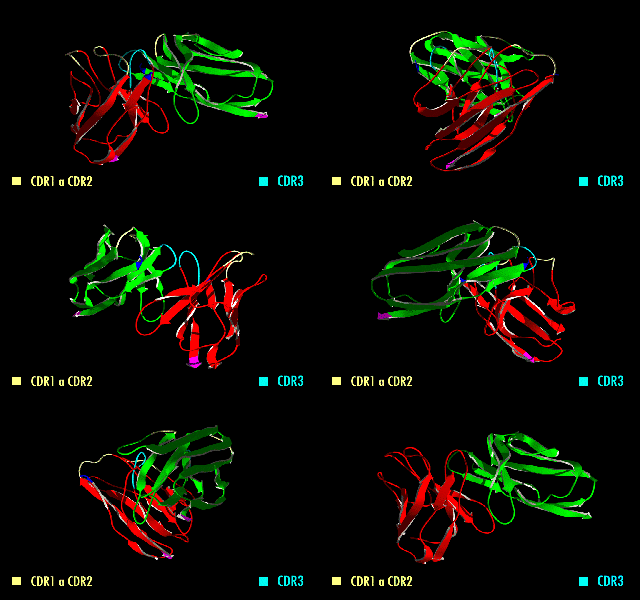
    Last week, Immunomedics, Inc. announced that the U.S. Patent and Trademark Office has issued U.S. Patent No. 7,435,803, which is directed to humanized and chimeric anti-CD20 antibodies and CD20 antibody fusion proteins.  Such antibodies are useful for the treatment and diagnosis of B-cell disorders, such as B-cell malignancies and autoimmune diseases.  The '803 patent is Immunomedics' 131st U.S. patent, which is also named as an assignee on 111 U.S. patent application publicationsCD20 is a non-glycosylated phosphoprotein that is expressed on the surface of all mature B-cells, and which plays a role in the development and differentiation of B-cells into plasma cells.

    According to the Morris Plains, NJ-based biopharmaceutical company's press release, the '803 patent encompasses Immunomedics' veltuzumab antibody, which targets the CD20 antigen present on B-lymphocytes, leukemias, and lymphomas.  Veltuzumab is currently being tested for the treatment and diagnosis of B-cell disorders, such as B-cell malignancies and autoimmune diseases.  A subcutaneous formulation of veltuzumab has also been recently licensed to Nycomed GmbH for use in all non-cancer indications.

    The '803 patent issued from U.S. Application No. 11/534,103, filed September 21, 2006, which is a continuation of U.S. Application No. 10/366,709, which issued as U.S. Patent No. 7,151,164 on December 19, 2006, which claims the benefit of U.S. Provisional Application Nos. 60/356,132, filed February 14, 2002, and 60/416,232, filed October 7, 2002.  Independent claim 1 of the '803 patent recites:

    1.  A chimeric or humanized monoclonal antibody that binds to CD20, said antibody having a light chain variable region CDR1 comprising the sequence RASSSVSYIH (SEQ ID NO:1); CDR2 comprising the sequence ATSNLAS (SEQ ID NO:4); and CDR3 comprising the sequence QQWTSNPPT (SEQ ID NO:5); and said antibody having a heavy chain variable region CDR1 comprising the sequence SYNMH (SEQ ID NO:8); CDR2 comprising the sequence AIYPGNGDTSYNQKFKG (SEQ ID NO:9); and CDR3 comprising the sequence STYYGGDWYFDV (SEQ ID NO:10) or the sequence VVYYSNSYWYFDV (SEQ ID NO: 13).

    ScFv-rotation

    (Tomas Moravec, Wikipedia Commons)

    For additional information regarding other related topics, please see:

    • "Immunomedics Awarded Patent Covering Pancreatic Cancer Therapeutic," October 16, 2007

  •     By Christopher P. Singer

    USPTO Seal
    In a Notice dated October 14, 2008, the U.S. Patent and Trademark Office announced that the Korean Intellectual Property Office (KIPO) has become the third participating foreign intellectual property office in the electronic priority document exchange program.  This complements our prior report based on information provided by one of our Korean foreign associates.  As of the date of the Notice, the USPTO will be able to electronically retrieve Korean priority documents from KIPO through the Priority Document Exchange (PDX) system.  Similarly, the KIPO will also gain the ability to electronically retrieve U.S. priority documents from the USPTO.

    For U.S. applications filed under 35 U.S.C. § 111(a) on or after October 14, 2008, the USPTO will automatically attempt to electronically retrieve a copy of any Korean (KR) priority document without the need for the applicant to file a request to retrieve in a separate document (no need to file Form PTO/SB/38) provided that the application claims foreign priority to the KR application and identifies the KR application in the oath or declaration, or in an application data sheet.  The same situation applies for priority applications originally filed in the EPO or JPO.  If the copy of the KIPO (or EPO or JPO) application is received by the USPTO prior to the payment of the issue fee, the requirement under 37 C.F.R. § 1.55 for a certified copy of the foreign priority application is satisfied.  While the USPTO will make the requests automatically, the request may not be fulfilled until several months after the filing of a qualifying new U.S. application.

    For U.S. applications filed prior to October 14, 2008, applicants must file a request to retrieve Form PTO/SB/38.  This program does not include design patent applications and PCT applications.  Similarly, the USPTO will not retrieve copies of priority applications filed in U.S. national stage applications under 35 U.S.C. § 371 unless the applicant files a separate Form PTO/SB/38, since the USPTO already receives copies of such priority applications from the International Bureau.

    The Notice also advises that Applicants will be ultimately responsible for ensuring that the priority document is filed by the time of patent grant as required under 37 C.F.R. § 1.55(a).  Applicants are encouraged to check Private PAIR to confirm receipt of appropriate documents.

    KIPO #1
    Similarly, if a KR (or EP or JP) application claims foreign priority to a U.S. provisional or nonprovisional application, the KIPO (or EPO or JPO) will automatically attempt to retrieve an electronic copy of the U.S. application.  Importantly, the USPTO will release copies of U.S. applications upon such request only if the U.S. priority application has received a foreign filing license in accordance with 37 C.F.R. § 5.11, and (1) the applicant of the U.S. application provided an appropriate written authority to permit access to application by participating offices (Form PTO/SB/39 or Form PTO/SB/01); or (2) the U.S. application has been published or patented.

    As with the USPTO, applicants are advised that KIPO (as well as EPO and JPO) regulations require a copy of a priority document to be filed with the corresponding KIPO (or EPO or JPO) application no later than 16 months from the priority date.  The USPTO advises that because U.S. applications are ordinarily published by the USPTO after the time period of 18 months from filing, most U.S. applications that are the basis for a foreign priority claim in a KR (or EP or JP) application will not be published at the time the applicant is required to provide a copy of the U.S. application to the KIPO (or EPO or JPO).  Accordingly, in most situations it will be necessary for applicants to provide the USPTO with appropriate written authorization for the foreign offices to access the U.S. application and obtain a copy by submitting either (1) Form PTO/SB/39; or (2) Form PTO/SB/01 in which the "Authorization to Permit Access by Participating Offices" has been checked.

    For further information regarding the PDX program, the USPTO asks that you contact either Don Levin (TDA Project Manager) at 571-272-3785, or Diana Oleksa (Legal Advisor for IT Policy) at 571-272-3291, or by sending an e-mail to PDX@uspto.gov.

    For additional information regarding this topic, please see:

    • "Online Priority Document Exchange Service Between USPTO and KIPO," October 9, 2008
    • "USPTO and KIPO Sign Memorandum on Cooperative Patent Examination," September 24, 2008
    • "Enhancement of PDX Program and Declaration Form," February 14, 2008
    • "USPTO e-Commerce Update and Public PAIR Verification System," January 16, 2008
    • "USPTO e-Commerce Update," December 5, 2007
    • "e-Commerce e-Alert," August 28, 2007
    • "JPO-USPTO Priority Document Exchange Update," August 2, 2007
    • "USPTO and JPO Launch Electronic Priority Document Exchange," July 31, 2007
    • "JPO to Join USPTO and EPO in Priority Document Exchange Program," July 11, 2007
    • "Patent Office Announces Simplification of Priority Document Exchange," June 7, 2007
    • "USPTO's Advice Concerning Priority Document Exchange (PDX) Program," April 24, 2007
    • "EFS-Web Document Indexing and Priority Document Exchange," January 30, 2007
    • "Priority Document Exchange Update," January 19, 2007
    • "USPTO Implements Priority Document Exchange," January 18, 2007
    • "Private PAIR 7.0 and PDX Presentation," December 20, 2006
    • "$$$ in Applicants' Pockets!" November 24, 2006

  •     By Donald Zuhn

    Last week, the Federal Circuit affirmed a determination by the Board of Patent Appeals and Interferences that the claims of U.S. Application No. 10/041,958 would have been obvious in view of five prior art references.

    The '958 application, filed by Appellants Saul Tzipori, Ramaswamy Balakrishnan, and Arthur Donohue-Rolfe (Tzipori), relates to antibodies that bind Shiga-like toxin II (SLT-II), which is secreted by some strains of Escherichia coli in the intestinal tracts of mammals.  SLT-II-producing E. coli in the intestines of humans and pigs can create holes in the intestinal wall through which SLT-II can pass, causing a sometimes fatal disease, hemolytic uremic syndrome.  The antibodies disclosed by Tzipori can be used to ameliorate the harmful effects of SLT-II.

    During prosecution of the '958 application, Tzipori's claims were rejected by the examiner as obvious in view of five references:  U.S. Patent No. 5,512,282 (Krivan); PCT Publication No. WO 90/07861 (Queen); Perera et al., J. Clin. Microbio. 26(10): 2127-31 (1988) (Perera); U.S. Patent No. 6,080,400 (Williams); and Danuta et al., Human Hybridomas and Monoclonal Antibodies 22-27 (Edgar G. Engleman et al., eds. 1985) (Engelman).  The Board affirmed this rejection.

    Federal Circuit Seal
    On appeal, Tzipori set forth a number of arguments for the nonobviousness of the claimed invention.  Tzipori first argued that because the claims recite anti-SLT-II antibodies that specifically bind the alpha and beta subunits of SLT-II, the claims could be distinguished from Krivan (the primary reference cited against the '958 application), which does not disclose anti-SLT-II antibodies that bind a particular subunit of SLT-II.  The Federal Circuit, however, noted that according to Tzipori, the only subunits of SLT-II are the alpha and beta subunits, and thus, "his implication that his claims are patentable because they are limited to the subunits 'responsible for the enteric and systemic disease in humans' rings hollow."  The Court concluded that "Tzipori's claims are, as a whole, directed to all parts of SLT-II and no more specific than Krivan's disclosure on this point."

    Tzipori next argued that his gnotobiotic pig model, which he used to determine effective doses of anti-SLT-II antibodies, was novel and rendered his claims patentable over the prior art.  The Federal Circuit, however, noted that the gnotobiotic pig model did not figure into the into the claims at issue and therefore was "of little relevance to the obviousness inquiry."

    Tzipori next argued that an important aspect of his studies was the use of a virulent strain of E. coli — the 0157:H7 strain — that infects and causes disease in humans.  Again, the Federal Circuit countered by noting that "[Tzipori's] claims do not specify that the antibodies bind specifically to SLT-II from the 0157:H7 strain of E. coli, nor do they make clear how or whether the claimed antibodies differ from antibodies, such as those claimed by Krivan, which would be suitable for animal treatment."

    Tzipori next argued that "there is no teaching in Krivan of the need in treating humans to make human or humanized antibodies to SLT II."  The Federal Circuit, however, noted that "Tzipori has not proven that non-human antibodies are necessarily ineffective for human treatment."

    While the CAFC conceded that Tzipori had established that Krivan did not disclose monoclonal or humanized antibodies to SLT-II, the Court noted that Queen disclosed a method of making humanized antibodies and Perara disclosed the manufacture of hybridomas that produce monoclonal antibodies.  The Federal Circuit also reprimanded the Board for failing to offer facts or reasoning in support of its assertion that one of ordinary skill in the art would combine the references cited by the examiner, stating that:

    Given the complexity of the technological issues and the combination of multiple references used to reject claim 26 [i.e., Tzipori's base claim], a more comprehensive explanation of the Board's reasoning would have facilitated review not only by better presenting the Board's reasoning to this court, but also by giving Tzipori a clearer idea why his claim was rejected.

    Nevertheless, the Board's failure to better articulate the case for obviousness did not deter the CAFC from agreeing with the Board that the claims of the '958 application were indeed obvious.

    In re Tzipori (Fed. Cir. 2008)
    Nonprecedential disposition
    Panel: Chief Judge Michel, Circuit Judge Friedman, and Chief District Judge Walker
    Opinion by Chief Judge Michel

  •     By Sherri Oslick

    Gavel_2About
    Court Report:  Each week we will report briefly on recently filed
    biotech and pharma cases, and a few interesting cases will be selected
    for periodic monitoring.


    Zydus Pharmaceuticals, Inc., USA et al. v. Teva Pharmaceutical Industries Ltd et al.

    1:08-cv-01071; filed October 14, 2008 in the Eastern District of Virginia

    Declaratory judgment of non-infringement, invalidity, and unenforceability of U.S. Patent Nos. 6,750,341 ("Preparation of Risperidone," issued June 15, 2005) and 7,256,195 (same title, issued August 14, 2007) based on Zydus' manufacture and sale of risperidone API and risperidone tablets (used to treat schizophrenia).  View the complaint here.


    AstraZeneca AB et al. v. Ivax Corp. et al.

    3:08-cv-04993; filed October 9, 2008 in the District Court of New Jersey

    Infringement of U.S. Patent No. 7,411,070 ("Form of S-omeprazole," issued August 12, 2008) following a Paragraph IV certification as part of Ivax's filing of an ANDA to manufacture a generic version of AstraZeneca's Nexium® (esomeprazole magnesium, used for the treatment of gastroesophageal reflux disease).  View the complaint here.

  • CalendarOctober 23-24, 2008 – Patent Litigation 2008 (Practising Law Institute) – Chicago, IL

    October 28-29, 2008 – Pharma/Biotech IP Due Diligence*** (C5) – Amsterdam, Netherlands
    November 10-11, 2008 – Patent Litigation 2008 (Practising Law Institute) – Atlanta, GA

    November 11-13, 2008 – 4th Biosimilars conference (Visiongain) – Philadelphia, PA

    November 12-14, 2008 – Structuring, Negotiating and Managing Pharma/Biotech Collaborative Agreements (American Conference Institute) – New York, NY

    November 17-18, 2008 – Pharmaceutical and Biotech Patent Opinion Writing*** (American Conference Institute) – Boston, MA

    November 17-18, 2008 – Patent Litigation 2008 (Practising Law Institute) – New York, NY

    November 19-20, 2008 – Paragraph IV on Trial*** (American Conference Institute) – New York, NY

    December 8-9, 2008 – Pharmaceutical and Biotech Patent Opinion Writing*** (American Conference Institute) – Atlanta, GA

    January 12-13, 2009 – Pharmaceutical and Biotech Patent Opinion Writing*** (American Conference Institute) – San Diego, CA

    January 20-21, 2009 – Bio/Pharmaceutical Summit on Legal and Regulatory Product Lifecycle
    Strategies
    *** (Center for Business Intelligence) – Baltimore, MD

    January 28-29, 2009 – 6th National Conference on Pharma/Biotech IP Due Diligence (American Conference Institute) – New York, NY

    ***Patent Docs is a media partner of this conference or CLE

  • BaltimoreBaltimore
    The Center for Business Intelligence (CBI) will be
    holding its Bio/Pharmaceutical Summit on Legal and Regulatory Product Lifecycle
    Strategies on January 20-21, 2009 in Baltimore, MD.  The conference will address the current challenges,
    policies, and practical strategies from both legal and regulatory perspectives
    to help companies implement a more effective and modern approach to lifecycle
    management (LCM).

    Topics to be discussed at the conference include:

    • The implications of the European Commission (EC)
    investigations on the pharmaceutical industry;
    • Increase return on investment (ROI) through the
    integration of lifecycle management with portfolio management;
    • The interplay between patent law and regulatory law to
    maximize product lifecycle;
    • Assess the impact of carve-outs and citizen petitions
    on LCM strategies; and
    • Managing in-licensing and the collaboration continuum.

    In particular, CBI's faculty will offer presentations on
    the following topics:

    • Antitrust law and LCM — The FTC's view on risks and
    regulations;
    • The expected implications of the EC pharma inquiry on
    industry;
    • Assess your patent portfolio to assign value and
    identify risks and opportunities;
    • The interplay between patent law and regulatory law to
    maximize product lifecycle;
    • Lifecycle management in emerging economies;
    • Understand labeling carve-outs and their impact on
    generic approvals;
    • Trademarks — Overcome the regulatory challenges to
    effectively utilize trademarks in your LCM strategies;
    • Evaluate the potential for alternate drug exclusivity
    pathways;
    • Integrating lifecycle management with portfolio
    management to maximize asset value; and
    • Drug repurposing — Call to service for old drugs; when
    being opportunistic is the strategy.

    An additional in-conference workshop entitled:  "Lifecycle Boot Camp — The Core
    Laws and Regulations Affecting Your Strategies" will be offered on January
    20, 2009.  The in-conference
    workshop will review Hatch-Waxman and MMA legislation, and USPTO proposals —
    with a special focus on patent term extensions, Orange Book practices, ANDA
    litigation, and other laws and regulations that apply to LCM.  The workshop will also provide
    practical strategies for successfully working within these regulations and the
    common pitfalls to avoid.

    The agenda for the Bio/Pharmaceutical Summit on Legal and
    Regulatory Product Lifecycle Strategies can be found here.  A brochure for this conference can be
    requested here.

    Center for Business Intelligence (CBI)
    The registration fee for the conference is $1,995.  Attendees registering on or before
    November 21, 2008 will receive a $300 discount off the registration fee, and
    attendees registering a group of three individuals will receive a fourth
    registration for free.  Those
    interested in registering for the conference can do so here, by calling 1-800-817-8601,
    or by e-mail at cbireg@cbinet.com.

    Patent Docs is a media sponsor of CBI's Bio/Pharmaceutical Summit on Legal and Regulatory Product Lifecycle Strategies .