
The authors and contributors of Patent Docs wish their readers a Happy Holidays. Publication of Patent Docs will resume on December 26th.

Patent Law Weblog
-
-
By Donald Zuhn —

Yesterday, the U.S. Patent and Trademark Office announced that the USPTO and Canadian Intellectual Property Office (CIPO) will be extending the Patent Prosecution Highway (PPH) pilot program between the Offices for an additional two years to January 28, 2011. The USPTO and CIPO will evaluate the results of the PPH pilot program at the end of the two-year period to determine whether and how the program should be fully implemented.
As we reported earlier this year (see links below), the USPTO and CIPO initiated the one-year PPH pilot on January 28, 2008. The objective of the PPH is to share the results of each Office's searches in order to make examination more efficient. The PPH allows an application that has allowable/patentable claims as determined in the Office of first filing (OFF) to have a corresponding application in the Office of second filing (OSF) to be advanced out of turn for examination, and give the OSF access to the search and examination results from the OFF. Thus, the applicant can enjoy accelerated examination in the OSF, which is based on the art and examination already dealt with in the OFF.Inquiries regarding the PPH pilot program should be directed to Magdalen Greenlief at 571-272-8800 or via e-mail (Magdalen.greenlief@us~to.gov).
For additional information regarding this topic, please see:
• "Patent Prosecution Highway Network Expands to Canada & Korea," January 29, 2008
• "USPTO Announces Two Additional Partners in the Patent Prosecution Highway Pilot Program," January 17, 2008 -
By Donald Zuhn —

Yesterday, the U.S. Patent and Trademark Office (USPTO) announced that the USPTO will be closed on Friday, December 26, 2008. The USPTO notice states that because December 25th is a federal holiday, the Office will consider December 26th to be a "Federal holiday within the District of Columbia." As a result, any action or fee due on December 25th or December 26th will be considered timely if the action is taken or the fee is paid on Monday, December 29, 2008 (i.e., the next business day on which the Office is open). Applicants are reminded that any correspondence sent to the USPTO via United States Postal Service (USPS) Express Mail will be considered filed on the date of deposit with the USPS, and any correspondence transmitted electronically to the USPTO will be considered filed with the USPTO on the date the USPTO received the electronic transmission. -
By Kevin E. Noonan —

The Federal Circuit engaged in judicial parsimony last week, in affirming the decision below that the asserted claims of U.S. Patent No. 5,723,283 are invalid for failure to encompass statutory subject matter. The opinion, written by Judge Moore and joined by Judge Newman and District Court Judge Joseph Farnan of the District of Delaware, sitting by designation, reads in its entirety as follows:In light of our decision in In re Bilski, 545 F.3d 943 (Fed. Cir. 2008) (en banc), we affirm the district court's grant of summary judgment that these claims are invalid under 35 U.S.C. § 101. Dr. Classen's claims are neither "tied to a particular machine or apparatus" nor do they "transform[] a particular article into a different state or thing." Bilski, 545 F.3d at 954. Therefore we affirm.The opinion is 69 words. At 89 words, the claim at issue is longer:
A method of determining whether an immunization schedule affects the incidence or severity of a chronic immune-mediated disorder in a treatment group of mammals, relative to a control group of mammals, which comprises immunizing mammals in the treatment group of mammals with one or more doses of one or more immunogens, according to said immunization schedule, and comparing the incidence, prevalence, frequency or severity of said chronic immune-mediated disorder or the level of a marker of such a disorder, in the treatment group, with that in the control group.
The result is also anomalous because the Classen case was widely viewed as foreshadowing how the Federal Circuit will address the issues raised by Laboratory Corp. v. Metabolite Labs., Inc. (LabCorp), and Justice Breyer's criticism of the scope of that claim under a patentability analysis.The following is the claim at issue in the Labcorp case:
13. A method for detecting a deficiency of cobalamin or folate in warm-blooded animals comprising the steps of: assaying a body fluid for an elevated level of total homocysteine; and correlating an elevated level of total homocysteine in said body fluid with a deficiency of cobalamin or folate.
There are parallels between the structure of this claim and the Classen claim. Each recites a preamble directed to identifying a biological phenomenon (a vitamin deficiency in Labcorp, a chronic immune-related disorder related to a acute immunization schedule in Classen), comprising an unambiguous diagnostic/tangible step (assaying a bodily fluid to detect elevated homocysteine levels in Labcorp, immunizing mammals with one or more doses of one or more immunogens, according to an immunization schedule in Classen), followed by an interpreting step (correlating elevated homocysteine with the vitamin deficiency in Labcorp, comparing the incidence, prevalence, frequency or severity of chronic immune-mediated disorders in mammals immunized according to the immunization schedule in Classen).Now it cannot be the case that all diagnostic claims are per se invalid, suggesting that the claims in both Labcorp and Classen are particularly deficient, in reciting limitations to "correlate" or "compare" results of assays or actions clearly falling within the scope of 35 U.S.C. § 101 as statutory subject matter. It may be (although it is not clear from the reasoning in Bilski) that the Federal Circuit would consider the claim to be patent-eligible if the comparing or correlating steps were "tied to a particular machine or apparatus" (such as a clinical diagnostic computer); it is clear that such claims would be significantly more narrow and less valuable.
What these claims have in common is that they use the results of a tangible step (assaying or immunizing) to provide the raw material, information, used in the second part of each claim. This is the relevance of Bilski, and the only apparent rationale for the court's decision in Classen: what is at issue is whether methods for using, interpreting, or manipulating information, from financial markets or clinical results, can be patented. The informational component bedevils the analysis, because it removes claims like the claims in Labcorp and Classen from the comfort of typical chemical/pharma claims.
But the Federal Circuit's rote application of Bilski to the Classen claims raises the question of whether diagnostic claims should be patentable. That the diagnostic methods in Labcorp and Classen are biological/medical methods should not be dispositive, under the Federal Circuit's "technology-neutral" approach to patent law and the Supreme Court's decision in Diamond v. Chakrabarty. It is thus interesting to speculate on whether the court would come to the same conclusion with regard to claim 1 of U.S. Patent No. 7,464,002:
A diagnosis method for boiler degradation, comprising: calculating a first thermal transmission rate from a difference in thermal quantity of gas or steam between an entrance and exit of a heat exchanger with respect to at least one heat exchanger constituting the boiler; calculating a second thermal transmission rate based upon a thermal conductivity rate of pipes and thermal conductivity transfer rate of steam and gas of the heat exchanger; comparing the first and second thermal transmission rates; and carrying out diagnosis of the progress of degradation, wherein the diagnosis is displayed on a display device, wherein the boiler is a heat recovery boiler for recovering heat from a gas turbine.While we are at a far remove from Sadie Carnot and Lord Rumsford, could it not be said that this claim has the very same problems as the Labcorp and Classen claims, provided the relationships between the thermal transmission rates and thermal conductivity are fundamental properties of thermodynamics? And is this claim, from U.S. Patent No. 7,435,551, patentable under Classen?
A method for diagnosing type II diabetes, which comprises measuring a level of adiponectin (GBP28) having a trimer structure of GBP28 and/or a structure of aggregated GBP28 trimers in its natural state in a sample wherein a level of monomeric GBP28 is not measured, and correlating the level of GBP28 having a trimer structure and/or a structure of aggregated GBP28 trimers to diagnose type II diabetes and wherein a decrease in the level of said GBP28 is indicative of type II diabetes.The answer to these questions await further developments. The decision is non-precedential, and so the judicial impact is minimal. But as of last week, the Court seems to have decided to address patentable subject matter questions using a mechanical application of the Bilski test, pending eventual Supreme Court review.
Classen Immunotherapies, Inc. v. Biogen Idec (Fed. Cir. 2008)
Nonprecedential disposition
Panel: Circuit Judges Newman and Moore and District Judge Farnan
Opinion by Circuit Judge Moore -
By Sherri Oslick —
 About
About
Court Report: Each week we will report briefly on recently filed
biotech and pharma cases, and a few interesting cases will be selected
for periodic monitoring.
Pfizer Inc. et al. v. Apotex Inc. et al.
1:08-cv-00948; filed December 17, 2008 in the District Court of DelawarePfizer Inc. et al. v. Apotex Inc. et al.
1:08-cv-07231; filed December 17, 2008 in the Northern District of IllinoisThe complaints in these cases are substantially identical. Infringement of U.S. Patent No. 5,273,995 ("[R-(R*R*)]-2-(4-fluorophenyl)-beta, delta-dihydroxy-5-(1-methylethyl-3-phenyl-4-[(phenylamino) carbonyl]-1H-pyrrole-1-heptanoic acid, its lactone form and salts thereof," issued December 28, 1993) based on Apotex's filing of an ANDA to manufacture a generic version of Pfizer's Lipitor® (atorvastatin calcium, used to treat high cholesterol and heart disease). View the Delaware complaint here.
Medimmune, LLC v. PDL Biopharma, Inc.
5:08-cv-05590; filed December 16, 2008 in the Northern District of CaliforniaDeclaratory judgment of invalidity and non-infringement of U.S. Patent Nos. 5,585,089 ("Humanized Immunoglobulins," issued December 17, 1996), 5,693,761 ("Polynucleotides Encoding Improved Humanized Immunoglobulins," issued December 2, 1997), 5,693,762 ("Humanized Immunoglobulins," issued December 2, 1997), 6,180,370 ("Humanized Immunoglobulins and Methods of Making the Same," issued January 30, 2001), and 7,022,500 ("Humanized Immunoglobulins," issued April 4, 2006), based on Medimmune's manufacture and sale of its Synagis® (palivizumab, for the prevention of serious lung infections caused by respiratory syncytial virus (RSV) in children at high risk of RSV disease) and Medimmune's manufacture of motavizumab (a next-generation anti-RSV antibody). View the (amended) complaint here.
Monsanto Co. et al. v. Mason
3:08-cv-00886; filed December 15, 2008 in the Southern District of IllinoisMonsanto Co. et al. v. Thacker
3:08-cv-00885; filed December 15, 2008 in the Southern District of Illinois
Monsanto Co. et al. v. Thoroughman
4:08-cv-01931; filed December 12, 2008 in the Eastern District of MissouriThe complaints in these cases are substantially identical. Infringement of U.S. Patent Nos. 5,352,605 ("Chimeric Genes for Transforming Plant Cells Using Viral Promoters," issued October 4, 1994) and RE39,247 ("Glyphosate-tolerant 5-enolpyruvylshikimate-3-phosphate Synthases," issued August 22, 2006) based on defendant's use of soybean seed produced from earlier planted Roundup Ready® soybean seed. View the Mason complaint here.
Schering Corp. v. Orgenus Pharma Inc. et al.
3:08-cv-06102; filed December 12, 2008 in the District Court of New JerseyInfringement of U.S. Patent No. 7,405,223 ("Treating Allergic And Inflammatory Conditions," issued July 29, 2008) following a Paragraph IV certification as part of defendants' amendment of their ANDA to manufacture a generic version of Schering-Plough's Clarinex® (desloratidine, used to treat allergies) prior to the expiration of the '223 patent. View the complaint here.
Eli Lilly and Company v. Wockhardt USA, Inc. et al.
3:08-cv-06135; filed December 12, 2008 in the District Court of New JerseyEli Lilly and Company v. Actavis Elizabeth LLC
3:08-cv-06136; filed December 12, 2008 in the District Court of New Jersey
Eli Lilly and Company v. Aurobindo Pharma USA, Inc. et al.
3:08-cv-06137; filed December 12, 2008 in the District Court of New JerseyEli Lilly and Company v. Cobalt Laboratories, Inc.
3:08-cv-06138; filed December 12, 2008 in the District Court of New JerseyEli Lilly and Company v. Sandoz, Inc.
3:08-cv-06124; filed December 12, 2008 in the District Court of New JerseyEli Lilly and Company v. Impax Laboratories, Inc.
3:08-cv-06139; filed December 12, 2008 in the District Court of New JerseyThe complaints in these cases are substantially identical. Infringement of U.S. Patent No. 5,023,269 ("3-Aryloxy-3-Substituted Propanamines," issued June 11, 1991) following a Paragraph IV certification as part of defendants' filing of an ANDA to manufacture a generic version of Lilly's Cymbalta® (duloxetine hydrochloride, used to treat depression and generalized anxiety disorder and for the management of diabetic peripheral neuropathic pain and fibromyalgia). View the Wockhardt complaint here.
Gilead Sciences, Inc., v. Teva Pharmaceuticals USA, Inc. et al.
1:08-cv-10838; filed December 12, 2008 in the Southern District of New YorkInfringement of U.S. Patent Nos. 6,642,245 ("Antiviral Activity and Resolution of 2-Hydroxymethyl-5-(5-fluorocytosin-1-yl)-l,3-oxathiolane," issued November 4, 2003) and 6,703,396 ("Method of Resolution and Antiviral Activity of 1,3-Oxathiolane Nucleoside Enantiomers," issued March 9, 2004) following a Paragraph IV certification as part of Teva's filing of an ANDA to manufacture a generic version of Gilead's Truvada® (emtricitabine and tenofovir disoproxil fumarate, used for the treatment of HIV-1 infection in adults). View the complaint here.
Intervet Inc. v. Merial Ltd.
1:08-cv-02162; filed December 11, 2008 in the District Court of the District of ColumbiaDeclaratory judgment of non-infringement and invalidity of U.S. Patent No. 6,224,882 ("Insect Cells or Fraction as Adjuvant for Antigens," issued May 1, 2001) based on Intervet's manufacture and sale of its Circumvent® PCV (porcine circovirus vaccine). View the complaint here.
-
 January 3-7, 2009 – 26th Annual National CLE Conference (Law Education Institute) – Vail, CO
January 12-13, 2009 – Pharmaceutical and Biotech Patent Opinion Writing*** (American Conference Institute) – San Diego, CA
January 20-21, 2009 – Bio/Pharmaceutical Summit on Legal and Regulatory Product Lifecycle
Strategies*** (Center for Business Intelligence) – Baltimore, MDJanuary 26-27, 2009 – Structuring and Negotiating Pharma & Biotech Collaborative Agreements (C5) – London, England
January 27-28, 2009 – ITC Litigation (American Conference Institute)*** – Washington, DC
January 28-29, 2009 – 6th National Conference on Pharma/Biotech IP Due Diligence (American Conference Institute) – New York, NY
January 29-30, 2009 – Commercialization of Life Sciences Inventions (Law Seminars International) – Phoenix, AZ
January 29-30, 2009 – Fourth Annual Conference on Best Practices in Patent Monetization (Law Seminars International) – San Francisco, CA
February 17-18, 2009 – Pharma/Biotech Patent Litigation (C5) – Amsterdam, Netherlands
February 23-24, 2009 – Pharmaceutical and Biotech Patent Claim Drafting*** (American Conference Institute) – Palo Alto, CA
March 9-10, 2009 – Pharmaceutical and Biotech Patent Claim Drafting*** (American Conference Institute) – Research Triangle Park, NC
March 30-31, 2009 – Pharmaceutical and Biotech Patent Claim Drafting*** (American Conference Institute) – New York, NY
***Patent Docs is a media partner of this conference or CLE
-
By Donald Zuhn —
Patent Docs periodically reports on the lobbying efforts of various players in the biotech/pharma industry (see links below for reports on first and second quarter lobbying this year). Our interest in the lobbying expenditures of these companies and organizations stems from the push by Congress over the past two years to pass patent reform and follow-on biologics legislation. With both houses of Congress expected to renew their efforts to pass patent reform and follow-on biologics bills in 2009, we provide the following update on third quarter biotech/pharma lobbying activities:

• Amgen Inc. spent $2.4 million on third quarter lobbying (see Forbes.com report). According to Amgen's October 20 filing with the House clerk's office, the biotech drugmaker's lobbying efforts were directed in part at patent reform and follow-on biologics legislation.
• The Biotechnology Industry Organization spent more than $1.9 million on third quarter lobbying (see Forbes.com report). According to the organization's October 20 filing with the House clerk's office, BIO's lobbying efforts were directed in part at patent reform and follow-on biologics legislation. The organization's filing also indicates that Patrick Carroll, a former legislative assistant to Representative Ray LaHood (R-IL); Tooshar Swain, who was a legislative correspondent to former Senator Rick Santorum (R-PA); and Bill Olson, a former legislative assistant to Representative John Shimkus (R-IL), lobbied on behalf of BIO.
• Genzyme Corp. spent $770,000 on third quarter lobbying (see Forbes.com report). According to Genzyme's October 20 filing with the House clerk's office, the drugmaker's lobbying efforts were directed in part at patent reform and follow-on biologics legislation.
• Baxter International Inc. spent $720,000 on third quarter lobbying (see Forbes.com report). According to Baxter's October 20 filing with the House clerk's office, the drug and medical device maker's lobbying efforts were directed in part at patent reform and follow-on biologics legislation. The company's filing also indicates that Deborah Williams, a former House Ways and Means Committee staffer, lobbied on behalf of Baxter.
• Genentech Inc. spent $570,000 on third quarter lobbying (see Forbes.com report). According to Genetech's October 20 filing with the House clerk's office, the biotech company's lobbying efforts were directed in part at follow-on biologics legislation.
• Amylin Pharmaceuticals Inc. spent $540,000 on third quarter lobbying (see Forbes.com report). According to Amylin's October 17 filing with the House clerk's office, the biotech drugmaker's lobbying efforts were directed in part at follow-on biologics legislation.
• The Generic Pharmaceutical Association spent $506,976 on third quarter lobbying (see Forbes.com report). According to the trade group's October 20 filing with the House clerk's office, the GPhA's lobbying efforts were directed in part at patent reform and follow-on biologics legislation.
• Cephalon spent $476,543 on third quarter lobbying (see Forbes.com report). According to Cephalon's October 20 filing with the House clerk's office, the biotech drugmaker's lobbying efforts were directed in part at patent reform legislation.
• Biogen Idec Inc. spent $180,000 on third quarter lobbying (see Forbes.com report). According to Biogen's October 16 filing with the House clerk's office, the biotech drugmaker's lobbying efforts were directed in part at patent reform and follow-on biologics legislation. The company's filing also indicates that Kathleen Weldon, a former House Ways and Means Committee staffer; and Adam Gluck, a former Senate Committee on Health, Education, Labor, and Pensions staffer, lobbied on behalf of Biogen.
In addition to the lobbying efforts described above, the Baltimore Business Journal and The Motley Fool recently reported that BIO has begun lobbying for government financial relief for certain members of the biotech industry (see "Biotech Companies Want Bailout Too" and "Drug Developers Want a Bailout, Too"). According to the Baltimore Business Journal, BIO is seeking a change in the tax laws to financially assist small companies, which have struggled to raise cash as a result of the year-long recession. BIO contends that 25% of the 370 publicly traded U.S. biotech companies now have less than six months of cash on hand.For additional information regarding this topic, please see:
• "Biotech/Pharma Lobbying Scoreboard – Second Quarter Update – Part II," September 12, 2008
• "Biotech/Pharma Lobbying Scoreboard – Second Quarter Update," August 21, 2008
• "Biotech/Pharma Lobbying Scoreboard – Part II," June 30, 2008
• "Biotech/Pharma Lobbying Scoreboard" June 6, 2008
• "Lobbying Spending Spree Continues," May 20, 2008
• "Abbott's First Quarter Lobbying Tab Hits $880,000," May 2, 2008 -
By Donald Zuhn —

Earlier this week, the National Venture Capital Association (NVCA), a trade association representing the U.S. venture capital industry, released the results of its third annual survey on venture investment. Perhaps not surprisingly, the trade organization forecasts that most sectors will see a continued slowdown in venture investment in 2009. The NVCA conducted its survey of 400 venture capitalists between November 24 and December 12.In a report on the NVCA survey in the Washington Business Journal, NVCA President Mark Heesen noted that "2009 will be a year of anticipation for the venture capital industry as the economic turmoil will engender a fair amount of Darwinian change." Results from the NCVA survey indicate that 62% of respondents expect a decline in venture investment of more than 10% in 2009, dropping from an expected $30 billion in 2008 to only $27 billion in 2009 (venture capital investment over the last ten years is shown below in a figure from the NVCA survey report). While 60-79% of respondents believe venture investment in wireless communications, media and entertainment, and semiconductor business will drop in 2009, 25% of respondents predicted that venture investment in biotechnology will actually increase in 2009 (and another 33% indicated that funding for biotechnology would at least stay flat).

-
By Donald Zuhn —

Last week, the Law, Science & Technology Program at Stanford Law School announced the launch of the Stanford IP Litigation Clearinghouse (IPLC) Patent Litigation Module, a database of more than 23,000 cases filed in U.S. district courts since 2000. According to the school's release, the publicly available, online database "will enable scholars, policymakers, lawyers, judges, and journalists to review real-time data about IP legal disputes that have been filed across the country, and ultimately to analyze the efficacy of the system that regulates patents, copyrights, trademarks, antitrust, and trade secrets." The Patent Litigation Module is the first part of the project to be released, with other modules to follow.
The IPLC project was the result of efforts by Stanford faculty members George Grigoryev, Joshua Walker, Larry Kramer, and Mark Lemley. Professor Lemley (at left), the William H. Neukom Professor of Law and director of the Law, Science & Technology Program, noted that:The IPLC offers searchable, accessible data on all U.S. patent cases since 2000, so it allows lawyers to research factors in litigation and help them arrive at more rational business decisions — before they litigate. Similarly, it allows judges to define what patent terms mean based on past cases and interpretations and to rely on data to inform settlement negotiations. We built this tool in part so that lawyers and judges could get more certainty. But, we also built this tool so that scholars and policymakers could help Congress reform the patent system in rational ways, based on what's really happening rather than our perception of what's happening. . . . The IPLC offers us the data we need to do empirical analysis and develop the best possible reforms.
The school's announcement indicated that the development of the IPLC was being funded by "a diverse group of industry and philanthropic partners who represent a wide range of industries as well as a good cross section of potential users, and who collectively form a neutral group of financial supporters since their own business interests stand apart from or, in some cases, compete with other members of the group." Among these supporters are: Cisco Systems Inc.; Cornerstone Research; Fenwick & West LLP; Genentech, Inc.; Intel Corporation; the Ewing Marion Kauffman Foundation; Oracle; Orrick, Herrington & Sutcliffe LLP; Qualcomm Inc.; SAP; and Winston & Strawn LLP.
According to the school's release, the IPLC database will be made available to scholars everywhere, as well as members form all three branches of government. UPDATE: Prof. Lemley informs us that the IPLC database can be accessed by anyone at the following site: http://lexmachina.stanford.edu. To access the site, however, users must obtain a free account and agree to terms of use that include a prohibition on using the site for "any commercial purpose or for private sector remuneration — directly or indirectly."
-
By Donald Zuhn —

An article in the October 10th issue of Science magazine presents the results of an analysis of litigated gene patents, and reaches the conclusion that "for the most part, fears expressed concerning human gene patents have not been manifested overtly in patent litigation." The article, entitled "Trends in Human Gene Patent Litigation" (the full text of the article can be obtained here for $10), was written by Dr. Christopher Holman (at right), an associate professor of law at the University of Missouri–Kansas City School of Law, and author of Holman's Biotech IP Blog.The motivation behind Dr. Holman's analysis was the suggestion by gene patenting critics that gene patents pose a substantial threat to public health and the progress of science by adversely impacting the development and availability of diagnostic testing and by creating a patent thicket that stifles the development and utilization of technologies, such as DNA microarrays, that involve the use of multiple genetic sequences. As we reported last year, such fears served as the impetus behind a bill introduced by Congressman Xavier Becerra (D-CA) that, if passed, would have banned human gene patenting (see "The Continuing Threat to Human Gene Patenting").
In his study, Dr. Holman first searched the Lexis and Westlaw databases to identify patents containing the sequence identifier language "SEQ ID NO" and for which a notice of litigation had been filed (other search strategies were also employed to identify gene patents that may have been the subject of a lawsuit). For the patents identified in these searches, Dr. Holman then analyzed the asserted patents themselves as well as relevant court documents to identify cases involving an allegation of infringement of a human gene patent. In this manner, Dr. Holman identified 31 human gene patent litigations dating from 1987 to the present. With respect to the number of identified litigations, Dr. Holman states that:
Considering the large number of human gene patents, the substantial amount of patent litigation that has taken place involving biotechnology patents other than human gene patents, and the high level of concern that has been expressed with respect to the negative impact of human gene patents, 31 seems a relatively small number.As a point of comparison, he notes that since 2000, at least 1,294 lawsuits have been filed asserting drug patents, and 278 lawsuits have been filed asserting molecular biology or microbiology patents. Breaking down the 31 gene patent litigations, the article indicates that sixteen of the cases involved therapeutic proteins (of which only six were litigated to a final decision, with the patentee prevailing twice) and six involved diagnostic testing (with five being settled and the sixth being dismissed). To gene patenting critics warning of patent thicket problems, Dr. Holman counters that he "found no instance in which a human gene patent was asserted against the manufacturer or user of microarray technology."
In a finding that parallels the results of a study conducted by Ann Mills and Dr. Patricia Tereskerz (see "Nature Biotechnology Study Finds Declining Litigation Rates for DNA-based Patents"), Dr. Holman noted that the number of human gene patent litigations has decreased in recent years (as shown in a figure from his article):
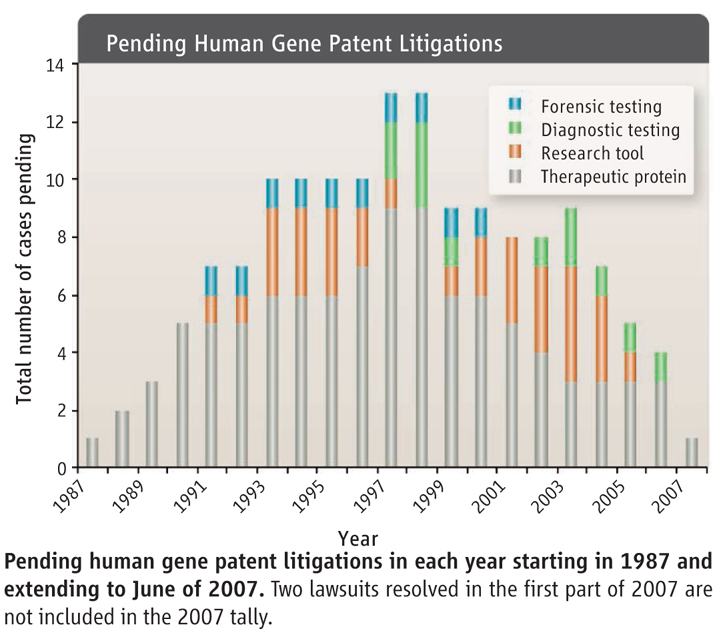
(Holman, Science 322: 198-99 (2008)). Dr. Holman observed that this decline corresponds to a similar marked decline in the filing and issuance of DNA patents in the U.S since 2001.
Dr. Holman begins his article by stating that "[f]ew human gene patents have ever been asserted in court, so any chilling effect [of such patents] arises primarily from a perception of risk that may not comport with reality." His results, however, indicate that if gene patenting critics are worried about the chilling effect of human gene patent litigation, such fears are unfounded. Moreover, with respect to Congressman Becerra's attempts to ban gene patenting, Dr. Holman argues that the results of his analysis "provide little empirical support for a legislative bar to the patenting of genes or DNA."
Patent Docs thanks Dr. Larry Millstein of Holland & Knight for alerting us to the above article.
 Patent Docs