• CalendarJanuary 12-13, 2009 – Pharmaceutical and Biotech Patent Opinion Writing*** (American Conference Institute) – San Diego, CA

    January 20-21, 2009 – Bio/Pharmaceutical Summit on Legal and Regulatory Product Lifecycle
    Strategies
    *** (Center for Business Intelligence) – Baltimore, MD

    January 26-27, 2009 – Structuring and Negotiating Pharma & Biotech Collaborative Agreements (C5) – London, England

    January 27-28, 2009 – ITC Litigation (American Conference Institute)*** – Washington, DC

    January 28-29, 2009 – 6th National Conference on Pharma/Biotech IP Due Diligence (American Conference Institute) – New York, NY

    January 29-30, 2009 – Commercialization of Life Sciences Inventions (Law Seminars International) – Phoenix, AZ

    January 29-30, 2009 – Fourth Annual Conference on Best Practices in Patent Monetization (Law Seminars International) – San Francisco, CA

    February 13, 2009 – Fourth Annual Workshop on Patent Claim Construction (Law Seminars International) – Chicago, IL

    February 17-18, 2009 – Pharma/Biotech Patent Litigation (C5) – Amsterdam, Netherlands

    February 23-24, 2009 – Pharmaceutical and Biotech Patent Claim Drafting*** (American Conference Institute) – Palo Alto, CA

    February 25-26, 2009 – Optimizing Patent Strategies at Patent Forum 2009 (World Research Group) – San Francisco, CA

    March 9-10, 2009 – Pharmaceutical and Biotech Patent Claim Drafting*** (American Conference Institute) – Research Triangle Park, NC

    March 30-31, 2009 – Pharmaceutical and Biotech Patent Claim Drafting*** (American Conference Institute) – New York, NY

    ***Patent Docs is a media partner of this conference or CLE

  •     By Donald Zuhn

    In November, we noted that the nation's largest mail order pharmacy, Franklin Lakes, NJ-based Medco Health Solutions, Inc., had announced that consumers could expect to see the establishment of a follow-on biologics regulatory pathway in the United States by 2011 (see "Medco Predicts Follow-on Biologics Regulatory Pathway by 2011").  Medco also announced that if Congress could meet such a timeline, more than $34 billion worth of biogeneric drugs could become available in this country between 2013-2017 (the company's calculations included a two-year interval for follow-on biologics to become available after innovator patent rights expire).

    Teva
    Last week, Reuters reported that Teva North America CEO Bill Marth predicted that there was a "very good chance" Congress would pass a follow-on biologics bill in 2009.  Despite the looming economic crisis — or perhaps as a result of it — the Reuters report noted that many "industry observers" see passage of a follow-on biologics bill as a way for President-elect Obama to cut healthcare spending.  Mr. Marth cautioned, however, that passage of a follow-on biologics bill would depend on which issues the Obama Administration would decide to attack first.

    Mr. Marth acknowledged that passage of the bill would require that generic and innovator companies come to some resolution on an appropriate exclusivity period, which he called the "toughest [issue] to negotiate."  Mr. Marth asserted that generic companies, like Teva, support a seven-year period while innovator companies support a fourteen-year period.  As we reported in November, Teva provided financial backing for a study that concluded that an exclusivity period of seven years would be "sufficient for maintaining strong incentives to innovate while fostering a competitive marketplace" (see "Former House Ways and Means Economist Claims 7-Year Data Exclusivity Period Is Sufficient").  We also reported last summer that the Biotechnology Industry Organization (BIO) indicated that either H.R. 1956 (providing fourteen years of exclusivity), H.R. 5629 (providing twelve years of exclusivity), or S. 1695 (also providing twelve years of exclusivity) would "come close" to striking a balance between meaningful cost savings for biologics spending and providing needed protections for innovator drug makers (see "CBO Releases Report on Senate Follow-on Biologics Bill; BIO Calls for Congress to Pass Biologics Bill in 2008").

  •     By Donald Zuhn

    FireworksReflecting upon the events of the past twelve months, Patent Docs presents its second annual list of top biotech/pharma stories.  For 2008, we identified a baker's dozen of top stories covered on Patent Docs.  Today we will count down stories #13 to #10.  On Sunday, we will present stories #9 to #6, and on Monday, we will count down the top five stories.  As with last year's list, links to our coverage of these stories (as well as a few links to articles on related topics) have been provided in case you missed the articles the first time around or wish to go back and have another look.  As always, we love to hear from Patent Docs readers, so if you think we left something off the list or disagree with our rankings, please let us know.


    #13 — Pharma Patent Injunctions in View of Amgen v. F. Hoffmann-La Roche
    Amgen
    In the fall of 2007, a jury returned verdicts in Amgen Inc. v. F. Hoffmann-La Roche Ltd., finding five of Amgen's patents not invalid and three of these patents infringed by Roche's Mircera®, a form of recombinant EPO that has been covalently linked to polyethylene glycol.  The District Court for the District of Massachusetts entered a preliminary injunction in February preventing Roche from putting Mircera® on the market.  In granting the injunction, the Court found that Amgen had satisfied all but the public interest prong of the classic four-factor test discussed in eBay Inc. v. MercExchange, L.L.C.  The District Court struggled with the public interest prong of the test, in view of Roche's argument that the public interest was served, at least in part, by the presumed reduced price that would ensue from competition between Mircera® and Amgen's Epogen® and Aranesp® products.  The Court, expressly refraining from entering any findings on the fourth prong, left open the possibility that the injunction could be modified under a handful of conditions.  Roche agreed to the Court's conditions, but Amgen did not, and the Court subsequently appointed a special master to consider the question of how dosing and pricing of Amgen's and Roche's products should be compared.  Roche responded to the Court's appointment of the special master by filing a Notice of Appeal.  On October 2nd, the Court issued a 150-page opinion in the case, handing victory to Amgen, and eight days later, the Federal Circuit affirmed the preliminary injunction without opinion.

    For information regarding this and other related topics, please see:

    • "Amgen v. Hoffmann-LaRoche: Remaining Issues," October 13, 2008
    • "Amgen v. Hoffmann-LaRoche: Back to the District Court," October 10, 2008
    • "Victory for Amgen in District Court Decision – Part III," October 9, 2008
    • "Victory for Amgen in District Court Decision – Part II," October 8, 2008
    • "Victory for Amgen in District Court Decision – Part I," October 6, 2008
    • "BIO Submits Amicus Brief in Amgen v. Hoffman-LaRoche," July 7, 2008
    • "How to Avoid a Permanent Injunction: The Lessons of Amgen v. Hoffmann-LaRoche," April 28, 2008
    • "Glasses Half-full or Half-empty: Hoffman-LaRoche's Different Interpretation of Pfizer v. Teva," April 15, 2008
    • "Hoffmann-LaRoche Can't Wait, Files Notice of Appeal to the Federal Circuit," April 11, 2008
    • "Will the Federal Circuit's Pfizer v. Teva Decision Spell the End of Amgen's Patent Rights to Recombinant Human Erythropoietin?" March 31, 2008
    • "Court Still Cannot Decide on Amgen's Permanent Injunction," March 26, 2008
    • "Amgen Inc. v. International Trade Commission (Fed. Cir. 2008)," March 20, 2008
    • "Roche Agrees to Court's Conditions for Modifying Preliminary Injunction," March 20, 2008
    • "Roche's Mircera® Remains Off the Market (For Now)," March 2, 2008


    #12 — International Enforcement of Drug Patents

    Thailand Flag
    Last year, drug pricing and compulsory licensing in the developing world took the #10 spot on our list of top stories.  The fact that this story dropped two places on this year's list should not, however, be taken to mean that developing countries and the pharmaceutical industry have reached accord regarding this issue.  For example, in February, Novartis responded to Thailand's threats to issue a compulsory license by agreeing to supply its cancer drug Gleevac® (imatinib mesylate) at no cost to Thai patients — provided that the Thai gvernment did not issue any compulsory licenses.  One month later, Thailand instead announced that it would maintain its compulsory licensing policy for Gleevac® as well as three other anti-cancer drugs (Novartis' Letrozole®, Sanofi-Aventis' Docetaxel®, and Roche's Erlotinib®).  The use by developing countries of tools provided in international agreements such as GATT, TRIPS, and the Doha Declaration (e.g., compulsory licensing and parallel importing) will no doubt continue to be a hotly debated in 2009.

    For information regarding this and other related topics, please see:

    • "Recent Developments in Pharmaceutical Patenting and Compulsory Licensing of Pharmaceutical Patents in Developing Countries," July 8, 2008
    • "Congressmen Criticize U.S. Trade Representative over Special 301 Report," July 1, 2008
    • "U.S. Continues Efforts to Protect Patent Rights Abroad," April 29, 2008
    • "Thailand Continues Its Compulsory Licensing Practices," March 11, 2008
    • "Indian Generic Drug Maker Seeks to Invalidate Cancer Drug Patent," February 29, 2008
    • "Novartis to Supply Cancer Drug to Thai Patients," February 5, 2008

    #11 — Greater Cooperation between Patent Offices
    USPTO Seal
    When your backlog of unexamined applications rises from 760,924 to 771,529, as it did for the USPTO in 2008, you should be searching for all reasonable ways to reduce that backlog.  Last year, the USPTO attempted to address its application backlog by focusing on the development of a number of worksharing programs with foreign patent offices.  In particular, the USPTO expanded its Patent Prosecution Highway (PPH) program to include pilots with the Canadian Intellectual Property Office (CIPO), Korean Intellectual Property Office (KIPO), IP Australia (IPAU), European Patent Office (EP), and Danish Patent and Trademark Office (DKPTO); extended its PPH pilot program with the CIPO; entered into an agreement with IPAU, in which the IPAU will act as an International Searching Authority (ISA) and International Preliminary Examining Authority (IPEA) for certain International applications filed with the USPTO Receiving Office; added the KIPO as a participating foreign patent office in the Priority Document Exchange (PDX) system; initiated the "Triway" worksharing program between the USPTO, EPO, and JPO; initiated the "New Route" worksharing program with the JPO; announced a new worksharing initiative with the KIPO, EPO, JPO, and State Intellectual Property Office of the People's Republic of China (SIPO); and released information about a Common Application Format (CAF) that arose out of an agreement between the USPTO, EPO, and JPO at the 25th Annual Trilateral Conference.

    For information regarding this topic, please see:

    • "Patent Prosecution Highway Pilot with CIPO Is Extended," December 23, 2008
    • "Additional Application Types Eligible for Participation in PPH Between USPTO and EPO," December 11, 2008
    • "'Blueprint' Announced for Work Sharing Initiative Between Five IP Offices," November 6, 2008
    • "IP Australia Now Competent ISA for PCT Applications Received by USPTO," November 3, 2008
    • "Patent Prosecution Highway Pilot Program Between U.S. and Danish Patent Offices," October 29, 2008
    • "KIPO Becomes Participating Foreign Office in PDX Program," October 21, 2008
    • "Online Priority Document Exchange Service Between USPTO and KIPO," October 9, 2008
    • "USPTO and JPO Sign Statement of Enhanced Mutual Cooperation," September 29, 2008
    • "IP Australia to Provide International Search and Examination Services for Certain PCT Applications," September 29, 2008
    • "Patent Prosecution Highway Expands to Europe," September 25, 2008
    • "USPTO and KIPO Sign Memoradum on Cooperative Patent Examination," September 24, 2008
    • "USPTO and UKIPO Extend Patent Prosecution Highway Pilot Program," September 3, 2008
    • "PTO Announces 'Triway' Pilot Program," July 15, 2008
    • "Docs at BIO: Representatives from JPO, EPO, SIPO, and USPTO Discuss Recent Developments in Japan, Europe, China, and the U.S.," June 22, 2008
    • "USPTO and EPO to Implement Pilot Patent Prosecution Highway Program," April 29, 2008
    • "Patent Office Announces Common Application Format," April 28, 2008
    • "Patent Prosecution Highway Extended to IP Australia," April 2, 2008
    • "Patent Prosecution Highway Network Expands to Canada & Korea," January 29, 2008
    • "'New Route' Created between USPTO and JPO," January 25, 2008
    • "USPTO Announces Two Additional Partners in the Patent Prosecution Highway Pilot Program," January 17, 2008

    #10 — USPTO's PTA Calculations Called into Question

    Wyeth
    On September 30th, the District Court for the District of Columbia issued a decision in Wyeth v. Dudas that could eventually impact the manner in which Patent Term Adjustment (PTA) determinations are made.  In particular, the Court granted summary judgment in favor of Wyeth, determining that the USPTO had misconstrued 35 U.S.C. § 154(b)(2)(A), and as a result, had denied Wyeth a portion of patent term to which it was entitled.  Less than a month later, USPTO Director Jon Dudas filed a Notice of Appeal in the District Court for the District of Columbia, appealing the Court's decision in Wyeth to the United States Court of Appeals for the District of Columbia Circuit, thus indicating how the Office would rule on requests for reconsideration being filed by patentees that had been similarly deprived of patent term.  Having no other recourse under 35 U.S.C. § 154(b)(4)(A), which requires patentees to file actions seeking corrected PTA determinations within 180 days of a patent's issuance, Napo Pharmaceuticals, Inc.; Ironwood Pharmaceuticals, Inc.; Solvay Pharmaceuticals GmbH; Biogen Idec Inc.; Purac Biochem B.V.; and Molecular Insight Pharmaceuticals, Inc. all followed Wyeth's lead by filing lawsuits against Director Dudas this fall.

    For information regarding this topic, please see:

    • "More Patentees Follow Wyeth's Lead in Seeking Additional PTA," December 3, 2008
    • "USPTO to Appeal Wyeth v. Dudas," December 2, 2008
    • "Two Patentees Follow Wyeth's Lead in Seeking Additional PTA," November 12, 2008
    • "Wyeth v. Dudas (D.D.C. 2008)," October 16, 2008

  •     By Donald Zuhn

    Earlier this month, we reported on the lobbying efforts of nine biotech/pharma companies and organizations in the third quarter of 2008 (see "Biotech/Pharma Lobbying Scoreboard – Third Quarter Update; BIO Lobbies for Biotech 'Bailout'").  Recent news reports have allowed us to add thirteen biotech/pharma companies and a trade group to the list:

    PhRMA #2
    • The Pharmaceutical Research and Manufacturers of America (PhRMA), which has more than 30 members including Bristol-Myers Squibb Co., GlaxoSmithKline PLC, Johnson & Johnson, Merck & Co., Novartis Corp., Pfizer Inc., and Sanofi-Aventis SA, spent more than $5.4 million on third quarter lobbying (see Forbes.com report).  According to organization's October 20 filing with the House clerk's office, the trade group's lobbying efforts were directed in part at patent reform and follow-on biologics legislation.  The group's filing also indicates that current PhRMA president and chief executive, and former Louisiana Representative, Billy Tauzin; Mimi Kneuer, former chief of staff to Rep. Tauzin; Amy Efantis, former legislative director for Rep. Artur Davis (D-AL); Valerie Jewett, former legislative director for Rep. Rodney Frelinghuysen (R-NJ); and Matt Sulkala, former senior legislative assistant to Rep. Allen Boyd (D-FL), lobbied on behalf of the PhRMA.

    Lilly
    • Eli Lilly and Co. spent more than $3.3 million on third quarter lobbying (see Yahoo! Finance report).  According to Lilly's October 14 filing with the House clerk's office, the drugmaker's lobbying efforts were directed in part at patent reform legislation and international patent enforcement.

    Pfizer
    • Pfizer Inc. spent almost $3.1 million on third quarter lobbying (see Forbes.com report).  According to Pfizer's October 27 filing with the House clerk's office, the drugmaker's lobbying efforts were directed in part at patent reform legislation, free trade issues, and tax credits for companies investing in drug research and development.

    GlaxoSmithKline - GSK
    • GlaxoSmithKline spent nearly $2 million on third quarter lobbying (see Forbes.com report).  According to GSK's October 20 filing with the House clerk's office, the drugmaker's lobbying efforts were directed in part at patent reform and follow-on biologics legislation as well as patent provisions of free-trade agreements with Peru, Colombia, Panama, and South Korea.  The company's filing also indicates that Jeffrey Ringer, former legislative aide for Rep. Mary Fallin (R-OK), Sen. Elizabeth Dole (R-NC), and former Sen. Conrad Burns (R-MT), lobbied on behalf of GSK.

    Abbott A
    • Abbott Laboratories spent almost $1.8 million on third quarter lobbying (see Forbes.com report).  According to Abbott's October 20 filing with the House clerk's office, the drug and medical device maker's lobbying efforts were directed in part at patent reform legislation.  The company's filing also indicates that Karen Hauda, former senior director with the U.S. Trade Representative's office, lobbied on behalf of Abbott.

    Johnson & Johnson
    • Johnson & Johnson spent $1.5 million on third quarter lobbying (see Motley Fool report).  According to Johnson & Johnson's October 17 filing with the House clerk's office, the health care company's lobbying efforts were directed in part at patent reform and follow-on biologics legislation.

    Novartis
    • Novartis AG spent nearly $1.4 million on third quarter lobbying (see Netscape Money & Business report).  According to Novartis' October 17 filing with the House clerk's office, the pharmaceutical company's lobbying efforts were directed in part at patent reform and follow-on biologics legislation as well as patent provisions of free-trade agreements with Peru, Colombia, and South Korea.

    Merck
    • Merck & Co. Inc. spent $1.11 million on third quarter lobbying (see Forbes.com report).  According to Merck's October 17 filing with the House clerk's office, the drugmaker's lobbying efforts were directed in part at patent reform legislation and international protection of drug patents.

    Bristol-Myers Squibb #2
    • Bristol-Myers Squibb Co. spent $840,000 on third quarter lobbying (see Forbes.com report).  According to BMS' October 16 filing with the House clerk's office, the pharmaceutical company's lobbying efforts were directed in part at patent reform and follow-on biologics legislation.

    Wyeth
    • Wyeth spent $756,650 on third quarter lobbying (see Forbes.com report).  According to Wyeth's October 20 filing with the House clerk's office, the drug and medical pharmaceutical company's lobbying efforts were directed in part at follow-on biologics legislation.

    Emergent Biosolutions
    • Emergent BioSolutions Inc. spent $575,000 on third quarter lobbying (see Forbes.com report).  According to Emergent's October 17 filing with the House clerk's office, the biopharmaceutical company's lobbying efforts were directed in part at government stockpiling of biodefense vaccines.

    Allergan
    • Allergan Inc. spent $460,000 on third quarter lobbying (see Forbes.com report).  According to Allergan's October 19 filing with the House clerk's office, the biotech company's lobbying efforts were directed in part at follow-on biologics legislation.

    Covidien
    • Covidien Ltd. spent $450,000 on third quarter lobbying (see Forbes.com report).  According to Covidien's October 20 filing with the House clerk's office, the health care products company's lobbying efforts were directed in part at patent reform legislation.

    Gilead Sciences
    • Gilead Sciences Inc. spent $240,000 on third quarter lobbying (see MSN Money report).  According to Gilead's October 27 filing with the House clerk's office, the biotech drug maker's lobbying efforts were directed in part at global health and international trade issues.

    In addition, a report indicates that the U.S. Chamber of Commerce, which represents more than three million businesses in a wide array of industries, spent $20.6 million on third quarter lobbying (see Forbes.com report).  According to organization's October 20 filing with the House clerk's office, the group's lobbying efforts were directed in part at health care and labor issues.  The Chamber of Commerce filing also indicates that Kai Hirabayashi, a former special assistant in the Labor Department; Jennifer Osika, former senior legislative assistant to Rep. Don Manzullo (R-IL); and Becky Fraser, former senior legislative assistant to Rep. Cass Ballenger (R-NC), lobbied on behalf of the group.

    In response to our most recent report on biotech/pharma lobbying, a Patent Docs reader inquired about the lobbying costs of IT companies and organizations, which unlike their biotech/pharma counterparts, have favored more "radical" patent reform.  An online search revealed that a number of IT companies and organizations disclosed significant third quarter lobbying expenditures, including:

    • Comcast Corp. — $3.2 million (see Forbes.com report)
    • Microsoft Corp. — $2 million (see Forbes.com report)
    • SAP AG — $880,000 (see Yahoo! Finance report)
    • Google Inc. — $720,000 (see Yahoo! Finance report)
    • Yahoo Inc. — $570,000 (see International Business Times report)
    • Consumer Electronics Association (CEA), a trade group that includes Dell Inc., Microsoft Corp., and Best Buy Co. — $440,000 (see Yahoo! Finance report)
    • Digital Media Association, a trade group that includes Apple Inc., Viacom Inc., and Microsoft Corp. — $251,413 (see Forbes.com report)

    Among the IT entities specifically disclosing that their third quarter lobbying expenses were directed in part at patent reform legislation were Microsoft, Google, and Yahoo.

    For additional information regarding this topic, please see:

    • "Biotech/Pharma Lobbying Scoreboard – Third Quarter Update; BIO Lobbies for Biotech 'Bailout'," December 19, 2008
    • "Biotech/Pharma Lobbying Scorecard – Second Quarter Update – Part II," September 12, 2008
    • "Biotech/Pharma Lobbying Scoreboard – Second Quarter Update," August 21, 2008
    • "Biotech/Pharma Lobbying Scoreboard – Part II," June 30, 2008
    • "Biotech/Pharma Lobbying Scoreboard" June 6, 2008
    • "Lobbying Spending Spree Continues," May 20, 2008
    • "Abbott's First Quarter Lobbying Tab Hits $880,000," May 2, 2008

  •     By Kevin E. Noonan

    There are the inklings of a stratagem taking shape in certain of the Federal Circuit's decisions since the spate of Supreme Court rejections of large portions of its jurisprudence.  That stratagem involves refusing to overturn district court decisions based on applying an abuse of discretion standard, as evidenced in the Federal Circuit's decision to affirm grant of a permanent injunction in Acumed LLC v. Stryker Corp.

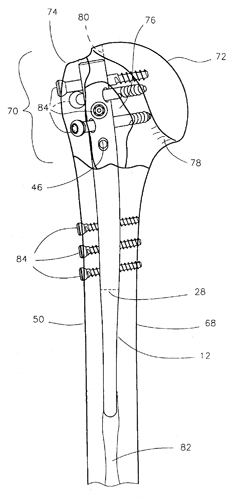
    The case involved a patent to an orthopedic nail used to reconstruct and stabilize a broken humerus.  The CAFC previously vacated a permanent injunction granted prior to the Supreme Court's decision in eBay Inc. v. MercExchange, L.L.C., which mandated that the traditional "four factor" test for granting injunctions was to be applied in patent cases.  This mandate overruled the Federal Circuit's "general rule [in patent cases] that an injunction will issue, once infringement and validity have been adjudged . . . unless there are some exceptional circumstances that justify denying injunctive relief."  Thus, the District Court revisited the issue based on a proper application of the law and arrived at the same conclusion.

    Acumed
    In making its determination that a permanent injunction was permissible in this case, the District Court considered together the four-factor test prongs of whether there was irreparable harm to patentee Acumed and whether the remedy at law (money damages) was adequate compensation as a remedy.  Stryker presented evidence that Acumed previously had granted licenses for the patent-in-suit (U.S. Patent No. 5,472,444) to two other competitors, Smith & Nephew and Zimmer.  The District Court distinguished this behavior on the grounds that, first, Acumed had granted the Smith & Nephew license to settle litigation, and second, that Zimmer was not direct competitor when Acumed granted it a license.

    Federal Circuit Seal
    The Federal Circuit, in a unanimous opinion written by Judge Lourie and joined by Judges Mayer and Gajarsa, found none of this to be an abuse of discretion.  The Court asserted that eBay itself stated that a patentee's willingness to license patents to others was not sufficient by itself to preclude a determination that a patentee would be irreparably harmed or that money damages would be an insufficient remedy.  The Court asserted that prior licenses were but one factor a court could consider in deciding whether the evidence favored vel non grant of a permanent injunction.  "Adding a new competitor to the market may create an irreparable harm that the prior licenses did not," according to the Court.  In a footnote, the Court noted that it did not consider whether an injunction would be appropriate in other circumstances where a patentee had granted licenses to third parties, thus avoiding creation of any per se rules in this regard.

    FIG4
    Regarding the balance of the hardships, the District Court was persuaded by Acumed's evidence that Stryker had available a non-infringing alternative (a straight rather than a curved humeral nail), and that Stryker was the world's largest orthopedic implant company (so sales of its infringing humeral nail were only a small portion of its sales, whereas the Acumed nail was its flagship product).  The District Court rejected Stryker's argument that a permanent injunction would cause harm to itself, its customers and patients, as well as Stryker's argument that Acumed would benefit from receiving a royalty, since it would gain access to Stryker's "otherwise inaccessible" customers.  The Federal Circuit found none of the District Court's reasoning to be error or an abuse of discretion.  Stryker's evidence of the expense incurred in designing and marketing were irrelevant to the hardships determination, according to the CAFC, because "[o]ne who elects to build a business on a product found to infringe cannot be heard to complain if an injunction against continuing infringement destroys the business so elected," citing Windsurfing Int'l. Inc. v. AMF, Inc., 782 F.2d 995, 1003 n.12 (Fed. Cir. 1986).  The Federal Circuit also found no abuse of discretion in the District Court's determination that Stryker's failure to introduce into the U.S. a straight-nail embodiment of its humeral nail was a business decision that did not tip the balance of hardships in Stryker's favor. 

    Stryker
    For the fourth factor, the public interest, the District Court found that this factor did not mitigate against the permanent injunction.  Stryker argued that its infringing humeral nail was "demonstrably safer and superior" to Acumed's product, citing trial testimony from five expert witnesses.  Stryker also contended that Acumed's product had specific deficiencies compared with its infringing product.  The District Court found that Stryker had not established "sufficient objective evidence of any public health issue" that would turn the public interest prong of the four-factor test in its favor.  The lower court also noted that "there was 'considerable dispute at trial' whether Stryker's evidence was the product of biased experts."  Finally, the District Court found that there were non-infringing alternatives to Acumed's product (ironically, the Zimmer and Smith & Nephew licensed products) available to satisfy any portion of the market Acumed was incapable of serving, so that patients would not be harmed by the injunction.  The Federal Circuit credited all these decisions as being within the sound discretion of the trial court, and found none of them to be an abuse of discretion.

    Perhaps it is the proper role of an appellate court to defer so assiduously to the decisions made by a district court that rely heavily of factual determinations depending on the demeanor and believability of witnesses, live testimony, and trial advocacy relating thereto.  And perhaps it has been the tendency of the Federal Circuit in many areas, most notably claim construction, to refuse to so defer, or to provide reasoning supporting its lack of deference (such as its Congressionally-mandated role of providing consistency and harmony to patent law) that makes it appear unusual that the Federal Circuit is so compliant with regard to the district court's assessment and balancing of the evidence in granting the injunction.  An inescapable consequence of this compliance, however, is that Federal Circuit also avoids any substantive decision-making in affirming the injunction, based on an abuse of discretion standard it defines as "a clear error of judgment in weighing relevant factors or exercised its discretion based upon an error of law or clearly erroneous factual findings."  Using this standard makes it less likely that there will be any readily-reviewable basis for the Supreme Court to grant certiorari in a case like this.  Avoiding another opportunity for its jurisprudence to be overruled may be all the justification the CAFC needs to be deferential for a while.

    Acumed LLC v. Stryker Corp. (Fed. Cir. 2008)
    Panel: Circuit Judges Mayer, Lourie, and Gajarsa
    Opinion by Circuit Judge Lourie
  •     By Donald Zuhn

    Congressional Budget Office
    Earlier this month, the Congressional Budget Office (CBO) issued a report, entitled "Budget Options, Volume I, Health Care," that presents 115 options for changing U.S. health care policy.  In the Preface to the report, the CBO states that "[t]he inclusion or exclusion of a particular policy change does not represent an endorsement or rejection" by the CBO, and that the report provides arguments for and against each option.  The report's Preface also notes that in keeping with the CBO's mandate to provide objective analysis, the report makes no recommendations.

    Option 68 of the report provides a discussion regarding the establishment of an abbreviated regulatory pathway for approving follow-on biologics under the Public Health Service Act.  Under such a regulatory scheme, manufacturers seeking FDA approval for generic biologic drugs (often referred to as follow-on biologics or biosimilars) would be allowed to rely on clinical data and information submitted by manufacturers of brand-name biologics during the approval process of the brand-name biologic.  The report states that:

    By streamlining the approval process, multiple manufacturers of follow-on biologics would be likely to enter the market, particularly for top-selling products; such competition would put downward pressure on prices and help lower expenditures on biologic products for both the federal government and private purchasers of health insurance.

    Interestingly, despite the controversy between generic and brand-name manufacturers concerning the issue of data exclusivity, the CBO report simply states that its follow-on biologics option "would grant brand-name biologics 12 years of exclusivity during which time no follow-on biologic could be approved."  The report also indicates, not surprisingly, that data exclusivity periods of more than 12 years would reduce estimated savings, and data exclusivity periods of less than 12 years would increase estimated savings.  

    The CBO report also outlines a modified version of its follow-on biologics option in which the Centers for Medicare and Medicaid Services would be required to place follow-on biologics in the same billing code as their brand-name counterparts for making payments under Medicare Part B.  The report notes that such a modification "would financially penalize physicians who did not dispense follow-on biologics, when available, to patients enrolled in Medicare Part B," explaining that because reimbursements to physicians would be based on the average cost of the brand-name drug and all follow-on biologic counterparts, physicians would not receive full reimbursement for prescribing brand-name drugs (assuming that such drugs would be priced higher than their generic counterparts).  Moreover, under such a scheme, "physicians would benefit financially from using follow-on biologics because they would be less expensive and physicians would be allowed to retain the difference between the acquisition cost of the biologic and Medicare's payment."

    The report predicts that implementation of a follow-on biologics regulatory scheme would save health programs such as Medicare and Medicaid about $8.1 billion over the 2010–2019 period, as well as reduce costs for private health insurance plans and lower insurance premiums for employers by almost 0.2% by 2019.  However, if the modification discussed above was also implemented, the report indicates that Medicare and Medicaid savings would increase to $10.6 billion over the 2010-2019 period.

    The report lists the reduction in health care expenditures for both government programs and private payers as an advantage of the follow-on biologics option, and a reduction in returns associated with the development of new biologics, and resulting reduction in investment in the research and development of new biologics, as a "potential" disadvantage.  The report notes, however, that after a regulatory pathway was established for small molecule drugs in 1984, investment in such drugs continued to grow.

    Biotechnology Industry Organization (BIO)
    On December 19th, the Biotechnology Industry Organization (BIO) released a statement regarding option 68 of the CBO report, and in particular, the proposal to modify payments for biologic drugs under Medicare Part B.  According to the BIO release "[t]he CBO estimate is based on a troubling assumption that reimbursement rules for biologics would be changed in a way that would financially incentivize physicians to switch patients to a cheaper follow-on version of a product at the potential expense of patient safety and therapeutic efficacy."  Concluding that "[t]he change would establish a perverse incentive to prescribe the lower-cost biosimilar regardless of efficacy or safety concerns," the BIO release notes that while the industry trade group supports the establishment of a follow-on biologics regulatory pathway, any regulatory scheme "must place ensuring patient safety — not potential cost savings — as the central concern."

    For additional information regarding this and other related topics, please see:

    • "Former House Ways and Means Economist Claims 7-Year Data Exclusivity Period Is Sufficient," November 20, 2008
    • "BU Economics Professor Releases Report on the Impact of Marketing Exclusivity on Biologics Innovation," September 18, 2008
    • "Congressional Fact-finding on Follow-on Biologics," August 13, 2008
    • "CBO Releases Report on Senate Follow-on Biologics Bill; BIO Calls for Congress to Pass Biologics Bill in 2008," July 1, 2008
    • "Follow-on Biologic Drugs and Patent Law: A Potential Disconnect?" March 25, 2008
    • "New Follow-on Biologics Bill Introduced in the House," March 18, 2008
    • "Dr. Robert Shapiro Discusses Follow-on Biologics Report," February 19, 2008
    • "BIO CEO Provides Update on Patent Reform and Follow-on Biologics Legislation – Part II," February 14, 2008
    • "Biologics Legislation Faces Unresolved Issues," December 28, 2007
    • "Senate Committee Passes Biologics Legislation" July 5, 2007

  •     By Sherri Oslick

    Gavel_2About
    Court Report:  Each week we will report briefly on recently filed
    biotech and pharma cases, and a few interesting cases will be selected
    for periodic monitoring.


    Bayer HealthCare LLC v. Abbott Laboratories et al.

    6:08-cv-00507; filed December 24, 2008 in the Eastern District of Texas

    Infringement of U.S. Patent No. 5,654,407 ("Human Anti-TNF Antibodies," issued August 5, 1997) based on Abbott's manufacture and sale of its Humira ® (adalimumab, used to treat rheumatoid arthritis, juvenile idiopathic arthritis, psoriatic arthritis, ankylosing spondylitis, Crohn's disease and plaque psoriasis).  View the complaint here.


    Eli Lilly and Company v. Lupin Pharmaceuticals, Inc. et al.

    3:08-cv-06261; filed December 22, 2008 in the District Court of New Jersey

    Eli Lilly and Company v. Sun Pharmaceutical Industries, Inc. et al.

    3:08-cv-06266; filed December 22, 2008 in the District Court of New Jersey

    The complaints in these cases are substantially identical.  Infringement of U.S. Patent No. 5,023,269 ("3-Aryloxy-3-Substituted Propanamines," issued June 11, 1991) following a Paragraph IV certification as part of defendants' filing of an ANDA to manufacture a generic version of Lilly's Cymbalta® (duloxetine hydrochloride, used to treat depression and generalized anxiety disorder and for the management of diabetic peripheral neuropathic pain and fibromyalgia).  View the Lupin complaint here.


    Sanofi-Aventis U.S. LLC et al. v. Ebewe Pharma GES.M.B.H. NFG.KG

    3:08-cv-06243; filed December 19, 2008 in the District Court of New Jersey

    Infringement of U.S. Patent No. 5,338,874 ("Cis oxalato (trans 1-1,2-cyclohexanediamine) PT(II) Having Optically High Purity," issued August 16, 1994) following a Paragraph IV certification as part of Ebewe's filing of an ANDA to manufacture a generic version of plaintiffs' Eloxatin® (oxaliplatin for injection, used to treat colorectal cancer).  View the complaint here.


    Novartis Corp. et al. v. Teva Parenteral Medicines Inc. et al.

    1:08-cv-00952; filed December 18, 2008 in the District Court of Delaware

    Infringement of U.S. Patent No. 4,939,130 ("Substituted Alkanediphosphonic Acids and Pharmaceutical Use," issued July 3, 1990) following a Paragraph IV certification as part of Teva's filing of an ANDA to manufacture a generic version of Novartis' Reclast® (zoledronic acid injection, once-yearly treatment for postmenopausal osteoporosis).  View the complaint here.


    Novartis Corp. et al. v. Cobalt Laboratories, Inc. et al.

    2:08-cv-06223; filed December 18, 2008 in the District Court of New Jersey

    Infringement of U.S. Patent No. 6,162,802 ("Synergistic Combination Therapy Using Benazepril and Amlodipine for the Treatment of Cardiovascular Disorders and Compositions Therefor," issued December 19, 2000) following a Paragraph IV certification as part of Cobalt's filing of an ANDA to manufacture a generic version of Novartis' Lotrel® (amlodipine besylate/benazepril hydrochloride, used to treat hypertension).  View the complaint here.  [As previously reported in Court Report, Novartis filed suit against Cobalt earlier this year on this same patent based on an ANDA directed to different dosage forms.]

  • CalendarJanuary 3-7, 2009 – 26th Annual National CLE Conference (Law Education Institute) – Vail, CO

    January 12-13, 2009 – Pharmaceutical and Biotech Patent Opinion Writing*** (American Conference Institute) – San Diego, CA

    January 20-21, 2009 – Bio/Pharmaceutical Summit on Legal and Regulatory Product Lifecycle
    Strategies
    *** (Center for Business Intelligence) – Baltimore, MD

    January 26-27, 2009 – Structuring and Negotiating Pharma & Biotech Collaborative Agreements (C5) – London, England

    January 27-28, 2009 – ITC Litigation (American Conference Institute)*** – Washington, DC

    January 28-29, 2009 – 6th National Conference on Pharma/Biotech IP Due Diligence (American Conference Institute) – New York, NY

    January 29-30, 2009 – Commercialization of Life Sciences Inventions (Law Seminars International) – Phoenix, AZ

    January 29-30, 2009 – Fourth Annual Conference on Best Practices in Patent Monetization (Law Seminars International) – San Francisco, CA

    February 13, 2009 – Fourth Annual Workshop on Patent Claim Construction (Law Seminars International) – Chicago, IL

    February 17-18, 2009 – Pharma/Biotech Patent Litigation (C5) – Amsterdam, Netherlands

    February 23-24, 2009 – Pharmaceutical and Biotech Patent Claim Drafting*** (American Conference Institute) – Palo Alto, CA

    February 25-26, 2009 – Optimizing Patent Strategies at Patent Forum 2009 (World Research Group) – San Francisco, CA

    March 9-10, 2009 – Pharmaceutical and Biotech Patent Claim Drafting*** (American Conference Institute) – Research Triangle Park, NC

    March 30-31, 2009 – Pharmaceutical and Biotech Patent Claim Drafting*** (American Conference Institute) – New York, NY

    ***Patent Docs is a media partner of this conference or CLE

  • Chicago #3
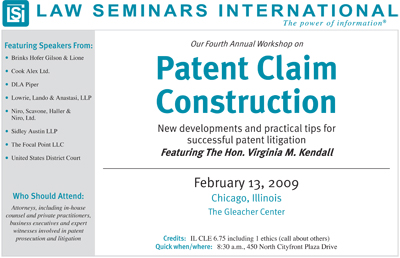
    Law Seminars International (LSI) will be holding its Fourth Annual Workshop on Patent Claim Construction on February 13, 2009 in Chicago, Illinois.  The workshop will provide information on:

    • Review of recent Federal Circuit Court decisions;
    • Evidentiary hearings:  Successful summary judgment motions;
    • Patentee and defendant concerns and strategies in litigation;
    • What is persuasive and what is not in a view from the bench;
    • Ethics rules and practical tips of particular importance in patent claims.

    In particular, LSI's faculty will offer presentations on the following topics:

    Brochure
    • The claim construction game;
    • Claim construction issues on appeal to the Federal Circuit;
    • Litigation strategies from plaintiff and defendant perspectives;
    • Adapting to the changes in the law:  Tips for successful claim and specification drafting to avoid undesired or unpredictable results;
    • View from the bench;
    • The development of claim construction theory and practice;
    • Using demonstrative evidence to help win claim construction disputes; and
    • Ethics.

    The agenda for the Patent Claim Construction workshop can be found here.  A complete brochure for this workshop, including an agenda, list of speakers, and registration form can be downloaded here.

    Law Seminars International
    The registration fee is $447.50 for students and new employees, $695 for government employees, or $895 for all other attendees.  Those interested in registering for the workshop can do so here, by calling 1-800-854-8009, or by faxing a registration form to 1-206-567-5058.

  • San Francisco #2
    World Research Group (WRG) will be holding its Optimizing Patent Strategies at Patent Forum 2009 on February 25-26 in San Francisco, California.  The conference will provide instruction regarding the best practices for creating a comprehensive patent strategy while maintaining a strong IP portfolio, avoiding litigation pitfalls, and managing case law changes.

    Among the presentations to be offered by WRG faculty are:

    Brochure-1
    • Establishing a comprehensive patent strategy from start to finish;
    • Examining your patent strategy to avoid litigation pitfalls;
    • Identifying changes with patent reform in the Supreme Court and the Federal Circuit;
    • Addressing best practices for patent prosecution;
    • Avoiding IP licensing pitfalls;
    • Leveraging involvement in patent pools:  When to do it and when to avoid it;
    • Collaborating with all parties in building a strong patent portfolio;
    • Looking outside the U.S. — Implementing a successful international patent strategy;
    • Redefining obviousness in the post-KSR period:  The implications and impact on litigation; and
    • Understanding Chinese patent strategies.

    The agenda for WRG's Patent Forum 2009 can be found here (Day One; Day Two).  A complete brochure for this conference, including an agenda and list of speakers, can be downloaded here.

    World Research Group
    The registration fee for the conference ranges from $1,895 (corporate rate) to $2,195 (law firm rate).  Those registering by January 9, 2009 will receive a $300 discount off the registration fee.  Those interested in registering for the conference can do so here, by sending an e-mail to info@worldrg.com, by calling 1-800-647-7600 or 1-781-939-2500, or by faxing 1-781-939-2543.