•     By Sherri Oslick

    Gavel_2About
    Court Report:  Each week we will report briefly on recently filed
    biotech and pharma cases, and a few interesting cases will be selected
    for periodic monitoring.

    Eurand Inc. et al. v. Impax Laboratories Inc.
    1:09-cv-00018; filed January 7, 2009 in the District Court of Delaware

    Infringement of U.S. Patent No. 7,387,793 ("Modified Release Dosage Forms of Skeletal Muscle Relaxants," issued July 17, 2008), licensed to Cephalon, following a Paragraph IV certification as part of Impax's filing of an ANDA to manufacture a generic version of Cephalon's Amrix® (cyclobenzaprine hydrochloride, used for relief of muscle spasm associated with acute, painful musculoskeletal conditions).  Complaint currently unavailable.


    Galderma Laboratories, LP et al. v. Paddock Laboratories Inc.

    4:09-cv-00002; filed January 7, 2009 in the Northern District of Texas

    Infringement of U.S. Patent No. 5,972,920 ("Formulation Containing a Carrier, Active Ingredient, and Surfactant for Treating Skin Disorders," issued October 26, 1999) following a Paragraph IV certification as part of Paddock's filing of an ANDA to manufacture a generic version of Galderma's Clobex® (clobetasol propionate, used for the treatment of moderate to severe plaque psoriasis).  View the complaint here.


    OptiGen, LLC v. International Genetics, Inc. et al.

    5:09-cv-00006; filed January 5, 2009 in the Northern District of New York

    Infringement of U.S. Patent Nos. 5,804,388, ("Chromosome 9 and Progressive Rod-Cone Degeneration Disease Genetic Markers and Assays," issued September 8, 1998) and 7,312,037 ("Identification of the Gene and Mutation Responsible for Progressive Rod-Cone Degeneration in Dog and a Method for Testing Same," issued December 25, 2007), licensed to OptiGen, based on International Genetics' sale of its Pawsitive I.D. kit to test for Progressive Rod-Cone Disease in dogs.  View the complaint here.

    Pozen Inc. v. Alphapharm Pty Ltd. et al.
    1:09-cv-00001; filed January 2, 2009 in the District Court of Delaware

    Pozen Inc. v. Alphapharm Pty Ltd. et al.

    6:09-cv-00003; filed January 2, 2009 in the Eastern District of Texas

    The complaints in these cases are substantially identical.  Infringement of U.S. Patent Nos. 6,060,499 ("Anti-migraine Methods and Compositions Using 5-HT Agonists with Long-Acting NSAIDS," issued May 9, 2000) and 6,586,458 ("Methods of Treating Headaches Using 5-HT Agonists in Combination with Long-Acting NSAIDS," issued July 1, 2003), licensed to GlaxoSmithKline, following a Paragraph IV certification as part of Alphapharm's filing of an ANDA to manufacture a generic version of GSK's Treximet® (sumatriptan and naproxen sodium, used to treat migrane attacks).  View the Delaware complaint here.

    Endo Pharmaceuticals Inc. et al. v. Sandoz Inc.
    1:08-cv-00970; filed December 30, 2008 in the District Court of Delaware

    Infringement of U.S. Patent No. 5,958,456 ("Controlled Release Formulation (Albuterol)," issued September 28, 1999) following a Paragraph IV certification as part of Sandoz's filing of an amendment to its ANDA (adding additional dosage forms) to manufacture a generic version of Endo's Opana® ER (oxymorphone hydrochloride, used to treat moderate to severe pain in patients requiring continuous, around-the-clock opioid treatment for an extended period of time).  View the complaint here.

  • Calendar

    January 12-13, 2009 – Pharmaceutical and Biotech Patent Opinion Writing*** (American Conference Institute) – San Diego, CA

    January 20-21, 2009 – Bio/Pharmaceutical Summit on Legal and Regulatory Product Lifecycle
    Strategies
    *** (Center for Business Intelligence) – Baltimore, MD

    January 26-27, 2009 – Structuring and Negotiating Pharma & Biotech Collaborative Agreements (C5) – London, England

    January 27-28, 2009 – ITC Litigation (American Conference Institute)*** – Washington, DC

    January 28-29, 2009 – 6th National Conference on Pharma/Biotech IP Due Diligence (American Conference Institute) – New York, NY

    January 29-30, 2009 – Commercialization of Life Sciences Inventions (Law Seminars International) – Phoenix, AZ

    January 29-30, 2009 – Fourth Annual Conference on Best Practices in Patent Monetization (Law Seminars International) – San Francisco, CA

    February 13, 2009 – Fourth Annual Workshop on Patent Claim Construction (Law Seminars International) – Chicago, IL

    February 17-18, 2009 – Pharma/Biotech Patent Litigation (C5) – Amsterdam, Netherlands

    February 23-24, 2009 – Pharmaceutical and Biotech Patent Claim Drafting*** (American Conference Institute) – Palo Alto, CA

    February 25-26, 2009 – Optimizing Patent Strategies at Patent Forum 2009 (World Research Group) – San Francisco, CA

    March 9-10, 2009 – Pharmaceutical and Biotech Patent Claim Drafting*** (American Conference Institute) – Research Triangle Park, NC

    March 30-31, 2009 – Pharmaceutical and Biotech Patent Claim Drafting*** (American Conference Institute) – New York, NY

    ***Patent Docs is a media partner of this conference or CLE

  •     By Jason Derry —

    Endo to Acquire Indevus

    Endo Pharmaceuticals
    On January 5, 2009, Endo Pharmaceuticals Holdings Inc. announced that it will buy Indevus Pharmaceuticals Inc. for an initial payment of about $370 million and an additional $267 million, based on certain milestones.  Currently, Indevus has marketed products for the treatment of overactive bladder, prostate cancer, hypogonadism, and central precocious puberty.  Indevus also has a number of potential products in its pipeline.  Endo has a number of marketed pain management products.  The acquisition will bolster Endo's sales force and product line.

    Escalon Acquires Hematology Business

    Escalon
    On January 2, 2009, Escalon Medical Corp. announced the acquisition of Immunodiagnostic Systems Holdings' hematology business.  According to the press release, the acquisition will cost Escalon $5.9 million spread over the next four years.

    Roche Licenses Anti-inflammatory Compounds

    Roche
    On December 30, 2008, BusinessWeek reported that Roche has entered a licensing agreement with Synta Pharmaceuticals for certain preclinical anti-inflammatory compounds.  The initial licensing fee is reportedly $25 million in cash.  The deal may be worth more than $1 billion in milestones and royalties if three products emerge to market from the licensed compounds.

    Jason Derry, Ph.D., who graduated with honors from DePaul University
    College of Law, is a molecular biologist and founding author of Patent Docs.
  •     By Christopher P. Singer

    200px-US_CoC_Logo
    Given the recent news of Governor Bill Richardson's withdrawal from consideration as Commerce Secretary, and the impending resignation of U.S. Patent and Trademark Office Director Jon Dudas, the incoming administration may be giving renewed attention and interest to the Department of Commerce and the USPTO in particular.  On December 23, 2008, the U.S. Chamber of Commerce published a report which contains a number of recommendations to the incoming administration about how PTO policies and procedures could be improved.  The report identifies specific issues confronting the USPTO, and eleven goals that should help improve the agency.  For each goal, the report provides several ways in which the incoming administration can implement procedures that could help the USPTO to achieve these goals. 

    One can hope that this report will be considered seriously by the Obama administration, as the list of contributors has gravitas in areas of intellectual property and government administration (as the report notes, the contributors have over 200 years of combined experience with the USPTO).  The contributors include Dana Robert Colarulli, Q. Todd Dickinson, Nicholas P. Godici, Brad Huther, Esther Kepplinger, Michael K. Kirk, Stephen G. Kunin, Gerald J. Mossinghoff, Charles E. Van Horn, and Herbert C. Wamsley.  Perhaps some of these contributors can form the basis of a short list of candidates for the next Director of the USPTO?

    The eleven goals identified in the report are listed below, along with some of the suggested ways in which those goals could be achieved.

    1.  Improve the Quality of U.S. Patents

    To help maintain and improve the quality of the patents issued by the USPTO, the report suggests a number of potential solutions, such as:  (1) introducing fee and order of examination incentives for applicants that participate in (a) pre-search interviews to discuss the content of the application and the search strategy and (b) pre-first action interviews to discuss search results and how they relate to the claimed subject matter; (2) expanding and enhancing PTO-based training programs for examiners; (3) developing a cooperative effort between patent users and the Office to develop models for drafting high-quality patent applications that meet the requirements of patentability, particularly 35 U.S.C. §§ 101 and 112; (4) improving the quality of searching resources to examiners; (5) revising existing methods or developing new methods for measuring examination quality as well as patent quality; (6) reviewing restriction practice and its impact on the backlog and loss of rights for inventors because of increased filing costs; (7) reevaluating the duty of disclosure without forcing new requirements upon applicants; and (8) ensuring that claims are adequately supported by the specification.

    2.  Provide Adequate Resources

    The report concludes that in order to even begin addressing the mounting application backlog, the USPTO needs adequate funding, and advocates for a legislative remedy to end future fee diversion.  The report also suggests that funds raised by increasing user fees, as circumstances require, would provide additional funding for critical new initiatives that could improve the quality and timeliness of application examination.

    3.  Reform the Examiner Production System

    The report states the current production system, unchanged since 1976, is a primary factor creating dissatisfaction among the examining corps.  The report recommends several possible solutions such as (1) reviewing the current system and adjusting the goals so they are more equitably established in light of the relative complexity of various technologies; (2) revising the count system to change the credit given for certain actions, such as reducing credit for continuations, while allowing for more time for first-filed cases; (3) providing more time after final rejection to consider additional amendments and arguments without the need for RCE filings; (4) considering a flat goal awards program; (5) reconsidering counts given in an application, such as whether a first action and disposal should be counted equally, whether other actions should be given a count, and additional counts given for initial patentability determinations; and (6) encouraging pre-search and pre-first action interviews in order to improve efficiency.

    4.  Improve Timeliness of Actions

    To help improve the PTO's timing in issuing administrative actions, the report suggests implementing several actions including:  (1) continuing to hire, train, and retain qualified examiners to address increasing workload demands; (2) identifying the most relevant prior art by:  (a) outsourcing prior art searches to qualified vendors, (b) improving communication and cooperation between foreign examining authorities in corresponding foreign applications, and (c) considering options that would encourage applicants to conduct searches and timely submit search results; (3) expanding the First Action Interview pilot program and the use of First Action Interview pilot program telephone interviews;  (4) recognizing search and/or examination results from first-filing offices; and (5) improving the atmosphere for the examining corps by revising the Second-Pair-of-Eyes Review program.

    5.  Strengthen the Relationship Between the PTO and Users

    The report states that the PTO has in the past few years formulated policies without consideration of any outside input, which has created an atmosphere of distrust between the PTO and its users.  The report recommends that this relationship can be improved by opening the lines of communication to create a more cooperative atmosphere.  Potential solutions include:  (1) clearly stating the problems that the PTO faces and holding public hearings and town hall meetings to allow for public participation in creating solutions to these problems; (2) increasing speaking opportunities for senior level PTO employees to increase awareness of issues and constraints the PTO faces; (3) making use of advance notices of proposed rulemaking when seeking to make significant changes to current practices; and (4) increasing the transparency of PTO operations, including publishing information about application pendency, the number of RCEs, appeals, reexaminations, etc.

    6.  Enhance Organizational Management

    The report also believes that the PTO should be established as a governmental corporate entity, which would help to enable the Office to adjust its operations more quickly and effectively than it can under its current structure as a performance-based organization.

    7.  Appoint a Well-Qualified Undersecretary and Director

    As to Mr. Dudas' future replacement, the report concludes that the PTO's next director should be "a top-caliber, knowledgeable intellectual property executive" with a background and skill set that would include experience in patent and trademark prosecution or litigation, a knowledge of copyright issues, a record of successful leadership and management of a large entity, experience in congressional and international IP policy issues, and experience with strategic planning, budgeting, and financial management.

    8.  Improve the Retention of Patent Examiners

    The report recognizes that simply hiring new examiners will not be sufficient to address the problem of the appl
    ication backlog — the Office has to work harder to retain experienced examiners.  To help retain and develop an experienced examining corps, the report suggests:  (1) reviewing and revising the current production goal system based on complexity of technology and volume of searches; (2) increasing mentoring programs; (3) establishing required meetings among examiners to discuss recent case law and technological developments; (4) improving communication between management and examiners; (5) providing more work flexibility; (6) increasing the number of senior level positions; (7) revising the retirement plan; and (8) reviewing and evaluating hiring and training practices.

    9.  Permit Deferred Patent Examination

    The report suggests that the application backlog would likely be reduced if a system of deferred examination was established.  While deferred examination could introduce public uncertainty about the status of pending applications, the potential benefit of such a system to the backlog as well as applicants would likely outweigh its drawbacks.

    10.  Adjust Fee Schedule

    The report suggests that the fee schedule could be adjusted to provide incentives for a more efficient examination.  Some suggestions include reduced fees for electronic filings; increasing fees for successive continuation or RCE filings; increasing fees for additional independent or total claims; reducing or eliminating multiple dependent claim fees; and charging fees for an IDS that contains more than 25 references or fees for each additional reference above 25 cited in an IDS.

    11.  Enhance Examination Efficiency by Reforming Incentives

    In order to have an efficient patent system, the report states that the PTO should make a patentability determination on an application in as few actions as possible.  The report suggests that the PTO could increase efficiency by analyzing how RCE and continuation filings have impacted the backlog, and more particularly, the motivation examiners and applicants have for making such filings.  If it would benefit efficiency, the report suggests that the PTO could adjust the credit given to examiners for RCE filings, and how to incentivize applicants to accelerate resolutions to pending applications.

    For information regarding other related topics, please see:

    • "BIO Gives President-elect Obama Its Ideas on Patent Reform," January 6, 2009

  •     By Donald Zuhn

    Federal Circuit Seal
    As we reported yesterday, the Federal Circuit heard oral argument today in In re Kubin (see "In re Kubin to Be Argued before the Federal Circuit on Thursday").  Kevin Noonan will be providing a complete analysis of the oral argument in this case in a subsequent post.  One interesting aside, however, involved an exchange between the Court (specifically Circuit Judge Rader) and USPTO Associate Solicitor Janet Gongola regarding Example 11 of the new Written Description Training Materials.

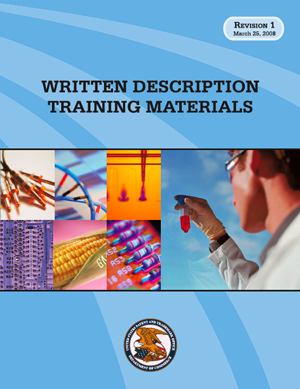
    Written Description Training Materials
    Last March, the Patent Office announced that it had updated the training materials to be used by examiners in the examination of patent applications for compliance with the written description requirement.  The revised training materials replaced the previous set of training materials issued by the Office in 1999.  Perhaps the most interesting of the seventeen examples in the new training materials is Example 11, which concerns claims that are directed to a polynucleotide or polypeptide sequence that shares percent identity with another sequence  (see "An Analysis of the New Written Description Training Materials – DNA Hybridization & Percent Identity").

    Example 11 is divided into two sections, one in which there is no art-recognized structure-function correlation for the claimed sequence (Example 11A), and one in which there is an art-recognized structure-function correlation for the claimed sequence (Example 11B).  Both subparts present identical exemplary claims reciting an isolated nucleic acid that encodes a polypeptide with at least 85% amino acid sequence identity to SEQ ID NO: 2, and nearly identical exemplary claims reciting an isolated nucleic acid that encodes a polypeptide with at least 85% amino acid sequence identity to SEQ ID NO: 2; wherein the polypeptide has a recited activity.  The only difference between the hypothetical specification of Example 11A and the hypothetical specification of Example 11B is that the latter identifies two domains — a binding domain and a catalytic domain — that are critical to the recited activity.  The training materials specify that the first exemplary claim in each subpart satisfies the written description requirement.  The training materials also state that while the second exemplary claim in Example 11B satisfies the written description requirement, the second exemplary claim in Example 11A does not.

    Last June, during a presentation at BIO 2008, Group 1600 Director Dr. George Elliott acknowledged that Example 11 represented a reversal in the Office's position (see "Docs at BIO: Representatives from JPO, EPO, SIPO, and USPTO Discuss Recent Developments in Japan, Europe, China, and the U.S.").  In particular, Dr. Elliott noted that the Office's position had previously been that claims lacking functional language (such as the first exemplary claim in Examples 11A and 11B) failed to comply with the written description requirement and that claims possessing such language (such as the second exemplary claim in Examples 11A and 11B) complied with the requirement.  Dr. Elliott contended that claims with functional language (where the specification lacks any teaching regarding the amino acid residues that are tolerable to change) do not satisfy the written description requirement because "the minute you add function, you've limited the claim to a subset of species, and you don't know which species are in the subset and which species aren't."  In other words, absent any teaching of structure/function relationships, the Patent Office's position is that one cannot determine the species that share at least 85% sequence identity with the recited sequence and also possess the recited function.  For a more thorough discussion of the rationale behind the USPTO's reversal on functional limitations, Dr. Elliott recommended that attendees read Ex parte Porro, which involved an application filed in June of 2003 (for a discussion of the Porro decision, see "The Written Description Training Materials and Ex parte Porro").

    With respect to today's oral argument in Kubin, the Court speculated that the Patent Office may have reversed its position on the fact pattern set forth in Example 11 in order to support its argument that Kubin lacked an adequate written description despite the recitation in claim 73 of an activity limitation (i.e., binding CD48).  A transcript of the exchange between the Court and Associate Solicitor Gongola follows:

    Gongola:  I'd like to move now — if the Court has no more questions on obviousness — into the written description area.  This Court found that written description was not satisfied under the only two tests that Kubin ever raised before the Board:  the representative number of species test and the structure-function correlation test.  Now, the Board found, at Finding of Fact 20 and 21, that the specification only taught how to make cDNA molecules that encode NAIL identically.  That's one subgenus.  The Board found, at Finding of Fact 22, that the specification did not teach anything about any variants.

    Court:  What about the conservative substitutions set forth at page 63?

    Gongola:  The language on conservative substitution, using the Board's own findings, does not demonstrate — Finding of Fact 23 — which 20% of the amino acid residues should be changed to maintain function.  So that discussion of conservative substitution may teach how to make the variants, but it doesn't teach what those variants are.  It doesn't describe them so that a person of skill in the art would understand that Kubin possessed the variants.  There — the Board Finding of Fact 25 says that there are a very large number of modifications that can be made.  One in five amino acids can vary.  We have no idea which of the 21 to 220 — 22 to 221 portion of NAIL to change and maintain binding — which amino acids have to remain and which can be substituted.  But more than that, even if this Court would accept the discussion that the conservative substitution could somehow provide written description support for variants, it wouldn't still do so for the full scope of the genus.  That discussion would only apply to variants made by substitution.  Applicant — Kubin has defined a variant to be made by a substitution, an insertion, or a deletion.  Conservative substitution dialog doesn't speak to anything about variants made by insertions, or variants made by deletions.  So therefore, Applicant Alonso still has — I'm sorry, Kubin . . .

    Court:  Yes, but the description of the variations is also linked to a protein having activity Y.  Therefore, this satisfies the function-structure alternative test for written description, doesn't it?

    Gongola:  No, your Honor.  The function-structure test requires an identification of a structure common to all members of the genus.  We do not have that identification of a common structure.  Twenty percent . . .

    Court:  I'm quoting almost out of PTO's manual on written description — verbatim — when I give my example there, am I not?  The variations plus the activity Y — protein having activity Y — isn't that exactly the PTO's manual on written description?

    Gongola:  Are you referring to the training materials?

    Court:  Yes, I am.

    Gongola:  That language may be found in the training materials, but it is not — it's guidance.  It's — each case of written description has to be decided on its own facts.

    Court:  The Patent Office is guiding applican
    ts on how to do things wrong?

    Gongola:  No, your Honor, but guidance provided in a training document cannot be taken and applied to each case.  Each case has to be decided on its own facts.

    Court:  So it's just guidance to examiners on how to do it wrong?

    Gongola:  No, your Honor — respectfully — it is guidance to the public as well, but . . .

    Court:  But if we take that guidance, we don't get to your result, do we?

    Gongola:  No, your Honor, I respectfully disagree; we do.  In Carnegie Mellon, this Court has explained that when there's substantial variation within a genus, an applicant has to describe a sufficient number of species to reflect the variation.  Kubin has not done that here.  Kubin hasn't described any variation.  If we want to look at the training materials, the Board only . . .

    Court:  It's interesting that this was revised immediately after Kubin — the Kubin result — wasn't it?

    Gongola:  That . . .

    Court:  Which is kind of an admission that the example did track Kubin and was detrimental to your position, wasn't it?

    Gongola:  No, your Honor.

    Court:  So, despite your smiling defense, the facts tend to give us a different conclusion.

    Gongola:  No, your Honor, that's not correct.  The training materials were not revised post-Kubin to somehow capture Kubin.  The revisions have been in the works for a very long time.

    Court:  I see, okay.

    Gongola:  So it's just coincidence that Example 11 may seem to look like the Kubin fact pattern.  But if we actually look at Example 11, it is distinguishable from the facts here.  Example 11 goes to a nucleic acid that encodes a polypeptide that has certain homology — 85% homology — and a certain activity.  Now here's where — that sounds a lot like Kubin's claim.  I agree with that.  But here's where the difference resides:  the specification in Example 11 disclosed two specific domains that were responsible for the activity.  Kubin's specification here doesn't contain any similar disclosure.  So the fact pattern here is different from the fact pattern in the revised training materials.  But I also want you to know — these materials, as you point out, were not even in existence when the Board rendered its decision.  So it really isn't proper to be considering them right now, since the Board didn't have a chance to consider them in the first instance.  And on top of that, they're only guidance.  They're not a rigid rule.

  •     By Kevin E. Noonan

    Federal Circuit Courtroom
    The Federal Circuit will hear oral argument on Thursday for In re Kubin, a case having great significance for biotechnology patenting.  At issue is the question of whether the existence in the prior art of a purified protein, combined with "routine" cloning methods, renders obvious a claim to a nucleic acid encoding the protein.  This was the Patent Office position twelve years ago, which was rejected by the Federal Circuit in the In re Bell and In re Deuel decisions.  But the Supreme Court's KSR Int'l Co. v. Teleflex Inc. decision emboldened the Patent Office to challenge the Federal Circuit on this issue.  As a bonus, the Court will also be asked to opine on how the Office has interpreted its frequently-conflicting written description jurisprudence.

    To recap, the case involved an application claiming an isolated cDNA encoding Natural Killer Cell Activation Inducing Ligand (abbreviated as NAIL).  The Board determined that all the claims would stand or fall together, since they were not argued separately; accordingly, its analysis was confined to claim 73:

    73.  An isolated nucleic acid molecule comprising a polynucleotide encoding a polypeptide at least 80% identical to amino acids 22-221 of SEQ ID NO:2, wherein the polypeptide binds CD48.

    The Board cited three prior art references, including (1) Valiante, which identified the existence of a protein, p38, present on the cell surface of natural killer cells and a monoclonal antibody specific for p38; and (2) Sambrook et al., a standard reference work describing gene cloning techniques (otherwise known as the "Maniatis manual").  The Valiante reference contained a prophetic example to the effect that the gene encoding the p38 protein could be isolated using methods such as those disclosed in Sambrook et al.  The Board considered but did not rely upon a reference to Matthews, which disclosed a mouse protein, 2B4, expressed on the cell surface of natural killer cells (2B4 is the mouse ortholog of human p38 although that was not disclosed in the art).  The Board stated that it found Matthews "cumulative" of the teachings of Valiante and Sambrook et al.; nevertheless, it used this reference as an "illustration" of how a gene could be isolated.  The evidence from the applicants' specification was that their NAIL cDNA clones were produced using an expression library screened with a commercially-available monoclonal antibody against human p38.

    The Board based its factual determinations on the notion that the art had progressed since the time Deuel was decided.  These differences included:

    1.  In Kubin, a cell "unambiguously" (see below) expressing the gene was known; in Deuel, the cloned gene was isolated from a cDNA library prepared from placenta, even though the protein encoded thereby was expressed specifically in brain.

    2.  In Kubin, the art provided an isolated preparation of the cognate protein and a monoclonal antibody that binds to the protein; in Deuel, the art disclosed isolated preparations of three different brain-specific proteins but no antibodies.

    3.  In Kubin, the art provided a monoclonal antibody specific for the gene product of the desired cDNA and thus providing a specific probe; in Deuel, the probes were a plurality of degenerate oligonucleotides prepared from the partial amino-terminal amino acid sequences.

    4.  In Kubin, the art has developed expression cloning technology and provided an antibody probe specific for the gene product of the desired clone; in Deuel, the absence of a specific antibody precluded use of expression cloning technology.

    Even if the Board was correct in considering these factual distinctions, the Board's decision demonstrated that it did not learn the fundamental lesson from the Federal Circuit's decision in Deuel:  that the obviousness of a method for producing a cloned nucleic acid is not sufficient to render obvious the cDNA itself.  Rather, the Board attempted to apply the Supreme Court's statements from KSR regarding the obviousness of what is "obvious to try."  Expressly citing the Supreme Court's language:

    When there is motivation to solve a problem and there are a finite number of identified, predictable solutions, a person of ordinary skill has good reason to pursue the known options within his or her technical grasp.  If this leads to anticipated success, it is likely the product not of innovation but of ordinary skill and common sense.  In that instance the fact that a combination was obvious to try might show that it was obvious under § 103.  KSR Int'l Co. v. Teleflex Inc., 127 S. Ct. 1727, ___, 82 USPQ2d 1385, 1397 (2007).

    the Board opined, "[t]his reasoning is applicable here."  The Board then went on to state:

    The "problem" facing those in the art was to isolate NAIL cDNA, and there were a limited number of methodologies available to do so.  The skilled artisan would have had reason to try these methodologies with the reasonable expectation that at least one would be successful.  Thus, isolating NAIL cDNA was "the product not of innovation but of ordinary skill and common sense," leading us to conclude NAIL cDNA is not patentable as it would have been obvious to isolate it.

    Using this reasoning as its basis, the Board showed its willingness to continue to conflate whether the method for making a cDNA such as the NAIL cDNA would be obvious with the obviousness of the cDNA itself.  This is consistent with the reasoning, and the mistakes, made by the Board in Deuel:

    The PTO's focus on known methods for potentially isolating the claimed DNA molecules is also misplaced because the claims at issue define compounds, not methods.  See In re Bell, 991 F.2d 781, 785, 26 USPQ2d 1529, 1532 (Fed. Cir. 1993).  In Bell, the PTO asserted a rejection based upon the combination of a primary reference disclosing a protein (and its complete amino acid sequence) with a secondary reference describing a general method of gene cloning.  We reversed the rejection, holding in part that "the PTO's focus on Bell's method is misplaced.  Bell does not claim a method.  Bell claims compositions, and the issue is the obviousness of the claimed compositions, not of the method by which they are made."  Id.

    We today reaffirm the principle, stated in Bell, that the existence of a general method of isolating cDNA or DNA molecules is essentially irrelevant to the question whether the specific molecules themselves would have been obvious, in the absence of other prior art that suggests the claimed DNAs.  . . .  There must, however, still be prior art that suggests the claimed compound in order for a prima facie case of obviousness to be made out; as we have already indicated, that prior art was lacking here with respect to claims 5 and 7.  Thus, even if, as the examiner stated, the existence of general cloning techniques, coupled with knowledge of a protein's structure, might have provided motivation to prepare a cDNA or made it obvious to prepare a cDNA, that does not necessarily make obvious a particular claimed cDNA.  "Obvious to try" has long been held not to constitute obviousness.  In re O'Farrell, 853 F.2d 894, 903, 7 USPQ2d 1673, 1680-81 (Fed. Cir. 1988).  A general in
    centive does not make obvious a particular result, nor does the existence of techniques by which those efforts can be carried out.  Thus, Maniatis's teachings, even in combination with Bohlen, fail to suggest the claimed invention.

    The problem with the Board's analysis is that KSR requires a "finite number of identified, predictable solutions" (something that does not apply to nucleic acids and which was the basis for the Federal Circuit's decisions in In re Deuel and In re Bell).  Such a "finite number" of "identified, predictable" solutions were not known in the prior art cited by the Board.

    An important factor discounted by the Board comes from the disclosure of the Matthews reference, relating to the isolation of the mouse ortholog of the human NAIL cDNA.  This reference was not considered by the Board, which seemed to recognize that the art did not teach that p38 was the mouse ortholog of NAIL.  Moreover, the Matthews reference contained Northern blot experiments (for detecting mRNA expression of NAIL) from human cells and tissues indicating that NAIL expression could not be detected in the immune cell types that applicants used for cloning the human NAIL cDNA.  The Board thus ignored evidence in the art that reduced the likelihood that the human NAIL cDNA could be isolated using the methods disclosed in the Sambrook et al. reference, since the art taught that human cells that actually expressed the NAIL cDNA did not do so.  This is an important distinction with Deuel:  in that case the gene was isolated from a tissue where its expression was not expected, while in Kubin the art taught affirmatively that the gene was not expressed in the tissue source of the cDNA used by applicants.

    Federal Circuit Seal
    The other issue to be decided by the Federal Circuit involves the Board's decision to affirm the Examiner's determination that the application failed to satisfy the written description requirement for claims reciting nucleic acids encoding proteins at least 80% identical to the disclosed amino acid sequence of the claimed human NAIL protein.  The Board held that Kubin was not entitled to a claim to an isolated nucleic acid encoding a protein having 80% identity to the disclosed amino acid sequence and that bound to CD48.  Kubin's specification disclosed the amino acid sequence of the protein encoded by the NAIL gene, as well as domains of the protein (signal peptide, extracellular domain, transmembrane domain, and cytoplasmic domain), including the portion of the protein that bound to CD48 (amino acids 22-221).  The specification also disclosed conservative substitutions of these sequences, in addition to deletions, insertions, and fusions.  These teachings were generic, however, and no specific amino acid sequence variants were disclosed.  The Board held that the absence of any specifically-disclosed variants was a failure to satisfy the written description requirement and upheld rejection on these grounds.

    The Federal Circuit's decision on the written description issue may be at least as important as its determination of what is non-obvious, since it presents a question not yet squarely put to the Federal Circuit.  The Federal Circuit has developed its written description jurisprudence (in Regents of the University of California v. Eli Lilly &
    Co.
    , Enzo Biochem, Inc. v. Gen-Probe Inc., and University of Rochester v. G.D. Searle & Co.) generally in the context of patent infringement litigation and, except for dicta in its second Enzo decision, has not had the opportunity to provide guidance to the Office on how (or whether) its Guidelines are properly applying the Court's case law.  The Patent Office has applied its Guidelines to effectively preclude an applicant from claiming "conservative substitutions," on the basis that there was no disclosure of a "representative number of species."  (Of the 8,367 issued U.S. patents reciting "isolated" and "nucleic acid" in the claims, only 20 contain the term "conservative substitution.")  It has become clear that the Office's use of the Guidelines would prevent an applicant from ever disclosing a sufficient number of substitutions that the Office would consider "representative" based on the type of generic disclosure set forth in Kubin's specification, and that it was impractical if not impossible to comply with the Office's requirements.  The Office appears to have extended the Federal Circuit's requirement that structural domains important for biological activity be identified, to require that an applicant identify which amino acid residues can be modified and which cannot.  This is a clear extension of the analysis set forth in Eli Lilly that has no support in any Federal Circuit decision.  Yet, the Office routinely refuses to allow claims containing "conservative substitutions" within their scope.  In re Kubin puts the question squarely before the Federal Circuit for the first time.

    Patent Docs will provide a synopsis of the argument in a subsequent post.

    For information regarding this and other related topics, please see:
    • "Docs at BIO: Panel Discusses IP Strategies after KSR," June 26, 2008
    • "Docs at BIO: 'Gotcha' Games Continue at USPTO," June 25, 2008
    • "Docs at BIO: Representatives from JPO, EPO, SIPO, and USPTO Discuss Recent Developments in Japan, Europe, China, and the U.S.," June 22, 2008
    • "Briefs for In re Kubin filed by Amgen and BIO," June 12, 2008
    • "USPTO's Bruce Kisliuk Addresses ACI Conference," March 3, 2008
    • "DNA Non-obviousness under Ex parte Kubin (It Gets Worse)," October 18, 2007
    • "Ex parte Kubin (B.P.A.I. 2007)," July 18, 2007

  •     By Kevin E. Noonan

    A change of administration always gives stakeholders a chance to make their policy views known, in an effort to influence the new people and policies taking power in Washington.  This is particularly true in this season of (welcome) change, and even more important for U.S. patent law, in view of the proposed (legislative), actual (judicial), and thwarted (administrative) changes in patent law and practice over the past few years. 

    Greenwood, Jim
    James Greenwood (at right), President and Chief Executive Office of the Biotechnology Industry Organization (BIO), took this opportunity to share BIO's views on patent reform in a letter recently sent to President-elect Obama.  In his letter, Mr. Greenwood reminds the President-elect of the importance of patents to the members of his organization, comprising "more than 1,250 biotechnology companies, academic institutions, state biotechnology centers and related enterprises across the United States and in more than 30 other countries."  These companies are on the cutting edge not only in the traditional fields of pharmaceuticals and medicine, but also in agriculture, energy, and environmental sciences.  According to Mr. Greenwood, "[s]trong patent protection is essential to the success and, in some instances, survival of biotechnology in this country.  Patents allow biotechnology companies and their life science partners to transfer technology, attract capital, and make business decisions that lead to the development of medicines and diagnostics for intractable diseases, and agricultural, energy, and environmental products to meet growing global needs."

    USPTO Seal
    In view of the importance of strong patent protection for biotechnology, BIO and its members have a unique interest in making U.S. patent law more effective in promoting innovation.  However, one of the most important players in U.S. patenting, the Patent and Trademark Office, is an "agency in crisis," according to Mr. Greenwood.  The problem:  the more than 1.2 million patent applications currently pending in an examiner corps of 6,000.  Despite large increases in the number of examiners (four-fold) and the PTO's budget (10-fold) over the past 10 years, Mr. Greenwood asserts that the Office has not been able to cope with the "ever-growing influx" of new applications, resulting in a backlog of unexamined applications and a 50% increase in pendency.  And it can be expected to get worse, according to Mr. Greenwood, in view of Patent Office statistics showing a 6% increase in patent application filings expected to continue for several years.

    Mr. Greenwood does not believe that current Patent Office efforts have been effective in addressing these problems.  He cites "aggressive" production goals for examiners that have increased examiner attrition, and the inconsistencies in the amount of time allotted for examination of applications that have become "more and more complex."  The inappropriate production goals are also having the expected bureaucratic effect of increasing the rate of rejection to "historically-high levels."  Even in the face of these trends, which might under other circumstances increase confidence in those patents that are granted, Mr. Greenwood rightly stated that there is an "erosion of confidence in the quality of U.S. patents."  (He neglects to mention the political motivations of groups like the Coalition for Patent Fairness that tout the lack of patent quality because it fits with their anti-patent agenda.)

    Mr. Greenwood also thinks that the efforts in the last two Congresses to "reform" U.S. patent law were ill-advised for focusing on "patent litigation and other divisive back-end changes to the patent system" rather than PTO problems.  He also notes that many of the policy drivers for legislative reform have been addressed by the courts, in cases such as KSR Int'l Co. v. Teleflex Inc., eBay Inc. v. MercExchange L.L.C., and In re Seagate.  In view of these changes in the law that have already effectuated much of what the proponents of patent reform legislation asserted as the bases for legislation, Mr. Greenwood posits that the proper place for patent reform is in the Patent Office using administrative remedies.

    And Mr. Greenwood has a number of such remedies that he proposes in his letter.  These include the following:

    Reassessment of examiner compensation, retention, and production goals and incentives (citing the fact that the Office's production system in use today was established in 1976 and has not been fundamentally changed since):   Mr. Greenwood proposes that production goals and time per application should be adjusted for complexity of the subject matter, and that the Office should not treat all applications equivalently, recognizing that examiners should receive more "credit" for examining applications of greater complexity that require more time and effort for proper examination.  He also mentions reforms that would reduce incentives for examiners to elicit practices, such as requests for continued examinations, that some patent reform proponents have characterized as being improper applicant behavior (not taking into account the incentives in the current system for examiners to desire RCE filings).

    PTO branch offices and other measures to facilitate hiring and access to talent:  BIO and Mr. Greenwood recognize that the complex applications examined by the Office today require individuals with the appropriate science and engineering backgrounds, and that the Office should have all the tools available to recruit and retain these people.  Thus, he proposes that the Office establish (or at least consider establishing) branch offices outside the Washington, D.C. area, using technology (PAIR, teleconferencing) in combination with branch offices to ensure consistency and adequate examiner supervision.

    Pre-first action interviews and issuance of "short form" search reports:  BIO and Mr. Greenwood propose expansion of certain features now used during "accelerated examination" that provide opportunities for applicants and examiners to have "informal" pre-examination conferences.  The advantages of such conferences would be that "applicants and examiners could meet for an informal pre-examination conference to discuss the application, explain the underlying technology, and agree on ways the application could be improved for more efficient substantive examination."  The goal would be to streamline the examination process by identifying art and amendments to overcome such art early in examination.  (An unspoken corollary of such a system would be that the examiner or applicant make expressly of record the substance of such pre-examination activities.)

    Reassessment of current restriction practice in light of the European unity-of-invention concept:  One of the unacknowledged (by the Office) inconsistencies of the now-enjoined new continuation rules was that divisional applications constituted a major portion of the applications vilified as "rework" in the Office's philosophical justification for the rules.  Mr. Greenwood and BIO propose that the Office consider using international standards for restriction practice, to reduce the incentive or capacity for examiners to "restrict . . . an invention down to every patentably distinct embodiment" and producing divisional applications in the process that increase the backlog of unexamined applications.

    Incentives for applicants to abandon obsolete applications:  BIO and Mr. Greenwood recognize that there are instances where the importance of patent applications diminishes over time, whether because the underlying technology is never commercially viable, the technology becomes obsolete, or the applicant simply runs out of time due to the patent term limit of twenty years from the earliest priority date.  Mr. Greenwood cites Patent Office statistics that over 10% of applications are abandoned for failure to respond to a first office action, and posits that this represents a waste of Office resources.  However, Mr. Greenwood also wants to ensure that there is no disincentive for an applicant to wait until receiving a first office action to make the decision to abandon an application.  One way to address this situation, according to Mr. Greenwood, would be to require an applicant to affirmatively request examination, noting that "up to 30% of all patent applicants decide that they no longer want to seek a patent on their application" in foreign jurisdictions imposing this requirement.  BIO's letter also suggests that the Office offer incentives for abandoning applications on obsolete technology, such as "offering a partial refund of search and/or examination fees for withdrawn applications" or advancing examination of "other, commonly-owned applications in the examination queue for every obsolete application that is withdrawn before substantive examination."  An additional proposal is to provide accelerated or deferred examination at an applicant&#3
    9;s option, citing the use of such practices in the EU, Japan, China, Canada, Germany, and Korea.

    International work sharing:  This proposal is in line with current efforts by the Office to "workshare" patent search and examination with patent offices in Australia, Japan, Korea, and elsewhere.  The advantage is that almost half (45%) of all patent applications pending in the Office were filed from abroad, and that international patent filing strategies are "routinely" used by U.S. businesses as well.  In these efforts the Office has recognized the inefficiencies in having essentially the same application subjected to patent searching by multiple patent offices worldwide.  Technology, such as electronic file sharing, could be used to promote consistency and efficiency in these efforts.  Mr. Greenwood also suggests adopting strategies employed in countries like Australia and Israel where an applicant can elect to accept a patent having "identical scope" as a granted foreign counterpart patent.

    Transparency and public assistance in patent examination process:  Public PAIR and the decision to open patent prosecution records to the public for published applications are the types of "transparency" reforms supported by Mr. Greenwood and BIO, and this type of transparency in the patenting process should be expanded, including permitting third parties to submit prior art to the Office to "improve the patent examination process."

    USPTO fees:  Finally, BIO and Mr. Greenwood propose that the fee structure of the Office be modified to permit examination fees to be "more directly proportional" to the amount of effort required for adequate examination work required.  As part of these reforms, Mr. Greenwood proposes that the Office be allowed to "retain and reinvest its revenues" and that fee diversion be permanently prohibited.

    Biotechnology Industry Organization (BIO)
    Who is appointed as Patent Office Director, and the direction the Office takes under the Obama administration has been the subject of wide speculation since the election.  The recent withdrawal by Governor Richardson from consideration as Commerce Secretary has made these questions even less clear.  BIO and Mr. Greenwood attests that the organization is "eager to engage constructively in the continuing debate on improving the timeliness, quality, transparency, and efficiency of the patent system."  It will be refreshing if the new administration proves to be more willing to listen to the ideas proposed by BIO and others, rather than to seek justification and support for policies produced by Patent Office bureaucrats without the benefit of input from the companies and other stakeholders most invested in solving the real problems facing the Office, patent applicants and the public.

  •     By Donald Zuhn

    Fireworks
    Yesterday, we counted down stories #9 to #6 of the top stories covered at Patent Docs in 2008 (see "Top Stories of 2008: #9 to #6"), and on New Year's Day, we listed stories #13 to #10 (see "Top Stories of 2008: #13 to #10").  Today, we conclude our second annual list of top stories by counting down the top five stories of 2008.  In case you missed the articles the first time around or wish to go back and review them, we have also provided links to our coverage of these stories (as well as a few links to articles on related topics).  As always, we love to hear from Patent Docs readers, so if you think we left something off the list or disagree with our rankings, please let us know.

    #5 — Examination of Obviousness in Group 1600

    USPTO Building Facade
    Obviousness-related stories took the #5 (obviousness guidelines) and #4 (Supreme Court KSR decision) spots on our 2007 list of top stories.  With respect to the USPTO's issuance of guidelines for making obviousness determinations, we "predicted" that it would take some time for patent practitioners to discover the extent to which the new obviousness guidelines might impact patent prosecution.  For practitioners in the biotech and pharma arts, it didn't take too long.  As we reported in March, Bruce Kisliuk, a former Director with USPTO Technology Center 1600, informed attendees at an American Conference Institute (ACI) conference that most of the rationales set forth in the new obviousness guidelines applied to "classical mechanical situations" rather than biotech and pharma applications.  As a result, TC 1600 examiners were being taught to analyze obviousness using eleven key cases (consisting of seven CAFC, three district court, and one board decision).  One of these cases, the board decision in Ex parte Kubin, is scheduled for oral argument before the Federal Circuit on Thursday.

    For information regarding this and other related topics, please see:

    • "Docs at BIO: Panel Discusses IP Strategies after KSR," June 26, 2008
    • "Docs at BIO: Representatives from JPO, EPO, SIPO, and USPTO Discuss Recent Developments in Japan, Europe, China, and the U.S.," June 22, 2008
    • "Briefs for In re Kubin filed by Amgen and BIO," June 12, 2008
    • "USPTO's Bruce Kisliuk Addresses ACI Conference," March 3, 2008


    #4 — New Written Description Guidelines Issued

    Written Description Training Materials
    Obviousness was not the only requirement for patentability that garnered special attention at the Patent Office last year.  At the end of March, the USPTO released revised training materials for use in the examination of patent applications for compliance with the written description requirement.  The new training materials, which replace the training materials issued by the Office in 1999, provide seventeen examples, of which fourteen are specifically related to biotech inventions.  While many of the examples should be of interest to biotech/pharma practitioners (as shown below, analyses of the majority of these examples were provided on Patent Docs), the most interesting example may be Example 11, which concerns claims reciting a polynucleotide or polypeptide sequence that shares percent identity with another sequence.  The new training materials give the impression that claims reciting both percent identity and functional limitations can create more of a written description problem than claims reciting just a percent identity limitation (while the training materials note that the latter class of claims could present an enablement problem, this advice comes by way of a separate practice note).  During a BIO 2008 presentation, TC 1600 Director Dr. George Elliott explained that the rationale behind Example 11 could be found in Ex parte Porro.  Unfortunately, with respect to Example 11, the training materials appear to neglect case law that allows for the recitation of a genus containing some inoperative species.

    For information regarding this and other related topics, please see:

    • "In re Alonso (Fed. Cir. 2008)," November 3, 2008
    • "The Written Description Training Materials and Ex parte Porro," July 8, 2008
    • "Docs at BIO: 'Gotcha' Games Continue at USPTO," June 25, 2008
    • "An Analysis of the New Written Description Training Materials – Protein Variants," June 24, 2008
    • "Docs at BIO: Representatives from JPO, EPO, SIPO, and USPTO Discuss Recent Developments in Japan, Europe, China, and the U.S.," June 22, 2008
    • "An Analysis of the New Written Description Training Materials – Antisense," May 13, 2008
    • "An Analysis of the New Written Description Training Materials – Antibodies to a Single Protein & Antibodies to a Genus of Proteins," May 12, 2008
    • "An Analysis of the New Written Description Training Materials – ESTs & Partial Protein Structures," May 8, 2008
    • "An Analysis of the New Written Description Training Materials – DNA Hybridization & Percent Identity," May 6, 2008


    #3 — Patent Reform Stalls in the Senate

    Congress
    No story on this year's list received more coverage on Patent Docs — as evidenced by the list below — than the story that moved from #6 on last year's list to #3 on this year's list:  patent reform.  But for the fact that the Senate patent reform bill never reached the floor for a vote (the bill was removed from the Senate calendar last spring), this story might have reached #2 on our list.  The year started out with the release of a draft of the Senate Judiciary Committee's report on the Patent Reform Act of 2007 (S. 1145), saw a better-late-than-never movement by biotech and pharma companies and organizations against biotech/pharma-unfriendly provisions of the bill, and ended with the announcement by Senator Jon Kyl (D-AZ) of a (possibly) more biotech/pharma-friendly patent reform bill to compete with Senator Patrick Leahy's (D-VT) bill.  Both bills are expected to be re-introduced when the 111th Congress gets down to business this month.  As with follow-on biologics legislation, however, whether the new Congress will be able to devote much attention to patent reform in view of the current economic crisis remains to be seen.

    For information regarding this and other related topics, please see:

    • "BIO Praises Senator Kyl's Patent Reform Bill," September 26, 2008
    • "Senator Kyl’s Patent Reform Bill Introduced Today," September 25, 2008
    • "BIO Discusses Legislative Accomplishments," September 3, 2008
    • "Senate Patent Reform Legislation — One Old Bill and One New Bill," August 11, 2008
    • "Patent Reform Critic Says Legislation Would Be Costly and Counterproductive," July 30, 2008
    • "Wall Street Journal: Current Patent System Suppresses Innovation," July 14, 2008
    • "Evolution of Inequitable Conduct," May 27, 2008
    • "Patent Hypocrisy," May 22, 2008
    • "Bush Administration Continues Attempt to Destroy U.S. Patent System," May 18, 2008
    • "Senate Patent Reform Bill: R.I.P.?" May 5, 2008
    • "New York Times to Innovation: Drop Dead," April 30, 2008
    • "No End to Fee Diversion?" April 21, 2008
    • "BIO Commends Senator Specter for Patent Reform Stance," April 10, 2008
    • "Commerce Secretary 'Entirely Wrong' on Inequitable Conduct Reform," April 8, 2008
    • "Last Call to Voice Your Opposition to AQS Provision," April 4, 2008
    • "Department of Commerce Sends Senators Second Letter on Patent Reform Bill," April 3, 2008
    • "IPO Distributes 'Urgent' Legislative Alert on Applicant Quality Submissions," March 30, 2008
    • "Amendments to S. 1145," March 17, 2008
    • "Harry Manbeck on Inequitable Conduct," March 13, 2008
    • "It's Getting to Be Crunch Time for S. 1145," March 13, 2008
    • "U.S Patent 'Reform' Bill Worries Israelis," February 22, 2008
    • "Judge Michel Doesn't Think Much of Senate Bill S. 1145, Either," February 20, 2008
    • "The (Un)Intended Consequences of the Law," February 18, 2008
    • "BIO CEO Provides Update on Patent Reform and Follow-on Biologics Legislation – Part I," February 14, 2008
    • "BIO Report Indicts 'Patent Reform' Proponents," February 13, 2008
    • "Patent Reform and Infringement Damages: Some Economic Reasoning," February 5, 2008
    • "Department of Commerce Sends Letter on Patent Reform to Senator Leahy," February 4, 2008
    • "Biotech and Pharma Opposition to Senate Patent Reform Bill," February 3, 2008
    • "The Letters Keep Coming Over the Senate Transom," January 30, 2008
    • "Draft Report on Senate Patent Reform Bill: Interlocutory Decisions & Venue," January 29, 2008
    • "Draft Report on Senate Patent Reform Bill: Damages," January 28, 2008
    • "Draft Report on Senate Patent Reform Bill: Applicant Quality Submissions & Micro-Entities," January 25, 2008
    • "U.S. Senate Mailbox Filling with Letters against Passage of Patent 'Reform' Bill: An Update," January 23, 2008
    • "Draft Report on Senate Patent Reform Bill: Post-Grant Procedures," January 22, 2008
    • "Draft Report on Senate Patent Reform Bill: Inequitable Conduct Provisions," January 21, 2008
    • "U.S. Senate Mailbox Filling with Letters against Passage of Patent 'Reform' Bill," January 18, 2008
    • "Draft Report on Senate Patent Reform Bill: First Inventor to File Provisions," January 17, 2008
    • "Draft Report on Senate Patent Reform Bill: Assignee Filings, Mandatory Publication, and Third Party Submissions," January 16, 2008
    • "Draft Report on Senate Patent Reform Bill: Late Patent Filings," January 15, 2008
    • "Draft Report on Senate Patent Reform Bill Circulated," January 14, 2008


    #2 — The Rise and Fall of Other USPTO Rules Packages

    Office of Management & Budget - OMB
    The USPTO spent most of 2008 defending four major rules packages:  the claims and continuations, IDS, Markush, and appeal rules.  The enjoinment of the claims and continuations rules is currently at issue in the Tafas v. Dudas appeal.  The other three rules packages, however, have been (at least for now) tabled by the USPTO.  A significant amount of the credit for forcing the USPTO to postpone (perhaps indefinitely) the implementation of these rules packages must go to David Boundy, the Vice President of Intellectual Property for Cantor Fitzgerald L.P., and Dr. Richard Belzer, a former civil service staff economist in the Office of Information and Regulatory Affairs within the Office of Management and Budget (OMB).  Mr. Boundy and Dr. Belzer regularly reminded (and encouraged patent practitioners and applicants to remind) the OMB that the Patent Office was not playing by the rules in trying to secure approval for each of the rules packages.  Whether the Obama Administration picks up the rules packages where the Bush Administration left off remains to be seen (as we have noted before, Obama advisor and Duke University School of Law Professor Arti Rai, co-signed one of only two amicus briefs in support of the USPTO in the Tafas v. Dudas appeal).

    For information regarding this and other related topics, please see:

    • "Patent Office Announces Delay for New Appeals Rules," December 10, 2008
    • "Patent Office to Publish Notice Delaying New Appeals Rules," December 9, 2008
    • "Patent Office Issues Appeals Rules Clarification," November 21, 2008
    • "PTO Announces No IDS or Markush Rules During Bush Administration," October 27, 2008
    • "More on Ex parte Appeal Rule," October 10, 2008
    • "Unhappy with the Ex parte Appeal Rule? Read This Now — Updated," October 8, 2008
    • "Patent Office Posts Comments on New Appeals Rules," September 11, 2008
    • "More on USPTO Rulemaking Practices," July 21, 2008
    • "USPTO Rulemaking Practices Being Called into Question (Again)," July 20, 2008
    • "Docs at BIO: Panel Discusses Impact of USPTO Rules Changes and Patent Reform Legislation on Biotech Patenting," June 23, 2008
    • "New Appeals Rules Published," June 10, 2008
    • "Patent Office to Publish New Appeals Rules on Tuesday," June 9, 2008
    • "USPTO Posts Comments on New Rules for Alternative Claiming," April 23, 2008
    • "Cantor Fitzgerald VP Comments on Markush Rules," April 10, 2008
    • "You Can't Fight the USPTO — or Can You?" March 11, 2008
    • "Patent Office Publishes Notice Regarding Impact of Proposed Markush Claims Rules on Small Entities," March 10, 2008
    • "Federal Register Notice Regarding Markush Claims to Publish on Monday March 10, 2008," March 7, 2008
    • "OMB Receives Additional Submission Regarding PTO Rules Packages," February 21, 2008


    #1 — Continuation and Claims Rules Enjoined in GSK/Tafas v. Dudas; USPTO Appeals Injunction

    Federal Circuit Seal
    Stories related to the new claims and continuations rules took the #3 (promulgation of new rules), #2 (USPTO clarification of new rules), and #1 (new rules preliminarily enjoined) spots on our 2007 list of top stories.  Not surprisingly, the Tafas case once again takes the top spot on this year's list of top stories.  On April 1st, Judge James C. Cacheris of the District Court for the Eastern District of Virginia granted Dr. Tafas' and GSK's motions for summary judgment and voided the claims and continuation rules as "otherwise not in accordance with law" and "in excess of statutory jurisdiction [and] authority," and thus, in contravention of the Administrative Procedure Act (APA).  The Patent Office responded by appealing the District Court's decision in May, and the Federal Circuit held oral argument on the appeal on December 5th.  In view of the panel's questioning of USPTO General Counsel James Toupin (and the quantity of amicus briefs supporting Dr. Tafas and GSK — thirteen of the fifteen amicus briefs supported the appellees), one might guess that the Federal Circuit will affirm the District Court's decision.  However, stranger things have happened (and if the CAFC does lift the injunction, the Tafas case will almost certainly take the top spot again next year).  

    For information regarding this topic, please see:

    • "Federal Circuit Hears Oral Argument on Tafas Appeal," December 8, 2008
    • "Law Professors Back USPTO in Tafas v. Dudas Appeal," October 23, 2008
    • "PTO Files Reply Brief in Tafas v. Dudas Appeal," October 15, 2008
    • "Dr. Tafas Files Brief in New Rules Appeal," September 20, 2008
    • "GSK Files Brief in Tafas v. Dudas Appeal," September 25, 2008
    • "Tafas v. Dudas Update," September 2, 2008
    • "Enjoined Rule Will Not Be Applied Retroactively . . . If PTO Prevails in Tafas v. Dudas," August 7, 2008
    • "Public Interest Groups Back USPTO in Tafas v. Dudas Appeal," August 5, 2008
    • "USPTO Files Opening Brief in Tafas v. Dudas Appeal," July 22, 2008
    • "Save the Date — Initial Scheduling of the Tafas/GSK v. Dudas Appeal," May 21, 2008
    • "USPTO to Appeal Tafas/GSK v. Dudas," May 7, 2008
    • "BIO Responds to Events of the Day," April 1, 2008
    • "No April Fool's Joke — Tafas and GSK Win on Summary Judgment," April 1, 2008
    • "PLI's John White Discusses Tafas/GSK v. Dudas," February 11, 2008
    • "Judge Cacheris Takes GSK Case under Advisement," February 8, 2008
    • "GSK Summary Judgment Hearing Set for Friday Morning," February 7, 2008

  •     By Donald Zuhn

    Fireworks
    On New Year's Day, we counted down the first four of the top thirteen stories covered on Patent Docs in 2008 (see "Top Stories of 2008: #13 to #10").  Today, we count down stories #9 to #6, and tomorrow, we will count down last year's top five stories.  In case you missed the articles the first time around or wish to go back and review them, we have provided links to our coverage of these stories (as well as a few links to articles on related topics).  As always, we love to hear from Patent Docs readers, so if you think we left something off the list or disagree with our rankings, please let us know.


    #9 — The USPTO Tightens Its Grip on Practitioners

    Moatz, Harry
    We kicked off 2008 by reporting on the comments made by Harry Moatz (at right), USPTO Director of the Office of Enrollment and Discipline (OED), at an Intellectual Property Owners (IPO) meeting in New York.  At that meeting, Mr. Moatz made it clear that the Office planned to discipline registered practitioners who did not comply with the new claims and continuations rules (despite the fact that the rules had been preliminarily enjoined less than three months before his address).  Then Robert Clarke, USPTO Director of the Office of Legal Administration, announced at a panel discussion on patent reform that the OED also planned to "investigate" attorneys who file a "large number" of references that "could be used" to reject "a substantial number" of the claims presented in an application.  By appealing the Tafas decision and abandoning (at least for now) the new IDS, Markush, and appeals rules, the USPTO has put some of the OED's plans on hold.  The OED has kept busy, however, by announcing the creation of online registration system for registered practitioners, initiating an online Continuing Education for Practitioners (CEP) pilot program (expected to eventually be expanded to all registered practitioners), and relying on a December 12, 2003 Federal Register Notice to institute a $118 annual fee for all registered practitioners.

    For information regarding this topic, please see:

    • "Patent Office Reminds Patent Practitioners to Update Contact Information," December 12, 2008
    • "Annual Fee Announced for Registered Practitioners," November 19, 2008
    • "Patent Office Seeking Volunteers to Test Continuing Education System," September 1, 2008
    • "EFS-Web Customer Satisfaction Survey & New Online Contact Information System for Practitioners," July 25, 2008
    • "New Rules, New Threats: More on the Office of Enrollment and Discipline," January 14, 2008

    #8 — Impact of Presidential Election on U.S. Patent Practice

    Obama Change
    On November 4th, Senator Barack Obama was elected the 44th president of the United States.  The impact of Senator Obama's election on U.S. patent policy will have to await the President-elect's commerce secretary and USPTO director appointments (interestingly, New Mexico Governor Bill Richardson, President-elect Obama's selection for commerce secretary, withdrew his name from consideration earlier today; see New York Times report).  In October, we provided a hint of what patent practitioners and applicants could expect from an Obama Administration in our coverage of a panel discussion between representatives of Senator Obama and Senator McCain.  Representing Senator Obama's campaign were Professor Arti Rai, from the Duke University School of Law, and Associate Professor Christopher Sprigman, from the University of Virginia School of Law.  While the panel discussed the Obama campaign's gold-plated patent plan, we noted that all mention of the concept had been removed from the campaign's official website.  We subsequently noted that Prof. Rai co-signed one of only two amicus briefs in support of the USPTO in the Tafas v. Dudas appeal.  On a more positive note, Harold Wegner, a partner at Foley & Lardner LLP and professor at George Washington University Law School, noted this fall that the Obama Administration was also listening patent practitioners such as Chicago-based Foley partner Sharon Barner.  The direction that the new Administration takes the USPTO will likely be a top story in 2009.

    For information regarding this topic, please see:

    • "New Administration Will Act Quickly to Jump-Start Stem Cell Research," November 11, 2008
    • "Reaction to Historic Presidential Election," November 5, 2008
    • "A Second Look at President-elect Obama's Technology Platform," November 4, 2008
    • "Presidential 'Debate' on U.S. Patent Policy," October 14, 2008


    #7 — Follow-on Biologics Debate Continues

    Congress
    While innovator and generic companies have reached a consensus regarding the need for a follow-on biologics regulatory pathway, they have been unable to reach consensus on the primary sticking point holding up passage of a follow-on biologics bill:  an appropriate exclusivity period.  Over the past twelve months, both sides issued reports and press releases supporting their particular stances.  For example, a Teva-funded study released in November suggested that a data exclusivity period of seven years would be "sufficient for maintaining strong incentives to innovate while fostering a competitive marketplace."  Another Teva-funded study released in September questioned the need for exclusivity provisions that would tack on an extra 7-12 years of protection.  Meanwhile, innovator companies have supported bills providing 12-14 years of exclusivity.  Five follow-on biologics bills were introduced during the 110th Congress:  H.R. 1956 (which provides twelve years of data exclusivity and two years of market exclusivity), S. 1695 and H.R. 5629 (which provide four years of data exclusivity and eight years of market exclusivity), and S. 623 and H.R. 1038 (which do not address data/market exclusivity).  Whether the 111th Congress will be able to devote much attention to a follow-on biologics bill in view of the current economic crisis, and if it does, what type of bill makes it to the White House, will also be a top story in 2009.

    For information regarding this and other related topics, please see:

    • "BIO Says CBO Estimate of Follow-on Biologics Savings Is Based on 'Troubling Assumption'," December 29, 2008
    • "Medco Predicts Follow-on Biologics Regulatory Pathway by 2011," November 25, 2008
    • "Former House Ways and Means Economist Claims 7-Year Data Exclusivity Period Is Sufficient," November 20, 2008
    • "Follow-on Biologics in the News," September 23, 2008
    • "BU Economics Professor Releases Report on the Impact of Marketing Exclusivity on Biologics Innovation," September 18, 2008
    • "BIO Discusses Legislative Accomplishments," September 3, 2008
    • "Congressional Fact-finding on Follow-on Biologics," August 13, 2008
    • "Insmed's Follow-on Biologics Campaign Continues," August 13, 2008
    • "JEC Holds Hearing on Drug Pricing; GPhA Lobbies for Follow-on Biologics Pathway," July 31, 2008
    • "Insmed Announces Bioequivalent G-CSF Biologic," July 10, 2008
    • "CBO Releases Report on Senate Follow-on Biologics Bill; BIO Calls for Congress to Pass Biologics Bill in 2008," July 1, 2008
    • "Follow-on Biologic Drugs and Patent Law: A Potential Disconnect?" March 25, 2008
    • "New Follow-on Biologics Bill Introduced in the House," March 18, 2008
    • "Dr. Robert Shapiro Discusses Follow-on Biologics Report," February 19, 2008
    • "BIO CEO Provides Update on Patent Reform and Follow-on Biologics Legislation – Part II," February 14, 2008
    • "Insmed Announces National Awareness Campaign Regarding Follow-on Biologics," February 13, 2008


    #6 — The USPTO Comes under Attack

    Berman, Howard
    In February, we reported on a USPTO oversight hearing held by the House Subcommittee on Courts, the Internet, and Intellectual Property.  In addition to hearing from USPTO Director Jon Dudas, the Subcommittee also heard from Robin Nazzaro, the Director of National Resources and Environment for the U.S. General Accountability Office; Robert Budens, the President of the Patent Office Professional Association (POPA); and Alan Kasper, the First Vice President of the American Intellectual Property Law Association (AIPLA) and a partner with Sughrue, Mion, PLLC.  Some of the most interesting testimony was provided by the POPA president, who indicted the Office's antiquated production system, which has remained essentially unchanged since it was put in place in 1976, for much of the Office's pendency problems.  In May, we reported that the Subcommittee's Chairman, Congressman Howard Berman (D-CA) (at right), sent a letter to Director Dudas requesting "additional information" regarding the Director's earlier testimony, and in June, we analyzed the Director's response to Congressman Berman's letter.  The Subcommittee's inquiry may have helped stall the Patent Office's efforts to enact some of the most sweeping changes to U.S. patent practice that have been proposed or promulgated in recent memory.  More on that tomorrow.

    For information regarding this and other related topics, please see:

    • "Pinkos Appointment Provokes Allegations – Updated," November 24, 2008
    • "Deputy Director Peterlin Announces Resignation," July 29, 2008
    • "Docs at BIO: Panel Discusses Impact of USPTO Rules Changes and Patent Reform Legislation on Biotech Patenting," June 23, 2008
    • "What the Director's Letter Didn't Say," June 15, 2008
    • "Director Answers House Subcommittee's Questions," June 12, 2008
    • "Maybe It's Finally Time They Went Home," May 28, 2008
    • "Maybe It Isn't Going to Get Much Better," May 21, 2008
    • "Congressman Berman Is on the Case," May 14, 2008
    • "IPO Disagrees with Director Dudas," May 11, 2008
    • "GAO Testimony Supports POPA's Position on Examiner Attrition," March 13, 2008
    • "POPA President Critical of USPTO During House Subcommittee Oversight Hearing," March 4, 2008
    • "More on House Subcommittee USPTO Oversight Hearing," February 28, 2008
    • "House Subcommittee Holds USPTO Oversight Hearing," February 27, 2008

  •     By Sherri Oslick

    Gavel_2About
    Court Report:  Each week we will report briefly on recently filed
    biotech and pharma cases, and a few interesting cases will be selected
    for periodic monitoring.

    Monsanto Co. et al. v. Pilman
    4:08-cv-02020; filed December 30, 2008 in the Eastern District of Missouri

    Infringement of U.S. Patent Nos. 5,352,605 ("Chimeric Genes for Transforming Plant Cells Using Viral Promoters," issued October 4, 1994) and RE39,247 ("Glyphosate-tolerant 5-enolpyruvylshikimate-3-phosphate Synthases," issued August 22, 2006) based on defendant's use of soybean seed produced from earlier planted Roundup Ready® soybean seed.  View the complaint here.

    Warner Chilcott Laboratories Ireland Ltd. et al. v. Impax Laboratories, Inc. et al.
    2:08-cv-06304; filed December 23, 2008 in the District Court of New Jersey

    Infringement of U.S. Patent No. 6,958,161 ("Modified Release Coated Drug Preparation," issued October 25, 2005) following a Paragraph IV certification as part of defendants' filing of an ANDA to manufacture a generic version of Warner Chilcott's Doryx® (modified release doxycycline hyclate, used for adjunctive treatment of severe acne).  View the complaint here.