•     By Sherri Oslick

    Chile
    On March 2, 2009, Chile deposited its instrument of accession to the Patent Cooperation Treaty (PCT) with the World Intellectual Property Office (WIPO), becoming the 140th PCT Contracting State.  The PCT will enter into force in Chile on June 2, 2009.  Further information will be available in the March edition of the PCT Newsletter, when available.

    Peru
    Elsewhere, the government of Peru has approved the ratification of the PCT; the Supreme Decree setting forth ratification was published on January 11, 2009.  At that time, the government was to shortly pass regulations implementing the date of entry into the treaty.

  • 09CLAIMGA-1
    Law Seminars International (LSI) will be holding a one-day seminar on Patent Claim Construction on April 24, 2009 at the Georgia International Convention Center in College Park, GA.  The seminar will address:

    • Current Federal Circuit cases on claim interpretation;
    • Creating more valuable patents and making them easier to defend;
    • Overall litigation strategies from plaintiff and defendant perspectives;
    • Evidentiary hearings;
    • The use of special masters;
    • Successful summary judgment motions;
    • Trying the case for appeal;
    • Effective discovery; and
    • Using demonstrative evidence to help win claim construction disputes.

    In particular, LSI's faculty will offer presentations on the following topics:

    • The claim construction game:  Review of recent claim construction law;
    • Claim drafting tips:  Applying lessons from recent cases and PTO decisions to create more valuable patents and make them easier for litigators to uphold;
    • Claim construction as a component of the overall litigation strategies from plaintiff and defendant perspectives;
    • Demonstrative Markman hearing;
    • Anticipating, and then adapting, a case strategy after the claim construction ruling; and
    • Using demonstrative evidence to help win claim construction disputes.

    The agenda for the Patent Claim Construction seminar can be found here.  A complete brochure for this workshop, including an agenda, list of speakers, and registration form can be downloaded here.

    Law Seminars International (LSI)
    The registration fee is $447.50 for students and new employees, $695 for government employees, and $895 for all other attendees. Those interested in registering for the workshop can do so here, by calling 1-800-854-8009, or by faxing a registration form to 1-206-567-5058.

  •     By Donald Zuhn

    Specter, Arlen
    On Tuesday, Senator Arlen Spector (R-PA) (at right), the ranking member of the Senate Judiciary Committee, sent a letter to Committee Chairman Patrick Leahy (D-VT), requesting that the Senate patent reform bill (S. 515) "not be placed on the Executive Business Agenda until late May, after the Court of Appeals for the Federal Circuit has the opportunity to hear argument in Lucent Technologies, Inc. v. Gateway, Inc."  According to Senator Specter's letter, the Lucent court "may consider issues related to the damages debate," which the Senator described as "very contentious."  Senator Specter believes that "oral argument [in Lucent] has the potential to facilitate a compromise or clarify the applicability of damages theories in various contexts."  The letter also noted that the Obama Administration had yet to nominate an Under Secretary of Commerce and U.S. Patent and Trademark Office Director, and that the Senate could benefit from hearing the views of the eventual nominee.

    At Tuesday's press conference to announce the introduction of the Senate and House (H.R. 1260) bills, Senator Orrin Hatch (R-UT) acknowledged that Congressional leaders "agree that more work needs to be done on the damages and inequitable-conduct provisions."  Senator Leahy also stated that he was "prepared to continue the conversation and debate [regarding the damages provision] from the last Congress in order to find the best language we can."

    The full text of Senator Specter's letter has been posted on the Senator's website.

    For additional information regarding this topic, please see:
    • "Senate Judiciary Committee Releases Witness List for Patent Reform Hearing," March 4, 2009
    • "Senate and House Introduce New Patent Reform Legislation," March 3, 2009
  •     By David Boundy —

    A notice and comment period of great importance to the patent community opened last week, and this period is scheduled to remain open only until March 16th.  This period arises as a result of a "Memorandum for the Heads of Executive Departments and Agencies" (74 Fed. Reg. 5977) issued by President Obama on January 30, 2009, directing the Director of the Office of Management and Budget (OMB) to produce a set of recommendations for a new Executive Order on Federal regulatory review.  In a notice published in the Federal Register, the OMB Director has invited public comments on how to improve the process and principles governing Federal regulatory review.

    Regulatory Oversight and Executive Order 12,866

    White House #1
    Executive Order 12,866 [1] is one of a handful of laws administered by the OMB [2].  The Executive Order requires agencies to analyze costs, benefits, and effects (both economic and non-economic) and to do cost-benefit balancing.  The Executive Order gives the OMB the authority to review rulemakings and approve or disapprove rules.  Importantly, the Executive Order requires an agency to regulate for the benefit of "the American people," not for the benefit of the agency itself.  Before regulating, an agency must:

    • Identify a "specific market failure," "compelling public need," or "other specific problem";

    • Examine whether the problem arises out of existing regulations or other law;

    • Consider all alternatives (including not regulating, and, presumably, internal reforms) to make sure that the problem is best addressed by regulation, and that the regulation proposed is the best and most cost-effective solution to the problem;

    • Study the problem and the regulation to ensure that the regulation is cost-benefit positive, using the best reasonably obtainable information [3]; and

    • "[T]ailor its regulations and guidance documents to impose the least burden on society . . . consistent with obtaining the regulatory objectives."

    Guidance Documents and the Final Bulletin for Agency Good Guidance Practices

    Executive Order 12,866 was amended in January 2007 to cover "guidance documents," those informal agency documents issued within the supervisory authority of agencies to their employees, and as nonbinding general guidelines for the public.  "Guidance documents" include agency manuals, agency personnel training materials, public notices interpreting agency rules or statutes, statements of policy that do not rise to hard-edged rules, and the like [4].

    Office of Management & Budget - OMB
    Concurrently in January 2007, the OMB issued the "Final Bulletin for Agency Good Guidance Practices" [5].  Together, Executive Order 12,866 and the Final Bulletin establish the following requirements for agency guidance documents:

    • Guidance documents may not bind or impose requirements on the public — except perhaps in the limited role of "interpretative rules" under the Administrative Procedure Act (APA).  When an agency wishes to bind the public, it must use the rulemaking procedures required by the APA, Paperwork Reduction Act, Regulatory Flexibility Act, etc.  Guidance documents may include the text of properly promulgated regulations in order to consolidate and provide notice of binding regulations, but may not themselves be treated as binding regulations.

    • When a guidance document uses mandatory language with respect to an agency or agency employee, that language is binding on the agency or employee, unless the employee obtains pre-clearance from fairly high up in the agency (not necessarily the agency head, but higher than a first-line manager).

    • The agency is required to post contact information for an office in charge of overseeing employees to ensure compliance, and to ensure that guidance documents are not improperly treated as binding.

    • Modifications to "economically significant guidance documents" (the M.P.E.P. is such a document) require notice and comment.

    • The agency must list all guidance documents (examiner memoranda, examiner training materials, and the like) on a web page, and clearly identify which are still in effect and which are not [6].

    These commonsense requirements phased in over 2007, and went into full effect in August 2007.  The Department of Commerce designated the M.P.E.P. as a "significant guidance document," the category that requires the highest level of scrutiny and care by an agency, in spring 2007.

    This Request for Comment

    Obama Change
    The Obama administration is currently reviewing Executive Order 12,866 as a central part of its reevaluation of Bush-era regulatory policy.  The current Executive Order is tailored around agencies that issue substantive regulations, for example, environmental and workplace safety agencies.  In previous revisions of regulatory review Executive Orders, the OMB received relatively little public comment on regulatory review processes for agencies that have only procedural rule making authority, and that have complicated adjudicatory processes governed by procedural regulations.  Additionally, current Executive Order 12,866 reflects Bush Administration priorities.  One expects that the Obama administration will generally give agencies greater freedom to regulate.

    The Federal Register notice specifically requests comments on these topics:

    • The relationship between the regulatory oversight office within the OMB and the agencies;
    • Disclosure and transparency;
    • Encouraging public participation in agency regulatory processes;
    • The role of cost-benefit analysis;
    • The role of distributional considerations, fairness, and concern for the interests of future generations;
    • Methods of ensuring that regulatory review does not produce undue delay;
    • The role of the behavioral sciences in formulating regulatory policy; and
    • The best tools for achieving public goals through the regulatory process.

    Thus, the patent bar has an unusually effective and unusually important chance to have a big impact on the process of rulemaking, and on White House oversight of the USPTO.  Even though this round of comment is specifically directed to an update of Executive Order 12,866, the OMB has treated the Executive Order and Good Guidance Practices as closely-related subject matter, and comments that addressing either document will be helpful to the OMB.  Comments that might be helpful to the OMB would include the following:

    • What are the regulatory oversight and rulemaking concerns specifically applicable to the PTO?  Special consideration might be warranted for:

    • Agencies that have only procedural rulemaking authority, and that do not participate in, oversee, or study proceedings relating to enforcement, conduct, or commercial transactions in their subject matter areas, might not understand how procedure can affect costs and outcomes, or what the practical economic effects are, and might be required to seek more external help before regulating.

    • Agencies whose senior officials earn bonuses calibrated to "objective factors" that would be influenced by proposed regulations might have conflicts of interest.  When those objective factors have been omitted from the agency's annual report for several years, that undisclosed conflict might raise issues that should be disclosed as part of any rulemaking.

    • Agencies that have very little "revolving door" inflow of personnel from the private sector and therefore have little insight into the real-life economic effects of agency rules.  Such agencies might be required to seek additional input before regulating.

    • How should Executive Order 12,866 be strengthened so that agencies can't "cheat"?  For example, the economic effect of a regulation is classified by the agency in order to signal to the OMB how much scrutiny it should give the rule during regulatory review.  But this gives agencies great temptation to fail to evaluate economic effect (so the effect can be estimated at zero), or under-report.  How should the OMB ensure that agencies fairly and accurately assess and report economic effects to the OMB?  What key terms should be defined to prevent cheating?  Are there particularly egregious examples of cheating that the OMB should use as case studies to design anti-cheating mechanisms? [7]  How should OMB handle future rule making requests from agencies that have cheated in the past?

    • When and how should an agency regulate its internal conduct, the procedures that its own employees are to follow?  If a statute provides that senior agency officials "shall be responsible for the management and direction of all activities" of the agency, and perform their duties in a "fair, impartial and equitable manner," and requires that the agency's rules be "cost effective," what implementing regulations should agencies be required to adopt?  What regulations for conduct of agency employees should the agency be required to provide so that agency employees are not left to their own devices?

    • What can the OMB do to help agencies ensure that they enforce existing rules governing intra-agency conduct? [8]  What supervisory checks should agencies be required to provide to ensure that rogue employees cannot run wild?  How should an agency be required to account for the costs it imposes on the public by failing to supervise its employees?  For the costs of failing to provide predictable regular procedures?  How should those facts affect the agency's efforts to impose regulations on the public?  Are there agencies that the OMB should know about, so that the OMB can exercise supervisory authority over agency supervisors, and assist them in complying with Good Guidance Practices and the intra-agency provisions of Executive Order 12,866?  The OMB would be interested in examples of bad agency behavior that can be supported with a record — pure anecdote is seldom helpful.

    • What steps should agencies take to implement Good Guidance Practices?  What kinds of ombudsman or supervisory access should agencies provide to ensure that the public can quickly and efficiently gain employee compliance with agency guidance?  How should an agency's employee compensation systems be designed to ensure that they do not incentivize breaches of the agency's procedural rules?  Are there examples of bad agencies that the OMB should know about, to use as case studies to set standards and rules to be followed by agency supervisory personnel?

    Comments Go to the White House Office of Management and Budget

    Those interested in submitting comments should note that the comments go to the OMB, and not the USPTO.  The IDS Rule, Markush Rule, and Appeals Rule were "delayed" (likely indefinitely, until the USPTO starts over with new Notices of Proposed Rulemaking that cure major procedural defects in these Notices of Proposed Rulemaking and other submissions — and omitted submissions — to the OMB) due to helpful comments received by the OMB during its comment periods directed to these rules.  The Federal Register notice asks that comments be emailed to oira_submission@omb.eop.gov.  In addition, comment letters concerning the USPTO should be copied to the OMB Desk Office having oversight responsibility for the USPTO, at Nicholas_A._Fraser@omb.eop.gov.

    Notes:

    [1]  As amended by Executive Orders 13,258 and 13,422.

    [2]  Other regulatory oversight laws administered by the OMB include the Paperwork Reduction Act, 44 U.S.C. §§ 3501-3519, the Information Quality Act, and the Final Bulletin on Agency Good Guidance Practices.  These are the laws under which the OMB "delayed" the Appeals Rule, IDS Rule, Markush Rule, and a major revision to the M.P.E.P. that the USPTO was attempting to "fly under the radar" last month (see Harold Wegner, "Sub-Federal Register 'Rulemaking' Now at the PTO in Defiance of the Emanuel Memorandum?" January 21, 2009).

    [3]  For the Continuations and Claims rules, the USPTO based its cost analysis s
    olely on interviews with Office staff, and (at least based on the record produced in Tafas v. Dudas) never asked a single practicing patent attorney to estimate compliance costs or economic effects of impaired patent rights (see "Certification Analysis under the Regulatory Flexibility Act:  Changes to Practice for Continued Examination Filings, Patent Applications Containing Patentably Indistinct Claims, and Examination of Claims in Patent Applications").

    [4]  This merely reinforces the general principle that the Administrative Procedure Act (APA) "broadly defines an agency 'rule' to include nearly every statement an agency may make," Batterton v. Marshall, 648 F.2d 694, 700–01 (D.C. Cir. 1980) (citing 5 U.S.C. § 551(4), definition of "rule").  A "regulation" is merely one species of the broader genus of "rule."

    [5]  Executive Office of the President, "Final Bulletin for Agency Good Guidance Practices," OMB Memorandum M-07-07 (Jan. 18, 2007), 72 Fed. Reg. 3432 (Jan. 25, 2007); and "Implementation of Executive Order 13422 (amending Executive Order 12866) and the OMB Bulletin on Good Guidance Practices," OMB Memorandum M-07-13 (April 25, 2007).

    [6]  Additionally, the APA requires that all rules be published, and the agency must run a Federal Register to inform the public where that publication may be found.

    [7]  The USPTO classified the IDS, Markush, and Appeal rules as "not significant," that is, having essentially zero economic effect.  The USPTO classified the Continuations and Claims rules into the middle category, "other significant," (0 < economic effect < $100 million per year) by splitting the rules apart (but only for E.O. 12,866 purposes — they were treated as a single rule for Paperwork Reduction Act purposes), and reporting to the OMB only the costs of each as if implemented separately.

    [8]  For example, an email from the office of Deputy Commissioner for Examination Policy John Love recently stated that examiners have absolute freedom to ignore much of the M.P.E.P. (particularly Chapter 2100), because the USPTO refuses to provide any enforcement mechanism.  Though 37 C.F.R. § 1.181(a)(1) states that every non-appealable action of an examiner is petitionable (and the Board has repeatedly held that M.P.E.P. examination procedure is not appealable), 35 U.S.C. § 3 requires that the Director and Commissioner supervise "every aspect" of examination, and the White House requires agencies to require employees to obtain supervisory pre-clearance before departing from guidance, the apparent view of the Office of Patent Examination Policy is that there are no predictable or enforceable patent examination policies.

    Boundy, David
    David Boundy (at left) is Vice President of Intellectual Property for Cantor Fitzgerald L.P.

  •     By Kevin E. Noonan

    Supreme Court Building #1
    The Supreme Court handed down its decision in Wyeth v. Levine today, and in a 6-3 decision, declared that the labeling regulations and decisions by the Food and Drug Administration (FDA) did not preempt state tort liability based on "failure-to-warn" and strict liability theories.

    As Justice Alito noted (albeit writing in dissent), this is a "tragic case."  Diane Levine, a musician, went to a clinic to obtain treatment for migraine headaches and nausea, and while there, received Wyeth's Phenergan® drug (promethazine) by direct intravenous injection (in a procedure termed "IV push," indicating that the drug was not diluted with saline or other solution prior to administration).  The drug's label contained a warning that administration by IV push was extremely risky, because inadvertent administration to an artery, or arterial contact due to extravasation into surrounding tissue, could lead to gangrene and the necessity to amputate the injected appendage.  Unfortunately for Ms. Levine, this is what ensued and doctors needed to amputate one of her arms as a consequence of Phenergan® administration.

    In addition to suing the clinic, physicians, and the physician assistant who actually administered the drug (that case settled before trial), Ms. Levine sued Wyeth on the grounds that the drug company was strictly liable and also that the FDA-approved labeling was inadequate and amounted to a failure to warn of the extent of the danger due to an ineffective label warning about the risks of administering the drug in the way the doctors had administered it.  After denying Wyeth's summary judgment motions that Ms. Levine's claims were preempted by the federal Food, Drug and Cosmetics Act (FDCA) and FDA regulations, a Vermont jury found in favor of the plaintiff.  In its judgment, the jury found that the (admitted) malpractice was not an intervening cause, that the inadequate label was a "but-for" and proximate cause, and also held Wyeth strictly liable.  The Vermont Supreme Court affirmed the judgment; in its decision, Vermont ruled that FDA regulations provide "a floor, not a ceiling, for state regulation."

    The Supreme Court granted certiorari specifically on the preemption question.  In a decision by Justice Stevens, joined by Justices Breyer, Ginsberg, Kennedy, Souter, and Thomas (the latter concurring in the judgment but not in the Court's reasoning), the Court held that federal statutes and regulations did not preempt state tort law claims for injuries based on harm due to inadequate warnings to the public for FDA-approved drugs.  The Court based its decision on two grounds:

    1)  There was no conflict or impediment for Wyeth to abide by both state and Federal law here, because FDA regulations permitted Wyeth to add stronger warnings to its label (i.e., stronger than the FDA required) under a "changes being effected" program.  In addition, there was no evidence that the FDA would have rejected stronger warning labels.  Finally, according to the Court, FDA regulations provide that the manufacturer bears the responsibility for its label at all times, subject merely to approval by the FDA; Wyeth had argued that its failure to act was predicated on compliance with the FDA-approved label.

    2)  Permitting state law claims in such cases does not contravene Congressional intent, nor does the agency itself have the capacity to preempt state law.  The Court found no evidence in legislative history of the FDCA that Congress intended preemption of state failure-to-warn actions.  The only basis asserted by Wyeth (and advanced by the U.S. as amicus) was the preamble to a 2006 FDA regulation.  The Court decided that the regulation did not merit deference, however, at least because the FDA did not offer interested parties the opportunity for notice and comment under its rulemaking authority; the court called this "inherently suspect."  The Court also opined that preemption was at odds with the "available evidence of Congress's purposes" and that it "reverses the FDA's own longstanding position that state law is a complementary form of drug regulation."

    Part of the factual predicate of the Court's decision is that it had been known for almost 50 years that Wyeth's Phenergan® drug could cause gangrene if improperly-administered, based on evidence of 20 amputations since the 1960s.  Indeed, Wyeth itself had considered changing the label.

    In performing its analysis, the majority held that the presumption is that Congress did not intend to preempt the "historic police powers" of the states, and that to find preemption required a "clear and manifest" Congressional intent.  The Court looked first to the history of federal drug regulations, particularly for indications that Congress did not intend to preempt state law (for example, in the 1962 bill revising FDCA included a state law "savings" provision, and the 1976 law preempting state law for medical devices expressly did not include pharmaceuticals).

    Turning to Wyeth's contention that it was precluded from making changes to its label once Phenergan® received FDA approval, the Court disagreed, saying:

    There is, however, an FDA regulation that permits a manufacturer to make certain changes to its label before receiving the agency's approval.  Among other things, this "changes being effected" (CBE) regulation provides that if a manufacturer is changing a label to "add or strengthen a contraindication, warning, precaution, or adverse reaction" or to "add or strengthen an instruction about dosage and administration that is intended to increase the safe use of the drug product," it may make the labeling change upon filing its supplemental application with the FDA; it need not wait for FDA approval.  §§314.70(c)(6)(iii)(A), (C).

    Under its interpretation of FDA regulations, the Court found that the "new information" required to change a label could include new interpretations of older information, such as the history of 20 amputees resulting from IV push Phenergan® administration.  Under these circumstances, the Court found that Wyeth could have complied with both Federal law and regulations while at the same time applying a stronger warning label in compliance with state tort liability law.  The Court recognized that the FDA could have rejected the label change, but there was no evidence that they did or would.  (Interestingly, the majority declined an invitation from the Solicitor General to address the question of whether the FDA regulation precluded state law requirements, on the grounds that this question was not required for the Court to reach its decision.)

    In this regard, Wyeth wasn't helped by evidence that Pfizer (ironically) had withdrawn another antinausea drug, Vistaril®, "several decades earlier" due to gangrene and amputation concerns.  And the Court also evinced skepticism that the FDA would initiate an enforcement action against a manufacturer for strengthening a label warning, and no cases were cited where they have.

    The majority completely rejected Wyeth's interpretation of FDA rules and regulations:

    Wyeth's cramped reading of the CBE regulation and its broad reading of the FDCA's misbranding and unauthorized distribution provisions are premised on a more fundamental misunderstanding.  Wyeth suggests that the FDA, rather than the manufacturer, bears primary responsibility for drug labeling.  Yet through many amendments to the FDCA and to FDA regulations, it has remained a central premise of federal drug regulation that the manufacturer bears responsibility for the content of its label at all times.  It is char
    ged both with crafting an adequate label and with ensuring that its warnings remain adequate as long as the drug is on the market.  See, e.g., 21 CFR §201.80(e) (requiring a manufacturer to revise its label "to include a warning as soon as there is reasonable evidence of an association of a serious hazard with a drug"); §314.80(b) (placing responsibility for postmarketing surveillance on the manufacturer); 73 Fed. Reg. 49605 ("Manufacturers continue to have a responsibility under Federal law . . . to maintain their labeling and update the labeling with new safety information").

    Indeed, prior to 2007, the FDA lacked the authority to order manufacturers to revise their labels.  See 121 Stat. 924–926.

    * * *

    Thus, when the risk of gangrene from IV-push injection of Phenergan became apparent, Wyeth had a duty to provide a warning that adequately described that risk, and the CBE regulation permitted it to provide such a warning before receiving the FDA's approval.

    Wyeth argued that the FDCA is intended by Congress to provide both a floor and a ceiling for drug regulation:  at least, but no more than what the FDA approves.  The Court disagreed, saying that "all evidence of Congress's purposes is to the contrary" including the fact that the original 1938 FDCA and subsequent amendments contained no Federal cause of action for consumer injury.  Relying on Senate testimony, the Court found that Congress left lawsuits for consumer injury to the states, contradicting Wyeth's preemption arguments:

    "The case for federal pre-emption is particularly weak where Congress has indicated its awareness of the operation of state law in a field of federal interest, and has nonetheless decided to stand by both concepts and to tolerate whatever tension there [is] between them."  Bonito Boats, Inc. v. Thunder Craft Boats, Inc., 489 U. S. 141, 166–167 (1989)

    The Court also refused to give deference to statements by the FDA, in its regulations and in the U.S. amicus brief, that state law tort claims interfere with agency action and frustrate Congressional intent.  The Court emphasized that it would consider the agency's expertise in the statutes it implements when it comes to preemption and frustration of Congressional purpose, but would not defer to the agency's conclusions.  The standard the Court applied to whether and to what extent it would rely on and give weight to an agency's explanation of state law's impact on the federal scheme depends on its thoroughness, consistency and persuasiveness.  The Court found that the preamble to the 2006 FDA regulation relied upon by Wyeth and the U.S. amicus "does not merit" this kind of deference, on both procedural and substantive grounds.  First, the Court found that the preamble was not a part of the proposed regulation published for notice and comment in the Federal Register, and was added to the rule in the publication announcing final rule-making, something the Court found "inherently suspect."  Second, the substance of the preamble was contrary to the entire history of earlier FDA positions, something supported by amicus briefs by two former FDA Commissioners.  Finally, the Court noted that the FDA has limited resources, that the manufacturers have more and better information about their drugs, especially post-approval, and that the FDA traditionally used state law tort claims to supplement federal drug regulations.  (In this regard, footnote 11 notes that the FDA is particularly inapt for monitoring post-approval adverse events and has imposed the responsibility on drug manufacturers to supply evidence thereof.  State tort law liability provides a strong impetus for drug companies to monitor and comply with these requirements.)

    Justice Breyer's concurrence emphasized that the Court did not consider the preemptive effect of a specific agency regulation bearing the force of law, and that under some circumstances state tort law could interfere with the Federal regulatory scheme.  He concurred in the majority opinion because he did not believe that state tort law did so in this instance.  However, he did opine that there is the possibility that the FDA could promulgate a lawful regulation establishing both a ceiling and a floor for label warnings that would have a preemptive effect, if based on the appropriate agency determinations.

    Justice Thomas concurred in the result but not the reasoning; he took the 'true' conservative position that Federal preemption should be severely limited and exist only upon express Congressional intent:

    In accordance with the text and structure of the Constitution, "[t]he powers delegated by the proposed constitution to the federal government, are few and defined" and "[t]hose which are to remain in the state governments, are numerous and indefinite."  The Federalist No. 45, at 237–238.

    To this effect he cited New York v. FERC, 535 U. S. 1, 18 (2002) that a "federal agency may pre-empt state law only when and if it is acting within the scope of its congressional delegated authority . . . [for] an agency literally has no power to act, let alone pre-empt the validly enacted legislation of a sovereign State, unless and until Congress confers power upon it."  He also cited FDA regulations that "require a drug manufacturer — after initial federal approval of a drug's label — to revise the federally approved label 'to include a warning as soon as there is reasonable evidence of an association of a serious hazard with a drug.'"  21 CFR §201.80(e).  The remainder of the concurrence argues against the Court's "purposes and objectives" preemption jurisprudence, which does not apply to the decision.

    Justice Alito wrote in dissent, joined by Chief Justice Roberts and Justice Scalia.  The majority characterized the dissent as selectively quoting the record and FDA statements to produce a fact pattern where the FDA gave the label change more attention than it actually did.  The dissent "undertakes a study of Phenergan's labeling that is more elaborate than any FDA order" according to the majority.  The dissents position was simple:  the content of a drug label is up to the FDA, as an agency having expertise in crafting what it called "[t]he centerpiece of risk management," that "communicates to health care practitioners the agency's formal, authoritative conclusions regarding the conditions under which the product can be used safely and effectively," citing the preamble to the 2006 regulation.  Justice Alito's dissenting opinion was based on the doctrine of "conflict preemption" that would preclude state law (as effected by the jury verdict) from "countermanding the FDA determination that a drug is safe."  (The precedent the Justice cites for this determination is a case involving a medical device, where Congress enunciated an express preemption.)  The opinion champions the Constitution's Supremacy Clause:

    [T]he degree of a State's intrusion upon federal law is irrelevant — the Supremacy Clause applies with equal force to a state tort law that merely countermands a federal safety determination and to a state law that altogether prohibits [it]. . .

    His reasoning, while almost cruel in this case, has a kernel of truth about the practical effects of the majority's opinion:

    By their very nature, juries are ill-equipped to perform the FDA's cost-benefit-balancing function.  As we explained in Riegel, juries tend to focus on the risk of a particular product's design or warning label that arg
    uably contributed to a particular plaintiff's injury, not on the overall benefits of that design or label; "the patients who reaped those benefits are not represented in court."  552 U. S., at ___ (slip op., at 12).  Indeed, patients like respondent are the only ones whom tort juries ever see, and for a patient like respondent — who has already suffered a tragic accident — Phenergan's risks are no longer a matter of probabilities and potentialities.

    In contrast, the FDA has the benefit of the long view.  Its drug-approval determinations consider the interests of all potential users of a drug, including "those who would suffer without new medical [products]" if juries in all 50 States were free to contradict the FDA's expert determinations.  Id., at ___ (slip op., at 13).  And the FDA conveys its warnings with one voice, rather than whipsawing the medical community with 50 (or more) potentially conflicting ones.  After today's ruling, however, parochialism may prevail.

    The Court's decision is somewhat surprising, in view of the 4-4 deadlock (Chief Justice Roberts recusing himself) in a similar case (Warner-Lambert v. Kent) decided last fall.  The way forward for Wyeth seems clear, however:  as it has with medical devices, Congress could expressly preempt state tort law claims regarding pharmaceuticals, cosmetics, foodstuffs, and supplements regulated by the FDA.  As with patent reform, any such efforts would be expected to be met by strong resistance, not only from the plaintiffs' bar but from consumer groups, public interest groups, and others.  In addition to Federalism and other structural impediments to the exercise of preemption of a traditional state police power, the abject failure of the FDA to police post-approval events resulting in consumer injury (whether from drugs such as Vioxx®, Celebrex®, and Phenfen® produced and sold in this country, or generic versions produced abroad) would suggest that preemption efforts are unlikely to pass muster absent a broad increase in the FDA's authority and budget, results that have become less likely in the current economic climate.

    ADDENDUM:  The 2006 regulation preamble was written by Daniel Troy in his capacity as FDA chief counsel.  A political appointee rather than a career government lawyer, Mr. Troy oversaw the filing of amicus briefs espousing preemption in a series of tort liability cases from 2002 through 2005, including appeals involving Pfizer's Zoloft and Paxil.  This strategy having proved ineffective, in early 2006 Mr. Troy included the preamble to revisions to drug labeling regulations.  Hat tip to Tamara Loomis from American lawyer.com for this information (see "Preemptive Strike").

    Wyeth v. Levine (2009)
    Opinion by Justice Stevens, joined by Justices Kennedy, Souter, Ginsburg, and Breyer
    Concurring opinion by Justice Breyer
    Opinion concurring in the judgment by Justice Thomas
    Dissenting opinion by Justice Alito, joined by Chief Justice Roberts and Justice Scalia
  •     By Donald Zuhn

    Senate Committee Room
    During yesterday's press conference announcing the introduction of new patent reform legislation in both the Senate and House, Senate Judiciary Committee Chairman Patrick Leahy (D-VT) noted that the Senate Judiciary Committee would be holding a hearing on patent reform next week.  The hearing, entitled "Patent Reform in the 111th Congress:  Legislation and Recent Court Decisions" will take place on March 10th at 10:00 AM (Eastern).

    Today, the Senate Judiciary Committee released a witness list for the hearing.  Among the witnesses scheduled to appear before the Committee are:

    Steven Appleton, Chairman and CEO of Micron Technology, Inc.;
    • Philip Johnson, Chief Intellectual Property Counsel for Johnson & Johnson;
    • David Kappos, Vice President and Assistant General Counsel of Intellectual Property Law and Strategy for International Business Machines Corporation;
    • Taraneh Maghame, Vice President of Tessera, Inc.;
    Herbert Wamsley, Executive Director for the Intellectual Property Owners Association; and
    Mark Lemley, the William H. Neukom Professor of Law at Stanford Law School.

    For biotech and pharma patent applicants and practitioners, the list seems a little imbalanced as only one of the witnesses (Philip Johnson of Johnson & Johnson) has any connection with the life sciences industry.

    A live webcast of the hearing will be broadcast on the Committee's website.

  •     By Sherri Oslick

    Thrasos Therapeutics
    Thrasos Therapeutics, a Hopkinton, MA based biotechnology company, announced earlier this week the issuance of U.S. Patent No. 7,482,329 ("Single Domain TDF-Related Compounds and Analogs Thereof," issued January 27, 2009) directed to small molecules that selectively activate the key receptors of the bone morphogenetic protein (BMP) family.  BMPs are part of the TGF-β superfamily of proteins, and are implicated, via the SMAD signaling pathway, in the reduction and control of inflammation and fibrosis and in the prevention of apoptosis in many different cells, tissues, and organs.  BMPs are also implicated in the stimulation of the growth of cartilage and bone.

    The claimed compounds selectively target key receptors of the BMP family of proteins to specifically activate the repair and regenerative effects of BMP, without stimulating bone growth, providing cell and tissue protection, repair and regenerative treatment without bone growth stimulation.  The compounds in particular offer promise in the treatment of Acute Kidney Injury and Chronic Kidney Disease.

    Claim 1 of the patent recites:

    1.  A compound comprising an amino acid sequence selected from the group consisting of
    SEQ ID NO.45 (H)-CYFDDSSNVLCKKYRS-(OH)
    SEQ ID NO.33 (H)-CYFDDSSNVLCKKYRS-(NH2)
    SEQ ID NO.24 (H)-CYFDDSSNVICKRYRS-(OH)
    SEQ ID NO.43 (H)-CYFDDSSOVLCKKYRS-(OH)
  •     By Donald Zuhn

    030309PatentPressConf
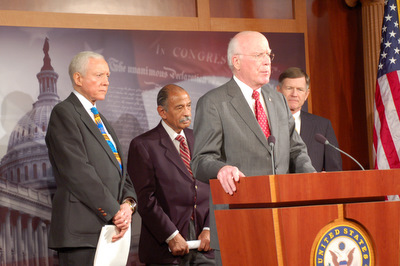
    In a joint press conference held earlier today, leaders from both the Senate and House announced the introduction of new patent reform legislation.  Appearing at the conference were Senator Patrick Leahy (D-VT), the Chairman of the Senate Judiciary Committee, Senator Orrin Hatch (R-UT), Representative John Conyers (D-MI), the Chairman of the House Judiciary Committee, and Representative Lamar Smith (R-TX) (at right, Sen. Hatch, Rep. Conyers, Sen. Leahy, and Rep. Smith).

    In a statement made available on Sen. Leahy's website, the Senate and House bills were described as being "similar to bipartisan legislation introduced in the 110th Congress" (specifically, H.R. 1908, which the House passed in September of 2007, and S. 1145, which was removed from the Senate calendar last spring before reaching the floor for a vote).  Sen. Leahy's press release noted that it "ha[d] been more than 50 years since significant reforms were made to the nation's patent system," and asserted that the newly introduced Patent Reform Act of 2009 "makes needed updates to the system that will improve patent quality and increase certainty among parties in litigation."

    At the press conference to announce the bills, Sen. Leahy said that:

    Patent reform is ultimately about economic development.  It is about jobs, it is about innovation, and it is about consumers.  All benefit under a patent system that reduces unnecessary costs, removes inefficiencies, and holds true to the vision of our Founders that Congress should establish a national policy that promotes the progress of science and the useful arts.  This bill will establish a more efficient and streamlined patent system that will improve patent quality and limit unnecessary and counterproductive litigation costs, while making sure no party's access to court is denied.

    Sen. Hatch hoped that the third time around for patent reform would be a charm.  He added that those working on the legislation "have listened to many of the concerns raised by stakeholders and have changed the legislative text accordingly."  Interestingly, he acknowledged that the leaders "agree that more work needs to be done on the damages and inequitable-conduct provisions," adding that he was confident that legislators would be able to "rely upon well-reasoned and persuasive case law, scholarship and other texts to achieve consensus on these two key provisions"."  Acknowledging that the damages provision of S. 1145 was "[p]erhaps the most hotly debated topic in the patent reform debate last Congress," Sen. Leahy stated that he was "prepared to continue the conversation and debate from the last Congress in order to find the best language we can."  Sen. Leahy also said that he would work with Sen. Hatch on the inequitable conduct provision (which has been removed from the new bill) "to address any statutory changes."

    Rep. Conyers stated that he was looking forward to working with other legislators "to perfect this legislation to bring the reforms that are needed to ensure that the Unites States remains strong in protecting and enforcing the creations of our inventors."  Rep. Smith added that the country "cannot expect individuals or companies to drive innovation without protecting the creative ideas that generate profit," and that the new legislation "updates current law to better protect intellectual property and encourage invention."

    The text of the Senate bill (S. 515), which has not yet been made available on THOMAS, can be obtained here.  The Senate bill was co-sponsored by Senators Chuck Schumer (D-NY), Mike Crapo (R-ID), Sheldon Whitehouse (D-RI), James Risch (R-ID), and Kirsten Gillibrand (D-NY).  According to Sen. Leahy's press release, S. 515 contains "significant changes" vis-à-vis S. 1145.  In particular, the new bill:

    • Strikes the provision establishing an 18-month publication requirement;
    • Strikes the provision establishing an Applicant Quality Submissions (AQS) requirement (due to what Sen. Hatch called "near uniform opposition from the patent community" about the provision), and "clarifies" that search and examination functions "are to be performed by the United States Government";
    • Adopts the post-grant review approach of H.R. 1908 bill by expanding inter partes reexamination, rather than introducing a new post-grant review for second window challenges;
    • Codifies the "objective recklessness" standard of In re Seagate;
    • Strikes the provision limiting damages for lack of notice or marking;
    • Strikes the provision allowing the USPTO to waive applicant deadlines for patent term extension applications;
    • Strikes the Check 21 provision;
    • Strikes the provision ending fee diversion; and
    • Strikes the inequitable conduct provision added in Committee last Congress.

    Sen. Leahy also announced that the Senate Judiciary Committee has scheduled a hearing, entitled "Patent Reform in the 111th Congress:  Legislation and Recent Court Decisions" on March 10th at 10:00 AM (Eastern).  A live webcast of the hearing will be broadcast on the Committee's website.

    Biotechnology Industry Organization (BIO)
    In response to the introduction of the new patent reform bills, the Biotechnology Industry Organization (BIO) released a statement noting that while the organization "continues to have concerns with some of the specific language in the bills introduced today," it recognizes that the introduction of the bills was "just the beginning of the legislative process."  BIO President and CEO Jim Greenwood noted that the group "continues to welcome improvements to the U.S. patent system, particularly those that increase patent quality, increase public participation, and provide additional resources to the Patent and Trademark Office (PTO)," and looked forward to working with legislators and other stakeholders "to achieve positive, meaningful, and consensus-oriented reforms to the patent system — reforms that will further enhance patent quality and spur innovation and economic growth here at home."

    In a statement posted on the Manufacturing Alliance on Patent Reform's (MAPP) website, the group asserted that the new legislation "includes language from last Congress that would seriously undermine our patent protections."  MAPP believed that "substantial improvements to the patent system are possible," and looked forward to "working with the Congress to make those improvements in ways that benefit all sectors of the American economy."  MAPP also pointed to a press release issued by Reps. Dan Manzullo (R-IL) and Mike Michaud (D-ME), in which the Congressmen contended that the new patent reform legislation "would actually weaken intellectual property protections for American manufacturers and put hundreds of thousands more Americans on the unemployment lines."  Citing a recent MAPP economic study (see "Manufacturing Alliance on Patent Policy: Apportionment of Damages Provision Will Have Adverse Effects"), Reps. Manzullo and Michaud assert that "[b]y diminishing the damage awards in patent infringement cases, this bill would encourage intellectual property theft by foreign competitors, putting 298,000 American manufacturing jobs at risk and curtailing U.S. research and development spending by $66 billion."  The statement argues that Congress' efforts would be better spent "tackl[ing] consensus issues like Patent and Trademark Office efficiency, patent pendency and patent quality."

    Patent Docs
    intends to provide additional coverage of the new bills, with an emphasis on their impact on biotech and pharma patent practice, after we have had a chance to analyze and compare the bills, and compare the new bills with previously introduced legislation.

    For additional information regarding this topic, please see:
    • Sen. Hatch's press release, which includes his complete remarks in introducing the bill.
  •     By Suresh Pillai

    Penwest and Endo Announce a Settlement of Opana® ER Litigation

    Penwest
    On February 20, Penwest Pharmaceuticals, based in Danbury, CT, and Endo Pharmaceuticals jointly announced a settlement of their litigation with Morristown, NJ-based Actavis South Atlantic LLC over the production and sale of generic formulations of Opana® ER (oxymorphone hydrochloride) (see "Court Report," July 20, 2008).  The patent in suit, U.S. Patent No. 5,958,486, which issued on September 28, 1999, covers a controlled release formulation of Albuterol.

    Actavis
    In addition to Penwest and Endo agreeing to dismiss their suit with prejudice, Actavis has agreed to dismiss its counterclaims with prejudice.  The settlement agreement grants Actavis a license and a covenant not to sue covering the patents in suit, clearing the way for Actavis to market a generic version of Opana ER on or after July 15, 2011.


    Federal Circuit Orders District Court to Reopen Enzo Biochem, Inc. v. Applera Corp. Patent Suit

    Enzo
    The Court of Appeals for the Federal Circuit issued an order directing the District Court for the District of Connecticut to reopen the patent litigation suit between Enzo Biochem, Inc. et al. and Applera Corp.  In the original litigation, Enzo sued Applera for infringement of six patents, and Applera counterclaimed for noninfringement and invalidity of all six patents.  The parties stipulated to the dismissal of two of the patents in suit, and the District Court entered summary judgment of invalidity with respect to three of the patents.  Enzo decided not to press their claims related to the final patent in suit, U.S. Patent No. 4,711,955, and the District Court directed that the case be closed.  However, prior to closing the case, the District Court did not rule on Applera's counterclaims directed to the final patent.  Subsequent to the dismissal, Endo filed a notice of appeal and then a motion to voluntarily dismiss the appeal.  The motion to dismiss was granted on January 30, 2008.

    After the motion to dismiss was granted, Enzo filed a motion for entry of final judgment, but the District Court denied the motion on the grounds that, because the District Court had found invalid all of the patent claims that were the subject of Endo's infringement allegations, there was no need to rule on Applera's noninfringement claims.

    The Federal Circuit ruled that the District Court's denial of the motion for final judgment failed to dispose of the Applera's invalidity counterclaim with regard to the '955 patent.  Because of the absence of an express ruling on the counterclaim, the Federal Circuit concluded that it remained pending and that Enzo had met its burden of showing a clear and indisputable right to issuance of the writ of mandamus.


    Federal Circuit Grants Permission for Appeal on Collateral Estoppel Issue Regarding Claim Construction

    Sandoz
    Sandoz, Inc. was granted permission to appeal to the Federal Circuit a district court's decision not to give preclusive effect to another district court's claim construction.  In the case of Shire LLC v. Sandoz, Inc., Sandoz petitioned the Federal Circuit to consider the issue of whether a patentee who has settled an earlier infringement case post-Markman ruling is precluded from relitigating claim-construction issues from that prior case under the doctrine of collateral estoppel.  The United States District Court for the District of Colorado granted summary judgment to Shire; in doing so, the Court refused to give preclusive effect to the first district court's claim construction.  The District Court did, however, grant Sandoz's motion to certify on the grounds that, as to infringement of at least one of the patents in suit, the issue could be dispositive.

  •     By Kevin E. Noonan

    Genentech
    Genentech announced last week that the U.S. Patent and Trademark Office had determined it would issue a re-examination certificate in Re-examination Control No. 90/007,542 involving U.S. Patent No. 6,331,415 ("the Cabilly II patent").  While a major victory for Genentech, it represents a bitter defeat for Medimmune, Genentech's licensee, as well as other biotechnology companies affected by Genentech's exclusive rights to basic recombinant DNA technology.

    The Cabilly II patent claims fundamental methods for making recombinant cells expressing both an immunoglobulin light chain and heavy chain; these methods are useful for making any of several genetically-engineered antibody molecules.  Claim 1 of the patent, which will issue in the re-examination certificate unchanged from the claim in the '415 patent, reads as follows:

    A process for producing an immunoglobulin molecule or an immunologically functional immunoglobulin fragment comprising at least the variable domains of the immunoglobulin heavy and light chains, in a single host cell, comprising the steps of:
        (i) transforming said single host cell with a first DNA sequence encoding at least the variable domain of the immunoglobulin heavy chain and a second DNA sequence encoding at least the variable domain of the immunoglobulin light chain, and
        (ii) independently expressing said first DNA sequence and said second DNA sequence so that said immunoglobulin heavy and light chains are produced as separate molecules in said transformed single host cell.

    The Cabilly II patent issued on December 18, 2001, on a application filed June 10, 1988.  That application claimed priority as a continuation from U.S. Application No. 06/483,457, filed April 8, 1983, and issued as U.S. Patent No. 4,816,567 on March 28, 1989.

    Prosecution of the Cabilly II patent was delayed by an interference declared between the Cabilly II application and U.S. Patent No. 4,816,397 to Boss.  The Board entered judgment against Cabilly on August 13, 1998.  Genentech filed suit under 35 U.S.C. § 146 that was not resolved in its favor until March 18, 2001.  The first of two ex parte re-examination requests (which were merged) was filed (by counsel for Medimmune) on May 13, 2005, and the re-examination ordered on July 7, 2005.  This re-examination was merged with re-examination Control No. 90/007,859 on June 6, 2006.

    The following is a timeline of the procedural history of this patent:

    Timeline
     

    All claims of the Cabilly II patent were rejected for obviousness-type double-patenting over parent U.S. Patent No. 4,816,567 ("the Cabilly I patent"); claim 1 of this patent reads as follows:

    A method comprising
        (a) preparing a DNA sequence encoding a chimeric immunoglobulin heavy or light chain having specificity for a particular known antigen wherein a constant region is homologous to the corresponding constant region of an antibody of a first mammalian species and a variable region thereof is homologous to the variable region of an antibody derived from a second, different mammalian species;
        (b) inserting the sequence into a replicable expression vector operably linked to a suitable promoter compatible with a host cell;
        (c) transforming the host cell with the vector of (b);
        (d) culturing the host cell; and
        (e) recovering the chimeric heavy or light chain from the host cell culture.

    The significance of such a determination would be that the Cabilly II patent would expire 17 years after the grant date of Cabilly I (March 28, 2006) rather than 17 years after its own grant date (December 18, 2018).

    The Office asserted the obviousness-type double patenting rejections against the three independent claims of the Cabilly II patent (1, 15, and 21) based solely on the parent Cabilly I patent; several of the remaining claims were rejected on obviousness-type double patenting grounds on the combination of the Cabilly I patent and other art, including U.S. Patent No. 4,399,216 to Axel et al., and several scientific publications, including one to Rice and Baltimore.  Genentech countered with numerous declarations from biotechnology luminaries, including Douglas Rice, the co-author of the Rice and Baltimore paper; Steven McKnight (linker-scanning technique); Arthur Riggs (DNA methylation); Michael Botchan (genetic mapping using Southern blot hybridization); and Sidney Altman (1991 Nobel Prize winner for ribozymes), among others.  Key points of contention in the re-examination was whether the Cabilly I patent encompassed expression of both an immunoglobulin light chain and an immunoglobulin heavy chain in its recitation of "DNA sequence encoding a chimeric immunoglobulin heavy or light chain," i.e., whether "or" should be interpreted to mean "in the alternative" or to mean "and/or" (the "logical or").  At various times during the re-examination this was cast as a "genus/species" question, but ultimately the issue was whether it would have been obvious to take the teachings of Cabilly I, interpreted to teach in the alternative, and express both immunoglobulin light chain and heavy chain molecules in the same cell, as well as whether the skilled worker in 1983 would have had a reasonable expectation of success that these co-expressed molecules would form a functional antibody, as required in the Cabilly II claims ("an immunoglobulin molecule or an immunologically functional immunoglobulin fragment").

    Genentech amended claim 21, which will issue in the re-examination certificate reading:

    A method comprising
        a) preparing a first DNA sequence [[consisting essentially of DNA]] encoding an immunoglobulin [[consisting of an immunoglobulin]] heavy chain and a second DNA sequence encoding an immunoglobulin light chain [[or Fab region, said immunoglobulin having specificity for a particular known antigen]];
        b) inserting the DNA sequences of step a) into a replicable expression vector wherein each sequence is operably linked to a suitable promoter;
        c) transforming a prokaryotic or eukaryotic microbial host cell culture with the vector of step b);
        d) culturing the host cell so that said immunoglobulin heavy and light chains are produced as separate molecules in said transformed host cell; and
        e) recovering the immunoglobulin from the host cell culture, said immunoglobulin being capable of binding to a known antigen.

    In the Notice of Intent to Issue a Re-examination Certificate, the Patent Office opined that the Cabilly I patent was limited to expression of immunoglobulin light chains and heavy chains in separate cells; the Office determined that the Kaplan reference (EP 0 044 722) was limited to the same disclosure (relying on the Harris, McKnight, Botchan, Rice, and Colman declarations).  Relying on the same declaratory evidence, the Office determined that the Axel patent did not teach co-expression of two "foreign" (i.e., exogenous) DNA sequences.  Further relying on the same declarations, the Office determined that the Rice and Baltimore reference (1982, Proc. Natl. Acad. Sci. U.S.A. 79: 7862-65) did not teach production of a functional immunoglobulin comprising an exogenous light chain and endogenous heavy chain; the Office came to the same conclusion regarding the Ochi reference (1983, Nature 302: 340-42).  The Dallas reference (WO 82/03088) was limited to recombinant E. coli transformed with exogenous E. coli genes and did not teach methods for producing "multiple eukaryotic proteins from a single cell host."  The Office determined that the Moore patent (U.S. Patent No. 5,840,545) was limited to producing rFv (recombinant single-chain immunoglobulin molecules) comprising heavy and light chain variable regions in separate cells.  Studies regarding production of immunoglobulin in Xenopus oocyte cells (Deacon and Valle, 1976, Biochem. Soc. Trans. 4: 818-20) were not directed towards producing recombinant immunoglobulins in eukaryotic cells according to the Notice.  The Builder reference (U.S. Patent No. 4,511,502) was limited to recovering expressed recombinant polypeptide from bacterial cells, but did not specifically teach recombinant immunoglobulin molecules.  Finally, the Accolla reference (1980, Proc. Natl. Acad. Sci. U.S.A. 77: 563-66) described methods for making immunoglobulins against carcinoembryonic antigen (CEA), but not recombinant versions thereof.

    The Notice summarizes the reasoning it reconsidered its earlier reject
    ion of the Cabilly II claims:

    Upon reconsideration of the declarations of Harris, McKnight, Botchan, Colman and Rice, a person of ordinary skill in the art at the time the invention was made would not have had a reasonable expectation of success modifying the Cabilly I Patent claims in accordance with the teachings of Axel, Rice, Kaplan, Builder, Accolla, Dallas, [the] Moore patent, Deacon and Valle, and Ochi references of record to produce an immunologically functional immunoglobulin molecule by independently expressing immunoglobulin heavy chain and light chain in a single transformed cell.

    The course of the Cabilly II re-examination is informative for several reasons that are relevant in the broader context of U.S. patent policy.  A careful reading of the Office Actions and the evidence adduced by Genentech reveals the difficulties attendant in evaluating, particularly so long after the fact, what the skilled worker would have known at the time the Cabilly invention was made (over 25 years ago).  Genentech benefitted from having declarants who were actively involved in the science of recombinant DNA technology and immunology at that time and who could opine on their specific knowledge of what they and their colleagues were doing as well as the state of the art.  Although the timeframe is long, it is not totally irrelevant under the modern patent term regime of 20 years from a first filing date:  an applicant who files a provisional application and receives patent term adjustment for PTO delay and patent term extension for regulatory delay might be able to obtain a term that is substantially equivalent.

    This raises a separate issue relevant to proposals in the last Congress (almost sure to resurface in this Congress) about post-grant review.  U.S. re-examination (both ex parte and the more recently-established inter partes versions) was intended to provide an avenue short of litigation for challenging patents that may have been improvidently granted.  Similar regimes exist in other countries, most particularly in the European Patent Convention.  One major difference between the U.S. systems and those found abroad is that oppositions in Europe and elsewhere are limited and cannot be brought at any time during the patent term.  While this has the effect of precluding later-accused infringers or competitors who are not diligent from pursuing the administrative avenue of opposition, patents can still be invalidated in Europe by nullity actions (albeit with the added expense and inconvenience of having to be pursued country-by-country).

    Medimmune #1
    The advantage of limiting the time for filing oppositions (in Europe, nine months after publication of the granted patent) is that it imposes the equivalent of a "statute of repose" on challengers, giving the patentee the benefit of being secure in its patent rights.  In the U.S., no such repose exists, and in view of the expense (and risk) of patent litigation perhaps there cannot be.  But the recent Supreme Court decision in Medimmune, Inc. v. Genentech, Inc. (on this same Cabilly patent) has expanded the limits of subject matter jurisdiction for declaratory judgment actions to establish invalidity.  So perhaps it might be wise to at least consider, during any future Congressional hearings for patent reform including yet another post-grant review system, whether there is an advantage in granting patentees repose after some sufficient time for granted patents to be challenged.  The Cabilly II re-examination illustrates the advantages that would be gained in having determinations like obviousness and obviousness-type double patenting decided more contemporaneously with the events that resulted in the claimed invention.