•     By Donald Zuhn

    Johnson & Johnson:  5-Year Exclusivity Period Would Kill Incentives to Innovate

    Johnson & Johnson Last month, Amgen Inc. Vice President Stuart Watt asserted that any follow-on biologics regulatory pathway established by Congress would have to specify an exclusivity period of at least 12 years in order to provide incentives to innovator drug companies to continue developing new biologic drugs (see "Amgen VP Makes Case for Longer Exclusivity Period in Follow-on Biologics Legislation").  On the heels of Mr. Watt's statement, Johnson & Johnson executive director for biotechnology policy Audrey Philips recently indicated that Congress should provide for a 14-year exclusivity period — such as in H.R. 1548, introduced by Rep. Anna Eshoo (D-CA) on March 17 (see "Second Follow-on Biologics Bill Is Introduced in House").

    According to a Bloomberg.com report, Ms. Philips contended that a 5-year exclusivity period — such as in H.R. 1427, introduced by Rep. Henry Waxman (D-CA) on March 11 — would be bad for innovation and bad for patients' health.  Ms. Phillips told reporters that follow-on biologics legislation should strike "the right balance between saving money and still having medicines to advance in the future," adding that a 5-year exclusivity period would "certainly have a chilling effect on [biotech] investment."  The follow-on biologics stakes are high for Johnson & Johnson as its top-selling product (arthritis drug Remicade; $3.75 billion in sales last year) and third-best-selling product (anemia drug Procrit; $2.46 billion in sales last year) are biologics.

    In contrast with a number of recent announcements from other drug manufacturers (see "Follow-on Biologics News Briefs – No. 2"), Ms. Phillips stated that Johnson & Johnson had "no current plans" to get into follow-on biologics itself.

    Countering Johnson & Johnson's position was Katie Huffard, executive director of the Coalition for a Competitive Pharmaceutical Market, who told Bloomberg.com that "Johnson and Johnson has less than 14 years of exclusivity in Europe where prices are controlled without innovation dying."

    Lupin Moving into Biologics and Follow-on Biologics

    Lupin Earlier this month, Lupin Ltd., one of India's top five pharmaceutical companies, announced plans to expand its drug research program into both biologics and follow-on biologics.  According to a Business Standard report, the change in strategy was necessitated by a drying pipeline that currently includes only four drugs at the clinical trial stage.  Lupin managing director Kamal Sharma stated that the company "had ambitious plans in New Chemical Entity (NCE) research but they did not translate into success," and as a result, Lupin needed to reorient its focus.  With respect to its follow-on biologics program, the Business Standard noted that Lupin was developing nine drugs in the areas of oncology, auto-immune diseases, and diabetes, which were expected to be ready for launch in 2012.

    Jefferson School of Population Health Dean Discusses Follow-on Biologics

    Nash, David On April 21st, the Jefferson School of Population Health hosted a forum on follow-on biologics at the National Press Club in Washington, DC.  The policy forum, entitled:  "Regulation of Follow-on Biologics: Ensuring Quality and Patient Safety," brought together clinicians, thought leaders, and policy makers to discuss and debate the clinical, economic, ethical, and patient safety issues surrounding the approval and regulation of follow-on biologics.  The forum was moderated by Dr. David Nash (at right), Dean of the Jefferson School of Population at Thomas Jefferson University in Philadelphia, PA.

    Patent Docs had an opportunity to briefly discuss the topic of follow-on biologics with Dr. Nash just prior to last week's forum.  Before addressing the issue of patient safety, which was the focus of the forum, we asked Dr. Nash whether he had a position with regard to the exclusivity periods provided in the two competing follow-on biologics bills currently before the House.  While noting that he had no preference, Dr. Nash stated that innovator drug companies should have some measure of economic protection for a period of time.  Turning to patient safety, Dr. Nash argued that Congress could ensure patient safety by passing legislation comparable to that in Western Europe, where, he noted, follow-on biologics are evaluated for safety on a case-by-case basis.  Dr. Nash asserted that a generic drug manufacturer's use of an innovator drug manufacturer's data may not be sufficient to ensure patient safety, and that further review of the follow-on biologic by the FDA may be necessary.

    More information regarding the forum can be found on Dr. Nash's blog, Nash on Health Policy.

  •     By Kevin E. Noonan

    Two pronouncements, one from the Supreme Court and the other from the Federal Circuit, portend the parlous state that could await American innovation should judges come to believe that that their judgment is as sound as that of actual innovators.

    From the Federal Circuit's In re Kubin decision (citing In re O'Farrell):

    Federal Circuit Seal Specifically, this court observed that an obviousness finding was appropriate where the prior art "contained detailed enabling methodology for practicing the claimed invention, a suggestion to modify the prior art to practice the claimed invention, and evidence suggesting that it would be successful."  853 F.2d at 902 (emphasis added).  Responding to concerns about uncertainty in the prior art influencing the purported success of the claimed combination, this court stated:  "[o]bviousness does not require absolute predictability of success . . . all that is required is a reasonable expectation of success."  Id. at 903-04 (emphasis added).  The Supreme Court in KSR reinvigorated this perceptive analysis.

    And, of course, from the Supreme Court in KSR Int'l Co. v. Teleflex Inc.:

    Supreme Court Seal When there is a design need or market pressure to solve a problem and there are a finite number of identified, predictable solutions, a person of ordinary skill has good reason to pursue the known options within his or her technical grasp.  If this leads to the anticipated success, it is likely the product not of innovation but of ordinary skill and common sense.  In that instance the fact that a combination was obvious to try might show that it was obvious under § 103.

    The combination of these sentiments leave open the question:  what isn't obvious?  We know that the Supreme Court has never disclaimed the discredited "flash of genius" requirement from Cuno Engineering Corp. v. Automatic Devices Corp., despite Congressional abrogation in the last sentence of 35 U.S.C. § 103:  "Patentability shall not be negatived by the manner in which the invention is made."  Indeed, the Court opined in Graham v. John Deere Co. that Congress merely intended to codify the Court's own obviousness jurisprudence.  Fortunately not, since even members of the Court had come to recognize, in the years just prior to the 1952 Act, that the Court's overt hostility to patents had become extreme:  Justice Robert Jackson was moved to remark that the remedy for "bad patents" (sound familiar?) was not "an equally strong passion in this Court for striking them down so that the only patent that is valid is one which this Court has not been able to get its hands on."  Jungersen v. Ostby & Barton Co., 335 U.S. 560, 572 (1949).

    We again seem to be in a period, as in the 1940's, of frank hostility to patents and patent law from the Supreme Court.  Indeed, if the following quote:

    The design of the patent laws is to reward those who make some substantial discovery or invention, which adds to our knowledge and makes a step in advance in the useful arts.  It was never their object to grant a monopoly for every trifling device, every shadow of a shade of an idea, which would naturally and spontaneously occur to any skilled mechanic or operator in the ordinary progress of manufactures.  Such an indiscriminate creation of exclusive privileges tends rather to obstruct that to stimulate invention.  It creates a class of speculative schemers who make it their business to watch the advancing wave of improvement, and gather its foam in the form of patented monopolies, which enable them to lay a heavy tax upon the industry of the country, without contributing anything to the real advancement of the arts.  It embarrasses the honest pursuit of business with fears and apprehensions of concealed liens and unknown liabilities to lawsuits and vexatious accountings for profits made in good faith.

    (from Atlantic Works v. Brady, 107 U.S. 192, 200 (1882)) appeared in the KSR decision (or, for that matter, on the Coalition for Patent Fairness' website), would anyone have been surprised or thought it out of place?

    The difference, of course, is that today we have the Court of Appeals for the Federal Circuit, capable (but lately seemingly unwilling) to provide legal analysis to assist the Court in its heretofore infrequent forays into waters it rarely, uncomfortably, and maladroitly treads.  However, as the CAFC has shown in Kubin, and earlier in Pfizer, Inc. v. Apotex, Inc., Aventis Pharma Deutschland GmbH v. Lupin, Ltd., and Pharmastem Therapeutics, Inc. v. Viacell, Inc., the KSR influence is strong on the Court.  All is not lost, of course:  there have been plenty of decisions since KSR where the Federal Circuit upheld the non-obviousness of pharmaceutical patents, including Sanofi-Synthelabo v. Apotex, Inc., Eisai Co. v. Dr. Reddy's Laboratories, Inc., Ortho-McNeil Pharmaceutical, Inc. v. Mylan Laboratories, Inc., Forest Labs, Inc. v. Ivax Pharm., Inc., and Takeda Chem. Indus., Ltd. v. Alphapharm Pty., Ltd.  However, in every case, the bases for so holding has been the application of traditional principles of chemical structural non-obviousness ("structure, structure, structure" according to Judge Rader) and none of these cases has focused on the more liberal "obvious to try" standard enunciated in In re Kubin.

    Antibody The Federal Circuit's Kubin decision (and to a lesser extent, the Court's disregard of the Graham secondary indicia of non-obviousness in the Pharmastem decision) raises the legitimate issue of what won't be obvious by the application of the Kubin doctrine.  For example, an analogy could be drawn between the way the court applied obviousness law to the facts in Kubin and the situation for most monoclonal antibody claims.  Just like the p38/NAIL protein in Kubin, antigens (particularly antigens to pathogens) are frequently known in the art.  Indeed, the existence in the art of such pathogen-derived antigens would presumably engender an even greater motivation for the skilled worker to make an antibody than the existence of p38 in the prior art motivated Kubin to isolate NAIL cDNA.  As in Kubin, the methods for making monoclonal antibodies are just as established (perhaps even more so, having been judicially recognized as "extensive, but routine" in In re Wands and Noelle v. Lederman), and obtaining a monoclonal antibody just as "predictable" (perhaps more so) as obtaining a cDNA in Kubin.  And the final similarity is that the structure of the antibody is equally as unknown in the prior art (and unrelated to the structure of the antigen) as is the protein structure to the nucleic acid comprising the gene encoding it.  (It is probably a wash that the genetic code provides some means for determining "a" — as opposed to "the" — nucleotide sequence encoding a known amino acid sequence, versus the binding affinity between an antibody and its cognate antigenic epitope, since neither the identity of the epitope — for antibodies — nor the complete amino acid sequence — for genes — is typically known.)  Thus, it can fairly be asked whether claims to a monoclonal antibody are now prima facie obvious under the Kubin doctrine.

    Indeed, something of this sort has already happened, in the Federal Circuit's In re Tzipori decision.  From a Patent Docs post on that case:

    While the CAFC conceded that Tzipori had established that Krivan did not disclose monoclonal or humanized antibodies to SLT-II, the Court noted that Queen disclosed a method of making humanized antibodies and Perara disclosed the manufacture of hybridomas that produce monoclonal antibodies.

    Taken to its extreme, everything thus becomes obvious.

    Hand, Learned In the last century, Learned Hand (at right; a jurist whose insight and intellect were indeed what current members of this or any Court should hope they would possess) recognized the problem and its rational solution:

    The test laid down [in 35 U.S.C. § 103] is indeed misty enough.  It directs us to surmise what was the range of ingenuity of a person "having ordinary skill" in an "art" with which we are totally unfamiliar; and we do not see how such a standard can be applied at all except by recourse to the earlier work in the art, and to the general history of the means available at the time.  To judge on our own that this or that new assemblage of old factors was, or was not, "obvious" is to substitute our ignorance for the acquaintance with the subject of those who were familiar with it.  Reiner v. I. Leon Co., 285 F.2d 501 (2d Cir. 1960)

    Courts, made up of laymen as they must be, are likely either to underrate, or to overrate, the difficulties in making new and profitable discoveries in fields with which they cannot be familiar; and so far as it is available, they had best appraise the originality involved by the circumstance which preceded, attended and succeeded the appearance of the invention.  Safety Car Heat & Light Co. v. General Electric Co., 155 F.2d 937 (2d Cir. 1946).

    Hat tip to Bob Harmon for the Learned Hand quotes.

    Antibody image: Tom Vickers, Wikipedia Commons

  •     By Sherri Oslick

    Gavel_2About
    Court Report:  Each week we will report briefly on recently filed
    biotech and pharma cases, and a few interesting cases will be selected
    for periodic monitoring.


    Bone Care International LLC et al. v. Eagle Pharmaceuticals Inc.

    1:09-cv-00285; filed April 23, 2009 in the District Court of Delaware

    Infringement of U.S. Patent No. 5,602,116 ("Method for Treating and Preventing Secondary Hyperparathyroidism," issued February 11, 1997) following a Paragraph IV certification as part of Eagle's filing of an ANDA to manufacture a generic version of plaintiffs' Hectorol® (doxercalciferol, used to treat secondary hyperparathyroidism in patients with chronic kidney disease).  View the complaint here.

    Pronova BioPharma Norge AS v. Teva Pharamceuticals USA, Inc. et al.
    1:09-cv-00286; filed April 23, 2009 in the District Court of Delaware

    Infringement of U.S. Patent Nos. 5,502,077 ("Fatty Acid Composition," issued March 26, 1996) and 5,656,667 (same title, issued August 12, 1997) following a Paragraph IV certification as part of Eagle's filing of an ANDA to manufacture a generic version of Pronova's Lovaza® (omega-3-acid ethyl esters, used to reduce triglyceride levels in adult patients with very high triglyceride levels).  View the complaint here.


    Eli Lilly and Company et al. v. Barr Laboratories Inc.

    1:09-cv-00272; filed April 22, 2009 in the District Court of Delaware

    Infringement of U.S. Patent No. 5,344,932 ("N-(pyrrolo(2,3-d)pyrimidin-3-ylacyl)-Glutamic Acid Derivatives," issued September 6, 1994), licensed to Eli Lilly, following a Paragraph IV certification as part of Barr's filing of an ANDA to manufacture a generic version of Lilly's Alimta® (pemetrexed for injection, used to treat malignant pleural mesothelioma and locally advanced or metastatic non-small cell lung cancer).  View the complaint here.


    Sepracor Inc. v. Alphapharm Pty. Ltd et al.

    1:09-cv-03987; filed April 22, 2009 in the Southern District of New York

    Infringement of U.S. Patent Nos. 6,864,257 ("Optically Active 5H-Pyrrolo[3,4-B] Pyrazine Derivative, Its Preparation and Pharmaceutical Compositions Containing It," issued March 8, 2005), 6,319,926 (same title, issued September 23, 2002), 6,444,673 (same title, issued November 20, 2001), and 7,381,724 (same title, issued June 3, 2008) following a Paragraph IV certification as part of Alphapharm's filing of an ANDA to manufacture a generic version of Sepracor's Lunesta® (eszopiclone, used to treat insomnia).  View the complaint here.

    Pfizer, Inc. et al. v. Teva Pharmaceuticals USA, Inc. et al.
    1:09-cv-03965; filed April 21, 2009 in the Southern District of New York

    Infringement of U.S. Patent No. 5,601,843 ("Pharmaceutical Tablet Composition," issued February 11, 1997) following a Paragraph IV certification as part of Teva's filing of an ANDA to manufacture a generic version of Pfizer's Arthrotech® (diclofenac sodium/misoprostol, used for treatment of the signs and symptoms of osteoarthritis or rheumatoid arthritis in patients at high risk of developing NSAID-induced gastric and duodenal ulcers and their complications).  View the complaint here.

    Reckitt Benckiser Inc. v. Watson Laboratories, Inc. – Florida et al.
    1:09-cv-03933; filed April 20, 2009 in the Southern District of New York

    Infringement of U.S. Patent Nos. 6,372,252 ("Guaifenesin Sustained Release Formulation and Tablets," issued April 16, 2002) and 6,955,821 ("Sustained Release Formulations of Guaifenesin and Additional Drug Ingredients," issued October 18, 2005) following a Paragraph IV certification as part of Watson's filing of an ANDA to manufacture a generic version of plaintiff's Mucinex® and Mucinex® DM (guaifenesin, and guaifenesin/dextromethorphan, respectively, used to treat chest congestion).  View the complaint here.

    OptiGen, LLC v. Texas A&M University System et al.
    5:09-cv-00457; filed April 17, 2009 in the Northern District of New York

    Infringement of U.S. Patent Nos. 7,285,388 ("Methods for Identification of Alport Syndrome," issued October 23, 2007), 6,
    210,897
    ("Identification of Canine Leukocyte Adhesion Deficiency In Dogs," issued April 3, 2001), 6,201,114 ("Identification of Congenital Stationary Night Blindness In Dogs," issued March 13, 2001), and 6,428,958 (same title, issued August 6, 2002), all licensed to OptiGen, based on defendants' sale of its Pawsitive I.D. kit to test for Progressive Rod-Cone Disease in dogs.  View the complaint here.

  • CalendarApril 27-28, 2009 – 3rd Annual Paragraph IV Disputes Conference*** (American Conference Institute) – New York, NY

    April 29-30, 2009 – Corporate IP Counsel Summit (World Research Group) – New York, NY

    May 18-21, 2009 – BIO International Convention (Biotechnology Industry Organization) – Atlanta, GA

    May 20, 2009 – Tafas v. Doll — Dissecting the Decision and Preparing for Resurgence of USPTO Rules Limiting Patent Claims*** (American Conference Institute) – 1:00-2:30 PM (EST)

    June 16-17, 2009 – Biotech Patenting (C5) – Munich, Germany

    June 19, 2009 – Patent Enforcement & Early Stage Litigation (Law Seminars International) – San Francisco, CA

    June 22-27, 2009 – Innovation Week 2009 (U.S. Patent and Trademark Office) – Arlington, VA

    June 21-23, 2009 – IP Business Congress (Intellectual Asset Management magazine) – Chicago, IL

    ***Patent Docs is a media partner of this conference or CLE

  • 813L09-WEB American Conference Institute (ACI) will be offering a webinar entitled:  "Tafas v. Doll — Dissecting the Decision and Preparing for Resurgence of USPTO Rules Limiting Patent Claims" on May 20, 2009 from 1:00-2:30 PM (EST).  Michele Cimbala, Ph.D.; Elizabeth Haanes, Ph.D.; Eric Steffe; and Robert Greene Sterne of Sterne, Kessler, Goldstein & Fox will focus on:

    • The background of the case and a brief analysis of the proposed final rules:  78, 114, 75, and 265;
    • An analysis of the details, reasoning, and nuances of the decision, including:

    • Distinguishing between substantive versus procedural rules,
    • Explaining the conflict between Section 120 of the Patent Act and Final Rule 78 limiting continuations,
    • Contrasting the court's reasoning for holding Rule 78 invalid while upholding the rules regarding claims, ESDs, and RCEs, and
    • Examining the criteria discussed for the lower court to consider upon remand;

    • Evaluating possible statutory reasons for why Rule 75 could also be under attack;
    • What happens next and where do we go from here?

    • Impact of the rules for patent claim drafting, filing applications, and potential litigation consequences, and
    • Practical tips for practitioners on what you should be doing now with your patent applications and portfolio.

    ACI - American Conference Institute The registration fee for this webinar is $299.  Those interested in registering for the webinar, can do so here.

    Patent Docs is a media sponsor of this webinar.

  •     By Donald Zuhn

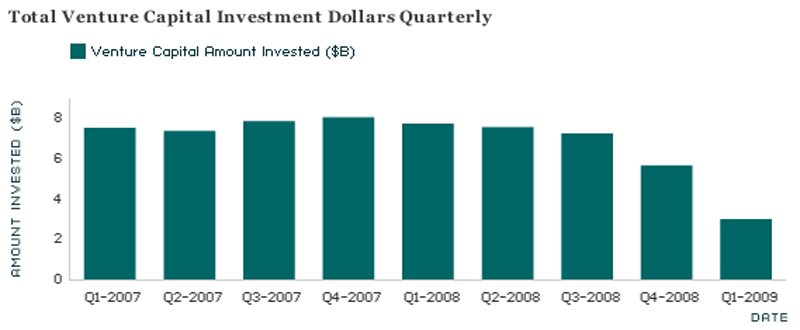
    PricewaterhouseCoopers (PWC) Late last week, PricewaterhouseCoopers and the National Venture Capital Association (NVCA), a trade association representing the U.S. venture capital industry, announced the release of their quarterly MoneyTree Report (based on data from Thomson Reuters), which showed that venture capitalists had invested $3.0 billion in 549 deals in the first quarter of 2009.  The first quarter figures were down 47% in terms of dollars invested and down 37% in terms of the number of deals as compared with the fourth quarter of 2008 ($5.7 billion invested in 866 deals), dropping to levels last seen in 1997.

    NVCA Tracy Lefteroff, global managing partner of the venture capital practice at
    PricewaterhouseCoopers LLP, said the drop was no surprise given the economic turmoil of the past two quarters, adding that "it's not unexpected that [venture capitalists] would pause to assess the impact [of the recession] on their portfolio companies before again looking forward to their next investment."  NVCA president Mark Heesen, however, stated that "those venture firms that have the ability to invest at this time are doing so as there remain entrepreneurs with game changing technologies waiting to be funded," and noted that the trade association was "not forecasting levels to continue to fall further."  He predicted "a mild and steady increase in investment throughout the rest of the year."

    Chart 2

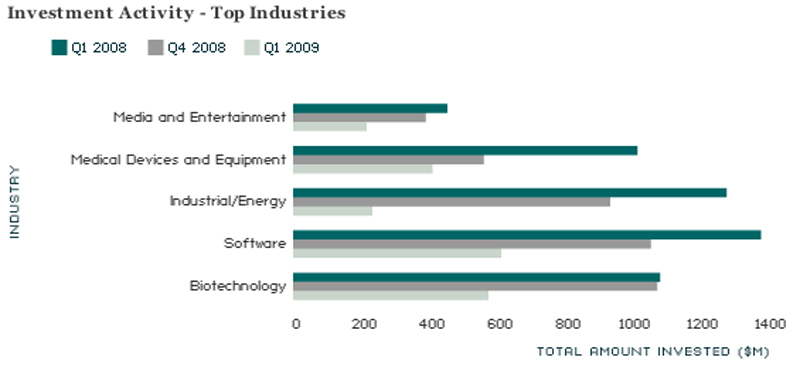
    According to the MoneyTree Report, first quarter declines were spread across almost every industry sector.  The life sciences sector (biotechnology and medical devices) saw a 40% decline in dollars (to $989 million) and 31% drop in deals (to 133) as compared with fourth quarter numbers.  However, the declines seen for the life sciences sector were not as bad as those seen for the software sector (dollars down 42% and deals down 34%) and clean technology sector (alternative energy, pollution and recycling, power supplies, and conservation; dollars down 84%), internet-specific sector.  Investments in life sciences companies constituted 33% of all investment dollars and 24% of all deals, which the report noted was in line with historical norms.  Surprisingly, the only sector that saw increases in both dollars (up 26%) and deals (up 21%) in the first quarter was the sector that many have blamed for the current economic crisis:  the financial services sector.

    Chart 1

    Charts from PricewaterhouseCoopers/National Venture Capital Association MoneyTree Report, Data: Thomson Reuters.
  •     By Donald Zuhn

    For the past two years, much of the debate surrounding the various follow-on biologics bills that have been introduced in Congress has centered on the exclusivity periods provided by each bill.  So far, three follow-on biologics bills have been introduced in the 111th Congress:  H.R. 1427 and its companion bill, S. 726, which would provide up to 5.5 years of exclusivity, and H.R. 1548, which would provide up to 14.5 years of exclusivity.

    Biotechnology Industry Organization (BIO) At last month's Biotechnology Industry Organization (BIO) Intellectual Property Counsels' Committee (IPCC) conference, Stuart Watt, Vice President and Law & Intellectual Property Officer at Amgen Inc., made a strong case for an exclusivity period closer to that provided by H.R. 1548.  In a presentation entitled: "Why Hatch-Waxman Is Not a Good Model for Biosmilars Legislation," Mr. Watt asserted that an exclusivity period of at least 12 years was needed to provide incentives to innovator drug companies to continue developing new biologic drugs.

    Amgen Mr. Watt began by noting that H.R. 1427, introduced by Rep. Henry Waxman (D-CA), was not very favorable to innovator drug companies such as Amgen, contending that Rep. Waxman even "went beyond" the parameters set out in the Hatch-Waxman Act for small molecule therapeutics.  In support of a longer exclusivity period, Mr. Watt pointed to three factors:  the research and development costs for bringing a biologic drug to market ($1 billion), the average product development time (12-15 years), and the product development risk (1 out of 100 candidates).  With respect to the second factor, Mr. Watt noted that product development times for proteins had almost doubled from five years in the mid 80's (three years in the clinic and two years securing regulatory approval) to nine years today.  As a result of these factors, every product that gets to market must pay for the numerous candidates that never make it to market.

    Looking at the impact of the Hatch-Waxman Act on small molecule drugs, Mr. Watt argued that if Rep. Waxman was successful in pushing his bill, and its shorter exclusivity period, through Congress, it would likely be the death knell for the industry.  Under the Hatch-Waxman regime, Mr. Watt noted that 67% of prescriptions of small molecule drugs are filled with generic versions of the drug and innovators lose 85% the market within six months of a generic company's entry into the market.  As a result, he argued that there has been a lack of sufficient innovation, which has resulted in pharma company consolidation, and that investment in innovation has shifted from pharma companies to biotech companies.

    Mr. Watt told conference attendees that he was not trying to take on Hatch-Waxman, since Amgen had no choice but to deal with the 25-year-old regime, but that he was trying to make a case for ensuring that the same "mistake" was not made with follow-on biologics.  As for supporters of the Waxman bill, who point out that its regulatory scheme would generate large healthcare cost savings (Mr. Watt mentioned that the Obama Administration has estimated such savings to be $9.2 billion over 10 years), Mr. Watt argued that one or two breakthrough products could achieve even greater cost savings.

    Now that a representative from an innovator drug company has indicated that a 12-year exclusivity period would be agreeable, the question remains:  will the generic industry support such an exclusivity period, or will it stick to the maximum 5.5 year period provided under Rep. Waxman's bill?

  •     By Suresh Pillai

    AstraZeneca Secures Temporary Restraining Order in PULMICORT® Case

    AstraZeneca_small Last week, the U.S. District Court for the District of New Jersey barred Apotex from launching a generic version of PULMICORT® by granting AstraZeneca's requested temporary restraining order (see "Biotech/Pharma Docket," April 15, 2009).  The TRO will remain in effect at least until April 27, 2009 when the Court is scheduled to hold a hearing to determine whether or not the injunction should continue.

    Apotex #1 The grant of the TRO is the latest round in litigation initiated by AstraZeneca in defense of its PULMICORT®-related intellectual property.  The original suit stemmed from the FDA’s March 30, 2009 approval of Apotex’s ANDA application for the marketing and manufacturing of a generic version of PULMICORT®.  AstraZeneca filed suit upon Apotex's indication of intent to market its generic version prior to the expiration of AstraZeneca's patents (scheduled to expire in 2018 with pediatric exclusivity following in 2019).


    Settlement Announced in Vanos® Patent Suit

    Medicis Last week, Medicis Pharmaceutical Corp., the owner of patents covering the dermatitis steroid skin cream Vanos®, announced the settlement of its patent dispute with Perrigo Corp.  Medicis filed the suit in the U.S. District Court for the Western District of Michigan in June 2008 (see "Court Report," June 15, 2008), following Perrigo’s ANDA filing seeking to market a generic version of Vanos®.  As part of the ANDA, Perrigo asserted that the Vanos® patents were invalid and unenforceable.  The Medicis suit addressed patent infringement for two patents-in-suit, U.S. Patent Nos. 6,765,001 and 7,220,424.  Medicis claimed that were Perrigo allowed to market a generic version of Vanos®, both patents would be infringed.

    Perrigo Under the terms of the agreement, Perrigo can commence marketing its generic version of Vanos® on December 13, 2013 and will, in return, pay royalties to Medicis based on sales.  Medicis also agreed to make an initial $3 million payment, to be followed by a payment of up to $5 million, at certain achievement milestones as the drug progresses through the hurdles of regulatory approval, commercialization, and development.  Medicis has also agreed to pay royalties to Perrigo based on sales of the drug.  This agreement also terminates the lawsuit.

    Ivax Fails in Effort Invalidate Detrol® Patent

    Pfizer The U.S. District Court for the District of New Jersey has ruled that the patents underlying Pfizer Inc.'s bladder control drug, Detrol®, are valid and enforceable.  Ivax Pharmaceuticals, a Teva subsidiary currently embroiled in a patent dispute with Pfizer over Detrol®, had filed a motion for reconsideration regarding its efforts to have Pfizer's U.S. Patent No. 5,382,600 ruled unenforceable due to Pfizer's alleged inequitable conduct before the U.S. Patent and Trademark Office during prosecution of the patent.  Pfizer originally filed this case in January 2007 (see "Court Report," February 25, 2007) after Ivax filed an ANDA with the FDA seeking approval to market a generic version of Detrol® prior to the 2012 expiration of the '600 patent.

    Ivax Pharmaceuticals In its complaint, Ivax claimed that Pfizer had knowledge of errors in statements made by one of the co-inventors during prosecution, and in spite of this knowledge, failed to correct these errors.  Ivax alleged that Pfizer's knowledge of the errors and failure to cure them constituted inequitable conduct.

    The District Court, however, disagreed with Ivax's assertion.  The Court stated that while errors in the declaration could be considered relevant, the errors in this case were not so serious as to undermine the validity of the inventor's declaration.  Though the USPTO originally rejected all claims on obviousness grounds and only reversed based in part on the information from the disputed declaration, the Court concluded that the declaration, as a whole, could not be considered a misstatement or invalid.

  • Another "Bright-Line" Rule from the Federal Circuit

        By Kevin E. Noonan

    The Supreme Court has had the occasion to overrule the Federal Circuit with prolixity over the past ten years.  And in many of those cases (including KSR Int’l Co. v. Teleflex Inc., eBay Inc. v. MercExchange, LLC, Quanta Computer, Inc. v. LG Electronics, Inc., Microsoft Corp. v. AT&T Corp., Festo Corp. v. Shoketsu Kinzoku Kogyo Kabushiki Co., Dickinson v. Zurko, and Medimmune, Inc. v. Genentech, Inc.), at least part of the Court's reasoning has been an attempt to prevent the Federal Circuit from developing and enforcing "bright line" rules where the Court believes a "totality of the circumstances" approach is more flexible and more consistent with the public interest that affects patent rights.  In part, this difference of opinion also stems from the two courts' fundamental disagreement about the Federal Circuit's role:  the appellate court sees its Congressional mandate to include not only harmonizing U.S. patent law nationwide but bringing consistency to patent law interpretation.  In this way, business people will be able to understand the metes and bounds of the patent grant with sufficient clarity that they can both avoid infringing activity and be prompted to further innovation without undue concern about the scope of third party patent rights.  (The Supreme Court, of course, sees the Federal Circuit more as a regional circuit court, subject to the Court's own vision of consistency in how certain legal principles — such as declaratory judgment actions and injunctions, recently — are applied.)

    Takeda The Federal Circuit had the opportunity to make another "bright line" determination in Takeda Pharmaceutical Co. v. Doll, where the issue was whether after-developed technology could be considered when assessing obviousness-type double patenting.  The patents at issue involved cepham antibiotics, having an original U.S. filing date of December 19, 1975 (for the product patent, U.S. Patent No. 4,098,888) and a later filing date of  January 8, 1990 (for the process patent, U.S. Patent No. 5,583,216).  The issue was raised in a re-examination proceeding initiated in 1998 by two anonymous requests.  The Examiner asserted a rejection on obviousness-type double patenting grounds, which rejection was affirmed by the Board.  Takeda appealed to the District Court of the District of Columbia under 35 U.S.C. § 145, and introduced additional evidence with regard to alternative synthetic methods first disclosed in 2002 and 2005.  The parties stipulated that at least one of these methods was in fact a "materially-distinct" method, the District Court granted summary judgment that Takeda was entitled to a reexamination certificate, and the government appealed.
    Federal Circuit Seal The Federal Circuit reversed and remanded, in part because there were genuine issues of material fact unresolved below.  This was due to the parties wanting the Federal Circuit to address the fundamental point of difference:  whether it was proper for courts and the Patent Office to consider after-developed technology (i.e., alternative, patentably-distinct processes for producing the cepham compounds claimed in the '888 patent) when deciding whether process claims are unpatentable under the judicially-created doctrine of obviousness-type double patenting.  In an opinion by Judge Rader, joined by Judge Moore and joined, in part, by Judge Schall, the Court started the analysis by noting that it had long been the law that the obviousness-type double patenting "doctrine bars an applicant from obtaining separate patents with separate terms for both a product and process for making that product, unless the product and process are 'patentably distinct,'" citing In re Taylor, 360 F.2d 232, 234 (C.C.P.A. 1966) and In re Cady, 77 F.2d 106, 109 (C.C.P.A. 1935).  The question of whether a product and a process for making that product were patentably-distinct was whether "the product as claimed can be made by another materially different process," citing M.P.E.P. § 806.05.  Returning to the Cady decision, the majority noted that "product and process claims are patentably distinct if multiple processes for creating a product exist at the time of the invention," Cady at 109.

    But this begs the question:  that is "the time of the invention?"  The Patent Office argued that this was the priority date, or in the alternative no later than the date that the first patent issues; the Office provided no support for these propositions, except by analogy to other requirements for patentability (including §§ 102, 103, and 112).  Takeda, of course, believed that later-developed technology could be used to show that a process was patentably-distinct from the product produced thereby.  Takeda cited several cases in support of this proposition, but according to the Federal Circuit the main case (U.S. Steel Corp. v. Phillips Petroleum Co.) does not address the issue.

    The Court decided that the Patent Office rule was too indeterminate, due to difficulties in deciding the "date of invention" (which could include the priority date, the filing date, the date of conception or reduction to practice, etc.); as noted in the dissent, these concerns seem unrealistic, since they are issues the Office and courts address and resolve every day.  The Court also rejected Takeda's position, as giving applicants "the best of both worlds: the applicant can use the filing date as a shield, enjoying the earlier priority date in order to avoid prior art, and rely on later-developed alternative processes as a sword to defeat double patenting challenges."

    Instead, the Court considered the purpose of the obviousness-type double patenting doctrine:  preventing the "unjustified extension of the patent term."  From this perspective, the filing date of the second application is what "triggers" obviousness-type dou
    ble patenting concerns, because, of course, without this filing there would be no "unjustified extension of the patent term."  The Court also considered the filing of the second application (without filing a terminal disclaimer) as constituting an assertion by the applicant that the claims are patentably distinct from the earlier-granted claims. 

    While seeming Solomonic, prudence suggests that the logic and effects of this decision should be assessed before hailing its wisdom.  When an application with product claims is filed, the application must disclose a method for making the claimed compounds (to satisfy § 112, first paragraph).  These methods can either be patentable (and thus be the only method known for making the product) or known in the art (and thus irrelevant to the double-patenting analysis).  If the product claims are patentable on the original filing date, this should also be true on the date the later-filed process patent is filed.  In the absence of alternative, patentably-distinct (and presumably non-infringing) methods, granting a separate patent under these circumstances would permit the patentee to effectively extend patent term, since there would be no alternative, non-infringing method for making the product even after the product patent expired.  Thus, determining whether there are alternative, patentably-distinct (and presumably non-infringing) methods on the filing date of the second, process claim containing application as decided by the majority opinion is consistent with the policy goals of the obviousness-type double patenting doctrine.

    On the other hand, if the patentee was limited to her filing date, then the only way a process would be independently patentable would be if there were known methods for making a patented compound.  This would be limited to instances where a known method of making was used to make a novel compound, or where known methods of making were modified to make a novel compound.  Otherwise, using the original filing date as espoused by the PTO would prevent independent patenting of compounds and methods per se.

    The Court's decision also prevents later "validation" of patentability by alternative methods developed after the filing date of the process patent application.  In addition to the uncertainty of when such methods are evaluated (During prosecution?  In an infringement action?  During a reexamination or interference proceeding?), it would also perhaps encourage development of those methods by patentee, disclosed or not.  But in any event, permitting a patentee to use after-developed technology after the process patent filing date would introduce further uncertainty to the analysis.  This result is inconsistent with the Court's preoccupation with business certainty.

    Judge Schall's dissent focused on the other requirements of the statute, which he says are relevant because obviousness-type double patenting is a patentability doctrine (as opposed to an equitable limit on separate patenting to prevent "unjustified extension of the patent term," which is the majority position).  His dissent was hardly scathing:  he characterizes the majority opinion as a "not-unreasonable attempt at compromise."  However, he dissents because there is, in his view, a fundamental logical inconsistency that after-developed processes can make an unpatentable process patentable.  He thinks the majority opinion permits an applicant to "have it both ways," by relying on its priority date to avoid subsequent art while relying on subsequent art to supplement its disclosure and render its process patentable.  "[T]here is no other doctrine or rule that allows unpatentable material to spring back into patentability based on later developments in the field," he writes.  He also has public policy concerns:

    I am also concerned that the majority's approach could, in certain cases, result in the upsetting of reasonable expectations as to what is in the public domain.  . . .  Takeda is granted a product patent in year one.  At that time, only one process exists (Process A).  That process is disclosed, but not claimed, in the patent.  In year eighteen, the product patent expires, putting Process A fully into the public domain.  In addition, during the seventeen-year patent term, no other process has been developed, and thus Process A remains unpatentable separately because it is coextensive with the product patent . . .  Then, in year nineteen, a second process, called Process B, is invented for making the patented product.  The initial inventor then files a patent application on Process A (assume proper co-pendency with the product patent), triggering double-patenting concerns.  According to the majority's approach, this second process would cause Process A to become patentable, despite the fact that Process A and the resulting product were in the public domain for one year.  It seems to me such a result runs counter to public expectation and patent law's public notice function.

    While Judge Rader characterized these concerns as "a stretch" (footnote 1 in the majority opinion), the real limitation on the effects of this decision is the change in U.S. law, pursuant to adoption of the GATT provisions in 1995, in the length of patent term for a U.S. patent to be 20 years from the earliest priority date instead of 17 years from grant date.  The decision thus can be seen as merely once again illustrating how the Federal Circuit continues to approach these policy decisions from its own unique perspective, something only occasionally in evidence recently.


    Takeda Pharmaceutical Co. v. Doll (Fed. Cir. 2009)
    Panel:  Circuit Judges Rader, Schall, and Moore
    Opinion by Circuit Judge Rader; opinion concurring-in-part and dissenting-in-part by Circuit Judge Schall
  •     By Sherri Oslick

    Gavel_2About
    Court Report:  Each week we will report briefly on recently filed
    biotech and pharma cases, and a few interesting cases will be selected
    for periodic monitoring.


    Par Pharmaceutical, Inc. v. Novartis Pharmaceuticals Corp. et al.

    2:09-cv-01592; filed April 16, 2009 in the Eastern District of Pennsylvania

    Declaratory judgment of invalidity and non-infringement of U.S. Patent Nos. 5,463,116 ("Crystals of N- (trans-4-isopropylcyclohexlycarbonyl)-D-phenylalanine and Methods for Preparing Them," issued October 31, 1995), 5,488,150 (same title, issued January 30, 1996), 6,559,188 ("Method of Treating Metabolic Disorders Especially Diabetes, or a Disease or Condition Associated with Diabetes," issued May 6, 2003), 6,641,841 ("Tablet Composition," issued November 4, 2003), 6,844,008 (same title, issued January 18, 2005), and 6,878,749 ("Method of Treating Metabolic Disorders, Especially Diabetes, or a Disease or Condition Associated with Diabetes," issued April 12, 2005) based on Par's filing of an ANDA to manufacture a generic version of Novartis' Starlix® (nateglinide, used to treat type 2 diabetes mellitus).  View the complaint here.

    Meda Pharmaceuticals Inc. v. Sun Pharmaceutical Industries Ltd.
    1:09-cv-00241; filed April 9, 2008 in the District Court of Delaware

    Infringement of U.S. Patent No. 5,164,194 ("Azelastine Containing Medicaments," issued November 17, 1992) following a Paragraph IV certification as part of Apotex's filing of an ANDA to manufacture a generic version of Meda's Optivar® (azelastine hydrochloride ophthalmic solution, used to treat seasonal allergic rhinitis).  View the complaint here.


    Hoffmann-La Roche Inc. v. Mylan Inc. et al.

    2:09-cv-01692; filed April 8, 2009 in the District Court of Delaware

    Infringement of U.S. Patent No. 5,472,949 ("N4-(Substituted-Oxycarbonyl)-5'-
    Deoxy-5-Fluorocytidine Compounds, Compositions and Methods of Using Same," issued December 5, 1995) following a Paragraph IV certification as part of Mylan's filing of an ANDA to manufacture a generic version of Roche's Xeloda® (capecitabine, used to treat breast and colorectal cancer and Dukes' C Stage III colon cancer).  View the complaint here.


    AsymmetRx, Inc. et al. v. Dako Denmark A/S et al.

    1:09-cv-10396; filed March 13, 2009 in the District Court of Massachusetts

    Infringement of U.S. Patent Nos. 6,946,256 ("Cell Regulatory Genes, Encoded Products, and Uses Related Thereto," issued September 20, 2005) and 7,030,227 (same title, issued April 18, 2006) by selling products utilizing p63 antibodies in the U.S.  View the complaint here.