•     By Mark Chael

    Raptor On April 29, 2009, Raptor Pharmaceuticals Corp. announced that the U.S. Patent and Trademark Office recently issued Notices of Allowance for two of its pending patent applications related to methods of delivering drugs to the brain.  The Notices were issued for U.S. Patent Application Nos. 10/812,849 and 11/202,566.  The published applications are entitled "Megalin-based Delivery of Therapeutic Compounds to the Brain and Other Tissues" and "Use of the Chaperone Receptor-associated Protein (RAP) for the Delivery of Therapeutic Compounds to the Brain and Other Tissues," respectively.  These applications are directed to the company's NeuroTrans™ drug delivery platform.

    An exemplary allowed claim from the '849 patent application reads as follows:

    1.  A method of delivering an active agent into the central nervous system of an animal comprising administering to said animal a conjugate comprising said agent conjugated to a Receptor Associated Protein (RAP) polypeptide consisting of an amino acid sequence at least 80% identical to amino acids 221-323 of RAP (SEQ ID NO:1), wherein said RAP polypeptide retains megalin-binding activity and wherein said agent is delivered into the central nervous system.

    Similarly, one of the allowed claims from the '566 patent application reads as follows:

    1.  A method of delivering a therapeutic or diagnostic/investigational agent across the blood brain barrier (BBB) into the central nervous system in a subject in need thereof, said method comprising:  administering to said subject a chimeric RAP fusion protein comprising said therapeutic or diagnostic/investigational agent, wherein the RAP portion of the chimeric RAP fusion protein consists of an amino acid sequence at least 80% identical to amino acids 221-323 of SEQ ID NO:1.

    According to Raptor's website, the company was founded in 2005 by former executives and scientists from BioMarin Pharmaceutical, Inc.  In January 2006, Raptor acquired the intellectual property for the NeuroTrans™ program from BioMarin.  Since its incorporation in 2005, Raptor has completed five product and technology acquisitions, including Convivia™, which addresses the toxicity associated with ALDH2 deficiency, and DR Cysteamine, which may be useful for a variety of clinical applications.

    The assignment databases at the USPTO list Raptor Pharmaceutical, Inc. as the assignee of four patent applications, and BioMarin Pharmaceutical as the assignor or assignee of a number of patents and applications.

  •     By Suresh Pillai

    Novartis Denied Jury Trial in Famvir® Suit

    Novartis Last week, the U.S. District Court for the District of New Jersey denied Novartis Pharmaceutical Corp.'s request for a jury trial in its suit against Roxane Laboratories Inc.  In the lawsuit, filed in July 2008 (see "Court Report," May 18, 2008), Norvartis alleges that Roxane infringed Novartis patents covering Famvir®, a treatment for genital and oral herpes.  The patent-in-suit, U.S. Patent No. 5,246,937, covers famciclovir, the active ingredient in Famvir®.  Novartis' original filing followed Roxane's filing of an ANDA with the U.S. Food and Drug Administration seeking regulatory approval to manufacture and market a generic version of Famvir®.

    In its arguments seeking a jury trial, Novartis argued that such a ruling would allow it to consolidate this trial with its action against Teva for infringement of the same patent.  The District Court, however, denied the request, ruling that because the infringement action was based solely on Roxane's ANDA filing, relief was limited solely to injunctive relief, thereby negating Novartis' right to a jury trial.  On the issue of consolidation, the Court ruled that Novartis' arguments were premature, as no consolidation of the cases had occurred.

    Roxane Laboratories The District Court also ruled on Roxane's motion to dismiss Novartis' claim that the case was exceptional, a claim that would set the stage for the awarding of attorneys fees.  Roxane argued that the "mere filing of an ANDA cannot support a finding of willful infringement," but the Court disagreed and found it premature to dismiss claims for willful infringement.  The Court concluded that during the course of litigation, Novartis could prove that the ANDA filing was unjustified, thereby making a ruling on this issue at this stage of litigation premature.


    Par Drops GSK from Treximet® Suit

    Par PharmaceuticalPar Pharmaceutical, the defendant in Pozen, Inc.'s infringement suit over its migraine treatment Treximet®, has agreed to drop GlaxoSmithKline PLC from the lawsuit due to GSK's cooperation with regard to discovery and abidance to the District Court's judgment.  The suit (see "Court Report," November 23, 2008) is part of a consolidated patent suit in the U.S. District Court for the Eastern District of Texas in which Pozen sued Par, Alphapharm Pty. Ltd., and Mylan Inc. for infringement of U.S. Patent Nos. 6,060,499, 6,586,458, and 7,332,183, Pozen's patents covering the migraine treatment Treximet®.  Pozen filed its original suit against Par in November on the heels of Par's ANDA filing with the FDA seeing regulatory approval to make and market a generic version of Treximet®.  Pozen and GSK have an agreement allowing GSK to distribute Treximet® in the United States; based on this relationship, GSK was added to the current suit when Par filed amended counterclaims addressing the agreements between GSK and Pozen.

    GlaxoSmithKline - GSK As part of its exit, GSK has promised to both give up any affirmative claims it might have had against Par and has agreed to be bound by "any and all judgments" in the current case or in any other related or consolidated actions.  GSK has also stipulated to providing "full and complete discovery" to Par and to provide necessary witnesses for trial should the witnesses be required.

    Galderma Drops Patent Suit over MetroGel®

    Galderma The U.S. District Court for the District of Colorado has approved Galderma SA's voluntary dismissal of its patent infringement suit against Tolmar Inc. over the rosacea treatment Metrogel® (see "Court Report," March 8, 2009).  The patents-in-suit, U.S. Patent Nos. 6,881,726 and 7,348,317, cover "aqueous compositions containing metronidazole," the active ingredient in Metrogel®.  Galderma filed the suit on
    March 4 following Tolmar's submission of an ANDA to the FDA seeking regulatory approval to manufacture and market a generic version of Metrogel®.  In a letter sent to Galderma, Tolmar claimed that its product would not infringe upon Galderma's patents, but Galderma initially disagreed.  Galderma had been seeking an injunction preventing Tolmar from marketing or manufacturing the generic version of Metrogel®, and an order requiring Tolmar to destroy all infringing products.  In addition to injunctive relief, Galderma had also been seeking damages and attorneys' fees.

  •     By Andrew Williams

    International Trade Commission (ITC) Last year, a panel of the Federal Circuit affirmed the International Trade Commission's (ITC's) grant of summary judgment against Amgen in its attempts to block importation of Roche's Mircera® peglylated erythropoietin product.  At the time, Patent Docs provided a detailed report of the decision and its implications.  As a review, in an decision authored by Judge Newman, and joined by Judge Lourie, the Federal Circuit affirmed the ITC's interpretation of the interactions of 19 U.S.C. § 1337, 35 U.S.C. § 271(e)(1) and § 271 (g), finding that the safe harbor provision of § 271(e)(1), which protects activities that are "reasonably related" to producing information for submission in support of obtaining regulatory approval, is as applicable to actions under Section 337 of the Tariff Act as it is to patent infringement actions in district courts under § 271 (g).  At issue was whether the Mircera® drug product produced by Roche offshore using a process covered by claims in the United States would fall under the safe harbor provision in an action brought before the ITC.  Judge Linn dissented from this ruling as it applied to those process claims.  Even though he believed that the Court's decision was consistent with the apparent intent of Congress, Judge Linn pointed out that the safe harbor provision provides that the activities covered by the provision "shall not be an act of infringement," but that the statute governing process claims before the ITC does not actually require an act of infringement.  Therefore, based on the plain meaning of the statute, the fact that the safe harbor provision protects what otherwise would have been an act of infringement is irrelevant for the determination of whether the ITC can issue an exclusion order related to method claims.  Judge Linn was, however, pleased to join the remainder of the opinion.

    Mircera In its previous opinion, the Federal Circuit reversed and remanded on the question of whether any portion of the imported Mircera® drug product fell outside of the safe harbor because the ITC had not considered whether the imported Mircera® had been used for activities other than those related to obtaining FDA approval.  Specifically, Amgen alleged that it did not bring the action until Roche has completed its submission to the FDA, and that Roche had shifted its attention in the United States to infringement analysis experiments, market-seeding trials, and litigation-related activity.  Because the ITC had incorrectly held that all importation and uses of the Mircera® drug product are exempt while FDA approval is pending, the Federal Circuit remanded.

    Amgen Finally, in Part II of its prior opinion, the panel held that the ITC had the power to use its authority prophylactically to ban importation, so as to prevent harm to American industry "in its incipiency."  The ITC had determined that it lacked jurisdiction to "investigate and resolve" Amgen's charges of infringement because its jurisdiction was limited to acts of importation and the sale of infringing articles (or articles made by using an infringing process) and there was no evidence that any of Roche's Mircera® drug product had been sold or the subject of a contract for sale in the U.S. — an observation that was true because Roche had not yet received FDA approval for Mircera®.  The panel provided detailed reasoning for its decision, including pointing out that the purpose of an ITC action was to prevent infringing articles from getting into the stream of commerce, and that actions before the ITC unify actions against accused infringers before commercial activities require a profusion of individual suits to prevent infringement.  The panel also noted that where the infringing acts are reasonably likely to occur, such as the present case where a party undertakes systematic efforts to meet regulatory requirements to market an imported drug product, the ITC has jurisdiction to consider infringement during the safe harbor period.  Thus, the panel concluded that the ITC erred in holding that it lacked jurisdiction under the Tariff Act absent actual sale or contract for sale of the imported Mircera®.

    Federal Circuit Seal At the urging of both the ITC and Roche, an en banc Federal Circuit "authorized" the panel in the earlier Amgen Inc. v. ITC case to revise Part II of its opinion related to the jurisdictional question, vacated the previous judgment and withdrew the accompanying opinion, and returned the appeal to the original panel.  Correspondingly, on Thursday of last week, that panel issued a revised opinion to accompany that order from the en banc court.  It appears from a comparison of the two opinions that the panels conclusions reached in Parts I.A and I.B were left unchanged, as well as Judge Linn's dissent from Part I.A.  The only difference in the two opinions was that the panel revised its response to the jurisdictional question, which was apparently informed by further briefing from both parties.  The panel noted that there was actually no dispute as to whether Roche had imported Mircera® — even Roche had acknowledged this while at the same time arguing that the importation fell within the safe harbor provision of § 271(e)(1).  Moreover, the panel pointed out that that this was a jurisdictional issue, and as such, it should not depend on the merits of Amgen's complaint.  Simply put, Amgen alleged that Roche imported Mircera®, an article made by a process that is patented in the U.S.  This was enough to overcome the jurisdictional hurdle.  The question of whether such importation was entitled to the protection of the safe harbor provision, or whether there was actually any importation at all, goes to the merits of Amgen's complaint.  The panel concluded that it did not need to address whether the ITC would have had jurisdiction based on "imminent importation," because Amgen had asserted actual importation.  As a reader of the revised opinion will note, the outcome from Part II of the opinion remained unchanged — the ITC had and has jurisdiction to decide this case.  However, the reasoning behind the original decision (as well as the holding that it is possible for the ITC to have jurisdiction absent actual sale or a contract for sale) was replaced with the simple observation that jurisdiction is conferred by a simple allegation of importation.&#016
    0; In the case of the importation of drug products, however, as long as the accused drug product is being imported prior to FDA approval, the patent holder should still be able to avail themselves of the ITC without worry.  Whether the patent holder will be successful will obviously depend on the merits of the case.

    Amgen Inc. v. International Trade Commission (Fed. Cir. 2009)
    Panel: Circuit Judges Newman, Lourie, and Linn
    Per curiam, dissenting opinion as to Section I.A. by Circuit Judge Linn

    Amgen Inc. v. International Trade Commission (Fed. Cir. 2009)
    Panel:  Chief Judge Michel and Circuit Judges Newman, Mayer, Lourie, Rader, Schall, Bryson, Gajarsa, Linn, and Prost
    Per curiam (order)

  •     By Sherri Oslick

    Gavel_2About
    Court Report:  Each week we will report briefly on recently filed
    biotech and pharma cases, and a few interesting cases will be selected
    for periodic monitoring.


    Warner Chilcott Co. et al. v. Midlothian Laboratories L.L.C.

    2:09-cv-02026; filed April 30, 2009 in the District Court of New Jersey

    Warner Chilcott Co. et al. v. Mission Pharmacal Co.
    2:09-cv-02025; filed April 30, 2009 in the District Court of New Jersey

    The complaints in these cases are substantially identical.  Infringement of U.S. Patent No. 6,521,247 ("Dual Iron Containing Nutritional Supplement," issued February 18, 2003) based on Midlothian's manufacture and sale of its Foltabs and Foltabs DHA prenatal supplements and Misson's manufacture and sale of its CitraNatal DHA, CitraNatal90 DHA, and CitraNatal Rx prenatal supplements.  View the Midlothian Laboratories complaint here.

    Biogen Idec Ma Inc. v. Doll
    1:09-cv-00792; filed April 30, 2009 in the District Court of the District of Columbia

    Review and correction of the patent term adjustment calculation made by the U.S. Patent and Trademark Office for U.S. Patent No. 7,446,173 ("Polymer Conjugates of Interferon Beta-1A and Uses," issued November 4, 2008).  View the complaint here.

    Pfizer Inc. et al. v. Alphapharm Pty. Ltd. et al.
    1:09-cv-00056; filed April 30, 2009 in the Northern District of West Virginia

    Pfizer Inc. et al. v. Teva Pharmaceuticals USA Inc. et al.
    1:09-cv-00307; filed April 29, 2009 in the District Court of Delaware

    The complaints in these cases are substantially identical.  Infringement of U.S. Patent Nos. 6,001,876 ("Isobutylgaba and Its Derivatives for the Treatment of Pain," issued December 14, 1999) and 6,197,819 ("Gamma Amino Butyric Acid Analogs and Optical Isomers," issued March 6, 2001) following a Paragraph IV certification as part of defendant's filing of an ANDA to manufacture a generic version of Pfizer's Lyrica® (pregabalin, used to treat fibromyalgia).  View the Teva Pharmaceuticals complaint here.


    Pfizer Inc. et al. v. Lupin Ltd. et al.

    1:09-cv-00309; filed April 29, 2009 in the District Court of Delaware

    Pfizer Inc. et al. v. Actavis Elizabeth LLC et al.
    1:09-cv-00311; filed April 29, 2009 in the District Court of Delaware

    Pfizer Inc. et al. v. Sandoz Inc.
    1:09-cv-00310; filed April 29, 2009 in the District Court of Delaware

    The complaints in these cases are substantially identical.  Infringement of U.S. Patent Nos. 6,001,876 ("Isobutylgaba and Its Derivatives for the Treatment of Pain," issued December 14, 1999), 6,197,819 ("Gamma Amino Butyric Acid Analogs and Optical Isomers," issued March 6, 2001), and 5,563,175 ("GABA and L-glutamic Acid Analogs for Antiseizure Treatment," issued October 8, 1996) following a Paragraph IV certification as part of defendant's filing of an ANDA to manufacture a generic version of Pfizer's Lyrica® (pregabalin, used to treat fibromyalgia).  View the Lupin complaint here.

    Pfizer Inc. et al. v. Cobalt Laboratories Inc. et al.
    1:09-cv-00315; filed April 29, 2009 in the District Court of Delaware

    Infringement of U.S. Patent Nos. 5,563,175 ("GABA and L-glutamic Acid Analogs for Antiseizure Treatment," issued October 8, 1996) and 6,197,819 ("Gamma Amino Butyric Acid Analogs and Optical Isomers," issued March 6, 2001) following a Paragraph IV certification as part of defendant's filing of an ANDA to manufacture a generic version of Pfizer's Lyrica® (pregabalin, used to treat fibromyalgia).  View the complaint here.

    Pfizer Inc. et al. v. Sun Pharma Global Inc. et al.
    1:09-cv-00313; filed April 29, 2009 in the District Court of Delaware

    Pfizer Inc. et al. v. Wockhardt Ltd. et al.
    1:09-cv-00312; filed April 29, 2009 in the District Court of Delaware

    The complaints in these cases are substantially identical.  Infringement of U.S. Patent No. 6,197,819 ("Gamma Amino Butyric Acid Analogs and Optical Isomers," issued March 6, 2001) following a Paragraph IV certification as part of defendant's filing of an ANDA to manufacture a generic version of Pfizer's Lyrica® (pregabalin, used to treat fibromyalgia).  View the Sun Pharma complaint here.


    Pfizer Inc. et al. v. Alphapharm Pty Ltd. et al.

    1:09-cv-00308; filed April 29, 2009 in the District Court of Delaware

    Infringement of U.S. Patent No. 6,001,876 ("Isobutylgaba and Its Derivatives for the Treatment of Pain," issued December 14, 1999) following a Paragraph IV certification as part of defendant's filing of an ANDA to manufacture a generic version of Pfizer's Lyrica® (pregabalin, used to treat fibromyalgia).  View the complaint here.

    Pronova BioPharma Norge AS v. Par Pharmaceutical Inc. et al.
    1:09-cv-00305; filed April 29, 2009 in the District Court of Delaware

    Pronova BioPharma Norge AS v. Apotex Corp. et al.
    1:09-cv-00304; filed April 29, 2009 in the District Court of Delaware

    The complaints in these cases are substantially identical.  Infringement of U.S. Patent Nos. 5,502,077 ("Fatty Acid Composition," issued March 26, 1996) and 5,656,667 (same title, issued August 12, 1997) following a Paragraph IV certification as part of Eagle's filing of an ANDA to manufacture a generic version of Pronova's Lovaza® (omega-3-acid ethyl esters, used to reduce triglyceride levels in adult patients with very high triglyceride levels).  View the Par Pharmaceutical complaint here.


    Novartis Pharmaceuticals Corp. et al. v. Anchen Pharmaceuticals, Inc.

    2:09-cv-02929; filed April 27, 2009 in the Central District of California

    Novartis Pharmaceuticals Corp. et al. v. Anchen Pharmaceuticals Inc.
    1:09-cv-00294; filed April 24, 2009 in the District Court of New Jersey

    Novartis Pharmaceuticals Corp. et al. v. Watson Pharmaceuticals Inc. et al.
    0:09-cv-60622; filed April 27, 2009 in the Southern District of Florida

    Novartis Pharmaceuticals Corp. et al. v. Watson Pharmaceuticals Inc. et al.
    1:09-cv-00292; filed April 24, 2009 in the District Court of New Jersey

    The complaints in these cases are substantially identical.  Infringement of U.S. Patent No. 6,106,864 ("Pharmaceutical Formulations Containing Darifenacin," issued August 22, 2000) following a Paragraph IV certification as part of defendant's filing of an ANDA to manufacture a generic version of Novartis' Enablex® (darifenacin, used to treat symptoms of overactive bladder).  View the California Anchen Pharmaceuticals complaint here.

    Novartis Pharmaceuticals Corp. et al. v. Teva Pharmaceuticals USA Inc.
    1:09-cv-00291; filed April 24, 2009 in the District Court of New Jersey

    Infringement of U.S. Patent Nos. 5,096,890 ("Pyrrolidine Derivatives," issued March 17, 1992) and 6,106,864 ("Pharmaceutical Formulations Containing Darifenacin," issued August 22, 2000) following a Paragraph IV certification as part of defendant's filing of an ANDA to manufacture a generic version of Novartis' Enablex® (darifenacin, used to treat symptoms of overactive bladder).  View the complaint here.

    Reckitt Benckiser Inc. v. Watson Laboratories, Inc. – Florida et al.
    0:09-cv-60609; filed April 24, 2009 in the Southern District of Florida

    Infringement of U.S. Patent Nos. 6,372,252 ("Guaifenesin Sustained Release Formulation and Tablets," issued April 16, 2002) and 6,955,821 ("Sustained Release Formulations of Guaifenesin and Additional Drug Ingredients," issued October 18, 2005) following a Paragraph IV certification as part of Watson's filing of an ANDA to manufacture a generic version of plaintiff's Mucinex® and Mucinex® DM (guaifenesin, and guaifenesin/dextromethorphan, respectively, used to treat chest congestion).  View the complaint here.

    Pozen Inc. v. Teva Pharmaceuticals USA Inc.
    6:09-cv-00182; filed April 24, 2009 in the Eastern District of Texas

    Infringement of U.S. Patent Nos. 6,060,499 ("Anti-migraine Methods and Compositions Using 5-HT Agonists with Long-Acting NSAIDS," issued May 9, 2000) and 6,586,458 ("Methods of Treating Headaches Using 5-HT Agonists in Combination with Long-Acting NSAIDS," issued July 1, 2003), licensed to GlaxoSmithKline, following a Paragraph IV certification as part of Teva's filing of an ANDA to manufacture a generic version of GSK's Treximet® (sumatriptan and naproxen sodium, used to treat migrane attacks).  View the complaint here.

    Hoffmann-La Roche Inc. v. Doll
    1:09-cv-00760; filed April 24, 2009 in the District Court of the District of Columbia

    Review and correction of the patent term adjustment calculation made by the U.S. Patent and Trademark Office for U.S. Patent No. 7,442,776 ("Cancerous Disease Modifying Antibodies," issued October 28, 2008).  View the complaint here
    .

    Biogen Idec Ma Inc v. Doll
    1:09-cv-00754; filed April 23, 2009 in the District Court of the District of Columbia

    Review and correction of the patent term adjustment calculation made by the U.S. Patent and Trademark Office for U.S. Patent No. 7,442,370 ("Polymer Conjugates of Mutated Neublastin," issued October 28, 2008).  View the complaint here.

  • CalendarMay 18-21, 2009 – BIO International Convention (Biotechnology Industry Organization) – Atlanta, GA

    May 20, 2009 – Tafas v. Doll — Dissecting the Decision and Preparing for Resurgence of USPTO Rules Limiting Patent Claims*** (American Conference Institute) – 1:00-2:30 PM (EST)

    June 16-17, 2009 – Biotech Patenting (C5) – Munich, Germany

    June 19, 2009 – Patent Enforcement & Early Stage Litigation (Law Seminars International) – San Francisco, CA

    June 22-27, 2009 – Innovation Week 2009 (U.S. Patent and Trademark Office) – Arlington, VA

    June 21-23, 2009 – IP Business Congress (Intellectual Asset Management magazine) – Chicago, IL

    July 14-15, 2009 – Pharma/Biotech Collaborative Agreements (American Conference Institute) – San Francisco, CA

    July 15, 2009 – Cost-Effective Patent Strategies (Law Seminars International) – Seattle, WA

    ***Patent Docs is a media partner of this conference or CLE

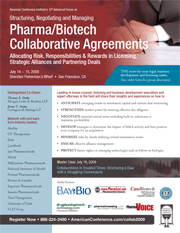
  • San Francisco #4 American Conference Institute (ACI) will be holding a Pharma/Biotech Collaborative Agreements conference from July 14-15, 2009 in San Francisco, CA.  The conference will allow attendees to:

    • Capitalize on shifting trends in the venture capital investment landscape;
    • Draft critical termination terms;
    • Forge and protect lucrative relationships with investors;
    • Negotiate partnerships with start-up innovators and government programs;
    • Contend with increased pressure from anxious investor's seeking an immediate healthy return on their investment;
    • Redefine alliance management priorities;
    • Position an IP portfolio to increase market power;
    • Negotiate milestones into the compensation structure; and
    • Convert a licensing deal into an acquisition.

    In particular, ACI's faculty will offer presentations on the following topics:

    663L09-SNF • Predicting future trends and developing emerging strategies in the current economic environment;
    • Conducting effective and strategic due diligence;
    • Negotiating essential critical terms to maximize profitability;
    • Developing a profitable compensation structure with built-in milestones to maximize value;
    • Structuring the agreement with an eye towards M&A;
    • Creating and implementing critical termination provisions;
    • Alliance management:  Establishing governance structures for successful collaborations;
    • Crafting international business agreements for calculated growth and sustainability;
    • Negotiating collaborative research agreements with the U.S. government and academic institutions; and
    • Anticipating future technologies and incorporating terms into the agreement to protect future rights.

    An additional post-conference master class entitled:  "Collaborations in Troubled Times: Structuring a Deal with a Struggling Counterparty" will be offered on July 16, 2009.  The master class will address critical aspects of the negotiating and management processes during the forging of strategic alliances.

    The agenda for the Pharma/Biotech Collaborative Agreements conference can be found here.  A complete brochure for this conference, including an agenda, list of speakers, and registration form can be downloaded here.

    ACI - American Conference Institute The registration fee ranges from $2,195 (conference alone) to $2,795 (conference and one master class).  Those registering on or before May 22, 2009 will receive a $300 discount off the registration fee and those registering on or before June 12, 2009 will receive a $200 discount off the registration fee.  Those interested in registering for the conference can do so here, by calling 1-888-224-2480, or by faxing a registration form to 1-877-927-1563.

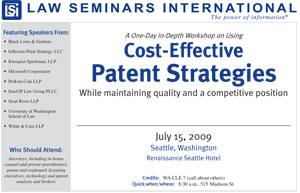
  • Seattle #1 Law Seminars International (LSI) will be holding a one-day workshop on Using Cost-Effective Patent Strategies on July 15, 2009 in Seattle, WA.  During the workshop, LSI's faculty will offer presentations on the following topics:

    • Value of patents under recent law:  Planning procurement in light of a changing landscape;
    • If not filing patents:  Using trade secret protection as a cost-saving measure;
    • Managing costs of patent procurement and enforcement defense;
    • Building a more profitable portfolio:  Tips for more effective and efficient patent procurement;
    • Managing legal costs in patent transactions;
    • Enforcing patents efficiently:  Getting the money without going to court;
    • Defending patent infringement suits efficiently:  Winning early; and
    • Dealing with trolls:  Best approaches under recent case law.

    Brochure The agenda for the workshop can be found here.  A complete brochure for this workshop, including an agenda, list of speakers, and registration form can be downloaded here.

    The registration fee is $447.50 for students and new employees, $695 for government employees, and $895 for all other attendees. Those interested in registering for the workshop can do so here, by calling 1-800-854-8009, or by faxing a registration form to 1-206-567-5058.

  •     By Donald Zuhn

    House of Representatives Seal Earlier today, the House Committee on the Judiciary heard testimony from seven witnesses (and accepted written testimony from other interested parties) regarding the House patent reform bill (H.R. 1260).  Although the hearing was not made available for online viewing, written testimony from the witnesses who testified at the hearing can be downloaded at the Committee's website.  In Part I of our report on the House patent reform hearing, we examine the written testimony submitted by two of the witnesses as well as testimony submitted by the Biotechnology Industry Organization (BIO).

    Kamen, Dean In contrast with the Senate Judiciary Committee's March 10th hearing on patent reform, the House Judiciary Committee solicited testimony from representatives of two groups that had not been previously heard from:  inventors and venture capitalists.  Speaking on behalf of inventors was Dean Kamen (at left) of DEKA Research and Development Inc., the inventor of the Segway.  In his written testimony, Mr. Kamen contends that "[s]ome of the provisions in H.R. 1260, the Patent Reform Act of 2009 — including the reduction of damages awarded to a patent holder whose patent has been found infringed and the various expansions of post-grant review — are very troubling."  With respect to the damages provision, Mr. Kamen states that:

    I was somewhat encouraged to learn that the Senate has reached a compromise on the damages provision which does not alter the standard for calculating damages, but provides some additional guidance to judges in these cases.  In my view this may be a reasonable compromise, but anything that went beyond this to alter the standards for calculating damages could have serious consequences for our patent system and our economy.

    As for post-grant review, he argues that "the expansion of post-grant reviews proposed by H.R. 1260 would add uncertainty to the value and validity of patents (in some instances many years after those patents were granted), create further disincentives for patent holders and investors, and may open the system up abuse by potential infringers."

    Mr. Kamen also calls for a permanent end to fee diversion and a reconsideration of the change from a first-to-invent system to a first-inventor-to-file system, contending that such a change "would create a rush to the patent office that would result in an increase in the number of poorly thought-out, lower quality patent applications," that "could unfairly disadvantage individual inventors, small and start-up companies, and universities, who may have smaller budgets and less access to patent professionals," as well as overburden the Patent Office.

    NVCA Another new voice to the debate (at least amongst witnesses called to testify at the two Congressional patent reform hearings held this year) was that of venture capitalists.  Representing this group, and the 460 venture firms of the National Venture Capital Association (NVCA), was Jack Lasersohn, a Partner with the Vertical Group.  Like Mr. Kamen, Mr. Lasersohn's written testimony "focuses on two critical elements of patent reform proposals:  the calculation of damages in patent infringement cases and the structure of post-grant review procedures."  With respect to the damages provision, Mr. Lasersohn notes that "the venture capital community believes that the current methodology for calculating damages is appropriate and working, and that patentees are not systematically overcompensated."  As a result, Mr. Lasersohn's group supports the gatekeeper language that replaced the apportionment of damages provision in the original version of the Senate bill (S. 515), and which was largely responsible for permitting the Senate bill to be voted out of Committee on April 2.

    As for post-grant review, Mr. Lasersohn states that:

    [T]he NVCA has supported the creation of a well defined, limited post grant review process with strong estoppel, because we believe it will improve the quality of future patents, which is in the interest of all.  However, we must recognize the imbalance of power intrinsic in this situation and take care that the system limits the potential for abuse by larger firms seeking to harass smaller competitors.

    The venture capital community supports a limited, 12 month window after a patent is granted to allow time for challengers to file opposition.  This single, finite post-grant window will serve to quickly weed out bad patents, but will not foster repeated challenges to patent validity nor introduce uncertainty into the patent system.

    In addition, Mr. Lasersohn notes that the NVCA opposes expanding inter partes reexamination to include the use of "prior public use or sale," language that was removed from S. 515 but which remains in H.R. 1260, since "in this procedural setting patentees will be disadvantaged if such issues may be raised many years after a patent has granted."

    Biotechnology Industry Organization (BIO) As with the Senate Judiciary Committee's hearing on patent reform, interested members of the patent community could submit written statements for consideration by the House Judiciary Committee.  One such member was the Biotechnology Industry Organization (BIO), which provided Patent Docs with a copy of its written testimony.  In its statement, BIO observes that since the House Judiciary Committee last took up patent reform in an April 2007 hearing:

    [B]oth the legal and economic landscape relevant to patent reform has shifted dramatically.  To the extent that proponents of patent reform argued two years ago that the judicial climate was overly protective of patents and patent owners (a view decidedly not embraced by BIO even back then), there can be no doubt that a series of landmark decisions by the U.S. Supreme Court and the United States Court of Appeals for the Federal Circuit has made it much harder to obtain and enforce valid patents, while making it easier to challenge patents.  And to the extent that concerns were raised in 2007 about the negative impact that some of the proposed patent reforms could have on U.S. economic gr
    owth at home and competitiveness abroad (a concern that BIO shared), there can be no doubt that such concerns are even more pronounced in light of the current economic situation in the U.S. today.

    Among the patent reforms that BIO supports (some of which have made it into H.R. 1260, and some of which have not) are full funding of the USPTO by permanently ending fee diversion, an expansion of opportunities for members of the public to submit prior art during examination, a transition to a first-inventor-to-file system that incorporates an "appropriate 'grace period,'" willful infringement reforms that require litigants to first resolve validity and infringement before turning to willfulness, venue reforms that discourage forum-shopping, repeal of the best mode requirement, and restoration of the rebuttable presumption of irreparable harm and inadequacy of remedies at law when evaluating a patentee's request for a permanent injunction.  BIO also "believes that [the inequitable conduct] doctrine should be abolished," and that "[t]he regulation of applicant conduct should be committed to the expert agency, the PTO."

    Echoing statements in both Mr. Kamen's and Mr. Lasersohn's written testimony, BIO notes that it opposes post-grant review provisions that would broaden the grounds upon which a patent can be administratively challenged, and the House bill's apportionment of damages provision.  With respect to these provisions, the industry group states:

    BIO wants to emphasize that, with respect to its opposition to these two key provisions in this bill — damages and expanded reexamination — it stands in good company.  There is broad consensus, among a variety of industries, universities, unions, and other stakeholders across the spectrum of American society, against these proposed changes.

    Patent Docs will examine written testimony provided by the other witnesses, as well as reaction in the patent community to today's hearing, in subsequent posts.

  •     By Donald Zuhn

    House of Representatives Seal On Monday, the House Committee on the Judiciary announced that it would be holding on hearing on its patent reform bill (H.R. 1260) on April 30, 2009 at 10:00 AM (Eastern).  Although the Committee posted a notice regarding the hearing on its website, it did not release a witness list until today.  The witnesses scheduled to appear before the Committee include:

    • David Simon, Chief Patent Counsel for Intel, Inc.;
    • Philip Johnson, Chief Intellectual Property Counsel for Johnson & Johnson;
    John Thomas, Professor at Georgetown University Law School;
    Jack Lasersohn, Partner with the Vertical Group;
    Dean Kamen, DEKA Research and Development Inc.;
    Mark Chandler, Senior Vice President for Cisco; and
    • Bernard Cassidy, Senior Vice President and General Counsel for Tessera Inc.

    Interestingly, Mr. Johnson will be making his second appearance at a Congressional patent reform hearing this year, having appeared as a witness at the Senate Judiciary Committee's hearing in March.  Like Mr. Johnson, Tessera will also be getting a second chance to address a Congressional hearing on patent reform, with Mr. Cassidy replacing Tessera Vice President Taraneh Maghamé, who appeared before the Senate Judiciary Committee.  Despite her company's focus (micro-electronics and imaging/optics), Patent Docs readers may recall that Ms. Maghamé testified that a gatekeeper approach, in which the court determined the Georgia-Pacific factors to be considered by the jury, was the best method for calculating a reasonable royalty (see "Senate Judiciary Committee Holds Hearing on Patent Reform").

    Unfortunately, the witness list for the House hearing appears to be nearly as imbalanced as the witness list for the Senate hearing.  While Mr. Johnson — the lone life sciences representative at the Senate hearing — will be joined by Mr. Lasersohn of the Vertical Group, a venture capital firm focused on medical technology and biotechnology, the Coalition for Patent Fairness will once again be well-represented, with Mr. Simon and Mr. Chandler taking over for Mr. Appleton, the Chairman and CEO of Micron Technology, Inc.  The witness list also includes Mr. Kamen, the inventor of the Segway, who is described on DEKA's website as an inventor, entrepreneur, and tireless advocate for science and technology and Professor Thomas from Georgetown University Law School.

  •     By Donald Zuhn

    California Health Institute Earlier today, California Healthcare Institute president and CEO Dr. David Gollaher provided Patent Docs with an update regarding the status of patent reform and follow-on biologics legislation in the 111th Congress.  The California Healthcare Institute (CHI) is an independent organization comprising more than 250 biomedical companies and academic and research institutions involved in researching and advocating policy to forward the interests of California's biomedical community.

    While in Washington, DC last week to host a workshop on comparative effectiveness research and participate in the CHI's quarterly board meeting, Dr. Gollaher and other representatives of CHI took the opportunity to meet with members of Congress to discuss pending patent reform and follow-on biologics legislation.  Dr. Gollaher was particularly interested in recent developments concerning H.R. 1260, the companion bill to the Senate patent reform bill (S. 515) voted out of Committee earlier this month, and H.R. 1548, the follow-on biologics bill introduced by Rep. Anna Eshoo (D-CA) on March 17.

    Gollaher, David With respect to patent reform legislation, Dr. Gollaher (at left) noted that the CHI had played an important role in securing the April 2 compromise that permitted S. 515 to be voted out of Committee (see "Senate 'Patent Reform' Bill (S. 515) Voted out of Judiciary Committee").  The organization accomplished this by working closely with Senator Dianne Feinstein (D-CA) to improve the bill originally introduced in the Senate on March 3 (see "Senate and House Introduce New Patent Reform Legislation").  Dr. Gollaher noted that the CHI was able to convince Senator Feinstein that the original version of the Senate bill would cause more problems for California's life sciences companies and universities than it would resolve problems with the U.S. patent system.  (Dr. Gollaher also noted that in making the argument for harm to California's universities, it probably did not hurt that Senator Feinstein's husband, Richard Blum, is the Chairman of the Board of Regents of the University of California.)  The CHI's work ultimately paid off when Senator Feinstein expressed concerns about the bill during the Senate Judiciary Committee's March 10 hearing on patent reform, and declared that absent a reworked damages provision, she would not be voting for the bill (see "Senate Judiciary Committee Holds Hearing on Patent Reform").

    Despite the successful outcome in the Senate, however, Dr. Gollaher was worried about what might happen to the House version of the bill in the coming weeks.  Dr. Gollaher's fears had only been heightened by conversations he had last week with Rep. Zoe Lofgren (D-CA), who suggested that the pro-apportionment faction might be looking to torpedo the House bill altogether rather than allow it to pass with the same gatekeeper damages provision currently in S. 515.  In view of the House's passage of H.R. 1908 in September of 2007 (see "Patent 'Reform' Bill Passes House of Representatives"), it is hardly surprising that a portion of the House — probably a good number of the Democrats that voted 160-58 in favor of the bill — might have problems with the compromise provisions in S. 515.  Interestingly, Dr. Gollaher indicated that some House members had signed onto H.R. 1908 with the promise, subsequently broken, that more controversial provisions in the bill would be "fixed" before the legislation reached the floor for a vote.  Because it was unlikely that these House members would be duped again, Dr. Gollaher suggested that the pro-apportionment faction might fail in its attempts to put an apportionment of damages provision back into play.

    As for the effort to enact follow-on biologics legislation, Dr. Gollaher noted that Rep. Eshoo's bill continued to maintain a sizeable advantage over Rep. Henry Waxman's competing bill (H.R. 1427) in terms of the number of co-sponsors (currently, H.R. 1548 has 66 co-sponsors and H.R. 1427 has 10).  Dr. Gollaher took this as a good indicator that Rep. Eshoo's bill, which the CHI supports, might prevail over Rep. Waxman's bill.  However, Dr. Gollaher conceded that Rep. Waxman, who chairs the House Committee on Energy and Commerce, still wielded much power, and as a result, could eventually swing support back to his own bill.  Dr. Gollaher also believed that the follow-on biologics debate could eventually be influenced by Senator Edward Kennedy (D-MA), who might introduce his own follow-on biologics bill in the Senate (as he did in the 110th Congress; see "Senate Committee Passes Biologics Legislation").  Dr. Gollaher concluded the discussion by noting that CHI member Deloitte recently released a study entitled "Avoiding No Man's Land: Potential Unintended Consequences of Follow-on Biologics," which examines the follow-on biologics bills introduced in Congress, and according to a CHI press release warns that "if responsible legislation is not carefully crafted specifically for today's industry, the industry may enter into a 'no man's land' which could significantly reduce our ability to continue to develop innovative treatments for the most dreaded diseases."  Patent Docs will provide a more comprehensive analysis of the study in a subsequent post.