• Practising Law Institute (PLI) will be holding a two-day seminar entitled:  "Advanced Patent Prosecution Workshop 2009:  Claim Drafting & Amendment Writing" on July 23-24, 2009 in New York, NY and on August 17-18, 2009 in San Francisco, CA.

    At the New York seminar, PLI's faculty will offer presentations on the following topics:

    New York #3 • Ethics in the PTO;
    • Concurrent Sessions I:  Advanced Specification Drafting Issues — all concurrent sessions will provide lectures specific to four different technologies including biotechnology and chemical/pharmaceutical;
    • Concurrent Sessions II:  Advanced Claim Drafting Issues;
    • Concurrent Workshops I:  Advanced Claim Drafting;
    In re Bilski — Section 101 Subject Matter;
    • Concurrent Sessions III:  Advanced Patent Prosecution Issues; and
    • Concurrent Workshops II:  Advanced Amendment Drafting.

    At the San Francisco seminar, presentations will be offered on the following topics:

    San Francisco #4 • Ethics for Patent Prosecutors;
    • On-Sale Bar;
    • Advanced Claim Drafting Issues — class to split into technology groups, including biology/chemistry group;
    • Patentable Subject Matter — class to split into technology groups, including biology/chemistry group;
    • Claim Drafting Workshops — class to split into technology groups, including biology/chemistry group;
    • Duty of Disclosure;
    • Examiner Interviews;
    • Post Final Practice;
    • Affidavit Practice; and
    • Amendment Workshops — class to split into technology groups, including biology/chemistry group.

    Practising Law Institute (PLI) #2 A complete program schedule, including descriptions of the presentations and a list of speakers, for the New York seminar can be found here, and a program schedule and list of speakers for the San Francisco seminar can be found here.

    The registration fee for the conference is $1,495.  Those interested in registering for the conference can do so here (New York) or here (San Francisco).

  • 814L09-WEB American Conference Institute (ACI) will be offering a webinar entitled:  "The Future of Reverse Payment Settlements:  Insider's Guide to Imminent Antitrust Policy Changes" on June 17, 2009 from 1:00-2:30 PM (EST).  Thomas Barnett, former Assistant Attorney General in charge of the Justice Department's Antitrust Division and co-chair of Covington & Burling's Antitrust & Consumer Law Practice Group; Meredyth Smith Andrus, Federal Trade Commission, Bureau of Competition; and Robert Rhoad, Co-Leader of Crowell & Moring's Health Care Litigation Team, will provide an overview of the present status of the law on patent settlements, including an analysis of the key issues in the debate and the positions of the Department of Justice and the Federal Trade Commission.  In particular, the panelists will address:

    • Recent controversial judicial developments and possible Supreme Court review;
    • The emerging position of the Obama Administration and new Justice Department;
    • Enforcement forecast:  What we can expect to see from the FTC?
    • Pending legislation:  Protecting Consumer Access to Generic Drugs Act of 2009.

    ACI - American Conference Institute The registration fee for this webinar is $199.  Those interested in registering for the webinar, can do so here, or by calling 888-224-2480.

    Patent Docs is a media partner of this webinar.

  •     By Donald Zuhn

    GlaxoSmithKline - GSK Plaintiff-appellee Dr. Triantafyllos Tafas was not alone yesterday in filing a petition for a panel rehearing or rehearing en banc of the March 20 decision in Tafas v. Doll (see Patent Docs report).  Also seeking a rehearing of the Federal Circuit's decision in Tafas were plaintiffs-appellees SmithKline Beecham Corp., SmithKline Beecham PLC, and Glaxo Group Ltd. ("GSK"), which filed a petition for rehearing en banc on Wednesday as well.  In that petition, GSK posed the following questions of exceptional importance:

    I.  Whether the Panel majority erred in rejecting the test for determining whether a Patent and Trademark Office ("PTO") rule is "substantive," as set forth in the controlling precedent of Chrysler, supra; Animal Legal Defense Fund, supra; and Cooper Technologies, supra.

    II.  Whether the Panel majority erred in holding that the challenged Final Rules, 72 Fed. Reg. 46,716 (Aug. 21, 2007), fall within the PTO's limited, non-substantive rulemaking authority.

    Noting that "[t]wo judges agreed that PTO has authority to issue Rules 114, 75, and 265, but disagreed on the applicable legal framework and rationale," GSK's petition contends that "[b]oth opinions that comprise the majority conflict with established precedent of this Court and the Supreme Court governing when a rule is substantive."  The petition asserts that "[t]he opinions also conflict with each other, leaving the PTO and patent applicants wholly uncertain about this Court's test for deciding whether PTO rules are lawful," and therefore argues that "[t]he conflict between the majority opinions and binding precedent, and the need to remove the uncertainty this has created as to the legal standard for measuring the legality of PTO rules, warrants en banc review."

    Stating that "[t]he principal opinion improperly and incorrectly dismissed Chrysler Corp. v. Brown, 441 U.S. 281, 289 (1979), as irrelevant in the course of finding the Final Rules non-substantive," the petition contends that "the line between substantive and procedural rules delineated in Chrysler is particularly important to enforce, given the PTO's narrow rulemaking authority, and both the principal opinion and the concurring opinion erred in rejecting its use in this case."  The petition notes that in Chrysler, the Supreme Court defined a "substantive rule" as one "affecting individual rights and obligations," and asserts that "[t]his Circuit has repeatedly endorsed the Chrysler test to determine whether rules, including PTO rules, are substantive."  In support of this assertion, GSK cites Animal Legal Defense Fund v. Quigg, 932 F.2d 920, 927 (Fed. Cir. 1991); Cooper Technologies Co. v. Dudas, 536 F.3d 1330, 1336 (Fed. Cir. 2008); Tunik v. MSPB, 407 F.3d 1326, 1344 (Fed. Cir. 2005); Schism v. United States, 316 F.3d 1259, 1281 (Fed Cir. 2002) (en banc)); and Merck & Co. v. Kessler, 80 F.3d 1543,1550 (Fed. Cir. 1996).  With respect to Animal Legal Defense Fund, the petition states that:

    In ALDF, this Court adopted the Chrysler standard in reviewing PTO rules, thereby serving the statutory goal of circumscribing the PTO's authority.  The PTO's power is limited to internal housekeeping matters; it cannot alter inventors' basic rights to receive patents if they otherwise satisfy the Patent Act's conditions.  Thus, it makes perfect sense to declare PTO rules ultra vires whenever they affect "individual rights and obligations."  Chrysler, 441 U.S. at 302.  Yet, neither the principal opinion nor the concurring opinion applied the Chrysler/ALDF test to determine whether the Rules are lawful.  That decision thus conflicts with Circuit precedent.

    GSK next addresses how each of the four Final Rules at issue "drastically change the existing law and alter an inventor's rights and obligations under the Patent Act" (quoting Judge Rader's dissent in Tafas v. Doll).  With regard to the limit on RCEs imposed by Final Rule 114, the petition states that:

    [I]f Rule 114 functions as the PTO intends, an applicant will never be able to file an RCE in any member of an application family if that applicant has previously filed an RCE in any other family member.  The effect of the Rule is that many applicants will not secure any patent rights, or not the full scope of rights, to which the inventor is constitutionally and statutorily entitled.

    While acknowledging that "Final Rule 114 does permit an applicant to file additional RCEs by filing a petition that establishes that 'the amendment, argument or evidence could not have been submitted prior to the close of prosecution in the application,'" GSK nonetheless observes that "the very purpose of Rule 114 is to limit the number of requests for continued examinations that are made, and to thereby reduce the PTO's backlog."

    As for Final Rule 265, which sets forth the requirements for the filing of an Examination Support Document (as a means of securing more than the 5 independent and 25 total claims permitted under Final Rule 75), the petition contends that "[t]he majority fails to appreciate the substantive impact that the ESD requirement will have on applicants," and further argues that "[t]he principal opinion also dismissed the implications of the ESD requirement on claim scope and inequitable conduct."  GSK also asserts that:

    The approach reflected in the principal opinion of dealing with the fatal vagueness of the ESD regulation is to suggest that applicants prosecute and litigate patents at their peril based on their own self-imposed search limitations.  The fiction of this assumption is that it is reasonable to rely on a standard which relies on this Court to tell applicants, on a case-by-case basis, whether their ESD-mandated search was adequate or if they committed inequitable conduct in preparing, providing and continually updating that ESD during examination.  This is an unacceptable approach.  Industry needs business certainty at the front end of the examination process to make well reasoned decisions based on clear rules.  Patent applicants cannot play the high risk game of going forward with millions of dollars of investment without any assurance that the investment will be adequately protected.

  •     By Kevin E. Noonan

    The Federal Circuit clarified the role of the written description requirement in interference practice today in an opinion by Judge Rader, one of the Court's most severe critics of its written description jurisprudence.  Unlike the situation where the written description requirement is used to invalidate patents (which is the subject of a petition for en banc review in Ariad v. Eli Lilly), Judge Rader's decision confirms that the written description requirement is particularly relevant to the essential interference question of inventive priority.

    Affymetrix The interference at issue was declared against U.S. Patent No. 6,513,968 to Schembri and assigned to Agilent, and U.S. Patent Application Serial No. 10/619,244 to Besemer and assigned to Affymetrix.  Affymetrix provoked the interference by copying claims from the '968 patent; because Affymetrix's application was awarded the earliest priority date, Besemer was declared the senior party, placing the burden of establishing priority on Agilent.

    The interference count was identical to claim 20 of the Schembri patent and claim 66 of the Besemer application:

    A method comprising:
        providing a first substrate and a second substrate having inner surfaces that define a closed chamber therebetween, said chamber adapted to retain a quantity of fluid so that the fluid is in contact with both inner surfaces, and wherein at least one of said inner surfaces is functionalized with polynucleotides, polypeptides, or polysaccharides;
        introducing a fluid containing a plurality of components into the closed chamber so as to provide a quantity of fluid therein in contact with both inner surfaces;
        providing a bubble in the fluid; and
        moving a bubble within the fluid to result in mixing.

    Agilent Technologies As explained in the opinion, Agilent's Schembri patent disclosed a microarray hybridization method performed in a closed chamber in which probe sequences were attached to one or both of two opposing surfaces on the interior of the chamber.  Because of the small volumes of fluid used for hybridization, mixing was effected by producing  bubbles in the fluid (by heating) and using motion of the bubbles in response to a temperature gradient to "cause the bubble to move and mix the fluid sample in the closed chamber," as illustrated in Figures 1 and 4 of the '968 patent:
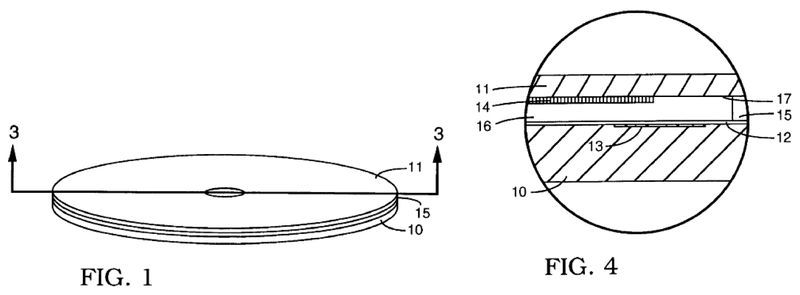
    FIG1&4

    FIG28 The Besemer application, on the other hand, disclosed microarrays contained in a chamber operably linked to "circulator" embodiments comprising reservoirs from which hybridization fluid was pumped through the hybridization chamber to effect mixing, as illustrated in Figure 28 (at right).

    FIG29 Alternatively,  the microarrays were contained in a chamber that was agitated at 3000 cycles per minute as shown in Figure 29 (at left).

    During interference proceedings in the Patent Office, Agilent challenged the Besemer claim in interference for failure to satisfy the written description requirement of 35 U.S.C. § 112, first paragraph.  The Board disagreed on the grounds that "Schembri had not advanced any 'meaningful evidence' to show that one of ordinary skill in the art would not have understood Besemer's specification to inherently disclose using bubbles to mix fluid in a closed chamber, as required by Besemer's claim 66.  Board Decision, slip op. at 28," awarded priority to the Besemer application and cancelled Schembri's '968 patent.  Agilent appealed, filing an action in the District Court for the Northern District of California pursuant to 35 U.S.C. § 146.  In that action, both parties submitted new expert reports concerning the disclosures of the '968 Schembri patent and the Besemer application.  After holding a claim construction hearing and considering summary judgment motions from both parties, the District Court affirmed the Board's decision that the Besemer application satisfied the written description requirement.  Agilent then appealed to the Federal Circuit, challenging the District Court's claim construction and written description determinations.

    Federal Circuit Seal The opinion, written by Judge Rader and joined by Judge Mayer and 7th Circuit Judge Richard Posner, sitting by designation, began by considering the question of which specification was to be used to construe Besemer's claim 66.  The District Court had used the disclosure of the Besemer application (termed "the host application" in the opinion), and Agilent contended that the proper reference was the Schembri patent specification.  Judge Rader framed the question in terms of which of the Court's precedents were controlling:  In re Spina or Rowe v. Dror.  In the Spina case, as here, an applicant copied a claim from an issued patent to provoke an interference.  The Board, in determining whether the copier's specification satisfied the written description requirement, construed the copied claim in light of the specification of the granted patent, an approach affirmed by the Federal Circuit:  "'[w]hen interpretation is required of a claim that is copied for interference purposes, the copied claim is viewed in the context of the patent from which it was copied.'&#01
    60; Spina, 975 F.2d at 856."

    In the Rowe case, junior party Rowe copied claims from the Dror patent to provoke an interference.  In that case, senior party Dror moved for judgment on the grounds that a third-party patent anticipated certain of Rowe's claims corresponding to the count.  In deciding the subsequent appeal, the Federal Circuit held that the specification of Rowe's application should be used to construe the claim term at issue — in other words, precisely the opposite result from the rule laid down in Spina.  That panel recognized the inconsistency with the Spina panel's rule, and distinguished the cases as follows:

    In Spina, this court considered whether an applicant was eligible to copy a patentee's claim and thereby challenge priority of invention, a question that turned on whether the copying party's specification adequately supported the subject matter claimed by the other party.  This court held, in that context, that a copied claim is interpreted in light of its originating disclosure.  This Spina rule sought to ensure that the PTO would only declare an interference if both parties had a right to claim the same subject matter.  However, that rule does not apply in cases, such as this one, where the issue is whether the claim is patentable to one or the other party in light of prior art.  In this posture, the PTO and this court must interpret the claim in light of the specification in which it appears.  Rowe, 112 F.3d at 479.

    In this case, the Federal Circuit held that the rule in Spina applies, because the question was whether "Besemer ha[s an] adequate basis to copy Schembri's claim and thereby challenge Schembri's priority of invention . . . .  This case does not present the Rowe situation, 'where the issue is whether the claim is patentable to one or the other in light of prior art.'"  In making this determination, the Court expressly rejected Affymetrix's contention that it would be contrary to 37 C.F.R. § 41.200(b), stating that "administrative regulations cannot trump judicial directives . . . .  Judicial precedent is as binding on administrative agencies as are statutes" (citing Rowe at 479 n.2).  The Court summarized its holding on this question as follows:

    To be clear, as this court explained in Rowe, when a party challenges written description support for an interference count or the copied claim in an interference, the originating disclosure provides the meaning of the pertinent claim language.  When a party challenges a claim's validity under § 102 or § 103, however, this court and the Board must interpret the claim in light of the specification in which it appears.  Thus, the district court erred in construing claim language in light of the host Besemer application, rather than the originating Schembri disclosure.
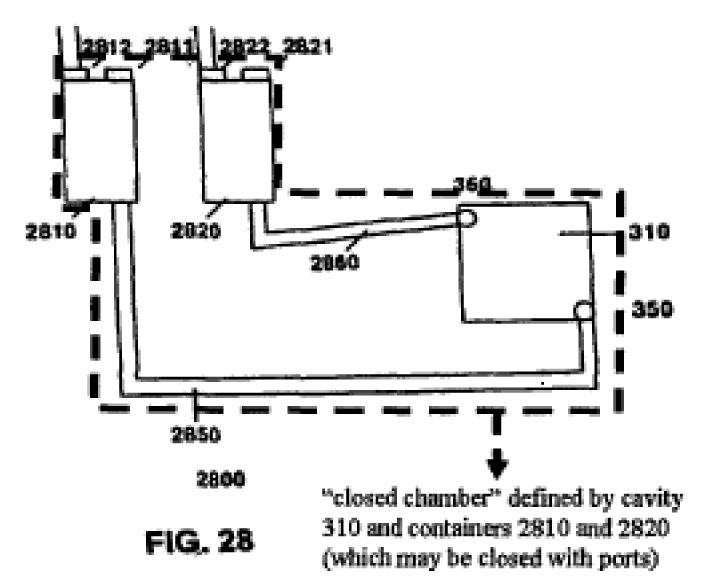
    FIG28-2 Turning to the District Court's claim construction, the panel disagreed with two aspects that were dispositive.  First, the panel disagreed with the District Court's construction of the claim term "a closed chamber . . . adapted to retain a quantity of clued" to mean "an enclosed cavity, or some other enclosure or system of enclosures, which is capable of being sealed or set apart from its surroundings to retain a quantity of fluid."  Under the District Court's construction, the configuration set forth in Figure 28 of the Besemer application provided an adequate written description of a "closed chamber," as illustrated at left.

    The Federal Circuit held that this construction was "dubious" since it ran counter to the plain meaning of the phrase "a closed chamber" considered in the context of the rest of the claim, which recited that the closed chamber was "'define[d by] a first substrate and second substrate having inner surfaces."  The Court contrasted the chamber thus recited as being "bounded by two discrete substrates" with "a nebulous space that could ambiguously span 'a system of enclosures.'"  The panel's contrary construction of the term was supported by the Schembri specification, rather than the Besemer specification used by the District Court.  As might be expected, the definition of "a closed chamber" in the Schembri specification provided no support for the embodiments disclosed in the Besemer specification.  The Federal Circuit also found functional as well as structural distinctions, including that the "closed chamber" disclosed in the Schembri specification was configured so that nucleated bubbles would be formed that would move in response to an induced temperature gradient to facilitate mixing, in contrast to the embodiments disclosed in the Besemer specification that used fluid flow from external reservoirs to mix hybridization fluid over the microarray surfaces.  The Court's opinion also noted that construing "a chamber" to comprise "several chambers" (as would be required to encompass the Besemer embodiments) would "provide no guidance as to where, amongst the several chambers, the first and second substrates [comprising the probe sequences] are located."  In this regard, the CAFC also held that the District Court's construction was faulty for rendering the word "closed" to be superfluous, finding that the term "closed" was synonymous with "sealed," a quality the embodiments disclosed  by Besemer did not have.

    Turning to the written description issue, the panel agreed with Agilent that there was no support in the Besemer specification for the count corresponding to Besemer's copied claim 66.  Summarizing, the opinion states that:

    [T]he "circulator" embodiments (illustrated in Figures 28 and 30) do not describe a method that takes place in a "closed chamber," whereas the "vortexer" embodiment (Figure 29) does not describe bubble mixing at all.  Thus, as per Agilent, Besemer cannot show possession of the claimed invention because no embodiments describe a method of both introducing fluid into a closed chamber and using bubbles to mix the fluid.

    The panel eliminated the embodiments disclosed in Figures 28 and 30 for failure to describe a closed chamber, and then eliminated the embodiment disclosed in Figure 29 for failure to disclose bubbles to facilitate mixing.  The panel's conclusions were based on the Court's reading of portions of the Besemer specification as well as expert testimony, which the opinion termed "a critical admission" that the vortexer embodiment described in Figure 29 did "not necessarily" generate bubbles in operation, testimony that the Court opined vitiated any inherency argument asserted by Affymetrix.

    The Federal Circuit also held that the District Court had improperly failed to consider new evidence presented by Agilent pursuant to the provisions of 35 U.S.C. § 146, directed at supplying what the Board found it had failed to supply during the interference:

    Meaningful evidence in this case might, for example, have included an expert declaration stating that one of ordinary skill in the art would not have had the requisite knowledge or skills to conclude from the Besemer '224 specification that the inventor was in possession of the invention as claimed.  Board decision, at 28.

    The District Court erred in not considering Agilent's new evidence and thus deferring to the Board's factual determinations.  Accordingly, the panel held that there was "no dispute of material fact that the Besemer application does not teach the claimed method" and thus the Besemer application was entitled to a priority date no earlier than its filing date.  Accordingly, the Federal Circuit held that Agilent was entitled to priority without remand to the District Court.

    Agilent Technologies, Inc. v. Affymetrix, Inc. (Fed. Cir. 2009)
    Panel: Federal Circuit Judges Mayer and Rader and Seventh Circuit Judge Posner
    Opinion by Circuit Judge Rader
  •     By Donald Zuhn

    Ikonisys Earlier today, counsel for Dr. Triantafyllos Tafas filed a petition for a panel rehearing or rehearing en banc of the decision issued by the Federal Circuit in Tafas v. Doll.  In that decision, issued on March 20, a split panel determined that Rules 75, 78, 114, and 265 are procedural, but that Rule 78 is inconsistent with 35 U.S.C. § 120 (see Patent Docs report).

    Dr. Tafas' request for rehearing or rehearing en banc is based on the grounds that the panel majority:

    (1) misapplied significant binding Supreme Court and Federal Circuit precedent concerning the correct standard for classifying administrative rules as "substantive" versus "non-substantive"; (2) failed, contrary to Supreme Court and Federal Circuit precedent, to fully consider evidence that the Final Rules significantly and adversely affect individual rights and obligations under the law; (3) failed to correctly address, as required by Supreme Court precedent, the threshold question of whether the PTO has the jurisdictional authority under 35 U.S.C. § 2(b)(2) to enact the Final Rules; and (4) misapplied Chevron deference to its improper determination that Final Rules 75, 265 and 114 were not "inconsistent with existing law".

    With respect to the first two grounds, the petition states that:

    Instead of conducting the required analysis of the Final Rules' effect on existing patent law, policy and individual rights and obligations, the majority, relying on out-of-context statements from JEM Broadcasting Co.[] v. Federal Communications Commission, 22 F.3d 320 (D.C. Cir. 1994), and a misconstruction of Lamoille Valley Railroad Co. v. Interstate Commerce Commission, 711 F.2d 295 (D.C. Cir. 1983), simply asserted that the RCE, ESD and 5/25 rules are "procedural" on the ground that while each may "alter the manner in which the parties present their viewpoints to the USPTO," each "do[es] not, on [its] face, foreclose effective opportunity to present patent applications for examination" or "effectively foreclose[] [applicants] from obtaining the patent rights to which they are entitled."  Tafas, 559 F.3d at 1356.  With these statements, the majority opinion created a new standard at odds with existing Federal Circuit precedents.  This standard suggests that a PTO rule with any procedural aspect cannot be struck down as "substantive" unless it eviscerates applicants' ability to successfully prosecute patent applications or utterly forecloses applicants' ability to obtain the patent rights to which they are entitled.

    On the third ground, the petition argues that "the majority inappropriately equated a 'consistency with the law' analysis [under 35 U.S.C. § 2(b)(2)] with an analysis of whether certain select patent statutes relied upon by the District Court are ambiguous so as to allow agency discretion in their interpretation."  Section 2(b)(2) of Title 35 specifies that the Patent Office "may establish regulations, not inconsistent with law" that "govern the conduct of proceedings in the Office" and "facilitate and expedite the processing of patent applications."  Thus, the petition contends that:

    [A]s part of its "Chevron Step Zero" analysis, the Court was required to consider whether or not the Final Rules were consistent with law and, therefore, within the PTO's jurisdiction.  This analysis should have been done before granting Chevron deference to the PTO's interpretation of the Patent Act, not after, as in the majority opinion.

    Finally, with respect to its fourth ground, the petition argues that the majority incorrectly concluded that Final Rules 75, 265 and 114 were not inconsistent with applicable law.  For example, according to the petition:

    Final Rule 75(b)(1) grants the PTO the right to withhold a patent on allowed claims in certain circumstances.  Where no ESD was filed before the first Office Action on the merits, but six or more claims depending on a single independent claim are allowed by the Examiner if the applicant agrees to cancel the independent claim and rewrite each of the dependent claims in independent form, the applicant cannot receive patent protection on at least one of the allowed embodiments under Final Rule 75.  This is contrary to 35 U.S.C. § 131.

    Section 131 states that "[t]he Director shall cause an examination to be made of the application and the alleged new invention; and if on such examination it appears that the applicant is entitled to a patent under the law, the Director shall issue a patent therefor."  The petition also contends that Final Rule 75 is inconsistent with 35 U.S.C. § 112, Final Rule 265 is inconsistent with 35 U.S.C. § 102, and Final Rule 114 is inconsistent with 35 U.S.C. § 132.

    Patent Docs thanks James Nealon of Kelley Drye & Warren LLP for kindly providing us with a copy of Dr. Tafas' Combined Petition for Panel Rehearing and Rehearing En Banc.
  •     By Donald Zuhn

    Ariad Yesterday, Ariad Pharmaceuticals filed a petition for a panel rehearing of the decision issued by the Federal Circuit in Ariad Pharmaceuticals, Inc. v. Eli Lilly & Co.  In that decision, issued on April 3, the Federal Circuit reversed the District Court's denial of Lilly's motion for JMOL in view of a jury verdict of infringement and validity of the asserted claims, and affirmed the District Court's ruling that Lilly failed to establish the affirmative defense of inequitable conduct (see Patent Docs report).  In its petition, Ariad lays out two questions of exceptional importance:

    (1)  Whether this Court has erred by "engrafting . . . a separate written description requirement onto section 112, paragraph 1 …. "  Ariad Pharms., Inc. v. Eli Lilly & Co., 560 F.3d 1366, 1380 (Fed. Cir. 2009) (Linn, J., concurring).
    (2)  What is the proper test to satisfy the requirement in Section 112, paragraph 1, that a patent specification contain "a written description of the invention, and of the manner and process of making and using it, in such full, clear, concise, and exact terms as to enable any person skilled in the art to which it pertains, or with which it is most nearly connected, to make and use the same"?

    Ariad begins by noting that:

    In past cases, six of the twelve judges of this Court have either voted to grant en banc review of this Court’s written description jurisprudence (Newman, Rader, Bryson, Gajarsa, and Linn, JJ.), or have expressly noted that future en banc review may be appropriate because this Court’s written description standards are unsatisfactory. (Dyk, J.).

    Stating that "[t]he controversy over this Court’s written description cases will not abate until the matter is definitively addressed either by this Court en banc, or by the Supreme Court," Ariad argues that "[t]his case provides a good vehicle for this Court to address the controversy."

    Citing Judge Linn's concurrence in Ariad v. Lilly; Judge Linn's and Judge Rader's dissents in University of Rochester v. G.D. Searle & Co., Inc., 375 F.3d 1303, 1325 (Fed. Cir. 2004), denying rehearing en banc; Judge Rader's dissent in Enzo Biochem, Inc. v. Gen-Probe Inc., 323 F.3d 956, 976 (Fed. Cir. 2002), denying rehearing en banc; and Judge Rader's concurrence in Moba, B.V. v. Diamond Automation, Inc., 325 F.3d 1306, 1323 (Fed. Cir. 2003), the petition argues that the test for an adequate written description is whether it provides enough written information for others to make and use the invention, and contends that Regents of the University of California v. Eli Lilly & Co., 119 F.3d 1559 (Fed. Cir. 1997), created a new disclosure requirement having no basis in 35 U.S.C. § 112.

    Ariad's petition points to four negative consequences that have resulted from the Federal Circuit's "making written description a free-standing disclosure doctrine":

    1.  Courts "bypass the issue of enablement (which clearly is provided for by the statute) and instead resolve validity based on the nonstatutory Lilly written description doctrine."
    2.  Research universities and small biotechnology companies will be disadvantaged.
    3.  Claim construction issues will create written description challenges.
    4.  The Lilly written description test will be hard to apply, as illustrated by the "flip-flop" in Enzo.

    Again citing to Judge Rader's concurrence in Moba, the petition concludes that:

    The Lilly written description rule (i) "defies over thirty years of case law"; (ii) "finds no specific support in any statutory language;" (iii) "creates a technology-specific rule in a technology-neutral statute"; (iv) "distorts the statute's rules for adequate disclosure of inventions"; (v) "complicates biotechnology patent drafting to the point of near impossibility and invites invalidating mistakes"; (vi) "prices non-corporate inventors out of some biotechnological invention markets;" and (vii) "burdens both trial and appellate courts with unnecessary and confusing procedures . . . ."

    Ariad, therefore, argues that "[t]he time has come for this Court to sit en banc to resolve this debate, clarify the law, and speak as one regarding what is the proper disclosure requirement of Section 112, ¶ 1."

  •     By Kevin E. Noonan

    Brill, Alex As reported today in a Patent Docs post, Economist Alex Brill (at right) has proposed that Congress include in patent reform legislation provisions "putting some teeth" into the penalties available for inequitable conduct, presumably as a way to discourage it.  These "teeth" include "criminal penalties, punitive damages and jail terms" to prevent "liars and cheaters" from abusing the patent system.

    It is easy for the patent cognoscenti to dismiss Mr. Brill's proposals as being out of touch with the realities of the inequitable conduct defense.  He may not recognize that the Federal Circuit, a court with vastly more real-world experience in assessing whether inequitable conduct occurs at rate requiring Mr. Brill's proposed (draconian) measures, has long considered the inequitable conduct defense to be a "plague on the patent system."  Burlington Industries Inc. v. Dayco Corp., 849 F.2d 1418 (Fed. Cir. 1988):

    Reputable lawyers seem to feel compelled to make the charge against other reputable lawyers on the slenderest grounds, to represent their client's interests adequately, perhaps.  They get anywhere with the accusation in but a small percentage of the cases, but such charges are not inconsequential on that account.  They destroy the respect for one another's integrity, for being fellow members of an honorable profession, that used to make the bar a valuable help to the courts in making a sound disposition of their cases, and to sustain the good name of the bar itself.  A patent litigant should be made to feel, therefore, that an unsupported charge of "inequitable conduct in the Patent Office" is a negative contribution to the rightful administration of justice.  The charge was formerly known as "fraud on the Patent Office," a more pejorative term, but the change of name does not make the thing itself smell any sweeter.  Even after complete testimony the court should find inequitable conduct only if shown by clear and convincing evidence.  A summary judgment that a reputable attorney has been guilty of inequitable conduct, over his denials, ought to be, and can properly be, rare indeed.

    Congress Nor may Mr. Brill realize that the standards for determining what is inequitable conduct have varied, both over time and in decisions from different Federal Circuit panels.  The ill-fated patent reform bill introduced in the Senate in the 110th Congress (S. 1145) contained a provision for "reforming" inequitable conduct.  In the Report of the Judiciary Committee on that bill were identified five different definitions used by the Federal Circuit in defining materiality, a required component of any inequitable conduct assessment:

    (1) the objective "but for" standard, where the misrepresentation was so material that the patent should not have issued;

    (2) the subjective "but for" test, where the misrepresentation actually caused the examiner to approve the patent application when he would not otherwise have done so;

    (3) the "but it may have" standard, where the misrepresentation may have influenced the patent examiner in the course of prosecution;

    (4) the old Rule 56 standard where it is likely a reasonable examiner would have considered the information important in deciding whether to issue of the patent; and

    (5) the new Rule 56 standard where the information is not cumulative and (i) establishes a prima facie case of unpatentability (either alone or in combination with other references), or (ii) refutes or is inconsistent with a position the applicant has taken.

    See Digital Control Inc. v. Charles Machine Works, 437 F.3d 1309, 1314-16 (Fed. Cir. 2006); see also American Hoist & Derrick Co. v. Sowa & Sons, Inc., 725 F.2d 1350, 1362 (Fed. Cir. 1984).  The Federal Circuit justifies these different tests on the grounds that there is "no reason to be bound by any single standard."

    Given this backdrop, it is unclear why there is any reason to increase penalties, particularly because the current remedy, the "nuclear option" of unenforceability of the entire patent (and, perhaps, any related patents) would appear to be sufficient.  Indeed, the attractiveness of this remedy is surely one of the reasons the defense is plead in almost every patent case, being a "Get Out of Jail Free" card for an accused infringer.  It is difficult to believe that the "enhanced" punishments promoted by Mr. Brill would have any greater deterrent effect on a patentee than the prospective loss of patent protection and the exclusivity attendant on such loss.

    There is a way to reform how the patent system deals with inequitable conduct, and it has its roots in how the Federal Circuit recently revised a parallel area of the law prone to abuse by patentees:  allegations of willful infringement.  Just as the inequitable conduct defense can be a fruitful way for an accused infringer to encourage settlement, a willful infringement charge can be used by a patentee to the same end, since the possible remedy (treble damages, attorneys' fees and costs) can be daunting to the accused infringer.  Since the conventional defense to a willfulness charge, a competent opinion of counsel, raised issues of attorney-client privilege and waiver, or in the alternative permitting a fact-finder to raise an adverse inference over failure to produce such an opinion, willfulness jurisprudence became another area of patent law fraught with uncertainties for all parties.  The Federal Circuit addressed, and perhaps overcame, these difficulties, by holding in In re Seagate Technology LLC that willfulness required a showing of "objective recklessness."  Applying this rationale to inequitable conduct, ordinary (or even severe) negligence would not be sufficient, and objective recklessness, if proven, would satisfy the standard.  There would also be no need to prove objective recklessness by clear and convincing evidence.

    Incorporating this standard into inequitable conduct law would go a long way towards inhibiting the greatest abuses that have arisen in this area.  It would avoid ex post facto reasoning and witch-hunts over what persons with a Rule 56 obligation "should have known," and substitute instead an assessment of what they did know.  The objectiveness of the standard would not prevent true malfeasors from being found to have committed inequitable conduct, since instances where such a person knew of a reference, appreciated it was material to patentability, and did not submit it would be objectively reckless.

    There are, of
    course, a number of other, perhaps better and certainly more direct ways to address the problem of inequitable conduct.  These include reducing (rather than increasing) the remedy, to destroy the presumption of validity or to be focused on particular claims related to (or invalid over) the undisclosed reference.  Inequitable conduct allegations could be postponed until after a defendant has procured a judgment that a claim or claims are invalid over an undisclosed reference, using the objective standard of invalidity as a gatekeeper.  Even absent this type of substantive reform, the defense can be curtailed in litigation by stringent application of Federal Rule of Civil Procedure 8(a).  This rule requires a pleading to contain assertions of fact supporting any allegations contained therein, including affirmative defenses.  Inequitable conduct allegations are usually contained in a defendant's answer to the patentee's complaint, at a time prior to discovery when the defendant has not yet obtained evidence to support the claim.  Preventing this automatic allegation of inequitable conduct, coupled with liberal application of the Rules regarding amended pleadings (Fed. R. Civ. Proc. 15), would at a minimum permit the inequitable conduct defense to be plead only after there was some evidence to support it.

    Ironically, most commentators opine that inequitable conduct is an issue in dire need for resolution to promote efficiency in both patent prosecution and litigation because it is plead so often, so unsuccessfully, and with so little evidentiary support.  In other words, this reasoning is the exact opposite of the reasoning Mr. Brill employs in support of this proposal to increase penalties.  While the evils Mr. Brill addresses would certainly be serious if they existed, it should not be too much to hope that a proposal as serious as his would be supported by equally serious objective evidence that the purported problem demands the proposed solution.  That is not the case with Mr. Brill's proposal, and this by itself provides ample reason why it should be ignored.

  •     By Christopher P. Singer

    USPTO Seal In a notice posted on June 3, 2009, the U.S. Patent and Trademark Office announced the launch of an on-line system that will allow registered practitioners to update their official address of record with the Office of Enrollment and Discipline (OED) electronically, without the need to submit paper forms.  The idea behind the system is to allow practitioners a convenient way to maintain and update their own telephone number, postal and e-mail addresses in a more convenient manner, eliminating delays and processing errors in updating information, reducing losses caused by mailings made to obsolete addresses, and ensuring prompt receipt of critical communications from OED.  The PTO further notes that email addresses will not be available to the public.  The on-line system will be free to its users.

    Practitioners will need to log in and register in order to use the system.  The OED will be sending two separately mailed letters in the second week of June 2009 to practitioners at their official mailing address as reflected on the official roster of registered patent attorneys and agents.  The letters will be mailed separately and may arrive on different days.  The first letter will contain the practitioner's user identification number and the second letter will provide a password.  Both the identification number and password will be necessary in order to register and log in to the system.  More information regarding the on-line interface is viewable on the homepage of the system, without having to log in.

  •     By Bradley Crawford

    EPO-EPC On May 19, 2009, Mr. Enrique Molina Galan, one of nine Directors of Biotechnology at the European Patent Office, discussed biotech patent practice before the European Patent Office at BIO 2009.  In a presentation entitled "How Is the European Patent Office Supporting Innovation in Europe?" Mr. Molina Galan provided some preliminary background information and then discussed how the European Patent Office has been trying to foster efficiency and improve patent quality.

    Since Mr. Molina Galan's presentation provided quite a bit of information, his discussion will be the subject of a series of posts.  Today's post focuses on the background information Mr. Molina Galan provided.  Subsequent posts will focus on some of the initiatives the European Patent Office plans on implementing to improve efficiency and increase patent quality, as well as possible interpretations and applications of new EPO rules garnered from a conversation Patent Docs had with with Mr. Molina Galan on May 20, 2009.

    Mr. Molina Galan began his talk with some background information on the European Patent Organization.  For example, he noted that the European Patent Organization is a European intergovernmental institution, but not an EU institution, that is self-financing, and comprised of 35 member states that constitute a market of more than 500 M citizens.  After giving a brief history of how the European Patent Organization came to be, he noted that the European Patent Organization is comprised of two parts.  The first is the European Patent Office, which is the executive body and is responsible for examining European patent applications.  The second is the Administrative Council, which is the legislative body.  The Administrative Council is made up of delegates from the member states, it supervises the activities of the European Patent Office, and has a legislative function.  The European Patent Office has five locations and a total staff of about 6,685 people.  Around 60% (3,990) of the EPO staff are patent examiners.

    Mr. Molina Galan also reported the number of PCT applications entering the European regional phase increased from 74,296 in 2006 to 78,684 in 2007, and then to 83,548 in 2008.  He also reported the number of direct European Filings as 61,133 in 2006, 62,755 in 2007, and 63,013 in 2008.  Upon analyzing the residence of the applicants for the year 2007, the top three filers were the U.S. at 25.3% of all applications, followed by Germany at 17.9%, and Japan at 16.3%.

    EPC States

  •     By Donald Zuhn

    Brill, Alex Economist Alex Brill, who last fall released a report on follow-on biologics, is back, this time focusing on proposals for "reforming" the U.S. patent system instead of suggestions for creating a follow-on biologics regulatory pathway.  Patent Docs readers may recall that in November, Mr. Brill (at right), a research fellow at the American Enterprise Institute and former chief economist to the House Ways and Means Committee, issued a white paper asserting that a follow-on biologics regulatory pathway providing a data exclusivity period of seven years would be "sufficient for maintaining strong incentives to innovate while fostering a competitive marketplace" (see "Former House Ways and Means Economist Claims 7-Year Data Exclusivity Period Is Sufficient").  Today, in a commentary appearing on Forbes.com (see "What Should Congress Do With Liars and Cheaters?"), Mr. Brill argues that "[c]ompanies that feel overly burdened by current [inequitable conduct] law should take solace
    in the fact that the government does not throw patent holders that lie
    and cheat behind bars" as it has done with a "parade of executives sentenced to jail time over the last few years for securities fraud."

    In the midst of continued Congressional debate over patent reform, Mr. Brill makes it clear that he favors harsher penalties for "patent holders that lie and cheat."  Few would disagree with Mr. Brill's assertion that "it is vital that patent holders not commit fraud" while procuring patents.  More than a few patent practitioners, however, would disagree with Mr. Brill's suggestion that Congress "put[] some more teeth into [the inequitable conduct defense]."  Mr. Brill's proposal appears to stem from his belief that Congress has begun "contemplating changing the rules with regard to inequitable conduct" — rules changes that he believes might "defang the inequitable conduct defense."  It is important to note, however, that the Senate patent reform bill (S. 515), which has already been reported out of Committee, and the House patent reform bill (H.R. 1260) do not address inequitable conduct.  Thus, Mr. Brill's fears of a weakened inequitable conduct defense would seem to be (at least for now) unfounded. 

    In addition, while Mr. Brill contends that "[a] strong deterrent is necessary to produce confidence in the entire patent system so that investors are willing to risk their capital to develop new innovations," he provides no evidence that fraud before the USPTO has become so rampant that investor confidence can only be restored (or assured) by passing radical inequitable conduct reform.  Moreover, Mr. Brill's proposed reform would only exacerbate a problem the Federal Circuit recognized more than twenty years ago when it called the frequent practice of pleading inequitable conduct a "plague on the patent system" (Burlington Industries Inc. v. Dayco Corp., 849 F.2d 1418 (Fed. Cir. 1988)).  Thus, while Congress should take up the issue of inequitable conduct reform, it would best refrain from adding "criminal penalties, punitive damages or jail terms" to the current penalty of patent unenforceability, and instead consider ways in which the defense can be improved in order to encourage a more open dialog between applicants and the Patent Office.