• CalendarJune 16-17, 2009 – Biotech Patenting (C5) – Munich, Germany

    June 17, 2009 – The Future of Reverse Payment Settlements: Insider's Guide to Imminent Antitrust Policy Changes (American Conference Institute) – 1:00-2:30 PM (EST)

    June 19, 2009 – Patent Enforcement & Early Stage Litigation (Law Seminars International) – San Francisco, CA

    June 22-27, 2009 – Innovation Week 2009 (U.S. Patent and Trademark Office) – Arlington, VA

    June 21-23, 2009 – IP Business Congress (Intellectual Asset Management magazine) – Chicago, IL

    July 6, 2009 – Prior Art & Obviousness 2009: The PTO & CAFC Perspective on Patent Law Sections 102 & 103 (Practising Law Institute) – New York, NY

    July 8, 2009 – Markman Hearings and Claim Construction in Patent Litigation (Practising Law Institute) – New York, NY

    July 14-15, 2009 – Pharma/Biotech Collaborative Agreements (American Conference Institute) – San Francisco, CA

    July 15, 2009 – Cost-Effective Patent Strategies (Law Seminars International) – Seattle, WA

    July 18-21, 2009 – National Association of Patent Practitioners (NAPP) 2009 Annual Meeting – San Diego, CA

    July 20, 2009 – Buying, Selling and Licensing Patents: Strategies for Turning Your Patent Portfolios into Revenue Streams (Law Seminars International) – Washington, DC

    July 21-22, 2009 – FDA Boot Camp*** (American Conference Institute) – Chicago, IL

    July 23-24, 2009 – Advanced Patent Prosecution Workshop 2009: Claim Drafting & Amendment Writing (Practising Law Institute) – New York, NY

    July 30 – August 4, 2009 – 2009 Annual Meeting (American Bar Association) – Chicago, IL

    August 17-18, 2009 – Advanced Patent Prosecution Workshop 2009: Claim Drafting & Amendment Writing (Practising Law Institute) – San Francisco, CA

    September 1, 2009 – Prior Art & Obviousness 2009: The PTO & CAFC Perspective on Patent Law Sections 102 & 103 (Practising Law Institute) – San Francisco, CA

    ***Patent Docs is a media partner of this conference or CLE

  •     By Donald Zuhn

    Congress While the recession has certainly had an effect on biotech/pharma patent filings, the recession appears to have had little impact on lobbying expenditures in the biotech/pharma industry.  With the reporting period for first quarter lobbying now passed, many biotech/pharma companies and organizations not only kept pace with, but handily surpassed, their first quarter spending from a year ago:

    PhRMA #2 • The Pharmaceutical Research and Manufacturers of America (PhRMA), the pharmaceutical industry's primary trade group, spent $6.9 million on first quarter lobbying (see Forbes report), up from the $3.6 million the organization spent in the first quarter of 2008.  According to the group's April 20 filing with the House clerk's office, the PhRMA, which includes some thirty pharmaceutical companies among its members, lobbied in part on patent reform and follow-on biologics legislation, as well as bills on international patent protection and a pilot program to provide District Court judges with expertise in patent cases.  The group's filing also indicated that Jennifer Swenson, former legislative director for Sen. Pat Roberts (R-KA); Matt Sulkala, former senior legislative assistant to Rep. Allen Boyd (D-FL); Valerie Jewett, former legislative director to Rep. Rodney Frelinguysen (R-NJ); Michael Woody, formerly a professional staffer on the Senate Health, Education, Labor & Pensions Committee; and David Boyer, who previously worked in the Food and Drug Administration and White House, lobbied on behalf of the PhRMA.

    Pfizer • Pfizer Inc. spent $6.1 million on first quarter lobbying (see Forbes report) — more than twice the amount the company spent in the first quarter of 2008.  According to Pfizer's April 18 filing with the House clerk's office, the world's top drugmaker lobbied in part on patent reform and follow-on biologics legislation.  The company's filing also indicated that Anthony Principi, former U.S. Secretary for Veterans Affairs, lobbied on behalf of Pfizer.

    Lilly • Eli Lilly and Co. spent $3.4 million on first quarter lobbying (see Forbes report), a 19% increase over its lobbying spending from the first quarter of 2008.  According to Lilly's April 17 filing with the House clerk's office, the drugmaker's lobbying efforts were directed in part at patent reform.

    Amgen • Amgen Inc. spent $2.8 million on first quarter lobbying (see Associated Press report).  According to Amgen's April 20 filing with the House clerk's office, the world's largest biotechnology company lobbied in part on follow-on biologics legislation.

    Biotechnology Industry Organization (BIO) • The Biotechnology Industry Organization (BIO) spent $1.9 million on first quarter lobbying (see Forbes report).  According to the group's April 20 filing with the House clerk's office, BIO lobbied in part on patent reform and follow-on biologics legislation.  The group's filing also indicated that Bill Olson, former legislative assistant to Rep. John Shimkus (R-IL); Patrick Carroll, former legislative assistant to Rep. Ray LaHood (R-IL); Melissa Bowie, former chief counsel for a Senate Health, Education, Labor and Pensions subcommittee; Tooshar Swain, a legislative correspondent for former Sen. Rick Santorum (R-PA); and Matthew Schumaker, former executive director of the New Democrat Coalition, lobbied on behalf of BIO.

    Merck • Merck & Co. spent $1.5 million on first quarter lobbying (see Forbes report), a 50% increase over its lobbying spending from the first quarter of 2008.  According to Merck's April 20 filing with the House clerk's office, the drugmaker lobbied in part on the House and Senate patent reform bills and follow-on biologics legislation.  With respect to follow-on biologics lobbying, Merck officials stated last year that the company was looking to become a leader in generic biotech drugs (see "Follow-on Biologics in the News"), and in February, Merck purchased a biologics manufacturing facility and a number of biosimilar candidates from Insmed Inc. (see "Biotech/Pharma Business Briefs").  The company's filing also indicated that Eli Joseph, a former legislative assistant in the White House, lobbied on behalf of Merck.

    Johnson & Johnson • Johnson & Johnson spent $1.5 million on first quarter lobbying (see Forbes report), up from the $1.4 million the company spent
    in the first quarter of 2008.  According to Johnson & Johnson's April 20 filing with the House clerk's office, the biologic drugmaker's lobbying efforts were directed in part at patent reform and follow-on biologics legislation.  The Forbes report noted that Johnson & Johnson has one of the world's biggest biotech businesses, with two of its drugs (Procrit and Remicade) bringing in more than $6 billion a year alone.  The company's filing also indicated that Lauryl Jackson, who served as a law clerk, fellow, health counsel, and intern in the offices of Reps. John Conyers, Donald Payne, Bobby Rush, and Julian Dixon, lobbied on behalf of Johnson & Johnson.

    DuPont • E.I. du Pont de Nemours & Co. spent $1.1 million on first quarter lobbying (see Forbes report), according to DuPont's April 17 filing with the House clerk's office.

    American Chemistry Council • The American Chemistry Council, a chemical trade group that includes Bayer Corp., Dow Chemical, DuPont, Eli Lilly & Co., Merck & Co., and Monsanto Co. among its members, spent $970,000 on first quarter lobbying (see Boston Globe report).

    Genzyme • Genzyme Corp. spent $920,000 on first quarter lobbying (see Forbes report).  According to Genzyme's April 20 filing with the House clerk's office, the biotech drugmaker's lobbying efforts were directed in part at patent reform and follow-on biologics legislation.

    Wyeth • Wyeth spent more than $876,000 on first quarter lobbying (see CNBC report), a 26% increase over its lobbying spending from the first quarter of 2008.  According to Wyeth's April 22 filing with the House clerk's office, the biotech drugmaker's lobbying efforts were directed in part at follow-on biologics legislation.  Wyeth also lobbied on the importance of protecting pharmaceutical patents in trade agreements.

    Amylin • Amylin Pharmaceuticals Inc. spent $350,000 on first quarter lobbying (see Forbes report).  According to Amylin's April 17 filing with the House clerk's office, the biotech drugmaker's lobbying efforts were directed in part at follow-on biologics legislation.

    Biogen Idec • Biogen Idec Inc. spent $290,000 on first quarter lobbying (see Forbes report).  According to Biogen's April 20 filing with the House clerk's office, the biotech company's lobbying efforts were directed in part at follow-on biologics legislation.  The company's filing also indicated that Kathleen Weldon, a former staffer with the House Ways and Means Committee; and Adam Gluck, who previously worked for the Senate Committee on Health, Education, Labor, and Pensions, lobbied on behalf of Biogen.

    Cephalon #1 • Cephalon Corp. spent more than $182,000 on first quarter lobbying (see Forbes report).  According to Genzyme's April 20 filing with the House clerk's office, the biotech drugmaker's lobbying efforts were directed in part at patent reform legislation.

    For additional information regarding this topic, please see:

    • "Biotech/Pharma Lobbying Scoreboard – Third Quarter Update; BIO Lobbies for Biotech 'Bailout'," December 19, 2009
    • "Biotech/Pharma Lobbying Scoreboard – Second Quarter Update – Part II," September 12, 2008
    • "Biotech/Pharma Lobbying Scoreboard – Second Quarter Update," August 21, 2008
    • "Biotech/Pharma Lobbying Scoreboard – Part II," June 30, 2008
    • "Biotech/Pharma Lobbying Scoreboard" June 6, 2008
    • "Lobbying Spending Spree Continues," May 20, 2008
    • "Abbott's First Quarter Lobbying Tab Hits $880,000," May 2, 2008

  • Chicago #2 As we noted last month, American Conference Institute (ACI) will be holding the next installment of its FDA Boot Camp conference on July 21-22, 2009 in Chicago, IL.  Designed to provide patent attorneys with a comprehensive overview of the basics of Fodd and Drug Administration law, this conference will help attendees gain a better understanding of the underlying regulatory processes with which drugmakers must comply.  The conference covers the entire product approval life cycle, from pre-approval and approval thru post-approval, and includes a bifurcated track for patent attorneys that will address non-patent exclusivity, bioequivalence, and follow-on biologics.  The conference will also address the following topics:

    779L09-CHI • The basics of the approval processes for drugs, biologics, and devices, including an in-depth discussion of the application, pre-approval, and post-approval requirements;
    • The structure of the FDA and the roles of the three major agency centers:  CDER, CBER, and CDHR;
    • Clinical trials for drugs and biologics and the clearance process for devices;
    • How devices are classified, monitored, and regulated;
    • The complexities of pharmaceutical IP and the regulatory balance between brand name and generic products;
    • The importance of cGMPs to the post-approval regulatory process;
    • How to best navigate the protocols of adverse events monitoring, signal detection, product withdrawals, and recall; and
    • What impact recent legislative and caselaw developments in the area of drug and biologic import/export guidelines will have on you and your clients.

    An additional post-conference master class entitled:  "Product
    Liability Master Class on Drug and Medical Device Preemption: 
    Reconciling Wyeth, Riegel and the Medical Device
    Safety Act of 2009" will be offered on July 23, 2009.  The master class
    will analyze the nuances of recent court decisions regarding preemption
    and provide insights into how to use these cases effectively in future
    litigation.

    The agenda for the FDA Boot Camp conference can be found here.  A complete brochure for this conference, including an agenda, list of speakers, and registration form can be downloaded here.

    ACI - American Conference Institute While the standard registration fee for the conference ranges from $2195 (conference alone) to $2795 (conference and workshop), ACI will be providing a $500 discount to anyone registering on or before June 19, 2009 when they reference the discount code "Patent Docs."  Those interested in registering for the conference can do so here, by calling 1-888-224-2480, or by faxing a registration form to 1-877-927-1563.

    Patent Docs is a media partner of ACI's FDA Boot Camp conference.

  •     By Donald Zuhn

    USPTO Seal Last February, the U.S. Patent and Trademark Office hosted a roundtable discussion on deferred examination.  The roundtable, which lasted about four hours, brought together two dozen participants, representing a variety of industries and organizations (as well as positions on the issue), to discuss the advantages and disadvantages of implementing a deferred examination system in the U.S.; the impact such a system would have on applicants, their competitors, the public, and the USPTO; and how such a system could (or should) be implemented (see Patent Docs reports on "The Opposition" and "The Proponents").

    In addition to hosting the roundtable, the Patent Office also sought comments from the public "on issues raised at the roundtable or on any issue pertaining to deferral of examination," setting an initial deadline of February 26, 2009 for submission of written comments (see "Comments on Deferred Examination Due by February 26th").  The Office subsequently posted a Notice extending the deadline for submitting comments to May 23, and then further extending the deadline to June 5.

    Katznelson, Ron Roundtable participant Dr. Ron Katznelson (at left), the President of Bi-Level Technologies and a named inventor on a number of U.S. patents, recently contacted us to let us know that the Patent Office has now made the deferred examination comments available on its website.  Among the 21 organizations, corporations, and individuals submitting comments were the Biotechnology Industry Organization (BIO) (by roundtable participant Hans Sauer), BIOCOM, Life Technologies Corp. (by roundtable participant Alan Hammond), Monsanto Co., Novo Nordisk Inc., Dr. Katznelson, and Dr. Nancy Linck (who also participated in the roundtable).

    While Patent Docs plans to provide summaries of a number of the submitted comments in subsequent posts, today we begin with the comments submitted by Dr. Katznelson.  Dr. Katznelson noted that because the USPTO removed important hyperlinks from his submission upon posting his comments on the Office's website, he recommends that those interested in reviewing his submission obtain a copy of the original PDF here.

    Dr. Katznelson's submission consists of a slide presentation summary of his paper on an Examination on Request (EOR) — or deferred examination — system, and a paper focusing on the workload savings of an EOR system.  According to Dr. Katznelson's analysis, if the USPTO were to implement a three-year deferral EOR procedure, the Office would reduce its examination workload by between 15% and 25% and realize an 8% to 11% drop in examined applications.  In addition to the reductions in examination workload and examined applications, Dr. Katznelson sees a number of advantages to implementing an EOR system.  For example, applicants would be able to defer patenting decisions until technology features and market opportunities are better understood, as well as defer or save user fees and other patent prosecution costs; the Patent Office would realize examination workload by savings by not having to examine applications or claims that an applicant no longer wants or needs, and would be able to increase the quality of its examination by using search reports and prior art submitted by interested third parties; and the public would benefit from reduced pendency and reduced patent term adjustment, as well as earlier notice of non-deferred applications.

    Under Dr. Katznelson's EOR system, an applicant filing a new application would elect to proceed to examination under the current rules or to defer examination until an express request for examination is filed (within 3 years of the application filing date).  If an applicant defers, but does not file a request for examination within three years, the application is deemed abandoned.  Dr. Katznelson's proposal would also allow third parties to anonymously request examination of a published application for which no examination request has been filed.  In order to permit such third party requests, he proposes that the Office promulgate rules requiring applicants to submit a Declaration & Non-Exclusive Limited Power of Attorney designating any third party to act on the Applicant's behalf as Applicant's authorized agent for perfecting the patent application under 35 U.S.C. § 111(a) at any time by requesting examination; paying the examination, excess claim, and excess pages fees; and requesting a search and paying the search fee (or submitting a search report).  Certain applications already in the Office's backlog (e.g., those for which a first action on the merits has not been issued) could also be deferred, with the Office refunding the examination fee if deferral was elected.  Once deferred, these applications would be treated the same as deferred new applications.

    In his submission, Dr. Katznelson contends that his proposal for an EOR system could be implemented under the present statutory scheme, and therefore, would require no new legislation (some rules changes, however, would be necessary).  In support of this contention, he points to the United States Patent and Trademark Fee Modernization Act of 2003, in which the Patent Office specifically sought from Congress, and received, the authorization to charge separate filing fee, search, and examination fees.  Moreover, Dr. Katznelson points to the House Report on the bill, which "specifically identified the Examination Fee as payable later than the filing fee."  Thus, while 35 U.S.C. § 41(a)(1)(A) requires that the filing fee be paid "[o]n filing each application," 35 U.S.C. § 111(a)(3) allows the "fee required by law" (i.e., filing, search, and examination fees, and excess claims and page fees) to "be submitted after the specification and any required drawing are submitted, within such period and under such conditions, including the payment of a surcharge, as may be prescribed by the Director."  Dr. Katznelson concludes his presentation to the USPTO by requesting that the
    Office proceed with a formal notice of inquiry regarding implementation of an EOR system as soon as possible.

  •     By Donald Zuhn

    The Federal Circuit today affirmed-in-part and vacated-in-part an order by the District Court for the Northern District of West Virginia awarding $1,011,712 in costs to Plaintiff-Appellee Daiichi Pharmaceutical Co., and remanded to the District Court for an apportionment determination of the awarded costs.

    Daiichi Sankyo Daiichi owns U.S. Patent No. 5,053,407, which relates to levofloxacin, an antibiotic that Daiichi markets under the trade name Levaquin®.  Seeking approval to market a generic version of levofloxacin, Defendants-Appellants Mylan Laboratories Inc. and Mylan Pharmaceuticals Inc. filed an Abbreviated New Drug Application (ANDA) with the FDA.

    In response to Mylan's ANDA filing, Daiichi filed suit for infringement of the '407 patent.  Mylan countered that the '407 patent was invalid and unenforceable.  The District Court, however, determined that Mylan failed to establish invalidity or unenforceability by clear and convincing evidence, and these determinations were later affirmed on appeal.

    As the prevailing party, Daiichi submitted a bill of costs to the District Court, seeking approximately $2.2 million from Mylan.  Mylan objected on a number of grounds, and argued for an apportionment of costs based on the fact that a portion of the discovery in the instant case had been conducted jointly with a separate levofloxacin-related action against Teva Pharmaceuticals, Inc. in the District Court for the District of New Jersey.  While the West Virginia District Court reduced Daiichi's requested costs by approximately 40%, the Court nonetheless rejected Mylan's argument that discovery costs should be apportioned between the instant case and the New Jersey case.  (Ortho-McNeil Pharmaceutical, Inc. and Johnson & Johnson Pharmaceutical Research and Development, LLC, which licensed the '407 patent from Daiichi and were co-plaintiffs with Daiichi, reached a settlement with Mylan on costs, and therefore, were not parties to the appeal).

    Mylan On appeal, Mylan again argued for apportionment of costs between the two cases.  In support of its argument, Mylan noted that for Daiichi's convenience, the depositions of Daiichi's witnesses in the two cases were taken jointly by Mylan and Teva, with attorneys for both Mylan and Teva present, and with the captions of both cases on the transcripts.  In addition, Mylan argued that because Teva agreed not to appeal the New Jersey District Court's grant of summary judgment of no inequitable conduct in exchange for Daiichi's agreement not to seek costs in that case, Daiichi received half of the shared discovery costs — in the form of Teva's agreement to forgo appeal — when it settled with Teva.  Thus, Mylan contended that the shared discovery costs should be reduced by 50% to prevent a double recovery of those costs.

    Federal Circuit Seal In vacating the portion of the West Virginia District Court's order awarding costs for the shared discovery (the rest of the awarded costs were affirmed), the Federal Circuit observed that the general rule in multiparty proceedings before a single judge is that the district court has discretion to apportion payment of jointly-incurred costs among the losing parties or to invoke the default rule that the losing parties are jointly and severally liable for costs.  The Federal Circuit also noted, however, that whether the costs are apportioned or awarded jointly and severally, the prevailing party may only receive one satisfaction of costs.  While the joint discovery in the instant case was conducted in multiple cases in different districts, the Federal Circuit still found that there was a risk of impermissible double recovery.  In addition, even though the New Jersey District Court did not make an actual award of costs in the Teva case, the Federal Circuit stated that:

    We see no basis for treating a settlement situation differently.  Here it is apparent that Daiichi has in effect already recovered some amount of costs through its settlement agreement with Teva.  Although Teva did not actually pay costs to Daiichi in cash . . . Daiichi agreed not to seek actual payment of costs as consideration for Teva foregoing its appeal.  Having recovered the value of those costs in the form of the foregone appeal, Daiichi cannot now recover more than its total entitlement by obtaining those same costs again from Mylan.

    As a result, the Federal Circuit vacated the judgment of the West Virginia District Court with regard to the portion of the award of costs related to jointly taken depositions, and remanded to the District Court to apportion the disputed deposition costs.

    Ortho-McNeil Pharmaceutical, Inc. v. Mylan Laboratories Inc. (Fed. Cir. 2009)
    Panel:  Circuit Judges Mayer, Dyk, and Moore
    Opinion by Circuit Judge Dyk
  •     By Donald Zuhn

    Gene Last Thursday, authorities on patent law and public policy were brought together to discuss the intersection of cutting-edge genetic research and intellectual property.  The discussion, prompted by the recent ACLU v. USPTO case, took place on The Kojo Nnamdi Show on WAMU, Washington, DC's leading public radio station, and those interested in listening to the full 52-minute program can do so here.  The conversation, guest-hosted by Rebecca Roberts, featured Dr. Hans Sauer, the Associate General Counsel for Intellectual Property for the Biotechnology Industry Organization (BIO); Joshua Sarnoff, Professor of the Practice of Law at American University's Washington College of Law; and Shobita Parthasarathy, Co-Director of the Science, Technology and Public Policy Program at the Ford School of Public Policy at the University of Michigan, and the author of "Building Genetic Medicine: Breast Cancer, Technology, and the Comparative Politics of Health Care."

    Ms. Roberts began the discussion by noting that almost 20% of all human genes are patented, and that since 1982, the U.S. Patent and Trademark Office has issued tens of thousands of patents for genes and gene-related products.  She then asked Dr. Sauer to briefly explain the basis upon which human genes are patentable.  Dr. Sauer analogized gene patenting to the patenting of purified vitamin B12 for treatment of megaloblastic anemia.  He noted that more than 80 years ago, prior to the isolation and purification of vitamin B12, the only "treatment" for megaloblastic anemia was for patients to consume a pound of raw liver a day.  While the discovery of this treatment was significant — George Whipple, George Minot, and William Murphy shared the 1934 Nobel Prize in Medicine for this discovery — researchers labored for more than 20 years to identify and purify the component in liver that was responsible for the treatment's efficiacy.  In 1947, Merck succeeded in identifying and isolating that component — vitamin B12 — and secured patent protection for isolated and purified vitamin B12.  Dr. Sauer pointed out that in an infringement suit brought by Merck against E.R. Squibb & Sons, the accused infringer asserted that vitamin B12 was a "natural substance," and therefore, not patentable.  The court disagreed, finding that Merck had claimed an isolated and purified form of vitamin B12 that was not found in nature, and that Merck's isolated vitamin B12 was better than the form found in nature since patients were spared having to consume a pound of liver in order to derive the same benefits.  Dr. Sauer explained that the requirements for patenting genes were no different than the requirements for patenting vitamin B12.  As for whether the isolation and purification of a gene sequence is sufficient to establish patentability, Dr. Sauer acknowledged that this is "a bit of a question," since the issue "hasn't been looked at by the courts for a long time."

    Turning to the ACLU case, which concerns BRCA1 and BRCA2 gene sequences patented by Myriad Genetics (see "Association for Molecular Pathology v. U.S. Patent and Trademark Office"), Prof. Sarnoff contended that the case had been filed "precisely to address the question of whether it is enough to isolate and purify and identify some additional, or even some improved use for the natural materials that you extract."  Alluding to the Supreme Court's decision in KSR International Co. v. Teleflex Inc. and the CAFC's recent decision in In re Kubin, Prof. Sarnoff observed that "the Federal Circuit said the Supreme Court 'unambiguously discredited' . . . a doctrine that [the CAFC] had adopted back in the early 90's on which most of these genetic patents had been found to be not obvious and therefore patentable," and thus believed that there were "yet other reasons why even if you think these things are patentable, many of the thousands of [gene] patents should never have been issued because they were not sufficiently creative to warrant granting them."

    Prof. Sarnoff opined that the ACLU and the Public Patent Foundation (PUBPAT) had targeted Myriad "because people view [Myriad] as the poster child for patents that have adverse effects in this area."  However, Dr. Sauer argued that the largest holders of gene patents are public institutions, with the University of California holding the top spot and the U.S. government finishing a close second.  Therefore, much of the hostility aimed at biotech companies for the patenting of human genes was probably misplaced.

    As for the particular sequences patented by Myriad Genetics, Ms. Parthasarathy indicated that while 5% of all breast cancers are linked to mutations in either the BRCA1 or BRCA2 genes, the possession of a mutated copy of the BRCA1 or BRCA2 gene does not necessarily result in breast or ovarian cancer.  She noted that in the 12 years since the patents has been issued, "a lot of the research that's been done [on the sequences] has actually not been done in this country, which is an interesting part of this question of whether or not these patents actually stimulated or stifled innovation."

    For Ms. Parthasarathy, the question of whether gene patents stimulate or stifle innovation hinges on the answers to two other questions.  First, "[a]t what stage in the development process, in the innovation process, do you need patents in order to really stimulate innovation?"  According to Ms. Parthasarathy, "[w]hat we found from a lot of studies is that in fact patenting genes is not something that a lot of people are thinking about in the innovation process," and that "in some cases [gene patenting] can stifle the innovation process."  Second, "[w]hat level of inventiveness do you need [to justify a patent on a gene]?"  Here, Ms. Parthasarathy suggested that "[i]n contemporary molecular genomics, the process of finding a gene — much of it is routine scientific work."

    With respect to Ms. Parthasarathy's characterization of contemporary molecular genomics, Dr. Sauer countered that "[d]iscovering, identifying, characterizing, and patenting a gene is not an easy thing to do."  He also noted that the patentability of gene sequences rested on more than the mere isolation and sequencing of a gene.  Although he acknowledged that maybe this wasn't always the case, developments in the past ten years — particularly with respect to examination of gene sequences for compliance with the utility requirement — meant that applicants needed to describe more than just a gene's sequence in order to secure patent protection.

    Ms. Parthasarathy, however, asserted that one thing that might be getting lost in the gene patenting debate was the impact of gene patents on "the culture of science."  She stated that "[t]here have bee
    n a number of studies that suggest that perhaps on a day-by-day basis, there isn't necessarily litigation or cease and desist letters, but however, people are now operating in a different kind of environment."  Ms. Parthasarathy contended that this changing environment was altering the way in which researchers study and work with gene sequences.  She argued that "we have to decide — and policy makers have to decide — whether that kind of decision making — decision making about patents out there in the market — is something that we're content with."

    Dr. Sauer countered that researchers need not alter the way in which they worked since "[e]nforcing a patent against a fellow scientist or somebody who does pure research — that may or may not be a situation where patent infringement even exists."  Moreover, he argued that it simply wasn't practical for a company to bring suit against a researcher:

    Enforcing your patent against somebody who really competes with your own product in the marketplace, that's commercially rational.  You will spend a lot of money enforcing a patent in that scenario.  Enforcing a patent against a researcher, it's not really worth it.  It's a low value use from a commercial perspective.  It's not worth hiring lawyers.  It's not worth your publicity costs trying to shut down a researcher.

    For Prof. Sarnoff, Ms. Parthasarathy's question about the impact of gene patenting on innovation also contains an ethical component.  In particular, he speculated about the impact of gene patents on "people's ability to use things that they think should be free for use."  Reading from an American Medical Association brief (from a case other than the ACLU case), Prof. Sarnoff stated that "physicians have an obligation to share their knowledge and skills and to report the results of clinical and laboratory research," and therefore, "[t]he intentional withholding of new medical knowledge, skills, and techniques from colleagues for reasons of personal gain is detrimental to the medical profession and society [and] is to be condemned."  He then asked:

    So if you think of [gene patenting] as an ethical issue, the question is why just physicians?  Why not scientists?  Why not companies?  Why doesn't everyone have an obligation to perform this research and share it freely and not impose these restrictions?

    For those who find his ethical argument unpersuasive, Prof. Sarnoff argues that because the federal government funds most of the early stage research that leads to gene patents, there is also a good financial argument against gene patents.  According to Prof. Sarnoff, "the public shouldn't have to pay twice, first by funding the research and then through the patents."

    Prof. Sarnoff also noted that an HHS Advisory Committee report recently concluded that "[t]he prospect of receiving a patent was not the major force motivating scientists to search for gene-disease associations that could be used to develop genetic tests, and patents do not serve as powerful incentives for either genetic research in the diagnostic area or the development of genetic tests."  Dr. Sauer, however, pointed out that this same report also concluded that "[p]atents don't seem to pose a huge obstacle with respect to patient access, test utilization, or even have clear impacts on test pricing — so that patented tests in that sense don't seem to be systematically more expensive than unpatented tests, or don't seem to be used more or less often."

    Speaking of the Supreme Court's decision to grant certiorari in another case involving patentable subject matter (In re Bilski) — and perhaps also alluding to the issue of gene patenting — Prof. Sarnoff concluded the discussion by asking:  "Will the Supreme Court Justices know enough about patent law to make good decisions, and the converse is, will they not be so captured by the history of patent boosterism, that they'll actually bring more common sense to the decision?"

  •     By Kevin E. Noonan

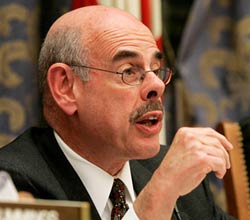
    Waxman, Henry If behavior can inform belief, it may be getting less and less likely that H.R. 1427, the "Promoting Innovation and Access to Life-Saving Medicine Act," has any reasonable chance of passing in this Congress.  The bill, introduced on March 11, 2009 by House Committee on Energy and Commerce Chairman Henry Waxman (D-CA; at right), has as one of its key provisions a data exclusivity period of only 5 years (see "Waxman Introduces Follow-on Biologics Bill"), a term most in the biotechnology community believe is too short to support innovation in the sector.  Indeed, Vaughn Kailian of MPM Capital LLC, and a seasoned veteran in the biotechnology sector, opined that Congressman Waxman's five year data exclusivity proposal was "dead in the water" at a Super Session on the challenges to biotechnology held at the BIO 2009 Convention in Atlanta last month (see "Docs at BIO: 'Perfect Storm' Super Session").

    Another participant at that session, Dr. Scott Gottlieb, a senior fellow at the American Enterprise Institute, said that there will be legislation "in the near future" but that this had not advanced in Congress because Rep. Waxman could not move his own bill out of (his own) committee.  Indeed, there is a competing bill, H.R. 1548 ("The Pathway to Biosimilars Act"), introduced on March 17, 2009 by Ms. Eschoo, Mr. Inslee, and Mr. Barton that specifies 12 years of data exclusivity with provisions for an additional 2 years for a "medically-significant new indication" and 6 months for pediatric studies (see "Second Follow-on Biologics Bill Is Introduced in House").  This bill has more than 65 co-sponsors, and it is widely believed that Congressman Waxman's bill has not advanced out of committee because he does not have the votes for its passage.

    Perhaps as a tacit acknowledgment of the political realities, or maybe simply as an attempt to ensure rapid implementation of whatever bill is ultimately passed, Congressman Waxman sent a letter to the President on Monday regarding how the Food and Drug Administration could approve follow-on biologics under its current regulatory scheme.  The tenor of his remarks suggests (as reported by modernhealthcare.com) that Mr. Waxman may be trying to have the FDA develop a pathway for biosimilar approval under existing law.

    In his letter, the Congressman "urge[s] the Administration to consider what steps can be taken under existing authority to prepare and even begin to use a pathway for generic biologics" (emphasis added).  Since it is widely accepted that FDA has no such authority under existing law, the emphasized portion of Mr. Waxman's remarks is curious at best.

    The rationale, of course, is cost; the letter prefaces this suggestion that the Obama administration "begin to use" a "pathway to generic biologics" that is non-existent under current FDA authority by reminding the President that:

    Biotech drugs, while often life-saving, are the fastest growing and most expensive components of the nation's prescription drug costs.  Many of them cost tens and thousands of dollars a year and impose an unsustainable burden on patients, employers, and the federal and state governments.

    Thus, "it is important for FDA to begin implementing the program as soon as possible" and "[t]he speed of FDA's action will determine how quickly safe and effective generic biologics become available to patients."  Because, after all, "[g]eneric biologics are a significant way to control costs," according to the Congressman.

    It is certainly the case that there are enormous economic and political pressures to reduce healthcare costs over the near term, as the Baby Boom generation hits their geriatric years and the burdens on all payors (public and private) can be expected to intensify.  So it is understandable that politicians of all stripes (as Mr. Waxman notes, his (and Congresswoman Eschoo's) bill are "bipartisan") would be inclined to address (or appear to address) these issues.  But suggestions that the government use "existing [FDA] authority" to cobble together a follow-on biologics pathway ignore some very real impediments to providing biosimilars that deserve approval.  Issues such as safety and efficacy, interchangeability, and even the definition of a biosimilar are not accounted for under existing U.S. law.  For example, what constitutes a "biosimilar" can depend on whether differences in primary amino acid sequence, post-translational modifications, level of impurities, the mechanism of action, and the mode of administration are or can be accommodated.  The issue of interchangeability, ensuring that a patient on the innovator biologic can be "switched" to the generic and (if need be) back again is another undefined area of great interest to the public, since the bureaucratic consideration, "increased risk of an adverse event" translates to real patients suffering real consequences if the risks are not minimized (if not eliminated).  And, of course, in view of the recent Supreme Court decision in Wyeth v. Levine, FDA approval even under well-established guidelines is not necessarily sufficient to shield a biosimilar company from liability should a "generic biologic" fail in any of these critical criteria for safety.

    Even more chilling, Congressman Waxman's letter can be interpreted to mean that the Congressman is willing to cut corners and avoid the political process to impose a biosimilars regime.  The biosimilars debate is an important one, balancing multiple competing interests and, with any luck, arriving at regulations that will reduce healthcare costs while protecting the incentives to invest that are vital to continued innovation.  These are just the kinds of questions that should be debated fully, fairly and openly.  Let's hope Congressman Waxman thinks so too.

  •     By Suresh Pillai

    Par Files Amended Complaint in Nascobal® Suit

    Fleming Pharmaceuticals Par Pharmaceuticals filed an amended complaint against Fleming & Co. Pharmaceuticals, alleging patent and trademark infringement and unfair competition over Par's prescription nasal spray, Nascobal®.  The patent-in-suit, U.S. Patent No. 7,404,489, covers Par's spray-based vitamin B-12 product that was designed as an alternative to monthly injections for the treatment of vitamin B-12 deficiencies.

    Par Pharmaceutical In its complaint, filed in the U.S. District Court for the Southern District of California, Par claims that Fleming's sale of CaloMist® to distributors and users, and the marketing of the spray to California physicians, intentionally traded on the goodwill Par had built up among California consumers of Nascobal®.

    Among the relief requested, Par has asked the District Court for a permanent injunction barring Fleming from infringing the '489 patent, treble damages for infringement and for Lanham Act violations, punitive damages, pre- and post-judgment interest, and attorneys' fees.


    AstraZeneca Granted Permanent Injunction in Pulmicort® Case

    AstraZeneca_small One month after granting AstraZeneca a temporary restraining order (see "Biotech/Pharma Docket," May 5, 2009), the U.S. District Court for the District of New Jersey has permanently enjoined Apotex from launching a generic version of Pulmicort Respules®, a pediatric asthma treatment.  This action is the latest in AstraZeneca's fight to protect its rights in the patents-in-suit, U.S. Patent Nos. 7,524,834, 6,598,603, and 6,899,099, key patents in AstraZeneca's Pulmicort® patent portfolio.  AstraZeneca filed its suit against Apotex on March 31, one day after Apotex had received FDA approval to manufacture and market a generic version of Pulmicort® Respules.  Because Apotex indicated its intent to market and manufacture its generic Apotex #1 version prior to the expiration of AstraZeneca's patents (2018 with pediatric exclusivity extending until 2019), AstraZeneca filed suit.

    Teva AstraZeneca's suit against Apotex is merely the latest in a series of lawsuits designed to protect its intellectual property rights covering Pulmicort®.  AstraZeneca has previously filed suit against Teva and only resolved the conflict upon reaching a licensing agreement with Teva.  Under the settlement with Teva, Teva acknowledged the validity and enforceability of the '603 and '099 patents and agreed to pay a significant royalty on sales of its generic version as well as damages connected with Teva's launch of its generic version of Pulmicort® following FDA approval.  In exchange, AstraZeneca granted Teva an exclusive license to make and market a generic version of Pulmicort®.  In the face of the permanent injunction, it is likely that Apotex will seek a similar deal with AstraZeneca.

    Abbott Denied Summary Judgment in Attempt to Invalidate Humira® Patents

    Abbott A The U.S. District Court for the Eastern District of Texas denied Abbott Laboratories' motion for summary judgment seeking invalidation, on the ground of anticipation, of two patents connected to the Abbott drug Humira®.  Although Abbott lost the summary judgment motion, Abbott did prevail in its demand to have the priority dates for the patents-in-suit established as February 4, 1994.  This decision is the latest in Centocor, Inc.'s suit against Abbott, alleging that the Abbott drug Humira® violates two patents owned by Centocor, Inc (see "Court Report," April 23, 2007).  The patents-in-suit, U.S. Patent Nos. 7,070,775 and 7,276,239, cover recombinant A2-specific TNFα-specific antibodies.  Humira® is widely use
    d in the treatment of various forms of arthritis and recently received FDA approval to be used in the treatment of Crohn's disease. 

    Centocor The prosecution history of the patents-in-suit consisted of the filing of 14 patent applications over 15 years.  As part of its demand, Abbott included as evidence five additions to the specification as evidence of Centocor's acquiescence of the filing date of February 4, 1994.  Although the District Court estopped the plaintiffs from gaining benefit of the earlier filing date, the Court did not go so far as to invalidate the patents themselves, holding that questions of anticipation that could invalidate patents were matters of fact and not law.

  •     By Sherri Oslick

    Gavel_2About
    Court Report:  Each week we will report briefly on recently filed
    biotech and pharma cases, and a few interesting cases will be selected
    for periodic monitoring.


    Takeda Pharmaceutical Co. et al. v. Sandoz, Inc.

    1:09-cv-05210; filed June 3, 2009 in the Southern District of New York

    Infringement of U.S. Patent Nos. 5,965,584 ("Pharmaceutical Composition," issued October 12, 1999), 6,329,404 (same title, issued December 11, 2001), 6,166,043 (same title, issued December 26, 2000), and 6,172,090 (same title, issued January 9, 2001) following a Paragraph IV certification as part of Sandoz's filing of an ANDA to manufacture a generic version of Takeda's Actoplus MET® (pioglitazone hydrochloride and metformin, used to treat type II diabetes).  View the complaint here.

    BASF Plant Science GmbH et al. v. Pioneer Hi-Bred International Inc. et al.
    1:09-cv-00392; filed June 1, 2009 in the District Court of Delaware

    Infringement of U.S. Patent No. 5,750,866 ("AHAS Promoter Useful for Expression of Introduced Genes In Plants," issued May 12, 1998) based on Pioneer's impending sale of its Optimum® GAT® corn.  Also, declaratory judgment of non-infringement, invalidity, and unenforceability of U.S. Patent Nos. 5,141,870 ("Nucleic Acid Fragment Encoding Herbicide Resistant Plant Acetolactate Synthase," issued August 25, 1992) and 5,605,011 (same title, issued February 25, 1997).  View the complaint here.


    Pioneer Hi-Bred International Inc. et al. v. BASF Corp. et al.

    1:09-cv-00393; filed June 1, 2009 in the District Court of Delaware

    Infringement of U.S. Patent Nos. 5,013,659 ("Nucleic Acid Fragment Encoding Herbicide Resistant Plant Acetolactate Synthase," issued May 7, 1991), 5,141,870 (same title, issued August 25, 1992), 5,378,824 (same title, issued January 3, 1995), and 5,605,011 (same title, issued February 25, 1997).  Also, declaratory judgment of non-infringement and invalidity of U.S. Patent Nos. 5,750,866 ("AHAS Promoter Useful for Expression of Introduced Genes In Plants," issued May 12, 1998) and 6,025,541 ("Method of Using as a Selectable Marker a Nucleic Acid Containing AHAS Promoter Useful for Expression of Introduced Genes in Plants," issued February 15, 2000).  View the complaint here.

    Human Genome Sciences Inc. v. Immunex Corp. et al.
    1:09-cv-00389; filed May 29, 2009 in the District Court of Delaware

    Review of the decision of the Board of Patent Appeals and Interferences awarding priority of invention to Immunex (now Amgen) in the interference between U.S. Patent No. 6,569,642 ("Receptor That Binds TRAIL," issued May 27, 2003), assigned to Immunex and U.S. Patent Application No. 09/042,583 ("Death Domain Containing Receptor 5," filed March 17, 1998), assigned to Human Genome Sciences.  View the complaint here.

  • CalendarJune 16-17, 2009 – Biotech Patenting (C5) – Munich, Germany

    June 17, 2009 – The Future of Reverse Payment Settlements: Insider's Guide to Imminent Antitrust Policy Changes (American Conference Institute) – 1:00-2:30 PM (EST)

    June 19, 2009 – Patent Enforcement & Early Stage Litigation (Law Seminars International) – San Francisco, CA

    June 22-27, 2009 – Innovation Week 2009 (U.S. Patent and Trademark Office) – Arlington, VA

    June 21-23, 2009 – IP Business Congress (Intellectual Asset Management magazine) – Chicago, IL

    July 6, 2009 – Prior Art & Obviousness 2009: The PTO & CAFC Perspective on Patent Law Sections 102 & 103 (Practising Law Institute) – New York, NY

    July 8, 2009 – Markman Hearings and Claim Construction in Patent Litigation (Practising Law Institute) – New York, NY

    July 14-15, 2009 – Pharma/Biotech Collaborative Agreements (American Conference Institute) – San Francisco, CA

    July 15, 2009 – Cost-Effective Patent Strategies (Law Seminars International) – Seattle, WA

    July 18-21, 2009 – National Association of Patent Practitioners (NAPP) 2009 Annual Meeting – San Diego, CA

    July 20, 2009 – Buying, Selling and Licensing Patents: Strategies for Turning Your Patent Portfolios into Revenue Streams (Law Seminars International) – Washington, DC

    July 21-22, 2009 – FDA Boot Camp*** (American Conference Institute) – Chicago, IL

    July 23-24, 2009 – Advanced Patent Prosecution Workshop 2009: Claim Drafting & Amendment Writing (Practising Law Institute) – New York, NY

    July 30 – August 4, 2009 – 2009 Annual Meeting (American Bar Association) – Chicago, IL

    August 17-18, 2009 – Advanced Patent Prosecution Workshop 2009: Claim Drafting & Amendment Writing (Practising Law Institute) – San Francisco, CA

    September 1, 2009 – Prior Art & Obviousness 2009: The PTO & CAFC Perspective on Patent Law Sections 102 & 103 (Practising Law Institute) – San Francisco, CA

    ***Patent Docs is a media partner of this conference or CLE