•     By Christopher P. Singer

    USPTO Seal In a Notice published in the Federal Register (74 Fed. Reg. 28473) on Tuesday, June 16, 2009, the U.S. Patent and Trademark Office announced an additional public comment period relating to a potential deferred patent examination pathway.  This additional period for submitting comments expires on August 31, 2009.  As readers will likely recall, the USPTO held a roundtable discussion back in February to assess whether the patent community had a general interest in establishing a deferred examination pathway in the U.S., and to discuss potential issues relating to implementing deferred examination.  Following the roundtable, the USPTO solicited public comment regarding deferred examination and the issues that were raised during the discussion.  That period for comment expired on May 29, 2009.  Comments submitted during the initial period can be found here.

    The additional comment period specified in Tuesday's Notice is to allow for further comments on any issue relating to deferred examination, as well as to allow for reply and commentary to the comments submitted during the initial comment period.  Comments can be submitted electronically to AC6comments@uspto.gov, or by regular mail to: Mail Stop Comments – Patents, Commissioner for Patents, P.O. Box 1450, Alexandria, VA 22313-1450, marked to the attention of Robert W. Bahr.  These comments will also be made available for public review.

  •     By Donald Zuhn

    Kappos, David Senate Judiciary Chairman Patrick Leahy (D-VT) released a statement today indicating that President Obama intends to nominate David Kappos (at right) to be the Undersecretary of Commerce for Intellectual Property and Director of the U.S. Patent and Trademark Office.  Senator Leahy stated that Mr. Kappos' experience as a development engineer and leading intellectual property attorney make him "exceptionally qualified to lead the Patent and Trademark Office."  The Senator also noted that Mr. Kappos, the Vice President and Assistant General Counsel of Intellectual Property Law at IBM, serves on the Board of Directors of the American Intellectual Property Law Association (AIPLA), the Intellectual Property Owners Association (IPO), and the International Intellectual Property Society.  Senator Leahy concluded by stating that:

    The USPTO faces serious challenges in this difficult economic environment, and the office requires strong leadership.  David Kappos is such a leader.  I look forward to working with him on issues confronting the USPTO, including reducing the backlog and pendency of patent applications and modernizing the patent system as Congress considers the Patent Reform Act.

    Senator Leahy's statement was followed shortly thereafter by a White House announcement regarding Mr. Kappos' nomination.

    Patent Docs thanks Hal Wegner for alerting us to Senator Leahy's statement.

  •     By Suresh Pillai

    Settlement Announced in Oxycontin® Litigation

    KV Pharmaceutical KV Pharmaceutical Co. announced a settlement in its litigation with Purdue Pharma LP over the painkiller Oxycontin® (see "Court Report," June 11, 2007).  The settlement resolves three lawsuits filed by Purdue in the U.S. District Court for the Southern District of New York.  Purdue launched the first of these lawsuits in January 2007 on the heels of KV's filing of an ANDA with the FDA in which KV sought to launch generic versions of oxycodone controlled-released tablets.  KV's ANDA also included a Paragraph IV certification claiming that the patents-in suit, U.S. Patent Nos. 5,508,042, 5,656,295, 5,549,912, and 5,266,331, were invalid and unenforceable and would not be infringed by the generic versions under development.

    Purdue Pharma Purdue filed another suit soon after KV amended its ANDA to include the sale of additional dosage strengths of generic Oxycontin®.  In response, KV countersued Purdue, claiming that the patents-in-suit were unenforceable on the basis of fraud committed during prosecution (i.e., failing to disclose relevant prior art and making misrepresentations to the USPTO).  However, in January 2008 in related antitrust case, the District Court held that Purdue's patents were valid and enforceable (see "In re OxyContin Antitrust Litigation").

    Under the terms of the settlement agreement, Purdue has consented to granting KV limited rights, which are nontransferable, nonexclusive, and royalty-bearing, to sell generic versions of Oxycontin® for a set period of time so long as KV pays sales royalties.  In return, KV has agreed to acknowledge that the patents-in-suit are valid and were infringed by KV.  For more information on the settlement, please see KV's press release.


    Medicis Files Suit Against Ranbaxy over Solodyn® Patents

    Medicis As previously reported on Patent Docs, Medicis Pharmaceutical Corp. has filed suit against India-based Ranbaxy Laboratories Ltd. in the U.S. District Court for the District of Delaware, alleging infringement of the patent covering the Medicis product Solodyn®, U.S. Patent No. 5,908,838.  Solodyn® is currently the only approved oral antibiotic for the treatment of acne in patients aged 12 and older.  Medicis' lawsuit was filed upon its receipt of a Paragraph IV notice letter from Ranbaxy, Inc. (based in Princeton, N.J.) in which Ranbaxy alleged that the patent was invalid.  This lawsuit is the latest in a series of suits filed by Medicis against generic drugmakers seeking to manufacture and market generic versions of Solodyn®.  To date, Medicis has reached settlements with Impax Laboratories, Inc.; Teva Pharmeceutical Industries, Ltd. (see "Biotech/Pharma Docket," March 24, 2009); and Barr Laboratories Inc. over the manufacture and marketing of generic versions of Solodyn®.

    Ranbaxy In the current complaint against Ranbaxy, Medicis is seeking a permanent injunction, a court order denying Ranbaxy ANDA approval until the patent's expiration, and costs.


    DuPont Countersues Monsanto in Dispute over Roundup Ready Technology

    DuPont In answer to Monsanto Co.'s infringement suit alleging DuPont Co's infringement of U.S. Patent No. RE39,247, the reissue of U.S. Patent No. 5,633,435, DuPont filed counterclaims alleging that the '247 patent was not infringed and that the suit itself was part of a larger plan on the part of Monsanto to establish an anticompetitive monopoly on certain agricultural products.  The original suit, filed in May in the U.S. District Court for the Eastern District of Missouri (see "Court
    Report
    ," May 10, 2009), alleged that DuPont combined Monsanto's Roundup Ready and Pioneer Hi-Bred International, Inc.'s Optimum GAT traits into its own soybean and corn plants.  Dupont countered Monsanto's claim of infringement by arguing that its use of Monsanto's patented trait was within DuPont's rights under a 2002 licensing agreement between DuPont and Monsanto.

    Monsanto In its counterclaims, DuPont alleged that Monsanto's patents were granted in part through fraud and inequitable conduct on the part of Monsanto during prosecution.  DuPont claimed that this inequitable conduct allowed Monsanto to procure patent rights that prevent other companies from stacking competitor traits with those of Monsanto, thereby illegally extending Monsanto's monopoly.

    Pfizer Adds Second Patent to Lyrica® Infringement Suit Against Sun Pharma

    Pfizer This week, Pfizer Inc. and Northwestern University, already embroiled in litigation with Sun Pharma over the nerve pain treatment Lyrica®, amended their complaint by adding a second patent to the suit.  The original complaint, filed in the U.S. District Court for the District of Delaware (see "Court Report," May 3, 2009), alleged that, through Sun's filing of an ANDA to make and market a generic version of Lyrica®, Sun infringed Pfizer's and Northwestern's rights in U.S. Patent No. 6,197,819.  The '819 patent is owned by Northwestern and exclusively licensed to Pfizer's subsidiary, Warner-Lambert Co. LLC.  The amended complaint added U.S. Patent No. 5,563,175 to the litigation; this patent is jointly owned by Northwestern and Warner-Lambert.

    Northwestern University Seal The amended complaint alleges that Pfizer received a letter from Sun that informed Pfizer that Sun's ANDA contained a Paragraph IV certification that the '819 patent was invalid, unenforceable, and not infringed by Sun's proposed product.  Six weeks after receipt of the first letter, Pfizer received a second letter that made similar claims about the '175 patent.  Pfizer and Northwestern are seeking judgments of infringement for both patents-in-suit, injunctive relief that would bar Sun from marketing and manufacturing generic versions of Lyrica® prior to patent expiration, monetary relief if Sun were to sell its generic product, and fees and costs.

    Sun Pharma This lawsuit is the latest to be filed in Pfizer's and Northwestern's efforts to prevent generic makers from making generic versions of Lyrica®.  The two partners currently have lawsuits pending against Sandoz Inc., Actavis Inc., Cobalt Laboratories Inc., Wockhardt Ltd., Teva Pharmaceuticals Industries Ltd., Lupin Ltd., and Mylan Pharmaceuticals Inc.

  •     By Christopher P. Singer

    USPTO Building Facade The U.S. Patent and Trademark Office posted a notice on its website today announcing that the next meeting of the Patent Public Advisory Committee (PPAC) will be held on June 18, 2009.  The meeting will be held on the USPTO campus, Madison North Auditorium, Concourse Level, 600 Dulany Street, Alexandria, VA.  The public is invited to participate from 11:00 a.m. to 2:15 p.m. in person, via webcast, or via teleconference.

    The PPAC webcast can be accessed here.  To conference in by phone (as a listening participant only) the dial-in number is 1-800-369-1750; passcode: 87786.  The public will be able to submit questions during the meeting by e-mail (PPAC@uspto.gov).  The questions will be reviewed and answered at the end of the public session (as time and subject matter permits) by Acting Chairman Damon Matteo.

    The planned agenda includes:

    11:00 am – 11:05 am — Call to Order    
    presenting:  Damon Matteo, Acting Chairman

    11:05 am – 11:30 am — Acting Under Secretary's Remarks – Key Issues Affecting the USPTO
    presenting:  John Doll, Acting Director of the USPTO

    11:30 am – 11:45 am — Financial Update – Fee Project   
    presenting:  Mark Olechowski, acting C.F.O.

    11:45 am – 12:05 pm — Legislative Update   
    presenting:  Jefferson Taylor, Director, Office of Governmental Affairs

    12:05 pm – 12:20 pm — OCIO Roadmap Update   
    presenting:  John Owens II, C.I.O.

    12:20 pm – 12:40 pm — Break     

    12:40 pm – 1:10 pm — Definition of Quality   
    presenting:  Marc Adler, Member, and Andrew Hirshfeld, Acting Deputy Commissioner for Patent Examination Policy

    1:10 pm – 1:40 pm — Quality/Efficiency Initiatives   
    presenting:  Peggy Focarino, Acting Commissioner for Patents  

    1:40 pm – 1:55 pm — International Worksharing Update – Status of Foundation Projects   
    presenting:  Mark Powell, Director, Technology Center 2600

    1:55 pm – 2:15 pm — CPIO Initiative   
    presenting:  Barry Hudson, Acting CPIO

  •     By Kevin E. Noonan

    Academics are useful people — they provoke us to think and rethink our assumptions and the consequences of our institutions and practices, and can expand them in unexpected and frequently useful ways.

    But they also tend to live in a world constructed within the boundaries of their own skulls, and rarely have the kind of practical experience that comes from building a business or making a product.  That isn't intended to be a criticism (for the thin-skinned in the academic ranks), just an accurate description of different skill sets.

    USA Today However, the anti-gene patenting debate, mostly championed by academics with philosophical objections to the practice, has serious consequences for U.S. innovation should their arguments convince policymakers to kill the golden goose of the golden age of biotechnology based merely on their philosophical objections.  Making the case strongly to the contrary of these arguments is Jim Greenwood, President and CEO of the Biotechnology Industrial Organization (BIO), in an op-ed piece in USA Today (see "Opposing View: Patents Promote Innovation").

    Mr. Greenwood starts, prudently, in debunking the most oft-repeated lie about gene patents:  that they somehow give patentees ownership rights over human beings.  Then he gets to the heart of the matter:  that isolating a protein, or the gene that encodes it, makes possible the development of drugs to treat and cure disease.  He explains that "[m]ore than 4,000 diseases are suspected to stem from mutated genes inherited from one or both parents," and thus provide targets for drugs against such diseases.

    Greenwood, Jim And this is not a mere pipedream:  Mr. Greenwood (at left) mentions that "more than 200 innovative new therapies and vaccines that have helped extend and improve the quality of life for hundreds of millions of patients" have been developed thanks in part to gene patents.  Taking cystic fibrosis (CF) as an example, he notes that since the CF gene was isolated "the average lifespan of a person with CF [has been extended] from 12 years to more than 40 years."

    Mr. Greenwood also debunks the argument that gene patents somehow inhibit biomedical innovation with the facts, not from BIO but from a recent study by the American Association for the Advancement of Science and a Department of Health and Human Services advisory committee and an earlier National Academy of Science study.  Specifically, he notes that the HHS study showed that gene patents "are not the cause of access-related issues regarding genetic diagnostic tests," contrary to the allegations from the plaintiffs in the ACLU's anti-gene patenting lawsuit.

    He also frames the issue starkly in terms of the almost certain consequences of a ban on gene patenting:

    [B]anning patents on gene-related breakthroughs would slow biomedical innovation to a halt — taking away the hope biotechnology offers to patients suffering from debilitating diseases such as cancer, Parkinson's and HIV/AIDS — while doing nothing to address what is really a much more complicated set of issues.

    As head of the pre-eminent biotechnology industry organization in the world, Mr. Greenwood has extensive experience in the real world problems in bringing life-saving drugs to market.  We should listen to him.

  •     By Christopher P. Singer

    EFS-Web Earlier this month, the U.S. Patent and Trademark Office sent out by e-mail its latest e-Commerce e-Alert, this one entitled "Tips to Improve Your e-Filing Effectiveness."  Included in the e-Alert were four general procedures that help to streamline electronic prosecution through the use of EFS-Web and Private PAIR.  Patent Docs has discussed most of these tips in previous posts, but it can't hurt to review these tips one more time.

    The e-Alert mentioned that most firms are using EFS-Web for prosecution-related matters, and that these regular EFS-Web tips continue to be helpful and encourage increased usage.  The tips from the e-Alert include:

    Tip 1 – Review Applications in Private PAIR.  Simple, preventable errors in patent applications cause unnecessary delays in processing applications.  Practitioners can reduce errors and rework in submitted patent applications by reviewing the correctness of submissions directly online in Private PAIR.  All patent applications submitted through EFS-Web are entered into Private PAIR and available for secure online viewing generally within minutes of submission if the application is associated with a customer number.

    Tip 2 – Use Document Descriptions.  Ensure prompt processing of submitted documents by using the correct document description on all electronically submitted documents.  For more information and general rules on document description indexing, access the Document Description information via the USPTO website.

    Tip 3 – Register for Recovery Codes.  Register for recovery codes in the event your Digital Certificate profile becomes expired or corrupt and receive a set of up to seven (7) recovery codes.  Access the Digital Certificate Management home page and click on "Register for Recovery Codes" to initiate the process.

    Tip 4 – Fully Utilize e-Commerce Tools.  Many leading IP firms have practically eliminated the filing of paper patent applications.  Those firms have incorporated USPTO's e-Commerce tools, such as EFS-Web and PAIR, in their electronic patent filing process to achieve the most benefits.  For firms that are still filing paper applications, it may be time to take full advantage of e-filing (notes on best practices can be found here), and share the benefits of going paperless, including (a) increased productivity and cost savings from reduced paper-based processing, (b) easy online access to important patent information, and (c) increased customer responsiveness and service levels.

  •     By Kevin E. Noonan

    Gene The zeitgeist has turned harshly on patenting in the U.S., perhaps nowhere as starkly as in gene patenting.  Originally the subject of op-ed rants by famous authors (see "Science Fiction in The New York Times") and quixotic bills introduced by undistinguished members of Congress (see "The Continuing Threat to Gene Patenting"), the filing by the American Civil Liberties Union of a complaint against Myriad Genetics several weeks ago seems to have opened the floodgates of opposition to these patents.  Thus, there have been debates on the topic on National Public Radio (see "Gene Patenting Debate Continues"), and an otherwise respectable blogger has let his pages be used by an academic with more passion than logic to present his anti-gene patenting views.

    While there may be a legitimate reason to revisit the question of whether genetic material should be patent-eligible, a great deal of the anti-gene patenting debate is based on faulty premises, incorrect science, and a studied lack of appreciation of patent law as it has been applied, inter alia, to eligibility of natural products.  Since any rational debate is only as good as the information it is based upon, in this post we will try to address the more flagrant inaccuracies spouted by the anti-gene patenting crowd.

    Genes are a product of nature:  The facts.  Genes may be, but the patents claiming genes do not claim products of nature.  The simple distinction is that gene claims recite that the genes are "isolated," thereby putting to rest the canard (asserted in the pages of the august New York Times by the late Michael Crichton) that a patent holder may one day ring your doorbell and ask for a royalty from you because your liver is "using" a patented gene.  More importantly, no one would want to own any person's genes:  it has been known for more than forty years that any particular copy of a gene in an individual in a population is likely to contain at least one polymorphism that does or could (under Venter, Craig the right environmental conditions) affect its function.  This was illustrated recently in reports of the complete diploid genomic DNA sequence of J. Craig Venter's (at left) DNA, where more than 4 million nucleotide variants were detected (see "A Complete Diploid Human Genome Reveals Some Surprises") — included in those surprises were an extraordinary amount of genetic variation that could affect gene expression and gene products in unpredictable ways.

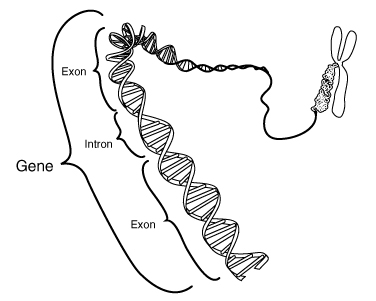
    But there is another, more significant distinction that requires a little biology to appreciate.  Genes have been described, properly, as the instructions for producing proteins.  A gene encodes the amino acid sequence of a protein in a linear sequence of 3-base triplet codons that correspond in linear order to the amino acid sequence of the protein.  However, in humans (and all other animals) almost all genes are interrupted by "junk" DNA that does not encode protein (or, at least, the protein the gene encodes).  The entire gene, junk and coding sequence, is transcribed into RNA by the cell and then the junk pieces are "spliced out," leaving the coding sequence (termed a messenger RNA or mRNA) that is used to produce the protein.  Scientists take advantage of this process to clone genes, by isolating the mRNA and converting it into a DNA molecule called complementary DNA (cDNA) which is what is cloned, sequenced, and patented.  The biology is set forth schematically below:
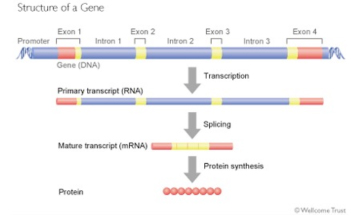
    Gene Structure

    The hallmark of what the Supreme Court has declared is patent-eligible is "anything under the sun made by man."  The cDNA copies of genes that form the basis for human gene patenting are "made by man" and not products of nature because they do not exist in nature prior to being synthesized in a test tube by a scientist.  If we are honest in defining what are actually "products of nature," then they must by definition be produced by nature.  cDNA molecules are not.

    Genes are products of nature:  The law.  The legal argument that "products of nature" such as "genes" are not patent-eligible proves too much, because if genes are not patentable then many other natural products cannot be, either.  This includes the example given by Hans Sauer during the NPR broadcast last week, vitamin B12, which was isolated by Merck and patented in the 1930's.  It also includes various antibiotics, including lincomycin that was the subject of the In re Bergy case, and any number of products isolated from crude oil, plants, animals, and even humans (see "A DNA Patenting Thought Experiment").  Indeed, there is even a chemical element, Americium, that has been the subject of a patent, because the element is unknown in nature and produced only in a nuclear reactor (and provides one embodiment of smoke detectors found in most homes).  If genes are not patent-eligible, based on the fact that they are products of nature, then the patent incentive cannot exist for these "products of nature," either.

    Genes are part of "the commons."  Ironically, genes and gene patenting were originally assailed as creating a "tragedy of the anticommons," because private "ownership" thereof would impede genetic research.  In fact, as has been shown by multiple studies over the past 10 years, gene patenting has done no such thing (see "The True Tragedy of the Anti-Commons").  Indeed, there have been a variety of reports from the U.S. (Walsh et al., 2003, "Science and the Law: Working Through the Patent Problem," Science 299: 1020), Germany (Straus, 2002, Genetic Inventions, Intellectual Property Rights and Licensing Practices), Australia (Nicol et al., 2003, Patents and Medical Biotechnology: An Empirical Analysis of Issues Facing the Australian Industry, Centre for Law & Genetics, Occasional Paper 6) and Japan (Nagaoka, 2006, "An Empirical Analysis of Patenting and Licensing Practice of Research Tools from Three Perspectives," presented in OECD Conference in Research Use of Patented Inventions, Madrid) finding that "patent thickets" (Shapiro, 2001, "Navigating the Patent Thicket: Cross Licenses, Patent Pools, and Standard Setting," In: Innovation Policy and the Economy 1: 119-50) or the "anticommons" (Heller & Eisenberg, 1998, "Can Patents Deter Innovation? The Anticommons in Biomedical Research," Science 280: 698-701) rarely affect the research of academic scientists.  In addition, the incentive for gene patenting motivated private companies, most notable Celera and Human Genome Sciences, to compete with the federally-funded efforts to sequence the human genome.  This competition accelerated these efforts and produced sequence information more rapidly than anyone expected.  If these efforts provided genetic information that can be used to address human disease one day, one month, or one year earlier than it would have been produced otherwise, who can say the incentive is insufficient?

    Gene patenting inhibits genetic research.  In fact, a very good case can be made that the opposite is true.  This is due to another distinction glossed over by the anti-gene patenting crowd:  genetic information isn't patented.  Patent law requires that claims be supported by a written description sufficient to enable the skilled worker to make and use the invention.  For genes, this has meant that the genetic sequence is disclosed in almost all gene patents.  This information can be used for any number of purposes, including sequence comparisons (which can be performed without "isolating" a gene), detecting genetic polymorphisms, and a variety of other scientific endeavors.  Indeed, agricultural scientists recently reported that they paid no heed to patents encompassing their work and gene patent owners do not enforce their patents against research scientists using gene sequences for basis research.  (This statement does not apply to medical scientists and institutions performing fee-for-service testing as in the Myriad case.)  For example, a retrospective study of BRCA genes in archival tumor samples (contained as laboratory collections in may hospitals and departments of academic medicine) that demonstrated genetic or familial patterns of BRCA polymorphism inheritance might infringe one of the Myriad patents that are the subject of the ACLU's suit.  But it would be surprising if Myriad (or any other gene patent holder) would ever try to assert these patents against this kind of genetic research.  We would be interested in any instances where a gene patent owner has threatened enforcement in the absence of commercial activity.  Until such time as this evidence is forthcoming (and, to be germane to the debate and support the anti-gene patenting position it would need to be widespread), there is no evidence that gene patenting has a negative effect on genetic research.

    We don't need gene patents — researchers will do it anyway.  With regard to basic genetic research, this is true — it is the corollary to the previous point, that gene patents don't inhibit genetic research.  However, there is a vast gap between identifying a genetic polymorphism related to a disease, or identifying a gene that encodes a useful protein, and developing a clinically-validated test or producing a commercial biologic drug product, and that is where biotechnology companies come in.  Of course, without the prospect of patent protection, investors are unlikely to provide the funding needed by start-up biotechnology companies to develop commercial embodiments of these inventions.  Large corporations, both foreign and domestic, may be able to do so, but then U.S. universities and research centers become merely unpaid research and development branches of these corporations.  And in view of the complexities of biotechnology products, other avenues — trade secrets and regulatory data exclusivity being just two — may enable such companies to keep their "monopoly" much longer than the term of a gene patent.  As just one example, the menopause drug Premarin® is not patent-protected but there is no generic version available for just these types of reasons.

    Genes are not patentable after In re Kubin.  This assertion, made by Joshua Sarnoff, Professor of the Practice of Law at American University's Washington College of Law during the NPR debate, conflates what is patent-eligible with what is patentable, a distinction made nicely by Judge Giles Sutherland Rich in the Bergy case.  There are many things that are patent-eligible that are not patentable, because the statutory requirements are different.  To be patent-eligible, an invention must be a machine, manufacture, process, or composition of matter, or an improvement thereof, and (per Supreme Court precedent) cannot be a mathematical formula, an abstract idea, or a product of nature.  To be patentable, on the other hand, an invention must be new, useful, and non-obvious.  The Kubin case merely stands for the court's determination that merely because a gene was unknown in the prior art does not automatically mean that it should be patentable, the principle enunciated by Judge Lourie in In re Deuel based on conventional rubrics of chemical obviousness.  But the decision in Kubin was based on a set of facts unlikely to have existed for most genes that have been patented, and its effects have yet to be felt.  Despite Professor Sarnoff's statements, genes are not per se unpatentable after Kubin.

    Gene patenting inhibits innovation.  It is easy to forget today the basis for gene patenting in the past   Any number of biologic drugs have been developed that, according to a recent Federal Trade Commission report, "have improved medical treatments, reduced suffering, and saved the lives of many Americans."  These drugs were developed by companies that isolated the genes encoding them, including erythropoietin, human growth hormone, interferon, blood clotting Factors VIII and XI, human insulin, tissue plasminogen activator, and a host of others.  The patent incentive was instrumental in supporting investment in these companies, and in developing a biotechnology industry in the U.S. that has been a world leader for 25 years.  (Paradoxically, this industry arose during a time when the U.S. was popularly portrayed as being a rustbelt has-been, a modern day Great Britain, that would be left in the dustbin of history by emerging economies that were superior to our own.)  The U.S. biotechnology industry has resulted in U.S. dominance in the pharmaceutical industry, to the detriment of the very European and Japanese companies poised to overtake this country economically in the past (see "The Continuing Value of Biotech Patenting").  As anyone following the debate on follow-on biologics will recognize, the need for patent protection to attract investment in what remains a fundamentally risky industry has not diminished.  Patent policies abroad already permit those countries to "free-ride" on American innovation.  Why should we adopt their failed policies here?  And who will create the next generation of drugs based on biotechnology if we do?

    Why are they lying to us?  Michael Crichton did it, Lori Andrews has been known to do it, and Professor Koepsell has done it again — the title of his book against gene patenting is "Who Owns You?"  The answer is no one, of course, as explained above, but it does raise a significant question.  If the case against gene patenting were so clear, logical, and in the best interests of U.S. innovation, why do its proponents always seem to intimate that somehow someone is trying to own us?  It is good propaganda, of course, and it is likely that it will be defended as being merely provocative.  But it doesn't advance the debate, it inhibits reasoned discussion, and it suggests (along with the studied ignorance of the facts set forth here and elsewhere) that gene patenting is just wrong somehow.  Perhaps it merely vitalism, the quasi-religious notion that natural products isolated from living things are somehow different from what can be found or produced from the inorganic world.  This notion was disproven more than 100 years ago by Friedrich Wohler's demonstration that urea (produced in mammalian urine) was in fact merely a chemical compound that could be produced from non-living chemicals in a laboratory.

    Or maybe it is just the same contrariness that motivates some to deny evolution or other doctrines that make them uncomfortable.  It may be a strain of anti-establishment rebelliousness unique to Americans (and in other contexts, part of what makes America exceptional), or maybe it is merely the window-dressing used to excuse infringement.  But unless we all make our arguments based not on fear, ignorance, or dishonesty, there cannot be a real debate.  The issue is too important for that.

  •     By Christopher P. Singer

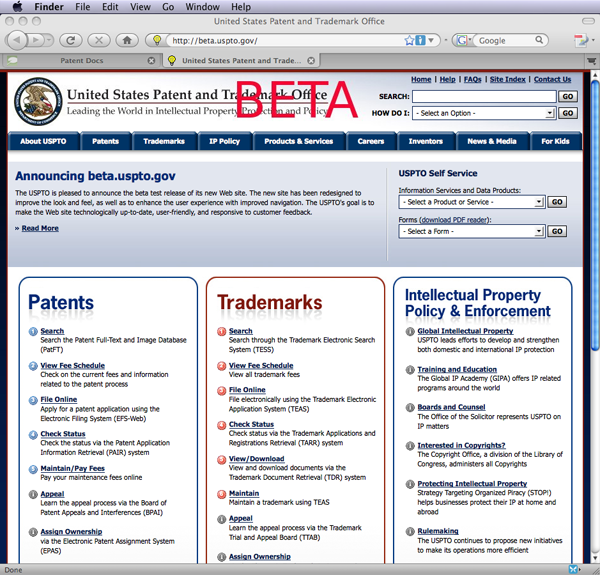
    USPTO Beta Website The U.S. Patent and Trademark Office recently unveiled a beta test release of its new website.  According to the USPTO, the new site has been designed to improve the overall look and feel, as well as to enhance the user experience with improved navigation.  The USPTO's goal of the redesign is to make its website technologically up-to-date and more user-friendly, and provide increased responsiveness to customer feedback.

    The USPTO cautioned that because this is an initial release of the new site, the content is not yet up to date.  The Office of the Chief Information Officer (OCIO) is still in the process of migrating and reorganizing the content.  The USPTO is inviting users of its current website to explore the beta website and provide the Patent Office with any constructive feedback.  The Office indicates that constructive feedback will help it construct a final version of the website that will better serve its users' needs.  Feedback can be sent to the USPTO through Google moderator (link), or by e-mail to betafeedback@uspto.gov.

  •     By Kevin E. Noonan

    Federal Trade Commission (FTC) Seal Last week, the Federal Trade Commission issued a report on follow-on biologics ("Emerging Health Care Issues:  Follow-on Biologic Drug Competition").  As many patent practitioners did a few years ago when the FTC issued a report on patent reform, many in the biotech and pharma community, generics companies, and Congress are asking "What is the FTC camel's nose doing in our tent?"

    The report is extensive, covering the likely market impact of follow-on biologics (FOB) competition, the effects of patent protection and market incentives in the face of FOB introduction, the potential impact of a Hatch-Waxman-like pre-approval patent resolution process, and how market exclusivity for FOBs would affect market competition.  The report also contains several recommendations, many of which appear to be at odds with the experiences and realities of biologic drug development.  These include:

    FTC FOB Report 1.    Competition between a biologic drug and an FOB is much more likely to resemble brand-to-brand competition than the dynamics of brand-generic competition under the Hatch-Waxman regime.  The Commission reached this conclusion after consultation with "[p]ioneer manufacturers, potential FOB manufacturers and payors," who were "virtually unanimous" in this prediction.  The report notes that in both the U.S. and Europe, the existence of FOBs "has not resulted in steep price discounting or rapid acquisition of market share" by FOB producers; in a footnote, the report states that certain drugs that would rightly be considered FOBs (such as insulin) have "traditionally" been regulated by the FDA under FDCA.  The reasons put forth by the Commission for this state of affairs include:

    a)    The number of actual generic competitors for FOB drugs is likely to be limited, due the "substantial costs" of FDA approval and the costs of developing manufacturing capacity to make FOBs — estimated to be $100-200M; conventional generic drugs cost $1-5M in comparison.

    b)    These costs in turn will require "large companies with substantial resources" to enter the FOB space.  In addition, the report speculates that only "2 or 3" companies will attempt to produce FOBs (compared with 10+ generic entrants for small molecule generic drugs), and only for biologic drugs with sales "in excess of $250 million."

    c)    Acquisition of market share for FOBs will be inhibited by the lack of "automatic substitution" for pioneer biologic drugs, in contrast to the rapid increase in market share, and reduced drug prices, seen with small molecule drugs.  FOBs will not be designated as "therapeutically equivalent" (due presumably to the scientific differences noted earlier in the report), and thus will not be automatically substituted by pharmacies.  This will require FOB manufacturers "to market their products and negotiate individual contracts with purchasers."

    d)    The report also anticipates that physicians and patients will have a stronger resistance to substituting FOBs than they have shown for generic drugs, due again to the differences in equivalencies.  The report speculates that this may initially restrict the FOB market to newly-diagnosed patients.

    e)    The nature of the diseases for which biologic drugs are prescribed may also be a factor, according to the report.  Patients treated with biologic drugs frequently are suffering from "severe, chronic diseases and sometimes fatal conditions."  Biologic drugs are frequently infused or injected, and involve special medical services or devices that require specialty training to be administered properly.  This drug delivery route, which the report characterizes as involving "clinics, hospitals, doctor's offices or other medically supervised setting[s]" would require inventory restocking and personnel retraining to adopt an FOB, and thus would present additional costs rather than immediate cost savings.

    f)    With regard to reimbursement, the current regime does not incentivize FOB use.  Rather than being available directly to patients, biologics drugs are "typically delivered to patients by healthcare providers as part of medical treatments" such as dialysis or chemotherapy, and thus are reimbursed as part of the medical treatment rather than as a pharmaceutical benefit.  This eliminates many of the incentives (such as differential co-pay requirements) that have been used successfully to incentivize patients, physicians, and pharmacists to adopt lower-cost generic drugs.  The report also notes the influence of the reimbursement methodologies used by the Centers for Medicaid and Medicare Services (CMS) as influencing these considerations.

    g)    The report provides the following scenario for FOB competition with a pioneer biologic drug:

    FOB entry is likely in biologic drug markets of greater than $250 million.  Only two or three FOB manufacturers are likely to attempt entry for a given pioneer drug product.  These FOB entrants are unlikely to introduce their FOB products at price discounts any larger than between 10 and 30 percent of the pioneer products' price.  Although not as steep a discount as small-molecule generic drugs, a 10 to 30 percent discount on a  $48,000 drug product represents substantial consumer savings.  Pioneer manufacturers are expected to respond and offer competitive discounts to maintain market share.  This price competition is likely to lead to an expanded market and greater consumer access.  Nonetheless, the lack of automatic substitution will slow significant market share acquisition by FOB products.  As a result, pioneer manufacturers are likely to retain 70 to 90 percent of their market share and, therefore, will likely continue to reap substantial profits years after entry by FOB drugs.

    2.    The report also finds that the existing incentives for brand-to-brand competition — namely, patent protection and market-based pricing — are "likely" to support FOB competition and biologic drug innovation.  The report acknowledges that an "FOB pathway" under FDA administration is "likely" to provide an efficient means for bringing FOBs to market, in view of the time and cost savings in the presently-contemplated schemes.  The report poses the question of whether provisions of proposed FOB legislation that delay FOB market entry (and thus "restrict competition") are necessary.  The report concludes that the evidence the FTC has examined indicates that there are "no economic arguments" suggesting that "such provisions are necessary to foster pioneer drug innovations or entry of interchangea
    ble FOBs."  Importantly, the report asserts that "[m]arket experience" indicates that the traditional incentives of patent protection and market exclusivity are sufficient to support FOB competition, and that "[i]t is likely that FOB competition similarly will develop without any special legislative incentives."

    The report actually goes further than merely asserting that FOB legislation may be unnecessary; it goes on to say:

    Indeed, any decision to adopt special legislative incentives that restrict competition may harm consumers.  The Commission is mindful that the benefits of suppressing rivalry by either pioneer or FOB manufacturers are realized by a comparatively small number of firms who fully understand the importance of restricting competition.  By contrast, the costs of restricting competition tend to be spread broadly across a large number of consumers, each of whom suffers a comparatively modest penalty compared to the relatively substantial gain realized by incumbent producers.  The phenomenon of highly focused benefits and broadly distributed costs gives firms a greater incentive to organize political resources to restrict competition.

    In expanding on this topic, the report includes the following specific recommendations:

    a)    The 12-14 year data exclusivity period shown by previous economic studies (the report specifically cited the Grabowski study in Nature) to be necessary to promote innovation by pioneer biologics companies is not necessary.  This conclusion is intimately wrapped up in the conclusion that innovator biologics companies will continue to command significant portions of the market (70-90% market share) after FOB entry.  This is due in part from the fact that FOB producers will not be able to discount FOB prices more than 10-30% of innovator biologics.  The report also asserts that patent protection may be sufficient (a position contradicted by several experts in presentations made during the recent BIO convention), particularly because biologic drugs "are covered by more and varied patents compared with conventional small molecule drugs."  The report opines that data exclusivity would be in addition to the incentives provided by patent protection and market-based pricing, and thus data exclusivity would provide no additional incentives to developing biologics drugs.  The report identifies as a potential harm posed by the proposed data exclusivity period the risk that R&D resources will be directed to developing "low-risk clinical and safety data for drug products with proven mechanisms of action rather than toward new inventions to address unmet medical needs."  With regard to prior economic analyses to the contrary, the report characterizes them as having "numerous methodological and conceptual weaknesses that render [their] results too imprecise and non-robust to inform discussions about the ideal length of any branded exclusivity period.  A model that balances the benefits of FOB competition (i.e., lower prices and an increased pace and scope of innovation) with the costs of potentially forsaking marginal branded drug development projects would be more informative."  The report does concede that data exclusivity might be necessary "to the extent that there are new biologic molecules that cannot obtain patent protection," but sees no evidence for such an eventuality.

    b)    The report also sees no need for any ANDA-like mechanisms to resolve patent disputes between pioneer biologic drug manufacturers and FOB producers prior to FDA approval of FOBs.  The report contends that patent infringement litigation, or the threat thereof, will be a sufficient disincentive to inhibit FOB companies from entering the market prior to patent expiry, even if they have obtained FDA approval.  The reasoning behind this conclusion resides in the Commission's belief that the Hatch-Waxman ANDA scheme has resulted in "extensive litigation, unintended consequences and delayed generic entry."  The report also bases this conclusion on the need for the ANDA provisions (particularly the 30-month stay of FDA approval) to protect innovator drug companies from "judgment-proof" generics companies, because the market share (and revenues) lost by the innovator would be impossible to recover from a generic infringer even if the innovator prevailed in litigation.  The report's conclusion that only established biologics drug manufacturers will be able to enter the FOB space renders these considerations moot, and hence the report concludes there is no need for protection over and above the threat of patent infringement liability.  The report's resistance to extending the pre-approval provisions of Hatch-Waxman to FOBs is also grounded in the Commission's disillusionment over their implementation in the small molecule arena, including reverse payment schemes.

    c)    The report also opines that FOB manufacturers are "unlikely to need additional incentives to develop interchangeable FOB products" beyond market-based pricing.  As with the ANDA provisions, the report finds that the 180-day market exclusivity provisions of Hatch-Waxman are also unnecessary in the FOB context.  For small molecules, the expected precipitous drop in drug prices that attends market entry by several generic manufacturers would preclude the first ANDA filer from recouping its development and litigation costs, and thus disincentive a generic company from being the first to challenge innovator patents.  This provides the justification for the 180-day exclusivity period, according to the report.  No such considerations are associated with FOBs, the report asserts, because it is unlikely that there will be the precipitous drop in biologics drug pricing upon FOB market entry (due to the limitations on interchangeability, etc. as discussed above).

    Biotechnology Industry Organization (BIO) Reaction to FTC report was swift and negative.  The Biotechnology Industrial Organization (BIO) released a statement by Jeff Joseph, BIO Vice President of Communications.  He said the FTC report was "based upon fundamentally flawed or highly selective assumptions" and a "lack of true understanding of the necessary conditions to drive future biomedical breakthroughs."  He noted that "two-thirds of the future clinical pipeline  . . . resides in small biotech companies" that have no profits and rely heavily on private investment for R&D.  These companies are "particularly susceptible to negative changes in investment incentives."  He urged Congress to adopt "a more balanced approach" than the proposals in the FTC report.  The statement also provided a link to a detailed rebuttal of the findings in the FTC report.

    Eshoo, Anna Congre
    ss wasn't too happy, either.  Rep Eshoo (D-CA; at left) also termed the report "flawed," reminding FTC representatives at a hearing last Thursday that "we have no experience with the similarity standard that will be used" to approve FOBs.  Adopting the recommendations in the report, particularly those relying solely on the threat of patent litigation to forestall "free-riding" on innovator investment, could open the door to "designing around" patents protecting biologics drugs in a way not contemplated in the report, according to the Congresswoman.  Another member of Congress, Rep. Inslee (D-WA), called the report "fantastically unrelated to the realities" of venture capital investment in high-risk technologies like biotech.  He warned that, if the FTC was wrong in its assumptions, "you've cut off the development of new drugs."

    The report was prepared by staff members from the Bureau of Competition in the Office of Policy Coordination, the Office of Policy Planning, and the Bureau of Economics, based in part on a panel discussion and submissions from a roundtable held last November.  The Commission directs inquiries to Michael S. Wroblewski, Deputy Director of the Office of Policy Planning (mwroblewski@ftc.gov)

  •     By Sherri Oslick

    Gavel_2About
    Court Report:  Each week we will report briefly on recently filed
    biotech and pharma cases, and a few interesting cases will be selected
    for periodic monitoring.


    Medicis Pharmaceutical Corp. v. Ranbaxy Inc. et al.

    1:09-cv-00435; filed June 11, 2009 in the District Court of Delaware

    Infringement of U.S. Patent No. 5,908,838 ("Method for the Treatment of Acne," issued June 1, 1999) following a Paragraph IV certification as part of Ranbaxy's filing of an ANDA to manufacture a generic version of Medics' Solodyn® (minocycline hydrochloride extended release tablets, used to treat acne).  View the complaint here.

    Reckitt Benckiser Inc. v. Watson Laboratories, Inc. – Florida et al.
    0:09-cv-60852; field June 5, 2009 in the Southern District of Florida

    Infringement of U.S. Patent Nos. 6,372,252 ("Guaifenesin Sustained Release Formulation and Tablets," issued April 16, 2002) and 6,955,821 ("Sustained Release Formulations of Guaifenesin and Additional Drug Ingredients," issued October 18, 2005) following a Paragraph IV certification as part of Watson's filing of an ANDA to manufacture a generic version of plaintiff's Mucinex® D (guaifenesin/pseudoephedrine hydrochloride, respectively, used to treat chest congestion).  View the complaint here.

    Allergan, Inc. v. Hi-Tech Pharmacal Co., Inc.
    2:09-cv-00182; filed June 5, 2009 in the Eastern District of Texas

    Infringement of U.S. Patent Nos. 7,030,149 ("Combination of Brimonidine Timolol For Topical Ophthalmic Use," issued April 18, 2006) and 7,320,976 (same title, issued January 22, 2008) following a Paragraph IV certification as part of Hi-Tech's filing of an ANDA to manufacture a generic version of Allergan's Combigan® (brimonidine tartrate/timolol maleate ophthalmic solution, used to treat glaucoma).  View the complaint here.