• CalendarJuly 20, 2009 – Buying, Selling and Licensing Patents: Strategies for Turning Your Patent Portfolios into Revenue Streams (Law Seminars International) – Washington, DC

    July 21-22, 2009 – FDA Boot Camp*** (American Conference Institute) – Chicago, IL

    July 23-24, 2009 – Advanced Patent Prosecution Workshop 2009: Claim Drafting & Amendment Writing (Practising Law Institute) – New York, NY

    July 29, 2009 – Pharmaceutical Antitrust Initiatives and Developments in the U.S. and Abroad*** (American Conference Institute) – 1:00-2:30 PM (EST)

    July 30 – August 4, 2009 – 2009 Annual Meeting (American Bar Association) – Chicago, IL

    August 17-18, 2009 – Advanced Patent Prosecution Workshop 2009: Claim Drafting & Amendment Writing (Practising Law Institute) – San Francisco, CA

    September 1, 2009 – Prior Art & Obviousness 2009: The PTO & CAFC Perspective on Patent Law Sections 102 & 103 (Practising Law Institute) – San Francisco, CA

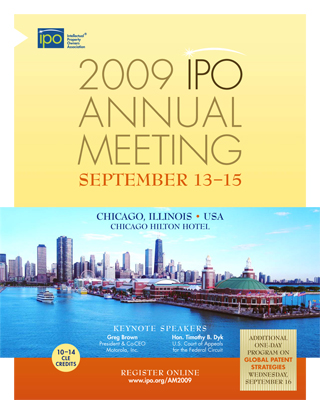
    September 13-15, 2009 – 2009 Annual Meeting (Intellectual Property Owners Association) – Chicago, IL

    September 14-15, 2009 – 3rd Summit on Biosimilars and Follow-on Biologics*** (Center for Business Intelligence) – National Harbor, MD

    September 15-16, 2009 – FDA Boot Camp*** (American Conference Institute) – Boston, MA

    September 17, 2009 – Developments in Pharmaceutical and Biotech Patent Law (Practising Law Institute) – New York, NY

    September 21-22, 2009 – 2009 World Stem Cell Summit*** – Baltimore, MD

    October 14, 2009 – Developments in Pharmaceutical and Biotech Patent Law (Practising Law Institute) – San Francisco, CA

    ***Patent Docs is a media partner of this conference or CLE

  • 2009 World Stem Cell Summit The 2009 World Stem Cell Summit will be taking place on September 21-22 in Baltimore, MD.  The 2009 Summit, which is being organized in part by the Genetics Policy Institute, will bring together researchers, clinicians, business pathfinders, key policy-makers, regulators, advocates, and experts in law and ethics to give presentations, share information, and chart the future of regenerative medicine.  Among the presentations to be offered at the Summit will be:

    • Stem cells 101 — Presentation and Q&A
    • Panel discussion:  Big pharma, big biotech, big device and the ReGEN industry
    • Panel discussion:  International perspectives — Countries having the competitive edge
    • Commercialization of stem cells and international partnerships, alliances and acquisitions
    • Stem cell law — Advanced intellectual property issues
    • Commercialization of SC and international market trends
    • Business models for successful stem cell companies and innovative funding mechanisms
    • Federal agencies:  Your questions answered relating to new NIH guidelines, standards, and clinical trials
    • Licensing, technology transfer and partnering in the ReGEN industry

    A complete agenda for the Summit can be found here, and an overview of the Summit's presentations and panel discussions can be found here.

    In addition, the Summit will offer a series of table discussions focusing on business, economic, political and therapeutic strategies.  Among the table discussions to be offered will be:

    • The Direction of FDA on Stem Cells
    • VC Perspectives
    • Opportunities in Stem Cell Law
    • Patent Solutions
    • Constitutional Battles Ahead
    • The Law Firm and Client's Essential Guide to Stem Cell Law

    A complete list of table discussions can be found here.

    The registration fee ranges from $395 (for students) to $695 (for government, non-profit, and academic attendees) or $1,095 (for industry & for-profit corporate attendees).  The registration fee will be $795 (for government, non-profit, and academic attendees) and $1,595 (for industry and for-profit corporate attendees) after July 31, 2009.  Those interested in registering for the conference can do so here.

    Patent Docs is a media partner of the 2009 World Stem Cell Summit.

    Baltimore Skyline

  • 2009 Annual Meeting The Intellectual Property Owners Association (IPO) will be holding its 2009 Annual Meeting on September 13-15, 2009 in Chicago, IL.  Among the presentations being offered at the annual meeting are:

    • Building, protecting and getting the most out of your IP portfolio in today's economic climate:  A New quality-and-cost paradigm;
    • Remedies:  Damages and injunctive relief from various perspectives;
    • IPO corporate IP management benchmarking survey;
    • Local Model Patent Rules;
    • Consequences to indemnification in view of Quanta Computer v. LG Electronics;
    • Tips for "after-final" patent practice:  What is your strategy after a final rejection is received?
    • Re-examination process, strategy and outcomes;
    • Patent litigation post-Seagate — What's changed and what hasn't;
    Bilski — What is the future for business method patents;
    • Venue and forum shopping; and
    • Ethics and professionalism.

    In addition, Greg Brown, President and Co-CEO, Motorola, Inc., will present the luncheon keynote on September 13, and Circuit Judge Timothy B. Dyk of the U.S. Court of Appeals for the Federal Circuit will present the luncheon keynote on September 14.

    An additional one-day program entitled "Aligning your patent strategy with your global corporate business plan," will be held on September 16.

    A complete brochure for the meeting and one-day program, including an agenda, list of speakers, and registration form can be downloaded here.

    The registration fee for the meeting is $950 for IPO members or $1,450 for attendees who are not IPO members (attendees registering before July 31 will receive a $100 discount).  The registration fee for the one-day program is $550 for IPO members or $800 for attendees who are not IPO members (attendees registering for both the meeting and one-day program will receive a $50 discount).  Those interested in registering for the meeting can do so here.

    McDonnell Boehnen Hulbert & Berghoff LLP, where most of the Patent Docs practice, is a sponsor of the IPO Annual Meeting.

  • Practising Law Institute (PLI) will be holding a seminar on Developments in Pharmaceutical and Biotech Patent Law on September 17, 2009 in New York, NY and on October 14, 2009 in San Francisco, CA.  Groupcasts of the New York session will also be held in Boston, MA; Philadelphia, PA; Pittsburgh, PA; and New Brunswick, NJ.  The conference will offer presentations on the following topics:

    New York #3 • Patentability of pharmaceutical products in view of KSR

    • The development of the "lead compound" analysis for determining obviousness of drug compounds;
    • Patentability issues affecting chemical compounds, stereoisomers, and pharmaceutical salts;
    • Review of significant post-KSR Federal Circuit pharma cases, including:  Takeda v. AlphaPharm (Actos®), Ortho-McNeill v. Mylan (Topomax®), Eisai v. Dr. Reddy's (AcipHex®), and Sanofi v. Apotex (Plavix®).

    • Inequitable conduct in biotechnology and pharmaceutical patent cases

    • Whether the "plague" rages on or is becoming more contained; and
    • Recent developments at the Federal Circuit and the Supreme Court, along with patent reform legislation.

    • Developments in § 112 law:  The enablement and written description requirements as applied to pharma and biotech patents

    • How have the USPTO's Written Description Guidelines developed and what has been their impact on pharma and biotech patents in litigation?
    • Are there special rules that apply to patents directed to nucleic acid sequences?
    • Explore the relationship between written description and the utility requirement for biotech patents.

    San Francisco #4 • Cutting edge issues impacting pharma and biotech prosecution

    • What has been the impact of KSR on the examination of pharmaceutical and biotech patent applications in the USPTO?
    • How have the revised Written Description Guidelines affected prosecution in the pharmaceutical and biotech arts?
    • How has the USPTO been dealing with nucleotide and amino acid sequence claims in terms of written description and utility?
    • What rule changes are being considered that may impact pharma and biotech practice before the USPTO?

    • Patent misuse and other issues in pharmaceutical and biotech licensing

    • What is patent misuse:  When does it matter and why?
    • Can patent misuse be cured and what does that mean when analyzing the potential for patent misuse?
    • When and how does monetizing research tool patents risk patent misuse?
    • Arbitration and Most Favored Nation clauses in patent licenses; and
    • Effect of corporate transactions on existing patent licenses.

    • Antitrust issues impacting pharma and biotech patent cases

    • What kinds of unique antitrust issues arise in litigation over pharma and biotech patents?
    • What strategies should be used to avoid antitrust liability in bringing and maintaining Hatch-Waxman litigation?
    • What constraints affect settlement?
    • What issues do authorized generics raise?
    • How have recent decisions by the courts and actions by the FTC altered the landscape?

    Practising Law Institute (PLI) #2 A full program for the Developments in Pharmaceutical and Biotech Patent Law seminar can be found here (New York) and here (San Francisco).  The registration fee for the seminar is $1,495. Those interested in registering for the conference can do so here (New York) or here (San Francisco).  Those interested in registering for the Groupcasts can do so here (Boston, MA), here (Philadelphia, PA), here (Pittsburgh, PA), or here (New Brunswick, NJ).

  •     By Donald Zuhn

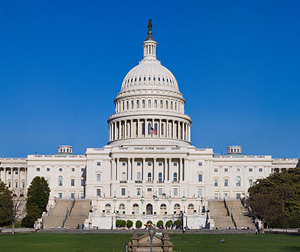
    U.S. Capitol Building In a hearing on follow-on biologics held earlier this week, the House Subcommittee on the Courts and Competition Policy heard testimony from seven witnesses including Rep. Anna Eshoo (D-CA), economist Alex Brill, Momenta Pharmaceuticals General Counsel Bruce Leicher, and representatives from the National Venture Capital Association (NVCA), Biotechnology Industry Organization (BIO), U.S. Public Interest Research Groups (USPIRG), and American Intellectual Property Law Association (AIPLA).  On Tuesday, we discussed Rep. Eshoo's written testimony (see Part I); today, we examine Mr. Brill's written testimony.

    Brill Paper Mr. Brill should be somewhat familiar to Patent Docs readers.  Last fall, the former chief economist to the House Ways and Means Committee released a white paper asserting that a follow-on biologics regulatory pathway providing a data exclusivity period of seven years would be "sufficient for maintaining strong incentives to innovate while fostering a competitive marketplace" (see "Former House Ways and Means Economist Claims 7-Year Data Exclusivity Period Is Sufficient").  And this past June, Mr. Brill, who is a Research Fellow at the American Enterprise Institute, wrote a commentary appearing on Forbes.com in which he addressed the issue of patent reform (see "Former House Economist Sets Sights on Inequitable Conduct 'Reform'" and "A Response to Mr. Brill, and a Modest Proposal Regarding Inequitable Conduct").

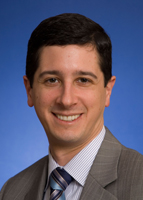
    Brill, Alex In his written testimony to the House Subcommittee, Mr. Brill (at right) began by stating that "[a] properly designed pathway for biogeneric entry will, over time, lead to additional market entrants, lower prices, increased access to drugs and a few billion dollars a year in reduced spending."  He reminded the Subcommittee that a properly designed follow-on biologics regulatory pathway must provide "adequate incentives for innovative drug companies to undertake the risk and expense of developing new drugs."  However, Mr. Brill warned the Subcommittee against establishing an "[e]xcessive exclusivity that needlessly blocks competition," since such a data exclusivity period would constitute a "government built monopoly that unduly interferes in the marketplace."  Thus, Congress was presented with the "crucially important regulatory problem" of determining the optimal data exclusivity period.

    Mr. Brill expressed some reservations about resolving this problem by merely patterning a follow-on biologics regulatory pathway on the Hatch-Waxman model.  He noted that "[b]ecause of the cost, uncertainty and complexity in biologic drugs (both for discovery and manufacturing), a competitive biologic drug market will be very different than a competitive small-molecule market."  Where generic competition in the small molecule arena leads to price declines of up to 80% and innovator drug companies face more than ten new entrants for popular small molecule drugs, Mr. Brill speculated that biologic drug competition could be quite different.  For example, the recent Federal Trade Commission (FTC) report on follow-on biologics estimates that biologic drug prices would decline between 10-30% following entry of generic competition, and late last year, the Congressional Budget Office (CBO) estimated a decline in prices of only 40%.

    While the FTC report argues that biologic drug patents are stronger than small molecule patents, and therefore contends that no data exclusivity is needed, Mr. Brill states that he "do[es] not take as strong a stand against an exclusivity period as the FTC."  Instead, he acknowledges that "[t]here is an immense importance to sufficiently encouraging healthcare innovation," adding that "the costs of providing modest additional intellectual property rights to drug originators will likely outweigh the potential costs (i.e. patents that otherwise would have been successfully challenged remaining valid because of the additional protection provided by data exclusivity)."  Stating that "[u]ltimately, it is a balancing act, promoting innovation by shielding a company from market competitors and promoting innovation and price competition by allowing market entrants," Mr. Brill stands by his assessment from last fall that a 7-year data exclusivity period would provide the best balancing between promoting innovation and promoting price competition.

    At the end of his written testimony, Mr. Brill briefly addressed the concept of tiered exclusivity for drug improvements (i.e., offering additional periods of exclusivity for new indications, dosages, or formulations).  He advised the Subcommittee that the concept could help promote innovation, but only if it satisfied five important principles: (1) the additional exclusivity period was very limited in duration, (2) was granted for the entire product, (3) was added to the end of the existing data exclusivity period, (4) was not limited as to the number of times it could be awarded, and (5) was only granted for "truly novel and substantial improvements."

    NVCA On a related note, Mr. Brill contacted Patent Docs following the House hearing to comment on a recent NVCA study that suggests that "a data exclusivity period of at least 12 years for innovator products is a critical fulcrum in the effort to balance cost with the preservation of biotech innovation" (see "NVCA Study Supports 12-Year Data Exclusivity Period").  The NVCA study indicates that the cost of capital for early stage biopharma companies is at least 20% — or almost twice as high as policymakers have assumed.  In a statement regarding the study, the NVCA noted that other studies (including Mr. Brill's) "assumed a biotech cost of capital of 10%, based on publicly traded biotech
    companies."

    Mr. Brill countered that "the modeling in the FTC report clearly demonstrates that 7-year data exclusivity is sufficient even assuming a 12.5% cost of capital."  He also noted that follow-on biologics models rely on the average cost of capital for the entire developmental cycle, and not just the early stage period.  In addition, Mr. Brill suggested that the NVCA would need to provide data on the share of total biotech research and development dollars that venture capitalists are responsible for "in order to do anything useful with their study results."  Finally, he pointed out that the Cockburn and Lerner study did not directly address follow-on biologics or data exclusivity, and contended that it was the NVCA that was "making the link" between this study and the issue of data exclusivity.

  •     By Kevin E. Noonan

    Follow-on biologic drugs, or biosimilars as they are called in Europe, are once again the subject of attempts by Congress to provide a regulatory pathway for approval.  Currently, these drugs are not regulated by the Food, Drug and Cosmetic Act and hence not subject to the provisions of the Hatch-Waxman Act that promote generic versions of small molecule drugs.  In this Congress, as in the last Congress, several bills have been introduced to "correct" this situation and provide a means for regulatory approval of generic versions of biologic drugs.

    Congress A good deal of the debate on these bills, and lobbying over their provisions, has focused on the term of data exclusivity that innovator biotechnology and biologics drug companies would be granted under any regulatory regime.  These periods range from 3.5 to 5.5 years in Congressman Waxman's bill (H.R. 1427) and Senator Schumer's related bill (S.726), to 12 years in Congresswoman Eshoo's bill (H.R. 1548), to a proposal by Senator Kennedy to provide up to 13.5 years of data exclusivity.  Several white papers and other academic and quasi-academic reports have been promulgated, advocating 7 years (see "Former House Ways and Means Economist Claims 7-Year Data Exclusivity Period Is Sufficient") and 14 years (see "Follow-on biologics: data exclusivity and the balance between innovation and competition" and "AEI Believes Advantages of Longer Data Exclusivity Period Outweigh Disadvantages") of data exclusivity, while the Office of Management and Budget and the Congressional Budget Office have recommended 7 years (see "White House Recommends 7-Year Data Exclusivity Period for Follow-on Biologics" and "BIO Says CBO Estimate of Follow-on Biologics Savings Is Based on 'Troubling Assumption'") and the Federal Trade Commission has (remarkably) recommended no data exclusivity, based on its idiosyncratic analysis of likely types and sources of competition (see "No One Seems Happy with Follow-on Biologics According to the FTC").

    What have been overlooked in the debate are other important aspects of biogeneric drugs, specifically first, what kinds of products will be considered "biosimilar," and second, will biosimilar and innovator biologic drugs be "interchangeable."  What constitutes a "biosimilar" can differ widely in definition, accommodating differences in primary amino acid sequence, post-translational modifications, level of impurities, the mechanism of action, and the mode of administration.  Patient safety concerns mandate that the biosimilar have no clinically-meaningful differences in safety, purity, or potency, a goal that becomes more difficult to achieve due to the complexities of biologic drugs.  Consequently, there is the possibility of increased risk of adverse events proportional to the amount of variability permitted in follow-on biologics (FOBs) that are considered "biosimilar."  The nomenclature is accurate:  unlike small molecule generic drugs, generic biologic drugs are not identical but are only similar to the innovator.  These differences can be in molecular size, structure (such as amino acid sequence), and composition (including glycosylation and other modifications to the protein sequence comprising most biologics drugs).  Conventional "small molecule" drugs typically comprise about 20-100 atoms (for example, omeprazole, the active ingredient in Prilosec®, contains 42 atoms), while biologic drugs comprise 5,000 to 50,000 atoms.  Moreover, peptide and protein embodiments (including monoclonal antibodies) are complex polymeric chains that can adopt secondary and tertiary structure beyond their simple linear formulae.  In addition, biologic drugs are frequently heterogeneous, comprising carbohydrates (by glycosylation), lipids, and occasionally small molecule cofactors.  All these considerations make biogeneric drugs a more challenging prospect that traditional small-molecule generic drugs.

    Similarly, interchangeability requires that a patient be capable of "switching" between the innovator and the biogeneric drug without any significantly-increased risks of adverse events.  The capacity for a patient to be switched between a generic and innovator drug is the basis for pharmacies providing generic versions of drugs unless the doctor affirmatively contravenes them, rather than having to obtain the physician's permission to substitute; this property is expected to just as important in market penetration for follow-on biologic drugs.  While all of the bills pending in Congress contain provisions for assessing whether the FOB is interchangeable with the innovator, the complexities of these molecules increases the difficulties of achieving the interchangeability goal.

    The Waxman bill contains provisions permitting a biogeneric drug to be considered a biosimilar where the follow-on biologic and the reference product have highly similar molecular structural features, the generic is interchangeable with the innovator biologic drug, and the biogeneric and innovator biologic drugs use the same mechanism of action, have the same the route of administration, or the dosage form and strength.  The Eshoo bill grants more authority to the FDA for making the determination:  a biogeneric will be considered to be biosimilar upon a showing comprised of analytic, animal, clinical, and immunogenicity studies, but the FDA can waive these requirements.  Moreover, the FDA is given the authority under the Eshoo bill to determine whether it is feasible to demonstrate interchangeability.

    Wall Street Journal All these considerations are even more relevant in view of increasing evidence that the gold-standard, small molecule generic drugs, may themselves not be without their risks and liabilities (despite the political rhetoric about the success of the Hatch-Waxman regime in facilitating generic drug entry into the pharmaceutical marketplace).  Examples of these difficulties were reported by Melinda Beck in The Wall Street Journal more than a year ago ("Inexact Copies: How Generics Differ from Brand Names").  Ms. Beck's piece conceded that "there is no hard evidence of growing problems with generics," but then provides at least one reason for this absence:  the FDA's procedures for ass
    essing reports of adverse events from generic drugs are woefully inadequate.  Some of these deficiencies are systemic:  for example, Ms. Beck reports that "[g]enerics can produce blood levels as much as 20% below or 25% above that of the original drug and still be considered 'bioequivalent' according to Food and Drug Administration guidelines."  Even when the FDA investigates, the focus seems to be on compliance with regulatory guidelines rather than patient safety.  Ms. Beck illustrates the problem with generic Welbutrin®, for which the FDA approved an extended-release formulation sold as Budeprion XL300.  From December 2006 through January 2008, the FDA received at least 130 complaints, according to the results of a Freedom of Information Act disclosure to Journal reporter Andy Georgiades.  Ms. Beck reports that Joe Graedon, who runs People's Pharmacy, received a sudden and markedly high level of complaints about Budeprion XL300 when it was introduced, including serious side effects like depression and suicidal ideation.  Tellingly, many patients reported that these symptoms stopped when they returned to the brand-name drug.  Mr. Graedon had an independent lab, ConsumerLab.com, analyze samples of the branded and generic forms of the drug, and their report showed that the generic drug dissolved faster and released more than eight times as much of the drug within the first two hours (34% with the generic versus 8% with the branded version).

    FDA The FDA, who performed its own investigation, found that "although there were 'small differences' between the two formulations, 'they are not outside the established boundaries for equivalence.'"  The generic did reach its maximum blood concentration in two to three hours, compared to five to six hours for Wellbutrin, but the FDA said those differences "were not considered clinically significant."  Maddeningly, the Agency attributed the inordinately high complaint levels to "the natural history of depression" in these patients.  Perhaps even more maddeningly, Ms. Beck reports that the FDA did not require testing performed during the approval period that compared the branded to the generic drug, but used a lower dose  — 150mg rather than 300mg — to do the comparative testing upon which it based its approval of Budeprion XL300.  Thus it can fairly be said that the agency failed to require any evidence of bioequivalence of the generic drug at the dosages actually approved.  The reason, Ms. Beck reports, is in part ethical — the agency did not want to expose clinical trial subjects to a seizure risk that accompanies the 300mg dose.  But this leads to a classic Catch 22, illustrated by a quote from Sandy Walsh, an FDA spokeperson:  "If we see scientific evidence that a product is not performing as expected, we will take action.  The FDA cannot offer examples where generics have not performed as expected because there have been none for the agency to report."

    This example illustrates a perennial problem with drug regulatory approval:  of necessity, clinical trials are performed with a test population that is much more limited, in numbers and representation (including gender, racial, and ethnic, to name a few) than the population that will be taking the drug.  Adverse incident reports after approval will, by their nature, be anecdotal and sporadic, and thus take time (and individual morbidity and mortality) for a pattern of problems with a particular drug to become evident.  The potential for differential effects, even for small molecule drugs that can be subjected to analyses that ensures "identity" for the active pharmaceutical ingredient, exists inter alia due to differences in "inactive" components (excipients, fillers, binding agents and other such components) that can affect how the drug is absorbed or metabolized in the body.

    These problems also will exist for biogenerics, in addition to the differences noted above that limit these drugs to bio-"similarity" rather than bio-"identity."  These are real challenges to any follow-on biologics regime and one that Congress will not doubt be inclined to leave to the FDA to administer.  It may behoove Congress to consider the consequences of the types of complications faced even for small molecule generic drugs, and to pay a little more attention to strengthening the provisions of these bills that mandate the level of "similarity" and "equivalence" that biogeneric drugs should be required to achieve before they are permitted in the marketplace.

  •     By Donald Zuhn

    U.S. Capitol Building This afternoon, the House Subcommittee on the Courts and Competition Policy held a hearing on follow-on biologics entitled "Biologics and Biosimilars: Balancing Incentives for Innovation."  Among the witnesses appearing before the Subcommittee were Rep. Anna Eshoo (D-CA), who introduced follow-on biologics legislation (H.R. 1548) in the House that would provide up to 14.5 years of data exclusivity; Alex Brill, a Research Fellow at the American Enterprise Institute (AEI), who authored a white paper last November asserting that a follow-on biologics regulatory pathway providing a data exclusivity period of seven years would be "sufficient for maintaining strong incentives to innovate while fostering a competitive marketplace" (see "Former House Ways and Means Economist Claims 7-Year Data Exclusivity Period Is Sufficient"); and Jack Lasersohn, a General Partner at the Verticle Group and representative of the National Venture Capital Association (NVCA), which last week released the results of a study suggesting that "a data exclusivity period of at least 12 years for innovator products is a critical fulcrum in the effort to balance cost with the preservation of biotech innovation" (see "NVCA Study Supports 12-Year Data Exclusivity Period").  Also appearing before the Subcommittee were Bruce Leicher, the Senior Vice President and General Counsel for Momenta Pharmaceuticals, Inc.; Jeffrey Kushan, who appeared on behalf of the Biotechnology Industry Organization (BIO); Larry McNeely, a Healthcare Reform Advocate with U.S. Public Interest Research Groups (USPIRG); and Teresa Stanek Rea, the President of the American Intellectual Property Law Association (AIPLA).  While Patent Docs plans to provide reports on the written testimony provided by many of these witnesses, today we begin with Rep. Eshoo's testimony.

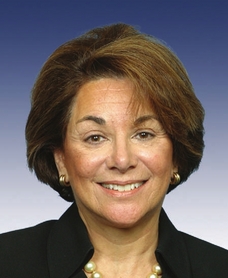
    Eshoo, Anna Rep. Eshoo (at left) began by discussing the findings of the NVCA study (which were released last week during a Capitol Hill briefing she hosted), noting that the study determined that "the 'cost of capital' for start-up biotech companies is more than double the costs that other companies must pay," and that "[t]hese costs stem from long developmental timelines of typically 10 years or more, extraordinary levels of risk (fewer than 1% of biologics make it to market), and the large amounts of capital required to support development."  Rep. Eshoo also noted that the Congressional Budget Office (CBO) has determined that "11.5 years is the average length of time that drugs are marketed under patent."

    Rep. Eshoo explained that H.R. 1548 would "establish[] a simple, streamlined patent resolution process" that would "take place within a short window of time — roughly 6-8 months after the biosimilar application has been filed with the FDA."  The Eshoo bill would also establish a listing of FDA approved biosimilars that included a designated agent for each biosimilar applicant, and provide an innovator patent holder with a limited time within which to enforce its patent against a biosimilar applicant.

    On a related note, yesterday we reported that Rep. Eshoo's bill enjoyed the support of 127 co-sponsors, and that Rep. Waxman's bill (H.R. 1427) had the support of 12 co-sponsors.  Since then, Rep. Eshoo's bill has picked up four more co-sponsors and Rep. Waxman's bill has picked up one additional co-sponsor — Rep. Eshoo's bill thus maintains its sizeable (131-13) advantage over Rep. Waxman's bill.  Of the fifteen members of the House Subcommittee on the Courts and Competition Policy (which includes nine Democrats and five Republicans), Ranking Member Howard Coble (R-NC), Rep. Charles Gonzalez (D-TX), and Rep. Darrell Issa (R-CA) are co-sponsors of H.R. 1548, and Rep. John Conyers, Jr. (D-MI) is a co-sponsor of H.R. 1427.  It remains to be seen whether Rep. Eshoo's testimony was persuasive enough to convince any of the eleven uncommitted members to join in co-sponsoring her bill.

    Testimony for the other witnesses appearing at today's Subcommittee meeting can be obtained at the following links:

    • Alex Brill's written testimony
    • Jack Lasersohn's written testimony
    • Bruce Leicher's written testimony
    • Jeffrey Kushan's written testimony
    • Larry McNeely's written testimony
    • Teresa Stanek Rea's written testimony

  •     By Suresh Pillai

    Settlement Announced in Eloxatin® Suit

    Sanofi-Aventis_small The U.S. District Court for the District of New Jersey has issued an order announcing a settlement of all outstanding litigation between Sanofi-Aventis and Ebewe Pharma over Eloxatin®, a colon cancer drug marketed and distributed by Sanofi.  This settlement puts an end to two years of litigation that commenced when Sanofi and Debiopharm, the patent holder of U.S. Patent Nos. 5,338,874 and 5,716,988, filed suit against Ebewe alleging patent infringement (see "Court Report," December 28, 2008).  Ebewe had earlier filed ANDAs for Eloxatin®.  In response to Sanofi's and Debiopharm's complaint, Ebewe counterclaimed that both patents were invalid and further alleged that the '874 patent was unenforceable on the grounds of inequitable conduct on the part of Debiopharm during prosecution.

    Ebewe Pharma As part of the findings of fact included with the order, the District Court stated that Ebewe had infringed both patents upon the filing of the ANDAs.  Under the terms of the settlement, Ebewe agreed to the dismissal, with prejudice, of all Ebewe defenses and counterclaims.  Ebewe has also stipulated that it infringed both patents and agreed to a permanent injunction barring it from marketing, manufacturing, or importing into the United States both theoxaliplatin and oxaliplatin for injection during the lives of both patents-in-suit.

    Although this puts an end to Sanofi and Debiopharm's litigation with Ebewe, its Eloxatin® suits against Abraxis BioScience Inc., Par Pharmaceutical Inc., Sun Pharmaceutical Industries Ltd., and Barr Laboratories Inc. are ongoing.

    Forest and Sun Settle Lexapro® Patent Suit

    Forest Laboratories Logo Sun Pharmaceutical Industries, Ltd. and Forest Laboratories Inc. jointly announced the settlement of litigation between the companies over the antidepressant drug Lexapro®.  The settlement includes a licensing deal under which Sun would license several Lundbeck A/S patents, including patents-in-suit U.S. Patent Nos. 6,916,941, RE 34,712, and 7,420,069.  If approved by the U.S. District Court for the Eastern District of Michigan, the settlement would end years of litigation between the two companies (see "Court Report," March 11, 2007).

    Sun Pharma Under the terms of the settlement agreement, when any third party generics drug manufacturer enters the market with final approval from the FDA, Forest will provide licenses to Caraco Pharmaceutical Laboratories Ltd., a Sun subsidiary, for any patents related to Lexapro®.  A separate assets agreement provides that Caraco will purchase products from Forest's Inwood Line of products, which consists of generic equivalents of Forest's branded products.  As part of this agreement, Caraco is to pay Forest advances against royalties as well as royalties on net sales of products.  Forest has also agreed to reimburse Caraco with a portion of the costs related to litigation.

    Settlement Announced in Everett Dispute with Breckenridge over Vitafol®-OB and Strovite® Advance Patents

    Everett Laboratories The U.S. District Court for the District of New Jersey has dismissed pending lawsuits and entered a jointly-filed Consent Judgment and Permanent Injunction against Breckenridge Pharmaceutical, Inc. in its dispute against Everett Laboratories Inc. over Breckenridge's alleged infringement of Everett's patents covering the prescription multivitamins Vitafol®-OB (U.S. Patent Nos. 6,814,983 and 7,390,509) and Strovite® Advance (U.S. Patent Nos. 6,660,293 and 6,893,904) (see "Biotech/Pharma Docket," March 16, 2009).  Under the terms of the settlement, Breckenridge has acknowledged that the patents-in-suit are valid and enforceable and would be infringed by the unlicensed sale of Breckenridge products covered by the patents and previously offered for sale.

    Purdue Pharma Loses Bid for Dismissal in Oxycontin® Dispute

    Alpharma Purdue Pharma Inc. has failed in its bid to have the U.S. District Court for the Western District of Virginia dismiss Alpharma Inc.'s lawsuit against Purdue on the grounds of lack of subject matter jurisdiction.  Alpharma filed suit last November over the right to market ALO-01, an opiod painkiller related to Oxycontin®, marketed and distributed by Purdue (see "Court Report," November 23, 2008).  Purdue has threatened to assert its rights in patents covering Oxycontin®, which Purdue claims would be infringed by Alpharma should Alpharma attempt to market ALO-01.  The patents-in-suit include U.S. Patent Nos. 6,277,384, 6,375,957, 6,475,494, 6,696,066, 7,172,767, 7,419,686, 6,228,863, 6,627,635, and 6,696,088.

    Purdue Pharma In its motion to dismiss, Purdue argued that the dispute was not ripe for adjudication because the dispute between the parties was not concrete and definite.  The District Court disagreed, however, and noted that in a 2007 meeting with Alpharma, a high-level Purdue official had asserted that Alpharma's product was covered by Purdue's patents.  Although Purdue insisted that this assertion was not a threat of litigation, the Court stated that so long as the defendant asserted rights that would force plaintiff to pursue possible illegal behavior or abandon a product that plaintiff may have had the right to market and manufacture, the plaintiff had a cause of action.  In reaching this decision, the Court also noted Purdue's aggressive litigation strategy in other similar cases.

  •     By Kevin E. Noonan

    Wall Street Journal As reported today in The Wall Street Journal, the innovator biotechnology industry scored a major victory in the Senate on Monday, when that chamber's Health, Education, Labor and Pensions Committee approved an amendment providing a 12-year data exclusivity period for biologic drug makers.

    Hatch, Orrin The committee voted 16-7 in favor of a proposal put forth by Senators Orrin Hatch (R-UT; at left), Michael Enzi (R-WY; below right) and Kay Hagan (D-NC), and rejected Senator Sherrod Brown's (D-OH) amendment for a 5-year data exclusivity term.  In doing so, the committee also rejected the Federal Trade Commission's rationale that data exclusivity (and, indeed, any sort of regulatory protection) is unnecessary for biologic drugs.

    Enzi, Michael While The Journal also noted that the ultimate fate of the 12-year data exclusivity period is uncertain in view of White House support for a seven-year period and the political pressures brought to bear by groups like the AARP, it should also be remembered that the 12-year term is shorter than at least come estimates of the average time required for biologics drug developers to recoup development costs.  It is also shorter than the period proposed by Senator Kennedy last week (although his proposal may have acted as a "placeholder" for the Hatch/Enzi proposal).  A 12-year data exclusivity term was one of the areas of consensus during debate last year on biosimilar legislation before Congressman Waxman's current bill (H.R. 1427) reduced the proposed term to 5 years.

    The Journal reports that these provisions are intended to be a part of the healthcare system overhaul bill expected to be voted out of committee today.  Importantly for the debate, Senators Hatch and Enzi argued persuasively that a shorter exclusivity period would "stifle innovation and put U.S. companies at a disadvantage to international competitors," an argument that may resonate with others in the current economic climate.

    For additional information regarding this and other related topics, please see:
    • "NVCA Study Supports 12-Year Data Exclusivity Period," July 13, 2009
    • "NCHC Sends Letter on Biosimilars to Senate Health Committee," July 9, 2009
    • "Senator Kennedy Weighs in on Biosimilar Data Exclusivity Period," July 9, 2009
    • "BIO CEO Provides Update on Follow-on Biologics Legislation," July 8, 2009
    • "Follow-on Biologics in the News – No. 4," June 29, 2009
    • "White House Recommends 7-Year Data Exclusivity Period for Follow-on Biologics," June 26, 2009
    • "AEI Believes Advantages of Longer Data Exclusivity Period Outweigh Disadvantages," June 18, 2009
    • "No One Seems Happy with Follow-on Biologics According to the FTC," June 14, 2009
    • "Follow-on Biologics in the News – No. 3," April 27, 2009
    • "Amgen VP Makes Case for Longer Exclusivity Period in Follow-on Biologics Legislation," April 22, 2009
    • "Former House Ways and Means Economist Claims 7-Year Data Exclusivity Period Is Sufficient," November 20, 2008

  •     By Donald Zuhn

    NVCA On Friday, the National Venture Capital Association (NVCA) released the results of a study suggesting that "a data exclusivity period of at least 12 years for innovator products is a critical fulcrum in the effort to balance cost with the preservation of biotech innovation."  The results of the NVCA-commissioned study were released during a Capitol Hill briefing hosted by Rep. Anna Eshoo (D-CA), who has introduced legislation (H.R. 1548) that would provide up to 14.5 years of data exclusivity.  According to a statement released by the NVCA, a trade association representing some 460 U.S. venture capital firms, the study's findings "are significant as they support a longer exclusivity period for innovators than is currently being proposed by some legislators with respect to a new Follow on Biologics (FOB) FDA approval process."  The NVCA release was likely referring to competing legislation introduced by Rep. Henry Waxman (D-CA) in the House (H.R. 1427) and Sen. Charles Schumer (D-NY) in the Senate (S. 726) that would only provide up to 5.5 years of data exclusivity.

    In a separate statement accompanying the release of the study, the NVCA noted that the central question facing legislators "is how to balance the public's interest in lower prices for biological drugs, with continued vigorous investment in the development of new medical treatments and cures for patients suffering from debilitating diseases such as cancer, Parkinson's, and multiple sclerosis."  To determine where this balance lies with respect to data exclusivity, the NVCA asked Iain Cockburn, Professor of Finance and Economics at the Boston University School of Management, and Josh Lerner, Professor of Investment Banking at the Harvard University School of Business, to examine the cost of capital for biopharma companies.  According to the NVCA, "prior attempts to identify factors that drive investment in new drug development have failed to recognize the high cost of capital for small, innovative biotech companies that comprise the majority of the biotech industry."  The NVCA noted that prior estimates regarding the cost of capital in the industry had been based on larger, publicly traded companies (primarily because data on cost of capital for venture capital funded companies is proprietary and therefore not accessible to the academic community; the NVCA notes that Professors Cockburn and Lerner were given "unprecedented access to proprietary venture capital databases" for the purposes of their study).  Moreover, the NVCA argues that because "the biotechnology industry is overwhelmingly comprised of small, private, venture capital (VC) funded, entrepreneurial companies, . . . conclusions about how a biosimilars system will affect innovation in this sector cannot be drawn directly from experience with Hatch-Waxman in the pharmaceutical sector."

    In explaining the link between cost of capital and investment in innovation, the NVCA states that:

    Since the goal of any FOB system is to produce lower prices for biologics, then such a system will reduce the flow of earnings from a biologic to investors.  If the reduction in the expected flow of earnings reduces the value of the earnings stream below the 'cost' of inventing the drug, investment in this area of innovation will ultimately cease[.]

    As a general rule, investments are made if the expected 'return on capital' is higher than the 'cost of capital'.  More importantly, investments are not made if the return is less than the cost.  If the FOB legislation has the intended result of reducing the stream of earnings from a future drug, the key question is whether the value of that 'return' has been reduced below the relevant investor's cost of capital, in this case the biotech segment of the venture capital industry.

    Brill Paper The NVCA study indicates that the cost of capital for early stage biopharma companies is at least 20% — or almost twice as high as policymakers have assumed.  In view of this result, the NVCA concludes that "the exclusivity period should be at least 12 years so that investors in innovation can exceed the [cost of capital] hurdle rate."  The NVCA notes that the cost of capital has been examined in other studies, including one conducted by economist Alex Brill, which "assumed a biotech cost of capital of 10%, based on publicly traded biotech companies, and determined that on average a 'data exclusivity' period of 7 years would permit an investor with an 10% cost of capital to make a positive return on its investment in the development of new biologics" (see "Former House Ways and Means Economist Claims 7-Year Data Exclusivity Period Is Sufficient").  The NVCA counters, however, that "7 years would not be long enough to clear the 20% hurdle rate for investing in early stage companies," and that a 7-year data exclusivity period would "drastically reduce such investments and thwart future innovation in a meaningful way."  The NVCA also notes that "[i]n its recent report on follow-on biologics drug competition, the Federal Trade Commission never even raised this question [i.e., whether the value of 'return' has been reduced below the relevant investor's cost of capital], let alone attempted to answer it."

    The NVCA also takes the FTC report to task with regard to its conclusions concerning the role and importance of biologic patents in a follow-on biologics regulatory scheme (see "No One Seems Happy with Follow-on Biologics According to the FTC").  In particular, the NVCA states that:

    With no abbreviated approval pathway today, biologics developers have little incentive to incur staggering development costs only to create me-too biologics that are marketed as merely "similar" to existing products with no opportunity for product differentiation.  The creation of an abbreviated approval pathway would change that — it would create powerful incentives for biologics competitors to identify and exploit gaps in each others' patent portfolios that could be filled with "similar" products, developed at a frac
    tion of today's costs.  In other words, "patent pressure" will increase by orders of magnitude — pressure on originators to develop only those biologics that have the best patent protection, and pressure on subsequent competitors to tear down or design around these same patents.  Thus, it is by no means assured that a patent system that enables abundant biotechnology innovation today will continue to do so under a follow-on biologics system that incentivizes biologics competitors to invade rather than avoid each others' patent space, and to develop similar rather than different products.  The answer to whether reliance on patents alone is justified under such a new system allows no margin for error.
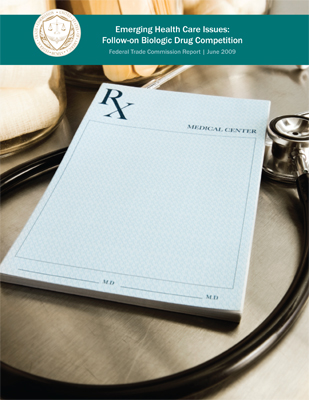
    FTC FOB Report The NVCA also argues that the FTC report "glosses over the most relevant point with respect to patent protection for biologics under a biosimilars system," namely that follow-on biologics will not need to be identical to the innovator drug (as indicated by the term biosimilar).  Thus, in contrast with small molecule drugs under Hatch-Waxman, the NVCA posits that composition of matter patents will be less likely to protect innovator companies against biosimilars competition, arguing that "potent patent protection is much more easily avoided in the biosimilars context because the biosimilar developer has more design alternatives, i.e., greater opportunities to modify the innovator’s molecule in ways that avoid the patent but are still similar enough for abbreviated approval."  The NVCA contends that even if the FTC is correct in assuming that patent protection will be sufficient, providing 12 years of data exclusivity would be of no consequence since patent protection and data exclusivity run concurrently, and "[y]ears of experience under Hatch-Waxman has already demonstrated that existing patent barriers for small molecule drugs delay generic entry for 12 years."

    Other notable findings of the NVCA study include:

    • That 44% of VC investments in biotech result in either partial or total loss of capital.
    • The VC fundraising rate for all sectors has declined by 50% in 2009.
    • The VC biotech investment rate has declined by 75% in 2009.

    Interestingly, in a related note, since OMB officials Peter Orszag and Nancy-Ann DeParle sent a letter to Rep. Waxman on June 25 stating that a follow-on biologics regulatory pathway providing a 7-year data exclusivity period would "strike[] the appropriate balance between innovation and competition" (see "White House Recommends 7-Year Data Exclusivity Period for Follow-on Biologics"), Rep. Eshoo's bill has picked up twenty additional co-sponsors (for a total of 127), while support for Rep. Waxman's bill has remained unchanged at 12 co-sponsors.

    For additional information regarding the NVCA study, please see:
    • "Cost of Capital for Early Stage Biotech Start-ups Found to be in Excess of 20 Percent," July 10, 2009 NVCA Press Release
    • "The Importance of Evaluating the Cost of Capital for Early-Stage Biotechnology Ventures to Preserve Innovation," July 10, 2009 NVCA Executive Summary
    • "The Cost of Capital for Early-Stage Biotechnology Ventures," PowerPoint presentation available at NVCA website

    For additional information regarding this and other related topics, please see:
    • "NCHC Sends Letter on Biosimilars to Senate Health Committee," July 9, 2009
    • "Senator Kennedy Weighs in on Biosimilar Data Exclusivity Period," July 9, 2009
    • "BIO CEO Provides Update on Follow-on Biologics Legislation," July 8, 2009
    • "Follow-on Biologics in the News – No. 4," June 29, 2009
    • "White House Recommends 7-Year Data Exclusivity Period for Follow-on Biologics," June 26, 2009
    • "AEI Believes Advantages of Longer Data Exclusivity Period Outweigh Disadvantages," June 18, 2009
    • "No One Seems Happy with Follow-on Biologics According to the FTC," June 14, 2009
    • "Follow-on Biologics in the News – No. 3," April 27, 2009
    • "Amgen VP Makes Case for Longer Exclusivity Period in Follow-on Biologics Legislation," April 22, 2009
    • "Former House Ways and Means Economist Claims 7-Year Data Exclusivity Period Is Sufficient," November 20, 2008