•     By Donald Zuhn

    OncoGeneX Last month, OncoGenex Pharmaceuticals,
    Inc.
    announced
    that the U.S. Patent and Trademark Office had issued
    U.S. Patent No. 7,569,551.  The '551 patent is
    directed to a method of enhancing cancer cell chemo- or radiation-sensitivity using
    an antisense oligodeoxynucleotide targeted against the testosterone-repressed
    prostate message-2 (TRPM-2) gene
    .  The inventors found that that
    administration of TRPM-2 antisense oligodeoxynucleotides can reduce the
    expression of TRPM-2, and as a result enhance the sensitivity of cancer cells
    to chemotherapeutic agents or radiotherapy either in vitro and in vivo.  While the '551 patent is assigned to
    the University of British Columbia, Oncogenex
    notes that it has exclusively licensed the patent.

    According to the biopharmaceutical company's
    announcement, the '551 patent encompasses
    methods for
    treating cancers that express the protein clusterin (the historical name for
    TRPM-2) using Oncogenex's lead cancer drug candidate, OGX-011 (also known as
    custirsen sodium), or any other clusterin antisense oligonucleotide, in
    combination with any chemotherapeutic agent or radiation therapy.  Oncogenex President and CEO Scott
    Cormack stated that the '551 patent "expands [the company's] intellectual
    property estate for treating clusterin-expressing cancers using antisense
    therapy and provides us with a broad patent that applies well beyond prostate
    cancer."

    The Onogenex release also notes that OGX-011
    utilizes antisense technology licensed from Isis Pharmaceuticals, and that OncoGenex
    and Isis partnered in the discovery and initial development of OGX-011.  Last year, OncoGenex and Isis amended
    their agreement involving OGX-011 to provide OncoGenex with sole rights to the
    molecule and sole responsibility for its development, subject to financial
    obligations to Isis.  The company's
    website states that preliminary data in a Phase 2 clinical trial evaluating
    OGX-011 in combination with second-line chemotherapy in patients with hormone
    refractory prostate cancer has shown that retreatment with docetaxel in
    combination with OGX-011 may reverse docetaxel resistance and improve patient
    survival.  OGX-011 is also being
    tested for use in the treatment of non-small cell lung cancer and breast
    cancer.

    The '551 patent issued from U.S.
    Application No. 09/967,726, filed September 28, 2001, which is a
    continuation-in-part of U.S. Application No. 09/913,325, filed August 10, 2001,
    which is a national stage application of International Application No.
    PCT/US00/0487, filed February 25, 2000, and claims the benefit of U.S.
    Provisional Application No. 60/236,301, filed September 28, 2000.  Independent claims 1 and 36 of the '551
    patent recite:

    1.  A method for enhancing the chemo- or radiation sensitivity
    of cancer cells in an individual suffering from a cancer that expresses TRPM-2
    in amounts different from normal tissue of the same type, comprising treating
    the individual with either chemotherapy or radiation therapy and administering
    to the individual a composition comprising an oligonucleotide targeted to
    TRPM-2 and effective to inhibit expression of TRPM-2 by cancer cells during at
    least a portion of the time that the chemotherapy or radiation therapy is active
    against cancer cells.

    36.  A method for treating a cancer which expresses TRPM-2 before
    or after treatment with a chemotherapy agent, comprising administering to an
    individual suffering from the cancer a chemotherapeutic agent which is at least
    partially effective against the cancer and a an oligonucleotide which is
    targeted to TRPM-2 and reduces the amount of TRPM-2 in cancer cell.

  •     By Christopher P. Singer

    Stoll, Robert In a press release
    issued last week, the U.S. Patent and Trademark Office announced that current Commissioner for Patents, John Doll, has indicated
    that he plans to retire from the agency on October 2, 2009.  USPTO Director David Kappos has nominated
    Robert Stoll (at right), a current USPTO executive, to take over Mr. Doll's position as Commissioner
    for Patents.  Mr. Stoll has been
    with the USPTO for 27 years, and has held a number of management positions
    including Supervisory Patent Examiner, Executive Assistant to the Assistant
    Secretary of Commerce and Commissioner of Patents and Trademarks, Administrator
    of the Office of Legislative and International Affairs, and Director of
    Enforcement.

    Focarino, Margaret Mr. Kappos also named Margaret ("Peggy")
    Focarino (at left) the Deputy Commissioner for Patents.  Ms. Focarino has been with the USPTO for more than 32 years,
    and has held positions including supervisory patent examiner, technology center
    director, and Deputy Commissioner for Patent Operations.  As the Deputy Commissioner, Ms.
    Focarino had oversight of the agency's patent examining corps.  She implemented a new approach to
    training examiners, and supported telework programs for patent examiners and
    technical support staff.

    USPTO Seal - background According to the press release, U.S. Commerce
    Secretary Gary Locke expressed support for Mr. Stoll's nomination and is
    expected to appoint him once Mr. Doll officially retires.

    If appointed, Mr. Stoll will serve as Commissioner for
    a term of five years.

  •     By Sydney Kokjohn

    USPTO Seal We recently received a
    dismissal of a Request for Reconsideration of Patent Term Adjustment
    Determination under 37 C.F.R. § 1.705(b).  The Request was filed solely on the basis that the Patent Office had
    taken more than three years to issue the patent.  The patent application was filed on December 7, 2005.  Thus,
    a patent should have issued by December 7, 2008.  A Request for Continued Examination (RCE) was filed on February
    16, 2009, thus cutting off from that date any additional patent term for
    failure to issue the patent within three years under 37 C.F.R. § 1.702(b).

    The Patent Office notice stated:

    Knowledge of the actual
    date the patent issues is required to calculate the amount, if any, of
    additional patent term patentee is entitled to for Office failure to issue the
    patent within 3 years.  See § 1.702(b).  (This is true even where a request for
    continued examination (RCE) was filed).  The computer will not undertake the § 1.702(b)
    calculation until the actual date of issuance of the patent has been
    determined.  Likewise, the computer will not calculate any further Office delay
    under § 1.702(a)(4) or applicant delay under § 1.704(c)(10) until the actual
    date of issuance of the patent has been determined.  As such, the Office can not
    make a determination on the correctness of the patent term adjustment until the
    patent has issued.

    Requesting
    reconsideration of the patent term adjustment to be indicated on the patent
    under 37 CFR 1.705(b) based on the initial determination of patent term
    adjustment and a projected issuance date of the patent (or even the filing date
    of the request for continued examination) is premature.  Accordingly, it is
    appropriate to dismiss as premature such a request.

    Rather than file an
    application for patent term adjustment under 37 CFR 1.705(b) contesting the 37
    CFR 1.702(b) calculation at the time of the mailing of the notice of allowance,
    applicant is advised that they may wait until the time of the issuance of the
    patent and file a request for reconsideration of the patent term adjustment
    pursuant to 37 CFR 1.705(d).  As the USPTO does not calculate the amount of time
    earned pursuant to 37 CFR 1702(b) until the time of the issuance of the patent,
    the Office will consider any request for reconsideration of the patent term
    adjustment due to an error in the calculation of 37 CFR 1.702(b) to be timely
    if the request for reconsideration is filed within two months of the issuance
    of the patent.  However, as to all other bases for contesting the initial
    determination of patent term adjustment received with the notice of allowance,
    applicant must timely file an application for patent term adjustment prior to
    the payment of the issue fee.

    Even though filing an RCE
    effectively cuts off any additional patent term for failure to issue a patent
    within three years, the Patent Office's computers will not calculate delay
    under 37 C.F.R. § 1.702(b) (or 1.702(a)(4) or 1.704(c)(10)) until after the
    actual date of issuance has been determined.

    The Office of Patent
    Legal Administration indicated that it plans to issue a statement regarding
    this matter.  In the meantime,
    a simple reading of the rules does not instill much confidence that a Request for
    Reconsideration of Patent Term Adjustment Determination when an RCE has been
    filed will not be considered untimely under 37 C.F.R. 1.705(d) if the Request
    is filed after the patent issues.  Section 1.705(d) states:

    If there is a revision to
    the patent term adjustment indicated in the notice of allowance, the patent
    will indicate the revised patent term adjustment.  If the patent indicates or
    should have indicated a revised patent term adjustment, any request for
    reconsideration of the patent term adjustment indicated in the patent must be
    filed within two months of the date the patent issued and must comply with the
    requirements of paragraphs (b)(1) and (b)(2) of this section.  Any request for reconsideration under this
    section that raises issues that were raised, or could have been raised, in an
    application for patent term adjustment under paragraph (b) of this section
    shall be dismissed as untimely as to those issues.

    Section 1.705(b) requires
    that the request be filed "no later than the payment of the issue fee."  As filing an RCE cuts off additional
    patent term, it seems that any request for additional patent term in the case
    of an RCE could be raised under
    1.705(b).  Nevertheless, this
    dismissal indicates that the Patent Office's computers do not calculate any
    delay for failing to issue a patent within three years under 1.702(b) until the
    date of issuance of the patent has been determined.

    In addition to a
    dismissal of the request as premature, note that another possible disadvantage
    of filing a request for additional patent term for failure to issue a patent
    within three years prior to the issuance of the patent is that the patent may
    issue later due to the time it takes the Patent Office to consider the
    request.  However, 37 C.F.R. §
    1.704(e) indicates that filing a request for patent term adjustment under
    1.705(b) "will not be considered a failure to engage in reasonable efforts
    to conclude prosecution."

  •     By Sherri Oslick

    Gavel_2About
    Court Report:  Each week we will report briefly on recently filed
    biotech and pharma cases, and a few interesting cases will be selected
    for periodic monitoring.


    King Pharmaceuticals Inc. et al. v. Sandoz Inc.
    2:09-cv-04513; filed September 1, 2009 in the
    District Court of New Jersey

    • Plaintiffs:  King Pharmaceuticals Inc.; King
    Pharmaceuticals Research and Development, Inc.; Elan Corporation, PLC.; Elan
    Pharma International Ltd.

    • Defendant:  Sandoz Inc.

    Infringement of U.S. Patent No. 6,066,339 ("Oral
    Morphine Particulate Formulation," issued May 23, 2000) following a
    Paragraph IV certification as part of Sandoz's filing of an amendment to its
    ANDA (adding additional dosage forms) to manufacture a generic version of King's
    Avinza® (morphine sulfate extended release capsules, used for the once-daily
    treatment of moderate-to-severe chronic pain).  View the complaint
    here.


    Centocor Ortho Biotech, Inc. v. Abbott GmbH & Co., KG
    1:09-cv-01653; filed August 28, 2009 in the
    District Court of the District of Columbia

    Review of the decision of the Board of Patent
    Appeals and Interferences awarding priority of invention to Abbott in the
    interference between U.S. Patent Application No.
    10/912,994 ("Anti-IL-12 Antibodies,
    Compositions," filed August 6, 2004), assigned to Centocor and U.S. Patent
    No. 6,914,128 ("Human Antibodies That Bind Human IL-12 and Methods for
    Producing," issued July 5, 2005), assigned to Abbott.  View the complaint
    here.


    Centocor Ortho Biotech, Inc. v. Abbott GmbH & Co., KG
    1:09-cv-01654; filed August 28, 2009 in the
    District Court of the District of Columbia

    Declaratory judgment of non-infringement and
    invalidity of U.S. Patent Nos. 6,914,128 ("Human Antibodies That Bind
    Human IL-12 and Methods for Producing," issued July 5, 2005) and 7,504,485
    ("Human Antibodies that Bind Human IL-12," issued March 17, 2009)
    based on Centocor's manufacture, use, and sale of its Stelara product
    (ustekinumab, anti-IL-12 antibody).  View the complaint
    here.


    Bristol-Myers Squibb Co. et al. v. Mylan Pharmaceuticals Inc. et
    al.

    1:09-cv-00651; filed August 28, 2009 in the
    District Court of Delaware

    • Plaintiffs:  Bristol-Myers Squibb Co.; Bristol-Myers
    Squibb Pharma Co.

    • Defendants:  Mylan Pharmaceuticals Inc.; Matrix
    Laboratories Ltd.; Matrix Laboratories Inc.

    Infringement of U.S. Patent No. 6,673,372 ("Crystalline
    Efavirenz," filed January 6, 2004) following a Paragraph IV certification
    as part of Mylan's filing of an ANDA to manufacture a generic version of BMS'
    Sustiva® (efavirenz, used to treat HIV infection).  View the complaint
    here.


    King Pharmaceuticals Inc. et al. v. Teva Parenteral Medicines
    Inc. et al
    .

    1:09-cv-00652; filed August 28, 2009 in the
    District Court of Delaware

    • Plaintiffs:  King Pharmaceuticals Inc.; Meridian
    Medical Technologies Inc.

    • Defendants:  Teva Parenteral Medicines Inc.; Teva
    Pharmaceuticals USA Inc.

    Infringement of U.S. Patent No. 7,449,012 ("Automatic
    Injector," issued November 11, 2008) following a Paragraph IV
    certification as part of Teva's filing of an ANDA to manufacture a generic
    version of Meridian's EpiPen® Auto-Injector (epinephrine, used to treat
    anaphylaxis).  View the complaint
    here.

  • CalendarSeptember 13-15, 2009 – 2009 Annual Meeting (Intellectual Property Owners Association) – Chicago, IL

    September 14-15, 2009 – 3rd Summit on Biosimilars and Follow-on Biologics*** (Center for Business Intelligence) – National Harbor, MD

    September 15-16, 2009 – FDA Boot Camp*** (American Conference Institute) – Boston, MA

    September 17, 2009 – Developments in Pharmaceutical and Biotech Patent Law (Practising Law Institute) – New York, NY

    September 21-22, 2009 – 2009 World Stem Cell Summit*** – Baltimore, MD

    September 21-22, 2009 – Patent Litigation 2009 (Practising Law Institute) – San Francisco, CA

    September 23-25, 2009 – 10th Annual Generic Drugs
    Summit on the Business of Biosimilars
    (
    Institute for
    International Research) –
    Boston, MA

    September 30-October 1, 2009 – Biotech Patents*** (American Conference Institute) – Boston, MA

    October 5-6, 2009 – Patent Litigation 2009 (Practising Law Institute) – McLean, VA

    October 7-8, 2009 – Maximizing Pharmaceutical Patent Lifecycles*** (American Conference Institute) – New York, NY

    October 14, 2009 – Developments in Pharmaceutical and Biotech Patent Law (Practising Law Institute) – San Francisco, CA

    October 15-16, 2009 – Patent Litigation 2009 (Practising Law Institute) – Chicago, IL

    October 20-21, 2009 – 17th Forum on Biotech Patenting (C5) – London,
    United Kingdom

    October 22-23, 2009 – Pharmaceutical Congress on Paragraph IV Disputes*** (Center for Business Intelligence) – Philadelphia, PA

    October 26-28, 2009 – Intellectual Property Counsels' Committee (IPCC) Fall Conference & Meeting (Biotechnology Industry Organization) – Washington, DC

    October 28-29, 2009 – Patent Opinion Writing Boot Camp*** (American Conference Institute) – Philadelphia, PA

    November 9-10, 2009 – Patent Litigation 2009 (Practising Law Institute) – Atlanta, GA

    November 9-11, 2009 – Developing
    IP Strategies for Crystalline Forms
    *** (
    International
    Quality & Productivity Center) –
    London,
    England

    November 12-13, 2009 – Paragraph IV on Trial*** (American Conference
    Institute) – New York, NY

    November 16-17, 2009 – Patent Litigation 2009 (Practising Law Institute) – New York, NY

    November
    17-18, 2009 –
    Structuring,
    Negotiating, and Managing Pharma/Biotech Collaborative Agreements
    (
    American Conference
    Institute) – New York, NY

    ***Patent Docs is a media partner of this conference or CLE

  •     By
    Donald Zuhn

    Life Science Leader In
    the August issue of Life Science Leader
    Magazine
    , Randal Kirk, Chairman and CEO
    of the venture capital firm Third Security, LLC, writes that while some 600 to 800 life
    science companies are expected to go out of business or be absorbed by other
    companies within the next two years, biotech is at the edge of "a golden
    era of valuable discoveries that forever will revolutionize its
    foundation" ("At the Outset of the Golden Era of Biotech").  According to Mr. Kirk, however, this
    golden era of biotechnology will be quite different from any previous stage of
    the industry's development.

    Kirk, Randal Not
    surprisingly, one impetus of change in the biotech industry will be the economic
    recession.  Mr. Kirk (at left), however, argues
    against the "common misconception that the industry has suffered a setback
    similar to that of others — largely due to the poor economy — and that, with
    recovery in the general economy the industry eventually will return to normal."  He suggests that "the
    biotech industry will not return to a state that we recently knew as 'normal,'"
    and instead will "morph[] into a new state."  A "new state" of biotechnology is required,
    Mr. Kirk contends, because "much of the biotech industry is based on
    flawed logic and processes that in the cruel light of day reveal themselves to
    have been chasing specious objectives with an overabundance of poorly directed
    capital."  With the economic
    woes leading to a withdrawal of venture funding, and many in the industry pointing
    to inadequate funding as the problem, Mr. Kirk notes that "the more
    obvious lesson seems to have gone largely unlearned:  We have been creating too little value."

    According
    to Mr. Kirk, the real problem with the biotech industry can be traced to its
    dependency on the healthcare industry, the latter of which "lacks critical
    feedback mechanisms that are normal to other consumer industries in a
    market-based economy."  Mr.
    Kirk notes that because the consumption decisions of healthcare consumers have
    been divorced from their payment obligations as a result of third-party payment
    systems, the healthcare industry lacks incentives to produce higher quality
    products (i.e., more effective
    treatments) at lower costs.  Mr.
    Kirk argues that "the healthcare industry has actually been selling a
    product that is quite different from what may reasonably be termed 'healthcare'
    and that product is called 'hope,'" adding that "[a]s a product, hope
    offers considerable profit opportunity."  As an example, Mr. Kirk points to "many of the cancer
    therapies that gross billions of dollars per year today [but] only manage to move
    overall survival rates by an average of a few weeks and are largely ineffective
    for the majority of patients who take them."

    Mr. Kirk therefore suggests that the solution to the biotech industry's problems will be
    to rededicate itself to "providing constantly improved value to the
    consumer."  In other words,
    "[c]ompanies should be focusing on adding genuine value to the maturation
    process of the health care industry by developing technologies that produce a higher
    quality product at lower cost." 
    For example, Mr. Kirk argues that clinical trial expenses for ineffective
    therapeutic candidates could often be avoided by performing "a simple
    proof-of-concept study [to] determine if the underlying premise — that the
    product candidate could achieve its therapeutic goal — was valid or not."

    Mr.
    Kirk concludes his article by suggesting that a handful of disciplines will
    lead the biotech industry into its new golden era:  "Within the life science fields, the most promising
    space includes molecular biology, cellular biology, and genetics, and the
    intersection of the three." 
    He notes that "[t]his space is accruing intellectual capital at
    such a fast rate that . . . the quantum of what is known is
    doubling every 2-3 years."  Drawing an analogy between where the biotech
    industry currently stands and the place where the semiconductor and software
    industries were in 1980, Mr. Kirk states that "[j]ust
    as GUI screens, object oriented code, data base software, optical fiber and
    many other science-based technologies became established as fairly fixed
    concepts in the development of a meteoric increase in productivity for those
    industries, biotech today is on the verge of identifying the technologies and
    motifs that will be the bases of its growth hereafter."  He
    also notes that the analogy is more than casual, stating that while the biotech
    industry spent its first 30 years focusing on genes, their modification, and
    the processing of their output, the industry is beginning to shift its focus to
    non-transcribed portions of the genome. 
    Mr. Kirk writes that "researchers now understand that the
    regulatory domains act as logical controllers, and, indeed, that DNA is nature's
    logic controller."

    Mr.
    Kirk will be speaking at the 2009 Mid-Atlantic Bio Conference on November 4-6,
    2009, where he plans to discuss the impact of the economy on the biotech
    industry, offer more thoughts on the next wave of advancements in the biotech
    industry, and provide predictions regarding the future direction of the industry.

  • London International
    Quality & Productivity Center (IQPC) will be holding its 5th Annual Developing
    IP Strategies for Crystalline Forms conference from November 9-11, 2009 in London,
    England.  The conference will provide:

    • An international
    case law update for the EU, U.S., and India;
    • A judicial review
    presentation from Alastair Wilson QC, Joint Head of Chambers, Hogarth Chambers;
    • A review of the
    EC competition commissions report and scrutinize how organizations may have to
    change;
    • A pharmaceutical
    extensions of patent exclusivity Focus Day, to help attendees maximize patent
    wealth;
    • Information
    regarding how applications have changed over the last 12 months, and how companies
    need to adapt to gain first time patent approval.

    Brochure-1 In particular, the
    conference and Focus Day will offer presentations on the following topics:

    • Opening
    keynote:  International IP;
    • Formulating a
    robust blueprint strategy for patent applications;
    • Analyzing the
    utility of your patent;
    • Scientist perspective:
     Strategy for first time patent approval;
    • Maximizing
    crystalline form and polymorph patent wealth:  European perspective;
    • European Patent
    Office:  Filing and approval and
    how applications have changed in the last 12 months;
    • The Glivec
    polymorph case in India:  History
    and current status;
    • Ensuring
    effective lifecycle management of your patent;
    • U.S. case law update:
     Judicial decisions impacting
    crystalline forms patent strategy;
    • UK judicial overview;
    • Polymorph patenting
    and the doctrine of inherent anticipation:  The U.S. perspective;
    • Roundtable discussion:
     Process claims vs. product claims;
    • A generics perspective;
    • European case law
    update;
    • European Commission,
    Directorate General for Competition;
    • Effective interaction
    between IP and regulatory affairs;
    • Recent cases and
    legislative changes concerning supplementary protection certificates in the UK;
    • Discussion session:  SPCs and patent term extensions —
    Target's for litigation;
    • Extending your
    patent lifecycle:  An agrochemical
    perspective;
    • Gaining pediatric
    exclusivity in Europe.

    The agenda for the Developing
    IP Strategies for Crystalline Forms conference can be found here (Day 1),
    here (Day 2), and here (Focus Day).  A complete brochure for this conference, including an
    agenda, list of speakers, and registration form can be downloaded here.

    The registration
    fees for the conference and focus day are as follows: £1,499 (conference
    alone), £849 (focus day), and £2,348 (conference and focus day).  Those registering on or before
    September 11, 2009 will receive a discount of £100 (conference alone) to £250 (conference
    and focus day) off the registration fee and those registering on or before October
    2, 2009 will receive a discount of £150 (conference and focus day) off the
    registration fee.  Those interested
    in registering for the conference can do so here.

    Patent Docs is a preferred blog of the Developing IP Strategies for Crystalline
    Forms conference.

  • New York #1 American Conference
    Institute (ACI) will be holding its 13th Advanced Forum on Structuring,
    Negotiating, and Managing Pharma/Biotech Collaborative Agreements from November
    17-18, 2009 in New York, NY.  The
    conference will allow attendees to:

    • Integrate
    emerging trends in investment capital and current deal structuring into product
    strategies;
    • Establish a
    strong presence in new and emerging markets;
    • Strengthen market
    power by ensuring effective due diligence;
    • Maximize
    profitability through skillful negotiations of critical performance terms;
    • Develop
    strategies to determine the impact of M&A activity and best position a
    company for an acquisition;
    • Gain greater
    control by drafting clearly defined termination provisions;
    • Ensure effective
    alliance management; and
    • Protect future
    rights on emerging technologies such as follow-on biologics.

    795L10-NYC In particular,
    ACI's faculty will offer presentations on the following topics:

    • Predicting future
    trends and reviewing emerging strategies from the year's top deals;
    • Setting the
    stage:  Conducting effective and
    strategic due diligence;
    • Negotiating
    essential critical terms with built-in milestones to maximize profitability;
    • Integrating
    M&A considerations into a collaborations strategy;
    • Creating and
    implementing critical termination provisions;
    • Establishing
    governance structures for successful alliance management;
    • Negotiating
    collaborative research agreements with the U.S. government and academic institutions;
    and
    • Anticipating
    future technologies and incorporating terms into the agreement to protect
    future rights.

    Two additional
    post-conference master classes will be offered on November 19, 2009.  The first mast class, entitled:  "International Collaborative
    Agreements:  Navigating and
    Managing the Unique Regulatory and Legal Risks of Global Partnerships,"
    will be offered from 9:00 am to 12:00 pm, and will provide information
    concerning specific legal contractual nuances of India, Asia, and the EU, as
    well as avoiding invalidation of restrictive terms, minimizing tax liability,
    and negotiating alliances with foreign academic institutions.  The second master class, entitled
    "The 'Win-Win' Collaborative Agreement:  Practical and Ethical Negotiating and Drafting
    Strategies," will be offered from 2:00 pm to 5:00 pm, and will provide insights
    that attendees can implement into future agreementa to achieve a win-win
    successful alliance.

    The agenda for the
    Pharma/Biotech Collaborative Agreements conference can be found here.  A complete brochure for this
    conference, including an agenda, list of speakers, and registration form can be
    downloaded here.

    ACI - American Conference Institute The registration
    fees for the conference and master classes are as follows:  $2,195 (conference alone), $2,795
    (conference and one master class), and $3,395 (conference and both master
    classes).  Those registering on or
    before September 18, 2009 will receive a $300 discount off the registration fee
    and those registering on or before October 23, 2009 will receive a $200
    discount off the registration fee. 
    Those interested in registering for the conference can do so here, by calling
    1-888-224-2480, or by faxing a registration form to 1-877-927-1563.

  •     By
    Donald Zuhn

    HACvrNew A
    paper published in the latest issue of the policy journal Health
    Affairs
    disputes the
    widely held notion that the United States has eclipsed Europe in terms of pharmaceutical
    research productivity.  In the
    article, entitled "Global Drug Discovery: Europe Is Ahead,"
    Dr. Donald Light,
    a professor of social medicine in the Department of Psychiatry at the
    University of Medicine and Dentistry of New Jersey, reexamined a data set
    originally collected by Dr. Henry Grabowski (professor of economics at Duke University) and Richard Wang (director of health services research and policy analysis at AstraZeneca Pharmaceuticals) and concluded that "the
    United States never overtook Europe in research productivity."

    In
    a 2006 Health Affairs paper entitled
    "The Quantity And Quality Of Worldwide New Drug Introductions, 1982–2003," Dr. Grabowski and Mr. Wang looked
    at all of the 919 new chemical entities (NCEs) approved between 1982 and 2003, and
    concluded that "U.S. firms overtook their European counterparts in
    innovative performance or the introduction of first-in-class, biotech, and
    orphan products."  In particular,
    the authors compared the number of NCEs discovered in the U.S., Europe, or
    Japan between 1982-1992 and 1993-2003, and determined that NCE development was
    shifting away from Europe and Japan and towards the U.S.  Following a reexamination of this data,
    Dr. Light concluded that "Congress and large purchasers are motivating
    companies to develop and market drugs that add little value, instead of
    rewarding true added value," and that "[t]his is not good for the
    long-term vitality of the industry or for those paying too much for too little."

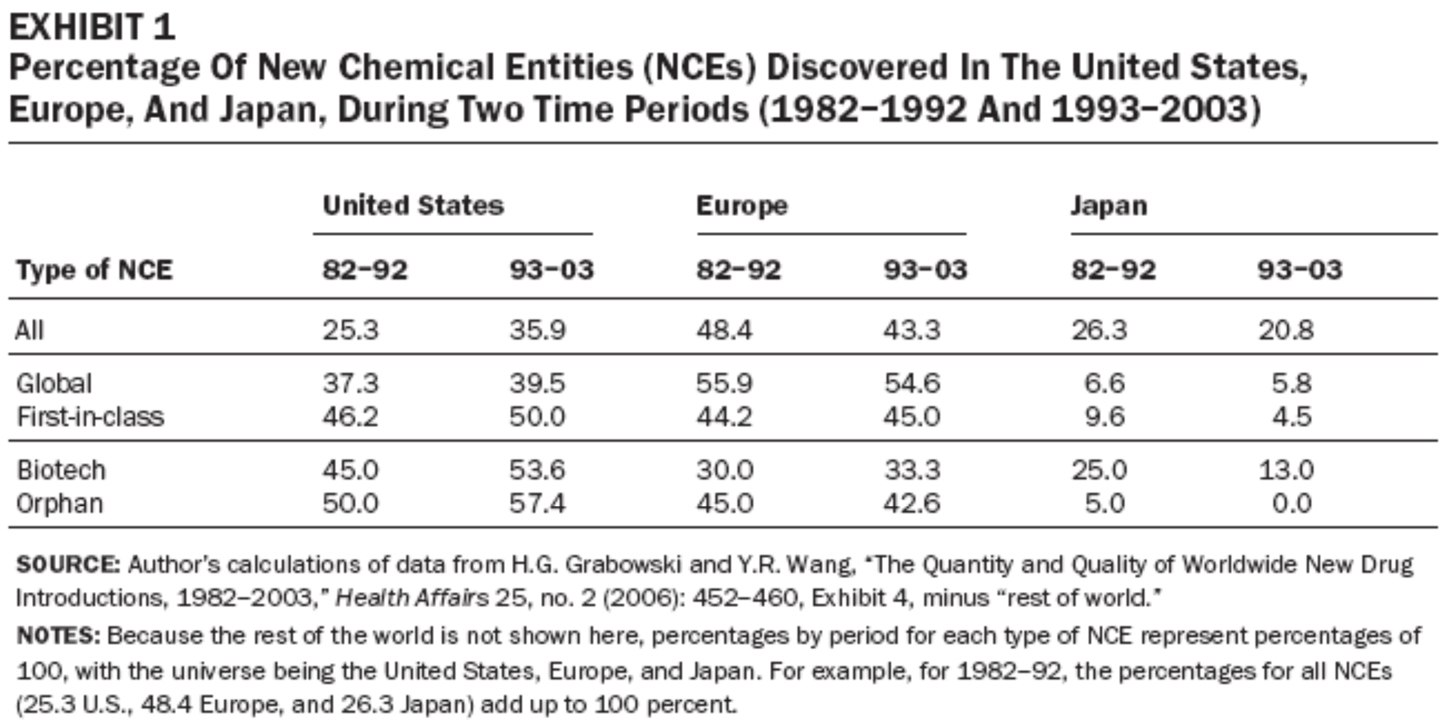
    Simply
    looking at the data collected by Dr. Grabowski and Mr. Wang, Dr. Light noted that
    "European research productivity scarcely declined, and Europe continued to
    dominate in discovering all NCEs as well as the highly profitable global NCEs,"
    adding that "[c]learly, the United States did not overtake Europe in
    discovering new chemical entities, and European researchers lost less ground
    than either Europeans or Americans believe." (see Light, 2009, Exhibit 1).

    Light, 2009, Exhibit 1

    Dr.
    Light, however, was interested in analyzing this data in view of total research
    funding (especially in view of data showing that research investment between 1990
    and 2007 grew 5.2 times in the U.S. versus 3.3 times in Europe).  In other words, Dr. Light wanted to determine
    how much bang for the buck each region was getting.  Thus, he compared the proportion of industry R&D funding
    in the United States, Europe, and Japan to the proportion of NCEs developed in
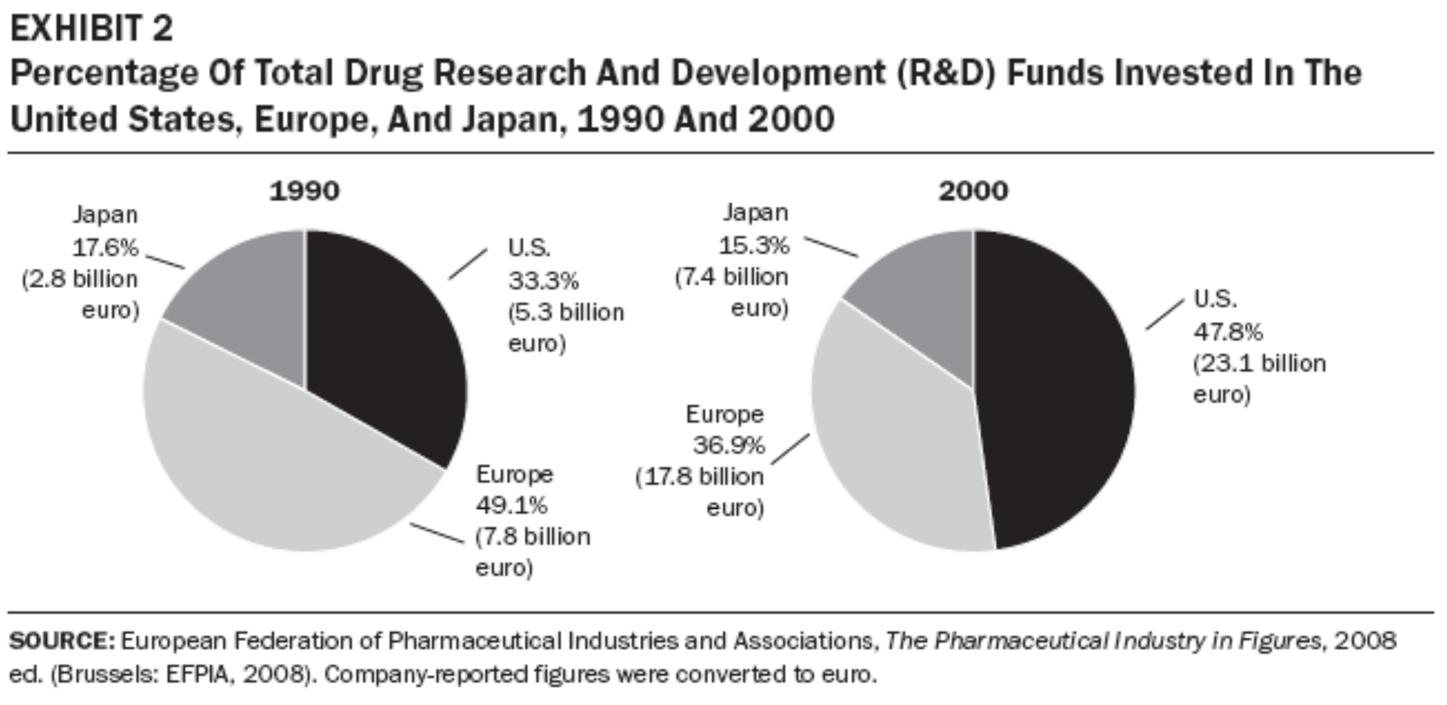
    each.  In his paper, Dr. Light
    notes that because annual figures were not available, he used investment
    figures for 1990 and 2000 that were reported by member companies to U.S.,
    Japanese, and European trade associations, and which were collected by the European
    Federation of Pharmaceutical Industries and Associations (see Light, 2009, Exhibit 2).

    Light, 2009, Exhibit 2

    Dividing
    the proportion of NCEs shown in Exhibit 1 by the proportion of R&D
    investment shown in Exhibit 2, Dr. Light determined that:

    [T]he
    United States discovered far fewer NCEs than its proportional share of funding:  0.76 (25.3/33.3) in the first period [1982-1992]
    and 0.75 in the second [1993-2003]. 
    Europe's ratio of all NCEs to investment went from 0.99 in the first
    period to 1.17 (43.3/36.9) in the second. 
    Japan's proportionate ratio was the highest: 1.49 in the first period
    and 1.36 in the second.

    From
    this, he contended that "[t]he big news in terms of innovation and
    international policy is the low and flat U.S. productivity and the high
    Japanese productivity," and further argued that "Grabowski and Wang's
    conclusions about U.S. dominance are not supported by their own data."  However, in view of the growing
    importance of biotech drugs (see, e.g., "BioWorld Reports on the Top
    25 Biotech Drugs
    "
    and "Future Drug Sales Predictions Highlight Importance of Follow-on
    Biologics Legislation
    "),
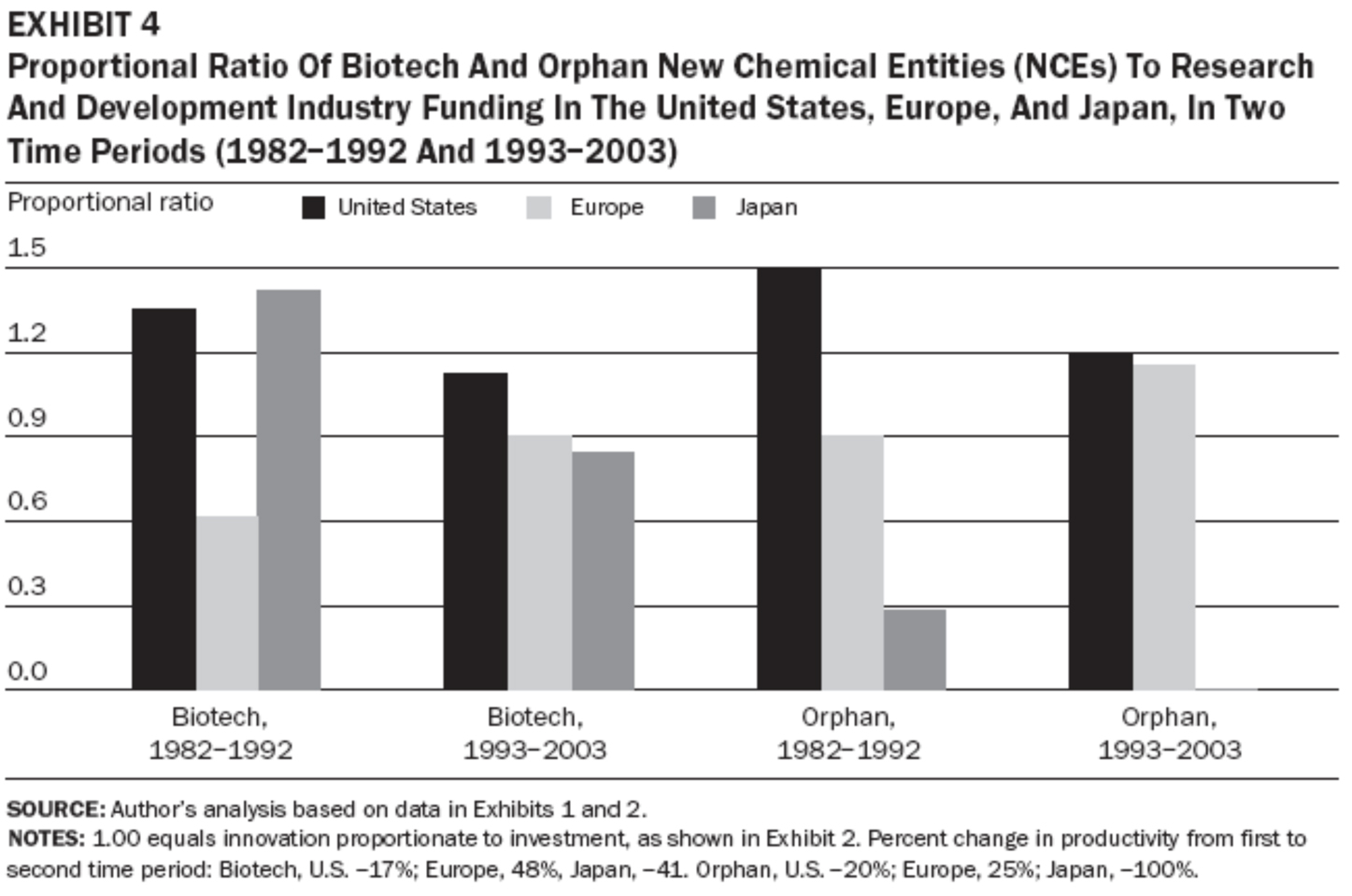
    it is interesting to note that Dr. Light's analysis shows that "European
    researchers became much more innovative in the second period but did not catch
    up with their U.S. counterparts, even though U.S. productivity declined" (see Light, 2009, Exhibit 4).

    Light, 2009, Exhibit 4

    Looking
    forward, Dr. Light suggests that "[g]iven the new institutes in European
    countries that bring together applied scientists from industry and academe to
    translate discoveries into drugs, such as Top Institute (TI) Pharma in the
    Netherlands [which funded Dr. Light's study]; Karolinska Institutet Innovations
    in Stockholm, Sweden; and the broader European Innovative Medicines Initiative,
    returns on R&D investment in Europe may increase further during the next
    decade of 2004-2014."  As for
    the implications of his study on U.S. drug policy, Dr. Light states that:

    Congressional
    leaders and others concerned about high prices of new patented drugs will be
    heartened by this analysis, because lower European prices seem to be no
    deterrent to strong research productivity.  A previous analysis using industry-based data showed that
    pharmaceutical companies recover all costs and make a good profit at European
    prices.  Europeans are not
    "free riders" on American patients — another myth promoted by
    industry that assumes that countries are separate R&D/market silos that
    should each pay for themselves.

  •     By Kevin E. Noonan

    New York Times The fastest-growing part of the biotech/pharma
    industry is anticancer drugs, according to an article in The New York Times
    today ("For Profit, Industry Seeks Cancer Drugs").  Written by Andrew
    Pollack, one of the paper's senior business and technology writers, the article
    highlights the interplay between scientific interest and business opportunity
    driving this phenomenon.

    The article supports its thesis on the recent rise
    in anticancer drugs with some telling statistics:  there are "
    more than twice the number of experimental drugs for heart disease and stroke combined, nearly twice
    as many as for AIDS
    and all other infectious diseases combined, and nearly twice as many as for Alzheimer's and all other neurological diseases combined."  This corresponds to 860 anticancer
    drugs currently in clinical trials.

    Weinberg, Robert The scientific reasons
    for these efforts stem from the nature of cancer as a disease.  Robert Weinberg (at left) from the Whitehead
    Institute at MIT is quoted in the article as saying "Cancer is not a
    single disease.  It's really
    dozens, arguable hundreds of diseases."  Bert Vogelstein (below right) from Johns Hopkins is quoted as saying that
    a typical tumor may have 50-100 genetic mutations, with any two patients having
    the same type of cancer having as few as five mutations in common.  Accordingly, there are many approaches
    and molecular targets for small molecule, immunological, and other avenues for
    attacking cancer cells in an effort to find a cure.  In addition, the situation is ripe for "personalized
    medicine," or efforts to tailor the treatment to the tumor based on the
    unique signature of genetic mutations and the corresponding phenotype of an
    individual's cancer and the targets for therapeutic intervention expressed by
    each individual's tumor.

    Vogelstein, Bert But this very
    complexity is the main reason why cancer remains so daunting after 40 years of
    concerted efforts to find a cure.  On the one hand, individual cancers even of the same type or in the same
    tissue vary dramatically in changes in gene expression, chromosomal
    abnormalities, and cancer-associated phenotypes, so that treatments that are
    effective for some cancer patients are completely ineffective for others.  This has caused the "war on cancer"
    to resemble a "grinding war of the trenches," according to an
    uncredited quote by a cancer researcher.  And intractable clinical situations provide a correspondingly broader
    scope of opportunities for new drugs effective against cancer in some portion
    of the patient population.

    However, on the other
    hand, the efficacy of many anticancer drugs is limited at best.  The article cites the instance of drugs
    like Erbitux® used as a "last ditch treatment for colorectal cancer"
    providing on average about 90 days of additional life to patients.  And Taceva®, used for treating
    pancreatic cancer (a cancer having a 3% 5-year survival rate that hasn't
    changed in the past 100 years), extends life for pancreatic cancer patients on
    average only 12 days (the basis for its approval by the FDA for this
    indication).

    Since 1998, when there
    were twelve anticancer drugs in the world's 200 medicines having the greatest
    sales, the number of anticancer drugs has almost doubled (to 23), and 20 of the
    126 drugs having revenues of $1 billion are anticancer drugs.  Despite these efforts, however, only a
    handful of new anticancer drugs are approved each year (two in 2008, one so far
    in 2009).  Nevertheless, the article cites studies by IMS Health, a
    pharmaceutical market research company, for evidence that "[c]ancer drugs
    have been the biggest category of drugs in terms of sales worldwide since 2006
    and in the U.S. since 2008."

    Imclone One factor driving
    anticancer drug development is the revenues that can be generated from their
    sales, which carry a hefty price tag.  Taceva® treatments cost about $3,500 a month, according to the article,
    and Erbitux® costs $10,000 per month (with an "extra" cost per
    patient averaging $50,000, based on the average length of treatment course).  These costs have resulted in ImClone
    having revenues of $1.6 billion in 2008 for Erbitux®, revenues that the article
    asserts motivated "Eli Lilly & Co. to outbid Bristol-Myers Squibb to
    acquire ImClone for $6.5 billion."

    Ratain, Mark While these costs are
    exorbitantly high, the article notes that "[p]atients are often desperate,
    and insurers risk outrage by denying payments for a[n anti]cancer drug,"
    even when there is little chance of benefit from the treatment.  "Cancer is such an emotional issue
    that the free market doesn't work like it does for bicycle wheels and
    umbrellas," according to Robert Erwin, head of the Marti Nelson Cancer
    Foundation.  Money will flow to
    anticancer drugs "[a]s long as the health care system will pay the price."  This situation raises special
    concerns for the healthcare system as a whole, particularly under the current
    economic climate, the pressures to reduce drug costs, and the amount of
    investment required to determine whether an anticancer drug lead compound will
    come to market.  These
    circumstances are characterized as "the biggest bubble you've ever seen,"
    according to Dr. Mark Ratain (at right), a University of Chicago oncologist.

    The confluence of the exponential increase in
    genetic information over the past decade and the technical ability to identify
    genetic polymorphism and outright mutation with different cancer phenotypes
    presents an unprecedented opportunity for developing new anticancer
    therapeutics.  Mr. Pollack's
    article is a reminder that the science is only part of the equation, and that
    the economic realities of drug development and the healthcare marketplace will
    also have a role in determining how many, and which, of these drugs will be
    available for the next generation of cancer patients.