•     By
    Donald Zuhn

    Milwaukee Journal Sentinel Last
    month, the Milwaukee Journal Sentinel
    published two articles documenting the current state of the U.S. patent system (see "The Milwaukee
    Journal Sentinel
    Gets It Right about Patents
    ").  The authors of those pieces, John
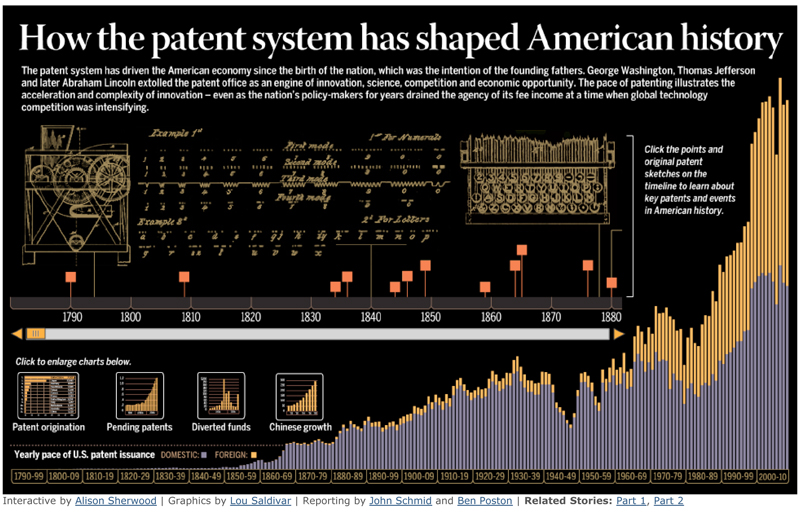
    Schmid and Ben Poston, have now compiled an interactive graphic
    that shows how the U.S. patent system has shaped American history and
    innovation.  The graphic contains a
    number of elements, including a timeline of key patents and significant events
    in American history, a comparison of domestic and foreign patents issued
    between 1790 and 2009, and charts showing the top countries and states in which
    U.S. patents originated, the number of pending applications between 1981 and
    2009 and average application pendency between 1983 and 2008, fee diversion
    between 1992 and 2004, and rapid growth of the Chinese patent system between
    1999 and 2008.

    Among the patents
    making the Journal Sentinel's
    timeline are the issuance in 1928 of U.S. Patent No. 1,680,818
    to Harry Steenbock, the issuance in 1948 of U.S. Patent No. 2,442,141 to Andrew Moyer, and the issuance
    in 1998 of U.S. Patent No. 5,843,780
    to James Thomson.  The '818 patent,
    which is directed to an antirachitic product and
    process (i.e., a process for
    enhancing Vitamin D in "organic substances of dietary value").  Dr. Steenbock secured a Nobel
    nomination in 1929 for the work leading to the '818 patent, and the success of
    the patent helped launch the Wisconsin Alumni Research Foundation (WARF).  The '141 patent is directed to a method
    a producing penicillin, and the '780 patent is the first embryonic stem cells
    patent.  The timeline also includes
    the Diamond v. Chakrabarty decision,
    which the authors state spurred an "unprecedented growth in biotechnology,"
    among its significant events.

    Interactive Graphic

  • Something for Everyone, but the Injunction Stands


        By Kevin E. Noonan

    Amgen Amgen has several times successfully defended its erythropoietin (EPO) franchise, the company's first commercial success and in many ways the crown jewel of its (or anyone's) biologics drug pipeline.  That string of successes continued today with a decision by the Federal Circuit against its latest challenger, Hoffman-La Roche.  But the decision also put several of the patents protecting Amgen's EPO at risk, making this a mixed victory at best for the biotechnology company.

    Mircera The case involved the most recent challenge, Roche's Mircera® product, a pegylated derivative of human EPO.  Amgen sued Roche in a declaratory judgment action in Massachusetts asserting six patents:  U.S. Patent Nos. 5,547,933 (the '933 patent), 5,441,868 (the '868 patent), and 5,618,698 (the '698 patent), U.S. Patent Nos. 5,955,422 (the '422 patent, claim 1) and 5,756,349 (the '349 patent, claim 7) and U.S. Patent No. 5,621,080 (the '080 patent).  On October 23, 2007, a jury found that Mircera® infringed the '933 patent, the '868 patent and the '698 patent, and that these patents as well as the '422 patent and the '349 patent were not invalid.  (The jury reached neither infringement nor validity of the '080 patent).  Specifically, the jury found that Roche's Mircera® infringed claims 3, 7, and 8 of the '933 patent (claim 12 was found not to be literally infringed but infringed under the Doctrine of Equivalents); claims 1 and 2 of the '868 patent; and claims 6 through 9 of the '698 patent.  On October 1, 2008, Massachusetts District Court Judge William Young ruled (in Amgen's favor for each) on several post-trial motions, including:  1) affirming the jury's infringement decision by denying Roche's motion for judgment as a matter of law (JMOL); 2) reaffirming its pretrial decision to grant summary judgment regarding infringement of claim 1 of the '422 patent; 3) "explaining" its reasoning for ruling, also pretrial, that the claims of Amgen's patents-in-suit are not invalid for obviousness-type double patenting (despite the intervening Federal Circuit decision in Pfizer, Inc. v. Teva Pharmaceuticals USA, Inc.); 4) denying Roche's motion for JMOL that claim 1 of the '422 patent and claims 3, 7, and 9 of the '933 patent are not invalid for indefiniteness for reciting the term "human erythropoietin"; and 5) granting Amgen a permanent injunction barring "Roche, its agents, servants, employees, counsel, and all persons and entities acting in concert therewith" from infringing the claims of the patents-in-suit for the remaining life of those patents.

    Federal Circuit Seal The Federal Circuit's decision, written by Judge Schall and joined by Judges Mayer and Clevenger, affirmed most of the determinations by the District Court and the jury.  These will be discussed more extensively in future posts, but can be summarized simply here:  the panel vacated Judge Young's decision on whether the '933 (claims 3, 7, and 8), '349 (claim 7) and '422 (claim 1) patents are not invalid under obviousness-type double patenting and remanded this issue to the trial court; vacated the judgment that claim 7 of the '349 patent was not infringed and remanded for a new trial on that issue; affirmed the judgments that the asserted claims of the '868 patent (claims 1 and 2) and the '698 patent (claims 6-9) are not invalid and were infringed, and that claims 3, 7, and 8 of the '933 patent and claim 1 of the '422 patent were infringed; and finally that claims 9, 11, 12, and 14 of the '933 patent are not infringed by Mircera®.

    Because of the number claims asserted and the status of these various claims under the CAFC's opinion, a scorecard seems in order:

    The following claims of the '933 patent are infringed but may be invalidated by the trial court for obviousness-type double patenting:

    3.  A non-naturally occurring glycoprotein product of the expression in a mammalian host cell of an exogenous DNA sequence comprising a DNA sequence encoding human erythropoietin said product possessing the in vivo biological property of causing bone marrow cells to increase production of reticulocytes and red blood cells.

    7.  The glycoprotein product according to claim 3 . . . wherein the host cell is a non-human mammalian cell.

    8.  The glycoprotein product according to claim 7 wherein the non-human mammalian cell is a CHO cell.

    The following claim is infringed by Mircera® under the doctrine of equivalents, but its status with regard to the obviousness-type double patenting question is uncertain (it does not fall within the CAFC's remand):

    12.  A pharmaceutical composition comprising an effective amount of a glycoprotein product effective for erythropoietin therapy according to claim 7 and a pharmaceutically acceptable diluent, adjuvant or carrier.  [Infringed under the doctrine of equivalents.]

    The following claims of the '868 patent are both not invalid and are infringed:

    1.  A process for the production of a glycosylated erythropoietin polypeptide having the in vivo biological property of causing bone marrow cells to increase production of reticulocytes and red blood cells comprising the steps of:
        (a)  growing, under suitable nutrient conditions, mammalian host cells transformed or transfected with an isolated DNA sequence encoding human erythropoietin; and
        (b)  isolating said glycosylated erythropoietin polypeptide therefrom.

    2.  The process according to claim 1 wherein said host cells are CHO cells.

    The following claims of the '698 patent are not invalid and are infringed:

    6.  A process for the production of a glycosylated erythropoietin polypeptide having the in vivo biological property of causing bone marrow cells to increase production of reticulocytes and red blood cells comprising the steps of:
        a) growing, under suitable nutrient conditions, vertebrate cells comprising amplified DNA encoding the mature erythropoietin amino acid sequence of FIG. 6; and
        b) isolating said glycosylated erythropoietin polypeptide expressed by said cells.

    7.  The process of claim 6 wherein said vertebrate cells further comprise amplified marker gene DNA.

    8.  The process of claim 7 wherein said amplified marker gene DNA is Dihydrofolate reductase (DHFR) gene DNA.

    9.  The process according to claims 2, 4 and 6 wherein said cells are mammalian cells.

    Claim 1 of the '422 patent is infringed but may be invalidated for obviousness-type double patenting:

    1.  A pharmaceutical composition comprising a therapeutically effective amount of human erythropoietin and a pharmaceutically acceptable diluent, adjuvant or carrier, wherein said erythropoietin is purified from mammalian cells grown in culture.

    Finally, infringement of claim 7 of the '349 patent will be decided in a new trial, but may be invalid under obviousness-type double patenting:

    7.  A process for producing erythropoietin comprising the step of culturing, under suitable nutrient conditions, vertebrate cells according to claim 1, 2, 3, 4, 5 or 6.

    Wherein claims 1 through 6 of the '349 patent related to vertebrate cells encoding recombinant EPO:

    1.  Vertebrate cells which can be propagated in vitro and which are capable upon growth in culture of producing erythropoietin in the medium of their growth in excess of 100 U of erythropoietin per 106 cells in 48 hours as determined by radioimmunoassay, said cells comprising non-human DNA sequences which control transcription of DNA encoding human erythropoietin.

    The significance of the Federal Circuit's decision, and the consequences of an adverse decision on remand for the '933, '349 and '422 patents are illustrated by the respective expiration dates of the five patents at issue in the litigation:
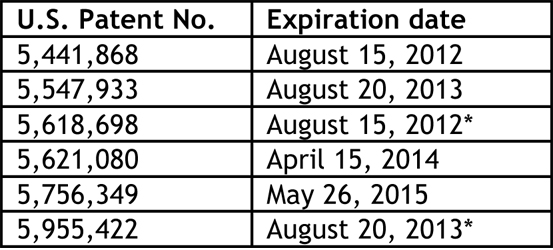
    Table_rev

    *term shortened by terminal disclaimer

    Thus, invalidation of the '933, '349 and '422 patents would reduce Amgen's patent protection on its various EPO products (including Aranesp® and Epogen®) from May 2015 to August 2012 (more than 3 years), which would have a significant (negative) effect on the corporate bottom line.  Accordingly, Amgen can be expected to continue this litigation.

    The CAFC's opinion did not disturb the permanent injunction imposed by Judge Young, preventing Roche from marketing Mircera® in the U.S. despite obtaining FDA approval in November, 2007, giving Roche more than sufficient incentive to continue as well.

    The substance of the Federal Circuit's opinion, including its reasoning on the standards for obviousness type double patenting, will be the subject of later posts.     

    Amgen Inc. v. F. Hoffman-La Roche Ltd. (Fed. Cir. 2009)
    Panel: Circuit Judges Mayer, Clevenger, and Schall
    Opinion by Circuit Judge Schall

  •     By Suresh Pillai

    Purdue Files Appeal in Ultram® Suit against Par

    Purdue Pharma Purdue Pharma Products Inc. has filed
    an appeal with the U.S. Court of Appeals for the Federal Circuit seeking
    to overturn an earlier federal court decision that invalidated Purdue's patents
    (U.S. Patent Nos. 7,074,430 and
    6,254,887 covering their product, Ultram ER®.

    Par Pharmaceutical Purdue originally filed suit in August 2007 in the
    wake of Par Pharmaceutical's
    filing of an Abbreviated New Drug Application (ANDA) with the FDA, claiming that Par
    infringed Purdue's Ultram® patents.  In August, the District Court concluded that, though Par infringed the patents-in-suit, the patents themselves were invalid in view of certain prior
    art references.  In that decision, the District Court reasoned that under 35 U.S.C. § 103, both pre- and
    post-KSR, Purdue's selection of
    tramadol as the active ingredient for Ultram® would have been obvious (see
    "Biotech/Pharma Docket," August 18, 2009).  At the time, Purdue argued that the
    existence of numerous other eligible analgesics at the time of patenting would
    have rendered the choice of tramadol nonobvious to a person having ordinary
    skill in the art.


    Navinta Appeals District Court Ruling in Naropin®
    Case

    Navinta Earlier this month, Navinta LLC filed notice in the
    U.S. District Court for the District of New Jersey announcing its intent to
    appeal the District Court's finding of infringement with respect to three patents covering Abraxis BioScience's pain drug
    Naropin®,
    U.S. Patent Nos. 4,870,086,
    5,670,524,
    and 5,834,489.  At the conclusion of an eight-day bench
    trial, the District Court ruled that the proposed generic described in Navinta's 2006
    Abbreviated New Drug Application (ANDA) fell within the asserted claims of the patents-in-suit.  The Court ordered that Navinta be
    denied permission to market and manufacture its generic version of Naropin®
    until after the expiration of the patents-in-suit in September 2014.

    Abraxis Bioscience The original lawsuit was filed in March 2007
    following Navinta's entrance into a collaboration with Sandoz AG
    that provided Sandoz's U.S. subsidiary with the exclusive rights to make,
    market, and distribute their generic form of Naropin® within the United States
    (see "Court Report," March 26, 2007).  Abraxis' lawsuit claimed that Navinta's
    2006 ANDA filing evidenced infringement of the three patents currently in
    suit.  Navinta countersued,
    claiming that Abraxis' suit was a sham litigation designed to extend
    Abraxis' monopoly on the drug through a conspiracy between Abraxis and AstraZeneca.


    Endo Files Motion to Intervene in Renega

    Infringement Dispute

    Endo Pharmaceuticals Endo Pharmaceuticals Inc. has filed a motion in the
    U.S. District Court for the District of Maryland seeking permission to
    intervene in the Renegal® patent infringement dispute between Genzyme Corp. and Impax
    Laboratories, Inc.
      In its motion, Endo argued that the
    only reason Impax challenged a second patent's validity in the case was for the
    sole purpose of forcing Endo, the first-filer of an ANDA based upon the patent,
    to forfeit its exclusivity period.  The patents-in-suit, U.S. Patent Nos. 6,733,780
    and 5,667,775,
    cover formulations of sevelamer hydrochloride, the active ingredient in Renegal®.

    Genzyme Genzyme originally filed suit in April 2009,
    alleging that Impax's filing of an ANDA seeking permission to market and
    manufacture generic versions of Renegal® infringed the '775 patent (see
    "Court Report," April 6, 2009).  Genzyme had also previously granted
    Impax a covenant not to sue over the '780 patent.  Based on this covenant, Endo and Genzyme have argued that
    the absence of a justiciable case or controversy creates a lack of subject
    matter jurisdiction over Impax's attempt to have the '780 patent declared
    invalid and noninfringed.  Although
    both Endo and Genzyme seek to have Impax's challenged dismissed, Endo still
    seeks to intervene, as Endo has argued that Genzyme has no direct interest in
    helping Endo retain its 180-day exclusivity period for manufacturing
    generics based upon the '780 patent.

  •     By
    Donald Zuhn

    ChemBridge Last
    month, ChemBridge Corp. announced
    that it would make ten of its most popular chemical screening libraries
    available to researchers via the Collaborative Drug Discovery (CDD) Public
    Access database.  The CDD Public
    Access database, a collection of public data from leading vendors, researchers,
    scientific literature, and patent resources, is hosted by Collaborative Drug
    Discovery, Inc. as a service to the research community.  Collaborative Drug Discovery provides
    web-based software for organizing preclinical research data to help scientists
    more effectively advance new drug candidates.  Researchers can register for free read-only access to the
    CDD public data sets here;
    read-and-write access, including the ability to archive, mine, and collaborate
    around private data and to import and export both private and public data is
    also available.  Compounds from the
    ten ChemBridge libraries being added to the Public Access database can be
    obtained from the San Diego-based discovery chemistry company.

    CDD The
    libraries being offered by ChemBridge include its DIVERSet, a 50,000 diverse
    small molecule dataset covering a broad range of pharmacophore space; and
    CNS-Set, which contains 56,000 molecules with an increased probability of blood
    brain barrier penetration. 
    ChemBridge noted that more than 600,000 molecules would be available
    through the CDD database.  CDD CEO
    Barry Bunin stated that both the CDD community for private access and the
    entire researcher community for public access would benefit from the addition
    of the ten ChemBridge libraries. 
    Prior to the addition of the ChemBridge molecules, the CDD database
    contained over a million compounds.

  •     By Sherri Oslick

    Gavel_2About
    Court Report:  Each week we will report briefly on recently filed
    biotech and pharma cases, and a few interesting cases will be selected
    for periodic monitoring.


    Warner Chilcott C. LLC v. Lupin Limited et al.
    1:09-cv-00673; filed September 9, 2009 in the
    District Court of Delaware

    • Plaintiff:  Warner Chilcott Co. LLC
    • Defendants:  Lupin Limited; Lupin Pharmaceuticals
    Inc.

    Infringement of U.S. Patent No. 5,552,394 ("Low
    Dose Oral Contraceptives with Less Breakthrough Bleeding and Sustained
    Efficacy," issued September 3, 1996) following a Paragraph IV
    certification as part of Lupin's filing of an ANDA to manufacture a generic
    version of Warner Chilcott's Loestrin® 24 Fe (norethindrone acetate and ethinyl
    estradiol tablets, and ferrous fumarate tablets, used for oral
    contraception).  View the complaint
    here.


    Warner Chilcott Co. LLC v. Lupin Limited et al.
    1:09-cv-00672; filed September 9, 2009 in the
    District Court of Delaware

    • Plaintiff:  Warner Chilcott Co. LLC
    • Defendants:  Lupin Limited; Lupin Pharmaceuticals
    Inc.

    Infringement of U.S. Patent No. 6,667,050 ("Chewable
    Oral Contraceptive," issued December 23, 2003) following a Paragraph IV
    certification as part of Lupin's filing of an ANDA to manufacture a generic
    version of Warner Chilcott's Femcon Fe® (formerly Ovcon® 35 Fe, norethindrone
    and ethinyl estradiol tablets, and ferrous fumarate tablets, used for oral
    contraception).  View the complaint
    here.


    Purdue Pharma Products LP et al v. Paddock Laboratories Inc.
    1:09-cv-00666; filed September 4, 2009 in the
    District Court of Delaware

    • Plaintiffs:  Purdue Pharma Products LP; Napp
    Pharmaceutical Group Ltd.; Ortho-McNeil-Janssen Pharmaceuticals Inc.
    • Defendant:  Paddock Laboratories Inc.

    Purdue Pharma Products L.P. et al v. Paddock Laboratories, Inc.
    0:09-cv-02411; filed September 4, 2009 in the
    District Court of Minnesota

    • Plaintiffs:  Purdue Pharma Products LP; Napp
    Pharmaceutical Group Ltd.; Ortho-McNeil-Janssen Pharmaceuticals Inc.
    • Defendant:  Paddock Laboratories Inc.

    The complaints in these cases are substantially
    identical.  Infringement of U.S.
    Patent Nos. 6,254,887 ("Controlled Release Tramadol," issued July 3,
    2001) and 7,074,430 ("Controlled Release Tramadol Tramadol [sic] Formulation,"
    issued July 11, 2006) following a Paragraph IV certification as part of Paddock's
    filing of an ANDA to manufacture a generic version of plaintiffs' Ultram® ER
    (tramadol hydrochloride, used to treat moderate to moderately severe chronic
    pain).  View the Delaware compliant
    here.


    Hospira Inc. et al v. Sandoz International GmbH et al.
    1:09-cv-00665; filed September 4, 2009 in the
    District Court of Delaware

    • Plaintiffs:
    Hospira Inc.; Orion Corp.
    Defendants:
    Sandoz International GmbH; Sandoz Inc.

    Hospira, Inc. et al v. Sandoz International GmbH et al.
    3:09-cv-04591; filed September 4, 2009 in the
    District Court of New Jersey

    • Plaintiffs:
    Hospira, Inc.; Orion Corp.
    • Defendants:
    Sandoz International GmbH; Sandoz, Inc.

    The complaints in these cases are substantially
    identical.  Infringement of U.S.
    Patent Nos. 4,910,214 ("Optical Isomer of an Imidazole Derivative
    Medetomidine as an Alpha-2-Receptor Agonist," issued March 20, 1990) and
    6,716,867 ("Use of Dexmedetomidine for ICU Sedation," issued April 6,
    2004), both licensed to Hospira, following a Paragraph IV certification as part
    of Sandoz's filing of an ANDA to manufacture a generic version of plaintiffs' Hospira's
    Precedex® (dexmedetomidine hydrochloride injection, used for the sedation of
    initially intubated and mechanically ventilated patients during treatment in an
    intensive care setting).  View the New
    Jersey compliant
    here.  [NB: The
    Delaware action was voluntarily dismissed by plaintiffs on September 11, 2009.]

  • CalendarSeptember 13-15, 2009 – 2009 Annual Meeting (Intellectual Property Owners Association) – Chicago, IL

    September 14-15, 2009 – 3rd Summit on Biosimilars and Follow-on Biologics*** (Center for Business Intelligence) – National Harbor, MD

    September 15-16, 2009 – FDA Boot Camp*** (American Conference Institute) – Boston, MA

    September 17, 2009 – Developments in Pharmaceutical and Biotech Patent Law (Practising Law Institute) – New York, NY

    September 21-22, 2009 – 2009 World Stem Cell Summit*** – Baltimore, MD

    September 21-22, 2009 – Patent Litigation 2009 (Practising Law Institute) – San Francisco, CA

    September 23-25, 2009 – 10th Annual Generic Drugs
    Summit on the Business of Biosimilars
    (
    Institute for
    International Research) –
    Boston, MA

    September 30-October 1, 2009 – Biotech Patents*** (American Conference Institute) – Boston, MA

    October 5-6, 2009 – Patent Litigation 2009 (Practising Law Institute) – McLean, VA

    October 7-8, 2009 – Maximizing Pharmaceutical Patent Lifecycles*** (American Conference Institute) – New York, NY

    October 14, 2009 – Developments in Pharmaceutical and Biotech Patent Law (Practising Law Institute) – San Francisco, CA

    October 15-16, 2009 – Patent Litigation 2009 (Practising Law Institute) – Chicago, IL

    October 20-21, 2009 – 17th Forum on Biotech Patenting (C5) – London,
    United Kingdom

    October 22-23, 2009 – Pharmaceutical Congress on Paragraph IV Disputes*** (Center for Business Intelligence) – Philadelphia, PA

    October 26-28, 2009 – Intellectual Property Counsels' Committee (IPCC) Fall Conference & Meeting (Biotechnology Industry Organization) – Washington, DC

    October 28-29, 2009 – Patent Opinion Writing Boot Camp*** (American Conference Institute) – Philadelphia, PA

    November 9-10, 2009 – Patent Litigation 2009 (Practising Law Institute) – Atlanta, GA

    November 9-11, 2009 – Developing
    IP Strategies for Crystalline Forms
    *** (
    International
    Quality & Productivity Center) –
    London,
    England

    November 10, 2009 – The Patent Cooperation Treaty (PCT): Important Tool for Small and Medium-Sized Enterprises (SMEs) and Independent Inventors (World Intellectual Property Organization) – Baltimore, MD

    November 12-13, 2009 – Paragraph IV on Trial*** (American Conference
    Institute) – New York, NY

    November 13, 2009 – The Patent Cooperation Treaty (PCT): Important Tool for Small and Medium-Sized Enterprises (SMEs) and Independent Inventors (World Intellectual Property Organization) – Las Vegas, NV

    November 16-17, 2009 – Patent Litigation 2009 (Practising Law Institute) – New York, NY

    November
    17-18, 2009 –
    Structuring,
    Negotiating, and Managing Pharma/Biotech Collaborative Agreements
    (
    American Conference
    Institute) – New York, NY

    ***Patent Docs is a media partner of this conference or CLE

  •     By
    Donald Zuhn

    Last
    week, Dr. Simos Simeonidis, a Senior Biotechnology Analyst for Rodman & Renshaw, LLC, provided
    FierceBiotech with a list of five biotech companies to watch in the coming
    months ("Five Biotech Companies to Watch").  On Dr. Simeonidis' list were Poniard
    Pharmaceuticals
    , GTx, OncoGenex, MannKind Corp., and Rigel Pharmaceuticals.

    Poniard Pharmaceuticals Dr.
    Simeonidis noted that he liked the chances of South San Francisco-based Poniard announcing the successful
    completion of a clinical trial of its platinum compound, picoplatin, for the treatment
    small cell lung cancer.  He
    believed that a successful trial would allow the company to secure a worldwide
    partnership for picoplatin, or alternatively, make Poniard an attractive target
    for acquisition.

    GTx GTx, headquartered in Memphis, made the list because of the possibility that the company could receive an
    approvable letter requiring additional data with respect to its compound,
    Toremifene, for preventing bone fractures in men with prostrate cancer on androgen
    deprivation therapy (ADT).  Dr.
    Simeonidis, however, did express some skepticism regarding the prospects of
    Toremifene.

    OncoGeneX Dr.
    Simeonidis believed that on the strength of recent efficacy data, Vancouver-based OncoGenex
    could find a partner for its molecule, OGX-011, for treating prostrate and lung
    cancer.  Aternatively, he thought
    the whole company could be acquired, noting that OncoGenex is valued at a
    fraction of the $894 million Johnson & Johnson recently paid for Cougar
    Biotechnology.  Earlier this week, Patent Docs reported on a patent
    OncoGenex recently obtained for using OGX-011 to enhance cancer cell chemo- or
    radiation-sensitivity (see "OncoGenex Announces Issuance of Patent for
    Antisense Cancer Therapeutic
    ").

    MannKind Corp According
    to Dr. Simeonidis, MannKind, which has been developing Afresa, an inhalable
    form of insulin, has been in active discussions with pharmaceutical partners
    for the co-development and commercialization of Afresa.  He expects MannKind
    , based in Valencia, CA, to secure a partner
    sometime this fall.

    Rigel Finally,
    South San Francisco-based Rigel made the list for demonstrating strong efficacy in one of two trials of
    its compound, R788, for treating rheumatoid arthritis.  The other trial, however, yielded
    inconclusive results.  Nevertheless,
    Dr. Simeonidis believed Rigel's shares were undervalued, and suggested that
    Rigel could secure a partner for R788 sometime this fall.

  • WIPO The
    World Intellectual Property Organization (WIPO) will hold a one-day seminar on
    the Patent Cooperation Treaty (PCT) for small and medium-sized enterprises and
    independent inventors on November 10, 2009 in Baltimore, MD and on November 13,
    2009 in Las Vegas, NV.  During each
    session, WIPO staff will provide an overview of the PCT, outline its
    advantages, and discuss aspects of the PCT with attendees.  In addition, attendees will have a
    chance to offer suggestions as to how the PCT can be further improved and
    enhanced to make it more accessible to small and medium-sized enterprises and
    independent inventors.  The seminar
    will address the following topics:


    Overview of the PCT system;

    International Search and Preliminary Examination;

    Effective use of patent information — PATENTSCOPE® service;

    Costs for filing a PCT application;

    PCT filing strategies;

    PCT and licensing activities; and

    Electronic filing of PCT applications.

    While
    no registration fee will be charged for either session, those wishing to attend
    one of the seminars must complete a registration form here (Baltimore) or here
    (Las Vegas).  Additional information regarding the
    seminar can be found here (Baltimore) or here (Las
    Vegas).

  • More Claim Construction Confusion from the Federal
    Circuit

        By Kevin E. Noonan

    The Federal Circuit demonstrated once again the
    quagmire that can exist when lower courts attempt to apply the CAFC's rather
    quixotic jurisprudence on claim construction.

    Sanofi-Aventis_small The case, Sanofi-Aventis
    U.S. LLC v. Sandoz, Inc.
    (1), arose as the result of ANDA filings by several Defendants for oxaliplatin, the active ingredient in Sanofi's Eloxatin®
    colorectal cancer drug.  Two
    claims of the patent at issue, U.S. Patent No. 5,338,874, were asserted against
    the Defendants:

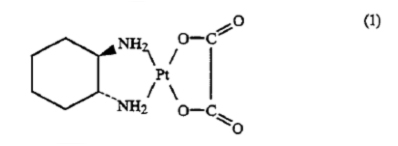
    1.  Optically-pure
    cis-oxalato(trans-l-1,2-cyclohexanediamine) Pt(II) having the general formula
    of Formula (1).

    Formula (1)

    (Dependent claim 2 merely added a melting point
    limitation and was not further at issue in the case.)  The question decided by the Federal Circuit on appeal was
    whether the claim term "optically pure" included an affirmative
    limitation that "optically pure oxaliplatin" had been "resolved
    by means of the HPLC method described" in the specification of the '874
    patent.

    The District Court had decided that this term did
    include the limitation.  While
    admitting that "[t]here was no
    dispute that nothing on the face of the claims of the '874 patent limit[ed] the
    claims to 'optically pure oxaliplatin that is produced through the use of HPLC,"
    the District Court identified statements in the prosecution history and
    disclosure in the specification that supported its interpretation.  Specifically, the District Court was
    persuaded that Sanofi had distinguished an asserted prior art reference (Kidani
    et al.) that purported to disclose "a single isomer [of oxaliplatin]
    useful as an antitumor agent" by arguing that the optical purity of the
    oxaliplatin in the reference was only 90%.  According to the District Court, Sanofi stated during
    prosecution that "[o]nly after HPLC resolution (in accordance with the
    teachings of the present application) was optical purity obtained."  In addition, the District Court pointed
    to portions of the specification that compared the optical purity of oxaliplatin
    prepared according to prior art methods contained in the asserted reference with
    the optical purity of Sanofi's molecule after resolution by HPLC.  To the District Court, these
    distinctions were sufficient to require that the claim term "optically
    pure oxaliplatin" describe only oxaliplatin resolved to optical purity by
    HPLC.  Accordingly, since the Defendants did not use HPLC to resolve oxaliplatin to optical purity, the District Court granted summary judgment of non-infringement.

    Federal Circuit Seal The Federal Circuit disagreed with the lower court's
    claim construction.  In a unanimous
    (albeit nonprecedential) opinion by Judge Moore, joined by Judges Linn and
    Prost, the Court found that the patentee had not disclaimed all embodiments of
    optically pure oxaliplatin except those resolved by HPLC.  The Court opined as follows:

    We have repeatedly warned of "the danger of
    reading limitations from the specification into the claim."  See, e.g.,
    Phillips, 415 F.3d at 1323.  "Absent a clear disavowal or contrary
    definition in the specification or the prosecution history, the patentee is
    entitled to the full scope of its claim language."  Home Diagnostics,
    Inc. v. Lifescan, Inc.
    , 381 F.3d 1352, 1358 (Fed. Cir. 2004).  To narrow the
    plain language of a claim, a disclaimer must be clear and unmistakable.  Cordis
    Corp. v. Boston Scientific Corp.
    , 516 F.3d 1319, 1329 (Fed. Cir. 2009).  We
    see no such disclaimer in the specification or prosecution history of the '874
    patent.

    The Court also disagreed that claim 1 of the '874
    patent was a product-by-process claim:

    The district court relied on Andersen Corp. v.
    Fiber Composites, L.L.C.
    , 474 F.3d 1361 (Fed. Cir. 2007), when construing
    claim 1 as a product-by-process claim.  In Andersen, this court held that
    claims to composite structures included a pelletizing process limitation where
    the patentee relied on that process both
    to define the invention and to distinguish the prior art
    .  . . .  We
    determined that the specification attributed the claimed physical properties to
    the process and that the specification indicated that the pelletizing step was a
    requirement
    , not a preference, of the invention.  . . .  We further determined
    that the patentee had clearly disavowed
    other processes during prosecution.  . . . [emphasis
    added
    ]

    By contrast, here, the patent specification and
    prosecution history focus on the property of the composition (optical purity)
    and not the process used to obtain that property.  . . .  The specification never
    asserts that HPLC is required to obtain optically pure oxaliplatin.  It
    characterizes HPLC as an "illustrative method" and a "representative
    process" by which the claimed compound "may be prepared".  . . .  Moreover,
    the specification does not define the property (optical purity) by reference to
    the process of purification by HPLC.  Thus nothing in the specification limits
    the invention to optically pure oxaliplatin purified using HPLC.

    The prosecution history also illustrates that it is
    the optical purity of oxaliplatin that distinguished it from the prior art, not
    the process used to obtain that purity.  The Examiner rejected the initially
    filed claims to oxaliplatin "of optically high purity" as anticipated
    or rendered obvious by Kidani.
      
    The Examiner stated that Kidani disclosed "a
    single isomer [oxaliplatin] useful as an antitumor agent.  Note that since the
    single isomer complex was prepared, the optical purity of such material is very
    high or almost pure isomer."  In response, the applicant . . . explained that it had repeated
    Kidani's process "using identical reactant materials and the subsequent
    testing thereof. . . . The resultant material was tested and found to be 90%
    [oxaliplatin] not optically pure . . . ."  Sanofi explained that "[o]nly
    after HPLC resolution (in accordance with the teachings of the present
    application) was optical purity obtained."  Sanofi further asserted that
    the products prepared using Kidani's method "do not have the presently
    claimed optical purity."  Therefore, Sanofi argued that the claimed
    oxaliplatin "having high optical purity[] is not found or taught in the
    prior art either by inherency or by being obvious thereover."  Following a
    telephone interview, Sanofi agreed to amend the claims to "optically pure"
    oxaliplatin, rather than oxaliplatin "of high optical purity."  The
    Examiner entered the amendment and allowed the claims, stating that "[t]he
    Examiner agrees with applicants that Kidani et al. does not teach[] the
    cis-oxalato(trans-l-1,2-cyclohexanediamine)Pt(II) as an optically pure isomer. 
    It is clear from Kidani et al. that also other isomers can be in the final
    product."  Thus, Sanofi argued that the
    defining feature of the claimed oxaliplatin was its optical purity, not the
    HPLC process
    .  Nothing in the prosecution history amounts to a clear and
    unmistakable disclaimer of optically pure oxaliplatin prepared using other
    (non-HPLC) processes.  [emphasis added].

    The Federal Circuit vacated the District Court judgment of non-infringement and remanded the
    case to the lower court.

    The panel's opinion illustrates how difficult it is
    for a district court to implement supposedly straightforward rubrics such as
    those enunciated by the en banc court
    in Phillips v. AWH Corp.  The District Court's reasoning was
    based on understanding the plain meaning of the term "optically pure,"
    a phrase that has no plain meaning outside its specialized meaning in the
    chemical arts.  The District Court
    looked to the specification and the prosecution history to identify how the
    patentee defined the term, and in the absence of an express definition used the
    examples in the specification and the arguments and amendments made during
    prosecution to construe the claim term "optically pure" to require
    that optical purity must be achieved using HPLC.  The Federal Circuit disagreed and substituted its judgment
    for the lower court's, a commonplace occurrence.

    The outcome brings to mind the dissenting opinion
    of District Court Judge
    Vaughn
    R. Walker, Chief Judge, U.S. District Court for the Northern District of
    California, sitting by designation,
    in Medegen MMS, Inc. v. ICU Medical Inc. (Fed, Cir. 2008) (see "Claim Construction at the Federal Circuit: A District Court Judge's View").  In
    that case, Judge Walker asserted that claim construction presented "a
    conundrum" to district courts.  This conundrum arose from these "twin
    axioms" of claim construction:  "[o]n the one hand, claims 'must
    be read in view of the specification'," citing Markman, while "[o]n
    the other hand, it is improper to read a limitation from the specification into
    the claims," citing Arlington Indus. Inc. v. Bridgeport Fittings, Inc.
      The problem with these axioms,
    according to Judge Walker, is that "the axioms themselves seldom provide
    an answer, but instead merely frame the question to be resolved."  While recognizing the sound policy reasons for a patent drafter to be required
    to include "all claim limitations in the claims of a patent," he also
    admonished that "patents must be read as well as written."  Citing Phillips, he asserted that this analysis must be performed with
    due consideration of a term's "ordinary and customary meaning"
    informed by the "context of the entire patent, including the
    specification."

    Judge Walker's
    dissent raised the essential paradox of the Federal Circuit's practice under Cybor Corp. v. FAS Technologies, Inc.
    of giving no deference to claim
    construction by district courts:  "[a]s a jurist more accustomed to
    working on the front lines of patent litigation than reviewing decisions from
    above, it is my experience that claim construction — determining how one of
    ordinary skill in the art would understand the patent at the time of invention
    — often requires making fact-like determinations not well suited to appellate
    review."  The "uniformity and predictability" desired by
    the CAFC as a general, guiding principle is not always best served in the
    individual determinations necessary to construe claim terms.  In this he
    cited with approval Judge Lourie's point in Phillips, that while there
    is (and perhaps cannot be) formal deference by the CAFC to a district court's
    claim construction, it is better policy for the Federal Circuit to affirm "in
    the absence of a strong conviction of error."

    Current academic
    research suggests that Federal Circuit affirmance rates of district court claim
    construction has "improved" to from 60-70%.  However, each Federal Circuit panel addresses, and resolves,
    specific claim construction issues in any particular case in its own way,
    introducing the kind of uncertainty that the Federal Circuit was created to curtail.  The inconsistencies resulting from the Federal Circuit's "no deference"
    standard of review can be expected to continue to produce the type of results
    decried by Judge Walker in Medegen and, arguably, that were obtained in Sanofi-Aventis v. Sandoz.

    (1) Additional defendants included Teva Parenteral
    Medicines, Inc., Teva Pharmaceuticals USA, Inc., and Pharmachemie BV; Mayne
    Pharma Ltd., Mayne Pharma (USA) Inc,, Hospira Australia Pty Ltd., and Hospira,
    Inc.; W.C. Heraeus GMBH; APP Pharmaceuticals, Inc. and Abraxis Bioscience,
    Inc.; Actavis Totowa LLC, Actavis, Inc. and Actavis Group HF; Fresenius Kabi
    Oncology PLC and Fresenius Kabi Pharma Ltd.; Sun Pharmaceutical Industries Ltd.
    and Caraco Pharmaceutical Laboratories, Ltd.; Ebewe Pharma GES.M.B.H. NFG HG;
    and Mustafa Nevzat Ilac Sanayii A.S., Par Pharmaceutical Companies, Inc. and
    Par Pharmaceutical, Inc.

    Sanofi-Aventis U.S. LLC v. Sandoz, Inc. (Fed. Cir.
    2009)

    Nonprecedential disposition
    Panel: Circuit Judges Linn, Prost, and Moore
    Opinion by Circuit Judge Moore

  •     By Kevin E. Noonan

    Biotechnology Industry Organization (BIO) The Biotechnology Industry Organization (BIO) held
    a media briefing on Federal policy issues today, with most of BIO's executive
    staff assembling at BIO headquarters in Washington, D.C.  In addition to the media present on
    site, BIO hosted several more members of the press by teleconference.

    Greenwood, Jim Jim Greenwood (at left), BIO's President and CEO, started the
    meeting with prepared remarks concerning healthcare reform, patent reform, and
    the energy bill.  With regard to
    healthcare reform, Mr. Greenwood reiterated BIO's support, provided that any
    healthcare bill recognize four fundamental objectives:  access for all ("every man, woman
    and child"), cost containment, quality, and innovation.  Mr. Greenwood also mentioned
    biosimilars legislation, where he expressed pride that BIO had "played it
    straight" with legislators "from the beginning."  BIO's position was consistently that a
    14-year data exclusivity period was the right length, and didn't advocate for
    longer terms of 16-18 years as a negotiating ploy.  He said that BIO had done "quite well" against a "well-organized
    coalition" of generics companies, the AARP, the White House, and other
    factions.  He also said that BIO
    was willing to accept the Senate bill's compromise of 12 years if that was what
    it takes to get a bill passed.  He
    also voiced BIO's support for "comparative effectiveness" as a tool
    for making medical decisions but not for reimbursement.  On energy, Mr. Greenwood maintained
    that there was no way to significantly reduce greenhouse gases without
    contributions from biotechnology, including cellulosic ethanol technology,
    algae, and other methods of energy production.  Mr. Greenwood ended his remarks with patent reform, which he
    characterized as a "long, hard fight" contested "at a great
    disadvantage" against an IT industry that supported "reforms"
    that would make it "easier to infringe patents."  He voiced BIO's support for the
    compromise that had produced a bill in the Senate.

    Sherwin, Stephen Also addressing the press was Dr. Stephen Sherwin (at right),
    BIO's chairman and also the Chairman of Cell Genesys, Inc.  Dr. Sherwin, a biotech entrepreneur
    throughout his career, spoke on the economic climate for biotechnology.  He mentioned the obvious — that it had been an "extremely
    difficult and challenging time" for biotech over the past 18-24 months,
    with almost half of the organization's member companies having enough cash for
    12 months and a quarter having less than 6 months of cash reserves.  He also mentioned that there has been
    no significant IPO activity in the biotech sector in almost two years.  The reason is that investors are
    nervous about the regulatory environment if there is a follow-on biologics bill
    and the effects any FOB bill may have on the timing of product
    development.  (In response to a
    question, Dr. Sherwin said that Wall Street hates uncertainty, even when it is
    uncertainty Wall Street has created.)  On the bright side, Dr. Sherwin mentioned that there had been "some
    thawing" in the capital markets in the face of "good news" from
    clinical trials, etc.  He also noted
    that he had met with the new FDA commissioner, Dr. Hamberg, and was pleased with
    her "science-based" approach.  He also noted that there was progress on reauthorizing SBIR
    grant legislation that would permit companies having venture capital funding to
    compete for such grants.  He said
    that he was optimistic, but that "we have our work cut out for us."

    In the question-and-answer portion of the meeting,
    Mr. Greenwood responded to a question from Reuters on healthcare reform that
    certain revenues for smaller companies — like royalties and milestone payments —
    should be exempt from the fees (or taxes) that the Obama administration
    proposed on drug sales revenues in an agreement with the pharma industry
    announced earlier this summer.  Mr.
    Greenwood also reminded listeners that predictions such as a recent one by
    BioWorld, that biotech drugs would represent 50% of all new drugs by 2015 and
    71% by 2025, might not come to pass if a shortened data exclusivity period
    drove investment away from the biotech sector.  The 12-year period is the minimum required to maintain
    the incentives for investment in new biologic drugs, which is why BIO supports
    this number.  Investors have other
    opportunities that are less risky that they will take if there isn't a
    sufficient data exclusivity period to support such investment, Mr. Greenwood
    said.

    Erikson, Brent Business Week asked about BIO's position on the "politics"
    of 'partisan gridlock" over the healthcare and energy bills, where
    Republicans might oppose the bills merely to hand the Obama administration a
    political defeat.  Mr. Greenwood
    said it wasn't BIO's role to try to "change the playbook" for the
    parties, and that the "big picture" required healthcare reform.  BIO has been (and by implication, will
    continue to be) "religiously non-partisan" on the healthcare issue,
    resulting in strong bipartisan support (with 28 of 38 Democratic members and all but one Republican member
    of the Energy and
    Commerce committee voting for the biosimilars amendment supported by
    BIO).  There is nothing partisan about using biotechnology in
    reducing greenhouse gases, he said.  Brent Erickson (at left), BIO's Executive Vice President, Industrial and
    Environmental Section, chimed in that opposition to the energy bill was not
    partisan so much as regional, reflecting differences in the reliance of
    different sections of the country on fossil fuels.  It has been "a bit of an uphill battle" in
    educating Congress about the contributions of biotechnology in addressing
    climate and energy problems, he said.

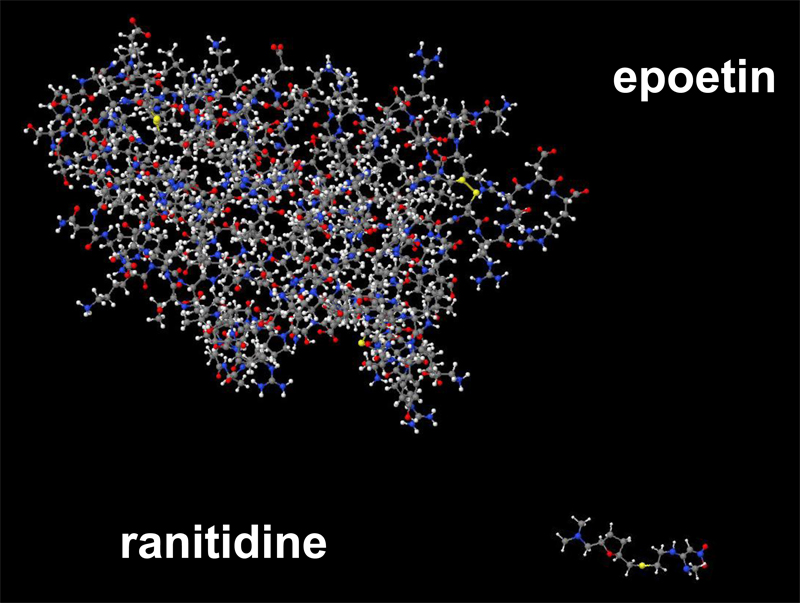
    Ranitidine vs. epo Mr. Greenwood had another opportunity to remind his
    listeners that BIO had played the role of honest broker in the healthcare
    debate, in response to a question from the Pink Sheet about whether BIO would
    need to "cut a deal" with the Obama administration like PhRMA did
    (according to the Pink Sheet reporter).  Mr. Greenwood said there had not been any horse-trading or quid pro quo
    in BIO's position — he said that BIO's success in pursuing its agenda regarding
    FOB legislation was the result of old-fashioned "shoe leather"
    politics, by meeting with "scores" of Congressional leaders and
    explaining BIO's position.  He
    mentioned that he carried two things to these meetings:  a model of the aspirin molecule and a
    DVD showing the structure of erythropoietin (see image at right).  Mr. Greenwood also said that BIO's
    success makes getting a bill passed even more important, since BIO's "enthusiasm
    for the package [will be] dramatically diminished" if the bill undergoes
    major changes in the House.

    Dr. Sherwin addressed a question about the
    priorities BIO would advocate for the FDA.  He mentioned that he was "encouraged' by the new FDA
    commissioner's (science-driven) approach, which he says he expects to be
    characterized by "efficiency" and "clarity."  He said there will be an effort to
    strike a balance between safety and efficacy, a balance he said was familiar to
    all physicians in assessing risks and benefits of any course of treatment.  While acknowledging that a single
    meeting could not address complex issues, he said he was "encouraged"
    by having someone with her background in her position early in the Obama
    administration.

    Andrew Noyes from Congress Daily asked about patent
    reform, and Brent Delmonte, BIO's Vice President for Governmental Relations
    said that BIO hopes for support for the Senate bill, a "fair, responsible
    compromise," and that contentious bills (like H.R. 1908 from the
    previous Congress) could slow patent reform.  He mentioned "great ideas" from both sides of the
    Hill, including re-examination and the "second window," and the "gatekeeper"
    function of judges on the damages issue.  On balance, BIO remains "hopeful" for a patent reform bill in
    this Congress, but doesn't see any "date certain" for the bill coming
    to the floor.

    A reporter from Scripps News asked the panel about
    the SBIR bill, and Mr. Greenwood said that BIO was very pleased with the result
    of the vote on the reauthorization bill in the House, which passed the bill
    386-41.  Alan Eisenberg, BIO's
    Executive Vice President Emerging Companies and Business Development, mentioned
    that the SBIR program is funded by a 2.5% set-aside from other departments and
    Federal agencies (the Department of Defense, the Department of Energy, the
    National Institutes of Health), and that the bill was an attempt to overturn "fairly
    arbitrary" administrative agency (Small Business Administration) decisions
    that prevented venture capital-funded companies — the majority of BIO's small
    company members — from participating.  BIO is confident that Congress will be able to resolve differences between
    the House and Senate versions of the bill.

    Hans Sauer, BIO's Associate General Counsel for
    Intellectual Property, fielded a question on the Bilski case, specifically why BIO was interested in the case.  Mr. Sauer provided a brief synopsis of
    the case, mentioning that the Federal Circuit had fashioned a rule on patent
    eligibility of method claims that was far broader than necessary to answer the
    question of whether the business method claims in the Bilski patent should be
    patent-eligible.  This broader rule
    put at risk the patentability of claims to important methods, such as
    biomarkers and biological correlations with disease, and personalized medicine,
    that made the issue one important to BIO.  He noted that biotech methods, not business method cases, were some of
    the first cases affected by the Federal Circuit's new rule.  He expressed confidence that the
    Supreme Court would understand these distinctions when it fashions a different
    rule in deciding Bilski.

    A reporter from the Journal of Commercial Biotechnology
    and Scientific American brought the discussion back to the economy, and Mr.
    Eisenberg provided some additional sobering statistics.  He said that the total number of public
    companies has been reduced, some by mergers and acquisitions, and others by
    bankruptcy, with more than 20 biotech member companies having declared
    bankruptcy under Chapter 11.  He
    also mentioned that the statistics were more certain for public companies,
    which are under an obligation to report bankruptcies, and that privately-held
    companies may be able to just "sell their assets" and disappear.  The number of public biotech companies
    has decreased from 370 to less than 330, and "well over" 100
    companies have laid off employees (with a total of 10,000 to 12,000 employees being
    laid-off throughout the industry).  The most ominous and telling fact, according to Mr. Eisenberg, is that
    companies were "shelving" projects having positive clinical data,
    simply because the companies don't have the money to continue funding these
    projects, and the capital markets have not recovered their interest in the
    sector.

    Finally, Mr. Greenwood reiterated that BIO is in
    favor of healthcare reform, but that it was just as important that any
    healthcare reform bill doesn't disincentive innovation.  As it is, investors are sufficiently
    concerned about FOB legislation that it is an impediment to investment, and it
    would help investment, and be favorable to innovation, to get a bill passed and
    end the uncertainty that is inhibiting investment in the industry.  Mr. Greenwood said that the slogan "heat,
    heal and feed the world" reflects BIO's view that you cannot address these
    problems in a sustainable way without contributions from biotechnology.

    A podcast of the media briefing can be obtained here.