•     By Suresh Pillai

    Capricorn Keeps Zicam® IP Suit Active, But Loses
    Bid for Inventorship Change

    Capricorn Pharma The U.S. District Court for the District of
    Delaware has ruled that Capricorn Pharma, Inc. can proceed
    with its suit against Matrixx Initiatives Inc. for allegedly infringing Capricorn's patent covering Zicam®, a cold medication.  The patent-in-suit, U.S. Patent No.
    6,375,982,
    covers rapid semi-solid compositions and methods of making such
    compositions.  In its complaint,
    Capricon alleges that Matrixx infringed the '982 patent following the expiration of a manufacturing
    agreement between the two companies, under which Capricorn had used its
    proprietary technology to manufacture RapidMelt® disintegrating tablets that
    would be sold under the Zicam® brand by Matrixx.  At the time, Matrixx had knowledge of the technology, and
    Capricorn has alleged that Matrixx was bound by non-disclosure terms in the
    agreement not to disclose this technology.  However, after the agreement was executed, Matrixx, through
    Zicam® LLC, filed two provisional patent applications which, according to
    Capricorn, contained its proprietary and confidential information.

    Matrixx Initiatives In the latest action, Matrixx attempted to dismiss
    Capricorn's claims of breach of contract, specific performance, misappropriation of trade
    secrets, fraud, and negligent misrepresentation under the reasoning that
    such claims were time barred under a three-year statute of limitations.  Capricorn countered Matrixx's arguments
    by stating that Matrixx had fraudulently concealed its misappropriation of
    trade secrets and breach of the manufacturing agreement, thereby negating the
    application of the statute of limitations.  Capricorn also sought to correct inventorship on a pending
    patent application related to the '982 patent.

    Though the District Court sided with Capricorn on the
    statute of limitations issue, the Court refused to correct inventorship,
    holding that such changes were under the exclusive control of the U.S. Patent and Trademark Office.


    Bayer Suit over Nexavar® Dismissed

    Cipla The Delhi (India) High Court has dismissed Bayer
    HealthCare AG's

    lawsuit challenging Cipla Ltd.'s
    application with the Drugs Controller General of India to market and
    manufacture Nexavar® in India.  Currently, Bayer holds Indian patent protection for Nexavar® until 2020;
    the patent was granted in 2008, and Cipla filed its opposition to that patent
    this past April.  In spite of Bayer's patent, the Indian Court held that Bayer was "attempting
    to tweak public policy" and that Bayer's lawsuit was "vexatious"
    in nature.  Nexavar is an oral
    anti-cancer therapy that has been approved in numerous countries for the
    treatment of liver cancer and advanced kidney cancer.

    Bayer Bayer's attempt was viewed by the Indian Court as a means
    to link the patent process with that of regulatory approval by preventing
    generic companies from utilizing the drugs for efficacy tests in anticipation
    of generic production, thereby lengthening the amount of time required to get
    the generics on the market.


    Mylan Appeals Federal Court Validation of Benicar®
    Patent

    Mylan Mylan Pharmaceuticals Inc. has filed a notice of appeal in the U.S.
    District Court for the District of New Jersey, formally objecting to the Court's
    ruling that Mylan had infringed on Daiichi Sankyo Co. Ltd.'s patent covering
    Benicar® and Azor®, two drugs for the treatment of hypertension (see
    "Biotech/Pharma Docket," August 11, 2009).  The patent-in-suit, U.S. Patent No.
    5,616,599,
    covers the active ingredient in both drugs.  Sankyo Co. Ltd., the owner of the patent, and Daiichi Sankyo
    Inc., its American licensee, originally filed suit in 2007 following Mylan's
    filing of an ANDA seeking FDA approval to make and market a generic version of
    Benicar® prior to the expiration date of the patent (see "Court Report," July 9,
    2007).  A second suit was filed in 2008
    following Matrix Laboratories Inc.'s
    submission of an ANDA seeking FDA regulatory approval to market a generic
    version of Azor®.

    Daiichi Sankyo At trial, the District Court held the patents to be valid, and dismissed Mylan's counterclaims of noninfringement and invalidity.  The Court enjoined Mylan
    from producing generic versions of both drugs until after the patent expires
    in April 2016.

  •     By Kevin E. Noonan

    BioWorld Today BioWorld Today posted an article last week about
    the top 25 biotech drugs currently on the market.  Written by Michael Harris, Executive Editor, the piece
    represents a précis of a longer report by BioWorld, entitled
    "Market-Leading
    Biotechnology Drugs 2009:  Blockbuster Dynamics in an Ailing Economy
    ."

    In its brief overview,
    the piece mentions the pitfalls and opportunities evident to anyone familiar
    with the technology.  These include
    what Mr. Harris calls an "innovation glut" of good ideas, novel and
    ground-breaking technologies, and inspired and dedicated scientists.  On the "downside," Mr. Harris writes,
    the "technologies are just as complicated as they are inspired," and as a
    result, "they tend to take a long time to go from dreams to drugs or to evolve
    through the concept-to-currency cycle." 
    He quotes a term for a successful clinical trial as taking about nine
    years, not including discovery, preclinical testing, or the time it takes for
    the Food and Drug Administration to approve a biologic drug after filing of a
    BLA.

    Despite these
    difficulties, the future looks promising to Mr. Harris:

    The
    truth is, people will continue to be susceptible to disease and drug
    development innovation, an aesthetic dynamic, unlike material products, that
    will never fall out of favor.  Investors know that ideas are the primary origins
    of drug development and that foundation must be nurtured with money in order to
    cultivate the process to a marketed stage.

    The proof is in the
    biologic drug pipeline:  the
    biotech industry has already produced "more than 200 prescription [drug]
    products, hundreds of diagnostics tools and tests and also has more than 400
    candidates in clinical trials."  The
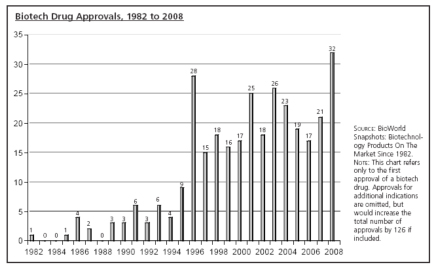
    following chart illustrates these successes:

    Table - Biotech Drug Approvals

    As shown, while the
    number of approved biotechnology-based products approved per year is variable,
    the trend is upward.  Mr. Harris
    characterized biotechnology drugs as being the fastest-growing sector for drug
    development, and predicts that biotech drugs will comprise over 50% of all drug
    approvals by 2015 and more than 75% by 2025.  These predictions are supported by the expected benefits of
    increased understanding of drug targets and the molecular and genetic bases of
    disease, as well as the declining conventional small-molecule drug pipelines in
    most major pharmaceutical companies.

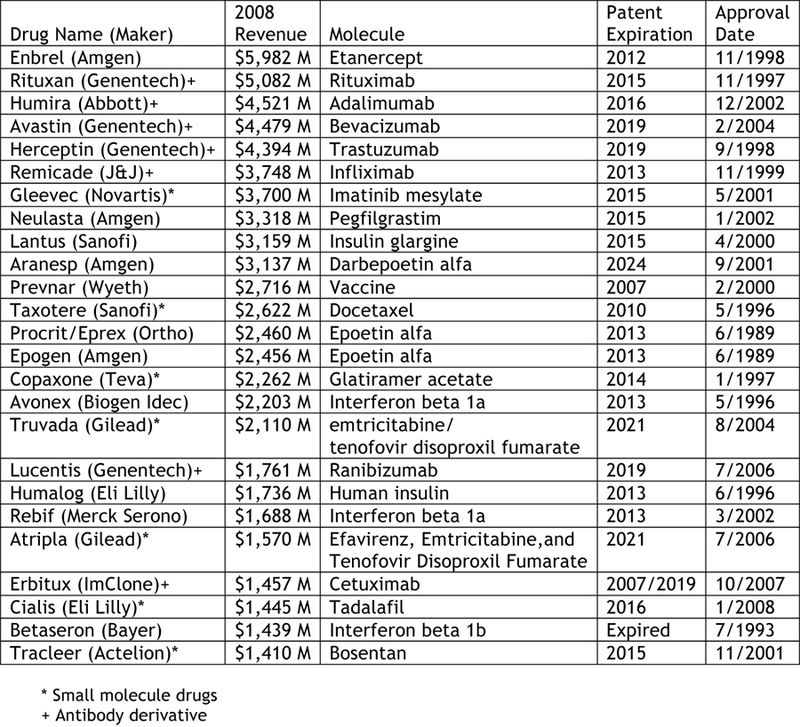
    The table
    below represents information from Mr. Harris' article, setting forth the revenues
    for each of the 25 top biotechnology drugs in 2008, and in addition includes
    the date each drug product was first approved by the FDA and when patents
    protecting each drug are due to expire.  It should be kept in mind that one feature of all these drugs is that
    they have been approved for more than one indication;  indeed, Mr. Harris reports that Genentech's Avastin is being
    tested in more than 450 clinical trials for treating more than 30 different
    types of cancer.  It should also be
    kept in mind that 7 of the 25 "biotech" drugs are small molecules, and another
    6 are antibodies.  We leave it as
    an exercise for the reader to assess the relative levels of protection provided
    by patents and data exclusivity should Congress pass a follow-on biologics bill
    this year.

    Table - Top 25 Drugs

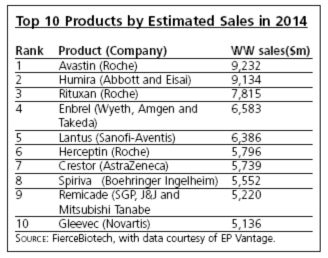
    Finally,
    the article includes a prediction of the estimated sales and the identities of
    the top 10 biotech drugs expected in 2014 (see table below).  Eight of the ten are top 25 biotech drugs today, with the
    other two being the small molecule drugs Crestor (rosuvastatin, used for lowering
    cholesterol) and Spiriva (tiotropium, a
    bronchodilator for treating asthma and COPD).

    Table - Top 10 Products

    This list is the same as the list compiled by EvaluatePharma, a market forecasting firm
    specializing in the life sciences sector, earlier in this year (see
    "Future Drug Sales Predictions Highlight
    Importance of Follow-on Biologics Legislation
    ").  Interestingly, the top three current
    drugs reported by EvaluatePharma (Lipitor, Plavix, and Advair) are all small
    molecule drugs having higher revenues than the highest biologic drug, Enbrel
    (Lipitor's revenues are more than double Enbrel's), and half the top ten in
    that survey are small molecule drugs and three are antibodies; Amgen's Epogen
    and Enbrel are the only recombinant drug products in EvaluatePharma's top
    ten.  In contrast, 11 of the 19
    drugs in BioWorld's top 25 are recombinant products.

    The BioWorld report follows other recent reports
    indicating that the biotechnology sector continues to improve, weathering
    serious threats caused by the economic downturn last year (see "Biotech/Pharma Financing Improving, R&D Spending Up"; "Investors Saw Biotech Rebound Coming"; and "Is Biotech/Pharma Beginning to Bounce Back?").  In view of the sentiments expressed by
    Mr. Harris about the reality that the need for new drugs is never-ending, that
    constitutes good news for biotech and pharma companies and the public combined.

  •     By Donald Zuhn

    Signals A recent article in Signals
    Magazine
    reports that biotech and specialty pharma companies raised 41%
    more revenue in the first six months of 2009 ($8.3 billion) than they did in
    the same period in 2008 ($5.9 billion) ("Biotech Financing Gathers
    Steam
    ").  Despite the overall rise in funding for
    the first half of the year, investment in the second quarter dropped by 4% ($180
    million) from the first quarter of the year.  The online biotech industry magazine also noted that while public
    offerings contributed more than $1.8 billion
    to
    the funding total
    (up 78% from 2008), and money
    raised by alternate financing schemes added $4.8 billion (up 75% from 2008), venture capital was down 8% from 2008 (from $2.4 billion to
    $2.2 billion).  Despite the drop in
    venture funding, the report suggested that Clovis Oncology's ability to raise
    $145 million in venture capital demonstrated "once again venture
    capitalists' (VC) old adage that there will always
    be money for the right company."

    PricewaterhouseCoopers (PWC) Signals Magazine contended that the data on the whole
    "indicate[d] that VCs are not
    turning their backs on biotech start-ups, contrary to some analyses"
    (without mentioning the sources of such analyses), and cited the latest
    MoneyTree Report
    from PricewaterhouseCoopers and the National Venture Capital Association
    (NVCA), which showed a 15% increase in venture dollars (rising from $3.2
    billion in the first quarter to $3.7 billion in the second quarter) for roughly
    the same number of deals (up slightly from 603 in the first quarter to 612 in
    the second quarter).  The MoneyTree
    Report noted that biotechnology received the highest portion of these venture
    dollars, securing $888.1 million of the second quarter talley.  While second NVCA quarter biotech venture
    funding was up 54% from the first quarter ($576.6 million), it
    still lagged behind venture funding from the second quarter of 2008 ($1,062.3
    million) —
    as the Signals Magazine report had also indicated.

    In summarizing the biotech/pharma financial landscape for the
    first half of the year, Signals Magazine
    concluded that:

    By all accounts . . . the capital markets are starting to ease
    — if ever so slightly.  Biotech
    and specialty pharma companies are raising money again through underwritten
    public offerings (20 of them by the end of July) and registered direct offerings
    (33 by the end of July).  The
    credit markets opened to a few select biotech firms in May, and venture capital
    investments are holding steady.

    But make no mistake: 
    The financial crisis is far from over.  While the biotech sector raised 41 percent more money in the
    first half of 2009 than it did in the first half of 2008, it's still severely
    under-funded.  Companies raised 55
    percent less money in the first half of 2009 than they did in the first half of
    2007 ($18,559M) and 49 percent less in the first half of 2009 than they did in
    the first half of 2006 ($16,458M).

    BusinessWeek Meanwhile, BusinessWeek
    reported last week that while research spending has been dropping over the past
    few years (decreasing 4% from the fourth quarter of 2007 to the second quarter
    of 2009), thirteen of the 25 companies that "most aggressively"
    increased their research budgets over the first half of 2009 were from the
    pharma/biotech sector ("Drug, Biotech Research Spending Hangs Tough").  The article notes that these thirteen
    companies raised R&D spending by a collective $2 billion in the first half
    of the year.

    For additional information regarding this and other related topics, please see:
    • "Investors Saw Biotech Rebound Coming," August 17, 2009
    • "Is Biotech/Pharma Beginning to Bounce Back?" August 12, 2009
    • "Docs at BIO: Steve Burrill's State of the Biotechnology Industry Report 2009," May 19, 2009
    • "Docs at BIO: Ernst & Young Hosts Super Session Addressing Financial Performance of Biotech Industry," May 19, 2009
    • "First Quarter Venture Capital Funding at 12-Year Low," April 23, 2009
    • "BIO Meets the Press," February 26, 2009
    • "NVCA Study Shows Decline in 2008 Investment; BIO Study Predicts Biotech Rebound in 2009," February 16, 2009
    • "NVCA Predicts Another Slow Year for Venture-backed Businesses in 2009," December 18, 2008

  •     By Kevin E. Noonan

    Cardigan Welsh Corgi One of the benefits of the exponential increase in
    genetic information consequent to the determination of the genomic DNA sequence
    of numerous species (the various "genome projects" that include the
    Human Genome Project) is that it permits sequence comparisons between related
    species.  One result of this new
    knowledge has been to verify the similarity of developmental control genes
    throughout the animal kingdom (where genes like the Hox genes in nematode worms
    and fruit flies have been identified in humans, for example).  Within species, decoded genetic
    information, and the ability to associate genetic variation between individuals
    in a species with specific phenotypes has elucidated the genes that control
    such phenotypes.  Several examples
    have been reported for domesticated dogs, where size is related to inheritance
    of different alleles of the insulin-like growth factor-1 gene (IGF-1), and coat length, curliness, and
    other features are related to inheritance of the FGR-5, KRT-71, and RPSO-2 genes.  Artificial human selection for breed characteristics has
    contributed to the ability to productively perform these types of association
    studies
    .

    Leg length in dogs is another phenotypic feature
    subject to the whims of human breed selection and characteristic of different
    breeds.  In this week's edition of the journal Science, a group from the National Institutes of Health reports on
    the genetic basis of this variation (termed chondrodysplasia), and associates
    its results with a form of human dwarfish with similarities to canine chondrodysplasia
    (wherein the growth plates in the long bones of the leg calcify prematurely,
    producing shortened bones with a curved appearance) (Parker et al., 2009, "An Expressed Fgf4 Retrogene Is Associated with Breed-Defining Chondrodysplasia in Domestic Dogs," Science 325: 995-98).

    The report is from Elaine Ostrander's lab at the
    NIH, joined by researchers at the Department of Ecology and Evolutionary
    Biology at UCLA, the WALTHAM Centre for Pet Nutrition in the UK, the Division
    of Cardiovascular Medicine at the Oregon Health and Human Science University, the
    Baxter Institute for Animal Health and the College of Veterinary Medicine and
    the Department of Biological Statistics and Computational Biology, Cornell
    University, and the Comparative Orthopedic Laboratory at the University of
    Missouri.  The study is
    particularly noteworthy as it identifies an expressed retrogene for fibroblast
    growth factor 4 (FGF4); retrogenes, more
    commonly termed pseudogenes, represent reverse-transcribed messenger RNA (thus
    lacking introns) that have been re-introduced into the genome.  Until recently, these genes were
    believed to be transcriptionally-silent relics of ancient retroviral infection
    and were not expected to be transcribed.  It is now recognized that such retrotransposition can, and has occurred
    at sites containing transcriptional regulatory sequences, as it appears to have
    in these dogs, leading to a novel form of gene duplication.

    Dogs - Dachshunds Genome-wide association studies (GWAS) using
    Affymetrix single nucleotide polymorphism (SNP) microarrays were performed on
    DNA from 835 dogs comprising 76 distinct breeds.  Using American Kennel Club (AKC) breed standards, 95 dogs
    from the chondrodysplastic breeds (including Pekinese, Welsh corgi, and
    dachshund) were compared to a control group of 64 non-chondrodysplastic dog
    breeds comprising 702 animals.  The
    strongest association in these studies specific for the chondrodysplastic
    breeds was found on canine chromosome 18 (CFA18).  This association was confirmed by studies on heterozygosity
    in this region of canine chromosome 18, which was expected and was found to be
    suppressed, consistent with human selection for chondrodysplasia as a part of
    the breed standard for these breeds of dogs.  Upon further sequencing analysis, the region was found to
    contain a processed retrogene of canine FGF4,
    comprising all the coding exon sequences as well as the 3' untranslated region
    (UTR) and a polyadenine tract (as expected from an mRNA retrotransposon), but
    lacking the 5' regulatory sequences of the native canine FGF4 gene (which also resides on canine chromosome 18, about 30 Mb
    from the FGF4 retrotransposon
    insertion site).  This gene was
    found in 175 dogs from 19 breeds exhibiting the chondrodysplasia phenotype, and
    the gene was found to be homozygous in all but seven of these dogs.  Fortuitously, the group found a single
    transition mutation difference (a G
    –> A change in the
    retrogene) that permitted expression to be differentiated between the retrogene
    and the native FGF4 gene.  Gene expression studies showed that the
    retrogene was expressed in the articulate cartilage of the long bones from chondrodysplastic
    dogs, "whereas only the G allele was detected in cDNA and genomic DNA
    samples from non-chondrodysplastic dogs."

    Finally, these authors found that the FGF4 retrogene was expressed using gene
    regulatory sequences in a copy of a long interspersed nuclear element (LINE)
    repeat residing at the retrogene insertion site.  However, analysis of the expression pattern of neighboring
    genes in adult dog tissues showed that neither the native FGF4 nor the FGF4
    retrogene were expressed in adult tissues.  Developmental regulation of FGF4 is believed to be mediated by sequences in the 3' UTR element
    of the native gene, and the presence of these sequences in the FGF4 retrogene suggests that it is also
    properly regulated during development.

    Pekingese1904 All modern domestic dog breeds are believed to have
    descended from the gray wolf, and the fact that chondrodysplastic breeds have
    been developed several times independently (i.e., without direct ancestral
    relationships) suggests that the retrotransposition event, and the presence of
    the FGF4 retrogene, should be present
    in populations of the ancestral gray wolf.  Using hapolotype analysis over the 24 kb region of
    canine chromosome 18 comprising the FGF4
    retrogene and its insertion site, "this combination was not found in any
    of the non-chondrodysplastic dogs we tested but was identified in wolves from
    Europe and the Middle East, supporting fossil evidence that these populations
    contributed to the early development of the dog."

    The authors put forth their hypothesis of how the FGF4 retrogene is involved in chondrodysplasia
    in dogs, and its relevance to humans:

    We hypothesize that
    atypical expression of the FGF4
    transcript in the chondrocytes causes inappropriate activation of one or more
    of the fibroblast growth factor receptors such as FGFR3.  An activating
    mutation in FGFR3 is responsible for
    >95% of achondrodysplasia cases, the most common form of dwarfism in humans,
    and 60 to 65% of hypochondrodysplasia cases, a human syndrome that is more
    similar in appearance to breed-defining chondrodysplasia.  . . .  FGF4 induces the expression of sprouty
    genes, which interfere with the ubiquitin-mediated degradation of the FGF
    receptors including FGFR3, and
    overexpression of the sprouty genes can cause chondrodysplastic phenotypes in
    both mice and humans.

    The greater significance of the study can be
    summarized in no better words than the authors' own:

    We have found a single
    retrotransposition event producing a conserved, expressed retrogene that has
    strongly focused the evolutionary direction of morphological change in the dog
    because at least 12% of American breeds share a common phenotype and the
    retrogene.  This retrogene is
    actively segregating within the species, has a coding sequence that is
    identical to that of the source gene, and to the best of our knowledge is the
    only example of a functional retrogene found in morphologically distinct
    populations of a single species that is actively maintained by selection.  If such rare mutational events or "sports,"
    as Charles Darwin referred to them in "The Origin of Species," happen
    only in the evolution of domestic animals, then these systems may be less
    informative for understanding the origin of evolutionary novelty in wild
    species.  However, if the molecular
    phenomenon we have observed represents a class of genomic change associated
    with dramatic phenotypic evolution, then such genetic changes might be keystone
    molecular innovations.

  •     By Sherri Oslick

    Gavel_2About
    Court Report:  Each week we will report briefly on recently filed
    biotech and pharma cases, and a few interesting cases will be selected
    for periodic monitoring.


    Aventis Pharma S.A. et al. v. Sun Pharmaceutical Industries Ltd.
    et al.

    3:09-cv-04333; filed August 24, 2009 in the
    District Court of New Jersey

    • Plaintiffs:  Aventis Pharma S.A.; Sanofi-Aventis
    U.S. LLC
    • Defendants:  Sun Pharmaceutical Industries Ltd.;
    Sun Pharmaceutical Industries Inc.; Sun Pharma Global FZE; Caraco
    Pharmaceutical Laboratories, Ltd.

    Aventis Pharma S.A. et al. v. Sun Pharmaceutical Industries Ltd.
    et al.

    1:09-cv-00630; filed August 21, 2009 in the
    District Court of Delaware

    • Plaintiffs:  Aventis Pharma S.A.; Sanofi-Aventis
    US LLC
    • Defendants:  Sun Pharmaceutical Industries Ltd.;
    Sun Pharmaceutical Industries Inc.; Sun Pharma Global FZE; Caraco
    Pharmaceutical Laboratories Ltd.

    The complaints in these cases are substantially
    identical.  Infringement of U.S.
    Patent Nos. 5,714,512 ("Compositions Containing Taxane Derivatives,"
    issued February 3, 1998) and 5,750,561 (same title, issued May 12, 1998)
    following a Paragraph IV certification as part of Sun's filing of an NDA (under
    § 505(b)(2) of the Food, Drug and Cosmetic Act) to manufacture a generic
    version of Aventis' Taxotere® (docetaxel, used to treat breast, lung, prostate,
    gastric, and head and neck cancers).  View the Delaware complaint
    here.


    LadaTech LLC v. Illumina Inc.
    1:09-cv-00627; filed August 21, 2009 in the
    District Court of Delaware

    Infringement of U.S. Patent No. 6,107,023 ("DNA
    Amplification and Subtraction Techniques," issued August 22, 2000) based on
    Illumina's manufacture and sale of products and associated instrumentation for
    use in Illumina's Genome Analyzer System.  View the complaint
    here.


    Eli Lilly and Co. v. Anchen Pharmaceuticals, Inc. et al.
    1:09-cv-01029; filed August 20, 2009 in the
    Southern District of Indiana

    • Plaintiff:  Eli Lilly and Company
    • Defendants:  Anchen Pharmaceuticals, Inc.; Anchen,
    Inc.

    Infringement of U.S. Patent No. 5,023,269 ("3-Aryloxy-3-Substituted
    Propanamines," issued June 11, 1991) following a Paragraph IV
    certification as part of Anchen's filing of an ANDA to manufacture a generic
    version of Lilly's Cymbalta® (duloxetine hydrochloride, used to treat
    depression and generalized anxiety disorder and for the management of diabetic
    peripheral neuropathic pain and fibromyalgia).  View the complaint
    here.

  •     By Kevin E. Noonan

    Science Magazine The genetic age, characterized by numerous genome
    projects (not the least of which is the Human Genome Project) has focused the
    public's attention on the influence of our genes on our characteristics.  This has led to questions about whether
    there is a "gene" for risk-taking, or homosexuality, or
    aggressiveness.  Indeed, the
    pervasiveness of the "gene" question for complex traits has produced
    something of a backlash, illustrated by Richard Lewontin's books, Not in Our Genes and It Ain't Necessarily So, making the
    reasonable point that genetic reductionism has its limitations.

    But genes are certainly implicated in a number of
    characteristics and traits, and one of the consequences of studying genomes has
    been the elucidation of these relationships.  In 2007, a report in Science
    disclosed that body size in domesticated dogs is associated with a particular
    single nucleotide polymorphism (SNP) in the insulin-like growth factor I gene
    (IGF-1) (see "From Toy Poodle to Rottweiler:  Why Is Fido So Small (or Large)?")
    .  Last week, in Science, a group from the National Institutes of Health report on
    another canine phenotype, coat variation, and the genes that are associated
    with variations in several coat related traits (Cadieu et al., 2009, "Coat Variation in the Domestic Dog Is Governed by Variants in Three Genes," Science
    DOI: 10.1126/science.1177808).

    Terrier Mixed Breed The report, from Elaine Ostrander's lab at the NIH
    and researchers at the Veterinary Genetics Laboratory at the University of
    California, Davis, the Biology Department at the University of Utah, the
    Department of Ecology and Evolutionary Biology at UCLA, Cornell University's
    Department of Biological Statistics and Computational Biology, the Faculte de
    Medicine in Rennes, France, and Affymetrix, involves genome-wide association studies (GWAS) for three coat
    variations:  the presence or
    absence of "furnishings" (eyebrows and mustaches as arise in wire-haired
    dogs), coat length, and coat curliness.  The study involved more than 1,000 dogs from 80 breeds of domestic dogs,
    and resulted in the identification of three genes associated with variations in
    coat.  These genes are RSPO2, encoding R-spondin-2; FGF5, encoding fibroblast growth factor
    5; and KRT71, encoding
    keratin-71.  These genes, and
    specifically SNPs associated with each of these genes, were found to be
    associated with the presence or absence of furnishings (RSPO2), length (FGF5), and
    curliness (KRT71).

    Unlike the situation with body size, these three
    genes form a combinatorial group of genes that can be independently segregated
    (i.e., they all reside on different chromosomes) and can thus create a number
    of different coat variations depending on the different variant alleles
    inherited by particular breeds of dog (since coat characteristics are
    frequently important components of the breed standard for different dog
    breeds).  Three datasets were used
    in these experiments:  the first
    comprised DNA from 96 dachshunds varying as wire-haired (with furnishings),
    smooth and long-haired coats; 76 Portuguese waterdogs, varying in curl type;
    and 903 dogs form 80 breeds representing "a wide variety of [coat]
    phenotypes."  The initial
    results of polymorphisms segregating with the different coat traits were
    validated using a larger panel of at least 661 dogs from 106 breeds that
    included the appropriate controls.

    Dachshunds From the dachshund (at right) studies was identified the
    association of RSPO2 with furnishings
    as a locus residing on canine chromosome 13 (CFA13).  As reported in the paper, "[a]

    718 Kb homozygous haplotype in all dogs fixed with furnishings was located
    within both the original 3.4Mb haplotype observed in the dachshund-only GWAS,
    and a 2.8 Mb haplotype identified in crossover analysis within the dachshund
    pedigree."  From this
    chromosomal location the RSPO2 gene
    was identified:

    Fine-mapping allowed us to reduce the
    homozygous region to 238 Kb spanning only the R-spondin-2 (RSPO2) gene,
    excluding the 5'UTR and the first exon (Fig. 1D; fig. S1 and table S3).  RSPO2
    is an excellent candidate for a hair growth phenotype as it is known to
    synergize with Wnt to activate
    β-catenin
    . . .
    , and Wnt signaling is required
    for the establishment of the hair follicles . . . .  Moreover, the Wnt/
    β-catenin pathway
    is involved in the development of hair follicle tumors or pilomatricomas . . . ,
    which occur most frequently in breeds that have furnishings . . . .  Recent
    studies have shown that a mutation in the EDAR gene, also involved in
    the Wnt pathway, is responsible for a course East-Asian hair type found
    in humans . . ., with some similarity to canine wirehair.

    The polymorphism associated with the
    furnishings trait in dachshunds and confirmed in 704 dogs of varying phenotype
    is a 167 bp insertion within the 3' untranslated region (UTR) of the RSPO2 gene;
    "297/298 dogs with furnishings were either homozygous (268) or
    heterozygous (29) for the insertion, while all 406 dogs lacking the trait were
    homozygous [for 3' UTR lacking the insertion]."  The authors also report a functional consequence of the
    insertion, wherein there is a 3-fold increase in RSPO2 expression in muzzle skin from dogs with furnishings,
    suggesting that the insertion in the 3' UTR influences mRNA stability.

    For the association of FGF5 with hair length, the same type of
    GWAS were performed, locating a polymorphism on canine chromosome 32 (CFA32) at
    the FGF5 locus.  Here, the polymorphism affected the
    coding sequence of the protein, resulting in a Cys –>
    Phe
    change at a conserved residue (95) in exon 1 of the FGF5 gene (corresponding to a G –>
    T transversion mutation).  This association was not unexpected, as
    prior work had shown that the FGF5
    gene was associated with a long-haired or "fluffy" phenotype in Welsh
    corgis.  Long hair was associated
    with the TT genotype, consistent with a genetically recessive mode of
    inheritance.  The T allele was
    found in 91% of all long-haired dogs tested and in only 3.9% of short-haired
    dogs (with medium-haired dogs having an intermediate 30% frequency level for
    this allele).  Curiously, Afghan
    hounds that have particularly long hair do not have the Cys95Phe mutation.

    Bo Finally, for the curly coat variation GWAS
    were performed with Portuguese water dogs (PWD) (at left, First Dog Bo).  These studies revealed a SNP on canine chromosome 27 (CFA27)
    located in the keratin 71 (KRT71)
    genetic locus.  As reported in the
    paper, "Non-curly haired dogs carried the CC genotype [and] curly coated
    dogs had the TT phenotype," and all three genotypes (CC, CT and TT) were
    found in PWDs, a breed that expressed curl hair to varying extents.  This SNP is also located in the coding
    sequence (in the second exon) of the gene, causing an Arg
    –> Trp change
    at residue 151.  These findings
    were also rationalized by the authors:

    Keratins are obvious
    candidates for hair growth . . . and mutations in KRT71 have been
    described in curly coated mice . . . .  The mutation described in our study is
    within the second exon of the gene and may affect either or both of two protein
    domains; a coiled-coil and a prefoldin domain
    .  Conceivably, sequence alterations in these domains could affect
    cellular targeting, receptor binding or proper folding of the protein after
    translation.

    These three mutations were
    sufficient to account for the coat phenotype in 95% of the dogs tested, a total
    of 622 dogs representing 108 of the 160 dog breeds recognized by the American
    Kennel Club.  The Supplemental
    Materials contain a combinatorial diagram of the different variations at the
    three loci that give rise to at least 7 different coat types (representing the
    majority of coat types in modern breeds):

    Table * The TT genotype was never found in this
    combination, even though it would likely also display a short phenotype.

    The authors set forth the following
    conclusions.  First, the "ancestral
    state" of all three genes (Cys95 in FGF5,
    Arg151 in KRT71, and absence of an
    insertion in the 3' UTR in RSPO2) is
    found in short-haired dog breeds (as well as grey wolves, the ancestors of all
    modern dog breeds).  Wire-haired
    breeds (which all have furnishings) have the insertion in the RSPO2 gene.  Curly wire hair is found in dogs having both the RSPO2 insertion and the KRT71 mutation, while longer-haired dog
    breeds have the FGF5 mutation.  Dogs carrying both the FGF5 mutation and the RSPO2 insertion have long, soft coats
    and furnishings, whereas dogs with the FGF5
    and KRT71 mutations have long,
    curly coats.  Finally,
    dogs bearing all three of the variants have long, curly coats, and furnishings.

    Elucidation of this genetic architecture of
    observable phenotypic traits is possible because of the large number of
    different dog breeds and the great variability, on one hand, and the consistent
    stability, on the other hand, of genetic transmission in these breeds.  This study suggests that these
    analytical methods can (and will) be applied to assess the genetic bases of
    other traits in dogs, and the extension of these results to homologous
    phenotypes in other mammals including humans.

    Photograph of mixed breed terrier (above) by Chris Barber, from the Wikipedia Commons under the Creative Commons license.


  • CalendarSeptember 1, 2009 – Prior Art & Obviousness 2009: The PTO & CAFC Perspective on Patent Law Sections 102 & 103 (Practising Law Institute) – San Francisco, CA

    September 2, 2009 – Biotechnology/Chemical/Pharmaceutical Customer Partnership Meeting (U.S. Patent and Trademark Office) – 10:00 am – 4:45 pm (EDT)

    September 13-15, 2009 – 2009 Annual Meeting (Intellectual Property Owners Association) – Chicago, IL

    September 14-15, 2009 – 3rd Summit on Biosimilars and Follow-on Biologics*** (Center for Business Intelligence) – National Harbor, MD

    September 15-16, 2009 – FDA Boot Camp*** (American Conference Institute) – Boston, MA

    September 17, 2009 – Developments in Pharmaceutical and Biotech Patent Law (Practising Law Institute) – New York, NY

    September 21-22, 2009 – 2009 World Stem Cell Summit*** – Baltimore, MD

    September 21-22, 2009 – Patent Litigation 2009 (Practising Law Institute) – San Francisco, CA

    September 23-25, 2009 – 10th Annual Generic Drugs
    Summit on the Business of Biosimilars
    (
    Institute for
    International Research) –
    Boston, MA

    September 30-October 1, 2009 – Biotech Patents*** (American Conference Institute) – Boston, MA

    October 5-6, 2009 – Patent Litigation 2009 (Practising Law Institute) – McLean, VA

    October 7-8, 2009 – Maximizing Pharmaceutical Patent Lifecycles*** (American Conference Institute) – New York, NY

    October 14, 2009 – Developments in Pharmaceutical and Biotech Patent Law (Practising Law Institute) – San Francisco, CA

    October 15-16, 2009 – Patent Litigation 2009 (Practising Law Institute) – Chicago, IL

    October 20-21, 2009 – 17th Forum on Biotech Patenting (C5) – London,
    United Kingdom

    October 22-23, 2009 – Pharmaceutical Congress on Paragraph IV Disputes*** (Center for Business Intelligence) – Philadelphia, PA

    October 26-28, 2009 – Intellectual Property Counsels' Committee (IPCC) Fall Conference & Meeting (Biotechnology Industry Organization) – Washington, DC

    October 28-29, 2009 – Patent Opinion Writing Boot Camp*** (American Conference Institute) – Philadelphia, PA

    November 9-10, 2009 – Patent Litigation 2009 (Practising Law Institute) – Atlanta, GA

    November 12-13, 2009 – Paragraph IV on Trial*** (American Conference
    Institute) – New York, NY

    November 16-17, 2009 – Patent Litigation 2009 (Practising Law Institute) – New York, NY

    ***Patent Docs is a media partner of this conference or CLE

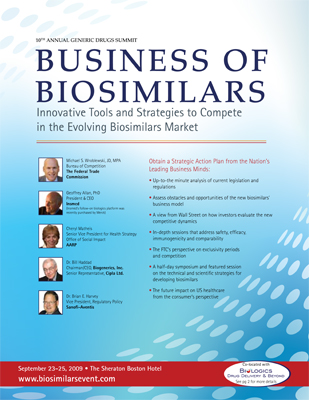
  • Boston Skyline The Institute for
    International Research (IIR) will be holding its 10th Annual Generic Drugs
    Summit entitled "Business of Biosimilars: Innovative Tools and Strategies
    to Compete in the Evolving Biosimilars Market" on September 23-25, 2009 in
    Boston, MA.  The Business of
    Biosimilars conference will offer presentations on the following topics:

    • Update on proposed biosimilars legislation;
    • Evaluating the new business model for
    biosimilars;
    • Wall Street address:  How investors evaluate the new competitive
    dynamics for biosimilars;
    • Exclusivity periods and their impact
    on competition
    ;
    • Analytical techniques for
    characterizing — biosimilars vs. biogenerics;
    • Assessing the competitive landscape
    for biogenerics;
    • The payor's perspective on biogenerics;
    • The effect of biosmilars on
    innovation and innovator pipelines;
    • Evaluating the IP implications of
    launching a biosimilar (panel discussion);
    • Regulatory insights and updates for biosimilars;
    • Skill sets, capabilities and
    facilities needed for success in biosimilars & biogenerics;
    • The science of biosimilars;
    • Insights into the European
    biosimilars marketplace;
    • Commercial and public sector
    insurance payment issues, future trends & perspectives; and
    • Main Street perspective:  What patients and consumers want from
    biosimilars and biogenerics.

    P1486 An additional
    symposium entitled "Technical & Scientific Strategies for Developing
    Biosimilars" will be offered from 9:00 am to noon on September 23,
    2009.  The symposium will offer
    presentations on the following topics:
    • Therapeutic
    equivalence of proteins and peptides:  Viewpoint from industry innovators;
    • Case study:  Overview of delivery technologies for
    GLP-1 analogues; and
    • Biosimilar development:  Clinical & manufacturing
    opportunities & challenges.

    An additional
    interactive workshop entitled "Prepare to Meet the Requirements —
    Understanding Current Legislation & Regulatory Developments for
    Biosimilars" will be held from 1:00 pm to 4:00 pm on September 23, 2009.

    The agenda for the Business
    of Biosimilars conference can be found here.  A complete brochure for this
    conference, including an agenda, list of speakers, and registration form can be
    requested here.

    The registration
    fee for the conference is $2,495 (conference alone), $2,795 (conference and one
    half-day workshop), or $2,995 (conference and two half-day workshops) for law
    firms and consultants.  Attendees
    from pharmaceutical, biotech, or generic drug manufacturers can receive a $300
    discount off the above fees.  Those
    interested in registering for the conference can do so here,
    by calling 1-888-670-8200 (or internationally at 941-951-7885, or by email at
    register@iirusa.com.

  • London C5 (UK) will be
    holding its 17th Forum on Biotech Patenting on October 20-21, 2009 in London,
    United Kingdom.  The conference
    will allow attendees to collect up-to-date information and insights on:

    • Recent changes in
    policy and patentability criteria: 
    Hear directly from the EPO;
    • The latest EPO
    decisions impacting key aspects of biotech patenting such as methods of surgery
    and new standards on double patenting and prior art;
    • Major U.S. case
    law developments and how they have radically shifted the status quo for
    biotech, including In re Bilski, Ariad, and In re Kubin;
    • The latest
    developments on second medical use and dosing regimens claims and an assessment
    of the Enlarged Board's upcoming decision;
    • Update on biotechnology
    patenting developments in China and India; and
    • The art of
    cross-jurisdiction patent litigation management and strategy.

    874L10-LON In particular, C5
    faculty will offer presentations on the following topics:

    • Keynote address:  A judicial view on biotech patenting litigation
    with Lord Hoffmann of Chedworth;
    • Criteria of the
    EPO and changes in rules:  Hear
    from the EPO on how they plan to raise the bar in biotech;
    • Best practice for
    divisional applications and responding to search reports;
    • Key European case
    law developments:  Updates from the
    EPO and National Courts;
    • Major case law
    and policy developments in U.S. biotech;
    • Assessing the
    impact of In re Bilski on patenting
    of biomarkers and treatment/diagnostic methods;
    • Securing patents
    for antibodies and antigens against a backdrop of heightened non-oobviousness requirements;
    • European and U.S.
    developments in obtaining and protecting biosimilars patents;
    • How has the WARF
    decision been applied in subsequent stem cells cases?
    • Assessing the potential
    impact of the Enlarged Board's decision on second medical use claims and dosing
    regimens;
    • New standards
    European and U.S. standards in written description enablement and sufficiency
    of disclosure;
    • Analysis of
    recent decisions impacting on patent term extension;
    • FTO strategies
    for vaccines, antibodies, protein therapies and other biotech products;
    • Developments in
    patent litigation procedures and optimal cross-jurisdictional litigation
    management strategies; and
    • Update on biotech
    patenting developments in China, India and Brazil.

    An additional
    post-conference workshop, entitled "Tips and Traps in Drafting Claims and
    Specifications for Biotech Inventions," will be offered on October 22,
    2009.

    C5 A complete brochure
    for this conference, including an agenda, list of speakers, and registration
    form can be requested here.

    The registration
    fee for the conference is £1608.85 ($2,283.07), for the conference and workshop
    £2067.70 ($2,957.43), and for the workshop alone £573.85 ($820.78).  Those interested in registering for the
    conference can do so here.

  •     By
    Donald Zuhn

    Last
    spring, Patent Docs discussed pending
    follow-on biologics legislation with California Healthcare Institute (CHI)
    president and CEO Dr. David Gollaher (see
    "CHI CEO on Patent Reform and Follow-on Biologics Legislation").  During the discussion, Dr. Gollaher
    mentioned that Deloitte Consulting LLP (a subsidiary of CHI member Deloitte LLP)
    had released its own white paper on follow-on biologics entitled "Avoiding
    No Man's Land:  Potential Unintended Consequences of Follow-on
    Biologics
    ."

    The
    Deloitte paper is a recent addition to a growing collection of publications
    that address the potential impact of implementing a follow-on biologics
    regulatory pathway in the United States. 
    To date, Patent Docs has reported
    on papers by AEI Resident Scholar Dr. John Calfee (see "AEI Presents Follow-on Biologic 'Reality'"
    and "AEI Believes Advantages of Longer Data Exclusivity Period Outweigh
    Disadvantages
    "),
    economist Dr. Robert Shapiro (see
    "Dr. Robert Shapiro Discusses Follow-on Biologics Report"), Duke Professor Dr.
    Henry Grabowski (see "Professor
    Grabowski's Economic Analysis of Data Exclusivity for Follow-on Biologic
    Drugs
    "),
    the Congressional Budget Office (CBO) (see
    "CBO Releases Report on Senate Follow-on Biologics Bill; BIO Calls for
    Congress to Pass Biologics Bill in 2008
    "), Boston University
    Professor Dr. Laurence Kotlikoff (see
    "BU Economics Professor Releases Report on the Impact of Marketing
    Exclusivity on Biologics Innovation
    "),
    Matrix Global Advisors principal (and AEI Research Fellow) Alex Brill (see "Former House Ways and Means
    Economist Claims 7-Year Data Exclusivity Period Is Sufficient
    "),
    and the Federal Trade Commission (FTC) (see
    "No One Seems Happy with Follow-on Biologics According to the FTC").

    Deloitte Paper In
    discussing the potential impact of a follow-on biologics (FOB) regulatory
    pathway on the biotech industry, the Deloitte paper carefully outlines the
    impact of the Hatch-Waxman Act on the small molecule pharmaceutical industry,
    and then analyzes the differences between the small molecule pharma and
    biotech industries in order to predict how an FOB regulatory pathway might
    affect the biotech industry.  The
    paper, authored by Jim Hollingshead and Rob Jacoby, notes that the Hatch-Waxman
    Act "fundamentally altered the 1983 pharmaceutical business system by
    changing . . . clinical trial requirements and market economics."  The Act changed clinical trial
    requirements by creating an abbreviated regulatory path for generic drugs,
    allowing a generic drug company to "borrow" an innovator's clinical
    data in order to secure FDA approval for a generic drug without having to perform
    lengthy and costly clinical trials. 
    In this way, the Act could meet its goal of speeding market entry of
    generic drugs to foster price competition.  In exchange for "loaning" their clinical data,
    the Act provided innovators with mechanisms to extend patent life (i.e., patent term extension) and data
    exclusivity (up to 5 years under Hatch-Waxman).  Stating that "[t]he results of Hatch-Waxman have been
    striking," the Deloitte paper notes that "[c]onsistent with its
    intent, it did succeed in creating price competition in the market" — with the
    Congressional Budget Office (CBO) estimating that the Act was generating annual
    cost savings of $8-10 billion ten years after its passage.

    The Deloitte paper, however, also notes that the Hatch-Waxman Act produced unintended
    consequences.  One consequence was
    a sharp increase in R&D investment among innovator companies, and another consequence was that prices for
    new branded drugs have substantially outpaced baseline GDP growth.  Contending that "it is important
    to understand these unintended consequences, because they may shed light on
    what we might expect if an abbreviated approval pathway is created for
    FOBs," the paper explains that these consequences are the result of three
    effects:  the "make hay
    effect," the "blockbuster effect," and the threat of "no
    man's land."

    With
    respect to the "make hay effect," the paper explains that when a
    generic company enters the market, it quickly takes market share from the
    innovator, which in turn reduces the innovator's revenues.  Faced with the prospect of lower
    revenues and a lower return on investment, the innovator will try to maximize
    its revenues prior to generic competition, which the innovator can do by raising prices
    and by investing more in the marketing of a new drug at launch in order to
    drive earlier adoption.  The paper
    states that in response to Hatch-Waxman, innovators utilized both of these
    options.

    Innovators
    also responded to Hatch-Waxman by increasing their R&D investment.  However, the Deloitte paper observes
    that "[g]iven an ever-increasing cost for drug development, but a capped
    period of patent protection during which to achieve most return on investment,
    innovators will concentrate on the development of drugs with the highest
    revenue potential, i.e., blockbusters."  Noting that the development of a single drug takes about 12 years and costs about $1
    billion, the paper concludes that "to break even the average
    drug must achieve average annual revenue of roughly $150 million," which
    "cannot reliably be achieved unless a drug targets a large population of
    patients, or comes at a high cost per treatment."

    The
    final effect, the threat of "no man's land," arises because "for
    each compound waiting to be developed, there is a point at which it will never
    earn sufficient return to fund its development, because if too much time
    elapses, there won't be enough time remaining on market for it to generate
    sufficient sales."  When a
    drug has reached that point, the Deloitte paper says it has crossed into
    "no man's land." 
    Interestingly (and unfortunately), the paper "estimate[s] that no
    man's land appears very quickly for a new compound — within as little as one
    year of receiving a patent" (see
    note 7 in the paper, where the authors assume 25 years of total patent life, and then subtract
    10-12 years for drug development and 10-12 years of time on market to earn
    required ROI, leaving the innovator with 1-4 years of commercial viability).

    In
    view of differences between the small molecule pharma and biotech industries, the
    paper next addresses whether a follow-on biologics regulatory pathway would likely
    generate unintended consequences and effects similar to those arising after
    passage of Hatch-Waxman. 
    The paper notes that because biologics are more complex than small
    molecule therapeutics, it takes longer (on average, 97.7 months for new
    biological entities versus 90.3 months for new chemical entities) and costs
    more to bring biologics to market. 
    In addition, the pharma and biotech industries are quite different, with
    the former comprising larger, self-funding companies and the latter comprising a
    smaller number of large companies and hundreds of smaller companies that are
    dependent on venture investment.

    The
    paper speculates that "the introduction of a follow-on path could spur
    investment in the technologies required to make it work," including, for
    example, "increased investment and therefore advances in genetic and molecular
    assay technology, required to assess biosimilarity" — which would be a positive consequence.  However, the paper also states
    that "[t]he very size of these molecules opens the possibility that a very
    small change to the molecule that preserves the core design . . . could
    circumvent the IP of the innovator company without technically infringing on
    its patent."  Thus, the paper
    asserts that while "patents protected innovators' IP, and the data
    exclusivity period rarely came into effect" for small molecule therapeutics,
    "[f]or biotech innovators, if patent provisions are not sufficient to
    protect their IP, it may need to be the other way around."

    The
    authors also contend that several of the effects seen in the pharma industry's
    response to Hatch-Waxman are already impacting the biotech industry (even
    without an FOB regulatory pathway).  Thus, innovators are forced to focus on drugs
    with the largest possible market potential — a result that "runs exactly counter
    to the direction and promise of the science of biotech, which has the potential
    to create more highly targeted and therefore more efficacious therapies."  The paper adds that "[i]t would be
    unfortunate if new regulations unintentionally circumvented the advances that
    now appear to be possible in medical science by putting in place economic
    incentives that rule out everything but blockbuster investments."

    After
    assessing the differences between the small molecule pharma industry, which was
    a stable and mature in 1984 when Hatch-Waxman was implemented, and the biotech
    industry, which is nascent and complex (both scientifically and financially), the
    Deloitte paper concludes that "[i]n establishing a path to market for
    follow-on biologics, Congress may need to employ a different set of levers to
    achieve the same results."  Therefore, an FOB regulatory pathway patterned too closely on the Hatch-Waxman regime would likely have unintended, and potentially adverse, consequences for the biotech industry.

    Patent Docs
    readers are encouraged to alert us to any papers that we may have missed —
    regardless of the positions that the authors of such papers may take on the
    issue.