•     By Kevin E. Noonan

    Bans on gene patenting and the possibility of
    having a court, Congress, or czar declare them banned are all the rage recently,
    spurred in part by the lawsuit against Myriad Genetics and the University of
    Utah (among other defendants) in the Federal District Court for the Southern
    District of New York (
    see "Association for Molecular Pathology v. U.S. Patent and Trademark Office").  Whether that lawsuit will go forward is
    expected to be decided by the end of the month, when a decision on standing for
    many of the plaintiffs is expected from the District Court.  No matter how the judge rules, however, interests groups
    like the American Civil Liberties Union are unlikely to refrain from efforts to
    have gene patenting banned.

    Under the circumstances, it is reasonable to wonder
    whether gene patents are in fact inhibiting innovation or otherwise harming
    patients, physicians, or researchers (since the existential harm asserted by
    those against gene patents — that it is fundamentally "wrong" — is
    harder to assess quantitatively).  The latest report from academia on the question is consistent with
    several other reports refuting negative effects predicted on theoretical
    grounds (such as the "tragedy of the anticommons" idea).  Indeed, the report's conclusions are that the
    greatest difficulty surrounding gene patents arises from the legal
    uncertainties created in part by efforts to ban gene patenting.
    Largecover The report, from Isabelle Huys, Nele Berthels, Gert Matthijs & Geertrui Van
    Overwalle,
    researchers at the Catholic University of Leuven,
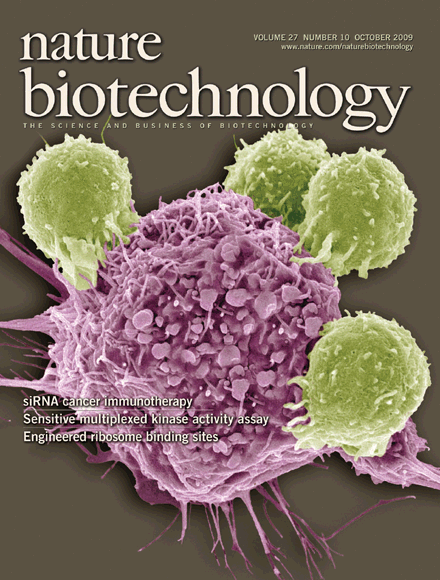
    Belgium, is found in the October 2009 edition of Nature Biotechnology (see "Legal uncertainty in the area of genetic diagnostic testing")
    .  The authors' express intent was to assess whether gene patents, either
    as "blocking patents" or as a "patent thicket," were
    inhibiting genetic technology.  The
    concern stemmed from the belief that such patents would be "difficult or
    impossible to circumvent."  Their research is current as of February 6, 2009 (and thus, it does not
    reference the ACLU-backed lawsuit filed earlier this year).

    Defined as a "large-scale empirical study,"
    the authors describe the following "heart of the problem:  which types of claims occur in
    disease-specific patents and to what extent are these claims essential for
    carrying out genetic diagnostic tests?"

    The sample set was U.S. and European (EP) patents
    and patent applications directed at twenty-two inherited, monogenic diseases (see Table 1 below; click on table to enlarge).  The legal
    status of the patent documents reviewed included patent applications, granted
    patents, patent applications "dropped" (i.e., abandoned during
    prosecution) and abandoned, withdrawn, revoked, or expired patents.  267 claims from 145 patents were
    assessed, with regard to whether they were "easy," "difficult,"
    or almost "impossible" to circumvent, based on comparing the claimed
    methods to the "best practices" guidelines for genetic susceptibility
    screening; claims deemed "impossible" to circumvent were
    characterized as "blocking" claims.  The claims studied were independent claims for genes,
    oligonucleotides, methods, and kits.  However, they did not review the file history nor does the report compare
    the commercial embodiments with the claims or their licensing status.  Finally, U.S. claims were assessed with
    regard to the "written description," "enablement," and "best
    mode" requirements, and the European patents with regard to EPC Art. 83
    and 69.

    Table 1
    The patents and applications (250 patent documents)
    were grouped into 72 different patent families (where a "family" is "a
    group of patents or applications ('patent documents') taken in
    various countries to protect a single invention").  U.S. patents were found in 66
    families whereas EP patents were found in only 26 families.  Twenty-one families had both U.S. and EP
    patents, while 46 families had only U.S. patents and only 5 families had EP but
    not U.S. patents.  There were 42
    patent families containing U.S. applications versus 22 families with EP
    applications pending.  "Remarkably," according to the authors, "about
    twice as many patent applications are dropped during the patent prosecution
    procedure in Europe (34) in EP than in US (16)."  Also, in Europe there were about the same number of granted
    patents (26) as pending applications (22), whereas in the U.S. there are 66
    granted patents and 42 pending applications.

    There were 56 different applicants for these
    patents/applications, with 62.5% of the applicants coming from non-profit
    sector, predominantly universities and research organizations, 58.9% of applicants from the U.S., 25%
    from EP, and 16.1% from JP or CA, with U.S. applicants owning 55.8% of the EP
    patents and 67% of the U.S. patents.  There were also 11 different co-ownerships with 17 different partners.  The top applicants from the U.S. were
    Johns Hopkins University (6 patent families) and Baylor College of Medicine (6
    families); the top European applicant was Leiden University (3 patent
    families).

    The vast majority of genetic diseases (19/22) have
    patented tests (Huntington's disease a surprising exception); the status of the
    diseases and the patents or applications relating to each are shown in Table 2 below (click on table to enlarge).  Four diseases were covered by
    granted patents in Europe, while six diseases have U.S. patent coverage.
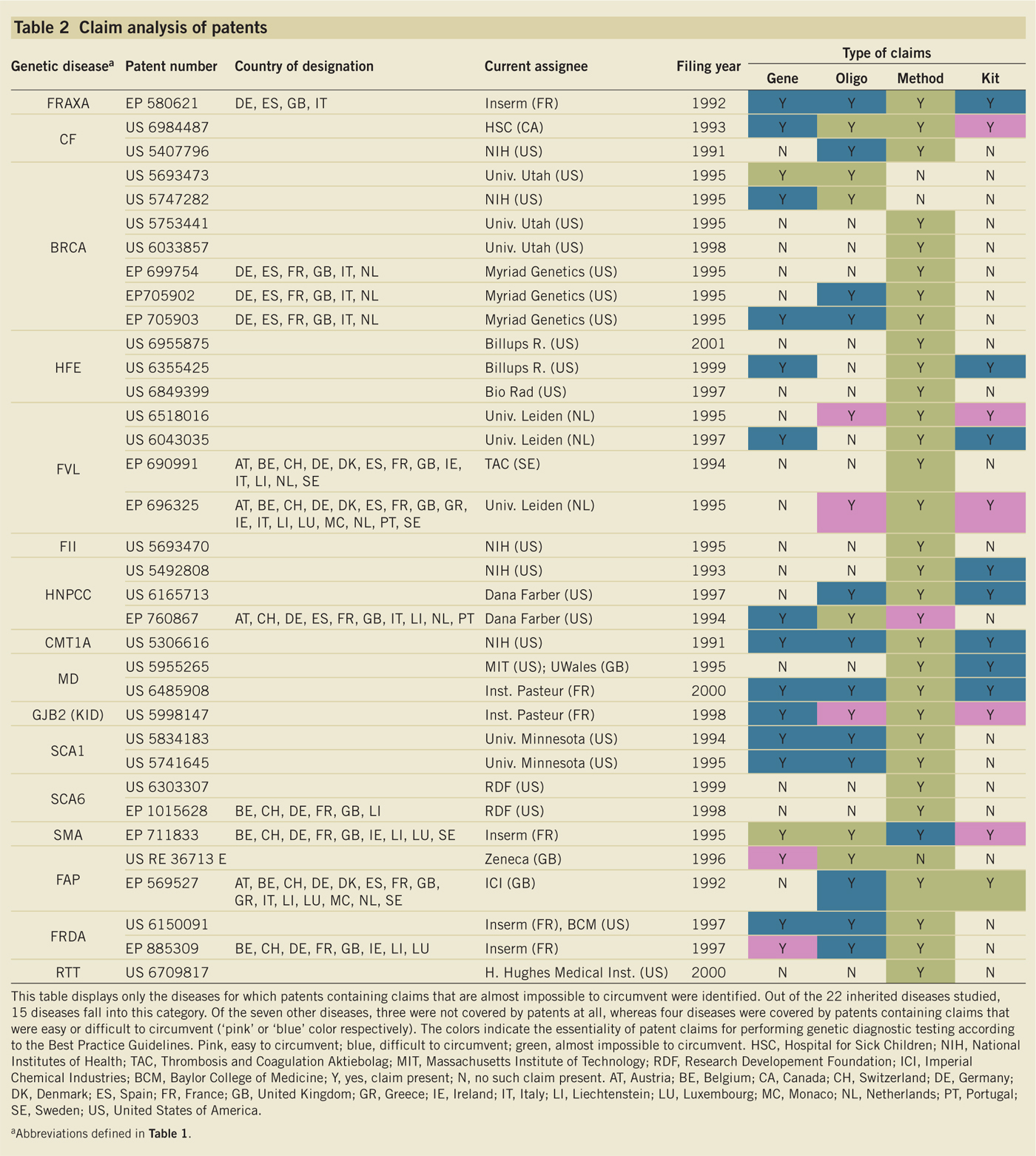
    Table 2
    (Huys et al., 2009, Nature Biotechnology 27: 903-909, Table 2, p. 907).

    The "[m]ost
    heavily patented [diseases] in Europe are hereditary hemochromatosis and
    familial breast cancer testing," while in the U.S., "most patents are
    for spinocerebellar ataxia, Charcot-Marie-Tooth neuropathy, hereditary
    nonpolyposis colon cancer and familial breast and ovary cancer."

    145 granted patents were reviewed (118 U.S. patents
    and 27 EP patents) and 267 claims from these patents characterized:  of these 38% were method claims, 25%
    gene claims, 23% oligonucleotide/probe claims, and 14% kit claims.  For the patents having claims to genes
    (66/145), the majority were claims for cDNA copies of genes (although there
    were 22 patents having claims to genomic DNA embodiments of the claimed
    genes).  When assessed under the "easy,"
    "difficult," or "impossible" (i.e., "blocking")
    standard, only 3% of these gene claims were "blocking."  Accordingly, the authors concluded that
    these claims did not represent a "patent thicket" or otherwise
    provide an impediment to innovation.

    For method claims, on the other hand, 30%
    impossible, 47% difficult, and 23% easy to circumvent, and 35/145 patents
    contained at least one blocking method claim.

    Claim 1 of U.S. Patent No. 5,693,470 was recited as
    exemplary of a "blocking" method claim (for
    hereditary nonpolyposis colon cancer):

    1.  A
    method of determining a predisposition to cancer comprising:
    testing a body sample of
    a human to ascertain the presence of a mutation in a gene identified as hMSH2
    (human analog of bacterial MutS and Saccharomyces cerevisine MSH2) which
    affects hMSH2 expression or hMSH2 protein function, the presence of such a
    mutation indicating a predisposition to cancer.

    60% of patent families (21/35) had no kit claims,
    and 15/22 diseases have claims impossible to circumvent.

    The authors reported a number of observations that
    they characterized as "surprising."  These included the supremacy of U.S. patents on genetic
    inventions persists, almost 30 years after Diamond
    v. Chakrabarty
    .  They also
    noted that, despite the requirement in the U.S. since 2001 that gene patents
    can be obtained in the U.S. only if "biochemical, biological, or genetic
    data describing the function are included" (they reported 63 such
    patents), 11 "key" patents were directed to genes without this
    information.  The situation is
    different in Europe, with many more applications abandoned during prosecution
    or otherwise not pursued.  The
    authors speculate that this many be due "perhaps" to a more
    restrictive and expensive patent system.  The authors also noted that 60% of applicants were U.S. universities
    and research institutes, due to the "progressive attitude" of the U.S.
    for universities to be able to patent their inventions.

    With regard to the claim analysis, the data clearly
    showed no evidence of a patent thicket for gene claims.  The situation is different for
    diagnostic method claims, with most of these claims being difficult or
    impossible to circumvent.  Because
    the authors found there to exist claims to the same disease owned by different
    applicants, they noted the possibility that a patent thicket could exist but
    provide no evidence for any.  They
    also noted that for method claims, there was a failure to link the biological
    observation to specific method steps, which may make it difficult to find
    infringement for these claims.  (For example, a claim reciting an isolated cDNA encoding a human gene is
    unlikely to be infringed by a test for identifying a mutation in DNA from a
    human sample.)

    The authors present these conclusions:

    In conclusion,
    the present analysis and accompanying observations do not point to the
    existence of a wide patent thicket in genetic diagnostic testing.  Rather, they
    highlight a problem of lack of transparency and clarity, leading to legal
    uncertainty.  Neither case law nor patent legislation resolves the legal
    uncertainty related to patents on genetic inventions.  In 2006, the US Supreme
    Court dismissed a judicial review on the case Laboratory Corporation of
    America Holdings v. Metabolite Laboratories Inc
    .  . . .  As a substantial
    number of patent claims would have been affected by a decision in this case,
    this refusal further increased legal
    uncertainty
    , including in the genetic field.  The consequence of this high
    level of legal uncertainty is that either enormous
    risks
    are taken if genetic tests are performed without knowingly infringing
    a specific patent, or much time and energy goes into establishing patent
    landscapes and freedom-to-operate analyses or to efforts to use different
    techniques and methods that may eventually be below the state of the art that
    is clinically requested.

    As this study shows that not that many blocking
    gene patents exist,
    proposals aiming at banning patents on human
    genes do not provide a plausible solution
    , unless the ban would be on
    patents for broad genetic diagnostic
    methods as such.  For instance, the European Society of Human Genetics (Vienna)
    has recently recommended avoiding patenting of the pure link between a mutation
    and disease.  More attention should
    be paid to the licensing practices in a 'responsible' way.  Otherwise, the risk exists that the control by owners of patents containing
    those broad claims with respect to genetic diagnostic testing may in the future dissociate actual
    genetic diagnostic testing from genetic counseling and clinical investigation, which
    is to the detriment of progress of the genetic diagnostic service and public healthcare
    system.

    (Emphasis added)

    These conclusions reflect two realities.  The first is that researchers have
    identified practices that may, in the future, lead to negative
    outcomes, but have not detected any evidence of such outcomes using current
    data.  The second is that the legal
    uncertainty occasioned by "decisions" such as Justice Breyer's
    dissent in the LabCorp case have
    consequences for research, investment, and healthcare.  Judge Rader may note, in the Prometheus decision, that this dissent
    is "not controlling law," but these sentiments, combined with the
    risk of a gene patenting ban, are (according to these authors) on balance
    having an effect more negative on innovation than the gene patents that are at
    risk.
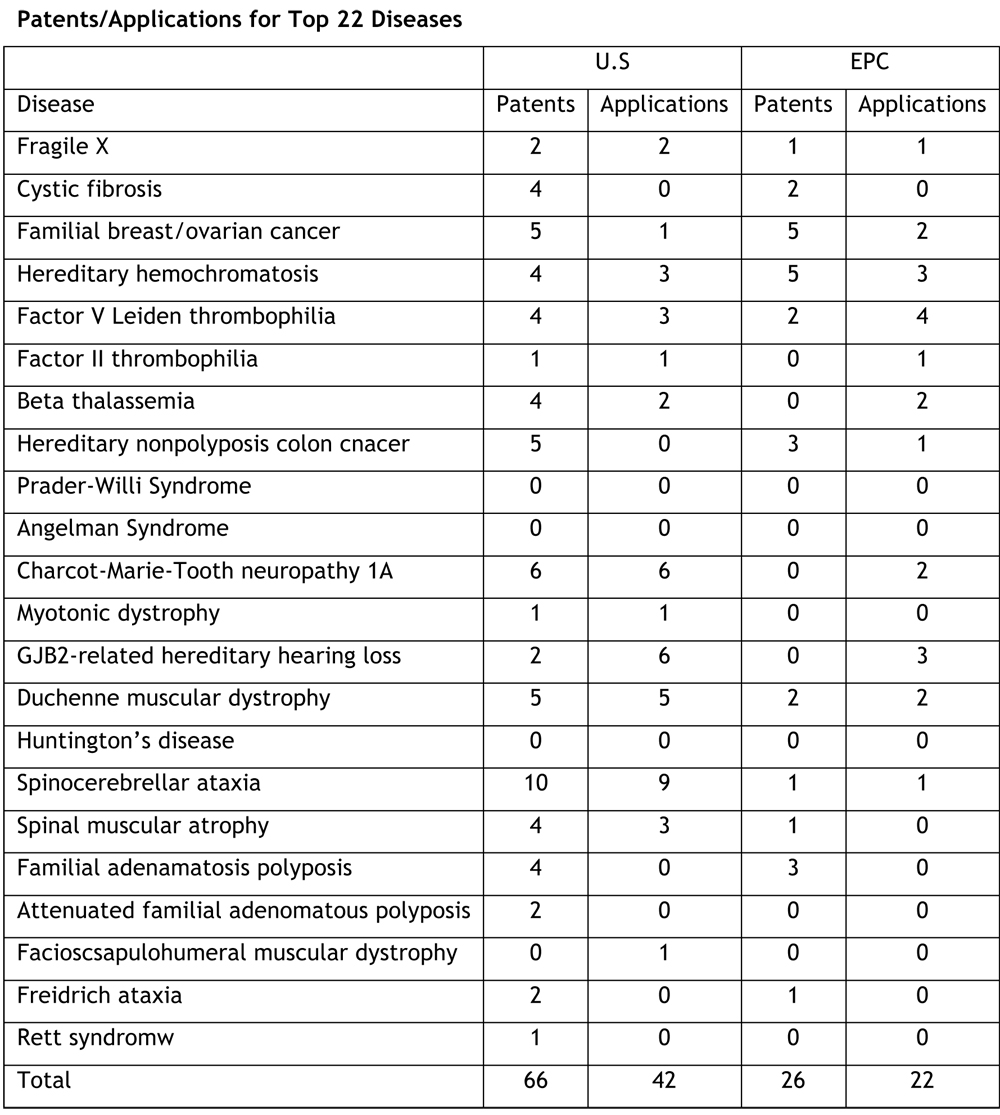
    Patent-Applications for Top 22 Diseases
    (click on table to enlarge)

  •     By
    Donald Zuhn

    USPTO Seal In
    a Federal Register notice published on Wednesday (74 Fed. Reg. 54028), the U.S. Patent and Trademark
    Office announced that it plans to hold a roundtable discussion to "obtain
    input from diverse sources in the patent community and/or the public sector to
    evaluate views on work sharing." 
    The roundtable discussion is scheduled for 8:30 am to 1:00 pm (EST) on Wednesday,
    November 18, 2009 at the USPTO, Madison Auditorium, Concourse Level, Madison
    Building, 600 Dulany Street, Alexandria, Virginia.

    While
    the roundtable will be open to the public (and made available via webcast), the
    Office will be inviting a limited number of roundtable participants from patent
    user groups, practitioners, industry, independent inventor organizations,
    academia, and Government, as well as selecting a few "at-large"
    participants based upon requests to Wednesday's notice.  Anyone interested in participating in
    the roundtable must send a request to the USPTO by e-mail to elizabeth.shaw2@uspto.gov.  The request must include the following:  (1) name of participant and contact
    information (phone number and e-mail address); and (2) the organization the
    participant represents.  The
    deadline for submitting requests to participate in the roundtable is 5 pm (EST)
    on November 4, 2009.

    The
    Office will also be accepting written comments on issues raised at the
    roundtable or on any issue pertaining to worksharing.  Written comments should be submitted by e-mail to IP.Policy@uspto/gov, or by mail to Mail
    Stop OIPPE, United States Patent and Trademark Office, P.O. Box 1450,
    Alexandria, VA 22313–1450, ATTN: Elizabeth Shaw.  The deadline for submitting written comments is December 11,
    2009.

  •     By Suresh Pillai

    Infosint Awarded $15 Million Verdict in Lexapro® Suit

    Lexapro A federal jury in the U.S. District Court for the
    Southern District of New York has awarded Infosint $15 million as a reasonable
    royalty in Infosint's patent dispute with Lundbeck A/S and Forest
    Laboratories, Inc.
    over
    the patent covering Lexapro®.  The patent-in-suit, U.S. Patent No.
    6,458,973,
    is owned by Infosint and covers methods for making citalopram, an
    antidepressant marketed under the trade names Celexa® and Lexapro®.  In the suit, originally filed in April
    2006, Infosint accused both Lundbeck and Forest Labs of infringing the '973 patent.  In response, Lundebeck and Forest Labs counterclaimed for infringement of U.S. Patent No. 6,403,813,
    owned by Lundbeck and issued four months prior to the earlier-filed '973 patent
    (see "Biotech/Pharma Docket," July 7, 2009).

    At trial, Lundbeck and Forest Labs failed to establish infringement of the '813 patent.  Although the District Court concluded at the summary
    judgment stage that two claims of the '973 patent were obvious, the Court also
    invalidated the first claim in the '813 patent, finding that Lundback had
    suppressed or concealed its invention.  On the remaining issues that went to the jury, the jury found that:  (1) the remaining claims of the '973
    patent were valid and (2) a process used by Lundbeck infringed the '973
    patent.


    Sun Pharmaceuticals Ceases Efforts to Market
    Generic Namenda®

    Forest Laboratories Logo The U.S. District Court for the District
    of Delaware has signed off on a stipulation and order resolving the patent
    dispute between Sun India Pharmaceuticals
    and Forest Laboratories, Inc.
    over alleged infringement of U.S. Patent No. 5,061,703 (see "Court Report," March 23, 2008).  The patent-in-suit, owned by Forest Labs and
    assigned to Germany-based Merz Pharma GmbH & Co. KGaA, covered formulations of
    adamantane derivatives that were manufactured and marketed as Namenda®, an Alzheimer's
    treatment.  Though Sun, in its
    reply to the complaint, denied infringement of the '703 patent, Sun retreated from this position
    in the stipulation, admitting that its filing of an Abbreviated New
    Drug Application with the FDA constituted a "technical act of infringement."

    Sun Pharma The District Court's order dismissed without prejudice all claims
    and counterclaims in the case.  Additionally, Sun agreed to refrain from marketing or manufacturing
    5-milligram or 10-milligram tablets during the life of the '703 patent unless
    all asserted claims of the patent have been found to be invalid.


    Court Finds Vigamox®
    Patent Infringed

    Alcon The U.S. District Court for the District
    of Delaware has ruled that Teva Pharmaceuticals infringed U.S. Patent No. 6,716,830,
    Alcon Inc.'s patent
    covering the active ingredient used in its antibacterial drug Vigamox®.  Alcon originally sued Teva in April
    2006 on the heels of Teva's filing of an Abbreviated New Drug Application with
    the FDA seeking permission to make and market a generic version of Vigamox®.  In February 2008, the District Court found that
    Teva's proposed generic included the active ingredient claimed in
    the '830 patent and rejected Teva's invalidity and obviousness arguments.  In the just-concluded bench trial, the Court concluded that Alcon had proven, by a preponderance of the evidence, that:  (1) Teva's proposed generic would infringe the '830 patent and that (2)
    Teva had failed to prove that the '830 patent was invalid.

  •     By
    Donald Zuhn –-

    Ikonisys On
    Monday, Counsel for Dr. Triantafyllos Tafas filed a
    reply to the joint motion
    to dismiss the appeal in Tafas v. Kappos
    and for a vacatur of the District
    Court's injunction and judgment filed by the U.S. Patent and Trademark Office
    and Appellee GlaxoSmithKline on October 9, 2009.  The joint motion by the USPTO and GSK was filed one day
    after the Office announced that Director Kappos had signed a new Final Rule
    rescinding the claims and continuation rules (see "'New Rules' Officially Rescinded").

    GlaxoSmithKline - GSK In
    his reply brief, Dr. Tafas "applauds the [USPTO] for its recent change in
    policy direction concerning the claims and continuation rules," and offers
    to work with USPTO Director Kappos and other patent community stakeholders
    "toward developing efficient solutions to the PTO's backlog
    problems."  However, the brief outlines four technical grounds for Dr. Tafas not joining the
    USPTO and GSK in seeking vacatur of
    the District Court judgment:

    (1)  Consenting to vacatur might impair Dr. Tafas'
    right to attorneys' fees and costs.

    (2)  Supreme Court precedent does not permit the losing party to have a District Court
    judgment vacated when the losing party merely declines to pursue an appeal.

    (3)  Several issues were never reached by the District Court.

    (4)  It is unclear whether the USPTO's motion to dismiss the appeal was truly
    voluntary in light of a direction by the White House Office of Management and
    Budget (OMB) that the USPTO withdraw the claims and continuation rules pursuant
    to the Paperwork Reduction Act (see
    "Response to Rescission of Claims and Continuations Rules"
    for an explanation of the circumstances surrounding Dr. Tafas' last ground).

    On
    the basis of these four grounds, Dr. Tafas requests that the Federal Circuit
    dismiss the USPTO's appeal as moot, deny the vacatur request as contrary to controlling law, and remand the case
    to the District Court.

    While
    acknowledging that "the substantive issues raised by the PTO on appeal . .
    . have now been rendered moot by virtue of the PTO's voluntary removal from the
    Code of Federal Regulation on October 14, 2009 of the changes in the Claims and
    Continuation Final Rules dated August 21, 2007," the brief states that the
    USPTO's decision to rescind the claims and continuations rules "while
    again commendable and praiseworthy, does not, and cannot, render moot [Dr.]
    Tafas' right to apply either in this Court or at the district court — after the entry
    of final judgment dismissing the appeal — for an award of fees and costs as a
    prevailing party."

    The
    brief also states that "vacatur
    of the district court's judgment by this Court would be directly contrary to
    U.S. Supreme Court precedent, which plainly provides that any mootness caused
    while the case is on appeal by the unilateral act of the losing party in the
    district court below (i.e., the PTO)
    is not a proper grounds for a court
    of appeals to vacate the underlying district court judgment."  Arguing that "[w]here an agency of
    the federal government, such as the PTO here, has been adjudicated to have
    engaged in dubious actions that supersedes its authority," the brief
    contends that "equity mandates that the ruling not simply be erased as if
    it never happened."

    The
    reply brief concludes by offering one example of an issue
    that was uniquely raised by Dr. Tafas, not joined by GSK, and not rendered moot by the
    Office's rescission of the claims and continuations rules (i.e.,
    Dr. Tafas' challenge to the USPTO's "long-standing
    practice" of permitting the issuance of first action final rejections after
    the filing of an RCE as being contrary to 35 U.S.C. § 132(a))
    .  "[I]n gratitude to the PTO for
    finally rescinding the Rules, and in the interests of engendering a new spirit
    of cooperation and rapprochement with the PTO," the brief states that Dr. Tafas
    will withdraw the above challenge when the case is remanded to the District Court.

    Patent Docs
    thanks James Nealon of Kelley Drye & Warren LLP for kindly providing us with
    a copy of Dr. Tafas' Reply to Motion for Dismissal of Appeal and Request for
    Remand.

  •     By Kevin E. Noonan

    Senate Seal With fresh life being breathed into its patent "reform"
    bill by the new Commerce Secretary and PTO management, the Senate Judiciary Committee on
    Thursday acted on another "reform"
    measure, voting in favor of sending to the floor of the Senate a bill
    prohibiting "reverse payments."  These are payments by branded drug makers to generic drug companies that
    forestall generic drug entry into the marketplace, which many, including the
    Federal Trade Commission, contend are (or should be) presumptively
    illegal.  The FTC maintains that
    these arrangements cost consumers about $3.5 billion annually in additional
    prescription drug costs.  The new administration's Justice Department has also
    changed the opinion espoused by the Bush administration, and now embraces the
    FTC's "presumptively unlawful" stance; President Obama is reported by
    Reuters to support the ban.

    However, the FTC and others have not been able to convince
    the Federal Circuit that there is anything illegal in these arrangements (as in
    In re Ciprofloxacin Hydrochloride
    Antitrust Litigation
    ),
    and as a result these agencies have turned to Congress to mandate the
    illegality of such payments.

    The bill (S. 369) was co-sponsored by Senators Kohl (D-WI), Grassley (R-IA),
    Feingold (D-WI), Durbin (D-IL), Brown (D-OH), Collins (R-ME), Klobuchar (D-MN),
    Nelson (D-NE) and Franken (D-MN).  As
    reported by the Committee, it provides, inter
    alia
    , that:

    (1) In 1984, the Drug Price Competition and Patent
    Term Restoration Act (Public Law 98-417) (referred to in this Act as the '1984
    Act'), was enacted with the intent of facilitating the early entry of generic
    drugs while preserving incentives for innovation.

    (2) Prescription drugs make up 10 percent of the
    national health care spending but for the past decade have been one of the
    fastest growing segments of health care expenditures.

    (3) Until recently, the 1984 Act was successful in
    facilitating generic competition to the benefit of consumers and health care
    payers – although 67 percent of all prescriptions dispensed in the United
    States are generic drugs, they account for only 20 percent of all expenditures.

    (4) Generic drugs cost substantially less than
    brand name drugs, with discounts off the brand price sometimes exceeding 90
    percent.

    (5) Federal dollars currently account for an
    estimated 30 percent of the $235,000,000,000 spent on prescription drugs in
    2008, and this share is expected to rise to 40 percent by 2018.

    (6)(A) In recent years, the intent of the 1984 Act
    has been subverted by certain settlement agreements between brand companies and
    their potential generic competitors that make 'reverse payments' which are
    payments by the brand company to the generic company.

    (B) These settlement agreements have unduly delayed
    the marketing of low-cost generic drugs contrary to free competition, the
    interests of consumers, and the principles underlying antitrust law.

    (C) Because of the price disparity between brand
    name and generic drugs, such agreements are more profitable for both the brand
    and generic manufacturers than competition, and will become increasingly common
    unless prohibited.

    (D) These agreements result in consumers losing the
    benefits that the 1984 Act was intended to provide.

    The Act is intended:

    (1) to enhance competition in the pharmaceutical
    market by stopping anticompetitive agreements between brand name and generic
    drug manufacturers that limit, delay, or otherwise prevent competition from
    generic drugs; and

    (2) to support the purpose and intent of antitrust
    law by prohibiting anticompetitive practices in the pharmaceutical industry
    that harm consumers.

    And the prohibitions of the Clayton Act (15 U.S.C. § 12
    et seq.) are amended as follows:

    SEC. 28. PRESERVING ACCESS TO AFFORDABLE GENERICS

    (a) In General-

    (1) ENFORCEMENT PROCEEDING- The Federal Trade
    Commission may initiate a proceeding to enforce the provisions of this section
    against the parties to any agreement resolving or settling, on a final or
    interim basis, a patent infringement claim, in connection with the sale of a
    drug product.

    (2) PRESUMPTION-

        (A) IN GENERAL- Subject to subparagraph (B), in
    such a proceeding, an agreement shall be presumed
    to have anticompetitive effects and be unlawful
    if–

            (i) an ANDA filer receives anything of value; and

            (ii) the ANDA filer agrees to limit or forego
    research, development, manufacturing, marketing, or sales of the ANDA product
    for any period of time.

        (B) EXCEPTION- The presumption in subparagraph (A)
    shall not apply if the parties to such agreement demonstrate by clear and convincing evidence that the
    procompetitive benefits of the agreement outweigh the anticompetitive effects
    of the agreement.

    (b) Competitive Factors- In determining whether
    the settling parties have met their burden under subsection (a)(2)(B), the fact
    finder shall consider–

    (1) the length of time remaining until the end of
    the life of the relevant patent, compared with the agreed upon entry date for
    the ANDA product;

    (2) the value to consumers of the competition from
    the ANDA product allowed under the agreement;

    (3) the form and amount of consideration received
    by the ANDA filer in the agreement resolving or settling the patent
    infringement claim;

    (4) the revenue the ANDA filer would have received
    by winning the patent litigation;

    (5) the reduction in the NDA holder's revenues if
    it had lost the patent litigation;

    (6) the time period between the date of the
    agreement conveying value to the ANDA filer and the date of the settlement of
    the patent infringement claim; and

    (7) any other factor that the fact finder, in its
    discretion, deems relevant to its determination of competitive effects under
    this subsection.

    (c) Limitations- In determining whether the
    settling parties have met their burden under subsection (a)(2)(B), the fact
    finder shall not presume–

    (1) that entry would not have occurred until the
    expiration of the relevant patent or statutory exclusivity; or

    (2) that the agreement's provision for entry of
    the ANDA product prior to the expiration of the relevant patent or statutory
    exclusivity means that the agreement is pro-competitive, although such evidence
    may be relevant to the fact finder's determination under this section.

    (d) Exclusions- Nothing in this section shall
    prohibit a resolution or settlement of a patent infringement claim in which the
    consideration granted by the NDA holder to the ANDA filer as part of the
    resolution or settlement includes only one or more of the following:

    (1) The right to market the ANDA product in the
    United States prior to the expiration of–

        (A) any patent that is the basis for the patent
    infringement claim; or

        (B) any patent right or other statutory
    exclusivity that would prevent the marketing of such drug.

    (2) A payment for reasonable litigation expenses
    not to exceed $7,500,000.

    (3) A covenant not to sue on any claim that the
    ANDA product infringes a United States patent.

    (emphasis added)

    Federal Trade Commission (FTC) Seal The bill permits the FTC to "exempt certain
    agreements" if the Commission finds that they are "in furtherance of
    market competition and for the benefit of consumers."  The legislation omits a requirement in draft
    versions of the bill that all agreements between generic and branded drug
    manufacturers were to be submitted under oath to the FTC and the DOJ under the
    Medicare Prescription Drug, Improvement, and Modernization Act of 2003, and also
    omits provisions wherein the 180-day exclusivity period granted under the
    Hatch-Waxman Act to the first ANDA filer would be forfeited if it enters into a
    "reverse payment" agreement with the branded drug manufacturer.

    The Committee vote was 12-7.  The bill is as yet unscheduled for
    a floor vote, and a companion bill in the House (H.R. 1706, introduced by
    Congressman Rush (D-IL) and co-sponsored by Congressmen Waxman, Dingell, Doyle,
    Markey, Stupak, Schakowsky and DeGette) has been forwarded by the Subcommittee
    on Commerce, Trade and Consumer Protection to the House Energy and Commerce
    Committee and to the Judiciary Committee for action.

  •     By
    Donald Zuhn –-

    Congress Earlier this month, four Senators sent a letter to Senate majority leader Harry Reid
    (D-NV) expressing their "strong support" for including an approval pathway
    for biosimilars in any health care reform package brought to the Senate floor
    for a vote.  The Senators — Orrin Hatch (R-UT), Barbara Mikulski (D-MD), Michael
    Enzi (R-WY), and Kay Hagan (D-NC) — noted in their letter that an amendment passed by the Senate
    Health, Education, Labor, and Pensions (HELP) Committee and calling, in part,
    for a 12-year data exclusivity period "received strong bipartisan
    support when it was considered," and had been passed by the HELP Committee
    by a 16-7 vote.  Noting that
    "[m]ore than 150 patient groups, research universities, local chambers of
    commerce, venture capital groups, and innovators have expressed strongly that a
    base 12 years of data exclusivity is crucial to ensure continued growth in the
    biotechnology industry and future discoveries that will make a difference in
    the lives of millions of patients," the Senators urged the majority leader
    "to support the enactment of a pathway for the approval of biosimilars
    with a base 12·year period of data exclusivity for innovator biotechnology
    companies."

  •     By
    Donald Zuhn –-

    PhRMA #2 In
    a statement issued by the Pharmaceutical Research and Manufacturers of America
    (PhRMA) earlier today,
    the advocacy group representing pharmaceutical and biotechnology research
    companies indicated that it "supports the development of a responsible,
    abbreviated approval pathway for biosimilars that includes a fair period of
    data protection that is critical for the future of medical progress."  The group noted that follow-on
    biologics legislation currently making its way through the House and Senate
    "provides for patient safety and strikes the appropriate balance between
    the desire for enhanced competition for biologics, and the need to provide
    meaningful incentives for innovation."  As reported here previously, the Senate Health, Education,
    Labor and Pensions (HELP) Committee approved an amendment in mid-July that
    would provide a 12-year data exclusivity period for biologic drug makers (see "Senators Champion 12-Year Data
    Exclusivity in Senate
    ").  In late July, the House followed suit
    by passing an amendment to its own health care reform bill that would prevent
    the FDA from approving a biosimilar application until 12 years after the date
    on which the reference product (i.e.,
    the innovator biologic) was first licensed. (see "House Committee Approves Health Care Reform Bill Calling
    for 12-Year Exclusivity Period
    ").

    Arguing
    that the complexity of biologics means that "[biologic] patents may cover
    just part of the molecule or simply cover the process for its manufacture,"
    PhRMA contended that "the nature of patent protection for biologics is
    uncertain in the context of biosimilars," and that this uncertainty would
    impact investment decisions.  The
    group envisions that biosimilar manufacturers will be able to use their own
    manufacturing processes to create biosimilars differing only slightly from innovator
    biologics and possibly "circumvent patents — while qualifying for an
    abbreviated application." 
    PhRMA warned that "[g]iving short shrift to incentives for
    innovation would grind to a halt uniquely American innovation, moving
    critically important R&D — and tens of thousands of U.S jobs –
    overseas," and noted that 80% of the world's biotech research currently is
    performed in the United States.

    The
    PhRMA release states that "[e]conomists and the venture capitalists whose
    private investments shore up this vital, yet vulnerable sector agree:  12 years of data protection, at a bare
    minimum, are needed to help recoup the significant development costs for
    biologic innovators." 
    However, the group also notes that this 12-year period would be for data
    exclusivity and not market exclusivity. 
    Significantly, PhRMA states that "[c]ompanies could still seek
    approval of competing biologics using their own data, but for those 12 years no
    biosimilar competitor could rely on innovators’ hard–earned data, collected during
    development that may span a decade, or more, to seek approval."

  •     By Kevin E. Noonan

    Myriad Myriad Genetics, one of the preeminent gene-based
    diagnostics companies, has been targeted by the American Civil Liberties Union,
    Dan Ravicher’s PUBPAT Organization, a raft of medical researchers and their
    associations, and individual patients in a lawsuit filed in the Southern
    District of New York; the avowed aim of the plaintiffs is to get the issue of "gene
    patenting" before the U.S. Supreme Court (see "Association for Molecular Pathology v. U.S. Patent and Trademark Office")
    .  While
    the case wends its way through the Federal judicial system, Myriad is
    continuing its pursuit of diagnostically-relevant cancer markers, the most
    recent of which is a gene related to susceptibility to pancreatic cancer licensed
    from the Johns Hopkins University.

    Covermed The gene encodes PALB2, a tumor suppressor gene
    reported to be involved in susceptibility to pancreatic cancer in the April 10,
    2009 issue of Science (Jones et al., 2009, "Exomic Sequencing Identifies PALB2 as a Pancreatic Cancer Susceptibility Gene," Science 324: 217
    ).  The product of the PALB2 gene is
    a binding partner of BRCA2, originally identified by its association with breast
    cancer susceptibility.  The two
    gene products bind to DNA to repair damage, wherein PALB2 localizes and anchors
    BRCA2 to damaged DNA in the cell nucleus.  More than 3% of familial pancreatic cancer patients had mutations in PALB2
    resulting in the production of a truncated version of the encoded protein.  In contrast, no mutations in the PALB2 gene
    were found in more than 1,000 normal DNA samples.

    Myriad contends that the predictive value of
    detecting such mutations are due to a 10- to 20-fold increase in the likelihood
    of developing pancreatic cancer by age 70 for individuals bearing the PALB2 mutation
    (or mutations in BRCA2 or another tumor suppressor gene, p16).  Early detection is particularly
    important for pancreatic cancer, which is typically detected only after it has
    progressed past the stage where intervention has any chance of significantly
    prolonging life.  Pancreatic cancer
    is diagnosed in about 200,000 patients worldwide each year, and is fatal almost
    without exception.

    The scope of the difficulty in identifying reliable
    diagnostic genes is reflected in the following synopsis of the extent of
    mutations found by the Johns Hopkins researchers in tumor DNA from one
    pancreatic cancer patient.

    Among the
    20,661 coding genes analyzed, we identified 15,461 germline variants in Pa10
    not found in the reference human genome.  Of these, 7318 were synonymous, 7721
    were missense, 64 were nonsense, 108 were at splice sites, and 250 were small
    deletions or insertions (54% in-frame)
    .

    The PALB2 mutation found in tumor DNA from this
    patient exhibited a germline deletion of four basepairs (TTGT) that produced a frameshift mutation at codon 58,
    resulting in production of a truncated gene product from this gene.  Additional mutations found associated
    with pancreatic cancer in the PALB2 gene are a G > T transversion at the 5'
    splice site of exon 6, a deletion of an A residue in exon 11 (at nucleotide
    3116) and a C > T transition mutation in exon 12 (at nucleotide 3256).  Fine structure mapping of mutations
    found in the PALB2 gene in pancreatic cancer, breast cancer, and Fanconi anemia
    patients was also reported.

    The company estimates that a diagnostic genetic
    test might be on the market by 2010.

  •     By Kevin E. Noonan

    The principal debate involving follow-on biologics
    legislation has revolved around the length of the data exclusivity term granted
    to innovators.  The bill voted out
    of the Senate Health, Education, Labor and Pensions (HELP) Committee earlier this year has
    a 12-year data exclusivity term, which is shorter than the term supported by
    industry groups such as the Biotechnology Industry Organization (BIO) and also
    shorter than the term supported by the only peer-reviewed economic analysis of
    record.  There have been many
    competing proposals, including a 7-year term supported by the Obama
    administration (see "White House Recommends 7-Year Data Exclusivity Period for Follow-on Biologics")
    ; a 5-year term provided in a bill (H.R. 1427) supported by Committee
    on Energy and Commerce Committee Chairman Henry Waxman (D-CA) in the House of
    Representatives (see "Waxman Introduces Follow-on Biologics Bill"); and finally the grant of no data exclusivity under a set of
    questionable assumptions promulgated by the Federal Trade Commission (see "No One Seems Happy with Follow-on Biologics According to the FTC").  Most recently, a pair of patent
    attorneys (one of whom has deep ties to the generic pharmaceutical industry) and
    a medical school professor proposed a 5-year data exclusivity term in an
    article published in last week's New
    England Journal of Medicine
    (see "NEJM Authors Say Five Years of Data Exclusivity Would Be Sufficient").

    Covermed Under these circumstances, an article published in
    this latest issue of Science is rather
    surprising.  The article, by Matthew
    J. Higgins
    of the Georgia Institute of Technology and Stuart J.H. Graham of the
    University of California, Berkeley Law School suggests that the current
    Hatch-Waxman regime having a 5-year data exclusivity term and provisions for
    generic drug companies to challenge innovator drug patents is responsible for
    the dramatic drop-off in new small molecule drugs (
    from an average of 35 in 1996–2001
    to 20 in 2002–07
    ), and that the solution is to increase (indeed,
    double) the data exclusivity term for conventional drugs to 10 years,
    consistent with trends in Europe, Canada, and Japan (see "Balancing Innovation and Access: Patent Challenges Tip the Scales").

    The authors start by reviewing the economic
    incentives for generic drug challenges to innovator drug patents.  The biggest factor is the 180-day exclusivity period awarded to the generic challenger that is the first to file
    an Abbreviated New Drug Application (ANDA).  The authors estimate that the average revenue garnered by a
    generic during this period is $60 million, which is 12 times the average cost
    of ANDA litigation ($5 million).  This
    differential exists because during that 6-month period the first successful generic challenger can price
    the generic substitute just below the brand-name drug price (representing a "savings"
    to consumers).  This potential
    windfall has motivated generic companies to engage in "prospecting"
    by filing numerous ANDAs with Paragraph IV certifications (that the patent
    protecting the innovator's drug is invalid).  This conclusion is supported by a review of the number of
    ANDA lawsuits filed over the past ten years:

    Table 1
    A total of 749 lawsuits
    have been filed challenging innovator drug patents during this period,
    involving 243 brand-name drugs.  The authors note that the
    FTC has shown that "72% of Paragraph IV challenges filed between 1992 and
    2000 resulted in litigation, with the generic drug challenger winning 42% of the time,"
    citing
    Generic Entry Prior to Patent Expiration: An
    FTC Study
    (FTC, Washington, DC, 2002).  Moreover, the drugs challenged in recent years have
    revenues of less than $100 million, showing that "blockbuster" drugs
    are no longer the only targets of Paragraph IV challenges.

    The economic effect on innovator drug companies is
    large, averaging about a 12% loss in revenue.  This loss "exceeded companies' gains from the patent
    extensions awarded to them," according to the authors, an outcome that is
    ironic considering the policy "balance" of the Hatch-Waxman regime between reducing the time needed for
    a generic drug to reach the market after innovator patent expiry and
    restoration of patent term lost to the period of regulatory review.  Using Merck's Fosamax as an example,
    the authors state that Teva's successful Paragraph IV challenge permitted
    generic competition 4 years before Merck's patents were to expire, costing the
    company about $1.5 billion.  (Teva
    is reported to have 160 pending ANDA filings and to be involved in 92 Paragraph
    IV challenges, "putting at risk over $100 billion in sales," citing
    Teva's Securities and Exchange Commission Form 20-F filing in 2007
    .)  This lost revenue represents the cost of bringing two new
    drugs to market in the U.S.

    As a result, innovator pharmaceutical companies are
    motivated to produce new branded drug offerings that bolster their existing
    franchises subject to generic challenge.  However, these are not "new" drugs, but rather are
    predominantly reformulations representing only "marginal improvements"
    over existing forms of these drugs.  The rate and number of successful Paragraph IV challenges is also
    reducing the average effective patent life for innovator drugs, particularly "blockbuster"
    drugs which remain the most attractive targets for Paragraph IV challenge (and the correspondingly higher value
    of the 180-day generic exclusivity term).

    The authors suggest as a solution changing the data
    exclusivity term under the Hatch-Waxman act from 5 years to 10 years, using a
    comparison with other "Western" countries as justification:

    Table 2
    Citing Professor
    Grabowski's research, as well as a report from the National Academies of
    Science and Engineering and the Institutes of Medicine (
    Rising
    Above the Gathering Storm: Energizing and Employing America for a Brighter Economic
    Future

    (National Academies Press, Washington, DC, 2007), the authors assert that extending the period of data
    exclusivity is necessary to overcome the "market failure" in the
    pharmaceutical industry caused by
    the Hatch-Waxman Paragraph IV challenges of patents on innovator drugs.  While they also suggest other
    regulatory incentives for drug development in particular areas (such as
    Alzheimer's disease and osteoarthritis), "[a]t a minimum,
    we should all note that Paragraph
    IV challenges are contributing to this failure when discussing the future of
    health care and long-term access to new treatment."

    The irony of this report will not be lost on anyone following
    the data exclusivity period debate over 
    follow-on biologics, and the authors' conclusions provide a direct
    challenge to those advocating a shortened term for biologic drugs based on the "successes"
    of the Hatch-Waxman regime for small molecule drugs.

  •     By Sherri Oslick

    Gavel_2About
    Court Report:  Each week we will report briefly on recently filed
    biotech and pharma cases, and a few interesting cases will be selected
    for periodic monitoring.


    Shelbyzyme LLC v. Genzyme Corp.
    1:09-cv-00768; filed October 14, 2009 in the
    District Court of Delaware

    Infringement of U.S. Patent No. 7,011,831 ("Recombinant
    α-galactosidase A Therapy for Fabry Disease," issued March 14, 2006) based
    on Genzyme's manufacture and sale of its Fabrazyme® (agalsidase beta, used to
    treat Fabry disease).  View the
    complaint
    here.


    Eli Lilly and Company v. Sandoz, Inc.
    1:09-cv-01282; filed October 14, 2009 in the Southern
    District of Indiana

    Infringement of U.S. Patent No. 5,464,826 ("Method
    of Treating Tumors in Mammals with 2',2'-difluoronucleosides," issued
    November 7, 1995) following a Paragraph IV certification as part of Sandoz's
    filing of an ANDA to manufacture a generic version of Lilly's Gemzar®
    (gemcitabine hydrochloride for injection, used to treat non-small cell lung
    cancer, pancreatic cancer, breast cancer, and ovarian cancer).  View the complaint
    here.


    Stiefel Research Australia Pty Ltd. v. Perrigo Co. et al.
    1:09-cv-00758; filed October 13, 2009 in the
    District Court of Delaware

    • Plaintiff:  Stiefel Research Australia Pty Ltd.
    • Defendants:  Perrigo Co.; Perrigo Israel
    Pharmaceuticals Ltd.

    Infringement of U.S. Patent No. 6,946,120 ("Pharmaceutical
    Composition," issued September 20, 2005) following a Paragraph IV
    certification as part of Perrigo's filing of an ANDA to manufacture a generic
    version of Stiefel's Rogaine® (minoxidil topical aerosol foam, used to treat
    androgenic alopecia of the vertex of the scalp).  View the complaint
    here.


    Chugai Seiyaku Kabushiki Kaisha v. Kappos
    1:09-cv-01928; filed October 9, 2009 in the
    District Court of the District of Columbia

    Review and correction of the patent term adjustment
    calculation made by the U.S. Patent and Trademark Office for U.S. Patent No.
    7,517,965 ("Non-Neutralizing Anti-aPC Antibodies," issued April 7,
    2009).  View the complaint
    here.


    Aventis Pharmaceuticals Inc. et al. v. Sun Pharmaceutical
    Industries Ltd. et al.

    2:09-cv-05179; filed October 9, 2009 in the
    District Court of New Jersey

    • Plaintiffs:  Aventis Pharmaceuticals Inc.; Aventis
    Inc.; Carderm Capital L.P.
    • Defendants:  Sun Pharmaceutical Industries Ltd.;
    Sun Pharmaceutical Industries Inc.; Sun Pharma Global Inc.

    Infringement of U.S. Patent Nos. 7,135,571 ("Process
    for Preparing Anhydrous and Hydrate Forms of Antihistaminic Piperidine
    Derivatives, Polymorphs and Pseudomorphs Thereof," issued November 14,
    2006), 6,399,632 ("Method of Providing an Antihistaminic Effect in a
    Hepatically Impaired Patient," issued June 4, 2002), 6,187,791 (same
    title, issued February 13, 2001), 6,037,353 (same title, issued March 14, 2000),
    5,855,912 ("Pharmaceutical Compositions for Piperidinalkanol Compounds,"
    issued January 5, 1999), 6,113,942 ("Pharmaceutical Composition for
    Piperidinalkanol Compounds," issued September 5, 2000), and 5,738,872
    (same title, issued April 14, 1998) following a Paragraph IV certification as
    part of Sun's filing of an ANDA to manufacture a generic version of Aventis'
    Allegra® (fexofenadine hydrochloride, used to treat allergies).  View the complaint
    here.


    Medicines Company v. Teva Parenteral Medicines Inc. et al.
    1:09-cv-00750; filed October 8, 2009 in the
    District Court of Delaware

    • Plaintiff: Medicines Co.
    • Defendants: Teva Parenteral Medicines Inc.; Teva
    Pharmaceuticals USA Inc.; Teva Pharmaceuticals Industries Ltd.

    Medicines Company v. APP Pharmaceuticals LLC et al.
    1:09-cv-00752; filed October 8, 2009 in the
    District Court of Delaware

    • Plaintiff: Medicines Co.
    • Defendants: APP Pharmaceuticals LLC; APP
    Pharmaceuticals Inc.

    The complaints in these cases are substantially
    identical.  Infringement of U.S.
    Patent No. 7,582,727 ("Pharmaceutical Formulations of Bivalirudin and
    Process of Making the Same," issued September 1, 2009) following a
    Paragraph IV certification as part of Teva's filing of an ANDA to manufacture a
    generic version of The Medicines Company's Angiomax® (bivalirudin, used as an
    anticoagulant in patients with unstable angina undergoing percutaneous
    translurninal coronary angioplasty).  View the Teva complaint
    here.