•     By
    Donald Zuhn

    Over
    the past twelve months, Patent Docs
    has reported on a number of papers, letters, and statements that outline
    positions taken by various players in the follow-on biologics (FOB) data
    exclusivity debate.  In view of the
    recent Time magazine article
    "How Drug-Industry Lobbyists Got Their Way on Health Care," which
    mentions that Duke University Prof. Henry Grabowski's oft-cited data
    exclusivity study was funded by the Pharmaceutical Research and Manufacturers
    of America (PhRMA) and two partisan patient groups (see "Time Magazine on Data Exclusivity Debate"),
    a review of these players and their positions on the issue seems
    appropriate.  Last week, we
    summarized the positions of seventeen individuals or groups that have
    participated in the debate (see
    "Follow-on Biologics Data Exclusivity Debate Scorecard" – Part I

    and Part II).  Today, we examine the positions of
    another eleven participants in the debate.  Among those who have advocated for shorter data exclusivity
    periods (i.e., less than 8 years)
    are:

    New England Journal of Medicine
    Alfred Engelberg, a New York patent attorney who represented the Generic
    Pharmaceutical Industry Association and played a role in the passage of the
    Hatch-Waxman Act in 1984; Dr. Aaron Kesselheim, a patent attorney and
    Instructor in Medicine at the Harvard Medical School; and Dr. Jerry Avorn, a
    Professor of Medicine at the Harvard Medical School, who published an article
    in the New England Journal of Medicine
    contending that FOB legislation being proposed in the House and Senate, which
    provides 12 years of data exclusivity, would "upset[] the delicate balance
    between the interests of consumers and those of innovators" (see "NEJM Authors Say Five Years of
    Data Exclusivity Would Be Sufficient
    ").  The authors also argue that
    "[e]ven if the new legislation is adopted, manufacturers of potential
    follow-on products would probably prefer to ignore the new pathway and opt to
    file a standard BLA, which would not be subject to the 12-year delay," and
    therefore contend that "as currently fashioned, the biosimilar legislation
    would have no value, because it would create a pathway that would scarcely be
    used."  The authors therefore suggest
    that the legislation currently being proposed in the House and Senate be
    amended to "give the FDA the mandate to evaluate and approve biosimilar
    drugs in a reasonable period, starting, as with small-molecule products, 5
    years after the approval of the original drug."

    Roll Call
    James Love, the director of the public interest advocacy group Knowledge
    Ecology International; and James Glassman, the former under secretary of State
    for public diplomacy and public affairs in the George W. Bush administration,
    who authored an article in the Congressional newspaper Roll Call expressing "alarm" regarding Congressional
    action to establish a follow-in biologics (FOB) regulatory
    pathway, and contending that passage of FOB provisions by the House Energy and
    Commerce and Senate HELP Committees would "make it difficult, if not
    impossible, for generic drugs to compete with biologics, even after patents
    have expired" (see "Roll
    Call
    Authors Unite against Current Follow Biologics Legislation
    ").  The authors state that "[t]he
    original proposal for biogenerics would have retained most of the features of
    the 1984 Hatch-Waxman Act, including the five-year exclusion [i.e., exclusivity
    period]," and assert that "after an intense lobbying campaign by the
    manufacturers of biologics, new amendments to the Senate and House versions of
    the bill made it much more difficult for makers of generics to enter the
    market."

    Momento Pharmaceuticals
    Momenta Pharmaceuticals Inc., which issued a statement supporting a shorter
    data exclusivity period (see "Follow-on
    Biologics News Briefs – No. 6
    ").  The Cambridge-based company, which is
    developing a technology platform that provides a series of analytic tools to
    help determine and reproduce exactly how a biologic drug was made, did not specify
    the particular data exclusivity period that it was seeking.

    Among
    those who have advocated for longer data exclusivity periods (i.e., 10 or more years) are:


    The AIDS Institute, Community Access National Network, CAEAR Foundation, and
    National Minority AIDS Council, which sent a letter to Sen. Ted Kennedy in July
    noting that approximately 32 HIV/AIDS drugs had been developed since 1987, and
    opining that "[a]ll of these life-saving drugs were developed with private
    investment [that] was only possible because pharmaceutical and biotechnology
    companies were able to recoup their investment in the extensive clinical
    research and clinical trials required to make these drugs available to the
    people that need them" (see
    "Follow-on Biologics News Briefs – No. 6").  The signatories to this letter
    therefore "strongly urge [Congress] to include a period of data
    exclusivity relative to biologics of 12 years."


    The Alliance for Aging Research, which sent a letter to Rep. Anna Eshoo (D-CA) announcing
    its support for Rep. Eshoo's FOB bill — which would have provided up to 14.5
    years of data exclusivity (see "Follow-on
    Biologics News Briefs – No. 6
    ").


    The ALS Association, which also sent a letter to Rep. Eshoo arguing that
    "any biosimilars legislation . . . must foster innovation," and
    therefore supporting a regulatory pathway providing a 12 year period of data
    exclusivity (see "Follow-on
    Biologics News Briefs – No. 6
    ").

    California Health Institute
    The California Healthcare Institute (CHI), an independent organization
    comprising more than 250 biomedical companies and academic and research
    institutions involved in researching and advocating policy to forward the
    interests of California's biomedical community, which issued a statement
    "support[ing] the development of a science-based biosimilars approval
    pathway that employs the best science to make sure that products are safe for
    patients, that encourages price competition among manufacturers, and provides
    ample incentives to encourage continued private-sector investment in the next
    generation of breakthroughs," and stating that it was "pleased" that Congressional legislation would "provide[] for 12 years of data exclusivity"
    (see "Follow-on Biologics News
    Briefs – No. 7
    ").


    Governors Deval Patrick of Massachusetts, M. Jodi Rell of Connecticut, Bill
    Ritter, Jr. of Colorado, John Markell of Delaware, Martin O'Malley of Maryland,
    Beverly Perdue of North Carolina, Theodore Kulongoski of Oregon, Donald Carcieri
    of Rhode Island, Luis Fortuño of Puerto Rico, and Christine Gregoire of
    Washington, who sent a letter to Speaker of the House Nancy Pelosi (D-CA),
    House minority leader John Boehner (R-OH), Senate majority leader Harry Reid
    (D-NV), and Senate minority leader Mitch McConnell (R-KY) stating that
    "the balance struck in the Senate Health, Education, Labor and Pensions
    Committee on 12 years of data exclusivity for biologics represents a critical
    element needed to ensure appropriate incentives for continued biomedical
    innovation" (see "Governors
    Send Letter to Congressional Leaders in Support of 12-Year Data Exclusivity
    Period
    ").  In their letter, the Governors assert that "[i]nnovator companies
    must be provided with at least 12 years of non-patent data exclusivity to allow
    for recovery of their original investment and to ensure licensing payments to
    our research institutions." 
    Governors Patrick, Ritter, Markell,
    O'Malley, Perdue, Kulongoski, and Gregoire are Democrats, and Governors Rell,
    Carcieri, and Fortuño are Republicans — Gov. Fortuño is also a member of the
    New Progressive Party of Puerto Rico.

    Grabowski, Henry
    Dr.
    Henry Grabowski (at right), a Professor of Economics at The Fuqua School of Business at
    Duke University, who published a paper in Nature
    Reviews Drug Discovery
    , in which he determined that the "break
    even" point for biologic drugs requires a data exclusivity period from
    between 12.9 and 16.2 years (see
    "Professor Grabowski's Economic Analysis of Data Exclusivity for Follow-on
    Biologic Drugs
    ").  In his paper, Dr. Grabowski cautions
    that the discount rates used to calculate the break even periods are
    conservative and that "smaller publicly listed biotechnology companies and
    non-listed private biotechnology firms would generally have a much higher cost
    of capital," suggesting that the actual "break even" point may
    require even longer data exclusivity periods.  As noted above, Dr. Grabowski's study was funded in part by
    the Pharmaceutical Research and Manufacturers of America (PhRMA).


    The Rhode Island BioGroup and the New England Biotech Association, which ran
    radio spots and full-page newspaper ads supporting an FOB regulatory pathway
    providing 12 years of data exclusivity (see
    "Follow-on Biologics News Briefs – No. 6").

    In addition to the above advocates, at least one other group has addressed the
    data exclusivity issue without taking a position on an appropriate
    exclusivity period:

    Deloitte
    Deloitte Consulting LLP, which published a paper assessing the differences
    between the small molecule pharma industry, which was a stable and mature in
    1984 when Hatch-Waxman was implemented, and the biotech industry, which is
    nascent and complex (both scientifically and financially), and concluding that
    "[i]n establishing a path to market for follow-on biologics, Congress may
    need to employ a different set of levers to achieve the same results" (see "Deloitte White Paper Addresses
    Unintended Consequences of Follow-on Biologic Regulatory Pathway
    ").  The Deloitte paper, which was authored
    by Jim Hollingshead and Rob Jacoby, suggests that an FOB regulatory pathway
    patterned too closely on the Hatch-Waxman regime would likely have unintended,
    and potentially adverse, consequences for the biotech industry.

    In
    summary, the following advocates support "shorter" data exclusivity
    periods:


    Federal Trade Commission — 0 years

    Alfred Engelberg, Dr. Aaron Kesselheim, and Dr. Jerry Avorn (NEJM authors) — 5 years

    Dr. Laurence J. Kotlikoff — 5 years

    James Love and James Glassman (Roll Call
    authors) — 5 years

    National Coalition on Health Care — 5 years

    AARP — 5.5 years

    Alex Brill — 7 years

    Office of Management and Budget — 7 years

    Momenta Pharmaceuticals Inc. — undefined

    And
    the following advocates support "longer" data exclusivity periods:


    AIDS Institute, Community Access National Network, CAEAR Foundation, and
    National Minority AIDS Council — 12 years

    ALS Association — 12 years

    California Healthcare Institute — 12 years

    Governors Deval Patrick, M. Jodi Rell, Bill Ritter, Jr., John Markell, Martin O'Malley,
    Beverly Perdue, Theodore Kulongoski, Donald Carcieri, Luis Fortuño, and Christine
    Gregoire — 12 years

    National Venture Capital Association — 12 years

    Pharmaceutical Research and Manufacturers of America — 12 years

    Rhode Island BioGroup and New England Biotech Association — 12 years

    Senators Orrin Hatch (R-UT), Barbara Mikulski (D-MD), Michael Enzi (R-WY), and
    Kay Hagan (D-NC) — 12 years

    Stuart Watt (Amgen Inc.) — 12 years

    Dr. John Calfee (American Enterprise Institute) — 12 to 14 years (period
    mentioned but not specifically endorsed)

    Dr. Henry Grabowski — 12.9 and 16.2 years

    Biotechnology Industry Organization — 14 years

    Andrew Grossman (Heritage Foundation) — 14 years (period mentioned but not
    specifically endorsed)

    Intellectual Property Owners Association — 14 years

    Audrey Philips (Johnson & Johnson) — 14 years

    Alliance for Aging Research — 14.5 years

    Dr. Howard Dean (Democratic National Committee) — 14.5 years

    Robert Armitage (Eli Lilly) – 15-20 years

    Readers
    are encouraged to review our prior coverage of the papers and letters described
    in this series.  Patent Docs will continue to update the
    list of data exclusivity debate participants — on both sides of the issue —
    as additional players make their positions known.

  •     By Andrew Williams

    As many children and partygoers prepare to dress up
    as the undead for trick-or-treating fun or Halloween-themed parties, the
    scientific community is taking the potential of a Zombie attack more seriously.  A group of mathematicians at the
    University of Ottawa and Carleton University (also in Ottawa) have prepared a
    paper for the up-coming book "Infectious Disease Modelling Research
    Progress
    ," in which they have not only introduced and refined a basic
    model for zombie infections, they derive conditions under which Zombie
    eradication can occur.  Dr. Robert
    Smith? (below), who is an assistant professor in the Department of Mathematics and
    Statistics and on the Faculty of Medicine, who should not to be confused with
    the lead singer of the The Cure, compares the modeling of a zombie attack to the
    modeling any new disease.  "We
    refined the model again and again to say . . . here's how you would tackle an
    unfamiliar disease," explains Dr. Smith? (see "The
    zombies are fictional: the science is real
    ").  And, in case you were
    wondering, the question mark is not a typographical error — according to
    records in Australia, it is actually part of Dr. Smith?'s name (see "Welcome to the homepage of
    Robert Smith?
    ").

    Dr. Robert Smith?
    For those who are not familiar, a zombie is defined
    as "a reanimated human corpse that feeds on living human flesh" (see Munz,
    P., et al., "When Zombies
    Attack!: Mathematical Modelling of an Outbreak of Zombie Infection," in Infections Disease Modelling Research
    Progress
    (Tchuenche and Chiyaka, eds., 133 (2009)), citing Brooks, Max, 2003 "The Zombie Survival Guide – Complete
    Protection from the Living Dead" (Three Rivers Press, pp. 2-23)).  Dr. Smith? and colleagues chose to
    model their zombies after the slow moving and cannibalistic undead of classical
    pop-culture, rather than the faster moving and smarter zombies of recent films
    (id. at 134-35).  The basic model includes three classes,
    Susceptible, Zombie, and Removed (those that have died, either through attack
    or natural causes) (id. at 135).  New zombies can only result from (1) the
    resurrected humans from the Removed class, or (2) members of the Susceptible
    class that have lost an encounter with a zombie (id.).  In addition,
    members of the Zombie class can only be moved to the Removed class by decapitation
    or destroying the brain of the zombie (id.)The basic model, therefore, looks like
    this:

    Basic Model
    where δ is the rate of Susceptibles that become
    deceased through natural causes, ζ is the rate of humans in the Removed class
    that resurrect and become zombies, β is the rate of Susceptibles that become Zombies
    through an encounter with a zombie, π is the birth rate, and α is the rate of Zombies
    that are destroyed (id. at 135-36).  Of course, this model had to
    subsequently be revised to include a latent class of infected individuals,
    because as everyone knows, there is an approximately 24-hour period between a
    human getting bit by a zombie and succumbing to the wound (id. at 137).  The other
    models also took into account the effect of a partial quarantine of zombies,
    the possibility of the quick development of a zombie cure, and the results of
    impulsive eradication (id. at 140-46).

    28weekslaterbig The researchers conclude that "a zombie
    outbreak is likely to lead to the collapse of civilization, unless it is dealt
    with quickly" (id. at 146).  They found that even though it may be
    possible to eradicate the infection with aggressive quarantine, it is likely
    that only sufficiently frequent attacks with increasing force will result in
    eradication (id.).  And this is only if the timescale of
    the outbreak is short — if the timescale increases, human births and deaths
    would provide the zombies with a limitless supply of new bodies (id.).  Therefore, the researchers warn, "if zombies arrive, we
    must act quickly and decisively to eradicate them before they eradicate us"
    (id.).  Dr. Smith? and his colleagues do recognize that a zombie
    attack is unrealistic, but the scenarios that they provide are instructive to
    help develop mathematical models for unusual infectious disease outbreaks (id.).  Their work helps demonstrate how mathematical modeling can be
    used to respond to a wide variety of "biological" challenges.  Regardless, I, for one, will sleep
    better tonight knowing that Dr. Smith? and others are on the forefront of both
    infectious disease modeling, as well as zombie eradication.

    A copy of Dr. Smith?'s report can be found
    here,
    and the book can be pre-ordered here.

  •     By
    Donald Zuhn

    Over
    the past twelve months, Patent Docs
    has reported on a number of papers, letters, and statements that outline
    positions taken by various players in the follow-on biologics data exclusivity
    debate.  In view of last week's Time magazine article "How
    Drug-Industry Lobbyists Got Their Way on Health Care," which mentions that
    Duke University Prof. Henry Grabowski's oft-cited data exclusivity study was
    funded by the Pharmaceutical Research and Manufacturers of America (PhRMA) and
    two partisan patient groups (see
    "Time Magazine on Data Exclusivity Debate
    "),
    a review of these players and their positions on the issue seems
    appropriate.  Yesterday, we
    summarized the positions of ten individuals or groups that have participated in
    the debate (see "Follow-on
    Biologics Data Exclusivity Debate Scorecard – Part I
    "
    ).  Today, we examine the positions of
    another seven participants in the debate. 
    Among those who have advocated for shorter data exclusivity periods (i.e., less than 8 years) are:

    AARP
    The AARP, which sent a letter to members of Congress stating that "there
    is little to support" the argument that legislation providing up to 5.5
    years of data exclusivity "would undermine [the biotech/pharma industry's]
    ability to recoup the costs of drug development" (see "BIO CEO Provides Update on Follow-on Biologics
    Legislation
    ").  In addition, the organization's letter
    asserted that "based on U.S. drug sales alone, many top selling biologics
    have recouped their manufacturer’s initial investment several times over in the
    last six years — often within a single year."

    Federal Trade Commission (FTC) Seal
    The Federal Trade Commission (FTC), which issued a report on follow-on
    biologics stating that a 12-14 year data exclusivity period was not necessary
    to promote innovation by pioneer biologics companies (see "
    No One
    Seems Happy with Follow-on Biologics According to the FTC
    ").  The FTC report opines that data
    exclusivity would be in addition to the incentives provided by patent
    protection and market-based pricing, and thus data exclusivity would provide no
    additional incentives to developing biologics drugs.

    Office of Management & Budget - OMB
    The Office of Management and Budget (OMB), which sent a letter to Rep. Henry
    Waxman (D-CA), the Chairman of the House Energy and Commerce Committee, stating
    that a follow-on biologics regulatory pathway providing a 7-year data
    exclusivity period would "strike[] the appropriate balance between
    innovation and competition" (see
    "White House Recommends 7-Year Data Exclusivity Period for Follow-on
    Biologics
    ").  The OMB letter was was signed by Peter
    Orszag, Director of the OMB, and Nancy-Ann DeParle, director of the Office of
    Health Reform.

    Among
    those who have advocated for longer data exclusivity periods (i.e., 10 or more years) are:

    Calfee, John
    Dr. John Calfee (at right) of the American Enterprise Institute for Public Policy
    Research (AEI), who wrote a white paper indicating that longer data exclusivity
    periods would provide the more prudent approach to the regulation of follow-on
    biologics (see "AEI Believes
    Advantages of Longer Data Exclusivity Period Outweigh Disadvantages
    ").  In his paper, Mr. Calfee stated that "[g]iven
    the stakes — a substantial amount of future R&D hangs in the balance —
    Congress should exercise an abundance of caution in designing follow-on
    biologic legislation so as not to endanger valuable future research," and
    concluded that "the social losses from providing for fairly long exclusivity
    periods (twelve to fourteen years) would be small compared to what are likely
    to be substantial social gains from exclusivity."

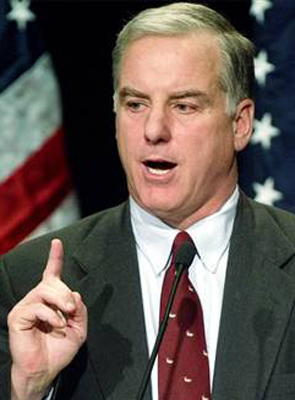
    Dean, Howard
    Democratic National Committee chairman Dr. Howard Dean (at right), who wrote an Op-Ed
    piece in The Hill backing legislation
    that would provide up to 14.5 years of data exclusivity (see "BIO CEO Provides Update on Follow-on Biologics
    Legislation
    ").  Dr. Dean argued that:

    A
    commonsense and fair approach, similar to the process and timeline currently in
    place for generic versions of chemical-based medicines, would allow the
    original developer of the biologic to protect the proprietary data used to
    develop the medicine for at least 12 years.  A shorter exclusivity period would prematurely rob biotech
    innovators of their intellectual property and destroy incentives to develop new
    cures.  Most firms would be unable
    to recoup their investments in new medicines, which ordinarily top $1 billion and
    involve 15 years of research and development.  If we discourage investment, we jeopardize the development
    of the next generation of breakthrough medicines and cures.

    PhRMA #2
    The
    Pharmaceutical Research and Manufacturers of America (PhRMA), which issued a
    statement warning that "[g]iving short shrift to incentives for innovation
    would grind to a halt uniquely American innovation, moving critically important
    R&D — and tens of thousands of U.S jobs – overseas," and stating that
    "[e]conomists and the venture capitalists whose private investments shore
    up this vital, yet vulnerable sector agree:  12 years of data protection, at a bare minimum, are needed
    to help recoup the significant development costs for biologic innovators"
    (see "PhRMA Supports Follow-on
    Biologics Regulatory Pathway Providing 12-Years of Data Exclusivity
    ").  The advocacy group representing
    pharmaceutical and biotechnology research companies noted
    that
    "[c]ompanies could still seek approval of competing biologics using their
    own data, but for those 12 years no biosimilar competitor could rely on
    innovators’ hard–earned data, collected during development that may span a
    decade, or more, to seek approval."

    Senate Seal
    Senators Orrin Hatch (R-UT), Barbara Mikulski (D-MD), Michael Enzi (R-WY), and
    Kay Hagan (D-NC), who wrote a letter to Senate majority leader Harry Reid
    (D-NV) noting that "[m]ore than 150 patient groups, research universities,
    local chambers of commerce, venture capital groups, and innovators have
    expressed strongly that a base 12 years of data exclusivity is crucial to
    ensure continued growth in the biotechnology industry and future discoveries
    that will make a difference in the lives of millions of patients," and urging
    the majority leader "to support the enactment of a pathway for the
    approval of biosimilars with a base 12·year period of data exclusivity for
    innovator biotechnology companies" (see
    "Four Senators Write in Support of 12-Year Data Exclusivity Period").

    Readers
    are encouraged to review our prior coverage of the papers and letters described
    above.

  •     By
    Donald Zuhn

    Over
    the past twelve months, Patent Docs
    has reported on a number of papers, letters, and statements that outline positions
    taken by various players in the follow-on biologics data exclusivity debate.  In view of last week's Time magazine article "How
    Drug-Industry Lobbyists Got Their Way on Health Care," which mentions that
    Duke University Prof. Henry Grabowski's oft-cited data exclusivity study was
    funded by the Pharmaceutical Research and Manufacturers of America (PhRMA) and
    two partisan patient groups (see "Time Magazine on Data Exclusivity Debate"),
    a review of these players and their positions on the issue seems timely.  Today, we summarize
    the positions of ten individuals or groups that have participated in the
    debate.  Among those who have advocated
    for shorter data exclusivity periods (i.e.,
    less than 8 years) are:

    Brill, Alex
    Alex Brill (at right), a principal at Matrix Global Advisors, LLC and former chief
    economist to the House Ways and Means Committee, who released a white paper entitled
    "Proper Duration of Data Exclusivity for Generic Biologics:  A Critique," which asserts that a
    follow-on biologics regulatory pathway providing a data exclusivity period of
    seven years would be "sufficient for maintaining strong incentives to
    innovate while fostering a competitive marketplace" (see "Former
    House Ways and Means Economist Claims 7-Year Data Exclusivity Period Is
    Sufficient
    ").
      The paper, which was
    funded by Teva Pharmaceuticals, finds fault with some aspects of an economic
    model described by Duke University economist Henry Grabowski in a paper
    published in Nature Reviews Drug
    Discovery
    , and specifically determines that a biologic's
    "break-even" point (i.e.,
    "the number of years required for an average portfolio of biologic drug
    investments to recoup all development and fixed production costs and to also
    reward the investors their expected (double-digit) rate of return") is
    just under 9 years — as opposed to Prof. Grawbowski's calculation of between
    12.9 and 16.2 years.

    Kotlikoff, Laurence
    Dr. Laurence J. Kotlikoff (at right), a professor of economics at Boston University, who authored
    a report entitled "Stimulating Innovation in the Biologics Industry:  A Balanced Approach to Marketing
    Exclusivity," which contends that Congress should look to the Hatch-Waxman
    model (which generally provides four years of data exclusivity and one year of
    approval exclusivity) when determining an appropriate exclusivity period (see "BU Economics Professor
    Releases Report on the Impact of Marketing Exclusivity on Biologics Innovation
    ").  The report, which was funded by Teva
    Pharmaceuticals USA, concludes that "[t]here are, quite simply, no
    compelling differences between the chemical-based and protein-based medication
    industries to justify deviating from a policy [embodied in the Hatch-Waxman
    Act] that has succeeded for over a quarter of a century in both dramatically
    reducing drug prices and stimulating innovation."

    National Coalition on Health Care (NCHC) • The National Coalition on Health Care (NCHC),
    which describes itself as a non-profit and "rigorously non-partisan"
    coalition comprised of more than 70 organizations, and which wrote a letter to the Senate
    Health Committee urging it "to oppose generic biologics legislation that
    contains excessive periods of exclusivity or that contains other unnecessary
    and significant barriers to generic, biologic competition."  The group concluded that "[t]he
    five year period of exclusivity provided in [Rep. Waxman's biosimilar bill]
    follows the Hatch-Waxman model and is the appropriate period of
    exclusivity," and suggested that "[a]n unnecessarily long period of
    exclusivity would . . . diminish the incentives for other companies to continue
    innovating, actually resulting in less innovation over time." (see "NCHC Sends Letter on
    Biosimilars to Senate Health Committee
    ").

    Among
    those who have advocated for longer data exclusivity periods (i.e., 10 or more years) are:

    Amgen
    Amgen Inc. Vice President and Law & Intellectual Property Officer Stuart
    Watt, who told attendees of the Biotechnology Industry Organization (BIO)
    Intellectual Property Counsels' Committee (IPCC) conference in March 2009 that
    an exclusivity period of at least 12 years is needed to provide incentives to
    innovator drug companies to continue developing new biologic drugs (see "Amgen VP Makes Case for Longer
    Exclusivity Period in Follow-on Biologics Legislation
    ").
      In support of a 12-year
    exclusivity period, Mr. Watt pointed to three factors:  the research and development costs for
    bringing a biologic drug to market ($1 billion), the average product
    development time (12-15 years), and the product development risk (1 out of 100
    candidates).

    Greenwood, Jim
    Biotechnology Industry Organization (BIO) President and CEO Jim Greenwood (at right), who stated
    that BIO supports a 14-year exclusivity period, noting that while "[l]ots
    of folks in the generic industry think it should be less," BIO was
    concerned that "if the industry does not have enough time to recover its
    investments, those investments will never be made" (see "BIO CEO Outlines Challenges for Obama Administration").

    Armitage, Robert #1
    Eli Lilly and
    Company Senior Vice President and General Counsel Robert Armitage (at right), who stated
    In an interview with the Washington Legal Foundation (WLF) that "Lilly
    has been adamant that a period of data exclusivity of 15-20 years for
    innovative products would represent the best policy choice for overall patient
    welfare," and further, that a 5-year or 10-year period of data exclusivity did not
    "make sense" in view of the safety hurdles and small number of new
    medicines coming to market (see
    "Washington Legal Foundation 'Conversations With' Series
    Examines IP Issues
    ").

    Grossman, Andrew
    In a paper primarily concerned with patent reform (as evidenced by its
    title: "Promoting Innovation
    with Patent Reform: A Memo to President-elect Obama"), Senior Legal Policy
    Analyst Andrew Grossman (at right) of The Heritage Foundation also touched on the issue of
    data exclusivity under a follow-on biologics regulatory pathway (see "Heritage Foundation Offers
    Patent Reform Proposals to the New President
    ").  Stating that "[w]ithout adequate
    data exclusivity, innovation in the biotech sector will dry up, leading to
    fewer lifesaving treatments and eroding America's leadership in this
    field," Mr. Grossman advised against "[i]mposing a short exclusivity
    period or otherwise limiting enforcement of biologic patents."  While exclusivity periods of between
    0-14 years had been proposed in various follow-on biologics bills introduced in
    the House and Senate at the time of the publication, the Heritage Foundation paper only mentions the 14-year
    period.

    IPO #2
    The Intellectual Property Owners Association (IPO) Board, which passed a resolution
    during its 2008 Annual Meeting supporting biosimilar legislation that would "promote[]
    continued innovation by providing at least 14 years of data exclusivity for an
    innovator’s biological product with additional periods of exclusivity available
    for new indications and/or for approval for use in the pediatric population (see "Follow-on Biologics News
    Briefs – No. 1
    ").

    Johnson & Johnson
    Johnson & Johnson executive director for biotechnology policy Audrey
    Philips, who contended that follow-on biologics legislation should strike "the
    right balance between saving money and still having medicines to advance in the
    future," and concluded that a 5-year exclusivity period would
    "certainly have a chilling effect on [biotech] investment" (see
    "Follow-on Biologics News Briefs – No. 3").  Instead, Ms. Philips argued for a 14-year
    exclusivity period.

    NVCA
    The National Venture Capital Association (NVCA), which released the results of a
    study conducted by Iain Cockburn, Professor of Finance and Economics at
    the Boston University School of Management, and Josh Lerner, Professor of
    Investment Banking at the Harvard University School of Business, suggesting
    that "a data exclusivity period of at least 12 years for innovator
    products is a critical fulcrum in the effort to balance cost with the preservation
    of biotech innovation" (see
    "NVCA Study Supports 12-Year Data Exclusivity Period").  In particular, the NVCA concludes that
    "the exclusivity period should be at least 12 years so that investors in
    innovation can exceed the [cost of capital] hurdle rate," and states that
    a 7-year data exclusivity period "would not be long enough to clear the
    20% hurdle rate for investing in early stage companies," and would
    "drastically reduce such investments and thwart future innovation in a
    meaningful way."

    Readers
    are encouraged to review our prior, more detailed coverage of the paper, letters, and statements described
    above.

  •     By Kevin E. Noonan

    Just when you thought . . . it was safe to ignore
    patent reform, and fresh off a concerted push from the new Commerce Secretary,
    the new Patent and Trademark Office Director, and the new Deputy Director for
    patent reform that includes fee setting and substantive rulemaking authority, a
    Senate insider told a group of assembled patent attorneys and their clients
    that there is an 70-80% chance that the Senate will pass a bill this year
    (early next year at the latest).  And the bill won't look much different from S. 515, the bill voted out of
    the Judiciary Committee in May.

    BIO IPCC This news came from Joseph Matal, Republican
    General Counsel, Senate Judiciary Committee, the after-dinner speaker at the IP
    Counsels Committee Conference hosted by the Biotechnology Industry Organization
    (BIO) in Washington, DC.  Mr. Matal
    shared his views that the opposing voices in the Senate will "reach a deal"
    on the bill, with some minor changes, and that the House would ultimately accept the bill as passed
    by the Senate.

    He characterized H.R. 1908 that was passed almost
    two years ago as a "terrible bill" that the big manufacturers in the
    high tech industry — Intel, Microsoft, Cisco and others in the (oxymoronic)
    Coalition for Patent Fairness (CPF) — not only supported but practically wrote, and
    said that these companies "did enough fundraisers that they thought they
    would ram it through."  Fortunately, he said, the Founders wisely conceived of the Senate, which
    fulfilled its constitutional role as "a killing field" for a bad bill,
    one that had some "bad provisions that would have done real damage to U.S.
    economy in the medium and far term."  He characterized S. 515 as a "real compromise" where "most
    of the noxious provisions were removed entirely or made inoffensive" in
    the form voted out of the Judiciary Committee.

    Mr. Matal garnered his first round of applause when
    he announced that, with regard to proposed provisions in the bill granting
    substantive rulemaking authority to the Patent Office, it "ain't gonna
    happen."  Regarding other provisions,
    he shared the following insights on the probable final form of the bill:

    • Inequitable conduct:  there is a "slim chance" that the bill will
    contain any extensive reform of inequitable conduct.  This he attributed to the last two election cycles, saying "elections
    have consequences," and while it wasn't as simple as saying Republicans
    supported innovator pharma while Democrats support generic pharma, it would
    have been possible to "wipe out" inequitable conduct 2 elections and
    15 Republican Senators ago, but not now.

    Congress However,
    he did say that Senator Hatch was insisting on a form of reissue proceeding, to
    be called "supplemental examination," which would permit a patentee
    to submit art to the Office that had not been submitted during initial examination.  New submissions would be limited to
    patents and printed publications, and submitting a patent to this reissue
    procedure would preclude inequitable conduct from being raised in any
    subsequent litigation.  However,
    there would be procedural limitations, such as having to complete the reissue
    process before litigation commenced, so that there would be a risk of laying
    out an inequitable conduct case for a defendant if a patentee was forced to
    litigate before completing reissue. 
    These provisions would not apply in the same way for declaratory
    judgment actions, so a potential defendant could not force a patentee in
    reissue to lose the protections provided by submitting unconsidered art to the
    Office.

    The way the Senate works, according to Mr. Matal,
    the fact that Senator Hatch is insisting on these provisions makes it likely
    that something along these lines will be in the final bill.

    • Post-grant review:  Mr. Matal recounted the story of what happened after the
    House passed its patent "reform" bill two years ago (H.R. 1908) that
    contained post-grant review provisions.  It seemed that several Patent Office officials, including Mr. Toupin and
    Mr. Love came to the Hill and explained that the post-grant provisions in the
    bill were "unadministrable."  Moreover, they told members
    of Congress that if the bill passed into law, they would be inundated by
    petitions and would "never dig themselves out" of the ensuing
    backlog.  Mr. Matal worked for
    Senator Kyl at the time, and in looking into the matter found that no one in
    the House had consulted with the PTO on whether the Office could handle the
    post-grant provisions in the bill.  This work was the basis for Senator Kyl's bill introduced at the end of
    the last Congress, and provided the Senator and Mr. Matal with the hope that
    S. 515 would have better language.  He described the goal as coming up with a system that "strikes a
    reasonable balance" between the interests of patentees and
    requestors.  He also ventured the
    opinion that it was a fair question whether inter
    partes
    reexam is a good idea in the first instance, saying that it is a
    reasonable position that litigation should be the way to resolve these
    issues.  However, he said Senator
    Kyl agreed that this was too radical a position that wouldn't be politically
    possible to enact.

    Unfortunately,
    as it turns out the language in S. 515 is the same as the language in H.R. 1908,
    and Senator Kyl's amendment directed at "striking a balance" was
    defeated 4-15 in committee.  However, since then Senators committed to having different language —
    describing a system that was developed in consultation with PTO officials —
    have been lobbying ("It's the Senate") the leadership to convince
    Senator Leahy to consider changing the language; Director Kappos has also
    gotten involved.  Mr. Matal
    conceded that he wasn't privy to the discussions between Majority Leader Reid
    and Senator Leahy, but that he thought "what we are waiting for" was
    some movement on Senator Leahy's part to negotiate alternative language
    acceptable to the Senators and the Patent Office.

    What
    could that language look like?  It
    would likely remove the "could have raised" estoppel provisions in
    the current inter partes
    reexamination statute, and would also remove the preclusion of pre-1999 patents
    from the inter partes reexamination
    regime.  However, in return
    patentees would get a higher threshold for initiating reexamination, requiring
    a showing of a prima facie case of
    invalidity — evidence that, if unrebutted, would be sufficient to invalidate a
    patent.  While describing this
    change as being good for patentees, he also said it was considered good for the
    Patent Office, which is inundated with requests that are granted about 95% of
    the time under the current threshold showing standard.  In addition, there would be a sharp limit
    on "successive proceedings," i.e.
    patents undergoing repetitive inter partes reexaminations.  (He noted in this regard that Patent
    Office statistics showed that "successive" inter partes reexamination requests constituted 25% of the total in
    2008.)  The bill would permit one inter partes reexamination, after which
    any challenge would be by litigation.  Initiating a reexamination for patents in litigation would also be
    limited to a time early in the litigation, to prevent defendants from adopting
    a "go long" strategy for a case that was going badly.  Finally, the Office has agreed to a
    12-month time limit on reexaminations, and has identified procedural changes
    to be instituted to achieve this goal.

    • Best mode:  would remain in the statute, but
    be unavailable in litigation to invalidate a patent.

    • Venue:  to be limited to codification of the TS Tech case, at the insistence of
    Senator Cornyn of Texas.

    • Damages:  "specific contribution over
    the prior art" and apportionment are not going to get back into the bill
    (for at least the reason that not even proponents could satisfactorily
    define what was meant by the former language, and "if you don't know what
    legislative language means, you shouldn't enact it").  There might be some provisions for
    enhanced Daubert-like considerations
    of how damages are calculated, and some practices prohibited (such as
    subjecting a defendant to questioning over the size of its liability before a
    patentee has established infringement and defeated any invalidity challenges —
    something that Mr. Matal says makes the defendant "look guilty" and
    isn't fair).  Practices "at
    the margins" that have this quality of unfairness might be proscribed by
    the bill, but he expects no big changes on the grand compromise cobbled
    together by Senators Leahy, Specter and Feinstein.

    Mr. Matal finished his remarks by noting that the
    CPF and others may want changes in the bill, and may resist supporting the bill
    in the hopes of getting such changes, but that in his view the amended bill —
    which he has shown only to PTO management — can be expected to be passed in
    this Congress.

  •     By
    Donald Zuhn

    Time A
    report in last week's Time magazine focuses
    on the ongoing debate over "an obscure but crucial health-care provision":  follow-on biologics data exclusivity —
    the period of time that generic biologic manufacturers would have to wait
    before they are allowed to use an innovator's data to secure FDA approval for
    their generic biologics, or biosimilars, under a follow-on biologics regulatory
    pathway.  The article, entitled
    "How Drug-Industry Lobbyists Got Their Way on Health Care,"
    examines the reasons behind the passage, by the House Committee on Energy and
    Commerce, of a health care reform amendment that would prevent the FDA from
    approving a biosimilar application until 12 years after the date on which the
    reference product — the innovator biologic — was first licensed (see "House Committee Approves
    Health Care Reform Bill Calling for 12-Year Exclusivity Period
    ").  (The Senate Health, Education, Labor
    and Pensions (HELP) Committee has approved a similar amendment; see "Senators Champion 12-Year Data
    Exclusivity in Senate
    .")

    Congress The
    Time article nicely characterizes the
    dilemma facing both the House and Senate on the data exclusivity issue, stating that
    legislators are trying to balance the need "to foster cost-saving
    competition without killing the financial incentives that have put the U.S.
    biotechnology industry at the vanguard of medical science and without stifling
    the development of even more drugs that could save lives and eliminate
    suffering."  However, while acknowledging
    the adverse consequences that might result if Congress chooses the
    "wrong" data exclusivity period, the article seems to side with Rep.
    Henry Waxman (D-CA), who favors a 5-year data exclusivity period, and the generic
    drug manufacturers rather than with innovator companies and their army of lobbyists.  With respect
    to the passage of a 12-year data exclusivity period by the House Committee on
    Energy and Commerce — a Committee chaired by Rep. Waxman — the article argues
    that "Waxman's loss . . . was a big victory for drug companies, which have
    spent more than any other segment of the medical industry to make sure that
    they come out winners in the effort to overhaul the nation's health-care
    system."  The article notes
    that biotech/pharma companies and their trade associations utilized 1,288
    lobbyists and spent more than $110 million in the first six months of the year lobbying
    lawmakers.  In a paragraph at the
    end of the article, Teva Pharmaceutials' expenditure of $2 million on lobbying
    is mentioned, but lobbying efforts by the rest of the generic industry or its
    trade associations (such as the Generic Pharmaceutical Association, where Rep.
    Waxman spoke on September 18th and back in February; see "Congressman Waxman Tells GPhA Meeting that Hatch-Waxman
    Model Will Work for Follow-on Biologics
    ")
    are not explored.

    In
    addition to Rep. Waxman's call for a 5-year data exclusivity period, the
    article discusses the Obama Administration's support for a 7-year period (see "White House Recommends 7-Year
    Data Exclusivity Period for Follow-on Biologics
    ")
    and the FTC's support for no data exclusivity period (see "No One Seems Happy with Follow-on Biologics According to
    the FTC
    ").  The article also
    mentions the study conducted by Duke University Prof. Henry Grabowski (see "Professor Grabowski's Economic
    Analysis of Data Exclusivity for Follow-on Biologic Drugs
    "), which is frequently
    cited in support of double-digit exclusivity periods, but notes that Prof.
    Grabowski's study was funded by the Pharmaceutical Research and Manufacturers
    of America (PhRMA) and two patient groups:

    One,
    called RetireSafe, receives regular infusions of "general operating
    support" from Pfizer and operates out of a small Washington law-firm
    office.  . . .  The other group, the Alliance of Aging
    Research, is also run by the drug industry. Its chairman is the managing
    partner of Foxkiser, a drug-company consultant, and its vice chairman is with
    Novartis.

    The
    Time article does not mention,
    however, that Prof. Grawbowski's study remains the only peer-reviewed analysis
    of the topic.

  •     By Suresh Pillai

    Teva
    Loses Bid For Dismissal of Famciclovir Infringement Suit

    Novartis Last week, the U.S. District Court for the District
    of New Jersey denied Teva Pharmaceutical's bid to have
    Novartis Pharmaceuticals'
    patent infringement suit dismissed for lack of plaintiff standing.  Novartis and two of its subsidiaries
    filed the original lawsuit in 2005 after Teva had filed an Abbreviated New Drug
    Application (ANDA) with the FDA in which it sought permission to market and manufacture
    a generic version of Novartis' famciclovir-based herpes treatment.  In its complaint, Novartis alleged that
    Teva's proposed product would infringe U.S. Patent No. 5,246,937,
    the patent covering famciclovir formulations and methods of treatment.  Teva countered, alleging that the '937
    patent was invalid for obviousness as well as unenforceable due to inequitable
    conduct by the inventors before the U.S. Patent and Trademark Office
    during prosecution.

    Teva In its most recent motion, Teva argued that
    Novartis Corp. and Novartis Pharma AG both lacked standing to sue because
    Novartis International Pharmaceutical Ltd. was the true patent holder of the '937
    patent.  Teva further
    argued that, as Novartis International was a patent holding company and not a
    manufacturer, Novartis International was unlikely to succeed in showing
    irreparable harm.  The District Court,
    however, concluded that it did not have sufficient facts to conclude the
    standing issue.  As the Court found
    that there was an issue of fact as to whether Novartis subsidiaries owned
    exclusive licenses via an implied license agreement or were titleholders to the
    '937 patent, the Court concluded that the issue should be determined by the
    trier of fact in the case.


    Allergan
    Prevails in Alphagan® P Infringement Suit

    Allergan The U.S. District Court for the District
    of Delaware has ruled that proposed products by Apotex Inc.
    and Exela PharmSci Pvt. Ltd. infringed the asserted claims of patents from
    Allergan Inc.
    covering glaucoma treatments.  The
    patents-in-suit, U.S. Patent Nos. 6,627,210,
    6,673,337,
    6,641,834,
    6,562,873,
    and 5,424,078,
    all cover formulations for Alphagan® P,
    Allergan's ophthalmic solution for the treatment of glaucoma.  The defendants had asserted noninfringement of the
    patents-in-suit, and that the patents-in-suit were invalid on grounds of obviousness,
    nonenablement, indefiniteness, lack of an adequate written description, lack of
    utility, incorrect inventorship, and operability
    (see "Court Report,"
    April 23, 2007).  Expert testimony from witnesses for Exela
    also tried to emphasize differences between the products from both
    companies.

    Apotex #1 However, the District Court found all of the patents to be
    valid and infringed.  Although Exela
    provided valid expert testimony to the contrary with regard to infringement,
    the Court concluded that the testimony offered was insufficient to rebut
    Allergan's evidence of infringement.  Exela's case was also harmed by expert testimony provided by their
    co-defendant, as the Court stated that Allergan's case was bolstered by expert
    testimony offered by Apotex.

  •     By Sherri Oslick

    Gavel_2About
    Court Report:  Each week we will report briefly on recently filed
    biotech and pharma cases, and a few interesting cases will be selected
    for periodic monitoring.


    Wyeth v. Intervet Inc. et al.
    1:09-cv-00780; filed October 20, 2009 in the
    District Court of Delaware

    • Plaintiff:  Wyeth
    • Defendants:  Intervet Inc. d/b/a
    Intervet/Schering-Plough Animal Health; Boehringer Ingelheim Vetmedica
    Inc.

    Infringement of U.S. Patent No. 7,604,808 ("Circovirus
    Sequences Associated with Piglet Weight Loss Disease," issued October 20,
    2009) based on defendants' manufacture and sale of their Circumvent® PCV,
    Porcilis® PCV, and CircoFLEX® vaccines (porcine circovirus vaccines).  View the complaint
    here.


    Purdue Pharma L.P. et al. v. Ranbaxy Inc. et al.
    1:09-cv-08878; filed October 20, 2009 in the
    Southern District of New York

    • Plaintiffs:  Purdue Pharma L.P.; P.F.
    Laboratories, Inc.; Purdue Pharmaceuticals L.P.
    • Defendants:  Ranbaxy Inc.; Ranbaxy Pharmaceuticals
    Inc.; Ranbaxy Laboratories Ltd.

    Infringement of U.S. Patent No. 5,508,042 ("Controlled
    Release Oxycodone Compositions," issued April 16, 1996) following a Paragraph IV certification as part of Ranbaxy's filing of an ANDA to manufacture
    a generic version of Purdue Pharma's OxyContin® (controlled release oxycodone
    hydrochloride, used to treat pain).  View the complaint
    here.


    Gen-Probe Inc. v. Becton Dickinson & Co.
    3:09-cv-02319; filed October 19, 2009 in the Southern
    District of California

    Infringement of U.S. Patent Nos. 7,560,256 ("Automated
    Process for Detecting the Presence of a Target Nucleic Acid in a Sample,"
    issued July 14, 2009), 7,560,255 (same title, issued July 14, 2009), 7,524,652
    (same title, issued April 28, 2009), 7,482,153 (same title, issued January 27,
    2009), 7,118,892 ("Automated Process for Preparing and Amplifying a Target
    Nucleic Acid Sequence," issued October 10, 2006), 5,612,200 ("Method
    and Kit for Destroying Ability of Nucleic Acid to be Amplified," issued
    March 18, 1997), 7,294,308 ("Penetrable Cap," issued November 13,
    2007), and 6,893,612 (same title, issued May 17, 2005) based on BD's
    manufacture and sale of its "Viper" and "Viper with XTR
    Technology" nucleic acid testing systems and companion nucleic acid
    diagnostic assays and its ProbeTec Female Endocervical and Male Urethral
    Specimen Collection Kits for Amplified Chlamydia tracomatis/Neisseria
    gonorrhoeae (CT/GC) DNA Assays.  View the complaint
    here.


    Centre National De La Recherche Scientifique v. Kappos
    1:09-cv-01969; filed October 19, 2009 in the
    District Court of the District of Columbia

    Review and correction of the patent term adjustment
    calculation made by the U.S. Patent and Trademark Office for U.S. Patent No.
    7,521,212 ("Method for Producing Oligopolysaccharides," issued April
    21, 2009).  View the complaint
    here.


    Bayer Healthcare LLC et al. v. Wedgewood Village Pharmacy, Inc.
    1:09-cv-05345; filed October 19, 2009 in the
    District court of New Jersey

    • Plaintiffs:  Bayer Healthcare LLC; University of
    Kentucky Research Foundation; New Ace Research Co.
    • Defendant:  Wedgewood Village Pharmacy, Inc.

    Infringement of U.S. Patent No. 5,883,095 ("Formulations
    and Method to Treat and
    Prevent Equine Protozoal Myeloencephalitis," issued March 16, 1999) based
    on Wedgewood's manufacture and sale of its Toltrazuril product (triazine-based
    anti-coccidial, used to treat and prevent equine protozoan myeloncephalitis in
    horses).  View the complaint
    here.


    Sandoz Inc. v. Pfizer, Inc. et al.
    1:09-cv-02457; filed October 16, 2009 in the
    District Court of Colorado

    • Plaintiff:  Sandoz Inc.
    • Defendants:  Pfizer, Inc.; Pfizer Ireland
    Pharmaceuticals; C.P. Pharmaceuticals International C.V.; Warner-Lambert
    Co.; Warner-Lambert Co. LLC

    Declaratory judgment of invalidity and
    non-infringement of U.S. Patent Nos. 6,126,971 ("Stable Oral CI-981 Formulation
    and Process for Preparing Same," issued October 3, 2000), 5,969,156 ("Crystalline
    [r- (R*,R*)]-2-(4-DFluorophenyl)-b,δ-Dihydroxy-5-(1-Methylethyl)-3-Phenyl-4-[(Phenylamino)Corbonyl]-1HPyrrole-1Heptanoic
    Acid Hemi Calcium Salt (Atorvastatin)," issued October 19, 1999), and
    5,686,104 ("Stable Oral CI-981 Formulation and Process of Preparing Same,"
    issued November 11, 1997) based on Sandoz's filing of an ANDA to manufacture a
    generic version of Pfizer's Caduet® (atorvastatin calcium — the active
    ingredient in Lipitor® — and amlodipine besylate — the active ingredient in
    Norvasc® — used to treat high cholesterol in combination with treating
    hypertension, angina, and/or coronary artery disease).  View the complaint
    here.


    Rockefeller University v. Kappos
    1:09-cv-01959; filed October 16, 2009 in the
    District Court of the District of Columbia

    Review and correction of the patent term adjustment
    calculation made by the U.S. Patent and Trademark Office for U.S. Patent No.
    7,521,258 ("Methods of Detecting, Measuring, and Evaluating Modulators of
    Body Weight in Biological Samples, and Diagnostic, Monitoring, and Therapeutic
    Uses Thereof," issued April 21, 2009).  View the complaint
    here.  [NB: This case was stayed upon plaintiff's consent pending
    final disposition of the appeal of the decision in Wyeth v. Dudas, 580 F. Supp. 2d 138 (D.D.C. 2008), which is now
    pending before the U.S. Court of Appeals for the Federal Circuit, No.
    2009-1120.]


    Hoffmann-La Roche Inc. v. Teva Pharmaceuticals USA, Inc. et al.

    2:09-cv-05283; filed October 16, 2009 in the District
    Court of New Jersey

    • Plaintiff:  Hoffmann-La Roche Inc.
    • Defendants:  Teva Pharmaceuticals USA, Inc.; Teva
    Pharmaceutical Industries Ltd.

    Infringement of U.S. Patent No. 5,472,949 ("N4-(Substituted-Oxycarbonyl)-5'-Deoxy-5-Fluorocytidine Compounds, Compositions and
    Methods of Using Same," issued December 5, 1995) following a Paragraph IV
    certification as part of Teva's filing of an ANDA to manufacture a generic
    version of Roche's Xeloda® (capecitabine, used to treat breast and colorectal
    cancer and Dukes' C Stage III colon cancer).  View the complaint
    here.


    Teva Pharmaceuticals USA, Inc. et al. v. Mylan Pharmaceuticals
    Inc. et al.

    1:09-cv-08824; filed October 16, 2009 in the
    Southern District of New York

    • Plaintiffs:  Teva Pharmaceuticals USA, Inc.; Teva
    Pharmaceutical Industries, Ltd.; Teva Neuroscience, Inc.; Yeda Research and
    Development Co. Ltd.
    • Defendants:  Mylan Pharmaceuticals Inc.; Mylan
    Inc.; Natco Pharma Ltd.

    Infringement of U.S. Patent Nos. 7,199,098 ("Copolymer-1
    Improvements in Compositions of Copolymers," issued April 3, 2007),
    6,939,539 (same title, issued September 6, 2005), 6,054,430 (same title, issued
    April 25, 2000), 6,620,847 (same title, issued September 16, 2003), 5,981,589
    (same title, issued November 9, 1999), 6,342,476 (same title, issued January
    29, 2002), and 6,362,161 (same title, issued March 26, 2002) following a Paragraph
    IV certification as part of Mylan's filing of an ANDA to manufacture a generic
    version of Teva's Copaxone® (glatiramer acetate injection, used for the reduction
    of frequency of relapses in patients with relapsing-remitting multiple
    sclerosis).  View the complaint
    here.


    Banyu Pharmaceutical Co. Ltd. et al. v. Kappos
    1:09-cv-01955; filed October 15, 2009 in the
    District Court of the District of Columbia

    • Plaintiffs:  Banyu Pharmaceutical Co. Ltd; Merck
    Sharp & Dohme Research Ltd.; Merck & Co., Inc.
    • Defendant:  David Kappos

    Review and correction of the patent term adjustment
    calculation made by the U.S. Patent and Trademark Office for U.S. Patent No.
    7,521,455 ("Fused Ring 4-Oxopyrimidine Derivative," issued April 21,
    2009).  View the complaint
    here.


    Elan Pharma International Ltd. et al. v. Anchen
    Pharmaceuticals Inc. et al.

    8:09-cv-01193; filed October 14, 2009 in the
    Central District of California

    • Plaintiffs:  Elan Pharma International Ltd.;
    Jazz Pharmaceuticals Inc.
    • Defendants:  Anchen Pharmaceuticals Inc.; Anchen
    Inc.

    Infringement of U.S. Patent No. 7,456,462 ("Multiparticulate
    Controlled Release Selective Serotonin Reuptake Inhibitor Formulations,"
    issued December 16, 2008) following a Paragraph IV certification as part of
    Anchen's filing of an ANDA to manufacture a generic version of Jazz's Luvox® CR
    (fluvoxamine maleate, used to treat social anxiety disorder and obsessive
    compulsive disorder).  View the
    complaint
    here.


  • CalendarOctober 26-28, 2009 – Intellectual Property Counsels' Committee (IPCC) Fall Conference & Meeting (Biotechnology Industry Organization) – Washington, DC

    November 9-10, 2009 – Patent Litigation 2009 (Practising Law Institute) – Atlanta, GA

    November 9-11, 2009 – Developing
    IP Strategies for Crystalline Forms
    *** (
    International
    Quality & Productivity Center) –
    London,
    England

    November 10, 2009 – The Patent Cooperation Treaty (PCT): Important Tool for Small and Medium-Sized Enterprises (SMEs) and Independent Inventors (World Intellectual Property Organization) – Baltimore, MD

    November 12-13, 2009 – Paragraph IV on Trial*** (American Conference
    Institute) – New York, NY

    November 13, 2009 – The Patent Cooperation Treaty (PCT): Important Tool for Small and Medium-Sized Enterprises (SMEs) and Independent Inventors (World Intellectual Property Organization) – Las Vegas, NV

    November 16-17, 2009 – Patent Litigation 2009 (Practising Law Institute) – New York, NY

    November
    17-18, 2009 –
    Structuring,
    Negotiating, and Managing Pharma/Biotech Collaborative Agreements
    (
    American Conference
    Institute) – New York, NY

    December 7, 2009 – 20th Annual Conference on U.S. Patent and
    Trademark Office Law and Practice (PTO Day)
    (
    Intellectual Property Owners Association (IPO) and U.S. Patent and Trademark
    Office) – Washington, DC

    December 7-8, 2009 – Foreign Patent Law &
    Regulation
    ***
    (American Conference
    Institute) – New York, NY

    ***Patent Docs is a media partner of this conference or CLE

  •     By
    Donald Zuhn

    NVCA On
    Tuesday, the National Venture Capital Association (NVCA), a trade association
    representing the U.S. venture capital industry, released the results of its latest
    venture funding study.  The study,
    conducted with PriceWaterhouseCoopers and Thomson Reuters, indicates that
    venture capitalists invested $4.8 billion in 637 deals in the third quarter of
    2009, a 17% increase in dollars and 3% decrease in deals as compared to the
    second quarter of 2009.

    Thomson Reuters According
    to the study, the Life Sciences sector, which comprises the biotechnology
    and medical device industries, had a "solid quarter" relative to
    other industry sectors.  In particular, the
    biotech industry, which received the highest level of funding in the third quarter,
    secured $905 million in 104 deals (a 4% decrease in dollars and a 16% increase
    in deals relative to the second quarter), and the medical device industry received $617 million in 71 deals (a 6% decrease in dollars and 15% decrease in deals). 
    In contrast, the Software sector dropped to its lowest level of funding
    since 1996, and ten of the 17 sectors examined by the NVCA experienced dollar
    declines in the third quarter, including Semiconductors (14% decline; a 10-year
    low), Healthcare Services (57% decline), Computers and Peripherals (40%
    decline) and Telecommunications (17% decline).

    PricewaterhouseCoopers (PWC) Tracy
    Lefteroff, the global managing partner of the venture capital practice at PricewaterhouseCoopers
    called the increase in third quarter venture capital funding "very
    encouraging," and predicted that the pace of investing would "continue
    to strengthen over the next several quarters as long as the IPO markets begin
    to open up and M&A activity increases."

    Additional
    information regarding the study can be found here.

    Quarterly Venture Funding