•     By
    Sarah Fendrick

    USPTO Seal In
    an effort to reduce the backlog of unexamined patent applications pending
    before the U.S. Patent and Trademark Office, the Office has implemented a procedure that allows small
    entities to have an application accorded special status examination if the
    applicant expressly abandons another co-pending unexamined application.  In a Federal Register
    notice
    issued on November 27, 2009, the Office explains that "this procedure
    will allow small entity applicants to have greater control over the priority
    with which their applications are examined while also stimulating a reduction
    of the backlog of unexamined patent applications pending before the USPTO."

    As
    detailed in the notice, the USPTO will accord special status for examination under
    the following conditions:

    (1)  The application for which special status is sought is a nonprovisional
    application that has an actual filing date earlier than October 1, 2009, in
    which the applicant has established small entity status under 37 C.R.F. § 1.27;

    (2)  The applicant has another copending nonprovisional application that has an
    actual filing date earlier than October 1, 2009, and is complete under 37 C.F.R.
    § 1.53 (i.e., the application contains
    an executed oath or declaration and the filing fee, search fee, examination
    fee, any applicable application size fee, and any applicable excess claims fee
    have been paid);

    (3)  The application for which special status is sought and the
    other copending nonprovisional application either are owned by the same party
    as of October 1, 2009, or name at least one inventor in common;

    (4)  The
    applicant files a letter of express abandonment under 37 C.F.R. § 1.138(a), signed
    in compliance with 37 C.F.R. § 1.33(b)(1), (b)(3), or (b)(4) (37 C.F.R. § 1.138(b)), in
    the copending nonprovisional application before it has been taken up for
    examination and includes with the letter of express abandonment a statement
    that the applicant has not and will not file an application that claims the
    benefit of the expressly abandoned application under any provision of Title 35 of the
    United States Code, and that the applicant agrees not to request a refund of
    any fees paid in the expressly abandoned application; and

    (5)  The applicant
    files a petition under 37 C.F.R. § 1.102 in the application for which special status
    is sought.  The petition under 37
    C.F.R. § 1.102 must identify the basis under which special status is being sought
    (express abandonment of another copending application) and include a copy of a
    letter of express abandonment and the statement that accompanies the letter of
    express abandonment from the copending application has been expressly abandoned
    .

    Generally
    applications that are accorded special status will be placed on an examiner's
    special docket throughout the entire course of prosecution.  Applications that are accorded special
    status under the procedure will be placed on the examiner's special docket,
    prior to the first office action and will have special status for appeals and
    the patent publication process, but will be placed on the examiner's amended
    docket following the first office action.  Continuing applications will not automatically be granted special
    status, rather each application must individually meet the conditions provided
    in the notice.

    The
    procedure is being temporarily implemented and will only be effective until
    February 28, 2010.  Upon review,
    the Office may extend the procedure in time or may extend the set of applicants
    that will be able to file for special status under the procedure.  To be granted
    special status under the procedure, the petition under 37 C.F.R. § 1.102 and the
    letter of express abandonment and its accompanying statement must be filed on
    or before February 28, 2010.

  •     By
    Donald Zuhn

    Federal Circuit Seal In
    anticipation of tomorrow's oral argument in the rehearing en banc of Ariad
    Pharmaceuticals, Inc. v. Eli Lilly & Co.
    (scheduled to begin at 2:00 pm
    (EST) in Courtroom 201), Patent Docs has
    spent the past three weeks reviewing a number of the briefs submitted by
    various amici.  By the November 20th filing deadline,
    twenty-five amicus briefs had been
    submitted (by our count), with nineteen briefs filed in support of
    Defendant-Appellant-Respondent Eli Lilly & Co. and/or judgment of affirmance, six
    briefs filed in support of neither party, and no amicus briefs filed in support
    of Plaintiffs-Appellees-Petitioners Ariad Pharmaceuticals, Inc., Massachusetts
    Institute of Technology, the Whitehead Institute for Biomedical Research, and
    the Presidents and Fellows of Harvard College ("Ariad").  Amici
    supporting Lilly and/or affirmance include:

    • Abbott Laboratories
    (see Patent Docs report);
    • The American Intellectual
    Property Law Association (AIPLA) (see
    Patent Docs
    report
    );
    • Amgen Inc. (
    see Patent Docs report);
    • Professor Christopher A.
    Cotropia
    (brief);
    • The Federal Circuit Bar
    Association (see Patent Docs report);
    • GlaxoSmithKline (see Patent Docs report);
    • Google Inc., Verizon
    Communications Inc., and Cisco Systems, Inc. (see Patent Docs report);
    • Hynix Semiconductor Inc.
    and Samsung Electronics Co., Ltd. (
    see Patent Docs report);
    • The Intellectual Property
    Owners Association (IPO) (see Patent Docs
    report
    );
    • Oskar Liivak
    (brief);
    • Medtronic, Inc. (
    see Patent Docs report);
    • Microsoft Corp. (
    see Patent Docs report);
    • Monsanto Co. (
    see Patent Docs report);
    • Public Patent Foundation
    (PUBPAT)
    (brief);
    • RealNetworks, Inc.
    (
    see Patent Docs report);
    • The Regents of the
    University of California, Wisconsin Alumni Research Foundation, The University
    of Texas System, University of Rochester, Rensselaer Polytechnic Institute,
    STC.UNM, The Research Foundation of State University of New York, NDSU Research
    Foundation, and Research Corporation Technologies, Inc. (discussed below);
    • United States (see Patent Docs report);
    • Washington Legal
    Foundation
    (brief); and

    William Mitchell College of Law (
    brief).

    Amici supporting neither party
    include:

    • Professor Christopher M.
    Holman (see Patent Docs report);
    • Mark D. Janis and Timothy
    R. Holbrook
    (brief);
    • Dr. Roberta J. Morris
    (brief);
    • The New York Intellectual
    Property Law Association
    (brief);
    • Novozymes A/S (
    see Patent Docs report);
    and
    • University of Kentucky
    Intellectual Property Law Society, Universal Support Systems LLC, Polymer Construction
    Products Ltd., and Safeteccs LLC
    (brief).

    University of California On
    the eve of oral argument, we examine the
    amicus brief filed by The Regents of the University of California, Wisconsin Alumni
    Research Foundation, The University of Texas System, University of Rochester,
    Rensselaer Polytechnic Institute, STC.UNM, The Research Foundation of State
    University of New York, NDSU Research Foundation, and Research Corporation
    Technologies, Inc. in support of affirmance of judgment.  The university amici begin their brief by describing written description as a
    doctrine once used only to police claims to priority of invention,
    but having "evolved judicially into a separate and oftentimes insurmountable
    requirement, particularly when applied to biological inventions."  The amici
    argue that "[t]he Federal Circuit's creation of this separate barrier to patentability
    . . . effectively imposes an actual reduction to practice requirement on
    biotechnology inventions," and that "[s]uch a requirement prejudices universities
    and research institutions that do not have the resources to reduce each
    pioneering biotechnological innovation to a 'precise definition.'"

    Stating
    that "[t]here is no statutory support and certainly no policy rationale
    for the technology-specific impact the current written description law has on
    the university and scientific research community," the university amici contend that:

    [T]he current incarnation of written description is not only at odds with the
    Federal Circuit's
    own jurisprudence bestowing broader patent protection to pioneering inventions,
    it muddies clear federal policy with respect to the role of the patent
    system.  Patent exclusivity granted
    for pioneering biological inventions fuels the creation and recruitment of
    commercial entities willing to undertake the huge investments necessary to
    refine and develop foundational university research into medical and
    biopharmaceutical products widely accessible to the general public.

    The
    amici suggest that the Federal
    Circuit "take the opportunity now to realign the written description law
    with the constitutional, statutory, and policy rationales that underlie the
    patent system, and return the doctrine to its proper role of assessing new
    matter rejections and claims to priority."

    In
    arguing that § 112, first paragraph, does not contain a written description
    requirement separate from the enablement requirement, the university amici spend some time discussing In re Ruschig, 379 F.2d 990 (CCPA 1967),
    a decision the amici contend was not
    based on § 112, but rather concerned the issue of whether a new claim added
    during prosecution was properly rejected as new matter.  The university amici believe it is "noteworthy that the cases after Ruschig
    purporting to
    apply a separate written description requirement were limited
    to
    those involving (1) the presentation of claims not presented in the
    application
    when originally filed, (2) entitlement to the benefit of an earlier
    filing
    date for claims in a later-filed application, and (3) interference
    proceedings,"
    adding that "[e]ach of those 'written
    description' cases
    involved evaluating the sufficiency of the claims in
    accordance
    with statutes governing a patent claim's entitlement to priority
    and
    the prohibition against adding new matter."  Noting the written description case for which one of the amici is closely associated, especially in the minds of biotech practitioners (i.e., The Regents of the University of California
    is v. Eli Lilly & Co.
    , 119 F.3d 1559 (Fed. Cir. 1997)), the brief states
    that:

    It was not until Lilly that a truly
    separate written description requirement — untethered to any other patent
    statute — was first created.  Beyond
    evaluating the sufficiency of claims added during prosecution, written
    description became a device for evaluating the sufficiency of disclosures in
    already-issued patents.  There was,
    however, no statutory change or legislative pronouncement to justify departing
    from the previous thirty years of precedent that limited written description to
    its corollary function of policing priority.

    The
    university amici also argue that there
    was no need to expand written description, because through In re Wands, "[t]he enablement inquiry already considers
    factors intended to assess the sufficiency of the disclosure."

    Returning
    to the impact of a separate written description requirement on universities,
    the amici argue that the separate
    requirement "operates to prejudice inventors at universities and other
    research institutions who often make the most important basic scientific
    discoveries," as "[u]niversities do not have the resources to support
    the time and labor-intensive process of reducing every species of a genus to
    practice or describing, for example, every possible amino acid or DNA sequence
    in exhausting detail as needed to 'precisely define' and adequately describe a
    biological invention." 
    According to the university amici,
    the impact of a separate written description requirement on universities also
    frustrates federal patent policy:

    A statutory interpretation of the written description requirement that unfairly
    prejudices biotechnology and university inventions impedes . . . growth and
    frustrates the goals of the patent system.  It limits universities' ability to obtain biotechnology
    patents, depriving the public of the full economic benefits and potentially
    life-saving products that flow from licensing relationships between universities
    and private corporations.

    The
    amici also argue that a separate
    written description requirement conflicts with the broad patent scope the
    Federal Circuit has bestowed on pioneer patents, stating that "what this
    Court grants to pioneering inventions with one hand, it takes away with the
    other."  In particular, the
    university amici contend that the
    Federal Circuit has used the separate written description requirement to
    invalidate some patents, "claiming the patent disclosures do not support
    the breadth of their claims," and that "[s]uch a requirement values
    minor incremental improvements well-suited to precise description over the
    monumental advances in technology often incapable of precise written
    description."  The amici state
    that "[i]t is inconsistent for Federal Circuit jurisprudence to
    acknowledge pioneer patents' entitlement to broad claims, while applying a
    written description standard that invalidates them on those same grounds."

    The
    university amici conclude by asking
    the Federal Circuit to return the written description requirement "to its
    historic role in the priority context, ensuring that later-filed claims are supported
    by the disclosures in an earlier-filed patent application."

    For additional information regarding this topic, please see:
    • "Amicus Briefs in Ariad v. Lilly: Briefs by Companies," December 6, 2009
    • "Amicus Briefs in Ariad v. Lilly: American Intellectual Property Law Association," December 1, 2009
    • "Amicus Briefs in Ariad v. Lilly: Federal Circuit Bar Association," November 29, 2009
    • "Amicus Briefs in Ariad v. Lilly: Intellectual Property Owners Association," November 25, 2009
    • "Amicus Briefs in Ariad v. Lilly: GlaxoSmithKline," November 24, 2009
    • "Amicus Briefs in Ariad v. Lilly: United States," November 23, 2009
    • "Amicus Briefs in Ariad v. Lilly: Google, Verzion Communications Inc. and Cisco Systems, Inc.," November 22, 2009
    • "Amicus Briefs in Ariad v. Lilly: Professor Christopher Holman," November 19, 2009
    • "Lilly Files Principal Brief for Ariad v. Lilly Rehearing En Banc," November 16, 2009
    • "Next Up: Ariad v. Lilly Rehearing En Banc," November 10, 2009
    • "Federal Circuit Grants En Banc Review in Ariad v. Lilly," August 21, 2009
    • "Ariad Files Petition for Rhearing in Ariad v. Lilly," June 3, 2009
    • "Ariad Decision Voids Attempt to Use Broad Claiming to Avoid the Written Description Requirement," April 14, 2009
    • "Ariad Pharmaceuticals, Inc. v. Eli Lilly and Co. (Fed. Cir. 2009)," April 6, 2009

  •     By Kevin E. Noonan

    Several companies have filed amicus curiae briefs
    with the Federal Circuit on the questions presented by the en banc Court in the Ariad
    case.  Although we have explored
    the positions taken by some of these companies in detail, on
    the eve of oral argument, we set forth here briefer synopses of the positions
    taken by the remaining technology companies that have filed amicus
    briefs.  While most of these companies
    have taken positions supportive of Lilly on the question of the existence
    of a separate written description requirement, one company (Novozymes) supports
    Ariad's position and another (Monsanto) argues for the existence of a separate
    written description requirement but at the same time maintains that the Federal
    Circuit has misapplied the standard in Regents
    of the University of California v. Eli Lilly & Co.
    and subsequent
    cases.

    Amgen Amgen:  Amgen has an interest in the outcome of this case insofar as Amgen filed a
    declaratory judgment action against Ariad on the same patents at issue in Ariad v. Lilly.  Amgen prevailed in its action on
    summary judgment of non-infringement, based inter
    alia
    on the extracellular situs of the action of its Enbrel® product on
    NF-kB activity.  Amgen filed its
    brief in support of affirmance of the judgment, and answers the first question
    presented by the en banc Court in the affirmative, that 35 U.S.C. § 112, first
    paragraph, contains a written description requirement separate from the
    enablement requirement.  The brief
    argues that the written description requirement promotes innovation by ensuring
    that inventors "carry their work to fruition" before filing a patent
    application.  The brief also
    asserts the notice function of patents, so that the public can appreciate the
    metes and bounds of the invention to determine its preclusive effects on their inventions.  The brief distinguishes both enablement
    (requiring a disclosure that permits public to practice invention once patent
    expires) and definiteness (which requires a precise delineation of the
    boundaries of exclusive power granted to a patentee) from the written
    description requirement, which ensures that an applicant had possession of the
    invention at the filing date.  The
    brief argues that:

    Without
    a written description requirement, there would be no reliable basis to assess
    the future patent risk of continued research and development, and far less
    enthusiasm or incentive to proceed.  In short, by requiring each applicant to
    describe in writing and thereby delimit their professed invention, the written
    description requirement promotes rather than quells innovation,

    characterizing
    this as an "objective standard" and citing Evans v. Eaton, O'Reilly
    v. Morse
    , Schriber-Schroth, Festo, and Permutit v. Graver.

    The brief also recites the high cost of investment
    and high rates of failure in developing biotech drugs, because "
    it is also important to ensure that
    such innovation is not preempted by those who provide no solution but only
    describe a problem and attempt to claim in a patent any or all solutions to the
    problem."

    Expanding
    beyond the parochial scope of its own concerns, Amgen's brief cites the concern
    of the "high technology" companies regarding "recasting the
    claimed scope of his invention to dominate the innovations of others in the
    field":

    While
    failure is an orphan, success knows many fathers.  Few patent-holders assert
    their claims against products that fail in the clinic.  But when innovators are
    successful after years of painstaking, costly research and development, others
    with patent applications still pending often try to dominate that proven
    success by claiming the innovator's success as their own invention.  The written
    description requirement prevents patent applicants from treating their
    disclosures as "a nose of wax."

    The brief admits that courts and the Patent Office
    may apply the written description requirement too stringently and that this could negatively impact
    universities and small entities without the resources to rigorously establish
    every detail of how their inventions work.  But the brief agrees with the position taken in the Intellectual
    Property Owners amicus brief that the Court does not
    write on a clean slate and has a body of well-developed case law to rely upon:

    Amgen
    agrees that requiring excessive detail or analysis in a patent disclosure
    or narrowing the scope of claims to the precise details of the disclosure would
    be injurious to the patent system and stifle innovation.  But, in our view, the
    written description pendulum has not swung that far.

    The
    description requirement, as currently applied, walks the fine line between
    rewarding a patentee for his/her actual invention and encouraging innovation by
    a competitor by requiring that a specification reasonably convey to an
    ordinarily skilled artisan "possession" of the claimed invention.  It
    is only if this balance is tipped, as Ariad and some of the amici suggest, to
    do away with the description requirement all together, or alternatively, to
    require an actual reduction to practice in all instances, that innovation will
    be quelled.

    Medtronic Medtronic:  Medtronic filed its brief in support of
    Eli Lilly.  This brief emphasizes
    the notice function of the disclosure, particularly with regard to medical
    devices.  Pointedly maintaining that
    its brief is not an "academic or intellectual exercise," the brief
    asserts its "unique position as a large company straddling all areas of
    technology, who deals with real world issues of intellectual property valuation
    on a daily basis."  The brief
    argues that "[t]he U.S. patent system is out of balance" due to
    "uncertainty" that makes it "difficult to operate effectively in
    the marketplace."  Eliminating the written description requirement would just make this
    situation worse, they argue.

    Reminiscent of Judge Rader's opinion in Sage Products v. Devon, the brief argues
    that patent applicants are responsible for what they claim in their patents,
    and that the notice function requires that the onus be placed on patentees to
    describe commensurate with the scope of what they claim.  The brief argues that the written
    description requirement is not only not being applied too stringently but is
    not applied stringently enough, because applicants can (presently)
    "combine disparate parts of the specification" to claim inventions
    not disclosed at the time of filing.  The brief also asserts that at present the written
    description requirement "allows applicants to broadly rename elements
    during prosecution so as to give them a breadth not contemplated at
    filing," resulting in the "peril of late claiming."

    The brief lists three reasons why a separate
    written description requirement is required in addition to enablement:  1) without it, an "enabled"
    invention would enjoy "an indefinite, subjective boundary due to an
    additional layer defined by the standard that a claim is enabled if it can be
    practiced by the skilled worker 'without undue experimentation;'" 2) publication becomes "meaningless"
    without a requirement that the specification sets forth an adequate written
    description separate from the requirement for an enabling disclosure; and 3)
    the "predicate basis" for assessing compliance with § 112, ¶ 2
    "disappears."

    The essence of the argument in this brief is
    "notice, notice, notice."  Its absence "harms competition and innovation, seriously inhibits
    the ability of companies to evaluate the value and breadth of its own and its
    competitor's intellectual property, and reduced the predictability of success
    in litigation."  The brief
    proposes setting a limit of the originally-filed claims for public notice — the
    "clearest written description," with amended claims being limited to
    subject matter that finds "direct and unambiguous support in the
    specification."  As
    stated succinctly in the brief, claims should be limited to what was actually
    "described in writing"
    rather than what can be "derived
    from the writing" (emphasis added)
    and cites Kennecott Corp. v. Kyocera
    for permitting what is inherent in the specification to be claimed.  The brief recites the benefits of
    requiring clarity in this requirement as it would "improve the investment
    decisions of businesses and promote better competition, improve the library of
    prior art, and force a clearer and more predictable claim construction, thereby
    reducing litigations and its related costs as well as its
    unpredictability."

    The brief cites three examples — from the computer (LizardTech), mechanical (Gentry Gallery) and chemical (In re Ahlbrecht) arts — where the Federal
    Circuit has used the written description requirement to invalidate
    "overbroad" claims.  This amicus argues that an important distinction between enablement and
    the written description requirement is that written description precludes any experimentation with regard to what
    is claimed as the invention, while enablement permits all but "undue"
    experimentation.  The
    importance of this distinction for the medical device industry depends on
    "convergence of a wide range of technologies" required for these
    inventions, which are frequently combinations of predictable and unpredictable
    arts.  As a consequence, there can
    arise the need to apply "inconsistent standards" of enablement should
    the court eliminate a separate written description requirement.

    The brief also proposes that the problem of initial
    overclaiming can be handled by requirements of the oath/declaration,
    regarding that the inventor swears is her invention.  Perhaps a little naively, the brief ties decisions about
    claim breadth — something typically less understood by inventors than by their
    attorneys — to penalties for false swearing including fines, imprisonment, and
    patent unenforceability.  While
    this might not be a very practical approach, its in terrorem consequence might be one that would appeal to a big
    company with specifically-directed patents.

    Abbott A Abbott:  Abbott's brief also argues in favor of
    a separate written description requirement.  The brief asserts that enablement and written description
    are different and distinct requirements, wherein written description imposes an
    independent duty "to describe the invention such that persons skilled in
    the art will know that the applicant actually invented the subject matter
    claimed" — "a critical check against overreaching by
    inventors."  The danger,
    according to this amicus, is applicants "prematurely claim[ing]
    subject matter they did not invent"
    or that they "lie in wait for others to discover it."  The brief characterizes Ariad's
    logic as being equivalent to "throwing the baby out with the
    bathwater" because eliminating the written description requirement would
    also destroy it as a check against late claiming.  The brief calls contentions that the Federal Circuit has
    fashioned a "heightened" standard for biotechnology inventions a
    "caricature of [the Court's] decisions" on the subject, which
    decisions the brief characterizes as an "appropriate standard" and a
    "nuanced and flexible approach."

    The company's brief is not overburdened with legal
    argument, with most of it advancing policy rather than legal arguments for
    interpreting § 112, 1st paragraph, as having a separate written
    description requirement.  The brief
    argues that enablement can be used to encompass "concurrent
    accomplishments of [an applicant's] competitors" with regard to the level
    of skill in the art, and thus extend what is claimed past what the applicant
    actually invented, citing several academic law review articles to this point.

    The written description requirement has independent
    value for "polic[ing] priority," according to this amicus, who
    asserts this as a reason for the en banc Court to reject Ariad's contention that there is no written description
    requirement in § 112.  The brief
    also addresses several specific contentions raised by Ariad, including the
    argument that the enablement requirement and § 132 are sufficient for
    priority policing.  These
    provisions would not be enough, they say, citing purported deficiencies and
    loopholes.  For example, the brief
    refutes Ariad's contention that there is no case where something that is
    enabled is not described, citing In re
    Alonso
    and In re Curtis (and,
    indeed, could have cited the Lilly case
    as well) and Chiron v. Genentech,
    since enablement did not invalidate these claims but the written description
    requirement did (albeit in the context of a priority determination).  The brief cites In re Rasmussen to support its
    contention that § 132 cannot supply the required priority policing function,
    making a distinction between new matter added to an application (prohibited by
    § 132) and broadening a claim to encompass undisclosed subject matter (§
    112, ¶ 1).  The brief also notes that the language of §§ 119 and 120 of the
    patent statute don't support this use of § 132, since they refer to
    compliance with § 112, not § 132.

    The brief contends that the appropriate standard
    for whether a specification provides an adequate written description of an
    invention was the one enunciated by the Federal Circuit in Vas-Cath:  that the
    disclosure must "convey with reasonable clarity to those skilled in the
    art that, as of the filing date sought, he or she [i.e., the applicant] was in
    possession of the invention."  The fact that this standard must be applied to each technology based on
    its complexity and the "maturity" of the field and knowledge in the
    art does not mean that requirement is improperly applied, amicus argues.

    Abbott's particular concern is the decision in Noelle v. Lederman, which permits the
    inventor of a novel antigen to claim all antibodies that bind to it.  The focus of this concern is the $1.67
    billion judgment against Abbott in Centocor
    v. Abbott
    over the company's Humira® product; the trial court in October
    denied Abbott's motion for judgment as a matter of law and the company is
    awaiting entry of final judgment so it can file its appeal with the Federal
    Circuit.  Thus, in its
    brief, this amicus argues that the Federal Circuit should clarify that Noelle does not stand for a per se rule that antibodies are always
    described by a description of the antigen.

    Samsung Hynix
    and Samsung
    :  In
    addition to the brief filed by Google, Verizon, and Cisco, four
    other companies in the "high technology" or "information
    technology (IT) industry filed amicus briefs in this action:  Microsoft, RealNetworks, and a
    combined
    brief by Hynix and Samsung.  In their brief, these amici argue that there is a separate written description
    requirement contained in 35 U.S.C. § 112, first paragraph.  In addition, like several other amici,
    this brief argues that the written description requirement should be considered as a matter of law.  The
    brief argues that U.S. patent law "appropriately rewards innovation and provides
    protection from opportunistic claims by patentees," terming the latter
    practice a "pernicious abuse of the patent system."  The brief does not cover new ground
    here on the cases cited in support of a separate written description requirement — including Evans, Morse, Schriber-Schroth, and Permutit.  The brief skirts the semantic argument over the
    grammatical structure of the statute by saying either interpretation is
    plausible, and thus that the Court can and should adopt the interpretation most
    consistent with promoting innovation.  The brief cites references to "settled
    expectations" (Festo) and
    "Congressional acquiescence" as reasons not to change statutory
    interpretation requiring a separate written description requirement.  Finally, the brief bases its contention
    that compliance with the written description should be a question of law for
    the Court on analogies with the Federal Circuit and Supreme Court decisions in Markman v. Westview Instruments on
    construing claims and in KSR International Co. v. Teleflex Inc.
    on deciding whether an invention is obvious.

    Microsoft Microsoft:  In its brief in support of Lilly,
    Microsoft contends that there is a separate written description requirement in
    the statute and agrees with Hynix and Samsung (and others) that compliance with
    the requirement should be decided as a matter of law.  The brief emphasizes the role of the written description in
    the "quid pro quo" aspect
    of the patent "bargain," saying that the written description
    requirement prevents the patentee from claiming more broadly that she
    discloses.  The brief
    addresses and rejects Ariad's grammatical reconstruction of the statute, saying
    that courts do not construe statutes by "pars[ing] each word or clause in the statute or focus[ing] on
    'statutory phrases in isolation,' but rather must 'read [the] statute[] as a
    whole,'" citing U.S. v. Morton:

    In this
    analytical framework, statutory interpretation is not a search for hidden
    meanings or embedded requirements, which can, when unearthed, then be numbered
    and categorized and reduced to formulae and checklists.  Rather, statutory
    interpretation discerns the intent of the legislature, as revealed, of course,
    in the words of particular provisions, but understood in the context of the
    purpose motivating the statute as a whole.

    The brief relies on O'Reilly v. Morse for the proposition that the enablement
    requirement is not enough, also citing Johns
    Hopkins v. CellPro
    , Invitrogen v.
    Clontech
    , and Spectra Physics v.
    Coherent Technologies
    for the proposition that broad claims can be enabled
    by disclosure of a single embodiment, but that this is a different and distinct
    requirement from requiring disclosure of the invention as broadly as it is
    claimed.  The brief
    analogizes software claiming concerns with genus/species issues in the chemical
    arts, insofar as it may be possible to enable production of a genus by
    disclosure of a single species, but that disclosure of a single species may not
    disclose invention of the genus.  The brief also looks to the provisions of § 112, 6th paragraph, for evidence of Congressional intent requiring consistency between what is
    claimed and what is disclosed (although this is not a particularly effective argument in view of the
    purpose of § 112, 6th paragraph, for permitting functional
    claiming and overturning a Supreme Court decision (the Halliburton case) to the contrary).

    As in the Hynix and Samsung brief (and others),
    this amicus argues that the written description requirement should be decided as
    a question of law, similarly analogizing written description with the
    jurisprudential considerations raised over claim construction in Markman and regarding definiteness and
    compliance with § 112, ¶ 2, and citing academic commentary (including two articles written by Judge
    Moore prior to her taking the bench).

    RealNetworks RealNetworks:  This brief supports Lilly and
    argues for a separate written description requirement without taking a position
    on the validity of Ariad's claims.  The brief asserts that there is "longstanding" Supreme Court,
    CCPA, and Federal Circuit precedent on the question, parsimoniously citing O'Reilly v. Morse, In re Ruschig, and Vas-Cath
    in support of this contention.  The
    brief also notes several cases where claims can be enabled yet not adequately
    disclosed throughout their scope, including University
    of Rochester v. G.D. Searle
    , In re
    Alonso
    , In re Curtis, In re Wertheim, In re Ahlbrecht, and In re
    Ruschig
    .

    The brief makes the policy argument that a separate
    written description requirement furthers the objectives of the patent system:  "the protection of legitimate inventions by preventing overreaching by
    patentees, and encouraging further inventive activity by the patentee and
    others in the industry."  "A separate written description requirement
    balances the need to reward legitimate invention while preventing overreaching,
    and encouraging innovation," this amicus asserts.  RealNetworks argues that while broad
    disclosure supports broad claims, citing In
    re Sus
    , patentees are not entitled to claims broader than the
    disclosure, citing Morse.  The brief also contends that requiring
    evidence of possession protects technology companies from being accused of
    infringing patents having no evidence of the claimed "invention"
    asserted against these companies.

    Novozymes Novozymes:  This brief argues against the existence
    of a separate written description requirement and contends not only that the
    existence of original claims is enough, but that functional description of the
    claimed invention is sufficient to satisfy the disclosure requirements of §
    112.  The issue for this amicus is
    the ease of "designing around" biotechnology claims limited in scope
    by the application of the written description requirement by the Patent Office
    in view of the Federal Circuit's jurisprudence in this area.  The problem identified by this amicus
    is the ability of a competitor to make "insubstantial changes" in a
    claimed biomolecule and successfully design around claims as they are currently
    issued (i.e., too narrowly).

    While the brief argues that there is a requirement
    that an applicant describe her invention, this amicus contends that the Federal
    Circuit has transformed this requirement into a heightened requirement
    differentially applied to biotechnology claims, particularly of nucleic acids
    and polypeptides.  This heightened
    requirement is identified by the "representative number" of species
    required to be disclosed to entitle an applicant to claims to a genus of
    molecules, here particularly those comprising the genus of sequence variants of
    a disclosed (and usually deduced) amino acid sequence as encoded by a claimed nucleic
    acid.  The solution urged by
    this amicus to the en banc Court is to "restore" the written description requirement to its
    "traditional" limits of preventing amended claims to extend past the
    disclosure as filed, citing In re Ruschig
    and In re Robins in support of this
    interpretation.

    The brief maintains that traditionally, and
    properly, the question of whether an applicant has complied with the written
    description requirement arises in only three instances:  "1) when an
    applicant presents a claim which is not present in the application as filed; 2)
    when an applicant claims the benefit of the filing date of an earlier-filed
    foreign of U.S. application for claims in a later-filed application; and 3)
    when an applicant presents a claim corresponding to an interference
    count."  The brief cites In re Gardner, In re Koller, In re Wertheim, and In re DiLeone in support of the
    proposition that an originally filed claim is itself sufficient to satisfy the
    requirement.  The brief in
    particular attacks the three pillars of the Federal Circuit's application of the written
    description requirement to biotech cases directly, saying that the written
    description requirement does not require "a precise structural
    definition" as recited in Fiers v.
    Revel
    because that was an interference case directed to priority to a
    specific nucleic acid sequence and in the context of an interference, where the
    requirement is reduction to practice of a single species.  Thus, amicus argues, the case cannot stand
    for a requirement of a "precise definition" of a genus.  The brief also contends that the
    holding in Lockwood v. American Airlines
    was limited to a priority situation, one of the "traditional" uses
    for the doctrine, and distinguishes the other cases relied upon by the Lilly panel (In re Smythe, In re Grimme)
    as being limited to priority situations.  Finally, as for the "representative number of
    species" requirement, enunciated in Lilly,
    the brief says it constitutes a "super-enablement" requirement
    differentially applied to biotechnology inventions (interestingly, Professor
    Lemley is the source of that characterization) (and while this argument is not
    well supported by citations, the brief does cite Judge Rich in the Robins case).

    As for functional claiming and the purported
    prohibition thereof contained in Lilly,
    this amicus contends that functional claiming properly falls within the scope
    of adequate written description, citing the "convention" in
    biotechnology that what something is can be conceptualized by what it does,
    citing In re Wallach and Capon v. Eshar in support.  The brief is least convincing when
    contending that in Lilly, production
    of a human insulin cDNA may not have been enabled but was disclosed, based (it
    appears) on the knowledge (or disclosure) of the amino acid sequence.  The brief also cites Invitrogen v. Clontech for the
    proposition that disclosure of one sequence is enough to claim any polypeptide
    having a specific function, and Enzo v.
    Genprobe
    , regarding satisfaction of the written description requirement by a
    deposit.

    The brief contends that in biotechnology,
    "cDNAs, enzymes, and other biomolecules may properly be described solely
    by reference to their specific biological functions," a stance directly at
    odds with the Court's written description jurisprudence and one unlikely to be
    particularly persuasive if the en banc Court is interested in answering the written description requirement question
    broadly over all technologies.

    Monsanto Monsanto:  Monsanto's brief takes the (on first
    blush) paradoxical position that there is a separate written description as
    part of the statute and that this requirement was properly interpreted by
    the courts prior to the Federal Circuit's Lilly
    opinion.  Thus the brief argues in
    favor of a "traditional" written description requirement that is
    different from the requirement that the Court and the Patent Office have applied since the Lilly case.

    The brief emphasizes the notice function of the
    written description requirement, consistent with arguments made by other amici,
    so that it and other biotech companies will be able to "accurately
    determine whether a future patent will impede either research and development
    or commercial use of its innovations."  Where Monsanto takes an original approach is in arguing that
    the "traditional" written description requirement is sufficient to
    satisfy this need, "if applied correctly and coupled with vigorous
    enforcement of the separate enablement requirement."  The basis for this contention is that
    this amicus needs to "obtain suitably broad patent claims to prevent competitors
    from simply designing around its inventions."  Like Ariad and amici supporting Ariad, Monsanto argues
    that the Federal Circuit's written description jurisprudence since the Lilly case is an improper
    "enhanced" requirement that "imposes a severe burden on
    biotechnology innovators" because it offers insufficient scope of claims
    to prevent designing around.

    The brief argues that the written description
    requirement, properly applied, would be satisfied per se by any claim disclosed in
    haec verba
    in the patent specification.  Original claims and original
    disclosure should be enough (citing In re
    DiLeone
    , In re Gardner, In re Wertheim, and In re Koller), and there is room even for satisfaction of the
    written description requirement when in
    haec verba
    support is lacking if one of skill in the art would
    "immediately discern the limitation at issue," citing Purdue Pharma v. Faulding and In re Robins.  The written description
    requirement should be limited to new matter and claiming aggregates of words
    and phrases in the specification to encompass inventions not contemplated by
    the patentee at the time of filing, according to this amicus.  The brief analogizes the use of the
    written description requirement to prevent such "cobbling" of words
    and phrases to encompass inventions not identified in the original
    specification to anticipation cases where the elements must be recited as they
    are recited in the claims.

    The brief also asserts, in agreement with Ariad and
    other amici, that the enablement requirement is sufficient to police
    overclaiming.  In the instant case,
    the brief argues that Ariad has failed to provide an adequate written
    description of the invention because it claimed all ways of reducing NF-kB
    activity using functional language that lack enablement.  The brief also cites In re Hyatt for prohibition of
    "single means claims" (which the brief contends properly
    characterizes Ariad's claims in suit) and asserts that prohibitions against
    such claims, based on failure to satisfy the enablement requirement, is sufficient
    to address the important policy considerations of the scope of patent
    disclosure without invoking the need for a separate written description
    requirement.

    For additional information regarding this topic, please see:
    • "Amicus Briefs in Ariad v. Lilly: American Intellectual Property Law Association," December 1, 2009
    • "Amicus Briefs in Ariad v. Lilly: Federal Circuit Bar Association," November 29, 2009
    • "Amicus Briefs for Ariad v. Lilly: Intellectual Property Owners Association," November 25, 2009
    • "Amicus Briefs in Ariad v. Lilly: GlaxoSmithKline," November 24, 2009
    • "Amicus Briefs in Ariad v. Lilly: United States," November 23, 2009
    • "Amicus Briefs in Ariad v. Lilly: Google, Verzion Communications Inc. and Cisco Systems, Inc.," November 22, 2009
    • "Amicus Briefs in Ariad v. Lilly: Professor Christopher Holman," November 19, 2009
    • "Lilly Files Principal Brief for Ariad v. Lilly Rehearing En Banc," November 16, 2009
    • "Next Up: Ariad v. Lilly Rehearing En Banc," November 10, 2009
    • "Federal Circuit Grants En Banc Review in Ariad v. Lilly," August 21, 2009
    • "Ariad Files Petition for Rhearing in Ariad v. Lilly," June 3, 2009
    • "Ariad Decision Voids Attempt to Use Broad Claiming to Avoid the Written Description Requirement," April 14, 2009
    • "Ariad Pharmaceuticals, Inc. v. Eli Lilly and Co. (Fed. Cir. 2009)," April 6, 2009

  • CalendarDecember 7, 2009 – 20th Annual Conference on U.S. Patent and
    Trademark Office Law and Practice (PTO Day)
    (
    Intellectual Property Owners Association (IPO) and U.S. Patent and Trademark
    Office) – Washington, DC

    December 7-8, 2009 – Foreign Patent Law &
    Regulation
    ***
    (American Conference
    Institute) – New York, NY

    December 9, 2010 – Biotechnology/Chemical/Pharmaceutical (BCP) Customer Partnership Meeting (U.S. Patent and Trademark Office) – 10:00 am – 4:00 pm (EDT)

    December 9, 2009 – Work Sharing Initiatives Between IP Offices
    Throughout the World — Legal and Policy Issues
    (
    Federal Circuit Bar Association) – 3:00 – 4:00
    pm (EST)

    January 6-10, 2010 – 27th
    Annual National CLE Conference
    (
    Law Education Institute, Inc.)

    January 20-21, 2010 – Life Sciences IP
    Due Diligence
    (American Conference
    Institute) – New York, NY

    January 25-26, 2010 – European Pharmaceutical Regulatory Law Boot
    Camp
    (American Conference
    Institute) – New York, NY

    ***Patent Docs is a media partner of this conference or CLE

  • USPTO Seal - background On
    Wednesday, December 9, 2009, the Federal Circuit Bar Association (FCBA) will be
    holding a discussion entitled "Work Sharing Initiatives Between IP Offices
    Throughout the World — Legal and Policy Issues
    ."  The discussion will be held from 3:00-4:00
    pm (EST) at the Federal Circuit Bar Association, 1620 I Street, NW Suite 900,
    Washington, DC, and will focus on recent work sharing initiatives implemented
    by the U.S. Patent and Trademark Office and other IP offices throughout the
    world.  Panelists for
    the discussion include Hal Wegner of Foley and Lardner LLP; Larry Welch, the
    Assistant General Patent Counsel at Eli Lilly and Company; Paul Salmon, the
    Acting Director of Office Governmental Affairs at the USPTO; and Chuck
    Eloshway, the Deputy Director of the office of IP Policy and Enforcement at the
    USPTO, who
    will have an
    opportunity to discuss work sharing benefits and potential hurdles, as well as
    look at the evolution of legal, policy, and international issues involving work
    sharing over time.  The panel discussion will be moderated by William LaMarca, Co-Chair of the PTO Committee of the FCBA.

    A
    webcast of the panel discussion will be available for a registration fee of $15
    (government/academic/retired FCBA member), $35 (government/academic/retired
    nonmember), $65 (private practitioner FCBA member), or $105 (private
    practitioner nonmember). 
    Instructions for accessing the webcast can be found here.  Those interested in attending the
    panel discussion at the FCBA should register here.

  •     By
    Donald Zuhn

    San Jose Mercury News In
    an Op-Ed appearing in Tuesday's San Jose
    Mercury News
    , two physicians have asked Rep. Anna Eshoo (D-CA) to close
    what they believe is a loophole in follow-on biologics (FOB) legislation
    currently before Congress ("Eshoo needs to close loophole in biologics
    legislation
    ").  The authors of the piece, psychiatrist
    Dr. Alexander Tsai of the Langley Porter Psychiatric Institute at the University
    of California, and Dr. Nicholas Rosenlicht, a clinical professor of psychiatry
    at UCSF who is in private practice in Berkeley, CA, directed their request
    to Rep. Eshoo because of her successful efforts to secure passage of FOB
    legislation in the House.

    Eshoo, Anna Last
    spring, Rep. Eshoo (at left) introduced an FOB bill (H.R. 1548)
    in the House that would establish a pathway for the licensure of biosimilar
    biological products (otherwise known as follow-on biologics or biogenerics) and
    provide up to 14.5 years of data exclusivity for biologic innovators (see "Second Follow-on Biologics
    Bill Is Introduced in House
    ").  The bill was introduced one week after
    House Energy and Commerce Committee Chairman Rep. Henry Waxman (D-CA)
    introduced his own bill (H.R. 1427),
    which would establish a regulatory pathway for the licensing of biosimilar or
    biogeneric biological products and provide up to 5.5 years of exclusivity (see "Waxman Introduces Follow-on
    Biologics Bill
    ").  Currently, H.R. 1548 enjoys the support
    of 150 members of the House while H.R. 1427 has the backing of only 17 members.

    House of Representatives Seal While
    the relative support of the two bills served as something of an indicator of where
    the House stood on the issue of data exclusivity, over the summer, the debate over FOB
    legislation merged with the heath care debate.  In late July, the House Committee on Energy
    and Commerce approved a health care bill (H.R. 3200)
    containing FOB provisions
    that are similar to the follow-on biologics
    legislation introduced by Rep. Eshoo back in March (see "House Committee Approves Health Care Reform Bill Calling
    for 12-Year Exclusivity Period
    ").  And in November, the House passed a
    separate health care bill (H.R. 3962)
    that would provide for the establishment of a licensure pathway for biosimilar
    biological products, and which would preclude a biosimilar application from
    being approved "until the date that is 12 years after the date on which
    the reference product was first licensed" (see "Follow-on Biologics News Briefs – No. 10").

    While
    the FOB debate over the past few years has been heavily focused on the length
    of an appropriate exclusivity period (see
    "Follow-on Biologics Data Exclusivity Debate Scorecard – Part III"),
    some opponents of current FOB legislation contend that another issue, known as
    evergreening, has been overlooked. 
    As the Mercury News article
    suggests, current FOB legislation would "reward[] branded biologic drug
    manufacturers with additional years of exclusivity if they make slight changes
    to their existing drugs, a strategy known as 'evergreening.'"  The authors note that "[a]ccording
    to the FTC, [Rep. Eshoo's] bill would stifle innovation by encouraging
    manufacturers to focus their research efforts on making minor modifications to
    existing drugs rather than on developing 'new inventions to address unmet
    medical needs,'" and add that "[a]s psychiatrists, we are very
    familiar with how evergreening has adversely affected our patients."  Drs. Tsai and Rosenlicht find fault
    with Rep. Eshoo's contention that her bill would not permit evergreening,
    countering that the legislation "actually contains a glaring loophole
    whereby simple, inexpensive modifications to drug structure could trigger
    additional years of exclusivity." 
    The authors conclude by asking Rep. Eshoo to "reconcile her
    priorities with those of the marginalized and excluded — and close her
    evergreening loophole" as negotiations on the health care bill progress.

    Drs.
    Tsai and Rosenlicht are not the first to call attention to an alleged
    evergreening loophole in current FOB legislation.  In early November, Jane Hamsher, writing for The Huffington Post, disagreed with Rep.
    Eshoo's interpretation of her bill, saying that "a number of experts including
    Ethan Guillen, Executive Director of Universities Allied for Essential
    Medicines (UAEM), Chris Manz, UAEM student at Duke University, and Sarah
    Rimmington, Attorney at Essential Action, Access to Medicines Project, . . . all
    concur that Rep. Eshoo's bill doesn't say what she believes it does"
    ("Anna Eshoo's PhRMA Boondoggle: The Devil Is In Her Details").  In the health care bill recently passed by the House (H.R.
    3962), the portion of the legislation that has been drawing criticism is contained within the following section (which also includes a provision providing for a 12-year data exclusivity period):

    (7)
    EXCLUSIVITY FOR REFERENCE PRODUCT.—

    (A)
    EFFECTIVE DATE OF BIOSIMILAR APPLICATION APPROVAL.—Approval of an application
    under this subsection may not be made effective by the Secretary until the date
    that is 12 years after the date on which the reference product was first
    licensed under subsection (a).

    (B)
    FILING PERIOD.—An application under this subsection may not be submitted to the
    Secretary until the date that is 4 years after the date on which the reference
    product was first licensed under subsection (a).

    (C)
    FIRST LICENSURE.—Subparagraphs (A) and (B) shall not apply to a license for or
    approval of—

    (i)
    a supplement for the biological product that is the reference product; or

    (ii)
    a subsequent application filed by the same sponsor or manufacturer of the
    biological product that is the reference product (or a licensor, predecessor in
    interest, or other related entity) for—

    (I)
    a change (not including a modification to the structure of the biological
    product) that results in a new indication, route of administration, dosing
    schedule, dosage form, delivery system, delivery device, or strength; or

    (II)
    a modification to the structure of the biological product that does not result
    in a change in safety, purity, or potency.

    The Hill Rep.
    Eshoo's interpretation of the passage above appeared in an article she wrote
    for The Hill's Congress Blog ("Setting
    the record straight on our health care legislation
    "),
    where she said that she was "quite frankly outraged by the falsehoods and
    misrepresentations" made by Ms. Hamsher in one of her earlier articles.  As for the accusation that her legislation
    contained an evergreening loophole, Rep. Eshoo explained that:

    There is no 'evergreening' clause in my
    legislation.  There is in fact an
    'anti-evergreening' clause which explicitly provides no new exclusivity period
    would be granted for "a change (not including a modification to the
    structure of the biological product) that results in a new indication, route of
    administration, dosing schedule, dosage form, delivery system, delivery device,
    or strength."  My amendment
    prohibits by its plain language exactly what Ms. Hamsher alleges it would
    encourage.

    Ms.
    Hamsher's experts, however, countered with their own post ("UAEM and AMSA
    Respond to Rep. Eshoo — Point by Point
    "),
    arguing that:

    The clause Representative Eshoo refers
    to does appear on its face to exclude changes that result in a new indication,
    route of administration, dosing schedule, dosage form, delivery system,
    delivery device, or strength from being eligible for a new 12-year exclusivity
    period.  Unfortunately, her
    understanding of how the language operates is incorrect.  The existence of the language in the
    bracket "(not including a modification to the structure of the
    biological product)"
    — actually does create a huge evergreening
    loophole.  If you look closely at
    the tricky language of the sentence you will see that changes to biologics that
    result in new indications, routes, dosing schedules, delivery systems,
    strengths, etc., are ineligible for another 12- year exclusivity period under
    the Eshoo approach only if they come about without a modification
    to the structure of the product.

    In
    other words, if a company makes a modification to the structure of the
    already approved biologic that results in a new indication or any of the other
    items listed, they will be eligible for a brand new 12-year exclusivity
    period.  Unfortunately, because the
    term "structural modifications" is not defined, interpretation is
    open to a very wide range of possible changes that will qualify for a brand new
    12-year monopoly, many of which are relatively simple and inexpensive to do,
    and which do not change a drug in any material way.

    As
    the health care debate moves to the Senate — and the FOB debate moves along with it — the
    Senate's response to the evergreening loophole argument merits watching.

  •     By Sarah Fendrick

    USPTO Seal Effective
    October 14, 2009, the U.S. Patent and Trademark Office revised the rules of practice to remove changes arising from the claims and continuations rules from the Code of Federal Regulations.  The Federal Register
    notice
    stated the changes in the claims and continuation rules "addressed
    the Office's patent application pendency and quality issues, but did so with
    provisions that were objectionable to a large segment of the patent user
    community."  The rules changes
    were initially published in the Federal Register in August of 2007.  However, the changes were never
    implemented as the result of a preliminary injunction granted by the U.S.
    District Court for the Eastern District of Virginia on October 31, 2007 and the
    permanent injunction granted by the District Court on April 1, 2008.  The
    government appealed this decision, which was overturned in substantial part by
    the Federal Circuit earlier this year.  The Federal Circuit had accepted review en banc, but briefing was postponed on
    motion of all parties.

    The
    Final Rule amends title 37, part 1 of the Code of Federal Regulations as
    follows:

    Sections
    1.17(f), 1.26(a) and (b), 1.52(d)(2), 1.53(b) and (c)(4), 1.75(b) and (c),
    1.76(b)(5), 1.78, 1.104(a)(1) and (b), 1.110, 1.114(a), and (d), 1.136(a)(1),
    1.142(a), 1.145, and 1.495(g) have been amended to remove changes in these provisions
    in the Claims and Continuations Final Rule.

    Sections
    1.105(a)(1)(ix), 1.114(f), (g), and (h), 1.117, 1.142(c) and 1.265 and
    1.704(c)(11) have been removed.

    Section
    1.704(c)(12) has been redesignated as 1.704(c)(11).

    According
    to the notice, "the Office is now considering other initiatives that would
    garner more of a consensus with the patent user community to address the
    challenges it currently faces."

  •     By
    Donald Zuhn

    Pozen, Robert On Saturday, in response to an Op-Ed piece published in The New York Times two weeks ago ("Inventing a Better Patent
    System
    "),
    the Times published five letters,
    including one from patent reform's biggest proponent, Senator Patrick Leahy
    (D-VT), the Chairman of the Senate Judiciary Committee ("A Fresh Look at
    Patents and Innovation
    ").  In the original Op-Ed article, Robert
    Pozen
    (at right),
    the chairman of MFS Investment Management and a Harvard senior lecturer, wrote that while Congress has been
    debating patent reform legislation since 2005, "a fierce fight involving
    the high-tech and drug industries on a technical issue — how to measure
    damages when a company violates a patent applying to one component of a larger
    product — has kept it from reaching a vote."  Mr. Pozen proposed that Congress "sidestep the damages
    question," and offered five ways in which existing statutes could
    be amended to "improve the processing of patents, reduce lawsuits and speed
    up the arrival of innovations on the market."  Mr. Pozen's revisions include: (1) "allowing experts in
    the field to submit explanatory or critical comments on patent
    applications," (2) requiring that all patent applications be published 18
    months after filing, (3) allowing a party challenging a patent in litigation to
    assert that the patent is invalid on any ground, including one that could have
    been raised during an earlier administrative proceeding, (4) providing "limited
    new immunity" to inventors who choose to protect their innovations as
    trade secrets (i.e., by expanding the
    prior user rights statute introduced in 1999 so that it encompasses more than
    just patented business methods), and (5) adopting a first-to-file system.

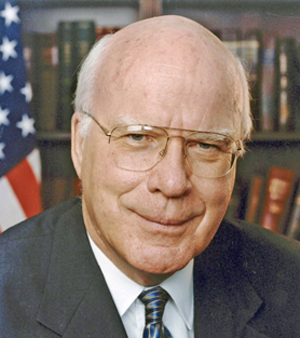
    Leahy, Patrick In
    a letter co-authored by Jeff Sessions (R-AL), the ranking member of the Senate
    Judicary Committee, Senator Leahy (at left) writes that "[w]e need to create the
    legal landscape that allows our innovators to flourish in the new economy, and
    we need to do it now." 
    Stating that "Mr. Pozen is correct that Congress should not let the
    controversial issue of how damages are calculated bog down needed
    reforms," Senator Leahy notes that the Senate Judiciary Committee had
    managed to "broker a deal on damages that paved the way for success that
    will benefit all inventors and innovators" (see "Senate 'Patent Reform' Bill (S. 515) Voted out of
    Judiciary Committee
    ").  Senator Leahy concludes the letter by
    reporting that Congress is in the process of "finalizing language"
    that would accomplish the three goals outlined in Mr. Pozen's article, adding
    that Congress "will make this happen, and America will invent its way back
    to prosperity."

    Senate Floor While
    Senator Leahy has expressed optimism in Congress' ability to pass patent reform
    legislation, twelve Senators (all Republicans) wrote to Senate
    Majority Leader Harry Reid (D-NV) earlier this fall to express the opinion that
    the Senate bill (S. 515) "needs additional work before it is brought to
    the floor."  While the twelve
    Senators believe the bill has been "greatly improved" since its
    introduction, especially with regard to the damages provision, the inclusion of
    "new and expanded mechanisms for the administrative re-examination of patents
    . . . are quite problematic." 
    The Senators argue that the bill's post-grant review provisions would
    permit "serial challenges" to patents in the Patent Office and the
    courts, thereby threatening "to diminish the value and enforceability of
    U.S. patent rights at a time when America's economic recovery is dependent on the
    strength of U.S. innovation."

    Signing
    the
    letter were Senators Sam Brownback (R-KS), Jim DeMint (R-SC), George
    Voinovich (R-OH), Thad Cochran (R-MS), Tom Coburn (R-OK), Chuck Grassley
    (R-IA), Roger Wicker (R-MS), Bob Corker (R-TN), Jim Inhofe (R-OK), John Barrasso
    (R-WY), Kit Bond (R-MO), and Judd Gregg (R-NH).

  •     By Kevin E. Noonan

    AIPLA The American Intellectual Property Law
    Association (AIPLA) has joined the chorus of patent bar groups opining on
    whether there is a separate written description requirement contained in 35
    U.S.C. § 112, first paragraph, in an
    amicus curiae brief filed in the rehearing en banc
    of
    Ariad Pharmaceuticals, Inc. v. Eli
    Lilly & Co
    .  The AIPLA agrees with
    other amici that there is such a requirement, but emphasize that properly
    construed, such a requirement must be assessed in the "context" of the
    entirety of 35 U.S.C. § 112 (but, in reality, that "entirety" extends
    no further than the second paragraph).  Similar sentiments were expressed by the Federal Circuit Bar Association
    in its amicus brief, but the basis of
    the argument is uniquely the AIPLA's. 
    The AIPLA also notes that it does not take a position on the validity of
    Ariad's patent-in-suit.

    The brief argues that the written description
    requirement should be construed to ensure that the patent specification "advances
    the well-recognized patent policies of disclosure," defining these as:

    (1) particularly and
    distinctly identifying the invention,
    (2) putting the
    invention in the hands of the public at the end of the patent term as part of
    the quid pro quo bargain for exclusive rights,
    (3) ensuring that the
    applicant was in possession of his/her invention at the time of filing to limit
    any exclusive rights to the subject matter he/she actually invented, and
    (4) informing the public
    of the patent scope so that potential competitors know how to avoid
    infringement and can reasonably design around the claimed invention.

    The brief argues that the written description
    requirement, as construed as being part of § 112, first paragraph, by the Court's
    jurisprudence, satisfies these different but related roles.  Enablement, the amicus argues, "serves
    a different and distinct purpose" — providing a disclosure that would
    permit the worker of ordinary skill to practice the invention.  The brief also
    notes, as have others, that the requirements differ in that the enablement
    inquiry includes the knowledge and skill of the worker of ordinary skill in the
    art, and that these can be "very different from any invention identified
    by the inventor as his/her own."

    In discussing the statute at length, the brief
    counsels the Court to "resist the temptation to dwell on parsing the
    statutory language to the point of drawing legal conclusions based on the
    placement of commas."  "Instead,"
    they counsel, the Court should employ an "as a whole" rationale that
    would be "faithful to the statute's literal language and policy
    objectives."  The amicus also
    asks the Court not to make a "radical departure" from precedent and reminds the Federal Circuit to
    be sure to "conform to Supreme Court precedent."  The brief asserts that the CAFC should
    adopt a "sufficiently flexible" approach that will avoid an "unfair
    standard of compliance that fails to take account of inherent differences in
    technologies and claim formats."

    The brief does admit that "statutory language,
    legislative history and judicial precedent" — all the tools the Court
    would normally employ in deciding this question — "fail to solve the
    puzzle."  Policy may be what
    ultimately drives (or should drive) the Court's conclusions, and the policy
    requires that the specification must:

    1) Sufficiently
    identify the invention;
    2) Put the
    invention in the hands of the public at the end of the patent term as part of the
    quid pro quo bargain for exclusive rights;
    3) Ensure that the
    applicant was in possession of his/her invention at the time of filing to limit
    any exclusive rights to subject matter he/she actually invented; and

    4) Inform the
    public of the patent scope so that potential competitors know how to avoid
    infringement and can reasonably design around the claimed invention,

    citing Festo
    Corp.
    v. Shoketsu
    Kinzoku Kogyo Kabushiki Co.,
    535 U.S. 722, 736 (2002); Bonito Boats, Inc. v. Thunder
    Craft Boats, Inc.,
    489 U.S. 141, 150-51
    (1989); McClain v. Ortmayer, 141 U.S. 419, 424 (1891); Praxair,
    Inc.
    v. ATMl, Inc., 543 F.3d 1306, 1319 (Fed. Cir. 2008); Purdue
    Pharma L.P.
    v. Faulding Inc., 230 F.3d 1320, 1323 (Fed. Cir. 2000); and Gentry Gallery, Inc. v. Berkline Corp., 134 F.3d 1473,
    1479 (Fed. Cir. 1998).

    Amicus argues
    that the question before the Court can be resolved by not considering the "number
    of distinct disclosure requirement[s] that must be met," but by using the totality
    of the specification to determine what was disclosed.  This "as a whole" approach they analogize with
    various "claims as a whole" provisions such as § 103.  Thus:

    [F]or purposes of determining whether a patent
    is invalid for failing to comply with the disclosure requirements, a
    specification should be judged by the sufficiency of the disclosures in the
    application as filed, taken as a whole, not by the sufficiency of the portion
    of a specification deemed the "written description" or the separate
    portion deemed the "enabling disclosure."

    The brief then explicates further its understanding
    of the totality approach, using 
    the equally-compelling rubric of faithfulness to the statutory scheme
    taken as a whole, in the context of criticizing the panel for failing to
    utilize the approach.  Here,
    amicus argues, the panel considered whether Ariad's specification contained an
    adequate written description, concluded it did not, and ended the inquiry.  The error was the belief that the
    written description requirement could be "viewed in isolation from the
    other requirements of Section 112."  Had the Federal Circuit applied the AIPLA's "as a whole" approach, the
    brief argues, it could have performed "a practical evaluation of the
    sufficiency of the disclosure" as understood by one of ordinary skill in
    the art, "taking into account the interaction and codependence of [all of]
    the Section 112 requirements."  By analogy, the brief compares (favorably!) this approach with the "common
    sense" approach to obviousness imposed by the Supreme  Court in KSR International Co. v. Teleflex Inc.  However, the amicus argues that this "as a whole" approach "does
    not relieve [the patent owner] of identifying in the patent a 'written
    description' of the invention commensurate with the scope of the claims at
    issue," citing Tronzo v. Biomet.  Ultimately, what is required is
    that the specification properly puts the public on notice "of what the
    inventor contemplates as the invention encompassed by the claims at issue."

    The brief emphasizes that the approach must be
    employed with sufficient flexibility to be able to adapt to different
    technologies.  This, the brief
    asserts, is the flaw in the argument that the enablement requirement is sufficient — there will be some instances where enablement simultaneously satisfies the
    written description requirement, and other instances (and technologies) when this
    will not be the case.  A particular
    example cited in the brief is genus/species claims, where it can certainly be
    the case that the specification enables making and using species within a
    claimed genus, but does not provide a written description "for a claim
    covering . . . a particular species."  On this point the brief concludes:

    In the end, it is
    the dynamic interaction of the Section 112 requirements that produce the kind
    of disclosures necessary to advance the policies recited above.  Whatever the answer on the sufficiency
    of the written description or enabling disclosure in the case, the proposal here
    would not allow the court to simply stop the analysis after examining only one
    of the requirements in isolation, and to ignore the others. 
    It would
    rather permit a party to point the court to the disclosure as a whole, which
    would be evaluated in light of the patent policies.

    The "as a
    whole" approach to assessing the sufficiency of disclosure in a
    specification proposed by AIPLA's brief is consistent with the statute, because
    the requirement for a written description, an enabling disclosure and a claim
    that "particularly points out and distinctly claims the subject matter the
    applicant regards as his invention" must be considered together, amicus
    argues.  Amicus ignores the best
    mode requirement (understandably, perhaps) but builds its "as a whole" argument
    by combining two of the requirements from the first paragraph of Section 112
    with the "claims" requirement from the second paragraph of Section
    112.  While this has been done by
    other amici, its consequence is to expand the scope of § 112, 2d ¶, from its
    traditional role of providing a statutory basis for the peripheral claiming
    requirement to being part of the sufficiency of disclosure requirement of § 112, 1st ¶.  The brief supports this interpretation
    of the statute by arguing, first, "there is no requirement that the
    written description of the invention be in a separately designated section of
    the specification, nor that the enablement be in a separately designated
    section," further saying that
    both requirements are "intertwined" in some specifications.  Second, the requirements of  §112, 1st ¶, must be
    evaluated in the context of what is claimed according to §112, 2d ¶, saying
    that this has "always" been the requirement for enablement, citing
    Christianson v. Colt Indus. Operating Corp., 870
    F.2d 1292, 1299 (1989).  "
    Taking ¶
    1 and ¶ 2
    together, it is not the written description requirement but the claim,
    interpreted in light of the specification and the patent file-history, that
    identifies the invention," amicus asserts.  Third, a claim can and will very often identify the
    invention without 'describing' it," says this amicus, citing Koito Mfg. Co.
    v. Turn-Key-Tech,
    LLC,
    381 F.3d 1142,
    1154 (Fed. Cir. 2004).  This
    argument relates to the "legal" wording of a claim, in contrast to
    the language used in a specification (which the brief contends is directed not at a lawyer
    but a person of ordinary skill in the art).  This argument appears to envision a "translation"
    function of the written description requirement, between the legal wording of
    the claim and the technical wording of the specification.  Finally, the brief appeals to the
    "inherent circularity" of the analysis, which they argue "points
    to the necessity for an 'as a whole' analysis," wherein the specification
    must be assessed in light of the "invention" and the claimed
    invention must be assessed in view of the description in the
    specification.

    Adopting this
    approach would not change the "content" of each individual
    requirement, the brief argues, but rather would affect "only the ultimate
    determination of the sufficiency of the disclosure."  Using the approach advocated by this
    amicus would require establishing the "context" of the "invention"
    in terms of the circularly-dependent claims and specification, and ultimately
    resulting in an approach that may make up in "common sense" what it
    seems to lack in analytical vigor.  Its greatest advantage may be that it is more consistent with the
    Supreme Court's "totality of the circumstances" approach to patent
    jurisprudence than the traditional efforts by the Federal Circuit to bring
    clarity to the application of U.S. patent law.

    For additional information regarding this topic, please see:
    • "Amicus Briefs in Ariad v. Lilly: Federal Circuit Bar Association," November 29, 2009
    • "Amicus Briefs for Ariad v. Lilly: Intellectual Property Owners Association," November 25, 2009
    • "Amicus Briefs in Ariad v. Lilly: GlaxoSmithKline," November 24, 2009
    • "Amicus Briefs in Ariad v. Lilly: United States," November 23, 2009
    • "Amicus Briefs in Ariad v. Lilly: Google, Verzion Communications Inc. and Cisco Systems, Inc.," November 22, 2009
    • "Amicus Briefs in Ariad v. Lilly: Professor Christopher Holman," November 19, 2009
    • "Lilly Files Principal Brief for Ariad v. Lilly Rehearing En Banc," November 16, 2009
    • "Next Up: Ariad v. Lilly Rehearing En Banc," November 10, 2009
    • "Federal Circuit Grants En Banc Review in Ariad v. Lilly," August 21, 2009
    • "Ariad Files Petition for Rhearing in Ariad v. Lilly," June 3, 2009
    • "Ariad Decision Voids Attempt to Use Broad Claiming to Avoid the Written Description Requirement," April 14, 2009
    • "Ariad Pharmaceuticals, Inc. v. Eli Lilly and Co. (Fed. Cir. 2009)," April 6, 2009

  •     By
    Donald Zuhn

    Affordable Health Care
    for America Act Placed on Senate Legislative Calendar

    Senate Floor The
    Affordable Health Care for America Act (H.R. 3962), which was passed by the
    House of Representatives on November 7th by a narrow five-vote margin (220-215),
    has now been placed on the Senate Legislative Calendar.  The 1,990-page bill includes a section
    (§ 2575) providing for the establishment of a licensure pathway for biosimilar
    biological products, which precludes a biosimilar application from being
    approved "until the date that is 12 years after the date on which the
    reference product was first licensed," and offers an additional 6 months
    of exclusivity for the use of reference products "in the pediatric population"
    (see "House Health Care Bill
    Includes Biosimilar Licensure Pathway
    ").


    Health Care Bill
    Introduced in the Senate

    Senate Seal On
    November 18th, two days after H.R. 3962 was placed on the Senate Legislative
    Calendar, Senate Majority Leader Harry Reid (D-NV) unveiled the Senate's own
    health care bill, the Patient Protection and Affordable Care Act (H.R. 3590).  At first glance, the bill appears to be
    unrelated to health care, stating instead that it "amend[s] the Internal
    Revenue Code of 1986 to modify the first-time homebuyers credit in the case of
    members of the Armed Forces and certain other Federal employees, and for other
    purposes."  However, a check
    of THOMAS indicates that the H.R. 3590 "is the vehicle for the version of
    health care reform that will be debated in the Senate."  Like H.R. 3962, the 2,074-page Senate
    bill contains a section (§ 7002) providing for an approval pathway for
    biosimilar biological products. 
    Also like H.R. 3962, the Senate bill precludes a biosimilar application
    from being approved "until the date that is 12 years after the date on
    which the reference product was first licensed."  In addition, the Senate bill, like H.R. 3962, offers an additional
    6 months of exclusivity for the use of reference products "in the
    pediatric population."


    AP Reports on Senate Health
    Care Bill

    Associated Press An
    Associated Press report ("Reid
    health bill helps chiropractors, drugmakers
    ")
    regarding the Senate bill states that it "extends the
    protection some brand-name manufacturers would get from generic competitors,"
    as "Reid's bill would add another six months of protection for drugmakers
    who also test those products for use by children."  Because the bill passed in the House
    contains an the same pediatric exclusivity provision, it is perhaps unfair to
    suggest that the pediatric exclusivity provision of Senator Reid's bill has somehow extended innovator exclusivity even
    further.


    CCPM Comments on Senate
    Health Care Bill

    CCPM The
    Coalition for a Competitive Pharmaceutical Market (CCPM),
    which recently released a statement "appealing to Congress to fix the
    excessive 12-year market exclusivity and ever-greening provisions for biologics
    or drop it altogether" (see
    "Follow-on Biologics News Briefs – No. 9"),
    released a short statement
    after Senator Reid unveiled H.R. 3590, in which the CCPM "voic[ed] serious
    concern in response to the extension of biologics exclusivity included in The
    Patient Protection and Affordable Care Act (H.R.3590)."  In particular, the group states that
    "[d]espite numerous economic studies, widespread media attention, patient
    outcry, and the support of the Administration for a more balanced approach, the
    Senate Health Care Reform bill went in the opposite direction by adding
    additional exclusivity to the already unacceptable 12 years of market
    exclusivity for brand products."  The CCPM statement does not specify exactly how the Senate bill goes "in
    the opposite direction by adding
    additional exclusivity."

    According
    to the CCPM website,
    the group has 33 participating members, which include Apotex, Hospira, Momenta
    Pharmaceuticals, Mylan Labs, Ranbaxy Pharmaceuticals, Teva Pharmaceuticals USA,
    Watson Pharmaceuticals, and the Generic Pharmaceutical Association (GPhA).


    GPhA Says Senate Bill
    "Gratuitously Extends Biologic Monopolies"

    Generic Pharmaceutical Association (GPhA) In
    a statement
    released by the Generic Pharmaceutical Association (GPhA) on November 19th,
    GPhA President and CEO Kathleen Jaeger writes that "[j]ust when you think
    the pro-BIO and PhRMA provisions in health care reform couldn't get any more
    favorable for them, the Senate health care reform bill has further disappointed
    consumers by adding additional monopoly protection to expensive biologic medicines,"
    adding that "[r]egardless of the motivation, the biologic provision in
    this bill takes the already egregious and unwarranted 12 years of exclusivity
    and extends it."  With regard to how the bill extends the 12-year exclusivity period, Ms. Jaeger
    alludes to the Senate's failure "to close down a major loophole known as
    'evergreening.'"  She also states that "[i]n the name of true health care
    reform, it is incumbent upon Congress to strip the anti-consumer biologic provision
    out of health care reform." 
    The GPhA represents manufacturers and distributors of finished generic
    pharmaceuticals and bulk active pharmaceutical chemicals.


    Boston Globe Criticizes
    12-Year Exclusivity Period; Prompts Response

    Boston Globe An
    Op-Ed article in last week's Boston Globe
    commends Congress for trying "to open the door for approval of generic
    versions of drugs known as biologics," but concludes that "after
    intensive lobbying by the biotech industry, the measures that are emerging from
    Congress grant too many years of exclusivity to the original makers"
    ("Biotech bills give drugmakers too many years of exclusivity").  The Globe
    argues that the 12-year exclusivity period in current House and Senate
    bills is "too long, more than double the five years of protection from
    competition guaranteed for conventional drugs."

    The
    Globe Op-Ed, however, appears to disregard
    the differences in developmental costs and time between small molecule
    therapeutics and biologics (see
    "Amgen VP Makes Case for Longer Exclusivity Period in Follow-on Biologics
    Legislation
    ").  Instead, the article contends that
    "competition from generics is not likely to erode the ability of the
    original biotech manufacturers to continue reaping profits," because
    "[t]here are onerous technical barriers to making so-called biogenerics,
    unlike generic versions of conventional medications, so companies that invent
    original drugs are likely to retain market share despite the new competition."

    In
    support of this argument, the Globe points
    to an article published in the New
    England Journal of Medicine
    last month, which contends that a 5-year
    exclusivity period would be sufficient because follow-on biologics have led to
    biologic price reductions of between 25-30% (as compared with innovator small
    molecule price reductions of up to 80%) in Europe (see "NEJM Authors Say Five Years of Data Exclusivity Would Be
    Sufficient
    ").  The Globe
    parts ways with the NEJM article on
    an appropriate exclusivity period, stating that "[i]n clearing the path
    for generic alternatives to expensive biologics, Congress should enact a
    shorter window of market exclusivity than 12 years, but more than the five
    years afforded to simpler, conventional drugs," and adding that "[a]
    protection period that falls directly in between these extremes would strike a
    balance between encouraging companies to make biologic drugs and making them
    affordable."

    MassBio In
    response
    to the Op-Ed article, Massachusetts Biotechnology Council (MassBio)
    President Robert Coughlin argued that the Globe's
    "editorial misleadingly compared the 12 years of data exclusivity in the
    biosimilars legislation with the five-year provision for traditional
    pharmaceuticals," contending that "[t]his apples-to-oranges
    comparison overlooks the fact that biologics cannot achieve the same kind of
    patent protection as pharmaceuticals."  Mr. Coughlin also noted that:

    Data
    exclusivity does not prevent competition. 
    Companies can bring competitive products to market during the
    exclusivity period, provided they conduct their own safety and efficacy
    research.  They cannot piggyback on
    an innovator’s proprietary data to obtain FDA approval until the exclusivity
    period ends.  That’s simply fair.

    According
    to the MassBio website, the group represents
    more than 600 biotechnology companies, universities, academic institutions and
    others dedicated to advancing cutting edge research.