•     By Sherri Oslick

    Gavel_2About
    Court Report:  Each week we will report briefly on recently filed
    biotech and pharma cases, and a few interesting cases will be selected
    for periodic monitoring.


    Cephalon Inc. et al. v. Actavis Group et al.
    1:09-cv-00940; filed December 8, 2009 in the
    District Court of Delaware

    • Plaintiffs: 
    Cephalon Inc.; Cephalon France
    • Defendants: 
    Actavis Group; Actavis Pharma Manufacturing Pvt Ltd.; Actavis Inc.

    Infringement of U.S. Patent Nos. RE37,516
    ("Acetamide Derivative Having Defined Particle Size," issued January
    15, 2002) and 7,132,570 ("Method for the Production of Crystalline Forms
    of Optical Enantiomers of Modafinil," issued November 7, 2006) following a
    Paragraph IV certification as part of Actavis' filing of an ANDA to manufacture
    a generic version of Cephalon's Nuvigil® (armodafinil, used to improve
    wakefulness in patients with excessive sleepiness associated with obstructive
    sleep apnea/hypopnea syndrome, narcolepsy, and shift work sleep disorder).  View the complaint
    here.


    Pfizer Inc. et al. v. Dr. Reddy's Laboratories Ltd. et al.
    1:09-cv-00943; filed December 8, 2009 in the
    District Court of Delaware

    • Plaintiffs:  Pfizer Inc.; Pfizer Ireland Pharmaceuticals; Warner-Lambert Co.;
    Warner-Lambert Co. LLC
    • Defendants:  Dr. Reddy's Laboratories Ltd.; Dr. Reddy's Laboratories Inc.

    Infringement of U.S. Patent No. 5,969,156
    ("Crystalline [R- (R*,R*)]-2-(4
    Fluorophenyl)-β,δ-dihydroxy-5-(1-methylethyl)- 3-phenyl-4-[(phenylamino)carbonyl]-1H-pyrrole-1-heptanoic
    acid hemi calcium salt (atorvastatin)," issued October 19, 1999) following
    a Paragraph IV certification as part of Dr. Reddy's filing of an ANDA to
    manufacture a generic version of Pfizer's Lipitor® (atorvastatin calcium, used
    to treat high cholesterol and heart disease).  View the complaint
    here.


    Galderma Laboratories, L.P. et al. v. Perrigo Co. et al.
    3:09-cv-02322; filed December 4, 2009 in the
    Northern District of Texas

    • Plaintiffs: 
    Galderma Laboratories, L.P.; Galderma S.A.; Dermalogix Partners Inc.
    • Defendants: 
    Perrigo Co.; Perrigo Israel Pharmaceuticals Ltd.

    Infringement of U.S. Patent No. 5,972,920
    ("Formulation Containing a Carrier, Active Ingredient, and Surfactant for
    Treating Skin Disorders," issued October 26, 1999) following a Paragraph
    IV certification as part of Perrigo's filing of an ANDA to manufacture a
    generic version of Galderma's Clobex® (clobetasol propionate, used for the
    treatment of moderate to severe plaque psoriasis).  View the complaint
    here.

  • CalendarJanuary 6-10, 2010 – 27th
    Annual National CLE Conference
    (
    Law Education Institute, Inc.)

    January 20-21, 2010 – Life Sciences IP
    Due Diligence
    (American Conference
    Institute) – New York, NY

    January 25-26, 2010 – European Pharmaceutical Regulatory Law Boot
    Camp
    (American Conference
    Institute) – New York, NY

    January 26-27,
    2010 –
    Advanced In-House Counsel Forum on China IP Law (C5) – Shanghai, China

    January 27-28, 2010 – Pharma & Biotech Patent Litigation (C5) – Amsterdam, Netherlands

    ***Patent Docs is a media partner of this conference or CLE

  • Amsterdam C5 (UK) will be
    holding its 2nd Annual Pharma & Biotech Patent Litigation conference on
    January 27-28, 2010 in Amsterdam, Netherlands.  The conference will provide strategic guidance regarding the
    following issues:

    • Is the
    Enforcement Directive an effective tool for brand name pharma in enforcing
    patents:  Analysis of post
    Directive case law;
    • The latest
    European Patent Office decisions and their implications:  Hear directly from the EPO's Legal
    Member to the Boards of Appeal;
    • SPCs and
    paediatric regulation:  Recent
    decisions and varying application requirements across Europe;
    • Pharma Sector
    Inquiry Final Report:  What lessons
    can both innovators and generics companies draw?
    • European
    Standards on sufficiency of description post Lundbeck and Novartis v
    Johnson & Johnson
    ; and
    • Enforcing IP
    rights in China, India, Russia and Israel:  Local practitioners' guide to the facilitative provisions
    and stumbling blocks.

    In particular, C5
    faculty will offer presentations on the following topics:

    P&B Patent Litigation • Highlights from
    pharma and biotech patent litigation in 2009 and trends for the future;
    • The Generics (UK) v Lundbeck case and
    subsequent conflicting decisions in the Netherlands and Germany:  What is the European position on
    sufficiency today?
    • Post-enforcement
    Directive case law across Europe: 
    New opportunities for effective enforcement of IP rights by innovators?
    • In discussion
    with the European Patent Office: 
    Update on recent decisions;
    • SPC
    litigation:  Recent case law and
    varying requirements for SPCs across Europe;
    • Critical analysis
    of key issues and recent case law involving pediatric extensions;
    • Pharma and
    biotech infringement litigation in China, India, Russia, and Israel;
    • Special
    address:  How have recent landmark
    decisions impacted the U.S. litigation landscape? — Judge Randall Rader,
    United States Court of Appeals for the Federal Circuit;
    • Pharma sector
    final report:  What are the
    implications for industry?
    • Settlement
    agreements post pharma Sector Inquiry: 
    What can and cannot be done?
    • Beyond the
    injunction:  The battle for damages
    in pharma patent litigation;
    • Using experiments
    in pharma and biotech patent litigation: 
    Key legal and practical considerations; and
    • Strategies and
    best practice for conducting and managing complex multi-jurisdictional
    litigation.

    An additional
    post-conference master class, entitled "Winning Strategies for Enforcing
    Your Life Sciences Patents in China and India," will be offered on January
    29, 2010.  This master class will
    examine patent enforcement in two jurisdictions — China and India — that, for
    the European pharma and biotech industry, are crucially important given the
    strong presence of local generics companies.

    A complete brochure
    for this conference, including an agenda, list of speakers, and registration
    form can be downloaded here.

    C5 The registration
    fee for the conference is £1399 ($2,044.67), for the conference plus master
    class £1798 ($2,627.81), and for the master class alone £499 ($729.30).  Those interested in registering for the
    conference can do so here, by
    calling +44 (0) 20 7878 6888, or by faxing a registration form to +44 (0) 20
    7878 6896.

  • Shanghai, China C5 (UK) will be
    holding its Advanced In-House Counsel Forum on China IP Law on January 26-27,
    2010 in Shanghai, China.  At the
    conference, C5 faculty will offer presentations on the following topics:

    • Status report on
    recent IP regulatory and enforcement initiatives;
    • Developing a
    filing strategy to address China's new secrecy examination;
    • Incorporating
    utility model patents in patent strategies;
    • How to collect
    evidence to win patent cases in Chinese Courts;
    • How absolute novelty
    standard will challenge patent validity;
    • Positioning an IP
    department to support legal, marketing, and R &D departments;
    • Mitigating
    leakage of "know-how" while licensing technology in China;
    • Maximizing ROI in
    anti-counterfeiting;
    • Minimizing patent
    litigation risks post Schneider;
    • Complying with
    new technology import and export measures;
    • How to obtain
    recognition of "well-known" trademarks in China;
    • Defining
    ownership and reasonable remuneration for inventor awards; and
    • Conducting effective
    freedom-to-operate (FTO) analysis to ensure right to commercialize products.

    China IP Law In addition, two
    pre-conference master workshops will be offered on January 25, 2010.  The first, entitled "Fundamentals
    of China Anti-Monopoly Law: What Every IP Attorney Needs to Know," will be
    held from 9:00 am to 12:30 pm, and the second, entitled "A Deep Dive into
    the 3rd Patent Amendment Legislation: 
    What Life Science Companies Need to Know about New Patent Law,"
    will be held from 1:30 to 5:00 pm.

    A complete brochure
    for this conference, including an agenda, list of speakers, and registration
    form can be downloaded here.

    C5 The registration
    fee for the conference is $2,195, for the conference plus one workshop $2,795,
    and for the conference and both workshops $3,395.  Those registering by January 5, 2010 will receive a $200
    discount off the registration fee. 
    Those interested in registering for the conference can do so here, by
    calling +44 (0) 20 7878 6888, or by faxing a registration form to +44 (0) 20
    7878 6896.

    Photograph of the Pudong skyline in Shanghai, China (above) by Jens Schott Knudsen, from the Wikipedia Commons under the Creative Commons license.

  •     By
    Donald Zuhn

    ScienceFriday On
    December 11th, National Public Radio's Science
    Friday
    , which is broadcast nationwide from 2:00 – 4:00 pm Eastern time as
    part of NPR's Talk of the Nation
    programming, will focus on the issue of gene patenting.  In particular, the program will examine
    the Association for Molecular Pathology
    v. United States Patent and Trademark Office
    case, in which a group of
    patients, physicians, academic researchers, and medical societies filed suit
    against the U.S. Patent and Trademark Office and Myriad Genetics, among others,
    over several patents claiming human BRCA1 and BRC2 genes and methods for
    detecting mutations in these genes to diagnose a predisposition to breast and
    ovarian cancer (see Patent Docs
    reports here
    and here).

    Patent Docs
    author Kevin Noonan, who has written a number of articles in this space on the
    topic of gene patenting, will be a guest on the show.  American Civil Liberties Union (ACLU) Science Advisor Tania
    Simoncelli will also be a guest on the show.

    A
    list of public radio stations that broadcast Science Friday can be found here.

    For additional information regarding this and other related topics, please see:
    • "BRCA Patent Suit to Continue in Southern District of New York," November 2, 2009
    • "Empirical
    Research Fails to Support Gene Patenting Ban
    ," October 22, 2009

    • "Gene
    Patenting Debate Continues – Round Two
    ," August 4, 2009

    • "The
    Unwanted Consequences of Banning Gene Patenting
    ," June 16, 2009

    • "Falsehoods,
    Distortions and Outright Lies in the Gene Patenting Debate
    ," June 15, 2009

    • "Gene
    Patenting Debate Continues
    ," June 9, 2009

    • "Association for Molecular Pathology v. U.S.
    Patent and Trademark Office
    ," May 17, 2009

    • "Court Report: Special Edition," May 13, 2009
    • "Gene Patenting and
    the Wisdom of Judge Lourie
    ," April 12, 2009

    • "Science Article
    Should Help Allay Gene Patenting Fears
    ," December 17, 2008

  •     By
    Donald Zuhn

    Ariad On
    Monday, an en banc panel of the
    Federal Circuit heard oral argument in Ariad
    Pharmaceuticals, Inc. v. Eli Lilly & Co
    . (see "Ariad v. Lilly:
    Oral Argument
    ").  During the hearing, several members of
    the Court as well as counsel for the Government focused on perceived
    differences between the positions taken by Plaintiffs-Appellees ("Ariad")
    in their principal and reply briefs. 
    (For a discussion of Ariad's principal brief, please see "Next Up: Ariad v. Lilly Rehearing En Banc").  Today, we examine Ariad's
    reply brief.

    Ariad
    begins the brief by listing the points on which the parties and amici find common ground, stating that:

    Lest it be obscured by rhetoric, it is important
    to note that there is much common ground amongst the parties and amici.  Specifically, they agree that:
        1.  The specification must provide a written
    description of the invention and of the manner and process of making and using
    it.
        2.  The description requirement of § 112
    applies to all claims, whether they were originally present in the application
    or not.
        3.  The description requirement of § 112
    polices an applicant's ability to add or amend claims during prosecution.
        4.  A patent may not claim an invention
    that is not described in the specification.
        5.  The description requirement of § 112
    prevents claims that extend beyond the inventor's contribution as set forth in
    the specification;
    claims
    of broad applicability must correspond to an invention that is identified in
    the specification by a broadly applicable common principle.

    Ariad
    then summarizes the "actual disagreement" between the parties as
    concerning the issue of:

    [W]hether § 112, first paragraph requires
    a written description of the invention that is separate from enablement. 
    Specifically, is the entire written description required by § 112 (i.e.,
    the description of the invention, and of the manner and process of making and
    using it) measured by the statutory duty to describe the invention in "such
    full, clear, concise, and exact terms as to enable any person skilled in the
    art to which it pertains . . . to make and use the same," as
    Plaintiffs-appellants contend? Or, as urged by Lilly, does § 112 impose a written
    description requirement independent of the rest of the statute and measured by
    the judicially-created "possession" test of Regents of the University of California v. Eli Lilly & Co., 119
    F.3d 1559 (Fed. Cir. 1997) and its progeny?

    Ariad's brief
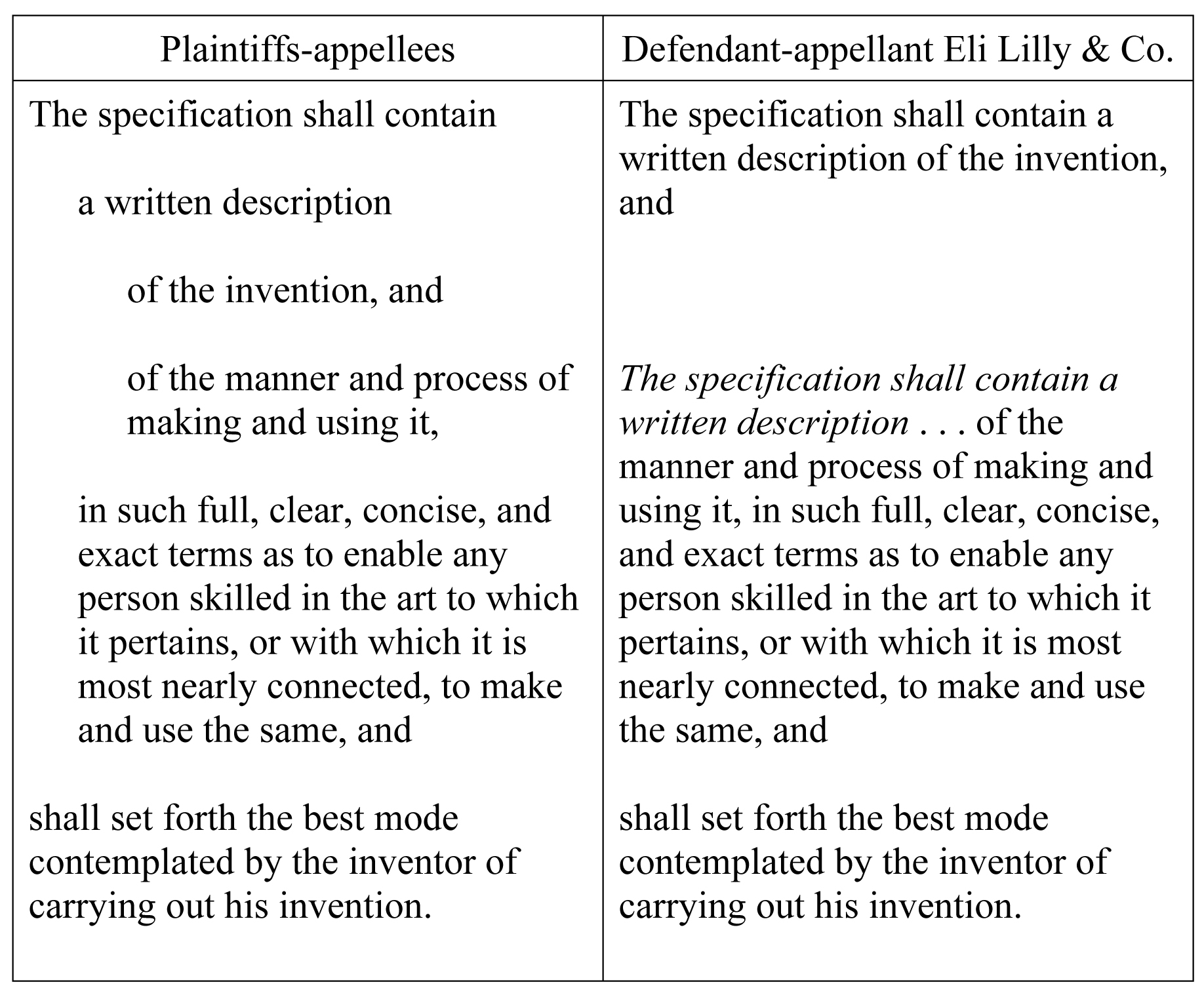
    next addresses the language of § 112, first paragraph, providing a table
    comparing the statutory constructions proposed by the parties:

    Statutory Construction
    Noting
    that "Lilly has effectively rewritten the statute by adding the italicized
    words," Ariad contends that Lilly's construction:

    [S]evers the "written description
    of the invention" not only from the requirement to enable, but also from
    the requirement that it be in "full, clear, concise, and exact"
    terms.  There is no reason for
    Congress to demand a written description of "the manner and process of
    making and using" the invention that is "full, clear, concise, and
    exact" while tolerating a "written description of the invention"
    that is incomplete, unclear, long-winded, and inexact.

    As
    in its principal brief, Ariad examines and compares the statutory language from
    the Patent Acts of 1793, 1836, and 1952, and concludes that:

    The history of the Patent Act also
    shows that, since 1793, the requirement for a description of the invention has
    always been linked with the requirement to describe the manner of making and
    using the invention, and has been measured by the text that follows, i.e.,
    clear, concise and exact, etc.

    Ariad's
    brief next provides a discussion of relevant Supreme Court precedent.  Contending that Lilly "mischaracterizes
    the Supreme Court decisions on which it relies," Ariad states that "Supreme
    Court precedent both before 1836 and after 1836 provides no support for the
    view that the written description requirement is to be separated from its
    statutory standard for enablement, let alone that it be judged by this Court's
    current 'possession' test." 
    Ariad notes that Lilly has failed to produce "even one post-1836 Supreme
    Court opinion in which the description of an invention claimed or otherwise
    identified at the time of filing was found to be deficient under any standard
    other than the enablement standard." 
    According to Ariad, the reason for this failure is that:

    The Supreme Court cases have never
    decoupled the "written description of the invention" from rest of the
    statutory language and have never held that a written description of an
    invention sufficient to enable others to practice a claimed invention could
    nonetheless fail because the description somehow did not "establish that
    the applicant was in possession of the claimed invention."

    Ariad
    explains that when § 112, first paragraph, is interpreted as proposed in its
    briefs, the "description requirement" serves two purposes by:  (1) "prevent[ing] patent
    applicants from introducing new or amended claims directed to a different
    invention than is described in an earlier-filed specification," and (2) "ensur[ing]
    that the claims — whether original or amended — match the inventor's
    contribution to the art." 
    With respect to the second objective, Ariad notes that claims
    encompassing more than the particular embodiments disclosed in the
    specification must be supported by an identification of "the common
    principle that defines the invention and distinguishes it from the prior art."

    In
    the last portion of its reply brief, Ariad outlines how the claims at issue in
    the appeal satisfy the "description requirement" of § 112, when §
    112, first paragraph, is construed as proposed in Ariad's briefs.  Ariad then summarizes its opponent's argument
    by stating that:

    Under Lilly's view, even though the claims-in-suit
    might be directed to novel, useful, non-obvious, and statutory methods, and
    even though the '516 patent applicants might have complied with their statutory
    duty to provide a written description of their invention "in such full,
    clear, concise, and exact terms as to enable any person skilled in the art to
    which it pertains . . . to make and use the same," the asserted claims are
    nevertheless worthless and void because the '516 patent applicants purportedly
    did not comply with a "separate", non-statutory, judicially-devised
    duty to describe their invention in terms that a court or jury might deem
    sufficient to prove that the '516 patent applicants had "possession"
    of the claimed methods to a legally sufficient degree.

    Ariad,
    however, counters by arguing that:

    The discoverer of a new and non-obvious
    process, whose use is not tied to particular materials or machines, has never
    been restricted in his or her patent protection to the details of particular
    instrumentalities that were then the best-known ways of carrying out the
    process. Lilly's "written description" arguments are aimed at denying
    patent protection to upstream researchers who discover and disclose generally
    applicable methods that Lilly would then subsequently exploit.

    For additional information regarding this topic, please see:
    "Ariad v. Lilly:
    Oral Argument
    ," December 9, 2009

    • "Amicus Briefs in Ariad v. Lilly: Regents of University of California et al.," December 6, 2009
    • "Amicus Briefs in Ariad v. Lilly: Briefs by Companies," December 6, 2009
    • "Amicus Briefs in Ariad v. Lilly: American Intellectual Property Law Association," December 1, 2009
    • "Amicus Briefs in Ariad v. Lilly: Federal Circuit Bar Association," November 29, 2009
    • "Amicus Briefs in Ariad v. Lilly: Intellectual Property Owners Association," November 25, 2009
    • "Amicus Briefs in Ariad v. Lilly: GlaxoSmithKline," November 24, 2009
    • "Amicus Briefs in Ariad v. Lilly: United States," November 23, 2009
    • "Amicus Briefs in Ariad v. Lilly: Google, Verzion Communications Inc. and Cisco Systems, Inc.," November 22, 2009
    • "Amicus Briefs in Ariad v. Lilly: Professor Christopher Holman," November 19, 2009
    • "Lilly Files Principal Brief for Ariad v. Lilly Rehearing En Banc," November 16, 2009
    • "Next Up: Ariad v. Lilly Rehearing En Banc," November 10, 2009
    • "Federal Circuit Grants En Banc Review in Ariad v. Lilly," August 21, 2009
    • "Ariad Files Petition for Rhearing in Ariad v. Lilly," June 3, 2009
    • "Ariad Decision Voids Attempt to Use Broad Claiming to Avoid the Written Description Requirement," April 14, 2009
    • "Ariad Pharmaceuticals, Inc. v. Eli Lilly and Co. (Fed. Cir. 2009)," April 6, 2009

  •     By Kevin E. Noonan

    Federal Circuit Courtroom Oral argument in Ariad
    Pharmaceuticals, Inc. v. Eli Lilly & Co.
    was heard on
    Monday before an en banc panel of the Federal Circuit.  Counsel for Ariad (John M. Whealan),
    Lilly (Charles E. Lipsey) and the U.S. Patent and Trademark Office (Mark R.
    Freeman) argued before an active Court, with most questioning coming from Judges
    Rader, Dyk, Lourie, Linn, Moore, and Newman.  While active, the Court and counsel avoided the principal
    question lurking under the question of whether there is a separate written description
    requirement (one of the questions posed to the parties and amici by the Court).  That question is what is
    the standard for assessing patentability under circumstances when the mere
    recitation of an invention — i.e., simply naming it — is insufficient to inform
    the skilled worker of what the invention is, even if the disclosure as a whole
    enables the skilled worker to make and use the invention.

    Lilly Mr. Lipsey, Lilly's counsel, began the argument, and
    was almost immediately sidetracked by two questions from the Court.  First, Judge Lourie asked whether written
    description should be considered a question of law or fact.  Mr. Lipsey answered that it always was
    described as a question of fact, but had "come to be resolved like claim
    construction," being determined from "the four corners of the
    document."  He said written
    description was akin to the question of conception, citing Professor Liivak's
    amicus brief to the effect that the specification is the "corroboration of
    conception."  This colloquy
    continued, with Judge Gajarsa suggesting that the written description issue could be
    treated like obviousness, being a question of law with underlying facts, to
    which Mr. Lipsey noted that this is how conception is assessed, so it would
    provide a logical way to do it.

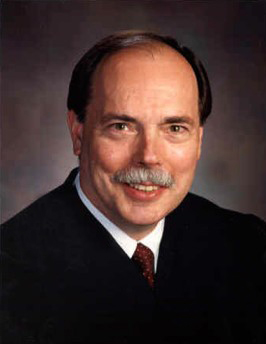
    Judge Michel At this point Chief Judge Michel (at right) asked whether there is
    any evidence that there is a harm in considering the written description
    requirement as a question of fact?  And more importantly, whether there was any evidence that any cases
    would have a decision changed if written description was considered a question of
    law versus a question of fact?  And
    finally, he pointedly asked Mr. Lipsey whether, if it's a question of fact, "do
    you lose?"  When Mr Lipsey
    answered "no," Judge Rader quickly asked, "Then why do you
    care?"  Lilly's counsel
    quickly responded, "I don't, I was asked the question," prompting the
    first of several outbursts of laughter from the gallery.

    Chief Judge Michel also delayed counsel arriving at the
    substantive portion of his argument by asking whether the District Court had
    ruled on alternative jury instructions regarding the written description
    issue.  This portion of the
    argument devolved quickly into specific questions of whether a timely objection
    was made and alternative jury instruction proffered, and whether there was a charge
    conference where the District Court considered the "proper" instruction.  Mr. Lipsey replied that the jury
    instruction permitted Ariad's claim to satisfy the written description
    requirement if the claims recited NF-kB inhibitors functionally, while Lilly
    insisted that the Federal Circuit's jurisprudence required there be some
    disclosed structural correlation with function.
    Judge Linn Judge Linn (at left) then asked, "if the original claims
    are published, how can they fail the public notice test?"  Mr. Lipsey responded that claims satisfy
    the notice function as to what the
    boundary of the invention is but do not describe the invention.  The Court countered, asking "don't
    the claims describe what the inventor considers to be his invention?"  "They sometimes do, but they often
    do not," according to Mr. Lipsey, reciting Judge Rich in a footnote in
    the In re Vanco case.  There, Judge Rich said, patent claims
    describe the boundaries of the invention, like lot lines do with real property.  But those boundaries do not describe
    the land itself, or in this context, the invention according to Mr. Lipsey's
    argument.  Judge Lourie then applied
    the question to genus/species claims, asking:  "Isn't the question of
    support that you possess a sufficient portion of the genus to be entitled to
    the boundary?"  Mr. Lipsey's
    answer was that this is always the inquiry if you claim a genus, whether you
    have sufficient support for a generic invention in the description, which can
    be satisfied "in any one of a number of ways," reciting a sufficient
    number of species or a generic description of a chemical compound as
    examples.  Judge Linn then asked:  "Doesn't
    the statute specify the way to do it, sufficiency is measured by enablement?"  Mr. Lipsey responded that this is one thing the statute requires.  The second thing the statute requires,
    he argued, is that the thing claimed be something that the applicant invented — as shown by an objective analysis
    of the four corners of the patent document.  He maintained that this description of what the inventor had
    invented had "always been required," citing O'Reilly, Schriber-Schroth,
    In re Moore, and In re Ruschig.
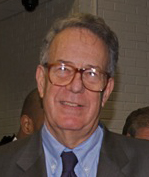
    Judge Dyk Judge Dyk (at right) asked:  "In light of what Mr. Whealan
    has conceded in his brief, what is the practical difference in Lilly's position
    and Ariad's position?"  (It
    should be noted here that Ariad's reply brief seems to have hurt its position
    somewhat, because some of the judges seem to believe that Ariad had "retreated" from the position it espoused in its opening brief.)  Mr. Lipsey took this occasion to make
    the strongest statement of Lilly's position, saying that "the question of
    whether the specification describes what an inventor has invented is
    fundamentally different than the question of what a hypothetical person of
    ordinary skill (in possession of all that is known in the art) might without
    undue experimentation be able to do."  Judge Dyk pressed its question, asking:  "But don't you
    take Mr. Whealan to have conceded that the specification must provide a written
    description as part of the enablement requriement?"  Mr. Lipsey answered by both taking
    advantage of this characterization by the Court yet distinguishing Lilly's
    position from Ariad's.  He said
    that while Mr. Whealen "does concede that, but then he circularly says the
    sufficiency of it is to be determined by enablement."  This was the error in Ariad's
    position, according to Mr. Lipsey, since "the case law is clear that if an
    inventor has not originated the subject matter, has not invented it, as
    reflected in the corroborated conception, the patent document, he is not
    entitled to a patent on it, that is how our system is set up."

    Mr. Lipsey continued in this vein, that the patent must
    go to the "originator" and not to a third party who could build upon
    what is contained in the patent specification.  He cited Schriber-Schroth as making this "abundantly
    clear," because the Supreme Court "accepted that people of ordinary
    skill in the art would recognize that a flexible web could be used" with
    the claimed invention, but that wasn't described in the patent.  Judge Rader asked whether the case said
    that the flexible-web embodiment of the invention in Schriber-Schroth had not been "described or identified"
    (foreshadowing a distinction made later by Mr. Whealan).  The reason for this distinction,
    according to Judge Rader, was that applying the written description requirement
    as advocated by Lilly would "turn claim construction into a validity
    doctrine."  (Mr. Lipsey later
    expressly answered this question, saying that that was claimed in the Schriber–Schroth case "was not the
    invention described, so it was a matter of description there.")  The Judge
    went on to say that "[c]laim construction is the most difficult area,
    given the philosophical imprecision of language, we find that varies even from
    panel to panel, yet now you are making that a validity doctrine, does that
    trouble you at all?"  Mr. Lipsey
    responded that he "wasn't making anything anything," and that the
    statute and a long history of court decisions supported his position.  Judge Rader disagreed, asking
    (repeatedly) for one example of a case where the written description
    requirement was used outside the priority context.  Mr. Lipsey responded that if there was a written description
    requirement in the statute (and both the Court and Mr. Lipsey agreed that Ariad
    had conceded that there was), "it has to apply to all claims in all
    applications in all arts."  In
    response to repeated demands from Judge Rader for a case law example supporting
    Lilly's position, Mr. Lipsey proferred In
    re Sus
    and In re Moore without
    further argument.

    Mr. Lipsey was permitted to make the following
    cogent statement of his argument:

    The cases are clear, from O'Reilly to the present day, that there is a requirement separate and apart from what anyone else looking
    might have been able to do it, that will limit what a patent applicant can
    claim in his application, and that is that he must have demonstrated within the
    four corners of the application as
    it is read by one of skill in the art that this is something he invented, i.e.,
    something he conceived, and because not all ideas are legally sufficient
    conceptions, and indeed many of them are not, research plans, the germ of an
    idea as in Genentech v, Novo Nordisk,
    not all ideas are conceptions, and it's up to the court to look at what this
    inventor actually invented what he is now claiming, and normally, I agree, in
    99 out of a 100 cases, written description and enablement stand and fall
    together, but they need not as Schriber–Schroth
    indicates and it is now and has always been a validity defense and a validity
    requirement.

    He then turned to a further response to Judge Rader's
    question of whether the written description requirement applies outside the
    priority context, making reference to the language of § 120 of the
    statute.

    Section 120 of the statute tells you when you are
    entitled to an earlier application filing date and it doesn't say that the
    claim has to be presented in the earlier case.  There is only one requirement,
    it says it has to comply with Section 112, and if it does, you are entitled to
    that date.  And indeed, I believe
    it has been conceded by Ariad that in that environment, the written description
    analysis is performed all the time, and if that's the case it can only go on
    under that statutory framework if it is a statutory requirement of Section 112,
    and if you accept that, there is no principled reason why the written
    description requirement does not apply to all claims in all applications at all
    times in all arts, which is what
    we contend.

    (Judge Lourie helpfully asked, "isn't
    it true that there is no limitation of 112 to the priority question?" to
    which Mr. Lipsey answered:  "Indeed, it does not.")

    Judge Rader then asked:  "Why did Judge Rich
    create the written description requirement in Ruschig?  Why did he say in Rasmussen that he was
    applying it as it had been applied in priority questions?  It was created for that purpose and he
    moved it out of the 130 Section because he was uncomfortable with the narrow
    interpretation of new matter?  So
    if it was created to be so narrow, how did it suddently get to be so broad?"

    Mr. Lipsey replied that he begged to differ:  "It [the written description
    requirement] was not created in In re
    Ruschig
    , it had been in existence a long time by the time of Ruschig and
    was not an unusual rule."  Responding to Judge Rader's challenge for "evidence that it had
    been in existence a long time," Mr. Lipsey replied that "O'Reilly v. Morse said, you are trying
    to claim something you didn't describe and haven't invented, you're out of
    here, Schriber–Schroth said you are trying to claim something you didn't
    describe."  When Judge Rader
    characterized these cases as "enablement cases," Mr. Lipsey replied
    that "the word they used was described."  Judge Rader then made his most direct statement of his
    previously-asserted position on the question, saying that the Court in these
    earlier cases used the word "described" "consistent with the
    statutory requirement, because the description was so as to enable, so you can
    use either term and be discussing the same thing."  Mr. Lipsey asserted in response that "the
    Schriber–Schroth case described the
    thing changed that everyone would have known, and the only reason not to allow
    the patentee to claim it is that it was not what he had described."  Judge Rader countered that "Schriber–Schroth said that the patentee
    must describe his invention so that others may construct and us it.  They used description in its proper
    enablement context, identification and enablement, the claim scope identifying
    and the description enabling."

    In his response, and final argument before his time
    was up, Mr. Lipsey made Lilly's argument for the difference between Ariad (and
    Judge Rader's) view, along with a suggestion that "overturning settled
    expectations" was not the Court's proper role:

    What gets left out is the fundamental requirement
    of a U.S. patent that the person who applied for it invented what is being
    claimed, and that is judged by reference to his own description of his
    invention, the corroborated evidence of what he conceived, and if he didn't
    invent it, he isn't entitled to a patent, whether anyone else could have done
    it or not.  And that's the
    structure of our system, and if this is to be changed, this interpretation of
    the statute has been in effect from 30, 40, 50, 100 years, and the Act has been
    amended many times, and not once has it been suggested that it be changed, and we
    suggest that the prudent thing, rather than upset settled expectations, it is
    for Congress.

    USPTO Seal The Court then heard from the Patent Office
    representative, Mr. Freeman, who directly addressed Judge Rader's argument that
    the early Supreme Court cases cited in support of a written description
    requirement were enablement cases, saying:  "We don't think there is any way
    to read Schriber–Schroth, Permutit, or Moore as merely reflecting an enablement question," and then
    proceeded to recite the Question Presented in Schriber–Schroth, asking whether the defendant could be held liable
    wherein elements of the claimed combination were not described.

    Judge Moore Judge Moore (at right) asked whether any of Ariad's claims at
    issue were originally-filed claims, and whether originally-filed claims could
    fail the written description requirement.  She also asked specifically whether there were cases outside the genus/species
    situation in chemical cases where an originally-filed claim could fail the WD
    requirement?  Mr. Freeman answered
    that, yes, claiming in purely functional terms, even as an original claim,
    could fail the requirement, citing the Office's Written Description Guidelines "where
    the specification describes how to make a compound but it is claimed by
    function, having a scope to any compound having that function."  He went on to say that fulfillment of
    the written description requirement by originally-filed claims is presumed, and
    cases where these claims failed to satisfy the written description requirement
    should be "rare."  He
    said that the "fight over original claims is a fight over whether it is always
    true that original claims describe themselves or if in the rare instance they
    may not."

    Judge Dyk asked whether there was "really a difference"
    between what the Patent Office was saying and Ariad was saying (again, seeming
    to adhere to the position espoused in Ariad's reply brief rather than its
    principal brief) — "what are we arguing about," he asked.  Mr. Freeman responded that this would
    be "a great question for Mr. Whealan," provoking another round of
    laughter.  Responding to the
    question, Mr. Freemand characterized Ariad's reply brief as being "baffling," and said that if all agree this means that when we
    judge "whether a patent does A and B, we look only at B — we don't think
    it consistent with the text [of the statute].  The statute does not say the description is required only
    insofar as it enables."

    Returning to the fray, Chief Judge Michel asked:  "Why
    does the PTO care?  How many
    applications are there that can't be rejected on other grounds?" and "I'm
    not asking about history, I'm asking about impact?"  Mr. Freeman responded that he didn't
    know the precise numbers, "but number must be high — there are 400,000 applications
    examined each year, and it has become increasing popular to claim inventions by
    their functions or effect or to describe species and claim the genus."  The written description requirement was
    "one of the basic tools" the Office uses "to constrain these
    claims and to make the patentee make clear to the public what the scope of the
    invention is."
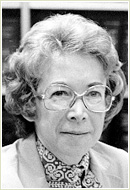
    Judge Newman Judge Rader countered that he didn't see any
    evidence of the written description requirement being used in Office rejections
    in the 300-400 cases that come to the Court each year — not a "a single
    case."  Although Mr. Freeman
    began a substantive response — "You cannot assume away 400,000 cases, the
    vast majority of the PTO's decisions are not litigated," Judge Newman
    (at left) chimed in, quietly saying:  "Let me help you" (and provoking another
    round of laughter).  Judge Newman
    said:

    When I started, chemistry was the hot area, and the
    question of how many species you needed was assessed by the written
    description requirement, and while many things have happened [since] . . . we
    have come full circle, where there are generic concepts, this case is a good
    example, and how one describes the genus depends on how much detail is
    required.  In some areas, description
    and enablement are not co-extensive.  And generally when it comes up in the Office it is resolved, so I agree
    completely that it is quite rare to see those cases on appeal; they are not insoluble, it is much
    easier to run some experiments than to appeal and come back a decade later.  The
    principle is importantly illustrated in this case, where the outcome may depend
    on how we answer the questions.

    Judge Lourie then threw Mr. Freeman a softball, asking:  "Doesn't it occur that someone files a broad claim and exemplifies it with
    very little, because it is all they have, and the PTO rejects on written
    description?"

    In answering "Yes" to this question, Mr. Freeman
    used the Tronzo case as an
    example.  Judge Rader remained
    unconvinced, asking:  "Why isn't that covered in the vast majority of cases
    by the doctrine of enabling throughout the scope of the claim?"  While agreeing that this could be the
    case, Mr. Freeman maintained that while it could be true in some cases, it is "not
    always true that what isn't described isn't enabled," using In re DiLeone as an example.

    To this, Judge Lourie said:  "It's because they
    are related, you have enabled other species but have not described it,"
    and Mr. Freeman agreed as Judge Rader informed him that his time had expired.

    Ariad Mr. Whealan (after exchanging pleasantries with Chief Judge Michel)
    was immediately directed to Judge Lourie's perception that there were significant
    differences in the positions taken in Ariad's opening brief and its reply
    brief.  He was pointedly asked if
    Ariad had "retreated," and parried this question with a clear
    statement of Ariad's position:

    What this Court has done is delinked the written
    description of the invention from the rest of the words of the statute, and
    what we are suggesting is that the description of the invention, and of how to
    make and use it is measured by the following terms.  Therefore it has to be clear, precise and exact, and it has
    to enable.  If this were not the
    case, then Congress would have said that the written description of the invention
    does not have to be clear, precise and exact terms, but the written description
    of the manner of making and using it does.  That makes no sense.

    Judge Prost He then also announced that he was not going to use
    "labels" (presumably, "written description" and "enablement"),
    but was stopped from developing this theme by a question from Judge Prost (at left),
    citing to that inconvenient reply brief — with reference to the statements in
    the reply brief about the written description matching the inventor's
    contribution:  "Are you saying that there is no way that you can enforce
    the written description requirement except by the enablement portion?"  "Absolutely not," Mr. Whealan
    replied.  Ariad's position was that the Court had
    delinked the written description and enablement requirements, leaving the Court
    with no standard for assessing compliance with the written description
    requirement.  This led to the
    development of the "possession" standard, which led to the
    requirement to supply sequences and structure.  "Possession does not exist in the statute," he
    said, "and it doesn't exist in the case law."

    The main portion of his argument was linked to the
    Telephone cases and (to a lesser extent) to other early cases, where he
    maintained that the evidence was that the inventor had not made the invention
    and had not actually made all embodiments within the scope of the patent
    claims, was permitted to claim broadly because he had enabled the skilled
    worker to practice the invention.  He said that the standard under the Court's jurisprudence had shifted
    from whether the inventor put the public in possession of the invention to
    whether the inventor was in possession of the invention, and ultimately to what
    the inventor had actually done.  He
    said that Bell would have failed under the possession test used by the Court,
    because Bell didn't get the invention to work, others did.  Judge Dyk noted that Lilly was not
    espousing that there has to be an actual reduction to practice, and Judge Linn asked what
    was the difference between possession and identification?  Mr. Whealan used a perpetual motion
    machine as an example, where you could identify it but not enable it.
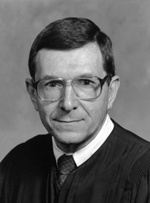
    Judge Lourie Judge Lourie (at right) then mentioned that almost all the amici, across all technologies and
    sizes, and most of the major patent bar associations, all disagreed with Ariad's
    position (at least the one taken in its principal brief).  "What do they know that you don't?" he asked.  When his initial
    response ("people like invalidating patents for any reason") was shot
    down by the bench, noting that the opinion was held "on both sides"
    (presumably, companies like Microsoft that frequently criticize patents and
    companies like Amgen that depend on patents), Mr. Whealan charged that Lilly
    and amici had set up "a strawman," that Ariad was not suggesting that
    the written description requirement be "read out" of the statute
    (something that might come as a surprise to anyone who read Ariad's principal
    brief and the grammatical parsing of the statutory language), but that the Court needed to enunciate the right standard.  He also said that, in view of the vast sentiment against Ariad's
    position (characterizing the amici as "noise"), Ariad could only
    prevail if he were to convince the Court that ruling in Ariad's favor would not
    "harm the system."

    When he began his argument with regard to the
    Supreme Court never having held, as
    the Federal Circuit has done, that there are separate written description and
    enablement requirements, he was interrupted by Judge Newman, who noted that
    while there are not cases that have come before the Court, that is because of
    the nature of the inventions in which the problem arises that they can be
    enabled — "getting a gene out of a chromosome," which is "well
    known" how to do — without being described.  Mr. Whealan asserted in response that an applicant would not
    get a patent under these circumstances, without supporting that statement with
    any citation or other authority (perhaps erroneously believing that In re Kubin has foreclosed patentability
    to gene claims).

    He also maintained that "an original claim
    defines itself," and that Lilly had changed this requirement because "under
    Lilly you would have to show possession."  In response to Judge Lourie's question concerning whether
    the factfinder needs to believe a genus has been described, Mr. Whealan said
    the Federal Circuit should "follow the Supreme Court" with regard to "whether
    the description matched the inventor's contribution."  He then contrasted the Telephone cases — where Bell was granted broad claims to his manner of transmitting voice over a
    distance — to the Incandescent Light cases, where the broad claims were not
    valid since most of the claimed "fibrous material" did not work
    (prompting one of the judges to ask whether Mr. Whealan was arguing a utility
    aspect to the question).  Judge Dyk asked Mr. Whealan to describe the difference between "identifying"
    and "describing" in view of his position that he would use the former
    but not the latter term.  Without
    directly responding, Mr. Whealan argued that "putting the statute back
    together" would lead the Court to applying the Telephone cases and that
    precedent, which he characterized as Supreme Court teaching that a patentee
    would not be limited to "how you did it" (i.e., practiced the
    invention).  If you had "changed
    the way to do something, then [you are] entitled [to a patent,]" he said.

    Judge Lourie then asked whether there were "a lot
    of broad claims with little support that [have] to be rejected?"  Mr. Whealan turned again to the
    Incandescent Light cases, to which Judge Lourie said:  "That was 150 years ago, we're dealing
    with today," and asked about the Gentry
    Gallery
    case.  The question
    wasn't that the claim wasn't enabled, Mr. Whealan said, but that if you failed
    to identify, you failed enablement.  Judge Moore asked in this regard whether requiring that a claim be
    enabled throughout its full scope would "satisfy this problem."  Again pointedly reminding the Court
    that he was "avoiding labels," Mr. Whealan agreed.  Judge Moore then turned to the facts of
    this case, and asked whether the other examples disclosed in Ariad's
    specification would "work like decoy molecules."  Mr. Whealan said the answer is no, but
    that the patentee had identified the concept of preventing NF-kB from "hitting"
    (actually, entering) the cell nucleus, and identified three ways to achieve
    that goal.  He then asserted that "others"
    did just what the patentees had told them to do and "got it to work."  He cited the "Michigan paper"
    that the patentee had "told them what to do" and that they "just
    did it with the exact sequences disclosed by the patentee."  He characterized the inventors — "research
    university people" — as "figuring
    out the key thing to do," and that "the Michigan people wouldn't have
    known to look at NF-kB."

    Judge Moore then asked whether the Court should use
    the principle of stare decisis to "leave
    it alone?"  Mr. Whealan
    responded that since the Supreme Court had not "done the analysis,"
    there was no stare decisis (nicely
    disparaging the Federal Circuit's own precedent).  He also noted the disagreements between the judges of the Federal
    Circuit, and said that this case was a "progression of the Court's
    jurisprudence" on the issue.

    Judge Newman acknowledged that this case presented
    questions that concerned "very fundamental aspects of policy based on
    areas of technology — how far an applicant must go with a scientific concept
    before the fundamental requirements of patentability will be met."  She said it was "easy to
    understand why this issue has not been before the Supreme Court," and that
    in the earlier cases "the issues were much easier," mentioning that
    in O'Reilly, "the Supreme Court
    said of course you couldn't patent electromagnetism."  Mr. Whealan countered that to the
    people in the late 19th Century, the telephone was "revolutionary"
    technology.

    In his final remarks, Mr. Whealan restated Ariad's
    position that "if you teach enough that someone could do it, that
    satisfies it [the disclosure requirements of Section 112]."  He said that "Ariad taught people
    what to do and they did it."

    In rebuttal, Mr. Lipsey dismissed Ariad's reliance
    on the Telephone cases, saying that these cases "have nothing whatsoever
    to do with written description," involving a "unique" claim set
    reciting the apparatus "as herein described."  He said that there was "no holding
    that identification of a common principle entitles you to claim every way of
    attaining it.  The cases are legion
    that what you are trying to do is claim the desired result, as in Morse and the ice
    cutting case, those claims are improper."

    He also dismissed the argument about the word "possession,"
    saying that "Carnegie Mellon and
    LizardTech makes clear that it is a
    synonym for 'did he invent it?'"

    Judge Dyk asked whether the issue was "the
    difference between a research plan and an invention, and that the parties would
    draw the line in different places?"  Mr. Lipsey agreed, but said
    that "the only way to get there is to do away with the statutory
    requirement."  The statute
    defines what is required — did the inventor conceive the invention and reflect
    that conception?  He also agreed
    with the final question posed by Judge Lourie, to the effect that "possession"
    is a synonym for what an inventor invented and disclosed.

    While there is little to be gained by speculating
    on how the Court will rule based on the questioning from the bench, a remarkable
    aspect of the argument is that neither party addressed four-squarely the issue
    underlying the argument:  how much
    disclosure is required for inventions and in arts where merely naming something is
    insufficient to describe it?  There
    are consequences (positive and negative) for patentees and the public under the Court's current written description jurisprudence, as evidenced by the
    arguments from the amici involved, as
    targets or enforcers of patents under the current interpretation of §
    112.  What the Court should
    consider is whether or not these consequences are in sufficient balance, and
    what the consequences would be if the Court significantly modified its
    application of the written description requirement, thereby unsettling the
    expectations that have arisen in the patenting community during the
    development of the modern form of the written description requirement.

    Patent Docs thanks Professor Oskar Liivak of Cornell Law School, who attended the oral argument and kindly provided identifications of a number of judges who asked questions during the hearing.

  •     By Suresh Pillai

    Breach of Contract Claims Dismissed in AIA-Mayo
    Suit

    Alzheimer's Institute of America (AIA) The District Court for the Middle District of
    Florida has dismissed two claims brought by the Alzheimer's Institute of
    America
    (AIA)
    against the Mayo Clinic and Myriad Pharmaceuticals alleging that the defendants had breached the no-challenge clause contained
    within the institutional licensing agreement.  This is the latest decision in a case that began in 2003
    when the AIA sued Mayo and Myriad for patent infringement in the U.S. District
    Court for the District of Kansas.  In the original filing, the AIA alleged that the companies infringed U.S. Patent Nos. 5,795,963
    and 5,455,169,
    which cover nucleic acids and methods for diagnosing and modeling Alzheimer's
    disease.

    Mayo Clinic The litigation was stayed pending the outcome of
    arbitration on the issue of whether the license between the AIA and the
    defendants covered the use of cell lines and whether the AIA was owed
    compensation under the agreement for benefits received by Mayo through third
    party agreements.  The arbitration
    panel concluded that the licensing agreement did not include the use of
    the patented technology with cell lines; however, the panel also concluded that
    Mayo owed nothing to the AIA in the way of compensation for the licensed use of
    the technology.  Following the
    conclusion of the arbitration, the AIA refiled the patent infringement suit,
    including counterclaims of unjust enrichment and equitable interest.  Both of these counterclaims had been
    dismissed in a June ruling (see "Biotech/Pharma Docket," July 7,
    2009).  The AIA subsequently filed an amended
    counterclaim that included the breach of contract claims.

    Myriad In its latest ruling, the District Court concluded that,
    because the no-challenge clause was neither part of a settlement agreement for
    litigation nor a consent decree, the Court could, under federal patent policy, invalidate
    the clause, thereby clearing the way for Mayo to challenge the patents'
    validity.  The Court also concluded
    that, because the breach of contract claim arose from the same set of facts as
    those presented in the earlier arbitration, the claim was barred by res
    judicata, as the arbitration had reached a decision on the breach of contract
    claims based on the merits.


    Settlement Announced in Loprox® and Vanos® Patent
    Dispute

    Glenmark Pharmaceuticals Glenmark Pharmaceuticals has
    announced that it has reached an agreement with Medicis Pharmaceuticals that should settle
    the companies' patent dispute over Glenmark's marketing of generic versions of
    Medicis' patented Loprox® topical skin gel
    and Vanos® steroidal skin cream (covered by U.S. Patent Nos. 6,765,001
    and 7,220,424).  Under the terms of the licensing and settlement
    agreement, Medicis has granted Glenmark permission to market a generic version
    of Vanos® by December 2013 at the earliest as well as permission to market a
    generic version of Loprox® immediately.  In return for the license, Glenmark has agreed to pay Medicis a
    sales-based royalty.

    Medicis This settlement is the latest agreement
    reached with a generic manufacturer of Medicis' products.  In April, Medicis reached a
    settlement with Perrigo Israel Pharmaceutical over Perrigo's marketing of a generic version of Vanos® (see "Biotech/Pharma
    Docket
    ," April 21, 2009).


    Ranbaxy Admits Infringment in OxyContin® Suit

    Ranbaxy The U.S. District Court for the Southern District
    of New York has approved a consent judgment between Ranbaxy Pharmaceuticals and Purdue Pharma,
    the rights holder for U.S. Patent No. 5,508,042,
    covering controlled-released compositions of oxycodone, including the trade
    drug OxyContin®.  Purdue originally
    filed suit in October after Ranbaxy had submitted an Abbreviated New Drug Application to the FDA seeking regulatory approval to market generic versions
    of OxyContin®.  Purdue's complaint
    also alleged that Ranbaxy's ANDA included a Paragraph IV certification that the
    '042 patent was invalid, unenforceable, and would not be infringed by the
    proposed generic version.  Earlier
    this month, the suit joined the multidistrict litigation already in progress
    related to allegations of Purdue engaging in sham patent infringement
    litigation as a means to prevent generic versions of OxyContin® from reaching
    the market.

    Purdue Pharma The consent judgment dismisses Purdue's suit
    against Ranbaxy without costs and establishes the present and future validity
    of the '042 patent in litigations involving Ranbaxy.  The judgment also permanently enjoins Ranbaxy from
    infringing the '042 patent by the marketing of generic versions of OxyContin®.  Ranbaxy also agreed not to seek FDA
    approval to market a generic version until the expiry of the patent and any
    period of exclusivity.

  •     By Sarah
    Fendrick


    USPTO Seal On November 23, 2009, the U.S. Patent and Trademark Office and India's Department of Industrial Policy and
    Promotion (DIPP) announced the signing of a Memorandum of Understanding (MOU) regarding comprehensive
    bilateral cooperation on intellectual property rights (IPR) protection and
    enforcement.  The MOU was
    signed in an effort to create a cooperative relationship between the USPTO and
    India's Intellectual Property Organisation.  In order to facilitate this cooperative effort, a number of
    initiatives have been proposed including programs that provide "exposure
    to patent examination practices, exchange of information on patent databases
    and patent manuals, IPR awareness programs, exchange of information on
    traditional knowledge and genetic resources, exchanges of best practices, and
    other matters."

    India In
    addition to the signing of the MOU, India granted access to U.S. patent examiners of its new traditional knowledge search tool.  The new search
    tool is a digital database containing 200,000 traditional medicine formulations
    on Ayurveda, Unani, and Siddha, and thousands of years of India's accumulated
    traditional knowledge.  The search tool provides an English translation of
    the 30 million pages in the database opening a vast amount of knowledge that
    was once unsearchable.  The newly acquired
    access to the database will help address the issue of misappropriation of traditional
    knowledge through the mistaken issuance of patents, a growing concern in the
    global economy.

    According to a press release regarding the MOU, "[t]he
    two offices will immediately begin planning the implementation of these
    cooperative projects under the MOU."

  •     By Sherri Oslick

    Gavel_2About
    Court Report:  Each week we will report briefly on recently filed
    biotech and pharma cases, and a few interesting cases will be selected
    for periodic monitoring.


    Pfizer Inc. et al. v. Kremers Urban LLC et al.
    1:09-cv-00924; filed December 3, 2009 in the
    District Court of Delaware

    • Plaintiffs: 
    Pfizer Inc.; Pfizer Ireland Pharmaceuticals; Warner-Lambert Co.;
    Warner-Lambert Co. LLC
    • Defendants: 
    Kremers Urban LLC; KUDCO Ireland Ltd.

    Infringement of U.S. Patent No. 5,969,156 ("Crystalline
    [R- (R*,R*)]-2-(4 Fluorophenyl)-β,δ-dihydroxy-5-(1-methylethyl)-
    3-phenyl-4-[(phenylamino)carbonyl]-1H-pyrrole-1-heptanoic acid hemi calcium
    salt (atorvastatin)," issued October 19, 1999) following a Paragraph IV
    certification as part of Kremers' filing of an ANDA to manufacture a generic
    version of Pfizer's Lipitor® (atorvastatin calcium, used to treat high
    cholesterol and heart disease). 
    View the complaint here.


    Takeda Pharmaceutical Co. Ltd. et al. v. Watson
    Laboratories Inc. – Florida et al.

    1:09-cv-00917; filed December 2, 2009 in the
    District Court of Delaware

    • Plaintiffs: 
    Takeda Pharmaceutical Co. Ltd.; Takeda Pharmaceuticals North America
    Inc.
    • Defendant: 
    Watson Laboratories Inc. – Florida; Watson Pharma Inc.; Watson
    Pharmaceuticals Inc.

    Infringement of U.S. Patent No. 6,034,239 ("Tricyclic
    Compounds, Their Production and Use," issued March 7, 2000) following a
    Paragraph IV certification as part of Watson's filing of an ANDA to manufacture
    a generic version of Takeda's Rozerem® (ramelteon, used to treat
    insomnia).  View the complaint
    here.


    Cephalon Inc. et al. v. Teva Pharmaceuticals USA Inc. et al.
    1:09-cv-00918; filed December 2, 2009 in the
    District Court of Delaware

    • Plaintiffs: 
    Cephalon Inc.; Cephalon France
    • Defendants: 
    Teva Pharmaceuticals USA Inc.; Teva Pharmaceutical Industries Ltd.

    Infringement of U.S. Patent Nos. RE37,517 ("Acetamide
    Derivative Having Defined Particle Size," issued January 15, 2002),
    7,297,346 ("Pharmaceutical Fromulations of Modafinil," issued
    November 20, 2007), and 7,132,570 ("Method for the Production of Crystalline
    Forms of Optical Enantiomers of Modafinil," issued November 7, 2006)
    following a Paragraph IV certification as part of Teva's filing of an ANDA to
    manufacture a generic version of Cephalon's Nuvigil® (armodafinil, used to
    improve wakefulness in patients with excessive sleepiness associated with
    obstructive sleep apnea/hypopnea syndrome, narcolepsy, and shift work sleep
    disorder).  View the complaint
    here.


    Bristol-Myers Squibb Co. et al. v. Teva Pharmaceuticals USA
    Inc.

    1:09-cv-00919; filed December 2, 2009 in the
    District Court of Delaware

    • Plaintiffs: 
    Bristol-Myers Squibb Co.; Novartis Corp.; Novartis Pharma AG
    • Defendant: 
    Teva Pharmaceuticals USA Inc.

    Infringement of U.S. Patent Nos. 5,849,911 ("Antivirally
    Active Heterocyclic Azahexane Derivatives," issued December 15, 1998) and
    6,087,383 ("Bisulfate Salt of HIV Protease Inhibitor," issued July
    11, 2000), both licensed to BMS, following a Paragraph IV certification as part
    of Teva's filing of an ANDA to manufacture a generic version of BMS's Reyataz®
    (atazanavir bisulfate, used to treat HIV infection).  View the complaint
    here.


    Medicis Pharmaceutical Corp. v. Paddock Laboratories,
    Inc.
    2:09-cv-02498; filed December 1, 2009 in the
    District Court of Arizona

    Infringement of U.S. Patent No. 6,455,551 ("Use
    of 1-Hydroxy-2-Pyridones For Treating Mucosa Diseases Which Are Difficult To
    Treat," issued September 24, 2002) based on Paddock's manufacture and sale
    of products, including ciclopirox shampoo for the topical treatment of
    seborrheic dermatitis of the scalp.  View the complaint
    here.


    Monsanto Co. et al. v. King
    4:09-cv-01970; filed December 1, 2009 in the
    Eastern District of Missouri

    • Plaintiffs: 
    Monsanto Co.; Monsanto Technology LLC
    • Defendant: 
    Billy King

    Infringement of U.S. Patent Nos. 5,352,605 ("Chimeric
    Genes for Transforming Plant Cells Using Viral Promoters," issued October
    4, 1994) and RE39,247 ("Glyphosate-tolerant 5-enolpyruvylshikimate-3-phosphate
    Synthases," issued August 22, 2006) based on defendant's use of soybean
    seed produced from earlier planted Roundup Ready® soybean seed.  View the complaint
    here.


    Teva Pharmaceuticals USA, Inc. v. Amgen Inc.
    2:09-cv-05675; filed November 30, 2009 in the
    Eastern District of Pennsylvania

    Declaratory
    judgment of non-infringement and invalidity of U.S. Patent Nos. 5,580,755 ("Human
    Pluripotent Granulocyte Colony-Stimulating Factor," issued December 3,
    1996) and 5,582,823 ("Methods of Treating Bacterial Inflammation and
    Granulocytopoiesis by Administering Human Pluripotent Granulocyte
    Colony-Stimulating Factor," issued December 10, 1996) in conjunction with
    Teva's filing of a BLA seeking approval to market its NEUTROVAL product,
    expected to compete with Amgen's Neupogen® product (filgrastim, used to treat
    neutropenia).  View the complaint
    here.


    Depomed, Inc. v. Lupin Pharmaceuticals, Inc. et al.
    4:09-cv-05587; filed November 25, 2009 in the
    Northern District of California

    • Plaintiff: 
    Depomed, Inc.
    • Defendants:  Lupin Pharmaceuticals, Inc.; Lupin Ltd.

    Infringement of U.S. Patent Nos. 6,723,340 ("Optimal
    Polymer Mixtures for Gastric Retentive Tablets," issued April 20, 2004),
    6,635,280 ("Extending the Duration of Drug Release Within the Stomach
    During the Fed Mode," issued October 21, 2003), 6,488,962 ("Tablet
    Shapes to Enhance Gastric Retention of Swellable Controlled-Release Oral Dosage
    Forms, issued December 3, 2002), and 6,340,475 ("Extending the Duration of
    Drug Release Within the Stomach During the Fed Mode," issued January 22,
    2002) following a Paragraph IV certification as part of Lupin's filing of an
    ANDA to manufacture a generic version of Depomed's Glumetza® (metformin
    hydrochloride extended release tablets, used to improve glycemic control in
    adults with type 2 diabetes mellitus).  View the complaint
    here.


    Merck & Co., Inc. et al. v. Teva Parenteral Medicines, Inc.
    et al.

    2:09-cv-06026; filed November 25, 2009 in the
    District Court of New Jersey

    • Plaintiffs: 
    Merck & Co., Inc.; Merck Sharp & Dohme Corp.
    • Defendants: 
    Teva Parenteral Medicines, Inc.; Teva Pharmaceuticals USA, Inc.; Teva
    Pharmaceutical Industries, Ltd.

    Infringement of U.S. Patent Nos. 5,378,804 ("Aza
    Cyclohexapeptide Compounds," issued January 3, 1995), 5,514,650 (same
    title, issued May 7, 1996), and 5,952,300 ("Antifungal Compositions,"
    issued September 14, 1999) following a Paragraph IV certification as part of Teva's
    filing of an ANDA to manufacture a generic version of Merck's Cancidas®
    (caspofungin acetate, used to treat presumed fungal infections in febrile,
    neutropenic patients, candidemia and certain Candida infections, esophageal candidiasis, and invasive aspergillosis
    in patients who are refractory to or intolerant of other therapies).  View the complaint
    here.