•     By Sherri Oslick

    Gavel_2About
    Court Report:  Each week we will report briefly on recently filed
    biotech and pharma cases, and a few interesting cases will be selected
    for periodic monitoring.


    Eli Lilly and Company v. APP Pharmaceuticals, LLC et al.
    1:09-cv-01551; filed December 16, 2009 in the
    Southern District of Indiana

    • Plaintiff: 
    Eli Lilly and Company
    • Defendants: 
    APP Pharmaceuticals, LLC; APP Pharmaceuticals, Inc.

    Infringement of U.S. Patent No. 5,464,826 ("Method
    of Treating Tumors in Mammals with 2',2'-difluoronucleosides," issued
    November 7, 1995) following a Paragraph IV certification as part of APP
    Pharmaceutical's filing of an ANDA to manufacture a generic version of Lilly's
    Gemzar® (gemcitabine hydrochloride for injection, used to treat non-small cell
    lung cancer, pancreatic cancer, breast cancer, and ovarian cancer).  View the complaint
    here.


    Syngenta Seeds, Inc. v. Bayer Bioscience N.V.
    1:09-cv-02370; filed December 15, 2009 in the
    District Court of the District of Columbia

    Declaratory judgment of non-infringement and
    invalidity of U.S. Patent Nos. 5,866,784 ("Recombinant Plant Expressing
    Non-Competitively Binding Insecticidal Crystal Proteins," issued February
    2, 1999), 5,908,970 ("Recombinant Plant Expressing Non-Competitively
    Binding BT Insecticidal Crystal Proteins," issued June 1, 1999), and
    6,172,281 (same title, issued January 9, 2001) based on Syngenta's development
    and anticipated sales of corn containing combinations of insect resistance
    derived from the bacterium Bacillus
    thuringiensis
    .  View the
    complaint
    here.


    Cephalon France et al. v. Mylan Pharmaceticals, Inc. et al.
    1:09-cv-00165; filed December 14, 2009 in the
    Northern District of West Virginia

    • Plaintiffs: 
    Cephalon France; Cephalon, Inc.
    • Defendants: 
    Mylan Pharmaceticals, Inc.; Mylan Inc.; Matrix Laboratories Ltd.;
    Matrix Laboratories Inc.

    Cephalon Inc. et al. v. Mylan Pharmaceuticals Inc. et al.
    1:09-cv-00954; filed December 11, 2009 in the
    District Court of Delaware

    • Plaintiffs: 
    Cephalon Inc.; Cephalon France
    • Defendants: 
    Mylan Pharmaceuticals Inc.; Mylan Inc.; Matrix Laboratories Ltd.;
    Matrix Laboratories Inc.

    Cephalon, Inc. et al. v. Actavis Group et al.
    2:09-cv-06239; filed December 10, 2009 in the
    District Court of New Jersey

    • Plaintiffs: 
    Cephalon, Inc.; Cephalon France
    • Defendants: 
    Actavis Group; Actavis Pharma Manufacturing Pvt. Ltd.; Actavis Inc.

    The complaints in these cases are substantially
    identical.  Infringement of U.S.
    Patent Nos. RE37,516 ("Acetamide Derivative Having Defined Particle Size,"
    issued January 15, 2002) and 7,132,570 ("Method for the Production of
    Crystalline Forms of Optical Enantiomers of Modafinil," issued November 7,
    2006) following a Paragraph IV certification as part of Mylan's filing of an
    ANDA to manufacture a generic version of Cephalon's Nuvigil® (armodafinil, used
    to improve wakefulness in patients with excessive sleepiness associated with
    obstructive sleep apnea/hypopnea syndrome, narcolepsy, and shift work sleep
    disorder).  View the Delaware Mylan complaint
    here.


    Wyeth Holdings Corp. et al. v. Sandoz Inc.
    1:09-cv-00955; filed December 11, 2009 in the
    District Court of Delaware

    • Plaintiffs: 
    Wyeth Holdings Corp.: Wyeth-Ayerst Lederle LLC
    • Defendant: 
    Sandoz Inc.

    Infringement
    of U.S. Patent No. RE40,183 ("7-Substituted-9-Substituted
    Amino-6-Demethyl-6-Deoxytetracyclines," issued March 25, 2008), licensed
    to Wyeth-Ayerst Lederle, following a Paragraph IV certification as part of Sandoz's
    filing of an ANDA to manufacture a generic version of Wyeth's Tygacil® (tigecycline
    injectible, used for the treatment of complicated skin and skin structure
    infections, complicated intra-abdominal infections, and community-acquired
    bacterial pneumonia caused by susceptible strains of designated microorganisms).  View the complaint
    here.


    Seattle Children's Hospital et al. v. Teva Parenteral Medicines
    Inc. et al.

    1:09-cv-00949; filed December 10, 2009 in the
    District Court of Delaware

    • Plaintiffs: 
    Seattle Children's Hospital; Novartis AG; Novartis Vaccines and
    Diagnostics Inc.; Novartis Pharmaceuticals Corp.
    • Defendants: 
    Teva Parenteral Medicines Inc.; Teva Pharmaceutical Industries Ltd.;
    Teva Pharmaceuticals USA, Inc.

    Infringement
    of U.S. Patent No. 5,508,269 ("Aminoglycoside Formulation for
    Aerosolization," issued April 16, 1996) following a Paragraph IV
    certification as part of Teva's filing of an ANDA to manufacture a generic
    version of Novartis' TOBI® (tobramycin inhalation solution, used in the
    management of cystic fibrosis patients with Pseudomonas aeruginosa).  View the complaint
    here.

  • CalendarJanuary 6-10, 2010 – 27th
    Annual National CLE Conference
    (
    Law Education Institute, Inc.) – Vail, CO

    January 20-21, 2010 – Life Sciences IP
    Due Diligence
    (American Conference
    Institute) – New York, NY

    January 25-26, 2010 – European Pharmaceutical Regulatory Law Boot
    Camp
    (American Conference
    Institute) – New York, NY

    January 26-27,
    2010 –
    Advanced In-House Counsel Forum on China IP Law (C5) – Shanghai, China

    January 27-28, 2010 – Pharma & Biotech Patent Litigation (C5) – Amsterdam, Netherlands

    February 9, 2010 – Patent
    Prosecution: Best Practices for Reducing Costs While Improving Patent
    Quality
    (
    Technology
    Transfer Tactics) –
    1:00 – 2:30 PM (EST)

    February 24-25, 2010 – 2nd Expert Forum on ITC Litigation &
    Enforcement
    (
    American Conference
    Institute) –
    New York, NY

    March 2-4, 2010 – 6th Annual Biosimilars Conference (Visiongain) – Boston,
    MA

    ***Patent Docs is a media partner of this conference or CLE

  • New York #1 American Conference
    Institute (ACI) will be holding its 2nd Expert Forum on ITC Litigation &
    Enforcement from February 24-25, 2010 in New York, NY.  The conference will offer practical
    advice for seizing the opportunities and meeting the challenges offered by
    fast-paced ITC litigation and allow attendees to:

    • Evaluate and
    compare the potential benefits of selecting ITC or another venue;
    • Navigate the
    ITC's complex procedural rules;
    • Understand and resolve
    questions relating to "domestic industry" standards;
    • Meet the demands
    of accelerated motion practice and discovery;
    • Implement
    effective defense and intervention strategies in a Section 337 action; and
    • Enforce ITC
    exclusion orders.

    In particular,
    ACI's faculty will offer presentations on the following topics:

    Resample_brochure.php • Evaluating where
    to litigate international IP disputes;
    • Positioning
    complainants, respondents and intervenors in Section 337 cases;
    • Successfully
    working the logistics of Section 337 litigation;
    • Keynote address
    by Chief Judge Paul R. Michel of the U.S. Court of Appeals for the Federal
    Circuit;
    • Coordinating
    related parties & proceedings;
    • Managing
    litigation through discovery, claim construction, summary determination and
    trial;
    • Meeting the
    challenge of the ITC’s unique trial procedures;
    • View from the
    Bench — Chief Administrative Law Judge Paul J. Luckern, Administrative Law
    Judge Theodore R. Essex, and Administrative Law Judge Robert K. Rogers of the
    U.S. International Trade Commission;
    • Seeking
    commission review and modification of ALJ decisions;
    • The year in
    review — Commission and Federal Circuit decisions in Section 337 cases;
    • Understanding and
    maximizing the available remedies in Section 337 ITC cases;
    • Seeking enforcement
    of exclusion orders;
    • Successfully
    appealing Section 337 determinations;
    • A view from the
    ITC General Counsel's office;
    • Keynote address
    by Shara Aranoff, Chairman of the International Trade Commission;
    • Handling ITC
    ancillary proceedings and parties;
    • Addressing
    downstream remedy strategies post-Kyocera;
    • Meeting the
    challenges faced by in-house counsel in Section 337 cases; and
    • Meeting the
    challenges raised when assisting foreign companies in the ITC with focus on
    Asian companies.

    Two breakout
    sessions will be offered from 9:00 am to 12:00 pm on February 26.  The first will address Section 337
    complaints and responses, and the second will address enforcement of ITC
    exclusion orders.

    ACI - American Conference Institute A complete brochure
    for this conference, including an agenda, list of speakers, and registration
    form can be downloaded here.  The registration fee for the conference
    ranges from $2,195 (conference alone) to $2,795 (conference and breakout
    session).  Those registering by
    January 5, 2010 will receive a $300 discount off the registration fee and those
    registering by January 29, 2010 will receive a $200 discount off the
    registration fee.  Those interested
    in registering for the conference can do so here,
    by calling 888-224-2480, or by faxing a registration form to 877-927-1563.

  • Technology Transfer Tactics
    Technology
    Transfer Tactics will be offering an audioconference entitled "Patent
    Prosecution: Best Practices for Reducing Costs While Improving Patent
    Quality
    "
    on February 9, 2010 from 1:00 – 2:30 PM (EST).  Dr. Jean Baker and Jack Cook of Quarles & Brady will
    provide specific prosecution strategies that Technology Transfer Offices can
    adopted to significantly reduce legal bills while improving overall patent
    quality.  The audioconference will
    address the following topics:


    Disclosure evaluation:  Strategies
    for distinguishing what TTOs can patent from what TTOs should patent to avoid
    unnecessary filing costs;

    Strategies for increasing the probability of successful licensing at the
    disclosure stage

    Ten proven tips for TTOs to reduce patent preparation costs;

    Working with researchers to enhance disclosures and claims construction;

    Reducing unnecessary paperwork and associated attorney costs; and

    Structuring patent prosecution: 
    Practical strategies for TTOs and licensees to increase the efficiency
    of prosecution, while reducing the cost and staff burden.

    The
    registration fee for the seminar is $197. 
    Those interested in registering for the seminar, can do so here.

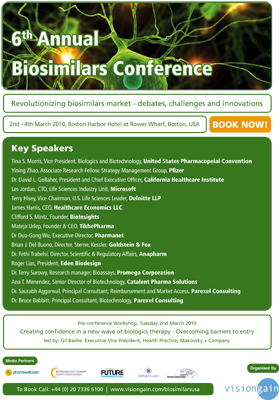
  • Boston Skyline Visiongain will be
    holding its 6th Annual Biosimilars Conference on March 2-4, 2010 in Boston,
    MA.  At the conference, Visiongain
    faculty will offer presentations on the following topics on March 3-4:

    • Opportunities and
    challenges for biosimilars in the global market;
    • Commercializing
    biosimilars:  Will they really be
    able to compete?
    • Demystifying the
    market aspects/implications of follow on biologics;
    • The impact of a
    patient centric viewpoint on biosimilars;
    • Strategies for
    process development/manufacturing of biosimilars (for global markets);
    • Bioassays for
    biosimilars;
    • Immunogenicity
    Programs — Not just another box to check;
    • Role of USP
    standards in the quality assessment of biological medicines;
    • An overview on
    regulatory and scientific issues of biosimilars and follow-on biologics;
    • Legislative and
    regulatory developments impacting the biologics and biosimilars marketplace;
    • Trends and
    technical challenges for the development of biosimilars in China;
    • Follow-on Biologics
    (Biosimilars) development with approval and market access;
    • Biosimilars —
    Succeeding in the market of the future; and
    • Clinical Phase 1
    PK/PD trials for biosimilar/follow-on products.

    Brochure In addition, a
    pre-conference interactive biosimilars workshop entitled "Creating
    confidence in a new wave of biologics therapy — Overcoming barriers to
    entry" will be offered on March 2. 
    The agenda for the Biosimilars Conference can be found here.  A complete brochure for this
    conference, including an agenda, list of speakers, and registration form can be
    downloaded here (free
    registration required).

    The registration
    fee ranges from £1299 ($
    2,099.31)
    for the
    conference alone to
    £1699 ($
    2,745.75) for the conference and workshop; the fee for
    attending the workshop alone is £599 ($
    968.04). Those interested in registering for the
    conference can do so here.

  •     By
    Donald Zuhn

    ScienceFriday Last
    week, National Public Radio's Science
    Friday
    , which is broadcast nationwide as part of NPR's Talk of the Nation, examined the issue of gene patenting.  The debate over gene patenting reignited
    in May as a result of the Association for
    Molecular Pathology v. United States Patent and Trademark Office
    case, in
    which a group of patients, physicians, academic researchers, and medical
    societies filed suit against the U.S. Patent and Trademark Office and Myriad
    Genetics, among others, over several patents claiming human BRCA1 and BRC2
    genes and methods for detecting mutations in these genes to diagnose a
    predisposition to breast and ovarian cancer (see Patent Docs reports here and
    here).  Since then, two public
    radio debates have focused on the issue.
    Gene In
    June, Dr. Hans Sauer, the Associate General Counsel for Intellectual Property
    for the Biotechnology Industry Organization (BIO); Joshua Sarnoff, Professor of
    the Practice of Law at American University's Washington College of Law; and
    Shobita Parthasarathy, Co-Director of the Science, Technology and Public Policy
    Program at the Ford School of Public Policy at the University of Michigan
    discussed the topic on WAMU, Washington, DC's leading public radio station (see "Gene Patenting Debate
    Continues
    ").  And last August, Kevin Keenan,
    Executive Director of the ACLU for San Diego and Imperial Counties; Stacey
    Taylor, a partner at DLA Piper; and Dr. Leonard Deftos, Professor of Medicine
    in Residence at the University of California, San Diego, and Adjunct Professor
    of Law at California Western School of Law tackled the issue on San Diego's
    KPBS "These Days" program (see
    "Gene Patenting Debate Continues – Round Two").  This past Friday, Patent Docs author Dr. Kevin Noonan, a partner at McDonnell Boehnen
    Hulbert & Berghoff, and Daniel Ravicher, the Executive Director of the
    Public Patent Foundation (PUBPAT), which is serving as
    co-counsel in the Association for
    Molecular Pathology
    case, squared off in a third debate
    on the topic on NPR's Science Friday.

    Flatow, Ira Science Friday
    host Ira Flatow (at right) began the program by asking Mr. Ravicher why the lawsuit was
    brought.  Mr. Ravicher replied that
    the suit was "about whether or not the government has the right to grant
    exclusive rights to one company over our genes" as well as the knowledge
    of gene mutations that might relate to a predisposition for particular types of
    diseases.  He added that the suit
    was filed because Myriad Genetics, which co-owns the seven patents-in-suit, had
    been asserting the patents in a way that "crack[s] down on anyone else
    doing any research" and "anyone else doing . . . second opinion
    testing."  After Mr. Flatow
    noted that the PUBPAT website describes gene patent holders as having "the
    right to prevent anyone from studying, testing, or even looking at a [patented]
    gene," Mr. Ravicher declared that "there's absolutely conclusive
    ownership of the gene by the patent holder."

    Noonan, Kevin Mr.
    Flatow then turned to Dr. Noonan (at left) for a response, asking whether he agreed with
    Mr. Ravicher's assessment.  Dr.
    Noonan conceded that Mr. Ravicher was "technically correct," but before
    he could opine further, Mr. Flatow asked whether it was true that "people
    aren't even able to look at the gene?"  Noting that "[t]he National Library of Medicine has a
    list of most of the major scientific journals in the U.S. and abroad," Dr.
    Noonan revealed that a search of the collection for BRCA references yielded
    "almost 3,500 papers that have been published about these genes, some as
    recent as last month."  (In
    addition, a search of the NCBI PubMed database
    yields 1,145 references containing "BRCA" in the title or abstract.)  In view of the NLM search results, Dr.
    Noonan contended that "the idea that people are not doing scientific
    research on these genes is just wrong," explaining that "[w]hat
    people are not being [allowed] to do, and what some of the named plaintiffs in
    this lawsuit are trying to do, is provide clinical testing."  According to Dr. Noonan, it was the
    commercial use of the BRCA sequences, and not the research use of the
    sequences, that was precluded.  Mr.
    Ravicher, however, replied that he represented researchers at the University of
    Pennsylvania, Emory University, and the University of California-Los Angeles, all
    of whom had received "very nasty letters" from Myriad saying that
    "[w]e know that you are doing things with these genes that relate to
    breast and ovarian cancer, and you shall stop or pay us money."  He added that "BRCA analysis at
    the University of Pennsylvania [had been] shut down because of Myriad's patent
    assertion."

    Returning
    from a short break, Dr. Noonan noted that he was on the program to defend gene
    patenting (and not necessarily Myriad), stating that "it would be a
    mistake for the United States government — whether through the courts, through
    Congress, or through the Patent Office — to not allow genes to be patented."  When asked why this would be a mistake,
    he replied that "[b]esides being contrary to 200 years of natural products
    patenting," a prohibition on gene patenting would adversely impact the disclosure
    of gene sequences and investment in biotechnology.  Explaining that "in the biotechnology space, investment
    is critical," Dr. Noonan noted that "[m]ost of the companies that do
    this are small companies like Myriad, and unless there's some way for investors
    — in something that's very high risk and [where] most of the products fail —
    to get their investment back, you're not going to have investment."  As a result, "you don't have the
    drugs and the diagnostics that the biotechnology industry has developed over
    the past 25 years, and I think that we're in worse shape if we don't have them."

    Ravicher, Dan In
    response, Mr. Ravicher (at right) argued that "[t]here are valid reasons to have
    patents on many things, but you can have patents on too many things, and
    there's a line that's been drawn by the Supreme Court, and we fully believe
    that these patents land on the wrong side of that line."  When pressed by Mr. Flatow to discuss
    the impact of the lawsuit on investment, Mr. Ravicher noted that "patents
    have both an incentivizing and a chilling effect," and analogized gene
    patents with a patent on the law of gravity, stating that "the Supreme
    Court has said that you can't patent some things [that] are basic laws of
    nature because that would have such a dramatic, countervailing chilling effect
    on everyone else — all 300 million other Americans and any research that they
    might do on that subject — that granting a [patent] to that one party isn't
    worthwhile."

    Mr.
    Flatow next asked Dr. Noonan whether he could patent a cure for cancer
    discovered in the course of doing research on a patented gene.  After Mr. Flatow outlined a lengthy
    hypothetical involving Bill Gates, Dr. Noonan observed that "we could spin
    hypotheticals all day, but it gets down very much to what exactly is it that
    you're doing."  Dr. Noonan
    added that "if you isolate [a patented] gene and use it, then you would be
    infringing," but "whether or not that would be something that you
    would be sued for . . . would depend on the circumstances."  When Mr. Flatow asked whether a patent
    holder could bring suit for "any arbitrary reason," Dr. Noonan
    responded that Rule 11 of the Federal Rules of Civil Procedure precluded such a
    suit, and "[y]ou have to have a good faith belief that somebody has
    infringed your patent."  Mr.
    Ravicher, however, noted that Rule 11 did not apply "to sending nasty
    letters."  Explaining that a
    lot of researchers were either universities that have "very skittish
    university counsel offices" or small businesses that "could never
    afford to defend themselves," Mr. Ravicher argued that "[m]erely the
    threat of a lawsuit just through a letter, which doesn't have to meet Rule 11,
    often chills conduct that most reasonable people would agree would never be
    covered by a valid claim of any patent."

    Turning
    to the impact of the claim term "isolated," Mr. Ravicher argued that:

    [M]ost reasonable people would agree
    that if the patents were just on the BRCA genes, that would not be valid
    because that exists in our body — the genes exist in our body.  It's that these patents say an
    "isolated gene," and the Patent Office . . . said that . . . if you
    isolated the gene, then that's patentable.  And we just think that's incorrect.  That's like saying I can go out into
    nature, I can dig up some gold, I can isolate it from the mountain, and well
    now I deserve a patent on gold, and that's just not the law.

    (Mr.
    Ravicher also contended that the decision to grant gene patents containing
    claims reciting "isolated" sequences was related to the "very
    pro-business, pro-patent Administration" under which authority the Office operated.)  With regard to the patentability of
    natural products, Dr. Noonan countered that antibiotics made by bacteria and
    the anti-cancer drug taxol, which is produced in the bark of the yew tree, were
    both examples of patentable natural products.  As for the BRCA genes, he contended that:

    (a) they're not identical to what's in
    the chromosome, (b) they're not in the chromosome anymore, and (c) they are
    much more converted [or] changed as the Supreme Court would say by the
    "hand of man," than . . . taxol from the yew tree.  So if you're going to use the traditional
    standards of what you have to do to change something that is found in nature to
    make it patentable, these genes satisfy that criteria hands down.

    Acknowledging
    that "Kevin does an excellent job of presenting our opponent's point of
    view," Mr. Ravicher noted that the plaintiffs in the BRCA case
    nevertheless disagreed.  According
    to Mr. Ravicher, "[a]ll those isolated natural product claims have never
    been upheld by the Supreme Court, and we think they would be invalid under
    binding precedent."

    For
    the last portion of the program, Mr. Flatow took calls from listeners.  The first caller stated that while she
    couldn't "fault the company Myriad, because they are the holders of the patent
    that was granted legally," and therefore she didn't "see any point in
    any lawsuits against them," she appeared to favor Mr. Ravicher's argument
    regarding the claim term "isolated," and thus saw "quite a bit
    of validity in complaints or suits against the U.S. Patent Office."  Mr. Ravicher noted that he:

    [W]ould disagree [with the caller] when she concedes that these patents are
    legal.  There are many things done
    under our previous Administration that were not legal.  Just because the Patent Office has
    granted a patent doesn't mean it's actually valid.  In fact, about half of the patents granted by the Patent
    Office and that are later litigated in court are found to be invalid.  They were wrongly granted by the Patent
    Office.  That's because the Patent
    Office has been created to be a pure patent-issuing Office under previous
    Administrations.  Under the new
    Administration, we expect that to change. 
    So I would not concede that these patents are valid just because they
    were granted.

    Unfortunately,
    Mr. Ravicher's attack on patent validity has some holes.  As an initial matter, Mr. Ravicher
    provided no support for his assertion that "about half of the patents . .
    . litigated in court are found to be invalid."  According to the Patstats.org,
    however, in cases where patent validity was at issue, the patent holder
    prevailed 59.8% of the time in 2008. 
    Mr. Ravicher's comment about patent validity also glosses over the
    motivation of accused infringers to invalidate asserted patents, as well as the
    impact of recent Federal Circuit decisions (e.g.,
    KSR International Co. v. Telflex Inc.)
    on patents that were examined and granted years ago.  With respect to Mr. Ravicher's comment that the USPTO had
    been "created to be a pure patent-issuing Office under previous
    Administrations," one hopes that he was not referring to the most recent
    Administration, as the Office's efforts to push through the claims and
    continuations rules (among other rules packages) and "reject, reject,
    reject" mantra contradict such a characterization.

    Turning
    to the cost of Myriad's test, Mr. Flatow asked Dr. Noonan whether there wasn't "something
    ethically, morally wrong with not allowing someone to come up with a cheaper
    test that potentially cancer patients can afford."  Dr. Noonan responded that he didn't
    have "any evidence that Myriad is the most profitable company in the
    country, or that what they're charging is excessive," adding that if
    Myriad was "making money hand over fist and w[as] on Forbes' front cover as the most profitable biotechnology company,
    maybe you'd have an argument." 
    He argued that Myriad appeared to be charging an amount that merely "justified
    the investment to [develop] the test in the first place."

    The
    second caller to the program admitted that she was "still a little unclear
    on this isolating of the gene," and asked:

    I have the gene, right?  It's in me?  So they've isolated it, but I have the gene, right?  So, why don't I have the patent on the
    gene, or why can't I sue Myriad?

    Agreeing
    with the caller, Mr. Flatow exclaimed that Myriad was "using your
    gene!" and asked Dr. Noonan for comment (while also accusing him of
    "trying to make light" of the caller's question).  Dr. Noonan argued that he was not
    making light of the question, and added that the caller's (and Mr. Flatow's) comment
    was "the emotional crux of the ACLU
    lawsuit."  He contended that:

    [N]obody is going to knock on your
    door, like Michael Crichton said in a New
    York Times
    editorial a few years ago, and give you a bill for using your
    gene.  That's just — it's great —
    it gets people all excited and all upset, but it's just — frankly, at the end
    of the day, it's a lie.

    The
    third (and final) caller observed that "the recommendation typically for
    women who test positive for the BRCA gene is to have a double mastectomy and
    their ovaries removed, and it's troubling that you can do this and you can't
    really get a second opinion," and noted that "[t]here's no other
    company you can go to get this test done before you have this very radical life
    changing surgery."  Dr. Noonan
    replied that he had "spoken with some people at Myriad [who] say nobody
    ever asked them for the second diagnosis," and therefore speculated that
    "the second opinion option is one that may still be out there."  Mr. Ravicher, however, asserted that he
    had "actually written a letter to Myriad on behalf of my client who has
    already paid [for one test]," and that Myriad had "refused to grant
    our client in this lawsuit the right to get a second opinion."  Dr. Noonan asked Mr. Ravicher whether
    this letter had been sent to Myriad after the lawsuit was filed, and Mr.
    Ravicher acknowledged that it had.

    After
    Mr. Ravicher suggested that an individual could get a second opinion outside
    the U.S. "because these gene patents are not allowed in most other
    countries in the world," Mr. Flatow compared such an option with the
    dilemma facing women prior to Roe v. Wade.  Mr. Ravicher noted that he had "seen
    another analogy, which was with respect to patents on human embryonic stem
    cells in this country, which were granted [in the U.S.] but not granted in
    other countries."  He
    suggested that these patents had forced "many researchers . . . to move
    their labs to foreign countries like Singapore because the [stem cell] patents
    didn't exist there."  Exposing
    the flaw in Mr. Ravicher's analogy, Dr. Noonan pointed out that "the
    reason those labs moved offshore was the Bush Administration's restriction on
    the cell lines," rather than the assertion of stem cell patents.

    While
    Mr. Flatow's guests found little common ground, they did agree on one thing at
    the conclusion of the debate:  that
    the case would likely be appealed to the Federal Circuit regardless of who wins
    at the District Court level.

    For additional information regarding this and other related topics, please see:
    • "BRCA Patent Suit to Continue in Southern District of New York," November 2, 2009
    • "Empirical
    Research Fails to Support Gene Patenting Ban
    ," October 22, 2009

    • "Gene
    Patenting Debate Continues – Round Two
    ," August 4, 2009

    • "The
    Unwanted Consequences of Banning Gene Patenting
    ," June 16, 2009

    • "Falsehoods,
    Distortions and Outright Lies in the Gene Patenting Debate
    ," June 15, 2009

    • "Gene
    Patenting Debate Continues
    ," June 9, 2009

    • "Association for Molecular Pathology v. U.S.
    Patent and Trademark Office
    ," May 17, 2009

    • "Court Report: Special Edition," May 13, 2009
    • "Gene Patenting and
    the Wisdom of Judge Lourie
    ," April 12, 2009

    • "Science Article
    Should Help Allay Gene Patenting Fears
    ," December 17, 2008

  •     By Kevin E. Noonan

    Senate Seal Until now, the major bones of contention over the
    Senate's patent "reform" bill (S. 515) have centered around two
    provisions:  putting in place
    statutory language governing how damages are to be assessed, and instituting
    a post-grant review system modeled on the European opposition, and that will be more
    extensive than current re-examinations.  These provisions have been the motivating force for a variety of "high-tech"
    companies (predominantly information technology companies like Cisco and Intel)
    and their lobbying arms (such as the Coalition for Patent Fairness (sic)), aimed at addressing
    "unconscionable" damages verdicts (typically but not always by juries) and the
    purportedly "low quality" of patents being granted by the U.S. Patent
    and Trademark Office.  A
    major breakthrough in passing the bill from the Senate Judiciary Committee was
    a "compromise" worked out by Chairman Leahy (D-VT), Senator Feinstein
    (D-CA), and then ranking Republican member Specter (R-PA) (see "
    Senate 'Patent Reform' Bill (S. 515) Voted out of Judiciary Committee").  In that compromise, the judge in a
    patent infringement case would assume a "gatekeeper" role,
    purportedly to stem the worst excesses of easily-swayed juries.

    The resulting bill enjoyed bipartisan but not
    universal support, with notable dissenting views voiced by Senators Hatch
    (R-UT) and Kyl (R-AZ); indeed,
    Senator Hatch stormed from the hearing room oblivious to Senator Leahy's
    entreaties not to go.  Senator Kyl, as he has with regard to prior versions of the bill,
    objected that Patent Office representatives had not been consulted regarding
    whether the post-grant review provisions were realistic in terms of personnel
    and the Office's budget.

    Missing from the fray has been any objection to
    some of the other aspects of the bill, specifically the change from a "first-to-invent"
    to a "first-to-file" (FTF) system, which reflects a major change in
    U.S. law.  Another provision (not
    contained in S. 515 but contained in other versions) is the grant of substantive
    rulemaking authority to the Patent Office.  Such
    provisions are a major goal of the new Commerce Secretary Gary Locke and
    (presumably) new USPTO Director David Kappos.

    This situation changed this week, with the delivery
    of a
    letter and supporting materials to Karen G. Mills, administrator of the
    Small Business Administration, by the Small Business Coalition on Patent
    Legislation, a coalition of "early-stage start-up companies, small
    businesses, individuals, academic inventors, researchers and new innovative
    market entrants" (including
    the National Small Business Association,
    the National Association of Patent Practitioners,
    the Professional Inventors Alliance,
    the United Inventors Association,
    CONNECT, and IP Advocate.  In their letter (copied to Penny
    Pickett and Susan Walthall of the SBA, as well as Secretary Locke, Director
    Kappos, and Rep. Nydia M. Velazquez (D-NY), Chairwoman of the House Small Business
    Committee, and Senator Mary L. Landrieu (D-LA), Chair of the Senate Committee on
    Small Business and Entrepreneurship), the group expresses their "concerns"
    about the bill, focusing primarily on the first-to-file and post-grant review provisions
    (although they also express reservations about the PTO rulemaking portions of
    the bill in supporting materials appended to the letter).  The letter references Secretary Locke's
    earlier letter to the Judiciary Committee, where the Secretary expressed the
    support of the Obama Administration for these provisions, which this group's
    letter contends "will inflict unprecedented harm on small firms that rely on
    patented innovations," the "very segment of the economy that is
    responsible for most of America's new jobs."  The group
    characterizes the Secretary's position as a departure from "a
    decades-long, bipartisan foreign intellectual property policy position,"
    something that is accomplished, according to the group, not by addressing the "very
    small number of priority contests" (interferences), but that "rewrite[s]
    Section 102 in its entirety, redefining the prior art . . . and weakening the
    grace period."  These changes
    have been proposed, they allege, without any study or evaluation of the
    expected effects of the change on U.S. patent practice, nor the effects
    (adverse, they claim) on patent quality of increased PTO workload.  They cite a study from McGill
    University (
    Lo and Sutthiphisal, "Does It Matter Who Has the Right to Patent: First-to-Invent or
    First-to-File? Lessons from Canada
    ," NBER Working Papers, No. W14926 (April 2009)
    )
    showing "adverse" effects on small businesses in Canada and "generally
    negative effects on patent quality" as a consequence of Canada's adoption
    of a first-to-file system in 1989.

    The letter also refers to comments made by Director
    Kappos at the Independent Inventors' Conference (on November 5, 2009)
    purporting to base the Office's support for the change on the burden of
    interference practice.  The group
    contests whether the "miniscule number of interference proceedings"
    have much to do with the harm they contend would follow from the change, from
    both harm to small businesses and decline in patent quality.  They catalog these adverse consequences
    as follows (emphasis in original):

    Focusing on applications that reach
    the USPTO misses the point.  The harmful effects of FTF for small
    startups and early-stage patenting firms will be in losing patent protection on
    inventions for which applications will not, or could not,
    reach the USPTO.  Harm will arise due to the "race to the patent office"
    whether or not an interference occurs with a competing application.  Harm will
    be inflicted when inventors race to the patent office with the wrong application,
    for the wrong invention, and for the wrong reasons, exhausting precious
    resources in the process.

    The letter also contests the argument
    that a first-to-file system would provide administrative convenience and
    increased certainty, contending instead that such a system would shift
    uncertainty onto small business to the advantage of "large patenting
    firms."  The letter cites the
    lack of in-house patent prosecution resources, less or more inconsistent
    funding and the need to disclose technology to investors as putting small
    businesses at a disadvantage to such "large patenting firms."  The letter references its supporting
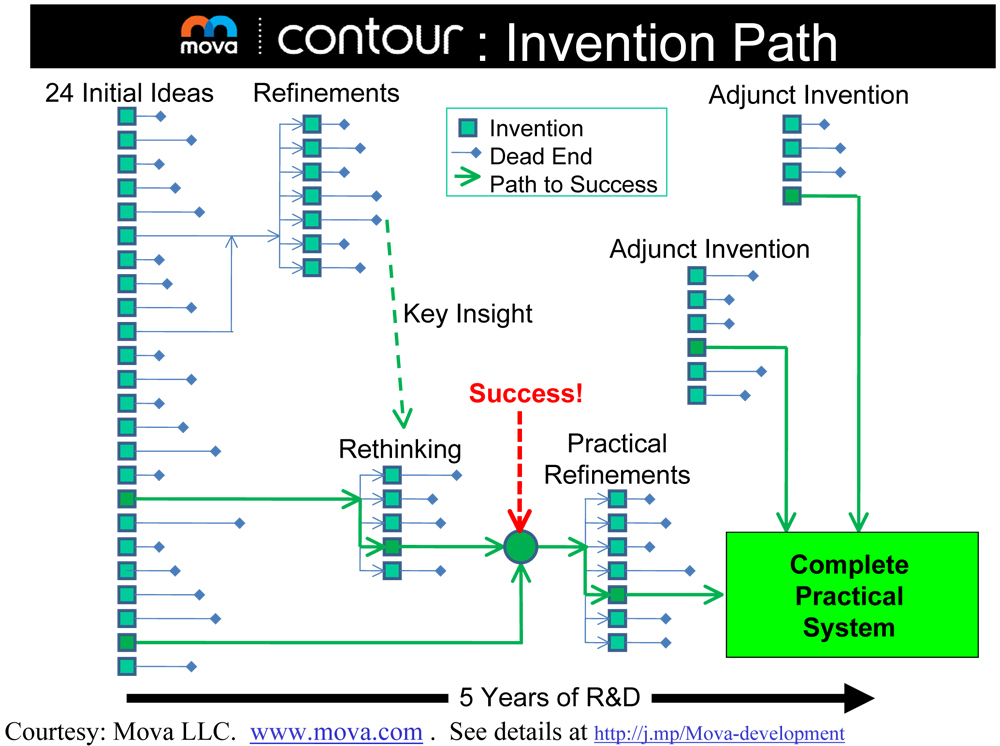
    materials, particularly an "actual profile of a five-year R&D and
    invention effort of one startup member of [the] Coalition" in support of its contentions of differential harm to small businesses (slide 12):

    Slide 12
    The letter characterizes this slide as showing fifty
    important inventive ideas "conceived, evaluated and tested" over
    months or years, and that the majority of these inventions turned out to be "useless."  Accordingly, during this time, the
    letter says that only six patent applications were filed.  Under a first-to-file system, the
    letter contends that this company would have faced the "painful dilemma as
    to which of these inventions should be written up and filed," presumably
    without the benefit of the time to establish which of the fifty inventions were
    appropriate for filing.  These "premature guesses" would in
    the main have been wrong, i.e., directed to inventions later shown to be "useless," resulting in
    patent protection being obtained (or at least applied for) for such inventions and other, ultimately more
    appropriate inventions failing to obtain patent protection.

    The consequence of changing to a
    first-to-file system would be "great risks, costs, dilemmas and increased
    patent prosecution uncertainties" for small businesses, the letter
    contends.  This will "undermine
    early-stage startups' ability to attract investment capital, an assertion
    supported by additional information in the supporting materials (see Slide 6).  The letter makes the following
    argument regarding whether anyone has considered the consequences of the FTF
    change (emphasis in original):

    A related practical problem with FTF is
    shown in Slide 23 [of the supporting materials], which shows that prior art
    published less than one year before the filing date is the most frequent source
    for invalidating patent applications in the European Patent Office (EPO), which
    operates under FTF law.  This category of prior art currently cannot be used to
    block or invalidate patents, because the U.S. has a one-year "grace
    period."  Yet, no one had studied the number of U.S. patents that will be
    invalidated by such prior art published after the invention date if
    FTF were adopted, or the chilling effect that this loss of U.S. patent
    protection would have on innovation.  Initial detailed legal analysis of the
    proposed change in S. 515 reveals several of its flaws.  The analysis shows that
    it creates strong incentives for making early nonenabling "springing public
    disclosures" in order to pre-empt later filed patent applications that are
    enabling from being granted as patents.  Such "springing public disclosures"
    will also allow second inventors who file second to
    obtain the patent (citing
    B. Pedersen and J. Woo, "The 'Matrix' for
    First-Inventor-To-File: An Experimental Investigation into Proposed Changes in
    U.S. Patent Law
    ", (December 4, 2009)
    .

    The letter characterizes as "a
    troubling aspect" of the Patent Office's "advocacy of the transition
    to FTF" the "apparent lack of data and models within its field of
    expertise" with regard to the "inevitable increase" of patent
    application filings that would result.  The letter cites statistics from the European Patent
    Office that almost 60% of the applications filed in the EPO are abandoned prior
    to examination, in contrast to a 16% abandonment rate of U.S. patent
    applications prior to examination.  The letter attributes this difference to the pressures accompanying the
    first-to-file regime, and concludes that under such a system "it takes more
    than two times
    the number of applications . . . in order to obtain one
    surviving application worthy of examination for patent protection" (emphasis
    in original).  The
    USPTO has "totally ignored these costly inefficiencies," the letter
    contends.

    The letter also predicts "dire
    financial collateral consequences" of a change to a first-to-file
    system.  In contrast to the
    European system, where a search report is generated prior to examination on the
    merits (after which about one third of the applications are abandoned), in
    the U.S. a search is provided only after a first action on the merits.  Thus, in the U.S., the PTO would be
    expending "search and examination resources on applications that would
    otherwise" never be examined.  This would result in a "substantial increase" in the Office's
    upfront expenses without a concomitant increase in grant and maintenance fees,
    requiring "inevitable" increases in filing fees to account for these
    increased costs.  The letter contrasts the percentage of
    total patent fees garnered at the initial phases of the patenting process in the U.S. (27%) and Canada (60%), contending that this increase in
    initial fees would disproportionally impact small businesses and startups which
    would otherwise be able to defer these costs until later in the commercial
    development cycle.

    This portion of the letter concludes by
    disputing the assertions in Secretary Locke's letter suggesting that changing
    to a first-to-file system would "'simplify the patent system, reduce legal
    costs [and] improve fairness,'" and that the "'complex,
    time-consuming and resource intensive' costs of global patent procurement are
    the supposed target of this 'reform.'"  There is simply no evidence for any of this, the letter
    asserts, and in fact there is "ample evidence" to the contrary.  The letter also notes that this change
    merely "give[s] away one of the few 'negotiating chips' the U.S. retains
    to encourage foreign patenting authorities to move in directions helpful for
    U.S. small business."

    With regard to post-grant review, the
    letter voices agreement with the concerns raised in the letter sent to
    Secretary Locke by 56 companies on September 14, 2009 (see "Tech Companies Send Letter on Patent Reform to Secretary Locke")
    .  The letter particularly mentions the
    risks to small business of "infringers who make repeated challenges to
    patents after they issue," particularly with provisions that permit "serial"
    challenges by providing an "extremely low threshold" for obtaining
    post-grant review, citing
    Scott Shane, "Problems To Be Expected From
    Expanded Administrative Challenges To U.S. Patents
    ," (July 20, 2009)
    .

    Patent reform has generally taken a
    back-burner to health care reform and follow-on biologics legislation since the
    bill was voted out of committee in the spring.  In addition to these concerns, Congress has financial reform
    and global warming bills to contend with in its next session.  But there is a real risk that this bill
    will eventually come to the floor for a vote, and in view of the political constitution
    of the Congress, it is also likely that the bill, or something very like it, will
    land on the President's desk before the 111th Congress ends.  Insofar as the concerns voiced by the
    small business coalition resonate, it is once again incumbent that our representatives
    be made aware of the many flaws of S. 515.

  •     By Suresh Pillai

    Teva's
    Discovery Request Blocked in Aricept® Suit

    Eisai The U.S. District Court for the District of New
    Jersey has denied a discovery request by Teva Pharmaceutical Industries to examine
    communications between Eisai and the U.S. Patent and Trademark Office.  Eisai filed the original suit in 2005 following Teva's
    submission of an Abbreviated New Drug Application with the FDA seeking
    permission to market a generic version of Aricept®,
    Eisai's Alzheimer's drug.  In its
    complaint, Eisai alleged that Teva's proposed generic would infringe one
    of Eisai's patents covering Aricept®, U.S. Patent No. 4,895,841.  Teva later stipulated that, unless the
    claims were found unenforceable, Teva's proposed generic might infringe upon
    some of the claims of the '841 patent.  Subsequently, the District Court granted Eisai a preliminary injunction on
    grounds that Teva was unlikely to prevail in its inequitable conduct
    defense.

    Teva Teva's most recent discovery request was unusual in
    that the communications at issue are not related to the patent at issue.  Teva also sought all communications connected
    to abandoned Eisai applications related to benzylpiperidine.  Teva argued that these communications
    would help in establishing its inequitable conduct defense in Eisai's
    infringement suit over Aricept®.  The District Court, however, concluded that the discovery request was
    unnecessarily overbroad because it was outside the scope of the case at
    bar.


    Settlement
    in Principle Reached in Bayer Hemophilia Drug Case

    Bayer Plaintiffs Novartis Vaccines and Diagnostics and
    Novo Nordisk and defendants Bayer and CSL Behring have jointly asked the U.S. District Court for the Northern
    District of Texas to stay their patent infringement dispute over defendants'
    marketing of hemophilia drugs, pending the outcome of settlement
    negotiations.  Plaintiffs
    originally filed suit in February 2008 in an effort to assert their claims over
    the underlying patent for two of the plaintiffs' hemophiliac drugs, Kogenate® and Hexilate®, drugs
    whose active ingredient is recombinant antihemophilic Factor VIII.  Plaintiffs accused defendants
    of infringing U.S. Patent No. 7,138,505,
    but defendants denied that their drugs infringed, and asserted that the
    patent-in-suit was invalid.  A
    spokesperson for Bayer stated that because the parties were sufficiently close
    to a settlement, a stay was sought.  However, the spokesperson also stated that discussions were
    continuing.


    Settlement
    Announced in Effexor XR® Infringement Suit

    Mylan Mylan has announced an agreement with Pfizer that would allow Mylan to market a generic version of Effexor XR®, Pfizer
    subsidiary Wyeth's blockbuster antidepressant drug.  Wyeth originally filed suit in July 2007 following Mylan's
    filing of an Abbreviated New Drug Application with the FDA seeking regulatory
    approval to market a generic version of Effexor XR® (see "Court Report,"
    July 15, 2007).  In its amended complaint, Wyeth
    alleged that Mylan's proposed generic would infringe three patents
    covering Effexor XR®, U.S. Patent Nos. 6,274,171,
    6,403,120,
    and 6,419,958.  Mylan then sought a declaratory
    judgment that the patents-in-suit were not infringed or invalid.

    Under the terms of the settlement, Mylan has agreed
    to a nonexclusive license to certain patents that permits Mylan to market
    generic versions of Effexor XR® on or after June 1, 2011, or earlier under
    certain circumstances.  The
    agreement allows Mylan to market 37.5 mg, 75 mg, and 150 mg versions of the
    drug.  Other details of the
    settlement agreement remain confidential.

  •     By Kevin E. Noonan

    Judge Michel At the outset of the en banc oral argument in Ariad
    Pharmaceuticals, Inc. v. Eli Lilly & Co
    .
    last week, Chief Judge Michel asked Lilly's counsel whether
    Lilly had preserved the written description issue by timely objecting to
    District Court Judge Zobel's jury instruction (see "
    Ariad v. Lilly:
    Oral Argument
    ")
    .  This question was curious:  perhaps Judge Michel (at right) wanted to be certain that the question
    was properly before the Court; perhaps he wanted to ascertain whether there was
    a simple answer to the complex question the Court had posed to the parties and amici; perhaps he wanted to avoid having
    the en banc Court make a definitive
    statement on the existence and scope of the written description requirement and
    invite Supreme Court review (a petition for certiorari is almost certain no
    matter how the Federal Circuit rules).

    Lilly Charles E. Lipsey, Lilly's counsel, responded to
    the Court by pointing to a particular part of the record (specifically,
    A172-173), and promised the Court that Lilly would provide "additional
    information" on the question.  That information has taken the form of a
    letter from Lilly's counsel to the Court, outlining how the jury instructions were proposed by the parties and
    adopted by the District Court during the patent infringement lawsuit, and the steps
    Lilly took to preserve the issue for appeal.

    The letter (which contains copious
    citation to the record) is signed by co-counsel Howard W. Levine, and relates that
    both parties submitted written jury instructions to the District Court, and
    that there was a charge conference on April 26, 2007.  However, at the charge conference, Judge Zobel informed the
    parties that "she had not determined how to phrase the parties' written
    description instructions in her 'own language' and needed additional time."  She also informed the parties that they
    would not have the opportunity to review the instruction before she charged the
    jury, but would be able to make their objections after she had charged the
    jury.  Mr. Levine states in his
    letter to the Court that Lilly timely objected to the instruction "at a
    sidebar conference" after the jury was charged (citing A172-173, the
    portion of the record cited at oral argument by Mr. Lipsey).

    This objection "preserved the issue for appeal"
    according to Mr. Levine, citing Fed. R. Civ. P. 51(c)(2)(B) and Suprenant v. Rivas, 424 F.3d 5, 15 (1st Cir. 2005).   In addition, Mr.
    Levine confirmed for the Court that Lilly raised the written description jury
    instruction in its motion for a new trial (A2774) and in pre- and post-verdict
    motions for judgment on the written description issue.

    Finally, the letter reminds the Court that Ariad
    did not argue that Lilly had not preserved the issue for appeal.

    After all the effort expended by the parties, amici, and the Court in bringing this
    issue to the brink of an en banc
    decision, it is comforting to know that the entire enterprise won't be derailed
    on procedural grounds.

    For additional information regarding this topic, please see:
    • "Ariad v. Lilly: Ariad's Reply Brief," December 10, 2009
    "Ariad v. Lilly:
    Oral Argument
    ," December 9, 2009

    • "Amicus Briefs in Ariad v. Lilly: Regents of University of California et al.," December 6, 2009
    • "Amicus Briefs in Ariad v. Lilly: Briefs by Companies," December 6, 2009
    • "Amicus Briefs in Ariad v. Lilly: American Intellectual Property Law Association," December 1, 2009
    • "Amicus Briefs in Ariad v. Lilly: Federal Circuit Bar Association," November 29, 2009
    • "Amicus Briefs in Ariad v. Lilly: Intellectual Property Owners Association," November 25, 2009
    • "Amicus Briefs in Ariad v. Lilly: GlaxoSmithKline," November 24, 2009
    • "Amicus Briefs in Ariad v. Lilly: United States," November 23, 2009
    • "Amicus Briefs in Ariad v. Lilly: Google, Verzion Communications Inc. and Cisco Systems, Inc.," November 22, 2009
    • "Amicus Briefs in Ariad v. Lilly: Professor Christopher Holman," November 19, 2009
    • "Lilly Files Principal Brief for Ariad v. Lilly Rehearing En Banc," November 16, 2009
    • "Next Up: Ariad v. Lilly Rehearing En Banc," November 10, 2009
    • "Federal Circuit Grants En Banc Review in Ariad v. Lilly," August 21, 2009
    • "Ariad Files Petition for Rhearing in Ariad v. Lilly," June 3, 2009
    • "Ariad Decision Voids Attempt to Use Broad Claiming to Avoid the Written Description Requirement," April 14, 2009
    • "Ariad Pharmaceuticals, Inc. v. Eli Lilly and Co. (Fed. Cir. 2009)," April 6, 2009

  •     By
    Sarah Fendrick

    USPTO Seal The
    U.S. Patent and Trademark Office and the Patent Public Advisory Committee (PPAC) have created a project to
    improve the overall quality of patents, reduce patent application pendency, and ensure that granted
    patents are valid.  The improvement
    initiative does not involve changes in patent law or substantive new rules, but
    rather the USPTO is seeking public comment on a number of categories identified
    in a Notice published in the Federal Register (74 Fed. Reg. 65093) on December 9, 2009.

    In
    the past, two official metrics of examination quality were employed by the
    USPTO, the Allowance Compliance Rate and the In-Process Review (IPR) Compliance
    Rate.  The Allowance Compliance Rate
    was determined by randomly selecting a sample of allowed applications and
    reviewing the patentability of the claims, the completeness of the record, and
    the quality of the examiner's search.  The IPR Compliance Rate was determined by randomly selecting a sample of
    applications that had Office actions issued prior to allowance and reviewing indicators of quality such as whether the rejections made in the Office
    action were proper, whether the examiner clearly articulated the reasons for
    rejection, the quality of the examiner's search, and the propriety of any
    restriction requirement (for a full list of factors, see Notice).  The IPR Compliance Rate during
    2005-2009 encompassed both final and non-final Office actions.  However, in 2010, the IPR Compliance Rate was redefined to include only non-final office actions and the Allowance
    Compliance Rate was changed to Final Rejection/Allowance Compliance Rate.

    In
    an effort to improve the quality of patents and to improve upon the current
    metrics of examination quality, the USPTO has identified a number of categories
    where public comment is being sought.  The first category includes currently implemented
    quality measures and future measures not yet adopted.  Regarding current measures, the USPTO hopes to receive
    comments on how effective the current procedures are for ensuring the quality of
    patents.  Of particular interest are methods for finding the best prior art, obtaining a comprehensive
    initial application, providing first Office actions that include clear
    explanations of all issues raised in the action, receiving clear and
    comprehensive responses to Office actions, and proper use of interviews.  To address the issue of prior art, the
    Office is looking for comments concerning search techniques and procedures that
    could be used to locate the best prior art as well as technologies where it appears
    the best prior art is not being identified by examiners.  To ensure the receipt of comprehensive
    initial applications, the USPTO is soliciting comments on what current USPTO guidelines
    prevent effective preparation of comprehensive applications as well as methods
    that can be implemented to measure the quality and completeness of the
    submitted application.  Comments
    are also being sought on what aspects of an initial Office action will enhance
    quality and how examiners can best communicate to applicants what is needed in
    a response to the Office action.  Similarly, the Office is requesting comments that will ensure comprehensive
    responses to Office actions.  Specifically, the Office is asking for comments on what USPTO guidelines
    stand in the way of applicants when preparing a response that will allow for
    efficient examination.

    The
    second category pertains to the stages of monitoring.  Within this category, the USTPO is looking for comments on
    procedures that may reduce patent pendency.  More specifically, the USPTO is
    considering at what stage and how frequently quality monitoring procedures
    should be implemented.  In addition, public
    input on how to effectively increase quality at initial stages of prosecution is being sought by the USPTO.

    The
    third category concerns pendency.  Under this category, the Office seeks comments on whether the quality of
    prosecution and examination of an application, and quality of the granted patent, can be improved while also reducing the pendency of the process.  The USPTO also seeks input on how continuing
    applications influence the goal of pendency and quality.

    Category
    four seeks comment and feedback on pilot programs and their role in ensuring
    quality and pendency.

    Category
    five calls for comment on past USPTO surveys of the patent community and suggestions
    for improving future surveys.  The
    Customer Panel Quality Survey was launched in 2006 to receive input from
    frequent users of the USPTO concerning examination quality issues as well as a
    means for customers to provide feedback to the USPTO regarding quality
    measures.  Past participants of the
    survey were top filers (law firms, organizations, or individuals that have
    submitted six or more applications in the previous year).  Survey results are analyzed quarterly
    and have on average 1100 participants per quarter.

    Category
    six regards feedback on existing tools which can aid the USPTO and its users to
    enhance the quality of USPTO processes.  Specifically, feedback on software tools that will facilitate
    monitoring, search tools, claim analysis tools, and case law identification
    tools is being sought.

    Finally, under category seven, the USTPO seeks comments on methods that can
    incentivize applicants and USPTO personnel to participate in efforts to improve
    the quality of patents.

    Individuals wishing to submit comments must do so on or before February
    2, 2010.  Each comment should
    include:  (1) the name and affiliation of the individual responding, and (2) an
    indication of whether the comments offered represent the views of the respondent's
    organization or are the respondent's personal views.  The Office indicates that it prefers to receive comments via
    the internet at patent_quality_commments@uspto.gov.  Alternatively, comments can be submitted by regular mail to:  Mail Stop Comments — Patents, Commissioner for Patents, P.O. Box 1450, Alexandria, VA 22313–1450, marked to the attention of Kenneth M. Schor and Pinchus M. Laufer.  The Office warns that parties should not submit information
    that they do not wish to be publicly disclosed or made electronically
    accessible.