• By Martin O'Brien —

    Australia Coat of ArmsThe patentability of genetic materials has been the subject of considerable community debate in Australia and elsewhere in recent years.  Several inquiries have been held in Australia, including the Senate Gene Patents Report (24 November 2010), the 2011 ACIP Report on Patentable Subject Matter, and the 2004 Australian Law Reform Commission's Report on Genes and Ingenuity: Gene Patenting and Human Health (ALRC 99 Report).  One of the recommendations of the Senate Gene Patents Report was that the Government provide a combined response to these Reports.

    The Government accepted that recommendation and, on 23 November 2011, the Government's combined response to those Reports was released.  A copy of the full response can be accessed here.

    In the Media Release accompanying the Government response, the Minister for Innovation stated that "the response is designed to give confidence to the significant investments in biotechnology innovation and research and development. It will also ensure that patients will not be denied reasonable access to affordable treatments and essential diagnostic tests through inappropriate use of the Patents Act."

    GeneThe Government response addresses many aspects of the debate.  This article focuses on what, for some biotechnology companies, might be described as the ultimate question, namely whether genetic materials may properly be considered appropriate subject matter for patentability.  Recommendation 7-1 of the ALRC 99 Report was that "[t]he Patents Act 1990 (Cth) should not be amended: (a) to exclude genetic materials and technologies from patentable subject matter; (b) to exclude methods of diagnostic, therapeutic or surgical treatment from patentable subject matter."  In the Government response, Recommendation 7-1 (a) is accepted in principle and Recommendation 7-1 (b) is accepted in full.

    During the course of the inquiries and public debates the desirability of a technology-neutral approach to patentability arose.  For example, the ALRC 99 Report recommended (6-1) that "[p]atent applications relating to genetic materials and technologies should be assessed according to the same legislative criteria for patentability that apply to patent applications relating to any other type of technology."  In accepting this recommendation the Government drew attention to Australia's obligations under TRIPS to maintain technology-neutral patentability criteria.

    The Patent Amendment (Human Genes and Biological Materials) Bill 2010 seeks to exclude biological materials, including genetic materials, from patentability ("The Gene Patent Debate — Bill Seeks to Exclude Biological Materials from Patentability").  That Bill remains pending.  Other than noting that the Senate Gene Patents Inquiry recommended that Bill be sent to the relevant Senate Committee for review and report, the Government's response to the three inquiries does not directly express an opinion on that Bill.  As we have previously reported, however, that Bill has now been the subject of a Senate Inquiry, the majority finding of which was that the Bill should not be passed.

    With the Government response to the three inquiries now having stated agreement in principle with the ALRC 99 Report that the Patents Act should not be amended to explicitly exclude genetic materials from patentability, it is difficult to see how the Government could now support that Bill.

    Dr. O'Brien is a Principal of Spruson & Ferguson in Sydney, Australia, specializing in molecular biology and biotechnology.

    For additional information regarding this topic, please see:

    • "Australian Senate Committee Issues Recommendation on Gene Patenting Bill," October 6, 2011
    • "Australian Senate to Release Gene Patenting Findings Next Week," June 8, 2010
    • "Gene Patenting: Australian Potpourri," December 28, 2009

  • By Donald Zuhn —

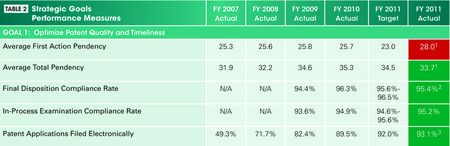
    CoverThe U.S. Patent and Trademark Office recently released its Performance and Accountability Report for Fiscal Year (FY) 2011.  With respect to the Office's performance goals, the report indicates that four of five patent-related performance targets were met in FY 2011.  Among the patent-related performance targets that the Office met were patent average total pendency (33.7 months actual versus 34.5 months target) and patent applications filed electronically (93.1% actual versus 90% target).  The lone performance target that went unmet was patent average first action pendency (28 months actual versus 23 months target).

    The FY 2011 report, like the FY 2010 report, identifies three strategic goals, each comprising several objectives:

    1.  Optimize patent quality and timeliness
    2.  Optimize trademark quality and timeliness
    3.  Provide domestic and global leadership to improve intellectual property policy, protection and enforcement worldwide

    With regard to the first strategic goal, the report indicates that the Office met four of five objectives (see table below), up from a 40% success rate in FY 2010 (click on any table to expand).

    Strategic Goals
    In particular, the report states that the Office:

    [M]ade significant progress in FY 2011 in meeting our goal of providing timely and quality patents.  While less-than-planned spending authority has greatly impacted the USPTO's ability to decrease patent pendency and the backlog, the Patent organization continued to respond to these challenges and obstacles by launching new and innovative initiatives to achieve its strategic goals.  Despite budget constraints suspending routine programs such as examiner hiring, overtime, and training, the Patent organization succeeded in making progress by focusing on new methods and processes to increase efficiencies and strengthen effectiveness through collaboration, communication, and transparency.

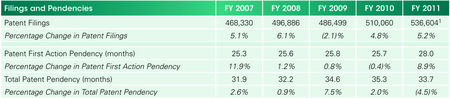
    The report notes that patent filings increased 5.2% for FY 2011, jumping from 510,060 in FY 2010 to 536,604 in FY 2011 (according to preliminary data).  This follows a 4.8% increase in patent filings for FY 2010.

    Filings & Pendencies
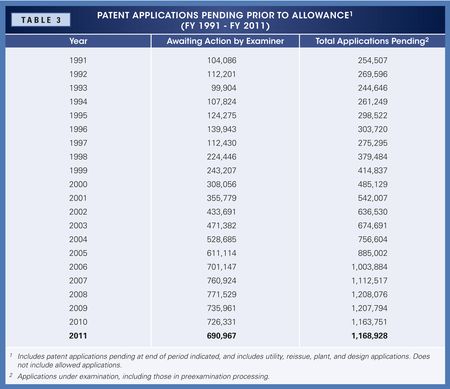
    Despite accepting more than 500,000 patent applications for the second straight year, the number of applications awaiting action dropped from 726,331 in FY 2010 to 690,967 in FY 2011 (the first time the Office has been below 700,000 applications awaiting action since 2005).  The total number of pending applications, however, was up slightly from 1,163,751 in FY 2010 to 1,168,928 in FY 2011.

    Applications Pending
    Utility patent issuances were up significantly in FY 2011 (according to preliminary data), rising from 207,915 in FY 2010 to 221,350 in FY 2011.  It was the second straight year that the Office set a record for utility patent issuances, and marked the fourth straight increase.

    With respect to first action and total pendency, the report shows that the Office will have to be satisfied with a split.  After dropping 0.1 months between FY 2009 and FY 2010, patent average first action pendency jumped 2.1 months to 28 months.  Patent average total pendency, however, was down 1.6 months to 33.7 months, the lowest this measure has been since FY 2008.

    Patent Pendency
    The report states that the increase in patent average first action pendency "was expected due to the efforts focused on clearing up the oldest patent applications from the backlog through the COPA [Clearing the Oldest Patent Applications] initiative," and that "with sufficient funding and the ability to hire and utilize overtime, the USPTO is confident that it will not only meet but exceed its target goals for next year."

    Participation in electronic filing continued to rise in FY 2011, with electronically-filed patent applications jumping from 89.5% in FY 2010 to 93.1% in FY 2011.  Only five years ago, less than half of all patent applications were filed electronically.

    Electronic Filing
    For biotechnology and organic chemistry applicants, average first action pendency rose from 22.8 months in FY 2010 to 23.8 months in FY 2011, and total average pendency dropped from 36 months in FY 2010 to 33.6 months in FY 2011.  Both pendency measures were below the Office's overall averages of 33.7 months and 28 months, respectively.  No other Technology Center posted a better first action pendency than TC 1600, and only TC 2800 (semiconductor, electrical, optical systems & components) and TC 3600 (transportation, construction, agriculture & electronic commerce) posted better final action pendencies (as they did in FY 2010).

    For additional information regarding this and other related topics, please see:
    • "USPTO Releases 2010 Performance and Accountability Report," November 17, 2010
    • "USPTO Announces 'Highest Performance Levels in Agency's History' in 2008," November 18, 2008
    • "USPTO Announces 'Record Breaking' 2007 Performance," November 15, 2007
    • "Patent Office Announces Record-Breaking Year," December 27, 2006

  • By Kevin E. Noonan —

    It is widely appreciated that the Supreme Court has spent the better part of the last ten years exercising its supervisory role over the Federal Circuit, something the Court generally refrained from doing for the first 15-20 years of the appellate court's existence (see "Is It Time for the Supreme Court to Stop Flogging the Federal Circuit?").  One of the first cases serving as a bell-weather for the High Court's new thinking about the Federal Circuit was Dickinson v. Zurko, 527 U.S. 150 (1999), where the Supreme Court found that the Federal Circuit, like all appellate courts, was constrained by the provisions of the Administrative Procedures Act of 1948 in the exercise of its supervisory authority over the U.S. Patent and Trademark Office.  This standard required the Federal Circuit to defer to factual determinations made by the Patent Office, imposing a "substantial evidence" standard for reversing decisions by the Office.  This was a much more deferential standard than the one the Federal Circuit was used to, albeit not rising to the "arbitrary and capricious" standard espoused by the PTO Commissioner (Q. Todd Dickinson).  But in rejecting the argument that the Federal Circuit was special and entitled to satisfy its own standards (due inter alia to its unique position among the regional Circuit Courts of Appeal), the Supreme Court clearly mandated that the Federal Circuit comply with legal standards the Court had established rather than ones the Federal Circuit felt appropriate for the fulfillment of its peculiar purpose of interpreting U.S. patent law.

    Stepan Co.It is both ironic and perhaps fitting, then, that the Federal Circuit had the opportunity to turn the provisions of the APA on the Patent Office in reversing the Board's decision in In re Stepan Co.  Stepan Co. ("Stepan") appealed the Board's decision affirming an Examiner's obviousness rejection in reexamination proceedings.  The Examiner based his rejection on a prior art reference to Singh (WO 97/21764) applied under 35 U.S.C. § 102(b).  The Board affirmed the rejection that the claims were obvious, but considered the reference to be prior art under 35 U.S.C. § 102(a).  In making its determination, the Board determined that a Declaration submitted by Stepan during the reexamination pursuant to 37 C.F.R. § 1.131 was "ineffective to remove Singh as a reference qualifying under 35 U.S.C. § 102(a)"; this determination was relevant because, unlike the absolute statutory bar of § 102(b), the requirement of § 102(a) that the invention was known or used in this country "before the invention thereof" by the patent applicant permits an inventor to "swear behind" the asserted reference.

    Stepan contended that the difference in the grounds of the rejection constituted a "new ground of rejection" that should have triggered the provisions of the APA (and the Office's own procedural rules) to provide (of right) an opportunity for further examination by the examiner, i.e., that the Board should have remanded the case back to the Group for further consideration.

    In a opinion by Judge Prost, joined by Judge Dyk, the Federal Circuit[1] agreed.  Citing "a series of [prior] opinions," the panel found that:

    [B]oth this court and our predecessor court, the United States Court of Customs & Patent Appeals ("Patent Court"), have recognized that if the appellant has not had a full and fair opportunity to litigate the Board's actual basis of rejection, the administrative validity proceedings before the United States Patent and Trademark Office ("PTO") should be allowed to continue.

    In re Kumar, 418 F.3d 1361, 1367–68 (Fed. Cir. 2005) (collecting cases).  This right to a "full and fair hearing" is embodied in Patent Office regulations, inter alia, 37 C.F.R. § 41.50(b), which the Court says is required to satisfy the statutory notice requirement embodied in 35 U.S.C. § 6.  In addition, as a procedural matter, Stepan argued that it had been denied the opportunity to address whatever deficiencies the Board found existed in its Rule 131 Declaration.  At root, this constituted a claim that Stepan's administrative due process rights had been violated.

    Federal Circuit SealThe Court agreed with Stepan that changing the statutory basis for deciding that the Singh reference was prior art (specifically, what kind of prior art) was a new ground of rejection.  The Federal Circuit rejected the Office's contention that since the basis for the rejection was the same — obviousness — there was no "new ground of rejection" asserted by the Board and thus due process was not implicated in its decision.  The panel also found insufficient the government's argument that, since Stepan had had the opportunity to present evidence and argument (and in fact had done so) during proceedings before the Board on the issue, it had been afforded with the required opportunity to be heard.  Finally, and equally unavailingly, the government argued that Stepan was under an obligation to petition for rehearing and by having failed to do so had squandered the right to "allege that it was deprived of its administrative due process rights."  Not so, according to the panel:

    It is crucial that the examiner issue a rejection (even if that rejection is subsequently withdrawn) so the applicant is on notice that it is obligated to respond.  Mere reliance by the Board on the same type of rejection or the same prior art references relied upon by the examiner, alone, is insufficient to avoid a new ground of rejection where it propounds new facts and rationales to advance a rejection — none of which were previously raised by the examiner.

    It was "mere fortuity" that Stepan had argued the validity of its Rule 131 Declaration during reexamination (its validity vel non not having been raised by the Examiner).  Further, the Court found that the phraseology of § 41.50(b), that "[s]hould the Board have knowledge of any grounds not involved in the appeal for rejecting any pending claim, it may . . . [issue] a new ground of rejection" (emphasis added) did not make discretionary notice of a new ground of rejection and remand to the examiner.

    It is this part of the argument that raises the sweet irony of the Zurko case.  In rejecting the government's arguments, the Court reminded the Office that "the PTO's regulatory interpretation is due no deference in view of the agency's statutory obligation under the Administrative Procedure Act ("APA") to provide prior notice to the applicant of all 'matters of fact and law asserted' prior to an appeal hearing before the Board.  5 U.S.C. § 554(b)(3)."  Granting the Office such discretion (i.e, to designate whether there was a new ground of rejection) would "frustrate the notice requirements of the APA," said the Court, citing the Zurko decision.  And the Court noted that the Office's own regulation predicated an applicant's obligation to request rehearing on the Board having designated its decision as a "new ground of rejection," recognizing that the Board's failure to do so here not only absolved Stepan of the obligation to request hearing but actually had prevented it from doing so.  Accordingly, the Court vacated the Board's decision and remanded to the Office "with instructions to designate its rejection as a new ground of rejection," leaving Stepan "free to pursue its patent application according to the requirements of 37 C.F.R. § 41.50(b)."

    In re Stepan Co. (Fed. Cir. 2011)
    Panel:  Circuit Judges Dyk, Friedman[1], and Prost
    Opinion by Circuit Judge Prost


    [1] Judge Friedman was on the panel that heard oral argument and was involved in the panel’s deliberations, but his death this past July prevented him from contributing to the opinion.

  • By Kevin E. Noonan —

    House of Representatives SealA decade after completion of the Human Genome Project, and after more than a decade of hyperbole regarding the promise and benefits of "personalized medicine," genetic diagnostic testing has come to the attention of Congress.  For example, Representative Debbie Wasserman Schultz (D-FL) introduced a provision of the Leahy-Smith America Invents Act (LSAIA) that would have "guaranteed" availability of "second opinion" testing for any patented genetic diagnostic test (see "Manager's Amendment (and Others) to H.R. 1249 — Second Opinions in Genetic Diagnostic Testing").  She withdrew this amendment in the face of strong opposition from the American Civil Liberties Union and other groups, who pursue a complete ban on such testing as well as other aspects of biotechnology; she later introduced a standalone bill (H.R. 2276) that would "require the Director of the United States Patent and Trademark Office to conduct a study on effective ways to provide confirming genetic diagnostic test activity where gene patents and exclusive licensing exist" (see "Bio/Pharm Legislation Watch"); these provisions were added to the LSAIA enacted into law as a mandate that the U.S. Patent and Trademark Office perform a study directed to such a determination.  And Congressman Xavier Becerra continues to introduce a bill that would ban all gene patenting, at least prospectively (see "He's Baaack!").

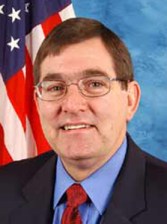
    Burgess, MichaelThe latest Congressional foray into genetic diagnostic testing comes from Rep. Michael Burgess (R-TX) (at left), who introduced legislation that would prohibit the Food and Drug Administration from regulating genetic diagnostic testing, based on the apprehension that such regulation would cripple innovation and that such testing would be "subsumed" by the bureaucracy.  Such testing is already regulated (as is all other laboratory testing) by the Centers for Medicare and Medicaid Services (CMS) under the Clinical Laboratory Improvement Amendments (CLIA).  Rep. Burgess discussed his bill on November 17th at a "bi-partisan policy forum" sponsored by The Hill and the American Clinical Laboratory Association.  The bill was prompted, in part, by FDA announcements that it intends to regulate "direct-to-consumer" genetic diagnostic tests.  Rather than cast the legislation as a ban, his bill (the "Modernizing Laboratory Test Standards for Patients Act of 2011," H.R. 3207) provides for regulation of such genetic diagnostic tests under the current CLIA regime, but with new guidelines and regulations directed towards greater clinical validity of such tests.  The bill also provides for the establishment of a Laboratory Developed Test (LDT) Test Registry Data Bank (for promoting "transparency") and a reporting requirement for clinical laboratories regarding death or serious injury that occurred as the result of a LDT.

    In this regard, the bill requires disclosure for LDTs of the following information to the Data Bank:

    • The location of the laboratory.
    • The certification and licensure information of the laboratory.
    • The purpose of the test.
    • The claimed use or uses of the test.
    • A description of the test methodology.
    • Information regarding the analytical validity of the test.
    • Information regarding the clinical validity of the test for each of its claimed uses.
    • Information describing the status of the test as an existing test (as described under paragraph (4)), a new test pending review (under subsection (c)), or an authorized new test (under subsection (c)(4)(B)).

    For so-called "direct-to-consumer" (DTC) DNA testing, the information required to be submitted includes all the aforementioned and in addition:

    (i)  The identity, location, and registration information of the test-offering entity.
    (ii)  The identity of the certified laboratory that will perform the test, and the certification and licensure information for such laboratory.
    (iii)  information to demonstrate that the consumer will be provided with access to pre-test and post-test counseling by a physician or qualified genetic counselor.

    Rep. Burgess has garnered the support of 4 co-sponsors (Rep. Marsha Blackburn, R-TN; Rep. Howard Coble, R-NC; Rep. Robert Latta, R-OH, and Rep. Erik Paulsen, R-MN).  The bill was referred to the House Committee on Energy and Commerce, and specifically the Subcommittee on Health, on October 14, 2011.

  • By Sherri Oslick —

    Gavel About Court Report:  Each week we will report briefly on recently filed biotech and pharma cases.

    Medicines Co. v. Sun Pharma Global FZE et al.
    2:11-cv-15175; filed November 23, 2011 in the Eastern District of Michigan

    • Plaintiff:  Medicines Co.
    • Defendants:  Sun Pharma Global FZE; Sun Pharmaceutical Industries Ltd.; Sun Pharmaceutical Industries Inc.; Caraco Pharmaceutical Laboratories, Ltd.

    Medicines Co. v. Sun Pharma Global FZE et al.
    3:11-cv-06819; filed November 19, 2011 in the District Court of New Jersey

    • Plaintiff:  Medicines Co.
    • Defendants:  Sun Pharma Global FZE; Sun Pharmaceutical Industries Ltd.; Sun Pharmaceutical Industries Inc.; Caraco Pharmaceutical Laboratories, Ltd.

    The complaints in these cases are substantially identical.  Infringement of U.S. Patent Nos. 7,582,727 ("Pharmaceutical Formulations of Bivalirudin and Process of Making the Same," issued September 1, 2009) and 7,598,343 (same title, issued October 6, 2009) following a Paragraph IV certification as part of Sun's filing of an ANDA to manufacture a generic version of The Medicines Company's Angiomax® (bivalirudin, used as an anticoagulant in patients with unstable angina undergoing percutaneous translurninal coronary angioplasty).  View the New Jersey complaint here.


    Warner Chilcott Co. LLC v. Mylan Inc. et al.

    3:11-cv-06844; filed November 22, 2011 in the District Court of New Jersey

    • Plaintiff:  Warner Chilcott Co.
    • Defendants:  Mylan Inc.; Mylan Pharmaceuticals Inc.; Famy Care Ltd.

    Infringement of U.S. Patent No. 6,667,050 ("Chewable Oral Contraceptive, " issued December 23, 2003) following a Paragraph IV certification as part of Mylan's filing of an ANDA to manufacture a generic version of Warner Chilcott's GeneressTM Fe (norethindrone and ethinyl estradiol, used for oral contraception).  View the complaint here.


    Cephalon Inc. et al. v. Impax Laboratories Inc.

    1:11-cv-01152; filed November 18, 2011 in the District Court of Delaware

    • Plaintiffs:  Cephalon Inc.; CIMA Labs Inc.
    • Defendant:  Impax Laboratories Inc.

    Infringement of U.S. Patent Nos. 6,200,604 ("Sublingual Buccal Effervescent," issued March 13, 2001), 6,974,590 (same title, issued December 13, 2005), 7,862,832 ("Generally Linear Effervescent Oral Fentanyl Dosage Form and Methods of Administering," issued January 4, 2011) and 7,862,833 ("Effervescent Oral Opiate Dosage Forms and Methods of Administering Opioids," issued January 4, 2011) following a Paragraph IV certification as part of Impax's filing of an ANDA to manufacture a generic version of Cephalon's Fentora® (fentanyl citrate buccal tablets, used to treat breakthrough pain in adult patients with cancer).  View the complaint here.


    Yeda Research and Development Co., Ltd. v. Kappos

    1:11-cv-01272; filed November 18, 2011 in the Eastern District of Virginia

    Review and correction of the patent term adjustment calculation made by the U.S. Patent and Trademark Office for U.S. Patent No. 7,947,672 ("Water-Soluble Anionic Bacteriochlorophyll Derivatives and Their Uses," issued May 24, 2011).  View the complaint here.


    Takeda Pharmaceutical Co. et al. v. Hetero Drugs Ltd. et al.

    1:11-cv-08302; filed November 16, 2011 in the Southern District of New York

    • Plaintiffs:  Takeda Pharmaceutical Co.; Takeda Pharmaceuticals North America, Inc.
    • Defendants:  Hetero Drugs Ltd.; Hetero Labs Ltd. Unit V; Hetero USA Inc.; Camber Pharmaceuticals Inc.; Invagen Pharmaceuticals Inc.

    Infringement of U.S. Patent Nos. 5,965,584 ("Pharmaceutical Composition," issued October 12, 1999), 6,329,404 (same title, issued December 11, 2001), 6,166,043 (same title, issued December 26, 2000), 6,172,090 (same title, issued January 9, 2001), 6,211,205 (same title, issued April 3, 2001), 6,271,243 (same title, issued August 7, 2001), and 6,303,640 (same title, issued October 16, 2001) following a Paragraph IV certification as part of Hetero's filing of an ANDA to manufacture a generic version of Takeda's Actos® (pioglitazone hydrochloride, used to treat type II diabetes).  View the complaint here.


    Aventis Pharma S.A. et al. v. Strides Inc. et al.

    1:11-cv-01121; filed November 14, 2011 in the District Court of Delaware

    • Plaintiffs:  Aventis Pharma S.A.; Sanofi-Aventis US LLC
    • Defendants:  Strides Inc.; Onco Therapies Ltd.

    Infringement of U.S. Patent Nos. 5,714,512 ("Compositions Containing Taxane Derivatives," issued February 3, 1998) and 5,750,561 (same title, issued May 12, 1998) following a Paragraph IV certification as part of Strides' filing of an ANDA to manufacture a generic version of Aventis' Taxotere® (docetaxel, used to treat breast, lung, prostate, gastric, and head and neck cancers).  View the complaint here.


    Alkermes Pharma Ireland Ltd. v. Par Pharmaceutical Inc.

    1:11-cv-01119; filed November 11, 2011 in the District Court of Delaware

    Infringement of U.S. Patent Nos. 6,228,398 ("Multiparticulate Modified Release Composition," issued May 8, 2001) and 6,730,325 (same title, issued May 4, 2004), licensed to Novartis, following a Paragraph IV certification as part of Par's filing of an ANDA to manufacture a generic version of Novartis' Focalin® XR (extended release dexmethylphenidate hydrochloride, used to treat attention deficit hyperactivity disorder).  View the complaint here.


    Allergan, Inc. v. Lupin Ltd. et al.

    6:11-cv-00611; filed November 11, 2011 in the Eastern District of Texas

    • Plaintiff:  Allergan, Inc.
    • Defendants:  Lupin Ltd.; Lupin Pharmaceuticals, Inc.

    Infringement of U.S. Patent No. 7,851,504 ("Enhanced Bimatoprost Ophthalmic Solution," issued December 14, 2010) following a Paragraph IV certification as part of Lupin's filing of an ANDA to manufacture a generic version of Allergan's Lumigan® (0.03% bimatoprost ophthalmic solution, used to treat lower intraocular eye pressure in people with open-angle glaucoma or ocular hypertension).  View the complaint here.


    Celgene Corp. et al. v. Par Pharmaceutical, Inc.

    2:11-cv-06640; filed November 10, 2011 in the District Court of New Jersey

    • Plaintiffs:  Celgene Corp.; Novartis Pharmaceuticals Corp.; Novartis Pharma AG
    • Defendant:  Par Pharmaceutical, Inc.

    Infringement of U.S. Patent Nos. 5,908,850 ("Method of Treating Attention Deficit Disorders with d-Threo Methylphenidate," issued June 1, 1999), 6,355,656 ("Phenidate Drug Formulations Having Diminished Abuse Potential," issued March 12, 2002, with a reexamination certificate issued March 27, 2007), 6,528,530 ("Phenidate Drug Formulations Having Diminished Abuse Potential," issued March 4, 2003), 5,837,284 ("Delivery of Multiple Doses of Medications," issued November 17, 1998), 6,635,284 (same title, issued October 21, 2003), and 7,431,944 ("Delivery of Multiple Doses of Medications," issued October 7, 2008) all licensed exclusively to Novartis in certain fields of use, following a Paragraph IV certification as part of Par's filing of an ANDA to manufacture a generic version of Novartis' Focalin XR® (extended release dexmethylphenidate hydrochloride, used to treat attention deficit hyperactivity disorder).  View the complaint here.


    Novartis Pharmaceuticals Corp. et al. v. Watson Laboratories, Inc. et al.

    1:11-cv-08130; filed November 10, 2011 in the Southern District of New York

    • Plaintiffs:  Novartis Pharmaceuticals Corp.; Novartis AG; Novartis Pharma AG; Novartis International Pharmaceutical Ltd.; LTS Lohmann Therapie-Systeme AG
    • Defendants:  Watson Laboratories, Inc.; Watson Pharma, Inc.; Watson Pharmaceuticals, Inc.

    Infringement of U.S. Patent Nos. 5,602,176 ("Phenyl Carbamate," issued February 11, 1997), 6,316,023 ("TTS Containing an Antioxidant," issued November 13, 2001), and 6,335,031 (same title, issued January 1, 2002) following a Paragraph IV certification as part of Waton's filing of an ANDA to manufacture a generic version of Novartis' Exelon® Patch (rivastigmine tartrate, used to treat mild to moderate dementia of the Alzheimer's type, and mild to moderate dementia associated with Parkinson's disease).  View the complaint here.


    Purdue Pharma L.P. et al. v. Amneal Pharmaceuticals, LLC

    1:11-cv-08153; filed November 10, 2011 in the Southern District of New York

    • Plaintiffs:  Purdue Pharma L.P.; The P.F. Laboratories, Inc.; Purdue Pharmaceuticals L.P.; Rhodes Technologies; Grunenthal GMBH
    • Defendant:  Amneal Pharmaceuticals, LLC

    Infringement of U.S. Patent Nos. 7,674,799 ("Oxycodone Hydrochloride Having Less Than 25 PPM 14-Hydroxycodeinone," issued March 9, 2010), 7,674,800 (same title, issued March 9, 2010), 7,683,072 (same title, issued March 23, 2010), and 7,776,314 ("Abuse-Proofed Dosage System," issued August 17, 2010) following a Paragraph IV certification as part of Amneal's filing of an ANDA to manufacture a generic version of Purdue Pharma's OxyContin® (controlled release oxycodone hydrochloride, used to treat pain).  View the complaint here.

  • Calendar

    November 30 to December 1, 2011 – Advanced Forum on Biotech Patents*** (American Conference Institute) – Boston, MA

    December 1, 2011 – Biotechnology/Chemical/ Pharmaceutical (BCP) Customer Partnership Meeting (U.S. Patent and Trademark Office) – 9:00 am – 5:15 pm (ET)

    December 1, 2011 – Strategic Implications of the Patent Reform Act of 2011 (American Bar Association Section of Litigation & Navigant) – Chicago, IL (check here for information regarding other roundtable locations and dates)

    December 5, 2011 – 22nd Annual Conference on USPTO Law and Practice — PTO Day (Intellectual Property Owners Association and U.S. Patent and Trademark Office) – Washington, D.C

    December 5-7, 2011 – Drug and Medical Device Litigation*** (American Conference Institute) – New York, NY

    December 6, 2011 – Biosimilars: Emerging Legal Challenges (Strafford) – 1:00 – 2:30 pm (EST)

    December 6-7, 2011 – Paragraph IV Disputes*** (American Conference Institute) – San Francisco, CA

    December 16, 2011 – A Review of the America Invents Act and Its Impact on the USPTO (Birch, Stewart, Kolasch & Birch, LLP and CONNECT) – San Diego, CA

    January 4-8, 2012 – 29th Annual National CLE Conference (Law Education Institute) – Snowmass, CO

    January 31 – February 1, 2012 – Patent Reform for Life Sciences Companies (American Conference Institute) – New York, NY

    January 31 – February 1, 2012 – Pharma & Biotech Patent Litigation (C5) – Amsterdam, The Netherlands

    ***Patent Docs is a media partner of this conference or CLE

  • New York #3American Conference Institute (ACI) a conference on Patent Reform for Life Sciences Companies from January 31 to February 1, 2012 in New York, NY.  Topics of discussion at the conference will include:

    • Scrutinizing the specific provisions of patent reform in The America Invents Act (S. 23 & H.R. 1249);
    • Analyzing the impact of a change to the first to file system from a first to invent system;
    • Strategic tools for taking advantage of or defending against expanded opposition procedures including inter partes reviews, supplemental examinations, post-grant reviews and multiple oppositions;
    • Accounting for changes to PTO fees including the reduction of fees for small and micro-entities;
    • Determining what constitutes prior art under the new requirements;
    • Navigating changes to PTO practices and procedures; and
    • Revamping strategic IP planning in light of new requirements under patent reform.

    UntitledIn particular, ACI's faculty will offer presentations on the following topics:

    • Keynote address: USPTO Commissioner Robert L. Stoll;
    • The timeline of enactment: Identifying what needs to be done now and planning for future changes;
    • First to file: Developing an updated and comprehensive intellectual property strategy in the new race to the Patent Office regime;
    • Audience Q&A open forum for discussion on the impact of first to file;
    • Examining the consequences of changes to inventorship provisions;
    • Prior art and public disclosure: Identifying what constitutes prior art under the revised §102;
    • Expediting the examination process by strategically using the different examination tracks, including the new prioritized examination option;
    • Balancing the seemingly contradictory best mode provisions to maximize IP protection;
    • Preparing for emerging patent challenges under the new post grant review system;
    • Accounting for changing evidentiary requirements and procedures for inter partes review;
    • Examining the potential ramifications of patent reform on Hatch Waxman litigation and the brand/generic wars;
    • Audience Q&A open forum for discussion on the new litigation provisions and the impact on life sciences companies;
    • Specific considerations for universities, non-profit institutions and micro-entities; and
    • Analyzing the potential impact of the "miscellaneous provisions" on life sciences companies.

    In addition, a pre-conference workshop entitled "Patent Reform 101: Overview of the Fundamental Provisions in the America Invents Act" will be offered from 1:00 to 4:00 pm on January 30, 2012.

    ACI - American Conference InstituteA program for this conference, including an agenda and detailed descriptions of conference sessions can be obtained here.  The registration fee for the conference is $2,195.  Patent Docs readers who reference the discount code "PD 200" will receive $200 off the current price tier when registering.  Those interested in registering for the conference can do so here, by calling 1-888-224-2480, or by faxing a registration form to 1-877-927-1563.

    Patent Docs is a media partner of the Patent Reform for Life Sciences Companies conference.

  • ABAThe American Bar Association Section of Litigation and Navigant will be holding a IP legal roundtable on the "Strategic Implications of the Patent Reform Act of 2011" on December 1, 2011 from 12:00 to 1:30 pm at Navigant's offices in Chicago, IL.  The roundtable will be moderated by Benjamin Bradford of Jenner & Block LLP.  There is no registration fee for the roundtable, but those interested in registering for the roundtable can do so here.  A program discussion outline for the roundtable can be downloaded here.  Roundtables will also be held in Atlanta (on December 1), Dallas (12/8), Las Vegas (12/7), Memphis (12/7), Minneapolis (12/7), Nashville (12/7), Philadelphia (12/8), and Washington, DC (11/29).  Additional information regarding other roundtable locations can be found here.

  • ThanksgivingThe authors and contributors of Patent Docs wish their readers and families a Happy Thanksgiving.  Publication of Patent Docs will resume on November 25th.

  • By James DeGiulio —

    Pfizer Settles Lipitor Patent Suits with Aurobindo, Kremers

    PfizerPfizer has settled separate cases with Aurobindo and Kremers, ending its patent infringement actions over the generic companies' efforts to enter the market for the cholesterol drug Lipitor.  On June 27, 2011, Pfizer sued Aurobindo in response to the generic's filing of an ANDA for atorvastatin calcium, claiming infringement of U.S. Patent No. 5,969,156, issued in 1999, and its reexamination certificate, issued in 2006 (see "Court Report," July 4, 2011).  Aurobindo's May 17 letter informed Pfizer of its intent to seek FDA approval to sell 10 mg, 20 mg, and 80 mg dosages of generic Lipitor.  The '156 patent's expiration date is July 8, 2016, but the patent has been granted a further period of pediatric exclusivity running through January 8, 2017.

    AurobindoOn November 7, Judge Leonard P. Stark signed off on a joint motion to dismiss filed by the parties under Federal Rule 41(a)(2).  The joint motion indicated that Pfizer and Aurobindo had entered into a settlement agreement on November 2, thus prompting their request for dismissal of all claims and counterclaims.  The dismissal is without prejudice and shall not act as an adjudication on the merits.

    Kremers UrbanOn November 18, in another Lipitor case pending since December 2009 (see "Court Report," December 7, 2009), Kremers Urban Pharmaceuticals Inc. also entered into a settlement agreement with Pfizer over 10 mg, 20 mg, 40 mg, and 80 mg dosages, known generically as atorvastatin calcium tablets.  The terms of this agreement are confidential, and the agreement remains subject to review by the U.S. Department of Justice and the Federal Trade Commission.


    Mylan and Novartis Settle Patent Suit over Vivelle-Dot

    Mylan #1Mylan has settled both of its patent litigations with Novartis related to the estrogen therapy drug Vivelle-Dot, opening the door to begin manufacturing a generic version of the estrogen replacement patch.  In February, Novartis filed two lawsuits against Mylan, one in the U.S. District Court for the District of Vermont and one in the U.S. District Court for the Southern District of New York.  The suits allege that Mylan's ANDA covering a generic Vivelle-Dot infringes U.S. Patent Nos. 5,656,286 and 6,024,976.  Mylan asserted that these patents were invalid or unenforceable, and would not be infringed by the generic estradiol transdermal system the company proposed.  Novartis requested a permanent injunction barring Mylan from manufacturing the drug and damages if the company produced its proposed generic before the two patents expired.

    NovartisOn November 23, New York District Judge Katherine B. Forrest issued a stipulation and order staying the case pending approval of the settlement by the U.S. Department of Justice and the Federal Trade Commission.  According to the agreement, Mylan will receive a patent license to begin selling generic versions of the product on December 16, 2013, or earlier under certain circumstances.  Additional details of the settlement are confidential.  The agreement allows Mylan to begin manufacturing a generic version of the estrogen replacement patch, and Mylan can enter the market first as the first ANDA filer.  Vivelle-Dot generated $240 million in U.S. sales over the past year.


    Teva and Bayer Settle Dispute over Levitra Patents

    BayerBayer reached a settlement with Teva over two patents directed to Levitra, and Teva agreed not to produce the generic drug until a settled date following a consent judgment for the plaintiffs.  Teva notified Bayer in May 2009 that it had filed an ANDA seeking to market generic vardenafil hydrochloride.  In response, Bayer filed five related but separate cases in 2009 and 2010, alleging infringement of U.S. Patent Nos. 6,362,178 and 7,696,206 based on Teva's ANDA (see "Court Report," April 19, 2010 and July 25, 2010).  Teva asserted that Bayer's patents were invalid and would not be infringed.  Bayer argued that Teva's Paragraph IV notice letter provided no valid basis for these assertions regarding the patents-in-suit.

    Teva #1On November 17, Judge Sleet signed off on a consent judgment and order, entering judgment in favor of Bayer and against Teva on Bayer's claims of infringement of the '178 and '206 patents.  Under the judgment, claims 1-5, 7, and 8 of the '178 patent and claims 1-6 of the '206 were deemed valid, the patents were declared enforceable, and Teva's ANDA was found to infringe the same claims.  Teva agreed not to make, offer for sale, or sell the products that are described in its ANDA prior to the date set forth in the Settlement Agreement.  The parties waived any right to appeal the judgment.