• By Kwame Mensah —

    Mayo ClinicIn an opinion published earlier today, the Supreme Court unanimously held that claims directed to the relationship between the concentrations of blood metabolites and response to a therapeutic drug in two patents owned by Prometheus Laboratories, Inc. were unpatentable, stating that they "effectively claim the underlying laws of nature themselves."  This is a reversal of the Federal Circuit's decision, which held that the claims did indeed encompass patentable subject matter.

    Prometheus LaboratoriesPrometheus Laboratories, Inc. (Prometheus) is the sole licensee of two patents (U.S. Patent Nos. 6,355,623 and 6,680,302) claiming methods for determining optimal dosages of thiopurine drugs used to treat gastrointestinal and non-gastrointestinal autoimmune diseases.  The patents generally claim methods reciting the steps of:  (a) administering a thiopurine drug to a subject, and (b) determining the levels of the drug or the drug's metabolites in red blood cells in the subject.  The measured metabolite levels are then compared to pre-determined metabolite levels, wherein measured metabolite levels in the patient that are outside the pre-determined range indicate a need to increase or decrease the level of drug to be administered so as to minimize toxicity and maximize treatment efficacy.

    Supreme Court Building #3The Court sought to determine whether the claims did more than merely describe laws of nature.  It asked specifically, "do the patent claims add enough to their statements of the correlations to allow the processes they describe to qualify as patent-eligible processes that apply natural laws?"  The Court generally focused its analysis on two specific cases:  Diamond v. Diehr, 450 U.S. 175 (1981) (granting claims which encompassed natural phenomena) and Parker v. Flook, 437 U.S. 854 (1978) (invalidating claims encompassing natural phenomena).  In analogizing the Prometheus claims to those in Flook, the Court stated that the steps recited in the claimed method “add nothing specific to the laws of nature other than what is well-understood, routine, conventional activity, previously engaged in by those in the field" and thus, the claims encompassed non-patentable subject matter.

    The general message conveyed by the Court seems to be two-fold.  First, if "the steps in claimed processes (apart from the natural laws themselves) involve well-understood, routine, conventional activity previously engaged in by researchers in the field," such claims likely encompass non-patentable subject matter.  And second, the Court demonstrated general concern that "upholding the patents would risk disproportionately tying up the use of the underlying natural laws, inhibiting their use in the making of further discoveries."  How this message affects the thousands of existing patents in the field of personal medicine remains to be seen.  However, going forward, patent practitioners would be wise to revisit this ruling when drafting claims to medical diagnostic methods.

    Patent Docs will provide a more detailed analysis of this decision in a subsequent post.

    Mayo Collaborative Services v. Prometheus Laboratories, Inc. (2012)
    Opinion by Justice Breyer

  • By Donald Zuhn —

    USPTO Seal

    The U.S. Patent and Trademark Office recently posted public comments it received regarding the table of patent fee changes the Office proposed in early February.  The comments, submitted by the American Bar Association (ABA) Section of Intellectual Property Law, American Intellectual Property Law Association (AIPLA), Association of American Universities (AAU), Japan Intellectual Property Association (JIPA), Minnesota Intellectual Property Law Association (MIPLA), and eighteen individuals, are available on the USPTO's Patent Public Advisory Committee (PPAC) public comments for fee setting webpage.  In addition, testimony provided by the Intellectual Property Owners Association (IPO) and New York Intellectual Property Law Association (NYIPLA) at the PPAC's first meeting on the proposed fees can be found on the PPAC's main webpage.

    The collection and publication of comments is the latest step in the Office's exercise of its new fee setting authority pursuant to § 10 of the Leahy-Smith America Invents Act.  Pursuant to AIA § 10, the Office submitted a table of patent fee changes to the PPAC on February 7, in advance of two public hearings that were held on February 15 and February 23 (see "USPTO Proposes Fees Changes").  In a notice published in the Federal Register in January, the Office set a February 29 deadline for the public to submit written comments regarding the proposed fees changes sent to the PPAC (see "PPAC to Hold Public Hearings on Proposed Fee Schedule").  Under AIA § 10, the Director can now publish the proposed fees in the Federal Register on March 23 (or sometime thereafter), and must afford the public with a 45-day period in which to comment on any proposed fee change so published.

    AIPLA

    Focusing on the comments and testimony provided by the IP organizations, the AIPLA's letter addresses a number of overall considerations as well as specific fee categories.  With respect to the Office's goal to create a 3-month reserve fund, the AIPLA states that "it is paramount that every precaution should be taken to ensure that the fees paid by users are not vulnerable to a Congress looking for ways to reduce the budget deficit."

    The AIPLA expresses appreciation for the Office's proposal to lower some of the fees in the core filing process, but notes that "at least anecdotally, a significant portion of issued patents currently have to go through the RCE process to educate the Examiner and reach agreement," and that "[t]he proposed significant increases to RCE fees undercut these postulated savings."  The group "believes there is a real opportunity to create an optional staging at the point of filing," suggesting that:

    The proposal would be to maintain a separate filing fee from the search and examination fees.  At the time of filing, only the filing fee would be due.  Then, when the application is about to be taken up for examination (the time to be determined by the Office), the applicant will be informed and have the opportunity to pay the search and examination fees or abandon the application.

    As for RCEs, the AIPLA's letter states that the group:

    [N]ow perceives that RCEs are a common and frequently necessary practice in examination generally (at least in some art units) for both applicant and examiner.  However, we are troubled that the USPTO appears to perceive RCEs as more of an applicant-generated problem that does not need to be addressed or accounted for by the Office, or more particularly by incented Examiner behavior, which among other things may have been exacerbated by efforts to reduce allowances or the unintended consequence of the recent performance agreement.

    The group suggests that "[a]ll things being equal, the increased revenue (and examiner credits) stemming from RCE filings (which are at least partly under the control of the Office) would tend to incentivize that behavior," and argues that "[i]ncentives need to be balanced for all constituents."  As one possible means for resolving the RCE issue, the AIPLA proposes the creation of a new "single review RCE" procedure at a fee lower than that being used currently for a full RCE (to make, for example, a last review of late cited art or a last updated search).

    With respect to appeals fees, the AIPLA writes that it is concerned about the new proposed fee structure for the appeals process, stating that:

    In at least some instances, the appeals process may reflect a break-down in the examination process which is not the fault of the Applicant.  This may be reflected in the number of cases in which a notice of appeal is filed but which are returned to prosecution after a pre-appeal conference.  It is also reflected in the number of cases that are resolved after the Applicant's brief is filed, or before the cases are submitted to the Board.  By combining the notice of appeal fee with the fee for the Appeal brief (which presumably was intended to cover the Examiner's efforts on the Response), the Applicant is bearing a larger share of the burden even if a pre-appeal conference ultimately indicates the Examiner had not made a proper rejection.

    The AIPLA also finds the fees for new procedures, such as supplemental examination, to be problematic.  The group indicates that:

    The USPTO is estimating costs for Supplemental Examination plus an ensuing Ex Parte Reexamination to be $5,180 + $16,116, but at the same time the USPTO estimates the fully burdened costs for Utility Examination (post search) at a little under $2,000.  Even if you double the estimated Utility Examination estimate to $4,000 to account for the 4 Office actions anticipated by the USPTO, this difference can only be described as striking and raises concerns about the underlying assumptions.  Equally challenging is the requirement to file two Supplemental Examination requests at a total cost of $42,600 when the number of references cited exceeds 10 while a third party can submit 11 references during prosecution for less than $400.

    The AIPLA notes that it "does not support raising the fees for Supplemental Examination as a disincentive to requesting it," adding that it "contemplates a broad variety of reasons why reasonable patentees might want to exercise the process without any intent to cleanse misconduct."

    The Office's proposed fees for post-grant and inter partes review also raise issues for the AIPLA.  In particular, the group believes that "[t]he fees currently proposed are very high, and at first glance appear to many members to be significantly out of line."  However, the AIPLA contends that "these post-grant processes are cornerstones of quality improvement envisioned by Congress in the AIA, and their valuable purpose should not be thwarted by fees which are excessive and discouraging."  Moreover, the AIPLA suggests that one "unintended consequence of the high PGR [post-grant review] fees is that they might actually encourage abusive behavior rather than deter it."  The group explains that:

    Although third parties would have to pay the high filing fee to initiate the PGR, thereafter they would be able to run their side of the PGR as cheaply as possible.  By contrast, the patent owner most certainly will not cut corners if important patents are involved, and its costs will mount.  Should those costs reach on the order of $500,000, win or lose, a rational patent holder might be encouraged, for example, to pay a settlement of $250,000 as a "nuisance value," regardless of the merits of the case.

    The AIPLA closes its letter by "urg[ing] the Office to advance the implementation schedule of the micro-entity fees on a preliminary basis to assist these applicants," noting that "the 15% surcharge provided by the AIA found its way into the Office fees as close to instantly as one could contemplate, but the cost reduction specifically provided for the benefit of classes impacted by the increased fees is on a very slow and deliberate path."

    ABA

    Like the AIPLA, the ABA Section of IP Law, in its letter, argues that "the Office should not set fees for access to newly mandated proceedings and procedures in the Office that would have the effect of inappropriately discouraging their use" (italics in original).  The group states that "[s]etting fees at a prohibitively high level would unacceptably impinge on the rights of patent applicants and the public to fully utilize the remedial and other provisions in the new laws."  As one example, the Section points to the claims fees imposed for both post-grant and inter partes review, which it contends "will render those proceedings effectively inaccessible in many instances," adding that "[e]mblematic of this issue is the situation where a patent owner has deliberately sought and been issued a vast network of interrelated patent claims, all directed to a single invention, solely for the purpose of complicating efforts of a competitor to invalidate the patent in a later enforcement proceeding."

    Examining the fees proposal for these new proceedings, the Section explains that:

    [T]he fee for filing a Post-Grant Review petition against a patent containing 20 or fewer claims will be $35,800.  This sizable basic filing fee will be challenging enough for many would-be petitioners.  It sits, however, at the low end of the proposed fee scale.  [For a] patent containing 200 claims, filing a petition for Post-Grant Review would cost: $125,300 for the first 70 claims, then an additional $465,400 for the remaining 130 claims, for a grand total of $590,700.

    The same fee-related concerns apply to Inter Partes Review.  The fee for filing an Inter Partes Review petition against a patent containing 20 or fewer claims is proposed to be $27,200.  For a patent containing 200 claims, the fee would be an astounding $448,800 ($95,200 for the first 70 claims plus $353,600 for the remaining 130 claims).

    The Section contends that "fees of this magnitude will all but foreclose use of the proceedings for claim-heavy patents," and argues that:

    Since Congress clearly could not have intended for patent applicants to have an incentive to flood applications with large numbers of claims, knowing that in many instances this will prevent a subsequent Post-Grant Review or Inter Partes Review challenge, the Section requests that the Office reconsider a fee structure for these proceedings that is not claim-number dependent.  For instance, the Office might consider a fee surcharge linked to the number of rejections proposed in a request, as opposed to the number of claims targeted by the request.

    The group also finds fault with the proposed fees for supplemental examination, noting that:

    [T]he fees for filing a Supplemental Examination for 10 items of information would be $27,000, assuming all items submitted are 20 pages or less in length.  If each of the 10 items is 100 pages, the filing fees would be $31,600.  Should the patentee have more than 10 items for consideration, then multiple Supplemental Examinations would have to be filed with the appropriate fees.  For consideration of 50 items of 100 pages each, for example, the filing fees alone would be $158,000.

    The Section argues that "fees of this magnitude may make the proceeding too costly for a majority of the potential users which, in turn, will frustrate congressional intent in creating such a proceeding."

    IPO #2

    In testimony provided by the IPO, the group "strongly urge[d] further analysis of whether fee increases as large as those proposed on February 7 are necessary in order to achieve the [Office's pendency and quality] goals."  Like the AIPLA, the IPO also expressed "concern[] that a substantial operating reserve would be a tempting target for congressional appropriators, who are under pressure to find funds for other government programs," adding that the group "believe[s] congressional confiscation of an operating reserve is a real danger."  The IPO also suggested that the Office take additional steps to reduce the number of RCE filings.

    In contrast with the AIPLA, the IPO closed its letter by indicating that:

    While innovative small businesses and universities certainly are a critical part of the innovation-based economy, so are large businesses.  We note that AIA section 10 gives the PTO Director authority to impose limits on who may qualify as a micro entity if reasonably necessary to avoid an undue impact on other patent applicants or owners.  Also, when subsidies are necessary for small and micro entities, we believe it would be better public policy for Congress to appropriate money for those subsidies from general government funds.

    JIPA

    In its letter, the JIPA noted that of all the proposed fees, it was most "concerned about the RCE, Post-Grant and Inter-Partes Review fees."  The group noted that like other participants at the public hearing on February 15, it "also believes that the RCE fee is too expensive."  The JIPA also expressed concern about the "expensive fees" for post-grant and inter partes review, explaining that "[t]here seems to be a possibility that many users cannot use new introduced reviews because of the expensive fees."  The group also suggested that "the substantial part of the petition fee for Post-Grant Review and Inter-Partes Review should be returned to the petitioner when Board decides not to institute the proceeding."  In addition, the JIPA suggested that "dependent claims should be excluded for the purpose of calculating the petition fee for Post Grant Review and Inter-Partes Review," noting that absent such exclusion, "it will not be possible for users to file a post grant review appropriately against patents with many claims."

    For additional information regarding this topic, please see:

    • "A Glimpse under the Hood: How the USPTO Proposes to Adjust Patent Fees," March 14, 2012
    • "USPTO Proposes Fees Changes," March 1, 2012
    • "USPTO News Briefs," February 20, 2012
    • "PPAC to Hold Public Hearings on Proposed Fee Schedule," February 1, 2012

  • By Sherri Oslick —

    Gavel About Court Report:  Each week we will report briefly on recently filed biotech and pharma cases.

    Bayer CropScience AG et al. v. Dow Agrosciences LLC
    1:12-cv-00256; filed March 2, 2012 in the District Court of Delaware

    • Plaintiffs:  Bayer CropScience AG; Bayer SAS
    • Defendant:  Dow Agrosciences LLC

    Infringement of U.S. Patent Nos. RE37,287 ("Chimeric Gene for the Transformation of Plants," issued May 27, 1997), RE36,449 (same title, issued April 23, 1996), 6,566,587 ("Mutated 5-Enolpyruvykshikimate-3-Phosphate Synthase, Gene Coding for Said Protein and Transformed Plants Containing Said Gene," issued May 20, 2003), 5,792,930 ("Chimeric Gene for the Transformation of Plants," issued August 11, 1998), 6,362,396 (same title, issued March 26, 2002), 6,313,282 ("Isolated DNA Sequence Which Can Serve as Terminator Region in a Chimeric Gene Capable of Being Used for the Transformation of Plants," issued November 6, 2001), and 6,338,961 ("Isolated DNA Sequence Capable of Serving as Regulatory Element in a Chimeric Gene Which Can Be Used for the Transformation of Plants," issued January 15, 2002) based on Dow's manufacture, use, sale, and offer for sale of glyphosate resistant transgenic plants and/or seeds.  View the complaint here.


    Avanir Pharmaceuticals Inc. et al. v. Watson Pharmaceuticals Inc. et al.

    1:12-cv-00258; filed March 2, 2012 in the District Court of Delaware

    • Plaintiffs:  Avanir Pharmaceuticals Inc.; Avanir Holding Co.; Center for Neurologic Study
    • Defendants:  Watson Pharmaceuticals Inc.; Watson Laboratories Inc.; Watson Pharma Inc.

    Infringement of U.S. Patent Nos. 7,659,282 ("Pharmaceutical Compositions Comprising Dextromethorphan and Quinidine for the Treatment of Neurological Disorder," issued February 9, 2010) and RE38,115 ("Dextromethorphan and an Oxidase Inhibitor for Treating Intractable Conditions," issued May 6, 2003) following a Paragraph IV certification as part of Watson's filing of an ANDA to manufacture a generic version of Avanir's Nuedexta® (dextromethorphan hydrobromide/quinidine sulfate, used to treat pseudobulbar affect).  View the complaint here.


    Abbott Laboratories et al. v. Mylan Inc. et al.

    1:12-cv-00257; filed March 2, 2012 in the District Court of Delaware

    • Plaintiffs:  Abbott Laboratories; Abbott Respiratory LLC
    • Defendants:  Mylan Inc.; Mylan Pharmaceuticals Inc.

    Infringement of U.S. Patent Nos. 6,080,428 ("Nicotinic Acid Compositions for Treating Hyperlipidemia and Related Methods Therefor," issued June 27, 2000), 6,129,930 ("Methods and Sustained Release Nicotinic Acid Compositions for Treating Hyperlipidemia at Night," issued October 10, 2000), 6,406,715 ("Intermediate Release Nicotinic Acid Compositions for Treating Hyperlipidemia Having Unique Urinary Metabolite Profiles," issued June 18, 2002), 6,469,035 ("Methods of Pretreating Hyperlipidemic Individuals with a Flush Inhibiting Agent Prior to the Start of Single Daily Dose Nicotinic Acid Therapy to Reduce Flushing Provoked by Nicotinic Acid," issued October 22, 2002), 6,676,967 ("Methods for Reducing Flushing in Individuals Being Treated with Nicotinic Acid for Hyperlipidemia," issued January 13, 2004), 6,746,691 ("Intermediate Release Nicotinic Acid Compositions for Treating Hyperlipidemia Having Unique Biopharmaceutical Characteristics," issued June 8, 2004), 6,818,229 ("Intermediate Release Nicotinic Acid Compositions for Treating Hyperlipidemia," issued November 16, 2004), 7,011,848 ("Hydrophobic Component Free Sustained Release Nicotinic Acid Compositions for Treating Hyperlipidemia and Related Methods Therefor," issued March 14, 2006), and 7,998,506 ("Nicotinic Acid Compositions for Treating Hyperlipidemia and Related Methods Therefor," issued August 16, 2011) following a Paragraph IV certification as part of Mylan's filing of an ANDA to manufacture a generic version of Abbott's Niaspan® (niacin extended-release tablets, used to treat hypercholesterolemia).  View the complaint here.


    Spectrum Pharmaceuticals Inc. et al. v. InnoPharma Inc.

    1:12-cv-00260; filed March 2, 2012 in the District Court of Delaware

    • Plaintiffs:  Spectrum Pharmaceuticals Inc.; University of Strathclyde
    • Defendant:  InnoPharma Inc.

    Infringement of U.S. Patent No. 6,500,829 ("Substantially Pure Diastereoisomers of Tetrahydrofolate Derivatives," issued December 31, 2002) following a Paragraph IV certification as part of InnoPharma's filing of an ANDA to manufacture a generic version of Spectrum's Fusilev® (levoleucovorin, used to treat advanced metastatic colorectal cancer).  View the complaint here.


    Merck Frosst Canada & Co. et al. v. Dr. Reddy's Laboratories, Ltd. et al.

    3:12-cv-01324; filed March 2, 2012 in the District Court of New Jersey

    • Plaintiffs:  Merck Frosst Canada & Co.; Merck Canada Inc.; Merck Sharp & Dohme Pharmaceuticals
    • Defendants:  Dr. Reddy's Laboratories, Ltd.; Dr. Reddy's Laboratories, Inc.

    Infringement of U.S. Patent No. 8,007,830 ("Granule Formation," issued August 30, 2011) following a Paragraph IV certification as part of Dr. Reddy's filing of an ANDA to manufacture a generic version of Merck's Singulair® (montelukast sodium, used to treat asthma and allergic rhinitis).  View the complaint here.


    Depomed, Inc. v. Actavis Elizabeth LLC et al.

    3:12-cv-01358; filed March 2, 2012 in the District Court of New Jersey

    • Plaintiff:  Depomed, Inc.
    • Defendants:  Actavis Elizabeth LLC; Actavis, Inc.; Watson Laboratories, Inc. – Florida; Watson Pharmaceuticals, Inc.; Incepta Pharmaceuticals Co. Ltd.; Watson Pharma, Inc.

    Infringement of U.S. Patent Nos. 6,340,475 ("Extending the Duration of Drug Release Within the Stomach During the Fed Mode," issued January 22, 2002), 6,488,962 ("Tablet Shapes To Enhance Gastric Retention of Swellable Controlled-Release Oral Dosage Forms," issued December 3, 2002), 6,635,280 ("Extending the Duration of Drug Release Within the Stomach During the Fed Mode," issued October 21, 2003), 6,723,340 ("Optimal Polymer Mixtures for Gastric Retentive Tablets," issued April 20, 2004), 7,438,927 ("Methods of Treatment Using a Gastric Retained Gabapentin Dosage," issued October 21, 2008) and 7,731,989 ("Gastric Retained Gabapentin Dosage Form," issued June 8, 2010) following a Paragraph IV certification as part of defendants' filing of an ANDA to manufacture a generic version of Depomed's Gralise® (gabapentin, used for the management of postherpetic neuralgia).  View the complaint here.

  • Calendar

    March 20-21, 2012 – FDA Boot Camp*** (American Conference Institute) – New York, NY

    March 22, 2012 – The FDA's Guidance on Biosimilars: Understanding the Impact on Patent Prosecution and Litigation (Intellectual Property Owners Association) – 2:00 – 3:00 pm (ET)

    March 26-27, 2012 – PTO Procedures under the America Invents Act*** (American Conference Institute) – New York, NY

    March 27, 2012 – The Biosimilar Drug Approval Pathway: Draft FDA Guidance and Beyond (McDonnell Boehnen Hulbert & Berghoff LLP) – 10:00 am to 11:15 am (CT)

    March 27, 2012 – US Patent Reform Forum 2012 (Managing Intellectual Property) – Washington, DC

    March 28-30, 2012 – 27th Annual Intellectual Property Law Conference (American Bar Association (ABA) Section of Intellectual Property Law) – Arlington, VA

    April 3, 2012 – Contested Proceedings Before the New Patent Trial and Appeal Board (Strafford) – 1:00 – 2:30 pm (EDT)

    April 16-18, 2012 – Intellectual Property Counsels Committee (IPCC) Spring Conference & Meeting (Biotechnology Industry Organization) – Austin, TX

    April 17, 2012 – 28th Annual Joint Patent Practice Seminar (Connecticut, New Jersey, New York, and Philadelphia Intellectual Property Law Associations) – New York, NY

    April 18, 2012 – European Biotech Patent Law Update (D Young & Co.) – 7:00 am and 12:00 pm (EDT)

    April 18, 2012 – Patent Term Adjustments and Extensions: Recent Developments (Strafford) – 1:00 – 2:30 pm (EDT)

    April 24-25, 2012 – Paragraph IV Disputes*** (American Conference Institute) – New York, NY

    May 22-23, 2012 – Biosimilars*** (American Conference Institute) – New York, NY

    ***Patent Docs is a media partner of this conference or CLE

  • Biotechnology Industry Organization (BIO)

    The Biotechnology Industry Organization (BIO) will be holding its Intellectual Property Counsels Committee (IPCC) Spring Conference & Meeting on April 16-18, 2012 in Austin, TX.  The semi-annual IPCC conference will once again be open to the public.

    The conference will offer presentations on the following topics:

    Monday, April 16:

    • Putting The Pieces Together (Pre-Conference Workshop)

    Tuesday, April 17:

    • The Decline of Process Patents
    • Patentability — The Writing on the Wall: Personalized Methods of Treatment and the Evolving "Printed Matter" Doctrine
    • The Regulatory Tide Is Coming In: FDA and Industry Get Ready for Biosimilars
    • The Coming Storm of Biosimilars Litigation

    Wednesday, April 18:

    • AIA Implementation and Strategy
    • Seeking Guidance: Updates on Federal Circuit Activity

    In addition, there will be a welcome reception at Malverde from 5:30 pm to 7:30 pm on April 16, and a dinner reception at Iron Cactus from 7:00 pm to 9:00 pm on April 17.

    A program agenda for this conference, including a list of speakers and descriptions of the presentations and events can be obtained here.

    The registration fee for the conference is $475 (core R&D companies that are BIO members), $875 (core R&D companies that are not BIO members), $1,100 (service providers that are BIO members), or $1,600 (service providers that are not BIO members).  Those interested in registering can do so here or by faxing a registration form to 202-488-0650.  Additional information can be found at the conference website.

    BIO IPCC
  • IPO #1

    The Intellectual Property Owners Association (IPO) will offer a one-hour webinar entitled "The FDA's Guidance on Biosimilars: Understanding the Impact on Patent Prosecution and Litigation" on March 22, 2012 beginning at 2:00 pm (ET).  A panel consisting of Henry Hadad of Bristol-Myers Squibb Co., Erika Lietzan of Covington & Burling LLP, and Suzanne Munck of the Federal Trade Commission will discuss important clues in the new FDA guidance on how innovator companies should proceed in their patent prosecution to best evade biosimilar threats; hints for companies planning to enter the biosimilar market (sometimes a corporate entity that is also an innovator) on how to direct their patent and scientific strategy; and view from the chief counsel for IP at the Federal Trade Commission on patent litigation and the biosimilar marketplace.

    The registration fee for the webinar is $120 (government and academic rates are available upon request).  Those interested in registering for the webinar can do so here.

  • By Kevin E. Noonan —

    Bayer

    In response to an earlier post on Novartis' challenge to the Indian Patent Office's decision not to grant a patent on its anticancer drug Gleevec® (see "Indian Supreme Court to Rule on Gleevec Patent"), a reader opined that we should appreciate the erudition and wisdom of the patent official in Mumbai responsible for the denial.  He helpfully sent along the decision granting a compulsory license to Natco for Bayer's anticancer drug, sorafenib tosylate (sold as Nexavar®).  A review of the decision indeed provides insights into how officials in India interpret the provisions of its law regarding compulsory licenses.  Such a review also suggests that what may appear to produce a "Catch 22" for Western drug companies can reasonably be considered to be a straightforward application of sound principles in the best interests of the Indian citizenry.

    The provision of Indian law at issue is Section 84 of the Patent Act:

    84. Compulsory licenses. – 

    (1) At any time after the expiration of three years from the date of the grant of a patent, any person interested may make an application to the Controller for grant of a compulsory license on patent on any of the following grounds, namely –

        (a) that the reasonable requirements of the public with respect to the patented invention have not been satisfied . . .

    . . .

            (ii) the demand for the patented article has not been met to an adequate extent or on reasonable terms . . .

        (b) that the patented invention is not available to the public at a reasonably affordable price . . .

        (c) that the patented invention is not worked in the territory of India.

    With regard to this requirement, the Indian Controller of Patents set out the competing claims of the compulsory license applicant and the patentee.  The applicant alleged that there were ~20,000 liver cancer patients and ~9,000 kidney cancer patients (the populations that benefit from the drug), and that assuming 80% demand there would be a need for about 23,000 bottles of the drug per month to satisfy the demand.  The facts (albeit disputed by Bayer) presented showed no bottles imported into India in 2008, ~200 bottles in 2009 and that there was no evidence for import in 2010.  The significance of these dates and amounts are that the Indian government granted Bayer a patent on the active pharmaceutical ingredient in Nexavar® in 2008, and the Controller assessed Bayer's behavior in fulfilling the "reasonable requirements of the public" during that time.  It was also significant that Bayer did not produce the drug in India, explaining the focus on bottles of imported drug.  The Controller's decision mentioned that failure to manufacture the drug in India was evidence that Bayer had not "taken adequate steps to . . . make full use of the invention."

    IP India

    In addition, and in what is the crux of the matter, the Controller stated that the drug is "exorbitantly priced" and out or reach of most of the people.  The price of the patented drug was quoted in the decision as being Rs.2,80,248/- per month and Rs.33,65,136/- per year, as opposed to the price of Rs.8800/- per month from Natco.  In addition, the Controller stated that while the drug might be available in metropolitan areas (such as Mumbai, Delhi, Chennai and Kolkata) it was not available throughout the country.  Even then the Controller said that the drug was frequently in short supply even in cities and that this was significant because it is a "life saving drug" and not a "luxury item."  Finally, the Controller noted that Bayer's worldwide sales increased from $165M in 2006 to $934M in 2010.  "These figures clearly demonstrate the neglectful conduct of the Patentee as far as India is concerned," he wrote.

    The Controller also disregarded Bayer's argument that sales of another Indian generic company, Cipla, should be taken into account in determining whether the Indian market was being reasonably satisfied, noting that Bayer had sued Cipla in Delhi and asked for an injunction to stop these infringing sales.  (In this regard, later in the decision the Controller characterizes this argument as "indulging in two-facedness" and "defend[ing] the indefensible.")  In so doing, the Controller also enunciated an Indian-centric philosophy, stating that "the mandate of law is not just to supply the drug in the market but to make it available in a manner such that substantial portion of the public is able to reap the benefits of the invention" and that "[i]f the terms are unreasonable such as high cost of nRS.2,80,000/-, availability is meaningless."  (This aspect of the decision was illustrated by the Controller's calculation that, at Bayer's prices it would take the "common man" (the lowest-paid government worker) 3.5 years' wages to afford one month's supply of the drug, but Nexavar extends life for the kidney cancer patient by only 4-6 years and the liver cancer patient by only 6-8 months.)  In coming to these determinations, the Controller cited a Bulletin from the World Health Organization; a research article on the "impoverishing effects" of the affordability of medicines in the developing world from PLoS; and an affidavit from James Packard Love, Director of Knowledge Ecology International and co-chair of the Trans-Atlantic Consumer Dialog Policy Committee on Intellectual Property Rights.  (Perhaps) needless to say, these sources did not support Bayer's petition that the Indian government deny a compulsory license to Natco.

    Sorafenib

    For its part, Bayer made the patently correct argument that the cost of drugs supports the pipeline of future drug development and that Bayer "continued to invest major sums into further development of Sorafenib" for treating other cancer types.  Bayer also noted that its investment in new drug development amounted to 8 billion Euros from 2007 to date, and that it takes more than 2 million Euros to bring a new drug to market.  Further research is in the public interest, Bayer argued, and granting Natco a compulsory license would harm the pubic interest in this regard.  In what appears to be an effort to avoid a complete defeat, Bayer also argued that a compulsory license should not benefit those in India ("the Rich class" and "the middle class") who could afford the drug at Bayer's price in an attempt to provide the drug to the "common man" who could not (supporting this argument with affidavits from representatives of the Indian medical and insurance industries).  (The Controller did not reject this argument but questions why Bayer had not instituted such a graduated pricing regime itself.)  But this varying level of the ability to pay, with the varying effects on the question of whether the price was "reasonably affordable" should be sufficient, Bayer argued, to preclude grant of a compulsory license to Natco, since it is a "sine qua non" (or "condition precedent") for a compulsory license that a drug not be available at a "reasonably avoidable price" (although this argument suffered from the fact that the availability of Nexavar® at a "reasonably affordable price" was dependent on sales by Cipla).

    The Controller's decision, in favor of granting a compulsory license, was based on his determination that the question of whether a drug was available at a "reasonably affordable price has to be construed predominantly with reference to the public" and under the "admitted facts" of this case these considerations fell in favor of granting the license.

    The Controller also considered the fact that Bayer did not "work" the invention in India.  Here, the law was construed with regard to whether the invention was worked "to the fullest extent possible" and here it clearly was not (upon evidence that Bayer had "worked" the patented invention "extensively" in other countries while having the industrial capacity to work the patent, i.e., produce Nexavar®, in india).  "Minimal" working is not enough, according to Natco, while Bayer argued that the extent of working a patented invention depends on the invention and, for Nexavar® the "small global demand" justifies the "strategic decision" to make the drug in Germany.

    In making his decision, the Controller noted that the term "worked in the territory of India" had not been defined in the Indian Patent Act, and so he needed to construe the term with regard to "various International Conventions and Agreements in intellectual property," the 1970 Patent Act and the legislative history.  But the Controller seemed more interested in addressing the "crucial argument" of the patentee that the applicant's construction of the term was incorrect because the phrase "default of the patentee to manufacture in India to an adequate extent and supply on reasonable terms the patented article" was deleted from the Act.  He decided that this was "one face of the coin," but that the other was that the phrase was deleted from Section 84(1)(a) with regard to the patented article being "reasonable available to the public" in favor of Section 84(1)(c) which "was made a separate ground for grant of a compulsory license."

    Natco

    In this light, the Controller considered the relevant provisions of the Paris Convention, the TRIPS agreement and the Indian Patents Act of 1970 and decided that the combination of Article 27(1) of TRIPS and Article 5(1)(A) of the Paris Convention supported an interpretation that failure to manufacture Nexavar® in India supported the grant of a compulsory license to Natco (which it termed "reasonable fetter" on Bayer's patent rights).  Ultimately, however, the Controller found ample justification for the compulsory license in Section 83(b) of the Patent Act, which states that "[p]atents are not granted merely to enable patentees to enjoy a monopoly for importation of the patented article" and Section 83(c) that "the grant of a patent right must contribute to the promotion of technological innovation and to the transfer and dissemination of technology."  Coupled with the provisions of Section 83(f) that a patent should not be abused, the Controller construed Indian patent law to require that a patentee work a patented invention in India or license another do to so.

    After refusing to adjourn the proceedings based on Section 86 of the law (finding, inter alia, that Bayer had not established any justifiable reason for its "delay" in working the patent in India), the Controller established the terms of the compulsory license, wherein:

    i.    the right to make and sell sorafenib is limited to applicant (no sublicensing)
    ii.    the compulsorily licensed drug product can be sold only for treatment of liver and renal cancer;
    iii.    the royalty shall be paid at a rate of 6%
    iv.    the price is set at Rs.74/- per tablet, which equals Rs. 8,800/- per month;
    v.    the applicant commits to provide the drug for free to at least 600 "needy and deserving" patients per year
    vi.    the compulsory license is not assignable and non-exclusive, with no right to import the drug
    vii.    No right for the licensee to "represent publicly or privately" that its product is te same as Bayer's Nexavar®
    viii.    Bayer has no liability for Natco's drug product, which must be physically distinct from Bayer's dosage form

    The license was granted on March 9, 2012.

    What lessons can be learned from Bayer's experience?  Some seem self-evident:  patents granted in India come encumbered with a responsibility to produce the patented article in India, either by the patentee itself or by licensing a local Indian company.  Second, political realities and economics, particularly for drugs, require some mechanism for providing drugs to those who genuinely cannot afford them.  Third, these efforts must be both effective and public; token efforts, specifically efforts that supply much less than the actual demand, will be deemed insufficient.  Finally, by licensing rather than being forced to license, patentees can negotiate (perhaps with more than one local company) rather than having the Patent Controller decide the terms (and those terms can be kept confidential).  While the Controller here was careful to craft the license to prevent the licensee from exporting the drug, not all compulsory licensees will necessarily be so limited, an important consideration in view of the risks attendant on a licensed competitor being able to supply the global market.  The lesson is again learned that foreign drug companies are no match for local drug manufacturers who promise to provide drugs at affordable prices to citizens of India who could not otherwise afford them.  In view of the near certainty that licenses under these circumstances will be granted, it behooves Western drug companies to take the initiative to avoid the outcome Bayer suffered last week.

  • By Kevin E. Noonan —

    USPTO Seal

    In what was an object of great controversy, the Leahy-Smith America Invents Act grants the Director of the U.S. Patent and Trademark Office the authority to "set or adjust by rule any fee established, authorized, or charged under title 35, United States Code, or the Trademark Act of 1946 (15 U.S.C. 1051 et seq.), for any services performed by or materials furnished by, the Office" (Sec. 10(a)(1)).  This authority is limited by many other provisions of the bill, including oversight by the Patent Public Advisory Committee (Sec. 10(d)), publication in the Federal Register for public comment (Sec. 10(e)), and is subject to being overruled by Congress (Sec. 10(f)).  The most immediate check on the Director's authority is set forth in paragraph (2) of Section 10(a), whereby the Director can set or adjust fees "only to recover the aggregate estimated costs to the Office for processing, activities, services, and materials relating to patents (in the case of patent fees) and trademarks (in the case of trademark fees), including administrative costs of the Office with respect to such patent or trademark fees (as the case may be)."

    The Director has taken this requirement seriously, as evidenced by the detailed appendices provided with his proposal to adjust fees submitted to the PPAC last month (see "USPTO Proposes Fee Changes").

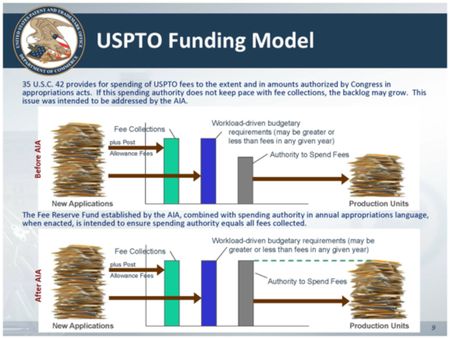
    The "USPTO Funding Model" analogizes the Office to a business, insofar as the shareholders (i.e., the public) requests products and services "according to established performance metrics."  "Aggregate costs . . . are funded from the aggregate revenue."  The Office provides context:  "[a]pplication rates increase each year," but the fees collected defray "less than one half the cost [for] prosecut[ing] the application[s]."  Office operations are "subsidized" by issue fee and patent maintenance fees; this reality complicates the budgeting process because of variability between revenue generating activities (allowance and patent maintenance) and revenue consuming activities (application examination).  The Office provides a chart depicting certain of these relationships:

    Slide 1

    This relationship was modified by the AIA, according to the Office:

    Slide 2

    The Office then sets out the goals fee setting intends to accomplish:

    • Accelerate the Office's progress in reducing the backlog of unexamined patent applications and reducing patent application pendency to bring more quality products to market within the timeframes demanded by patent applicants and owners and the public;

    • Realign the fee structure to add processing options during patent application prosecution; and

    • Put the Office on a path to financial sustainability.

    These goals were motivated by objectives, including:  1) promoting the strategy for American innovation ("promoting competitive markets that spur productive entrepreneurship," "foster innovation that will lead to technologies of the future," and "encourage high-growth and innovation-based small business entrepreneurship"); 2) aligning fees with the "full cost" of products and services provided by the Office (from historical information and in view of the Office's "strategic objectives"); 3) setting fees "to facilitate the effective administration of the patent and trademark systems," including, perhaps ominously, "encouraging the prompt conclusion of application prosecution"; and 4) offering application processing options (including various "processing choices" for applicants).  The Office used a number of analytical tools in making its fee setting decisions, including (in addition to budget formulations and economic analyses) the historical costs to the Office, the objectives of strategic planning, production workloads, and legal and policy analysis, and then proposed an iterative fee setting methodology using feedback from actual experience to "readjust" fees as needed.  These individual components were split out in separate appendices.

    The Office provides one example of how it estimates the financial "risks" using this approach:

    • If: Application filings grow at a rate faster than planned, and maintenance fees (which subsidize search and exam fees) do not; or If: Maintenance fee collections are realized at a rate lower than planned;

    • Then: The USPTO will realize a financial risk that may impact the Office's ability to continue working off the application backlog and/or maintain steady‐state operations.

    • A sufficiently funded operating reserve will mitigate this risk until the fee structure can be recalibrated using AIA Section 10 fee setting guidelines.

    The Appendices are chock full of interesting information, such as the balance between regulatory (20%) and statutory (80%) fees in the total revenue collected by the Office, despite the fact that of the 242 fees charged by the Office, 41% were regulatory fees.  Also included are the Office's plans for reducing the patent application backlog:

    Patent Pendency and Backlog Reduction

    • By the end of FY 2013, the USPTO expects to spend $1.7 billion with about 10,400 personnel on board for patent examining activities.

    • This includes hiring 1,500 new patent examiners during FY 2013.  With this hiring, the USPTO will have hired more than 3,800 patent examiners since FY 2011 to expand examination capacity sufficient to reduce the application backlog and maintain pendency thereafter.

    • The additional revenue generated with the proposed fee structure will enable the USPTO to continue paying for this increased examination capacity in the out years.

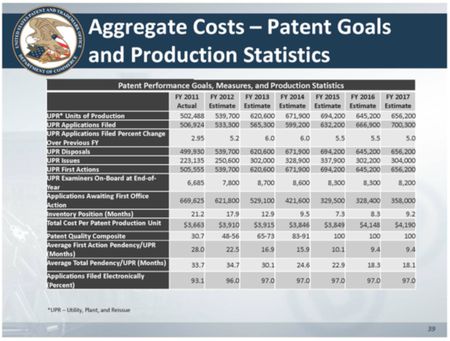
    • Increased production units and reduced patent pendency and application backlog are the most significant benefits realized from generating and using these additional resources.  The chart on the following page outlines the annual improvements to reach a 10.1 months average first action pendency in FY 2015, an 18.3 months average total pendency by FY 2016, and reducing the patent application backlog in half by FY 2015.

    Slide 3

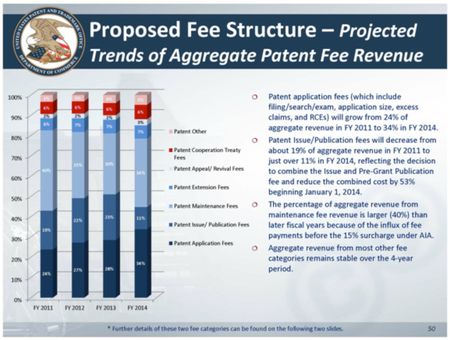
    The proposed fee structure also depends on the projected number of application fees, publication fees, maintenance fees, and "other" fees to be collected:

    Slide 4

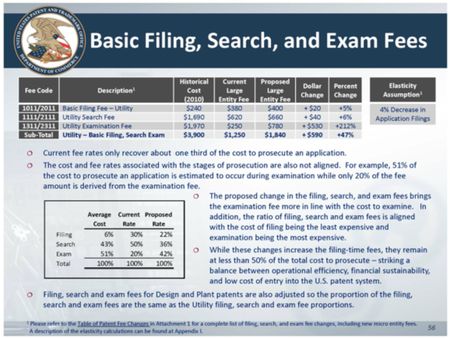
    And the Office provides its rationale for why certain fees are increased (or not); for example:

    Slide 5
    Slide 6
    Slide 7

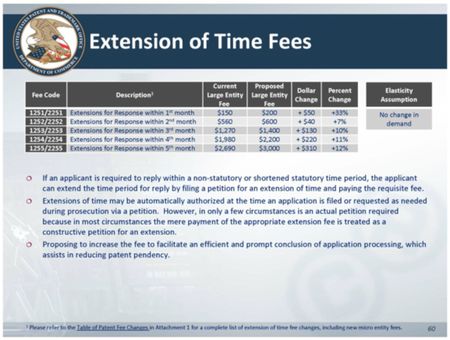
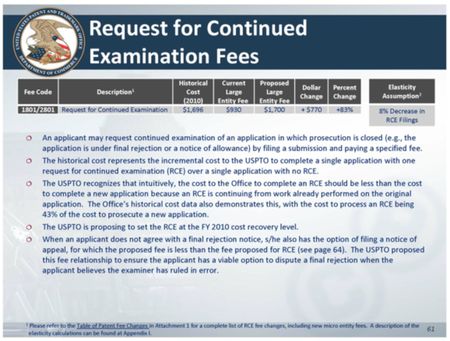
    (where the changes in extension of time fees and RCE fees are expressly intended to "facilitate and efficient and prompt conclusion of application processing").

    Finally, the Office provides "other resources," including the FY2010 – FY2015 Strategic Plan; the President's FY 2013 Budget, and the Administration's Strategy for American Innovation.

    What is remarkable, commendable, and noteworthy about these efforts by the Office is the apparent level of transparency into how the Office is proposing to exercise its new authority.  The patenting public cannot effectively comment on whether the proposed fees are appropriate without this kind of information, and while this might be expected to be self-evident, it is contrary to the conventional bureaucratic reflex to reveal an agency's thinking to this extent.  For this, Office personnel should be commended, while at the same time its assumptions and proposals should be critically examined and feedback fulsomely provided.  But at least we have the tools to do so, and kudos to the Office for providing them.

    For additional information regarding this topic, please see:

    • "USPTO Proposes Fees Changes," March 1, 2012
    • "USPTO News Briefs," February 20, 2012
    • "PPAC to Hold Public Hearings on Proposed Fee Schedule," February 1, 2012

  • By Kevin E. Noonan —

    Principles-for-synthetic-biology

    A broad coalition of 111 public interest groups announced today a manifesto for containing "synthetic biology," a term with a loose definition (including "extreme genetic engineering") that includes efforts such as Craig Venter's to produce novel microorganisms to more traditional biotechnology efforts in transgenic plants and animals and other genetically modified organisms (see "Not Quite Artificial Life, But We're Getting Closer: Reactions to Venter's Synthetic Cell").  The effort was the occasion for a press conference this morning, hosted by the Friends of the Earth and featuring four speakers:

    • Jaydee Hanson — Policy Director at the International Center for Technology Assessment
    • Dr. Stuart Newman
    — Professor of Cell Biology and Anatomy at New York Medical College and board member of the Alliance for Humane Biotechnology
    • Becky McClain
    — biotechnology whistleblower and Injured Workers National Network
    • Silvia Ribeiro
    — Latin American Director for the ETC Group

    Eric Hoffman, Food & Technology Policy Campaigner at Friends of the Earth U.S., moderated the conference, introducing the principle motivation for the proposal:  that government regulators have prematurely deemed the technology safe, which poses a risk to humans, the earth, and its other inhabitants.

    Dr. Hanson started the conference, pointing out the "newness" of the technology and distinguishing this iteration of the biotechnology revolution with the one 40 years ago, based on the difference between copying a gene from one organism into another and "writing" an entirely new gene (or genome).  He also cautioned against simplistic metaphors for genetic manipulation, such as bricks or computer code, in view of the undeniably more complex nature of this technology.  His message was simple:  we don't know enough about how genes or organisms work to be creating new ones.

    Dr. Newman continued with this theme, noting that another difference between the first biotechnology revolution and this one is that in the 1970's, the NIH created guidelines for containing genetically modified organisms (both physically and biologically), while this revolution is aimed at "releasing" genetically modified organisms into the environment in the form of modified foodstuffs, biofuel producers, etc.  It was noted that, in addition to his scientific accomplishments and work with the Alliance for Humane Biotechnology, Dr. Newman was named as an inventor in an application filed several years ago directed to a human-pig chimera (at the behest of his friend, Jeremy Rifkin, who spearheaded attempts in Cambridge, MA and elsewhere to contain the first biotechnology revolution).  (If memory serves, the U.S. Patent and Trademark Office refused to examine Dr. Newman's patent application.)

    Ms. McClain gave the most personal and most frightening testimonial, embodying all the fears of corporate misfeasance and unchecked and dangerous technology.  According to Ms McClain, she was a molecular biologist working for a drug company on recombinant microorganisms and became ill after exposure to such a recombinant.  She catalogued several unsafe practices in the workplace and how her efforts to correct them were met with resistance and finally refusal to remedy or even address the situation.  Tragically, Ms. McClain described not only the disastrous effects of her experience on her career and health, but the failure of the legal system to provide redress because the evidence of causation was lacking (according to her, having been suppressed or destroyed by her former employer).  She also reminded the audience (during the Q&A following the speakers' prepared remarks) that the nature of this technology — novel genetically engineered organisms — could make it impossible for any future injured worker to successfully sue, since the diseases that may result from exposure (inadvertent or otherwise) would not be something readily recognized by a doctor as a human disease.  This comment was reminiscent of the early response to HIV infection in the 1980's.

    The final speaker, Ms. Ribiero, included in her remarks many of the ills of Western capitalism visited on developing and underdeveloped companies in addition to synthetic biology, correctly noting that the indigenous people in such countries are at risk for harmful consequences of corporate liasons with local governments that may enrich some at a societal cost to the majority that may not be noticed in the U.S.  These concerns are encapsulated in a quote from Ms. Ribiero in the group's e-mail announcing release of the Principles:

    In addition to the risks synthetic biology poses to human health and the environment, this technology may also deepen global social and economic injustices.  Novel organisms tailored to break down biomass will enable a new bio-economy in which land, water and fertilizers used to produce food for communities in the global South will be diverted for producing biomass feed for synthetic organisms in order to produce fuels, chemicals and other high-end products for wealthy nations.

    There was a lively question and answer period following the prepared remarks; the most interesting comment came in response to a question from a reporter covering the U.S. Environmental Protection Agency.  She asked how the group expected to provoke the U.S. Congress to pass needed legislation in this area in view of partisan gridlock, and the response was that it could (and, the suggestion was, would) be done through riders to appropriations bills.  Not a prospect likely to provide the type of factfinding or deliberations that the topic no doubt warrants, but certainly a politically astute strategy.

    The proposal was released over the Internet today, entitled The Principles for the Oversight of Synthetic Biology, and has the following points: 

    I.  Employ the Precautionary Principle
    II. Require mandatory synthetic biology-specific regulations

    III.  Protect public health and worker safety

    IV.  Protect the environment

    V.  Guarantee the right-to-know and democratic participation

    VI.  Require corporate accountability and manufacturer liability
    VII.  Protect economic and environmental justice

    The upshot of the Principles is a call for a moratorium on "the release and commercial use of synthetic organisms and products."  The justification is that such a moratorium is necessary "to safeguard public health and the environment from the novel risks of synthetic biology and to ensure open, meaningful and full public participation in decisions regarding its uses."

    The Precautionary Principle (said to be incorporated into many international conventions, including the Rio Declaration on Environment and Development, the Cartegena Protocol on Biosafety, the U.N. Framework Convention on Climate Change, the World Charter on Nature, the London Convention on the Prevention of Marine Pollution by Dumping Wastes and Other Matter, and the Agreement for the Implementation of the Provisions of the United Nations Convention on the Law of the Sea) reads as follows:

    When an activity raises threats of harm to human health or the environment, precautionary measures should be taken even if some cause and effect relationships are not fully established scientifically.  In this context the proponent of an activity, rather than the public, should bear the burden of proof.  The process of applying the Precautionary Principle must be open, informed and democratic and must include potentially affected parties.  It must also involve an examination of the full range of alternatives, including no action.

    In accordance with the application of this Principle espoused in the report, the coalition rejects voluntary compliance with good practices codes or other forms of self-regulation by the biotechnology industry, and proposes mandatory government regulation instead.  The coalition specifically calls for a ban on human genetic engineering and other extensions of genetic technology into the human species, saying:

    The use of synthetic biology to change the human genetic makeup — including the human genome, epigenome and human microbiome — must be prohibited.

    Enforcement of the "strictest levels of physical, biological and geographical" containment of synthetic biology is also proposed, and the groups’ proposal envisions a "legally enforceable right" by the public to comment (and presumably prevent) particular applications of the technology before they are implemented, with corporations and other developers of the technology being financially liable for any "harm" cause to the public or the environment.  Finally, uses of the technology that would "deepen economic and social injustice" should be prohibited (although it is difficult to see how such outcomes could be predicted reliably).

    The report in its entirety can be found here, and the groups endorsing this approach are:

    African Biodiversity Network
    Agricultural Missions, Inc (AMI) (U.S.)
    Alliance for Humane Biotechnology (U.S.)
    Amberwaves (U.S.)
    Amigos de la Tierra España
    Asociacion ANDES (Peru)
    Asociación para la Promoción y el Desarrollo de la
    Comunidad CEIBA / Friends of the Earth Guatemala
    Basler Appell gegen Gentechnologie" (Appeal of Basle against Genetic-Manipulation) (Switzerland)
    Biofuelwatch (International)
    Biotechnology Reference Group of the Canadian Council of Churches
    Biowatch South Africa
    Brazilian Research Network in Nanotechnology, Society, and Environment – RENANOSOMA
    Bund für Umwelt und Naturschutz Deutschland / Friends of the Earth Germany
    Canadian Biotechnology Action Network (CBAN)
    Center for Biological Diversity (U.S.)
    Center for Food Safety (U.S.)
    Center for Genetics and Society (U.S.)
    Center for Humans and Nature (U.S.)
    Center for International Environmental Law (U.S.)
    Centro Ecológico (Brazil)
    Centre for Environmental Justice/Friends of the Earth Sri Lanka
    CESTA – Amigos de la Tierra, El Salvador
    Citizens' Environmental Coalition (U.S.)
    COECOCEIBA – Friends of the Earth Costa Rica
    Columban Center for Advocacy and Outreach (U.S.)
    Community Alliance for Global Justice (CAGJ) (U.S.)
    Development Fund (Norway)
    Diverse Women for Diversity (India)
    Doctors for Food Safety & Biosafety (India)
    Econexus (International)
    Ecoropa (Europe)
    Envirocare (Tanzania)
    Environmental Rights Action/Friends of the Earth Nigeria
    ETC Group (International)
    Ethiopian Society for Consumer Protection (ETHIOSCOP)
    European Network of Scientists for Social and Environmental Responsibility (ENSSER)
    Family Farm Defenders (U.S.)
    Federation of German Scientists
    Food Democracy Now! (U.S.)
    Food & Water Watch (U.S.)
    Friends of the Earth Australia
    Friends of the Earth Brazil
    Friends of the Earth Canada
    Friends of the Earth Cyprus
    Friends of the Earth Latin America and the Caribbean (ATALC)
    Friends of the Earth Mauritius
    Friends of the Earth U.S.
    Friends of ETC Group (U.S.)
    Gaia Foundation (U.K.)
    Gene Ethics (Australia)
    GeneWatch UK
    GLOBAL 2000/FoE Austria
    Global Forest Coalition (International)
    GM Freeze (UK)
    GMWatch (UK)
    IBON International
    Indian Biodiversity Forum
    Indigenous Peoples Council on Biocolonialism (U.S.)
    Initiative for Health & Equity in Society (India)
    Injured Workers National Network (U.S.)
    Institute for Agriculture and Trade Policy (U.S.)
    Institute for Responsible Technology (U.S.)
    International Center for Technology Assessment (U.S.)
    International Peoples Health Council (South Asia)
    International Union of Food, Agricultural, Hotel, Restaurant, Catering, Tobacco and Allied Workers' Associations (IUF) (International)
    Jamaican Council of Churches
    Karima Kaaithiegeni Ambaire (CBO) (Kenya)
    Latin American Nanotechnology & Society Network (ReLANS)
    Loka Institute (U.S.)
    MADGE Australia Inc.
    Maendeleo Endelevu Action Program (MEAP) (Kenya)
    Maryknoll Office for Global Concerns (U.S.)
    MELCA-Ethiopia
    Midwest Environmental Justice Organization (U.S.)
    Movimiento Madre Tierra (Honduras)
    Mupo Foundation (South Africa)
    Nanotechnology Citizen Engagement Organization (U.S.)
    National Association of Professional Environmentalists (Friends of the Earth Uganda)
    Navdanya (India)
    NOAH Friends of the Earth Denmark
    Non-GMO Project (U.S.)
    No Patents on Life! (Germany)
    Northeast Organic Farming Association — Interstate Council (NOFA-IC) (U.S.)
    Organic Seed Growers and Trade Association (U.S.)
    Otros Mundos AC/Amigos de la Tierra México
    Our Bodies Ourselves (U.S.)
    Partners for the Land & Agricultural Needs of Traditional Peoples (PLANT) (U.S.)
    Pesticide Action Network North America
    Pro-Choice Alliance for Responsible Research (U.S.)
    Pro Natura – Friends of the Earth Switzerland
    Public Employees for Environmental Responsibility (PEER)
    Rescope Programme (Malawi)
    Research Foundation for Science, Technology, and Ecology (India)
    Rural Coalition (U.S.)
    Save our Seeds (Europe)
    Say No to GMOs! (U.S.)
    Schweizerische Arbeitsgruppe Gentechnologie SAG (Swiss Working Group on Genetic Engineering)
    Science & Environmental Health Network (U.S.)
    Seed Stewards Association of Turkey
    Sobrevivencia – Amigos de la Tierra Paraguay
    Sustainability Council of New Zealand
    Sustainable Living Systems (U.S.)
    Testbiotech (Germany)
    Third World Network (International)
    Timberwatch Coalition (South Africa)
    Tree Is Life Trust (Kenya)
    USC Canada
    VivAgora (France)
    Washington Biotechnology Action Council (U.S.)
    Women in Europe for a Common Future (International)
    World Rainforest Movement (International)

  • By Kevin E. Noonan —

    One of the signal achievements of late 20th Century trade diplomacy was the ratification of the Uruguay Round of the General Agreement on Tariffs and Trade (GATT), and specifically the Trade-related Aspects on Intellectual Property Rights (TRIPS).  These international agreements created the World Trade Organization and changed national practices regarding intellectual property rights protection, which was a quasi quid pro quo for membership.  Part of the GATT/TRIPS related changes mandated that intellectual property rights be expanded and protected without discrimination against non-native patent holders, and that certain national practices (like banning outright intellectual property rights for entire categories of inventions) would cease.

    Emblem of India

    The most economically significant and high-profile of such practices relate to the pharmaceutical industry and specifically to patents on drugs; countries like India frankly refused to patent drugs or to permit actions against Indian companies making generic versions of drugs patented elsewhere.  This all changed, or was supposed to change, with India's ratification of GATT.  However, change comes slowly if at all and the years since Indian ratification of the new system have seen many drugs in many contexts run into national legislation, government agency action, or litigation-related court orders that have thwarted attempts by Indian patent holders, predominantly Western drug companies, from enforcing their patents to prevent generic competition.

    This is part of a larger trend, exemplified by passage of the Doha Declaration of 2001 and compulsory licensing provisions in national TRIPS implementing laws.  This has created a crisis for Western pharmaceutical companies, who have seen the trend for compulsory licensing, or the threat of such licenses, expand from anti-AIDS drugs to other drugs less relevant to "national medical emergencies," to where the levels of protection may be lower in the post-TRIPS world than they were before the GATT treaty was signed (see "The Law of Unintended Consequences Arises in Applying TRIPS to Patented Drug Protection in Developing Countries").

    While other countries have been more vigorous in using these provisions to reduce their levels of compliance with the spirit if not the letter of TRIPS, including Thailand, Brazil, and Venezuela, India has perhaps created the biggest problem for Western drug companies.  This is because India has a large, educated middle class and a democratically elected government, meaning that India's middle class has the clout to influence the government to act in their (and India's) best interests.  Coupled with its large generic pharmaceutical industry, the outcome is not surprising:  Western pharmaceutical companies have been embroiled in several disputes regarding compulsory licensing and an outright refusal to patent several important drugs, while seeing India provide generic drugs for the rest of the world (ROW) (and, in some instances, including Western countries as well).

    Novartis

    The latest patent imbroglio (Novartis v. Union of India) involves imatinib mesylate, sold by Novartis as Gleevec® (in the U.S.) and Glivec® (in the ROW) for the treatment of chronic myelogenous leukemia and certain gastrointestinal cancer.  As reported today in The New York Times ("India's Supreme Court to Hear Dispute on Drug Patents" by Vikas Bajaj and Andrew Pollack), the case has moved through the Indian legal system for six years.  At issue is the application of Section 3(d) of the Indian patent statute:

    Section 3(d): the mere discovery of a new form of a known substance which does not result in the enhancement of the known efficacy of that substance or the mere discovery of any new property or new use for a known substance or of the mere new use of a known process, machine or apparatus unless such known process results in a new product or employs at least one new reactant.

    IP India

    Initially, the Indian Patent Office refused to grant a patent to the drug maker, Novartis.  Novartis appealed, and it has taken until now for the case to arrive at the Indian Supreme Court, which will hear argument later this month.  A great deal is at stake:  while a year's treatment of Gleevec can cost $70,000 in the U.S., Novartis has made attempts to provide it for greatly reduced cost (and, in some cases for free) in an effort to blunt the political pressure to uphold the government's refusal to grant the patent.  Generic Gleevec is available for about $2,500 a year, and various non-governmental organizations, like Doctors without Borders, are afraid this drug (and others like it) will become unavailable if Novartis is granted an Indian patent.

    For its part, the Obama administration is reportedly exerting pressure on the Indian government to grant the patent.  NGOs are exerting political pressure of their own, including protesting at a Novartis shareholder meeting in Basel, Switzerland and at several Novartis company locations in he U.S.  The article also reports that the U.S. has demanded that a new treaty for the Pacific region, the Trans-Pacific Partnership, contain provisions requiring member countries to grant patents for drugs like Gleevec, according to what are called "a leaked text of the government's position."  The article also speculates that the case could influence Western drug manufacturers' appetite for investment in India.

    As described in the article, the dispute concerns a provision of the law that precludes patent protection for drugs known or developed before 1995 unless it is in a new form that "significantly improves the medicine's 'efficacy,' or effectiveness."  Because the ability to protect new forms of old drugs is common (termed "evergreening"), it is not limited to Gleevec, and this, according to the article, is another source of concern for some groups.  Brook K. Baker, a professor of law at Northeastern University in Boston and a policy analyst for the Health Global Access Project, is quoted as posing the question "Do you get one patent monopoly for the basic ingredient or do you keep tweaking it to get more patents?"  (While not a bad question it ignores the reality that the "old" form of the drug, once off patent, can be made, used and sold free of the patent "monopoly," as illustrated nicely for omeprazole, sold first as Prilosec® and, in altered form, as Nexium®.  No one needs to take Nexium, and omeprazole has been available in the U.S. as a genetic for almost 10 years.)  Ironically, the "earlier" version of Novartis' Gleevec, although patented in the early 1990s, was never marketed as a drug, and the "newer" version was approved at least in part because it is "30 percent easier for the body to absorb" than the older drug.  And of course the earlier version of the drug was not patented in India because India did not grant pharmaceutical patents at that time.  Paul Herrling was quoted as explaining that it is frequently the case that the first embodiment of a drug compound is not what ultimately becomes the approved drug product.  Under these circumstances, India's position would prevent patenting of the actual drug, which frequently has important beneficial properties (compared with the first patented compound, which "might not be absorbed into the bloodstream well enough, or it might be chemically unstable, or unsafe").

    The implications of the case extend to other cancer drugs (such as erlotinib, sold by Roche as Tarcera®, and numerous anti HIV drugs, including tenofovir, sold by Gilead Sciences as Viread®).

    The positions taken by Professor Baker and Shamnad Basheer, a law professor at West Bengal National University of Juridical Sciences in Kolkata who has filed an amicus brief, provide an interesting perspective.  Professor Baker takes the traditional legal academic view, that Western drug companies "want India shut down as a place that can make early versions of generic medicines that can compete with them" while conceding that "a victory for Novartis would not shut off the production of generic Gleevec or of other existing generics."  Professor Basheer, on the other hand, said that "[i]t is important that the court take on the matter and interpret the law in a way that balances the need for innovation against public health concerns."  His amicus brief argued that the improved "effectiveness" standard needed clarification and that "[i]t would be impractical for drug companies to seek patents only after they have conducted years of clinical trials that could provide definitive proof that updated drugs work better than their older version."  On the other hand, evergreening is an important concern, however, and the Indian government has a legitimate interest in protecting its generic drug industry.

    The Indian Supreme Court will make its decision, and thereafter it is possible we will see whether and to what extent either of these positions is correct.