• By Kevin E. Noonan —

    Washington - Capitol #5Companion bills were introduced in Congress on April 25th of this year with little fanfare (particularly in comparison to the Leahy-Smith American Invents Act) but they have the potential to provide significant funding for university-related start-up companies.  The bills, H.R. 4720 and S. 2369, are entitled the "America Innovates Act of 2012" and are sponsored by Reps. Rush Holt (D-NJ) and Timothy Bishop (D-NY) in the House of Representatives and Sens. Frank Lautenberg, Sherrod Brown (D-OH), and Kirsten Gillibrand (D-NY) in the Senate.  They have been referred to their respective committees (the House Sub-Committee on Technology and Innovation and the Senate Committee on Commerce, Science, and Transportation), but to be frank it is unlikely that they will receive positive action in this election year.

    The bill provides for the U.S. to establish an American Innovation Bank as an "independent agency," (Sec. 101(a)) that will "promote the commercialization of science and engineering discoveries" (Sec. 102(a)) by "provid[ing] grants, loans, and other assistance to eligible entities and individuals to enable the entities and individuals to perform the necessary research and development to make research discoveries attractive for private investment that will lead to the development of new companies, products, and jobs." Sec. 102(b).  There are provisions for a Board (Sec. 101(b)(1)) and a Director, appointed by the President with the advice and consent of the Senate (Sec. 101(B)(2)); the Board will "advise the Director on new and emerging areas of research and industry that would benefit from investment from the Bank" (Sec. 101(b)(3)(A)) and "critically evaluate the success of the Bank's investments in helping to commercialize scientific discoveries and create new companies and jobs." (Sec. 101(B)(3)(B))  The bill also provides for annual Reports of its activities to Congress (Sec. 103(a)) that will include at a minimum the number of patents, products, new companies and jobs resulting from Bank investments (Sec. 103(b)).

    Grants will be available to "eligible entities" (Sec. 104(a)) that will include "institutes of higher education" as defined by section 101 of the Higher Education Act of 1965 (20 USC 101), Sec. 104(B)(1) and "nonprofit research institution[s] that focus[] on science research" (Sec. 104(B)(2)).  The grants will be awarded "on a competitive basis" (Sec. 104(d)) in life sciences, medicine, computer sciences, communications, technology, physical sciences, engineering and "[o]ther research areas determined important for economic development by the Director" (Sec. 104(d)(1) – (4)) and using a priority system that awards institutions already receiving "a significant amount of Federal funding" from the National Institutes of Health (NIH), National Science Foundation (NSF), Department of Energy (DOE) or "other agencies" (Sec. 104(e)(1)), that "do not have a significant proof of concept fund already established at the entity" (Sec. 104(e)(2)), have "established relationships" with business and industry that can commercialize the technology and "may be" local industries (Sec. 104(e)(3)), that have "an institutional environment that is supportive of business development" (Sec. 104(e)(4)(A) & (B)) and "demonstrate the appropriate administrative capacity" to encourage patenting, companies, products or jobs from the grants (Sec. 104(e)(5)).  Decisions on grants will be made by an advisory panel of experts, both business leaders and scientists, who will make recommendations to the Director based on grant applications submitted by prospective awardees (Sec 104(c)).  Funds may be used to support the scientists performing the research as well as further research or data collection directed to making a discovery "more attractive" to corporations or venture capital firms (Sec. 104(f)(1)(A)), for facilities and business incubators (Sec. 104(f)(1)(C))  and to attract additional private investment (Sec. 104(f)(1)(D)).  The bill also contains additional provisions governing subgrants to individuals (Sec. 104(f)(2)) and for facilities construction (Sec. 104(f)(3)).  And of course there are provisions for Reports from grantees for each year during the grant period as well as for 5 years after the grant period ends (Sec. 104(g)).

    In addition, the bill provides for direct grants to individuals (Sec. 105), governed by many of the same considerations and requirements for institutional grants (Sec. 105(a) – (c)), as well as grants to private companies in the form of loans "at competitive interest rates" (Sec. 106).  But when the government giveth it can also taketh away, under conditions where the grantees "do not use such grants or loans to make reasonable attempts to develop discoveries into new companies, products, or jobs" and can require repayment, as provided by Sec. 107.

    Section 201 et seq. sets forth provisions for "improving science and technology" by amending Section 510 of the NSF Authorization Act of 2010 (42 USC 1869) to permit the NSF to award grants under the Integrative Graduate Education and Research Traineeship (IGERT) program to support students who perform "some or all of their graduate research in an industry setting." (Sec. 201).  In addition, the bill provides that NSF, NIH or any other Federally funded graduate student training program must provide students with training related to protecting intellectual property, commercializing inventions and developing scientific discoveries (Sec. 202(a)-(b)), exempting institutions of higher education that enroll fewer than 6 students (Sec. 202(c)).  The NSF Authorization Act is further amended to award grants for "professional science masters programs" (Sec. 301).

    The Bank is intended, among other things, to help companies navigate the "valley of death" where university-related start-up companies go through initial funding monies before having sufficient experimental results to attract venture capital or large company investment or commercialize their products.  One of the bills' proponents, Senator Gillibrand, called the bill "common-sense legislation [that] will help develop scientific breakthroughs into cutting-edge businesses and new jobs."  That kind of promotion worked well for the AIA, and could be the ticket for accelerating consideration of the bills before November.

  • By Kevin E. Noonan —

    MyriadThe Federal Circuit heard oral argument in Association for Molecular Pathology v. U.S. Patent and Trademark Office (the Myriad case) on Friday, and the cast of characters remained mostly the same.  On the panel were Judge Lourie, Judge Bryson, and Judge Moore.  Representing Myriad was Gregory Castanias from Jones Day, and Chris Hansen reprised his role as ACLU/AMP advocate.  New to the proceedings was Melissa Patterson for the U.S. government, in place of former Acting Solicitor General Eric Katyal who has left the government for private practice.  Each side had a nominal twenty minutes to argue, with Mr. Hansen conceding half his time to Ms. Patterson.

    Castanias, GregoryMr. Castanias (at left) began his argument as he would end it, citing Diamond v. Chakrabarty as the seminal authority on the patent-eligibility of product claims and stating that the Supreme Court's decision in Mayo v Prometheus did not change this.  Taking the argumentative bull by the horns, he addressed the issue of "preemption" (which would be a theme in both Mr. Hansen's and Ms. Patterson's arguments) by saying that preemption is a proxy for whether there is an invention.  Judge Lourie posed the contrast between a law of nature (in Mayo) and an isolated natural material (here) in instances where there was only a "small move" from the naturally occurring molecule.  Mr. Castanias answered in a manner that would raise philosophical issues for Myriad later, citing to the expert declarations by the inventors and others on the question of how small the step actually was.  Here, his point was that there was a great deal of human ingenuity involved in producing the isolated genomic DNA encompassed by the claims, and that contributes to its inventiveness.

    Mr. Castanias then reminded the Court of Judge Bryson's analogy regarding making a baseball bat from wood (and the judge included sculpting a statue of David from marble), which were patent-eligible, and Judge Bryson then asked about whether isolating genomic DNA was like cutting off the branches and roots of a tree and then claiming a trunk (illustrating again that bad analogies make bad law), with the wrinkle that the trunk was produced using a laser that caused chemical changes.  Mr. Castanias agreed that this would not be patent-eligible but because it is not an invention, being just a new way to make an old thing.  With a gene, he emphasized that it is unknown until an inventor identifies, and in some sense, defines it.  Citing the '282 patent, he pointed to Figure 10 and to columns 19 and 24 of the specification, for the teaching that what the patent defines as a "gene" includes the coding sequences, the intervening sequences (or "introns" to the coding sequences "exons") and regulatory sequences that could themselves encompass 100 kilobases (100,000) of DNA.  The inventors defined this as the BRCA1 gene, which required an enormous amount of inventive effort, according to Mr. Castanias (making it very unlike a tree trunk).  Judge Lourie leant a hand by remarking that the gene is thus "the product of human ingenuity."

    Judge Lourie then did Myriad and Mr. Castanias no favors by broaching the issue of claim 20 of the '282 patent and asking him to distinguish this claim from the patent-ineligible claims in Mayo.  Mr. Castanias started well, pointing out that, unlike in Mayo, this claim does not encompass the "principle of the holy trinity of well-understood, routine and conventional," as in Mayo, but with something that is not well-understood, routine or conventional, namely the transformed cell.

    But then Mr. Castanias and the bench spent what everyone recognized was a few unfruitful minutes discussing whether claim 20 was properly before the Court.  Mr. Castanias repeated Myriad's contention from its brief, that AMP not only had not included this claim in its certiorari petition but had affirmatively stated that the method claims were not being appealed.  Judge Bryson said that was not the point, and that he (and presumably his colleagues) believed that the Court's "task" was not limited by plaintiffs' certiorari petition (his argument having a strong flavor of not letting the inmates run the asylum).  Judge Bryson characterized the current state of the case as a "do-over" where "the vacated judgment is in the same position as it was last year."  He then asked for any authority for Myriad's position and Mr. Castanias was unable to provide any (Mr. Hansen, during his argument, was happy to provide the Court with Lockheed Martin Corp. v. Space Systems/Loral, Inc. for authority to the contrary).

    Judge Bryson also voiced confusion over the meaning of certain claim language, illustrating again the unusual posture of the case where the claims have never been construed.  Mr. Castanias and the Court were unable to parse out the language "causing cancer" in the phrase "growing a transformed eukaryotic host cell containing an altered BRCA1 gene causing cancer in the presence of a compound suspected of being a cancer therapeutic," which is not surprising:  the claim is not clearly written, and the word "transform" has two meanings in the art easily conflated.  First, a "transformed" cell can mean a cell into which an exogenous DNA has been introduced (most likely the meaning intended in the claim), but it can also mean a cell that has been "oncogenically" transformed to be, inter alia, immortalized so that cell lines can grow indefinitely in vitro.  Again, Mr. Hansen came to the rescue, stating properly that his interpretation of the claim was that the BRCA gene in a form associated with cancer in vivo.  And Judge Moore chimed in asking whether claim 20 comprising the transformed cell would be patent-eligible if the panel found the isolated DNA claims not to be patent-eligible.  For her, "transformation" (unclear whether in the biological or legal sense) was irrelevant.

    Hansen, ChristopherMr. Hansen (at right) began his argument by noting what he called the "stunning breadth" of the composition of matter claims, and the "preemptive effect" of such claims, but Judge Lourie interrupted by noting that breadth is properly a concern under Section 112 and not Section 101 of the Patent Act.  Mr. Hansen proceeded to read the laundry list of types of nucleic acids recited in the '282 specification, but Judge Lourie again interrupted and asked about the relevance of this to the issues raised in Mayo.  In response to Judge Lourie's assertion that the "law of nature" argument in Mayo was not directly relevant to composition claims, Mr. Hansen asserted a "law of nature"/"product of nature" exclusion (the latter being completely fantastical as far as actual case law is concerned), saying that these should be "available to everyone" under Supreme Court precedent.  Judge Moore noted that his breadth argument undercut his preemption argument, because if preemption the issue, breadth is irrelevant under Mayo.  She indicated that preemption is a "bright line prohibition" and thus this argument is "a waste of time and space."

    Wisely, Mr. Hansen took the opportunity to move on to claim 20.  In this argument he produced the wildest of wild hair arguments (which is saying something in this case), asserting that Myriad "bought the transformed cell off the shelf" and that "it wasn't their invention."  (Reality check:  it would have been impossible to produce a recombinant (or "transformed") cell comprising a cancer-causing BRCA gene variant until such a gene was isolated by Myriad.)  Judge Lourie pointed out that in Mayo the claims recited administering and determining and the Supreme Court demanded something more, significantly more, asking whether that was not provided in claim 20 (presumably, the transformed cell).  Mr. Hansen was able to argue it did not, because having falsely negated the inventiveness of the BRCA transformed cell he could concentrate on the rest of the claim, which recited "[growing said transformed eukaryotic host cell] in the presence of a compound suspected of being a cancer therapeutic, growing said transformed eukaryotic host cell in the absence of said compound, determining the rate of growth of said host cell in the presence of said compound and the rate of growth of said host cell in the absence of said compound and comparing the growth rate of said host cells."  Then the claim directs the practitioner to "see what happens," and moreover, with anything — "salt, sugar, water, oil" as opposed to the non-naturally occurring drug in Mayo — and without any recitation of the type of "precise numbers" the Supreme Court rejected in Mayo.  Judge Moore pointed out that the transformed cell is not found in nature and asked how this differs from Chakrabarty's bacterium.  Mr. Hansen merely reminded the Court that the drug in Mayo had not been found in nature.  Judge Lourie then raised the example of Penicillin G, which was a natural product and asked whether it should be patent-eligible.  Mr. Hansen stated that it depended on "the degree to which it is transformed" (presumably from its natural state) but said that the rule has to be that it doesn't matter for method claims — "administering and looking to see what happens is not patentable."  Judge Lourie sounded skeptical of this reasoning, mentioning that Penicillin G was not patented and there was "a lag" between when it was discovered by Fleming and when it was commercially available.

    Mr. Hansen then said that it is well-accepted that patents are not rewarded for being the product of great effort, saying that E=mc2 might have taken great effort but was not patent eligible.  Judge Bryson said that wasn't his understanding of AMP's argument and returned the questioning back to claim 20, asking if Mr. Hansen agreed that "if all you did was to put PenG next to bacterium and tested and it worked better than water, then that isn't patentable," which, of course, he did.

    Department of Justice (DOJ) SealLast to speak was the government, represented by Melissa Patterson.  Her argument proved that, although former Acting Solicitor General Katyal may be gone, his arguments (and his magic microscope) remain.  Ms. Patterson started as Mr. Hansen did, with an argument regarding the "unduly preemptive" scope of Myriad's composition of matter claims.  Judge Moore raised the magic microscope, asking whether the government still thought that was a useful test.  Ms. Patterson, with the benefit of hindsight characterized it as a metaphor rather than a test, but stated that the government still considered it "useful" as such.  The government's position was that the Supreme Court had voiced a "concern" in Mayo regarding the extent to which claims preclude public access to a product of nature; in this version of the government's view, the preemption issues raised for process claims in Mayo are directly applicable to the preemptive issues the government — and, coincidentally, the ACLU — raise here.  Judge Bryson raised the issue of whether the views of the U.S. government included the views of the Commerce Department and the USPTO, and Mr. Patterson stuck to the "unitary Executive" stance espoused (to some skepticism from Judge Moore) in the previous oral argument in this case.

    Turning back to the merits, Ms. Patterson stated that the government did not consider this a "close case," analogizing (badly) Myriad's claims to patenting an electron or a quark (or a Higgs boson, noted Judge Lourie).  She then said that the government did not believe there should be a "huge wall" between the law of nature and product of nature and that the government was seeking to assert a general rule not a rule specific for DNA.  She went on to say that changes in a product of nature "incidental to its extraction" raised preemption concerns, citing coal as an example.

    Judge Moore raised the issue of "settled expectations" as she had at the previous oral argument, noting that an industry had arisen during the "decades" in which the government (through the USPTO) had granted these patents.  Ms. Patterson raised Bilski as an example of where "thousands" of patents had been invalidated and said that the "settled expectations" provided "no reason to alter how a court looks at Section 101," asking the Court to make general (and preclusive) rules on patent eligibility.

    Ms. Patterson then turned to a more potentially pernicious portion of her argument, saying that products of nature that differ "only by changes that are incidental to extraction" too broadly preempt the public's ability to study and otherwise use them.  Judge Moore raised the issue of primers and probes, which Ms. Patterson dismissed as "depend[ing] on the inherent properties of basepair complementarity" (thus presumably relegating anything that occurs naturally to be patent-ineligible so long as it continues to evince "inherent properties").  Judge Moore continued, asking about Chakrabarty's bacterium and the Court's rubric of things being "distinct and markedly different," to which Ms. Patterson returned to coal and uranium — as properties discovered but not "invented."

    In his rebuttal time, Mr. Castanias clarified the language of claim 20 and disputed Mr. Hansen's allegations that the transformed cell was something Myriad "got of the shelf, like a test tube."  He also attacked the government's argument as establishing "no principled line" for making the distinction between patent eligibility and ineligibility, and said that Chakrabarty draws the line.  He also distinguished his earlier remarks as not being a "sweat of the brow analysis" for patent eligibility but being the product of "work and inventive judgment."

    Judge Moore asked Mr. Castanias to distinguish isolating a gene from extracting coal from rock, which he admitted would not be patent eligible, and mentioned the additional utilities present in an isolated gene, including re-introducing the gene into a cell that had a defective copy.  Utility had not been litigated in this case, he reminded the Court, the plaintiffs' having conceded that the isolated DNA had utility.

    Judge Bryson returned to his kidney hypothetical from the previous oral argument, and Mr. Castanias attempted to distinguish without much success.  Judge Lourie ended this line of questioning by reminding the panel that a kidney is an organ, not a chemical compound, and that the analogy breaks down when that is taken into account.

    Mr. Castanias ended his rebuttal argument by rebutting a point persuasive to Judge Bryson in his dissent from the now-vacated decision:  that "whole genome sequencing" was not impacted by Myriad's isolated DNA claims.  He mentioned that Professor Watson had had his whole genome sequenced without infringement liability.  After some additional questions regarding the importance of "where to make the cut" (and some colloquy from Judge Lourie that some of these considerations sound in obviousness, which was not before the Court), Mr. Castanias ended with his most persuasive argument:  that Chakrabarty is the answer and Mayo doesn't change it.

    One thing is clear from this argument.  The danger in AMP's preemption argument, and even more so in the government's argument, is something hinted at in the now-vacated Federal Circuit majority opinion.  That is the argument, expressed frankly by the government, that merely isolating something from nature was "not enough" to render it patent eligible.  Part of the problem is the government's avowed purpose for setting out "general rules" (one shudders to think of the implications for "bright line" rules made by people who don't understand the implications).  Another is the failure to discuss the inseparable impact on what is claimed and how it is claimed.  Using one of the examples raised with regard to claim 20, what of the patent-eligibility of penicillin?  That question varies with the nature of the claim:

    1.  Penicillin.

    2.  An isolated preparation of penicillin having a purity of greater than 99% and capable of killing one million bacterial cells per microgram.

    3.  A pharmaceutical preparation of penicillin suitable for injecting into a human being to treat a bacterial infection.

    Philosophically (while we are talking general principles), the government's position that claims should not be allowed that will preempt a "product of nature" is a good way to create a "tragedy of the commons," because there is no incentive to identify, isolate/extract, test, and produce a drug from a naturally occurring source if its source precludes patent eligibility.

    What the government (or that portion of the government populated by the scientifically illiterate or their opposites, the scientific elite who have little appreciation for the legal and practical implications of their positions) does not recognize is that there is a good reason to make the distinction between natural law as in Mayo (even as marginally as the logic of that case is laid out) and isolated products from nature.  Patenting a natural law restricts development of any future application of that law during the lifetime of the patent, whereas patenting a chemical compound from nature is limited to that compound.  Indeed, it has always been the case that "the public" is free to find new uses for compounds made by others and to patent them, which the original product patentee cannot practice without a license.  Thus, product patents by their nature do not have the breadth of method patent claims and do not raise the same issues due to the specificity of what is claimed in a composition of matter claim.  That distinction renders much of what the government argues as irrelevant, or at least not tethered to any legitimate policy concern regarding the availability of "products of nature" to the "public."

    No matter how the Federal Circuit decides this case, what is at stake is a larger principle.  The old aphorism (raised to an anthem by John Cougar Mellancamp) is that if you don't stand for something, you fall for anything.  What the Court needs to stand for is the Congressional intent that "anything under the sun made by man" is eligible for patenting.  If the Supreme Court indulges in judicial nullification of this intent, so be it (and even the Court recognizes that Congress can amend the law to overcome all but the most fundamental grounds for patent ineligibility).  But the Federal Circuit spent a generation under the leadership of Judge Rich, and Judge Markey, and all the other Chiefs and other judges, in fulfilling its mandate of being the court that understands technology and patent law and thus is in the best position to interpret that law and apply it to the cases before it.  It should continue to do so.

  • By Donald Zuhn —

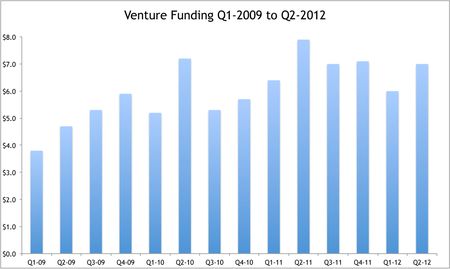
    NVCALast week, the National Venture Capital Association (NVCA), a trade association representing the U.S. venture capital industry, released the results of its MoneyTree Report on venture funding for the second quarter of 2012.  The report, which is prepared by NVCA and PriceWaterhouseCoopers LLP using data from Thomson Reuters, indicates that venture capitalists invested $7.0 billion in 898 deals in the second quarter, which constituted a 17% increase in dollars and a 11% decrease in deals as compared with the first quarter of 2012, when $6.0 billion was invested in 809 deals.  The NVCA also revised its first quarter numbers, raising the funding and deals totals by $200 million and 51, respectively.  As a result, the first quarter drop was somewhat less severe than initially reported (see "Biotech Venture Funding Drops 43% in First Quarter").

    Venture Funding 2012-Q2
    The report also notes that the Life Sciences sector (biotechnology and medical device industries) saw another decrease in both dollars and deals in the second quarter, dropping by 9% in funding to $1.4 billion and by 6% in deals to 174.  The drop in Life Sciences funding was the industry's fourth consecutive quarterly decrease, and was due mostly to a drop in Biotech funding where $697 million went into 90 deals, down from the $780 million that was invested in 99 deals in the first quarter.  Medical device funding remained flat with respect to dollars ($700 million) and was up 11% with respect to deals (84).  In contrast with the Life Sciences sector, the Software industry received the highest level of funding, securing $2.3 billion in the second quarter — which marked a 38% increase over the first quarter.  The Software industry also led all sectors in deals with 290, a 16% increase over the first quarter.  Overall, eleven of the seventeen sectors tracked by the NVCA saw increases in dollars invested in the second quarter (in the first quarter, the numbers were flipped with eleven of seventeen sectors seeing decreases).  Eleven of seventeen sectors also saw increases in the number of deals being completed.

    PricewaterhouseCoopers (PWC)NVCA president Mark Heesen noted that "[t]he concentration of venture capital dollars in the hands of fewer firms will increasingly dictate the flow of investment," adding that this currently "translates into more funding for IT start-ups and less capital available for life sciences and clean technology."  He also noted that the NVCA "hope[s] to see this investment mix rebalance over time as the start-up ecosystem is better served with more diversity, not less."  Tracy Lefteroff, the global managing partner of the venture capital practice at PricewaterhouseCoopers pointed out that at the current pace venture funding in 2012 was unlikely to outpace the 2011 total of $30 billion, but would still exceed the 2010 total of $23 billion.  She also noted that "Software and Internet companies continue to be attractive industries for VCs since most of these companies tend to be capital efficient and don't require large amounts of capital to operate," and that "given the regulatory challenges currently impacting the Life Sciences industry and the amount of capital required to fund these companies, it's no surprise that investments in this industry have declined for the fourth consecutive quarter."

    For additional information regarding this and other related topics, please see:

    • "Biotech Venture Funding Drops 43% in First Quarter," May 3, 2012
    • "Venture Funding Increased 22% in 2011," February 2, 2012
    • "Life Sciences Venture Funding Drops in Third Quarter," October 27, 2011
    • "Life Sciences Venture Funding up 37% in Second Quarter," August 1, 2011
    • "VentureSource Reports 35% Increase in 1Q Venture Funding," April 26, 2011
    • "NVCA Reports Modest Gains in First Quarter Venture Funding," April 19, 2011

    • "NVCA Reports 31% Drop in Venture Funding for Third Quarter," October 17, 2010

    • "NVCA Reports 34% Increase in Venture Funding for Second Quarter," July 22, 2010

    • "NVCA Report Shows First Quarter Drop in Venture Funding," April 20, 2010

    • "Biotech/Pharma Financing Improving, R&D Spending Up," August 31, 2009
    • "NVCA Study Shows Increase in Third Quarter Venture Funding," October 23, 2009

    • "First Quarter Venture Capital Funding at 12-Year Low," April 23, 2009

    • "NVCA Study Shows Decline in 2008 Investment; BIO Study Predicts Biotech Rebound in 2009," February 16, 2009

    • "NVCA Predicts Another Slow Year for Venture-backed Businesses in 2009," December 18, 2008

  • By Sherri Oslick —

    Gavel About Court Report:  Each week we will report briefly on recently filed biotech and pharma cases.

    Novartis Pharmaceuticals Corp. et al. v. Sun Pharmaceuticals Industries, Inc. et al.
    2:12-cv-04393; filed July 14, 2012 in the District Court of New Jersey

    • Plaintiffs:  Novartis Pharmaceuticals Corp.; Novartis Corp.; Novartis AG
    • Defendants:  Sun Pharmaceuticals Industries, Inc.; Sun Pharma Global FZE; Caraco Pharmaceutical Laboratories, Ltd; Sun Pharmaceutical Industries Ltd.

    Infringement of U.S. Patent No. 7,932,241 ("Pharmaceutical Products Comprising Bisphosphonates," issued April 26, 2011) following Paragraph IV certifications as part of Sun's filing of ANDAs to manufacture generic versions of Novartis' Reclast® (zoledronic acid injection, once-yearly treatment for postmenopausal osteoporosis) and Zometa® (zoledronic acid injection, used to treat patients with multiple myeloma and patients with documented bone metastases from solid tumors).  View the complaint here.


    Shionogi Inc. et al. v. Nostrum Laboratories, Inc. et al.

    1:12-cv-04402; filed July 13, 2012 in the District Court of New Jersey

    • Plaintiffs:  Shionogi Inc.; Andrx Corp.; Andrx Pharmaceuticals, Inc. a/k/a Watson Laboratories, Inc.- Florida; Andrx Pharmaceuticals, L.L.C.; Andrx Laboratories (NJ), Inc.; Andrx EU Ltd.; Andrx Labs, L.L.C.
    • Defendants:  Nostrum Laboratories, Inc.; Nostrum Pharmaceuticals LLC

    Infringement of U.S. Patent Nos. 6,099,859 ("Controlled Release Oral Tablet Having a Unitary Core," issued August 8, 2000) and 6,866,866 ("Controlled Release Metformin Compositions," issued March 15, 2005), both licensed to Shionogi, following a Paragraph IV certification as part of Nostrum's filing of an ANDA to manufacture a generic version of Shionogi's Fortamet® (extended release metformin hydrochloride, used to treat Type 2 diabetes).  View the complaint here.

  • Calendar

    July 30-31, 2012 – Freedom to Operate*** (American Conference Institute) – Philadelphia, PA

    July 30 to August 1, 2012 – Intensive Patent Law Seminar (Chisum Patent Academy) – Seattle, WA

    August 2, 2012 – USPTO Post-Grant Proceedings:  Meeting the New Requirements for Post-Grant and Inter Partes Reviews and Supplemental Examination (Strafford) – 1:00 – 2:30 pm (EDT)

    September 9-11, 2012 – IPO Annual Meeting (Intellectual Property Owners Association) – San Antonio, TX

    September 10-12, 2012 – Business of Biosimilars & Generic Drugs (Institute for International Research) – Boston, MA

    September 20-21, 2012 – FDA Boot Camp*** (American Conference Institute) – Boston, MA

    September 24-25, 2012 – Biosimilars and Biobetters*** (SMi) – London, UK

    September 25-26, 2012 – EU Pharma Regulatory Law*** (C5) – Brussels, Belgium

    ***Patent Docs is a media partner of this conference or CLE

  • By Kevin E. Noonan —

    MyriadAppellant Myriad Genetics (the real "target" in interest of the ACLU/PubPat lawsuit over isolated human DNA molecules) filed its Supplemental Brief pursuant to Federal Circuit order in the remand of AMP v. USPTO.  Not surprisingly, the brief urges the Court to reaffirm its judgment that claims to isolated DNA molecules are patent-eligible.  Perhaps more surprisingly, the brief argues that Claim 20 is not before the Court on remand, but that if the Court considers it then the Court should recognize and reaffirm its prior determination that Claim 20 is patent-eligible.

    Myriad argues that the Supreme Court's decision in Mayo v. Prometheus does not affect Federal Circuit's decision that Myriad's composition of matter claims are patent eligible.  The brief uses the Supreme Court's own language and considerations rather than their own, amici, or the Federal Circuit's rationales in making this argument.  This language includes the Court's express intent not to "break new ground" and merely to provide "an examination of the particular [method] claims before [it] in light of the Court's precedents."  Supreme Court precedents cited in the brief as "supporting" the Court's Mayo decision include Bilski v. Kappos, Diamond v. Diehr, Parker v. Flook, Gottschalk v. Benson, O'Reilly v. Morse, and Neilson v. Hartford (the British case); all cases involved solely method claims, according to the brief.  Myriad asserts that the Mayo decision by its own terms is limited to method claims, and consistent with this earlier precedent.  When the Court wishes to address composition of matter or manufacture claims patent-eligibility, as it did in Diamond v. Chakrabarty, the Court cites other precedent – Hartranft v. Weigmann and Funk Bros. Seed Co. v. Kalo Inoculant Co. — as precedent.  And the brief notes that "no appellate court has ruled a product patent ineligible since the 1952 Act," citing In re Kratz, In re Chakrabarty, In re Bergstrom, and Merck & Co. v. Olin Mathieson Chem. Corp. in addition to In re Bergy.

    The brief asserts that the Mayo decision stands for there being a requirement for something "significantly more" than reciting a "law of nature" coupled with "well-understood, routine, conventional activity."  By satisfying the Chakrabarty standard, Myriad argues that the composition of matter claims satisfy the Mayo standard.  According to the brief, the "overarching" question posed by Mayo is whether there is "invention" and that the changes in the naturally occurring genetic materials as claimed by Myriad satisfy that requirement.  The brief expressly cites In re Bergy as the paradigm for the current situation before the Federal Circuit.  In that case, there was a decision by the appellate court (the Court of Customs and Patent Appeals, C.C.P.A.) on composition of matter claims, later vacated by the Supreme Court and remanded for reconsideration over an intervening Supreme Court decision on method claims (Parker v. Flook).  The CCPA (in an opinion by Judge G.S. Rich) found its earlier decision, that an isolated and purified culture of a naturally occurring bacterium was patent eligible, to be unaffected by the intervening Supreme Court precedent.  Myriad contends that "[t]he same result is compelled here" because "Mayo sheds no new light on the patent eligibility of the isolated DNA claims" and thus the Mayo decision "should not alter the Court's prior judgment."

    The brief argues that the Supreme Court standards for patent eligibility for method claims and composition of matter claims are different, and Myriad's claims satisfy the Chakrabarty standard that the claimed compositions have "a distinctive name, character and use."  The brief characterizes the Mayo decision as requiring "the application of human ingenuity" as a requirement for patent-eligibility, and cites Mayo for the proposition that, for composition of matter claims, "a novel and useful structure is patent-eligible," based on Mackay Radio & Tel. Co. v. RCA.  This is because "[e]very product has its origins in something that exists in nature" (echoing Chief Judge Rader's comment that "all we have is nature"), according to the brief.  Thus, there is not (and indeed, cannot) be a requirement that all inventions be "wholly artificial"; "[h]uman ingenuity must simply have played a role," the brief argues.  The Court's previous, now vacated decision is consistent with these standards according to Myriad.

    In deference perhaps to the extent to which the Mayo decision blended considerations other than subject matter eligibility into the criteria to be applied by courts (including, specifically, considerations that resemble obviousness), the brief explains that even the isolation of the BRCA genes involved unconventional, non-routine methods that were not well-understood and, indeed, were contrary to conventional wisdom on how to isolate a gene.  Reminding the Court that these method steps are not part of the claim, the brief argues that they were nevertheless "groundbreaking" and "a major breakthrough."  Myriad's brief takes pains to explain these steps and their unconventionality.  The brief also includes what can only be described as "secondary considerations" or "objective indicia" on nonobviousness, including that the methods used and that their successfulness were surprising and unexpected.  The brief also ties the inventors' decision to patent the genes, and disclose the information regarding them thereby, as enabling "thousands of researchers to publish thousands of papers" on the genes.

    In a footnote, the brief makes creative use of the Court's discussion in Chakrabarty regarding the Plant Protection Act (which the Patent Office used to argue that Congress had not authorized utility patents on "living" inventions).  Here, Myriad argues that by creating the PPA, Congress determined that "the work of the plant breeder in aid of nature was a patentable invention."  This focuses the inquiry on the difference between what is naturally occurring and what is the product of human ingenuity, a standard reinforced by the Court's decision in J.E.M. Ag Supply Inc. v. Pioneer Hybrid Int'l. Inc. (which extended the scope of plant patent protection, under appropriate circumstances, to utility patenting under Section 101).

    And in another footnote, the brief asserts that, under plaintiffs' reading, the Chakrabarty bacterium would have been patent-ineligible:

    That bacterium was identical to the naturally occurring one, except for a few small pieces of DNA that had been transferred to it with the aid of human researchers (essentially through a process of selective breeding).  It had the same genome and same internal components.  It also retained all of its original functions and properties; it just gained a few new ones.  In fact, the invention in Chakrabarty merely added known utilities from one bacterium into another (by contrast, the molecules in the present case gave rise to entirely new utilities that were impossible before, such as sequencing a patient's BRCA1 gene).

    The policy concerns raised by the Supreme Court in rendering its Mayo decision — for example, that the claims monopolize "the basic tools of scientific and technological work" — are not to the contrary.  The brief argues that the Supreme Court has cautioned against "categorical rules" for patent eligibility and requires a "fact-intensive analysis" of the particular claim(s) before it when deciding questions of patent eligibility.  And the brief cautions that, if the law should be changed or clarified to exclude patent eligibility for DNA claims nunc pro tunc, the resulting upset of settled expectations is for Congress, not the courts, to decide (characterizing the contrary as "judicial lawmaking").  The role of the PTO in granting patents to isolated DNA molecules, and Congressional disinterest and inaction in modifying the law regarding composition of matter claims are factors to be considered by the Court in reconsidering its earlier determination that the composition of matter claims are patent eligible, Myriad argues.

    The brief gets to the heart of the matter with regard to the mischief that the Court could wreak on the patent system by considering the effects of ruling for plaintiffs outside the area of DNA claims:

    The impact of this case is not limited to human genetics.  In 2012, the era of human gene discovery has been over for more than a decade, and human isolate DNA patents are in their twilight.  But the consequence of ruling these claims ineligible would be tragic, and would reach far beyond this field and industry.  Striking them down, despite the reliance of the inventive and investing communities on the well-established rule, would send a shiver up the spines of future investors and commercial research and development — and not just in molecular diagnostics.  Such a ruling would additionally cast a pall on other innovation industries whose existence depends on patent protection.

    In a footnote, the brief enumerated such ancillary consequences to include pharmaceuticals, antibiotics, immunosuppressants, biologics drugs and viruses, vaccines, human therapeutic proteins such as erythropoietin, enzymes used for producing biofuels, nutritionally improved fruits and vegetables, biological pesticides, flavorants, dyes and enzyme used, for example, in detergents.

    And the brief reminds the Court that while all claims are "pre-emptive" the standard is that they not be unduly preemptive.  Myriad's claims are not, the brief argues, because they are claiming just what the inventors invented:  isolated BRCA gene encoding DNA molecules, "not any of the other 20,000 human or other genes."  Even claims to the BRCA genes themselves are not unduly preemptive, as evidenced by the cited scientific research and other ways to test for hereditary breast cancer that are not impacted by Myriad's DNA claims.

    With regard to Claim 20, the brief's argument that this claim is not properly before the Federal Circuit on remand is based, in part, on the plain language of the certiorari petition which was limited to the composition of matter claims and affirmatively stated that all of the method claims were not appealed — "None of the method claims is the subject of this [certiorari] petition" — so that there is no basis for further review.  In any event, Myriad argues that Claim 20 is patent eligible because it encompasses "significantly more than" a "law of nature" and "well-understood, routine, conventional activity."  That "more than" includes the transformed cell, which is not naturally occurring, particularly insofar as it has been genetically engineered to include an exogenous human BRCA gene, and these factors are enough to distinguish Claim 20 from the Prometheus claims in Mayo and to be patent eligible.

    Oral argument is set for Friday, July 20th and will be available on the Federal Circuit website shortly thereafter.

  • By Andrew Williams —

    On April 30th, the Federal Circuit issued an Order in the Association for Molecular Pathology v. U.S. Patent and Trademark Office case vacating its July 29, 2011 opinion and reinstating the appeal.  That Order was based on the Supreme Court's decision vacating the Federal Circuit's prior judgment and remanding the case for further proceedings.  In addition, the Federal Circuit requested that both parties file supplemental briefs to address the following issue:  "What is the applicability of the Supreme Court's decision in Mayo to Myriad's isolated DNA claims and the method claim 20 of the '282 patent?"  The Order also scheduled oral argument for this Friday, July 20, 2012, at 10:00 a.m.  As a preview of that hearing, we are providing a summary of the supplemental briefs from both parties.  This post will address the supplemental brief for Appellees Association for Molecular Pathology, et al. ("AMP").

    AMPAMP alleges that Mayo "gave new vigor to three principles for determining whether a law/product of nature has been 'transformed' into something patentable."  The first of these principles is whether the claims "preempt what is unpatentable," for example laws and products of nature.  The second principle is that what is patented must either be based on an "inventive concept," "add enough" to the natural phenomena, or have "markedly different characteristics from any found in nature."  The third principle is that the court must make this determination without regard to industry reliance.  Of course, the significant difference between now and nearly a year ago when the original opinion was released is the Supreme Court's Mayo decision.  Therefore, it is important keep in mind what Mayo said, and more importantly, what Mayo did not say (regardless of what either party would like to read into the decision).

    AMP's first argument is that the claims to isolated DNA preempt the use of laws/products of nature.  It begins by quoting Mayo (and other Supreme Court cases) for the proposition that patenting laws of nature, natural phenomena, or abstract ideas is prohibited because "they are the basic tools of scientific and technological work."  Mayo, 132 S. Ct. at 1293.  However, AMP does not cite to any Supreme Court precedent for the proposition that "products of nature" are not patentable, and indeed because it is a case about a claimed method, Mayo is basically silent on the issue.  Nevertheless, there is sufficient support for the idea that machines, manufactures, and compositions of matter can also run afoul of § 101, for example such as when they are "manifestations . . . of nature," as indicated in Chakrabarty.  Apparently to cover its bases, however, AMP points out that isolated DNA is both a law and product of nature — the law is the correlation between the DNA and the BRCA protein, and the product is the DNA itself.  In other words, isolated DNA is the physical embodiment of the law of nature.  As support for this proposition, AMP alleges that isolated DNA can be reintroduced into a cell, and it will be able to "code for" and "transmit" the same protein with the same traits.  However, this is an oversimplification of the biology involved.  Clearly one cannot reinsert a naked piece of DNA, without more, into the cell and have any hope of obtaining an expressed protein.  In fact, figuring out what else would be required to get an expressed protein from an isolated DNA is not necessarily a trivial matter, and would be highly dependent on what cell you were reintroducing the DNA into.

    Nevertheless, AMP highlights several "aspects" of the claims-at-issue that it alleges make "unduly preemptive of laws/products of nature" (emphasis added).  AMP's "unduly preemptive" aspects are (1) that because humans did not invent DNA, it is not possible to invent around the claims; (2) the disputed claims are broader than those in Mayo; (3) the claims "threaten to inhibit the development of more refined treatment recommendations"; (4) the claims pose a barrier to the development of targeted cancer therapies, and (5) the contested claims have already inhibited research.  In so noting these, however, AMP is implying that it is possible for something to be "less preemptive," and thereby make it patent eligible.  However, in doing so, AMP turns the Supreme Court's inquiry on its head.  In Mayo, the Court articulated (again) that laws of nature, natural phenomena, or abstract ideas are not patent eligible.  The Court went on to explain that one of the reasons for this was the "concern that patent law not inhibit further discovery by improperly tying up the future use of laws of nature."  However, the Mayo opinion made clear that Supreme Court precedent has "not distinguished among different laws of nature according to whether or not the principles they embody are sufficiently narrow."  Instead, as Mayo articulated, there is a bright-line prohibition against patenting laws of nature — and so the inquiry must be whether isolated DNA claims are (or improperly incorporate) laws of nature.

    AMP's second argument is that isolated DNA claims are not based on an inventive concept and therefore do not add enough to the law and/or product of nature to make them patent eligible.  AMP's argument is based on the Supreme Court Mayo decision, which pointed out that the claims at issue in that case were nothing more than informing the relevant audience about the law of nature (specifically the correlation of the levels of metabolites).  The fact that the claims also had "administering" and "determining" steps was irrelevant, because they were conventional steps, and therefore could not be considered to contribute to an "inventive concept."  In an attempt to analogize, AMP alleges that the techniques for the isolation of DNA are similarly well-known, and therefore would add nothing to the law and/or product of nature.  First, this argument presumes that the DNA itself is the law (or product) of nature, and the only difference between it and the isolated DNA is the process of isolating it.  However, Mayo dealt with a process claim, in which the recited claim steps themselves were found to be conventional — because people had already been "administering" thiopurine drugs, and methods to "determine" the levels of 6-thioguanine were already known.  Therefore, all you were left with in the claim was the correlation — or the law of nature.  In the present case, the claims are to the composition of matter of isolated DNA, regardless of how it was obtained.  The Federal Circuit previously found that isolated DNA consisted of a different chemical composition than the full-length DNA.  Mayo should not change the conclusion that isolated DNA did not exist in nature, regardless of whether isolating DNA is simply the application of conventional steps.

    AMP also cites to Mayo as allegedly changing the "transformation" test, almost to the point of doing away with it in the case of chemical changes.  In Mayo, the Supreme Court rejected Prometheus' argument that both the body and the blood were transformed, which could have made the claims patent eligible.  First, the body was not transformed because the "administering" step merely selected the individuals for whom the law of nature was to be applied.  Second, the "determining" step was not transformative because the method could theoretically be done without transforming the blood.  In this case, isolated DNA was found to be transformative because there were at least covalent bonds broken.  AMP alleges that this is not enough, because such steps are routine.  However, just because the step itself might be routine doesn't mean that the selection of that step, or the decision of which starting chemical entity to use is also routine.  In fact, for chemical entities, such a line of reasoning is a slippery slope.  A lot of new small-molecule chemical entities can be obtained by routine steps, but this does not (and should not) preclude their patent eligibility.  To say that a composition of matter cannot be patent eligible simply because the methods used to obtain it were "routine" would have serious implications on the pharmaceutical and biotechnology industry.

    AMP further cites to the fact that the use of small fragments of DNA in diagnostics is well known and conventional.  However, this is relevant to determining whether isolated DNA has utility, not whether it is a law/product of nature.  Therefore, such an argument is not well suited to the present case.

    AMP's final argument against the patent eligibility of isolated DNA claims was that Mayo rejected the idea that you could rely on industry reliance as a factor in applying the law/product of nature doctrine.  In making this argument, however, AMP cited to its previous briefs, and those of their amici, that allegedly identified the harms of gene patents.  If Mayo teaches that you cannot consider the reliance on the industry in upholding the patents, it also has to stand that you cannot look to alleged harms that result from such patents.  Instead, the analysis should be whether the claims attempt to patent a law of nature, a natural phenomenon, or an abstract idea.

    As almost an afterthought, AMP briefly addresses method claim 20 of the '282 patent, but only to allege that it is indistinguishable from the method claims in Mayo.  However, other than pointing out that the claims are both method claims, AMP does not spend much time explaining why they were otherwise the same.  Instead, AMP analogizes the "growing" and "determining" steps of claim 20 to the "administering" and "determining" steps in Mayo, and concludes that the steps in claim 20 could not be transformative.  However, with all of the detail found in claim 20, it is difficult to see how it is simply a law of nature, and without more explanation, the Federal Circuit's decision regarding this claim should be the same.

    For additional information regarding this topic, please see:

    • "Biopharmaceutical Companies Weigh-In on Myriad Case," July 17, 2012
    • "Health Care Professionals Contend That Isolated DNA and cDNA Are Patent Ineligible," July 16, 2012
    • "Coalition of Amici File Brief in Support of Myriad," July 15, 2012
    • "Dr. James Watson: Human Genes Should Not Be Patented," July 12, 2012
    • "Scientist-Law Professor Files Amicus Brief in Myriad Case," July 11, 2012
    • "U.S. Government: Mayo Decision Supports Prior Argument That Isolated Genomic DNA Is Not Patent Eligible," July 10, 2012
    • "IPO Amicus Brief Argues for Patent Eligibility of Myriad's Isolated DNA Claims and Method Claim 20," July 9, 2012
    • "Eli Lilly & Co. File Amicus Brief in AMP v. Myriad," June 27, 2012
    • "Parties and Amici File Briefs in Myriad Case," June 17, 2012

  • By Kevin E. Noonan —

    Federal Trade Commission (FTC) SealThe Federal Trade Commission (FTC) has been on a mission over the past decade, to eradicate a practice it believes is anticompetitive.  That practice relates to so-called "reverse payments" (also known as "pay-for-delay" arrangements, ala those who term non-practice entities "trolls") between innovator pharmaceutical companies and generic drugmakers in ANDA litigation brought under 35 U.S.C. § 271(e)(2).  Despite a ban on such agreements being part of the Obama administration's budget for the past few years, neither Congress nor the courts have been willing to adopt the FTC's stance on the purported anticompetitiveness of such agreements.  Indeed, most courts that have considered the issue disagreed with the FTC's position, based on their assessment that, on average, generic drugs actually come on the market sooner than they would if the patentee retained its exclusivity for the full scope of the patent term.  This rationale has been applied, in varying degrees, by the Second, Eleventh, and Federal Circuits, in Valley Drug Co. v. Geneva Pharmaceuticals, Inc., 344 F.3d 1294 (11th Cir. 2003); Schering-Plough Corp. v. Federal Trade Commission, 402 F.3d 1056 (11th Cir. 2005); In re Tamoxifen Citrate Antitrust Litigation, 466 F.3d 187 (2d Cir. 2006), Arkansas Carpenters Health & Welfare Fund v. Bayer AG, 604 F.3d 98, 105 (2d Cir. 2010); and In re Ciprofloxacin Hydrochloride Antitrust Litigation, 544 F.3d 1323 (Fed. Cir. 2008).  Where a court has found a reverse payment agreement to be anticompetitive, In re Cardizem CD Antitrust Litigation, 332 F.3d 896 (6th Cir. 2003), the facts of the case distinguished the behavior of these parties from the behavior of the other parties involved in such agreements.

    K-Dur 20That was the situation until yesterday, where a three-judge panel of the Third Circuit agreed with the FTC's position and reversed a finding by the District Court that the reverse payment agreement at issue was not barred by the antitrust laws.  The case, In re K-Dur Antitrust Litigation, involved the drug K-Dur 20, a specific formulation of potassium chloride sold by Schering-Plough Co. and protected by a formulation patent, U.S. Patent No. 4,863,743 (which the decision says is "set to expire on September 5, 2006").  Upsher filed its ANDA as first-filer (and thus eligible for the statutory 180-day exclusivity) and filed a Paragraph IV certification of non-infringement based on alleged chemical differences between Upsher's generic drug and Schering's branded drug product.  Schering filed suit within 45 days of receiving notice of Upsher's ANDA filing, triggering the statutory 30-month stay of ANDA approval by the FDA.  Settlement negotiations resulted in an agreement, entered into on June 18, 1997, wherein Upsher would "refrain from marketing its generic potassium chloride supplement or any similar product until September 1, 2001."  In return, Schering agreed to grant Upsher a "non-royalty [bearing] non-exclusive license."  Upsher also granted Schering non-exclusive licenses on several of its products (although Schering never marketed any Upsher products).  Schering agreed to pay Upsher sixty million dollars over three years, plus additional amounts tied to its marketing of Upsher's products under the non-exclusive license.  Finally, the agreement called for Upsher to dismiss the patent litigation and not to enter the market with its KCl product until September 1, 2001, thus forming the predicate for allegations that this was at heart a "pay for delay" agreement.

    A second ANDA filer, ESI Lederle, was also involved in a separate litigation that was settled (under the supervision of a magistrate judge) with an agreement wherein ESI agreed not to market its generic KCl formulation (which, like Upsher, it alleged was not infringing) in return for a $5 million upfront payment and additional payments depending on when ESI's ANDA was approved by the FDA (an amount the District Court said varied from $10 million to $625,000 depending on the ANDA approval date); as it turns out, ESI obtained FDA approval of its ANDA in sufficient time to be entitled to $10 million, which it received from Schering.

    An FTC action ensued, with the Commission alleging that the agreements between Schering, Upsher, and ESI amounted to an unlawful restraint of trade under Section 5 of the FTC act.  The Administrative Law Judge dismissed, based on his determination that the agreements included separate licensing terms that fell outside a simple "pay for delay" arrangement.  The Commission reversed the ALJ's determination, finding a "direct nexus between Schering's payment and Upsher's agreement to delay its competitive entry" and that this agreement "unreasonably restrain[ed] commerce," and that the Schering-ESI agreement violated the antitrust laws (wherein the Commission rejected the parties' contention that "judicial pressure to settle" was involved in their agreement).  The Commission did not review or rule on the merits of the underlying patent suits, creating a per se rule that:

    [W]here a name brand pharmaceutical maker pays a generic manufacturer as part of a settlement, "[a]bsent proof of other offsetting consideration, it is logical to conclude that the quid pro quo for the payment was an agreement by the generic to defer entry beyond the date that represents an otherwise reasonable litigation compromise."

    Under a "rule of reason" analysis, the Commission found that "the possible existence of a reverse payment raises a red flag and can give rise to a prima facie case that an agreement was anticompetitive."  Schering appealed in the Eleventh Circuit, which overturned the FTC.

    The plaintiffs here include drug wholesalers (Louisiana Wholesale Drug Co.) and retailers (CVS Pharmacy, Rite Aid, Walgreens, Eckerd, Safeway, Kroger, Albertson's, Hy-Vee and Maxi Drug) against Merck & Co. (the successor-in-interest to Schering-Plough) and Upsher-Smith Laboratories.  Amici include the American Antitrust Institute, the FTC, the Pharmaceutical Research and Manufacturers of America (PhRMA), the Washington Legal Foundation, the U.S. Department of Justice, and the National Association of Chain Drug Stores.  Characterized as "separate from the FTCs challenge" (but no doubt motivated by it), the plaintiffs here filed various lawsuits that were consolidated in the District of New Jersey by the Judicial Panel on Multidistrict Litigation (fortuitously for plaintiffs and the FTC, in an appellate circuit that had not ruled on the reverse payment practice).  Not so fortuitously, a Special Master appointed by the Court filed a Report and Recommendation that the lawsuits be dismissed, based on Schering's right under the patents to "exclude infringing products until the end of [the patent's] term," and that reverse payment agreements warrant antitrust scrutiny only if they either exceeded the scope of the underlying patents or if the patent infringement lawsuits brought under the authority of the patents were objectively baseless (grounds that other appellate circuits had also considered in assessing the legality of reverse payment agreements).

    The Third Circuit opinion then provided what it characterized as an "Economic Background and [] History of Reverse Payment Settlements" based largely upon FTC Reports and recommendations (including the 2010 report entitled Pay-for-Delay: How Drug Company Pay-offs Cost Consumers Billions (see "FTC Disapproves of 'Pay-for-Delay' Drug Deals"), a title more appropriate for a supermarket tabloid than a government report).  Thereafter, exercising its "plenary review" of the District Court's summary judgment decision, the opinion sets forth its view of antitrust law and its application to the reverse payment agreements before it.  It is clear from this explication of the law that the panel believes the proper approach is to evaluate any agreement alleged to be one that restrains trade by the "rule of reason," following its appreciation of applicable Supreme Court precedents.  In doing so, the opinion states that "the finder of fact must decide whether the questioned practice imposes an unreasonable restraint on competition, taking into account a variety of factors, including specific information about the relevant business, its condition before and after the restraint was imposed, and the restraint's history, nature, and effect," citing State Oil Co. v. Khan, 522 U.S. 3, 10 (1997).  This inquiry has three parts, according to the Third Circuit:  there must be a showing of an anticompetitive effect on the market, which (if established) "shifts the burden to the defendant to show that the challenged conduct promotes a sufficiently pro-competitive effect."  The antitrust plaintiff can rebut this showing if it can establish that the restraint on trade is not "reasonably necessary to achieve the [purportedly] pro-competitive objective" asserted by the antitrust defendant.  The opinion also notes that there is a class of activities that have been deemed "unlawful per se" that includes "horizontal price fixing, output limitations, market allocation, and group boycotts," citing Copperweld Corp. v. Independence Tube Corp., 467 U.S. 752, 768 (1984).

    The opinion then turns to "precedent from other Circuits," namely the cases noted above that have almost unanimously found reverse payment agreements to be lawful.  The opinion begins with the two earliest cases — Andrx Pharmaceuticals, Inc. v. Biovail Corp. (D.C. Circuit 2001), and In re Cardizem CD Antitrust Litigation (6th Cir. 2003), both of which found that reverse payment agreements should be subjected to strict antitrust scrutiny (and both having facts that distinguish them from the later cases where reverse payments were found to be lawful).  These cases are related, in that they both considered the antitrust implications of the same agreements relating to generic Cardizem.  Turning to the later cases, the opinion notes that in each case, the appellate court found the reverse payments to be lawful based on the patent's presumption of validity and the patentee's right to exclude, and that the agreements did not involve an improper extension of that exclusionary right (as well as the policy considerations involving favoring settlements).  The panel opinion terms these considerations the "scope of the patent" test, which it identifies from the Second Circuit's In re Tamoxifen Antitrust Litigation decision.  In a footnote, the panel acknowledges these decisions but, finding that they are persuasive and not binding authority and that the panel does not find the arguments persuasive, they "decline to follow [them]."

    The panel then explains its analysis of this case law and why it is unpersuaded.  Put simply, the panel does not believe that the "scope of the patent" test as it characterizes it, is the appropriate test and should not entitle reverse payments to avoid antitrust scrutiny.  The opinion forms this conclusion because "that test [in the panel's view] improperly restricts the application of antitrust law and is contrary to the policies underlying the Hatch-Waxman Act and a long line of Supreme Court precedent on patent litigation and competition."  The opinion provides three grounds for this conclusion.  First, the opinion states that it creates "an almost unrebuttable presumption of patent validity," due to the fact that the settlement "forces a presumption that the patent holder would have prevailed" in the underlying (and settled) ANDA litigation.  This presumption has (or should have) no substantive vitality, according to the panel, because it is merely 'a procedural device and is not a substantive right of the patent holder," citing Stratoflex, Inc. v. Aeroquip Corp., 713 F.2d 1530, 1534 (Fed. Cir. 1983).  The opinion also thinks using the presumption of validity to uphold reverse payment agreements is "particularly misguided" when the basis for the underlying patent infringement defense is non-infringement (as it was in this case), because the burden is properly on the patentee, not the challenger, to prove infringement.  A decade of rhetoric on the "broken" patent system is evident in the court's exhortation that "courts must be mindful of the fact that "[a] patent, in the last analysis, simply represents a legal conclusion reached by the Patent Office," citing Lear, Inc. v. Adkins, 395 U.S. 653, 670 (1969), for the proposition (the best that can be said about this citation is that it has nothing to do with the correctness of Patent Office determinations); this statement is "supported" by yet another FTC Report from 2002, which indicated that generic challengers in ANDA litigation prevailed 73% of the time (Generic Drug Entry Prior to Patent Expiration 16 (2002)).  Curiously, the opinion also supports these assertions with a law review article by now-Circuit Judge Moore, which showed that generic challengers prevailed only 42% of the time; the disparity goes unaddressed in the opinion.

    The panel opinion also "question[s] the assumption" that subsequent ANDA filers will come forward to challenge "weak" patents (what the court in FTC v. Watson colorfully characterized as:  "though a patent holder may be able to escape the jaws of competition by sharing monopoly profits with the first one or two generic challengers, those profits will be eaten away as more and more generic companies enter the waters by filing their own paragraph IV certifications attacking the patent").

    Here, the Third Circuit panel considered its perceived pernicious effects on reverse settlements as being directed to first ANDA filers, which it asserts are the "most motivated" due to the promise of 180 days of market exclusivity.  (The Court shows its prejudices by then noting that "the high margins of a monopolist drug manufacturer may enable it to pay off a whole series of challengers rather than suffer the possible loss of its patent through litigation," citing King Drug Co. of Florence, Inc., 702 F. Supp. 2d 514, 521-22 (E.D. Pa. 2010).

    The panel also cites several Supreme Court cases for the proposition that patent rights are "a limited exception to a general rule of the free exploitation of ideas" that indicate that "the public interest supports judicial testing and elimination of weak patents" (this in contrast to the 11th Circuit's recognition that:

    No matter how valid a patent is — no matter how often it has been upheld in other litigation or successfully reexamined — it is still a gamble to place a technology case in the hands of a lay judge or jury.  Even the confident patent owner knows that the chances of prevailing in patent litigation rarely exceed seventy percent.  Thus, there are risks involved even in that rare case with great prospects.

    Significantly, several (albeit not all) of these cases come from earlier times when the Court was less enlightened regarding the salutary effects of patents in innovation (including United States v. Masonite Corp., 316 U.S. 265, 277 (1942), Sola Elec. Co. v. Jefferson Elec. Co., 317 U.S. 173, 177 (1942), and Edward Katzinger Co. v. Chicago Metallic Manufacturing Co., 329 U.S. 394 (1947)).  The "logic" of these cases, that the public interest is best protected by "judicial challenge" of patents is persuasive, according to the panel, "because reverse payments permit the sharing of monopoly rents between would-be competitors without any assurance that the underlying patent is valid."

    The panel explicitly limits the scope of its decision to "reverse payments between patent holders and would be generic competitors in the pharmaceutical industry" (rather unnecessarily, in view of the fact that these types of agreements stem exclusively from agreements involving the Hatch-Waxman statutory scheme).  It is clear that the panel was motivated at least in part by its perception, as argued by the FTC, that reverse payment settlement agreements were contrary to and in contravention of Congressional goals of "increase[ing] the availability of low cost generic drugs" (despite findings in other circuits that in some circumstances reverse payment settlements do just that).  Nevertheless, the panel finds that "[t]he line that Congress drew between these competing objectives [of stimulating innovation and furthering the public interest] strongly supports the application of rule of reason scrutiny of reverse payment settlements in the pharmaceutical industry."  And the panel limits the scope of its decision only to settlements that involve payments from the patentee to the putative generic competitor:  "[n]othing in the rule of reason test that we adopt here limits the ability of the parties to reach settlements based on a negotiated entry date for marketing of the generic drug:  the only settlements subject to antitrust scrutiny are those involving a reverse payment from the name brand manufacturer to the generic challenger."  Again relying on an FTC Report (Agreements Filed with the Federal Trade Commission under the Medicare Prescription Drug, Improvement, and Modernization Act of 2003: Overview of Agreements Filed in FY 2010, 2 (2011)), the opinion asserts that "the vast majority of pharmaceutical patent settlement [will be] unaffected" by its ruling.

    Accordingly, the Court directs the District Court to reconsider plaintiffs' evidence using a "quick look" rule of reason analysis "based on the economic realities of the reverse payment settlement rather than the labels applied by the settling parties" and that "any payment from a patent holder to a generic patent challenger who agrees to delay entry into the market as prima facie evidence of an unreasonable restraint of trade."  In doing so, the Court also "agrees [] with the FTC that there is no need to consider the merits of the underlying patent suit because '[a]bsent proof of other offsetting consideration, it is logical to conclude that the quid pro quo for the payment was an agreement by the generic to defer entry beyond the date that represents an otherwise reasonable litigation compromise,'" citing the Commission's Final Order in this matter that was overturned by the 11th Circuit.

    With this decision, the FTC now has an opportunity to have the Supreme Court decide the issue.  The posture of the decision raises a clear circuit court split between the Third Circuit and the Second, Eleventh, and Federal Circuits.  But it may take awhile, provided there is no reconsideration en banc by the circuit court:  the case has been remanded to the District Court, and should the defendants decide not to petition for certiorari the FTC has no basis for doing so.  If the sentiments voiced by Justice Breyer in Mayo v. Prometheus hold, the Supreme Court may be inclined to agree with what the FTC has been arguing for almost a decade.  However, the solid legal and business decisions underlying reverse payment agreements, as well as the more realistic, less ideological underpinnings of the decisions contrary to this one in the earlier decisions in the Second, Eleventh, and Federal Circuits, could test the extent to which the Roberts Court is willing to let these considerations guide its jurisprudence.

  • By Andrew Williams —

    In addition to the various associations, academics, and interest groups that filed "supplemental" amici curiae briefs in Association for Molecular Pathology v. U.S. Patent and Trademark Office ("the Myriad case"), two briefs were filed by companies that would be directly negatively impacted if either "the isolated DNA claims [or the] method claim 20 of the '282 patent" were found to be patent ineligible.  This is because, as one of the briefs put it, a broad application of patent ineligibility "could disrupt the expectations of large numbers of chemical and biotechnology patent holders and researchers who have depended on the patent system to secure rights to valuable intellectual property and to attract necessary capital and investment."  Therefore, these organizations have "a strong interest in ensuring the stability of the patent system as it relates to chemical and biotechnology inventions."

    Gilead SciencesThe above language comes from an amici brief filed by research-based biopharmaceutical companies Gilead Sciences, Inc., Confluence Life Sciences, Inc. and Euclises Pharmaceuticals, Inc. (collectively "Gilead").  Gilead's brief is directed solely to the issue of "whether a synthetic, man-made sequence of nucleotides forming a 'composition of matter,' which is both 'new and useful," is § 101-includable," and therefore it focuses exclusively on the cDNA sequence defined in claim 2 and recited as SEQ ID NO:1 of U.S. Patent No. 5,747,282 ("the '282 patent").  However, Gilead is quick to point out that this is not a "gene patenting" case — most likely because the synthetic sequence of nucleotides invented by Myriad Genetics, Inc. ("Myriad") never existed in nature prior to its invention.  Gilead alleges that the lower court (the District Court of the Southern District of New York) erred as a matter of law for failing to recognize the "made-by-man" standard for determining whether a new chemical substance satisfies 35 U.S.C. § 101, and erred as a matter of fact by misapplying the "markedly different" test.  Gilead concludes by arguing that nothing in the Supreme Court's Prometheus decision changes the Federal Circuit's July 2011 decision that claim 2 of the '282 patent is § 101-eligible.

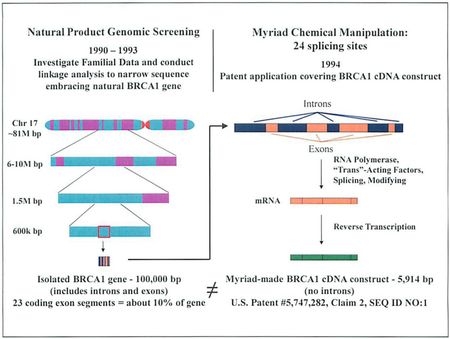
    Gilead begins by pointing out all of the transformative steps that Myriad had to undergo in order to make SEQ ID NO:1.  First, Myriad researchers identified that genetic defects in the BRCA1 gene were the likely source of a pre-disposition to breast and ovarian cancer.  Further, before any chemical transformative step was undertaken, the researchers used natural product genomic screening to narrow Chromosome 17 (with about 81 million base pairs) to a 100,000 base pair isolated BRCA1 gene.  This gene, of course, includes both introns and exons (with 23 coding exon segments).  Therefore, Myriad had to chemically manipulate, or transform, the isolated gene to derive its cDNA construct (as shown in the below figure from Gilead's brief).

    Gilead Image
    Gilead alleges legal error on the part of the lower court because, as the Supreme Court reiterated in Diamond v. Chakrabarty, "Congress intended statutory subject matter to 'include anything under the sun that is made by man.'"  In fact, Gilead provides a reminder of the broad statutory goal of the patent system, pointing out that it was Jefferson's philosophy that "ingenuity should receive a liberal encouragement."  Therefore, even though patent eligibility has clear limits, the fundamental question "should be whether the invention is truly 'made by man," i.e., whether the invention is 'the result of human ingenuity and research.'"  Gilead supports this proposition by citing to eleven Federal Circuit, CCPA, and District Court cases that found synthetic compounds and materials patent eligible, and six Federal Appellate and District Court cases that found purified compounds to be patent eligible.

    In contrast, the Gilead brief does not spend much effort explaining why the lower court erred as a matter of fact by misapplying the "markedly different" test.  Instead, it simply points out that, to the extent the Chakrabarty decision imposed a "markedly different characteristics" requirement into § 101, the Federal Circuit had already found that this requirement was satisfied in its July 2011 decision.  The brief also reiterates the practical utility of new DNA molecules at least as a diagnostic tool, which is evidenced by Myriad's medical and economic success using the synthetic cDNA compound as a predictor of genetic pre-disposition to cancer.

    Gilead's conclusion, however, focuses exclusively on explaining why the Prometheus decision does not apply to Myriad's synthetic cDNA.  First, unlike Prometheus's method claims, there were at least 20 transformative steps that resulted in a sequence of nucleotides that had not, and could not, exist in nature.  Second, these transformative steps fully meet the Diehr standard of not being mere applications of "mathematical formula" or "laws of nature."

    Protein SciencesProtein Sciences Corporation ("PSC), another biopharmaceutical company, filed a separate amicus brief.  However, instead of limiting its analysis to the DNA claims, PSC addresses all of the claims that were originally at issue.  Importantly, PSC explains how the "Growth Rate Claim" continues to be patent eligible, even after the Prometheus decision.

    According to PSC, Prometheus reduced the patent-eligibility question to the following test:

    (1)  Is the claim a method or process claim?  If yes, then:
    (2)  Does the method or process call for applying a law of nature?  If yes, then:
    (3)  Do the steps of the method or process:

    a.   Merely call for a particular audience to apply the law of nature or for applying the law of nature in a particular technological environment, or
    b.  Call for "[p]urely 'conventional or obvious' '[pre]-solution activity'"?

    If the answer to either (3)(a) or (3)(b) is "yes," then the method or process fails to be patent eligible, and also fails to meet § 112, ¶ 1.  If either question cannot be answered because of an insufficient record as to whether the steps are "conventional or obvious," the case should be remanded to develop the record.  This is, of course, a very narrow reading of Prometheus (suggesting that any composition of matter would be patent eligible), but PSC's application of Prometheus to the present claims is rooted in this understanding.  PSC also finds it necessary to define "law of nature," which according to the 1993 New Shorter Oxford English Dictionary is a "scientific generalization based on empirical observation" (as paraphrased by PSC).

    Therefore, the analysis as to whether isolated DNA or cDNA are patent eligible according to Prometheus is simple — they are compositions of matter, and therefore Prometheus does not apply.  However, apparently to be safe, PSC also explains that "isolated DNA molecules are chemical compositions that possess physical, chemical and structural properties that differ from their naturally-occurring counterparts, and are molecules that man must create."  In addition, PSC points out that isolated DNA has new properties not shared by its native counterpart, including uses as a probe, a diagnostic tool, a primer, and in sequencing.  Thus, as to part 2 of the alleged Prometheus test, they are not products of nature.  To further bolster its conclusion, PSC points out that this conclusion comports with the longstanding practice of the PTO and the Federal Circuit.  PSC's analysis of cDNA is similar to that of isolated DNA, and the same conclusion is reached — cDNA is patent eligible.

    As for the method claims, PSC first notes that Myriad's "analyzing" and "comparing" claims, which the Federal Circuit previous held to be not patent eligible, would also fail the Prometheus test.  However, the Growth Rate Claim, claim 20 of the '282 patent, would be patent eligible under this test.  The claim at issue reads:

    20.  A method for screening potential cancer therapeutics which comprises: growing a transformed eukaryotic host cell containing an altered BRCA1 gene causing cancer in the presence of a compound suspected of being a cancer therapeutic, growing said transformed eukaryotic host cell in the absence of said compound, determining the rate of growth of said host cell in the presence of said compound and the rate of growth of said host cell in the absence of said compound and comparing the growth rate of said host cells, wherein a slower rate of growth of said host cell in the presence of said compound is indicative of a cancer therapeutic.

    Because this claim is a method claim, question (1) of the test is answered in the affirmative.  However, according to PSC, the method uses transformed cells that contain an altered BRCA1 gene, which are not naturally occurring (after all, even the claim language itself indicates a "transformation" has occurred).  Moreover, because these cells do not occur naturally, they cannot be calling for the application of a law of nature.  Therefore, PSC concludes that this claim is more akin to the claim in Diehr (applying the Arrhenius equation) than the claims in Prometheus.

    It is unclear if either of these briefs adds anything new to the discussion.  However, it is clear that each of these four companies, and many others like them, have invested substantial research and development (and therefore money and time) with the understanding that the patent system will protect their investments.  If the Federal Circuit were to take a narrow view of patent eligibility after the Prometheus case, it could seriously negatively impact the development and investment of future biopharmaceuticals and vaccines.  As such, hopefully the Federal Circuit will at least consider the perspective of these companies.

    For additional information regarding this topic, please see:

    • "Health Care Professionals Contend That Isolated DNA and cDNA Are Patent Ineligible," July 16, 2012
    • "Coalition of Amici File Brief in Support of Myriad," July 15, 2012
    • "Dr. James Watson: Human Genes Should Not Be Patented," July 12, 2012
    • "Scientist-Law Professor Files Amicus Brief in Myriad Case," July 11, 2012
    • "U.S. Government: Mayo Decision Supports Prior Argument That Isolated Genomic DNA Is Not Patent Eligible," July 10, 2012
    • "IPO Amicus Brief Argues for Patent Eligibility of Myriad's Isolated DNA Claims and Method Claim 20," July 9, 2012
    • "Eli Lilly & Co. File Amicus Brief in AMP v. Myriad," June 27, 2012
    • "Parties and Amici File Briefs in Myriad Case," June 17, 2012

  • By Donald Zuhn —

    AMASeven organizations of health care professionals argue in an amici brief filed in Association for Molecular Pathology v. U.S. Patent and Trademark Office ("Myriad") that Myriad's isolated DNA and cDNA claims, as well as claim 20 of U.S. Patent No. 5,747,282, are all invalid under 35 U.S.C. § 101.  The organizations, which include the American Medical Association, American Society of Human Genetics, American College of Obstetricians and Gynecologists, American Osteopathic Association, American College of Legal Medicine, American College of Embryology, and Medical Society of the State of New York, open their brief by expressing their "concern[] about the effect of gene sequence patents on the practice of medicine," stating that "[s]uch patents interfere with diagnosis, treatment, and research and contravene the United States Supreme Court's long-standing precedents about the scope of patentable subject matter, which was reiterated in Mayo Collaborative Services v. Prometheus Laboratories, Inc., 132 S.Ct. 1289 (2012)."

    In arguing against the patent eiligibility of isolated DNA and cDNA, the amici brief, which was authored by Professor Lori Andrews of Chicago-Kent College of Law, states that:

    Nature's handiwork is excluded from patentability.  Prometheus, 132 S.Ct. at 1293; Bilski v. Kappos, 130 S.Ct. 3218, 3225 (2010).  Just as a patent involving a law of nature must have an "inventive concept" that does "significantly more than simply describe these natural relations" (Prometheus, 132 S.Ct. at 1294, 1297), a patent involving a product of nature must have an inventive concept that involves significantly more than describing the product of nature.  Indeed, the claimed invention must be "markedly differently" from what occurs in nature.  Diamond v. Chakrabarty, 447 U.S. 303, 310 (1980).

    The brief notes that:

    For over 150 years, the U.S. Supreme Court has held that products of nature are not patentable (Chakrabarty, 447 U.S. at 309), nor are isolated or purified products of nature (American Wood-Paper Co. v. Fibre Disintegrating Co., 90 U.S. (23 Wall.) 566, 594 (1874)), nor are synthetic products that are not markedly different from what is found in nature (Cochrane v. Badische Anilin & Soda Fabrik, 111 U.S. 293, 311 (1884)).  The Supreme Court has repeatedly held that compositions of matter involving products of nature or isolated products of nature must be "markedly different" from what occurs in nature to be patentable.  See, e.g., Chakrabarty, 447 U.S. at 309-10; Funk Bros. Seed Co. v. Kalo Inoculant Co., 333 U.S. 127, 130 (1948); American Fruit Growers, Inc. v. Brogdex Co., 283 U.S. 1, 11-12 (1931); Cochrane, 111 U.S. at 311; American Wood-Paper Co., 90 U.S. (23 Wall.) at 594.

    The brief contends that because claims covering isolated DNA and cDNA constitute claims "on products of nature without an inventive concept" that are "not markedly different from what occurs in nature," these claims are invalid under § 101.

    With respect to isolated DNA, the brief contends that "Myriad's composition of matter claims involving gene sequences are not unconventional or novel creations and do not involve an 'inventive concept,"" adding that "[t]he term 'isolated' adds nothing of significance to the claims."  In responding to the panel's earlier decision regarding these claims, the brief argues that:

    [T]he breaking of covalent bonds [does not] make isolated DNA patentable.  The breaking of covalent bonds (itself a natural process that occurs in the body) is not an "inventive concept" and does not make the gene sequence "markedly different" and therefore patentable subject matter.  The change in chemical bonds is insignificant because the isolated gene sequence is the same string of nucleotides that exists in the cell.  Additionally, because the claims are written in terms of the genetic sequence, patentability should be determined by an analysis of the genetic sequence, not by the chemical structure.

    Going further than other amici, the brief contends that cDNA is also patent ineligible under § 101.  Noting that "cDNA is useful in the laboratory because it has the same nucleotide sequence and contains the same information as found in the exons of naturally occurring DNA and can perform the same functions as a full nucleotide sequence or DNA molecule," the brief argues that "Myriad's use of routine chemical tools to synthesize cDNA lacks the inventive concept for patentable subject matter," and further, that "cDNA is not 'markedly different' from the sequence as it occurs within the chromosome."  According to the brief, "[o]nce the gene's naturally occurring DNA sequence — an unpatentable product of nature — is known, synthesis of cDNA is a routine mainstay of the art of biologists and chemists," and therefore, "[a]llowing a patent on cDNA would be a disproportionate reward in relation to what the alleged inventor contributed."

    As for Myriad's method claim 20 of the '282 patent, the brief contends that the claim is analogous to the claim at issue in Mayo, arguing that claim 20 contains an "administering" step that "serves to identify who would be interested in the law of nature — physicians or researchers using or studying cancer therapeutics," a "determining" that "tells the physician or researcher to measure the growth of the cells — a routine activity for physicians and scientists in the field," and a "wherein" step that "tells the physician or researcher about the relevant natural law."

    The brief also chastises the U.S. Patent and Trademark Office for granting gene sequence patents, stating that the Office "ignored the U.S. Supreme Court's precedents and applied invalid reasoning to grant patents on genetic sequences and, consequently, its decision should not be accorded deference."  The brief indicates that in granting such patents, "[t]he USPTO relied on the 1873 grant of a patent to Louis Pasteur for a purified yeast and on a lower court decision upholding a patent for isolated and purified adrenaline," but suggests that "Pasteur never enforced his patent, so there was no judicial assessment of whether the patent was valid."

    The brief further contends that upholding Myriad's claims would be a detriment to further innovation, stating that:

    Th[e] inhibition on future innovation is particularly true with patents on isolated DNA and cDNA.  There is no way to "invent around" gene patents.  Because an isolated gene sequence is identical to the sequence of the gene in the body, a patent holder can prevent scientists and clinicians from undertaking any genetic research related to a disease arising from a mutation in that gene.

    In support of the detrimental effect of gene patents on innovation, the brief cites a study of laboratory directors (Mildred K. Cho et al., Effects of Patents and Licenses on the Provision of Clinical Genetic Testing Services, 5 Journal of Molecular Diagnostics 3 (2003)), a study of American Society of Human Genetics members (Issac Rabino, How Human Geneticists in U.S. View Commercialization of the Human Genome Project, 29 Nature Genetics 15 (2001)), and the Secretary's Advisory Committee on Genetics, Health, and Society (SACGHS), Report on Gene Patents and Licensing Practices and Their Impact on Patient Access to Genetic Tests.

    Lastly, the brief argues that Myriad's contributions do not justify the threat to innovation presented by Myriad's claims.  Citing Mayo, the brief states that "[i]n a Section 101 analysis, courts need to weigh 'how much future innovation is foreclosed relative to the contribution of the inventor.'"  With respect to Myriad's claims, the brief argues that:

    Myriad's contribution to the sequencing and identification of the BRCA1 and BRCA2 genes was minor in comparison to what their patents foreclose.  Myriad used common techniques to isolate, sequence, and clone the BRCA1 and BRCA2 genes.  Further, Myriad did not identify the sequence on its own.  Myriad had significant scientific aid and financial support, including from the U.S. government.  Controversy surrounds the question of whether Myriad even sequenced the BRCA2 gene first.

    The brief therefore concludes that isolated DNA, cDNA, and method claim 20 are patent ineligible under § 101, arguing that "[i]t is crucial to patient care and to medical research that the products of nature and the basic laws of nature that Myriad has sought to propertize be freely shared, used, and analyzed."

    For additional information regarding this topic, please see:

    • "Coalition of Amici File Brief in Support of Myriad," July 15, 2012
    • "Dr. James Watson: Human Genes Should Not Be Patented," July 12, 2012
    • "Scientist-Law Professor Files Amicus Brief in Myriad Case," July 11, 2012
    • "U.S. Government: Mayo Decision Supports Prior Argument That Isolated Genomic DNA Is Not Patent Eligible," July 10, 2012
    • "IPO Amicus Brief Argues for Patent Eligibility of Myriad's Isolated DNA Claims and Method Claim 20," July 9, 2012
    • "Eli Lilly & Co. File Amicus Brief in AMP v. Myriad," June 27, 2012
    • "Parties and Amici File Briefs in Myriad Case," June 17, 2012