• By Donald Zuhn —

    USPTO Seeks Comments on
    Proposed Fee Schedule

    USPTO SealYesterday, the U.S. Patent
    and Trademark Office announced
    that it would be publishing a notice in the Federal Register on September 6,
    2012, seeking public input on proposed patent fees.  The Office noted that:

    The proposed fees are at least 22 percent lower
    for a routine patent process — i.e., filing, search, examination, publication,
    and issue fees — than the current fee schedule.  The current proposed fees also are lower than
    those originally proposed by the USPTO in February.  The Office acted on extensive public feedback
    solicited in writing and at public hearings held by the Patent Public Advisory
    Committee in Alexandria, Virginia, and Sunnyvale, California.

    An advance copy of the 213-page
    notice to be published on Thursday can be found here.  Publication of the notice will begin a 60-day
    comment period that will conclude on Monday, November 5, 2012.


    USPTO Begins Inter Partes Reexamination Countdown

    Last week, the U.S. Patent
    and Trademark Office published a notice in the Federal Register (77 Fed. Reg.
    52315
    )
    reminding potential third-party requesters that pursuant to § 6(c)(3) of the
    Leahy-Smith America Invents Act, which terminates the authority for inter partes reexamination filings
    effective September 16, 2012, "any original or corrected/replacement request
    for an inter partes reexamination
    submitted on or after September 16, 2012, will not be accorded a filing date,
    and any such request will not be granted." 
    Thus, the last day for filing an inter
    partes
    reexamination request is Saturday, September 15, 2012 (the Office
    notes that September 15, 2012 is the final deadline "even though September
    15, 2012, the last day to file a request, is a Saturday").  The notice advises requesters to file any
    requests as soon as possible in order to give the Office time to receive,
    process, and review such requests, and if necessary, notify requesters of any
    deficiencies via a Notice of Failure to Comply with Inter Partes Reexamination Request Filing Requirements so that the
    requester can submit a corrected/replacement request by September 15,
    2012.  Most importantly, the notice
    states that:

    The Office will make every effort to promptly
    and efficiently process and review all requests for inter partes reexamination.  It
    is to be emphasized, however, that the Office cannot guarantee that a Notice of
    Failure to Comply with Inter Partes
    Reexamination Request Filing Requirements will be issued by the Office prior to
    September 16, 2012, or even if it is so issued, that sufficient time will
    remain for the mailing to reach a requester and allow for response prior to
    September 16, 2012.  While,
    traditionally, the Office has been setting a thirty-day period to respond to
    the Notice of Failure to Comply, this will no longer be possible for any Notice
    of Failure to Comply mailed after August 16, 2012, because the statute which
    provides for the filing of a request for inter
    partes
    reexamination will no longer be in effect as of September 16, 2012.


    USPTO to Host AIA Webinar
    on September 7

    The U.S. Patent and
    Trademark Office announced that
    it will be holding a webinar on September 7, 2012 from 12:30 to 1:30 pm (EDT)
    to discuss all aspects of the AIA. 
    Participants will include USPTO Director David Kappos, Deputy Director
    Terry Rea, Commissioner for Patents Peggy Focarino, General Counsel Bernie
    Knight, Chief Judge James Smith, and Lead Judge Michael Tierney.  Chief Communications Officer Todd Elmer will
    moderate the webinar.

    The roundtable will be
    available via WebEx webinar
    (event number: 990 842 706; password: 123456) or via teleconference at
    +1-408-600-3600 (access code: 990 842 706).

    The September 7 webinar
    will be the Office's second AIA event this week, with a roundtable scheduled
    for tomorrow to obtain public input from organizations and individuals on
    issues relating to the USPTO's proposed implementation of the first-inventor-to-file
    provisions of the AIA (see "USPTO
    News Briefs
    ," August
    27, 2012 for information regarding tomorrow's roundtable).

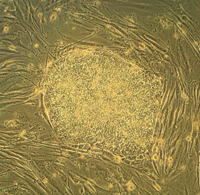
  • Human Embryonic Stem Cell (Wikipedia Commons)On 8 October 2011, the Court of Justice of the European Union's
    (CJEU) handed down a landmark judgment on the correct interpretation of Article
    6(2)(c) of the Biotechnology Directive (98/44/EC) relating to the patentability
    of human embryonic stem cells.

    The Court of Justice's judgment

    The
    decision excludes an invention from patentability where the technical teaching
    which is the subject-matter of the patent application requires the prior destruction
    of human embryos or their use as base material, whatever the stage at which
    that takes place and even if the description of the technical teaching claimed
    does not refer to the use of human embryos.

    The EPO's position

    Until
    recently, there has been a degree of uncertainty surrounding the EPO's stance
    on the CJEU's judgment, and whether the Office will align their practices by
    shifting to the more restrictive interpretation of the human embryonic stem
    cell exclusion.  A review of the EPO's recently-revised Guidelines for
    Examination appears to have settled the debate.  The Guidelines advise that:

    A claim directed to a product, which at
    the filing date of the application could be exclusively obtained by a
    method which necessarily involved the destruction of human embryos from which
    the said product is derived is excluded from patentability under Rule 28(c),
    even if said method is not part of the claim.  The point in time at which such
    destruction takes place is irrelevant.

    The UK IPO's position

    Perhaps
    less surprising is the reaction of the UK IPO, which, in recognizing that it is
    bound by the guidance provided by the CJEU, has recently issued a Practice
    Note
    for inventions involving human embryonic stem cells.  The relevant
    passage of the Note advises that:

    [T]he Office practice will now
    recognise that where the implementation of an invention requires the use of
    cells that originate from a process which requires the destruction of a human
    embryo, the invention is not patentable according to paragraph 3(d) of Schedule
    A2 [corresponding to Article 6(2)(c) of the Directive].  For example, where the
    implementation of the invention requires the use of a human embryonic stem cell
    line the establishment of which originally required the destruction of a human
    embryo, the invention is not patentable.

    The future

    The recent guidance
    provided by both the EPO and the UK IPO does little more than paraphrase the
    Decision of the CJEU.  It is therefore hoped that the situation for biotech
    innovators operating in this area will become clearer as individual cases are
    deliberated by the EPO's Boards of Appeal and National Courts.

    This report comes from
    European Patent Attorneys at WP Thompson & Co., 55 Drury Lane, London
    UK.  Further details and commentary can
    be obtained from Gill Smaggasgale, a partner at the firm.

  • By
    Kevin E. Noonan —

    Federal Circuit SealLast
    Friday, the Federal Circuit reconsidered en
    banc
    the Court's decisions in Akamai
    Technologies, Inc. v. Limelight Networks, Inc.
    and McKesson Technologies, Inc. v. Epic Systems Corp.  Long awaited, the
    decision was handed down "per curiam," with a majority consisting of
    Chief Judge Rader joined by Judges Lourie, Bryson, Moore, Reyna, and Wallach.  Judge Newman wrote her own dissent and Judge Linn authored another, being
    joined by Judges Dyk, Prost, and O'Malley.

    The
    facts of the cases are as follows.  In Akamai, the asserted patent claimed
    methods for delivering web content by placing content on a number of "replication
    servers" and having web browsers access the content by being directed to
    those server pages.  Accordingly there
    is no direct modification of content providers' web pages; the defendant merely
    instructs users how to do so.  In McKesson, the patent claims were
    directed toward electronic communication between patients and healthcare
    providers, whereby portions of defendant's software permitted patients to
    access their healthcare records directly from physicians.  Defendant's software did not perform any of the steps of the method; rather,
    performance of the steps of the patented method was divided between the
    patients and healthcare providers.  Below, both defendants prevailed, on the
    grounds that there was no single, direct (literal) infringer, based on Muniauction,
    Inc. v. Thomson Corp.
    , 532 F.3d
    1318 (Fed. Cir. 2008).

    The
    majority opinion characterizes its decision as being directed to induced
    infringement, where direct infringement (§ 271(a))
    requires that "a single actor commits all the elements of infringement"
    and induced infringement (§ 271(b)) occurs when "a single actor induces another actor to
    commit all the elements of infringement.  Neither is the case here, and "when the
    acts necessary to give rise to liability for direct infringement are shared
    between two or more actors, doctrinal problems arise" according to the
    majority.  The opinion contrasts two
    generic scenarios that illustrate the issues before the Court:  an actor
    performs some of the steps of a claimed method and induces others to commit the
    remaining steps (the fact pattern in Akamai)
    versus an actor inducing multiple
    parties to "collectively perform" all the steps of a claimed method,
    i.e., no single party has performed all of the steps (the fact pattern in McKesson).

    The
    problem (according to the majority):  "[r]ecent precedents of this court
    have interpreted section 271(b) to mean that unless the accused infringer
    directs or controls the actions of the party or parties that are performing the
    claimed steps, the patentee has no remedy, even though the patentee's rights
    are plainly being violated by the actors' joint conduct."  This is the wrong approach, according to the
    opinion, but only a bare majority of the Court decided not to decide the
    question of whether there can be direct infringement when no single actor
    performs all the method steps, stating that induced infringement can be used to
    decide the questions in both cases.

    The
    majority expressly overruled BMC Resources, Inc. v. Paymentech, L.P.,
    498 F.3d 1373 (Fed. Cir. 2007), which held that there must be a single actor
    (or a second actor acting under the control of another) for infringement to
    lie.  All the steps of the claimed method
    still need to be performed, according to the majority opinion, but it is not
    necessary to prove a "single entity" performed them.

    Going
    back to its own case law, the majority states that "for a party to be
    liable for direct patent infringement under 35 U.S.C. § 271(a), that party must
    commit all the acts necessary to infringe the patent, either personally or
    vicariously," citing Cross Med. Prods., Inc. v. Medtronic Sofamor
    Danek, Inc.
    , 424 F.3d 1293, 1311 (Fed. Cir. 2005), and Fromson v. Advance
    Offset Plate, Inc.
    , 720 F.2d 1565, 1568 (Fed. Cir. 1983).  The legal grounds for this position is that
    patent infringement is a "strict liability tort" and being able to
    sue "actors who did not themselves commit all the acts necessary to
    constitute infringement and who had no way of knowing that others were acting
    in a way that rendered their collective conduct infringing" would be
    unfair, citing In re Seagate Tech.,
    497 F.3d 1360, 1368 (Fed. Cir. 2007) (en banc).  While agency principles were used in the past
    to find infringement when a second actor was acting as the accused infringer's
    agent, absent such a relationship infringement liability was not created by the
    acts of independent actors, according to the opinion (citing Cross Med.
    Prods., Inc.
    ).

    The opinion does not address the correctness of
    these precepts in its opinion, because it bases its judgment that defendants in
    the cases at bar are liable for infringement on its interpretation of the
    requirements for induced infringement (a portion of the statute that as written
    requires more than one tortfeasor).  This
    leads the majority into a disquisition on the grounds and bases for induced
    infringement liability under the 1952 Patent Act.  These grounds are expressly that the accused
    party is "a party who advises, encourages, or otherwise induces others to
    engage in infringing conduct."  In a
    footnote, the majority hints at why their result is not tainted by the
    considerations of unfairness that were thought to attach to innocent parties in
    the prior jurisprudence:

    Because liability for inducement,
    unlike liability for direct infringement, requires specific intent to cause
    infringement, using inducement to reach joint infringement does not present the
    risk of extending liability to persons who may be unaware of the existence of a
    patent or even unaware that others are practicing some of the steps claimed in
    the patent.

    Fn. 1.  In addition, induced (like contributory)
    infringement requires intent (or, at minimum, "willful blindness"
    according to the Supreme Court; see Global-Tech Appliances, Inc. v. SEB
    S.A.
    ,
    131 S. Ct. 2060, 2068 (2011)) and thus is not a strict
    liability tort according to the majority, citing DSU Med. Corp. v. JMS Co.,
    471 F.3d 1293, 1306 (Fed. Cir. 2006) (en banc).  The utility of induced infringement doctrines
    in this case arises because there is no requirement for any type of agency
    relationship between infringers, so long as the infringing acts are performed.  (The opinion cites Nat'l Presto Indus.,
    Inc. v. West Bend Co.
    , 76 F.3d 1185, 1196 (Fed. Cir. 1996), for the analogy
    that induced infringement is akin to "aiding and abetting" in the
    criminal context.)  The decision does not
    alter the "well-settled" law that direct infringement must occur for
    there to be indirect infringement, according to the majority.  But the BMC decision "extended
    that principle in an important respect that warrants reconsideration"; specifically,
    by requiring direct infringement in support of induced infringement to be
    performed by a single actor.  Although
    the individual prongs of the analysis was supported by precedent, the majority
    say here that "the conclusion that the [BMC] court drew from them
    was not."  As stated in the opinion (emphasis in original):

    Requiring proof that there has been direct
    infringement as a predicate for induced infringement is not the same as
    requiring proof that a single party would be liable as a direct
    infringer.  If a party has knowingly induced others to commit the acts necessary
    to infringe the plaintiff's patent and those others commit those acts, there is
    no reason to immunize the inducer from liability for indirect infringement
    simply because the parties have structured their conduct so that no single
    defendant has committed all the acts necessary to give rise to liability for
    direct infringement.

    The majority opinion relies on the intent
    requirement to justify extension of infringement liability further than the BMC
    precedent would permit.  In the majority's
    view, a party who induces several other parties to infringe collectively "has
    had precisely the same impact on the patentee as a party who induces the same
    infringement by a single direct infringer" and there is no reason to
    differentiate between the two types of inducing infringers.  Nor is there any reason, according to the
    majority, to treat someone differently who only performs certain steps of a
    claimed method, and has one or more other parties complete infringement by
    performing other steps.  Both scenarios
    are set forth with relation to the harm to the patentee; indeed, the majority
    believes that, if anything, an inducing party that performs some of the steps
    may be even more culpable.

    The en banc majority reads 35 U.S.C. § 271(b) as being "entirely consistent"
    with how they apply it to the two cases under their consideration here.  Perhaps in the face of the strong dissent,
    the majority also sets forth their exegesis of § 271(b) and its historical and legislative history
    predicates.  The opinion notes that,
    prior to the 1952 Act, indirect infringement comprising induced and
    contributory infringement were joined in the same section of the patent law.  Citing the
    legislative history, P.J. Federico (Commentary on the New Patent Act reprinted
    in 75 J. Pat. & Trademark Off. Soc'y 161, 214 (1993)), and Judge (then Mr.) G.S.
    Rich, the "principal architect" of the 1952 Act, the majority contends
    that Congress intended to give induced infringement a broad scope, whereas
    contributory infringement (§ 271(c))
    was drafted more narrowly, reflecting a compromise directed at addressing some
    of the more egregious anti-patent decisions from the Supreme Court at that time
    (as examples, the opinion cites Mercoid Corp. v. Mid-Continent Investment
    Co.
    , 320 U.S. 661 (1944), and Mercoid Corp. v. Minneapolis-Honeywell
    Regulator Co.
    , 320 U.S. 680 (1944)).  The majority finds that the content of the legislative history evinces a
    legislative intent for § 271(b)
    that was "significant" for its analysis here, insofar as it was
    intended to "reach cases of divided infringement, even when no single
    entity would be liable for direct infringement."  According to that legislative history, § 271(b) having a broad scope was necessary to
    protect inventions, inter alia, in the radio and television
    communication arts, which almost by definition encompassed "both
    transmitting and receiving" embodiments (i.e., where both a
    transmitter and a receiver needed to be changed in parallel in order to
    function).  The revised statute was
    needed, according to Judge Rich, because "recent decisions of the Supreme
    Court [the cases targeted by the statutory changes] appear to make it
    impossible to enforce such patents in the usual case where a radio transmitter
    and a radio receiver are owned and operated by different persons, for, while
    there is obvious infringement of the patent, there is no direct infringer of
    the patent but only two contributory infringers
    ," citing Contributory
    Infringement of Patents: Hearings Before the Subcomm. on Patents, Trademarks,
    and Copyrights of the H. Comm. on the Judiciary
    , 80th Cong. 5 (1948) ("1948
    Hearing") (emphasis in original).  The majority thus invoked Judge Rich's considerable authority for their
    proposition that there should be infringement liability under an inducement
    theory even in cases where there was no direct patent infringer.

    The majority then went far afield into other areas
    of tort law, to show (presumably) the reasonableness of their decision and for
    the principle that "courts look to the common law principles of joint
    tortfeasance (Hewlett-Packard Co. v. Bausch & Lomb, Inc., 909 F.2d
    1464, 1469 (Fed. Cir. 1990); see also Aro Mfg. Co. v. Convertible Top
    Replacement Co.
    , 377 U.S. 476, 500 (1964)).  These include the First and Second Restatements of Torts, §§ 876 &
    877(a)(1979) and the Federal Criminal Code (relating to "aiding and
    abetting" criminal activity; 18 U.S.C. § 2(a)).  The Restatements provide the majority with a
    basis and rationale for their opinion, wherein the common law requires that "the
    rule imposing liability for inducement of a tort applies even if the person
    being induced is unaware that his act is injurious and is not liable for that
    reason" (circumstances that exist in the cases under review).  The majority draw from these sources the
    conclusion that:

    The implication of that principle, as applied
    in the divided infringement context, is that a party may be liable for inducing
    infringement even if none of the individuals whose conduct constituted
    infringement would be liable, as direct infringers, for the act of infringement
    that was induced.

    Turning to their review of the decisions at hand,
    the majority reversed the district court in both cases and remand for
    reconsideration.

    Judge NewmanJudge Newman wrote her own dissent, noting that the
    question presented has "split [the Court] into two factions" and acknowledging
    that a "scant majority" recognizes what she terms "a new theory
    of patent infringement, based on criminal law" (something that could also
    be said about the Supreme Court's decision in the Global-Tech
    case).  She characterizes these as "dramatic
    changes" to infringement law, which she states could have been avoided by
    simply applying existing law.  And she characterizes
    the dissent as addressing an issue not raised by the majority ("[a]lthough
    review of the singe-entity rule was the sole reason for this rehearing en
    banc
    , and the sole question briefed by the parties and the amici curiae").  Neither side of the Court "provides a
    reasonable answer" to the question before them in her view, the majority's
    opinion "impos[ing]
    disruption, uncertainty, and disincentive upon the innovation communities."

    For Judge Newman the task is
    straightforward:  the Court should have
    addressed the question posed and briefed, by the parties as well as several amici, relating to whether infringement
    liability can lie under the circumstances in the Akamai or McKesson cases
    below.  She is not persuaded that the
    majority actually overrules the BMC
    Resources
    case, saying that what was ultimately addressed by the majority
    (and overruled) was but a single sentence in the earlier decision, specifically:  "Indirect infringement requires, as a predicate, a finding that some party
    amongst the accused actors has committed the entire act of direct infringement."  While she acknowledges that "this [the
    Federal Circuit's] jurisprudence is in need of correction, clarification, and
    consistency, for neither the single-entity rule nor the majority's newly minted
    inducement-only rule is in accord with the infringement statute, or with any
    reasonable infringement policy," the majority decision is not such a
    solution (it is, she says, "a spontaneous judicial creation.  And it is
    wrong.").  She further acknowledges
    that while "[q]uestions of divided infringement are not new," the "single
    entity rule" espoused in Judge Linn's dissent (representing the status
    quo) "is plainly inadequate" for the task because it "leaves the
    meritorious patentee without redress," citing the McKesson decision below.  She
    identifies the rule, not the statute, as the problem, because in her reading
    the statute is not ambiguous:

    §271(a) Except as otherwise provided in this title, whoever without authority makes,
    uses, offers to sell, or sells any patented invention, within the United States
    or imports into the United States any patented invention during the term of the
    patent therefor, infringes the patent.

    The crux of her argument is that the "whoever"
    in the statute can be singular or plural, citing statutes and case law from
    other areas of the law as well as other portions of the Patent Act.  This interpretation of the statute makes the
    problem posed in these cases disappear:  no matter how many actors are required,
    if all the steps in a method claim are performed direct infringement has been
    established.  In this part of her
    argument, Judge Newman relies on Mowry v. Whitney, 81 U.S. 620, 652
    (1871), Aro Manufacturing Co. v. Convertible Top Replacement Co., 365
    U.S. 336, 342 (1961), and the linkage she perceives between § 154 (defining the
    right to exclude) and § 271 (defining what constitutes infringement), supporting
    this linkage by language from the Supreme Court in Deepsouth Packing Co. v.
    Laitram Corp.
    , 406 U.S. 518, 522 (1972), and comments from Judge Rich ("We
    got along without [a separate infringement provision] for 162 years and we
    could again").

    For Judge Newman, the cases could be
    resolved merely by resolving earlier conflicts in the Court's precedent.  After describing her understanding of this
    precedent (BMC Resources and Muniauction, including the earlier panel
    decisions in these cases), Judge Newman writes that many of the earlier
    decisions were not mandated by the statute or binding precedent.  And she showed little patience for "the
    Linn cadre's argument" that the single-entity rule could be avoided by "ingenious
    patent claim drafting."  "I do
    not discourage ingenuity," she writes, "but the presence or absence
    of infringement should not depend on cleverness or luck to satisfy a malleable
    single-entity rule."  Judge Newman
    also finds "useful guidance" from copyright law, where she cites Metro–
    Goldwyn–Mayer Studios Inc. v. Grokster, Ltd.
    , 545 U.S. 913, 930 (2005), for
    the proposition "that one 'infringes vicariously by profiting from direct
    infringement while declining to exercise a right to stop or limit it,'"
    citing Shapiro, Berstein & Co. v. H.L. Green Co., 316 F.2d 304, 307
    (2d Cir. 1963).  Under these rubrics,
    finding vicarious liability would settle the question before the Court in a way
    that would address infringement as presented by the cases at bar while not
    doing violence to the statutory scheme.  She states:

    The court
    should simply acknowledge that a broad, all-purpose single-entity requirement
    is flawed, and restore infringement to its status as occurring when all of the
    claimed steps are performed, whether by a single entity or more than one
    entity, whether by direction or control, or jointly, or in collaboration or
    interaction.

    The majority, according to Judge
    Newman, erred by "discard[ing] decades of precedent, refus[ing] our en
    banc
    responsibility, and stat[ing] that 'we have no occasion at this time
    to revisit any of those principles regarding the law of divided infringement as
    it applies to liability for direct infringement'" as the basis for
    enunciating their new "inducement only rule."  Judge Newman believes that the better way to
    address the question is utilizing the same analysis used by the Court prior to BMC Resources, i.e., "application of the existing laws of infringement, whether
    direct, induced, or contributory infringement."  This means that "liability for
    inducement requires direct infringement," which for Judge Newman means
    turning to precedent (common law as well as statutory) on contributory
    infringement cases (including NTP, Inc. v. Research in Motion, Ltd., 418
    F.3d 1282, 1318 (Fed. Cir. 2005); Everpure, Inc. v. Cuno, Inc., 875 F.2d
    300, 302 (Fed. Cir. 1989); and National Presto Industries, Inc. v. West Bend
    Co.
    , 76 F.3d 1185 (Fed. Cir. 1996)), all of which required direct
    infringement as a predicate for finding contributory infringement.  (She also
    castigates her brethren in the majority for introducing negligence concepts ("duty,
    breach and causation") into patent law (a strict liability tort).  And she disagrees with the majority's
    selective citation of the legislative history and Judge Rich's contributions,
    finding quotes contrary to the ones cited in the majority opinion to support
    her position.

    Judge Newman then performs her own bit
    of judicial legerdemain by defining away the problem facing the Court.  She states that the problem does not require
    a change in the law so much as a change in definition; she says that "[t]he
    court misconstrues 'strict liability' as requiring that
    every participant in an interactive or collaborative method is fully
    responsible for the entire harm caused by the infringement" and that
    recognizing that the "strict liability" standard is not the standard
    for patent infringement is a legitimate way to permit the Court to find joint
    tortfeasor liability.  Strict liability
    is only required, according to Judge Newman, when there is "an absolute
    duty to make something safe" such as arises with regard to "ultrahazardous
    activities or in products-liability cases," citing Black's Law Dictionary
    998 (9th ed. 2009).  Treating patent
    infringement as a tort, and not requiring strict liability, would permit courts
    to apply traditional remedies (including apportionment of remedies on the bases
    of "relative contribution to the injury to the patentee, the economic
    benefit received by the tortfeasor, and the knowledge and culpability of the
    actor") against two or more tortfeasors required (in some cases) to
    infringe a patent claim.  Thus, "[w]hen
    the several steps of a process claim are performed by more than one entity,
    whether the entities operate under common direction or control, or jointly or
    independently or interactively, remedy for infringement is appropriately
    allocated based on established criteria of culpability, benefit, and the like."

    For Judge Newman, the best and most
    simple course is to acknowledge that the "single entity rule" is
    flawed, and to "restore direct infringement to its status as occurring
    when all of the claimed steps are conducted, whether by a single entity or in
    interaction or collaboration," allocating remedies for infringement
    between the defendants "in accordance with statute and the experience of
    precedent."

    Judge LinnJudge Linn's dissent is based on his
    belief, shared by a significant portion of the Court that the majority engaged
    in judicial policymaking in developing its "inducement only"
    test.  To the dissenting judges, the "plain
    text" of the statute controls and (by implication) the "single entity"
    test is both appropriate and required by the statute.  Citing a plethora of
    Supreme Court cases as well as its own precedent, the dissenting judges argue
    that direct infringement (and thus, a single, direct infringer) must exist in
    order to apply induced or contributory infringement.  "Congress removed joint-actor patent
    infringement liability from the discretion of the courts," according to
    their opinion, "defining 'infringement' in § 271(a) and expressly defining
    the only situations in which a party could be liable for something less
    than an infringement in §§ 271(b) and (c) — clearing away the morass of
    multi-actor infringement theories that were the unpredictable creature of
    common law."  For Judge Linn, the Court should have "adopt[ed] en banc" the Court's earlier BMC Resources and Muniauction decisions requiring "all steps of a claimed method
    be practiced, alone or vicariously, by a single entity or joint enterprise."  These dissenting judges agree with Judge
    Newman that the majority avoided the question presented to the Court en banc.

    Judge Linn's explication of the law
    of infringement is directed to narrowly defining it.  Thus, the opinion speaks about what the
    statute limits infringement to be, and that the statute defines in §§ 271(b)
    and (c) as "the only ways in
    which individuals not completing an infringing act under § 271(a) could nevertheless
    be liable" and in doing so "reject[ed] myriad other possibilities
    that existed in the common law at the time" (emphasis in original).  According
    to Judge Linn and his colleagues in dissent, the statute requires that there be
    direct infringement before a court could find liability for contributory
    infringement or inducing infringement.  The majority errs in "redefining 'infringement' for the purposes of
    establishing liability" for inducement (as well as for writing an opinion that
    is directly contradictory to the Supreme Court's decision in Aro
    Manufacturing Co. v. Convertible Top Replacement Co
    .),
    according to the dissent.

    The dissent also uses Congressional
    approval of additional infringement provisions of the Patent Act enacted since
    1952 (specifically, §§ 271(e), (f) and (g)) as evidence that Congress can, and
    has, amended the patent statute to address policy goals such as the ones
    identified by the majority.  Accordingly,
    because these sections of the statute show that "Congress knows how to create
    alternative forms of infringement" and it has not altered §§ 271(a) and (b),
    the dissent believes that Congress has evinced no intention to change the
    requirement that direct infringement must be shown before indirect infringement
    (here, inducement) can be use to raise infringement liability.  Additionally, the dissent rejects the
    majority's reliance on standards in criminal and tort law, stating that "the
    majority overstates and improperly analogizes to fundamental principles of
    criminal and tort law."  And the
    dissent also disagrees with Judge Newman, believing that direct infringement is
    a strict liability tort having all the requirements that prevent infringement
    except by a single actor.

    For the dissenting judges, "[t]he
    well established doctrine of vicarious liability is the proper test for
    establishing direct infringement liability in the multi-actor context"
    because, inter alia, "[a]bsent
    direct infringement, the patentee has not suffered a compensable harm."  Because a patentee establishes the conditions
    under which it is harmed (by drafting patent claims that describe the patentee's right to
    exclude), the patentee also bears the responsibility to properly draft claims that avoid
    the joint-tortfeasor limitations incumbent upon § 271(a).  Thus, "[a] patentee
    can usually structure a claim to capture infringement by single party,"
    says the dissent, citing BMC Resources.

    Turning to the cases at bar, Judge
    Linn writes that, because they properly found that no one entity directly
    infringed the claims there could be no indirect infringement, he would affirm.

    The decision has implications for
    biotechnology and pharma patent claims, even if (as seems likely) these
    implications will prove ephemeral; it is unlikely that the Supreme Court will
    deny certiorari in a case of statutory construction where the Federal Circuit
    is so plainly fractured.  The majority
    opinion, if upheld, would be a boon for biotechnology, if only because it would
    provide another way for claim drafters to protect diagnostic method
    claims.  These claims, under attack in Mayo v Prometheus and AMP v. USPTO, would be much more robust
    if they could include (as the Prometheus
    claims did not) a treatment step in a diagnostic method claim.  Until last Friday (and most likely someday in
    the not distant future), such claims could not be enforced because the actors —
    the diagnostician or testing lab and the treating physician) were not thought
    to be under each other's control and thus there was no direct infringer who
    practiced every step.  That requirement
    is eliminated under the majority's views, and thus infringement could be found
    under circumstances common in modern medicine — a physician orders an
    infringing diagnostic test and then treats using the diagnostic results as her
    guide.  This outcome will only occur
    should the majority's views ultimately prevail, something that in all candor is
    just not very likely.

    Akamai Technologies, Inc.
    v. Limelight Networks, Inc.
    and McKesson
    Technologies, Inc. v. Epic Systems Corp
    . (Fed. Cir. 2012) (en banc)

    Panel: Chief Judge Rader and Circuit
    Judges Newman, Lourie, Bryson, Linn, Dyk, Prost, Moore, O’Malley, Reyna, and
    Wallach
    Opinion Per Curiam; dissenting opinion by Circuit Judge Newman; dissenting
    opinion by Circuit Judge Linn, joined by Circuit Judges Dyk, Prost, and
    O’Malley

  • By Sherri Oslick —

    Gavel About Court Report:  Each week we will report briefly on recently filed biotech and pharma cases.

    GlaxoSmithKline LLC v. Apotex
    Inc.

    1:12-cv-01090; filed August
    31, 2012

    Infringement of U.S. Patent
    Nos. 5,565,467 ("Androstenone Derivative," issued October 15, 1996)
    following a Paragraph IV certification as part of Apotex's filing of an ANDA to
    manufacture a generic version of GSK's Avodart® (dutasteride, used to treat
    symptomatic benign prostatic hyperplasia (BPH) in men with an enlarged
    prostate).  View the complaint here.


    Life Technologies Corp. et
    al. v. Ebioscience, Inc.

    3:12-cv-02156; filed August
    30, 2012 in the Southern District of California

    • Plaintiffs:  Life
    Technologies Corp.; Molecular Probes, Inc.; Regents of the University of
    California
    • Defendant:  Ebioscience, Inc.

    Infringement of U.S. Patent
    Nos. 8,071,359 ("Semiconductor Nanocrystal Probes for Biological
    Applications and Process for Making and Using Such Probes," issued
    December 6, 2011), 8,071,360 (same title, issued December 6, 2011), and
    8,071,361 (same title, issued December 6, 2011) based on Ebioscience's
    manufacture, sale, and offer for sale of certain eFluor® products, including
    eFluor® Nanocrystals Products.  View the
    complaint here.


    Mallinckrodt LLC et al. v.
    Apotex Inc. et al.

    1:12-cv-01087; filed August
    30, 2012 in the District Court of Delaware

    • Plaintiffs:  Mallinckrodt
    LLC; Mallinckrodt Inc.; Nuvo Research Inc.
    • Defendants:  Apotex Inc.;
    Apotex Corp.; Lupin Ltd.; Lupin Pharmaceuticals Inc.

    Infringement of U.S. Patent
    No. 8,217,078 ("Treatment of Pain with Topical Diclofenac," issued
    July 10, 2012) following a Paragraph IV certification as part of defendants'
    filing of an ANDA to manufacture a generic version of Mallinckrodt's Pennsaid® (diclofenac
    sodium topical solution, used for the treatment of signs and symptoms of
    osteoarthritis of the knee(s)).  View the
    complaint here.


    AbbVie Inc. et al. v. Amneal
    Pharmaceuticals LLC et al.

    1:12-cv-01088; filed August
    30, 2012 in the District Court of Delaware

    • Plaintiffs:  AbbVie Inc.;
    Abbott Respiratory LLC
    • Defendants:  Amneal
    Pharmaceuticals LLC; Amneal Pharmaceuticals Co. India Pvt. Ltd.

    Infringement of U.S. Patent
    Nos. 6,080,428 ("Nicotinic Acid Compositions for Treating Hyperlipidemia and
    Related Methods Therefor," issued June 27, 2000) and 6,469,035 ("Methods
    of Pretreating Hyperlipidemic Individuals with a Flush Inhibiting Agent Prior
    to the Start of Single Daily Dose Nicotinic Acid Therapy to Reduce Flushing
    Provoked by Nicotinic Acid," issued October 22, 2002) following a
    Paragraph IV certification as part of Kremers' filing of an ANDA to manufacture
    a generic version of Abbott's Niaspan® (niacin extended-release tablets, used
    to treat hypercholesterolemia).  View the
    complaint here.


    Danisco US, Inc v. Novozymes
    A/S et al.

    3:12-cv-04502; filed August
    27, 2012 in the Northern District of California

    • Plaintiff:  Danisco US, Inc.
    • Defendants:  Novozymes A/S;
    Novozymes North America, Inc.

    Danisco US Inc. v. Novozymes
    A/S et al.

    1:12-cv-00085; filed August
    27, 2012 in the Northern District of Iowa

    • Plaintiff:  Danisco US, Inc.
    • Defendants:  Novozymes A/S;
    Novozymes North America, Inc.

    The complaints in these cases
    are substantially identical.  Declaratory
    judgment of non-infringement, invalidity of U.S. Patent No. 8,252,573 ("Alpha-Amylase
    Variant with Altered Properties," issued August 28, 2012) or in the
    alternative, priority of invention of U.S. Patent No. 8,084,240 ("Geobacillus Stearothermophilus
    Alpha-Amylase (AMYS) Variants with Improved Properties," issued December
    27, 2011) relating to Danisco's Rapid Starch Liquefaction alpha-amylase
    products.   View the Iowa complaint here.


    Genetic Technologies Ltd.
    v. Reproductive Genetics Institute, Inc.

    1:12-cv-06857; filed August 27.
    2012 in the Northern District of Illinois

    Infringement of U.S. Patent
    No. 5,612,179 ("Intron Sequence Analysis Method for Detection of Adjacent
    Locus Alleles as Haplotypes," issued March 18, 1997) based on RGI's
    manufacture, use, sale, and offer for sale of preimplantation genetic diagnosis
    services.  View the complaint here.


    Merck & Co., Inc. et al.
    v. Sun Pharmaceutical Industries, Ltd. et al.

    3:12-cv-05374; filed August
    27, 2012 in the District Court of New Jersey

    • Plaintiffs:  Merck & Co.,
    Inc.; Organon USA Inc.; MSD Oss B.V.; Roche Palo Alto LLC
    • Defendants:  Sun
    Pharmaceutical Industries, Ltd.; Sun Pharmaceutical Industries, Inc.; Caraco
    Pharmaceutical Laboratories, Inc.

    Infringement of U.S. Patent
    Nos. 5,757,082 ("Nonapeptide and Decapeptide Analogs of LHRH Useful as
    LHRH Antagonists," issued June 16, 1998) and 6,653,286 ("Gonadotropin
    Releasing Hormone Antagonist," issued November 25, 2003) following a
    Paragraph IV certification as part of Sun's filing of an ANDA to manufacture a
    generic version of Merck's Ganirelix Acetate Injection  (ganirelix acetate, used for the inhibition
    of premature luteinizing hormone surges in women undergoing controlled ovarian
    hyperstimulation).  View the complaint here.


    Purdue Pharmaceutical
    Products, L.P. et al. v. Watson Pharmaceuticals, Inc. et al.

    2:12-cv-05390; filed August
    27, 2012 in the District Court of New Jersey

    • Plaintiffs:  Purdue
    Pharmaceutical Products L.P.; Purdue Pharma L.P.; Transcept Pharmaceuticals,
    Inc.
    • Defendants:  Watson
    Pharmaceuticals, Inc.; Watson Pharma, Inc.; Watson Laboratories, Inc. –
    Florida

    Purdue Pharmaceutical Products
    L.P. et al. v. Actavis Elizabeth LLC

    2:12-cv-05311; filed August
    23, 2012 in the District Court of New Jersey

    • Plaintiffs:  Purdue
    Pharmaceutical Products L.P.; Purdue Pharma L.P.; Transcept Pharmaceuticals,
    Inc.
    • Defendant:  Actavis Elizabeth
    LLC

    The complaints in these cases
    are substantially identical. 
    Infringement of U.S. Patent No. 7,682,628 ("Compositions for
    Delivering Hypnotic Agents Across the Oral Mucosa and Methods of Use Thereof,"
    issued March 23, 2010) following a Paragraph IV certification as part of
    defendants' filing of an ANDA to manufacture a generic version of Purdue's
    Intermezzo® (sublingual zolpidem tartrate, used to treat insomnia when
    middle-of-the-night awakening is followed by difficulty returning to
    sleep).  View the Actavis complaint here.


    Janssen Products, L.P. et al.
    v. Lupin Ltd. et al.

    2:12-cv-05358; filed August
    24, 2012 in the District Court of New Jersey

    • Plaintiffs:  Janssen Products,
    L.P.; Janssen R&D Ireland; G.D. Searle, LLC
    • Defendants:  Lupin Ltd.;
    Lupin Pharmaceuticals USA, Inc.; Teva Pharmaceuticals USA, Inc.; Teva
    Pharmaceutical Industries, Ltd.; Mylan Pharmaceuticals Inc.; Mylan Inc.

    Infringement of U.S. Patent
    No. RE43,596 ("α- and β-Amino Acid Hydroxyethylamino Sulfonamides Useful
    as Retroviral Protease Inhibitors," issued May 9, 2000) in conjunction
    with defendants' filing of an ANDA to manufacture a generic version of Janssen's
    Prezista® (darunavir, used to treat human immunodeficiency virus (HIV-1)
    infection).  View the complaint here.


    Metabolon, Inc. v. Stemina
    Biomarker Discovery, Inc.

    3:12-cv-00618; filed August
    24, 2012 in the Western District of Wisconsin

    Infringement of U.S. Patent
    Nos. 7,550,258 ("Methods for Drug Discovery, Disease Treatment, and
    Diagnosis Using Metabolomics," issued June 23, 2009) and 7,910,301 (same
    title, issued March 22, 2011) based on Stemina's offer, sale and provision in
    the United States metabolomics services, including services utilizing brain
    tumor stem cells, human embryonic stem cells and human and animal tissue and
    fluid.  View the complaint here.


    Cepheid v. Roche Molecular
    Systems, Inc. et al.

    3:12-cv-04411; filed August
    21, 2012 in the Northern District of California

    • Plaintiff:  Cepheid
    • Defendants:  Roche Molecular
    Systems, Inc.; F. Hoffman-La Roche, Ltd.

    Declaratory judgment of
    invalidity, unenforceability, expiration, and non-infringement of U.S. Patent
    Nos. 5,804,375 ("Reaction Mixtures for Detection of Target nucleic Acids,"
    issued September 8, 1998) and 6,127,155 ("Stabilized Thermostable Nucleic
    Acid Polymerase Compositions Containing Non-ionic Polymeric Detergents,"
    issued October 3, 2000) based on Cepheid's manufacture and sale of its Xpert®
    diagnostic kits.  View the complaint here.

  • Calendar

    September 5, 2012 – Inter Partes Review: Rules and
    Strategy
    (Intellectual Property Owners Association ) – 2:00 – 3:00 pm

    September 6, 2012 – A Review of the Impact of Recent Supreme Court and Federal Circuit Decisions on Patent Strategy (McDonnell Boehnen Hulbert & Berghoff LLP) – 10:00 – 11:15 am (CT)

    September 9-11, 2012 – IPO Annual Meeting (Intellectual Property Owners Association) – San Antonio, TX

    September 10-12, 2012 – Business of Biosimilars & Generic Drugs (Institute for International Research) – Boston, MA

    September 18,
    2012 – New USPTO Rules for Post-Grant Proceedings (Strafford) – 1:00 – 2:30 pm (EDT)

    September 18, 2012 – Supplemental Examination: Rules and Strategy (Intellectual Property Owners Association ) – 2:00 – 3:00 pm

    September 19, 2012 – New Post Grant Proceeding Rules: Adjusting to the New Reality (Technology Transfer Tactics) – 1:00 – 2:15 pm (Eastern)

    September 20-21, 2012 – FDA Boot Camp*** (American Conference Institute) – Boston, MA

    September 24-25, 2012 – Biosimilars and Biobetters*** (SMi) – London, UK

    September 25-26, 2012 – EU Pharma Regulatory Law*** (C5) – Brussels, Belgium

    September 28, 2012 – Focus on Biologics and Biosimilars (Catalyzing Collaboration Between Industry and Academia in the Life Sciences) – Hospira, Inc., Lake Forest, IL

    October 10-11, 2012 – Maximizing Pharmaceutical Patent Lifecycles*** (ACI) – New York, NY

    October 10-11, 2012 – Biotech & Pharmaceutical Patenting*** (C5) – London, UK

    October 22-23, 2012 – Tech Transfer Summit North America*** (Tech Transfer Summit Ltd.) – John Hopkins University, Montgomery County, MD

    October 24-25, 2012 – FDA Boot Camp Devices Edition*** (American Conference Institute) – Chicago, IL

    October 25-26, 2012 – Life Sciences Congress on
    Paragraph IV Disputes
    (Center for
    Business Intelligence) – Washington, DC

    October 25-27, 2012 – AIPLA 2012 Annual Meeting (American
    Intellectual Property Law Association) – Washington, DC

    ***Patent Docs is a media partner of this conference or CLE

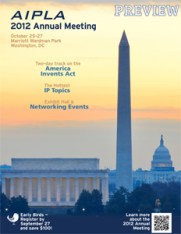
  • BrochureThe American
    Intellectual Property Law Association (AIPLA) will be holding its 2012 annual
    meeting on October 25-27, 2012 in Washington, DC.  Among the sessions being offered during the
    annual meeting will be:

    Plenary Session —
    The Impact of the AIA Rules

    Concurrent Track —
    Patent Litigation Under the AIA — including presentations on:

    • AIA Effects on
    Litigation, Operating Under PGR/IPR and Getting Best Effect/Results
    • Discovery
    Procedures Under AIA
    • Best Practices
    for Corporate e-Discovery Under AIA
    • Joint
    Infringement—Akamai/McKesson Aftermath and Strategies Under AIA

    Concurrent Track —
    Emerging IP Issues in Emerging Markets — including presentations on:

    • If You Can’t Beat 'Em, Can You Join 'Em? Trying to Use Recent Changes in Israel Patent Law to Get
    an Early Look Inside Your Competitor's Head
    • Tips, Tricks and
    Pitfalls in the Brazilian Patent Prosecution System
    • South Africa —
    An Overview of Important Prosecution and Enforcement Issues in South Africa and
    Other African Countries
    • Important Aspects
    of IP Practice in Russia for Foreign Patent Practitioners
    • Strategies for
    Foreign Filing
    • Export Control
    Issues

    Concurrent Track —
    What In-House Lawyers Need to Know About the AIA and Whether It Will Change
    Corporate Practice — including presentations on:

    • What In-House
    Lawyers Need to Know About the AIA — Focus on Post Grant Reviews
    • Third Party
    Interactions and the AIA
    • Implications and
    Considerations for In-House Counsel in the Implementation of AIA First Inventor
    to File Provision

    Committee
    Educational Session — IP Issues in Novel Venture Financing of
    Biopharmaceutical Development — including presentations on:

    • Overview of Novel
    Venture Structures and Financing Arrangements
    • Venture Capital
    Company Approaches Investing in Clinical Development and Generation of IP
    • Big Pharma
    Partnerships with Small Biotech/Pharma
    • Partnerships with
    Government to Commercialize New Technologies

    Committee
    Educational Session — Declarations and Assignments and Effective Filing Date
    of Claims Under the AIA

    Concurrent Track —
    What’s the Big Diff? — Patent Prosecution Under the AIA — including
    presentations on:

    • USPTO Perspective
    and Developments — Policy, Rules, and Examination Guidelines — to be
    presented by USPTO Deputy Director Teresa Stanek Rea
    • In-House
    Perspectives on the AIA: Strategies for Successful Corporate Outcomes
    • International
    Perspectives and Developments: One Off, Harmonizing, Progress?
    • Changes at the
    OED: What Corporations and Practitioners Need to Know and When You Need to Know
    It — to be presented by William R. Covey, USPTO Office of Enrollment and
    Discipline
    • Strategies, Tips,
    and Potholes
    • Patent System RX:
    Pre-issuance Submissions

    Concurrent Track —
    AIA — Will the New System Work? — Panel discussion to be moderated by AIPLA
    Executive Director Q. Todd Dickinson and including Chief Judge Randall Rader of
    the U.S. Court of Appeals for the
    Federal Circuit; USPTO Director David Kappos; Robert A. Armitage of Eli Lilly
    & Company; Aaron Cooper, Senior Counsel, IP and Antitrust, U.S. Senate
    Committee on the Judiciary; and W. Todd Baker of Oblon Spivak McClelland Maier
    & Neustadt, LLP

    Committee
    Educational Session — Antibody Patents and Patenting Antibodies — US and EP
    Perspectives — including presentations on:

    I.  Patenting Antibodies — A European
    Perspective:
    • Antibodies and
    the EPO
    • International
    Antibody Patenting Strategy
    • Patenting
    Antibodies in Europe

    II.  Antibody Patents — Written Description
    • Written
    Description and Predictability — One Corporate View
    • Written
    Description: Not Required for Antibodies — An Academic View
    • Understanding the
    Patent Office's "Antibody Exception" to the Requirement for Written Description

    On October 26, the
    luncheon keynotes will be given by the Hon. Kathleen O’Malley of the U.S. Court
    of Appeals for the
    Federal Circuit.

    A brochure for the
    meeting, which includes an agenda, list of speakers, and registration
    information can be downloaded here.

    The registration
    fee for the AIPLA annual meeting is $825 (AIPLA members), $1,280 (non-members),
    $55 (AIPLA student members), or $70 (government employees or AIPLA
    academic/government members).  AIPLA
    members or non-members registering by September 27, 2010 will receive a $100
    discount off the registration fee.  Those
    interested in registering for the conference can obtain a registration form
    here.

  • IPO #2The
    Intellectual Property Owners Association (IPO) will offer a one-hour webinar on
    "Supplemental Examination: Rules and Strategy" on September 18, 2012
    beginning at 2:00 pm (ET).  A panel
    consisting of Robert Bahr, Deputy Commissioner for Patent Examination Policy,
    USPTO; Courtenay Brinckerhoff of Foley & Lardner LLP; and Kurtis MacFerrin
    of Google, Inc. will discuss the final rules and when a patent holder would be
    well advised to ask for supplemental examination, balancing the risks and
    benefits.

    The
    registration fee for the webinar is $120 (government and academic rates are
    available upon request).  Those
    interested in registering for the webinar can do so here.

  • IPO #2The
    Intellectual Property Owners Association (IPO) will offer a one-hour webinar on
    "Inter Partes Review: Rules and
    Strategy" on September 5, 2012 beginning at 2:00 pm (ET).  A panel consisting of the Hon. Sally Medley,
    Administrative Patent Judge, USPTO; Kevin Laurence of Stoel Rives, LLP; and
    Scott Markow of Stanley Black & Decker, Inc. will focus on the final rules
    and such topics as estoppel, costs, and related stays in litigation.  The panel will also discuss when to launch an
    inter partes review in light of other
    alternatives, the nature of the trial at the PTAB, how to defend the patent,
    and how to manage teams that include litigators who have not previously
    practiced at the USPTO.

    The
    registration fee for the webinar is $120 (government and academic rates are
    available upon request).  Those
    interested in registering for the webinar can do so here.

  • By
    Kevin E. Noonan —

    Supreme Court Building #2Earlier
    this year, the Supreme Court asked the Solicitor General for his views on
    whether the Court should grant certiorari
    in Bowman v. Monsanto.  The Solicitor has now given the Court his
    views, and they are that the Court should not grant cert.  Although the Court does not always follow the
    Solicitor's recommendations (and sometimes regrets not doing so; see Laboratory
    Corp. v. Metabolite Labs., Inc.
    ("LabCorp")), in this case
    the rationales in the Solicitor's brief make it unlikely that the Court will
    not agree.

    To
    recap, the case arose as the result of a farmer replanting Monsanto's patented
    Roundup Ready® seed.  The patents-in-suit are (as they have been in
    other cases) U.S. Patent Nos. 5,352,605 and RE39,247 (a reissue of
    5,633,435).  Claims 1 and 4 of the '605 patent are representative:

    1.  A chimeric gene which
    is expressed in plant cells comprising a promoter from a cauliflower mosaic
    virus, said promoter selected from the group consisting of a CaMV (35S)
    promoter isolated from CaMV protein-encoding DNA sequences and a CaMV (19S)
    promoter isolated from CaMV protein-encoding DNA sequences, and a structural
    sequence which is heterologous with respect to the promoter.

    4.  A plant cell which comprises a chimeric gene that contains
    a promoter from cauliflower mosaic virus . . . .

    Claims 103, 116, 122, 128, 129, and
    130 of the '247 patent are representative:

    103.  A recombinant,
    double-stranded DNA molecule comprising in
    sequence:

        (a)  a promoter which functions in
    plant cells to cause the production of an RNA sequence;
        (b)  a structural DNA sequence that
    causes the production of an RNA sequence which encodes an EPSPS enzyme having
    the sequence of SEQ ID NO:70; and

        (c)  a 3' non-translated region that
    functions in plant cells to cause the addition of a stretch of polyadenyl
    nucleotides to the 3' end of the RNA sequence;
        where the promoter is heterologous with
    respect to the structural DNA sequence and adapted to cause sufficient
    expression of the encoded EPSPS enzyme to enhance the glyphosate tolerance of a
    plant cell transformed with the DNA molecule.

    116.  A glyphosate-tolerant plant cell comprising a DNA
    sequence encoding and EPSPS enzyme having the sequence of SEQ ID NO: 70.

    122.  A seed of the plant of claim 116, wherein the seed
    comprises the DNA sequence encoding an EPSPS enzyme having the sequence of SEQ
    ID NO: 70.

    128.  A glyphosate[-]tolerant plant cell
    comprising the recombinant DNA molecule of claim 103.

    129.  A plant comprising the glyphosate[-]tolerant plant cell of
    claim 128.

    130.  A method for selectively controlling weeds in a field
    containing a crop having planted crop seeds or plants comprising the steps
    of:

        (a)  planting the crop seeds or plants which
    are glyphosate-tolerant as a result of a recombinant double-stranded DNA
    molecule being inserted into the crop seed or plant . .
    .

        (b)  applying to the crop and weeds in the field
    a sufficient amount of glyphosate herbicide to control the weeds without
    significantly affecting the crop.

    Roundup Ready SoybeansPioneer Hi-Bred (Pioneer), one of Monsanto's
    licensed seed producers, sold seed to Bowman; these sales were subject to a
    Technology Agreement similar to the Agreements Monsanto typically requires for
    farmers who purchase its seed.  Under the Technology Agreement, the
    licensed grower agreed: (1) "to use the seed containing Monsanto gene
    technologies for planting a commercial crop only in a single season"; (2) "to
    not supply any of this seed to any other person or entity for planting";
    (3) "to not save any crop produced from this seed for replanting, or
    supply saved seed to anyone for replanting"; and (4) "to not use this
    seed or provide it to anyone for crop breeding, research, generation of
    herbicide registration data, or seed production."  It was undisputed
    that Bowman complied with these provisions as to its "first planting"
    each year.  Monsanto's complaint arose from farmer Bowman's "second
    planting," which was made using so-called "commodity seed"
    obtained from local grain elevators.  Farmers under the Technology
    Agreement could freely sell seed to grain elevators for commodity use (for
    example, as cattle feed), which did not include replanting.  However,
    since Farmer Bowman's "second planting" was riskier (in terms of
    potential yield) he decided to use commodity seed because it was significantly
    cheaper than Roundup Ready® seed.  After planting this seed, Farmer
    Bowman tested this second crop for Roundup® resistance, and finding that
    substantial amounts of the seed were resistant, used Roundup® on these
    plantings and replanted this seed.

    The District Court granted summary
    judgment of patent infringement and entered judgment against Farmer Bowman in
    the amount of $84,456.20.  The Federal Circuit rejected Bowman's arguments
    that were predicated directly on the Supreme Court's Quanta
    decision.  In Quanta, the Supreme Court reiterated its "substantial
    embodiment" test to apply the patent exhaustion principle, which applied
    to both composition and method claims (reversing the Federal Circuit as to
    method claim exhaustion), citing Ethyl
    Gasoline Corp. v. United States
    ,
    309 U.S. 436 (1940), and United
    States v. Univis Lens Co.
    , 316 U. S. 241
    (1942).  Specifically, the Court stated the standard that sales that "substantially
    embody" the patents in suit will be sales that exhaust the patent right to
    obtain royalties, citing Univis.  The immediately evident
    application of this decision to biotechnology patent claims include cases, as
    in Monsanto, where a patented article has the biological property of
    replication, where the license precludes use of replicates of the article after
    purchase.  Although critically important economically (since it is clear
    that Monsanto would not be in the seed business for very long in the absence of
    these restrictions), the rubrics for applying patent exhaustion set forth in
    the Court's Quanta decision could be applied to Monsanto's claim, and
    Bowman argued that they should be so applied.  It is without question that
    the seeds "embody" (figuratively and literally) the "essential
    features" of the patented invention, and thus the types of limitations
    Monsanto (and other seed producers) have placed on replanting of their patented
    seeds implicate the application of these standards to Monsanto's claims.

    The Federal Circuit did not see it this
    way.  Farmer Bowman argued that exhaustion applied to all Roundup Ready®
    soybean seeds, including those present in grain elevators as undifferentiated
    commodity.  "Sales of second-generation seeds by growers to grain
    elevators, and then from grain elevators to purchasers (like Bowman) are
    authorized according to the terms of Monsanto's [T]echnology [A]greement[], and
    are thus exhausting sales . . . under the Supreme Court's analysis in Quanta
    [Computer, Inc. v. LG Electronics, Inc., 553 U.S. 617 (2008)],"
    according to Bowman.

    MonsantoIn response, Monsanto argued that sale of
    soybeans are not "authorized" when those soybeans are replanted (i.e.,
    used as seed rather than as commodity grain).  Monsanto further argued
    that, even if sale to grain elevators resulted in exhaustion, infringement
    occurred when the seed was replanted because "patent protection 'is
    independently applicable to each generation of soybeans (or other crops)
    that contains the patented trait,'" arguments Monsanto had previously
    (successfully) made in other infringement actions.  Monsanto also urged
    that J.E.M. Ag Supply, Inc. v. Pioneer Hi-Bred International, Inc.,
    534 U.S. 124 (2001), was controlling for patent exhaustion in
    seeds, specifically that exhaustion "must be limited to the seeds sold." 
    In this regard, Monsanto urged the portion of the J.E.M. opinion that
    stated that "there are no exemptions for research or saving seed
    under a utility patent."  Id.
    at 143 (emphases added).

    The Federal Circuit agreed that patent
    exhaustion did not apply.  Citing the McFarling opinion, the panel
    stated that "[t]he 'first sale' doctrine of patent exhaustion . . . [wa]s
    not implicated, as the new seeds grown from the original batch had never been
    sold.  The price paid by the purchaser 'reflects only the value of the 'use'
    rights conferred by the patentee.'"  Id. at 1299 (citing B. Braun Med., Inc. v. Abbott Labs.,
    124 F.3d 1419, 1426 (Fed. Cir. 1997)).  Turning to the specific facts in this case,
    the Court stated that the important consideration is that "the grower has
    created a newly infringing article" when commodity seed was planted by Bowman
    and the "next generation" of seeds comprising Monsanto's Roundup
    Ready® technology were produced.  "The fact that a patented
    technology can replicate itself does not give a purchaser the right to use
    replicated copies of the technology," according to the opinion, and "[a]pplying
    the first sale doctrine to subsequent generations of self-replicating
    technology would eviscerate the rights of the patent holder," citing Monsanto Co. v.
    Scruggs
    , 459 F.3d 1328, 1336 (Fed. Cir. 2006), cert.
    denied, 549 U.S. 1342 (2007).  According to the opinion, the right to use
    patented technology upon purchase "do[es] not include the right to
    construct an essentially new article on the template of the original, for the
    right to make the article remains with the patentee," citing Jazz Photo Corp. v. Int'l Trade Comm'n,
    264 F.3d 1094, 1102 (Fed. Cir. 2001), cert. denied, 536 U.S. 950 (2002). 
    The opinion applied the "substantial embodiment" test with regard to
    separate generations of seed, stating that present seed does not "substantially
    embody" "all later generation seeds," because with regard to the
    commodity seeds "nothing in the record indicates that the 'only reasonable
    and intended use' of commodity seeds is for replanting them to create new
    seeds, citing Quanta, 553 U.S. at 631 and noting that other uses for
    commodity seed existed (such as use as feed).  "While farmers, like
    Bowman, may have the right to use commodity seeds as feed, or for any other
    conceivable use, they cannot 'replicate' Monsanto's patented technology by
    planting it in the ground to create newly infringing genetic material, seeds,
    and plants.  Bowman's certiorari petition
    followed the adverse decision by the Federal Circuit.

    The
    Solicitor's brief acknowledges that the Federal Circuit's treatment of
    so-called "conditional" sales has not been entirely consistent with
    the Supreme Court's views on patent exhaustion; this contrary jurisprudence was
    corrected by the Court in Quanta and
    thus does not warrant further correction.  More importantly, the Solicitor contends that conditional exhaustion was
    not the basis for the Federal Circuit's decision in this case.  Rather, the Solicitor's brief quotes the
    Federal Circuit as saying that "'[e]ven if
    [respondent's] patent rights in the commodity seeds are exhausted, such a
    conclusion would be of no consequence because once a grower, like [petitioner],
    plants the commodity seeds containing [respondent's] Roundup Ready technology
    and the next generation of seed develops, the grower has created a newly
    infringing article."  In addition, "[t]he
    right to use [] do[es] not include the right to construct an essentially new
    article on the template of the original, for the right to make the article
    remains with the patentee.'"  The Solicitor further
    notes that the Court rejected the argument that replanting was the only use for
    the "commodity seed," noting that the seed was useful, inter alia, as animal feed.

    The Solicitor's brief notes
    that a majority (pp. 9-16) of petitioner's brief is focused on the Federal
    Circuit's "conditional sale" jurisprudence.  The brief sets forth these cases, beginning
    with Mallinckrodt, Inc. v. Medipart, Inc., 976 F.2d 976 F.2d 700, 706-08 (1992), where the Federal Circuit held that a patent was
    not exhausted if the patentee conditioned the sale of a patented article to "unilateral
    or bilateral restrictions on the use or resale of the purchased article."  The Federal Circuit had justified these
    restraints under conditions where the restriction was "within the patent
    grant" (i.e., it did not exceed or be unrelated to subject matter
    within the scope of the claims) and did not have "anticompetitive effects
    extending beyond the patentee's statutory right to exclude" or was in
    violation of the antitrust laws.  These
    line of cases was relevant to the instant case, the Solicitor wrote, because
    other cases (significantly, ones for which the Court had denied certiorari) were based (at least in
    part) on the conditional sale doctrine, including Monsanto Co. v.
    McFarling
    , 302 F.3d 1291 (2002), cert, denied, 537 U.S.
    1232 (2003), and Monsanto Co. v. Scruggs.  But these cases were all decided prior to the Supreme Court's Quanta decision; perhaps somewhat tongue
    in cheek, the brief states that "[i]t is not clear, however, whether the
    Federal Circuit will continue to adhere to the Mallinckrodt line of
    cases after Quanta.  What is clear
    is that the court did not do so here," thus avoiding this issue as a basis
    for a certiorari grant (which may
    arise by implication if the Federal Circuit does not follow the Court's lead from Quanta).

    Here, the Solicitor
    affirms that the Federal Circuit rejected the patent exhaustion defense as
    point of "no consequence" because "'[e]ven if' exhaustion had
    occurred [] petitioner would still be liable because he had 'created a newly
    infringing article' when he 'plant[ed] the commodity seeds containing
    respondent's Roundup Ready technology and the next generation of seed
    develop[ed].'"  In other words, even if the petitioner had a "right to
    use" the seed for any "conceivable use," the one right that he
    did not have was the "'right to
    construct an essentially new article on the template of the original.'"  The brief casts the issue as one of the patent law
    giving a patentee "separate rights" to exclude others from "making, using, offering for sale, and selling [or
    importing] a patented invention," rights that can be separately
    alienated.  Separate from the rights to
    use and (re)-sell a patented article (which rights are exhausted upon first
    sale) is the right to make a new infringing article, something the Solicitor's
    brief contends was never the subject of the patent exhaustion doctrine.  Citing Quanta
    and other Supreme Court case law (including Mitchell v. Hawley, 83
    U.S. (16 Wall.) 544, 547 (1872); United States v. Univis Lens Co., and Aro
    Mfg. Co. v. Convertible Top Replacement Co.,
    365 U.S. 336,346 (1961)), the
    Solicitor argues that exhaustion is particular to the article sold.  This
    issue has arisen in the past when courts have been asked to determine the
    distinction between repair of a purchased patented article (which is
    permitted) and reconstruction (which is not); this principle is a
    long-standing one according to the brief, hieing from cases like Wilson v.
    Simpson,
    50 U.S. (9 How.) 109, 123-125 (1850), and American Cotton-Tie
    Co. v. Simmons,
    106 U.S. 89, 93-94 (1882).  Quoting the Federal
    Circuit, "the rights of ownership do not include the right to construct an
    essentially new article on the template of the original, for the right to make
    the article remains with the patentee" says the Solicitor, citing Jazz
    Photo Corp. v. Int'l Trade Comm'n
    .

    The Solicitor's
    brief recognizes that the case presents something of a novelty, because this
    invention is capable of making replicas of itself (although later in the brief
    the Solicitor rejects petitioner's contention that this self-replicating
    property absolves him of infringement liability).  The brief rejects petitioner's contention
    that planting new seed is a "use" of the seed and does not constitute
    "making" new seed, because while planting see is certainly a use, "the planting and harvesting of soybeans also
    constitutes the 'making' of newly infringing seed" (emphasis in original).  The brief also rejects petitioner's argument that new Roundup Ready
    seeds are "made" only "'when they
    artificially insert patented germplasm into naturally occurring soybean seeds.'"  This is also a making, according to the
    brief, but is does not negate that planting and harvesting seed is also a "making"
    of seed.  (Here, the brief relies on a
    dictionary definition of the word "make," in the absence of any
    special definition of the word in the Patent Act, unlike, for example, the
    definition of the word "process" at 35 U.S.C. § 100(b).)  "Petitioner 'cause[d]
    [the progeny seed] to exist,'" according to the Solicitor, and it was
    immaterial that how that was accomplished differed from how the patentee had
    created the recombinant seed in the first place.

    Turning to the
    argument that seeds "self-replicate without farmer assistance" (and
    thus, presumably, somehow absolve the farmer from responsibility for
    infringement), the Solicitor states that:

    [P]etitioner
    did not simply leave the seed "untended on a field."  . . .  Rather, he
    intentionally planted the commodity seed in order to create a new crop of
    soybeans; he saved some of that new crop to replant the next growing season; he
    continued to plant, harvest, and save seed for eight successive years; and he
    exploited the known glyphosate-resistant properties of the progeny seed by
    treating his crops with a glyphosate-based herbicide.

    All
    these are acts presumably raising infringement liability.

    The
    brief also relied upon the Court's decision in J.E.M.
    Ag Supply, Inc. v. Pioneer Hi-Bred International, Inc
    . in support of its argument that
    planting seeds constituted "making" under the patent statute.  There, the Supreme Court held that the Patent
    Act provided utility patent protection (that endowed patent holders with "greater
    rights of exclusion" than patents under the Plant Variety Protection
    Act).  The PVPA provides an affirmative
    exemption for farmers to save seed that can be used for replanting, and the J.E.M. Court noted that there was no
    such exemption for utility patents.  The Solicitor's brief argues that there would be "no practical
    significance" for this distinction (between plant and utility patents) "if
    the unauthorized creation of new seed was treated as non-infringing under 35 U.S.C. 154 and 271 [] based on
    the patent-exhaustion doctrine.  Petitioner would effectively read a
    seed-saving exemption into the Patent Act."  This aspect of the
    difference between the extent of the exclusionary right conferred by utility
    versus plant patents also distinguished Asgrow Seed Co. v. Winterboer,
    513 U.S. 179 (1995), another case involving the seed-saving exemption of the PVPA:

    If, as petitioner contends, the authorized
    sale of patented seed exhausts a patentee's rights in that seed, as well as in
    its progeny, then a grower could save second-generation seed and sell that seed
    commercially without infringing the patent.  That would, in turn, afford greater
    rights of exclusion to holders of a PVPA certificate than to utility patent
    holders, contrary to this Court's understanding in J.E.M.

    The
    Solicitor also notes that recombinant seed are not exempt from the patent
    exhaustion doctrine.  The question is for
    which seed does patent exhaustion
    apply, and the Solicitor answers that it is the seed that is sold, and not
    progeny seed, that is subject to exhaustion.  "But the sale of patented seed never authorizes a purchaser to
    create a new generation; the right to make is a distinct, exclusive right that
    remains with the patentee," says the brief.

    The Solicitor
    ends his brief by addressing the policy issues raised by petitioner:  "that
    the court of appeals' decision will eliminate commodity soybeans as a low-cost
    alternative for second-crop plantings, and will otherwise alter traditional
    farming practices."  These are
    decisions best left for Congress, according to the Solicitor.  In addition, a decision by the Court on
    recombinant seeds "could also affect the
    enforcement of patents for man-made cell lines, DNA molecules,
    nanotechnologies, organic computers, and other technologies that involve
    self-replicating features."  Instead
    of deciding this issue in this case, "[t]he Court should allow the case
    law to develop further before considering whether to adopt a more restrictive
    definition of 'making' that could have unforeseen consequences for other
    present and future self-replicating technologies, citing the Court's own
    cautionary statements in this regard in Bilski v. Kappos, 130 S. Ct. 3218, 3227
    (2010).

    The
    Court will schedule a conference to discuss whether to grant certiorari in due
    course after the summer recess.

  • By Craig Humphris & David McCarthy
    —

    Australia Coat of ArmsAustralia is attempting to raise its patentability
    threshold and specification
    requirements.  Significant amendments have been made to Australia's
    patent laws through enactment of the Intellectual Property Laws Amendment (Raising
    the Bar) Act
    2012.  Most provisions will take effect from 15 April 2013.

    The Raising the Bar Act, which was enacted on 15 April 2012, seeks to raise the quality of granted patents to a level that is more
    consistent with the standards set with Australia's major trading partners,
    including the U.S., Japan, and Europe.  Prior to this Act, concerns were expressed
    in the 2008 review of the national innovation system (entitled 'Venturous Australia') and the
    Government's response to this review (Powering
    Ideas: the innovation agenda for the 21st century, 12 May 2009
    ),
    that the thresholds set for the grant of a patent in Australia are too low,
    patents are granted for inventions that are not sufficiently inventive, and
    that the details of inventions are not sufficiently disclosed to the public.

    The Raising
    the Bar Act
    intends to raise the requirements for patentability and the
    requirements for patent specifications for all applications filed after 15
    April 2013, and for patent applications filed prior to that date for which an
    examination request has not been filed prior to 15 April 2013.

    A number of actions are available to patent applicants
    to ensure that the current and perhaps more lenient patentability and
    specification requirements apply to their applications and future patent
    grants.

    • File
    patent applications, including national phase applications, and request examination before 15
    April 2013.

    • If a PCT
    application has not been filed, consider filing a Convention application in Australia and request examination before 15
    April 2013.

    • Instead of filing a
    provisional application to obtain a priority date, file a complete application and request examination before 15 April 2013.

    • Add all
    new subject matter to description/examples before 15 April 2013.

    • File divisional
    applications and a request for examination before 15 April 2013.

    • File divisional
    applications from opposed applications before 15 April 2013.

    • If desired, convert
    pending applications to a divisional application before 15 April 2013

    Future granted patents will still be litigated
    under the current patentability and specification requirements if the
    application was filed and had examination requested before 15 April 2013.


    FURTHER INFORMATION

    The key amendments made by the Raising the Bar Act are as follows:

    Schedule 1 – Raising the quality of granted patents

    Inventive Step

    Currently, only common general knowledge from
    Australia is taken into account in determining what is common general knowledge
    for the purposes of assessing inventive step.  Under the Raising the Bar Act, common general knowledge from overseas (that
    is, without a territorial limitation) can also be taken into account and this
    will permit the use of foreign experts who have given evidence in overseas
    proceedings.

    Previously, only information 'ascertained,
    understood and regarded as relevant' was considered in a review of prior art
    for the assessment of inventive step.  Under the Raising the Bar Act, all information in existence in Australia or
    overseas can be considered prior art, provided it is capable of being understood
    and regarded as relevant.  This should increase the volume of prior art taken
    into account when assessing inventive step.

    Sufficiency

    The level of disclosure required for provisional
    applications will be increased and will require a similar level of disclosure
    required for complete specifications, although provisional applications need
    not disclose the best method of performance of the invention.

    Complete applications will have their disclosure
    requirements changed.  The law will be amended to conform substantially to the
    corresponding United Kingdom provision and the new provision states that the
    complete specification must "disclose the invention in a manner which is
    clear enough and complete enough for an invention to be performed by a person
    skilled in the relevant art".  The explanatory memorandum to the Raising the Bar Act, indicates that the
    subject matter of a claim should be enabled across its "whole width".

    Fair Basis

    Australia's requirement that a claim needs to be 'fairly
    based' on matter disclosed in the specification will be replaced with a 'supported
    by' requirement.

    Under the new law, there must be basis in the
    description for each claim.  Further, the scope of the claims must not be
    broader than is justified by the extent of the description, drawings, and
    contribution to the art.  This second aspect of the support requirement appears
    to be intended to provide a means for rejecting unduly speculative claims.

    Currently, it appears settled by the Australian
    High Court (the supreme court in Australia's court hierarchy) following its
    decision in Lockwood
    Security Products Pty Ltd v Doric Products Pty Ltd
    (2004)
    217 CLR 274, that there
    is no link between claim scope and technical contribution in the art.  The Raising the Bar Act attempts to change
    this and seeks to import a link between these two elements.

    Utility

    The Raising
    the Bar Act
    introduces a new provision which will require a complete
    specification to disclose a "specific, substantial and credible use"
    for the invention.  This provision was based substantially on the corresponding
    US section.  This requirement for a specification to disclose a use for the
    invention is additional to the requirement for the invention itself to be
    useful, in the sense of meeting the promise of the invention as described in
    the specification.

    Examination

    Under the new system, patent examiners will be able to consider utility and prior use at the
    examination stage.  These grounds are not available to examiners under the
    current system.

    The standard of proof to be applied by an
    examiner for all examination tests will be raised to the civil standard
    (balance of probabilities).  Currently, an Examiner is required to accept a
    patent application 'unless it appears practically certain' or 'clear' that the
    patent would be invalid.  Under the new laws, the Examiner will need to be satisfied on the balance of probabilities that a patent
    would be valid.  These changes
    will shift more burden on the applicant to show patentability.

    Re-Examination

    Australia's ex parte re-examination procedure
    before the patent office (IP Australia) will be modified.  Currently, re-examination only considers the
    grounds of novelty and inventive step.  However, from 15 April 2013,
    re-examination will be extended to include the grounds of best method, clarity,
    fair basis, manner of manufacture, and utility.

    Amendments

    The
    amendment provisions will be modified to prevent applicants from adding subject
    matter to their applications, except when the amendment is to correct an
    obvious mistake or clerical error.  Whether subject matter has been added is
    made with reference to the complete specification as filed, as well as "other
    prescribed documents (if any)".


    Schedule 2 – Free access to patented inventions for
    regulatory approvals and research

    Regulatory Exemption

    Under the current system, exemption from patent
    infringement is allowed for use of a patented invention solely connected with
    generating information for submission to a drug regulation authority for
    seeking regulatory approval of a pharmaceutical.

    From 15 April 2013, exemptions from patent
    infringement will be broadened beyond pharmaceutical products and will be
    provided for use solely connected with generating information
    for seeking regulatory approval for any product.  These changes will be most
    relevant to certain medical device products and agricultural products that
    require regulatory approval
    before market launch.

    Experimental use
    exemption

    Australia has now codified an experimental use
    exemption to patent infringement.

    The provision was made effective on 15 April 2012
    and applies to acts done for experimental purposes
    relating to the subject matter of the invention, including:

    • Determining the properties of an invention;

    • Determining the scope of a claim relating to the invention;

    • Improving or modifying the invention;

    • Determining the validity of a patent or of a claim relating to the
    invention; or

    • Determining whether the patent would be/has been infringed by the doing
    of an act.


    Schedule 3 – Reducing delays in resolution of
    patent applications

    Divisional Applications

    Other significant amendments introduced by the Raising the Bar Act, include changes to
    practice on divisional applications (Australian divisional applications are
    often seen as equivalent to U.S. continuation applications).

    (1)  
    Under the current system, it is possible to file divisional applications
    from applications under opposition (Australia has a post acceptance, pre-grant,
    third party opposition procedure).  The practice of filing divisionals from
    applications under opposition is a useful tactic by patent applicants who want
    to maintain a live application in case the parent application is successfully
    opposed or substantially narrowed.  From 15 April 2013, it will no longer be possible to file divisional applications from applications
    under opposition or at the end of the opposition period (3 months from
    advertisement of acceptance).

    Furthermore, under the current system, it is possible to withdraw an
    opposed application at any time and pursue a divisional application.  The
    applicant can also wait to see the evidence from the opponent before making a
    decision to pursue this option and withdraw.  However, under the new system,
    patent applicants will require the Commissioner's consent to withdraw an
    opposed application and consent is likely to be withheld if all other
    divisional applications are removed.

    (2)   From 15 April 2013, it will also no longer be
    possible to convert an application to a divisional or
    innovation patent off an earlier filed application, e.g., to overcome novelty or
    inventive step rejections from own application.

    Under the current system, where a novelty objection is raised against an
    applicant's invention citing their own earlier application, the applicant could
    overcome the objection by converting the later application to make it a
    divisional of the earlier application.  The Raising
    the Bar Act
    will close this option.

    Mr.
    Humphris is a Senior Associate with Wrays and team leader of Wrays' Adelaide
    office.  Dr. McCarthy is an Associate
    with Wrays.