• By Kevin E. Noonan —

    MyriadWhile the rest of the patent world was focused on Supreme Court opinions (issued and pending) and Congressional action vel non on threats like patent trolls, the consolidated Multi District Litigation between Myriad Genetics and several defendants over BCRA 1 and 2 genetic testing has been proceeding apace in the U.S. District Court for the District of Utah.  There have been developments (although none too surprising) that have been to Myriad's benefit, as well as some bad news and the opening of another front in the gene testing wars that threaten to raise the political rhetoric over Myriad's business model to levels reminiscent of the ACLU's tactics.

    Ambry GeneticsThe good news for Myriad is that the District Court dismissed two sets of counterclaims:  the first, asserted by Ambry Genetics, that the bringing the lawsuit was itself a violation of the antitrust laws.  Ambry had argued specifically that Myriad filed its lawsuit "to enforce its invalid patents in bad faith in order to keep competitors from entering the market," citing Myriad's intention to maintain the "status quo" (which, according to Ambry is Myriad's "wrongful monopoly") as set forth in its brief in support of its preliminary injunction motion, in violation of Sections 1 and 2 of the Sherman Antitrust Act.  Ambry also asserted as an improper motive for the lawsuit its intention to contribute the results of its BRCA gene testing to public databases.  In Ambry's view, Myriad's failure to do the same constitutes an attempt to use "its invalid patents to maintain as secret patients' gene sequences (which do not belong to Myriad) in an attempt to limit competition."  And Ambry also asserted that Myriad is using the lawsuit to delay market entry by competitors other than Ambry, and to incorporate aspects of its own technology into Myriad's testing, resulting in an expropriation of "Ambry's superior screening services, which utilize more sensitive, efficient and cost-effective next-generation sequencing technologies."  Ambry's counterclaims also alleged that Myriad has "market power" and that its activities have harmed the market for diagnostic genetic testing for BCRA gene mutations in the United States, because Myriad has an "over 90% market share" for BRCA genetic testing and "possesses the power to control prices and exclude competitors."  Additionally, Ambry contended that Myriad falsely attested that Ambry's testing has "variant of unknown significance (VUS)" rates of 10-30%, and that Myriad knowing this falsity has had its employees conduct a campaign of informing genetic counselors of this false VUS rate for Ambry's BRCA testing.  Myriad opposed these allegations, and moved to dismiss under Fed. R. Civ. Pro. 12(b)(6) because it was immune from antitrust liability under the Noerr-Pennington doctrine first enunciated by the Supreme Court in Eastern R.R. Presidents Conference v. Noerr Motor Freight, Inc., 365 U.S. 127 (1961), and Mine Workers v. Pennington, 381 U.S. 657 (1965).  This immunity can only be abrogated by bringing a lawsuit that is objectively baseless, in bad faith or enforcing a patent obtained by fraud, i.e., inequitable conduct.

    On May 16th, the District Court granted Myriad's motion to dismiss in a terse Order stating that the Order was based on Myriad's argument in its briefing.

    Quest DiagnosticsThe Court, in an equally terse Order granted Myriad's motion to dismiss Quest Diagnostics' counterclaims for defamation and unfair competition.  These counterclaims were based on allegations by Quest that Myriad had, by asserting its patents broadly against any entity entering the BRCA testing market, violated unfair competition laws.  Quest's declaratory judgment complaint supported its allegations with factual assertions of specific actions by Myriad representatives.

    The bad news is both general and specific.  Generally, Chief Judge Rader's descent from the Federal Circuit bench removes from the Court a strong voice in favor of patent rights and enforcement of valid patents.  He consistently applied patent law using traditional concepts until overturned by the Supreme Court (inter alia, in Prometheus v. Mayo) and whatever influence he might have with the other members of the Court is now lost.  More bad news stems from the Supreme Court's decisions in Octane Fitness, LLC v. ICON Health & Fitness, Inc. and Highmark Inc. v. Allcare Health Mgmt. Sys., Inc., because (despite the protections of Noerr-Pennington) the District Court might find that bringing these several lawsuits even in good faith engendered liability for all the defendants' litigation expenses.

    Pathway GenomicsMore significant is the entry into the BRCA gene testing market of Pathway Genomics, who began offering testing for BRCA 1, BCRA 2 and MUTYH genes "on or about June 3, 2014."  Myriad filed suit ten days later.  In its complaint, which mirrors complaints against several other defendants, Myriad alleges infringement of the following claims of the following patents:

    Table
    Pathway Genomics has announced that its BRCATrue test is one that has taken more than a year to develop and has a sensitivity of 99.99%.  Uniquely, and important for the politics of the situation is Pathway Genomic's decision to donate up to $10 million in "free" genetic testing, in partnership with eight advocacy groups including the Susan G. Koman for the Cure, Bright Pink, Living Beyond Breast Cancer, National Ovarian Cancer Coalition, Young Survival Coalition, Foundation for Women's Cancer, Facing Our Risk of Cancer, and Sharsheret.  But this generosity is grounded on sound economics:  each "free" test will only be given one-for-one with paid testing.  Still, in view of the cost for each "paid-for" test of $1,799, the $10 million represents about 5,600 "free" tests.  And while Pathway Genomic's price is significantly less than Myriad's on its face (Myriad's tests cost $3,000-4,000 apiece), Myriad's business model is to charge relatives of a patient much less than the test for the initial patient.  Thus, it may be possible that for a given family Myriad's test costs could well be less than Pathway's.

    Despite these potentialites, Pathway Genomics has seized the rhetorical high ground (or low, depending on your understanding of the issues).  A press release issued by Pathway Genomics after Myriad filed suit proclaims "Pathway Genomics Responds to Myriad Genetics Lawsuit, Defends the Rights of All Women to Receive BRCA Testing Regardless of Socioeconomic Status" and is illustrated with a graphic that would have been at home in a World War II propaganda banner flying over the Red Army:
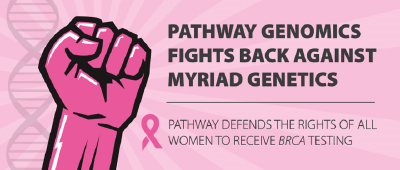
    Pathway Genomics Fights Back
    These graphics are accompanied by strong words from Jim Plante, Pathway Genomics' CEO, who the press release quotes as saying:

    We are a company trying to do good in the world.  Forty-eight hours after we raised hundreds of thousands of dollars for Susan G. Komen to fight breast cancer and announced our donation of $10 million of free genetic testing for women in need, Myriad Genetics slaps us with this unwarranted lawsuit.

    Given their pattern of filing lawsuits against other companies broadening access to this life-saving technology in clear disregard of the Supreme Court's decision last year, this lawsuit is not unexpected.  We do not infringe on any valid patent claims and are prepared to vigorously defend ourselves.

    And almost obligatorily:

    We are on a mission to make genetic testing more accessible and affordable, especially testing related to cancer screening, one of the leading causes of death in the world.  We believe that no corporation should have a monopoly over an individual's genes.  Every person should have access to vital information about their own body.

    In addition, Pathway Genomics has broached the issue of Myriad's sequestration of its genetic diagnostic mutation database, which Myriad has kept proprietary since about 2004.  Pathway Genomics also touts in its press release that it is part of the "Free the Data" movement, which opposes keeping genetic information as trade secrets (see "Consortium Launches Public Database of BRCA Data").  Their asserted hope is that "broadening access and sharing genetic information, we can collectively harness the power of the genome to improve our understanding of disease and improve healthcare for everyone" and vows to make its BRCA gene data available on the public database ClinVar.  While Myriad today has a large head start in its proprietary database, rapid adoption of Pathway Genomics' testing may provide a viable commercial alternative in much less time than it has taken Myriad to develop its own database (and may influence how long Myriad keeps its database as a trade secret).  These efforts may provide a market alternative to proposals for Congress to mandate disclosure, which would of course constitute a taking under the Fifth Amendment of the Constitution and require compensation sufficient to vitiate the public health cost advantage its proponents advocate.
  • BIO and World-Wide Intellectual Property Protection

    By Andrew Williams —

    BIO International ConventionThe 2014 BIO International Convention begins next week in San Diego.  If you are planning on attending, you probably already know that the amount of information and opportunities available at BIO can be daunting.  Therefore, over the next week, Patent Docs will be highlighting a few sessions or other opportunities, in thematic fashion, to help you navigate your way through the convention.  For example, today, in honor of the World Cup, we focus on the "International" aspect of the convention by highlighting opportunities for those attendees that wish to compare intellectual property issues around the globe.  Of course, Patent Docs authors and contributors will be present at BIO as part of the MBHB contingent, and Patent Docs readers are encouraged to stop by the MBHB booth (#1337) to discuss these sessions (or whatever other topic is of interest to you).

    As any patent practitioner in the biotech and pharmaceutical space is aware, the various intellectual property protections available worldwide, with the varying requirements for patentability, can create a landmine for the unwary.  For example, some countries encourage early filing to avoid potential prior art issues, thereby providing for quicker public access to the technology disclosed.  Others, unfortunately, have heightened disclosure requirements, which counsels against filing until sufficient data is obtained.  Moreover, the various countries' policies towards follow-on biologics or personalized medicine with accompanying diagnostics create a tension between disclosure in order to obtain patent protection and non-disclosure in order to maintain trade secrets.  Several sessions across various tracks and forums will address some of these most difficult issues.

    First on our list, the Emerging Opportunities in Global Markets Forum will present "Predictions for the Future: Biopharmaceuticals and Exclusivity" on Thursday, June 26 at 11:00 AM to 12:00 noon.  The panel involved in this presentation will provide their perspective on the issue of follow-on biopharmaceuticals in various leading markets.  Pathways for the approval of such drugs are either very new or still forming.  Therefore, as the description of the session explains, decisions must be made in view of an uncertain legal and regulatory landscape, especially with regard to the intellectual property or regulatory exclusivity of these products.  The panel will explore the state of the global regulatory pathways, and how they present both opportunity and risk.  In addition, they will explain how organizations are dealing with new IP laws, and how these biopharmaceutical regulatory and IP systems will change strategies going forward.  This panel includes the Associate General Counsel of BIO, Hans Sauer; as well as Sherry Knowles, currently of Knowles Intellectual Property Strategies; Stephen Auten, Partner at Taft and renowned for his LinkedIn Hatch-Waxman ANDA Litigation Forum; and James Shehan, Counsel at Hyman, Phelps & McNamara, P.C.  The session will be moderated by Len Smith, currently General Counsel and Vice President of Heliae Development, LLC.

    Another area of significant interest for patent professionals practicing on a global scale is the concerns regarding disclosure requirements for patent application in different countries.  The problem becomes concrete when applicants need to decide whether to file an application with minimal data as soon as possible to minimize the changes of invalidating prior art, or to wait for additional data because of heightened disclosure requirements.  Famously, the Canadian courts have invalidated at least two of Eli Lilly's successful drugs, as well as many other companies' pharmaceuticals, because they did not meet the "promise doctrine" for utility.  In response, Eli Lilly has filed a Notice of Arbitration pursuant to the provision in the North American Free Trade Agreement (or NAFTA).  In contrast to the restrictions placed on the post-filing evidence to support utility in Canada and China, the U.S. and Europe allow such evidence for already-filed applications.  A session of the Intellectual Property track entitled "Show Me the Data!  Threshold Patent Application Disclosure Requirements & Post-Filing Evidence Admissibility in the U.S., Europe, Canada & China" will explore how the patent offices in these countries and regions treat post-filing evidence, and identify strategies of preparing applications in view of these disparate policies.  In addition, they will examine what impact the timing and availability of data acquisition has on filing applications in different jurisdictions worldwide.  The panelists will be Arvie Anderson, Assistant General Patent Counsel at Eli Lilly and Company; Patrick Kierans, Senior Partner at Norton Rose, LLP in Toronto, Canada; Wen Cao, Patent Attorney with NTD Intellectual Property Attorneys in Shanghai, China; and Ute Kilger, Partner at Boehmert & Boehmert in München, Germany.  The session will be moderated by Ed Haug, Managing Partner of Frommer Lawrence & Haug LLP, and will take place on Tuesday, June 24 at 4:15 PM to 5:15 PM.

    As a final example, the Personalized Medicine & Diagnostic Forum with be presenting "Navigating the Intellectual Property Minefield to Protect Personalized Medicine Innovations Worldwide" on Thursday, June 26 at 1:00 PM to 2:00 PM.  As pointed out in the description of this session, recent legal decisions and local policies have presented obstacles for obtaining IP protection involving personalized medicine.  However, numerous drugs are being developed with companion diagnostics.  Without sufficient IP protection to justify investments, many such therapies may never reach the market.  This panel of U.S. and European attorneys will identify the primary IP obstacles and offer strategies for generating adequate IP protection for personalized medicine innovations.  In addition, they will explore the impact that this IP will have for business and investment decisions in the major market countries.  The panel includes Hans-Rainer Jaenichen, Partner at Vossius & Partner; Shihong Nicolaou, Intellectual Property Manager of the Technology Transfer Office, U.C.S.D; and Scott Rittman, Associate Chief Intellectual Property Counsel, Becton, Dickinson and Company.  The panel will be moderated by Ned Israelsen, Managing Partner of Knobbe Martens Olson & Bear, LLP.

    Be on the look-out for the next installment of BIO 2014 previews in the next few days.

  • By Michael Borella —

    NintendoA very experienced patent attorney once told me that you should never write means-plus-function claims unless there is a Luger at your temple.  This, the first opinion addressing indefiniteness to come from the Federal Circuit since the Supreme Court weighed in on the subject in Nautilis v. Biosig Instruments, does nothing to make one question the wisdom of that advice.

    Triton sued Nintendo in the Western District of Washington, alleging infringement of U.S. Patent No. 5,181,181.  Particularly, Triton contended that Nintendo's Wii Remote, in combination with other aspects of the Wii video game system, infringed several claims of the '181 patent.

    The '181 patent is directed to an input device that includes "components for determining its position, attitude, and motion."  These components may be, for instance, "three accelerometers and three rotational rate sensors for measuring linear acceleration along, and rotational velocity about, three orthogonal axes."  Each asserted claim recites "[an] integrator means associated with said input device for integrating said acceleration signals over time to produce velocity signals for linear translation along each of . . . first, second and third axes . . . ."

    The specification of the '181 patent discloses that a general-purpose microprocessor and an associated memory would facilitate this function.  With respect to details of the integration, however, the specification was silent.

    The District Court held the claims invalid for indefiniteness.  Triton appealed.

    Writing for a panel consisting of herself, Judge Reyna, and Judge Hughes, Federal Circuit Judge Moore began by noting that means-plus-function claiming under 35 U.S.C. § 112, paragraph 6 requires that the "specification . . . disclose with sufficient particularity the corresponding structure for performing the claimed function and clearly link that structure to the function."  Further, "[i]f the function is performed by a general purpose computer or microprocessor, then the specification must also disclose the algorithm that the computer performs to accomplish that function . . . failure to disclose the corresponding algorithm for a computer-implemented means-plus-function term renders the claim indefinite."

    The trade-off of means-plus-function claims in the computing arts is that the patentee can claim an outcome rather than the steps required to obtain that outcome.  But, to counteract the breadth of such claims, the patentee must disclose at least one algorithm for performing the steps.  The scope of the claims will be limited to the disclosed algorithm(s) and their equivalents.

    Without an algorithm for integration in the specification of the '181 patent, Triton found itself in a difficult situation.  First, Triton contended that the phrase "numerical integration" implicitly disclosed an algorithm, because such algorithms are well known to those of skill in the art.  This, of course, is true — integration is a basic calculus operation, and numerical integration algorithms are undergraduate textbook material.

    Judge Moore differed though, and asserted that "merely using the term 'numerical integration' does not disclose an algorithm — i.e., a step-by-step procedure — for performing the claimed function."  Instead, she agreed with the District Court that numerical integration "is not an algorithm but is instead an entire class of different possible algorithms used to perform integration."  Thus, the claim was not appropriately limited to the corresponding structure for performing the claimed function.  The fact that one of skill in the art could choose an appropriate well-known algorithm was immaterial because the '181 patent failed to disclose any such algorithm.

    Triton made a second argument that the specification did actually disclose an algorithm, though somewhat indirectly.  Judge Moore quickly disposed of this point because Triton had not properly raised it in the District Court proceedings.

    This outcome should not be surprising to anyone.  In Aristocrat v. IGT, the Federal Circuit warned against conflating the enablement requirement of 35 U.S.C. § 11, paragraph 1 with the disclosure requirement of 35 U.S.C. § 112, paragraph 6: "Enablement of a device requires only the disclosure of sufficient information so that a person of ordinary skill in the art could make and use the device.  A section 112 paragraph 6 disclosure, however, serves the very different purpose of limiting the scope of the claim to the particular structure disclosed, together with equivalents."

    In Nautilus, the Supreme Court held that "[a] patent is invalid for indefiniteness if its claims, read in light of the patent's specification and prosecution history, fail to inform, with reasonable certainty, those skilled in the art about the scope of the invention."  The claims at issue in Nautilus did include some means-plus-function language.  That holding however, apparently does not address the additional disclosure requirement of 35 U.S.C. § 112, paragraph 6.  Thus, a means-plus-function claim can be held invalid even if it passes the Court's "reasonable certainty" test.

    Triton Tech of Texas, LLC v. Nintendo of America, Inc. (Fed. Cir. 2014)
    Panel: Circuit Judges Moore, Reyna, and Hughes
    Opinion by Circuit Judge Moore

  • By Michael Borella —

    Tesla MotorsOn June 12, Tesla CEO Elon Musk announced that the company "will not initiate patent lawsuits against anyone who, in good faith, wants to use our technology."  This move was hailed by some as a win for those who support reform of an allegedly broken patent system.

    But the truth is more complicated.

    Tesla is not dedicating its patents to the public.  Instead, Tesla appears to be promising not to sue potential infringers of its patents so long as those parties maintain "good faith."  Tesla's press release does not define what Mr. Musk means by good faith, nor does it set forth any licensing procedures for a party wanting to use Tesla's patented technology.  Consequently, should a competitor sue Tesla for infringement, Tesla has probably maintained the ability to assert its patents in a countersuit.  Perhaps of more concern is what happens if Tesla sells its patents.  Are good faith users then subject to lawsuits?

    Further, Mr. Musk announced on a later conference call that the company will continue to pursue patents and put them "into what is essentially an open source category."  So Tesla is not exiting the patent game, just employing a different strategy.

    It is not uncommon for holders of a proprietary technology to share it with competitors in order to grow a market.  Many standards bodies exist for such a purpose, and require that participants license their standards-essential patents on a fair and non-discriminatory basis.

    Tesla has found itself in a difficult situation.  While it holds about 42% of the electric car market, that segment is less than 1% of the overall vehicle market.  In order for Tesla to grow and become more successful, the adoption of electric cars needs to be more widespread.  For instance, if Tesla ends up holding 20% of an electric car market that is 10% of the overall vehicle market, its effective market share will have roughly quintupled.

    And Tesla does need electric car technology to become mainstream in order to succeed.  Its flagship Model S starts at $69,900, well above what the vast majority of car owners worldwide can afford.  One of Tesla's stated goals is to sell a $30,000 electric car.  But to do so it requires a worldwide ecosystem of parts suppliers, mechanics, charging stations, and other partners.  Tesla needs economies of scale, especially for its battery technology, which is a significant portion of the cost of a Model S.  Allowing others a limited dip into its patent portfolio will help make this a reality.

    As an ostensible reason for Tesla's move, Musk claimed that patents "serve merely to stifle progress, entrench the positions of giant corporations and enrich those in the legal profession, rather than the actual inventors."  He did not address, however, why the technology industry as a whole continues to grow, as evidenced by recent record-breaking stock values, billion-dollar acquisitions, and successful initial public offerings, despite this purported stifling of progress.

    There is no doubting the brilliance and leadership of Mr. Musk, who is also the founder of Paypal and Space X.  Casting the policy change as an indictment of the patent system has been lauded by the technology industry media and their mainstream counterparts.  But Musk's proclamation is also a savvy business move, well-calculated to help Tesla grow its business.  Any benefit to other companies is a side-effect.

  •         By Sherri Oslick —

    Gavel About Court Report:  Each week we will report briefly on recently filed biotech and pharma cases.

    Glenmark Generics Ltd. et al. v. Ferring, B.V.
    3:14-cv-00422; filed June 9, 2014 in the Eastern District of Virginia

    • Plaintiffs:  Glenmark Generics Ltd.; Glenmark Generics Inc., USA
    • Defendant:  Ferring, B.V.

    Declaratory judgment of unenforceability of U.S. Patent No. 7,022,340 ("Pharmaceutical Composition as Solid Dosage Form and Method for Manufacturing Thereof," issued April 4, 2006) in conjunction with Glenmark's Paragraph IV certification as part of its filing of an ANDA to manufacture a generic version of Sanofi-Aventis' DDAVP® Tablets (desmopressin acetate, used as antidiuretic replacement therapy in the management of central diabetes insipidus and for the management of the temporary polyuria and polydipsia following head trauma or surgery in the pituitary region).  View the complaint here.

    Gilead Sciences, Inc. et al. v. Mylan Inc. et al.
    1:14-cv-00099; filed June 9, 2014 in the Northern District of West Virginia

    • Plaintiffs:  Gilead Sciences, Inc.; Emory University
    • Defendants:  Mylan Inc.; Mylan Pharmaceuticals Inc.

    Gilead Sciences, Inc. et al. v. Mylan Inc. et al.
    1:14-cv-03928; filed June 2, 2014 in the Southern District of New York

    • Plaintiffs:  Gilead Sciences, Inc.; Emory University
    • Defendants:  Mylan Inc.; Mylan Pharmaceuticals Inc.

    The complaints in these cases are substantially identical.  Infringement of U.S. Patent Nos. 6,642,245 ("Antiviral Activity and Resolution of 2-Hydroxymethyl-5-(5-fluorocytosin-1-yl)-l,3-oxathiolane," issued November 4, 2003), 6,703,396 ("Method of Resolution and Antiviral Activity of 1,3-Oxathiolane Nucleoside Enantiomers," issued March 9, 2004), and 8,592,397 ("Compositions and Methods for Combination Antiviral Therapy," issued November 26, 2013) following a Paragraph IV certification as part of Mylan's filing of an ANDA to manufacture a generic version of Gilead's Truvada® (emtricitabine and tenofovir disoproxil fumarate, used for the treatment of HIV-1 infection in adults).  View the SDNY complaint here.

    Warner Chilcott Co. et al. v. Amneal Pharmaceuticals LLC et al.
    1:14-cv-00718; filed June 6, 2014 in the District Court of Delaware

    • Plaintiffs:  Warner Chilcott Co. LLC; Warner Chilcott (US) LLC
    • Defendants:  Amneal Pharmaceuticals LLC; Amneal Pharmaceuticals of New York LLC

    Infringement of U.S. Patent No. 6,106,864 ("Pharmaceutical Formulations Containing Darifenacin," issued August 22, 2000) following a Paragraph IV certification as part of Amneal's filing of an ANDA to manufacture a generic version of Warner Chilcott's Enablex® (darifenacin, used to treat symptoms of overactive bladder).  View the California Anchen Pharmaceuticals complaint here.

    Warner Chilcott Co. v. Lupin Atlantis Holdings SA et al.
    1:14-cv-01827; filed June 6, 2014 in the District Court of Maryland

    • Plaintiff:  Warner Chilcott Co., LLC
    • Defendants:  Lupin Atlantis Holdings SA; Lupin Ltd.; Lupin Pharmaceuticals, Inc.

    Infringement of U.S. Patent No. 6,667,050 ("Chewable Oral Contraceptive," issued December 23, 2003) following a Paragraph IV certification as part of Lupin's filing of an ANDA to manufacture a generic version of Warner Chilcott's Minastrin® 24 Fe (ethinyl estradiol and norethindrone acetate, used for oral contraception).  View the complaint here.


    Cipher Pharmaceuticals Inc. et al. v. Actavis Laboratories FL, Inc. et al.
    1:14-cv-03653; filed June 6, 2014 in the District Court of New Jersey

    • Plaintiffs:  Cipher Pharmaceuticals Inc.; Galephar Pharmaceutical Research, Inc.; Ranbaxy, Inc.; Ranbaxy Pharmaceuticals, Inc.
    • Defendants:  Actavis Laboratories FL, Inc.; Andrx Corp.; Actavis, Inc.; Actavis Pharma, Inc.

    Infringement of U.S. Patent No. 7,435,427 ("Pharmaceutical Semi-Solid Composition of Isotretinoin," issued October 14, 2008) following a Paragraph IV certification as part of Actavis' filing of an ANDA to manufacture a generic version of Ranbaxy's Absorica® (isotretinoin, used for the treatment of severe recalcitrant nodular acne).  View the complaint here.


    Amarin Pharma, Inc. et al. v. Teva Pharmaceuticals USA, Inc.
    2:14-cv-03251; filed June 6, 2014 in the Eastern District of Pennsylvania

    • Plaintiffs:  Amarin Pharma, Inc.; Amarin Pharmaceuticals Ireland Ltd.
    • Defendant:  Teva Pharmaceuticals USA, Inc.

    Infringement of U.S. Patent Nos. 8,293,728 ("Methods of Treating Hypertriglyceridemia," issued October 23, 2012), 8,318,715 (same title, issued November 27, 2012), 8,357,677 (same title, issued January 22, 2013), 8,367,652 (same title, issued February 5, 2013), 8,377,920 (same title, issued February 19, 2013), 8,399,446 (same title, issued March 19, 2013), 8,415,335 (same title, issued April 9, 2013), 8,426,399 (same title, issued April 23, 2013), 8,431,560 (same title, issued April 30, 2013), 8,440,650 (same title, issued May 14, 2013), 8,501,225 ("Stable Pharmaceutical Composition and Methods of Using Same," issued August 6, 2013), 8,518,929 ("Methods of Treating Hypertriglyceridemia," issued August 27, 2013), 8,524,698 (same title, issued September 3, 2013), 8,546,372 (same title, issued October 1, 2013), 8,551,521 ("Stable Pharmaceutical Composition and Methods of Using Same," issued October 8, 2013), and 8,617,594 (same title, issued December 31, 2013) following a Paragraph IV certification as part of Teva's filing of an ANDA to manufacture a generic version of Amarin's Vascepa® (icosapent ethyl, used as an adjunct to diet to reduce triglyceride levels in adult patients with severe hypertriglyceridemia).  View the complaint here.


    Teva Women's Health et al. v. Lupin Ltd.
    1:14-cv-04055; filed June 4, 2014 in the Southern District of New York

    • Plaintiffs:  Teva Women's Health; Teva Branded Pharmaceutical Products R & D, Inc.
    • Defendant:  Lupin Ltd.; Lupin Pharmaceuticals, Inc.

    Infringement of U.S. Patent Nos. 8,415,332 ("Methods of Hormonal Treatment Utilizing Ascending-Dose Extended Cycle Regimens," issued April 9, 2013) and 8,450,299 (same title, issued May 28, 2013) following a Paragraph IV certification as part of Lupin's filing of an ANDA to manufacture a generic version of Teva's Quartette® (levonorgestrel/ethinyl estradiol and ethinyl estradiol, used for oral contraception).  View the complaint here.  [NB: The complaint was voluntarily dismissed 6 days after it was filed.]

  • CalendarJune 16, 2014 – "Limelight Networks, Inc. v. Akamai Technologies, Inc. — Implications of the Landmark Patent Decision" (Law Seminars International) – 2:00 to 3:00 pm (Eastern).

    June 17, 2014 – "Indefiniteness after In re Packard and Nautilus" (Intellectual Property Owners Association) – 2:00 to 3:00 pm (ET)

    June 18, 2014 – "Reviewing Fact Issues of Claim Construction — Will the Supreme Court Defer to Federal Circuit Precedent?" (ABA Roundtable) – Palo Alto, CA/Silicon Valley & Richmond, VA

    June 19, 2014 – "Double Patenting: Defeating Double Patenting Rejections and Avoiding Terminal Disclaimer" (Strafford) – 1:00 to 2:30 pm (EDT)

    June 23-26, 2014 – BIO International Convention (Biotechnology Industry Organization) – San Diego, CA

    June 25-26, 2014 – International Forum on Pharma Patent Extensions*** (C5) – London, England

    June 30, 2014 – "Drafting Patent Claims After In re Packard: Navigating the New PTO Regime for Evaluating Indefiniteness" (Strafford) – 1:00 to 2:30 pm (EDT)

    July 9, 2014 – "Nautilus and Limelight: The Supreme Court Keeps Chipping Away at Patentees" (McDonnell Boehnen Hulbert & Berghoff LLP) – 10:00 to 11:15 am (CT)

    July 9-11, 2014 – Fundamentals of Patent Prosecution 2014: A Boot Camp for Claim Drafting & Amendment Writing (Practising Law Institute) – San Francisco, CA

    July 20-22, 2014 – 2014 Annual Meeting & Conference (National Association of Patent Practitioners) – Alexandria, Virginia.

    August 13-15, 2014 – Advanced Patent Law Seminars (Chisum Patent Academy) - Seattle, WA

    August 18-20, 2014 – Advanced Patent Law Seminars (Chisum Patent Academy) - Seattle, WA

    ***Patent Docs is a media partner of this conference or CLE

  • IPO #2The Intellectual Property Owners Association (IPO) will offer a one-hour webinar on "Indefiniteness after In re Packard and Nautilus" on June 17, 2014 beginning at 2:00 pm (ET).  A panel consisting of Prof. Dennis Crouch of the University of Missouri School of Law; Stephen Maebius of Foley & Lardner LLP, and Micky Minhas of Microsoft Corp. will help practitioners understand the bottom line for patent practice of this spring's two important appellate decisions addressing the standard for indefiniteness under § 112.

    The registration fee for the webinar is $130 (government and academic rates are available upon request).  Those interested in registering for the webinar can do so here.

  • LSI - Law Seminars International - blueLaw Seminars International (LSI) will be offering a one-hour telebriefing on "Limelight Networks, Inc. v. Akamai Technologies, Inc. — Implications of the Landmark Patent Decision" on June 16, 2014 from 2:00 to 3:00 pm (Eastern).  Scott M. Alter of Faegre Baker Daniels LLP will moderate a panel that includes David M. Rosenblatt, Assistant General Counsel/Intellectual Property, Thomson Reuters Corporation; and Aaron D. Van Oort of Faegre Baker Daniels LLP.  The panel will analyze the decision in Limelight, provide advice for companies on induced infringement scenarios that have (and have not) been impacted by the decision, consider the potential fate of current law regarding joint infringement.

    A Q&A will follow the presentation and last for up to 30 minutes.

    The registration fee is $150 per caller and $100 for each additional person on the same line who desires continuing education credit.  Those interested in registering for the telebriefing, can do so here.

  • Whither the Meaning of "a" as a Claim Term

        By Kevin E. Noonan —

    Every once in a while a Federal Circuit panel construes a common claim term contrary to how it has been construed in prior precedent, usually based on the particular situation or circumstance the Court is addressing and consistent with the scope and meaning of the claim as supported by the claim term's plain meaning, use in the specification, and prosecution history.  And as a consequence, commentators, pundits, and CLE providers create a flurry of activity surrounding whether there is now a new rubric of patent claim construction thus created (along with dire warnings that only if patent practitioners adhere to the recommendations arising from this "new" precedent can valid claims be acquired).  Such an instance has arisen in the Court's Braintree Labs v. Novel Labs case, involving the meaning of the shortest claim limitation, the indefinite article "a."

    Braintree LaboratoriesThis is an ANDA case relating to the product SUPREP® Bowel Prep Kit, a colonic purgative used in preparation for colonoscopies or other procedures requiring a clean inner lumen of the colon.  This product is a combination of magnesium sulfate, potassium sulfate, and sodium sulfate, and has as an advantage over prior art products that it can be administered in relatively small amounts (100-500 mL) but does not cause severe shifts in electrolyte levels, which in prior art products had produced "heart failure, kidney failure, neurological impairment, and even death."  Claim 15 of U.S. Patent No. 6,946,149 is representative:

    A composition for inducing purgation of the colon of a patient, the composition comprising from about 100 mL to about 500 mL of an aqueous hypertonic solution comprising an effective amount of Na2SO4, an effective amount of Mg SO4, and an effective amount of K2SO4, wherein the composition does not produce any clinically significant electrolyte shifts and does not include phosphate. (Italics in original, indicating claim terms construed by the District Court.)

    The District Court construed certain claim terms, granted summary judgment of infringement against ANDA filer Novel Labs, and held that the claims were not invalid for indefiniteness, anticipation, or obviousness over certain prior art.

    Novel LaboratoriesThe Federal Circuit affirmed in part, reversed in part, vacated in part, and remanded, in an opinion by (now Chief) Judge Prost, joined in part by Judges Dyk, who filed an opinion dissenting in part to a portion of the majority opinion; Judge Moore dissented.  The opinion affirmed construction of the term "purgation" to mean less than complete colonic cleansing using 100-500mL of the composition (the kit contained 473 mL bottles that were diluted before use; it was uncontested that both bottles were needed for complete cleansing).  The opinion held the District Court's construction of the term "clinically significant electrolyte shifts" was incorrect by including "other untoward effects" along with "alterations in blood chemistry that are outside the normal upper or lower limits of their normal range or other untoward effects."  Rather, the opinion adopted a construction that limited the claim to mean ""alterations in blood chemistry that are outside the normal upper or lower limits of their normal range or other untoward effects."  This change did not alter the correctness of the District Court's determination regarding Novel's failure to establish invalidity on anticipation, obviousness, or indefiniteness grounds, however.

    The third construed claim term, the meaning of "a patient," did require the panel to vacate the lower court's grant of summary judgment of infringement to the patentee however.  First, the District Court imported the term "a patient" (words contained in the preamble) into their construction of the "clinically significant electrolyte shifts" term and application of the construed claims to the accused infringing article.  In its application of the claim term the District Court held that the term requires that "clinically significant electrolyte shifts" had been experienced by at least one patient, adopting the conventional construction for the word "a" as meaning "one or more."  This construction was incorrect, according to the majority opinion (which Judge Moore did not join) because it would permit the accused infringer to be charged with infringement liability "even if 99 patients out of 100 experienced clinically significant electrolyte shifts, as long as one patient did not."  In addition to the illogic of such a conclusion, the majority found support in the language of the specification and the claims, from which the panel majority concluded that the term must mean "the general class of persons to whom the patented compositions are directed, i.e., a patient population" (relying, inter alia, on language from the specification that the "objective was to find a well tolerated orally administered colonic purgative that . . . avoided the risks of upset or electrolyte balance in patients" (emphasis in opinion)).  Because there was evidence of record that some individuals actually experienced "clinically significant electrolyte shifts," the panel vacated and remanded to the District Court for "further factual findings" on this issue.

    Judge Moore dissented based on this construction of the word "a" as it modifies the word "patient" in the claims.  According to her dissent, Judge Moore believes that the plain meaning of the word must be "one or more than one" and that the majority was in error in construing the term to exclude "one" patient.  She cited precedent for this position, including 01 Communique Lab., Inc. v. LogMeIn, Inc., 687 F.3d 1292, 1297 (Fed. Cir. 2012); SanDisk Corp. v. Kingston Tech. Co., Inc., 695 F.3d 1348, 1360–61; Baldwin Graphic Sys., Inc. v. Siebert, Inc., 512 F.3d 1338, 1342 (Fed. Cir. 2008); Tivo, Inc. v. EchoStar Commc'ns Corp., 516 F.3d 1290, 1303–04 (Fed. Cir. 2008); and Insituform Techs., Inc. v. Cat Contracting, Inc., 99 F.3d 1098, 1105–06 (Fed. Cir. 1996) that "a" means "one or more than one" absent inventor lexicography or express disclaimer of scope, citing Thorner v. Sony Computer Entm't Am. LLC, 669 F.3d 1362, 1365 (Fed. Cir. 2012).  She also found far less express use of the term "patient" solely in the plural in the specification or prosecution; indeed, her dissent cited several instances where the patentee used the singular ("a patient" or "a recipient") instead of the plural in this regard.  Judge Moore disregarded the majority's concern with their hypothetical that the construction she advanced would find infringement if "99 out of 100 patients experienced clinically significant electrolyte shifts," which her opinion dismissed as being "a question of damages, not infringement," citing precedent to the effect that sporadic or "rare" infringement does not purge infringement but rather lowers the amount of damages for the infringement.  In the context of ANDA litigation, Judge Moore realized that her interpretation could lead to the unpalatable consequence that a formulation that only avoids "clinically significant electrolyte shifts" in as little as one patient would be infringing and subject to the "de facto injunction" provided by the Hatch-Waxman Act.

    Aberrant constructions of the word "a" have arisen before in the Federal Circuit's jurisprudence, including the case of Abtox v. Exitron (Fed. Cir. 1997).  In that case, the question was whether a claim reciting "a metallic gas-confining chamber" in claim 3 of U.S. Patent No. 4,931,261 encompassed embodiments comprising a second chamber:

    Apparatus for sterilization of medical devices and materials in a gas plasma comprising
            a metallic gas-confining chamber having a non-metallic portion,
            a microwave energy source including a microwave cavity positioned to couple microwave energy into said chamber through said non-metallic portion, and
            means for holding said medical devices and materials to be sterilized within said chamber volume and away from said microwave cavity, and including a perforated electrical shielding member positioned within said chamber and in close proximity to said microwave energy source to provide a portion of the internal volume of said chamber shielded from and away from said microwave energy providing a field free zone containing said devices and materials.

    In that case, the Federal Circuit held, in an opinion by Judge Rader, joined by Judges Mayer and Michel, that the term "a metallic gas-confining chamber" did not encompass a device having separate chambers for the medical devices to be sterilized and the source of neutral particle plasma.  The Court based its unanimous decision on the language of the examples and drawings contained in the specification, which showed that embodiments of the claimed device comprising microwave excitation of a gas to produce plasma only comprised a single chamber and thus the word "a" did not have its ordinary meaning of "one or more."  The absence of express disclaimer (because this interpretation clearly relied on inference) or lexicography led some to opine that the Court had altered its traditional interpretation of the term, and resulted in (perhaps felicitously) more precise definitions in patent specifications where the term "a" was intended to mean one or more."

    The exclusion of "one" from the construction of the word "a" in the Braintree case has likewise raised concerns, in this case for the Biotechnology Industry Organization (BIO) and the Pharmaceutical Researcher and Manufacturers of America (PhRMA), who have filed an amicus brief urging the Federal Circuit to rehear the issue (by the panel or en banc).  According to their brief, the panel majority's construction "creates a conflict with [prior] precedent," "ignores basic science [in its rationale}," and "upset settled expectations [that] under[lie] enormous investment."  The brief recites the same cases cited by Judge Moore in her dissent and more, and asserts that by not addressing Judge Moore's arguments the panel majority "provided no guidance for determining when its new rule of construction will apply" or provided "any other apparent limit on how far the majority's new rule extends" (and then recited the many other articles that could fall within this purportedly new rule of construction).  The brief rebuts the "absurdity" rationale proffered by the majority by noting that "not all drugs work for all people," exemplifying this statement with the success or lack thereof of the combination of caffeine, aspirin, and acetaminophen at alleviating migraines (which is not effective for all migraine sufferers).  The brief foresees additional needs for litigation in many other patent cases to determine infringement under circumstance where a substantial proportion of a "population" would not respond to a drug (noting classes of drugs, such as anticancer drugs for which there are a significant proportion of patient populations who are non-responders).  Finally, the brief expounds on the "unsettled expectations" produced (in its members and otherwise) by the Court's decision in this case.

    Whether or not this case is reviewed by the panel, the full Federal Circuit Court of Appeals, or even the Supreme Court, its claim construction decision once again illustrates the difficulties inherent in deciding the scope and meaning of claim terms in view of each patent's unique specification and prosecution history.  Perhaps that is the lesson for these "outlier" claims:  that there are no absolutes in claim construction upon which the patent drafter can rely, and each claim should be scrutinized during prosecution and drafting with a view that a court may at some later date need to determine what the claims were intended to exclude.  Which is not such a bad way to craft or prosecute patent claims.

    Braintree Laboratories, Inc. v. Novel Laboratories, Inc. (Fed. Cir. 2014)
    Panel: Circuit Judges Dyk, Prost, and Moore
    Opinion for the court by Circuit Judge Prost; opinion concurring in part, dissenting in part, and concurring in the result by Circuit Judge Dyk; dissenting opinion by Circuit Judge Moore

  • [Ed. On May 9, the U.S. Patent and Trademark Office held a four-hour long forum to receive public feedback on the Myriad-Mayo Guidance, which was issued by the Office on March 4.  According to the Office's Guidance webpage, the forum was intended to provide an opportunity for stakeholders to present their interpretation of the impact of Supreme Court precedent on the complex legal and technical issues involved in subject matter eligibility analyses during patent examination.  Our coverage of the forum can be found here.  Dr. Anthony D. Sabatelli of Dilworth IP LLC, who appeared in the forum's first group of presenters, allowed Patent Docs to republish the following article on the forum.]

    By Anthony D. Sabatelli* —

    USPTO Building FacadeIt has now been a week since the U.S. Patent and Trademark Office held its public forum on the March 4th Guidance For Determining Subject Matter Eligibility Of Claims Reciting Or Involving Laws of Nature, Natural Phenomena, & Natural Products (the Guidance.  I was invited to present at this Forum, where I provided comments before the USPTO on the necessity for the Guidance, how the Guidance can be improved, and also provided cautions to prevent its misapplication.  I had previously written about the Guidance in an earlier article on this site (see "How to Patent Grapefruit Juice: the New USPTO Guidance for Patent Eligible Subject Matter is Both Sticky and Sour").

    Now that the dust has settled and the press and others have been publishing their commentary, I would like to share some thoughts from the perspective as both a speaker and attendee.  According to the USPTO, there were about 80 attendees at the forum and an additional 400 hundred viewing via a live webcast.  A copy of the agenda and the presentations (including my own) are available on the USPTO's webpage devoted to the Guidance.

    USPTO Deputy Director Michelle Lee provided welcoming remarks.  Andrew Hirshfeld, Deputy Commissioner for Patent Examination Policy, provided a high level overview of the Guidance and the USPTO's rationale for issuing it.  This was followed by an in-depth review by Raul Tamayo, Senior Legal Advisor for the Office of Patent Legal Administration.  The USPTO presentations were followed by three groups of invited public presentations, including Q&A, an open public forum period, and closing remarks by Commissioner Hirshfeld.  I presented during the first group of the invited presentations.  The entire program ran about four hours.

    The USPTO speakers emphasized that it was necessary to issue the Guidance as reasonably soon as possible and pointed out that this supplanted the interim memo of June 14, 2013, that was issued the day after the Myriad decision came down from the Supreme Court.  Commissioner Hirshfeld also explained that the process for informing and training the examining corps on this topic is iterative and that the work product will continue to evolve.

    Most of the commentary from the invited speakers, as well as the general public, was critical of the Guidance.  A common theme expressed was that the Guidance is not workable and is not helpful for practitioners to give advice to their clients.  In fact, several comments suggested withdrawal and there was even a point blank request from one speaker to do so.  Commissioner Hirshfeld stated that the USPTO was "unlikely to withdraw the guidelines," indicating it would "not be productive to do so."  However, he invited further comments and suggestions from the public, and pointed out that the USPTO would be accepting written comments through June 30th.

    In my presentation, one of the concerns I had raised is that the Guidance seems to be confusing the § 101 threshold inquiry of patent eligibility with the subsequent patentability determination (i.e., the determinations for § 102 novelty, § 103 obviousness, etc.).  I discussed how the Guidance factor analysis could be misapplied by bringing in these patentability determinations under the guise of the threshold § 101 inquiry.  I suggested the need for appropriate oversight, examiner training, and applicant recourse, to prevent such misapplication.  Other presenters commented that the Guidance failed to give consideration to the function of claimed subject matter by putting the emphasis solely on structural differences.  Other concerns were raised with respect to diagnostics and natural-product derived pharmaceuticals.

    It became very clear from the forum that the USPTO realized it should have sought public input on the Guidance before issuing it.  Commissioner Hirshfeld acknowledged this oversight and continues to actively seek further commentary and recommendations from the public.  I would therefore urge anyone with a strong opinion on the Guidance, whether positive or negative, to provide their written feedback to the USPTO.  Comments can be submitted via the USPTO's webpage (cited above).  The deadline for doing so is June 30, 2014.  In view of the public forum and the request for additional public comments, it is my hope the USPTO will next issue a "revised draft Guidance" for further public comment before finalizing.

    * Dr. Sabatelli is a Partner with Dilworth IP.